Noise-Resilient Quantum Machine Learning: Predicting Chemical Properties in the NISQ Era
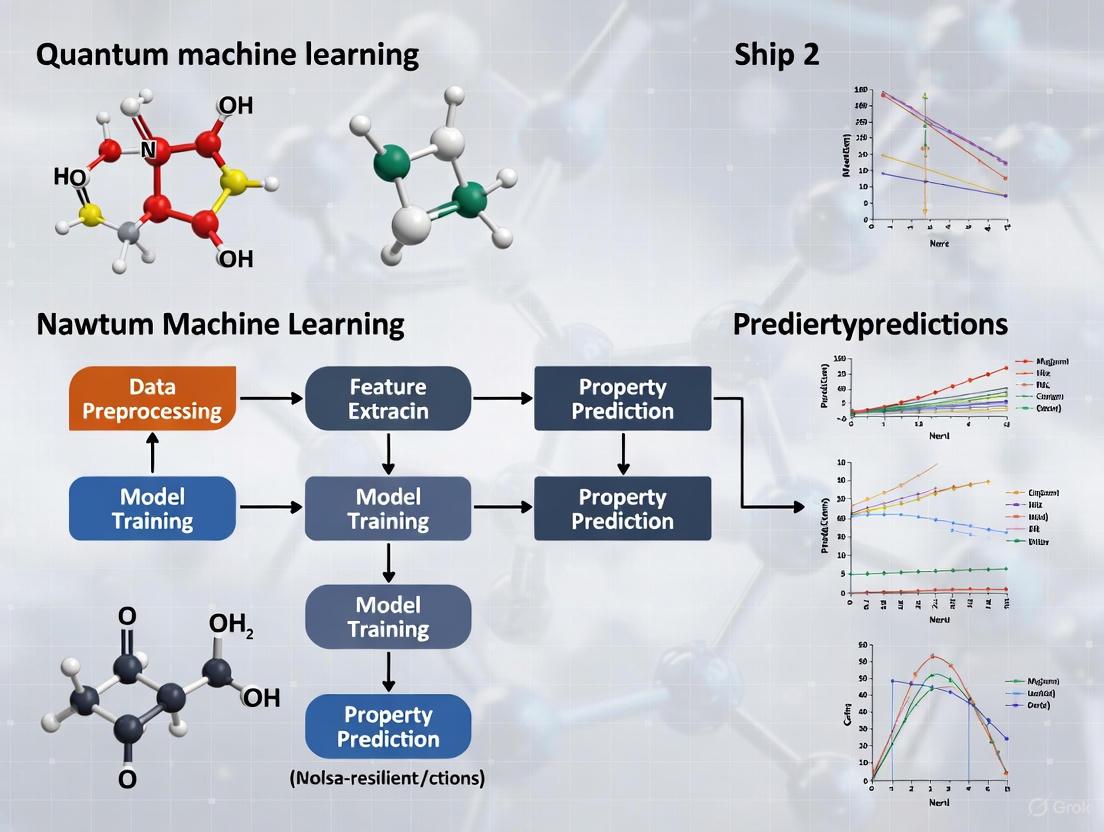
This article explores the emerging paradigm of Quantum Machine Learning (QML) for predicting chemical properties, with a specific focus on overcoming the pervasive challenge of quantum hardware noise.
Noise-Resilient Quantum Machine Learning: Predicting Chemical Properties in the NISQ Era
Abstract
This article explores the emerging paradigm of Quantum Machine Learning (QML) for predicting chemical properties, with a specific focus on overcoming the pervasive challenge of quantum hardware noise. Aimed at researchers and drug development professionals, it provides a comprehensive overview from foundational principles to practical applications. We detail how QML leverages quantum mechanics to process chemical data in exponentially large feature spaces, survey current noise-resilient algorithms and data encoding methods, and present optimization strategies for realistic, noisy quantum processors. The discussion is grounded in validation benchmarks and comparative analyses with classical machine learning, highlighting both the immediate potential and the path toward reliable, quantum-accelerated discovery in chemistry and biomedicine.
Quantum Foundations and the NISQ Challenge for Chemical Data
Core Concepts of Quantum Machine Learning in Chemistry
Quantum Machine Learning (QML) represents a transformative convergence of quantum computing and artificial intelligence, offering new paradigms for solving complex problems in chemistry. In computational chemistry, QML aims to leverage the inherent properties of quantum systems—such as superposition, entanglement, and interference—to model molecular systems and predict chemical properties with potentially greater efficiency than classical computers [1] [2] [3]. This quantum-chemical synergy is particularly valuable for simulating quantum mechanical phenomena that are computationally expensive for classical computers, such as electron interactions and molecular reactivity [4].
The operational framework of QML in chemistry typically follows a hybrid quantum-classical approach, especially on current Noisy Intermediate-Scale Quantum (NISQ) devices [3]. In this model, quantum computers handle specific tasks like data encoding and quantum state preparation, while classical computers manage optimization and parameter updates [5] [3]. This division of labor allows researchers to harness quantum advantages while mitigating the limitations of current quantum hardware, including limited qubit counts, short coherence times, and inherent operational noise [3].
Key Applications and Performance Benchmarks
Quantum machine learning demonstrates significant potential across multiple chemistry domains, from molecular property prediction to materials discovery. The table below summarizes key applications and their reported performance benchmarks.
Table 1: QML Applications in Chemistry and Performance Benchmarks
| Application Area | Specific Task | QML Approach | Reported Performance |
|---|---|---|---|
| Molecular Property Prediction | HOMO-LUMO Gap Prediction [6] | Uni-Mol+ (3D Deep Learning) | MAE = 0.0914 on PCQM4MV2 validation set [6] |
| Polymer Informatics | Glass Transition Temperature (Tg) Prediction [5] | Quantum Circuit Learning (QCL) | Coefficient of Determination (R²) improved equally on actual quantum hardware and simulator [5] |
| Materials Discovery | Battery Material Screening [1] | Quantum Chemistry + ML | 32 million options narrowed to 1 top lithium-reducing material in less than a week [1] |
| Molecular Representation | Stereoelectronic Effect Encoding [7] | Stereoelectronics-Infused Molecular Graphs (SIMGs) | Better performance than standard molecular graphs with less data [7] |
Beyond these specific applications, QML approaches are being explored in quantum chemical property prediction [6], catalyst optimization [7], and drug discovery [1], where they can potentially reduce discovery timelines from years to significantly shorter periods by providing more accurate molecular simulations and property predictions.
Noise Challenges in NISQ-Era Quantum Hardware
Current quantum computers operate in the Noisy Intermediate-Scale Quantum (NISQ) era, characterized by hardware limitations that significantly impact QML algorithm performance [3]. These constraints include:
- Limited Qubit Count: Current devices typically have 50-100 qubits, restricting algorithm complexity [3].
- Short Coherence Times: Qubits rapidly lose quantum properties due to environmental interference, limiting computation duration [3].
- Operational Noise: Various noise sources including decoherence, gate errors, and measurement errors introduce inaccuracies in computations [3].
These noise sources collectively degrade QML model performance by introducing errors in predictions, hindering optimization convergence, and potentially eliminating any quantum advantage for practical chemical applications [8] [3]. As quantum computations scale for complex chemical systems, these noise effects become increasingly problematic, necessitating robust mitigation strategies.
Noise-Resilient QML Methodologies and Protocols
Quantum Circuit Learning with Robust Optimization
For predicting polymer properties like glass transition temperature (Tg), a robust Quantum Circuit Learning protocol has been demonstrated effectively on both simulators and actual quantum hardware [5].
Table 2: Key Components of Noise-Resilient Quantum Circuit Learning
| Component | Description | Function in Noise Resilience |
|---|---|---|
| Multi-Scale Entanglement Renormalization Ansatz (MERA) | A specific quantum circuit architecture [5] | Improves prediction accuracy without increasing parameter count, reducing susceptibility to noise [5] |
| Stochastic Gradient Descent with Parameter-Shift Rule | Optimization method for training [5] | Demonstrates robustness to stochastic variations in expected values due to finite sampling [5] |
| Data Preprocessing | Principal Component Analysis + Min-Max Normalization [5] | Reduces computational complexity and adapts data for quantum circuit constraints [5] |
| Objective Function | Mean Square Error [5] | Standard loss function for regression tasks, optimized with noise-resistant techniques [5] |
Experimental Protocol:
- Data Preparation: Utilize 86 monomer-polymer property datasets generated by computational tools. Calculate 10 monomer features as explanatory variables and glass transition temperature as the target variable [5].
- Feature Engineering: Apply Principal Component Analysis to explanatory variables, retaining first four principal components. Apply min-max normalization to adapted features for quantum encoding [5].
- Quantum Encoding: Encode preprocessed features into quantum states using parameterized quantum circuits with rotation gates [5].
- Model Training: Implement stochastic gradient descent with parameter-shift rule for gradient calculation. Use MERA circuit architecture to balance expressibility and noise resilience [5].
- Validation: Evaluate model performance using coefficient of determination (R²) on both quantum simulator and actual IonQ quantum computer to verify noise resilience [5].
Learning Robust Observables
A novel approach to noise resilience focuses on learning custom observables that remain stable under noisy conditions rather than using fixed observables like Pauli matrices [8].
Experimental Protocol:
- Problem Formulation: Define the learning objective as minimizing the difference in expectation values of observables before and after noise introduction: min‖⟨O⟩−⟨O⟩̃‖², where O is the learned observable [8].
- Noise Simulation: Subject quantum states to various noise channels including depolarization, amplitude damping, phase damping, bit flip, and phase flip channels [8].
- Model Training: Train machine learning models to identify observables that demonstrate minimal deviation in expectation values across different noise conditions [8].
- Validation: Test learned observables on diverse quantum circuits including Bell state circuits, Quantum Fourier Transform circuits, and highly entangled random circuits [8].
Advanced 3D Conformation-Based Prediction
For accurate quantum chemical property prediction, the Uni-Mol+ framework leverages 3D molecular conformations with specialized noise-resilient techniques [6].
Experimental Protocol:
- Conformation Generation: Generate initial 3D conformations from molecular structures using RDKit with ETKDG method, at a cost of approximately 0.01 seconds per molecule [6].
- Conformation Refinement: Implement iterative updates of 3D coordinates toward DFT equilibrium conformation using a two-track transformer model with atom and pair representation tracks [6].
- Trajectory Sampling: During training, sample conformations from pseudo trajectories between RDKit-generated conformations and DFT equilibrium conformations using a mixture of Bernoulli and Uniform distributions [6].
- Property Prediction: Predict quantum chemical properties from the refined conformations, demonstrating significant improvements over 1D/2D molecular representation approaches [6].
Diagram 1: Hybrid quantum-classical workflow for chemical property prediction
Table 3: Essential Resources for QML in Chemistry Research
| Resource Category | Specific Tools/Frameworks | Application in QML Chemistry Research |
|---|---|---|
| Quantum Programming Frameworks | Qiskit (IBM), PennyLane (Xanadu), Cirq (Google) [3] | Provide tools for building, simulating, and running QML algorithms on real hardware and simulators [3] |
| Quantum Hardware Providers | IonQ, IBM Quantum Systems [5] | Enable real-world testing and validation of QML algorithms on actual quantum processors [5] |
| Computational Chemistry Tools | RDKit, Synthia (Materials Studio) [5] [6] | Generate molecular descriptors, 3D conformations, and reference property data for model training [5] [6] |
| Specialized Representations | Stereoelectronics-Infused Molecular Graphs (SIMGs) [7] | Incorporate quantum-chemical orbital interactions into machine learning representations [7] |
| Noise Mitigation Techniques | Zero-Noise Extrapolation, Measurement Error Mitigation, Dynamic Decoupling [3] | Improve result accuracy from noisy quantum computations without full error correction [3] |
Diagram 2: 3D conformation refinement workflow for accurate property prediction
The integration of quantum machine learning into chemical research represents a paradigm shift in molecular discovery and property prediction. Current research demonstrates that QML approaches can already provide tangible benefits in specific chemical applications, particularly when designed with noise resilience as a fundamental principle [5] [6]. The continued development of hybrid quantum-classical algorithms, advanced noise mitigation techniques, and quantum-native chemical representations will further enhance the capabilities of QML in chemistry [7] [3].
As quantum hardware continues to evolve with increasing qubit counts, longer coherence times, and improved gate fidelities, the applications of QML in chemistry will expand accordingly [2] [3]. Future directions include extending these methods to broader regions of the periodic table, applying them to complex spectroscopic characterization, and scaling to larger molecular systems such as peptides and proteins [7]. For researchers in chemistry and drug development, engaging with QML technologies now provides a pathway to develop domain-specific expertise that will become increasingly valuable as quantum computing continues to mature.
The advent of the Noisy Intermediate-Scale Quantum (NISQ) era marks a critical phase in the development of quantum computing. Coined by John Preskill, this term describes the current generation of quantum hardware, characterized by processors containing from approximately 50 to several hundred qubits that operate without full error correction [9] [10] [11]. For researchers in computational chemistry and drug development, these devices present both unprecedented opportunities and significant challenges for predicting chemical properties.
The fundamental challenge in the NISQ era lies in the delicate balance between scale and reliability. While current devices possess sufficient qubit counts to encode meaningful molecular problems, their computational fidelity is severely constrained by intrinsic physical limitations. Quantum information is exceptionally fragile, and the slightest environmental interference can disrupt calculations, leading to decoherence and operational errors that accumulate throughout quantum circuits [9] [11]. This noise sensitivity presents particular difficulties for quantum machine learning (QML) applications in chemical property prediction, where accurate energy landscape calculations require sustained quantum coherence through deep circuit structures.
Understanding these hardware limitations is not merely an engineering concern but a fundamental prerequisite for designing effective quantum computational chemistry protocols. The exponential resource requirements for error correction illustrate the magnitude of the challenge: estimates suggest that a modest 1,000 logical-qubit processor suitable for complex chemical simulations could require approximately one million physical qubits given current error rates [9]. This overhead renders full fault-tolerance impractical with contemporary technology, necessitating alternative strategies for extracting useful chemical insights from imperfect quantum computations.
Quantitative Analysis of NISQ Hardware Limitations
The performance constraints of NISQ devices can be systematically categorized and quantified across several physical and operational parameters. For chemical property prediction research, understanding these specific limitations is crucial for designing feasible experiments and setting realistic expectations for computational accuracy.
Table 1: Key NISQ Hardware Limitations and Their Impact on Chemical Computations
| Parameter | Current NISQ Specifications | Impact on Chemical Computations |
|---|---|---|
| Qubit Count | 20-5000+ physical qubits (vendor-dependent) [9] [12] | Limits molecular system size; insufficient for full error correction |
| Gate Fidelity | 99.9% for best superconducting devices; slightly lower for ions/atoms [9] | Accumulated errors limit maximum circuit depth for accurate simulation |
| Coherence Times (T1/T2) | Typically microseconds to milliseconds [13] | Constrains total algorithm execution time before quantum information decays |
| Two-Qubit Gate Error Rates | ~0.1% on best superconducting devices [9] | Critical for entanglement operations essential for molecular orbital simulations |
| Error Correction Overhead | ~1000 physical qubits per logical qubit estimated [9] [11] | Makes fault-tolerant chemical calculations impractical with current technology |
These hardware constraints directly impact the feasibility of quantum computational chemistry applications. For instance, while a quantum computer might theoretically excel at simulating molecular systems like the FeMo-cofactor of nitrogenase (a computation believed to require around 4 million qubits), current NISQ devices cannot support this scale of computation with sufficient accuracy [12]. Similarly, the limited coherence times restrict the depth of quantum circuits that can be executed before decoherence degrades the results, creating a fundamental trade-off between computational complexity and accuracy [13].
The hardware-specific error profiles further complicate algorithm design. Different qubit technologies (superconducting, trapped ions, neutral atoms) exhibit distinct error characteristics, with varying ratios of coherence limits to gate fidelities [9]. This technological diversity means that chemical computations optimized for one hardware platform may perform poorly on another, necessitating hardware-aware algorithm design tailored to specific device capabilities and limitations.
Noise and Decoherence: Fundamental Challenges for Quantum Computations
Physical Origins and Manifestations
In quantum computing for chemical applications, noise refers to any unwanted interaction that disrupts the ideal evolution of a quantum state, while decoherence specifically describes the loss of quantum coherence through environmental interactions. These phenomena represent the most significant barriers to reliable quantum computation in the NISQ era [11].
The physical origins of these limitations are rooted in the extreme sensitivity of qubits to their environment. For superconducting qubits, which operate at cryogenic temperatures, even minute thermal fluctuations or stray electromagnetic fields can cause decoherence. As noted in one analysis, "a microwave operating across the street can disrupt the quantum states, resulting in a loss of these states due to quantum decoherence" [11]. This environmental sensitivity means that maintaining qubit integrity requires extraordinary isolation measures that remain imperfect in current implementations.
The primary manifestations of these limitations include:
Gate Errors: Each fundamental quantum operation has a probability of incorrect execution. With current fidelity rates of 99.9%, a quantum circuit with thousands of gates—as required for meaningful chemical simulations—accumulates significant errors [9].
Decoherence Times (T1 and T2): The T1 time represents energy relaxation, while T2 represents phase coherence loss. Both typically range from microseconds to milliseconds in current devices, creating strict windows for computation [13].
Measurement Errors: The process of reading qubit states introduces additional inaccuracies, with error rates typically below 1% but contributing significantly to overall result uncertainty [9].
Crosstalk: Unwanted interactions between adjacent qubits during gate operations can corrupt computations, particularly in densely connected qubit architectures [10].
For chemical property prediction, these error sources manifest as inaccuracies in calculated molecular energies, incorrect geometric configurations, and unreliable reaction barrier predictions. The challenge is particularly acute for transition states and weakly-bound complexes where energy differences are small relative to computational error margins.
Impact on Quantum Machine Learning for Chemical Prediction
Quantum machine learning approaches for chemical property prediction face specific vulnerabilities to NISQ-era limitations. The barren plateaus phenomenon, where gradients in parameterized quantum circuits vanish exponentially with system size, renders many QML models untrainable under noise conditions [14] [15]. Additionally, the winner's curse statistical bias—where the lowest observed energy in variational algorithms appears better than the true value due to noise—can mislead optimization and produce incorrect chemical predictions [14].
These challenges necessitate specialized approaches for chemical applications. As demonstrated in recent research, "hybrid quantum-neural wavefunction" methods that combine quantum circuits with classical neural networks can achieve "near-chemical accuracy" while maintaining "significant resilience to noise" on superconducting quantum computers [16]. This resilience stems from distributing the computational burden across quantum and classical subsystems, leveraging the strengths of each while mitigating their respective limitations.
Hardware-Aware Algorithmic Strategies for Chemical Applications
Hybrid Quantum-Classical Approaches
The most successful strategy for practical quantum computational chemistry in the NISQ era involves hybrid quantum-classical algorithms that partition computations between quantum and classical processors. In these frameworks, the quantum computer handles specific subroutines that potentially provide quantum advantage, while classical computers manage optimization, control, and error mitigation [16] [17] [3].
The Variational Quantum Eigensolver (VQE) exemplifies this approach for chemical applications. In VQE, a parameterized quantum circuit prepares trial wavefunctions for molecular systems, while a classical optimizer adjusts parameters to minimize the energy expectation value [16] [14]. This division of labor accommodates NISQ constraints by allowing relatively short quantum circuit executions while leveraging robust classical optimization techniques.
Recent advances have demonstrated sophisticated hybrids specifically designed for chemical accuracy under noise constraints. The pUNN (paired unitary coupled-cluster with neural networks) approach employs "an efficient quantum circuit and a neural network" to learn molecular wavefunctions, achieving "near-chemical accuracy, comparable to advanced quantum and classical techniques" while demonstrating "high accuracy and significant resilience to noise" on superconducting quantum hardware [16]. This hybrid design uses quantum circuits to capture quantum phase structures—challenging for classical networks—while neural networks correct amplitudes, creating a synergistic combination that enhances noise resilience.
Table 2: Hybrid Algorithm Strategies for Chemical Property Prediction
| Algorithm Type | Key Mechanism | Advantages for NISQ Chemistry | Proven Applications |
|---|---|---|---|
| VQE (Variational Quantum Eigensolver) | Parameterized quantum circuit with classical optimization [14] | Short quantum executions; noise resilience through classical outer loop | Molecular ground state energy calculations [14] |
| Quantum Echo-State Networks (QESN) | Reservoir computing approach using quantum dynamics [13] | Naturally handles noise as part of computational model; persistent memory | Chaotic system prediction; running "100 times longer than median T1/T2 times" [13] |
| Quantum-Neural Hybrid (pUNN) | Quantum circuit for phase structure + neural network for amplitudes [16] | Complementary strengths; enhanced expressivity with noise resistance | Molecular energy computation; isomerization reaction barriers [16] |
| QAOA (Quantum Approximate Optimization Algorithm) | Alternating operator sequences for combinatorial problems [15] | Handles discrete optimization problems relevant to molecular conformation | Molecular structure optimization; portfolio optimization [15] |
Error Mitigation Techniques
Beyond algorithmic strategies, specific error mitigation techniques have been developed to extract more accurate results from noisy quantum computations without the overhead of full error correction. These techniques are particularly valuable for chemical property prediction, where small energy differences have significant chemical implications.
Zero-Noise Extrapolation (ZNE): This method involves deliberately running quantum circuits at increased noise levels (through stretched gates or identity insertions) and extrapolating results back to the zero-noise limit [9] [3]. For chemical applications, ZNE can improve energy estimates, though the sampling overhead grows with circuit size.
Measurement Error Mitigation: By characterizing the measurement error matrices for individual qubits through calibration experiments, researchers can apply classical post-processing to correct readout errors in chemical computations [3]. This is particularly effective for expectation value estimation in molecular energy calculations.
Probabilistic Error Cancellation: This advanced technique constructs quasi-probability distributions to invert specific error channels, effectively canceling out systematic errors in quantum computations [9]. While resource-intensive, it can significantly improve accuracy for critical chemical predictions.
Dynamic Decoupling: Applying carefully timed sequences of pulses to idle qubits can decouple them from environmental noise, effectively extending coherence times during quantum computations [3]. This is especially valuable for chemical simulations with inherent latency between operations.
The implementation of these techniques in chemical applications demonstrates measurable improvements. As noted in one study, error mitigation has enabled "valuable experiments" including "random circuit sampling tasks on a 103-qubit processor with 40 layers of two-qubit gates" [9], representing significant progress toward chemically relevant circuit depths.
Experimental Protocols for Noise-Characterization in Chemical Computations
Quantum Hardware Benchmarking Protocol
Before executing chemical computations on NISQ hardware, comprehensive characterization of device-specific noise profiles is essential. The following protocol provides a standardized approach for assessing hardware suitability for chemical property prediction tasks:
Basic Parameter Verification
- Confirm qubit count exceeds molecular orbital count for target chemical system
- Verify T1 and T2 coherence times exceed estimated circuit execution time
- Check native gate set compatibility with chosen quantum chemistry algorithm
Gate Fidelity Assessment
- Execute randomized benchmarking for single-qubit gate error rates
- Perform interleaved randomized benchmarking for two-qubit gate fidelities
- Characterize spatial variations in gate performance across qubit array
Connectivity and Crosstalk Evaluation
- Map hardware qubit connectivity graph against algorithm requirements
- Measure simultaneous gate operation crosstalk errors
- Identify optimal qubit subsets for chemical computation
Measurement Error Characterization
- Prepare and measure all computational basis states for error matrix construction
- Determine readout fidelity for each qubit
- Establish measurement error correlations between adjacent qubits
This characterization protocol typically requires 4-8 hours of dedicated hardware access and provides essential data for algorithm selection and parameter tuning specific to chemical applications.
Noise-Resilient VQE Implementation for Molecular Energy Calculations
For calculating molecular energies on NISQ hardware, the following protocol implements a noise-resilient Variational Quantum Eigensolver:
Diagram 1: Noise-resilient VQE workflow for molecular energy calculation
Protocol Steps:
Molecular Hamiltonian Preparation
- Perform classical Hartree-Fock calculation for molecular system
- Transform electronic Hamiltonian to qubit representation using Jordan-Wigner or Bravyi-Kitaev transformation
- Apply qubit reduction techniques (parity, tapering) to minimize qubit requirements
Ansatz Selection and Parameter Initialization
- Choose hardware-efficient ansatz compatible with device connectivity
- Initialize parameters using chemical intuition or classical approximations
- Implement parameter shift rules for gradient calculation if using gradient-based optimization
Iterative Optimization Loop
- Execute quantum circuit with current parameters (minimum 10,000 shots for statistical significance)
- Apply measurement error mitigation to expectation values
- Use robust classical optimizers (CMA-ES or iL-SHADE recommended for noisy environments) [14]
- Monitor for barren plateaus through gradient magnitude checks
Result Validation and Error Analysis
- Compare with classical methods (CCSD, DMRG) where feasible
- Estimate systematic errors through multiple protocol executions
- Report final energy with statistical confidence intervals
This protocol typically converges in 50-200 iterations depending on molecular complexity and noise conditions, with the quantum subroutine requiring 1-5 minutes per iteration on current hardware.
Table 3: Research Reagent Solutions for Quantum Computational Chemistry
| Tool/Category | Specific Examples | Function in Chemical Research |
|---|---|---|
| Quantum Programming Frameworks | Qiskit (IBM), PennyLane (Xanadu), Cirq (Google) [3] | Circuit design, noise simulation, and hardware interface for chemical algorithms |
| Classical Computational Chemistry Packages | PySCF, FermiNet, PauliNet [16] | Provide benchmarks, initial parameters, and hybrid computation components |
| Error Mitigation Modules | M3 (measurement mitigation), ZNE (zero-noise extrapolation) [3] | Improve accuracy of quantum computations without full error correction |
| Quantum Chemistry Ansätze | UCCSD, pUCCD, hardware-efficient ansätze [16] [14] | Encode molecular wavefunctions into parameterized quantum circuits |
| Classical Optimizers | CMA-ES, iL-SHADE, SPSA [14] | Robust parameter optimization resistant to noise-induced false minima |
| Molecular Datasets | PubChem Quantum Chemistry Dataset [16] | Provide benchmark systems for method validation and development |
This toolkit represents the essential software and methodological components for conducting chemical property prediction research on current NISQ devices. The integration across these domains enables the hybrid approaches necessary for extracting chemically meaningful results from noisy quantum computations.
Particularly noteworthy is the evolving synergy between classical computational chemistry methods and quantum approaches. As demonstrated in recent research, neural network quantum states (such as FermiNet and PauliNet) "demonstrate accuracy comparable to Coupled Cluster with Single and Double excitations (CCSD) but with significantly lower computational scaling" [16], making them valuable both as standalone methods and as components in hybrid quantum-classical frameworks. This interdisciplinary integration characterizes the most promising directions for NISQ-era quantum computational chemistry.
The NISQ era presents a complex landscape for quantum computational chemistry, defined by the tension between substantial theoretical potential and persistent hardware limitations. Current devices, while continuously improving, face fundamental constraints in qubit counts, coherence times, and gate fidelities that restrict their application to chemical discovery. However, through carefully designed hybrid algorithms, specialized error mitigation techniques, and hardware-aware experimental protocols, researchers can already extract chemically relevant insights from these imperfect devices.
The path forward involves continued co-design of algorithmic and hardware solutions, with particular emphasis on error-resilient approaches that can bridge the gap between current capabilities and future fault-tolerant systems. As hardware progresses through what researchers term the "megaquop, gigaquop, and teraquop eras" [9], each stage will unlock new opportunities for chemical prediction. The most immediate applications will likely focus on specific subproblems where quantum approaches offer clear advantages, such as strongly correlated electron systems and reaction dynamics involving conical intersections.
For researchers in drug development and chemical design, engagement with NISQ-era quantum computing requires realistic assessment of both capabilities and limitations. While transformative applications remain years away, the current period offers valuable opportunities for methodology development, benchmark establishment, and preliminary exploration of quantum advantage in specific chemical contexts. By understanding and working within current hardware constraints, the chemical research community can position itself to fully leverage quantum computational power as hardware capabilities continue their steady advancement toward fault-tolerant quantum computing.
The emerging field of quantum machine learning (QML) holds significant promise for advancing computational chemistry, potentially revolutionizing areas such as drug discovery and materials science by providing accelerated and more accurate predictions of molecular properties [18] [19]. A central challenge in this domain, often termed "The Data Problem," is the effective encoding of classical molecular information into quantum states that can be processed by quantum algorithms. The chosen encoding scheme directly impacts the resource requirements on near-term intermediate-scale quantum (NISQ) hardware, the model's resilience to noise, and its ultimate predictive performance [18] [19]. This document provides application notes and detailed protocols for prevalent molecular encoding strategies, contextualized within research aimed at achieving noise-resilient chemical property prediction.
Molecular Encoding Schemes: A Comparative Analysis
Molecular encoding, or featurization, transforms a molecule's structure into a fixed-dimensional representation suitable for computational models. The following table summarizes the core characteristics of major encoding approaches relevant to QML.
Table 1: Comparative Analysis of Molecular Encoding Methods for QML
| Encoding Method | Core Principle | Key Advantages | Key Limitations | Notable Implementations/Frameworks |
|---|---|---|---|---|
| Quantum Molecular Structure Encoding (QMSE) [18] [19] | Encodes a hybrid Coulomb-adjacency matrix directly as parameterized one- and two-qubit rotation gates. | High interpretability; Improved state separability; Shallow, hardware-efficient circuits; Scalable via chain contraction. | Requires classical pre-computation of matrix; Circuit structure depends on molecular size. | Custom implementation based on literature specifications. |
| Fingerprint / Angle Encoding [19] | Maps a fixed-length molecular fingerprint (e.g., RDKit fingerprint) to qubit rotation angles. | Simple and widely applicable; Low qubit requirement with amplitude encoding. | Poor state separation; High circuit depth for amplitude encoding; Can lead to barren plateaus. | Built into most QML software stacks (Qiskit, Pennylane). |
| Classical Learnable Representations [20] | Uses neural networks (e.g., Graph Neural Networks) to learn optimal molecular representations from data. | Powerful performance on many benchmarks; Automates feature engineering. | Struggles with data scarcity; Can be a "black box"; High computational cost for training. | DeepChem [20], MoleculeNet [20]. |
| 3D Conformation-Aware Encoding [21] | Utilizes the 3D equilibrium geometry of a molecule as input, often refined towards DFT-quality structures. | High accuracy for quantum chemical properties; Physically grounded. | Computationally expensive to generate 3D conformations; Sensitive to conformational noise. | Uni-Mol+ [21]. |
Detailed Experimental Protocols
Protocol 1: Implementing Quantum Molecular Structure Encoding (QMSE)
This protocol details the steps to implement the QMSE scheme, which has demonstrated superior state separability and noise resilience for molecular classification and regression tasks [18] [19].
I. Research Reagent Solutions
Table 2: Essential Materials for QMSE Implementation
| Item | Function/Description | Example Source/Implementation |
|---|---|---|
| Molecular Structure File | Input data; typically a SMILES string or .mol file. | PubChem Database, RDKit |
| RDKit Chemistry Library | Open-source toolkit for generating molecular graphs, bond orders, and initial 3D conformations. | https://www.rdkit.org |
| Hybrid Coulomb-Adjacency Matrix | A custom matrix combining topological and electronic structure information for encoding. | Calculated via custom script (see Step II.2). |
| Quantum Simulator/Hardware | Platform to execute the parameterized quantum circuit. | IBM Qiskit, Google Cirq, Amazon Braket |
| Parameterized Quantum Circuit (PQC) | A quantum circuit with tunable parameters for the machine learning task. | Custom ansatz using QMSE feature map. |
II. Step-by-Step Procedure
Molecular Input and Pre-processing:
- Begin with a SMILES string representation of the target molecule (e.g., Ethanol: "CCO").
- Use the RDKit library to parse the SMILES string, generate a 2D molecular graph, and assign bond orders. Generate an initial 3D conformation using RDKit's ETKDG method.
Construct the Hybrid Coulomb-Adjacency Matrix (H):
- The matrix H is defined for a molecule with N atoms.
- The diagonal elements Hᵢᵢ represent the atomic number or other atomic property of the i-th atom.
- The off-diagonal elements Hᵢⱼ for i ≠j are a function of the bond order BOᵢⱼ and the interatomic Coulomb potential: Hᵢⱼ = BOᵢⱼ / |rᵢ - rⱼ|, where |rᵢ - rⱼ| is the Euclidean distance between atoms i and j in the generated 3D conformation.
- This matrix directly encapsulates the molecule's unique chemical identity.
Map Matrix to Quantum Circuit:
- The elements of H are normalized and used as parameters for rotation gates.
- Single-qubit rotations: The normalized diagonal elements of H are used as angles for R_y or R_z rotations on qubits representing each atom.
- Two-qubit entangling gates: The normalized off-diagonal elements Hᵢⱼ are used as angles for parameterized two-qubit interaction gates (e.g., R_{XX} or R_{ZZ}) between qubits i and j, creating entanglement that reflects molecular connectivity.
Integrate into a QML Workflow:
- The resulting parameterized circuit serves as the data-encoding layer (feature map) for a downstream QML model, such as a Variational Quantum Classifier or a Quantum Neural Network.
- Train the model by adjusting the parameters of a subsequent variational ansatz to minimize a loss function (e.g., mean-squared error for property prediction).
Diagram 1: QMSE encoding workflow.
Protocol 2: Hybrid Quantum-Neural Wavefunction for Molecular Energy Calculation
This protocol outlines the procedure for using a hybrid quantum-neural network, specifically the pUNN method, to achieve noise-resilient and accurate prediction of molecular energies [16].
I. Research Reagent Solutions
Table 3: Essential Materials for pUNN Implementation
| Item | Function/Description | Example Source/Implementation |
|---|---|---|
| Molecular Hamiltonian | The quantum mechanical operator representing the system's energy; defines the problem. | Generated via PySCF or OpenFermion. |
| pUCCD Ansatz Circuit | A shallow, paired unitary coupled-cluster ansatz that captures correlation in the seniority-zero subspace. | Custom circuit built with quantum computing framework. |
| Classical Neural Network | A feed-forward network that corrects amplitudes for configurations outside the seniority-zero subspace. | PyTorch, TensorFlow with ~2KN neurons/layer. |
| Quantum Computer/Simulator | To execute the pUCCD circuit and measure expectations. | Noisy quantum simulator or real NISQ hardware. |
II. Step-by-Step Procedure
System Setup and Hamiltonian Generation:
- Define the molecular geometry (e.g., Nâ‚‚ or cyclobutadiene) and basis set.
- Use a classical quantum chemistry package (e.g., PySCF) to generate the second-quantized electronic Hamiltonian in terms of Pauli operators via the Jordan-Wigner or Bravyi-Kitaev transformation.
Prepare the Hybrid Quantum-Neural Wavefunction (pUNN):
- Quantum Circuit (pUCCD): Construct and initialize the pUCCD ansatz on N qubits. This circuit is responsible for learning the phase structure within the seniority-zero subspace.
- Hilbert Space Expansion: Add N ancilla qubits, initialized to |0⟩. Apply a shallow perturbation circuit (e.g., small-angle R_y rotations) to these ancillas.
- Entanglement: Apply a layer of CNOT gates, entangling each original qubit with its corresponding ancilla. This creates a state in a 2N-qubit Hilbert space.
- Neural Network Operator: Apply a classical neural network as a non-unitary post-processing operator. The NN takes the bitstring |k⟩ ⊗ |j⟩ (from the original and ancilla registers) as input and outputs a coefficient b_{kj}, modulated by a particle-number-conserving mask.
Compute the Energy Expectation Value:
- The energy is calculated as E = ⟨Ψ|Ĥ|Ψ⟩ / ⟨Ψ|Ψ⟩, where |Ψ⟩ is the full hybrid wavefunction.
- The measurement protocol is designed to compute these expectations efficiently without full quantum state tomography, by leveraging the structure of the pUCCD ansatz and the classical NN [16].
Joint Optimization:
- The parameters of both the quantum circuit (pUCCD) and the classical neural network are optimized simultaneously using a classical optimizer (e.g., Adam or L-BFGS) to minimize the energy expectation value E.
Diagram 2: Hybrid pUNN architecture.
Benchmarking and Validation
To ensure the validity and performance of any encoding scheme or QML model, rigorous benchmarking on standardized datasets is essential.
Recommended Benchmark Datasets:
- MoleculeNet: A large-scale benchmark collection encompassing multiple public datasets for molecular machine learning, including quantum mechanics (e.g., QM9), physical chemistry (e.g., ESOL), and biophysics tasks [20]. It provides standardized data splits and metrics.
- PubChemQCR: A large-scale dataset of molecular relaxation trajectories, useful for benchmarking methods that predict energies and forces on non-equilibrium geometries [22].
- PCQM4MV2: A dataset of ~4 million molecules for HOMO-LUMO gap prediction, commonly used to benchmark 3D conformation-aware models [21].
Evaluation Metrics:
- Regression Tasks (Energy Prediction): Mean Absolute Error (MAE), Root Mean Squared Error (RMSE).
- Classification Tasks (Phase Prediction): Accuracy, AUC-ROC.
- Quantum-Specific Metrics: Circuit depth, number of qubits, susceptibility to noise (e.g., performance drop under noise simulation).
The application of quantum machine learning (QML) to chemical property prediction represents a paradigm shift in computational chemistry and drug discovery. At the core of this transformation lie two fundamental quantum mechanical properties: superposition and entanglement. These properties enable quantum computers to map chemical data into feature spaces that are computationally intractable for classical systems. In the context of noise-resilient chemical property prediction, understanding and harnessing these advantages is crucial for developing next-generation QML models that can operate effectively on current noisy intermediate-scale quantum (NISQ) devices. This application note details the theoretical foundations, practical implementations, and experimental protocols for leveraging superposition and entanglement in chemical feature mapping, with specific emphasis on creating robust models for predicting molecular properties despite hardware limitations.
Quantum feature mapping refers to the process of encoding classical chemical data (such as molecular structures or electronic properties) into quantum states through carefully designed quantum circuits. Unlike classical encoding methods, quantum feature maps can exploit the exponentially large Hilbert space available to quantum systems, enabling the detection of complex, non-linear relationships in chemical data that often challenge classical machine learning approaches. The unique advantage of quantum feature mapping stems from the inherent parallel processing capabilities of superposition states and the rich correlation structures enabled by entanglement, which together facilitate more expressive representations of chemical systems.
Theoretical Framework: Superposition and Entanglement in Feature Mapping
The Superposition Advantage in Chemical Space Exploration
Quantum superposition allows a qubit to exist in multiple states simultaneously, unlike classical bits that are confined to definite 0 or 1 states. This property provides quantum systems with innate parallel processing capabilities that are particularly advantageous for exploring complex chemical spaces. When applied to chemical feature mapping, superposition enables the simultaneous representation of multiple molecular configurations, structural features, or electronic states within a single quantum state.
Mathematically, a single qubit in superposition can be represented as (|\psi\rangle = \alpha|0\rangle + \beta|1\rangle), where (\alpha) and (\beta) are complex probability amplitudes satisfying (|\alpha|^2 + |\beta|^2 = 1). For a system of (n) qubits, this generalizes to a superposition of (2^n) basis states, creating an exponentially large state space for representing chemical information. This exponential scaling provides a theoretical foundation for efficiently handling the vast complexity of chemical space, which is estimated to contain approximately (10^{60}) drug-like molecules [23].
In practical chemical applications, superposition enables quantum models to evaluate multiple molecular configurations or reaction pathways simultaneously. For instance, when predicting molecular properties, a quantum feature map can encode numerous structural motifs or electronic configurations in parallel, allowing the model to capture complex structure-property relationships that might be obscured in classical feature representations. This capability is particularly valuable for exploring undruggable protein targets, where conventional methods have failed to identify viable molecular binders [23].
The Entanglement Advantage in Capturing Molecular Correlations
Quantum entanglement creates non-classical correlations between qubits, where the quantum state of each qubit cannot be described independently of the others. This property enables the representation of complex, multi-body interactions that are ubiquitous in chemical systems, such as electron correlations in molecular bonds, non-covalent interactions in protein-ligand complexes, and collective motions in molecular dynamics.
For feature mapping, entanglement creates distributed representations of chemical features that capture intrinsic dependencies within molecular systems. For example, entangled states can simultaneously encode information about a molecule's electronic structure, steric constraints, and pharmacophoric features in a correlated manner that reflects their physical interdependence. This stands in contrast to classical feature representations that often struggle to capture such multi-scale, correlated relationships without explicit engineering.
The enhancement provided by entanglement can be quantified through precision gains in sensing applications. Research has demonstrated that compared to a single qubit in superposition, 100 unentangled qubits would be 10 times more sensitive, while 100 entangled qubits would be 100 times as sensitive [24]. This order-of-magnitude improvement directly translates to enhanced capability in detecting subtle patterns in chemical data, such as minor structural modifications that significantly alter biological activity or molecular properties.
Table 1: Quantitative Advantages of Quantum Feature Mapping
| Quantum Property | Classical Challenge | Quantum Advantage | Impact on Chemical Prediction |
|---|---|---|---|
| Superposition | Limited parallel processing for chemical space exploration | Simultaneous evaluation of ~$2^n$ molecular states | Enables comprehensive exploration of ~$10^{60}$ molecule chemical space [23] |
| Entanglement | Difficulty capturing multi-body correlations in molecular systems | Creates non-classical correlations between molecular features | Enhances sensitivity 10x over unentangled systems for 100 qubits [24] |
| Coherent Interference | Manual feature engineering for complex structure-property relationships | Constructive/destructive interference amplifies relevant features | Improves prediction accuracy for experimental chemical properties [25] |
Quantum Feature Mapping in Chemical Applications
Implementation Architectures for Chemical Property Prediction
Multiple quantum computing architectures have been developed to implement feature mapping for chemical property prediction, each with distinct advantages for handling molecular data:
Parametrized Quantum Circuits (PQCs) combine fixed encoding layers with tunable variational layers to transform classical chemical representations into quantum feature spaces. These hybrid quantum-classical models have demonstrated promising results for predicting bond separation energies (BSE49 dataset) and reconstructing coupled-cluster wavefunctions for water conformers [26]. The encoding layers map classical feature vectors (such as molecular fingerprints or quantum chemical descriptors) onto quantum states, while the variational layers with optimized parameters perform the actual feature transformation tailored to specific prediction tasks.
Quantum Convolutional Neural Networks (QCNNs) implement a hierarchical structure inspired by classical CNNs but leverage quantum entanglement for feature detection. Unlike classical convolution that operates on spatial neighborhoods, QCNNs perform convolution through entangling operations between qubits, followed by pooling operations that reduce qubit count while preserving essential features [27]. This architecture is particularly suited for detecting multi-scale patterns in molecular data, such as hierarchical structural motifs that influence compound properties.
Quantum Neural Networks (QNNs) with error mitigation techniques address the critical challenge of noise in NISQ devices. Approaches such as Zero-Noise Knowledge Distillation (ZNKD) use a teacher-student framework where a noise-resistant teacher model (enhanced with zero-noise extrapolation) trains a compact student model for deployment [28]. This methodology has demonstrated robust performance across various datasets while maintaining hardware efficiency, making it particularly valuable for chemical property prediction where training data may be limited.
Application-Specific Feature Mapping Strategies
Different chemical prediction tasks require specialized feature mapping approaches to effectively capture relevant aspects of molecular systems:
For electronic property prediction, quantum feature maps often encode electron correlation patterns directly into entangled states. This approach has shown promise for predicting ground state energies of complex molecules like cytochrome P450 enzymes and FeMoco, with recent resource estimates suggesting that fault-tolerant quantum computers could require as few as 99,000 physical qubits for such simulations [29]. The feature mapping in these applications explicitly represents electron interactions through carefully designed entanglement structures that mirror the correlation patterns in molecular systems.
For molecular generative design, hybrid quantum-classical models combine quantum circuit Born machines (QCBM) with classical long short-term memory (LSTM) networks to explore chemical space for drug discovery. In one implementation targeting the previously undruggable KRAS protein for cancer therapy, the QCBM generates initial molecular fragments that serve as starting points for the classical LSTM model to build upon [23]. The quantum component provides diverse, novel molecular foundations that enhance the exploration capabilities of the overall generative system.
For small dataset learning, quantum circuit learning (QCL) leverages the inherent expressivity of quantum systems to achieve accurate predictions from limited chemical data. Research has demonstrated that QCL can process both linear and smooth non-linear functions from small datasets (<100 records) while outperforming conventional algorithms like random forest, support vector machine, and linear regressions for certain chemical prediction tasks [25]. This capability is particularly valuable in chemical domains where experimental data is scarce or expensive to acquire.
Table 2: Quantum Feature Mapping Methods for Chemical Applications
| Method | Key Mechanism | Chemical Application Examples | Performance Highlights |
|---|---|---|---|
| Parametrized Quantum Circuits (PQCs) [26] | Combination of encoding and variational layers | Bond separation energy prediction, Wavefunction reconstruction | Comprehensive evaluation of 168 PQC variants on chemical datasets |
| Quantum Circuit Learning (QCL) [25] | Regression via quantum circuit sampling | Toxicity prediction, Experimental property estimation | Superior prediction from small datasets (<100 records) vs. classical models |
| Hybrid Quantum-Classical Generative Models [23] | Quantum circuit Born machine with classical LSTM | Molecular generation for undruggable targets (KRAS protein) | Exploration of vast chemical space (~$10^{60}$ molecules) |
| Quantum Neural Networks (QNNs) with ZNKD [28] | Teacher-student distillation with noise mitigation | Noise-resilient chemical property prediction | Maintains within 2-4% accuracy of teacher model with 6:2-8:3 compression |
Experimental Protocols: Implementing Quantum Feature Mapping
Protocol: Quantum Feature Mapping for Molecular Property Prediction
This protocol details the implementation of a parametrized quantum circuit for predicting experimental chemical properties from molecular structure data, based on established methodologies [25] [26].
Research Reagent Solutions and Computational Tools
Table 3: Essential Research Tools for Quantum Feature Mapping
| Tool/Category | Specific Examples | Function in Quantum Feature Mapping |
|---|---|---|
| Quantum Programming Frameworks | PennyLane [26], Qiskit [26] | Construct and simulate parametrized quantum circuits |
| Chemical Informatics Tools | RDKit (for MACCS, Morgan fingerprints) [26] | Generate classical molecular representations for encoding |
| Quantum Simulators | State-vector simulators, "Fake" backends [26] | Test circuits in ideal and noisy conditions before hardware deployment |
| Optimization Libraries | Classical optimizers (e.g., Adam, SPSA) | Optimize variational parameters in hybrid quantum-classical models |
Step-by-Step Procedure
Molecular Data Preparation and Feature Engineering
- Select a chemical dataset with associated experimental properties (e.g., toxicity, solubility, energy values)
- Generate molecular representations using classical chemical informatics methods:
- Normalize all feature values to the range [-1, 1] for compatibility with quantum encoding schemes
Quantum Circuit Design and Feature Encoding
- Select an appropriate number of qubits based on feature dimensionality and hardware constraints
- Choose a feature encoding strategy from established approaches:
- Implement the encoding unitary operation (U{\Phi(\mathbf{x})}) that maps classical feature vector (\mathbf{x}) to quantum state (U{\Phi(\mathbf{x})}|0\rangle^{\otimes n})
Variational Circuit Optimization
- Design a variational ansatz (U(\theta)) with parameterized gates following the encoding layer
- Select an entanglement structure that matches the correlation patterns expected in the chemical data:
- Linear entanglement: Sequential entanglement between adjacent qubits
- Full entanglement: All-to-all connectivity for maximum correlation capacity
- Initialize parameters (\theta) randomly or using strategic initialization schemes
Measurement and Objective Definition
- Select a subset of qubits for measurement (typically 1-2 qubits for regression tasks)
- Define the measurement observable (M) (often Pauli-Z operator on target qubits)
- Calculate the expectation value (\langle M \rangle = \langle 0|U^{\dagger}(\theta)U{\Phi(\mathbf{x})}^{\dagger} M U{\Phi(\mathbf{x})}U(\theta)|0\rangle)
- Establish the loss function between predicted and actual chemical properties (typically mean squared error)
Hybrid Optimization Loop
- Execute the quantum circuit to obtain property predictions
- Compute the loss function comparing predictions to experimental values
- Use classical optimization to update variational parameters (\theta)
- Iterate until convergence or predetermined stopping criteria
Protocol: Noise Resilience Enhancement for Quantum Feature Maps
This protocol addresses the critical challenge of noise in NISQ devices by implementing error mitigation strategies specifically tailored for chemical property prediction tasks [24] [27] [28].
Step-by-Step Procedure
Noise Characterization and Modeling
- Profile target quantum hardware or simulator to identify dominant noise channels:
- Phase damping and amplitude damping noise
- Depolarizing noise
- Bit-flip and phase-flip errors
- Quantify error rates for single and two-qubit gates
- Establish baseline performance without error mitigation
- Profile target quantum hardware or simulator to identify dominant noise channels:
Partial Quantum Error Correction Implementation
- Design entanglement-based sensors with inherent noise tolerance
- Apply quantum error correction codes selectively rather than comprehensively
- Balance error correction intensity against sensitivity preservation
- Configure systems to correct only dominant error patterns rather than all possible errors [24]
Zero-Noise Knowledge Distillation (ZNKD)
- Implement teacher-student framework with ZNKD [28]
- Construct teacher model enhanced with zero-noise extrapolation (ZNE)
- Run circuits at scaled noise levels (1x, 3x, 5x base noise through unitary folding)
- Extrapolate to zero-noise limit to generate training labels
- Train compact student model to replicate teacher's noise-free predictions
- Deploy student model for inference without runtime extrapolation overhead
Noise-Aware Circuit Architecture Selection
- Evaluate different quantum neural network architectures for noise robustness:
- Quantum Convolutional Neural Networks (QCNN)
- Quanvolutional Neural Networks (QuanNN)
- Quantum Transfer Learning (QTL)
- Select architecture demonstrating optimal noise resilience for specific chemical prediction task [27]
- Optimize circuit depth to balance expressivity and noise susceptibility
- Evaluate different quantum neural network architectures for noise robustness:
Robustness Validation and Performance Benchmarking
- Test optimized model under simulated noise conditions matching target hardware
- Compare performance against classical baselines and unmitigated quantum models
- Validate on held-out chemical datasets to ensure generalization
- Quantize robustness improvement through metrics like noise-induced accuracy degradation
Emerging Applications and Future Directions
Quantum feature mapping using superposition and entanglement continues to evolve with several promising directions for chemical property prediction. Hardware-efficient feature maps tailored to specific qubit technologies (such as cat qubits [29]) show potential for reducing physical resource requirements while maintaining expressivity. Multi-modal feature encoding strategies that combine different types of molecular representations (structural, electronic, and physicochemical) through specialized quantum circuits may enhance model performance for complex prediction tasks. Federated quantum learning approaches that distribute feature mapping across multiple quantum processors while preserving data privacy represent an emerging paradigm for collaborative drug discovery efforts.
The integration of quantum feature mapping with classical machine learning architectures continues to yield practical benefits even within the constraints of NISQ devices. As quantum hardware advances toward fault tolerance, the unique advantages of superposition and entanglement for chemical feature representation are expected to play an increasingly central role in accelerating drug discovery and materials design.
The pursuit of practical quantum machine learning (QML) for chemical property prediction is currently constrained by a formidable obstacle: quantum noise. In the Noisy Intermediate-Scale Quantum (NISQ) era, quantum processing units are inherently affected by various sources of noise that fundamentally limit their computational utility [30] [31]. These limitations are particularly acute for applications in chemical and drug discovery, where predicting molecular properties with high accuracy could potentially revolutionize materials design and pharmaceutical development [32] [33]. While classical machine learning has demonstrated effectiveness in molecular property prediction, the theoretical promise of QML offers the prospect of exponential speed-ups and enhanced pattern recognition capabilities for navigating complex chemical spaces [34] [33]. However, current quantum hardware suffers from gate errors, decoherence, and imprecise readouts that drastically restrict the circuit depth and qubit count that can be reliably executed [30]. As quantum circuits become deeper to handle complex chemical structures, the cumulative noise often overwhelms the signal, creating a critical barrier that must be understood and addressed before practical applications can be realized.
Quantum noise in NISQ devices manifests through several distinct physical mechanisms, each with characteristic effects on quantum information processing. Understanding these fundamental sources is essential for developing effective mitigation strategies for chemical property prediction.
Primary Quantum Noise Channels
Table 1: Fundamental Noise Channels in NISQ Devices and Their Effects
| Noise Channel | Physical Cause | Effect on Quantum State | Impact on Chemical Prediction | ||
|---|---|---|---|---|---|
| Amplitude Damping | Energy dissipation to environment | Loss of excited state population | Incorrect molecular energy calculations | ||
| Phase Damping | Elastic scattering without energy loss | Loss of quantum phase information | Destruction of interference patterns crucial for quantum algorithms | ||
| Depolarizing Noise | Randomizing interactions with environment | Complete mixing of state with maximally mixed state | General loss of quantum features in molecular simulations | ||
| Bit Flip | Classical bit errors in computation basis | Interchange of | 0⟩ and | 1⟩ states | Corruption of encoded molecular descriptor data |
| Phase Flip | Classical phase errors | Introduction of relative phase of -1 | Disruption of coherent superpositions in quantum feature maps |
Hardware Limitations and Coherence Constraints
The practical execution of QML algorithms is constrained by fundamental hardware limitations. Current NISQ devices typically have limited qubit counts (50-100) and suffer from decoherence processes characterized by T1 (energy relaxation time) and T2 (dephasing time) parameters [30] [35]. These limitations drastically restrict the circuit depth that can be reliably executed before quantum information is lost. For chemical property prediction, this translates to an inability to simulate complex molecular systems with sufficient accuracy, as the cumulative noise across deep quantum circuits required for complex chemical transformations often overwhelms the signal of interest [30]. The thermal relaxation channel â„°thermal, which models T1 and T2 processes during gate operations, combines with depolarizing noise â„°depol in comprehensive noise models, where the depolarizing error probability is calibrated to match experimentally characterized gate error rates [35].
Quantitative Analysis of Noise Impact on QML Performance
Rigorous evaluation of noise effects on quantum neural networks reveals significant performance degradation across various architectures and tasks. The following comparative analysis quantifies these impacts specifically for classification tasks relevant to chemical property prediction.
Performance Degradation Across QML Architectures
Table 2: Comparative Performance of Quantum Neural Network Architectures Under Various Noise Conditions
| QML Architecture | Noise-Free Accuracy | Depolarizing Noise (p=0.05) | Amplitude Damping | Phase Damping | Best Noise Resilience |
|---|---|---|---|---|---|
| Quanvolutional Neural Network | 85.2% | 72.1% | 68.3% | 70.5% | Phase Damping |
| Quantum Convolutional Neural Network | 78.5% | 55.3% | 51.2% | 53.7% | Phase Damping |
| Quantum Transfer Learning | 82.7% | 65.8% | 62.1% | 64.2% | Phase Damping |
| Variational Quantum Circuit | 80.3% | 58.7% | 54.9% | 57.1% | Phase Damping |
Recent comprehensive studies evaluating hybrid quantum-classical neural networks (HQNNs) for image classification tasks provide crucial insights into noise resilience that directly inform chemical prediction applications [27]. The research reveals that Quanvolutional Neural Networks (QuanNN) demonstrate superior robustness across multiple quantum noise channels compared to other architectures, maintaining approximately 72% of their original accuracy under depolarizing noise conditions (p=0.05), while Quantum Convolutional Neural Networks (QCNN) retain only about 70% of their performance [27]. This resilience differential becomes critically important when processing complex molecular descriptors where faithful feature extraction is essential for accurate property prediction.
Resource Overhead and Scalability Challenges
The impact of noise escalates dramatically with increasing circuit complexity and qubit count. Theoretical bounds indicate that the generalization error of a QML model scales approximately as √(T/N), where T is the number of trainable gates and N is the number of training examples [30]. In the presence of noise, the number of samples required for successful optimization may grow super-exponentially, creating fundamental scalability barriers for practical applications in chemical discovery [30]. Error mitigation strategies necessary to counteract these effects typically impose significant resource overhead, with some methods requiring up to 2×10^5 shots to obtain a factor of 10 improvement over unmitigated results [36]. For large-scale chemical space exploration involving thousands of candidate molecules, this overhead becomes prohibitive, particularly when compared to classical graph neural networks that can efficiently handle multi-task molecular property prediction even with limited data [34].
Experimental Protocols for Noise Characterization and Mitigation
Protocol 1: Quantum Noise Modeling via Machine Learning
Accurate noise modeling is a prerequisite for effective mitigation in chemical property prediction pipelines. The following protocol enables data-efficient characterization of device-specific noise parameters:
Initialization: Construct a parameterized noise model ð’©(ðœ½) that incorporates amplitude damping, phase damping, and depolarizing channels with learnable parameters 𜽠[35].
Data Collection: Execute a diverse set of benchmark circuits (4-6 qubits) on the target quantum processor, focusing on circuit structures relevant to chemical feature mapping, such as those encoding molecular descriptors [35].
Classical Optimization: Employ machine learning techniques to optimize parameters ðœ½* by minimizing the Hellinger distance between simulated and experimental output distributions using classical computing resources [35].
Validation: Test the refined noise model on larger validation circuits (7-9 qubits) to verify predictive accuracy for scalable chemical applications [35].
Integration: Incorporate the validated noise model into noise-aware compilers to optimize qubit mapping, gate decomposition, and error mitigation strategies specifically for molecular property prediction circuits.
This approach has demonstrated up to 65% improvement in model fidelity compared to standard noise models derived from basic device properties, enabling more accurate simulation of quantum circuits for chemical prediction tasks [35].
Figure 1: Experimental workflow for data-efficient quantum noise modeling using machine learning techniques.
Protocol 2: Noise Resilience Evaluation for Quantum Neural Networks
Systematic evaluation of QML architecture resilience is essential for selecting appropriate models for chemical prediction tasks:
Baseline Establishment: Train target QML architectures (QuanNN, QCNN, QTL) on molecular descriptor datasets under ideal (noise-free) simulation conditions to establish baseline performance metrics [27].
Controlled Noise Injection: Introduce specific quantum noise channels (Phase Flip, Bit Flip, Phase Damping, Amplitude Damping, Depolarization) at progressively increasing probability levels (0.01-0.20) during inference [27].
Performance Monitoring: Track accuracy, fidelity, and convergence metrics across 10 independent runs for each noise condition to ensure statistical significance [27].
Architecture Comparison: Compute relative performance degradation for each architecture and identify optimal models for specific noise environments encountered in target quantum hardware [27].
Hyperparameter Optimization: Fine-tune circuit depth, entanglement patterns, and error mitigation strategies to maximize noise resilience while maintaining expressibility for chemical feature extraction.
This protocol has revealed that QuanNN architectures generally exhibit superior robustness across multiple quantum noise channels, making them promising candidates for noisy chemical prediction applications on current quantum hardware [27].
Table 3: Research Reagent Solutions for Noise-Resilient Quantum Chemical Prediction
| Resource Category | Specific Tools/Techniques | Function in Noise Resilience | Application Context |
|---|---|---|---|
| Error Mitigation Frameworks | Clifford Data Regression (CDR), Zero-Noise Extrapolation (ZNE) | Reduce algorithmic errors without physical qubit overhead | Post-processing of quantum chemical computations |
| Noise Characterization Tools | Process Tomography, Gate Set Tomography, Randomized Benchmarking | Quantify and characterize specific noise channels | Device calibration and noise model parameterization |
| Hybrid Quantum-Classical Algorithms | Variational Quantum Eigensolver (VQE), Quantum Natural Language Processing (QNLP) | Distribute computational load, leverage classical resilience | Molecular energy calculation, Structure-property mapping |
| Quantum Neural Network Architectures | Quanvolutional Neural Networks (QuanNN), Quantum Transfer Learning (QTL) | Intrinsic architectural resistance to specific noise types | Pattern recognition in chemical space, Molecular classification |
| Software Development Kits | Qiskit, TKET, Munich Quantum Toolkit | Noise-aware compilation, Circuit optimization | Algorithm design and implementation |
Emerging Strategies: Turning Noise from Obstacle to Opportunity
Recent research has revealed that quantum noise, while generally detrimental, may be harnessed under specific conditions to enhance learning dynamics. The phenomenon of Noise-Induced Equalization (NIE) demonstrates that modest noise levels can increase the relevance of less influential parameters in quantum neural networks, creating a more uniform optimization landscape that potentially improves generalization capabilities [31]. This effect can be quantified through spectral analysis of the Quantum Fisher Information Matrix (QFIM), where optimal noise levels p* induce the strongest equalization without triggering noise-induced barren plateaus [31]. Similarly, studies on quantum reinforcement learning have demonstrated that carefully tuned amplitude and phase damping noise can sometimes improve algorithm performance rather than purely degrading it [37]. These counterintuitive findings suggest a paradigm shift from unconditional noise suppression to strategic noise management, particularly relevant for chemical property prediction where optimal generalization to novel molecular structures is paramount.
Figure 2: Conceptual relationship between quantum noise levels and model generalization performance, highlighting the optimal zone for noise-enhanced learning.
The critical barrier posed by quantum noise in practical chemical property prediction necessitates a multifaceted approach combining noise-aware algorithms, advanced error mitigation, and strategic hardware utilization. While significant challenges remain in achieving quantum advantage for real-world chemical discovery applications, recent advances in noise characterization, model resilience, and error mitigation provide promising pathways forward. The research community must continue to develop specialized quantum architectures like QuanNN that demonstrate inherent noise resilience, refine resource-efficient error mitigation techniques like enhanced Clifford data regression that reduces shot requirements by an order of magnitude [36], and explore novel paradigms that strategically leverage noise phenomena to enhance learning. For researchers and drug development professionals, the current landscape suggests a pragmatic approach of targeting specific chemical prediction tasks where current NISQ devices offer complementary capabilities rather than outright superiority over classical methods, while steadily building the foundational knowledge and technical capabilities needed for more transformative impacts as quantum hardware continues to evolve.
Building Noise-Aware QML Models for Chemical Property Prediction
The accurate prediction of chemical properties is a cornerstone of modern drug discovery and materials science. Traditional computational methods, such as Density Functional Theory (DFT), provide high accuracy but are computationally expensive, hindering large-scale screening efforts [21]. Quantum Machine Learning (QML) emerges as a transformative approach, potentially offering quantum advantages for these complex tasks. A critical factor determining the success of QML models is the strategy used to encode classical molecular data into quantum states [38] [26].
Early QML approaches often relied on classical molecular fingerprints, which compress molecular structures into fixed-length bit vectors. However, these methods can suffer from information loss, high qubit requirements, and poor model trainability on Noisy Intermediate-Scale Quantum (NISQ) devices [18]. This application note details advanced encoding strategies, focusing on a novel method that directly translates molecular structure into parameterized quantum circuits, enhancing performance for noise-resilient chemical property prediction.
Molecular Data Encoding Schemes
Classical Fingerprints and Their Limitations
Classical molecular fingerprints, such as MACCS keys or Morgan fingerprints, have been widely used as input features for QML models [26]. They function by hashing specific molecular substructures or paths into a bit vector, creating a fixed-dimensional representation.
While simple to generate, these encodings present significant challenges for QML:
- High Resource Demands: Large fingerprints require a substantial number of qubits for direct embedding.
- Circuit Complexity: Preparing these states often necessitates deep quantum circuits, which are prone to errors on NISQ devices.
- Poor Representation: The compression process can lose crucial stereochemical and topological information, hindering the model's ability to distinguish similar molecules [18].
- Trainability Issues: These methods can lead to "barren plateaus" in the optimization landscape, where the cost function gradient vanishes, preventing effective training [18].
Quantum Molecular Structure Encoding (QMSE)
The Quantum Molecular Structure Encoding (QMSE) scheme is a breakthrough designed to overcome these limitations. Instead of using a compressed fingerprint, QMSE directly encodes the molecular graph and its chemical features into a quantum circuit [38] [39].
The core innovation of QMSE is its use of a hybrid Coulomb-adjacency matrix. This matrix integrates:
- Bond Order Information: Representing the strength and type of chemical bonds.
- Interatomic Couplings: Captured through Coulomb interactions, providing a richer physical description than simple connectivity [38] [18].
This matrix is directly mapped onto parameterized quantum circuits as one- and two-qubit rotation gates. This approach is inherently more interpretable, as each quantum gate corresponds to a specific atomic or bonding feature [18]. A key enabling theory behind QMSE is the fidelity-preserving chain-contraction theorem, which allows the algorithm to reuse common molecular substructures (e.g., methylene groups in long-chain fatty acids). This dramatically reduces the qubit count required to represent large molecules while maintaining the accuracy of the quantum state [38].
Performance Comparison of Encoding Schemes
The following table summarizes the performance of QMSE against traditional fingerprint encoding in key chemical tasks, demonstrating its significant advantages.
Table 1: Performance Benchmark of QMSE vs. Fingerprint Encoding
| Task Type | QMSE Performance | Fingerprint Encoding Performance |
|---|---|---|
| Classification | Achieved near 100% accuracy on test datasets [18] | Less than 70% accuracy, even with optimized circuits [18] |
| Regression | Attained an R² > 0.95 (e.g., boiling point prediction) [18] | Lower accuracy with significant information loss [18] |
| Generalization | Better quantum state separation, improving kernel methods [18] | Difficulties in capturing structural similarities [18] |
| Scalability | Enabled by chain contraction for large molecules [38] | Becomes increasingly qubit-intensive [18] |
Experimental Protocols
Protocol 1: Implementing QMSE for Property Prediction
This protocol details the steps for encoding a molecule using the QMSE scheme to train a Variational Quantum Circuit (VQC) for property prediction.
1. Molecular Input and Preprocessing
- Input: Obtain the molecular structure as a SMILES (Simplified Molecular-Input Line-Entry System) string.
- Canonicalization: Convert the SMILES string into a canonical form using a toolkit like RDKit to ensure a standardized representation [40] [39].
- Conformation Generation: Use a cheap method (e.g., RDKit's ETKDG) to generate an initial 3D molecular conformation. This serves as the geometric input for constructing the hybrid matrix [21].
2. Construct the Hybrid Coulomb-Adjacency Matrix
- Adjacency Component: Build a matrix where entries represent bond orders between atoms.
- Coulomb Component: Compute the Coulomb interaction between all atom pairs based on their atomic numbers and distances in the initial conformation.
- Hybridization: Combine these two components into a single matrix that captures both topological and electrostatic information [38].
3. Circuit Encoding via Parameterized Gates
- Qubit Allocation: Assign one qubit per atom in the molecule.
- Gate Mapping:
- Chain Contraction (Optional): For molecules with repeating subunits, apply the chain-contraction theorem to reduce qubit requirements by treating common substructures as a single, reusable module [38].
4. VQC Model and Training
- Ansatz: Append a variational ansatz (parameterized circuit layers) after the encoding layer.
- Measurement: Measure the expectation values of a set of observables (e.g., Pauli Z operators on all qubits).
- Training Loop:
- Use a classical optimizer (e.g., Adam) to minimize a cost function (e.g., L2 loss between predicted and true properties).
- Employ k-fold cross-validation to assess model robustness and prevent overfitting [39].
The workflow for this protocol is illustrated below.
Protocol 2: Contrastive Pretraining for Label-Efficient Learning
Acquiring labeled quantum chemical data is often difficult and expensive. This protocol describes a self-supervised contrastive learning method to pretrain a quantum representation using unlabeled molecular data, improving performance when fine-tuned on a small labeled dataset [41].
1. Data Preparation and Augmentation
- Input: A set of unlabeled molecular conformations.
- Augmentation: For each molecule, generate a perturbed version. Perturbations can include:
- Random Rotation: Rotating the entire molecular conformation by a random angle.
- Coordinate Noise: Adding small, random noise to the atomic coordinates [41].
- Output: An augmented dataset containing pairs of original and perturbed conformations
(x_i, x~_i).
2. Quantum Contrastive Pretraining
- Encoding: Process both the original and augmented conformations through a parameterized quantum circuit
f_θ(x), which can be a QMSE-encoded circuit. - Similarity Measurement: Compute the similarity between quantum states as the overlap
z_i^T * z_j, wherez_i = f_θ(x_i). This overlap is measured directly on quantum hardware [41]. - Contrastive Loss Function: Minimize the following loss to train the encoder
f_θ:ℓ_i(θ) = -log[ exp((z_i^T * z~_i)/τ) / Σ_{j≠i} exp((z_i^T * z_j)/τ) ]This objective pulls the quantum representations of augmented pairs closer while pushing apart representations of different molecules [41].
3. Supervised Fine-Tuning
- Initialization: Use the pretrained parameters
θ_pretrainedto initialize the quantum circuit for the downstream task. - Training: Fine-tune the entire model on the small, labeled dataset using standard supervised learning for classification or regression (e.g., predicting HOMO-LUMO gaps or boiling points) [41].
The following diagram visualizes this two-stage training process.
The Scientist's Toolkit
This section catalogs essential software and computational resources for implementing the described encoding strategies and protocols.
Table 2: Essential Research Reagents and Computational Tools
| Item Name | Type | Function/Benefit |
|---|---|---|
| RDKit | Software Library | Generates initial 3D molecular conformations from SMILES strings; essential for preprocessing [21]. |
| QMSE Code Repository | Software | Provides reference implementation for the Quantum Molecular Structure Encoding scheme [40]. |
| PennyLane / Qiskit | Software Framework | Provides tools for constructing and simulating parameterized quantum circuits for QML [26]. |
| Trapped-Ion Quantum Computer | Hardware | Features all-to-all qubit connectivity, suitable for complex circuits like contrastive learning [41]. |
| qregress | Software Framework | A modular Python framework for regression-based QML tasks, built on PennyLane and Qiskit [26]. |
| 6-Chloro-1-tetralone | 6-Chloro-1-tetralone, CAS:26673-31-4, MF:C10H9ClO, MW:180.63 g/mol | Chemical Reagent |
| Abecomotide | Abecomotide, CAS:907596-50-3, MF:C45H79N13O16, MW:1058.2 g/mol | Chemical Reagent |
Moving beyond simple fingerprint-based encodings to sophisticated, physically-grounded strategies like Quantum Molecular Structure Encoding is pivotal for advancing quantum machine learning in computational chemistry. QMSE provides a scalable, interpretable, and hardware-efficient framework that directly captures the intricacies of molecular structure, leading to superior performance in classification and regression tasks. Furthermore, emerging techniques like contrastive pretraining address the critical challenge of data scarcity. Together, these encoding and training strategies form a robust foundation for developing noise-resilient QML models, paving a clear path toward practical quantum advantage in drug discovery and materials innovation.
Variational Quantum Circuits (VQCs) as Flexible QML Models
Variational Quantum Circuits (VQCs) have emerged as a foundational model in quantum machine learning (QML), offering a flexible framework for harnessing the potential of near-term quantum devices. As parameterized quantum models trained via classical optimization loops, VQCs are regarded as quantum analogs of neural networks due to their layered structures and tunable parameters [42]. In the context of quantum computational chemistry, VQCs form the core of hybrid quantum-classical algorithms like the Variational Quantum Eigensolver (VQE), designed to approximate ground states of molecular systems by minimizing the energy expectation value of the Hamiltonian [43] [16]. However, the inherent noise present on Noisy Intermediate-Scale Quantum (NISQ) devices poses significant challenges, as VQEs are particularly susceptible to measurement shot noise and hardware decoherence, which can hinder convergence and accuracy [43] [44]. This document outlines application notes and experimental protocols for implementing noise-resilient VQC models, specifically framed within research aimed at predicting chemical properties for drug development.
Performance Benchmarking of Advanced VQC Architectures
The table below summarizes key performance metrics and noise resilience of advanced VQC-based architectures, providing a comparative overview for researchers.
Table 1: Performance and Noise Resilience of VQC Architectures
| Architecture Name | Key Innovation | Reported Accuracy/Performance | Noise Resilience Features |
|---|---|---|---|
| EMICoRe [43] | Enhances VQE optimization with Gaussian Process Regression & Bayesian Optimization. | Outperforms NFT baseline in noisy simulations; enables efficient parameter space exploration. | Data-driven, noise-resilient Sequential Minimal Optimization (SMO); handles measurement and hardware noise. |
| pUNN (Hybrid Quantum-Neural Wavefunction) [16] | Combines pUCCD quantum circuit with a neural network to represent molecular wavefunctions. | Achieves near-chemical accuracy for systems like N2 and CH4; high accuracy on superconducting quantum hardware. | Inherits low qubit count and shallow depth from pUCCD; neural network enhances expressiveness and noise resilience. |
| VQC-MLPNet [42] | Uses a VQC to generate parameters for a classical Multi-Layer Perceptron (MLP). | Empirically validated on quantum-dot states and genomics; offers exponential improvement in representation capacity. | Robust performance under simulated IBM quantum noise; classical MLP adds nonlinear expressivity and stability. |
| Basis Rotation Grouping [45] | Employs tensor factorization for efficient Hamiltonian measurement. | Reduces number of measurements by up to 3 orders of magnitude for large systems. | Mitigates readout error via postselection on particle number and spin; measures local (1-2 qubit) operators. |
Detailed Experimental Protocols
Protocol 1: Gaussian Process-Enhanced VQE Optimization (EMICoRe)
This protocol is designed for optimizing VQEs in the presence of quantum hardware noise, leveraging machine learning for improved convergence [43].
Problem Initialization:
- Define the Hamiltonian: Express the molecular Hamiltonian H as a sum of Pauli strings: ( H = \sum{\alpha=1}^{T} h{\alpha}P{\alpha} ), where ( P{\alpha} \in {X, Y, Z, I}^{\otimes N} ) [43].
- Initialize VQE: Prepare a parameterized quantum circuit (ansatz) ( U(\boldsymbol{\theta}) ) to generate the trial state ( |\psi(\boldsymbol{\theta})\rangle ) from an initial state ( |\psi_{0}\rangle ).
Noisy Energy Estimation:
- For a given parameter set ( \boldsymbol{\theta} ), run the circuit on a quantum processor (or noisy simulator) to measure the energy ( \tilde{E}(\boldsymbol{\theta}) = E^*(\boldsymbol{\theta}) + \varepsilon ), where ( \varepsilon ) encompasses both shot noise and hardware noise [43].
Gaussian Process-Based Sequential Optimization:
- Instead of optimizing all parameters at once, select one parameter ( \theta_d ) for optimization while keeping others fixed.
- Use Gaussian Process Regression (GPR) to model the noisy energy landscape as a function of ( \theta_d ). The GPR provides a posterior distribution over the objective function.
- Apply Bayesian Optimization (BO) to select the next value for ( \theta_d ) that is most likely to minimize the energy, balancing exploration and exploitation.
- Iterate this process sequentially for all parameters over multiple cycles.
Validation and Error Mitigation:
- Incorporate error mitigation techniques, such as readout error mitigation, during the measurement phase.
- Validate the final converged energy and wavefunction against classical simulations where possible.
Protocol 2: Hybrid Quantum-Neural Wavefunction (pUNN) for Molecular Energy Calculation
This protocol describes a hybrid approach that integrates a quantum circuit with a neural network to achieve high-accuracy, noise-resilient molecular energy calculations [16].
System Setup and Active Space Selection:
- Classical Pre-processing: Perform a classical electronic structure calculation (e.g., Hartree-Fock) to select an active space of molecular orbitals.
- Define the pUCCD Ansatz: Map the active space problem to N qubits and initialize the paired Unitary Coupled-Cluster with Double excitations (pUCCD) circuit with parameters ( \boldsymbol{\theta} ).
Quantum Circuit Execution:
- Prepare the seniority-zero quantum state ( |\psi(\boldsymbol{\theta})\rangle ) on the quantum device using the pUCCD ansatz.
- Apply a low-depth perturbation circuit ( V ) (e.g., single-qubit Ry gates with small angles) to the ancilla qubits to introduce configurations outside the seniority-zero subspace.
Neural Network Processing:
- For measurement outcomes (bitstrings k and j), feed them into a classical neural network.
- The neural network, with architecture comprising L dense layers and ReLU activations, outputs coefficients ( b_{kj} ) to modulate the quantum state amplitude.
- Apply a particle number conservation mask ( m(k,j) ) to the neural network's output to ensure physicality [16].
Energy Expectation Calculation:
- Compute the expectation value of the energy ( \langle H \rangle = \frac{\langle \Psi | \hat{H} | \Psi \rangle}{\langle \Psi | \Psi \rangle} ) using an efficient measurement protocol that avoids quantum state tomography. This involves combining quantum measurement outcomes with the neural network outputs to compute the numerator and denominator [16].
Parameter Optimization:
- Use a classical optimizer (e.g., gradient descent) to minimize the energy with respect to both the quantum circuit parameters ( \boldsymbol{\theta} ) and the neural network weights.
The Scientist's Toolkit: Essential Research Reagents & Materials
Table 2: Key Components for VQC Experiments in Computational Chemistry
| Item Name | Function/Description | Example/Notes |
|---|---|---|
| Parameterized Quantum Circuit (Ansatz) | Core quantum component that prepares the trial wavefunction. | Examples: pUCCD [16], tUCCSD [46], k-UpCCGSD [46]. Choice impacts expressivity and noise resilience. |
| Classical Optimizer | Updates VQC parameters to minimize the cost function (e.g., energy). | Bayesian Optimization [43], gradient-based methods. Critical for navigating complex, non-convex landscapes. |
| Gaussian Process Model | Surrogate model for the noisy quantum objective function. | Used in EMICoRe to guide optimization and filter out noise [43]. |
| Neural Network Module | Enhances wavefunction representation and provides noise resilience. | A multi-layer perceptron (MLP) with ReLU activations, as used in pUNN and VQC-MLPNet [16] [42]. |
| Error Mitigation Suite | Techniques to reduce the impact of hardware noise on results. | Readout error mitigation [45], Ansatz-based error mitigation [46], post-selection on symmetries (particle number, spin) [45]. |
| Hamiltonian Factorization Tool | Classical pre-processing to reduce quantum measurement cost. | Double factorization or density fitting to achieve low-rank form of the Hamiltonian [45]. Enables efficient "Basis Rotation Grouping". |
| Avobenzone | Avobenzone | High-purity Avobenzone (Butyl Methoxydibenzoylmethane), a broad-spectrum UVA absorber. For research use only. Not for human consumption. |
| Avorelin | Avorelin For Research|RUO Avorelin | Avorelin for Research Use Only (RUO). Investigate its potential applications and mechanism of action. Not for human or veterinary diagnostic or therapeutic use. |
Workflow Visualization
The following diagram illustrates the integrated workflow of a hybrid quantum-classical algorithm for chemical property prediction, incorporating the key elements discussed in these protocols.
Hybrid Quantum-Classical Architectures for Drug Discovery Pipelines
The integration of hybrid quantum-classical architectures into drug discovery pipelines represents a paradigm shift in computational chemistry and pharmaceutical research. These architectures are designed to leverage the unique capabilities of noisy intermediate-scale quantum (NISQ) devices while mitigating their limitations through classical computational frameworks [47] [48]. The fundamental premise behind this approach is to create synergistic systems where quantum processors handle specific, computationally intensive subproblems—particularly those involving quantum mechanical phenomena—while classical computers manage broader workflow orchestration, data preprocessing, and post-processing [16] [49]. This division of labor allows researchers to exploit the potential quantum advantage for molecular simulations while maintaining practical feasibility within current hardware constraints.
The drug discovery process inherently involves navigating exponentially large chemical spaces, with estimates suggesting up to 10â¶â° possible drug-like molecules [47] [50]. Classical computational methods face significant challenges in thoroughly exploring these spaces and accurately predicting quantum chemical properties critical to drug efficacy and safety. Quantum machine learning (QML) approaches within hybrid architectures offer promising avenues to overcome these hurdles by naturally modeling quantum mechanical effects essential to molecular behavior [47]. Specifically, these approaches show potential for enhancing various drug discovery stages, including molecular property prediction, generative chemistry for novel compound design, and reaction pathway analysis [51] [49].
Framed within the broader context of quantum machine learning for noise-resilient chemical property prediction research, these hybrid architectures must contend with the significant challenge of hardware noise and errors in current quantum processors [52] [53]. Consequently, a crucial research focus involves developing noise-resilient algorithms and error mitigation strategies that can maintain accuracy despite the limitations of NISQ devices [52]. The following sections detail specific architectural implementations, their quantitative performance, and experimental protocols that demonstrate the practical application of these frameworks to real-world drug discovery challenges.
Key Hybrid Architectures and Performance Benchmarks
Architectures and Quantitative Performance
Multiple hybrid architectural paradigms have emerged, each with distinct advantages for particular drug discovery applications. The performance of these architectures is quantitatively assessed using standardized benchmarks and datasets, enabling direct comparison of their capabilities and limitations.
Table 1: Performance Benchmarks of Hybrid Quantum-Classical Architectures in Drug Discovery
| Architecture | Application | Dataset | Key Metric | Performance | Classical Baseline |
|---|---|---|---|---|---|
| BO-QGAN (Optimized Hybrid GAN) [47] | Molecular Generation | QM9 | Drug Candidate Score (DCS) | 2.27× higher than prior quantum-hybrid benchmarks; 2.21× higher than classical baseline | Standard MolGAN |
| Quantum LSTM (QLSTM) [51] | Molecular Property Prediction | BBBP, BACE, SIDER | ROC-AUC | 3-6% improvement over classical LSTM | Classical LSTM |
| Hybrid Quantum-Neural Wavefunction (pUNN) [16] | Molecular Energy Calculation | Diatomic/Polyatomic Molecules | Accuracy vs. CCSD(T) | Near-chemical accuracy | CCSD(T), UCCSD |
| Noise-Resilient Quantum Metrology [52] | Quantum Sensing Enhancement | NV-center experiments | Accuracy Improvement | 200× improvement under strong noise | Conventional metrology |
| Discrete VAE with Quantum Sampling [50] | Molecular Generation | ChEMBL | Valid Novel Molecules Generated | 2,331 valid novel structures | Classical Gibbs sampling |
The optimized hybrid generative adversarial network (BO-QGAN) represents a systematically engineered architecture for molecular generation. Through multi-objective Bayesian optimization, this model achieves a 2.27-fold higher Drug Candidate Score than prior quantum-hybrid benchmarks while using over 60% fewer parameters than classical baselines [47]. Key architectural insights favor sequentially layering multiple (3-4) shallow quantum circuits (4-8 qubits) rather than using single, deeper circuits. This design significantly enhances model expressivity while maintaining feasibility on current hardware.
For predictive tasks, the Quantum Long Short-Term Memory (QLSTM) architecture demonstrates consistent improvements across multiple biochemical property prediction benchmarks. With ROC-AUC improvements of 3% to over 6% compared to classical LSTM, QLSTM exhibits enhanced capability in predicting properties critical to drug development, such as membrane permeability and toxicity [51]. Notably, QLSTM shows improved predictive accuracy with increasing qubit counts and demonstrates faster convergence than classical counterparts under identical training conditions.
In quantum chemistry calculations, the hybrid quantum-neural wavefunction (pUNN) approach combines a parameterized quantum circuit with a classical neural network to represent molecular wavefunctions. This architecture maintains the low qubit count (N qubits) and shallow circuit depth of paired unitary coupled-cluster with double excitations (pUCCD) while achieving accuracy comparable to high-level classical methods like CCSD(T) [16]. The neural network component corrects for contributions from unpaired configurations, enabling high-accuracy energy calculations essential for molecular property prediction.
Noise Resilience and Error Mitigation
A critical consideration for practical deployment is the noise resilience of these hybrid architectures. Current quantum hardware suffers from significant noise, decoherence, and error rates that can compromise computational accuracy [52] [53]. The referenced architectures incorporate various strategies to mitigate these effects:
The noise-resilient quantum metrology approach demonstrates a 200-fold accuracy improvement under strong noise conditions by employing quantum principal component analysis (qPCA) for noise filtering [52]. This technique effectively extracts dominant components from noise-contaminated quantum states, significantly enhancing signal quality.
In the VQE optimizations used for molecular energy calculations, advanced error mitigation techniques include noise-aware qubit mapping, measurement error mitigation, and Zero-Noise Extrapolation (ZNE) [53]. These approaches collectively improve the accuracy and reliability of quantum computations despite hardware imperfections.
The pUNN framework demonstrates particular robustness when implemented on superconducting quantum computers, maintaining high accuracy for complex reactions like the isomerization of cyclobutadiene despite realistic noise conditions [16]. This resilience stems from its hybrid design, which offloads certain computational aspects to classical neural networks less susceptible to quantum errors.
Detailed Experimental Protocols
Protocol 1: Molecular Property Prediction with QLSTM
Objective: To predict biochemical properties of molecules using Quantum Long Short-Term Memory (QLSTM) architecture, leveraging quantum enhancement for improved accuracy in classification tasks such as blood-brain barrier penetration (BBBP) and toxicity prediction [51].
Materials and Reagents:
- Datasets: BBBP, BACE, SIDER, BCAP37, T-47D benchmark datasets
- Software: Quantum machine learning framework with QLSTM implementation
- Hardware: Quantum simulator or NISQ device with sufficient qubits
- Classical Computing Resources: GPU-enabled workstation for classical deep learning components
Procedure:
- Data Preprocessing:
- Convert molecular structures to SMILES representations
- Tokenize SMILES strings into sequences of characters
- Pad sequences to uniform length for batch processing
- Split data into training (70%), validation (15%), and test (15%) sets
QLSTM Model Construction:
- Initialize quantum circuit with parameterized gates (RY, CNOT) per LSTM cell
- Design quantum circuit depth commensurate with available quantum coherence time
- Implement classical embedding layer to transform input features into quantum state
- Add measurement layer to extract quantum state information for classical processing
Training Protocol:
- Use Adam optimizer with learning rate of 1×10â»â´
- Employ binary cross-entropy loss function for classification tasks
- Implement gradient clipping with norm threshold of 1.0
- Train for minimum of 300 epochs, monitoring validation loss for early stopping
Evaluation:
- Calculate ROC-AUC on held-out test set
- Compare performance against classical LSTM baseline under identical conditions
- Assess convergence rate and noise robustness through ablation studies
Troubleshooting Notes:
- If encountering barren plateaus, incorporate identity-block initialization strategies
- For excessive noise sensitivity, implement measurement error mitigation techniques
- If quantum resources are limited, reduce circuit depth and increase classical components
Protocol 2: Molecular Energy Calculation with Hybrid Quantum-Neural Wavefunction
Objective: To accurately compute molecular energies using the pUNN (paired unitary coupled-cluster with neural networks) framework, combining quantum circuits with classical neural networks for enhanced accuracy in electronic structure calculations [16].
Materials and Reagents:
- Target Molecules: Small organic molecules (e.g., Nâ‚‚, CHâ‚„) from QM9 dataset
- Software: pUNN implementation with quantum chemistry packages (TenCirChem)
- Hardware: Quantum processor or simulator with 2N qubits for N-electron system
- Classical Resources: High-performance computing node for neural network component
Procedure:
- Active Space Selection:
- Identify relevant molecular orbitals for quantum computation
- Freeze core orbitals to reduce quantum resource requirements
- Select active space size based on available qubits (typically 2-8 electrons in 2-8 orbitals)
Quantum Circuit Setup:
- Initialize pUCCD ansatz with linear-depth circuit structure
- Apply entanglement circuit Ê using parallel CNOT gates between original and ancilla qubits
- Implement perturbation circuit with single-qubit rotation gates (Ry) with small angles (0.2 radians)
Neural Network Configuration:
- Construct feedforward neural network with L = N-3 layers
- Set hidden layer size to 2KN where K=2 (tunable integer)
- Implement particle number conservation mask to enforce physical constraints
- Use ReLU activation functions in hidden layers
Hybrid Optimization:
- Employ stochastic gradient descent for neural network parameters
- Use quantum natural gradient or classical optimizers for quantum circuit parameters
- Implement efficient measurement protocol to estimate expectations without quantum tomography
- Optimize until energy convergence threshold of 1×10â»â¶ Ha is reached
Validation:
- Compare computed energies with CCSD(T) reference values
- Calculate mean absolute error relative to chemical accuracy (1 kcal/mol)
- Test noise resilience on actual quantum hardware for small molecules
Technical Notes:
- The neural network component scales as O(K²N³) in parameter count
- Circuit depth remains O(N) due to pUCCD ansatz structure
- Measurement overhead is significantly reduced compared to full quantum tomography
Protocol 3: Generative Molecular Design with Hybrid GANs
Objective: To generate novel, drug-like molecules using hybrid quantum-classical Generative Adversarial Networks (GANs) with optimized architecture for chemical space exploration [47] [50].
Materials and Reagents:
- Training Data: QM9 dataset (134k molecules) or ChEMBL subset (200k molecules)
- Software: PennyLane with PyTorch for hybrid model implementation
- Hardware: Quantum processing unit (QPU) with 4-8 qubits per circuit
- Classical Resources: Multi-GPU workstation for transformer network components
Procedure:
- Molecular Representation:
- Represent molecules as graphs with node features (atom types) and edge features (bond types)
- Encode molecular graphs as feature matrix X ∈ â„^(N×T) and adjacency tensor A ∈ â„^(N×N×Y)
- Use one-hot encoding for atom types (C, O, N, F, H) and bond types (single, double, triple, aromatic)
Generator Construction:
- Implement quantum circuit with specified width (M) and depth (number of layers)
- Use angle encoding to embed noise vector into quantum state
- Apply parameterized quantum circuit with single-qubit rotations (RY) and entangling layers (CNOT)
- Measure Pauli-Z expectation values to generate quantum latent representation
- Connect to classical decoder with fully connected layers and Gumbel-Softmax sampling
Discriminator/Reward Network:
- Build graph neural network with graph convolution and aggregation layers
- Implement Wasserstein loss with gradient penalty for training stability
- Use independent reward network to predict chemical properties (QED, logP, SA)
Training Protocol:
- Use separate Adam optimizers for generator and discriminator (LR = 1×10â»â´)
- Employ warm-up/constant/decay learning rate scheduler
- Implement gradient clipping with norm 1.0
- Train for 300 epochs until ELBO convergence
Molecular Generation and Validation:
- Sample latent vectors and generate novel molecular structures
- Assess validity using RDKit chemical validation
- Calculate key properties: molecular weight (MW), logP, synthetic accessibility (SA), QED
- Evaluate novelty via Tanimoto similarity to training set (<1% with T>0.9 target)
Optimization Guidelines:
- Bayesian optimization recommends 3-4 sequential quantum circuits with 4-8 qubits each
- Classical component size shows less sensitivity above minimum capacity threshold
- Balance quantum and classical components to minimize total parameter count while maintaining expressivity
Workflow Visualization
Diagram 1: Hybrid quantum-classical drug discovery workflow showing the iterative interaction between quantum and classical computational components.
Table 2: Essential Resources for Hybrid Quantum-Classical Drug Discovery Research
| Resource | Type | Function | Example Implementations |
|---|---|---|---|
| QM9 Dataset [54] [55] | Benchmark Data | Provides 134k small organic molecules with DFT-calculated quantum chemical properties for model training and validation | Geometries, atomization energies, electronic properties, vibrational frequencies |
| Quantum Chemistry Packages | Software | Enables molecular Hamiltonian generation, ansatz design, and hybrid algorithm implementation | TenCirChem [49], Qiskit [53], PennyLane [47] |
| Parameterized Quantum Circuits | Algorithm | Forms tunable quantum components for variational algorithms like VQE and QML | Hardware-efficient ansatz, UCCSD, pUCCD [16] [53] |
| Error Mitigation Techniques | Methods | Reduces impact of quantum noise on computational results | Zero-Noise Extrapolation, measurement error mitigation, noise-aware mapping [53] |
| Classical Neural Networks | Software | Handles feature extraction, pattern recognition, and components less suited to quantum processing | Transformer networks, LSTMs, MLPs [47] [51] [16] |
| Molecular Representations | Data Structure | Encodes chemical structures for computational processing | SMILES strings [50], Coulomb matrices [55], graph representations [47] |
Hybrid quantum-classical architectures represent a pragmatic and powerful approach to advancing computational drug discovery within the current NISQ era. By strategically distributing computational tasks between quantum and classical processors, these frameworks leverage the complementary strengths of both paradigms: quantum systems for naturally modeling quantum mechanical phenomena, and classical systems for handling large-scale data processing and workflow management [16] [49].
The experimental protocols and performance benchmarks detailed in this document demonstrate tangible progress across multiple drug discovery applications, from molecular generation and property prediction to high-accuracy energy calculations [47] [51] [16]. The consistent theme across these implementations is the careful co-design of quantum and classical components to maximize performance while respecting current hardware limitations. As quantum processors continue to improve in qubit count, coherence times, and gate fidelities, the balance within these hybrid architectures will likely shift toward increasingly quantum-centric approaches.
For researchers entering this rapidly evolving field, the resources, protocols, and architectural principles outlined here provide a foundation for developing and implementing hybrid quantum-classical solutions to pressing challenges in drug discovery. The continued refinement of these approaches, coupled with advances in both quantum hardware and algorithmic innovation, promises to accelerate the identification and optimization of novel therapeutic compounds through computational means.
The accurate prediction of material properties like formation energy and topological class is a cornerstone of the design and discovery of new quantum materials. While traditional methods like Density Functional Theory (DFT) are highly accurate, they are computationally expensive, often requiring "days, weeks, or even months to compute properties of complex materials" [56]. Machine learning (ML), and more recently quantum machine learning (QML), have emerged as powerful tools to accelerate this process, offering high-speed predictions and the potential to navigate the complexities of quantum materials with inherent noise resilience [3] [33]. This application note details the protocols and performance benchmarks for using these advanced computational methods, framed within the critical research objective of achieving noise-resilient chemical property prediction.
Performance Benchmarks
The following tables summarize the performance of various classical and quantum-inspired models on key material property prediction tasks.
Table 1: Performance of Classical ML Models on Material Property Prediction
| Model | Property | Performance | Key Feature |
|---|---|---|---|
| Crystal Graph Neural Network (CGNN) [56] | Topological Properties | State-of-the-art prediction for TQC materials [56] | Faithful representation of crystal structure & symmetry [56] |
| CGNN + Persistent Homology [57] | Topological vs Non-topological Classification | 91.4% Accuracy, 88.5% F1-score [57] | Integrates graph representation with topological data analysis [57] |
| Crystal Convolution Neural Network (CCNN) [56] | Space Group Classification | State-of-the-art on benchmark [56] | Faithful representation; captures atomic locality [56] |
| Crystal Attention Neural Network (CANN) [56] | Multiple Benchmarks (e.g., topology, magnetism) | Near state-of-the-art performance [56] | Pure attentional approach; no adjacency matrix input [56] |
| Gradient Boosted Trees (GBT) [56] | Topological Classification | 76% Accuracy (reconstructed model) [56] | Electron counts and space groups as primary decision factors [56] |
Table 2: Performance of Quantum-Hybrid Models on Molecular Systems
| Model | Property | Performance | Key Feature |
|---|---|---|---|
| pUNN (paired UCC with Neural Networks) [16] | Molecular Energies | Near-chemical accuracy, comparable to CCSD(T) [16] | Hybrid quantum-neural wavefunction; noise-resilient [16] |
| Hybrid Quantum-Neural Wavefunction [16] | Molecular Energies | High accuracy on superconducting quantum computer [16] | Quantum circuit learns phase; neural network describes amplitude [16] |
Experimental Protocols
Protocol 1: Classical ML for Topological Material Classification
This protocol outlines the procedure for building a robust classifier for topological materials using a graph neural network integrated with persistent homology [57].
A. Crystal Graph Generation
- Input Data Preparation: Obtain crystal structure information (CIF files) from databases like the Materials Project, which provides atomic species and their positions within the primitive cell [56].
- Node Representation: Represent each atom as a node. Encode atomic information into a feature vector using one-hot encoding for discrete properties (e.g., group and period in the periodic table) and segmented one-hot encoding for continuous properties (e.g., electronegativity, ionization energy) [57].
- Edge Representation: Determine connectivity between atoms. Use the Voronoi-Dirichlet polyhedra method to partition the crystal geometry and identify interacting atoms that share a Voronoi face and are within the Cordero Covalent radii distance [57]. Represent each bond as an edge, with the interatomic distance as the initial edge feature.
- Adjacency Matrix: Construct an adjacency matrix that captures the global connectivity of the entire crystal structure based on the determined edges [57].
B. Feature Extraction with Atom-Specific Persistent Homology (ASPH)
- Topological Descriptor: In parallel to graph generation, perform Atom-Specific Persistent Homology (ASPH) on the crystal structure. This algebraic topological method encodes multi-scale geometric information and many-atom interactions into a stable topological feature vector that serves as a complementary descriptor to the graph structure [57].
C. Model Training and Prediction
- Network Architecture: Implement a dual-path network. One path is a Graph Convolutional Network (GCN) that processes the crystal graph. The other path processes the ASPH feature vector [57].
- Feature Integration: Concatenate the high-level feature vectors from the GCN and the ASPH paths [57].
- Classification: Feed the concatenated feature vector into a final fully-connected layer with a softmax activation function to produce predictions for the topological class (e.g., trivial, topological insulator, topological semimetal) [57].
- Training: Train the model end-to-end using a labeled dataset (e.g., from Topological Quantum Chemistry databases) and a cross-entropy loss function [56] [57].
Protocol 2: Hybrid Quantum-Neural Method for Molecular Energy Prediction
This protocol describes the pUNN method for computing molecular energies with high accuracy and resilience to quantum hardware noise [16].
A. System Initialization
- Active Space Selection: For the target molecule, define an active space, selecting a subset of molecular orbitals and electrons for the quantum computation [16] [14].
- Ansatz Preparation: Initialize the paired Unitary Coupled-Cluster with double excitations (pUCCD) ansatz. This is a parameterized quantum circuit that efficiently represents the seniority-zero component of the molecular wavefunction using
Nqubits [16].
B. Hilbert Space Expansion and Perturbation
- Ancilla Qubit Addition: Add
Nancilla qubits, expanding the Hilbert space fromNto2Nqubits. This allows the representation of configurations outside the seniority-zero subspace [16]. - Entanglement Circuit: Apply an entanglement circuit
Êcomposed ofNparallel CNOT gates, each entangling an original qubit with its corresponding ancilla qubit [16]. - Perturbation Circuit: Apply a low-depth perturbation circuit (e.g., single-qubit
Ryrotations with a small angle) to the ancilla qubits. This slightly diverts the state from the exact seniority-zero subspace, introducing necessary correlations [16].
- Ancilla Qubit Addition: Add
C. Neural Network Post-Processing
- Network Application: Apply a non-unitary neural network operator
bto the quantum state. This operator, implemented as a classical neural network, modulates the state's amplitude based on the combined bitstrings of the original and ancilla qubits [16]. - Particle Number Conservation: Enforce particle number conservation by applying a mask that eliminates configurations not matching the correct number of spin-up and spin-down electrons [16].
- Network Application: Apply a non-unitary neural network operator
D. Energy Estimation and Optimization
- Measurement: Compute the expectation values for the energy
⟨Ψ|Ĥ|Ψ⟩and the norm⟨Ψ|Ψ⟩using an efficient measurement protocol that avoids quantum state tomography [16]. - Classical Optimization: Use the computed energy to update the parameters of both the quantum circuit (pUCCD) and the classical neural network via a classical optimizer in a closed loop, minimizing the energy expectation value until convergence [16].
- Measurement: Compute the expectation values for the energy
Workflow Visualization
Workflow for Predicting Quantum Material Properties
The Scientist's Toolkit
Table 3: Essential Research Reagents and Computational Tools
| Tool / Resource | Function / Description | Relevance to Noise-Resilient Prediction |
|---|---|---|
| Crystal Graph Representation [56] [57] | Encodes crystal structure as a graph (nodes=atoms, edges=bonds) for input into ML models. | Provides a faithful representation of structure and symmetry, forming a robust foundation for prediction [56]. |
| Persistent Homology [57] | A topological data analysis method that extracts multi-scale shape and connectivity features from crystal structures. | Captures robust topological invariants of the crystal, enhancing model performance and generalizability [57]. |
| Faithful Representations [56] [58] | Input representations that directly and uniquely encode crystal structure and symmetry without reduction. | Mitigates representation error, improving model accuracy and transferability for quantum properties [56]. |
| Paired UCCD (pUCCD) Ansatz [16] | A parameterized quantum circuit with linear depth that efficiently represents the seniority-zero part of the wavefunction. | Reduces circuit depth and qubit requirements, lowering susceptibility to decoherence and gate errors [16]. |
| Hybrid Quantum-Neural Wavefunction [16] | A framework combining a quantum circuit (for phase) with a neural network (for amplitude) to represent molecular wavefunctions. | The classical neural network compensates for quantum noise and adds expressiveness, improving accuracy under NISQ conditions [16]. |
| Metaheuristic Optimizers (e.g., CMA-ES) [14] | Classical optimization algorithms designed for noisy, non-convex landscapes. | Effectively navigates cost landscapes distorted by finite-shot quantum noise, preventing premature convergence [14]. |
| Amebucort | Amebucort, CAS:83625-35-8, MF:C28H40O7, MW:488.6 g/mol | Chemical Reagent |
| Amelubant | Amelubant, CAS:346735-24-8, MF:C33H34N2O5, MW:538.6 g/mol | Chemical Reagent |
This application note details the integration of Quantum Machine Learning (QML) into the drug discovery pipeline for infectious diseases, specifically SARS-CoV-2 and Tuberculosis (TB). It is situated within a broader thesis on noise-resilient QML for chemical property prediction. The potential for quantum computing to revolutionize pharmaceutical research lies in its innate ability to simulate quantum-mechanical systems more efficiently than classical computers and to uncover complex patterns in high-dimensional biological data [59]. This document provides a framework for applying QML protocols to key stages of drug discovery, from molecular simulation to the identification of novel drug candidates, with a focus on practical, experimentally-validated methodologies.
The core challenge in classical computational drug discovery is the vastness of the chemical space (estimated at ~10^60 molecules) and the difficulty of accurately modeling quantum-level molecular interactions [59]. QML approaches, particularly those utilizing specialized feature maps and hybrid quantum-classical models, aim to overcome these bottlenecks. For instance, the recently developed Quantum Molecular Structure Encoding (QMSE) scheme directly incorporates molecular bond orders and interatomic couplings into quantum circuits, improving state separability and offering a more interpretable and scalable representation compared to conventional fingerprint encoding methods [19]. The protocols herein are designed to be robust, providing a pathway for researchers to leverage near-term quantum devices in concert with classical high-performance computing resources.
QML Methodologies for Drug Discovery
Data Encoding and Feature Mapping
A critical first step in any QML workflow is the efficient encoding of classical molecular data into a quantum state. The choice of encoding scheme significantly impacts model performance, trainability, and resource requirements.
Quantum Molecular Structure Encoding (QMSE): This method moves beyond simple molecular fingerprints by encoding a hybrid Coulomb-adjacency matrix, which contains information on bond orders and interatomic couplings, directly as parameterized one- and two-qubit rotation gates [19]. This graph-based representation is more expressive and has demonstrated improved state separability between different molecules, which is crucial for classification and regression tasks in drug discovery.
Comparative Analysis of Encoding Schemes: The table below summarizes common encoding strategies and their suitability for near-term applications.
Table 1: Comparison of Quantum Data Encoding Schemes for Molecular Data
| Encoding Scheme | Key Principle | Qubit Requirement | Advantages | Limitations for Near-Term Devices |
|---|---|---|---|---|
| Quantum Molecular Structure Encoding (QMSE) [19] | Encodes hybrid Coulomb-adjacency matrix via one- and two-qubit rotations. | Scales with atom count. | High interpretability, improved state separability, efficient for graph-like structures. | Requires moderately complex circuits; scalability to very large molecules is under investigation. |
| Amplitude Encoding | Stores a normalized 2^d-dimensional feature vector in the amplitudes of d qubits. | Logarithmic (O(log d)). | Extremely qubit-efficient. | State preparation requires deep circuits (exponential gate scaling in worst case), impractical on current devices [19]. |
| Angle Encoding | Classical features parameterize rotation angles of individual qubits. | Linear (O(d)). | Hardware-efficient, low circuit depth. | Can suffer from poor state separation and trainability issues without careful feature design [19]. |
| Basis Encoding | Represents a binary fingerprint of length Ï„ directly into Ï„ qubits. | Linear (O(Ï„)). | Conceptually simple. | Becomes unfeasible for large fingerprints due to high qubit demand [19]. |
Core QML Algorithmic Frameworks
Most QML algorithms applied to classical data, such as molecular structures, can be described as linear quantum models. The general form of the output for a quantum machine learning algorithm is given by f(x, θ) = Tr[U(x, θ) Ï0 U†(x, θ) Ô], where x is the input data, θ are tunable parameters, U is the parameterized quantum circuit, Ï0 is the initial state, and Ô is the observable measured [60]. For linear models, the data encoding and parameterized gates are separated, leading to a function of the form f(x, θ) = ⟨Ï_x, O_θ⟩ [60]. The two primary algorithmic paradigms encountered are:
- Quantum Neural Networks (QNNs): Also known as variational quantum algorithms, QNNs use parameterized quantum circuits where parameters
θare optimized via classical gradient-based methods to minimize a cost function. These are well-suited for tasks like molecular property prediction [60] [59]. - Quantum Kernel Methods: These methods leverage the quantum state space to compute a kernel function (a measure of similarity) between data points. A quantum computer computes the kernel, while a classical support vector machine performs the final classification or regression [60]. These are powerful but can suffer from exponential kernel concentration issues if not designed carefully [19].
Application Protocols & Experimental Validation
Protocol 1: QML-Enhanced Screening for SARS-CoV-2 Viral Entry Inhibitors
This protocol outlines a hybrid classical-quantum workflow for identifying small molecules that inhibit the SARS-CoV-2 spike protein from binding to the human ACE2 receptor, a crucial step for viral entry. It is based on classical high-throughput screening (HTS) validation, as demonstrated in a study that screened 2,500 FDA-approved compounds [61].
Objective: To repurpose existing FDA-approved drugs as SARS-CoV-2 viral entry inhibitors using a QML-prioritized screening approach.
Experimental Workflow:
Detailed Methodology:
Compound Library Preparation:
- Source: Utilize an FDA-approved drug library (e.g., Johns Hopkins ChemCORE library containing ~2,500 compounds) [61].
- Classical Pre-processing: Filter compounds based on classical drug-likeness rules (e.g., Lipinski's Rule of Five) and known Absorption, Distribution, Metabolism, Excretion, and Toxicity (ADMET) profiles to create a refined subset.
QML Model for Prioritization:
- Feature Mapping: Encode each molecule in the refined subset using the QMSE scheme to create a quantum feature map that captures structural and electronic information [19].
- Algorithm: Train a quantum kernel-based support vector machine or a QNN classifier. The model should be trained on previously known viral entry inhibitors (positive controls) and non-inhibitors (negative controls) to learn the complex structure-activity relationship.
- Inference: Use the trained QML model to score and rank all compounds in the library based on their predicted probability of inhibiting viral entry. Select the top N (e.g., 50-100) candidates for experimental validation.
Experimental Validation via Pseudovirus Assay:
- Cell Line: Use Human Embryonic Kidney 293 (HEK-293) cells stably transfected to express the human ACE2 receptor [61].
- Virus: Employ a Murine Leukemia Virus (MLV) pseudotyped with the SARS-CoV-2 spike protein and encoding a firefly luciferase reporter gene [61].
- Procedure: a. Plate ACE2-expressing HEK-293 cells. b. Pre-treat cells with the candidate drugs (e.g., at 10 µM) for 90 minutes. c. Incubate with the pseudovirus and the drug together on ice, followed by centrifugation and incubation at 37°C for 2 hours. d. Replace media and incubate for 48 hours. e. Measure luciferase activity as a proxy for viral entry. Normalize results to cell protein content [61].
- Hit Confirmation: For compounds showing significant inhibition, perform dose-response curves to determine the half-maximal inhibitory concentration (IC50). Pyridoxal 5′-phosphate, Dovitinib, Adefovir dipivoxil, and Biapenem have been identified via this method with IC50 values of 57 nM, 74 nM, 130 nM, and 183 nM, respectively [61].
Research Reagent Solutions:
Table 2: Key Reagents for SARS-CoV-2 Viral Entry Inhibition Screening
| Reagent / Material | Function / Description | Example / Source |
|---|---|---|
| ACE2-Expressing HEK-293 Cell Line | Model system expressing the human receptor for SARS-CoV-2 spike protein. | Generated via transfection with pCEP4-myc-ACE2 plasmid [61]. |
| MLV SARS-CoV-2 Pseudovirus | Safe, replication-incompetent virus mimicking SARS-CoV-2 entry; contains luciferase reporter. | Produced by co-transfecting HEK-293T cells with pGag-Pol, pQC-Fluc, and pCAGGS-SARS-2S-FM plasmids [61]. |
| FDA-Approved Compound Library | Collection of clinically used drugs for rapid repurposing. | Johns Hopkins ChemCORE library (2,500 compounds) [61]. |
| Luciferase Assay System | Quantifies viral entry by measuring luminescence from the reporter gene. | Commercial kits (e.g., Passive Lysis Buffer & LAR-II solution) [61]. |
| Hygromycin | Antibiotic for selecting and maintaining stable cell lines. | Used at 0.25-1 mg/mL for selection [61]. |
Protocol 2: Targeting Mycobacterium Tuberculosis Enzymes with QML
This protocol applies QML to discover inhibitors for essential enzymes in Mycobacterium tuberculosis, such as the main protease (Mpro) or other validated targets, drawing parallels from successful SARS-CoV-2 Mpro screening campaigns [62].
Objective: To identify novel, small-molecule inhibitors of a key TB enzyme using QML-powered structure-based drug design.
Experimental Workflow:
Detailed Methodology:
Target and Structure Preparation:
- Identify a essential bacterial enzyme target (e.g., a protease or dehydrogenase).
- Obtain a high-resolution X-ray crystal structure of the target protein from a protein data bank.
QML-Driven Virtual Screening:
- Library: Generate or curate a large virtual library of small molecules (commercially available or synthetically tractable).
- Binding Affinity Prediction: For each molecule in the library: a. Generate a plausible binding pose using molecular docking. b. Encode the protein-ligand complex or key interaction fingerprints using the QMSE scheme or a simplified quantum feature map. c. Use a QNN regression model to predict the binding affinity or interaction energy. This model should be pre-trained on a dataset of known protein-ligand complexes with experimentally determined binding energies.
- Prioritization: Rank compounds based on the QML-predicted affinity and select the top candidates for experimental testing.
Experimental Validation:
- X-ray Crystallography Screening: For the selected hits, perform co-crystallization with the target TB enzyme. Use high-throughput X-ray crystallography (e.g., at a synchrotron source) to obtain atomic-level structures of the protein-ligand complexes. This confirms the binding mode and reveals key interactions, as demonstrated in the SARS-CoV-2 Mpro study that screened nearly 6,000 compounds [62].
- Cell-Based Anti-TB Assay: Test the inhibitory activity of the confirmed binders against live Mycobacterium tuberculosis in a BSL-3 laboratory setting to determine minimum inhibitory concentrations (MIC) and validate efficacy in a biologically relevant environment.
Research Reagent Solutions:
Table 3: Key Reagents for TB Drug Discovery Screening
| Reagent / Material | Function / Description | Example / Source |
|---|---|---|
| Target Protein (e.g., Mtb Protease) | Purified enzyme for crystallography and biochemical assays. | Recombinant expression in E. coli or other systems. |
| Virtual Compound Library | Large digital collection of molecules for in silico screening. | ZINC database, in-house corporate libraries. |
| Crystallization Reagents | Solutions for growing protein and protein-ligand co-crystals. | Commercial sparse matrix screens (e.g., from Hampton Research). |
| Live Mycobacterium Tuberculosis | For validating compound efficacy in a physiological model. | H37Rv reference strain or clinical isolates. |
| X-ray Synchrotron Source | High-intensity X-rays for determining atomic-resolution structures. | Facilities like DESY, APS, or ESRF [62]. |
Performance Data & Comparative Analysis
The following table synthesizes key quantitative findings from classical studies that provide a benchmark for QML performance targets. A successful QML implementation should aim to match or exceed the efficiency and accuracy of these classical benchmarks.
Table 4: Benchmarking Data from Classical Drug Discovery Studies for QML Targets
| Disease Target | Discovery Method | Key Quantitative Findings | Identified Candidate Drugs (Examples) | Experimental Efficacy (IC50/MIC) |
|---|---|---|---|---|
| SARS-CoV-2 Viral Entry | Classical HTS of FDA library (n=2,500) [61] | 18 initial hits (0.72% hit rate); 4 novel inhibitors confirmed. | Pyridoxal 5′-phosphate, Dovitinib | IC50: 57 nM, 74 nM [61] |
| SARS-CoV-2 Main Protease (Mpro) | Classical X-ray crystallography screen (n~6,000) [62] | 43 binders identified from structure; 2 promising leads. | Calpeptin, Pelitinib | Effective in virus-infected cells [62] |
| Mycobacterium Tuberculosis | Target for QML | QML objective: To achieve a higher hit rate and identify novel chemotypes with improved potency compared to classical virtual screening. | QML Candidate Output | Target MIC: < 1 µg/mL |
This case study demonstrates a practical and experimentally-grounded framework for integrating QML into the drug discovery workflow for infectious diseases. By leveraging advanced encoding strategies like QMSE and hybrid quantum-classical algorithms, researchers can potentially accelerate the identification of novel therapeutic candidates against pathogens like SARS-CoV-2 and Mycobacterium tuberculosis. The provided protocols and benchmarking data offer a roadmap for validating QML predictions against rigorous classical standards.
The future of QML in drug discovery is promising but requires addressing current challenges, including the development of noise-resilient algorithms suitable for near-term hardware and the creation of larger, high-quality, curated molecular datasets for training [60] [59]. As quantum hardware continues to advance with longer coherence times and improved fidelities, QML is poised to move from a supportive role to a central driver in de-risking and accelerating the journey from target identification to clinical candidate.
Strategies for Robust QML: Mitigating Noise and Enhancing Performance
The pursuit of accurate quantum machine learning (QML) models for chemical property prediction is fundamentally linked to the challenge of quantum noise. Current Noisy Intermediate-Scale Quantum (NISQ) devices exhibit complex error dynamics that severely limit the utility of quantum computations in practical applications such as drug discovery and materials science. Conventional noise models, often derived from simplified device calibration data, fail to capture the intricate correlated and non-Markovian errors present in real hardware, while comprehensive characterization techniques like quantum process tomography require prohibitive experimental overhead.
This application note details a data-efficient, machine learning (ML)-based framework for constructing accurate, parameterized noise models for superconducting quantum processors. This approach repurposes existing experimental data from standard benchmark and application circuits, bypassing the need for dedicated, resource-intensive characterization protocols. By learning hardware-specific error parameters directly from measurement outcomes, this method achieves a up to 65% improvement in model fidelity compared to standard models, providing a crucial tool for developing noise-aware compilation and error-mitigation strategies essential for reliable quantum computational chemistry and drug property prediction. [63] [64] [35]
Core Theoretical Framework
The data-efficient noise modeling framework transforms an initial parameterized noise model, ( \mathcal{N}(\bm{\theta}) ), into a high-fidelity model through an iterative, ML-driven optimization process. The objective is to find the optimal parameter vector ( \bm{\theta^*} ) that minimizes the discrepancy between the probability distribution of circuit outputs from simulation, ( P{\text{sim}} ), and those from experimental runs on real hardware, ( P{\text{exp}} ). [35]
A crucial feature is the use of the Hellinger distance as the cost function for this optimization, quantifying the similarity between two probability distributions. The framework's robustness is demonstrated by its ability to train on small-scale circuits (4-6 qubits) and subsequently accurately predict the behavior of larger, more complex circuits (7-9 qubits), confirming its generalizability and scalability. [63] [35]
The Parameterized Noise Model
The model incorporates a comprehensive set of error channels, with learnable parameters for different error mechanisms:
- Single-Qubit Gate Errors: Modeled as a composition of a depolarizing channel (( \mathcal{E}{\text{depol}} )) and a thermal relaxation channel (( \mathcal{E}{\text{thermal}} )), with parameters scaled by learnable coefficients to more accurately match real error rates beyond the standard model. [35]
- Two-Qubit Gate Errors: Similar to single-qubit gates, but with an added stochastic coherent noise component to account for unitary errors, such as those from residual ZZ-coupling. [35]
- Readout Errors: Modeled using a stochastic matrix ( M ), where elements ( M_{ij} ) represent the probability of measuring state ( |i\rangle ) when the true state is ( |j\rangle ). The model can be adapted to use a parameterized form for scalability. [35]
Table 1: Key Performance Metrics of the ML-Based Noise Model vs. Standard Model
| Metric | Standard Noise Model | ML-Based Noise Model | Improvement |
|---|---|---|---|
| Model Fidelity (Hellinger Distance) | Baseline | Up to 65% reduction | Significant [63] [35] |
| Characterization Data Requirements | High (dedicated protocols) | Low (leverages existing circuit data) | Dramatic reduction [63] [64] |
| Prediction for Larger Circuits | Limited | Accurate prediction from small-circuit training | Enables scalability [63] [35] |
| Captured Error Types | Basic Pauli, relaxation | Correlated, non-Markovian, coherent errors | More comprehensive [35] |
Experimental Protocols
Data Acquisition and Preprocessing
1. Circuit Selection and Execution:
- Training Circuits: Select a diverse set of benchmark circuits (e.g., short-depth random circuits, QAOA, VQE for small molecules) that are executable on the target QPU. The number of qubits for training can be as low as 4-6. [63] [35]
- Validation Circuits: Prepare a separate set of circuits, including larger ones (7-9 qubits), to test the model's predictive power. [35]
- Data Collection: For each circuit, execute it on the quantum hardware for a sufficient number of shots (e.g., 20,000 measurements) to obtain a reliable experimental output distribution, ( P_{\text{exp}} ). [65] [35]
2. Data Repurposing: This framework uniquely allows for the incorporation of data from pre-existing algorithm runs or calibration benchmarks, effectively eliminating the overhead of specialized characterization experiments. [63] [35]
Model Optimization and Training Protocol
1. Initialization:
- Initialize the parameterized noise model ( \mathcal{N}(\bm{\theta}) ) with baseline parameters, potentially from the device's calibration data (e.g.,
T1,T2, gate error rates). [35]
2. Optimization Loop:
- Step 1 - Simulation: For each training circuit, simulate its execution using the current noise model ( \mathcal{N}(\bm{\theta}) ) to generate the predicted output distribution ( P_{\text{sim}} ). [35]
- Step 2 - Cost Calculation: Compute the total cost as the sum of Hellinger distances between ( P{\text{sim}} ) and ( P{\text{exp}} ) across all training circuits. [63] [35]
- Step 3 - Parameter Update: Use a classical optimization algorithm (e.g., Bayesian optimization, gradient-based methods) to adjust the parameter vector ( \bm{\theta} ) to minimize the total cost. [43] [35]
- Iteration: Repeat steps 1-3 until convergence is achieved, yielding the optimized model ( \mathcal{N}(\bm{\theta^*}) ). [35]
Validation and Benchmarking Protocol
1. Out-of-Distribution Validation:
- Execute the validation circuits (including the larger ones not seen during training) on the real QPU to get their true experimental distributions. [35]
- Simulate the same validation circuits using the optimized noise model ( \mathcal{N}(\bm{\theta^*}) ).
- Quantify the model's predictive power by calculating the Hellinger distance between the simulated and experimental results for these circuits. Successful models show significantly reduced distance compared to standard models. [63] [35]
2. Application-Specific Benchmarking:
- Integrate the validated noise model into a quantum compiler for noise-aware qubit mapping and gate routing. [35]
- For chemical applications, run VQE simulations for molecular ground-state energy calculations (e.g., for drug candidate molecules) using the noise model and compare the results with ideal simulations and experimental results from the QPU where feasible. [43] [65]
- The accuracy of the predicted molecular properties (e.g., energies, dipole moments) serves as the ultimate benchmark for the model's utility in quantum chemistry. [65]
Table 2: Comparison of Noise Characterization Techniques
| Characteristic | Process Tomography | Standard Vendor Model | ML-Based Efficient Model |
|---|---|---|---|
| Experimental Overhead | Prohibitive for >2 qubits | Low (uses calibration data) | Very Low (uses existing data) [63] [64] |
| Model Fidelity | High for small systems | Low to Medium | High [63] [35] |
| Captures Correlated Noise | Yes | No | Yes [35] |
| Scalability | Poor | Good | Excellent [63] [35] |
| Best Use Case | Precise characterization of small subsystems | Rough performance estimation | Noise-aware compilation for applications [35] |
The Scientist's Toolkit
This section catalogs the essential computational tools and software resources required to implement the described data-efficient noise modeling protocol, with a focus on accessibility for chemists and drug development researchers.
Table 3: Essential Research Reagent Solutions for Quantum Noise Modeling
| Tool / Resource | Function & Description | Relevance to Chemical Prediction |
|---|---|---|
| Quantum Circuit Simulators (e.g., Qiskit Aer [35], PennyLane [66]) | Simulates quantum circuit execution, including the application of custom noise models. | Allows for in-silico testing of quantum algorithms for molecular energy calculation (VQE) before QPU execution. |
| ML-Optimization Libraries (e.g., Scikit-learn, Bayesian optimization tools) | Implements the classical optimization loop for tuning noise model parameters to minimize the Hellinger distance cost function. | Core engine for the data-efficient learning of error profiles from chemical benchmark circuits. |
| Quantum Hardware Cloud Access (e.g., IBM Quantum [65] [35]) | Provides application programming interface (API) access to real superconducting quantum processors for running benchmark circuits and acquiring experimental data. | Source of real-world data for noise model training and validation. |
| ChemXploreML [67] | A user-friendly desktop application that leverages ML to predict molecular properties (e.g., boiling point, toxicity), requiring minimal programming. | Represents the class of chemical ML applications whose accuracy could be improved by more reliable quantum computations via better noise models. |
| Classical Shadow Toolkit [65] | A suite of methods for efficiently capturing a classical representation of a quantum state from randomized measurements, reducing the number of required experiments. | Can be used to process quantum states generated from molecular simulations, making them suitable for classical ML analysis. |
| Amiquinsin | Amiquinsin, CAS:13425-92-8, MF:C11H12N2O2, MW:204.22 g/mol | Chemical Reagent |
| Anipamil | Anipamil, CAS:83200-10-6, MF:C34H52N2O2, MW:520.8 g/mol | Chemical Reagent |
The integration of data-efficient quantum noise modeling into the quantum machine learning pipeline represents a significant advancement toward practical quantum-enhanced chemical research. By leveraging machine learning to extract accurate error profiles from existing benchmark data, this protocol directly addresses the critical bottleneck of noise in near-term quantum devices. This enables the development of more reliable noise-aware compilers and error mitigation strategies, which in turn increases the fidelity of quantum algorithms like VQE for predicting molecular properties.
For researchers in drug development and materials science, this methodology provides a scalable and practical path to harness the growing potential of quantum computers. It reduces the characterization barrier, allowing for more focus on algorithm and application development. As quantum hardware continues to evolve, the synergy between machine learning and quantum device characterization will be indispensable for unlocking new discoveries in chemical science.
Within the field of quantum machine learning (QML), generative models such as Quantum Generative Adversarial Networks (QGANs) and Quantum Circuit Born Machines (QCBMs) are being explored for their potential to learn complex data distributions, including those relevant to molecular and chemical data [66]. However, current Noisy Intermediate-Scale Quantum (NISQ) devices are plagued by gate errors, decoherence, and imprecise readouts, which severely impact the performance and training of quantum models [68]. For research aimed at noise-resilient chemical property prediction, understanding the inherent robustness of the underlying QML algorithms is a critical first step.
This application note provides a comparative analysis of QGANs and QCBMs under various noise conditions. We summarize recent benchmarking results on their scalability and noise resilience, provide detailed experimental protocols for their evaluation, and outline key reagent solutions for researchers seeking to implement these algorithms for applications in drug development and materials science.
Performance Comparison & Quantitative Analysis
A systematic study evaluating the scalability and noise resilience of quantum generative models revealed fundamental differences in how QGANs and QCBMs respond to statistical and quantum noise [66]. The key findings are summarized in the tables below.
Table 1: Comparative Scalability under Statistical Noise. This table summarizes the impact of finite sampling (n_shots) on the training of QGANs and QCBMs as the number of qubits (n) increases [66].
| Model | Training Routine | Scalability with n_shots |
Key Challenge |
|---|---|---|---|
| QCBM | Minimizes KL divergence via CMA-ES (gradient-free) [66] | Requires exponentially large n_shots with qubit count (n) to control statistical error of the full PMF [66] |
Curse of dimensionality; training becomes infeasible as the Hilbert space grows [66] |
| QGAN | Adversarial training via gradient descent & parameter-shift rule [66] | Less affected by the exponential scaling of n_shots [66] |
Training instability and mode collapse are potential issues [69] |
Table 2: Noise Resilience Against Quantum Noise Channels. This table synthesizes findings on model robustness against common NISQ-era noise channels [66] [27].
| Noise Channel | QCBM Resilience | QGAN Resilience | Notes |
|---|---|---|---|
| Depolarizing Noise | Lower resilience | Greater resilience | QGANs show a more graceful degradation in performance [66] |
| Amplitude Damping | Lower resilience | Greater resilience | Models energy dissipation; critical for evaluating chemical system simulations [66] |
| Phase Damping/Flip | Lower resilience | Greater resilience | Models loss of quantum information without energy loss [66] |
| Bit Flip | Lower resilience | Greater resilience | A common error model for qubit state flips [66] |
Experimental Protocols
Protocol 1: Benchmarking Scalability with Statistical Noise
This protocol outlines the steps to evaluate the scaling behavior of QGANs and QCBMs as the number of qubits increases, under the constraint of a finite number of measurement shots.
- Objective: To determine the minimum number of shots (
n_shots) required for successful training as a function of qubit count (n) and its impact on model performance. - Materials: Use the QUARK benchmarking framework for a standardized and reproducible setup [66].
- Procedure:
- Configuration: Define a benchmarking instance in QUARK. Select a discrete dataset or transform a continuous chemical dataset (e.g., molecular descriptors) into a discrete probability distribution with 2^n bins using a transformation like the Probability Integral Transform (PIT) [66].
- Circuit Selection: Choose a parameterized quantum circuit (PQC) architecture, such as a copula circuit or a hardware-efficient ansatz [66].
- Model Training:
- For the QCBM, configure the training to minimize the Kullback-Leibler (KL) divergence between the dataset distribution
pand the model distributionqusing the CMA-ES optimizer [66]. - For the QGAN, configure a hybrid model where a PQC generator is trained against a classical discriminator. Use the parameter-shift rule to calculate gradients for the generator and a classical optimizer (e.g., Adam) for the discriminator [66] [69].
- For the QCBM, configure the training to minimize the Kullback-Leibler (KL) divergence between the dataset distribution
- Data Collection: Execute the benchmark for a range of qubit counts (n) and shot values (
n_shots). For each run, record the final KL divergence (for QCBM) and the generator/discriminator loss (for QGAN).
- Analysis: Plot the performance metric (e.g., KL divergence) against the number of qubits for different
n_shotsvalues. The point where performance sharply degrades for eachn_shotsindicates the scalability limit for that model under statistical noise.
Protocol 2: Evaluating Robustness to Quantum Noise
This protocol describes a method for assessing the inherent resilience of QGAN and QCBM models to specific quantum noise channels.
- Objective: To quantify the performance degradation of QGANs and QCBMs when subjected to coherent and incoherent quantum errors.
- Materials: A quantum simulator with noise injection capabilities (e.g., Qiskit or PennyLane) [66].
- Procedure:
- Baseline Establishment: Train both a QCBM and a QGAN on a target dataset (e.g., a simplified molecular property distribution) using a noise-free simulator. Record the final performance.
- Noise Model Introduction: Configure the simulator to incorporate specific noise channels. Standard channels to test include [27]:
- Phase Damping
- Amplitude Damping
- Depolarizing Noise
- Bit Flip
- Phase Flip
- Noisy Re-training: Retrain the models (from the same parameter initialization) under the same noise model, sweeping over a range of noise probabilities (e.g., from 10^-5 to 10^-2).
- Data Collection: For each model and noise probability, record the final performance metric and the number of training epochs required for convergence (if achieved).
- Analysis: Plot the performance metric against the noise probability for each model and noise channel. The model with a slower performance decay for a given channel is considered more robust. This data can be used to construct a robustness profile like the one in Table 2.
The Scientist's Toolkit: Essential Research Reagents
Table 3: Key Software and Hardware "Reagents" for Quantum Generative Learning Experiments. This table lists essential tools and their functions for conducting research in this field.
| Research Reagent | Type | Primary Function | Example/Note |
|---|---|---|---|
| QUARK Framework | Software | Orchestrates application-oriented benchmarking of quantum algorithms in a reproducible, vendor-neutral way [66] | Configures modules for generative modeling, datasets, circuit design, and training [66] |
| Parameterized Quantum Circuit (PQC) | Algorithm | Serves as the quantum trainable model (e.g., the generator in a QGAN or the core of a QCBM) [69] | Architecture choice (e.g., copula, hardware-efficient ansatz) is a key hyperparameter [66] |
| Parameter-shift Rule | Algorithm | Enables exact calculation of gradients for parameterized quantum gates, required for gradient-based optimization [66] | Used for training the PQC in QGANs [66] |
| CMA-ES Optimizer | Algorithm | A gradient-free optimization method used to train models like the QCBM where gradient estimation is prohibitive [66] | An evolutionary strategy suited for noisy optimization landscapes [66] |
| Noise-Aware Simulator | Software | Models the behavior of real quantum hardware by incorporating error models like depolarization and amplitude damping [66] | Qiskit FakeBackends or PennyLane plugins can mimic specific quantum processors [66] |
| Wasserstein Distance with Gradient Penalty (WGAN-GP) | Algorithm | A classical training strategy for GANs that improves stability and mitigates mode collapse; can be adapted for QGANs [69] | Leads to more stable training compared to GANs with JS or KL divergence [69] |
| Arbaclofen Placarbil | Arbaclofen Placarbil|GABA-B Receptor Agonist|For Research | Arbaclofen Placarbil is a prodrug of R-baclofen, a selective GABA-B receptor agonist. This product is for Research Use Only and not intended for diagnostic or therapeutic use. | Bench Chemicals |
| Auten-67 | Auten-67, CAS:301154-74-5, MF:C23H14N4O6S, MW:474.4 g/mol | Chemical Reagent | Bench Chemicals |
Workflow and System Diagrams
QCBM Training Workflow
QGAN Training Loop
Noise Robustness Evaluation
Error Mitigation and Noise-Aware Compilation Techniques
The practical application of quantum computing to real-world problems, such as the prediction of chemical properties for drug discovery, is currently constrained by the pervasive presence of noise on Noisy Intermediate-Scale Quantum (NISQ) devices. Quantum Error Mitigation (QEM) and Noise-Aware Compilation techniques have emerged as essential software-level strategies to overcome these hardware limitations, enabling more accurate and reliable computations without the need for full-scale fault tolerance. These techniques are particularly vital for quantum machine learning (QML) tasks in chemistry, where the accurate estimation of molecular properties like ground state energy directly impacts the speed and success of pharmaceutical research [70]. By strategically reducing errors in computation and tailoring quantum circuits to both the algorithmic requirements and the specific noise profile of a target processor, these methods extend the computational reach of existing quantum hardware, providing a pathway to practical quantum advantage in the near term.
Quantum Error Mitigation (QEM) Techniques
Quantum Error Mitigation encompasses a suite of post-processing techniques designed to reduce the impact of noise on measurement outcomes, thereby yielding a more accurate estimate of the true, noiseless result. Unlike error correction, these methods do not require additional qubits but instead use classical post-processing and repeated measurements.
Machine Learning for Practical Quantum Error Mitigation (ML-QEM)
Classical Machine Learning models can be trained to predict and correct errors in quantum computations, offering a powerful and flexible mitigation framework.
- Protocol: Machine Learning Quantum Error Mitigation (ML-QEM)
- Objective: To reduce the computational overhead of traditional error mitigation methods like Zero-Noise Extrapolation (ZNE) by using machine learning models to learn the relationship between noisy and error-mitigated results [71].
- Prerequisites: A target quantum circuit; a set of training circuits (which can include the target); a quantum device or noise model for data generation.
- Procedure:
- Training Data Generation: For a set of training circuits, execute each circuit on the quantum device (or simulator with a realistic noise model) and, in parallel, compute the ideal, noiseless result using a classical simulator. Optionally, also compute the result using a traditional mitigation technique like ZNE [71].
- Model Training: Train a classical machine learning model (e.g., Linear Regression, Random Forest, Multi-Layer Perceptron, Graph Neural Network) to map the noisy results to the ideal or traditionally mitigated results.
- Inference: For the target circuit, execute it on the quantum device to obtain a noisy result. Then, input this noisy result into the trained ML model to obtain a corrected, error-mitigated result.
- Key Insight: ML-QEM has been demonstrated to achieve accuracy comparable to digital ZNE while "drastically reducing the cost of mitigation" on experiments involving up to 100 qubits [71].
Robust Shallow Shadows
This technique enhances the classical shadows protocol, making it robust to noise in the randomized measurement circuits and thereby improving the sample efficiency for learning properties of quantum states.
- Protocol: Robust Shallow Shadows for Quantum State Learning
- Objective: To enable sample-efficient and unbiased prediction of many properties of a quantum state (e.g., fidelity, entanglement entropy) from randomized measurements performed on noisy, shallow quantum circuits [72].
- Prerequisites: A quantum state Ï; a noisy quantum device; a classical computer for post-processing.
- Procedure:
- Calibration: Perform a calibration experiment to learn the noise model of the shallow random circuit. This involves characterizing the noise channels associated with the randomized measurement circuit using Bayesian inference, which helps minimize the calibration sample overhead [72].
- Randomized Measurement: For K independent trials:
- Apply a random shallow circuit (e.g., a brickwork circuit of depth d) to the state Ï.
- Measure all qubits in the computational basis, recording the outcome |b⟩i.
- Noise-Informed Post-Processing: For each measurement outcome, construct a classical snapshot. Instead of using the ideal inverse channel ℳâ»Â¹, apply a noise-corrected inverse channel that incorporates the learned noise model to produce an unbiased classical shadow of the state [72].
- Property Prediction: Use the set of robust classical shadows to predict properties of interest by calculating empirical averages.
- Key Insight: This protocol provides a scalable, robust, and sample-efficient method for quantum state characterization on near-term devices, with experiments showing a sample complexity reduction by up to five times for observables like fidelity compared to random Pauli measurements [72].
Zero-Noise Extrapolation (ZNE)
ZNE is a widely used error mitigation technique that works by intentionally increasing the noise level in a controlled way to extrapolate back to the zero-noise result.
- Protocol: Zero-Noise Extrapolation (ZNE)
- Objective: To estimate the noiseless expectation value of an observable by extrapolating from results obtained at multiple, intentionally heightened noise levels.
- Prerequisites: A quantum circuit; a method to scale the circuit's noise level (e.g., pulse stretching, identity insertion).
- Procedure:
- Noise Scaling: Execute the target circuit at multiple different noise scaling factors (λâ‚, λ₂, ..., λₙ), where λ=1 is the base noise level.
- Data Collection: For each noise factor λi, run the circuit multiple times to estimate the expectation value of your observable, ⟨O(λi)⟩.
- Extrapolation: Fit a curve (e.g., linear, exponential) to the data points (λi, ⟨O(λi)⟩) and extrapolate to the zero-noise limit (λ=0) to find the mitigated estimate ⟨O(0)⟩.
Measurement Error Mitigation
This technique corrects for errors that occur during the final readout of qubits.
- Protocol: Measurement Error Mitigation
- Objective: To correct for bit-flip errors that occur during the measurement of qubits.
- Prerequisites: A quantum device; the ability to prepare all basis states.
- Procedure:
- Calibration Matrix Construction: For each computational basis state |i⟩, prepare the state and measure it. Repeat many times to build a calibration matrix M where each element Mji is the probability of measuring state |j⟩ when the prepared state was |i⟩.
- Correction: After running your actual circuit, you obtain a raw probability distribution vector praw. The mitigated distribution is found by solving the linear system pmitigated = Mâ»Â¹ p_raw.
Table 1: Comparison of Key Quantum Error Mitigation Techniques
| Technique | Underlying Principle | Key Advantage | Primary Cost/Overhead | Demonstrated Application |
|---|---|---|---|---|
| ML-QEM [71] | Machine learning model maps noisy results to corrected ones. | Drastic reduction in mitigation runtime cost; high accuracy. | Generation of training data; classical model training. | General quantum circuits (tested up to 100 qubits). |
| Robust Shallow Shadows [72] | Bayesian inference of noise in randomized measurement circuits. | Up to 5x sample efficiency gain for non-local observables. | Calibration experiment; classical post-processing. | Quantum state characterization (fidelity, entanglement). |
| Zero-Noise Extrapolation (ZNE) [70] | Extrapolate results from multiple elevated noise levels to zero noise. | Conceptually straightforward; no need for detailed noise model. | Increased circuit depth or duration; multiple circuit runs. | Ground state energy estimation in molecules [70]. |
| Measurement Error Mitigation [70] | Invert a calibration matrix of measurement errors. | Highly effective for readout errors; relatively simple to implement. | Exponential number of calibration experiments in qubits. | Standard pre-processing step in most quantum algorithms. |
Noise-Aware Compilation Techniques
Noise-Aware Compilation involves optimizing the process of translating a high-level quantum algorithm into hardware-native operations, while explicitly considering the device's noise characteristics. The goal is to produce an executable circuit that minimizes the impact of errors.
Noise-Aware Circuit Compilations for Parameterized Gatesets
This approach leverages the continuous parameterization of native gates, particularly in platforms like trapped ions, to optimize circuits for both performance and fidelity.
- Protocol: Noise-Aware Compilation with a Continuous Gateset
- Objective: To compile quantum circuits into native gates in a way that minimizes the total accumulated error, specifically by optimizing the use of continuously parameterized two-qubit gates [73].
- Prerequisites: A quantum algorithm to be compiled; a quantum processor with a continuously parameterized native gateset (e.g., trapped-ion processor with arbitrary-angle
ZZgates); calibration data detailing the performance and error rates of gate pairs. - Procedure:
- Gateset Expansion: Move from a restricted, discrete gateset (e.g., only CNOT) to a fully continuous one, utilizing arbitrary-angle
ZZ(θ)gates to achieve more natural and efficient decompositions of algorithm operations [73]. - Swap Mirroring: For devices with limited connectivity, use SWAP gates to route qubits. The compiler should be designed to minimize the total entangling angle of all operations, as error rates often correlate with the interaction time or angle [73].
- Qubit Mapping and Gate Assignment: Map logical qubits to physical qubits and assign specific gate implementations such that the most demanding operations (e.g., the largest
ZZangles) are executed on the best-performing qubit pairs, as identified by device calibration data [73]. - Circuit Approximation: Prune or approximate the circuit by removing the least impactful
ZZgates, those whose contribution to the overall algorithm output is below a certain threshold, thereby reducing the total circuit duration and error accumulation [73].
- Gateset Expansion: Move from a restricted, discrete gateset (e.g., only CNOT) to a fully continuous one, utilizing arbitrary-angle
- Key Insight: Applying these techniques to Quantum Volume circuits demonstrated "the potential to realize a larger quantum volume" on the hardware, showcasing a direct improvement in system performance through intelligent compilation [73].
Hardware-Efficient Ansatz Design and Optimization
The choice of the parameterized circuit architecture (ansatz) is critical for the success of variational quantum algorithms on NISQ devices. The design process must balance expressibility with low quantum resource consumption.
- Protocol: Hardware-Efficient Ansatz Optimization
- Objective: To find a quantum circuit architecture that minimizes the circuit depth and number of parameters while maintaining high accuracy for a given task, such as molecular energy estimation.
- Prerequisites: Definition of the computational task (e.g., molecular Hamiltonian); a target quantum device; a method for searching and evaluating circuit architectures.
- Procedure:
- Define Search Space: Establish a set of allowed quantum gates and connectivity patterns that are native or easily compiled to the target hardware.
- Search and Evaluate: Use a search algorithm (e.g., QuantumNAS [70], Monte Carlo Tree Search (QASC) [70]) to generate candidate ansätze. Evaluate their performance using a classical simulator or the quantum device itself.
- Noise-Adaptive Pruning: Iteratively prune gates from the circuit that have minimal impact on the output (e.g., gates with near-zero rotation angles) to reduce depth and susceptibility to noise [70].
- Selection: Select the ansatz that achieves the desired performance threshold (e.g., energy accuracy) with the shallowest depth.
Table 2: Comparison of Noise-Aware Compilation and Optimization Strategies
| Strategy | Core Methodology | Key Benefit | Associated Overhead | Example Implementation |
|---|---|---|---|---|
| Continuous Gateset Optimization [73] | Leverages arbitrary-angle 2-qubit gates and assigns heavy operations to high-fidelity qubit pairs. | Reduces total entangling gate "cost"; improves fidelity. | Requires sophisticated compiler; device calibration data. | Superstaq platform on trapped-ion processors [73]. |
| Hardware-Efficient Ansatz Design [70] | Uses classical search to find shallow, noise-resilient circuit architectures. | Reduces circuit depth and decoherence errors. | Classical computational cost for architecture search. | QuantumNAS [70], QASC (MCTS) [70]. |
| Pauli Term Grouping [70] | Groups commuting Hamiltonian terms to be measured simultaneously. | Reduces the number of distinct circuit executions (shots). | Classical pre-processing to identify commuting groups. | Grouping XX and YY terms in molecular Hamiltonians [70]. |
| Iterative Gate Pruning [70] | Removes gates with parameters below a threshold from a trained circuit. | Creates a shallower, more noise-resilient circuit for inference. | Requires an initial trained circuit and threshold setting. | Replacing RX(Ï€) with X; removing near-identity gates [70]. |
Integrated Workflow for Chemical Property Prediction
The true power of these techniques is realized when they are combined into an integrated workflow for a specific application, such as predicting chemical properties for drug discovery.
Diagram 1: Integrated QML workflow for chemistry.
To implement the protocols described, researchers require a suite of software and hardware resources.
Table 3: Essential Research Reagent Solutions for Noise-Aware Quantum Computation
| Tool / Resource Name | Type | Primary Function | Relevance to Error Mitigation & Compilation |
|---|---|---|---|
| IBM Qiskit [70] | Software Framework | A comprehensive SDK for quantum circuit design, simulation, and execution. | Provides built-in error mitigation methods (e.g., ZNE) and noise models; enables algorithm development and testing. |
| Superstaq [73] | Quantum Software Platform | A platform for hardware-aware circuit compiler optimizations. | Performs deep noise-aware compilations, including continuous gateset optimization and swap mirroring for target devices. |
| QuantumNAS [70] | Software Tool | A noise-adaptive framework for quantum architecture search. | Finds optimal, low-depth ansätze by leveraging a SuperCircuit and evolutionary search, trading classical compute for quantum efficiency. |
| ResilienQ [70] | Software Technique | A noise-aware parameter training technique for variational circuits. | Uses a differentiable classical simulator to enable back-propagation with noisy quantum outputs, improving parameter training robustness. |
| QSCOUT [73] | Quantum Testbed | The Quantum Scientific Computing Open User Testbed, a trapped-ion quantum processor. | Provides a platform with a continuously parameterized gateset for testing and benchmarking noise-aware compilation protocols. |
Descriptor Compression Methods for Feasible Quantum Computation
Quantum computing holds significant promise for simulating quantum systems, such as molecules in drug discovery, more efficiently than classical methods. However, a major bottleneck in realizing this potential on current Noisy Intermediate-Scale Quantum (NISQ) hardware is the efficient implementation of complex quantum operations, particularly controlled time evolution. Descriptor compression methods aim to alleviate this by creating more compact, hardware-feasible quantum circuit representations of these operations, which is especially critical for quantum machine learning (QML) applications like noise-resilient chemical property prediction [74] [16].
These compression techniques are vital for making algorithms such as the Variational Quantum Eigensolver (VQE) and Quantum Phase Estimation (QPE) practical for chemical problems. By reducing circuit depth and qubit overhead, they help mitigate the effects of noise and limited coherence times, bringing the accurate simulation of complex molecular systems like cyclobutadiene and LiH closer to reality on today's quantum devices [16] [75].
Core Compression Methods & Quantitative Benchmarks
This section details two advanced descriptor compression methods, presenting their key principles and a quantitative performance comparison.
Translationally Invariant Compressed Control (TICC)
The TICC protocol is designed for compressing the controlled time evolution operator of translationally invariant, local Hamiltonians, a common component in quantum simulation. Its key innovation is reducing the multiplicative control overhead in standard Quantum Phase Estimation (QPE) to a more favorable additive one [74].
The method leverages an equivalence between ancilla-controlled forward time evolution and a sequence of uncontrolled forward (+t/2) and backward (-t/2) evolutions. The circuit compression optimizer is made aware that the resulting time evolution circuit will be used in a controlled sequence. This awareness allows the protocol to achieve a scaling of circuit depth of $\mathcal{O}(t \text{ polylog}(tN/\epsilon))$, which is near-optimal [74].
Paired Unitary Coupled-Cluster with Neural Networks (pUNN)
The pUNN framework is a hybrid quantum-classical approach for compressing the wavefunction descriptor in quantum computational chemistry. It uses a paired Unitary Coupled-Cluster with double excitations (pUCCD) circuit to represent the core part of the molecular wavefunction within the seniority-zero subspace. This is combined with a classical neural network that accounts for contributions from unpaired configurations, correcting for the limitations of the shallow quantum circuit [16].
This hybrid model retains the low qubit count (N qubits) and shallow circuit depth of pUCCD while achieving accuracy comparable to more expensive methods like UCCSD and CCSD(T). An efficient measurement protocol avoids the need for quantum state tomography, enhancing its practicality on real devices [16].
Table 1: Performance Benchmarking of Compression Methods
| Compression Method | System / Application | Key Metric | Reported Performance | Circuit Cost / Complexity |
|---|---|---|---|---|
| TICC [74] | Frustrated spin system (6x6 triangular lattice) | CNOT Gate Count for Iterative QPE | ~414 CNOT gates | Near-optimal $\mathcal{O}(t \text{ polylog}(tN/\epsilon))$ scaling |
| TICC [74] | Transverse-Field Ising Model (4x4 triangular lattice) | Ground State Energy Error | < 1% (with ±1.5% variation via noise-aware emulation) | Reduced control overhead (multiplicative to additive) |
| pUNN [16] | Molecular Systems (e.g., N2, CH4) | Accuracy vs. Classical Methods | Near-chemical accuracy, comparable to CCSD(T) | N qubits, shallow pUCCD circuit depth |
| pUNN [16] | Isomerization of cyclobutadiene (on superconducting quantum computer) | Noise Resilience & Accuracy | High accuracy and significant noise resilience demonstrated on hardware | Low qubit count, linear-depth circuit |
Experimental Protocols
This section provides detailed, step-by-step protocols for implementing the described compression methods in chemical property prediction tasks.
Protocol for TICC-Enhanced Quantum Phase Estimation
This protocol details the use of the TICC method for compressing controlled time evolution within QPE to calculate molecular ground state energies [74].
Input: Hamiltonian of the target molecular system (e.g., derived from a compressed ab initio many-body Hamiltonian); Initial state preparation circuit with non-zero overlap with the ground state. Output: Estimated ground state energy EGS. Tools: Quantum processor or noise-aware emulator; Classical optimizer for circuit compression.
- Hamiltonian Encoding: Compile the molecular Hamiltonian into a form suitable for quantum simulation (e.g., a qubit operator via Jordan-Wigner or Bravyi-Kitaev transformation).
- TICC Circuit Compression: a. Small System Pre-optimization: On a classical computer, optimize the parameters (two-qubit unitaries ${V0, V1, ...}$) of a brickwall Ansatz circuit $W$ for a small, translationally invariant version of the Hamiltonian (e.g., 4-6 qubits). The cost function is $f(V0, V1, ...) = -\text{Re}{\text{Tr}[U(t)^{\dagger} W(V0, V1, ...)]}$, where $U(t)$ is the exact time evolution [74]. b. Circuit Transfer: Transfer the optimized parameter set ${V0, V1, ...}$ to construct the time evolution circuit $W$ for the larger target molecular system.
- Controlled Evolution Sequence: Implement the QPE algorithm, substituting the standard deep controlled-time evolution circuits with the compressed TICC circuit. The TICC method natively constructs the circuit to be used in a controlled sequence, minimizing overhead [74].
- Execution & Measurement: Run the compiled QPE circuit on the quantum device (or emulator). For iterative QPE, perform multiple runs, doubling the evolution time in each iteration to resolve the phase digit-by-digit [74].
- Energy Estimation: Process the measurement outcomes from the ancilla qubit(s) to compute the phase $\phi$, from which the ground state energy is calculated as $E_{GS} = 2\pi\phi / t$.
Protocol for pUNN-based Molecular Energy Calculation
This protocol describes the procedure for training and evaluating the hybrid pUNN model for predicting molecular energies and other chemical properties [16].
Input: Classical electronic structure data (e.g., molecular geometry, basis set); Number of spin-up (Nα) and spin-down (Nβ) electrons. Output: Estimated molecular energy (e.g., ground state or first excited state). Tools: Hybrid quantum-classical computing setup; Classical machine learning framework (e.g., TensorFlow, PyTorch) for the neural network.
- Quantum State Preparation (Seniority-Zero Subspace): a. Prepare the initial state $|ψ⟩$ using the pUCCD ansatz on N qubits. This state encodes the wavefunction within the seniority-zero space: $|ψ⟩ = \sumk ak |k⟩$, where $|k⟩$ represents electron pair occupations [16]. b. Expand the Hilbert space by adding N ancilla qubits, all initialized in the $|0⟩$ state. The combined state is $|ψ⟩ \otimes |0⟩$. c. Apply an entanglement circuit $\hat{E}$, composed of N parallel CNOT gates, where the i-th original qubit controls the i-th ancilla qubit. This creates the state $|Φ⟩ = \hat{E}(|ψ⟩ \otimes |0⟩)$ [16].
- Perturbation & Neural Network Post-Processing: a. Apply a low-depth perturbation circuit $\hat{P}$ (e.g., single-qubit Ry rotations with a small angle) to the ancilla qubits. This slightly diverts the state from the seniority-zero subspace: $|\phi⟩ = \hat{P}|0⟩$ [16]. b. Apply the non-unitary neural network operator $\hat{N}$ to the entire system. The final hybrid wavefunction is: $|Ψ⟩ = \hat{N} \hat{E}(|ψ⟩ \otimes \hat{P}|0⟩) = \sum{k,j} b{kj} ak |k⟩ \otimes |j⟩$ The coefficients $b{kj}$ are output by a classical neural network that takes the bitstrings k and j as input and is constrained by a particle-number-conserving mask [16].
- Energy Estimation via Efficient Measurement: a. Compute the expectation value of the molecular Hamiltonian Ĥ for the non-normalized state $|Ψ⟩$: $E = \frac{⟨Ψ|Ĥ|Ψ⟩}{⟨Ψ|Ψ⟩}$. b. This calculation uses a specialized protocol that avoids full quantum state tomography by leveraging the structure of the pUNN ansatz and classical computation of the neural network outputs, significantly reducing measurement overhead [16].
- Hybrid Training Loop: a. The parameters of the pUCCD quantum circuit and the classical neural network are optimized jointly. b. A classical optimizer (e.g., gradient descent) minimizes the energy expectation value E by updating both sets of parameters based on measurements from the quantum computer and gradients from the classical network.
Workflow Visualization
The following diagrams illustrate the logical structure and information flow of the key compression methodologies.
TICC Compression and QPE Workflow
pUNN Hybrid Model Architecture
The Scientist's Toolkit
This section catalogues the essential research reagents and computational tools required to implement the described quantum compression methods.
Table 2: Essential Research Reagent Solutions
| Tool / Resource | Type | Primary Function in Compression Protocols | Example Platforms / Libraries |
|---|---|---|---|
| Hybrid Quantum-Classical Cloud Platform | Software/Hardware Service | Provides access to quantum processors and simulators for running variational algorithms and testing compressed circuits. | Amazon Braket, Google Cirq, IBM Qiskit [76] |
| Quantum Circuit Optimization Library | Software Library | Implements and optimizes parameterized quantum circuits (PQCs) like the brickwall Ansatz used in TICC. | Qiskit, PennyLane [76] |
| Classical Machine Learning Framework | Software Library | Defines, trains, and executes the neural network component of hybrid models like pUNN. | TensorFlow, PyTorch [16] |
| Chemical Hamiltonian Encoder | Software Tool | Translates molecular system descriptions (geometry, basis set) into qubit Hamiltonians for quantum simulation. | OpenFermion, Qiskit Nature |
| Noise-Aware Emulator | Software Simulator | Models the behavior of real quantum hardware, including specific noise channels, to validate noise resilience before hardware deployment. | Quantinuum H2 emulator [74] |
The emergence of noisy intermediate-scale quantum (NISQ) computing has positioned Quantum Machine Learning (QML) as a paradigm with potential advantages for complex computational tasks, including chemical property prediction. However, the inherent probabilistic nature of quantum mechanics, combined with device noise and hybrid execution pipelines, introduces unique risks that hinder reliable deployment in safety-critical applications like drug development. The Trustworthy QML (TQML) framework addresses these challenges by systematically integrating three foundational pillars: uncertainty quantification, adversarial robustness, and privacy preservation [77] [78]. For research in noise-resilient chemical property prediction, adopting this framework ensures that quantum-enhanced models provide not only superior performance but also calibrated confidence measures, resilience against perturbations, and secure handling of sensitive molecular data.
Core Pillars of the TQML Framework
Pillar I: Uncertainty Quantification for Risk-Aware Prediction
Uncertainty Quantification (UQ) provides calibrated confidence estimates for QML predictions, a critical feature when predicting complex chemical properties where decision-making carries significant resource implications. In QML, UQ separates the inherent uncertainty from quantum noise (e.g., shot noise) from model uncertainty, enabling risk-aware decision-making [77] [78]. Formalized through a variance-based decomposition of predictive uncertainty, it allows researchers to gauge the reliability of a quantum model's output on a new molecular structure. In practice, this involves analyzing the statistical properties of measurement outcomes from parameterized quantum circuits (PQCs) to quantify how noise contributes to overall predictive variance, thus distinguishing trustworthy predictions from those requiring further validation [66].
Pillar II: Adversarial Robustness for Resilient Models
Adversarial robustness ensures QML model resilience against malicious or noisy perturbations, which can occur in classical input data (e.g., molecular descriptors) or within the quantum state itself [78]. This pillar is formalized through trace-distance-bounded robustness, defining an allowable perturbation radius within Hilbert space [77] [78]. For chemical property prediction, this means the model maintains stability despite small variations in input data or quantum processing, a key requirement for generating consistent and reliable results. Defense mechanisms, such as quantum adversarial training using a min-max optimization framework (min_θ ð”¼[max_D(Ï',Ï_x)≤ϵ â„’(f_θ(Ï'), y)]), help harden models against these perturbations [78].
Pillar III: Privacy Preservation in Distributed Learning
Privacy preservation enables secure, distributed quantum learning, which is essential for collaborative drug discovery where proprietary molecular data must remain confidential. This pillar addresses potential data leakage through gradients or intermediate quantum states in federated learning scenarios [77] [78]. Techniques such as differential privacy for hybrid learning channels, where carefully calibrated noise is added to the learning process, protect sensitive training data without substantially degrading model utility. The inherent noise in NISQ devices, such as shot noise and quantum channel noise, can sometimes be leveraged to enhance these privacy guarantees, creating a favorable privacy-utility trade-off in certain regimes [78].
Quantitative Trust Metrics for QML
Table 1: Core Trust Metrics for TQML in Chemical Property Prediction
| Metric Category | Specific Metric | Formal Definition | Target Value for Trustworthiness |
|---|---|---|---|
| Uncertainty | Predictive Variance | Var[f_θ(x)] = ð”¼[(f_θ(x) - ð”¼[f_θ(x)])²] |
Minimized, with clear decomposition into aleatoric and epistemic components |
| Robustness | Quantum Adversarial Risk | R_adv^Q = ð”¼_(x,y)∼𒟠[max_D(Ï',Ï_x)≤ϵ ð•€{f_θ(Ï')≠y}] |
< 5% performance degradation under bounded perturbations |
| Robustness | Robust Accuracy (RA) | RA_Q(ϵ) = Pr[argmax_y f_θ(Ï') = y, D(Ï', Ï_x) ≤ ϵ] |
> 90% under defined perturbation ϵ |
| Privacy | (ϵ, δ)-Differential Privacy | Pr[M(S) ∈ O] ≤ e^ϵ ⋅ Pr[M(S') ∈ O] + δ |
ϵ < 1.0, δ < 10â»âµ |
Experimental Protocols for TQML Assessment
Protocol 1: Assessing Adversarial Robustness in Quantum Classifiers
Objective: To evaluate the resilience of a quantum classifier for molecular toxicity prediction against adversarial perturbations in the input feature space [78].
- Model Preparation: Train a parameterized quantum circuit (PQC) as a classifier on a curated dataset of molecular fingerprints and their toxicity labels.
- Perturbation Generation: For a test molecule
x, generate an adversarial perturbationδsuch that the trace distanceD_tr(Ï_(x+δ), Ï_x) ≤ ϵfor a defined boundϵ. The perturbation should be optimized to maximize prediction loss:argmax_δ â„’(f_θ(Ï_(x+δ)), y). - Robustness Evaluation: Compute the Robust Accuracy (
RA_Q(ϵ)) across the test set by measuring the classifier's accuracy on the perturbed inputsx+δ. - Adversarial Training (Defense): Retrain the PQC using a min-max objective:
min_θ ð”¼_(x,y)∼𒟠[max_D(Ï',Ï_x)≤ϵ â„’(f_θ(Ï'), y)]. This involves iteratively generating worst-case perturbations during training. - Re-evaluation: Repeat Step 3 on the adversarially trained model and report the improvement in
RA_Q(ϵ).
Protocol 2: Noise Resilience with Quantum Principal Component Analysis (qPCA)
Objective: To mitigate the impact of noise on a quantum sensor measuring a chemical environment, thereby improving the accuracy and precision of the inferred chemical property [52].
- State Preparation: Let the probe state
Ï_0 = |ψ_0⟩⟨ψ_0|evolve under the influence of the target chemical parameter (e.g., local pH) and a known noise channelΛ. This yields a noise-affected stateÏ~_t = Λ(Ï_t). - State Transfer: Transfer
Ï~_tto a more stable quantum processor using quantum state transfer or teleportation protocols, avoiding classical data loading bottlenecks. - qPCA Processing: Apply a quantum Principal Component Analysis (qPCA) algorithm on the quantum processor to filter the dominant components of
Ï~_t. This can be implemented via a variational quantum algorithm using a parameterized quantum circuit trained to output the principal components. - Fidelity Calculation: The resulting noise-resilient state is
Ï_NR. Compute the fidelity improvementΔF = ⟨ψ_t|Ï_NR|ψ_t⟩ - ⟨ψ_t|Ï~_t|ψ_t⟩, where|ψ_t⟩is the ideal, noiseless target state. - Performance Validation: Use
Ï_NRfor the final parameter estimation. Compare the Quantum Fisher Information (QFI) ofÏ_NRandÏ~_tto quantify the gain in measurement precision.
Framework and Workflow Visualization
TQML Framework Integration
qPCA Noise Mitigation Workflow
The Scientist's Toolkit: Research Reagent Solutions
Table 2: Essential Research Reagents and Computational Tools for TQML Implementation
| Tool / Resource | Type | Primary Function in TQML | Application Context |
|---|---|---|---|
| Parameterized Quantum Circuit (PQC) | Algorithmic Core | Encodes data and implements the tunable quantum model. | Core component of hybrid quantum-classical neural networks for chemical property prediction [27]. |
| Quantum Principal Component Analysis (qPCA) | Quantum Algorithm | Filters noise and extracts dominant features from noisy quantum states [52]. | Noise resilience protocol for quantum sensing of chemical environments. |
| Covariance Matrix Adaptation Evolution Strategy (CMA-ES) | Optimizer | Gradient-free optimization of quantum circuit parameters, particularly effective for generative models like QCBMs [66]. | Training quantum generative models for molecular structure generation. |
| QUARK Framework | Benchmarking Suite | Standardized, reproducible evaluation of QML application performance, scalability, and noise resilience [66]. | Comparative analysis of different quantum models and tracking progress in TQML. |
| Quantum Differential Privacy | Privacy Mechanism | Provides formal, mathematical guarantees of data confidentiality in distributed quantum learning [78]. | Secure, federated learning on proprietary molecular datasets from multiple pharmaceutical partners. |
| Nitrogen-Vacancy (NV) Centers | Physical Platform | Highly sensitive quantum sensors for measuring magnetic fields and other physical quantities in chemical systems [52]. | Experimental validation of noise-resilient quantum metrology protocols. |
Benchmarking QML: Performance Validation Against Classical Methods
The rapid development of quantum technologies necessitates robust methods for evaluating and comparing the performance of quantum computing systems, particularly for practical, application-level problems. The QUantum computing Application benchmaRK (QUARK) framework addresses this need by providing an open-source framework for designing, implementing, executing, and analyzing application-centric benchmarks for quantum computers [79] [80]. Unlike low-level benchmarks that focus on individual quantum component performance, QUARK is designed to facilitate the investigation of industry-relevant applications on quantum computers, providing insights into real-world performance across optimization, simulation, and machine learning domains [80].
The framework's development responds to a critical challenge in the quantum computing field: the need for standardized performance evaluation that enables fair comparison between different quantum solutions and hardware platforms [81]. As the field progresses toward practical applications, frameworks like QUARK provide essential methodologies for assessing whether quantum approaches offer meaningful advantages over classical counterparts for specific problem types.
QUARK Framework Architecture and Components
QUARK follows a modular architecture based on the separation of concerns design principle, which encapsulates application-specific aspects, mappings to mathematical formulations, solvers, and hardware implementations into distinct, interchangeable components [79] [82]. This architecture enables researchers to systematically benchmark different algorithmic approaches against varied problem types and hardware platforms.
Core Module Structure
The framework's architecture consists of several specialized module types that work in concert to execute benchmarking workflows:
Table: QUARK Framework Core Modules
| Module Type | Function | Examples |
|---|---|---|
| Applications | Defines problems and instance generation | Traveling Salesperson, Maximum Satisfiability, Robot Path Optimization [79] |
| Mappings | Translates problems to mathematical formulations | Ising, QUBO formulations [79] |
| Solvers | Implements algorithmic solutions | Quantum Annealing, QAOA, Greedy Classical [79] |
| Devices | Provides hardware execution environments | IonQ, Rigetti, Local Simulator [79] |
This modular design makes QUARK highly extendable, allowing researchers to contribute new applications, mappings, solvers, or devices without modifying the core framework infrastructure [79]. The framework manages its own module system alongside Python environments, keeping both in sync to handle dependencies efficiently.
Execution Workflows
QUARK supports multiple execution modes to accommodate different research needs:
- Interactive Mode: Guides users through benchmark configuration via an interactive interface, automatically saving results with timestamps in the
benchmark_runsdirectory [79]. - Non-Interactive Mode: Enables experienced users to execute benchmarks using preconfigured YAML files for specific module combinations [79].
- Resume Capability: Allows interrupted benchmark runs to be resumed, preserving progress and enabling long-running experiments [79].
The framework automatically collects comprehensive data during benchmark execution, including configuration details, performance metrics, and results, facilitating subsequent comparative analysis and reproducibility.
Standardized Performance Metrics for Quantum Computing
Establishing meaningful, standardized performance metrics is essential for the maturation of quantum computing as a field. Drawing lessons from classical computing benchmarking, effective quantum benchmarks should exhibit key quality attributes including relevance, reproducibility, fairness, verifiability, and usability [81].
Performance Evaluation Challenges
Quantum computing introduces unique challenges for performance evaluation that distinguish it from classical benchmarking:
- Multidimensional Performance Nature: Quantum systems may excel on different metrics depending on resource constraints, execution time, or problem types [81].
- Hardware Heterogeneity: Diverse quantum hardware platforms (superconducting, trapped ions, photonic) have distinct performance characteristics and error profiles [83].
- NISQ Era Limitations: Current Noisy Intermediate-Scale Quantum devices face significant decoherence and error rates that profoundly impact performance [84].
- Application-Specific Performance: Quantum advantage may be problem-dependent, requiring diverse application benchmarks rather than single-figure metrics [81].
Emerging Benchmarking Approaches
Several complementary approaches have emerged for evaluating quantum computing performance:
- Application-Level Benchmarks: Focus on real-world problems like those implemented in QUARK, assessing how quantum systems perform on practical tasks [80].
- Hardware-Level Metrics: Characterize basic quantum processor capabilities (gate fidelities, coherence times, qubit connectivity) [81].
- Algorithmic Benchmarks: Evaluate performance on canonical quantum algorithms or subroutine components [81].
- Protocol-Based Assessment: Employ specialized protocols like randomized benchmarking or gate set tomography to quantify specific capabilities [81].
Table: Standardized Performance Metric Categories
| Metric Category | Measurement Focus | Relevance to Applications |
|---|---|---|
| Circuit-Based Metrics | Gate fidelity, depth, width | Direct impact on algorithm implementation |
| Problem-Scale Metrics | Maximum solvable problem size | Practical utility for real-world problems |
| Time-to-Solution | Computation wall time | End-user perspective on performance |
| Accuracy Metrics | Solution quality versus exact | Reliability for practical deployment |
| Resource Efficiency | Qubit count, gate operations | Feasibility on current hardware |
The push for standardization aims to prevent a recurrence of the "benchmarking industry" problems experienced in classical computing, where manufacturers optimized specifically for benchmark metrics rather than general performance [81]. Initiatives like the IEEE P7131 Project Authorization Request proposal seek to establish standardized quantum computing performance benchmarking methodologies [81].
Experimental Protocols for Quantum Benchmarking
Implementing rigorous benchmarking protocols requires careful experimental design and execution methodology. The following sections outline standardized protocols for conducting application-level quantum benchmarks.
Benchmark Configuration Protocol
Proper configuration is essential for obtaining meaningful, reproducible benchmark results:
- Application Selection: Choose relevant application domains based on potential quantum utility and practical importance. QUARK includes applications such as the Traveling Salesperson Problem, Maximum Satisfiability Problem, and generative modeling [79].
- Problem Instance Specification: Define specific problem instances with varying complexity scales. For example, in TSP benchmarks, node counts might range from 3 to 16 or employ custom ranges [79].
- Solver and Algorithm Selection: Identify appropriate quantum and classical solvers for comparison. QUARK supports multiple solvers including quantum annealing, QAOA, and classical greedy approaches [79].
- Hardware Platform Selection: Choose target quantum devices or simulators, considering factors such as qubit count, connectivity, and error rates.
- Repetition Specification: Determine appropriate repetition counts for statistical significance, considering variance in quantum algorithmic performance [79].
Execution and Data Collection Protocol
Systematic execution ensures consistent, comparable results across different benchmark runs:
- Environment Initialization: Configure execution environment, including necessary dependencies and quantum device access credentials [79].
- Benchmark Execution: Execute benchmarks using either interactive or configuration file-driven approaches, ensuring proper sequencing of experimental conditions.
- Result Capture: Automatically capture comprehensive performance data, including:
- Timing metrics (wall time, quantum processing time)
- Solution quality metrics (accuracy, approximation ratio)
- Resource utilization (qubit count, circuit depth, gate operations)
- Hardware performance data (error rates, coherence times if available)
- Data Storage: Save results with complete configuration metadata and versioning information to ensure reproducibility [79].
Analysis and Reporting Protocol
Rigorous analysis transforms raw data into meaningful performance insights:
- Statistical Analysis: Compute performance statistics (means, variances, confidence intervals) across repetitions.
- Comparative Analysis: Compare quantum approaches against classical baselines and between different quantum implementations.
- Scaling Analysis: Evaluate how performance metrics scale with problem size and complexity.
- Resource Analysis: Relate performance to computational resources required (qubits, gates, time).
- Visualization: Generate standardized visualizations showing key performance relationships and trade-offs.
Implementing effective quantum benchmarking requires specialized tools and resources. The following table details essential components for establishing a robust benchmarking workflow.
Table: Research Reagent Solutions for Quantum Benchmarking
| Tool Category | Specific Tools/Resources | Function in Benchmarking |
|---|---|---|
| Benchmarking Frameworks | QUARK Framework [79] | End-to-end benchmark design, execution, and analysis |
| Quantum SDKs | Qiskit, Cirq, Amazon Braket [83] | Quantum algorithm implementation and circuit construction |
| Hardware Access | IBM Quantum, Rigetti, IonQ [79] [83] | Execution on real quantum processing units |
| Simulation Tools | Qiskit Aer, NVIDIA cuQuantum | Classical simulation of quantum circuits |
| Noise Modeling | Qiskit Noise Models, Quantum Virtual Machine | Realistic simulation of noisy quantum execution |
| Chemical Modeling | OpenFermion, PSI4 [45] | Domain-specific problem preparation |
| Visualization | QUARK plotting, custom analysis | Results communication and interpretation |
Workflow Visualization
The following diagram illustrates the complete quantum benchmarking workflow implemented in the QUARK framework, showing the sequence of stages from problem definition through result analysis.
Advanced Applications: Noise-Resilient Chemical Property Prediction
The QUARK framework provides particular value for assessing quantum approaches to challenging computational chemistry problems, where noise resilience is essential for practical utility on near-term quantum devices. Several recent advances demonstrate the framework's applicability to this domain.
Noise Resilience in Quantum Chemistry Simulations
Quantum computers show significant promise for simulating electronic structures of molecular systems, with the Variational Quantum Eigensolver (VQE) being a leading approach for near-term devices [45]. However, these algorithms face significant challenges from measurement noise and decoherence in NISQ-era quantum hardware.
Advanced measurement strategies based on low-rank factorization of the two-electron integral tensor can provide cubic reduction in term groupings over prior state-of-the-art approaches, dramatically reducing measurement times [45]. For the largest chemical systems studied, this approach enables measurement times three orders of magnitude smaller than those suggested by commonly referenced bounds [45].
Error Mitigation Through Symmetry Exploitation
Quantum chemistry simulations can leverage molecular symmetries for error mitigation:
- Symmetry Postselection: Directly postselect on proper eigenvalues of particle number (η) and spin (Sz) operators rather than just their parities, effectively projecting computations into the correct symmetry sector [45].
- Basis Rotation Grouping: Applying unitary circuits prior to measurement to transform into bases where measurements require only local Pauli operators rather than nonlocal Jordan-Wigner transformed operators, reducing susceptibility to readout errors [45].
These approaches are particularly valuable for chemical property prediction, where molecular ground states typically possess well-defined particle number and spin symmetries that can be exploited for error detection and mitigation.
Integration with Quantum Machine Learning
Quantum machine learning approaches offer complementary strategies for noise-resilient chemical property prediction:
- Quantum Principal Component Analysis (qPCA): Can filter noise from quantum states, improving measurement accuracy by up to 200 times even under strong noise conditions, as demonstrated in quantum metrology applications [52].
- Variational Quantum Algorithms: Employ parameterized quantum circuits that can be optimized to navigate around systematic hardware errors while maintaining chemical accuracy.
- Error-Aware Training: Incorporates noise models directly into the training process, enabling the discovery of algorithms that are intrinsically robust to specific device error profiles.
These techniques can be systematically evaluated within the QUARK framework to assess their comparative effectiveness for specific chemical prediction tasks and hardware platforms.
The QUARK framework represents a significant advancement in application-level quantum benchmarking, providing standardized methodologies for evaluating quantum computing performance on practical problems. Its modular architecture enables comprehensive comparison across diverse applications, algorithms, and hardware platforms, facilitating the identification of genuine quantum advantages.
For the specific domain of noise-resilient chemical property prediction, QUARK offers a structured approach to assess emerging techniques such as symmetry-based error mitigation, advanced measurement strategies, and quantum machine learning approaches. As quantum hardware continues to evolve, frameworks like QUARK will play an increasingly critical role in guiding development toward practically useful quantum applications and establishing standardized performance metrics for the field.
The ongoing development of quantum benchmarking standards, including initiatives like the proposed Standard Performance Evaluation for Quantum Computers (SPEQC) organization [81], will further strengthen the ecosystem for fair, reproducible quantum performance evaluation, accelerating progress toward practical quantum advantage in chemical prediction and other application domains.
For researchers in drug development, leveraging Quantum Machine Learning (QML) for noise-resilient chemical property prediction presents a promising frontier. This application note provides a detailed scalability analysis of QML models, focusing on their performance as computational resources—qubits and data—increase. Understanding these scaling relationships is crucial for designing feasible experiments on current Noisy Intermediate-Scale Quantum (NISQ) hardware and for projecting future utility as quantum technology matures [30] [3]. We frame this analysis within the specific context of chemical property prediction, where managing noise and resource constraints is paramount for achieving accurate results.
Theoretical Foundations of QML Scalability
The potential power of QML stems from its operation within an exponentially large Hilbert space. For an n-qubit system, the associated state space dimension scales as (2^n), offering a theoretical framework for immense representational capacity [30] [15]. This is particularly relevant for chemistry problems, where the quantum nature of molecular interactions can be naturally represented.
However, theoretical capacity is constrained by practical limitations. The generalization error of a QML model—its ability to perform on unseen data—offers a key metric for scalability. Theoretical work indicates that this error scales approximately as (\sqrt{T/N}), where (T) is the number of trainable gates in the parameterized quantum circuit and (N) is the number of training examples [30]. This relationship highlights a critical trade-off: more complex models (larger (T)) require proportionally more data (larger (N)) to maintain the same level of generalization performance. Fortunately, this bound can tighten to (\sqrt{K/N}) if only (K \ll T) parameters are significantly updated during training, suggesting that efficient training strategies are vital for scalability on limited data [30].
Empirical Scalability and Noise Resilience Benchmarks
Theoretical scaling relationships are borne out in empirical benchmarking studies, which reveal how model performance behaves with increasing system size and under the influence of noise.
Statistical and Quantum Noise in Generative Models
A benchmarking study using the QUARK framework provides direct insights into the scalability of quantum generative models, which are used for tasks like molecular structure generation [66]. The study compared Quantum Circuit Born Machines (QCBMs) and Quantum Generative Adversarial Networks (QGANs), analyzing their resilience to statistical noise (from finite measurement shots) and quantum noise (from decoherence and gate errors).
Table 1: Scalability and Noise Resilience of Quantum Generative Models [66]
| Model | Training Method | Scalability with Qubits (n) | Statistical Noise Resilience | Quantum Noise Resilience |
|---|---|---|---|---|
| QCBM | Gradient-free (CMA-ES) | Challenging; requires shots scaling as (O(2^n)) for constant statistical error. | Low; performance degrades significantly as shot noise increases. | Low; training fidelity decreases rapidly with increased noise. |
| QGAN | Gradient-based (Adversarial) | More favorable; less affected by the "curse of dimensionality". | Moderate; more resilient to finite-shot statistics than QCBMs. | Moderate; shows greater inherent robustness to quantum noise. |
Key findings indicate that QGANs demonstrate superior scalability compared to QCBMs, which are heavily impacted by the exponential growth of the state space. For chemical problems, this suggests QGANs are a more promising candidate for near-term application, though their training remains complex [66].
Scaling of Real-World QML Tasks
Beyond generative models, scaling behavior is observed in other QML paradigms. For Quantum Kernel Methods, the primary challenge is the potential exponential decay of kernel functions with qubit count, a phenomenon known as kernel concentration, which can hinder the separation of data classes [30]. Furthermore, the circuit depth required to compute kernels often increases with problem complexity, pushing the limits of NISQ hardware coherence times [15].
The barren plateau phenomenon remains a fundamental scalability bottleneck. In this scenario, the gradients used to train variational quantum models vanish exponentially with the number of qubits, making optimization practically impossible for large systems [30]. This is compounded by realistic noise, which can cause the number of samples required for successful training to grow super-exponentially [30].
Experimental Protocols for Scalability Analysis
To systematically evaluate the scalability of a QML model for a task like chemical property prediction, we propose the following experimental protocol.
Workflow for Scalability Benchmarking
The diagram below outlines the core workflow for a scalability study, from problem definition to data analysis.
Protocol: Scaling with Qubit Count
Objective: To evaluate model performance and resource requirements as the number of qubits is increased, using a fixed dataset. Hypothesis: Performance will improve with more qubits until limited by noise or training issues (e.g., barren plateaus).
- Configuration: Using a framework like QUARK, define a parameter sweep for the number of qubits, n (e.g., from 4 to 20 in increments of 2) [66].
- Circuit Selection: Choose a parameterized quantum circuit (ansatz) whose size and depth scale with n. For chemical property prediction, this could be a Hamiltonian variational ansatz suited for molecular simulation.
- Data Encoding: Select a fixed-sized benchmark dataset (e.g., molecular property data from QM9). Use a consistent encoding strategy (e.g., amplitude encoding) that can accommodate the varying n.
- Execution: Run the training routine (e.g., VQE for energy estimation) for each value of n on a noisy simulator configured with a realistic hardware noise model (e.g., an IBM FakeBackend) [66].
- Data Collection: For each n, record:
- The final performance metric (e.g., prediction accuracy, energy error).
- The number of optimization iterations required for convergence.
- The variance of the cost function gradient (to diagnose barren plateaus).
- The total execution time or number of circuit evaluations.
- Analysis: Plot the performance and resource metrics against the qubit count n. The point where performance plateaus or degrades indicates the current scalability limit for the given model and hardware.
Protocol: Scaling with Training Data Volume
Objective: To determine the amount of training data required to achieve a target generalization error for a fixed model. Hypothesis: The generalization error will decrease according to a (\sqrt{1/N}) scaling law, up to a point of diminishing returns.
- Configuration: Fix the model (ansatz and qubit count) and define a sweep for the number of training examples, N.
- Data Splitting: For each value of N, randomly sample a training set of that size from a large pool of molecular data. Maintain a fixed, held-out test set for evaluation.
- Training and Evaluation: Train the model on each training set and evaluate its performance on the fixed test set. Repeat for multiple random splits to obtain statistical confidence.
- Data Collection: For each N, record the average test set performance (generalization error).
- Analysis: Plot the generalization error against the training set size N on a log-log scale. Fit a curve to determine the empirical scaling law ((\propto N^{-\alpha})) and compare it to the theoretical (\sqrt{1/N}) scaling [30].
The Scientist's Toolkit
This section details the essential software and hardware resources required for conducting QML scalability research in chemical property prediction.
Table 2: Essential Research Tools for QML Scalability Analysis
| Tool / Resource | Type | Function in Scalability Research | Example Platforms |
|---|---|---|---|
| Quantum Computing SDKs | Software Framework | Provides the interface for constructing, simulating, and running quantum circuits. Essential for algorithm development. | Qiskit [3] [85], PennyLane [3] [85], Cirq [3] |
| Benchmarking Frameworks | Software Framework | Standardizes the evaluation of quantum algorithms across different hardware and configurations, enabling reproducible scalability studies. | QUARK Framework [66] |
| Noisy Quantum Simulators | Software / Hardware | Allows for the simulation of quantum circuits with realistic noise models, crucial for pre-fabrication testing and scalability projection on NISQ devices. | Qiskit Aer [66], FakeBackends [66] |
| Cloud-Accessed QPUs | Hardware | Provides access to real quantum processing units for final validation and testing of algorithms under true noise conditions. | IBM Quantum [86], Google Quantum AI [86], Amazon Braket [86] |
| Classical High-Performance Computing (HPC) | Hardware | Used for large-scale quantum circuit simulations, data pre/post-processing, and hybrid classical optimization routines. | Local clusters, Cloud HPC services |
The scalability of QML models is not a foregone conclusion but a complex interplay of qubit count, data volume, noise, and algorithmic choice. Current evidence suggests that hybrid quantum-classical models, particularly Quantum Kernel Methods and QGANs, offer the most promising near-term path due to their relatively better noise resilience and trainability compared to deeply entangled variational circuits [30] [15] [66].
For drug development professionals, this implies that initial applications of QML in chemical property prediction will likely be focused on specific, well-defined sub-problems where the quantum feature space provides a tangible advantage, and where the model complexity (T) is carefully balanced with the available training data (N). As theoretical and empirical scaling laws become better understood and hardware progresses, the scope of these applications will expand, ultimately bringing us closer to realizing a quantum advantage in accelerating drug discovery.
In the evolving field of quantum machine learning (QML) for chemical property prediction, the interplay between statistical sampling noise and physical quantum noise presents a fundamental challenge to model fidelity. On near-term noisy intermediate-scale quantum (NISQ) devices, algorithms such as the Variational Quantum Eigensolver (VQE) are susceptible to finite-shot sampling noise, which distorts cost landscapes and creates false variational minima, alongside hardware-level decoherence, gate errors, and readout inaccuracies [14] [35]. Quantifying the resilience of these models is a critical prerequisite for deploying reliable QML pipelines in computational chemistry and drug discovery. This document provides detailed application notes and experimental protocols, framed within a broader thesis on developing noise-resilient QML models, to accurately characterize and mitigate the impact of these compounded noise sources on the fidelity of quantum computations.
Quantitative Fidelity Metrics Under Depolarizing Noise
Accurately predicting quantum circuit fidelity without exhaustive hardware execution is essential for scalable quantum system design. The following analytic and data-driven models provide benchmarks for assessing resilience under depolarizing noise.
Table 1: Analytical Fidelity Estimation Models for Quantum Circuits
| Model Name | Core Principle | Key Formula / Output | Reported Accuracy vs. State-of-the-Art | Notable Advantages |
|---|---|---|---|---|
| Analytic Depolarizing Noise Model [87] [88] | Theoretical framework modeling depolarizing noise effects on quantum states. | An efficient algorithm based on device calibration data; specific formula not fully detailed in excerpts. | Improved accuracy with R² prediction enhancements of 4.96% to 213.54% [87]. | High scalability; strong theoretical foundation; validated on real hardware. |
| Probability of Successful Trial (PST) / Estimated Success Probability (ESP) [87] [88] | Multiplies individual gate and measurement fidelities. | ( ESP = \prod{i=1}^{N{gates}} F{gi} \cdot \prod{i=1}^{N{meas}} F{mi} ) [88] | Consistently overestimates fidelity compared to real hardware results [88]. | Simple, computationally efficient. |
| Quantum Vulnerability Analysis (QVA) [87] [88] | Uses gate fidelities with a hyperparameter ((w)) for cross-error in two-qubit gates. | Accounts for two-qubit gate errors on both participating qubits; fidelity depends on tuned (w) [88]. | Highly dependent on hyperparameter (w); can provide a balanced prediction at (w=0.5) [88]. | Accounts for error propagation and qubit topology. |
| Machine Learning-Based Noise Model [35] | ML framework learning hardware-specific error parameters from benchmark circuit data. | Parameterized noise model ( \mathcal{N}(\bm{\theta}) ); parameters (\bm{\theta^*}) minimize Hellinger distance to experimental outputs [35]. | Up to 65% reduction in Hellinger distance compared to standard vendor models [35]. | Data-efficient; captures complex, correlated errors; generalizes to larger circuits. |
Experimental Protocols for Noise Characterization and Fidelity Benchmarking
Protocol 1: Characterizing a Data-Efficient Machine Learning Noise Model
This protocol outlines the procedure for constructing an accurate, hardware-tailored noise model from existing circuit execution data, minimizing characterization overhead [35].
- Objective: To create a parameterized noise model (\mathcal{N}(\bm{\theta})) that accurately predicts a quantum device's output distribution for a given circuit, using primarily pre-existing benchmark data.
- Materials and Setup:
- Target Quantum Processing Unit (QPU): A superconducting quantum processor (e.g., from IBM).
- Classical Computing Resource: A workstation for running machine learning optimization.
- Software Stack: Python with quantum SDK (e.g., Qiskit) and ML libraries (e.g., PyTorch or TensorFlow).
- Training Data: A set of quantum circuits (e.g., 4-6 qubit benchmarks like QAOA, VQE, or random circuits) and their corresponding experimental output distributions obtained from the QPU.
- Procedure:
- Initialization: Construct a baseline model, such as the standard vendor model that combines depolarizing and thermal relaxation error channels for gates, and a stochastic matrix for readout error [35].
- Parameterization: Define a set of learnable parameters (\bm{\theta}) for the noise model. These can include Pauli error rates, coherence times ((T1), (T2)), or readout assignment probabilities, which will be optimized.
- Optimization Loop:
- Step 1: For each circuit in the training set, simulate its execution using the current noise model (\mathcal{N}(\bm{\theta})) to generate a predicted output distribution.
- Step 2: Calculate the cost function, typically the Hellinger distance, between the predicted distribution and the experimental distribution from the real QPU.
- Step 3: Use a classical optimizer (e.g., gradient descent or evolutionary algorithm) to adjust parameters (\bm{\theta}) to minimize the total cost across the training set.
- Validation: Test the optimized model (\mathcal{N}(\bm{\theta^*})) on a separate set of validation circuits (e.g., 7-9 qubits) not seen during training. Assess predictive power by comparing the Hellinger distance of the new model against the baseline model.
- Key Outputs: An optimized parameter vector (\bm{\theta^*}) defining the noise model, enabling high-fidelity prediction of circuit behaviors on the target QPU.
Protocol 2: Benchmarking Optimizer Resilience for Noisy VQE
This protocol evaluates the performance of classical optimizers in the presence of finite-shot noise during a Variational Quantum Eigensolver (VQE) experiment, a core component of quantum computational chemistry [14].
- Objective: To identify classical optimizers that are resilient to sampling noise and avoid premature convergence in VQE tasks.
- Materials and Setup:
- Target System: A molecular Hamiltonian (e.g., Hâ‚‚, LiH) or a condensed matter model (e.g., transverse-field Ising model).
- Ansatz: A parameterized quantum circuit, such as the Hardware-Efficient Ansatz (HEA) or the truncated Variational Hamiltonian Ansatz (tVHA).
- Quantum Simulator/Hardware: A noisy quantum simulator or a NISQ device.
- Number of Measurement Shots ((N_{\text{shots}})): A fixed, finite number (e.g., 1000-10000) to induce measurable sampling noise.
- Procedure:
- Optimizer Selection: Select a diverse set of optimizers to benchmark. The set should include:
- Gradient-based methods (e.g., SLSQP, BFGS)
- Gradient-free methods (e.g., COBYLA, SPSA)
- Population-based metaheuristics (e.g., CMA-ES, iL-SHADE)
- VQE Execution: For each optimizer, run the VQE algorithm to minimize the energy expectation value (\langle \psi(\bm{\theta}) | \hat{H} | \psi(\bm{\theta}) \rangle), using the specified (N_{\text{shots}}) per energy evaluation.
- Data Collection: For each run, record:
- The lowest energy found (\min(\bar{C}(\bm{\theta}))).
- The number of optimization iterations and circuit evaluations required.
- The true energy of the final parameters (if calculable via classical simulation) to assess statistical bias ("winner's curse").
- Analysis:
- Compare the final achieved energies against the known ground state energy (e.g., from Full Configuration Interaction).
- Analyze convergence trajectories for signs of stagnation or divergence.
- Rank optimizers based on their consistency, final accuracy, and resource efficiency under noise.
- Optimizer Selection: Select a diverse set of optimizers to benchmark. The set should include:
- Key Outputs: A ranked list of optimizer performance under noise, providing practical guidelines for reliable VQE optimization. Studies suggest adaptive metaheuristics like CMA-ES are particularly resilient [14].
Logical Framework for Noise-Resilient Quantum Machine Learning
The following diagram illustrates the integrated logical workflow for developing a noise-resilient QML model for chemical property prediction, synthesizing the quantification, mitigation, and application steps.
The Scientist's Toolkit: Essential Research Reagents & Solutions
This section details the key computational tools and methodological "reagents" required to implement the protocols and frameworks described in this document.
Table 2: Key Research Reagents for Noise-Resilient QML Experiments
| Item Name | Type | Function / Application | Exemplars / Notes |
|---|---|---|---|
| Parameterized Noise Model [35] | Software Model | Serves as a digital twin of a QPU for in silico testing and compiler guidance. | Model with learnable parameters ((\bm{\theta})) for gate and readout errors. Superior to static vendor models. |
| Metaheuristic Optimizers [14] | Algorithm | Robustly navigates noisy, flattened VQE cost landscapes to find global minima. | CMA-ES, iL-SHADE. More effective than gradient-based methods under finite-shot noise. |
| Greedy Gradient-Free Adaptive VQE (GGA-VQE) [89] | Quantum Algorithm | Constructs compact, noise-resilient ansatz circuits with minimal measurements. | Requires only 2-5 measurements per iteration. Demonstrated on a 25-qubit quantum computer. |
| Basis Rotation Grouping [45] | Measurement Strategy | Drastically reduces the number of circuit repetitions needed for energy estimation in VQE. | Groups Hamiltonian terms via unitary basis rotations, enabling a cubic reduction in term groupings. |
| Fidelity Estimation Framework [87] [88] | Analytic Tool | Predicts circuit performance and fidelity directly from calibration data, guiding system design. | Analytic model for depolarizing noise. Provides a scalable alternative to full simulation. |
| Hybrid Quantum-Neural Wavefunction (pUNN) [16] | Ansatz Architecture | Enhances expressiveness of quantum circuits with a neural network, improving accuracy for complex molecules. | Combines pUCCD quantum circuit with a classical NN; achieves near-chemical accuracy. |
Head-to-Head: QML vs. Classical Graph Neural Networks on Material Property Datasets
The accurate prediction of molecular and material properties is a cornerstone of modern scientific discovery, from designing efficient carbon-capture amines to developing next-generation high-entropy alloys. Classical Graph Neural Networks (GNNs) have emerged as a powerful tool for this task, natively processing non-Euclidean data like molecular graphs. Concurrently, Quantum Machine Learning (QML) promises to leverage the inherent properties of quantum mechanics—superposition and entanglement—to capture complex electronic interactions beyond the reach of classical models. This application note provides a detailed, experimentalist-focused comparison of these two paradigms, framing the analysis within the critical research challenge of achieving noise-resilient chemical property prediction on current quantum hardware.
Theoretical Foundations & Methodological Frameworks
This section delineates the core architectural principles and algorithmic protocols for both classical and quantum approaches.
Advanced Classical GNN Protocols
Classical GNNs have evolved beyond simple convolutional operations to incorporate sophisticated mechanisms for handling geometric and chemical complexity.
Protocol: Kolmogorov-Arnold GNN (KA-GNN)
- Objective: Enhance the expressivity and interpretability of standard GNNs by replacing multilayer perceptrons (MLPs) with Kolmogorov-Arnold Networks (KANs) [90].
- Methodology: KA-GNNs integrate Fourier-series-based KAN modules into the three core components of a GNN [90]:
- Node Embedding: Atomic and bond features are passed through a KAN layer for initialization, creating rich, data-driven embeddings.
- Message Passing: Feature aggregation and update functions within the graph convolutional or attention layers are handled by KANs, modulating feature interactions adaptively.
- Readout: The graph-level representation is generated using a KAN-based readout function, which can capture more expressive global representations than simple summation or averaging.
- Theoretical Basis: The model is grounded in the Kolmogorov-Arnold representation theorem and uses Fourier series to effectively capture both low-frequency and high-frequency structural patterns in molecular graphs [90].
Protocol: Nested Crystal Graph Neural Network (NCGNN)
- Objective: Model chemically complex solid-solution materials (e.g., high-entropy alloys) where atomic sites are occupied by multiple species [91].
- Methodology: NCGNN employs a hierarchical, nested graph structure [91]:
- An outer structural graph encodes the global crystallographic connectivity and site geometry.
- Multiple inner compositional graphs capture the elemental distributions and local chemical disorder at each lattice site.
- Bidirectional message passing occurs between the outer structural graph and inner compositional graphs, integrating global structure with local chemistry without requiring large supercells.
Protocol: Attention-Based Pooling
- Objective: Overcome the limitations of simple pooling operations (sum, average) for properties that are highly localized or intensive, such as orbital energies [92].
- Methodology: This is a drop-in replacement for the final pooling layer in atomistic models like SchNet or DimeNet++ [92].
- The atom-wise representations from the last GNN layer are used as inputs.
- A self-attention mechanism computes a set of attention scores for each atom, determining its relative importance for the target property.
- The final molecular representation is a weighted sum of the atom representations based on these scores.
Hybrid Quantum Neural Network (HQNN) Protocols
QML models for chemistry are predominantly implemented as Hybrid Quantum Neural Networks (HQNNs), which combine parameterized quantum circuits with classical neural networks to make them compatible with current NISQ devices.
Protocol: pUNN (paired Unitary Coupled-Cluster with Neural Networks)
- Objective: Achieve near-chemical accuracy for molecular energy calculations with high noise resilience [16].
- Methodology: The framework combines a shallow quantum circuit with a classical neural network to represent the molecular wavefunction [16].
- Quantum Circuit (pUCCD): A linear-depth paired Unitary Coupled-Cluster with double excitations circuit learns the wavefunction within the seniority-zero subspace, requiring only N qubits for a system with N electron pairs.
- Neural Network Operator: A classical neural network acts as a non-unitary post-processing operator, correcting the amplitudes from the quantum circuit and accounting for contributions outside the seniority-zero subspace. This hybrid design provides exponential acceleration for non-unitary post-processing compared to a naive transformed Hamiltonian approach [16].
- Measurement: An efficient algorithm computes energy expectations without quantum state tomography, enhancing scalability.
Protocol: HQNN with Variational Quantum Regressor (VQR) for QSPR
- Objective: Enhance Quantitative Structure-Property Relationship (QSPR) modeling for molecular properties like basicity, viscosity, and boiling point [93].
- Methodology: A classical GNN or MLP is used as a feature extractor. Its outputs are then fed into a Variational Quantum Regressor [93].
- Classical Feature Extraction: A pre-trained classical GNN or MLP generates informative molecular representations (e.g., from molecular fingerprints).
- Quantum Regression: The classical features are encoded into a variational quantum circuit (VQC). The VQC's parameters are optimized to minimize the prediction error for the target property.
- Training Strategy: Both "fine-tuned" (joint optimization of classical and quantum parameters) and "frozen" (only quantum parameters optimized) strategies can be employed, with the frozen pre-trained approach often showing strong performance [93].
The following workflow diagram illustrates the typical architecture of a Hybrid Quantum Neural Network for material property prediction, integrating both the pUNN and VQR concepts.
Comparative Performance Analysis on Material Property Datasets
This section provides a quantitative comparison of state-of-the-art classical and quantum models across various chemical and material science benchmarks.
Table 1: Performance Benchmarking on Molecular Property Prediction
| Model | Type | Key Dataset(s) | Performance Metric | Result / Advantage | Key Feature |
|---|---|---|---|---|---|
| KA-GNN [90] | Classical GNN | 7 Molecular Benchmarks | Prediction Accuracy | Consistently outperforms conventional GNNs | Integrates KANs in embedding, message passing, and readout. |
| NCGNN [91] | Classical GNN | Solid Solution Alloys, Perovskites | R² on Validation Sets | >0.9, outperforms composition-only model by 10-50% | Nested graph structure for chemical disorder. |
| Attention Pooling [92] | Classical GNN (Pooling) | QM7b, QM9, QMugs | Mean Absolute Error (MAE) | Up to 85% improvement over sum/mean pooling on some tasks | Learnable, attention-weighted atom aggregation. |
| pUNN [16] | HQNN (Chemistry) | Nâ‚‚, CHâ‚„, Cyclobutadiene | Energy Accuracy | Achieves near-chemical accuracy, comparable to CCSD(T) | Hybrid quantum-neural wavefunction; noise-resilient. |
| HQNN-VQR [93] | HQNN (QSPR) | CO₂-Capturing Amine Properties | R², MAE | Highest ranking model for basicity, viscosity, etc.; robust under noise. | Integrates VQR with pre-trained classical models. |
The Scientist's Toolkit: Essential Research Reagents & Materials
Successful implementation of the protocols described above requires a suite of software and hardware tools.
Table 2: Essential Research Tools for GNN and QML Experiments
| Item / Solution | Function / Application | Example Use Case |
|---|---|---|
| Graph Neural Network Frameworks (PyTorch Geometric, DGL) | Provides building blocks for developing and training GNN models. | Implementing KA-GNN or NCGNN architectures. |
| Quantum Computing SDKs (Qiskit, PennyLane, Cirq) | Enables the design, simulation, and execution of quantum circuits. | Constructing the VQR or pUCCD quantum circuit in an HQNN. |
| Chemical Datasets (QM9, QMugs, Materials Project) | Standardized, high-quality datasets for training and benchmarking. | Evaluating model performance on quantum mechanical properties. |
| Relational Deep Learning Tools | Applies GNNs directly to relational databases without manual feature engineering. | Data mining and feature extraction from complex scientific databases [94]. |
| NISQ Quantum Hardware (Superconducting qubits) | Physical quantum devices for running hybrid quantum-classical algorithms. | Experimental validation of noise resilience (e.g., on IBM Quantum systems) [93]. |
Critical Evaluation: Noise Robustness in NISQ-era QML
A core thesis of modern QML is its potential for noise resilience, a crucial attribute given the limitations of NISQ hardware. Recent studies provide a nuanced experimental picture.
Table 3: Noise Robustness Evaluation of HQNN Models
| Model / Algorithm | Noise Channels Tested | Key Findings on Robustness | Proposed Mechanism |
|---|---|---|---|
| Quanvolutional Neural Network (QuanNN) [27] [95] | Bit Flip, Phase Flip, Depolarizing, Amplitude/Phase Damping | High robustness across most noise channels at low probabilities (0.1-0.4). Robust to Bit Flip noise even at high probabilities (0.9-1.0). | Localized filter operations may average out stochastic errors. |
| Quantum Convolutional Neural Network (QCNN) [27] [95] | Bit Flip, Phase Flip, Depolarizing, Amplitude/Phase Damping | Performance can sometimes benefit from noise injection (e.g., Bit/Phase Flip). Shows gradual degradation with Amplitude Damping/Depolarizing noise. | Noise may act as an unintended regularizer in specific contexts. |
| pUNN Framework [16] | Hardware noise on superconducting processor | Demonstrated high accuracy and significant resilience when computing reaction barriers for cyclobutadiene. | The neural network component corrects for errors in the quantum circuit's phase structure. |
| Noise-Resilient QRL [96] | Non-Markovian Decoherence | Performance restored when a bound state forms in the total agent-noise system energy spectrum. | Intrinsic physical mechanism that suppresses decoherence. |
The following diagram synthesizes the experimental workflow for evaluating the noise robustness of HQNNs, as detailed in the comparative studies.
Application Notes & Experimental Guidelines
Based on the comparative analysis, we propose the following guidelines for researchers designing experiments in this field.
- For High-Accuracy, Extensive Properties: Classical GNNs with advanced architectures (like KA-GNN or NCGNN) should be the first choice for predicting global, extensive properties such as total energy or formation enthalpy, especially when large datasets are involved. Their performance is state-of-the-art and they avoid NISQ-era constraints [90] [91].
- For Localized, Intensive Properties: When targeting intensive or localized properties (e.g., HOMO/LUMO energies, reaction barrier heights), models with attention-based pooling or specific QML approaches like pUNN show significant promise. The choice depends on whether a classical model with enhanced expressivity suffices or if a quantum-mechanical treatment of electron correlation is necessary for chemical accuracy [16] [92].
- For Noisy Hardware Deployment: If the experimental goal is to run on real NISQ devices, QuanNN-type architectures have demonstrated superior and more consistent robustness across various noise channels. The pUNN framework is also a strong candidate due to its inherent design for noise resilience [16] [27] [95].
- For QSPR with Limited Data: HQNNs with a VQR can provide a performance uplift in QSPR modeling, even with limited data, by leveraging the feature representation of a pre-trained classical network. The "frozen pre-trained" strategy is particularly effective for stabilizing training and enhancing performance [93].
- Validate Under Noise: Any QML protocol intended for near-term application must include a validation step under simulated or real quantum noise. The workflow in Section 5 should be considered a mandatory part of the experimental design to ascertain the real-world utility of the model [27] [95] [93].
This head-to-head analysis demonstrates that both classical GNNs and QML models are rapidly advancing the field of material property prediction. Classical GNNs, through architectural innovations like KAN integration and nested graphs, continue to set a high bar for accuracy and scalability. Concurrently, hybrid QML models are emerging as viable tools for specific, chemically complex problems, showing particular promise in achieving noise resilience—a critical requirement for the NISQ era. The optimal choice of model is not universal but is dictated by the specific property of interest, the available data, and the computational environment. Future research should focus on co-designing quantum-classical architectures that intrinsically mitigate noise while leveraging the distinct strengths of both paradigms.
The application of Quantum Machine Learning (QML) to chemical property prediction presents a paradigm shift in computational chemistry and drug discovery. However, the predictive models generated by these algorithms often function as "black boxes," creating a significant trust deficit among researchers and drug development professionals. The fusion of Explainable Artificial Intelligence (XAI) principles with QML is now creating pathways to bridge this gap, transforming opaque predictions into chemically intuitive insights.
Recent research has demonstrated that the integration of XAI and quantum computing enables the development of scalable, transparent solutions for precision medicine applications, including drug discovery and biomarker identification [97]. This approach is particularly valuable for creating trustworthy AI systems in high-stakes domains like pharmaceutical development, where understanding model decisions is as critical as prediction accuracy. The unique challenge in QML lies in explaining models where the data is classical but the processing occurs on quantum devices, producing irreducibly probabilistic outputs [98].
Fundamental Concepts: From Quantum Black Boxes to Interpretable Predictions
The Interpretability Challenge in QML
Quantum neural networks (QNNs) and other variational quantum algorithms face interpretability challenges that extend beyond those of classical deep learning. The inherent probabilistic nature of quantum measurements, combined with complex, entangled quantum states, makes it difficult to trace how specific molecular features influence final property predictions [98]. Unlike classical models where feature importance can be directly assessed, QML models require specialized techniques to elucidate the relationship between input molecular structures and output predictions.
Explaining Quantum Models with Classical Analogues
Research has begun to adapt successful classical interpretability methods to the quantum domain. Model-agnostic approaches like LIME (Local Interpretable Model-agnostic Explanations) and SHAP (Shapley Additive Explanations) have quantum analogues being developed [97] [98]. For instance, Q-LIME has been proposed as a generalization of the classical LIME technique specifically designed to produce explanations for QNNs [98]. These methods function by creating interpretable surrogate models that approximate the QML model's predictions in local regions of the feature space, helping researchers understand which molecular fragments or properties drive specific predictions.
Molecular Encoding Strategies for Enhanced Interpretability
Quantum Molecular Structure Encoding (QMSE)
The Quantum Molecular Structure Encoding (QMSE) scheme represents a significant advancement for interpretable QML in chemical applications. Unlike conventional fingerprint encoding methods that often produce chemically uninterpretable representations, QMSE explicitly encodes molecular bond orders and interatomic couplings as a hybrid Coulomb-adjacency matrix directly into parameterized one- and two-qubit rotation gates [19].
This approach provides superior state separability between encoded molecules compared to fingerprint encoding methods, which is crucial for both model performance and interpretability [19]. By directly representing chemically meaningful features like bond orders and stereochemistry within the quantum circuit, QMSE creates a more transparent relationship between molecular structure and the resulting quantum representation, allowing researchers to better understand how structural features influence the model's latent representations.
Table 1: Comparison of Molecular Encoding Schemes for QML
| Encoding Scheme | Qubit Requirements | Interpretability | Chemical Intuition | Key Strengths |
|---|---|---|---|---|
| QMSE [19] | Moderate | High | High | Direct encoding of bond orders and couplings |
| Fingerprint Encoding [19] | Low | Low | Low | Hardware-efficient, simple implementation |
| Amplitude Encoding [19] | Low | Very Low | Very Low | Logarithmic qubit requirements |
| Basis Encoding [19] | High | Medium | Low | Simple binary representation |
Advanced Graph-Based Encodings
Beyond QMSE, other graph-based encodings show promise for interpretable QML. Methods like stereoelectronics-infused molecular graphs (SIMGs) enrich traditional molecular graphs by incorporating orbital-centric nodes and quantifying donor-acceptor interactions derived from Natural Bond Orbital analysis [19]. These approaches provide superior chemical fidelity by explicitly encoding quantum interactions, enhancing both model performance and interpretability through more physically meaningful representations.
Explainability Techniques for Quantum Chemical Models
Model-Agnostic Interpretation Methods
Model-agnostic interpretation methods represent the most flexible approach to explaining QML predictions. These techniques treat the QML model as a black box and analyze input-output relationships without requiring internal access to the quantum circuit. Key approaches include:
Quantum Local Interpretable Model-agnostic Explanations (Q-LIME): Generates local explanations by perturbing input molecular features and observing changes in predictions [98]. The method identifies the region where data samples have been given random labels due to inherently random quantum measurements, helping distinguish meaningful predictions from quantum noise.
Quantum Shapley Additive Explanations (Q-SHAP): Adapted from classical SHAP, this method quantifies the contribution of each molecular feature to individual predictions by computing marginal contributions across all possible feature subsets [97]. Quantum-specific implementations address the computational complexity of calculating Shapley values for quantum circuits.
Model-Specific Interpretation Techniques
Model-specific techniques leverage the internal structure of quantum neural networks to generate explanations:
Quantum Layerwise Relevance Propagation (Q-LRP): Redistributes the prediction backward through the quantum circuit layers to assign relevance scores to input features [97]. This approach helps identify which parts of a molecular structure contribute most significantly to property predictions.
Gate-Level Analysis: Examines the importance of specific quantum gates to model predictions by analyzing parameter gradients or performing ablation studies [98]. This method provides insights into how different components of the quantum circuit influence chemical property predictions.
Table 2: Explainability Techniques for Quantum Chemical Models
| Technique | Scope | Quantum Adaptation | Key Advantage | Application Context |
|---|---|---|---|---|
| Q-LIME [98] | Local | Model-Agnostic | Identifies quantum measurement randomness | Explaining individual molecular predictions |
| Q-SHAP [97] | Local & Global | Model-Agnostic | Theoretical foundation from game theory | Feature importance analysis |
| Q-LRP [97] | Local | Model-Specific | Leverages circuit structure | Understanding layer contributions |
| Gate-Level Analysis [98] | Local | Model-Specific | Direct circuit interpretation | Quantum circuit debugging and refinement |
Experimental Protocols for Interpretable QML in Chemical Property Prediction
Protocol 1: Implementing QMSE with Explainability Analysis
Objective: Encode molecular structures using QMSE and interpret predictions for boiling point regression.
Materials and Computational Resources:
- Quantum Processing Unit (QPU) or quantum simulator with at least 8 qubits
- Classical computing resources for hybrid optimization
- Chemical dataset with molecular structures and experimental boiling points
- Quantum chemistry software for calculating Coulomb matrices
Procedure:
- Molecular Representation Generation:
- Compute the hybrid Coulomb-adjacency matrix for each molecule in the dataset
- Include bond order information and interatomic couplings in the matrix representation
- Normalize matrix elements to ensure compatibility with quantum rotation gates
Quantum Circuit Implementation:
- Initialize qubits to the ground state |0⟩
- Encode the Coulomb-adjacency matrix elements as parameters for one-qubit rotation gates (Rx, Ry, R_z)
- Implement two-qubit entanglement gates (R_xx) to capture interatomic interactions
- Apply parameterized quantum circuit layers for feature transformation
Model Training and Validation:
- Employ hybrid quantum-classical optimization with a mean-squared-error loss function
- Use classical optimizers (e.g., Adam, SPSA) to update quantum circuit parameters
- Validate model performance on held-out test molecules
Explanation Generation:
- Apply Q-LIME to individual predictions by perturbing molecular substructures
- Calculate Q-SHAP values to quantify feature importance across the dataset
- Correlate explanation results with known chemical principles for validation
Figure 1: QMSE with Explainability Analysis Workflow
Protocol 2: Noise-Resilient Interpretation with Quantum Error Correction
Objective: Enhance interpretability of QML models under noisy quantum hardware conditions using partial error correction.
Materials and Computational Resources:
- Noisy Intermediate-Scale Quantum (NISQ) processor or noise-aware simulator
- Quantum error correction libraries (e.g., Mitiq [99])
- Chemical dataset for cardiotoxicity prediction (e.g., doxorubicin analogs [97])
Procedure:
- Noise Characterization:
- Profile quantum hardware for dominant noise sources (decoherence, crosstalk, gate imperfections)
- Model noise channels using quantum process tomography
- Identify noise thresholds for maintaining interpretable predictions
Partial Error Correction Implementation:
Interpretation Under Noise:
- Compare explanation consistency between noiseless simulations and noisy hardware
- Quantify robustness of feature importance rankings across multiple runs
- Identify molecular features with noise-resistant explanatory power
Validation:
- Benchmark against classical computational chemistry methods
- Assess correlation between explanation stability and prediction accuracy
- Identify minimum qubit fidelity requirements for chemically meaningful interpretations
Case Study: Interpretable Prediction of Drug Cardiotoxicity
A recent case study demonstrates the practical application of interpretable QML for predicting doxorubicin cardiotoxicity [97]. Researchers implemented a hybrid variational-quantum pipeline wrapped with SHAP-based explanations. The model successfully identified key molecular fragments associated with cardiotoxic outcomes, aligning with known medicinal chemistry principles. The integration of explainability techniques enabled researchers to validate model predictions against domain knowledge, significantly increasing trust in the QML system.
The study employed quantum-enhanced interpretability methods including QSHAP and QLRP to quantify the contribution of specific molecular substructures to cardiotoxicity predictions [97]. This approach facilitated the identification of novel chemical motifs with potential cardiotoxic effects, demonstrating how interpretable QML can generate chemically actionable insights beyond simple prediction accuracy.
Table 3: Research Reagent Solutions for Interpretable QML Experiments
| Resource | Function | Example Implementation |
|---|---|---|
| Quantum Simulators | Simulate quantum circuits classically | Qiskit Aer, Cirq |
| XAI Libraries | Implement explanation algorithms | SHAP, LIME, Q-LIME [98] |
| Chemical Informatics Tools | Generate molecular representations | RDKit, OpenBabel |
| Error Mitigation Frameworks | Reduce quantum hardware noise | Mitiq [99] |
| Hybrid Optimization Libraries | Train parameterized quantum circuits | Pennylane, TensorFlow Quantum |
| Quantum Chemistry Software | Calculate reference properties | Gaussian, Psi4, NWChem |
The integration of explainability techniques with quantum machine learning represents a critical step toward building trustworthy AI systems for chemical property prediction. By bridging the gap between complex quantum algorithms and chemical intuition, these methods enable researchers to not only predict molecular properties but also understand the underlying reasons, facilitating scientific discovery and drug development.
Future research directions include developing quantum-native interpretability methods that leverage quantum entanglement and superposition for more efficient explanation generation, creating standardized benchmarks for interpretability in quantum chemical models, and establishing best practices for visualizing and communicating QML explanations to interdisciplinary teams of quantum scientists and chemists. As quantum hardware continues to advance, with improvements in noise resilience [100] and new fabrication techniques enabling more robust qubits, the potential for interpretable QML to transform chemical discovery will only continue to grow.
Figure 2: Complete QML Interpretation Pipeline
Conclusion
The integration of Quantum Machine Learning for chemical property prediction represents a promising frontier, poised to navigate the constraints of NISQ-era hardware through dedicated noise-resilient strategies. By leveraging advanced data encoding, hybrid quantum-classical models, and data-efficient noise characterization, QML can offer tangible benefits in specific domains, such as predicting complex quantum properties and accelerating early-stage drug discovery. For QML to become a mainstream tool in biomedical research, future work must focus on enhancing algorithmic trustworthiness through formal uncertainty quantification, adversarial robustness, and privacy guarantees. The collaborative development of standardized benchmarks and reproducible pipelines will be crucial in transitioning these techniques from theoretical promise to practical, reliable tools that augment classical computational chemistry methods.
References
- 1. How Quantum Principles are Transforming Chemistry [https://quantum2025.org/news-link/how-quantum-principles-are-transforming-chemistry/]
- 2. Advances in Machine Learning: Where Can Quantum ... [https://arxiv.org/abs/2507.08379]
- 3. Unlocking Quantum Machine Learning: Tackling Noise in ... [https://dev.to/vaib/unlocking-quantum-machine-learning-tackling-noise-in-the-nisq-era-3gc1]
- 4. Quantum modeling for breakthroughs in materials science ... [https://news.mit.edu/2025/quantum-modeling-breakthroughs-materials-science-sustainable-energy-ernest-opoku-1119]
- 5. Noise-robust optimization of quantum machine learning ... [https://www.nature.com/articles/s41598-022-22940-4]
- 6. Data-driven quantum chemical property prediction ... [https://pmc.ncbi.nlm.nih.gov/articles/PMC11333583/]
- 7. Enhancing Molecular Machine Learning with Quantum ... [https://www.cmu.edu/chemistry/news/2025/0605_machine-learning-quantum-chemical-insight.html]
- 8. Learning Robust Observable to Address Noise in Quantum ... [https://lab.rivas.ai/?p=4854]
- 9. NISQ to FASQ -- Quantum Computing Still Faces a Climb ... [https://thequantuminsider.com/2025/11/01/nisq-to-fasq-quantum-computing-still-faces-a-climb-from-promise-to-practicality/]
- 10. Quantum Resource Management in the NISQ Era [https://arxiv.org/html/2508.19276v1]
- 11. NISQ Computers – Can We Escape the Noise? [https://quantumcomputinginc.com/news/blogs/nisq-computers-can-we-escape-the-noise]
- 12. The timelines: when can we expect useful quantum ... [https://introtoquantum.org/essentials/timelines/]
- 13. [2505.06799] Quantum Observers: A NISQ Hardware ... [https://arxiv.org/abs/2505.06799]
- 14. Reliable Optimization Under Noise in Quantum Variational ... [https://arxiv.org/html/2511.08289v1]
- 15. Quantum Machine Learning (QML),Navigating the NISQ ... [https://medium.com/@nirvana.elahi/quantum-machine-learning-qml-navigating-the-nisq-era-for-exponential-ai-advantage-bacb0c5fe737]
- 16. Quantum machine learning of molecular energies with hybrid ... [https://pubs.rsc.org/en/content/articlehtml/2025/dd/d5dd00222b]
- 17. Practicality of training a quantum-classical machine in the ... [https://www.sciencedirect.com/science/article/pii/S2589004225013197]
- 18. Quantum Molecular Structure Encoding: A Breakthrough in ... [https://quantumcomputingreport.com/quantum-molecular-structure-encoding-a-breakthrough-in-computational-chemistry/]
- 19. Encoding molecular structures in quantum machine learning [https://arxiv.org/html/2507.20422v1]
- 20. MoleculeNet: a benchmark for molecular machine learning [https://pmc.ncbi.nlm.nih.gov/articles/PMC5868307/]
- 21. Data-driven quantum chemical property prediction ... [https://www.nature.com/articles/s41467-024-51321-w]
- 22. A Benchmark for Quantum Chemistry Relaxations via ... [https://arxiv.org/html/2506.23008v1]
- 23. Chemical space exploration with quantum computing [https://www.nature.com/articles/s41592-025-02638-x]
- 24. In Quantum Sensing, What Beats Beating Noise? Meeting ... [https://thequantuminsider.com/2025/09/11/in-quantum-sensing-what-beats-beating-noise-meeting-noise-halfway/]
- 25. Quantum circuit learning as a potential algorithm to predict ... [https://pubs.rsc.org/en/content/articlehtml/2023/dd/d2dd00090c]
- 26. Parametrized Quantum Circuit Learning for ... [https://arxiv.org/html/2507.08183v2]
- 27. A comparative analysis and noise robustness evaluation in ... [https://www.nature.com/articles/s41598-025-17769-6]
- 28. Noise-Resilient Quantum Neural Networks via Zero ... [https://openreview.net/forum?id=cS2zLrJ3qN]
- 29. Alice & Bob Shortens Timeline to Quantum Computing ... [https://alice-bob.com/newsroom/alice-bob-quantum-computing-applications-health-agriculture/]
- 30. Supervised Quantum Machine Learning: A Future Outlook ... [https://arxiv.org/html/2505.24765v2]
- 31. Improving Quantum Neural Networks exploration by Noise ... [https://arxiv.org/html/2511.09428v1]
- 32. Property-guided inverse design of metal-organic ... [https://www.nature.com/articles/s41524-025-01806-z]
- 33. Quantum machine learning: A comprehensive review of ... [https://www.sciencedirect.com/science/article/pii/S2215016125001645]
- 34. Multi-task methods for molecular property prediction [https://www.sciencedirect.com/science/article/pii/S0098135425002571]
- 35. Data-Efficient Quantum Noise Modeling via Machine ... [https://arxiv.org/html/2509.12933v1]
- 36. Improving the efficiency of learning-based error mitigation [https://quantum-journal.org/papers/q-2025-05-05-1727/]
- 37. Impact of amplitude and phase damping noise on quantum ... [https://link.springer.com/article/10.1140/epjs/s11734-025-01760-3]
- 38. structures in Encoding molecular quantum machine learning [https://arxiv.org/abs/2507.20422]
- 39. Structure Molecular Improves State Separability For... Encoding [https://quantumzeitgeist.com/molecular-structure-encoding-improves-state-separability-for-quantum-machine-learning/]
- 40. GitHub - stfc/ quantum - molecular - encodings : Data and codes used in... [https://github.com/stfc/quantum-molecular-encodings]
- 41. Quantum Machine Learning via Contrastive Training [https://arxiv.org/html/2511.13497v1]
- 42. VQC-MLPNet: An Unconventional Hybrid Quantum- ... [https://arxiv.org/html/2506.10275v1]
- 43. Machine-Learning-Enhanced Optimization of Noise ... [https://arxiv.org/html/2501.17689v2]
- 44. Quantum Fourier Models And Noise Resilience In ... [https://quantumzeitgeist.com/quantum-fourier-models-and-noise-resilience-in-variational-algorithms/]
- 45. Efficient and noise resilient measurements for quantum ... [https://www.nature.com/articles/s41534-020-00341-7]
- 46. Understanding and mitigating noise in molecular quantum ... [https://pubs.rsc.org/en/content/articlehtml/2025/sc/d4sc05839a]
- 47. Bridging Quantum and Classical Computing in Drug Design [https://arxiv.org/html/2506.01177v1]
- 48. A Benchmarking Framework for Hybrid Quantum–Classical ... [https://www.mdpi.com/2076-3417/15/18/10245]
- 49. A hybrid quantum computing pipeline for real world drug ... [https://www.nature.com/articles/s41598-024-67897-8]
- 50. Hybrid quantum-classical machine learning for generative ... [https://www.nature.com/articles/s41598-023-32703-4]
- 51. Quantum Long Short-Term Memory for Drug Discovery [https://arxiv.org/abs/2407.19852]
- 52. Noise-Resilient Quantum Metrology with ... [https://arxiv.org/html/2509.00771v1]
- 53. Synergizing quantum techniques with machine learning for ... [https://www.nature.com/articles/s41598-024-82576-4]
- 54. QM9: A Quantum Chemistry Benchmark Dataset [https://www.emergentmind.com/topics/qm9-dataset]
- 55. QM7 dataset [https://quantum-machine.org/datasets/]
- 56. Faithful novel machine learning for predicting quantum ... [https://www.nature.com/articles/s41524-025-01655-w]
- 57. A machine learning based classifier for topological quantum ... [https://pmc.ncbi.nlm.nih.gov/articles/PMC11686355/]
- 58. Faithful novel machine learning for predicting quantum ... [https://arxiv.org/html/2407.18388v2]
- 59. Quantum-machine-assisted Drug Discovery [https://arxiv.org/html/2408.13479v5]
- 60. A systematic review of quantum machine learning for ... [https://www.nature.com/articles/s41746-025-01597-z]
- 61. Frontiers | FDA-approved drug repurposing screen identifies inhibitors... [https://www.frontiersin.org/journals/pharmacology/articles/10.3389/fphar.2025.1537912/full]
- 62. X-ray screening finds two drugs that could help treat COVID-19 [https://cen.acs.org/pharmaceuticals/drug-discovery/X-ray-screening-finds-two-drugs-that-could-help-treat-COVID-19/99/i13]
- 63. [2509.12933] Data-Efficient Quantum Noise Modeling via ... [https://arxiv.org/abs/2509.12933]
- 64. Data-efficient Quantum Noise Modeling Via Machine ... [https://quantumzeitgeist.com/quantum-machine-learning-models-data-efficient-noise-modeling-enables-accurate-existing/]
- 65. Machine learning on quantum experimental data toward ... [https://www.nature.com/articles/s41467-024-51932-3]
- 66. A Study on Scalability and Noise Resilience using QUARK [https://link.springer.com/article/10.1007/s13218-024-00864-7]
- 67. New machine-learning application to help researchers ... [https://news.mit.edu/2025/chemxploreml-app-helps-predict-chemical-properties-0724]
- 68. Supervised Quantum Machine Learning: A Future Outlook ... [https://arxiv.org/html/2505.24765v4]
- 69. Quantum generative adversarial network with automated ... [https://epjquantumtechnology.springeropen.com/articles/10.1140/epjqt/s40507-025-00372-z]
- 70. Synergizing quantum techniques with machine learning for ... [https://pmc.ncbi.nlm.nih.gov/articles/PMC11682165/]
- 71. for Practical Machine Learning Quantum Error Mitigation [https://arxiv.org/abs/2309.17368]
- 72. Demonstration of robust and efficient quantum property ... [https://www.nature.com/articles/s41467-025-57349-w]
- 73. Noise-Aware Circuit Compilations for a Continuously ... [https://arxiv.org/abs/2411.01094]
- 74. Phase Estimation with Compressed Controlled Time ... [https://arxiv.org/html/2511.21225v1]
- 75. Taking advantage of noise in quantum reservoir computing [https://www.nature.com/articles/s41598-023-35461-5]
- 76. Quantum Machine Learning: The Complete Guide for 2025 [https://morsoftware.com/blog/quantum-machine-learning]
- 77. [2511.02602] Trustworthy Quantum Machine Learning [https://www.arxiv.org/abs/2511.02602]
- 78. Trustworthy Quantum Machine Learning: A Roadmap for ... [https://arxiv.org/html/2511.02602v1]
- 79. QUARK-framework/QUARK [https://github.com/QUARK-framework/QUARK]
- 80. QUARK: A Framework for Quantum Computing Application ... [https://arxiv.org/abs/2202.03028]
- 81. Benchmarking Quantum Computers: Towards a Standard ... [https://arxiv.org/html/2407.10941v3]
- 82. Welcome to QUARK's Documentation! — QUARK ... [https://quark-framework.readthedocs.io/]
- 83. Implementation and Performance Evaluation of Quantum ... [https://www.mdpi.com/2674-113X/3/4/24]
- 84. - Noise Reinforcement Resilient Quantum Learning [https://arxiv.org/html/2508.20601v1]
- 85. Quantum Machine Learning: Real-World Impact & ... [https://dev.to/vaib/quantum-machine-learning-real-world-impact-applications-2024-2025-381]
- 86. Quantum Machine Learning 2025: Future Of AI & Computing [https://epicsoft360.com/quantum-machine-learning-2025/]
- 87. An Accurate and Efficient Analytic Model of Fidelity Under Depolarizing Noise Oriented to Large Scale Quantum System Design [https://arxiv.org/html/2503.06693]
- 88. An Accurate Efficient Analytic Model of Fidelity under Depolarizing Noise oriented to Large Scale Quantum System Design [https://arxiv.org/html/2503.06693v1]
- 89. Greedy Quantum Algorithm Charts a New Course to ... [https://blog.qubit-pharmaceuticals.com/blog/greedy-quantum-algorithm-charts-a-new-course-to-ground-state-energy-success-1]
- 90. Kolmogorov–Arnold graph neural networks for molecular ... [https://www.nature.com/articles/s42256-025-01087-7]
- 91. Nested Crystal Graph Neural Networks for Modeling ... [https://www.sciencedirect.com/science/article/abs/pii/S1359645425010122]
- 92. Modelling local and general quantum mechanical ... [https://www.nature.com/articles/s42004-023-01045-7]
- 93. Hybrid Quantum Neural Networks with Variational ... [https://arxiv.org/html/2503.00388v1]
- 94. AI trends in 2025: Graph Neural Networks [https://assemblyai.com/blog/ai-trends-graph-neural-networks]
- 95. A Comprehensive Analysis of Noise Robustness in Hybrid ... [https://arxiv.org/abs/2505.03378]
- 96. Noise-Resilient Quantum Reinforcement Learning [https://arxiv.org/abs/2508.20601]
- 97. Coalition of explainable artificial intelligence and quantum ... [https://www.sciencedirect.com/science/article/pii/S2001037025005008]
- 98. On the Interpretability of Quantum Neural Networks [https://arxiv.org/html/2308.11098v2]
- 99. Noise-Resilient Quantum Computing with Python [https://cfp.scipy.org/scipy2025/talk/NEGTPD/]
- 100. A Quiet Revolution: New Technique Could Accelerate Noise ... [https://newscenter.lbl.gov/2025/04/10/a-quiet-revolution-new-technique-could-accelerate-noise-free-superconducting-qubits-for-quantum-computing/]