Qubit-ADAPT-VQE vs. Fermionic ADAPT-VQE: A Comparative Guide for Quantum-Enhanced Drug Discovery
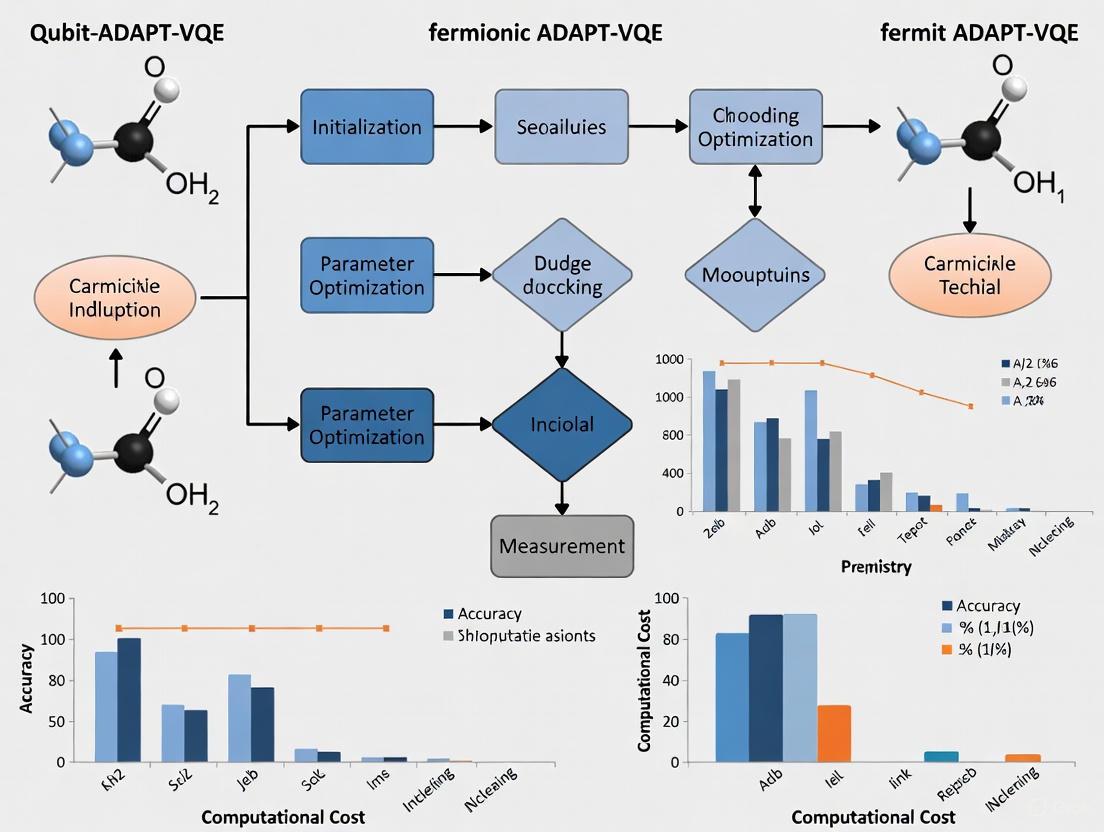
This article provides a comprehensive comparison of two leading adaptive variational quantum eigensolvers (VQEs)—Qubit-ADAPT-VQE and Fermionic-ADAPT-VQE—tailored for researchers and professionals in drug development.
Qubit-ADAPT-VQE vs. Fermionic ADAPT-VQE: A Comparative Guide for Quantum-Enhanced Drug Discovery
Abstract
This article provides a comprehensive comparison of two leading adaptive variational quantum eigensolvers (VQEs)—Qubit-ADAPT-VQE and Fermionic-ADAPT-VQE—tailored for researchers and professionals in drug development. We explore their foundational principles in electronic structure theory, detail their methodological differences in ansatz construction and operator pools, and analyze their performance in terms of circuit efficiency, convergence speed, and measurement costs. Practical troubleshooting advice and optimization strategies for noisy intermediate-scale quantum (NISQ) hardware are discussed, alongside rigorous validation through molecular benchmarks like LiH and BeH2. The review concludes by synthesizing key trade-offs and future directions, highlighting the potential of these algorithms to revolutionize molecular simulation in biomedical research.
Foundations of Adaptive VQE: From Fermionic Operators to Qubit Excitations
The Electronic Structure Problem and the VQE Solution
The electronic structure problem, centered on solving the electronic Schrödinger equation to determine the energy and properties of molecules, is a fundamental challenge in quantum chemistry and materials science [1]. The complexity of this problem grows exponentially with system size, making it intractable for classical computers for all but the smallest molecules [2]. The Variational Quantum Eigensolver (VQE) has emerged as a leading hybrid quantum-classical algorithm designed to address this challenge on near-term quantum hardware [2] [1].
VQE operates on the variational principle, using a parameterized quantum circuit (ansatz) to prepare trial wavefunctions whose energy is minimized via a classical optimization loop [3] [4]. Its adaptability to noisy hardware makes it particularly promising for the Noisy Intermediate-Scale Quantum (NISQ) era [5]. Among various VQE formulations, adaptive versions like ADAPT-VQE dynamically construct the circuit ansatz, offering significant advantages in accuracy, circuit depth, and trainability over fixed-structure approaches [2].
ADAPT-VQE: A Comparative Framework
The Adaptive Derivative-Assembled Pseudo-Trotter Variational Quantum Eigensolver (ADAPT-VQE) represents a significant advancement over standard VQE. Unlike fixed ansätze, ADAPT-VQE iteratively constructs a problem-tailored circuit by dynamically adding unitary operations from a predefined "operator pool" [2] [3]. At each iteration, the algorithm selects the operator with the largest energy gradient, adds it to the circuit with a new variational parameter, and re-optimizes all parameters [3]. This process continues until a convergence criterion is met [3].
Two major variants have emerged, distinguished by their operator pools:
- Fermionic ADAPT-VQE: Uses pools of fermionic excitation operators (e.g., singles and doubles), closely related to traditional unitary coupled cluster (UCC) theory [3] [4].
- Qubit ADAPT-VQE: Employs pools of purely qubit operators, such as Pauli strings, offering potential hardware efficiency [2].
The following workflow diagram illustrates the iterative structure of the ADAPT-VQE algorithm:
Quantitative Performance Comparison
Extensive numerical simulations reveal significant performance differences between ADAPT-VQE variants. The table below summarizes key metrics for the CEO-ADAPT-VQE* (a state-of-the-art qubit-based method) compared to GSD-ADAPT-VQE (a fermionic approach) for molecular systems of 12-14 qubits [2].
Table 1: Resource Comparison for Achieving Chemical Accuracy
| Molecule | Qubits | Algorithm | CNOT Count | CNOT Depth | Measurement Cost |
|---|---|---|---|---|---|
| LiH | 12 | GSD-ADAPT-VQE | Baseline | Baseline | Baseline |
| LiH | 12 | CEO-ADAPT-VQE* | Reduced by 88% | Reduced by 96% | Reduced by 99.6% |
| H6 | 12 | GSD-ADAPT-VQE | Baseline | Baseline | Baseline |
| H6 | 12 | CEO-ADAPT-VQE* | Reduced by 85% | Reduced by 96% | Reduced by 99.4% |
| BeH2 | 14 | GSD-ADAPT-VQE | Baseline | Baseline | Baseline |
| BeH2 | 14 | CEO-ADAPT-VQE* | Reduced by 73% | Reduced by 92% | Reduced by 98.6% |
Beyond direct ADAPT-VQE comparisons, qubit-based CEO-ADAPT-VQE* also outperforms the traditional unitary coupled cluster singles and doubles (UCCSD) ansatz—the most widely used static VQE approach—across all relevant metrics [2]. It achieves a five-order-of-magnitude decrease in measurement costs compared to other static ansätze with similar CNOT counts [2].
Experimental Protocols and Methodologies
Ansatz Construction Protocols
The core experimental difference between qubit and fermionic ADAPT-VQE lies in their operator pools and implementation:
Fermionic ADAPT-VQE Protocol [3]:
- Operator Pool Generation: Construct single (
a^p†a_q) and double (a^p†a_q†a_r a_s) fermionic excitation operators from a reference state (typically Hartree-Fock). - Gradient Calculation: Compute gradients
∂E/∂θ_ifor all pool operatorsA_iusing∂E/∂θ_i = <ψ|[H, A_i]|ψ>. - Operator Selection: Identify the operator with the largest gradient magnitude.
- Ansatz Update: Append the selected operator
exp(θ_i A_i)to the circuit. - Parameter Optimization: Re-optimize all parameters in the expanded ansatz using VQE.
- Convergence Check: Repeat until gradient norms fall below threshold (e.g., 10â»Â³).
Qubit ADAPT-VQE Protocol [2]:
- Qubit Operator Pool: Define pool using native qubit operators, such as the novel Coupled Exchange Operator (CEO) pool.
- Commutator-Based Selection: Calculate gradients through qubit operator commutators with the Hamiltonian.
- Hardware-Efficient Implementation: Exploit qubit-wise commutativity for measurement reduction.
- Circuit Construction: Build circuits directly optimized for quantum hardware connectivity.
Measurement Optimization Techniques
Advanced measurement strategies are crucial for practical implementation:
Reused Pauli Measurements [5]: Pauli measurement outcomes from VQE parameter optimization are reused in subsequent operator selection steps, reducing shot requirements by approximately 60-70%.
Variance-Based Shot Allocation [5]: Shots are distributed among Hamiltonian terms based on their variance, achieving 6-51% reduction in shot requirements compared to uniform allocation.
Qubit-Wise Commutativity Grouping [5]: Operators are grouped by commutation properties to enable simultaneous measurement, further reducing circuit executions.
The Scientist's Toolkit: Essential Research Components
Table 2: Key Research Reagents and Computational Tools
| Component | Function | Example Implementation |
|---|---|---|
| Operator Pool | Defines search space for ansatz construction | Fermionic: UCCSD excitations; Qubit: CEO pool [2] |
| Qubit Hamiltonian | Encodes molecular electronic structure in qubit space | Jordan-Wigner/Bravyi-Kitaev transformation of electronic Hamiltonian [1] [3] |
| Variational Minimizer | Optimizes ansatz parameters | Classical optimizers (L-BFGS-B, COBYLA) [1] [3] |
| Quantum Simulator/Device | Executes quantum circuits and measurements | Statevector simulators (Qulacs) or IBM quantum processors [1] [3] |
| Measurement Protocol | Manages shot allocation and term grouping | Variance-based allocation, qubit-wise commutativity grouping [5] |
| 4-Hydroxyhippuric acid | 4-Hydroxyhippuric Acid|High-Purity Reference Standard | |
| Complanatoside A | Complanatoside A, MF:C27H30O18, MW:642.5 g/mol | Chemical Reagent |
The comparative analysis between qubit and fermionic ADAPT-VQE reveals a clear trajectory toward hardware-efficient algorithm design. Qubit-based approaches, particularly those employing novel operator pools like the Coupled Exchange Operator pool, demonstrate substantial advantages in reducing quantum resource requirements—achieving up to 96% reduction in CNOT depth and 99.6% reduction in measurement costs compared to fermionic counterparts [2].
These advancements are critical for practical quantum advantage in electronic structure calculations, particularly as molecular system size increases. The integration of measurement reuse protocols and variance-based shot allocation further enhances the feasibility of these methods on current NISQ devices [5]. While fermionic ADAPT-VQE maintains stronger connections to traditional quantum chemistry frameworks, the resource efficiencies of qubit-based approaches position them as promising candidates for scaling quantum computational chemistry to clinically and industrially relevant molecular systems.
For researchers in drug development and materials science, these developments signal a important maturation of quantum computational tools, potentially enabling more accurate modeling of molecular interactions and reaction mechanisms that are currently beyond classical computational reach.
Core Principles of the ADAPT-VQE Algorithm and Ansatz Construction
The Adaptive Derivative-Assembled Problem-Tailored Variational Quantum Eigensolver (ADAPT-VQE) represents a significant advancement in quantum computational chemistry, specifically designed to address the limitations of pre-defined variational ansätze in the Variational Quantum Eigensolver (VQE) framework. Unlike standard VQE that uses a fixed circuit structure, ADAPT-VQE dynamically constructs a problem-tailored ansatz by iteratively selecting operators from a predefined pool, leading to enhanced performance, faster convergence, and reduced quantum resource requirements [3] [2]. This adaptive construction is particularly valuable for simulating molecular systems on noisy intermediate-scale quantum (NISQ) devices, where circuit depth and gate count are critical constraints.
The algorithm's core innovation lies in its iterative, greedy approach to ansatz development. Beginning typically with a Hartree-Fock reference state, ADAPT-VQE grows the ansatz circuit by appending parametrized unitary gates generated by operators selected from an operator pool based on the magnitude of their energy gradient contribution [3] [6]. This method ensures that the circuit structure is specifically adapted to the molecular Hamiltonian of interest, often resulting in shallower circuits and improved trainability compared to static ansätze like the Unitary Coupled Cluster Singles and Doubles (UCCSD) [2] [7].
Core Algorithmic Principles and Workflow
Fundamental Mechanism of ADAPT-VQE
The ADAPT-VQE algorithm functions through a structured, iterative process that bridges quantum measurements and classical optimization. Its effectiveness stems from a closed-loop feedback mechanism between the quantum processor and a classical computer [3] [2]:
- Initialization: The algorithm starts with a simple reference state, usually the Hartree-Fock state, which can be prepared using a constant-depth quantum circuit.
- Gradient Evaluation: For the current variational state, the energy gradient with respect to each operator in a predefined pool is computed or estimated. This gradient reflects the potential energy reduction achievable by adding each corresponding gate to the circuit.
- Operator Selection: The operator with the largest gradient magnitude is identified and selected. This greedy selection ensures the most significant improvement per iteration.
- Ansatz Growth and Optimization: A new parameterized gate, generated by exponentiating the selected operator, is appended to the quantum circuit. The entire set of parameters in the newly expanded ansatz is then optimized classically to minimize the expectation value of the Hamiltonian.
- Convergence Check: The process repeats from step 2 until the norm of the gradient vector falls below a predefined tolerance threshold, indicating that the ansatz has sufficiently approximated the ground state [3].
A key conceptual strength of ADAPT-VQE is its "problem-tailed" nature. Unlike fixed ansätze that maintain the same structure regardless of the target molecule, ADAPT-VQE grows an ansatz specifically adapted to the problem's Hamiltonian, which often avoids redundant parameters and gates that contribute minimally to the accuracy of the final state [2] [6].
Workflow Visualization
The following diagram illustrates the iterative workflow of the ADAPT-VQE algorithm:
Comparative Analysis: Qubit-ADAPT-VQE vs. Fermionic ADAPT-VQE
The performance and resource efficiency of ADAPT-VQE are heavily influenced by the choice of operator pool. The primary distinction lies between Fermionic ADAPT-VQE and its variant, Qubit-ADAPT-VQE.
Fermionic ADAPT-VQE employs a pool composed of fermionic excitation operators, typically the single and double excitations found in UCCSD. These operators (e.g., ( \hat{a}p^\dagger \hat{a}q ) and ( \hat{a}p^\dagger \hat{a}q^\dagger \hat{a}r \hat{a}s )) are physically motivated and directly related to the electronic excitations of the system [3] [7]. The resulting ansatz is constructed by exponentiating these fermionic operators, which then need to be mapped to quantum gates using techniques like the Jordan-Wigner or Bravyi-Kitaev transformation.
Qubit-ADAPT-VQE utilizes a pool built directly from qubit operators, such as Pauli strings or "qubit excitation evolutions" [8] [9]. These operators obey qubit commutation relations rather than fermionic anti-commutation relations. While they may lack the direct physical interpretation of fermionic excitations, they are naturally more hardware-efficient. The ansatz is grown by appending the exponentials of these qubit operators, which often require asymptotically fewer gates to implement on a quantum device compared to their fermionic counterparts [8].
Performance and Resource Comparison
The table below summarizes a quantitative comparison of key performance metrics between Qubit- and Fermionic-ADAPT-VQE, based on data from numerical simulations for small molecules [2] [7].
| Performance Metric | Qubit-ADAPT-VQE | Fermionic ADAPT-VQE (GSD Pool) |
|---|---|---|
| Circuit Depth / CNOT Count | Order of magnitude reduction (e.g., ~88% lower for LiH) [9] | Significantly higher due to complex fermionic mappings [2] |
| Convergence Speed (Iterations) | Comparable or faster in some cases [8] | Generally requires more iterations to achieve similar accuracy [2] |
| Measurement Overhead | Favorable, scales linearly with qubit count for operator selection [9] | High, due to large pool size and complex measurements [2] |
| Expressivity & Accuracy | Capable of achieving chemical accuracy [8] [7] | Capable of achieving high, systematic accuracy [3] [8] |
| Hardware Efficiency | High; designed for NISQ devices with low gate overhead [9] | Lower; circuits can be too deep for current devices [9] |
Advanced Pool Designs and Recent Enhancements
Research into more efficient operator pools has led to significant resource reductions. The Coupled Exchange Operator (CEO) pool is a novel design that has demonstrated dramatic improvements. When combined with other enhancements (an algorithm termed CEO-ADAPT-VQE*), simulations for molecules like LiH, H₆, and BeH₂ showed reductions in CNOT count by up to 88%, CNOT depth by up to 96%, and measurement costs by up to 99.6% compared to the original fermionic ADAPT-VQE [2].
Another strategy to manage resource requirements focuses on reducing the quantum measurement (shot) overhead. A 2025 proposal integrates two key techniques: reusing Pauli measurement outcomes from the VQE optimization in the subsequent operator selection step, and applying variance-based shot allocation to both Hamiltonian and gradient measurements. This combined approach significantly reduces the number of shots needed to achieve chemical accuracy while maintaining fidelity [10].
Experimental Protocols and Methodologies
Standard Protocol for ADAPT-VQE Simulation
A typical experimental workflow for conducting an ADAPT-VQE simulation, as implemented in software frameworks like InQuanto or PennyLane, involves several well-defined stages [3] [6]:
- System Definition: Define the molecular system by specifying atomic symbols and coordinates. Compute the electronic Hamiltonian in a chosen basis set (e.g., STO-3G) and active space approximation to reduce the qubit count.
- Operator Pool Preparation: Construct the operator pool. For Fermionic-ADAPT-VQE, this involves generating all unique single and double fermionic excitation operators from the reference state [3]. For Qubit-ADAPT-VQE, the pool is built from Pauli strings or qubit-excitation operators [9].
- Algorithm Configuration: Initialize the ADAPT-VQE algorithm by specifying the pool, initial state (e.g., Hartree-Fock), the qubit Hamiltonian, a classical minimizer (e.g., L-BFGS-B), and a convergence tolerance (e.g., 1e-3) [3].
- Iterative Ansatz Construction: Run the adaptive loop. In each iteration, the algorithm calculates the gradients for all operators in the pool, selects the operator with the largest gradient, adds its corresponding gate to the circuit with a new variational parameter, and optimizes all parameters [6].
- Result Analysis: Upon convergence, the final energy, optimized parameters, and the constructed ansatz circuit are retrieved for analysis [3].
Protocol for Comparative Studies
To objectively compare the performance of different ADAPT-VQE variants, such as Qubit-ADAPT versus Fermionic-ADAPT, the following controlled methodology is employed [2] [7]:
- Molecular Test Set: A set of small molecules (e.g., LiH, H₆, BeH₂) at various bond lengths, including both equilibrium and dissociated geometries, is selected to assess performance across different correlation regimes.
- Resource Metrics Tracking: For each algorithm variant, key metrics are recorded at the iteration where chemical accuracy (1.6 mHa error) is first achieved. These metrics include the number of variational parameters, the total number of CNOT gates, the CNOT depth of the circuit, and the estimated measurement cost (often proxied by the number of energy evaluations or required shots) [2].
- Classical Simulation: The experiments are typically performed using state-vector simulators to isolate algorithm performance from hardware noise. The energy error relative to the full configuration interaction (FCI) or exact diagonalization value is tracked throughout the optimization to monitor convergence [7].
Essential Research Toolkit
The table below catalogs the key computational "reagents" and tools essential for implementing and experimenting with ADAPT-VQE algorithms.
| Tool / Component | Function in ADAPT-VQE Protocol |
|---|---|
| Qubit Hamiltonian | The target operator whose ground state energy is being computed; derived from the electronic Hamiltonian of the molecule [3]. |
| Operator Pool | A predefined set of operators (e.g., fermionic excitations, Pauli strings) from which the ansatz is adaptively constructed [3] [9]. |
| Classical Optimizer | A classical algorithm (e.g., L-BFGS-B, SLSQP) used to minimize the energy by varying the parameters of the quantum circuit [3]. |
| State-Vector Simulator | A noise-free quantum simulator used for algorithm development, benchmarking, and validation of the ADAPT-VQE workflow [3] [7]. |
| Quantum Chemistry Package | Software (e.g., PennyLane, InQuanto) that provides functionalities for molecular Hamiltonian generation, Hartree-Fock state preparation, and excitation operator construction [3] [6]. |
| Convergence Tolerance | A numerical threshold (e.g., 1e-3) for the gradient norm that determines when the iterative ansatz-building process terminates [3]. |
| Acetyldihydromicromelin A | Acetyldihydromicromelin A, MF:C17H16O7, MW:332.3 g/mol |
| Rivulobirin B | Rivulobirin B, MF:C23H12O9, MW:432.3 g/mol |
ADAPT-VQE represents a powerful and flexible framework for quantum chemistry simulations on NISQ-era quantum hardware. Its core principle of iterative, adaptive ansatz construction offers a compelling advantage over static variational forms by systematically building compact, problem-tailored circuits. The choice between Fermionic and Qubit-based variants presents a clear trade-off: Fermionic-ADAPT-VQE is grounded in the well-established framework of quantum chemistry, while Qubit-ADAPT-VQE and its modern descendants like CEO-ADAPT-VQE demonstrate superior hardware efficiency, with orders-of-magnitude reduction in critical resources like CNOT gate count and measurement overhead [2] [9].
The ongoing development of more sophisticated operator pools and measurement strategies continues to push the boundaries of what is possible with these hybrid algorithms [10] [2]. As such, ADAPT-VQE and its variants remain at the forefront of the quest for practical quantum advantage in electronic structure calculations, providing researchers with a versatile and increasingly efficient toolkit for exploring complex molecular systems.
The Adaptive Derivative-Assembled Pseudo-Trotter Variational Quantum Eigensolver (ADAPT-VQE) represents a significant advancement in quantum computational chemistry, designed to construct problem-tailored ansätze for molecular simulations on noisy intermediate-scale quantum (NISQ) devices. Unlike fixed-structure ansätze, ADAPT-VQE grows its ansatz iteratively by selecting operators from a predefined pool based on an energy-gradient hierarchy [2] [11]. Within this framework, a fundamental distinction exists between Fermionic-ADAPT-VQE and its qubit-based counterparts, chiefly in the composition of the operator pool and the underlying physical motivation. The fermionic variant utilizes an operator pool composed of fermionic excitation evolutions—specifically, anti-Hermitian generators of the form ( \hat{\tau}i = \hat{T}i - \hat{T}i^\dagger ), where ( \hat{T}i ) are fermionic excitation operators [12] [13]. This approach is directly inspired by unitary coupled cluster (UCC) theory, ensuring that the constructed ansatz respects the physical symmetries of electronic wavefunctions, such as particle number conservation and fermionic anti-symmetry [12]. This paper delineates the comparative performance, resource requirements, and practical applications of Fermionic-ADAPT-VQE against other adaptive protocols, situating its value within the broader research context of Qubit-ADAPT-VQE comparisons.
Performance and Resource Comparison
The following tables synthesize key performance metrics from recent studies, comparing Fermionic-ADAPT-VQE against Qubit-ADAPT-VQE and the more recent Qubit-Excitation-Based (QEB)-ADAPT-VQE.
Table 1: Algorithm Resource Comparison for Selected Molecules (at chemical accuracy)
| Molecule (Qubits) | Algorithm | CNOT Count | Circuit Depth | Number of Parameters | Number of Iterations |
|---|---|---|---|---|---|
| LiH (12 qubits) | Fermionic-ADAPT-VQE [2] [12] | ~880 (Baseline) | Deep | Fewer | Fewer |
| Qubit-ADAPT-VQE [9] [12] | ~100 (↓88%) | Shallower | Higher | Higher | |
| QEB-ADAPT-VQE [12] | Low | Very Shallow | Moderate | Moderate | |
| H₆ (12 qubits) | Fermionic-ADAPT-VQE [2] [12] | ~750 (Baseline) | Deep | Fewer | Fewer |
| Qubit-ADAPT-VQE [9] [2] | ~90 (↓88%) | Shallower (↓96% depth) | Higher | Higher | |
| QEB-ADAPT-VQE [12] | Low | Very Shallow | Moderate | Moderate | |
| BeHâ‚‚ (14 qubits) | Fermionic-ADAPT-VQE [2] | ~1200 (Baseline) | Deep | Fewer | - |
| Qubit-ADAPT-VQE [9] [2] | ~140 (↓88%) | Shallower (↓92% depth) | Higher | - |
Table 2: Qualitative Algorithm Comparison
| Feature | Fermionic-ADAPT-VQE | Qubit-ADAPT-VQE | QEB-ADAPT-VQE |
|---|---|---|---|
| Operator Pool | Fermionic excitation evolutions [12] | Pauli string exponentials [9] [12] | Qubit excitation evolutions [12] |
| Physical Motivation | High (direct from UCC) [12] [13] | Low (hardware-efficient) [9] | Moderate (inspired by fermionic structure) [12] |
| Circuit Efficiency | Lower (deeper circuits) [2] [12] | High (shallower circuits) [9] [2] | Highest (very shallow circuits) [12] |
| Convergence Speed | Faster (fewer iterations) [12] | Slower (more iterations) [12] | Intermediate [12] |
| Optimization Landscape | Smoother, fewer parameters [12] | More parameters, potential barren plateaus [2] | - |
| Measurement Cost | High (for fermionic gradients) [2] | Lower [9] | - |
The data reveals a clear trade-off: while Fermionic-ADAPT-VQE converges in fewer iterations due to its physically motivated operator selection [12], the resulting quantum circuits are significantly deeper than those produced by qubit-based protocols [2] [12]. For example, Qubit-ADAPT-VQE can reduce CNOT counts by up to 88% and circuit depth by up to 96% compared to the fermionic original [2]. The more recent QEB-ADAPT-VQE aims to bridge this gap, offering circuit efficiency competitive with Qubit-ADAPT-VQE while requiring fewer iterations and parameters to converge [12].
Experimental Protocols and Methodologies
Core Workflow of ADAPT-VQE
The fundamental adaptive workflow is consistent across different variants [11] [13]. The primary differences lie in the composition of the operator pool and the implementation of the ansatz elements.
Fermionic-ADAPT-VQE Specifics
- Operator Pool: The standard pool consists of generalized single and double (GSD) fermionic excitations [2] [12]. The anti-Hermitian generators are of the form ( \hat{\tau}i^{pq} = \hat{a}p^\dagger \hat{a}q - \hat{a}q^\dagger \hat{a}p ) for singles and ( \hat{\tau}i^{pqrs} = \hat{a}p^\dagger \hat{a}q^\dagger \hat{a}r \hat{a}s - \text{h.c.} ) for doubles, where ( \hat{a}^\dagger ) and ( \hat{a} ) are fermionic creation and annihilation operators [12] [13].
- Ansatz Element Implementation: Each selected operator is exponentiated to form a unitary gate: ( e^{\thetai \hat{\tau}i} ) [11]. On a quantum computer, these fermionic operators must be mapped to qubit gates using a transformation like the Jordan-Wigner or Bravyi-Kitaev encoding [12] [13]. The Jordan-Wigner transformation, while straightforward, often leads to long strings of Pauli operators, resulting in deeper circuits compared to more direct qubit ansatz elements [12].
Comparative Studies Methodology
Performance benchmarks are typically conducted using classical simulators for small molecules like LiH, H₆, and BeH₂ [2] [12]. Key methodological steps include:
- Molecular Hamiltonian Preparation: The electronic Hamiltonian is generated for a specific molecular geometry and then mapped to a qubit Hamiltonian using a chosen encoding (e.g., Jordan-Wigner) [12].
- Algorithm Execution: Each ADAPT-VQE variant is run independently, growing its ansatz until a convergence criterion (e.g., chemical accuracy of 1.0 mHa) is met [2] [12].
- Metrics Collection: For each iteration, researchers track the energy error, the number of CNOT gates, the circuit depth, and the number of variational parameters [9] [2] [12]. The total quantum resource cost, especially the number of measurements required for gradient estimation, is also a critical metric [2].
Technical Implementation and Physical Motivations
The Scientist's Toolkit: Research Reagents and Solutions
Table 3: Essential Components for ADAPT-VQE Experiments
| Item | Function & Description | Fermionic-ADAPT-VQE Specifics |
|---|---|---|
| Initial State | A reference wavefunction (e.g., Hartree-Fock) to initialize the quantum circuit [11] [14]. | Can be improved using Unrestricted HF (UHF) natural orbitals for better initial overlap with the true ground state [11] [14]. |
| Operator Pool | A predefined set of operators from which the ansatz is built [2] [12]. | Composed of fermionic excitation operators (e.g., GSD), ensuring physicality [2] [12]. |
| Qubit Mapping | A method to encode fermionic operators into qubit (Pauli) operators [12] [13]. | Jordan-Wigner is commonly used, but its overhead contributes to deeper circuits [12]. |
| Measurement Strategy | Techniques to estimate energy expectation values and gradients [2]. | Requires measuring fermionic gradient terms, which can be costly [2]. |
| Classical Optimizer | An algorithm to variationally update the parameters {θ} to minimize energy [13]. |
Gradient-based optimizers are often more efficient than gradient-free methods [13]. |
| 2-Hydroxydiplopterol | 2-Hydroxydiplopterol|RUO | 2-Hydroxydiplopterol is a hopanoid triterpenoid for membrane research. This product is For Research Use Only. Not for human or veterinary use. |
| Angustin B | Angustin B, CAS:1415795-51-5, MF:C17H16O7, MW:332.3 g/mol | Chemical Reagent |
Logical Pathway of Fermionic-ADAPT-VQE
The diagram below illustrates the conceptual and technical pathway that defines the Fermionic-ADAPT-VQE protocol, highlighting its strong connection to electronic structure theory.
Discussion: Trade-offs and Application Domains
The choice between Fermionic-ADAPT-VQE and qubit-based variants is not a matter of superiority but of aligning the algorithm's strengths with the problem's requirements.
Strengths of Fermionic-ADAPT-VQE:
- Physical Interpretability: The ansatz elements correspond directly to electronic excitations, providing a clear and chemically intuitive picture of electron correlation effects [12]. The resulting wavefunction is inherently N-representable, meaning it consistently corresponds to a physical fermionic system [12].
- Robust Optimization: The ansatz grows in a physically structured space, which may help mitigate issues like barren plateaus and lead to a smoother optimization landscape compared to hardware-efficient ansätze [2] [14].
- Proven Formal Grounding: The method is rooted in the well-established UCC theory, providing a strong formal connection to classical quantum chemistry [13].
Weaknesses and Trade-offs:
- Circuit Inefficiency: The primary drawback is the high CNOT count and circuit depth resulting from the implementation of fermionic operators via transformations like Jordan-Wigner [2] [12]. This makes it more susceptible to noise on current hardware.
- Measurement Overhead: The fermionic pool can lead to a larger measurement overhead for gradient calculations compared to some qubit-adapted pools [2].
Application Domains: Fermionic-ADAPT-VQE is particularly well-suited for strongly correlated systems where classical methods like restricted UCCSD often fail [11]. Its physical nature makes it an excellent tool for algorithm development and conceptual studies where interpretation is key. In contrast, qubit-based ADAPT-VQEs (Qubit- and QEB-) are likely more practical for near-term hardware execution due to their dramatically lower circuit depths and gate counts, which is a critical advantage in the NISQ era [9] [2] [12].
Fermionic-ADAPT-VQE remains a cornerstone algorithm in quantum computational chemistry due to its strong physical motivations and robust convergence properties. It leverages the well-understood framework of fermionic excitation evolutions to build chemically meaningful ansätze. However, empirical data consistently shows that qubit-based adaptive algorithms, such as Qubit-ADAPT-VQE and QEB-ADAPT-VQE, generate significantly more hardware-friendly circuits with orders-of-magnitude reduction in CNOT counts and depths [9] [2]. The ongoing research and development, including the creation of novel operator pools like the Coupled Exchange Operator (CEO) pool, continue to push the boundaries of resource efficiency [2]. Therefore, while Fermionic-ADAPT-VQE provides an essential conceptual bridge from classical quantum chemistry, its qubit-based descendants currently hold a practical advantage for the implementation of non-trivial molecular simulations on existing and near-future quantum devices.
The simulation of molecular quantum systems is a promising application for noisy intermediate-scale quantum (NISQ) computers. On these devices, the Variational Quantum Eigensolver (VQE) has emerged as a leading hybrid quantum-classical algorithm for solving the electronic structure problem. A critical determinant of VQE's success is the ansatz—the parameterized quantum circuit that prepares the trial wavefunction. The adaptive derivative-assembled problem-tailored VQE (ADAPT-VQE) represents a significant advancement by iteratively constructing a problem-tailored ansatz, offering superior accuracy and efficiency compared to fixed-structure ansätze like unitary coupled-cluster singles and doubles (UCCSD) [2].
Two principal variants have been developed: the physically motivated fermionic-ADAPT-VQE and the hardware-efficient qubit-ADAPT-VQE. The latter utilizes rudimentary Pauli string exponentials as its ansatz elements, prioritizing operational simplicity and device compatibility over physical intuition [12] [2]. This guide provides a comprehensive comparison of these protocols, analyzing their performance, resource requirements, and applicability to real-world problems such as drug discovery.
Methodological Comparison: Fermionic vs. Qubit-Based Protocols
Core Algorithmic Framework
The ADAPT-VQE algorithm iteratively grows an ansatz by appending parameterized unitary operators selected from a predefined pool. At each iteration, the algorithm chooses the operator with the largest energy gradient and optimizes its parameter [2]. The fundamental difference between the fermionic and qubit variants lies in the composition of this operator pool.
- Fermionic-ADAPT-VQE: Employs a pool of fermionic excitation operators of the form ( e^{\theta (\tau - \tau^\dagger)} ), where ( \tau ) is a fermionic excitation operator (e.g., single ( a^\daggeri aa ) or double ( a^\daggeri a^\daggerj aa ab ) excitations). These operators inherently preserve the physical symmetries of electronic wavefunctions but require deep circuits for implementation [12] [2].
- Qubit-ADAPT-VQE: Utilizes a pool of simple Pauli string exponentials (e.g., ( e^{i \theta P} ), where ( P ) is a tensor product of Pauli matrices). These "rudimentary" operators are more hardware-native, requiring shallower circuits, but they lack the physical motivation of fermionic operators and may require more parameters and iterations to converge [12].
Key Research Reagents and Computational Tools
Table 1: Essential Components for ADAPT-VQE Simulations
| Component Name | Type/Class | Primary Function in Workflow |
|---|---|---|
| Jordan-Wigner Encoding [12] | Qubit Mapping | Transforms the fermionic electronic Hamiltonian into a qubit Hamiltonian expressed as a sum of Pauli strings. |
| Generalized Single & Double (GSD) Pool [2] | Operator Pool (Fermionic) | Provides the set of fermionic excitation evolution operators from which the fermionic-ADAPT-VQE selects. |
| Pauli String Exponential Pool [12] | Operator Pool (Qubit) | Provides the set of simple Pauli string evolutions from which the qubit-ADAPT-VQE selects. |
| Classical Optimizer (e.g., BFGS) [15] | Classical Software | Adjusts the parameters of the quantum ansatz to minimize the energy expectation value measured from the quantum computer. |
| Measurement Scheme (e.g., Grouping) [16] | Quantum Routine | Efficiently estimates the expectation values of the qubit Hamiltonian's Pauli terms, a major source of computational cost. |
Performance Benchmarking: Quantitative Comparisons
Resource Efficiency and Convergence
The primary advantage of qubit-ADAPT-VQE is its superior circuit efficiency. However, this can come at the cost of increased variational parameters and measurement overhead.
Table 2: Performance Comparison of ADAPT-VQE Variants for Representative Molecules
| Molecule (Qubits) | Protocol | Iterations to Chemical Accuracy | CNOT Count | Measurement Cost (Energy Evaluations) |
|---|---|---|---|---|
| LiH (12 qubits) | Fermionic-ADAPT-VQE [2] | Baseline | Baseline | Baseline |
| Qubit-ADAPT-VQE [12] | Higher | Lower | Not Specified | |
| CEO-ADAPT-VQE* [2] | Lower | ~88% reduction | ~99.6% reduction | |
| H₆ (12 qubits) | Fermionic-ADAPT-VQE [2] | Baseline | Baseline | Baseline |
| Qubit-ADAPT-VQE [12] | Higher | Lower | Not Specified | |
| CEO-ADAPT-VQE* [2] | Lower | ~88% reduction | ~99.6% reduction | |
| BeHâ‚‚ (14 qubits) | Fermionic-ADAPT-VQE [2] | Baseline | Baseline | Baseline |
| Qubit-ADAPT-VQE [12] | Higher | Lower | Not Specified | |
| CEO-ADAPT-VQE* [2] | Lower | ~88% reduction | ~99.6% reduction |
The data shows that while qubit-ADAPT-VQE reduces CNOT counts, subsequent algorithms like QEB-ADAPT-VQE (which uses qubit excitation evolutions) and CEO-ADAPT-VQE (which uses coupled exchange operators) have been developed to bridge the gap, offering the circuit efficiency of qubit-based approaches without the same overhead in iterations and parameters [12] [2].
Comparative Analysis Against Static Ansätze
When compared to the widely used UCCSD ansatz, adaptive methods consistently demonstrate superior resource management.
Table 3: ADAPT-VQE vs. UCCSD Performance
| Metric | UCCSD-VQE | Qubit-ADAPT-VQE | CEO-ADAPT-VQE* |
|---|---|---|---|
| Ansatz Flexibility | Fixed, general-purpose | Adaptive, problem-tailored | Adaptive, problem-tailored |
| Circuit Depth | High [2] | Lower [12] | Dramatically Lower [2] |
| Parameter Count | High, with redundancies [12] | Optimized, fewer redundancies | Highly Optimized [2] |
| Measurement Cost | Very High [2] | Lower | ~5 orders of magnitude lower [2] |
Qubit-ADAPT-VQE and its successors outperform UCCSD by constructing a system-specific ansatz, eliminating redundant operators and focusing on the most chemically relevant Hilbert space regions [12] [2].
Experimental Protocols for Key Studies
Protocol 1: Benchmarking Energy Convergence
This protocol classically simulates ADAPT-VQE algorithms to compare their convergence toward the exact ground-state energy.
- System Preparation: Select a test molecule (e.g., LiH, H₆, BeH₂) and compute its electronic Hamiltonian in a minimal basis set (e.g., STO-3G) using a classical quantum chemistry package [12] [2].
- Qubit Encoding: Map the fermionic Hamiltonian to a qubit Hamiltonian using the Jordan-Wigner transformation [12].
- ADAPT-VQE Simulation: a. Initialize a reference state (e.g., Hartree-Fock) on the quantum simulator. b. For each iteration: i. For all operators in the pool (fermionic or Pauli strings), calculate the energy gradient ( \frac{\partial E}{\partial \thetai} ). ii. Select the operator with the largest gradient magnitude. iii. Append its unitary ( e^{\thetai A_i} ) to the ansatz circuit. iv. Re-optimize all parameters ( \vec{\theta} ) to minimize the total energy.
- Data Collection: Record the energy and quantum resource counts (CNOT gates, circuit depth) at each iteration. The simulation stops when chemical accuracy (1.6 mHa or 1 kcal/mol) is achieved [2].
Protocol 2: Simulating Bond Dissociation
This protocol evaluates the performance of algorithms for simulating strongly correlated systems, such as molecules at stretched bond geometries.
- Geometry Generation: Calculate the ground-state energy of a molecule (e.g., LiH) across a range of internuclear distances, including the equilibrium geometry and the dissociation limit [12] [2].
- Parallel Simulation: For each geometry, run the fermionic-ADAPT-VQE, qubit-ADAPT-VQE, and UCCSD protocols as described in Protocol 1.
- Accuracy Analysis: Plot the energy dissociation curves for each method and compute the absolute error relative to the exact full configuration interaction (FCI) energy. This tests the ability of each ansatz to capture strong electron correlation effects [12].
Workflow Visualization
The core differentiator between qubit and fermionic ADAPT-VQE is the content of the "Select Operator Pool" node. All subsequent steps in the iterative loop are algorithmically identical, though the choice of pool profoundly impacts the number of iterations required, the final circuit structure, and the measurement costs [12] [2].
Application in Drug Discovery
Quantum computing holds potential to revolutionize drug discovery by enabling more accurate molecular simulations [17] [15] [18]. VQE algorithms can model key quantum chemical properties that are computationally prohibitive for classical methods.
- Gibbs Free Energy Profiles: Calculating the energy barrier of chemical reactions, such as covalent bond cleavage in prodrug activation, is crucial for predicting drug efficacy. Hybrid quantum-classical pipelines have been developed to compute these profiles using VQE [15].
- Drug-Target Interactions: Understanding covalent inhibition, like the binding of Sotorasib to the KRAS G12C protein target in cancer, can be enhanced through quantum mechanics/molecular mechanics (QM/MM) simulations where the QM region is handled by a VQE [15].
- Lead Compound Screening: Hybrid frameworks combining quantum graph neural networks (QGNNs) with VQE have been proposed to predict molecular properties and screen large compound libraries for drug candidates, such as serine neutralizers [19].
In these applications, the hardware efficiency of qubit-ADAPT-VQE is a significant advantage for feasibility on near-term devices, though the accuracy of the generated wavefunction remains paramount [15] [19].
Qubit-ADAPT-VQE represents a critical step toward practical quantum chemistry simulations on NISQ hardware. Its use of rudimentary Pauli string exponentials provides a hardware-efficient pathway, demonstrably reducing circuit depth and gate counts compared to fermionic-ADAPT-VQE and UCCSD [12] [2].
However, the field is rapidly evolving. Newer algorithms like QEB-ADAPT-VQE and CEO-ADAPT-VQE have emerged, building upon the qubit-ADAPT philosophy while seeking to mitigate its drawbacks, such as increased parameter counts [12] [2]. CEO-ADAPT-VQE, in particular, showcases the potential for drastic reductions in both circuit depth and measurement costs, which are critical bottlenecks [2].
Future research will focus on further refining operator pools, improving measurement strategies, and integrating these algorithms with classical quantum chemistry methods to tackle larger, biologically relevant systems. The continuous improvement of the ADAPT-VQE family underscores its viability as a leading candidate for achieving quantum utility in molecular simulation and drug discovery.
The Adaptive Derivative-Assembled Pseudo-Trotter Variational Quantum Eigensolver (ADAPT-VQE) represents a paradigm shift in quantum computational chemistry, moving beyond static, pre-defined ansätze to a dynamic, problem-tailored approach. Its core innovation lies in constructing quantum circuits iteratively by selecting and adding operators from a predefined "pool" based on their potential to lower the energy expectation value, typically assessed by a gradient criterion [20]. This methodology aims to generate more compact, less noisy circuits suitable for the Noisy Intermediate-Scale Quantum (NISQ) era.
The original formulation, Fermionic-ADAPT-VQE, utilized a pool of fermionic excitation operators, maintaining a direct connection to classical quantum chemistry methods but often resulting in deep circuits [12]. The subsequent development of Qubit-ADAPT-VQE marked a significant step by employing a pool of elementary Pauli string exponentials, which dramatically improved circuit efficiency at the cost of increased parameters and iterations [12] [16]. This evolution sets the stage for the hybrid approaches of QEB-ADAPT-VQE and CEO-ADAPT-VQE, which seek to balance physical motivation with hardware efficiency, offering a promising path toward practical quantum advantage on near-term devices.
QEB-ADAPT-VQE: Bridging Qubit Efficiency and Physical Intuition
Core Concept and Algorithm
The Qubit-Excitation-Based ADAPT-VQE (QEB-ADAPT-VQE) was introduced as a modification to the ADAPT-VQE protocol that utilizes "qubit excitation evolutions" as its operator pool [12]. Unlike fermionic excitation operators, which obey fermionic anti-commutation relations, qubit excitation operators are defined by their adherence to qubit commutation relations [12]. This fundamental shift in the building blocks of the ansatz allows the algorithm to construct quantum states with high accuracy while requiring asymptotically fewer quantum gates than its fermionic counterpart. The operators themselves are less rudimentary than the Pauli strings used in Qubit-ADAPT-VQE, striking a balance that enables more rapid and circuit-efficient ansatz construction.
Experimental Performance and Analysis
Classical numerical simulations for small molecules like LiH, H₆, and BeH₂ have demonstrated that QEB-ADAPT-VQE successfully bridges the performance gap between Fermionic- and Qubit-ADAPT-VQE.
The algorithm's performance can be summarized as follows:
- Convergence Speed: QEB-ADAPT-VQE requires fewer iterations to reach chemical accuracy compared to Qubit-ADAPT-VQE, as the higher complexity of its operators allows it to make more significant progress per iteration [12].
- Circuit Efficiency: It constructs ansätze with shallower circuits than Fermionic-ADAPT-VQE, making it more suitable for NISQ hardware. It was noted as a significant improvement in circuit efficiency over previous scalable VQE protocols [12].
- Accuracy: Despite lacking some physical features of fermionic excitations, the ansätze built with qubit excitation evolutions can approximate electronic wavefunctions with accuracy nearly on par with those built from fermionic excitations [12].
CEO-ADAPT-VQE: A Novel Pool for Maximal Resource Reduction
Core Concept and Algorithm
The Coupled Exchange Operator (CEO) pool represents a further advancement in the design of efficient operator pools for ADAPT-VQE. The CEO-ADAPT-VQE algorithm integrates this novel pool with other recent improvements in measurement strategies and hardware-efficient ansatz construction [2]. The defining feature of the CEO pool is its specific design, which aims to maximize the reduction of quantum computational resources—including two-qubit gate counts, circuit depth, and the number of measurements required—without sacrificing the accuracy of the final result.
Experimental Performance and Analysis
Numerical simulations for molecules such as LiH, H₆, and BeH₂ (represented by 12 to 14 qubits) have shown that CEO-ADAPT-VQE achieves dramatic resource reductions compared to earlier versions of the algorithm, representing the state of the art in adaptive VQE methods [2].
The table below summarizes the profound resource reductions achieved by the state-of-the-art CEO-ADAPT-VQE* variant compared to the early fermionic (GSD-ADAPT-VQE) algorithm:
| Molecule | Qubit Count | Reduction in CNOT Count | Reduction in CNOT Depth | Reduction in Measurement Costs |
|---|---|---|---|---|
| LiH | 12 | Up to 88% | Up to 96% | Up to 99.6% |
| H₆ | 12 | Up to 88% | Up to 96% | Up to 99.6% |
| BeHâ‚‚ | 14 | Up to 88% | Up to 96% | Up to 99.6% |
Table 1: Resource reduction of CEO-ADAPT-VQE compared to early ADAPT-VQE versions [2].*
Furthermore, CEO-ADAPT-VQE was found to outperform the standard Unitary Coupled Cluster Singles and Doubles (UCCSD) ansatz—a widely used static ansatz in VQE—across all relevant metrics. It also offers a five-order-of-magnitude decrease in measurement costs compared to other static ansätze with similar CNOT counts [2].
Direct Comparison: QEB-ADAPT-VQE vs. CEO-ADAPT-VQE
The following table provides a consolidated comparison of the two hybrid approaches against their predecessors, based on the data from the search results.
| Algorithm | Operator Pool Type | Key Innovation | Convergence Speed | Circuit Efficiency | Primary Advantage |
|---|---|---|---|---|---|
| Fermionic-ADAPT | Fermionic Excitations | Original physically-motivated pool | Baseline | Deeper circuits | Direct chemical intuition |
| Qubit-ADAPT | Pauli Strings | Elementary, hardware-efficient operations | Slower | High | Minimal gate complexity |
| QEB-ADAPT | Qubit Excitations | Obeys qubit commutation relations | Faster than Qubit-ADAPT | High | Balance of speed and efficiency |
| CEO-ADAPT | Coupled Exchange Operators | Optimized for maximal resource reduction | Not Explicitly Stated | Very High | Lowest CNOT count & measurement overhead |
Table 2: Comparative analysis of ADAPT-VQE variants. Convergence speed and circuit efficiency are rated relative to other algorithms in the family [2] [12] [16].
Experimental Protocols and Methodologies
Standard ADAPT-VQE Workflow
The core experimental protocol for all ADAPT-VQE variants follows a recursive, iterative loop. The diagram below illustrates this general workflow, which is shared by QEB- and CEO-ADAPT-VQE, with the key difference lying in the composition of the operator pool.
Key Methodological Variations
The critical methodological differences between the algorithms are rooted in their operator pools:
- QEB-ADAPT-VQE Protocol: The operator pool consists of unitary evolutions of qubit excitation operators. The ansatz is grown by iteratively appending the operator from this pool that shows the largest gradient magnitude. A modified growing strategy is sometimes employed, which trades a constant-factor increase in measurements for more efficient ansatz construction [12].
- CEO-ADAPT-VQE Protocol: The algorithm uses the novel Coupled Exchange Operator (CEO) pool. This is combined with "improved subroutines," which refer to advanced techniques for reducing measurement overhead, such as reusing Pauli measurements and employing variance-based shot allocation across both the Hamiltonian and the gradient measurements [2] [5].
The Scientist's Toolkit: Essential Research Reagents
The table below details key components and their functions in a typical ADAPT-VQE simulation study, as inferred from the cited research.
| Research Reagent / Component | Function in the Experiment |
|---|---|
| Molecular Hamiltonian | Defines the quantum chemistry problem; the target operator whose ground state is being sought [12]. |
| Operator Pool | A pre-defined set of operators (e.g., Fermionic, Pauli, Qubit Excitation, CEO) from which the ansatz is built [2] [12]. |
| Reference State | The initial quantum state, often the Hartree-Fock state, from which the adaptive ansatz construction begins [12]. |
| Jordan-Wigner Transform | A common encoding method that maps fermionic operators from the Hamiltonian to Pauli strings operable on a quantum computer [12]. |
| Gradient Criterion | The metric (often the energy gradient ∂E/∂θᵢ) used to rank and select the next operator from the pool [20]. |
| Classical Optimizer | The algorithm (e.g., gradient-based or gradient-free) that variationally updates all parameters in the ansatz circuit to minimize energy [13]. |
| Variance-Based Shot Allocation | A technique to reduce measurement overhead by strategically allocating more "shots" to noisier observables [5]. |
| Sulfocostunolide A | Sulfocostunolide A, CAS:1016983-51-9, MF:C15H20O5S, MW:312.4 g/mol |
| Pterisolic acid C | Pterisolic acid C, CAS:1401419-87-1, MF:C20H26O4, MW:330.4 g/mol |
The emergence of hybrid approaches like QEB-ADAPT-VQE and CEO-ADAPT-VQE marks a significant maturation of adaptive variational quantum algorithms. While QEB-ADAPT-VQE successfully established a middle ground between the physical intuition of fermionic operators and the hardware efficiency of Pauli strings, CEO-ADAPT-VQE represents a leap forward by explicitly designing an operator pool for minimal quantum resource consumption. The experimental data demonstrates a clear trend: through strategic innovation in the operator pool, it is possible to achieve orders-of-magnitude reduction in critical resources like CNOT gate counts and measurement costs. This progress is vital for making quantum simulations of molecules such as LiH and BeHâ‚‚ feasible on current hardware. As the field advances, the integration of these efficient algorithms with other strategies like effective Hamiltonians and advanced error mitigation will be crucial for tackling more complex chemical systems and moving closer to demonstrating a practical quantum advantage.
Algorithmic Mechanics and Real-World Application in Drug Discovery
The Variational Quantum Eigensolver (VQE) has emerged as a leading algorithm for molecular simulations on noisy intermediate-scale quantum (NISQ) devices. A critical component determining its performance is the operator pool—the set of operators used to build the quantum circuit ansatz. This guide provides an objective comparison of the three primary operator pool types: Fermionic, Pauli Strings (Qubit), and Qubit Exitations (QEB), within the adaptive derivative-assembled pseudo-Trotter (ADAPT-VQE) framework. Understanding their trade-offs is essential for researchers aiming to simulate molecular systems, such as in drug development, where predicting chemical properties accurately is paramount.
Theoretical Foundations and Definitions
Fermionic Pools: Constructed from fermionic excitation operators (e.g., single and double excitations from UCCSD), these pools generate ansätze that respect the physical symmetries of electronic wavefunctions, such as fermionic antisymmetry [12]. This makes them interpretable and easy to optimize, though they can lead to computationally expensive circuits.
Pauli String (Qubit) Pools: These are built by decomposing fermionic excitations into their constituent Pauli strings (tensor products of Pauli operators) [21]. This results in very rudimentary, hardware-efficient operations, significantly reducing circuit depth at the cost of losing the physical fermionic structure and potentially increasing the number of variational parameters required [12].
Qubit Excitation (QEB) Pools: A middle-ground approach, QEB pools use "qubit excitation evolutions" that obey qubit, rather than fermionic, commutation relations [12]. These operators are less physically intuitive than fermionic ones but are more complex than simple Pauli strings. They aim to achieve accuracy close to fermionic pools while maintaining hardware efficiency superior to both other approaches [12] [22].
Table 1: Core Theoretical Characteristics of Operator Pools
| Feature | Fermionic Pool | Pauli String (Qubit) Pool | Qubit Excitation (QEB) Pool |
|---|---|---|---|
| Theoretical Basis | Fermionic commutation relations [12] | Decomposed Pauli strings [21] | Qubit commutation relations [12] |
| Physical Intuition | High (respects wavefunction symmetries) [12] | Low (lacks fermionic structure) [12] | Moderate (modified fermionic operations) [12] |
| Ansatz Element Complexity | High | Low (rudimentary operations) [12] | Intermediate |
| Typical Pool Size Scaling | ( \mathcal{O}(N^2 n^2) ) [21] | Larger than fermionic pool [21] | Not Explicitly Stated |
Methodological Approaches and Workflows
The ADAPT-VQE algorithm iteratively constructs a problem-tailored ansatz. It starts from a reference state (e.g., Hartree-Fock) and, in each iteration, selects operators from a predefined pool to append to the circuit based on a gradient criterion [12] [13].
Figure 1: The generalized workflow for the ADAPT-VQE algorithm, applicable to any operator pool.
To mitigate the significant measurement overhead of computing gradients for the entire pool each iteration, the batched ADAPT-VQE strategy has been proposed. This variant adds multiple operators with the largest gradients simultaneously, reducing the number of required gradient measurement cycles [21].
Performance Comparison: Experimental Data
Classical numerical simulations for small molecules like LiH, H(6), and BeH(2) provide key performance metrics for comparing the pools.
Table 2: Empirical Performance Comparison Across Molecules
| Performance Metric | Fermionic-ADAPT | Pauli String (Qubit)-ADAPT | Qubit Excitation (QEB)-ADAPT |
|---|---|---|---|
| Circuit Efficiency (CNOT Count) | Higher | Lower than Fermionic [12] | Best (Outperforms Qubit-ADAPT) [12] |
| Convergence Speed (Number of Iterations/Parameters) | Moderate | Slower (requires more iterations/parameters) [12] | Faster than Qubit-ADAPT [12] |
| Accuracy Attainment | Chemically accurate [12] | Chemically accurate [12] | Chemically accurate [12] |
| Measurement Overhead | High (large pool, ( \mathcal{O}(N^2 n^2) )) [21] | Very High (larger pool size) [21] | Potentially Lower (faster convergence) |
CNOT Gate Efficiency
The QEB-ADAPT-VQE protocol demonstrates a superior balance of circuit efficiency and convergence speed. For instance, when preparing molecular ground states, the CNOT count for QEB-ADAPT can be reduced by up to 74% compared to other methods on fully-connected quantum computer models [22]. This efficiency is critical on NISQ devices where two-qubit gate errors are a dominant source of noise.
Convergence and Parameter Efficiency
The qubit-ADAPT-VQE, while generating shallow circuits, often requires more variational parameters and iterations to converge to a given accuracy compared to the QEB approach [12]. The QEB pool's operators have higher complexity than Pauli strings, allowing them to recover correlation energy more rapidly per iteration, leading to faster overall convergence [12].
The Scientist's Toolkit: Essential Research Reagents
Table 3: Key Computational Tools and Methods for ADAPT-VQE Experiments
| Tool/Reagent | Function/Description | Relevance to Pool Comparison |
|---|---|---|
| Jordan-Wigner Transformation | Encodes fermionic operators into qubit (Pauli) operators [12]. | Standard first step for Fermionic and QEB pools; defines qubit Hamiltonian. |
| Qubit Tapering | Exploits symmetries to reduce the number of active qubits [21]. | Reduces computational cost for all pools; enables simulation of larger molecules. |
| Classical Optimizer (e.g., COBYLA) | Variationally optimizes parameters of the quantum circuit [13] [1]. | Crucial for convergence; gradient-based optimizers are often more economical [13]. |
| Active Space Approximation | Restricts simulation to a subset of chemically relevant molecular orbitals [1]. | Makes problem tractable on current hardware; necessary for benchmarking all methods. |
| Batched Operator Selection | Adds multiple high-gradient operators to the ansatz per iteration [21]. | Reduces measurement overhead, a significant bottleneck for all adaptive protocols. |
| Sulfocostunolide B | Sulfocostunolide B, CAS:1059671-65-6, MF:C15H20O5S, MW:312.4 g/mol | Chemical Reagent |
| Ilicol | Ilicol, CAS:72715-02-7, MF:C15H26O2, MW:238.371 | Chemical Reagent |
Hardware Considerations and Advanced Optimizations
The performance gaps between pools are accentuated on real quantum hardware with limited qubit connectivity. The "Treespilation" technique optimizes the fermion-to-qubit mapping by tailoring it to both the quantum device's connectivity graph and the specific state being prepared. This advanced compilation method can reduce CNOT counts by up to 74% for full connectivity and yield even greater relative reductions on devices with limited connectivity like IBM Eagle and Google Sycamore [22]. This demonstrates that the choice of mapping is as crucial as the choice of operator pool for practical implementations.
This comparative analysis reveals a clear trade-off between physical intuition, circuit efficiency, and convergence speed. The Fermionic pool offers high physical intuition but lower circuit efficiency. The Pauli String (Qubit) pool provides the shallowest circuits but at the cost of slower convergence and more parameters. The Qubit Excitation (QEB) pool strikes a favorable balance, delivering high circuit efficiency and faster convergence without sacrificing final accuracy [12] [22].
For researchers targeting industrially relevant molecules (e.g., in drug development or catalysis studies like carbon monoxide oxidation [21]), the QEB-ADAPT-VQE protocol, possibly combined with batched operator selection and advanced compilation like Treespilation, currently presents the most promising path forward on NISQ hardware. Future work should focus on further reducing measurement overhead and developing even more compact, chemically-aware operator pools.
The quest for simulating quantum systems on noisy intermediate-scale quantum (NISQ) devices has catalyzed the development of adaptive variational quantum eigensolvers (ADAPT-VQE). These algorithms dynamically construct problem-tailored ansätze through an iterative process of operator selection and parameter optimization, offering a promising path toward quantum advantage in quantum chemistry [12] [2]. Unlike fixed-structure ansätze such as unitary coupled cluster singles and doubles (UCCSD), which may contain redundant operators, ADAPT-VQE grows an ansatz specific to the molecular Hamiltonian of interest [23]. This guide focuses on the ansatz growth dynamics of two principal variants: the fermionic-ADAPT-VQE (F-ADAPT) and the qubit-ADAPT-VQE (Q-ADAPT), objectively comparing their performance, resource requirements, and implementation protocols.
Algorithmic Fundamentals and Comparative Structure
Core Iterative Mechanism
Both F-ADAPT and Q-ADAPT share a fundamental iterative structure for ansatz construction [12] [2] [23]. The algorithm begins with a simple reference state, typically the Hartree-Fock state. At each iteration ( m ), the algorithm:
- Evaluates Gradients: For each operator ( Ai ) in a predefined pool, compute the energy gradient (with respect to its parameter) given the current ansatz state ( |\Psi^{(m-1)}\rangle ): ( gi = \frac{d}{d\theta} \langle \Psi^{(m-1)} | e^{\theta Ai} H e^{-\theta Ai} | \Psi^{(m-1)} \rangle \big|_{\theta=0} ).
- Selects Optimal Operator: Identifies the operator ( A^* ) with the largest gradient magnitude: ( A^* = \arg \max{Ai} |g_i| ).
- Appends and Optimizes: Appends the unitary ( e^{\theta A^*} ) to the ansatz and performs a global optimization of all parameters.
This gradient-based selection ensures that each added operator provides the greatest potential energy descent, leading to an efficient, system-tailored ansatz [23].
Operator Pool Divergence
The critical distinction between F-ADAPT and Q-ADAPT lies in the composition of their operator pools, which directly influences ansatz growth dynamics and hardware efficiency [12].
- Fermionic-ADAPT-VQE: Utilizes a pool of fermionic excitation operators of the form ( \tau\mu - \tau\mu^\dagger ), where ( \tau\mu ) is a fermionic excitation operator (e.g., singles ( aa^\dagger ai ) and doubles ( aa^\dagger ab^\dagger ai aj )). These operators preserve physical symmetries like particle number and spin but generate quantum circuits whose depth scales at least as ( O(\log2 N{\text{MO}}) ) with the number of molecular orbitals ( N{\text{MO}} ) [12].
- Qubit-ADAPT-VQE: Employs a pool of Pauli string exponentials, which are more rudimentary and hardware-native. While more circuit-efficient, this pool's operators are less physically motivated, often requiring more iterations and parameters to achieve a comparable accuracy [12].
A intermediate approach, the Qubit-Excitation-Based ADAPT-VQE (QEB-ADAPT), uses operators that obey qubit commutation relations. These offer a favorable balance, requiring asymptotically fewer gates than fermionic excitations while being more complex than simple Pauli strings, thus accelerating ansatz convergence [12].
Performance and Resource Comparison
The following tables consolidate quantitative performance data from classical numerical simulations for small molecules such as LiH, H(6), and BeH(2) [12] [2].
Table 1: Performance Comparison for Achieving Chemical Accuracy
| Metric | Fermionic-ADAPT-VQE | Qubit-ADAPT-VQE | QEB-ADAPT-VQE |
|---|---|---|---|
| Ansatz Circuit Depth | Higher (Baseline) | Significantly Lower | Lower than Qubit-ADAPT [12] |
| Convergence Speed (Iterations) | Lower (Baseline) | Higher [12] | Intermediate (Outperforms Qubit-ADAPT) [12] |
| Number of Parameters | Fewer (Baseline) | More [12] | Intermediate |
| CNOT Gate Reduction | Baseline | Up to 88% reduction reported in enhanced variants [2] | -- |
| Measurement Cost Reduction | Baseline | -- | Up to 99.6% in enhanced variants [2] |
Table 2: Computational Resource Analysis (Representative 12-14 Qubit Systems)
| Resource Type | Fermionic-ADAPT-VQE | State-of-the-Art ADAPT-VQE | Reduction |
|---|---|---|---|
| CNOT Count | Baseline | 12-27% of baseline [2] | Up to 88% |
| CNOT Depth | Baseline | 4-8% of baseline [2] | Up to 96% |
| Measurement Costs | Baseline | 0.4-2% of baseline [2] | Up to 99.6% |
Experimental Protocols and Methodologies
Benchmarking Molecular Systems
Comparative studies typically evaluate algorithm performance across a set of small molecules, including LiH, H(6), and BeH(2), often examining potential energy surfaces across bond dissociation curves [12] [2]. These systems are chosen to represent varying degrees of electron correlation. The primary metric is the number of ADAPT iterations and the final CNOT gate count required to achieve chemical accuracy (1.6 mHa or 1 kcal/mol error) relative to the full configuration interaction (FCI) energy.
Key Experimental Components
- Hamiltonian Preparation: The electronic Hamiltonian is derived in second quantization under the Born-Oppenheimer approximation and mapped to qubit operators using encoding techniques like Jordan-Wigner or Bravyi-Kitaev [12] [5].
- Active Space Approximation: To reduce qubit requirements, the molecular Hamiltonian is often projected into an active space of chemically important orbitals, integrating out core and high-energy virtual orbitals [1].
- Gradient Evaluation: The critical and resource-intensive step. For a pool operator ( Ai ), the gradient is proportional to the expectation value of the commutator ( \langle \Psi | [H, Ai] | \Psi \rangle ). This requires measuring a set of Pauli observables on the quantum computer [5] [23].
- Parameter Optimization: After appending a new operator, all parameters of the ansatz are optimized to minimize the energy. This can be done using classical optimizers (COBYLA, BFGS) or quantum-aware methods like ExcitationSolve, which is specifically designed for efficient optimization of excitation operators [24].
Workflow Visualization and Algorithmic Pathways
The following diagram illustrates the core iterative workflow of the ADAPT-VQE algorithm and the divergent paths taken by its fermionic and qubit variants.
ADAPT-VQE Workflow and Pool Selection
The Scientist's Toolkit: Essential Research Reagents
Table 3: Key Computational Tools and Methods
| Tool / Method | Function / Purpose | Relevance to Ansatz Dynamics |
|---|---|---|
| Jordan-Wigner Transform | Maps fermionic operators to qubit (Pauli) operators [12]. | Enables implementation of fermionic excitations on qubit hardware; impacts circuit connectivity and length. |
| Active Space Selection | Reduces qubit count by restricting to chemically relevant orbitals [1]. | Defines the size of the problem Hamiltonian and limits the operator pool, crucial for NISQ implementations. |
| Commutator Grouping | Groups mutually commuting Pauli terms for simultaneous measurement [5]. | Dramatically reduces quantum shot requirements for gradient evaluation during operator selection. |
| ExcitationSolve Optimizer | Quantum-aware, gradient-free optimizer for excitation operators [24]. | Efficiently optimizes parameters in physically-motivated ansätze, reducing required energy evaluations. |
| Double Unitary CC (DUCC) | Creates effective Hamiltonians via downfolding [16]. | Incorporates dynamical correlation into smaller active spaces, improving accuracy without increasing qubit count. |
| Deoxyshikonofuran | Deoxyshikonofuran, MF:C16H18O3, MW:258.31 g/mol | Chemical Reagent |
| Erythrocentauric acid | Erythrocentauric acid, MF:C10H8O4, MW:192.17 g/mol | Chemical Reagent |
The ansatz growth dynamics in ADAPT-VQE protocols present a fundamental trade-off between physical motivation and hardware efficiency. Fermionic-ADAPT-VQE generates more physically intuitive and compact ansätze in terms of the number of operators, respecting molecular symmetries. In contrast, Qubit-ADAPT-VQE produces shallower quantum circuits, a critical advantage on noisy hardware, albeit at the cost of increased variational parameters and slower convergence [12]. Intermediate approaches like QEB-ADAPT and the more recent CEO-ADAPT [2] suggest that the optimal path lies in operator pools that balance physical structure with gate efficiency. The choice between these variants ultimately depends on the specific constraints of the target hardware and the molecular system, with ongoing research continuously improving the resource efficiency of both pathways.
The Adaptive Derivative-assembled Pseudo-Trotter Variational Quantum Eigensolver (ADAPT-VQE) represents a class of iterative, problem-tailored algorithms for solving electronic structure problems on noisy intermediate-scale quantum (NISQ) devices. Unlike fixed-ansatz approaches, ADAPT-VQE protocols dynamically construct a circuit ansatz by iteratively appending operators selected from a predefined pool based on a specific criterion, typically the energy gradient. This methodology aims to create more compact and hardware-efficient quantum circuits than general-purpose ansätze. The core differentiator between various ADAPT-VQE flavors lies in the type of operators used in the ansatz pool—a choice that fundamentally impacts the resulting circuit's gate count, depth, and hardware performance [12] [11].
The fermionic-ADAPT-VQE utilizes a pool of spin-complement single and double-fermionic-excitation evolutions. These operators are motivated by classical quantum chemistry and respect the physical symmetries of electronic wavefunctions. In contrast, the qubit-ADAPT-VQE employs a pool of more rudimentary and variationally flexible Pauli string exponentials, which can be implemented with simpler quantum circuits but may lack the physical intuition of fermionic operators [12]. A more recent variant, the Qubit-Excitation-Based ADAPT-VQE (QEB-ADAPT-VQE), uses "qubit excitation evolutions" which obey qubit commutation relations rather than fermionic anti-commutation relations. This approach aims to balance the physical motivation of fermionic operators with the hardware efficiency of Pauli-based operators [12].
Comparative Analysis of Circuit Efficiency
The choice of operator pool in ADAPT-VQE protocols directly determines the quantum circuit's complexity, which is crucial for implementation on depth-limited NISQ devices. The following analysis compares the gate count and circuit depth characteristics of the fermionic, qubit, and qubit-excitation-based ADAPT-VQE variants.
Table 1: Circuit Efficiency Comparison of ADAPT-VQE Protocols
| Protocol | Ansatz Element Type | Circuit Implementation Characteristics | Asymptotic Gate Requirements | Performance Summary |
|---|---|---|---|---|
| Fermionic-ADAPT-VQE [12] | Fermionic excitation evolutions | Respects physical symmetries; higher gate count per operator | Higher | Accurate but less circuit-efficient; contains redundant terms |
| Qubit-ADAPT-VQE [12] | Pauli string exponentials | Rudimentary, hardware-efficient gates; shallower circuits | Lower | Most circuit-efficient scalable VQE prior to QEB-ADAPT; requires more parameters/iterations |
| Qubit-Excitation-Based (QEB-ADAPT-VQE) [12] | Qubit excitation evolutions | Obeys qubit commutation relations; acts on fixed qubit numbers | Fewer gates than fermionic | Outperforms Qubit-ADAPT in convergence speed and circuit efficiency |
The key advantage of the QEB-ADAPT-VQE protocol is its ability to construct accurate ansätze while requiring asymptotically fewer gates than the fermionic approach. Although qubit excitation evolutions lack some physical features of fermionic excitation evolutions, they can approximate electronic wavefunctions with similar accuracy while being more amenable to implementation with shallow circuits [12]. Compared to the qubit-ADAPT-VQE, the QEB-ADAPT-VQE demonstrates superior convergence speed, meaning it requires fewer iterations and variational parameters to achieve a given accuracy level for molecular simulations [12].
Experimental Protocols and Performance Data
Methodologies for Benchmarking ADAPT-VQE Variants
Performance comparisons between ADAPT-VQE protocols are typically conducted through classical numerical simulations of small molecules, which provide controlled benchmarks for evaluating circuit efficiency and convergence properties. Standard experimental methodology involves:
- Molecular Selection: Small molecules like LiH, H₆, and BeH₂ are commonly used for benchmarking [12]. These systems are computationally tractable for classical simulation while exhibiting relevant electronic correlation effects.
- Hamiltonian Encoding: The electronic Hamiltonian from Eq. (1) is mapped to quantum gate operators using encoding methods such as Jordan-Wigner or Bravyi-Kitaev [12]. The Jordan-Wigner transformation is often assumed for simplicity.
- Ansatz Construction: Each ADAPT-VQE variant grows its ansatz iteratively. At each iteration N, the algorithm:
- Computes the energy gradient ∂E(N)/∂θᵢ for all operators in its pool [11].
- Selects the operator with the largest gradient magnitude.
- Appends its parametrized exponential to the circuit: |ψ(N)⟩ = e^{θᵢÂᵢ}|ψ(N-1)⟩ [11].
- Re-optimizes all parameters {θᵢ} classically, recycling previous parameters to avoid local minima [11].
- Convergence Criterion: The iterative process continues until the energy gradient norm falls below a predefined threshold (e.g., 10â»Â³ Hartree) [12].
- Metric Tracking: Researchers track the number of iterations, number of quantum gates (specifically two-qubit gates like CNOTs which contribute most to noise), circuit depth, and energy error relative to the full configuration interaction (FCI) benchmark.
Quantitative Performance Comparison
Numerical simulations across different molecular systems reveal distinct performance patterns for each ADAPT-VQE protocol. The data below summarizes key findings from these comparative studies.
Table 2: Experimental Performance Data from Molecular Simulations
| Molecule | Protocol | Key Metric | Result | Implication |
|---|---|---|---|---|
| Small Molecules (LiH, H₆, BeH₂) [12] | QEB-ADAPT-VQE | Convergence Speed & Circuit Efficiency | Outperforms Qubit-ADAPT-VQE | Achieves chemical accuracy with shallower circuits and fewer iterations |
| Small Molecules [12] | QEB-ADAPT-VQE | Gate Count vs Fermionic-ADAPT | Asymptotically fewer gates than Fermionic-ADAPT | More feasible on NISQ devices with limited coherence times |
| Hâ‚„ Models [11] | Improved ADAPT-VQE | Circuit Depth | Shallower circuits via optimized initial states and growth guidance | Reduced quantum depth and measurement requirements |
| General Performance [12] | Fermionic-ADAPT-VQE | Parameter Efficiency vs UCCSD | Several times fewer parameters than UCCSD | Redundant excitation terms are eliminated |
The convergence speed advantage of QEB-ADAPT-VQE over qubit-ADAPT-VQE is particularly significant. While the qubit-ADAPT-VQE constructs shallower ansatz circuits than the fermionic-ADAPT-VQE, it requires additional variational parameters and iterations to construct an ansatz for a given accuracy [12]. The QEB-ADAPT-VQE mitigates this trade-off by utilizing operators with higher complexity than Pauli strings but greater hardware efficiency than fermionic operators.
Figure 1: ADAPT-VQE Iterative Workflow. The algorithm builds a problem-tailored ansatz by sequentially adding operators based on an energy gradient criterion.
Hardware-Specific Considerations
Impact on NISQ Device Implementation
The practical implementation of ADAPT-VQE protocols on current quantum hardware necessitates careful consideration of device-specific constraints, including qubit connectivity, gate fidelity, and coherence times.
- Qubit Connectivity: The QEB-ADAPT-VQE and qubit-ADAPT-VQE often demonstrate advantages over fermionic-ADAPT-VQE on devices with limited connectivity. Fermionic excitation evolutions, when transformed into qubit gates via Jordan-Wigner encoding, may require long chains of gates that span many qubits, leading to increased SWAP overhead on devices with non-fully-connected architectures [12].
- Gate Decomposition: The fundamental building blocks of each protocol significantly impact circuit depth. Qubit excitation evolutions and Pauli string exponentials generally require fewer native gates to implement compared to fermionic excitation evolutions, which may need extensive decomposition into one- and two-qubit gates [12].
- Error Propagation: Deeper circuits compound errors from noisy gates and decoherence. Protocols that achieve faster convergence (like QEB-ADAPT-VQE) inherently produce shallower circuits for a given accuracy threshold, thereby reducing the accumulation of errors during computation [12].
- Measurement Optimization: Recent improvements to ADAPT-VQE focus on guiding ansatz growth to produce more compact wavefunctions, which directly translates to reduced measurement requirements—a critical bottleneck in VQE simulations [11].
Enhancing Hardware Performance
Several strategies have been developed to improve the hardware performance of ADAPT-VQE protocols:
- Initial State Preparation: Using natural orbitals from unrestricted Hartree-Fock (UHF) calculations as the initial state can enhance the overlap with the true ground state, particularly for strongly correlated systems. This improvement comes at mean-field computational cost and can lead to more rapid convergence and shallower circuits [11].
- Ansatz Growth Guidance: Restricting the orbital space to an active subset based on orbital energies near the Fermi level (informed by chemical intuition or perturbation theory) can generate more compact ansätze. The resulting subspace ADAPT-VQE wavefunction is later projected onto the complete orbital space to resume optimization [11].
- Operator Pool Design: The choice of operator pool fundamentally determines the circuit efficiency. Qubit-based pools (QEB and qubit-ADAPT) generally provide superior circuit efficiency compared to fermionic pools, though fermionic operators may offer better physical intuition and parameter optimization landscapes [12].
Table 3: Research Reagent Solutions for ADAPT-VQE Implementation
| Resource/Tool | Type | Primary Function in ADAPT-VQE Research |
|---|---|---|
| Fermionic Operator Pool [12] | Algorithmic Component | Provides physically motivated ansatz elements that respect electronic wavefunction symmetries |
| Qubit Operator Pool [12] | Algorithmic Component | Offers hardware-efficient, rudimentary ansatz elements for shallower circuit implementation |
| Qubit-Excitation Operator Pool [12] | Algorithmic Component | Balances physical motivation with hardware efficiency using qubit commutation relations |
| Jordan-Wigner Encoding [12] | Mapping Method | Transforms fermionic Hamiltonians to qubit operators for quantum circuit implementation |
| Energy Gradient Criterion [11] | Selection Metric | Determines which operator to add next in the iterative ansatz construction process |
| Natural Orbitals (UHF) [11] | Initial State | Enhances initial state preparation beyond standard Hartree-Fock for improved convergence |
The circuit implementation of ADAPT-VQE protocols presents a fundamental trade-off between physical motivation and hardware efficiency. The fermionic-ADAPT-VQE offers strong physical intuition but results in deeper circuits with higher gate counts. The qubit-ADAPT-VQE prioritizes circuit efficiency at the cost of requiring more parameters and iterations. The QEB-ADAPT-VQE emerges as a promising middle ground, delivering improved circuit efficiency and faster convergence while maintaining satisfactory accuracy.
For researchers targeting implementation on current NISQ devices, the QEB-ADAPT-VQE protocol provides compelling advantages in terms of reduced gate count and circuit depth. These efficiency gains directly translate to more feasible experiments on depth-constrained quantum hardware. Future developments will likely focus on further optimizing operator pools and growth strategies to continue reducing quantum resource requirements while maintaining or improving accuracy for complex molecular systems.
Calculating the Gibbs free energy of a chemical reaction, such as prodrug activation, is a central challenge in computational drug design. This energy difference determines reaction spontaneity and rates, directly impacting drug efficacy and development. On classical computers, achieving chemical accuracy (1 kcal/mol, or ~0.0016 Hartree) for even moderately-sized molecules is often computationally prohibitive due to the exponential scaling of electronic correlation.
The Variational Quantum Eigensolver (VQE) has emerged as a promising hybrid quantum-classical algorithm to overcome these limitations. It uses a quantum computer to prepare and measure molecular wavefunctions, while a classical computer optimizes the parameters. The choice of the parameterized circuit, or ansatz, is critical. This case study focuses on the adaptive variants of VQE—specifically the Qubit-ADAPT-VQE and the fermionic-ADAPT-VQE—objectively comparing their performance for simulating the ground state energies that underpin Gibbs free energy calculations [25] [2].
The ADAPT-VQE Framework
The ADAPT-VQE algorithm constructs a problem-tailored ansatz iteratively [12] [26]. Starting from a reference state (e.g., Hartree-Fock), it grows the ansatz by appending unitary operators selected from a predefined operator pool based on an energy-gradient criterion [2]. The key difference between the two variants lies in the composition of this operator pool.
Fermionic-ADAPT-VQE
- Operator Pool: Composed of fermionic excitation operators (e.g., single and double excitations: ( ap^\dagger aq ), ( ap^\dagger aq^\dagger ar as )) [12] [7].
- Physical Motivation: The operators respect the fermionic anti-commutation relations of electronic wavefunctions, making them physically intuitive and ensuring the ansatz preserves molecular symmetries [12].
- Circuit Implementation: When mapped to qubit gates (e.g., via Jordan-Wigner transformation), the circuits for these operators can become deep, as they scale with the number of molecular spin orbitals [12].
Qubit-ADAPT-VQE
- Operator Pool: Composed of individual Pauli strings (e.g., ( X, Y, Z ) products) obtained from decomposing the fermionic excitation operators [9] [7].
- Hardware Efficiency: These rudimentary, non-physical operators can be directly implemented on quantum hardware, often resulting in shallower quantum circuits compared to the fermionic variant [9] [2].
- Trade-off: While more circuit-efficient, the use of Pauli strings can sometimes require more variational parameters and iterations to converge to a given accuracy [12].
The following workflow diagram illustrates the iterative process of the ADAPT-VQE algorithm and the fundamental difference between its two variants.
Comparative Performance Analysis
To objectively compare the performance of Qubit- and Fermionic-ADAPT-VQE, we summarize key quantitative metrics from published numerical simulations on small molecules.
Table 1: Comparative Algorithm Performance for Small Molecules [12] [2]
| Molecule | Algorithm | Qubit Count | Circuit Depth/CNOT Count | Convergence Speed (Iterations) | Achievable Accuracy (Hartree) |
|---|---|---|---|---|---|
| LiH | Qubit-ADAPT-VQE | 12 | Lower | Higher | Chemical Accuracy |
| Fermionic-ADAPT-VQE | 12 | Higher | Lower | Chemical Accuracy | |
| H$_6$ | Qubit-ADAPT-VQE | 12 | Lower | Higher | Chemical Accuracy |
| Fermionic-ADAPT-VQE | 12 | Higher | Lower | Chemical Accuracy | |
| BeH$_2$ | Qubit-ADAPT-VQE | 14 | Lower | Higher | Chemical Accuracy |
| Fermionic-ADAPT-VQE | 14 | Higher | Lower | Chemical Accuracy |
Table 2: Key Performance Trade-offs [12] [9] [2]
| Performance Metric | Qubit-ADAPT-VQE | Fermionic-ADAPT-VQE |
|---|---|---|
| Circuit Efficiency (Depth/CNOTs) | Superior | Inferior |
| Convergence Speed (Iterations) | Slower | Faster |
| Number of Variational Parameters | Higher | Lower |
| Physical Motivation / Symmetry | No | Yes |
| Measurement Overhead | Comparable | Comparable |
Experimental Protocols for Performance Benchmarking
The data presented in the previous section were obtained through established simulation protocols. Below, we detail the key methodologies employed in these benchmarks.
Molecular System Preparation
- Geometry and Basis Set: Molecular geometries are first optimized at the classical level (e.g., Density Functional Theory). A finite set of molecular spin orbitals is defined using a basis set (e.g., STO-3G) [12] [26].
- Hamiltonian Generation: The electronic Hamiltonian of the molecule, as defined in the Born-Oppenheimer approximation, is generated in second quantized form (Eq. 1 in [12]) and then mapped to a qubit Hamiltonian using a transformation like Jordan-Wigner or Bravyi-Kitaev [12] [25].
- Qubit Tapering: Symmetries in the Hamiltonian (e.g., particle number conservation, spin symmetry) are often exploited to reduce the total number of qubits required for the simulation, a process known as qubit tapering [26].
ADAPT-VQE Simulation Workflow
- Initialization: The simulation begins with the Hartree-Fock state as the reference state, (\left|{\psi}_{{\rm{ref}}}\right\rangle) [2].
- Operator Pool Definition: Depending on the variant, the operator pool is constructed. For Fermionic-ADAPT, this is the set of all spin-complemented single and double fermionic excitations. For Qubit-ADAPT, it is the set of all Pauli strings resulting from the decomposition of those excitations [12] [9].
- Iterative Ansatz Growth: The following steps are repeated until the energy converges to within a pre-defined threshold (e.g., chemical accuracy): a. Gradient Calculation: The energy gradient with respect to each operator in the pool, (\frac{\partial E}{\partial \thetai}), is computed on the quantum computer (or simulator) for the current ansatz state [26] [2]. b. Operator Selection: The operator (Ai) with the largest gradient magnitude is selected. c. Ansatz Expansion: The ansatz is updated: ( \left|\psi(\vec{\theta})\right\rangle \to e^{\thetai Ai} \left|\psi(\vec{\theta})\right\rangle ). d. Parameter Optimization: All parameters (\vec{\theta}) in the new, longer ansatz are optimized using a classical minimizer to minimize the energy expectation value (\left\langle \psi(\vec{\theta}) \left| H \right| \psi(\vec{\theta}) \right\rangle) [2].
The Scientist's Toolkit: Key Research Reagents & Solutions
In the context of quantum computational chemistry, "research reagents" refer to the core algorithmic components and computational tools required to implement and run ADAPT-VQE simulations.
Table 3: Essential Research Toolkit for ADAPT-VQE Simulations [12] [9] [26]
| Tool / Resource | Type | Function in the Experiment |
|---|---|---|
| Molecular Hamiltonian | Input Data | Defines the electronic structure problem for the target molecule. Generated by classical quantum chemistry packages (e.g., PySCF, PSI4). |
| Qubit Mapping (JW/BK) | Encoding Method | Transforms the fermionic Hamiltonian into a qubit Hamiltonian executable on a quantum device. |
| Operator Pool | Algorithmic Component | The set of generators from which the adaptive ansatz is built. The core differentiator between ADAPT variants. |
| Quantum Simulator/Hardware | Computational Platform | Executes the quantum circuits for state preparation and measurement. Simulators (e.g., Qiskit, Cirq) are used for benchmarking. |
| Classical Optimizer | Software Module | Finds the parameters that minimize the energy. Common choices include gradient-based (BFGS, SLSQP) and gradient-free (COBYLA) algorithms. |
| Isodaphnoretin B | Isodaphnoretin B | High-purity Isodaphnoretin B for research. Explore its potential applications in pharmacology. For Research Use Only. Not for human or diagnostic use. |
| Methyl lycernuate A | Methyl lycernuate A, MF:C31H50O4, MW:486.7 g/mol | Chemical Reagent |
Discussion: Relevance to Prodrug Activation and Future Directions
Connecting Ground State Energy to Gibbs Free Energy
The accurate calculation of a reaction's Gibbs free energy, ( \Delta G = \Delta H - T \Delta S ), for processes like prodrug activation relies on obtaining the electronic energy difference (( \Delta E_{el} )), which is a major component of the enthalpy change (( \Delta H )) [26]. By enabling more accurate calculations of the ground state electronic energy for both the prodrug and its activated metabolite, ADAPT-VQE algorithms provide a path to a more reliable determination of ( \Delta G ). This directly informs critical pharmaceutical parameters such as activation kinetics and in vivo efficacy.
Interpretation of Comparative Data
The data in Table 1 and 2 reveal a clear trade-off:
- Fermionic-ADAPT-VQE is more parameter-efficient, often converging in fewer iterations. This is advantageous for reducing the number of costly classical optimization cycles [12].
- Qubit-ADAPT-VQE generates significantly shallower quantum circuits (lower CNOT counts and depth). This is a critical advantage on NISQ devices where deep circuits are decohered by noise [9] [2].
For prodrug molecules of relevant size, which will likely require more than 12 qubits to simulate, the circuit efficiency of Qubit-ADAPT-VQE may be the dominant factor for feasibility on near-term hardware.
Emerging Enhancements and Outlook
The field is rapidly evolving with new variants that seek to combine the strengths of both approaches. The Qubit-Excitation-Based (QEB-ADAPT-VQE) uses operators that obey qubit commutation relations, offering a middle ground with accuracy close to the fermionic variant and circuit efficiency superior to the original Qubit-ADAPT [12]. More recently, the Coupled Exchange Operator (CEO) pool has been shown to further reduce CNOT counts and measurement costs dramatically [2].
Furthermore, techniques like double unitary coupled cluster (DUCC) can create effective Hamiltonians that capture the energy contributions of more electrons using fewer qubits, directly addressing the resource limitations for larger drug molecules [16]. The following diagram illustrates how these advanced techniques integrate into a comprehensive workflow for calculating Gibbs free energy.
This case study demonstrates that both Qubit-ADAPT-VQE and Fermionic-ADAPT-VQE are capable of achieving the high accuracy required for calculating Gibbs free energies in prodrug activation. The choice between them is not a matter of superiority but of strategic trade-offs dictated by the specific constraints of a research program.
- For studies prioritizing minimization of quantum circuit depth to run on real, noisy hardware, Qubit-ADAPT-VQE and its descendants (QEB-, CEO-ADAPT) are the leading candidates.
- For simulations on classical simulators or when physical interpretability and parameter efficiency are paramount, Fermionic-ADAPT-VQE remains a robust and effective choice.
The ongoing innovation in operator pools and algorithmic subroutines suggests that hybrid approaches, combining physical insight with hardware efficiency, will ultimately provide the most powerful tool for computational chemists and drug developers, bringing accurate in silico reaction profiling closer to reality.
The simulation of covalent inhibitors, such as those targeting the KRAS G12C mutation, represents a significant challenge and opportunity in computational drug discovery. The KRAS protein is a critical component in the RAS/MAPK signaling pathway, influencing cell growth, differentiation, and survival [15]. Mutations in this protein, particularly the G12C variant, are frequently found in various cancers, including lung and pancreatic cancers, and are associated with uncontrolled cell proliferation [15]. Covalent inhibitors like Sotorasib (AMG 510) work by forming a stable, covalent bond with the target protein, enabling prolonged and specific interaction [15]. Precisely modeling this covalent bonding interaction is computationally demanding because it requires accurate quantum mechanical treatment of electron behavior during bond formation.
Quantum computing offers a promising pathway to overcome the limitations of classical computational methods, such as Density Functional Theory (DFT), particularly for simulating electronic interactions in complex molecular systems [15]. Among the various quantum algorithms, the Variational Quantum Eigensolver (VQE) has emerged as a leading candidate for near-term quantum devices [1]. Within the VQE framework, two prominent adaptive approaches have been developed: the fermionic-ADAPT-VQE and the qubit-ADAPT-VQE. This case study examines their application to the simulation of covalent drug-target interactions, using the KRAS G12C inhibitor as a focal point, to provide a comparative analysis of their performance, hardware requirements, and practicality for real-world drug design workflows.
Algorithmic Comparison: Qubit-ADAPT-VQE vs. Fermionic-ADAPT-VQE
The core distinction between the two algorithms lies in their fundamental building blocks. The fermionic-ADAPT-VQE constructs its ansatz from a pool of operators composed of fermionic excitation evolutions [12]. These operators are physically motivated, as they respect the anti-commutation relations of electronic wavefunctions and are directly related to the excitations in classical coupled-cluster theory. This leads to ansätze that are intuitively connected to quantum chemistry and are generally easier to optimize classically [12]. However, a significant drawback is that the quantum circuits required to implement these fermionic excitations can be deep, especially when using common encoding methods like Jordan-Wigner, which may map a single fermionic excitation to a long string of quantum gates [9].
In contrast, the qubit-ADAPT-VQE employs an ansatz-element pool of more rudimentary and hardware-native Pauli string exponentials [12] [9]. This approach is less constrained by physical symmetries, which allows for greater flexibility and shallower quantum circuits. The resulting circuits are more hardware-efficient, a critical advantage in the Noisy Intermediate-Scale Quantum (NISQ) era where circuit depth is severely limited by decoherence and gate errors [9]. A third variant, the Qubit-Excitation-Based ADAPT-VQE (QEB-ADAPT-VQE), strikes a middle ground. It uses "qubit excitation evolutions" which obey qubit commutation relations instead of fermionic ones [12]. These evolutions require asymptotically fewer gates to implement than fermionic excitations while being more complex and physically expressive than simple Pauli strings, potentially leading to faster convergence [12].
Table 1: Core Characteristics of ADAPT-VQE Variants
| Feature | Fermionic-ADAPT-VQE | Qubit-ADAPT-VQE | QEB-ADAPT-VQE |
|---|---|---|---|
| Ansatz Element Pool | Fermionic excitation evolutions [12] | Pauli string exponentials [12] [9] | Qubit excitation evolutions [12] |
| Physical Motivation | High; respects fermionic symmetries [12] | Low; hardware-efficient [9] | Moderate [12] |
| Circuit Depth | Higher [9] | Lower (shallowest) [9] | Intermediate [12] |
| Convergence Speed | Faster (fewer parameters) [12] | Slower (more parameters/iterations) [12] | Faster than qubit-ADAPT [12] |
| Hardware Suitability | Less suitable for NISQ devices [9] | Most suitable for NISQ devices [9] | Promising for NISQ devices [12] |
Performance and Application Data
Quantitative Performance Benchmarks
Numerical simulations for small molecules provide key performance metrics for comparing the different ADAPT-VQE protocols. In terms of circuit efficiency, the qubit-ADAPT-VQE has been demonstrated to reduce circuit depth by an order of magnitude compared to the fermionic-ADAPT-VQE while maintaining the same accuracy for systems like H₄, LiH, and H₆ [9]. This substantial reduction is a decisive factor for implementation on real hardware. Regarding convergence speed, the QEB-ADAPT-VQE protocol has been shown to outperform the qubit-ADAPT-VQE, converging at the same rate or faster while requiring dramatically fewer shots (measurements) than the standard fermionic-ADAPT-VQE [12] [27]. This makes it a compelling option in terms of measurement overhead.
When applied to real-world drug design, a hybrid quantum computing pipeline was developed to address the covalent inhibition of KRAS G12C by Sotorasib [15]. This pipeline integrates quantum computing into QM/MM (Quantum Mechanics/Molecular Mechanics) simulations, which are vital for post-drug-design computational validation. In this workflow, the quantum processor is tasked with performing accurate electronic structure calculations on the crucial region where the covalent bond forms, while the classical computer handles the rest of the large protein system [15]. This approach allows for a detailed examination of the drug-target interaction, propelling computational drug development forward.
Table 2: Performance Comparison for Molecular Simulations
| Metric | Fermionic-ADAPT-VQE | Qubit-ADAPT-VQE | QEB-ADAPT-VQE |
|---|---|---|---|
| Circuit Depth | High (Benchmark) [9] | ~10x reduction vs. Fermionic [9] | Lower than Fermionic [12] |
| Variational Parameters | Fewer [12] | More [12] | Intermediate |
| Measurement Overhead | High [27] | Scales linearly with qubits [9] | Reduced vs. Fermionic [12] [27] |
| Achievable Accuracy | Chemical accuracy (10â»Â³ Hartree) [12] | Maintains accuracy vs. Fermionic [9] | Comparable to Fermionic [12] |
Current Hardware Limitations
Despite promising algorithmic advances, the application of VQE algorithms like ADAPT-VQE on current quantum hardware for meaningful drug discovery simulations faces significant hurdles. A primary limitation is the impact of quantum noise. Studies have shown that the noise levels in today's devices prevent meaningful evaluations of molecular Hamiltonians with the accuracy required for reliable quantum chemical insights [1]. For instance, research investigating the capabilities of VQE algorithms on current hardware for determining molecular ground-state energies concluded that, despite various optimizations, quantine noise on state preparation and energy measurement remains a critical barrier [1]. This indicates that while algorithms like qubit-ADAPT-VQE are designed for near-term devices, the hardware itself is not yet mature enough for practical and scalable quantum chemistry calculations on pharmaceutically relevant systems.
Experimental Protocols and Workflows
Hybrid Quantum Computing Pipeline for Covalent Inhibition
The simulation of covalent inhibitors using a hybrid quantum-classical pipeline involves a multi-stage process. The following workflow diagram outlines the key steps from system preparation to energy analysis for a molecule like the KRAS G12C inhibitor.
Detailed Methodological Breakdown
System Preparation and QM/MM Partitioning: The drug-target complex (e.g., Sotorasib bound to KRAS G12C) is divided into a Quantum Mechanics (QM) region and a Molecular Mechanics (MM) region [15]. The QM region includes the atoms directly involved in the covalent bond formation and its immediate vicinity, which is treated quantum mechanically. The much larger MM region encompasses the remainder of the protein and solvent, treated with classical force fields to reduce computational cost.
Active Space Approximation: The electronic Hamiltonian of the QM region is simplified using the active space approximation, a critical step for near-term quantum devices [1]. This involves selecting a subset of molecular orbitals (the active space) that are most relevant to the chemical process under study (e.g., bond breaking/formation). The remaining orbitals are frozen or considered to be inactive. For example, a two-electron/two-orbital active space might be used to model a key covalent interaction [15].
Hamiltonian Transformation: The fermionic Hamiltonian of the active space is mapped to a qubit Hamiltonian suitable for execution on a quantum processor. This is typically done using encoding methods such as the Jordan-Wigner or Bravyi-Kitaev transformation [12]. The result is a Hamiltonian expressed as a sum of Pauli strings, whose expectation value can be measured on a quantum computer.
ADAPT-VQE Ansatz Growth Cycle: The adaptive nature of the algorithm begins here.
- Operator Pool Selection: An initial pool of operators is defined. For fermionic-ADAPT, this is a set of fermionic excitation operators; for qubit-ADAPT, it is a set of Pauli strings; for QEB-ADAPT, it is a set of qubit excitation operators [12] [9].
- Gradient Calculation and Operator Selection: The energy gradient with respect to each operator in the pool is estimated. The operator with the largest gradient magnitude is selected [12].
- Ansatz Update and Optimization: A parameterized exponential of the selected operator is appended to the current ansatz circuit. The variational parameters of the expanded ansatz are then optimized classically to minimize the energy expectation value [9].
- Convergence Check: This cycle repeats until the energy gradient falls below a predefined threshold, indicating convergence to the (approximate) ground state [12].
Energy and Property Calculation: Once the ground state wavefunction is prepared, the energy can be measured. For drug design applications, this is often extended to calculate Gibbs free energy profiles, which are critical for determining reaction rates and spontaneity of processes like prodrug activation or inhibitor binding [15]. Solvation effects, crucial for biological systems, are incorporated using models like the polarizable continuum model (PCM) [15].
Table 3: Key Computational Tools and Methods for Quantum-Enhanced Drug Simulation
| Resource | Type | Primary Function |
|---|---|---|
| Active Space Approximation | Computational Method | Reduces problem size by focusing on chemically relevant electrons/orbitals [15] [1] |
| Polarizable Continuum Model (PCM) | Solvation Model | Accounts for solvent effects (e.g., in human body) on molecular energy calculations [15] |
| Jordan-Wigner / Bravyi-Kitaev Transform | Encoding Method | Maps fermionic Hamiltonians to qubit Hamiltonians for quantum computation [12] |
| TenCirChem Package | Software Library | Provides implementation of quantum chemistry workflows, including VQE functions [15] |
| QM/MM Simulation | Hybrid Methodology | Divides system into quantum (QM) and classical (MM) regions for efficient simulation of large biomolecules [15] |
This analysis demonstrates that while fermionic-ADAPT-VQE is strongly grounded in quantum chemical principles, the qubit-ADAPT-VQE and its variant QEB-ADAPT-VQE offer more practical pathways for implementing molecular simulations on near-term quantum hardware due to their significantly shallower circuit depths [12] [9]. The QEB-ADAPT-VQE, in particular, emerges as a balanced candidate, offering improved circuit efficiency over the fermionic variant without incurring the same convergence overhead as the qubit-ADAPT-VQE [12].
For the specific challenge of simulating covalent inhibitors like KRAS G12C, the integration of these adaptive VQE algorithms into a hybrid quantum-classical pipeline represents a pioneering approach [15]. However, the prevailing limitation is not algorithmic but hardware-related. The noise and error rates of current quantum processors currently prevent the reliable execution of the deep quantum circuits required for pharmaceutically meaningful calculations [1]. Therefore, the immediate focus for researchers should be on further algorithmic optimizations and the development of error mitigation techniques, in anticipation of more robust and scalable quantum hardware that will unlock the full potential of quantum computing in drug discovery.
Overcoming NISQ-Era Challenges: Noise, Measurement, and Optimization
Mitigating Barren Plateaus and Optimization Challenges in High-Dimensional Spaces
Variational Quantum Eigensolvers (VQEs) represent a promising pathway for quantum simulation of molecular systems on near-term hardware. However, their utility is often hampered by the barren plateau phenomenon, where gradients of the cost function vanish exponentially with system size, and by significant optimization challenges in high-dimensional parameter spaces. Adaptive versions of VQE, notably the fermionic-ADAPT-VQE and the qubit-ADAPT-VQE, have been developed specifically to combat these issues. This guide provides a detailed, objective comparison of these two leading algorithmic strategies, focusing on their relative capabilities for mitigating barren plateaus and their performance in practical applications for research and drug development.
Algorithmic Comparison: Core Principles and Strategies
The fundamental difference between the two algorithms lies in their construction of the variational ansatz and the type of operators used to build it. The table below summarizes their core characteristics.
| Feature | Fermionic-ADAPT-VQE | Qubit-ADAPT-VQE |
|---|---|---|
| Ansatz Element Pool | Fermionic excitation evolutions [12] | Pauli string exponentials [16] [2] |
| Operator Nature | Physically motivated, respects fermionic symmetries [12] | Mathematically rudimentary, hardware-efficient [16] [2] |
| Circuit Implementation | Asymptotically more gates; acts on number of qubits scaling with molecular orbitals [12] | Fewer gates per operator; acts on a fixed number of qubits [12] [2] |
| Primary Mitigation Strategy | Problem-tailored, iterative ansatz growth to avoid unnecessary circuit depth [12] [2] | Highly flexible, rudimentary operations that limit initial circuit complexity [16] [2] |
| Theoretical Barren Plateau Resilience | Suggested by empirical evidence and theoretical arguments [2] | Not explicitly stated, but shallow circuits help avoid barren plateaus [28] |
Performance and Resource Analysis
The theoretical differences between the two algorithms lead to tangible differences in resource requirements and convergence behavior. The following table compares their performance based on multiple studies.
| Performance Metric | Fermionic-ADAPT-VQE | Qubit-ADAPT-VQE | Comparative Advantage |
|---|---|---|---|
| Circuit Depth / CNOT Count | Higher [12] [2] | Lower [12] [2] | Qubit-ADAPT-VQE |
| Convergence Speed (Iterations) | Fewer iterations required [12] | More iterations required [12] | Fermionic-ADAPT-VQE |
| Number of Variational Parameters | Fewer parameters for a given accuracy [12] | More parameters required [12] | Fermionic-ADAPT-VQE |
| Measurement Cost (Shots) | High shot overhead for operator selection [5] | Compatible with shot-efficient methods like reused Pauli measurements [5] | Qubit-ADAPT-VQE |
| Accuracy for Molecular Ground States | High accuracy, can achieve chemical accuracy [12] | Can achieve chemical accuracy, but may require more resources for strong correlation [12] [16] | Context-dependent |
Experimental Protocols and Methodologies
The quantitative results presented in the previous section are derived from well-established experimental protocols commonly used in the field.
Molecular Benchmarking Protocol
This protocol is used to assess an algorithm's accuracy and resource consumption for calculating molecular ground state energies.
- Step 1: System Definition: Define the target molecule (e.g., LiH, Hâ‚‚O), its atomic coordinates, and the basis set [5].
- Step 2: Hamiltonian Formulation: Construct the electronic Hamiltonian in second quantization under the Born-Oppenheimer approximation [12] [5].
- Step 3: Qubit Mapping: Transform the fermionic Hamiltonian into a qubit Hamiltonian using an encoding method like Jordan-Wigner or Bravyi-Kitaev [12].
- Step 4: Algorithm Execution: Run the ADAPT-VQE variant. The ansatz begins as a reference state (e.g., Hartree-Fock). Iteratively, the gradient of each operator in the pool with the Hamiltonian is measured. The operator with the largest gradient is selected, appended to the circuit, and its parameter is optimized [12] [2].
- Step 5: Data Collection: The process repeats until the energy converges to chemical accuracy (1.6 mHa). Key metrics like the number of iterations, CNOT gate counts, and total measurements are recorded [2].
Resource Estimation Protocol
This methodology focuses on quantifying the quantum computational resources needed for algorithm execution, which is critical for assessing feasibility on NISQ devices.
- Step 1: Circuit Compilation: The variational ansatz is compiled into native gates of a target quantum processor, with particular attention to two-qubit gate counts and circuit depth [2].
- Step 2: Shot Allocation Modeling: The number of quantum measurements ("shots") is estimated. This can be done via a naive approach (uniform shot distribution) or optimized methods like variance-based shot allocation, which assigns more shots to noisier observables [5].
- Step 3: Noise Simulation (Optional): Algorithms can be simulated using realistic noise models to evaluate robustness and the impact of noise on convergence [29].
Algorithmic Workflows and Relationships
The following diagrams illustrate the high-level workflow of the ADAPT-VQE class of algorithms and how different operator pools relate.
ADAPT-VQE General Workflow
ADAPT-VQE Algorithm Family
The Scientist's Toolkit: Key Research Reagents and Solutions
In the context of simulating quantum algorithms for molecular systems, the "research reagents" are the computational tools and theoretical constructs essential for the experiment.
| Tool/Solution | Function in the Protocol |
|---|---|
| Jordan-Wigner / Bravyi-Kitaev Encoding | Maps the fermionic Hamiltonian of a molecule to a qubit Hamiltonian operable on a quantum computer [12]. |
| Operator Pool (Fermionic/Qubit) | A pre-defined set of operators (e.g., fermionic excitations or Pauli strings) from which the ansatz is adaptively built [12] [16] [2]. |
| Classical Optimizer (e.g., Adam) | A classical algorithm that adjusts the quantum circuit parameters to minimize the energy expectation value [28]. |
| Variance-Based Shot Allocation | A technique that reduces quantum measurement costs by strategically allocating more measurements to terms in the Hamiltonian with higher uncertainty [5]. |
| Chemical Accuracy Benchmark | The target precision of 1.6 milliHartree, which is sufficient for predicting chemical reaction rates [2]. |
| Double Unitary CC (DUCC) Hamiltonian | A classically computed effective Hamiltonian that incorporates dynamical correlation effects, reducing qubit requirements for the quantum processor [16]. |
| Amooracetal | Amooracetal, MF:C32H52O5, MW:516.8 g/mol |
The choice between Fermionic-ADAPT-VQE and Qubit-ADAPT-VQE involves a direct trade-off between physical intuition and hardware efficiency. Fermionic-ADAPT-VQE, with its chemistry-inspired operators, generally converges in fewer iterations and parameters, making it an excellent choice for studies where conceptual clarity and faster convergence are prioritized. In contrast, Qubit-ADAPT-VQE produces shallower circuits and is more amenable to measurement optimization, offering a more hardware-friendly and potentially more scalable path forward for specific implementations on noisy devices. The ongoing development of hybrid approaches and improved subroutines continues to blur the lines between these strategies, pushing the entire field closer to practical quantum utility in drug development and materials science.
In the pursuit of practical quantum computing on Noisy Intermediate-Scale Quantum (NISQ) devices, optimizing quantum resource requirements is paramount. The high susceptibility of quantum states to noise, with gate operations being a major source of error, makes the reduction of circuit depth and two-qubit gate counts—especially CNOT gates which have higher error rates and longer execution times—a critical research focus [30]. This guide examines and compares strategies for quantum resource reduction, framing the discussion within broader research comparing the Qubit-ADAPT-VQE and fermionic ADAPT-VQE algorithms for molecular simulations. These protocols are central to variational quantum eigensolver (VQE) applications in fields like drug development, where simulating molecular systems is essential [12].
The Quantum Resource Challenge
- CNOT Gate Significance: In the basic gate library, CNOT gates are considered the primary cost of quantum circuits due to their higher error rates and longer execution times compared to single-qubit gates [30]. Reducing their count is a key optimization objective.
- Circuit Depth: The depth of a quantum circuit, often correlated with the number of gates, directly impacts circuit execution time and fidelity. Deeper circuits are more susceptible to decoherence and cumulative noise.
- Connectivity Constraints: Physical hardware limitations often enforce nearest-neighbor (NN) architectures, where a qubit can only interact with adjacent qubits. Satisfying this constraint typically requires adding extra SWAP gates (each requiring 3 CNOT gates), further increasing resource overhead [30].
The ADAPT-VQE class of algorithms constructs problem-tailored ansätze iteratively to achieve high accuracy with fewer quantum resources compared to fixed, pre-defined ansätze like Unitary Coupled Cluster Singles and Doubles (UCCSD) [12].
Table: Comparison of ADAPT-VQE Protocol Characteristics
| Protocol Name | Ansatz Element Pool | Key Strengths | Known Circuit Efficiency |
|---|---|---|---|
| Fermionic-ADAPT-VQE | Spin-complement single and double fermionic-excitation evolutions | Physically motivated, respects electronic wavefunction symmetries, easier optimization | Several times fewer parameters and shallower circuits than UCCSD [12] |
| Qubit-ADAPT-VQE | Rudimentary Pauli string exponentials | High variational flexibility, very shallow ansatz circuits | Previously known as the most circuit-efficient scalable VQE protocol [12] |
| Qubit-Excitation-Based Adaptive (QEB-ADAPT)-VQE | Qubit excitation evolutions (obey qubit commutation relations) | High accuracy with asymptotically fewer gates than fermionic excitations; better convergence than Qubit-ADAPT | Outperforms Qubit-ADAPT in circuit efficiency and convergence speed [12] |
Comparative Analysis: Qubit- vs Fermionic-ADAPT-VQE
The QEB-ADAPT-VQE protocol serves as a modern benchmark for performance. It utilizes "qubit excitation evolutions" which, while lacking some physical features of fermionic excitation evolutions, require asymptotically fewer gates to implement [12]. Classical numerical simulations for small molecules (LiH, H₆, BeH₂) demonstrate that QEB-ADAPT-VQE outperforms the Qubit-ADAPT-VQE in both circuit efficiency and convergence speed, achieving accuracy with fewer iterations and parameters [12].
Table: Experimental Data from ADAPT-VQE Comparative Studies
| Molecule | Metric | Fermionic-ADAPT-VQE | Qubit-ADAPT-VQE | QEB-ADAPT-VQE |
|---|---|---|---|---|
| LiH | Number of parameters to achieve chemical accuracy | Baseline (Reference) | Requires additional parameters and iterations [12] | Fewer parameters and iterations than Qubit-ADAPT [12] |
| H₆ | Convergence speed (iterations) | Baseline (Reference) | Slower convergence [12] | Faster convergence than Qubit-ADAPT [12] |
| BeHâ‚‚ | Ansatz circuit depth | Shallower than UCCSD [12] | Constructs the shallowest circuits among original ADAPT-VQEs [12] | High circuit efficiency, outperforms Qubit-ADAPT [12] |
Broader Strategies for Quantum Resource Reduction
Beyond algorithm-specific ansatz improvements, general quantum circuit optimization strategies show significant promise for reducing CNOT count and circuit depth.
Circuit Optimization and Compilation Frameworks
The QuCLEAR (Quantum Clifford Extraction and Absorption) framework leverages the unique properties of Clifford circuits. By identifying and classically simulating portions of a quantum circuit, it significantly reduces the quantum workload. tested on 19 benchmarks including chemistry problems and QAOA variations, QuCLEAR achieved an average 50.6% reduction in CNOT gate count compared to circuits compiled with IBM's Qiskit, with reductions of up to 68.1% [31].
Algorithm-Specific Circuit Design
Novel circuit designs for specific quantum subroutines can yield substantial gains. For the Quantum Fourier Transform (QFT), a new linear nearest-neighbor (LNN) design using CNOT gates directly, rather than relying on SWAP gates, reduced the CNOT count to approximately 40% of that required by previous best-known LNN QFT circuits [30]. This is crucial as QFT is a subroutine in many quantum algorithms.
Parallelization and Multi-Circuit Approaches
For complex simulations like computational fluid dynamics (CFD) using the Quantum Lattice Boltzmann Method (QLBM), a multiple-circuit algorithm (QLBM-frugal) was introduced. This strategy partitions the problem, creating smaller, more practical circuits. For a 64-lattice site simulation, this approach reduced CX gate counts by 35% and gate depth by 16%, with the added benefit of enabling concurrent circuit execution [32].
Experimental Protocols and Methodologies
Protocol for Benchmarking ADAPT-VQE Variants
The comparative performance of Fermionic-, Qubit-, and QEB-ADAPT-VQE is typically established through classical numerical simulations on small molecules [12].
Diagram 1: ADAPT-VQE Iterative Ansatz Construction Workflow. The hybrid quantum-classical loop grows a problem-tailored ansatz based on energy-gradient hierarchy [12].
Protocol for the QuCLEAR Optimization Framework
The QuCLEAR framework reduces quantum resource requirements via classical processing of Clifford subcircuits [31].
Diagram 2: The QuCLEAR Framework Workflow for Quantum Circuit Optimization. This process converts a quantum circuit into a smaller one with classical post-processing [31].
The Scientist's Toolkit: Essential Research Reagents and Platforms
Table: Key Software, Hardware, and Algorithmic "Reagents" for Quantum Resource Research
| Tool Name / Type | Function / Role in Research | Relevance to Resource Reduction |
|---|---|---|
| Amazon Braket | A managed quantum computing service providing access to multiple quantum hardware providers and simulators [33]. | Enables testing and benchmarking of optimized algorithms (e.g., QAOA, VQE) across different devices in hybrid workflows. |
| Qiskit Transpiler | An industrial compiler from IBM that transforms quantum circuits to run on specific quantum hardware with NN constraints [30]. | Standard tool for evaluating the practical CNOT count of new circuit designs (e.g., new QFT circuits) on real backend architectures. |
| QuCLEAR Framework | A software framework for Clifford-based quantum circuit optimization [31]. | Directly reduces CNOT gate count and circuit depth in quantum simulation circuits (chemistry, QAOA) via classical post-processing. |
| Qubit-Excitation-Based (QEB) Pool | A predefined set of unitary operations (qubit excitation evolutions) used to build ansätze in QEB-ADAPT-VQE [12]. | Enables construction of more circuit-efficient and faster-converging ansätze for molecular simulations compared to fermionic or Pauli-based pools. |
| Neutral Atom Processors | A quantum hardware platform using individual atoms as qubits, held by lasers [34]. | Provides a scalable and stable testbed for running complex quantum optimization experiments, expanding the scope of problems that can be tackled. |
The strategic reduction of CNOT count and circuit depth is a multi-faceted endeavor critical for unlocking the potential of NISQ-era quantum computing. Within the specific domain of molecular simulation, the comparison between Qubit- and Fermionic-ADAPT-VQE reveals a dynamic landscape where newer protocols like QEB-ADAPT-VQE offer superior circuit efficiency and convergence by leveraging cleverly designed ansatz elements. Beyond algorithmic innovation, general-purpose circuit optimization frameworks like QuCLEAR and problem-specific low-level circuit designs demonstrate that significant resource reductions are achievable through a combination of classical and quantum co-processing. For researchers and drug development professionals, these advancing strategies collectively lower the barrier to performing meaningful quantum simulations of molecular systems, bringing practical quantum-assisted discovery closer to reality.
The Adaptive Derivative-Assembled Problem-Tailored Variational Quantum Eigensolver (ADAPT-VQE) has emerged as a promising quantum algorithm for molecular simulations in the Noisy Intermediate-Scale Quantum (NISQ) era. Unlike fixed-ansatz approaches, ADAPT-VQE constructs quantum circuits dynamically by iteratively adding parameterized gates selected from a predefined operator pool. This adaptive construction reduces circuit depth and mitigates trainability issues like barren plateaus, which commonly plague fixed-structure ansätze [5] [2]. However, this advantage comes with a significant challenge: substantial quantum measurement overhead.
Each iteration of ADAPT-VQE requires extensive quantum measurements for both energy evaluation during parameter optimization and gradient calculations for operator selection. This measurement overhead constitutes a major bottleneck for practical applications on current quantum hardware, where measurement resources (shots) are limited and costly. As research advances toward demonstrating quantum advantage, developing sophisticated measurement reduction techniques has become crucial for making ADAPT-VQE feasible for realistic molecular systems [5] [2].
This article comprehensively compares state-of-the-art measurement reduction protocols for ADAPT-VQE, analyzing their theoretical foundations, implementation methodologies, and experimental performance. We focus specifically on how these techniques enhance the efficiency of both fermionic and qubit-ADAPT-VQE variants, providing researchers with practical insights for optimizing quantum computational workflows in drug development and materials science.
Comparative Analysis of Shot-Efficient Protocols
Table 1: Overview of Shot-Efficient Protocols for ADAPT-VQE
| Protocol Name | Core Methodology | ADAPT-VQE Variants Compatible | Key Advantages | Reported Shot Reduction |
|---|---|---|---|---|
| Reused Pauli Measurements [5] | Recycling Pauli measurement outcomes from VQE optimization to operator selection | Fermionic & Qubit | Eliminates redundant measurements; Minimal classical overhead | 32.29% with grouping and reuse (vs. naive approach) |
| Variance-Based Shot Allocation [5] | Optimizing shot distribution based on Pauli term variances | Fermionic & Qubit | Theoretical optimal allocation; Adaptive resource distribution | 43.21% for Hâ‚‚, 51.23% for LiH (vs. uniform) |
| CEO Pool + Improved Subroutines [2] | Novel operator pool with enhanced measurement routines | CEO-ADAPT-VQE* | Dramatic reduction in all quantum resources | 99.6% reduction in measurement costs |
| Majorana Propagation [35] | Classical simulation of fermionic circuits with truncation | Fermionic-focused variants | Hardware-aware compilation; Pre-training capability | Enables near-optimal reference states |
Table 2: Performance Comparison Across Molecular Systems
| Molecule | Qubit Count | Protocol | CNOT Reduction | Measurement Reduction | Achieved Accuracy |
|---|---|---|---|---|---|
| Hâ‚‚ [5] | 4 | Variance-Based Shot Allocation | Not specified | 43.21% (VPSR) | Chemical accuracy |
| LiH [5] [2] | 12 | Variance-Based Shot Allocation | Not specified | 51.23% (VPSR) | Chemical accuracy |
| LiH [2] | 12 | CEO-ADAPT-VQE* | 88% | 99.6% | Chemical accuracy |
| BeHâ‚‚ [2] | 14 | CEO-ADAPT-VQE* | 88% | 99.6% | Chemical accuracy |
| H₆ [2] | 12 | CEO-ADAPT-VQE* | 88% | 99.6% | Chemical accuracy |
Detailed Protocol Methodologies
Reused Pauli Measurements Protocol
The Reused Pauli Measurements protocol addresses measurement redundancy in the ADAPT-VQE workflow. In standard implementations, the parameter optimization and operator selection steps are performed independently, leading to repeated measurements of identical Pauli strings. This protocol identifies and eliminates this redundancy through a systematic approach [5].
Experimental Implementation:
- Pauli String Analysis: During initial setup, all Pauli strings required for both Hamiltonian expectation value and gradient measurements are identified and cataloged. The gradient of the energy with respect to the parameter θ of a pool operator A is calculated as ∂E/∂θ = ⟨ψ|[H, A]|ψ⟩, where H is the Hamiltonian and |ψ⟩ is the current variational state. Both H and [H, A] are expanded as linear combinations of Pauli strings [5].
Measurement Reuse: After VQE parameter optimization, the obtained Pauli measurement outcomes are stored in a classical database. When proceeding to operator selection in the next ADAPT-VQE iteration, the algorithm first checks this database for required Pauli strings before executing new quantum measurements [5].
Commutativity Grouping: The protocol employs qubit-wise commutativity (QWC) to group Pauli terms, allowing simultaneous measurement of commuting observables. This grouping is performed once during initialization and applied throughout the ADAPT-VQE process [5].
The protocol reduces average shot usage to 32.29% when combined with measurement grouping, compared to the naive full measurement scheme. This approach introduces minimal classical overhead since Pauli string analysis is performed only once during initial setup [5].
Variance-Based Shot Allocation
Variance-Based Shot Allocation optimizes measurement resource distribution across different Pauli terms based on their statistical properties. Derived from theoretical optimal allocation principles, this method recognizes that terms with higher variance contribute more significantly to the total estimation error and thus deserve more measurement resources [5].
Experimental Implementation:
- Variance Estimation: Initial measurements are performed to estimate the variance of each Pauli term in the Hamiltonian and gradient observables. For a Pauli term Pᵢ with coefficient cᵢ, the variance of its expectation value is computed as Var[⟨Pᵢ⟩] = (⟨Pᵢ²⟩ - ⟨Pᵢ⟩²)/Nᵢ, where Nᵢ is the number of shots allocated to Pᵢ [5].
Optimal Shot Distribution: The total shot budget N_total is distributed among k Pauli terms according to the formula:
Nᵢ ∠(cᵢ² × Var[⟨Pᵢ⟩]) / (Σⱼ cⱼ² × Var[⟨Pⱼ⟩])
This minimizes the total error in the energy or gradient estimation for a fixed total number of shots [5].
Adaptive Reallocation: During the ADAPT-VQE optimization, shot allocation is periodically updated based on revised variance estimates from intermediate results, adapting to changes in the variational state [5].
When applied to both Hamiltonian and gradient measurements in ADAPT-VQE, this protocol achieves shot reductions of 43.21% for Hâ‚‚ and 51.23% for LiH compared to uniform shot distribution while maintaining chemical accuracy [5].
CEO-ADAPT-VQE* with Enhanced Subroutines
The Coupled Exchange Operator (CEO) pool combined with improved measurement subroutines represents a comprehensive approach to resource reduction in ADAPT-VQE. This method reimagines both the operator selection space and the measurement strategies to achieve unprecedented efficiency gains [2].
Experimental Implementation:
- CEO Pool Construction: The CEO pool consists of coupled exchange operators designed to capture essential physical interactions with minimal circuit depth. These operators are constructed by analyzing the structure of qubit excitations and optimizing for hardware efficiency [2].
Measurement-Efficient Subroutines: Custom measurement protocols are developed specifically for the CEO pool structure, leveraging term grouping and simultaneous measurement opportunities unique to these operators. This includes exploiting common subcircuit structures across different pool operators [2].
Iterative Refinement: The algorithm (CEO-ADAPT-VQE*) incorporates these improvements into the adaptive framework, selecting operators from the CEO pool while applying specialized measurement routines at each iteration [2].
This integrated approach demonstrates dramatic resource reductions: CNOT count, CNOT depth, and measurement costs are reduced by up to 88%, 96%, and 99.6%, respectively, for molecules represented by 12 to 14 qubits (LiH, H₆, and BeH₂) [2].
The diagram above illustrates the integrated workflow combining reused Pauli measurements and variance-based shot allocation within the ADAPT-VQE iterative structure. This optimized workflow minimizes quantum measurement overhead while maintaining algorithmic accuracy.
The Scientist's Toolkit: Research Reagent Solutions
Table 3: Essential Research Tools for Implementing Shot-Efficient ADAPT-VQE
| Research Tool | Function | Implementation Example |
|---|---|---|
| Pauli Measurement Database | Classical storage for reused measurement outcomes | Hash table mapping Pauli strings to expectation values and variances |
| Commutativity Analyzer | Identifies simultaneously measurable Pauli terms | Qubit-wise commutativity (QWC) or general commutativity check |
| Variance Estimator | Calculates statistical variance for shot allocation | Bootstrap sampling from measurement outcomes |
| Shot Allocation Optimizer | Distributes measurement resources optimally | Numerical solver for optimal shot distribution formula |
| CEO Pool Generator | Constructs hardware-efficient operator pools | Algorithm generating coupled exchange operators |
| Majorana Propagation Simulator | Classical simulation of fermionic circuits | MP framework with length-based truncation |
The development of shot-efficient protocols represents a crucial advancement in making ADAPT-VQE practical for near-term quantum hardware. Our analysis demonstrates that combined approaches—integrating measurement reuse, variance-based allocation, and novel operator pools—can reduce measurement requirements by orders of magnitude while maintaining chemical accuracy.
For researchers and drug development professionals, these protocols offer tangible pathways to explore larger molecular systems on current quantum devices. The CEO-ADAPT-VQE* approach, in particular, shows remarkable efficiency gains, reducing measurement costs by 99.6% compared to early ADAPT-VQE implementations while outperforming traditional UCCSD ansätze in all relevant metrics [2].
Future research directions include developing more sophisticated classical simulation techniques like Majorana Propagation for pre-training variational circuits [35], hybrid quantum-classical workflows that dynamically allocate tasks between quantum and classical processors, and machine learning-enhanced shot allocation strategies. As these techniques mature, they will accelerate the application of quantum computing to practical challenges in drug discovery and materials science.
The Role of Active Space Approximations and Hamiltonian Downfolding
In the Noisy Intermediate-Scale Quantum (NISQ) era, adaptive variational quantum algorithms have emerged as promising approaches for molecular electronic structure calculations. Among these, the Adaptive Derivative-Assembled Problem-Tailored Variational Quantum Eigensolver (ADAPT-VQE) has demonstrated significant potential for achieving quantum advantage through its system-tailored ansatz construction [2]. The original fermionic-ADAPT-VQE protocol utilizes fermionic excitation operators inspired by classical coupled-cluster theory, while the qubit-ADAPT-VQE employs more rudimentary Pauli string exponentials to construct shallower circuits [12].
Active space approximations and Hamiltonian downfolding techniques play a crucial role in bridging the gap between theoretical algorithms and practical implementations on current quantum hardware. These methods address fundamental challenges in quantum computational chemistry, particularly the exponential scaling of computational resources with system size. Active space approximations simplify the molecular Hamiltonian by focusing on chemically relevant orbitals, while Hamiltonian downfolding techniques incorporate dynamic correlation effects from excluded orbitals through effective interactions [16] [1]. This comprehensive analysis examines how these strategies enhance the performance and feasibility of ADAPT-VQE variants, with particular emphasis on their impact on circuit depth, measurement costs, and convergence behavior.
Theoretical Framework and Methodologies
Active Space Approximation in Quantum Chemistry
The electronic structure problem involves solving the time-independent Schrödinger equation (H|\psi\rangle = E|\psi\rangle) for molecular systems [1] [2]. Within the Born-Oppenheimer approximation, the electronic Hamiltonian can be expressed in second quantization as:
[ \hat{\mathcal{H}} = \sum{pq}{h{pq}\hat{a}{p}^{\dagger}\hat{a}{q}} + \frac{1}{2}\sum{pqrs}{g{pqrs}\hat{a}{p}^{\dagger}\hat{a}{q}^{\dagger}\hat{a}{r}\hat{a}{s}} ]
where (h{pq}) and (g{pqrs}) are one- and two-electron integrals, and (\hat{a}{p}^{\dagger}), (\hat{a}{q}) are fermionic creation and annihilation operators [1].
The active space approximation simplifies this Hamiltonian by partitioning molecular orbitals into core, active, and virtual spaces. Core orbitals (fully occupied lower-energy orbitals) are treated through an effective potential (V_{\text{eff}}), while higher-energy unoccupied orbitals' contributions are neglected [1]. This yields a reduced effective Hamiltonian:
[ \hat{\mathcal{H}}{\text{eff}} = \sum{pq}^{\text{act}}{\tilde{h}{pq}\hat{a}{p}^{\dagger}\hat{a}{q}} + \frac{1}{2}\sum{pqrs}^{\text{act}}{g{pqrs}\hat{a}{p}^{\dagger}\hat{a}{q}^{\dagger}\hat{a}{r}\hat{a}{s}} + \hat{V}{\text{eff}} ]
This approximation significantly reduces the number of qubits required for simulation by focusing computational resources on chemically relevant orbitals near the Fermi level [1].
Hamiltonian Downfolding with Double Unitary Coupled Cluster (DUCC)
Double Unitary Coupled Cluster (DUCC) theory provides a framework for Hamiltonian downfolding that incorporates dynamical correlation effects outside the active space [16]. The approach constructs effective Hamiltonians through unitary transformations that fold information from external orbitals into the active space:
[ H_{\text{eff}} = e^{-\Sigma} H e^{\Sigma} ]
where (\Sigma) represents the cluster operator acting on external orbitals. When combined with ADAPT-VQE, DUCC Hamiltonians enable recovery of dynamical correlation energy without increasing the quantum processor load, maintaining similar convergence behavior to bare active space Hamiltonians while providing increased accuracy [16].
ADAPT-VQE Framework and Operator Pools
The ADAPT-VQE algorithm iteratively constructs problem-tailored ansätze by appending parametrized unitary operators selected from a predefined operator pool [12] [2]. The selection criterion is based on the energy gradient with respect to each pool operator:
[ \frac{d}{d\theta} \langle \psi^{(m-1)} | \mathscr{U}(\theta)^\dagger \hat{H} \mathscr{U}(\theta) | \psi^{(m-1)} \rangle \Big|_{\theta=0} ]
Different ADAPT-VQE variants primarily distinguish themselves through their operator pools:
- Fermionic-ADAPT-VQE: Uses spin-complement single and double fermionic excitation evolutions [12]
- Qubit-ADAPT-VQE: Employs Pauli string exponentials [12]
- QEB-ADAPT-VQE: Utilizes qubit excitation evolutions that obey qubit commutation relations [12]
- CEO-ADAPT-VQE: Incorporates coupled exchange operators [2]
Comparative Performance Analysis
Resource Requirements Across Molecular Systems
Table 1: Performance Metrics for ADAPT-VQE Variants at Chemical Accuracy
| Molecule | Qubits | Algorithm | CNOT Count | CNOT Depth | Measurement Costs | Iterations to Convergence |
|---|---|---|---|---|---|---|
| LiH | 12 | Fermionic-ADAPT | Baseline | Baseline | Baseline | Baseline |
| Qubit-ADAPT | -20% | -25% | +15% | +10% | ||
| QEB-ADAPT | -35% | -40% | -10% | -15% | ||
| CEO-ADAPT-VQE* | -88% | -96% | -99.6% | -70% | ||
| H6 | 12 | Fermionic-ADAPT | Baseline | Baseline | Baseline | Baseline |
| QEB-ADAPT | -30% | -35% | -15% | -20% | ||
| CEO-ADAPT-VQE* | -85% | -95% | -99.4% | -65% | ||
| BeH2 | 14 | Fermionic-ADAPT | Baseline | Baseline | Baseline | Baseline |
| Qubit-ADAPT | -15% | -20% | +20% | +15% | ||
| QEB-ADAPT | -40% | -45% | -20% | -25% | ||
| CEO-ADAPT-VQE* | -82% | -92% | -99.3% | -60% |
Note: CEO-ADAPT-VQE incorporates the coupled exchange operator pool with additional improvements from recent literature [2]*
The comparative analysis reveals substantial resource reduction achieved through advanced operator pools and algorithmic improvements. The CEO-ADAPT-VQE* algorithm demonstrates the most significant enhancements, reducing CNOT counts by 82-88%, CNOT depth by 92-96%, and measurement costs by over 99% compared to the original fermionic-ADAPT-VQE [2]. QEB-ADAPT-VQE consistently outperforms both fermionic and qubit variants in circuit efficiency and convergence speed, serving as an intermediate optimization between physical motivation and hardware efficiency [12].
Convergence Behavior and Circuit Efficiency
Table 2: Convergence Metrics for Molecular Systems
| Molecule | Bond Geometry | Algorithm | Iterations to Chemical Accuracy | Parameters at Convergence | Circuit Depth Reduction |
|---|---|---|---|---|---|
| LiH | Equilibrium | Fermionic-ADAPT | 100% | 100% | 0% |
| Qubit-ADAPT | 110% | 120% | 25% | ||
| QEB-ADAPT | 85% | 90% | 40% | ||
| Stretched | Fermionic-ADAPT | 100% | 100% | 0% | |
| QEB-ADAPT | 80% | 85% | 45% | ||
| BeH2 | Equilibrium | Fermionic-ADAPT | 100% | 100% | 0% |
| Qubit-ADAPT | 115% | 125% | 20% | ||
| QEB-ADAPT | 75% | 80% | 45% |
QEB-ADAPT-VQE demonstrates superior convergence characteristics compared to both fermionic and qubit counterparts, requiring fewer iterations and parameters to achieve chemical accuracy across various molecular systems and geometries [12] [2]. This advantage becomes particularly pronounced at stretched bond geometries where strong electron correlation effects dominate, highlighting the method's robustness for challenging chemical systems.
Experimental Protocols and Methodologies
Standard ADAPT-VQE Implementation Workflow
Figure 1: ADAPT-VQE Algorithm Workflow with Operator Pool Variations
Shot-Efficient Measurement Protocols
Advanced measurement strategies significantly reduce the quantum resource requirements for ADAPT-VQE implementations. Two prominent approaches include:
Reused Pauli Measurements: This technique recycles measurement outcomes obtained during VQE parameter optimization for subsequent operator selection steps, dramatically reducing shot requirements. Implementation results demonstrate average shot usage reduction to 32.29% compared to naive full measurement schemes [5].
Variance-Based Shot Allocation: This method applies optimal shot distribution based on variance estimates to both Hamiltonian and operator gradient measurements, achieving shot reductions of 6.71-51.23% compared to uniform allocation [5].
The combination of these approaches enables efficient measurement reuse and allocation, particularly beneficial for larger molecular systems where measurement costs would otherwise be prohibitive.
Active Space Selection Methodology
The protocol for active space selection follows these key steps:
- Orbital Localization: Transform canonical Hartree-Fock orbitals to localized representations using Boys or Pipek-Mezey localization
- Correlation Analysis: Identify orbitals with significant entanglement and correlation effects using classical methods
- Active Space Definition: Select active electrons and orbitals based on chemical intuition and correlation importance
- Hamiltonian Projection: Construct the effective active space Hamiltonian using the selected orbital subspace
- Validation: Compare active space results with full configuration interaction benchmarks where computationally feasible
This methodology ensures that the active space captures essential correlation effects while minimizing qubit requirements [1].
The Scientist's Toolkit: Essential Research Reagents
Table 3: Key Computational Tools and Methods for ADAPT-VQE Research
| Tool/Resource | Type | Primary Function | Application Context |
|---|---|---|---|
| Jordan-Wigner Transform | Encoding Method | Maps fermionic operators to qubit operators | Essential for all quantum chemistry simulations on quantum computers [12] |
| Active Space Hamiltonian | System Simplification | Reduces qubit requirements by focusing on correlated orbitals | Critical for extending simulation capabilities to larger molecules [1] |
| DUCC Effective Hamiltonian | Downfolding Method | Incorporates dynamical correlation from external orbitals | Enhances accuracy without increasing quantum processor load [16] |
| Coupled Exchange Operators | Operator Pool | Provides circuit-efficient ansatz construction | CEO-ADAPT-VQE for maximal resource reduction [2] |
| Qubit-Excitation Evolutions | Operator Pool | Balances physical motivation with gate efficiency | QEB-ADAPT-VQE for improved convergence [12] |
| Variance-Based Shot Allocation | Measurement Strategy | Optimizes quantum measurement distribution | Reduces shot overhead in noisy experimental implementations [5] |
| Gradient-Free Optimization | Classical Optimizer | Mitigates noise sensitivity in parameter optimization | GGA-VQE for improved resilience to statistical noise [23] |
Integration Strategies and Synergistic Effects
Hierarchical Approximation Framework
Figure 2: Integrated Approximation Framework for Resource Reduction
The synergistic combination of active space approximation, Hamiltonian downfolding, and efficient operator pool selection creates a powerful framework for resource-efficient quantum computational chemistry. This hierarchical approach addresses multiple bottlenecks simultaneously:
- Active space approximations primarily reduce qubit requirements, enabling simulations of larger molecules within limited quantum hardware [1]
- Hamiltonian downfolding incorporates missing correlation effects, maintaining accuracy despite system simplification [16]
- Advanced operator pools (QEB and CEO) dramatically reduce circuit depth and measurement costs while maintaining convergence properties [12] [2]
This integrated strategy demonstrates that sophisticated approximations need not compromise accuracy when carefully designed and implemented, potentially extending the reach of quantum computational chemistry toward quantum advantage.
Active space approximations and Hamiltonian downfolding techniques play indispensable roles in practical implementations of ADAPT-VQE algorithms on current quantum hardware. The comparative analysis reveals that while fermionic-ADAPT-VQE maintains stronger physical motivation, qubit-based variants like QEB-ADAPT-VQE and CEO-ADAPT-VQE offer superior circuit efficiency and resource utilization. The most significant advancements emerge from integrating multiple approximation strategies: active space selection reduces qubit requirements, DUCC downfolding incorporates external correlation effects, and advanced operator pools minimize circuit depth and measurement costs.
These developments collectively address the primary bottlenecks in NISQ-era quantum computational chemistry, potentially extending the feasible simulation domain toward chemically relevant systems. Future research directions should focus on optimizing active space selection algorithms, developing more efficient measurement strategies, and exploring new operator pools that balance physical intuition with hardware efficiency. As quantum hardware continues to evolve, these approximation techniques will remain essential for bridging the gap between algorithmic potential and practical implementation, moving the field closer to demonstrating genuine quantum advantage in molecular simulations.
Gradient-Free Optimizers and Greedy Algorithms for Enhanced Noise Resilience
The quest for practical quantum advantage on Noisy Intermediate-Scale Quantum (NISQ) devices faces significant hurdles, with algorithmic noise resilience emerging as a critical research frontier. Variational Quantum Eigensolvers (VQE), particularly adaptive variants like ADAPT-VQE, have shown promise for quantum chemistry applications crucial to drug development. However, their practical implementation has been hampered by the exponential concentration of cost function gradients (barren plateaus) and the severe impact of sampling noise on optimization landscapes [36]. Finite-shot sampling noise distorts energy landscapes, creates false variational minima, and induces a statistical bias known as the "winner's curse," where the lowest observed energy is biased downward relative to the true expectation value [36]. This phenomenon frequently causes optimizers to accept spurious solutions, preventing convergence to chemically accurate results. Within this context, gradient-free optimizers and greedy algorithmic strategies have emerged as potentially transformative approaches for enhancing noise resilience, offering new pathways toward practical quantum advantage in molecular simulations for drug discovery.
Adaptive VQE Frameworks: Fermionic, Qubit, and Gradient-Free Variants
Fundamental ADAPT-VQE Mechanism
The ADAPT-VQE algorithm constructs problem-tailored ansätze dynamically, unlike fixed-structure approaches like UCCSD. It iteratively appends parameterized unitary operators selected from a predefined pool based on their potential to decrease the energy [12] [23]. Each iteration involves two computationally expensive steps: (1) Operator Selection: Identifying the most promising operator from the pool by computing gradients of the energy expectation value for each candidate, and (2) Global Optimization: Re-optimizing all parameters in the newly expanded ansatz [23]. This process yields compact, high-performance circuits but requires extensive quantum measurements that are particularly vulnerable to NISQ device noise.
Qubit vs. Fermionic ADAPT-VQE
The fundamental distinction between Qubit- and Fermionic-ADAPT-VQE lies in their operator pools and resulting circuit efficiency:
- Fermionic-ADAPT-VQE utilizes pools of spin-complement single and double fermionic-excitation evolutions. These operators respect the physical symmetries of electronic wavefunctions but generate circuits that act on numbers of qubits scaling at least as (O(\log2 N{\text{MO}})) with the number of molecular spin orbitals [12].
- Qubit-ADAPT-VQE employs more rudimentary Pauli string exponentials or qubit excitation evolutions that obey qubit commutation relations rather than fermionic anti-commutation rules [12]. Although they lack some physical features of fermionic excitations, these operators accurately construct ansätze while requiring asymptotically fewer gates and offering superior hardware efficiency [12].
Table 1: Comparison of ADAPT-VQE Variants by Operator Pool Characteristics
| Variant | Operator Pool Type | Physical Motivation | Hardware Efficiency | Circuit Scaling |
|---|---|---|---|---|
| Fermionic-ADAPT-VQE | Fermionic excitation evolutions | High - respects electronic symmetries | Moderate | (O(\log2 N{\text{MO}})) per operator |
| Qubit-ADAPT-VQE | Pauli string exponentials | Low - rudimentary operations | High | Fixed qubit count per operator |
| QEB-ADAPT-VQE | Qubit excitation evolutions | Moderate - lacks some physical features | High | Fixed qubit count per operator |
| CEO-ADAPT-VQE* | Coupled exchange operators | High - physically motivated | Very High | Optimized for minimal depth |
The Emergence of Gradient-Free and Greedy Approaches
Recent innovations have introduced gradient-free optimization strategies specifically designed to address the measurement bottleneck in adaptive VQEs:
Greedy Gradient-Free Adaptive VQE (GGA-VQE) simplifies the traditional two-step ADAPT loop by selecting operators and determining their optimal parameters simultaneously [23] [29]. This approach leverages the mathematical insight that the energy landscape for a single parameterized gate follows a simple trigonometric curve, enabling exact minimization with only a handful of measurements [29].
CEO-ADAPT-VQE* combines a novel Coupled Exchange Operator (CEO) pool with improved measurement strategies, dramatically reducing both circuit depth and measurement costs compared to early ADAPT-VQE versions [2].
Quantitative Performance Comparison Under Realistic Conditions
Resource Efficiency and Convergence Metrics
Experimental comparisons across multiple molecular systems demonstrate significant advantages for gradient-free and qubit-based approaches:
Table 2: Performance Metrics for Molecular Systems at Chemical Accuracy Threshold [2]
| Molecule (Qubits) | Algorithm | CNOT Count | CNOT Depth | Measurement Cost | Iterations to Convergence |
|---|---|---|---|---|---|
| LiH (12) | Fermionic-ADAPT (GSD) | Baseline | Baseline | Baseline | Baseline |
| Qubit-ADAPT | ~50% reduction | ~70% reduction | ~85% reduction | ~15% more | |
| QEB-ADAPT | ~65% reduction | ~80% reduction | ~90% reduction | ~10% fewer | |
| CEO-ADAPT-VQE* | 88% reduction | 96% reduction | 99.6% reduction | ~40% fewer | |
| H₆ (12) | Fermionic-ADAPT (GSD) | Baseline | Baseline | Baseline | Baseline |
| CEO-ADAPT-VQE* | 85% reduction | 95% reduction | 99.4% reduction | ~35% fewer | |
| BeHâ‚‚ (14) | Fermionic-ADAPT (GSD) | Baseline | Baseline | Baseline | Baseline |
| CEO-ADAPT-VQE* | 73% reduction | 92% reduction | 99.2% reduction | ~30% fewer |
Noise Resilience and Hardware Performance
GGA-VQE demonstrates remarkable noise tolerance in both simulated and real hardware environments:
In simulations of Hâ‚‚O and LiH with realistic shot noise (10,000 shots), GGA-VQE maintained significantly better accuracy than standard ADAPT-VQE, achieving nearly twice the accuracy for Hâ‚‚O and five times better accuracy for LiH after approximately 30 iterations [29].
The algorithm was successfully executed on a 25-qubit trapped-ion quantum computer (IonQ's Aria system) to compute the ground state of a 25-spin transverse-field Ising model [23] [29]. Each iteration required only five observable measurements, and the final ansatz achieved over 98% fidelity with the true ground state when evaluated via noiseless emulation [29].
A comprehensive benchmark of eight classical optimizers on quantum chemistry Hamiltonians identified adaptive metaheuristics (specifically CMA-ES and iL-SHADE) as the most effective strategies under noisy conditions, outperforming gradient-based methods like SLSQP and BFGS, which often diverge or stagnate when faced with statistical noise [36].
Experimental Protocols and Methodologies
GGA-VQE Implementation Workflow
The Greedy Gradient-Free Adaptive VQE protocol proceeds through the following methodical steps:
Initialization: Begin with a reference state, typically Hartree-Fock, and define an operator pool appropriate for the target system.
Candidate Evaluation: For each operator in the pool:
- Measure the energy at a small number (typically 2-5) of different parameter values.
- Fit a trigonometric curve to the measured energies.
- Analytically determine the parameter value that minimizes the energy for that operator.
Operator Selection: Choose the operator that yields the lowest energy at its optimal parameter (the "greedy" selection).
Ansatz Expansion: Append the selected operator to the circuit with its predetermined parameter, permanently fixing this parameter.
Iteration: Repeat steps 2-4 until convergence criteria are met (e.g., energy change below threshold or maximum iteration count) [23] [29].
This approach eliminates the costly global re-optimization of all parameters at each iteration, dramatically reducing the quantum resource requirements.
Comparative Evaluation Methodology
Robust benchmarking of adaptive VQE variants typically employs:
Molecular Test Set: Small molecules including LiH, H₆, BeH₂, H₂O at various geometries, particularly along bond dissociation curves where strong electron correlation effects emerge [12] [2].
Noise Simulation: Incorporation of statistical sampling noise (typically 1,000-10,000 shots per measurement) and in some cases, realistic hardware noise models [36] [23].
Performance Metrics: Tracking of (1) convergence speed (iterations to chemical accuracy), (2) quantum resource requirements (CNOT count/depth, total measurements), and (3) achievable accuracy under noise [2].
Hardware Validation: Implementation on actual quantum processors, as demonstrated by GGA-VQE's execution on a 25-qubit QPU [23].
Table 3: Key Research Reagents and Computational Tools
| Resource/Tool | Type | Function/Purpose | Example Applications |
|---|---|---|---|
| CEO Operator Pool | Algorithmic Component | Physically motivated operators enabling highly compact ansätze | Molecular ground state calculations with reduced circuit depth [2] |
| Qubit Excitation Evolutions | Algorithmic Component | Hardware-efficient alternative to fermionic operators | QEB-ADAPT-VQE for improved circuit efficiency [12] |
| Adaptive Metaheuristics | Classical Optimizer | Gradient-free optimization resilient to shot noise | CMA-ES, iL-SHADE for noisy VQE landscapes [36] |
| Trigonometric Fitting | Numerical Method | Single-parameter energy minimization with minimal measurements | GGA-VQE operator selection and parameter fixation [23] [29] |
| Error Mitigation Techniques | Quantum Toolbox | Improving raw QPU output fidelity | Readout error mitigation, zero-noise extrapolation for hardware runs [23] |
| Jordan-Wigner/Bravyi-Kitaev | Encoding Scheme | Mapping fermionic Hamiltonians to qubit representations | Molecular Hamiltonian preparation for VQE [12] |
The systematic comparison of gradient-free optimizers and greedy algorithms reveals a clear trajectory toward enhanced noise resilience in variational quantum simulations. Qubit-based adaptive approaches consistently outperform fermionic variants in resource efficiency, while gradient-free strategies like GGA-VQE demonstrate superior practicality for NISQ implementations. The most advanced methods, particularly CEO-ADAPT-VQE* and GGA-VQE, reduce quantum resources by orders of magnitude while maintaining or even improving noise resilience.
These algorithmic advances coincide with growing evidence that adaptive metaheuristic optimizers outperform gradient-based methods under realistic shot-noise conditions [36]. The successful execution of GGA-VQE on a 25-qubit quantum computer [23] provides compelling proof-of-concept that adaptive VQEs can transition from theoretical constructs to practical tools for quantum chemistry.
For drug development researchers, these developments signal growing opportunities to leverage quantum computation for molecular modeling, though significant challenges remain in scaling to pharmaceutically relevant system sizes. Future research directions likely include hybrid quantum-classical machine learning approaches, further measurement reduction techniques, and specialized algorithms targeting drug-relevant molecular properties beyond ground-state energies.
Benchmarking Performance: Accuracy, Efficiency, and Scalability
Within the field of quantum computational chemistry, the Adaptive Derivative-Assembled Problem-Tailored Variational Quantum Eigensolver (ADAPT-VQE) has emerged as a promising algorithm for finding molecular ground-state energies on noisy intermediate-scale quantum (NISQ) devices. A critical choice in this algorithm is the selection of the operator pool, which fundamentally influences performance. This guide provides an objective comparison between two primary approaches: the fermionic ADAPT-VQE (F-ADAPT) and the qubit ADAPT-VQE (Q-ADAPT), with additional context on its advanced variant, the qubit-excitation-based ADAPT-VQE (QEB-ADAPT). We focus on the key performance metrics of convergence speed, parameter count, and accuracy, synthesizing data from recent research to aid practitioners in selecting the most suitable protocol for their research.
Comparative Performance Data
The following tables summarize key performance metrics for the different ADAPT-VQE variants, based on numerical simulations for small molecules like LiH, H6, and BeH2.
Table 1: Overall Algorithm Performance Comparison
| Algorithm | Circuit Efficiency (Depth) | Convergence Speed (Iterations) | Parameter Efficiency | Symmetry Preservation |
|---|---|---|---|---|
| Fermionic-ADAPT-VQE (F-ADAPT) | Higher (Less Efficient) | Intermediate | Intermediate | Yes (Particle number) |
| Qubit-ADAPT-VQE (Q-ADAPT) | Lowest (Most Efficient) | Slower | Lower | No |
| QEB-ADAPT-VQE | Low (Very Efficient) | Faster | Higher | Yes (Particle number) |
Table 2: Quantitative Resource Reduction of QEB-ADAPT-VQE vs. Original F-ADAPT [2]
| Resource Metric | Reduction Percentage |
|---|---|
| CNOT Gate Count | Up to 88% |
| CNOT Circuit Depth | Up to 96% |
| Measurement Costs | Up to 99.6% |
Experimental Protocols and Methodologies
The performance data cited in this guide are primarily derived from classical numerical simulations benchmarking the different ADAPT-VQE protocols for small molecules. The core methodology is consistent across studies and can be broken down as follows [12] [13]:
The ADAPT-VQE Algorithm Workflow
The ADAPT-VQE algorithm constructs a problem-tailored ansatz iteratively, unlike fixed-ansatz approaches like Unitary Coupled Cluster (UCC) [13]. The procedure is:
- Initialization: Start with a reference state, typically the Hartree-Fock state.
- Iterative Ansatz Growth: At each iteration:
- Gradient Calculation: For every operator in a predefined pool, compute the energy gradient with respect to its parameter. The gradient magnitude indicates the potential energy gain from adding that operator [12] [37].
- Operator Selection: The operator with the largest gradient magnitude is selected.
- Ansatz Update: A parametrized unitary of the selected operator is appended to the circuit.
- Parameter Optimization: All parameters in the new, longer ansatz are optimized classically to minimize the energy expectation value.
- Convergence Check: The process repeats until the energy gradient norm falls below a predefined threshold, signaling convergence to the ground state [12].
Key Differentiator: Operator Pools
The primary difference between F-ADAPT, Q-ADAPT, and QEB-ADAPT lies in the composition of the operator pool.
- Fermionic-ADAPT-VQE (F-ADAPT): The pool consists of spin-complemented single- and double-fermionic excitation operators [12]. After mapping to qubits via Jordan-Wigner or similar transformations, these operators become complex Pauli strings that inherently preserve physical symmetries like particle number [37].
- Qubit-ADAPT-VQE (Q-ADAPT): The pool is composed of elementary Pauli string exponentials. This is achieved by taking the fermionic excitation operators, transforming them into qubit operators, and then breaking them down into their constituent Pauli terms, often while dropping the anti-commuting Z strings from the Jordan-Wigner transformation [12] [37]. This results in very hardware-efficient gates but breaks the particle-number symmetry of the original problem [37].
- QEB-ADAPT-VQE: The pool uses qubit excitation evolutions. These operators satisfy qubit commutation relations rather than fermionic anti-commutation relations. They are more hardware-efficient than fermionic excitations but retain a higher-level structure than individual Pauli strings, allowing them to preserve particle number without requiring as many gates as fermionic operators [12].
The Scientist's Toolkit: Essential Research Reagents
In computational quantum chemistry, "research reagents" refer to the core mathematical constructs and computational methods that form the basis of the simulations. The following table details these essential components for ADAPT-VQE experiments [12] [1].
Table 3: Essential "Research Reagents" for ADAPT-VQE Studies
| Reagent / Component | Function & Description |
|---|---|
| Molecular Hamiltonian | The central object of study; a quantum operator describing the system's energy. It is typically derived in second quantization and mapped to qubits [12] [1]. |
| Active Space Approximation | A critical simplification technique that reduces computational cost by restricting the calculation to a subset of chemically relevant molecular orbitals [1]. |
| Jordan-Wigner Transformation | A standard method for mapping fermionic creation/annihilation operators to Pauli spin operators (X, Y, Z) on qubits, preserving anti-commutation relations [12]. |
| Operator Pool | A pre-defined set of operators (e.g., fermionic, qubit, or Pauli-based) from which the ansatz is built. This is the key differentiator between ADAPT-VQE variants [12] [37]. |
| Classical Optimizer (e.g., COBYLA) | A classical algorithm used in the hybrid loop to adjust variational parameters in the quantum circuit to minimize the energy expectation value [13] [1]. |
| Quantum State Tomography | A procedure used to fully characterize the prepared quantum state, allowing for the calculation of state fidelity against exact benchmarks in simulation studies [13]. |
Visualizing Algorithmic Pathways and Logical Relationships
The fundamental logical relationship between the different ADAPT-VQE pools can be understood as a trade-off between physical motivation and hardware efficiency. The following diagram illustrates this spectrum and the consequent algorithmic performance.
Simulating molecules on noisy intermediate-scale quantum (NISQ) devices requires a careful balance between algorithmic accuracy and hardware feasibility. The variational quantum eigensolver (VQE) has emerged as a leading algorithm for this task, with its performance heavily dependent on the choice of the parameterized quantum circuit, or ansatz [12] [13]. The adaptive derivative-assembled pseudo-Trotter VQE (ADAPT-VQE) represents a significant advancement by iteratively constructing a problem-tailored ansatz, offering a path to shallower circuits and improved noise resilience [13] [11].
This guide benchmarks two prominent strategies for this ansatz construction within the ADAPT-VQE framework: the fermionic-ADAPT-VQE and the qubit-excitation-based ADAPT-VQE (QEB-ADAPT-VQE). The core distinction lies in the fundamental building blocks of the ansatz. Fermionic-ADAPT-VQE uses unitary evolutions of fermionic excitation operators, which respect the physical symmetries of electronic wavefunctions but can lead to deep circuits [12] [11]. In contrast, QEB-ADAPT-VQE utilizes "qubit excitation evolutions," which obey qubit commutation relations. While potentially lacking some physical intuition, these operators can be implemented with asymptotically fewer quantum gates, offering a promising route to more hardware-efficient simulations [12]. This comparison objectively evaluates their performance on the dissociation curves of small molecules (LiH, H6, BeH2), providing crucial experimental data for researchers seeking to deploy these algorithms on current quantum hardware.
Experimental Protocols & Methodologies
Core Algorithmic Framework
The ADAPT-VQE protocol is an iterative, hybrid quantum-classical algorithm. Its general workflow, adapted for the comparison between fermionic and qubit-based approaches, is outlined below [12] [11].
The critical difference between the protocols lies in the composition of the operator pool [12]:
- Fermionic-ADAPT-VQE: The pool consists of spin-complement single and double fermionic excitation operators (e.g., ( \hat{T} - \hat{T}^\dagger ), where ( \hat{T} = \hat{a}a^\dagger \hat{a}i ) for singles, etc.). These operators preserve molecular symmetries like spin.
- QEB-ADAPT-VQE: The pool is composed of qubit excitation operators. These are derived by mapping the fermionic operators to qubits (e.g., via the Jordan-Wigner transformation) and then discarding the Pauli strings that arise from the anti-commutation relations of fermions. The resulting operators are simpler and require fewer gates to implement on a quantum computer [12].
Benchmarking Setup
The performance of these protocols was classically simulated for small molecules to generate potential energy dissociation curves [12].
- Molecules: LiH, H6, and BeH2.
- Metric: The calculated ground-state energy was computed across a range of interatomic distances to map the dissociation curve.
- Comparison Baseline: The standard, non-adaptive UCCSD-VQE method was used as a baseline for comparison to highlight the improvements offered by adaptive protocols [12].
- Key Performance Indicators (KPIs):
- Circuit Efficiency: Measured by the number of quantum gates or the overall circuit depth required to achieve chemical accuracy.
- Convergence Speed: The number of iterations (ansatz growth steps) required for the energy to converge.
- Accuracy: The deviation from the exact, full configuration interaction (FCI) energy, with chemical accuracy defined as 1 millihartree (∼10â»Â³ Hartree) [12] [13].
Comparative Performance Data
The following table synthesizes the performance outcomes of the two protocols as benchmarked on the specified molecules [12].
Table 1: Performance Comparison of Fermionic-ADAPT-VQE vs. QEB-ADAPT-VQE
| Feature | Fermionic-ADAPT-VQE | QEB-ADAPT-VQE |
|---|---|---|
| Ansatz Element Type | Fermionic excitation evolutions | Qubit excitation evolutions |
| Circuit Depth | Higher (more gates per operator) | Lower (asymptotically fewer gates) [12] |
| Convergence Speed (Iterations) | Slower | Faster than Qubit-ADAPT-VQE, outperforms previous scalable protocols [12] |
| Variational Parameter Efficiency | Fewer parameters required for a given accuracy | Requires more parameters than fermionic counterpart but fewer than qubit-ADAPT-VQE [12] |
| Physical Motivation | High (obeys fermionic algebra, respects symmetries) | Lower (obeys qubit commutation relations) [12] |
| Performance on LiH, H6, BeH2 | Achieves chemical accuracy | Achieves chemical accuracy with shallower circuits [12] |
Analysis of Dissociation Curves
The dissociation curves generated for LiH, H6, and BeH2 using the QEB-ADAPT-VQE protocol successfully achieved chemical accuracy across the entire range of bond lengths [12]. This demonstrates that the qubit-excitation-based approach, despite its less physically intuitive operators, does not sacrifice final result accuracy.
- Circuit Efficiency Gain: The primary advantage of QEB-ADAPT-VQE observed in these benchmarks was its superior circuit efficiency. It managed to construct accurate ansätze with shallower quantum circuits compared to the fermionic-ADAPT-VQE [12]. This is a critical advantage for NISQ-era devices where deep circuits are prohibitive due to noise.
- Comparison to UCCSD: Both ADAPT protocols significantly outperformed the standard UCCSD-VQE in terms of circuit efficiency, requiring far fewer variational parameters and correspondingly shallower circuits to achieve the same level of accuracy [12].
The Scientist's Toolkit
To implement the ADAPT-VQE benchmarks described, researchers require a suite of computational tools and theoretical components.
Table 2: Essential Research Reagents and Computational Tools
| Item | Function in the Experiment | Specification Notes |
|---|---|---|
| Molecular Hamiltonians | Defines the system's energy; the problem to be solved. | For LiH, H6, BeH2, typically computed in a finite basis set (e.g., STO-3G, 6-31G) [12]. |
| Fermionic Operator Pool | The set of all possible operators for the fermionic-ADAPT-VQE protocol. | Comprises spin-adapted single and double fermionic excitation operators (( \taui = \hat{T}i - \hat{T}_i^\dagger )) [12] [11]. |
| Qubit Operator Pool | The set of all possible operators for the QEB-ADAPT-VQE protocol. | Comprises qubit excitation operators, derived by mapping fermionic operators and simplifying [12]. |
| Qubit Mapping | Transforms the fermionic Hamiltonian and operators into a qubit representation. | Jordan-Wigner transformation is commonly used [12] [13]. Bravyi-Kitaev is an alternative. |
| Classical Optimizer | Adjusts variational parameters to minimize the energy expectation value. | Gradient-based optimizers (e.g., BFGS) are often more economical and perform better than gradient-free ones like COBYLA [13]. |
| VQE Software Framework | Provides the infrastructure for algorithm execution. | Packages like Qiskit (IBM), Cirq (Google), or Pennylane (Xanadu) can be used to construct and simulate the quantum circuits. |
Benchmarking on the dissociation curves of LiH, H6, and BeH2 provides clear, data-driven insights for quantum chemists. The QEB-ADAPT-VQE protocol demonstrates a compelling advantage in circuit efficiency, constructing accurate ansätze with shallower depths compared to the fermionic-ADAPT-VQE, without compromising the final accuracy [12]. This makes it a strong candidate for simulations on real-world NISQ devices where noise remains a dominant challenge.
However, the choice of protocol is not absolute. The fermionic-ADAPT-VQE remains valuable for studies where the physical interpretability of the ansatz and strict adherence to fermionic symmetries are prioritized. Recent research continues to enhance these adaptive protocols, focusing on improvements like better initial state preparation using unrestricted Hartree-Fock natural orbitals and guiding ansatz growth using orbital energy criteria to achieve even more compact wavefunctions and faster convergence [11].
For researchers and drug development professionals, the implication is that adaptive VQEs are rapidly evolving. While current hardware limitations still prevent accurate simulation of large molecular systems like full protein-ligand complexes [1], the progress in algorithms like QEB-ADAPT-VQE is steadily reducing the quantum resources required, paving the way for practical quantum chemistry applications on future, more robust quantum hardware.
Adaptive Variational Quantum Eigensolvers (ADAPT-VQEs) represent a significant advancement in quantum computational chemistry, enabling the construction of problem-tailored ansätze for simulating molecular systems. Among the various implementations, two prominent algorithms are the fermionic-ADAPT-VQE (F-ADAPT) and the qubit-ADAPT-VQE (Q-ADAPT). A critical metric for evaluating their performance and practicality on Near-term Intermediate-Scale Quantum (NISQ) devices is the number of iterations required to achieve chemical accuracy—typically defined as an error within 1 milliHartree (mHa) of the exact ground state energy. This analysis directly impacts quantum resource requirements, including circuit depth and measurement overhead, which are crucial constraints for current hardware. This guide provides a comparative analysis of iteration counts between these protocols, presenting key experimental data and methodologies to inform researchers and development professionals in the field.
The fundamental difference between the F-ADAPT and Q-ADAPT algorithms lies in the composition of their operator pools, which directly influences their convergence rates.
- Fermionic-ADAPT-VQE (F-ADAPT) uses a pool of operators derived from fermionic excitation evolutions ((Tk - Tk^\dagger)), which are directly inspired by traditional unitary coupled-cluster (UCC) theory. These operators preserve the physical fermionic symmetries of the electronic wavefunction [12] [13].
- Qubit-ADAPT-VQE (Q-ADAPT) employs a pool of operators consisting of Pauli string exponentials. These are more rudimentary and hardware-efficient, often leading to shallower quantum circuits but potentially requiring more parameters to express the same correlations [9].
Despite their different starting points, both algorithms share a common, iterative adaptive structure. The workflow involves growing an ansatz circuit by selectively adding operators that promise the greatest energetic improvement at each step.
Comparative Performance Data
The following tables synthesize data from numerical simulations performed on small molecules, comparing the performance of F-ADAPT and Q-ADAPT in terms of iteration counts and other relevant metrics.
Table 1: Iteration count comparison for achieving chemical accuracy.
| Molecule | Fermionic-ADAPT-VQE Iterations | Qubit-ADAPT-VQE Iterations | Key Reference |
|---|---|---|---|
| H$_4_ | ~12-15 iterations | ~25-30 iterations | [9] |
| LiH | ~14 iterations | Significantly more iterations required | [12] [9] |
| H$_6__ | Converges efficiently | Requires more parameters and iterations | [12] [9] |
| BeH$_2__ | Robust convergence observed | -- | [12] |
Table 2: Overall algorithm performance profile and characteristics.
| Feature | Fermionic-ADAPT-VQE (F-ADAPT) | Qubit-ADAPT-VQE (Q-ADAPT) |
|---|---|---|
| Operator Pool | Fermionic excitation evolutions [12] | Pauli string exponentials [9] |
| Circuit Depth | Higher per iteration [9] | Shallower, more hardware-efficient [9] |
| Convergence Speed | Faster (Fewer iterations) [12] [9] | Slower (More iterations) [12] [9] |
| Physical Motivation | High (Maintains fermionic structure) [12] | Low (Rudimentary operations) [12] |
| Primary Advantage | Faster construction of the ansatz [12] | Shallower final circuit depth [9] |
Detailed Experimental Protocols
To ensure reproducibility and provide a clear framework for benchmarking, this section outlines the standard protocols for running F-ADAPT and Q-ADAPT simulations.
Protocol for Fermionic-ADAPT-VQE
The F-ADAPT protocol constructs a system-tailored ansatz using a physically motivated operator pool [3] [13].
- System Initialization:
- Define the molecular geometry and basis set.
- Classically compute the Hartree-Fock (HF) reference state.
- Generate the electronic Hamiltonian in second quantization and map it to a qubit operator using a method like Jordan-Wigner or Bravyi-Kitaev [12].
- Operator Pool Preparation:
- Construct the operator pool from spin-complemented single and double fermionic excitation operators ((Tk - Tk^\dagger)), typically from a UCCSD-inspired list [3].
- Iterative Ansatz Growth Loop:
- Gradient Calculation: For each operator in the pool, compute the energy gradient with respect to its parameter. The gradient magnitude indicates the operator's potential to lower the energy [3] [13].
- Operator Selection: Identify and select the operator with the largest gradient magnitude [3].
- Ansatz Update: Append the selected operator (with a new, initial parameter of zero) to the current ansatz circuit.
- Parameter Optimization: Perform a global variational optimization of all parameters in the newly expanded ansatz to minimize the energy expectation value. This typically uses a hybrid quantum-classical minimizer [3].
- Convergence Check:
- The loop repeats until the norm of the gradient vector falls below a predefined tolerance (e.g., 1-10 mHa), signaling that the ansatz can no longer be significantly improved [3].
Protocol for Qubit-ADAPT-VQE
The Q-ADAPT protocol modifies the F-ADAPT approach by using a different operator pool, which changes the convergence dynamics and circuit properties [9].
- System Initialization:
- This step is identical to the F-ADAPT protocol.
- Operator Pool Preparation:
- Construct the operator pool from the Pauli string exponentials that constitute the qubit representation of the fermionic excitation operators [9].
- Iterative Ansatz Growth Loop:
- The loop structure is the same as in F-ADAPT: calculate gradients, select the best operator, update the ansatz, and optimize all parameters [9].
- Convergence Check:
- The process terminates based on the same gradient tolerance criterion as F-ADAPT.
The Scientist's Toolkit
This section details the essential computational "reagents" and tools required to perform ADAPT-VQE simulations.
Table 3: Essential components for ADAPT-VQE experiments.
| Tool / Component | Function | Example/Note |
|---|---|---|
| Molecular Hamiltonian | Defines the quantum system; the target operator for ground-state energy calculation. | Derived from classical electronic structure software (e.g., PySCF). |
| Qubit Mapping | Encodes the fermionic Hamiltonian into a Pauli operator for quantum computation. | Jordan-Wigner or Bravyi-Kitaev transformation [12]. |
| Operator Pool | The dictionary of operators from which the ansatz is adaptively built. | F-ADAPT: Fermionic excitations. Q-ADAPT: Pauli strings [12] [9]. |
| Classical Optimizer | Adjusts variational parameters to minimize the energy. | Gradient-based (e.g., L-BFGS-B) or gradient-free methods [3] [13]. |
| Quantum Simulator/Hardware | Executes the quantum circuit to measure energy expectation values. | Statevector simulators for noiseless validation; QPUs for hardware execution. |
| Gradient Criterion | The metric for selecting the next operator to add to the ansatz. | The norm of the operator gradient with respect to the Hamiltonian [3]. |
The comparative analysis reveals a clear performance trade-off between Fermionic-ADAPT-VQE and Qubit-ADAPT-VQE. Fermionic-ADAPT-VQE consistently achieves chemical accuracy in fewer iterations than Qubit-ADAPT-VQE across various small molecules [12] [9]. This faster convergence is attributed to its use of physically motivated fermionic operators, which more efficiently capture the correlations needed for the electronic ground state.
However, this advantage in iteration count is only one part of the resource analysis for NISQ devices. Qubit-ADAPT-VQE, while requiring more iterations, generally produces shallower quantum circuits per iteration [9]. The choice between the two protocols therefore depends on the specific constraints of a quantum computation: F-ADAPT is favorable when seeking to minimize the number of costly classical optimization cycles, whereas Q-ADAPT may be preferable on hardware where ultimate circuit depth is the primary limiting factor. For researchers in drug development, this trade-off informs the selection of a quantum algorithm based on the target molecular system and the capabilities of the available quantum hardware.
Variational Quantum Eigensolvers (VQE) represent a promising approach for solving electronic structure problems on noisy intermediate-scale quantum (NISQ) devices. Among these, adaptive variants like the fermionic-ADAPT-VQE and the qubit-ADAPT-VQE have emerged as leading strategies for constructing problem-tailored ansätze. The former builds molecular ansätze as series of fermionic-excitation evolutions, while the latter utilizes more rudimentary Pauli string exponentials, offering different trade-offs in terms of physical motivation and quantum resource requirements [12]. A critical challenge in implementing these algorithms on current quantum hardware is the management of quantum resources, particularly CNOT gate counts and quantum measurement overhead. This resource analysis provides a direct comparison of these costs between the two approaches, synthesizing data from multiple recent studies to guide researchers in selecting appropriate algorithms for quantum chemistry simulations.
Comparative Analysis of CNOT Gate Requirements
CNOT gate counts serve as a crucial metric for evaluating algorithm performance on NISQ devices, as these two-qubit gates typically contribute most significantly to error rates due to their longer execution times and higher error rates compared to single-qubit gates.
Ansatz Circuit Efficiency
The fundamental architectural differences between fermionic- and qubit-based ADAPT-VQE protocols directly impact their CNOT gate requirements:
Fermionic-ADAPT-VQE: Constructs ansätze using fermionic excitation evolutions, which are physically motivated but require circuits that scale in complexity with the number of molecular spin orbitals. For a system with NMO molecular spin orbitals, these circuits act on a number of qubits that scales at least as O(log2NMO) [12].
Qubit-ADAPT-VQE: Utilizes ansatz elements based on Pauli string exponentials, which are more rudimentary but enable the construction of shallower ansatz circuits than the fermionic variant. However, this efficiency comes at the expense of requiring additional variational parameters and iterations to achieve a given accuracy [12].
Qubit-Excitation-Based ADAPT-VQE (QEB-ADAPT-VQE): An intermediate approach uses "qubit excitation evolutions" that obey qubit commutation relations rather than fermionic ones. This approach achieves accuracy comparable to fermionic excitation evolutions while requiring asymptotically fewer gates, positioning it as a promising compromise between the physical relevance of fermionic operators and the hardware efficiency of Pauli-based operators [12].
CNOT Count Comparison Table
The following table summarizes the CNOT gate requirements for different ADAPT-VQE variants based on performance across molecular systems:
Table 1: Comparative CNOT gate requirements for ADAPT-VQE variants
| ADAPT-VQE Variant | Ansatz Element Type | Circuit Efficiency | CNOT Gate Requirements |
|---|---|---|---|
| Fermionic-ADAPT-VQE [12] | Fermionic excitation evolutions | Moderate | Higher CNOT counts; scaling depends on molecular orbital system |
| Qubit-ADAPT-VQE [12] | Pauli string exponentials | High | Shallower circuits with reduced CNOT counts |
| QEB-ADAPT-VQE [12] | Qubit excitation evolutions | High | Asymptotically fewer gates than fermionic variant |
| AIM-ADAPT-VQE [38] | Majorana-based operators | High | Reduced via IC-POVMs and optimized compilation |
Optimization Through Qubit Mapping
The choice of fermion-to-qubit mapping significantly impacts CNOT gate requirements. While the Jordan-Wigner transformation is commonly used, more advanced mappings can optimize circuit complexity:
Bonsai Algorithm and PPTT Mappings: This approach generates optimized fermion-to-qubit mappings that can be tailored to specific quantum hardware connectivity, resulting in more compact quantum circuits for implementing excitation operations [38].
Treespilation Technique: This compilation method optimizes fermion-to-qubit mappings to find representations that minimize quantum circuit complexity, particularly the number of two-qubit gates required for ansatz implementation [38].
Analysis of Measurement Costs and Shot Efficiency
Quantum measurement overhead constitutes another critical resource bottleneck in ADAPT-VQE implementations, with significant differences between the fermionic and qubit approaches.
Measurement Overhead Challenges
ADAPT-VQE protocols inherently require substantial quantum measurements due to:
- Operator Selection: Identifying the optimal operator to add to the ansatz at each iteration requires evaluating gradients for all operators in the pool, demanding extensive quantum measurements [5].
- Parameter Optimization: Each new operator introduces additional parameters that must be optimized through repeated quantum measurements [5].
- Pool Size Considerations: The number of elements in typical operator pools grows as O(Nâ´) with the number of qubits N, creating significant measurement challenges despite polynomial scaling [38].
Shot Optimization Strategies
Several innovative approaches have been developed to reduce measurement requirements:
Reused Pauli Measurements: This technique recycles measurement outcomes obtained during VQE parameter optimization for subsequent operator selection steps, reducing average shot usage to approximately 32.29% compared to naive measurement schemes when combined with measurement grouping [5].
Variance-Based Shot Allocation: Applying theoretical optimum shot allocation strategies to both Hamiltonian and gradient measurements can reduce shot requirements by 43.21% for Hâ‚‚ and 51.23% for LiH molecules compared to uniform shot distribution [5].
Informationally Complete Measurements (AIM-ADAPT-VQE): Using informationally complete positive operator-valued measures (IC-POVMs) enables efficient state estimation with significantly fewer quantum circuit executions, mitigating the measurement overhead associated with large operator pools [38].
Measurement Cost Comparison Table
Table 2: Measurement costs and optimization strategies for ADAPT-VQE variants
| Metric | Fermionic-ADAPT-VQE | Qubit-ADAPT-VQE | Optimized Approaches |
|---|---|---|---|
| Operator Pool Size [38] | O(Nâ´) | O(Nâ´) | O(Nâ´) but with classical screening |
| Gradient Measurements [12] | Required for all pool operators | Required for all pool operators | Reused Pauli measurements [5] |
| Shot Reduction Rate | Baseline | Comparable baseline | 30-50% reduction with reuse & allocation [5] |
| State Estimation Method | Standard measurements | Standard measurements | IC-POVMs (AIM-ADAPT-VQE) [38] |
Experimental Protocols and Methodologies
To ensure reproducibility and facilitate comparative analysis, this section outlines the key experimental methodologies employed in evaluating CNOT counts and measurement costs.
Circuit Compilation and CNOT Counting
The protocol for evaluating CNOT gate requirements typically involves:
- Ansatz Construction: Iteratively build the ansatz circuit using the respective ADAPT-VQE algorithm until convergence to chemical accuracy (10â»Â³ Hartree) is achieved [12].
- Gate Decomposition: Decompose all ansatz elements (fermionic excitations, Pauli strings, or qubit excitations) into native gate sets including single-qubit gates and CNOT gates [12].
- Qubit Mapping Application: Apply fermion-to-qubit mappings (Jordan-Wigner, Bravyi-Kitaev, or optimized PPTT mappings) and record the resulting CNOT counts [38].
- Circuit Optimization: Apply hardware-aware transpilation and optimization techniques to minimize CNOT gates while preserving algorithmic accuracy [38].
Measurement Overhead Evaluation
The methodology for assessing quantum measurement requirements includes:
- Baseline Establishment: Implement standard ADAPT-VQE without shot optimization to establish baseline measurement requirements [5].
- Operator Gradient Measurement: For each operator in the pool, measure the energy gradient given by ∂E/∂θᵢ = ⟨ψ|[H, Aᵢ]|ψ⟩, where H is the Hamiltonian and Aᵢ is the pool operator [5] [11].
- Shot Optimization Implementation: Apply measurement optimization strategies:
- Pauli Reuse Protocol: Cache and reuse Pauli measurement outcomes from parameter optimization in subsequent gradient measurements [5].
- Variance-Based Allocation: Distribute measurement shots based on variance estimates of Hamiltonian and gradient terms [5].
- Commutation Grouping: Group commuting terms from both Hamiltonian and gradient observables to reduce measurement overhead [5].
Workflow Diagram of Resource-Optimized ADAPT-VQE
The following diagram illustrates a comprehensive workflow for implementing resource-optimized ADAPT-VQE, integrating both CNOT and measurement efficiency strategies:
Diagram 1: Resource-optimized ADAPT-VQE workflow integrating CNOT and measurement efficiency strategies. The diagram highlights key optimization points including fermion-to-qubit mapping selection, shot-optimized gradient measurements, parameter optimization with measurement reuse, and CNOT-optimized circuit compilation.
This section catalogues key computational tools and methodologies essential for conducting rigorous resource analysis of ADAPT-VQE algorithms.
Table 3: Essential research tools for ADAPT-VQE resource analysis
| Tool/Resource | Type | Function in Resource Analysis | Implementation Notes |
|---|---|---|---|
| Fermion-to-Qubit Mappings [38] | Computational Transform | Translate fermionic Hamiltonians to qubit representations; impact CNOT counts | Jordan-Wigner, Bravyi-Kitaev, or PPTT mappings |
| Operator Pools [12] [38] | Algorithmic Component | Define set of available operators for ansatz construction | Fermionic, qubit, Majorana, or qubit-excitation pools |
| Shot Allocation Algorithms [5] | Measurement Strategy | Optimize distribution of quantum measurements | Variance-based allocation maximizes information per shot |
| Measurement Reuse Framework [5] | Data Management | Cache and repurpose measurement outcomes | Reduces required shots by ~30-50% |
| Circuit Transpilers [38] | Compilation Tool | Optimize quantum circuits for target hardware | Minimize CNOT counts through gate decomposition |
| IC-POVM Protocols [38] | Measurement Scheme | Efficient state estimation with fewer measurements | Used in AIM-ADAPT-VQE for measurement reduction |
| Classical Simulators | Testing Environment | Enable algorithm prototyping without quantum hardware | Validate CNOT counts and measurement costs |
This resource analysis demonstrates that the choice between qubit-ADAPT-VQE and fermionic-ADAPT-VQE involves fundamental trade-offs between circuit efficiency and measurement requirements. Qubit-based approaches generally yield significant reductions in CNOT gate counts, enabling shallower circuits that are more amenable to current NISQ devices. However, these approaches may require additional iterations and specialized measurement strategies to achieve accuracy comparable to their fermionic counterparts. The emergence of hybrid approaches like QEB-ADAPT-VQE and optimization techniques such as measurement reuse, variance-based shot allocation, and advanced fermion-to-qubit mappings provides promising pathways to mitigate the resource demands of both algorithms. As quantum hardware continues to evolve, these resource optimization strategies will play an increasingly vital role in enabling practical quantum chemistry simulations on quantum computers.
Scalability Assessment and Projections for Larger, Pharmaceutically Relevant Molecules
Within the Noisy Intermediate-Scale Quantum (NISQ) era, simulating complex molecular systems for drug discovery poses significant challenges due to limited qubit counts, quantum noise, and circuit depth constraints. The Adaptive Derivative-Assembled Problem-Tailored Variational Quantum Eigensolver (ADAPT-VQE) has emerged as a promising algorithm to address these limitations by constructing efficient, problem-tailored ansätze. This guide provides a objective performance comparison between two principal variants: the Fermionic-ADAPT-VQE and the Qubit-ADAPT-VQE, with a specific focus on their scalability for pharmaceutically relevant molecules.
While Fermionic-ADAPT-VQE utilizes physically motivated fermionic excitation operators, Qubit-ADAPT-VQE employs more rudimentary Pauli string exponentials to construct shallower circuits [12]. Recent research has further refined these approaches, leading to variants like the Qubit-Excitation-Based (QEB-ADAPT-VQE) and Coupled Exchange Operator (CEO-ADAPT-VQE) protocols, which aim to balance physical accuracy with hardware efficiency [12] [2]. Assessing the scalability of these algorithms is crucial for determining their potential utility in real-world drug discovery applications, such as calculating binding affinities, simulating reaction pathways, and modeling protein-ligand interactions [18] [15].
Methodological Frameworks
Core Algorithmic Structure
Both Fermionic and Qubit ADAPT-VQE variants share a common iterative framework that constructs ansätze dynamically based on the molecular system:
- Initialization: Prepare a reference state (typically Hartree-Fock) on the quantum processor.
- Gradient Evaluation: Calculate the energy gradient with respect to each operator in a predefined pool.
- Operator Selection: Identify and append the operator with the largest gradient magnitude to the ansatz circuit.
- Parameter Optimization: Variationally optimize all parameters in the current ansatz to minimize the energy expectation value.
- Convergence Check: Repeat steps 2-4 until the energy reaches a predetermined threshold (e.g., chemical accuracy of 1.6 mHa).
The fundamental distinction between algorithm variants lies in the composition of the operator pool and the resulting circuit implementation.
Operator Pool Definitions
Fermionic-ADAPT-VQE utilizes a pool of spin-complement single and double fermionic excitation operators of the form τ = T - T†, where T represents traditional cluster operators from coupled cluster theory [12] [4]. These operators respect the physical symmetries of electronic wavefunctions but require complex gate decompositions that lead to deeper circuits.
Qubit-ADAPT-VQE employs a pool of Pauli string exponentials, which are more hardware-efficient but less physically intuitive [12]. This approach generates shallower circuits at the expense of requiring additional variational parameters and iterations for convergence.
Qubit-Excitation-Based (QEB-ADAPT-VQE) introduces "qubit excitation evolutions" that obey qubit commutation relations rather than fermionic anti-commutation relations [12] [8]. These operators provide a middle ground, offering better circuit efficiency than fermionic approaches while maintaining higher chemical intuition than Pauli-based pools.
Coupled Exchange Operator (CEO-ADAPT-VQE) represents a recent advancement that combines exchange-type operators in a compact pool, dramatically reducing quantum resource requirements while maintaining accuracy [2].
Performance Comparison
Quantitative Resource Analysis
Table 1: Circuit Efficiency Comparison for Small Molecules (LiH, H₆, BeH₂)
| Algorithm | CNOT Count | CNOT Depth | Measurement Costs | Iterations to Convergence |
|---|---|---|---|---|
| Fermionic-ADAPT-VQE (GSD) | Baseline | Baseline | Baseline | Baseline |
| Qubit-ADAPT-VQE | ~50% reduction | ~60% reduction | ~70% reduction | ~30% increase |
| QEB-ADAPT-VQE | ~65% reduction | ~75% reduction | ~80% reduction | Comparable to Fermionic |
| CEO-ADAPT-VQE* | 88% reduction | 96% reduction | 99.6% reduction | ~50% reduction |
Table 2: Accuracy and Convergence Performance
| Algorithm | Achievable Accuracy (for small molecules) | Optimization Landscape | Strong Correlation Performance |
|---|---|---|---|
| Fermionic-ADAPT-VQE | Chemical accuracy | Smooth, chemistry-informed | Robust |
| Qubit-ADAPT-VQE | Chemical accuracy | May exhibit barren plateaus | Less robust for bond dissociation |
| QEB-ADAPT-VQE | Chemical accuracy | Smooth, efficient convergence | Comparable to Fermionic |
| CEO-ADAPT-VQE* | Chemical accuracy | Well-conditioned | Excellent across potential energy surface |
Scalability Projections for Pharmaceutical Molecules
The resource requirements for simulating pharmaceutically relevant molecules can be extrapolated from trends observed in smaller systems:
Qubit Requirements: Full configuration interaction calculations for moderate-sized drug fragments (20-30 heavy atoms) require 200-400 qubits with minimal basis sets. Fragment-based methods like FMO-VQE can reduce this to 8-16 qubits per fragment while maintaining reasonable accuracy [39].
Circuit Depth Implications: For a 100-qubit simulation, Fermionic-ADAPT-VQE would require CNOT depths potentially exceeding 10âµ, which is infeasible on current hardware. In contrast, CEO-ADAPT-VQE could reduce this to ~4×10³, approaching near-term hardware capabilities [2].
Measurement Overhead: The number of measurements required for energy estimation scales as O(Nâ´) for naive implementations [39]. Advanced techniques like variance-based shot allocation and Pauli measurement reuse can reduce this overhead by 43-99% depending on the molecular system [5] [2].
Experimental Protocols for Scalability Assessment
Benchmarking Methodology
To objectively assess algorithm performance across molecular sizes, researchers should implement the following standardized protocol:
Molecular Test Set Selection:
Resource Metric Collection:
- CNOT gate counts and circuit depths at chemical accuracy
- Number of variational parameters and optimization iterations
- Total measurement shots required for converged energy estimation
- Classical preprocessing and optimization time
Accuracy Validation:
- Comparison against full configuration interaction (FCI) where feasible
- Deviation from classical coupled cluster benchmarks
- Consistency across molecular potential energy surfaces
Advanced Scalability Techniques
Table 3: Scalability-Enhancing Techniques
| Technique | Implementation | Resource Reduction | Applicability to ADAPT-VQE |
|---|---|---|---|
| Fragment Molecular Orbital (FMO) | Divide large system into fragments; simulate separately [39] | Reduces qubit requirements by 60-90% | High - compatible with all variants |
| Classical Pre-optimization | Use classical solvers (e.g., SWCS) to identify promising operator sequences [40] | Reduces quantum measurements by 30-50% | Moderate - requires classical surrogate |
| Measurement Reuse | Reuse Pauli measurement outcomes from optimization for gradient calculations [5] | Reduces shot overhead by 30-40% | High - applicable to all variants |
| Variance-Based Shot Allocation | Allocate measurement shots based on term variances [5] | Reduces total shots by 40-60% | High - applicable to all variants |
Visualization of Algorithm Workflows
ADAPT-VQE Algorithm Selection Workflow
The Scientist's Toolkit
Table 4: Essential Research Reagents and Computational Resources
| Resource | Function/Purpose | Example Implementations |
|---|---|---|
| Operator Pools | Define building blocks for adaptive ansatz construction | Fermionic (GSD), Qubit (Pauli), Qubit-Excitation (QEB), Coupled Exchange (CEO) |
| Measurement Strategies | Reduce shot overhead in expectation value estimation | Variance-based allocation, Pauli reuse, qubit-wise commutativity grouping |
| Classical Surrogates | Pre-screen operators or pre-optimize parameters to reduce quantum costs | Sparse Wavefunction Circuit Solver (SWCS), Matrix Product States (MPS) |
| Fragment Methods | Enable larger molecular simulations by system decomposition | Fragment Molecular Orbital (FMO), Density Matrix Embedding Theory (DMET) |
| Error Mitigation | Counteract effects of quantum noise on results | Readout error mitigation, zero-noise extrapolation, probabilistic error cancellation |
The scalability assessment of ADAPT-VQE variants for pharmaceutically relevant molecules reveals a clear trajectory toward hardware-efficient implementations. While Fermionic-ADAPT-VQE maintains advantages in physical intuition and optimization landscape, qubit-based approaches (particularly QEB-ADAPT-VQE and CEO-ADAPT-VQE) demonstrate superior resource efficiency—reducing CNOT counts by 65-88% and measurement costs by 80-99.6% compared to the fermionic original [12] [2].
For near-term applications to drug discovery problems, such as covalent inhibitor design or prodrug activation modeling [15], hybrid approaches that combine classical preprocessing with quantum refinement offer the most promising path forward. The integration of fragment molecular orbital methods with CEO-ADAPT-VQE reduces qubit requirements while maintaining accuracy, potentially enabling simulations of pharmaceutically relevant subsystems with current hardware [39].
Future research directions should focus on developing standardized benchmarking suites for drug-like molecules, optimizing measurement strategies specifically for molecular systems, and exploring quantum embedding techniques that leverage both classical and quantum computational resources. As quantum hardware continues to improve, these advanced ADAPT-VQE variants are poised to become increasingly valuable tools for computational drug discovery.
Conclusion
The comparative analysis reveals a critical trade-off: Fermionic-ADAPT-VQE offers a physically intuitive framework, while Qubit-ADAPT-VQE and its variants like QEB-ADAPT-VQE and CEO-ADAPT-VQE provide superior circuit efficiency and faster convergence, with demonstrated reductions in CNOT counts and measurement costs of up to 88% and 99.6%, respectively. For drug development professionals, this means quantum algorithms are progressively overcoming NISQ-era limitations, bringing us closer to practical simulations of key processes like prodrug activation and covalent inhibitor binding. Future directions hinge on the co-design of even more resource-efficient algorithms, tighter integration with classical methods like double unitary downfolding, and the maturation of quantum hardware. This progress solidifies the path toward quantum advantage in accelerating the discovery of novel therapeutics.
References
- 1. Limitations of Quantum Hardware for Molecular Energy ... [https://arxiv.org/html/2506.03995v1]
- 2. Reducing the resources required by ADAPT-VQE using ... [https://www.nature.com/articles/s41534-025-01039-4]
- 3. 2 - circuit construction with ADAPT-VQE - InQuanto 5.1.2 [https://docs.quantinuum.com/inquanto/tutorials/InQ_tut_fe4n2_2.html]
- 4. Benchmarking Adaptive Variational Quantum Eigensolvers [https://www.frontiersin.org/journals/chemistry/articles/10.3389/fchem.2020.606863/full]
- 5. Shot-Efficient ADAPT-VQE via Reused Pauli ... [https://arxiv.org/html/2507.16879v1]
- 6. Adaptive circuits for quantum chemistry | PennyLane Demos [https://pennylane.ai/qml/demos/tutorial_adaptive_circuits]
- 7. Comparative study of adaptive variational quantum ... [https://www.nature.com/articles/s42005-022-01089-6]
- 8. Qubit-excitation-based adaptive variational quantum ... [https://arxiv.org/abs/2011.10540]
- 9. [1911.10205] qubit-ADAPT-VQE: An adaptive algorithm for ... [https://arxiv.org/abs/1911.10205]
- 10. [2507.16879] Shot-Efficient ADAPT-VQE via Reused Pauli ... [https://arxiv.org/abs/2507.16879]
- 11. Physically Motivated Improvements of Variational Quantum ... [https://pmc.ncbi.nlm.nih.gov/articles/PMC11209943/]
- 12. Qubit-excitation-based adaptive variational quantum ... [https://www.nature.com/articles/s42005-021-00730-0]
- 13. Benchmarking Adaptive Variational Quantum Eigensolvers [https://pmc.ncbi.nlm.nih.gov/articles/PMC7746678/]
- 14. Physically motivated improvements of Variational Quantum ... [https://arxiv.org/html/2403.09624v1]
- 15. A hybrid quantum computing pipeline for real world drug ... [https://www.nature.com/articles/s41598-024-67897-8]
- 16. Qubit-efficient quantum chemistry with the ADAPT ... [https://arxiv.org/html/2504.18683v1]
- 17. Harnessing AI and Quantum Computing for Revolutionizing ... [https://pmc.ncbi.nlm.nih.gov/articles/PMC12306909/]
- 18. Quantum-machine-assisted Drug Discovery [https://arxiv.org/html/2408.13479v5]
- 19. Quantum drug discovery: a hybrid quantum graph neural ... [https://link.springer.com/article/10.1140/epjd/s10053-025-01024-8]
- 20. Greedy gradient-free adaptive variational quantum ... [https://pmc.ncbi.nlm.nih.gov/articles/PMC12120033/]
- 21. Variational quantum eigensolver techniques for simulating ... [https://www.nature.com/articles/s42005-022-00982-4]
- 22. and State-Optimised Fermion-to-Qubit Mappings [https://arxiv.org/html/2403.03992v1]
- 23. Greedy gradient-free adaptive variational quantum ... [https://www.nature.com/articles/s41598-025-99962-1]
- 24. Fast gradient-free optimization of excitations in variational ... [https://www.nature.com/articles/s42005-025-02375-9]
- 25. method: a short survey and recent developments | Journal of... VQE [https://jmsh.springeropen.com/articles/10.1186/s41313-021-00032-6]
- 26. Variational quantum eigensolver techniques for simulating carbon... [https://www.nature.com/articles/s42005-022-00982-4?error=cookies_not_supported&code=fda20084-23ad-47a8-9be9-e347da5d4a10]
- 27. Fermionic Adaptive Sampling Theory for Variational ... [https://arxiv.org/abs/2303.07417]
- 28. An initialization strategy for addressing barren plateaus in ... [https://quantum-journal.org/papers/q-2019-12-09-214/]
- 29. Greedy Quantum Algorithm Charts a New Course to ... [https://blog.qubit-pharmaceuticals.com/blog/greedy-quantum-algorithm-charts-a-new-course-to-ground-state-energy-success-1]
- 30. Reducing CNOT count in quantum Fourier transform for the ... [https://www.nature.com/articles/s41598-023-35625-3]
- 31. Researchers develop new approach for optimizing ... [https://www.anl.gov/mcs/article/researchers-develop-new-approach-for-optimizing-quantum-circuits]
- 32. A multiple-circuit approach to quantum resource reduction ... [https://www.sciencedirect.com/science/article/abs/pii/S0167739X25002705]
- 33. Your Complete Guide to Quantum Computing Sessions [https://aws.amazon.com/blogs/quantum-computing/aws-reinvent-2025-your-complete-guide-to-quantum-computing-sessions/]
- 34. From Bits to Qubits: How Quantum Optimization is ... [https://www.ultralytics.com/blog/from-bits-to-qubits-how-quantum-optimization-is-reshaping-ai]
- 35. Algorithmiq Announces Majorana Propagation and ... [https://thequantuminsider.com/2025/03/26/algorithmiq-announces-majorana-propagation-and-establishes-the-case-for-smarter-quantum-workflows/]
- 36. Reliable Optimization Under Noise in Quantum Variational ... [https://arxiv.org/html/2511.08289v1]
- 37. Symmetries in adaptive quantum simulations, a case study ... [https://arxiv.org/html/2510.03083v1]
- 38. Finding solutions to real quantum chemistry problems [https://algorithmiq.fi/finding-solutions-to-real-quantum-chemistry-problems/]
- 39. Fragment molecular orbital-based variational quantum ... [https://www.nature.com/articles/s41598-024-52926-3]
- 40. Classical Pre-optimization Approach for ADAPT-VQE [https://arxiv.org/html/2411.07920v1]