Electron Correlation in Drug Discovery: A Practical Guide to DFT vs. Post-HF Methods
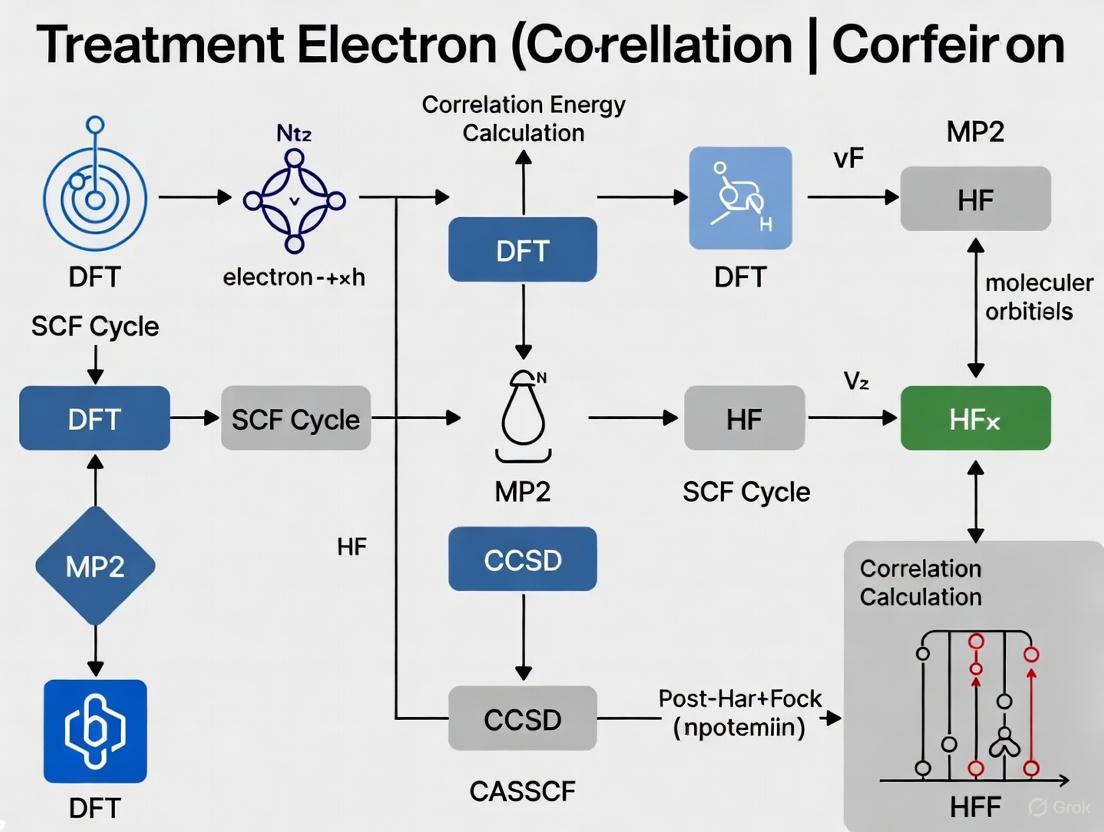
Accurate treatment of electron correlation is fundamental to reliable quantum chemical calculations in drug discovery, impacting predictions of binding affinities, reaction mechanisms, and molecular properties.
Electron Correlation in Drug Discovery: A Practical Guide to DFT vs. Post-HF Methods
Abstract
Accurate treatment of electron correlation is fundamental to reliable quantum chemical calculations in drug discovery, impacting predictions of binding affinities, reaction mechanisms, and molecular properties. This article provides a comprehensive guide for researchers and drug development professionals, exploring the foundational theories, practical applications, and comparative performance of Density Functional Theory (DFT) and post-Hartree-Fock (post-HF) methods. We examine the inherent trade-offs between computational cost and accuracy, detail strategies for method selection and troubleshooting, and validate approaches against benchmark systems and real-world case studies. By synthesizing current methodologies and emerging trends, this review aims to equip scientists with the knowledge to optimize their computational strategies for challenging therapeutic targets, from small molecules to complex biomolecular systems.
The Quantum Mechanical Foundation: Understanding Electron Correlation
Defining the Electron Correlation Problem in Quantum Chemistry
Electron correlation has been called the "chemical glue" of nature due to its ubiquitous influence in molecules and solids [1]. This fundamental problem dates back to early quantum mechanical studies of two-electron systems like helium and H₂ in the 1920s [1]. The correlation concept presupposes an independent particle model, typically Hartree-Fock mean-field theory, which serves as a reference compared to which the exact solution is correlated [1]. The associated idea of correlation energy goes back to Wigner's work in the 1930s on the uniform electron gas and metals, with Löwdin providing the modern definition as the difference between the exact and Hartree-Fock energy [1].
Understanding and accurately calculating electron correlation represents one of the most significant challenges in quantum chemistry today. This challenge forms the central divide between two predominant computational approaches: density functional theory and post-Hartree-Fock wavefunction methods. As research continues to advance in both domains, recognizing their complementary strengths and limitations becomes essential for researchers, particularly those applying these methods to complex problems in drug development and materials science.
Theoretical Foundations and Definitions
Quantifying Electron Correlation
From a statistical perspective, Hartree-Fock theory already contains some correlation introduced by antisymmetrization and the Pauli exclusion principle [1]. Two fundamental measures help quantify electron correlation:
The cumulant ( \lambda_2 ) obtained from one- and two-body reduced density matrices provides an intrinsic measure of correlation effects beyond what can be factorized in terms of the one-body density matrix [1]. This approach goes beyond Löwdin's definition as it contains no explicit reference to the Hartree-Fock state.
The Fermi and Coulomb correlation distinction emerges when using an antisymmetrized reference. Fermi correlation relates to exchange effects already included in Hartree-Fock, while Coulomb correlation represents the residual electron correlation effects [1].
The Reference State Problem
The choice of reference state significantly impacts how electron correlation is defined and calculated [1]. In practice, researchers can build reference states using different N-electron basis states:
- Determinants: Antisymmetrized products of orbitals that are eigenfunctions of Ŝ_z but not necessarily Ŝ² [1]
- Configuration State Functions: Eigenstates of both Ŝ_z and Ŝ² obtained from linear combinations of determinants [1]
- Configurations: Sets of determinants or CSFs sharing the same spatial orbital occupation numbers [1]
The distinction among these reference functions is crucial because configurations incorporating spin-coupling into the reference can reduce the complexity of the wavefunction expansion [1].
Table 1: Measures of Electron Correlation in Quantum Chemistry
| Measure Type | Key Descriptors | Theoretical Foundation | Applications |
|---|---|---|---|
| Wavefunction-Based | Dominant weights in full configuration solution, CI coefficients | Löwdin's correlation energy definition, multi-reference character | Post-HF methods (CI, CC, CASSCF) |
| Density-Based | Shannon entropy, Fisher information, Onicescu energy, Rényi entropy | Information-theoretic approach, electron density as probability distribution | Predicting correlation energies, QML models |
| Statistical | Two-body cumulant ( \lambda_2 ), reduced density matrices | Kullback-Leibler divergence, independence measures | Analysis of correlation strength |
Computational Approaches to Electron Correlation
Post-Hartree-Fock Wavefunction Methods
Post-Hartree-Fock methods explicitly account for electron correlation by going beyond the single-determinant approximation:
- Møller-Plesset Perturbation Theory: Particularly MP2 (second-order), which adds correlation effects via perturbation theory [2]
- Coupled-Cluster Theory: Including CCSD and the "gold standard" CCSD(T) that provides high accuracy for correlation energies [3]
- Configuration Interaction: CISD and other variants that mix multiple electronic configurations [2]
- Multi-Reference Methods: CASSCF and similar approaches that handle strong correlation [2]
These methods are systematically improvable but suffer from rapidly increasing computational cost with system size. For example, CCSD(T) scales as the seventh power of the system size, making it prohibitive for large molecules [3].
Density Functional Theory Approximations
Density Functional Theory原则上是一种精确的理论,但实际应用中需要近似:
- Key Distinction: Must differentiate between exact DFT and Density Functional Approximations - failures are typically DFA failures, not DFT failures [4]
- Jacob's Ladder: Hierarchy of functionals from LDA to meta-GGA, hybrids, and beyond, but no systematic improvability [4]
- Common Failures: Standard DFAs struggle with dispersion interactions, self-interaction error, charge transfer systems, anions, and strongly correlated systems [4]
Emerging Approaches
Recent research has explored innovative approaches to the electron correlation problem:
- Information-Theoretic Approach: Uses simple physics-inspired density-based quantities like Shannon entropy and Fisher information to predict post-Hartree-Fock electron correlation energies at reduced computational cost [3]
- Linear Regression Protocols: LR(ITA) can predict MP2, CCSD, and CCSD(T) correlation energies at Hartree-Fock cost while maintaining chemical accuracy for various systems [3]
- Quantum Information Theory: Entanglement-based approaches to understanding and quantifying electron correlation [1]
Methodologies and Experimental Protocols
Information-Theoretic Approach Protocol
The information-theoretic approach provides a method for predicting correlation energies using density-based descriptors [3]:
Step 1: System Preparation
- Select molecular systems of interest (e.g., octane isomers, polymeric structures, molecular clusters)
- Generate molecular geometries through optimization or experimental data
Step 2: Reference Calculations
- Perform Hartree-Fock calculations with appropriate basis sets (e.g., 6-311++G(d,p))
- Compute low-cost information-theoretic quantities from electron density:
- Shannon entropy ((SS))
- Fisher information ((IF))
- Ghosh, Berkowitz, and Parr entropy ((S{GBP}))
- Onicescu information energy ((E2) and (E3))
- Relative Rényi entropy ((R2^r) and (R3^r))
- Relative Shannon entropy ((IG))
- Relative Fisher information ((G1), (G2), and (G_3))
Step 3: Target Correlation Energies
- Calculate reference electron correlation energies using post-Hartree-Fock methods (MP2, CCSD, CCSD(T))
- For large systems, employ linear-scaling methods like generalized energy-based fragmentation (GEBF)
Step 4: Regression Model Development
- Construct linear relationships between ITA quantities and correlation energies
- Validate model accuracy using root mean squared deviations (RMSD)
- Apply to predict correlation energies for new systems
This protocol has demonstrated chemical accuracy (<1 kcal/mol error) for various systems including organic polymers and molecular clusters while reducing computational cost significantly [3].
Performance Assessment Methodology
Comparative evaluation of computational methods follows established protocols:
Systematic Benchmarking:
- Select diverse molecular test sets with varying electronic structure characteristics
- Include zwitterionic systems, transition metal complexes, and extended systems
- Compute multiple molecular properties: dipole moments, reaction energies, structural parameters
- Compare with high-level reference data and experimental results
Accuracy Validation:
- Statistical analysis of errors (RMSD, mean absolute errors)
- Assessment of method transferability across different system types
- Evaluation of computational cost and scaling behavior
Comparative Performance Analysis
Quantitative Assessment Across System Types
Recent studies provide comprehensive quantitative comparisons of different approaches for handling electron correlation:
Table 2: Performance of Correlation Methods Across Molecular Systems
| System Type | Representative Examples | HF Performance | DFT Performance | Post-HF Performance | ITA Approach |
|---|---|---|---|---|---|
| Octane Isomers | 24 structural isomers | Baseline reference | Varies with functional | MP2/CCSD/CCSD(T) reference | RMSD <2.0 mH with IF descriptor [3] |
| Linear Polymers | Polyyne, polyene, acene | Insufficient correlation | Functional-dependent | High accuracy but expensive | RMSD ~1.5-11 mH depending on system [3] |
| Molecular Clusters | (H₂O)ₙ, (CO₂)ₙ, (C₆H₆)ₙ | Poor for dispersion | Varies; may need dispersion correction | Accurate but computationally challenging | RMSD 2.1-9.3 mH for H⁺(H₂O)ₙ [3] |
| Zwitterions | Pyridinium benzimidazolates | Excellent for dipole moments (~10.33D exp) [2] | Poor performance for charge separation | CASSCF, CCSD, QCISD match HF accuracy [2] | Not specifically tested |
| Metallic Clusters | Beₙ, Mgₙ, Siₙ | Typically inadequate | Varies with functional | High accuracy but prohibitively expensive | Moderate accuracy (RMSD ~17-42 mH) [3] |
Information-Theoretic Quantities as Correlation Descriptors
The effectiveness of different information-theoretic quantities for predicting correlation energies varies significantly:
Table 3: Performance of ITA Quantities for Correlation Energy Prediction
| ITA Quantity | Physical Interpretation | Performance for Octane Isomers | Performance for Polymers | Performance for Water Clusters |
|---|---|---|---|---|
| Shannon Entropy | Global delocalization of electron density | Moderate accuracy (RMSD <2.0 mH) [3] | Good for delocalized systems | Not best performer |
| Fisher Information | Local inhomogeneity, density sharpness | Best performer for alkanes [3] | Excellent for various polymers | Moderate accuracy |
| Onicescu Energy | Information energy measure | Not reported as top performer | Not highlighted | Best performer (RMSD 2.1 mH) [3] |
| Relative Rényi Entropy | Distinguishability between densities | Variable performance | Good for certain polymers | Moderate accuracy |
| G₃ Relative Fisher | Local density differences | Less accurate for alkanes | Inadequate for some systems | Least accurate (RMSD 9.3 mH) [3] |
Visualization of Methodological Relationships
Diagram 1: Methodological approaches to electron correlation, showing the relationships between major computational families and specific methods.
The Researcher's Toolkit: Essential Computational Methods
Table 4: Computational Methods for Electron Correlation Studies
| Method Category | Specific Methods | Key Applications | Strengths | Limitations |
|---|---|---|---|---|
| Hartree-Fock | RHF, UHF, ROHF | Reference calculations, initial guess | Conceptual foundation, no empirical parameters | Lacks electron correlation, poor for many properties |
| Post-HF Wavefunction | MP2, CCSD, CCSD(T), CASSCF, MRCI | Benchmark calculations, small molecules | Systematically improvable, high accuracy | Computational cost, scaling with system size |
| Density Functional Approximations | B3LYP, ωB97XD, M06-2X, TPSSh | Medium-large systems, organic chemistry | Favorable cost-accuracy ratio | Not systematically improvable, functional-dependent errors |
| Information-Theoretic | LR(ITA) with density descriptors | Correlation energy prediction, large systems | Low computational cost, physical interpretability | Developing field, limited validation across system types |
| Composite Methods | GEBF, ONIOM, QM/MM | Very large systems, biomolecules | Enables treatment of large systems | Approximation errors, boundary effects |
The electron correlation problem remains a central challenge in quantum chemistry, with significant implications for drug development and materials science. The divergence between DFT and post-Hartree-Fock approaches reflects complementary philosophies: one seeking computational efficiency while maintaining reasonable accuracy, the other pursuing systematic improvability at higher computational cost.
Recent developments in information-theoretic approaches suggest promising middle ground, using physical descriptors to predict correlation energies at reduced computational expense [3]. For zwitterionic systems important in pharmaceutical contexts, traditional Hartree-Fock sometimes outperforms DFT, particularly for properties sensitive to charge separation [2]. This highlights the continued importance of method validation and the danger of overreliance on single approaches.
Future progress will likely emerge from hybrid strategies that leverage the strengths of multiple approaches, such as combining DFT's computational efficiency with wavefunction methods' systematic improvability or information-theoretic descriptors' physical interpretability. For researchers in drug development, this landscape underscores the importance of carefully selecting computational methods appropriate for specific molecular systems and properties of interest, rather than relying on universal solutions to the electron correlation problem.
The Hartree-Fock (HF) method stands as the foundational cornerstone in modern electronic structure theory, providing the essential reference wavefunction from which most sophisticated quantum chemical methods are built [5]. Its formulation is central to understanding the challenging problem of electron correlation. The HF approximation utilizes a mean-field approach where each electron experiences the average electrostatic field of all other electrons, resulting in a wavefunction described by a single Slater determinant [6]. While this method recovers approximately 99% of the total electronic energy of a system, the remaining 1%—termed the electron correlation energy—is crucial for achieving chemical accuracy, as it corresponds energetically to the strength of typical chemical bonds and reactions [5].
This whitepaper examines the fundamental strengths and limitations of the Hartree-Fock method, with particular focus on its inherent inability to capture electron correlation effects. We position this discussion within the ongoing methodological competition between density functional theory (DFT) and post-Hartree-Fock (post-HF) approaches, both of which seek to address this correlation deficiency through fundamentally different philosophical frameworks.
Theoretical Foundation of the Hartree-Fock Method
Methodological Framework
The Hartree-Fock method approximates the exact N-electron wavefunction of a quantum system with a single Slater determinant, constructed from one-electron spin orbitals [6]. Through the variational principle, these orbitals are optimized to minimize the total energy, leading to the self-consistent field (SCF) procedure [6]. The key simplification arises from the mean-field approximation, where the complex electron-electron interactions are replaced with an effective potential [6].
The Fock operator, (\hat{F}), embodies this approach for a closed-shell system:
[ \hat{F} = \hat{H}^{\text{core}}(1) + \sum{j=1}^{N} [2\hat{J}j(1) - \hat{K}_j(1)] ]
where (\hat{H}^{\text{core}}) represents the one-electron operators (kinetic energy and electron-nuclear attraction), while (\hat{J}j) and (\hat{K}j) correspond to the Coulomb and exchange operators, respectively [5]. The exchange term, (\hat{K}_j,) accounts for Fermi correlation, ensuring the wavefunction antisymmetry required by the Pauli exclusion principle [5].
Critical Approximations and Their Consequences
The HF method introduces five major simplifications [6]:
- The Born-Oppenheimer approximation.
- Complete neglect of relativistic effects.
- Use of a finite basis set expansion.
- Representation of the wavefunction by a single Slater determinant.
- The mean-field approximation for electron-electron interactions.
The last two approximations define the "correlation problem" in Hartree-Fock theory. While the method fully accounts for Fermi correlation (through antisymmetrization), it completely neglects Coulomb correlation—the correlated motion of electrons due to their mutual repulsion [6] [5]. In the HF picture, electrons experience only the average field of their counterparts, leading to statistically independent motion rather than the physically realistic scenario where electrons instinctively avoid one another to minimize Coulomb repulsion.
Quantifying the Hartree-Fock Deficiency
The Correlation Energy Definition
The electron correlation energy, (E{\text{corr}}), is formally defined by Löwdin as the difference between the exact non-relativistic energy of the system, (E{\text{exact}}), and the Hartree-Fock energy, (E_{\text{HF}}) [5]:
[ E{\text{corr}} = E{\text{exact}} - E_{\text{HF}} ]
This missing energy component, though typically representing only about 1% of the total energy, is chemically significant, often corresponding to 100-400 kJ/mol—precisely the energy range of chemical bonding and reactivity [5].
The Coulomb Hole
A powerful visualization of the HF deficiency is the Coulomb hole—the difference in the probability distribution of interelectronic distances between correlated and HF wavefunctions [5]. For a two-electron system, the intracule density, (h(r)), measures the distribution of the interelectronic distance (r_{12}):
[ h(r) \equiv \rho{12}(r) = \langle \Psi | \delta(r{12} - r) | \Psi \rangle ]
The Coulomb hole is then defined as [5]:
[ \Delta D(r) = D{\text{FC}}(r) - D{\text{HF}}(r) ]
where (D{\text{FC}}(r)) and (D{\text{HF}}(r)) are the intracule distribution functions for the fully correlated and Hartree-Fock wavefunctions, respectively. As shown in Figure 1 for the hydride ion, the Coulomb hole demonstrates that the HF method overestimates the probability of electrons being close together, while correlated methods correctly show that electrons avoid each other more effectively [5].
Systematic Errors in Molecular Properties
The correlation deficiency in HF manifests in predictable systematic errors across various molecular properties:
- Binding Energies and Reaction Barriers: Systematic overestimation due to inadequate description of bond breaking and transition states.
- Weak Interactions: Complete failure to describe dispersion-bound complexes (e.g., van der Waals complexes, π-π stacking) as HF lacks any London dispersion component [6].
- Bond Dissociation: Pathological errors in describing homolytic bond cleavage, where HF fails to converge to the correct degenerate atomic limit.
- Electronic Excitations: Inaccurate prediction of excited states, particularly those with charge-transfer character or double-excitation character.
Contemporary Research: Bridging the Correlation Gap
Predictive Models Using Information-Theoretic Quantities
Recent advances demonstrate that information-theoretic approach (ITA) quantities derived from Hartree-Fock electron densities can successfully predict post-HF correlation energies, potentially bypassing expensive computations. These ITA descriptors—including Shannon entropy, Fisher information, and Onicescu information energy—encode essential features of the electron density distribution and show strong linear correlations with MP2, CCSD, and CCSD(T) correlation energies across diverse chemical systems [3].
Table 1: Performance of Linear Regression (LR) Models for Predicting MP2 Correlation Energies Using ITA Quantities
| System Class | Representative Examples | Best ITA Descriptor | R² Value | RMSD (mH) |
|---|---|---|---|---|
| Organic Isomers | 24 Octane Isomers | Fisher Information (I_F) | >0.990 | <2.0 |
| Linear Polymers | Polyyne, Polyene | Multiple (SGBP, IF, E_2) | 1.000 | ~1.5-3.0 |
| Molecular Clusters | (H₂O)ₙ, (CO₂)ₙ, (C₆H₆)ₙ | Onicescu (E2, E3) | 1.000 | 2.1-9.3 |
| Metallic Clusters | Beₙ, Mgₙ | Shannon Entropy (S_S) | >0.990 | 17-42 |
This LR(ITA) protocol achieves remarkable accuracy, often reaching chemical accuracy (1 kcal/mol ≈ 1.6 mH) at merely the computational cost of a HF calculation [3]. For instance, in protonated water clusters H⁺(H₂O)ₙ comprising 1480 structures, the method maintained R² = 1.000 with RMSDs as low as 2.1 mH [3].
Machine Learning Approaches
Machine learning (ML) techniques have emerged as powerful tools for correcting HF deficiencies. Recent work demonstrates that ML models can predict B3LYP-D4/def-TZVP electronic energies and thermodynamic properties from HF-3c calculations on supramolecular structures [7]. Using a dataset of 1031 dimer, trimer, and tetramer cyclic structures, models including LASSO, XGBoost, and single-layer perceptrons successfully predicted energy-related features with high fidelity, though dipole moments remained challenging [7]. This HF-to-DFT prediction framework significantly reduces computational cost while potentially achieving DFT-level accuracy.
Table 2: Experimental Protocols for Correlation Energy Prediction
| Method | Computational Protocol | Target Property | Key Steps | Validation |
|---|---|---|---|---|
| LR(ITA) Protocol [3] | 1. HF/6-311++G(d,p) calculation2. Compute ITA quantities from density3. Apply linear regression equations | MP2, CCSD, CCSD(T) correlation energy | • Calculate 11 ITA descriptors (Shannon entropy, Fisher information, etc.)• Use pre-trained LR coefficients | Compare predicted vs. calculated correlation energies; RMSD analysis |
| ML Prediction [7] | 1. HF-3c geometry optimization2. Feature extraction (energy, entropy, etc.)3. Model training with scikit-learn/TensorFlow | B3LYP-D4/def-TZVP electronic energy, Gibbs energy | • Pad coordinate vectors to uniform length• Train on 1031 supramolecular structures• Use 6 quantum chemical descriptors | Mean absolute error comparison; benchmark against reference DFT |
| CMR Method [8] | 1. Construct Gutzwiller wavefunction2. Optimize local configuration weights3. Solve renormalized HF-like equations | Total energy with strong correlation | • Evaluate two-particle correlation matrix• Apply Gutzwiller approximation• Include residual correlation energy E_c | Compare dissociation curves with full CI/MCSCF |
Hybrid Approaches: Combining DFT and Wavefunction Theory
Innovative hybrid methods are emerging that combine the strengths of different theoretical approaches. The CI/DFT method, for instance, performs configuration interaction calculations using molecular orbitals generated from preliminary DFT calculations rather than the conventional HF orbitals [9]. This approach exploits the flexibility of DFT orbitals and their inherent account for electron correlation, potentially offering improved convergence and accuracy for excited states, particularly core-excited states where electron correlation effects are pronounced [9].
Another promising direction is the Correlation Matrix Renormalization (CMR) theory, which extends the Gutzwiller approximation to evaluate expectation values of two-particle operators [8]. This method provides accurate descriptions of strongly correlated systems like hydrogen and nitrogen clusters during bond dissociation, achieving accuracy comparable to high-level quantum chemistry calculations while maintaining computational workload similar to the HF approach [8].
The Scientist's Toolkit: Research Reagent Solutions
Table 3: Essential Computational Tools for Electron Correlation Studies
| Tool/Resource | Type | Primary Function | Application Context |
|---|---|---|---|
| 6-311++G(d,p) Basis Set | Basis Set | Triple-zeta quality with diffuse and polarization functions | Balanced accuracy for correlation energy calculations on main-group elements [3] |
| def2-TZVP | Basis Set | Triple-zeta valence polarization basis | DFT and correlated calculations; used with D4 dispersion corrections [7] |
| HF-3c Method | Composite Method | Fast Hartree-Fock with geometrical corrections | Low-cost calculations for ML training sets on large systems [7] |
| B3LYP-D4 Functional | DFT Functional | Hybrid functional with dispersion corrections | Reference values for ML model training [7] |
| ORCA 5.0.4 | Software Package | Quantum chemistry program | High-performance computation of molecular properties [7] |
| Psi4 | Software Package | Open-source quantum chemistry | Configuration interaction calculations (CI/DFT) [9] |
| ITA Descriptors | Analytical Tool | Information-theoretic quantities | Predict correlation energies from HF densities [3] |
| Gutzwiller Wavefunction | Wavefunction Ansatz | Variational wavefunction for correlations | Strong correlation treatment in CMR theory [8] |
The Hartree-Fock method remains an indispensable baseline in quantum chemistry, providing both the conceptual framework and computational starting point for understanding electron correlation effects. Its strengths—conceptual clarity, variational foundation, and computational efficiency—are balanced by its critical deficiency in capturing Coulomb correlation. Contemporary research demonstrates remarkable progress in addressing this limitation through innovative approaches including information-theoretic descriptors, machine learning corrections, and hybrid methodologies.
The ongoing competition between DFT and post-HF approaches for treating electron correlation is increasingly giving way to synergistic integration, where methods like CI/DFT combine density-based orbitals with wavefunction theory expansion [9]. Similarly, ML models now enable the prediction of high-level correlation energies from minimal HF computations [3] [7]. For researchers in drug development and materials science, these advances translate to increasingly accurate predictions of molecular properties, binding affinities, and reaction pathways with computational efficiency that bridges the gap between accuracy and feasibility. As these methodologies continue to mature, the Hartree-Fock baseline will undoubtedly maintain its central role in the multiscale modeling of molecular systems.
Theoretical Foundation and Electron Correlation
The Limitations of Hartree-Fock Theory
Hartree-Fock (HF) theory serves as the fundamental starting point for most ab initio quantum chemical methods but contains a critical simplification: it neglects electron correlation [10]. In HF theory, electrons move in an average field created by all other electrons, which fails to capture their instantaneous repulsive interactions [11] [12]. This mean-field approximation leads to systematic errors in predicted molecular properties and energies [6]. The correlation energy is formally defined as the difference between the exact energy and the HF energy: (E{corr} = E{exact} - E_{HF}) [11]. While this typically represents a small fraction of the total energy, it proves crucial for achieving chemical accuracy in computational predictions.
Types of Electron Correlation
Electron correlation manifests in two primary forms that post-HF methods must address:
Dynamic Correlation: Arises from the instantaneous Coulombic repulsion between electrons, reflecting their tendency to avoid one another due to Coulomb's law. This represents rapid fluctuations in electron positions and is particularly significant in systems with weakly interacting electrons [11].
Static (Non-Dynamic) Correlation: Results from near-degeneracy of electronic configurations, occurring when multiple electronic states have comparable energies. This becomes particularly important in systems with stretched bonds, transition metal complexes, diradicals, and excited states [11]. Static correlation requires a multi-reference description where multiple Slater determinants contribute significantly to the wavefunction.
Post-Hartree-Fock methods comprise a family of computational approaches designed to recover the electron correlation missing in conventional HF calculations [10]. These methods systematically improve upon HF by expanding the description of the electronic wavefunction beyond a single Slater determinant [13]. The development of these methods represents a fundamental divergence from Density Functional Theory (DFT), as post-HF methods specifically target increasingly accurate approximations of the many-electron wavefunction, whereas DFT employs various approximations to the exchange-correlation functional [14] [12].
Table 1: Classification of Major Post-Hartree-Fock Methods
| Method Category | Representative Methods | Key Features | Electron Correlation Treated |
|---|---|---|---|
| Wavefunction-Based | MP2, MP4, CCSD, CCSD(T) | Systematic improvement, size-consistent | Primarily dynamic |
| Multi-Reference | CASSCF, MRCI, CASPT2 | Active space selection, multi-determinantal | Both static and dynamic |
| Variational | CISD, FCI | Exact within basis set, computationally demanding | Both static and dynamic (if full CI) |
Contextual Framework: Post-HF vs. DFT for Electron Correlation
The treatment of electron correlation represents the fundamental distinction between post-HF and DFT approaches. While both frameworks aim to overcome HF limitations, their philosophical and methodological approaches differ significantly [14] [12]:
DFT Approach: Incorporates electron correlation through an approximate exchange-correlation functional, which depends solely on the electron density [12]. This makes DFT computationally efficient but subject to limitations of approximate functionals, particularly for strongly correlated systems, dispersion interactions, and charge-transfer excitations [14].
Post-HF Approach: Explicitly accounts for electron correlation through wavefunction expansion, offering a systematically improvable hierarchy of methods [13] [10]. While computationally more demanding, post-HF methods can, in principle, approach the exact solution of the non-relativistic Schrödinger equation within the chosen basis set [11].
Recent research has demonstrated that HF can sometimes outperform DFT for specific systems, particularly zwitterionic molecules where HF's localization behavior proves advantageous over DFT's delocalization issue [14]. This highlights the continued importance of wavefunction-based methods as benchmarks for developing and validating new DFT functionals.
Key Post-Hartree-Fock Methods
Wavefunction Expansion Methods
Configuration Interaction (CI)
The CI method expands the wavefunction as a linear combination of Slater determinants representing various electronic configurations [13]:
[
\Psi{CI} = c0\Psi0 + \sum{i,a}ci^a\Psii^a + \sum{i
where (\Psi0) is the HF reference wavefunction, (\Psii^a) represents singly-excited determinants, (\Psi_{ij}^{ab}) represents doubly-excited determinants, and so on [13]. The coefficients (c) are determined variationally by minimizing the energy. Different truncation levels yield various CI methods:
- CIS: Includes only single excitations; improves description of excited states but not correlation energy.
- CISD: Includes single and double excitations; recovers approximately 80-90% of correlation energy but lacks size-consistency.
- FCI: Includes all possible excitations within the basis set; provides exact solution for the system but is computationally prohibitive for all but smallest systems [13] [11].
The major limitation of truncated CI methods is their lack of size-consistency, meaning the energy of separated molecular fragments does not equal the sum of individually computed fragment energies [13].
Coupled Cluster (CC)
Coupled Cluster theory employs an exponential ansatz for the wavefunction operator [13]:
[ \Psi{CC} = e^{\hat{T}}\Psi0 ]
where (\hat{T} = \hat{T}1 + \hat{T}2 + \hat{T}3 + \cdots) is the cluster operator consisting of single ((\hat{T}1)), double ((\hat{T}2)), triple ((\hat{T}3)), etc., excitation operators. The exponential operator ensures size-consistency, addressing a key limitation of CI methods [13]. Common CC variants include:
- CCSD: Includes single and double excitations; offers excellent accuracy for many systems.
- CCSD(T): Adds a perturbative treatment of triple excitations; often called the "gold standard" of quantum chemistry for single-reference systems, providing chemical accuracy (~1 kcal/mol error) for many applications [10].
CC methods typically recover 98-99% of the correlation energy and are size-consistent and size-extensive, making them particularly valuable for studying reaction energies and molecular properties [13].
Møller-Plesset Perturbation Theory
MP perturbation theory treats electron correlation as a perturbation to the HF Hamiltonian [13]. The Hamiltonian is partitioned as (\hat{H} = \hat{H}0 + \lambda\hat{V}), where (\hat{H}0) is the HF Hamiltonian and (\hat{V}) represents the fluctuation potential. The MP series expansion provides systematic improvement:
- MP2: Second-order MP theory; captures 80-90% of correlation energy with reasonable computational cost ((O(N^5)) scaling).
- MP4: Includes contributions from single, double, triple, and quadruple excitations; more accurate but computationally demanding ((O(N^7)) scaling).
MP methods are size-consistent but not variational, meaning computed energies may fall below the exact energy [13]. The MP series may exhibit divergent behavior for systems with significant static correlation [13].
Multi-Reference Methods
Complete Active Space SCF (CASSCF)
CASSCF represents a special case of Multi-Configurational SCF (MCSCF) where the CI expansion includes all possible distributions of electrons within a carefully selected active space of orbitals [13] [11]. The active space is denoted CAS(n,m), where n is the number of active electrons and m is the number of active orbitals. CASSCF is particularly effective for treating static correlation in systems with near-degenerate states, including bond-breaking reactions, diradicals, and transition metal complexes [13] [11].
The CASSCF wavefunction is expressed as: [ \Psi{\text{CASSCF}} = \sum{I} cI \PhiI ] where the sum includes all configurations within the active space [11]. The method optimizes both the CI coefficients and molecular orbitals simultaneously. The primary challenge lies in selecting an appropriate active space, which requires chemical intuition and understanding of the system [13].
Multi-Reference Configuration Interaction (MRCI)
MRCI extends the CI approach by using a multi-reference wavefunction (often from CASSCF) as the starting point, then including all single and double excitations from all reference configurations [13]. This approach combines accurate treatment of both static and dynamic correlation but comes with extremely high computational cost, limiting applications to small systems.
Multi-Reference Perturbation Theory
Methods like CASPT2 and NEVPT2 add a perturbative treatment of dynamic correlation to a CASSCF reference wavefunction [13]. CASPT2 has emerged as a powerful method for calculating accurate excitation energies and reaction barriers in multi-reference systems, while NEVPT2 offers advantages in avoiding intruder state problems.
Table 2: Computational Scaling and Applications of Post-HF Methods
| Method | Computational Scaling | Key Strengths | Key Limitations |
|---|---|---|---|
| HF | (O(N^4)) | Fast, robust convergence | Neglects electron correlation |
| MP2 | (O(N^5)) | Good cost/accuracy ratio for dynamic correlation | Poor for static correlation, not variational |
| CCSD | (O(N^6)) | Size-consistent, excellent for dynamic correlation | Expensive, poor for static correlation |
| CCSD(T) | (O(N^7)) | "Gold standard" for single-reference systems | Very expensive, poor for multi-reference cases |
| CASSCF | Depends on active space | Excellent for static correlation, bond breaking | Active space selection, misses dynamic correlation |
| CASPT2 | Depends on active space | Both static and dynamic correlation | Intruder states, expensive |
| FCI | Factorial | Exact within basis set | Computationally prohibitive |
Computational Implementation and Protocols
Basis Set Requirements
All post-HF methods exhibit strong basis set dependence, requiring larger, more flexible basis sets to achieve converged results [13]. Correlation-consistent basis sets (cc-pVDZ, cc-pVTZ, cc-pVQZ, etc.) were specifically designed for post-HF calculations, systematically approaching the complete basis set (CBS) limit [13]. The basis set incompleteness error typically converges as (1/X^3) for correlation energy with cc-pVXZ basis sets.
Workflow and Method Selection
The following diagram illustrates a typical decision workflow for selecting appropriate electronic structure methods based on system characteristics and computational resources:
Experimental Protocols and Methodologies
A comprehensive investigation of zwitterionic systems provides an illustrative example of post-HF methodology application [14]:
Computational Protocol:
- Software: Gaussian 09 quantum chemistry program package
- Methods Comparison: HF, various DFT functionals (B3LYP, CAM-B3LYP, BMK, B3PW91, TPSSh, LC-ωPBE, M06-2X, M06-HF, ωB97xD), and post-HF methods (MP2, CASSCF, CCSD, QCISD, CISD)
- System: Pyridinium benzimidazolate zwitterions
- Geometric Constraints: No symmetry restrictions during optimization
- Convergence Criteria: True local minimum confirmed through vibrational frequency analysis (all positive frequencies)
Key Findings:
- HF method outperformed all tested DFT functionals in reproducing experimental dipole moments of zwitterionic systems
- Post-HF methods (CCSD, CASSCF, CISD, QCISD) confirmed reliability of HF for these specific systems
- HF's localization behavior proved advantageous over DFT's delocalization issue for zwitterions
- This study demonstrates that system-specific method validation remains essential despite general trends favoring more sophisticated methods [14]
Table 3: Essential Software and Computational Resources for Post-HF Calculations
| Resource Category | Specific Examples | Primary Function | Application Context |
|---|---|---|---|
| Quantum Chemistry Packages | Gaussian, PSI4, COLUMBUS, MOLPRO | Implementation of electronic structure methods | Production calculations, method development |
| Basis Set Libraries | Basis Set Exchange, EMSL Basis Set Library | Provide standardized basis sets | Ensuring transferability, comparison studies |
| Visualization Software | GaussView, Avogadro, VMD | Molecular structure, orbitals, properties visualization | Results interpretation, publication graphics |
| High-Performance Computing | Cluster computing, cloud resources | Computational demanding post-HF calculations | Large systems, high-accuracy methods |
Post-Hartree-Fock wavefunction theories provide a systematically improvable framework for treating electron correlation, addressing fundamental limitations of both HF and DFT methods. While computational demands remain substantial, ongoing algorithmic advances and increasing computational resources continue to expand the applicability of these methods. The hierarchy of post-HF methods offers researchers a principled approach to balancing accuracy and computational cost based on specific system requirements.
The complementary strengths of wavefunction-based and density-based approaches suggest that both will continue to play crucial roles in computational chemistry, with post-HF methods often serving as benchmarks for developing and validating more efficient approximate methods like DFT. For systems where chemical accuracy is paramount, particularly those exhibiting strong static correlation or challenging electronic structures, post-HF methods remain indispensable tools in the computational chemist's arsenal.
A fundamental challenge in quantum chemistry is the accurate and computationally feasible description of electron correlation—the correction to the mean-field approximation that accounts for electron-electron interactions. The development of theoretical methods to treat electron correlation represents a central divide in computational chemistry, primarily between the highly accurate but computationally expensive post-Hartree-Fock (post-HF) wavefunction methods and the more efficient but approximate density functional theory (DFT). While post-HF methods like MP2 and CCSD(T) systematically approach exact solutions of the Schrödinger equation, their steep computational scaling (often O(N⁵) to O(N⁷)) restricts their application to small molecules. DFT, with its more favorable O(N³) scaling, emerges as the indispensable practical alternative for studying large, complex systems across chemistry, materials science, and drug discovery, despite ongoing challenges in functional development [15] [16].
Theoretical Foundations: From Wavefunction to Electron Density
The theoretical foundation of DFT represents a paradigm shift from traditional wavefunction-based quantum chemistry. Whereas post-HF methods explicitly treat the many-electron wavefunction, DFT recasts the problem in terms of the electron density, a simple 3-dimensional function.
The Hohenberg-Kohn Theorems and Kohn-Sham Framework
The modern formulation of DFT rests on two cornerstone theorems established by Hohenberg and Kohn in 1964 [17]:
- The existence theorem: The ground-state electron density uniquely determines the external potential (nuclear framework) and thus all properties of the system.
- The variational theorem: A universal energy functional E[ρ] exists, and the exact ground-state density minimizes this functional.
The practical implementation of DFT was enabled by Kohn and Sham (1965), who introduced a revolutionary approach: replacing the complex interacting system with a fictitious system of non-interacting electrons that generates the same density [17]. This leads to the Kohn-Sham equations:
[ \left[-\frac{1}{2}\nabla^2 + v{\text{eff}}(\mathbf{r})\right] \psii(\mathbf{r}) = \epsiloni \psii(\mathbf{r}) ]
where the effective potential (v{\text{eff}}(\mathbf{r}) = v{\text{ext}}(\mathbf{r}) + v{\text{H}}(\mathbf{r}) + v{\text{xc}}(\mathbf{r})) includes the external, Hartree, and exchange-correlation (XC) potentials. The total energy functional becomes:
[ E[\rho] = Ts[\rho] + V{\text{ext}}[\rho] + J[\rho] + E_{\text{xc}}[\rho] ]
where (Ts[\rho]) is the kinetic energy of non-interacting electrons, (V{\text{ext}}[\rho]) is the external potential energy, (J[\rho]) is the classical Coulomb energy, and (E_{\text{xc}}[\rho]) is the exchange-correlation functional that encapsulates all many-body effects [18].
The Exchange-Correlation Functional: DFT's Central Challenge
The accuracy of Kohn-Sham DFT hinges entirely on the approximation used for (E_{\text{xc}}[\rho]), as its exact form remains unknown. The evolution of XC functionals is often visualized as climbing "Jacob's Ladder," where each rung incorporates more sophisticated ingredients to achieve better accuracy [17].
Diagram 1: Jacob's Ladder of DFT functional evolution, showing increasing complexity and accuracy.
Comparative Analysis: DFT Versus Post-HF Methods
Computational Efficiency and Application Scope
The primary advantage of DFT over post-HF methods lies in its computational efficiency, which enables studies of systems that are computationally prohibitive for wavefunction-based methods.
Table 1: Computational Scaling and Application Scope Comparison
| Method | Computational Scaling | Typical System Size | Key Applications | Key Limitations |
|---|---|---|---|---|
| DFT (GGA) | O(N³) | 100-1000+ atoms | Materials screening, geometry optimization, catalysis [19] | Systematic errors for dispersion, strongly correlated systems |
| DFT (Hybrid) | O(N⁴) | 50-200 atoms | Accurate thermochemistry, band gaps [18] | Higher cost, integration grid sensitivity |
| MP2 | O(N⁵) | 20-50 atoms | Non-covalent interactions, benchmark calculations [15] | Poor performance for metallic systems, basis set sensitivity |
| CCSD(T) | O(N⁷) | 10-20 atoms | "Gold standard" for molecular energies [15] | Prohibitive cost for large systems |
Accuracy Assessment Across Chemical Properties
Recent benchmark studies provide quantitative comparisons of DFT and post-HF methods for various chemical properties.
Table 2: Accuracy Comparison for Different Property Classes (Mean Absolute Errors)
| Method | Bond Energies (kcal/mol) | Reaction Barriers (kcal/mol) | Non-covalent Interactions (kcal/mol) | Band Gaps (eV) |
|---|---|---|---|---|
| PBE (GGA) | ~10-15 | ~8-12 | >100% error | ~1-2 underestimation [20] |
| B3LYP (Hybrid) | ~4-6 | ~5-8 | ~1-2 [15] | ~0.5-1 underestimation |
| SCAN (meta-GGA) | ~3-5 | ~3-5 | ~0.5-1 | ~0.3-0.5 underestimation |
| MP2 | ~2-4 | ~3-5 | ~0.3-0.5 [15] | Not applicable |
| CCSD(T) | ~0.5-1 | ~1-2 | ~0.1-0.2 [15] | Not applicable |
For specific applications like halogen-π interactions relevant to pharmaceutical design, MP2 with TZVPP basis sets has been identified as offering the best balance between accuracy and computational cost [15]. However, for high-throughput screening of materials or large biomolecular systems, DFT remains the only practical choice.
Practical Implementation: Protocols for Reliable DFT Calculations
Systematic Convergence and Optimization Procedures
Reproducible DFT predictions require careful attention to computational parameters. Recent studies highlight that approximately 20% of standard bandgap calculations experience significant failures without optimized protocols [20].
Protocol 1: Basis Set and k-point Convergence
- Plane-wave cutoff energy: Perform convergence tests starting from low values (200 eV) increasing until total energy changes < 1 meV/atom
- k-point grid: Use the second-derivative matrix of orbital energies to minimize interpolation errors rather than merely maximizing grid density [20]
- Pseudopotential selection: Test multiple pseudopotentials (e.g., PAW, ultrasoft) and verify against all-electron calculations when possible
Protocol 2: Self-Consistent Field (SCF) Convergence Acceleration Bayesian optimization of charge mixing parameters can reduce SCF iterations by 20-40%, significantly decreasing computational time [21]:
- Apply Bayesian optimization to identify optimal mixing parameters (AMIN, AMIX, BMIX)
- Implement algorithm for automatic parameter tuning during initial SCF cycles
- Achieve faster convergence than default parameters for insulating, semiconducting, and metallic systems [21]
Diagram 2: Workflow for reliable DFT calculations incorporating Bayesian optimization.
Table 3: Essential Software and Computational Resources for DFT Calculations
| Tool Category | Representative Examples | Primary Function | Application Context |
|---|---|---|---|
| DFT Codes | VASP [21], Quantum ESPRESSO | Solve Kohn-Sham equations | Materials science, surface chemistry |
| Quantum Chemistry Packages | Gaussian, ORCA, PySCF | Molecular DFT calculations | Drug design, molecular properties |
| Analysis Tools | VESTA, ChemCraft | Visualization, density analysis | Data interpretation, publication graphics |
| Machine Learning Extensions | ML-DFT frameworks [19] | Error correction, property prediction | High-throughput screening |
Emerging Frontiers and Future Directions
Machine Learning-Enhanced DFT
Machine learning approaches are addressing fundamental limitations of traditional DFT. Neural network models can now predict discrepancies between DFT-calculated and experimental formation enthalpies, significantly improving phase stability predictions for ternary alloys [19]. These models utilize elemental concentrations, atomic numbers, and interaction terms as features, achieving superior accuracy compared to uncorrected DFT for complex systems like Al-Ni-Pd and Al-Ni-Ti [19].
Advanced Functional Development
Recent innovations in functional design include the development of ionization-energy-dependent correlation functionals that incorporate the density's dependence on ionization energy [22]. When combined with the corresponding exchange functional, this approach demonstrates minimal mean absolute error for bond energies, dipole moments, and zero-point energies across 62 molecules, outperforming established functionals like PBE and B3LYP [22].
Specialized Applications: Positron Binding and Beyond
DFT continues to expand into non-traditional domains through methodological extensions. The correlation-polarization potential (CPP) method combined with DFT now enables calculations of positron binding to molecules and clusters [23]. This approach provides insights into positron affinities of hydrocarbons and water clusters, revealing delocalized features distinct from electron binding [23].
Density functional theory maintains its position as the practical alternative for computational studies of real-world systems where post-HF methods remain prohibitively expensive. While challenges persist—particularly for strongly correlated systems, dispersion interactions, and predictive bandgap calculations—ongoing developments in machine learning correction, functional design, and specialized methodologies continue to expand DFT's capabilities [19] [16].
The future of DFT lies not in supplanting high-accuracy wavefunction methods but in complementing them through increased efficiency and expanding applicability. As methodological improvements address current limitations and computational resources grow, DFT's role as the workhorse of computational chemistry, materials science, and drug design appears secure for the foreseeable future, providing the essential bridge between abstract quantum theory and practical material design.
The Jacob's Ladder Classification of DFT Functionals
Density Functional Theory (DFT) stands as the most widely used electronic structure method in computational chemistry and materials science, striking a balance between computational cost and accuracy. The central challenge in DFT is the exchange-correlation (XC) functional, which encapsulates complex many-electron effects. Unlike wavefunction-based methods that explicitly handle electron correlation through increasingly sophisticated treatments of the electronic wavefunction, DFT approaches electron correlation indirectly through approximations of this universal functional. To bring order to the proliferation of XC functionals, John Perdew introduced the powerful conceptual framework of Jacob's Ladder in 2001, creating a systematic classification that organizes functionals into a hierarchy of increasing complexity and accuracy [17].
This hierarchical system arranges functionals across five rungs, with each successive level incorporating more sophisticated ingredients from the electron density and Kohn-Sham wavefunction. As one ascends the ladder, the computations become more demanding but approach what Perdew metaphorically called the "heaven of chemical accuracy" [17]. The name draws biblical allusion to Jacob's ladder, representing a stepwise ascent toward increasingly accurate descriptions of electron correlation. This classification has become indispensable for understanding the trade-offs between computational cost and accuracy in modern DFT applications, particularly when contrasted with post-Hartree-Fock (post-HF) methods that tackle electron correlation through different theoretical avenues.
Theoretical Foundation
The DFT Formalism and the Exchange-Correlation Challenge
Density Functional Theory revolutionized quantum chemistry by demonstrating that the ground-state energy of a many-electron system could be expressed as a functional of the electron density alone, rather than the vastly more complicated N-electron wavefunction. The Hohenberg-Kohn theorems established in 1964 provide the theoretical foundation, proving that the ground-state electron density uniquely determines all molecular properties [17] [24]. The practical implementation of DFT occurs primarily through the Kohn-Sham equations, which introduce a fictitious system of non-interacting electrons that reproduces the same density as the real, interacting system [17].
The Kohn-Sham framework captures most energy components exactly, leaving only the exchange-correlation functional as an unknown quantity. This universal functional must account for both exchange effects (related to the Pauli exclusion principle) and correlation effects (describing electron-electron repulsions beyond mean-field approximations). The accuracy of any DFT calculation hinges entirely on the approximation used for this functional [17] [25].
Contrasting DFT and Post-HF Approaches to Electron Correlation
The fundamental difference between DFT and post-HF methods lies in their treatment of electron correlation. Post-HF methods, such as Møller-Plesset perturbation theory (MP2), coupled-cluster (CCSD(T)), and configuration interaction, systematically improve upon the Hartree-Fock wavefunction by adding excited determinants, explicitly accounting for electron correlation through increasingly sophisticated wavefunction expansions [3]. While these methods can achieve high accuracy, their computational cost scales steeply with system size, making them prohibitive for large molecules and complex materials [25].
DFT, in contrast, implicitly captures electron correlation through the XC functional, operating entirely within the elegant but approximate density-based formalism. This approach maintains favorable computational scaling, typically O(N³), enabling applications to systems containing hundreds or even thousands of atoms [25]. The Jacob's Ladder classification systematically organizes the various strategies for approximating this crucial XC component.
The Rungs of Jacob's Ladder
Rung 1: Local Density Approximation (LDA)
The Local Density Approximation (LDA) constitutes the first and simplest rung of Jacob's Ladder, originating with the original Kohn-Sham paper in 1965. LDA approximates the XC energy at each point in space using the expression for a uniform electron gas with the same density [17].
Key Characteristics:
- Ingredients: Local electron density ρ(r)
- Computational Cost: Lowest on the ladder
- Strengths: Reasonably accurate for simple metals; computationally efficient
- Limitations: Poor performance for molecular systems; tends to overbind
- Representative Functionals: SVWN [17]
LDA's simplicity stems from using only the electron density as input, but this limitation makes it inadequate for most chemical applications where electron densities are highly non-uniform.
Rung 2: Generalized Gradient Approximations (GGAs)
Generalized Gradient Approximations (GGAs) marked a significant advancement by incorporating the gradient of the electron density (|∇ρ(r)|) in addition to its local value. This allows the functional to account for inhomogeneities in the electron distribution, dramatically improving accuracy for molecular systems [17].
Key Characteristics:
- Ingredients: ρ(r), |∇ρ(r)|
- Computational Cost: Low, slightly higher than LDA
- Strengths: Vast improvement over LDA for molecular geometries and energies
- Limitations: Systematic errors for certain properties like reaction barriers
- Representative Functionals: PBE, BLYP [26]
The development of GGAs in the 1980s, driven by researchers like Axel Becke and John Perdew, was pivotal in winning over the initial skepticism of chemists toward DFT and establishing it as a valuable tool in quantum chemistry [17].
Rung 3: Meta-GGAs
Meta-GGAs introduce additional ingredients beyond the density and its gradient, typically the kinetic energy density (τ) or the Laplacian of the density (∇²ρ). These additional descriptors provide information about the local nature of chemical bonding [27].
Key Characteristics:
- Ingredients: ρ(r), |∇ρ(r)|, τ(r)
- Computational Cost: Moderate
- Strengths: Improved accuracy for diverse chemical properties
- Limitations: Still struggles with certain electronic effects
- Representative Functionals: B97M-V, M06-L [26] [27]
Meta-GGAs represent a balance between cost and accuracy, with functionals like B97M-V achieving mean absolute deviations of 2.9 kcal/mol for total atomization energies in benchmark studies [27].
Rung 4: Hybrid Functionals
Hybrid functionals, introduced by Axel Becke in 1993, mix a portion of exact Hartree-Fock exchange with GGA or meta-GGA exchange [17]. This incorporation of nonlocal information from the Kohn-Sham orbitals represents a significant step toward improved accuracy.
Key Characteristics:
- Ingredients: ρ(r), |∇ρ(r)|, τ(r), exact exchange
- Computational Cost: High, due to exact exchange calculation
- Strengths: Excellent accuracy for main-group thermochemistry
- Limitations: Computationally demanding for periodic systems
- Representative Functionals: B3LYP, PBE0, M06-2X [26]
The wildly popular B3LYP functional has demonstrated remarkable performance, achieving a mean absolute deviation of 4.09 kcal/mol for total atomization energies across 122,000 species in large-scale benchmarks [26]. M06-2X shows even better performance with 1.8 kcal/mol mean absolute deviation in high-level benchmarks [27].
Rung 5: Double Hybrids and Beyond
The fifth and highest rung incorporates not only exact exchange but also unoccupied Kohn-Sham orbitals, introducing some explicit correlation effects. Double hybrid functionals include a perturbative second-order correlation term, blending DFT with wavefunction theory concepts [17].
Key Characteristics:
- Ingredients: ρ(r), |∇ρ(r)|, τ(r), exact exchange, virtual orbitals
- Computational Cost: Highest on the ladder, approaching MP2 cost
- Strengths: Highest accuracy for thermochemical properties
- Limitations: Very computationally expensive
- Representative Functionals: No specific examples in search results
Table 1: Summary of Jacob's Ladder Rungs and Representative Functionals
| Rung | Key Ingredients | Computational Cost | Representative Functionals | Typical MAD for TAEs (kcal/mol) |
|---|---|---|---|---|
| LDA | ρ(r) | Lowest | SVWN | >20 |
| GGA | ρ(r), |∇ρ(r)| | Low | PBE, BLYP | ~10-15 |
| Meta-GGA | ρ(r), |∇ρ(r)|, τ(r) | Moderate | B97M-V, M06-L | 2.9-6.24 |
| Hybrid | ρ(r), |∇ρ(r)|, τ(r), exact exchange | High | B3LYP, PBE0, M06-2X | 1.8-4.09 |
| Double Hybrid | All above + virtual orbitals | Highest | - | - |
Computational Protocols and Benchmarking
High-Accuracy Benchmarking Methodologies
Rigorous assessment of DFT functional performance requires comparison against highly accurate reference data, typically generated through advanced wavefunction-based methods. The protocols for these benchmarks involve carefully designed computational workflows:
Reference Data Generation:
- W1-F12 Theory: A high-level composite method that extrapolates Hartree-Fock, CCSD, and (T) components separately to the complete basis set limit, explicitly including core-valence corrections [27]
- CCSD(T)/CBS: Coupled cluster with singles, doubles, and perturbative triples at the complete basis set limit, considered the "gold standard" for molecular energetics
- G4(MP2) Theory: A more economical composite method using CCSD(T)/6-31G(d) with MP2 and HF basis set corrections [26]
Benchmark Databases:
- GDB9-W1-F12 Database: 3,366 molecules with 4-8 non-hydrogen atoms with CCSD(T)/CBS total atomization energies [27]
- GDB-9 Database: 133,000 species with CCSD(T) total atomization energies, filtered to 122,000 systems excluding those with significant multireference character [26]
- W4-17: A diverse collection of molecules for assessing computational thermochemistry methods [25]
Table 2: Performance of Selected DFT Functionals Across Jacob's Ladder Rungs
| Functional | Jacob's Ladder Rung | Mean Absolute Deviation (MAD) for TAEs | Key Applications | Systematic Biases |
|---|---|---|---|---|
| B97-D | GGA | 10.0 kcal/mol [27] | General purpose | - |
| B97M-V | Meta-GGA | 2.9 kcal/mol [27] | Thermochemistry | - |
| M06-L | Meta-GGA | 6.24 kcal/mol [26] | Transition metals | - |
| B3LYP | Hybrid | 4.09 kcal/mol [26] | General purpose, main group | Minimal (MSD = 0.45 kcal/mol) |
| CAM-B3LYP-D4 | Hybrid | 4.0 kcal/mol [27] | Charge transfer, spectroscopy | - |
| M06-2X | Hybrid | 1.8 kcal/mol [27] | Thermochemistry, non-covalent | Systematic overestimation |
| PW6B95 | Hybrid | 18.69 kcal/mol (scalable to 3.38) [26] | Specialized applications | Systematic overestimation |
Experimental Validation Protocols
Beyond quantum chemical benchmarks, DFT methods must be validated against experimental measurements to ensure predictive capability:
Core-Electron Binding Energies (CEBEs):
- Method: ΔSCF (delta self-consistent field) approach calculating energy differences between neutral and core-ionized species
- Functionals: PW86x-PW91c, mPW1PW, PBE50
- Accuracy Targets: Root mean square deviations <0.2 eV from synchrotron XPS measurements [28]
- Experimental Reference: Gas-phase XPS with 0.001 eV precision for small molecules [28]
Magnetic Exchange Coupling Constants:
- Application: Dinuclear transition metal complexes
- Functionals: Range-separated hybrids (HSE), B3LYP
- Validation: Comparison with experimental magnetic susceptibility measurements
- Performance Metrics: Mean absolute error, mean signed error, root mean square error (in cm⁻¹) [29]
Recent Advances Beyond Traditional Jacob's Ladder
Machine-Learned Density Functionals
The traditional Jacob's Ladder paradigm, with its hand-designed density descriptors, has faced limitations in achieving consistent chemical accuracy. Recent approaches leverage machine learning to escape the accuracy-cost tradeoff:
Microsoft's Skala Functional:
- Architecture: Deep-learning model trained on >150,000 accurate energy differences
- Ingredients: Meta-GGA components plus D3 dispersion and machine-learned nonlocal features
- Performance: Hybrid-level accuracy at computational cost comparable to meta-GGAs for large systems [25]
- Innovation: Learns relevant features directly from data rather than relying on predetermined Jacob's Ladder ingredients [17]
Data-Driven Functional Development:
- Training Data: Large-scale generation of reference data using wavefunction methods (CCSD(T), MP2) [25]
- Feature Learning: Representation learning from electron densities without predefined descriptors
- Generalization: Transfer of accuracy from small training systems to larger, more complex molecules [25]
Information-Theoretic Approaches (ITA)
Alternative approaches to electron correlation prediction utilize information-theoretic quantities derived from the Hartree-Fock density:
LR(ITA) Protocol:
- Descriptors: Shannon entropy, Fisher information, Onicescu information energy, relative Rényi entropy
- Methodology: Linear regression between ITA quantities and post-HF correlation energies
- Applications: Molecular clusters, polymeric structures, octane isomers
- Accuracy: Prediction of MP2, CCSD, and CCSD(T) correlation energies at Hartree-Fock cost [3]
- Performance: Root mean square deviations <4.0 mH for linear polymers [3]
The Scientist's Toolkit
Table 3: Essential Computational Resources for DFT Research
| Tool/Resource | Type | Primary Function | Application Context |
|---|---|---|---|
| W1-F12 Theory | Composite Ab Initio Method | Generate benchmark-quality reference data | Training sets for ML functionals [27] |
| GDB9-W1-F12 Database | Benchmark Dataset | 3,366 CCSD(T)/CBS total atomization energies | Functional validation [27] |
| SeA (SCDM+exx+ACE) | High-Throughput Software | Hybrid DFT for thousand-atom systems | Condensed-phase materials [30] |
| ΔSCF Method | Computational Protocol | Core-electron binding energy calculation | XPS spectrum prediction [28] |
| D3/D4 Dispersion Corrections | Empirical Correction | Account for van der Waals interactions | Non-covalent interactions [26] |
| CORE65 Dataset | Experimental Benchmark | Experimentally determined C1s binding energies | Core-electron spectroscopy validation [28] |
The Jacob's Ladder classification has provided an invaluable framework for understanding the evolution and selection of density functional approximations over the past two decades. By systematically organizing functionals according to their theoretical ingredients and corresponding accuracy, it has guided researchers in navigating the complex landscape of DFT methodologies. The stepwise ascent from LDA to hybrid functionals has yielded consistent improvements in accuracy, with the best hybrid functionals like B3LYP and M06-2X achieving remarkable performance for diverse chemical applications.
Nevertheless, traditional Jacob's Ladder approaches appear to be reaching diminishing returns, with persistent accuracy gaps for challenging electronic properties and system types. The most promising future directions emerge from paradigm shifts rather than incremental ladder-climbing: machine-learned functionals that discover relevant features directly from data, and information-theoretic approaches that bypass traditional functional development altogether. These innovations, combined with the continued expansion of high-accuracy benchmark datasets and computational resources, suggest that DFT is poised for transformative advances in its predictive capability for both molecular and materials applications.
Diagram 1: Jacob's Ladder of DFT Functionals. Each rung incorporates more sophisticated ingredients from the electron density and Kohn-Sham wavefunction, with corresponding increases in both computational cost and accuracy.
Computational Strategies in Practice: Applying DFT and Post-HF Methods
The accurate treatment of electron correlation represents a fundamental challenge in computational quantum chemistry and materials science. Electron correlation energy, defined as the difference between the exact solution of the non-relativistic Schrödinger equation and the Hartree-Fock (HF) result, lies at the heart of predicting molecular structure, reactivity, and properties [3] [13]. Two dominant theoretical paradigms have emerged to address this challenge: post-Hartree-Fock (post-HF) methods and density functional theory (DFT). Post-HF methods systematically improve upon the HF wavefunction, while DFT focuses on the electron density as the fundamental variable [18] [13].
The selection between these approaches involves navigating critical trade-offs between computational cost, accuracy, and applicability to specific chemical systems. This guide provides researchers with a comprehensive framework for method selection grounded in current theoretical understanding and empirical evidence, with particular attention to applications in drug development and materials science where reliable predictions are essential.
Theoretical Foundations
Post-Hartree-Fock Methods: A Wavefunction-Based Hierarchy
Post-HF methods attempt to recover electron correlation by moving beyond the single-determinant approximation of HF theory. These methods form a systematic hierarchy where both computational cost and accuracy generally increase with higher levels of theory [13].
Configuration Interaction (CI): CI constructs a multielectron wavefunction as a linear combination of different electron configurations using HF wavefunctions. The most rigorous variant, full CI (FCI), provides the exact solution for a given basis set but is computationally prohibitive for all but the smallest systems. Truncated approaches like CISD (including single and double excitations) offer practical alternatives but suffer from size-inconsistency problems [13].
Møller-Plesset Perturbation Theory: MP perturbation theory, particularly the second-order MP2 method, introduces electron correlation through perturbative treatment. MP2 captures a considerable amount of dynamical correlation at reasonable computational cost, though it may perform poorly for systems with strong static correlation or metallic clusters [3] [13].
Coupled-Cluster (CC) Methods: CC theory, particularly CCSD and CCSD(T), offers an excellent balance of accuracy and computational feasibility for many systems. The CCSD(T) method is often regarded as the "gold standard" for single-reference systems when applicable [3] [15].
Multiconfigurational Methods: Complete active space self-consistent field (CASSCF) and related methods address static correlation by performing a full CI within a carefully selected active space of orbitals. These methods are particularly valuable for systems with degenerate or near-degenerate states, such as bond dissociation or transition metal complexes [31] [13].
A significant limitation shared by most post-HF methods is their poor scaling with system size, which restricts application to relatively modest systems. Additionally, they typically exhibit strong basis set dependence, requiring larger basis sets for accurate results [13].
Density Functional Theory: The Functional Landscape
DFT fundamentally differs from wavefunction-based methods by using the electron density as the central variable, dramatically reducing computational complexity while formally providing the exact solution if the functional was known [18] [32]. The accuracy of DFT depends almost entirely on the approximation used for the exchange-correlation functional, leading to a diverse "functional zoo" often visualized as Jacob's Ladder or Charlotte's Web [18].
Table 1: Hierarchy of Density Functional Approximations
| Functional Class | Description | Key Ingredients | Representative Functionals |
|---|---|---|---|
| LDA/LSDA | Local (spin) density approximation; homogeneous electron gas model | ρ(r) | SVWN |
| GGA | Generalized gradient approximation; includes density gradient | ρ(r), ∇ρ(r) | BLYP, PBE, BP86 |
| meta-GGA | Includes kinetic energy density | ρ(r), ∇ρ(r), τ(r) | TPSS, SCAN, M06-L |
| Hybrid | Mixes DFT exchange with HF exchange | ρ(r), ∇ρ(r), τ(r), %HF | B3LYP, PBE0, TPSSh |
| Range-Separated Hybrids | Varies HF/DFT mixing with electron-electron distance | ρ(r), ∇ρ(r), τ(r), ω | CAM-B3LYP, ωB97X, ωB97M |
The progression from LDA to range-separated hybrids represents increasing sophistication in capturing electron correlation effects, with each rung on Jacob's Ladder incorporating additional physical ingredients [18]. Range-separated hybrids are particularly useful for systems with charge transfer character or stretched bonds, as they correctly incorporate the higher proportion of HF exchange at long range [18].
Performance Comparison Across Chemical Systems
Quantitative Benchmarking Data
The performance of electronic structure methods varies significantly across different chemical systems and properties. Recent benchmarking studies provide quantitative insights into method accuracy across diverse molecular classes.
Table 2: Performance of Electronic Structure Methods Across Chemical Systems
| System Type | Method/Basis Set | Performance Metrics | Key Findings | Reference |
|---|---|---|---|---|
| Halogen-π Interactions | MP2/TZVPP | Excellent agreement with CCSD(T)/CBS reference | Optimal balance of accuracy and efficiency for large-scale data generation | [15] |
| Octane Isomers (24 structures) | LR(ITA) with HF/6-311++G(d,p) | RMSD <2.0 mH for MP2/CCSD/CCSD(T) correlation energies | Information-theoretic quantities accurately predict correlation energies | [3] |
| Zwitterionic Systems | HF | Better reproduces experimental dipole moments vs. DFT | Localization advantage for charge-separated systems | [2] |
| Polymeric Structures | LR(ITA) | RMSD ~1.5-11 mH for MP2 correlation energies | Accurate for delocalized systems except challenging acenes | [3] [33] |
| Molecular Clusters (Ben, Mgn, Sn) | LR(ITA) | R²>0.990 but RMSD ~17-42 mH | Limited accuracy for 3D metallic/covalent clusters | [3] [33] |
| NV- Center in Diamond | CASSCF-NEVPT2 on clusters | Accurate in-gap states, fine structure, ZPLs | Suitable for multiconfigurational defects; converges with cluster size | [31] |
Case Studies in Method Selection
Zwitterionic and Charge-Transfer Systems
Unexpected performance patterns sometimes emerge, challenging conventional wisdom in method selection. For pyridinium benzimidazolate zwitterions, HF theory surprisingly outperformed multiple DFT functionals (B3LYP, CAM-B3LYP, BMK, B3PW91, TPSSh, LC-ωPBE, M06-2X, M06-HF, ωB97xD) in reproducing experimental dipole moments and structural parameters [2]. This superior performance was attributed to HF's localization behavior, which proved advantageous for describing charge-separated systems where delocalization error in DFT can lead to unphysical charge distribution [2]. The HF results were further validated by higher-level methods including CCSD, CASSCF, CISD, and QCISD, which showed similar performance [2].
Complex Molecular Clusters and Polymers
The information-theoretic approach (ITA) represents a promising recent development for predicting post-HF correlation energies at HF cost. By establishing linear relationships between information-theoretic descriptors (Shannon entropy, Fisher information, etc.) and correlation energies, researchers have achieved chemical accuracy (<1 kcal/mol) for diverse systems including octane isomers, polymeric structures, and molecular clusters [3] [33]. For benzene clusters (C₆H₆)ₙ (n=4-30), the LR(G3) method predicted MP2 correlation energies with RMSD of 8.6 mH, comparable to linear-scaling generalized energy-based fragmentation methods [33].
Strongly Correlated and Multiconfigurational Systems
For systems with strong static correlation, such as the NV⁻ center in diamond, single-reference methods often fail regardless of computational level. A combined CASSCF-NEVPT2 approach applied to carefully converged cluster models successfully computed energy levels of electronic states involved in the polarization cycle, Jahn-Teller distortions, fine structure, and pressure dependence of zero-phonon lines [31]. The critical importance of active space selection was highlighted, with a CAS(6e,4o) capturing the essential defect physics of this prototypical quantum bit candidate [31].
Computational Protocols and Workflows
Information-Theoretic Approach (ITA) Protocol
The recently developed LR(ITA) protocol enables accurate prediction of post-HF correlation energies at HF computational cost [3] [33]:
Workflow Description:
- Initial Calculation: Perform HF/6-311++G(d,p) calculation on target system [3]
- Density Analysis: Compute electron density ρ(r) and its derivatives (∇ρ(r), ∇²ρ(r)) [3]
- ITA Descriptors: Calculate 11 information-theoretic quantities including Shannon entropy (SS), Fisher information (IF), Ghosh-Berkowitz-Parr entropy (SGBP), Onicescu information energies (E2, E3), relative Rényi entropies (R2^r, R3^r), relative Shannon entropy (IG), and relative Fisher information (G1, G2, G_3) [3]
- Regression Model: Apply pre-trained linear regression models between ITA quantities and target correlation energies (MP2, CCSD, or CCSD(T)) [3] [33]
- Prediction: Obtain correlation energy predictions at HF cost with chemical accuracy [3]
Multireference Wavefunction Protocol for Defect Centers
For strongly correlated systems like the NV⁻ center in diamond [31]:
Workflow Description:
- Cluster Construction: Build hydrogen-terminated nanodiamond cluster with increasing size until property convergence [31]
- Geometry Optimization: Optimize atomic positions near vacancy while maintaining perfect diamond structure in outer shells [31]
- Active Space Selection: Identify four defect orbitals (a₁, a₁*, ex, ey) from dangling bonds of three carbon atoms and nitrogen atom adjacent to vacancy [31]
- CASSCF Calculation: Perform state-specific CASSCF(6e,4o) for equilibrium geometries or state-averaged for multiple states [31]
- Dynamic Correlation: Apply NEVPT2 to include dynamic correlation effects of surrounding lattice [31]
- Property Calculation: Compute electronic spectra, zero-phonon lines, fine structure, and pressure dependencies [31]
Research Reagent Solutions: Computational Tools
Table 3: Essential Computational Tools for Electronic Structure Research
| Tool Category | Specific Examples | Function/Purpose | Application Context |
|---|---|---|---|
| Quantum Chemistry Packages | Gaussian, COLUMBUS, MOLFDIR | Implementation of standard electronic structure methods | General purpose quantum chemistry |
| Wavefunction-Based Methods | CASSCF, NEVPT2, CCSD(T), MP2 | Treatment of strong correlation, high accuracy | Multiconfigurational systems, benchmark calculations |
| DFT Functionals | B3LYP, PBE, ωB97X, M06-2X | Balanced cost/accuracy for diverse systems | Large systems, screening studies |
| Basis Sets | 6-311++G(d,p), TZVPP, cc-pVXZ | Spatial discretization of molecular orbitals | Systematic improvement of accuracy |
| Specialized Methods | GEBF, LR(ITA), DMRG | Large systems, specific physical properties | Extended systems, strong correlation |
| Analysis Tools | AIM, Density Analysis | Bonding analysis, property calculation | Understanding chemical bonding |
Method Selection Guide
The optimal choice between DFT and post-HF methods depends on multiple factors including system size, chemical nature, target properties, and computational resources. The following decision framework provides guidance:
Choose Wavefunction-Based Post-HF Methods When:
- High accuracy is required for small to medium systems (<50 atoms)
- Treating multiconfigurational systems with strong static correlation
- Studying diradicals, bond dissociation, or open-shell transition metal complexes
- Calculating spectroscopic properties requiring high precision
- Benchmarking more approximate methods
Choose Density Functional Theory When:
- Studying larger systems (>100 atoms) where post-HF is prohibitive
- Performing geometry optimizations or molecular dynamics
- Investigating metallic systems or periodic materials
- Screening studies requiring balanced cost/accuracy
- Modeling organic molecules with predominantly dynamic correlation
Special Considerations:
- Range-separated hybrids are preferred for charge-transfer excited states
- Double hybrids offer post-HF accuracy at lower cost
- Meta-GGAs provide improved properties without HF exchange cost
- Composite methods (e.g., CBS-QB3) offer pragmatic accuracy/cost balance
Emerging Trends and Future Outlook
The field of electronic structure theory continues to evolve with several promising directions. Machine learning approaches are being integrated to develop better functionals and predict correlation energies [3] [15]. Linear-scaling methods and fragmentation approaches extend accurate calculations to larger systems [33]. Multilevel methods combine different theories for various system parts, while embedding techniques like DMET and QDET merge wavefunction and density-based approaches [31].
The information-theoretic approach represents a particularly promising development, demonstrating that simple density-based descriptors can capture complex correlation effects at dramatically reduced computational cost [3] [33]. As these methods mature, they may help bridge the conceptual and practical gap between DFT and wavefunction-based theories, potentially leading to more universally applicable methods with controllable accuracy.
In conclusion, method selection remains both a science and an art, requiring careful consideration of chemical intuition, theoretical understanding, and empirical evidence. By applying the principles and protocols outlined in this guide, researchers can make informed decisions that maximize computational efficiency while ensuring the reliability of their computational predictions.
Density Functional Theory in Structure-Based Drug Design
Density Functional Theory (DFT) has emerged as a pivotal computational methodology in structure-based drug design, enabling precise investigation of molecular interactions at quantum mechanical levels. This technical guide examines DFT's role within the broader context of electron correlation treatment, contrasting its approximations with post-Hartree-Fock (post-HF) methods. While DFT provides an exceptional balance of accuracy and computational efficiency for many pharmaceutical applications, its performance relative to post-HF approaches remains system-dependent, with each method exhibiting distinct strengths and limitations in handling electron correlation effects critical to drug-receptor interactions.
The transition from empirical to rational drug design has positioned computational chemistry as an indispensable tool in pharmaceutical development. Among quantum mechanical methods, Density Functional Theory has gained prominence for investigating biological systems containing hundreds of atoms, enabling detailed study of enzyme-substrate interactions, reaction pathways, and precise energy calculations [34]. DFT's computational efficiency compared to traditional wavefunction-based methods allows its application to biologically relevant systems while maintaining quantum mechanical accuracy, establishing it as a cornerstone technique in modern medicinal chemistry.
The treatment of electron correlation represents a fundamental distinction between computational approaches. Post-HF methods explicitly address electron correlation through increasingly sophisticated mathematical formulations, while DFT incorporates correlation effects implicitly within the exchange-correlation functional. This fundamental difference in approach underlies the ongoing research discourse comparing these methodologies and drives development of hybrid approaches that leverage the strengths of both paradigms.
Theoretical Foundations
Fundamental Principles of Density Functional Theory
DFT is a computational quantum mechanical modeling method that investigates the electronic structure of many-body systems, particularly atoms, molecules, and condensed phases. Unlike wavefunction-based approaches, DFT determines system properties using functionals of the spatially dependent electron density [35]. The theoretical foundation rests on the Hohenberg-Kohn theorems, which establish that the ground-state properties of a system are uniquely determined by its electron density, effectively reducing the complex 3N-dimensional many-electron problem to a three-dimensional problem of electron density [36] [35].
The practical implementation of DFT occurs primarily through the Kohn-Sham equations, which reduce the intractable many-body problem of interacting electrons to a tractable problem of non-interacting electrons moving in an effective potential [35]. The Kohn-Sham Hamiltonian includes several key components: the kinetic energy term for non-interacting electrons, the electron-nuclear attraction term, the classical Coulomb repulsion term (Hartree potential), and the exchange-correlation term, which encompasses all quantum mechanical exchange and correlation effects [36]. The accuracy of DFT calculations critically depends on approximations used for the exchange-correlation functional, leading to the development of various classes of functionals with different accuracy and computational cost trade-offs.
Electron Correlation in DFT versus Post-HF Methods
The fundamental distinction between DFT and post-HF methods lies in their treatment of electron correlation:
Post-HF Approaches explicitly address electron correlation through systematic expansion beyond the single Slater determinant of Hartree-Fock theory. These include:
- Møller-Plesset Perturbation Theory (MP2)
- Configuration Interaction (CI)
- Coupled Cluster (CC) methods
- Multi-configurational Self-Consistent Field (MC-SCF) methods [14]
These methods progressively improve accuracy but incur substantial computational costs, typically scaling as O(N⁵) or higher, limiting their application to smaller molecular systems in drug design [8].
DFT Approaches incorporate electron correlation implicitly through the exchange-correlation functional, with computational cost typically scaling as O(N³), making it applicable to larger systems relevant to pharmaceutical research [37]. However, the exact form of the universal functional remains unknown, requiring approximations that can lead to systematic errors in certain chemical systems [35] [38].
Table 1: Comparison of Computational Methods for Electron Correlation Treatment
| Method | Theoretical Approach | Computational Scaling | Typical Applications in Drug Design | Key Limitations |
|---|---|---|---|---|
| HF | Single Slater determinant | O(N⁴) | Initial geometry optimization | No electron correlation |
| DFT (GGA) | Implicit correlation via XC functional | O(N³) | Enzyme-inhibitor binding energy, reaction mechanisms | Delocalization error, self-interaction error |
| DFT (Hybrid) | Mixes HF exchange with DFT correlation | O(N⁴) | Accurate thermochemistry, transition states | Increased cost, residual delocalization error |
| MP2 | Perturbation theory to 2nd order | O(N⁵) | Non-covalent interactions, dispersion | Sensitive to basis set, fails for some electronic states |
| CCSD(T) | Coupled cluster with perturbative triple excitations | O(N⁷) | Benchmark calculations, small molecule accuracy | Prohibitive cost for drug-sized molecules |
| CASSCF | Multi-configurational self-consistent field | Exponential | Diradicals, excited states, bond breaking | Active space selection, very high computational cost |
DFT Methodologies and Implementation
Exchange-Correlation Functionals in Pharmaceutical Applications
The selection of appropriate exchange-correlation functionals represents a critical consideration in DFT-based drug design. Different functional classes offer distinct trade-offs between accuracy, computational cost, and applicability to specific chemical systems:
Generalized Gradient Approximation (GGA) functionals incorporate density gradient corrections beyond the Local Density Approximation (LDA), providing improved accuracy for molecular properties, hydrogen bonding systems, and surface/interface studies relevant to biomolecular systems [36].
Hybrid Functionals such as B3LYP and PBE0 incorporate exact Hartree-Fock exchange with DFT correlation, offering improved accuracy for reaction mechanisms, molecular spectroscopy, and thermochemical properties [36]. These functionals have demonstrated particular utility in studying enzyme reaction mechanisms and drug-receptor interaction energies.
Range-Separated and Specialized Functionals including LC-DFT (long-range corrected) and meta-GGA functionals address specific limitations in standard functionals. LC-DFT functionals are particularly effective for studying solvent effects, hydrogen bonding, van der Waals interactions, and structure-function relationships of biomacromolecules, while meta-GGA provides accurate descriptions of atomization energies, chemical bond properties, and complex molecular systems [36].
DFT Integration with Multiscale Computational Paradigms
The integration of DFT with complementary computational methods has significantly expanded its applicability in drug design:
QM/MM (Quantum Mechanics/Molecular Mechanics) approaches combine the quantum mechanical accuracy of DFT for the active site with molecular mechanics efficiency for the protein environment, enabling realistic modeling of enzyme-inhibitor complexes [34]. For instance, the ONIOM multilayer framework employs DFT for high-precision calculations of drug molecule core regions while using MM force fields to model protein environments, substantially enhancing computational efficiency [36].
Machine Learning-Augmented DFT represents a emerging paradigm where ML models trained on high-level quantum data generate improved exchange-correlation functionals. Recent research demonstrates that ML models trained using both interaction energies of electrons and the potentials describing how that energy changes at each point in space can develop more universal XC functionals that maintain accuracy across diverse molecular systems [38].
Fragment-Based Approaches such as the Molecular Fractionation with Conjugate Caps (MFCC) method enable full quantum mechanical calculation of protein-molecule interaction energy by decomposing large systems into manageable fragments [34].
Experimental Protocols and Methodologies
Standard Protocol for Enzyme-Inhibitor Interaction Studies
The following methodology represents a standardized approach for investigating enzyme-inhibitor interactions using DFT:
System Preparation:
- Extract enzyme active site coordinates from protein data bank structures
- Define the quantum mechanical region typically including inhibitor, key amino acid side chains, catalytic metals, and surrounding water molecules
- Prepare molecular mechanics region encompassing remaining protein structure and solvent environment
- Assign protonation states of ionizable residues appropriate for physiological pH
Computational Procedure:
- Perform initial geometry optimization using molecular mechanics or semi-empirical methods
- Conduct DFT geometry optimization employing hybrid functionals (B3LYP, PBE0) with double-zeta basis sets
- Execute frequency calculations to confirm local minima (no imaginary frequencies) or transition states (one imaginary frequency)
- Perform single-point energy calculations with larger basis sets (triple-zeta with polarization functions)
- Calculate interaction energies using counterpoise correction to address basis set superposition error
- Analyze electronic properties including Molecular Electrostatic Potential (MEP) maps, Frontier Molecular Orbitals (HOMO-LUMO), and Fukui functions for reactivity prediction
Validation and Analysis:
- Compare computed binding energies with experimental inhibition constants (IC₅₀ values)
- Calculate solvation effects using implicit solvation models (COSMO, PCM)
- Perform charge analysis (Mulliken, Natural Population Analysis) to characterize charge transfer
- Correlate computed thermodynamic parameters (ΔG, ΔH) with experimental data [36] [34]
Thermodynamic Parameter Calculation in Drug Formulation
DFT protocols for pharmaceutical formulation design incorporate specialized approaches for solid-state and solubility properties:
Co-crystal Design Protocol:
- Optimize geometry of Active Pharmaceutical Ingredient (API) and co-crystal formers using periodic DFT or cluster approximations
- Calculate intermolecular interaction energies between API and excipients
- Map Molecular Electrostatic Potential surfaces to identify complementary binding regions
- Compute Fukui functions to predict reactive sites for co-crystallization
- Calculate cohesive energy density and lattice energy to predict stability [36]
Solvation and Release Modeling:
- Employ explicit solvation models for primary solvation shell with implicit models (COSMO) for bulk solvent effects
- Calculate solvation free energy (ΔG_solv) to predict solubility
- Determine partition coefficients (Log P) for membrane permeability prediction
- Model pH-dependent release kinetics through protonation state calculations [36]
Comparative Performance Analysis
Quantitative Assessment of Method Performance
The performance of DFT relative to post-HF methods varies significantly across different chemical systems and molecular properties. Systematic comparisons reveal distinct patterns of accuracy:
Table 2: Performance Comparison for Molecular Properties Relevant to Drug Design
| Property | HF Performance | GGA DFT Performance | Hybrid DFT Performance | High-Level Post-HF Benchmark |
|---|---|---|---|---|
| Bond Lengths | Underestimated by 1-2% | Accurate to 1-2% | Highly accurate (<1% error) | CCSD(T)/CBS (reference) |
| Reaction Barriers | Overestimated by 30-50% | Underestimated by 20-30% | Accurate to 5-10% | CASSCF/MP2 (reference) |
| Dipole Moments | Overestimated for polar systems | Accurate for neutral systems | Highly accurate (<5% error) | CCSD(T) (reference) |
| Hydrogen Bonding | Underbinds by 2-5 kcal/mol | Accurate to 1-2 kcal/mol | Highly accurate (<1 kcal/mol) | MP2/CBS (reference) |
| Dispersion Interactions | Fails to describe | Poor without corrections | Good with empirical dispersion | CCSD(T) (reference) |
| Transition Metal Complexes | Variable performance | Often qualitative only | Good with meta-hybrids | CASSCF/NEVPT2 (reference) |
Case Studies in Drug Design Applications
Zwitterionic Systems: A comprehensive investigation of pyridinium benzimidazolate zwitterions demonstrated HF method superiority in reproducing experimental dipole moments (10.33D experimental vs. 10.34D HF) compared to various DFT functionals which showed significant deviations [14]. This exceptional performance was attributed to HF's localization advantage for systems with pronounced charge separation, with further validation from high-level methods (CCSD, CASSCF) producing similar results to HF.
Enzyme-Inhibitor Binding: DFT investigations of HIV-1 reverse transcriptase inhibition mechanisms successfully modeled drug resistance through point mutations, demonstrating DFT's capability for analyzing subtle electronic effects in drug-target interactions [34]. The QM/MM-DFT approach provided insights into resistance mechanisms that aligned with experimental observations.
Strongly Correlated Systems: For systems with strong electron correlation (transition metal complexes, diradicals), both DFT and standard post-HF methods face challenges. Specialized approaches like DFT+U, DFT+Gutzwiller, and CASSCF are required for quantitative accuracy [8] [39]. The Correlation Matrix Renormalization (CMR) theory, which extends the Gutzwiller approximation, demonstrates comparable accuracy to high-level quantum chemistry calculations while maintaining computational workload similar to HF [8].
Research Reagent Solutions: Computational Tools
Table 3: Essential Computational Tools for DFT in Drug Design
| Tool Category | Specific Software/Package | Primary Function | Application in Drug Design |
|---|---|---|---|
| DFT Codes | Gaussian, ORCA, Turbomole | Electronic structure calculations | Enzyme-inhibitor energy calculations, reaction mechanism studies |
| QM/MM Frameworks | ONIOM (Gaussian), QSite | Multiscale simulations | Protein-ligand binding, enzymatic reaction modeling |
| Visualization & Analysis | GaussView, VMD, ChemCraft | Molecular visualization, orbital analysis | Binding site analysis, interaction visualization |
| Solvation Models | COSMO, PCM, SMD | Implicit solvation treatment | Solubility prediction, physiological environment modeling |
| Force Fields | AMBER, CHARMM, OPLS | Molecular mechanics calculations | Protein dynamics, QM/MM simulations |
| Wavefunction Analysis | Multiwfn, AIMAll | Electron density analysis | Bonding analysis, reactivity descriptor calculation |
Future Directions and Methodological Advancements
The evolution of DFT in drug design continues through several promising research directions:
Machine Learning Enhancement: Recent advances integrate machine learning with DFT to overcome traditional limitations. ML models trained on high-quality quantum many-body data can generate more universal exchange-correlation functionals, with approaches incorporating both electron interaction energies and potentials demonstrating improved transferability across diverse molecular systems while maintaining computational efficiency [38].
Advanced Correlation Treatments: For strongly correlated systems problematic for conventional DFT, corrective approaches including DFT+U, DFT+Gutzwiller, and self-interaction correction methods are undergoing rapid development [39]. These approaches aim to address fundamental limitations in describing electron localization, Mott transitions, and other correlation-dominated phenomena relevant to metalloenzyme systems in drug targets.
Multiscale Method Integration: The integration of DFT with dynamical mean-field theory (DMFT), reduced density matrix functional theory, and Green-function-based approaches represents a frontier in electronic structure theory for pharmaceutical applications [39]. These methods seek to bridge the accuracy gap between computationally efficient DFT and high-level wavefunction methods while maintaining applicability to biologically relevant systems.
Density Functional Theory occupies a crucial position in the computational drug design toolkit, offering an exceptional balance between accuracy and computational feasibility for many pharmaceutical applications. Its performance relative to post-HF methods remains system-dependent, with DFT generally superior for larger systems where electron correlation is not strongly system-dependent, while post-HF methods maintain advantages for smaller systems requiring high accuracy or those exhibiting strong correlation effects.
The ongoing development of more sophisticated exchange-correlation functionals, coupled with integration machine learning approaches and multiscale modeling frameworks, continues to expand DFT's applicability in structure-based drug design. As methodological advancements address current limitations in describing strongly correlated systems and long-range interactions, DFT is positioned to remain an indispensable methodology in the computational pharmaceutical sciences, particularly when employed with understanding of its strengths and limitations relative to alternative electron correlation treatment approaches.
DFT Drug Design Workflow
DFT Method Relationships
Leveraging Post-HF Methods for Accurate Energetics
The accurate description of electron correlation remains one of the most significant challenges in computational quantum chemistry. Electron correlation refers to the interaction between electrons in a many-electron system that cannot be described by a simple mean-field approach, such as the Hartree-Fock (HF) method [40]. While Density Functional Theory (DFT) has emerged as a widely used computational tool due to its favorable balance between cost and accuracy, its inherent limitations in treating strongly correlated systems have maintained the importance of post-Hartree-Fock (post-HF) wavefunction theory (WFT) methods for achieving high-precision energetics [31] [41].
The fundamental challenge stems from the fact that the Hartree-Fock method approximates the total wave function as a single Slater determinant, which neglects electron correlation effects and leads to substantial inaccuracies in predicted molecular properties [40]. This limitation becomes particularly pronounced in systems characterized by strong electron-electron interactions, such as transition metal complexes, radical species, and systems exhibiting multireference character or significant static correlation [40] [31]. As computational chemistry plays an increasingly vital role in fields ranging from drug design to materials science, the selective application of advanced post-HF methods has become indispensable for achieving reliable predictions of molecular properties, reaction energies, and spectroscopic parameters [40] [42].
This technical guide provides an in-depth examination of post-HF methodologies for treating electron correlation, with a specific focus on their theoretical foundations, practical implementation, and applications where they provide distinct advantages over DFT approaches. By comparing these methods within the broader context of electron correlation treatment, we aim to provide researchers with a comprehensive framework for selecting and applying the most appropriate computational tools for their specific energetic prediction challenges.
Theoretical Foundations of Post-HF Methods
The Electron Correlation Problem
The quantum mechanical description of electron correlation is based on the many-electron Schrödinger equation:
[ \hat{H} \Psi = E \Psi ]
where (\hat{H}) is the Hamiltonian operator, (\Psi) is the many-electron wave function, and (E) is the total energy of the system [42]. The Hamiltonian includes kinetic energy terms for electrons, potential energy due to nuclei-electron attractions, and crucially, electron-electron repulsion terms. The Hartree-Fock method simplifies this problem by approximating the many-electron wavefunction as a single Slater determinant but fails to capture the correlated motion of electrons [40] [42].
Electron correlation can be conceptually divided into two categories: dynamic correlation, which accounts for the instantaneous Coulombic repulsion between electrons, and static correlation, which arises in systems with significant multiconfigurational character where a single determinant is insufficient [31]. Post-HF methods address these limitations through different theoretical frameworks, each with characteristic strengths and computational complexities.
Methodological Approaches
Table 1: Key Post-HF Methodologies for Electron Correlation
| Method | Theoretical Approach | Electron Correlation Treatment | Computational Scaling | Key Advantages | Key Limitations |
|---|---|---|---|---|---|
| Configuration Interaction (CI) | Linear combination of Slater determinants | Variational; includes excited configurations | O(N⁵~N!) | Systematic improvability; conceptually straightforward | Not size-extensive; exponential cost for full CI |
| Coupled Cluster (CC) | Exponential ansatz of excitation operators | Size-extensive; systematic inclusion of excitations | O(N⁶~N⁸) | High accuracy with singles/doubles; gold standard for small systems | High computational cost; non-variational |
| Møller-Plesset Perturbation (MP2) | Rayleigh-Schrödinger perturbation theory | Approximate correlation through 2nd-order expansion | O(N⁵) | Favourable cost-accuracy ratio; size-extensive | Diverges for small-gap systems; overbinds non-covalent complexes |
| Complete Active Space SCF (CASSCF) | Multiconfigurational self-consistent field | Handles static correlation in active space | O(N!~N²!) | Excellent for strongly correlated systems | Exponential scaling limits active space size |
| Multireference Perturbation (e.g., NEVPT2) | CASSCF reference + perturbation theory | Treats both static and dynamic correlation | O(N⁶~N⁸) | Balanced treatment for multireference systems | Complex implementation; high computational demand |
Configuration Interaction (CI) represents one of the most conceptually straightforward approaches to electron correlation. The CI wavefunction is expressed as a linear combination of Slater determinants:
[ \Psi{\text{CI}} = c0 \Phi{\text{HF}} + \sum{i,a} ci^a \Phii^a + \sum{i>j,a>b} c{ij}^{ab} \Phi_{ij}^{ab} + \cdots ]
where (\Phii^a) represents a singly-excited determinant, (\Phi{ij}^{ab}) a doubly-excited determinant, and so on [40] [42]. The coefficients are determined variationally by minimizing the energy. While CI with single and double excitations (CISD) provides a significant improvement over HF, it lacks size-extensivity, meaning the energy does not scale correctly with system size [42].
Coupled Cluster (CC) methods employ an exponential ansatz for the wavefunction:
[ \Psi{\text{CC}} = e^{\hat{T}} \Phi{\text{HF}} ]
where (\hat{T} = \hat{T}1 + \hat{T}2 + \hat{T}_3 + \cdots ) is the cluster operator that generates single, double, triple, etc. excitations [40] [42]. The CC with single and double excitations (CCSD) approach provides excellent treatment of dynamic correlation, while the inclusion of perturbative triple excitations (CCSD(T)) is often regarded as the "gold standard" for quantum chemical accuracy for single-reference systems, albeit at O(N⁷) computational cost [40].
Møller-Plesset Perturbation Theory treats electron correlation as a perturbation to the HF Hamiltonian. The second-order correction (MP2) provides a computationally efficient approach to capturing dynamic correlation:
[ E{\text{MP2}} = -\frac{1}{4} \sum{ijab} \frac{|\langle ij||ab \rangle|^2}{\epsilona + \epsilonb - \epsiloni - \epsilonj} ]
where (\langle ij||ab \rangle) are antisymmetrized two-electron integrals and (\epsilon_p) are orbital energies [43]. While MP2 offers an excellent cost-accuracy ratio, it suffers from limitations in strongly correlated systems and tends to overestimate binding energies in noncovalent complexes [43].
Multiconfigurational Methods address the challenge of strong static correlation. The Complete Active Space Self-Consistent Field (CASSCF) approach optimizes both the CI coefficients and molecular orbitals within a defined active space, providing a qualitatively correct description of bond breaking and electronically degenerate systems [31]. To recover dynamic correlation, multireference perturbation theories such as NEVPT2 (N-electron valence state perturbation theory) are employed, which combine the strengths of CASSCF for static correlation with efficient perturbation theory for dynamic correlation [31].
Diagram 1: Method Selection Workflow for Post-HF Calculations. This decision tree guides researchers in selecting appropriate electronic structure methods based on system characteristics and computational resources.
Comparative Analysis: Post-HF vs. DFT Performance
Fundamental Limitations of Density Functional Approximations
While DFT has revolutionized computational chemistry through its favorable scaling and efficiency, fundamental limitations in common density functional approximations (DFAs) present significant challenges for accurate energetic predictions. The central issue stems from the self-interaction error (SIE), where electrons in DFAs experience an unphysical interaction with themselves [41]. This leads to delocalization error, causing modeled electron densities to be more delocalized than in reality, with particularly severe consequences for systems with intricate electronic structures [41].
The impact of SIE becomes pronounced in applications involving material semiconductor band gaps, molecular ions, radicals, vertical excitations, heteroatomic bond dissociation, and reaction barrier heights [41]. In severe cases, these errors can produce "catastrophically incorrect predictions" [41]. Hybrid functionals incorporating exact exchange mitigate SIE to some extent but do not eliminate it entirely, and they come with substantially increased computational expense compared to semi-local DFAs [41].
Recent research has revealed that SIE in DFAs creates wild oscillations in many-body expansions (MBEs), which are fundamental to developing force fields and machine learning potentials for large-scale simulations [41]. These oscillations are particularly problematic in higher-order many-body terms, raising concerns that "any force field and/or MLP that appears well-fitted to DFA data on small systems might be poorly conditioned for large-scale simulations due to intrinsic SIEs" [41].
Systematic Benchmarking Studies
Table 2: Performance Comparison of Computational Methods for Molecular Properties
| Method | Bond Length Accuracy (Å) | Vibrational Frequencies (% error) | Reaction Energy Error (kcal/mol) | Strong Correlation Performance | Computational Cost |
|---|---|---|---|---|---|
| Hartree-Fock | ~0.02 (underestimated) | 10-15% (overestimated) | 10-50 | Poor | Low |
| DFT (GGA) | ~0.01-0.02 | 3-5% | 5-15 | Variable | Medium |
| DFT (Hybrid) | ~0.01 | 2-4% | 3-10 | Moderate | Medium-High |
| MP2 | ~0.005-0.015 | 2-5% | 2-8 | Moderate | Medium |
| CCSD | ~0.001-0.005 | 1-2% | 1-3 | Good | High |
| CCSD(T) | ~0.001-0.003 | <1% | ~1 | Good | Very High |
| CASSCF/NEVPT2 | ~0.005-0.010 | 1-3% | 2-5 | Excellent | Very High |
Comparative studies consistently demonstrate the superior accuracy of post-HF methods for challenging chemical systems. For example, research on electron correlation's role in determining molecular properties has shown that "CC and DFT methods align closely with experimental data for bond lengths and vibrational frequencies, while the Hartree-Fock approach consistently underestimates these values due to its simplistic treatment of electron interactions" [40]. Furthermore, the analysis of reaction energies reveals that "neglecting electron correlation can result in considerable errors, emphasizing the importance of sophisticated computational techniques in thermodynamic predictions" [40].
In some specialized applications, even Hartree-Fock can outperform DFT. A quantum mechanical investigation of pyridinium benzimidazolate zwitterions found that "HF was more effective in reproducing experimental data compared to especially the DFT methodologies" [2]. The study attributed this surprising result to the "localization issue associated with HF proved to be advantageous over delocalization issue of DFT based methodologies, in correctly describing the structure-property correlation for zwitterion systems" [2].
For strongly correlated systems, such as point defects in semiconductors, multiconfigurational wavefunction theories provide unique capabilities. In studying the NV⁻ center in diamond, researchers applied "perturbation theory (NEVPT2) on top of a defect-localized many-body wavefunction (CASSCF)" to accurately compute "energy levels of NV⁻ electronic states involved in the polarization cycle, the effect of Jahn-Teller distortion on measurable properties, the fine structure of ground and excited states, and the pressure dependence of zero-phonon lines" [31]. These properties are exceptionally challenging for conventional DFT approaches due to their multireference character.
Advanced Developments and Regularized Methods
Addressing MP2 Limitations through Regularization
The MP2 method, while widely used for its favorable cost-accuracy ratio, suffers from several well-documented limitations: "divergence in small energy gap systems, or overestimation of binding energies for large noncovalently bonded species" [43] [44]. These deficiencies arise primarily from the conventional MP2 denominator becoming singular as the HOMO-LUMO gap approaches zero, and the lack of higher-order screening effects in the correlation energy expression [43].
To address these issues, regularized MP2 methods have been developed that modify the correlation energy expression to avoid divergence and improve accuracy:
- κ-MP2: Introduces a multiplicative damping term dependent on an empirical κ parameter and the standard MP2 denominator [43]
- DCPT2: Second-order degeneracy corrected perturbation theory derived from considering the Hamiltonian of a two-level system [43]
- QDPT2: Quasi-degenerate perturbation theory with complex level shift parameter Γ in the denominator [43]
- BGE2: Bethe-Goldstone energy expression where the denominator includes pair-correlation energy (εij) [43]
- iQPMP2: Iterative quasi-particle MP2 theory with modified denominators [43]
Table 3: Comparison of Regularized Second-Order Energy Expressions
| Method | Size Extensivity | Size Consistency | Invariance | Iterative | Strong Correlation Performance |
|---|---|---|---|---|---|
| MP2 | Yes | Yes | Yes | No | Poor |
| DCPT2 | No | Yes | Yes | No | Moderate |
| QDPT2 | No | Yes | No | No | Moderate |
| BGE2 | No | Yes | No | Yes | Moderate |
| κ-MP2 | Yes | Yes | Yes | No | Poor |
| iQPMP2 | Yes | Yes | Yes | Yes | Moderate |
These regularized expressions "partially incorporate the higher-order screening effects at the second-order level and avoid the singular correlation energies once the HOMO-LUMO gap tends to zero" [43]. However, each approach involves trade-offs, with some losing desirable properties such as size extensivity or invariance to orbital transformations [43].
Machine Learning-Enhanced Correlation Methods
Machine learning (ML) approaches represent a promising frontier for advancing electron correlation treatment. Rather than replacing first-principles methods entirely, ML techniques are increasingly employed to "increase the accuracy of DFT and related methods rather than substituting these first-principles approaches completely with ML models for acceleration" [45].
One innovative approach involves developing machine-learned density functionals for exchange and correlation (XC). These ML-based DFAs "hold the promise of providing DFT predictions with chemical accuracy and enabling accurate electronic structure simulations where DFAs fundamentally fail and which are currently out of reach for higher levels of theory" [45]. For example, Kernel Density Functional Approximation (KDFA) represents a type of machine-learning based DFA that is "pure, non-local and transferable, and can be efficiently trained with fully quantitative reference methods" [46]. These functionals retain the mean-field computational cost of common DFAs while demonstrating applicability to "non-covalent, ionic and covalent interactions, as well as across different system sizes" [46].
The remarkable potential of these approaches was demonstrated by computing "the free energy surface for the protonated water dimer at hitherto unfeasible gold-standard coupled cluster quality on a single commodity workstation" [46]. This represents a significant advancement toward achieving high-accuracy energetics for chemically relevant systems at accessible computational costs.
Computational Protocols and Best Practices
Protocol for Multireference Calculations
For systems exhibiting strong static correlation, the CASSCF/NEVPT2 protocol provides a robust approach:
Active Space Selection: Identify the relevant molecular orbitals strongly involved in the correlation effects. For the NV⁻ center in diamond, this corresponds to a CASSCF(6e,4o) procedure with four defect orbitals originating from dangling bonds of three carbon atoms and nitrogen atom adjacent to the vacancy [31].
State Selection: Determine the electronic states of interest. For the NV⁻ center, this includes "six lowest-lying electronic states of (1)³A₂, (1)³Eₓ, (1)³Eᵧ, (1)¹Eₓ, (1)¹Eᵧ, and (1)¹A₁" [31].
Orbital Optimization: Perform state-specific (SS-CASSCF) or state-averaged (SA-CASSCF) calculations depending on the target properties. "For equilibrium geometries, which are peculiar to one well-defined electronic state, we applied the state-specific CASSCF approach to describe the state of interest as accurately as possible" [31].
Dynamic Correlation Recovery: Apply NEVPT2 on top of the CASSCF reference wavefunction to incorporate dynamic correlation effects of the surrounding lattice [31].
Convergence Testing: Systematically test convergence with respect to active space size and basis set. For cluster models, "progressively scaling up the cluster size" ensures accurate replication of the essential characteristics of the defected crystal [31].
Protocol for Accurate Single-Reference Calculations
For systems where a single-reference description is adequate:
Geometry Optimization: Perform initial geometry optimization at DFT or MP2 level with a medium-sized basis set.
Single-Point Energy Calculation: Compute high-level energies using CC or MP2 methods with large basis sets. For the highest accuracy, "CCSD(T) method, which includes perturbative corrections for triple excitations, is often employed" [40].
Basis Set Extrapolation: Employ correlation-consistent basis sets (cc-pVXZ, X=D,T,Q,5) and extrapolate to the complete basis set (CBS) limit.
Core Correlation: Include core-valence correlation effects using specialized basis sets (cc-pCVXZ) when targeting spectroscopic accuracy.
Relativistic Effects: Incorporate scalar relativistic effects via Douglas-Kroll-Hess or exact-two-component Hamiltonians for systems containing heavy elements.
Diagram 2: Workflow for High-Accuracy Single-Reference Energy Calculation. This protocol enables the computation of highly accurate energetics through a composite approach.
Table 4: Key Research Reagent Solutions for Post-HF Calculations
| Tool/Category | Specific Examples | Function/Purpose | Application Context |
|---|---|---|---|
| Electronic Structure Packages | PySCF, Molpro, CFOUR, ORCA, Gaussian | Implementation of post-HF algorithms with varying specializations | PySCF offers flexibility for method development; Commercial codes provide user-friendly interfaces |
| Basis Sets | cc-pVXZ, aug-cc-pVXZ, cc-pCVXZ, def2-XZVPP | Mathematical functions for expanding molecular orbitals | Correlation-consistent sets for systematic convergence; Karlsruhe sets for DFT and post-HF |
| Active Space Selectors | AVAS, AUTOCAS, DMRG-SCF | Automated identification of active orbitals for multireference calculations | Essential for streamlining CASSCF calculations for complex systems |
| Geometry Optimization Tools | geomeTRIC, Optking, DL-FIND | Efficient location of stationary points on potential energy surfaces | Specialized algorithms for wavefunction methods with analytical gradients |
| Analysis & Visualization | Multiwfn, ChemCraft, Jmol | Analysis of wavefunctions, densities, and molecular properties | Interpretation of computational results and generation of publication-quality graphics |
| Reference Data | GMTKN55, Noncovalent Interaction Databases | Benchmark sets for method validation and development | Critical for assessing method performance across diverse chemical problems |
Post-HF methods provide an essential toolkit for achieving accurate energetics in computational chemistry, particularly for systems where density functional approximations struggle due to self-interaction error, strong correlation, or multireference character. While these methods incur higher computational costs than DFT, their systematic improvability and more rigorous theoretical foundation make them indispensable for benchmark calculations and challenging chemical applications.
The future of post-HF methodologies lies in several promising directions: (1) development of more efficient algorithms and implementations to extend the applicability of high-level methods to larger systems; (2) advancement of multireference approaches with automated active space selection to make them more accessible to non-specialists; (3) integration of machine learning techniques to enhance the accuracy of computationally efficient methods; and (4) continued benchmarking and validation across diverse chemical spaces to establish clear guidelines for method selection.
As computational resources continue to grow and methodological advances reduce the cost of high-accuracy calculations, post-HF methods will play an increasingly important role in the computational chemist's toolkit, particularly for applications in catalysis, materials design, and pharmaceutical development where reliable energetic predictions are crucial for success.
The accurate treatment of electron correlation is a central challenge in computational chemistry, particularly for complex biological systems. While density functional theory (DFT) and post-Hartree-Fock (post-HF) methods offer distinct pathways for incorporating electron correlation, their application to large biomolecules requires sophisticated embedding strategies. Hybrid Quantum Mechanics/Molecular Mechanics (QM/MM) and the Fragment Molecular Orbital (FMO) method have emerged as two powerful approaches that enable quantum mechanical treatment of electronic structure in a computationally tractable manner. These methods are especially critical for modeling biological processes where electron correlation effects—such as dispersion interactions, charge transfer, and bond breaking—significantly influence system behavior and properties. Within the broader context of electron correlation treatment, QM/MM and FMO provide frameworks for applying both DFT and post-HF methodologies to systems that would otherwise be computationally prohibitive, making them indispensable for modern computational drug discovery and biomolecular simulation.
Theoretical Foundation of Electron Correlation Methods
The Electron Correlation Problem
Electron correlation refers to the interaction between electrons in a quantum system, representing the difference between the mean-field approximation of Hartree-Fock theory and the exact solution of the non-relativistic Schrödinger equation [47]. The correlation energy is formally defined as the difference between the exact energy and the Hartree-Fock limit energy [47]. This missing energy component arises because Hartree-Fock theory assumes each electron moves independently in an average field of other electrons, neglecting instantaneous electron-electron repulsions.
Electron correlation is conventionally divided into two categories:
- Dynamical correlation: Results from the correlated movement of electrons avoiding each other due to Coulomb repulsion; this is ubiquitous in all molecular systems.
- Non-dynamical (static) correlation: Becomes important in systems with near-degenerate orbitals, such as transition states, bond-breaking situations, and open-shell systems, where a single Slater determinant is insufficient [47].
DFT vs. Post-HF Approaches to Electron Correlation
Density Functional Theory (DFT) and post-HF methods represent philosophically distinct approaches to capturing electron correlation effects:
Post-HF Methods systematically improve upon the Hartree-Fock wavefunction by adding excitations (Configuration Interaction), using perturbation theory (Møller-Plesset), or employing coupled-cluster formulations [10] [13]. These methods:
- Provide systematically improvable accuracy
- Can achieve high precision with high-level treatments (e.g., CCSD(T))
- Are typically computationally demanding, limiting application to small systems
- Include methods such as MP2, CISD, CCSD, and CASSCF [13]
DFT Methods incorporate correlation through the exchange-correlation functional, bypassing the wavefunction approach entirely [48]. These methods:
- Offer better computational efficiency for medium-sized systems
- Provide accuracy dependent on the chosen functional
- Struggle with certain correlation types (e.g., dispersion, strongly correlated systems)
- Include various functionals from LDA to hybrid formulations like B3LYP [48]
Table 1: Comparison of Electron Correlation Treatment Methods
| Method | Correlation Treatment | Computational Scaling | Key Strengths | Key Limitations |
|---|---|---|---|---|
| HF | None (mean-field) | O(N⁴) | Fast convergence; reliable baseline | No electron correlation; poor for weak interactions |
| DFT | Approximate via functionals | O(N³) | Good accuracy/efficiency balance; wide applicability | Functional dependence; struggles with dispersion |
| MP2 | 2nd-order perturbation theory | O(N⁵) | Accounts for dispersion; more affordable than higher-level post-HF | Not variational; can overestimate correlation |
| CCSD(T) | Coupled-cluster with perturbative triples | O(N⁷) | "Gold standard" for small molecules; high accuracy | Extremely computationally expensive |
| CASSCF | Multi-configurational self-consistent field | Exponential | Handles static correlation; degenerate systems | Active space selection; misses dynamic correlation |
For biological applications, the critical challenge lies in applying these correlation treatments to systems comprising thousands of atoms, which necessitates the embedding approaches discussed in subsequent sections.
Quantum Mechanics/Molecular Mechanics (QM/MM) Methodology
Theoretical Framework
The QM/MM approach, pioneered by Warshel, Levitt, and Karplus, provides an intuitive framework for simulating chemical reactions in biomolecular systems by partitioning the system into a QM region (where the reaction occurs) and an MM region (the environmental surroundings) [49]. In the standard additive scheme applied to biomolecules, the total energy is expressed as:
[E{\text{Tot}} = \langle \Psi | \hat{H}{QM} + \hat{H}{elec}^{QM/MM} | \Psi \rangle + E{vdW}^{QM/MM} + E{bonded}^{QM/MM} + E{MM}]
This formulation indicates that QM and MM atoms interact through electrostatic, van der Waals, and bonded terms, with only the QM/MM electrostatic interaction included in the self-consistent determination of the QM region wavefunction [49].
Diagram 1: QM/MM partitioning scheme (40px)
QM/MM Implementation Protocols
System Setup and Partitioning:
- Covalent Bond Cutting: When QM/MM partitioning crosses covalent bonds, link atoms, frozen orbitals, or pseudo potentials are required to properly treat boundary QM atoms [49]. Partitioning across highly polar covalent bonds is generally advised against.
- QM Region Selection: The QM region should include all chemically active species (substrates, cofactors, key amino acid residues). For energy transduction problems involving charged species migration, adequate sampling is essential due to significant protein and solvent responses [49].
- Electrostatic Embedding: In most implementations, MM partial charges polarize the QM electron density during SCF cycles. To prevent overpolarization at short distances, MM charges can be "blurred" as spherical Gaussians [49].
Advanced Considerations:
- Polarizable Force Fields: Explicit inclusion of MM electronic polarization is critical for reliable treatment of bioenergy transduction systems involving buried charges or ion-pairs [49]. Polarizable models like CHARMM-Drude and AMEOBA provide more physical descriptions than fixed-charge force fields.
- QM Method Selection: Balance between accuracy and computational expense is crucial. Ab initio or DFT methods provide higher accuracy but limit sampling, while semi-empirical methods (e.g., DFTB) enable enhanced sampling at reduced accuracy [49].
QM/MM for Excited States
For photobiological processes, QM/MM excited state methodologies include:
- Time-Dependent DFT (TD-DFT): Typical errors of 0.2-0.4 eV, dependent on functional. Pure GGAs have smaller errors than hybrids like B3LYP (0.26 eV error reported) [49].
- Range-Separated Functionals: LC-DFT corrects systematic underestimation of charge-transfer states common in biological systems [49] [50].
- Semi-Empirical Methods: OM2/OM3 with MRCI implementation offer reliability for large-scale sampling of excited states [49].
Table 2: QM/MM Method Selection Guide
| QM Method | Typical QM Region Size | Sampling Capacity | Best Applications | Electron Correlation Treatment |
|---|---|---|---|---|
| Semi-empirical (DFTB) | 500-2000 atoms | ~ns | Ground state dynamics; large systems | Approximate via DFTB parameters |
| DFT (GGA) | 100-300 atoms | ~100ps | Enzymatic reactions; redox processes | Approximate via functionals |
| DFT (Hybrid) | 50-150 atoms | ~10-50ps | Reaction mechanisms; spectroscopic properties | Improved with exact exchange |
| Ab Initio (MP2) | 30-80 atoms | ~10ps | Non-covalent interactions; binding energies | 2nd-order perturbation theory |
| Post-HF (CASSCF) | 20-50 atoms | Limited | Photobiology; bond breaking | Multi-configurational active space |
Fragment Molecular Orbital (FMO) Methodology
Theoretical Foundation
The Fragment Molecular Orbital (FMO) method enables full quantum mechanical calculation of large biomolecules by dividing the system into fragments and solving the electronic structure in a embedded fashion [51]. In this approach, the total energy of the system is approximated as:
[E{\text{total}} \approx \sum{I>J}^{N} (E{IJ}' - EI' - EJ') + \sum{I>J}^{N} \text{Tr}(\Delta D^{IJ}V^{IJ}) + \sum{I>J}^{N} EI']
where (E{IJ}'), (EI'), and (E_J') are the energies of fragment pairs and individual fragments without environmental electrostatic potential, and the final term represents the environmental contribution [51].
FMO Implementation Protocol
System Fragmentation:
- Proteins are typically divided into residue-based fragments (one fragment per amino acid)
- Waters, ions, and cofactors are treated as separate fragments
- Covalent bonds across fragments are handled with link atoms or localized orbital schemes
Interaction Analysis: The key output of FMO calculations is the inter-fragment interaction energy (IFIE or PIE), defined as:
[\Delta E{IJ} = (E{IJ}' - EI' - EJ') + \text{Tr}(\Delta D^{IJ}V^{IJ})]
Through Pair Interaction Energy Decomposition Analysis (PIEDA), IFIE can be decomposed into physically meaningful components:
[\Delta E{IJ} = \Delta E{IJ}^{\text{ES}} + \Delta E{IJ}^{\text{EX}} + \Delta E{IJ}^{\text{CT+mix}} + \Delta E_{IJ}^{\text{DI}}]
where ES represents electrostatic, EX exchange-repulsion, CT+mix charge transfer with higher-order mixed terms, and DI dispersion interactions [51].
Diagram 2: FMO calculation workflow (41px)
Electron Correlation Treatment in FMO
The FMO method can incorporate electron correlation through the quantum mechanical method applied to each fragment:
- FMO-HF: No electron correlation beyond exchange
- FMO-DFT: Approximate correlation via functionals
- FMO-MP2: Includes electron correlation via second-order Møller-Plesset perturbation theory [51]
The FMO-MP2/6-31G* level has become a standard for biomolecular applications due to its balance between accuracy and computational cost, as it accounts for electron correlation and includes polarization functions for non-hydrogen atoms [51].
Comparative Analysis of QM/MM and FMO
Methodological Comparison
Table 3: QM/MM vs. FMO for Biomolecular Applications
| Feature | QM/MM | FMO |
|---|---|---|
| System Partitioning | Physical/chemical division (active site vs. environment) | Mathematical fragmentation (typically residue-based) |
| QM Region Definition | Single contiguous region | Multiple distributed fragments |
| MM Region Treatment | Explicit classical force field | None (full QM treatment) |
| Electrostatic Embedding | MM charges polarize QM region | Fragment ESP polarizes other fragments |
| Computational Scaling | Determined by QM method size | O(N²) for two-body FMO |
| Best Applications | Chemical reactions; explicit solvent effects; dynamics | Protein-ligand binding; residue interaction networks; large biomolecules |
| Electron Correlation | Limited by QM region size | Limited by fragment-level method |
Practical Applications in Drug Discovery
QM/MM Applications:
- Modeling enzymatic reaction mechanisms and inhibition [48] [49]
- Studying covalent inhibitor formation [48]
- Investigating photobiological processes (e.g., vision, photosynthesis) [49]
- Analyzing proton and electron transfer in bioenergy transduction [49]
FMO Applications:
- Protein-ligand binding energy decomposition [51]
- Analysis of allosteric networks in proteins [51]
- Large-scale interaction screening for drug discovery [48] [51]
- Database construction for machine learning (e.g., FMODB with 37,450 entries) [51]
Research Reagents and Computational Tools
Table 4: Essential Computational Tools for QM/MM and FMO Research
| Tool/Resource | Type | Primary Function | Application Scope |
|---|---|---|---|
| CHARMM | Software Suite | MM force field development and QM/MM simulations | Biomolecular simulations with polarizable force fields |
| AMBER | Software Suite | Molecular dynamics with QM/MM capabilities | Biomolecular simulations and NMR property calculation |
| GAMESS | Quantum Chemistry | FMO method implementation | FMO calculations of proteins and nucleic acids |
| ABINIT-MP | Quantum Chemistry | FMO method implementation | Large biomolecular systems with parallel efficiency |
| Gaussian | Quantum Chemistry | General quantum chemistry with QM/MM | QM/MM geometry optimization and reaction path analysis |
| DFB+ | Software Package | DFTB and LC-DFTB calculations | Ground and excited states with range-separated functionals |
| FMODB | Database | FMO calculation data repository | Machine learning training and interaction analysis |
Protocol for FMO Analysis of Protein-Ligand Interactions
System Preparation
- Structure Source: Obtain protein-ligand complex structure from PDB or AlphaFold2 prediction [51]
- Hydrogen Addition: Add missing hydrogen atoms using molecular modeling software
- Protonation States: Assign appropriate protonation states for amino acids at physiological pH
- Fragmentation: Divide system into fragments (typically one fragment per amino acid residue, with ligands as separate fragments)
Calculation Parameters
- Method and Basis Set: Select FMO-MP2/6-31G* for balanced accuracy and efficiency [51]
- Two-Body Expansion: Include all fragment pairs within specified distance (typically 5-10Å)
- Convergence Criteria: Set SCF tolerance to 1.0×10⁻¹⁰ for accurate charge determination [50]
- PIEDA Analysis: Request decomposition into ES, EX, CT+mix, and DI components
Data Analysis
- IFIE Matrix: Examine residue-ligand interaction energies to identify key binding contacts
- Energy Decomposition: Analyze PIEDA components to determine interaction nature (e.g., electrostatic vs. dispersion)
- Network Analysis: Construct interaction networks from significant IFIE values
- Database Integration: Compare results with existing FMO databases (e.g., FMODB) for context
Future Perspectives
The ongoing development of QM/MM and FMO methodologies continues to enhance their applicability to biological systems. Key frontiers include:
- Machine Learning Integration: Using FMO databases to train neural network potentials for accelerated sampling [51]
- Multiscale Modeling: Combining QM/MM with coarse-grained approaches for larger-scale dynamics
- Quantum Computing: Potential acceleration of quantum chemical calculations for fragment-based methods [48]
- Polarizable Embeddings: Improved treatment of electronic polarization in both QM/MM and FMO frameworks [49]
- High-Performance Computing: Leveraging exascale computing to expand QM region sizes and sampling capabilities
As these methodologies mature, they will increasingly bridge the gap between accurate electron correlation treatment and biologically relevant system sizes, further solidifying their role in drug discovery and biomolecular engineering.
The accurate computational modeling of zwitterionic systems presents a significant challenge in quantum chemistry, sitting at the heart of the ongoing methodological development for treating electron correlation effects. Zwitterions, molecules containing an equal number of positively and negatively charged functional groups, are ubiquitous in biological systems—most notably in amino acids and peptides—and are increasingly important in materials science, particularly in the development of anti-icing polymers and antifouling coatings [52] [53]. Their unique electronic structure, characterized by strong intramolecular charge separation and complex interactions with solvent environments, makes them stringent test cases for evaluating the performance of electronic structure methods.
This case study examines the application of Hartree-Fock (HF) and Density Functional Theory (DFT) methods to zwitterionic systems within the broader research context of electron correlation treatment. Electron correlation energy, defined as the difference between the exact non-relativistic energy of a system and its HF energy, plays a crucial role in determining the accuracy of computational predictions for molecular structure, energetics, and properties [3]. While post-HF methods like MP2, CCSD, and CCSD(T) provide systematically improvable treatments of electron correlation, their computational cost becomes prohibitive for larger zwitterionic systems relevant to biological and materials applications [3]. This computational reality creates a pressing need for efficient methods that can achieve chemical accuracy at reduced cost, making the comparison between DFT and post-HF approaches particularly relevant for researchers studying zwitterionic molecules.
Theoretical Background: Electron Correlation in DFT and Post-HF Methods
The Electron Correlation Challenge
The electron correlation problem remains one of the most significant challenges in quantum chemistry. In HF theory, each electron moves in the average field of the others, neglecting the instantaneous correlations in electron motion. This mean-field approximation leads to systematic errors in predicted molecular properties and energetics. Post-HF methods address this limitation by explicitly accounting for electron correlation, but at a steep computational cost that often scales as the fifth power or higher of the system size (e.g., MP2 scales as O(N⁵), while CCSD(T) scales as O(N⁷)) [3].
For zwitterionic systems, an accurate treatment of electron correlation is particularly important due to their unique electronic characteristics. The charge-separated nature of zwitterions creates complex electron density distributions with significant delocalization and correlation effects. Furthermore, these systems often exhibit strong intermolecular interactions with solvent environments, requiring methods that can accurately describe dispersion forces, hydrogen bonding, and polarization effects—all of which are heavily influenced by electron correlation.
Information-Theoretic Approach to Electron Correlation
Recent research has explored innovative approaches for predicting electron correlation energies using information-theoretic quantities derived from the electron density. The information-theoretic approach (ITA) employs descriptors such as Shannon entropy, Fisher information, and relative Rényi entropy to encode global and local features of the electron density distribution [3]. These descriptors are inherently basis-set agnostic and physically interpretable, providing a promising avenue for developing efficient correlation energy predictions.
The LR(ITA) protocol has demonstrated particular promise, establishing linear relationships between ITA quantities computed at the HF level and post-HF correlation energies. This approach has shown accuracy within chemical accuracy (∼1 kcal/mol) for various molecular systems, including alkanes, polymers, and molecular clusters [3]. For large molecular clusters, the linear-scaling generalized energy-based fragmentation (GEBF) method can be combined with LR(ITA) to maintain accuracy while managing computational cost.
Computational Methodologies
Basis Set Selection and Optimization
The choice of basis set significantly impacts the accuracy of both HF and DFT calculations for zwitterionic systems. Balanced basis sets that minimize errors across different atomic species are particularly important for biological molecules containing heteroatoms. The def2-TZVP basis set has demonstrated superior performance compared to augmented correlation-consistent basis sets for hydrated peptide systems [54]. This advantage stems from its internal balance across the periodic table, avoiding the over-polarization of hydrogen atoms that can occur in strictly designed n-tuple basis sets.
For accurate conformational analysis of zwitterionic peptides, the def2-TZVP basis set provides better agreement with experimental J-coupling constants compared to trimmed aug-cc-pVDZ basis sets [54]. This performance makes it particularly suitable for modeling hydrated zwitterions where interactions with water molecules significantly influence conformational distributions.
Exchange-Correlation Functionals for Zwitterionic Systems
The selection of appropriate exchange-correlation functionals is crucial for obtaining accurate results with DFT. Studies comparing functional performance for hydrated glycine peptides have established that hybrid functionals like B3LYP generally outperform pure generalized gradient approximation (GGA) functionals such as PBE and BP86 [54]. This enhanced performance is particularly evident in reproducing experimental conformational distributions and free energy profiles.
For specific applications such as predicting core-electron ionization energies—relevant for X-ray photoelectron spectroscopy studies of zwitterions—specialized functionals like cQTP25 have been developed [55]. This functional, inspired by correlated orbital theory, optimizes range-separation parameters specifically for core-electron properties and has demonstrated superior performance for predicting 1s ionization energies.
Table 1: Comparison of DFT Exchange-Correlation Functionals for Peptide Systems
| Functional | Type | Key Features | Performance for Zwitterions |
|---|---|---|---|
| B3LYP | Hybrid GGA | Mixes HF exchange with DFT exchange-correlation | Best overall for conformational distributions of hydrated peptides [54] |
| PBE | GGA | Generalized gradient approximation | Good performance with D3 dispersion correction [54] |
| BP86 | GGA | Combines Becke 88 exchange with Perdew 86 correlation | Reasonable performance, basis set originally tested with this functional [54] |
| cQTP25 | Range-separated hybrid | Optimized for core-electron properties | Superior for core-electron ionization energies [55] |
Advanced Electron-Positron Correlation Methods
For specialized applications involving positron binding to zwitterionic systems, advanced correlation methods have been developed. The electron-positron correlation-polarization potential (CPP) method combines DFT with an effective Hamiltonian that includes short-range correlation and long-range polarization potentials [23]. This approach has been successfully applied to study positron binding to water clusters and hydrocarbons, providing insights into the behavior of excess positive charges in molecular systems—particularly relevant for understanding zwitterionic electronic structures.
The CPP method employs a generalized gradient approximation with an adjustable parameter that can be optimized for different molecular categories. For the short-range correlation part, the local density approximation based on the Boronski-Nieminen parametrization has proven effective [23].
Case Study: Zwitterionic Amino Acids and Polymers
Alanine Zwitterion Structure and Spectroscopy
DFT studies of zwitterionic alanine have provided fundamental insights into the structure and spectroscopic properties of this fundamental amino acid building block. Research has focused on modeling the Raman spectrum of alanine zwitterions, with particular attention to the vibrational modes characteristic of the charge-separated structure [52]. These studies employ DFT to calculate optimized geometries and vibrational frequencies, comparing the results with experimental spectroscopic data to validate the computational approach.
The accurate modeling of alanine zwitterions requires careful attention to the intramolecular interactions between the positively charged ammonium group and negatively charged carboxylate group, as well as their interactions with solvent water molecules. These charge-charge interactions significantly influence the conformational energy landscape and spectroscopic signatures.
Anti-Icing Zwitterionic Polymers
Zwitterionic polymers have emerged as promising materials for anti-icing applications, with poly(sulfobetaine-methacrylate) (polySB) and poly(2-methacryloxoethyl-phosphorylcholine) (polyMPC) demonstrating exceptional performance in reducing ice formation and adhesion [53]. DFT studies have revealed the molecular mechanisms underlying this anti-icing behavior, highlighting the crucial role of hydration structures around the zwitterionic groups.
Through detailed bonding analysis using crystal orbital Hamilton populations (COHP), researchers have identified strong interactions with covalent character between water hydrogen atoms and the anionic oxygen atoms of the polymers [53]. Electron partial density of states (PDOS) and Bader charge analyses further elucidate the electronic structure changes accompanying hydration. Interestingly, these studies have revealed that the addition of more water molecules decreases the bonding stability between adsorbed water molecules and the polymer, creating a dynamic hydration layer that inhibits ice formation.
Table 2: Performance of Computational Methods for Zwitterionic Systems
| System Type | Method | Accuracy | Computational Cost | Key Applications |
|---|---|---|---|---|
| Octane Isomers | LR(ITA) with HF | RMSD <2.0 mH for correlation energy [3] | Low (HF cost only) | Predicting MP2/CCSD(T) correlation energies |
| Hydrated Glycine | B3LYP/def2-TZVP | Excellent agreement with NMR J-couplings [54] | Moderate | Conformational distributions, free energy profiles |
| Zwitterionic Polymers | DFT with COHP/PDOS | Reveals hydration mechanism [53] | Moderate to High | Anti-icing properties, water-polymer interactions |
| Protonated Water Clusters | LR(ITA) | RMSD 2.1-9.3 mH for correlation energy [3] | Low (HF cost only) | Predicting hydrogen-bonded cluster correlation energies |
Peptide-Montmorillonite Intercalation
The intercalation of zwitterionic peptides into layered minerals like montmorillonite has important implications for pharmaceutical sciences, particularly in the development of anti-inflammatory agents with controlled release properties [56]. DFT studies of cysteine-asparagine-serine (CNS) tripeptide intercalation have revealed significant conformational changes during the process, with the intercalation being energetically favorable [56].
These computational studies provide valuable insights into the stabilization of peptide structures within confined mineral interlayers and the electronic structure modifications that accompany intercalation. The results demonstrate the potential of computational chemistry to guide the design of therapeutic applications using zwitterionic peptides.
Practical Protocols for Zwitterionic System Modeling
Workflow for Conformational Analysis of Hydrated Zwitterions
The following workflow has been validated for conformational analysis of hydrated zwitterionic peptides:
Protocol Details:
System Preparation: Construct zwitterionic peptide (e.g., Ace-Gly₅-NMe for glycine) in a periodic water box containing approximately 2600-2700 water molecules [54]. The use of blocked (capped) peptides eliminates end-group effects and reduces system size compared to zwitterionic peptides.
Geometry Optimization: Perform initial geometry optimization using B3LYP functional with def2-TZVP basis set [54]. Include dispersion corrections (D3 with BJ damping) to account for van der Waals interactions.
Conformational Sampling: Utilize adaptive force matching (AFM) or molecular dynamics with enhanced sampling techniques to explore relevant conformational basins. Key conformations to sample include:
- Unbiased sampling (no constraints)
- α-helix conformations (φ = -60°, ψ = -45° and symmetric equivalents)
- β-strand conformations (φ = -135°, ψ = 135° and symmetric equivalents)
- Polyproline II conformations (φ = -75°, ψ = 150° and symmetric equivalents)
- Survey sampling for underrepresented torsional angles [54]
Single-Point Energy Calculations: Compute high-level energies for sampled conformations using the selected DFT functional (B3LYP recommended) or post-HF methods if computationally feasible.
Free Energy Calculation: Construct free energy profiles from conformational distributions using potential of mean force or similar approaches.
Property Prediction: Calculate NMR J-coupling constants using Karplus relationships or other spectroscopic properties for comparison with experimental data.
Protocol for Predicting Correlation Energies with ITA
For efficient prediction of post-HF correlation energies at HF cost:
Protocol Details:
Training Set Construction: Select a diverse set of molecular structures relevant to the target application (e.g., octane isomers for alkanes, water clusters for hydrated systems) [3].
HF Calculations: Perform HF calculations for all structures in the training set using a consistent basis set (e.g., 6-311++G(d,p)).
ITA Descriptor Computation: Calculate information-theoretic descriptors from the HF electron density, including:
- Shannon entropy (S_S)
- Fisher information (I_F)
- Ghosh, Berkowitz, and Parr entropy (S_GBP)
- Onicescu information energy (E2, E3)
- Relative Rényi entropy (R2^r, R3^r)
- Relative Shannon entropy (I_G)
- Relative Fisher information (G1, G2, G_3) [3]
Reference Post-HF Calculations: Compute reference correlation energies using post-HF methods (MP2, CCSD, or CCSD(T)) for the training set structures.
Linear Regression: Establish linear relationships between ITA descriptors and reference correlation energies using linear regression.
Correlation Energy Prediction: Apply the linear regression equations to predict correlation energies for new systems based solely on HF calculations.
Table 3: Research Reagent Solutions for Zwitterionic System Modeling
| Tool/Category | Specific Examples | Function | Application Context |
|---|---|---|---|
| Basis Sets | def2-TZVP, aug-cc-pVDZ, 6-311++G(d,p) | Describes molecular orbitals | Balanced accuracy/efficiency for biological systems [3] [54] |
| DFT Functionals | B3LYP, PBE, BP86, cQTP25 | Models exchange-correlation effects | Conformational analysis, core-electron properties [55] [54] |
| Post-HF Methods | MP2, CCSD, CCSD(T) | Provides reference correlation energies | Benchmarking, training data for ML models [3] |
| Dispersion Corrections | D3(BJ) | Accounts for van der Waals interactions | Essential for condensed phase systems [54] |
| Information-Theoretic Descriptors | Shannon entropy, Fisher information | Quantifies electron density features | Predicting correlation energies [3] |
| Software Packages | GROMACS, Custom AFM Code | Molecular dynamics simulations | Conformational sampling, force field development [54] |
This case study has examined the application of HF and DFT methods to zwitterionic systems, highlighting the critical importance of electron correlation treatment for obtaining accurate computational predictions. The unique electronic structure of zwitterions, characterized by significant charge separation and complex solvent interactions, makes them challenging yet rewarding test cases for methodological development.
Key findings demonstrate that hybrid DFT functionals like B3LYP with balanced basis sets such as def2-TZVP provide an excellent compromise between accuracy and computational cost for conformational analysis of hydrated zwitterionic peptides. For larger systems where even DFT becomes prohibitive, innovative approaches like the information-theoretic LR(ITA) protocol show remarkable promise in predicting post-HF correlation energies at substantially reduced computational cost.
The continuing development of specialized exchange-correlation functionals, efficient electron correlation methods, and multiscale modeling approaches will further enhance our ability to model zwitterionic systems with chemical accuracy. These methodological advances support critical applications in drug design, materials science, and fundamental molecular physics, enabling researchers to tackle increasingly complex zwitterionic systems with greater confidence in computational predictions.
Navigating Computational Challenges: Accuracy, Cost, and System Limitations
The accurate treatment of electron correlation remains one of the most significant challenges in computational quantum chemistry. This in-depth technical guide examines the core trade-off between computational cost (speed) and predictive reliability (accuracy) in modern electronic structure methods, specifically framing this relationship within the ongoing research discourse comparing Density Functional Theory (DFT) and post-Hartree-Fock (post-HF) methodologies. For researchers, scientists, and drug development professionals, the selection of an appropriate level of theory has profound implications for the predictive value of simulations, influencing outcomes in areas ranging from catalyst design to drug-receptor binding affinity predictions. The central thesis of this analysis is that while systematic improvement in accuracy is possible, it incurs a quantifiable—and often substantial—increase in computational resources; the optimal method is therefore not universal but is dictated by the specific scientific question, system size, and property of interest.
This review provides a structured, quantitative comparison of these computational approaches. It summarizes key performance data in accessible tables, delineates detailed experimental protocols for reproducibility, and introduces visual guides to method selection and workflow. Furthermore, it equips the practitioner with a "Scientist's Toolkit," cataloging essential computational reagents and their functions to inform strategic planning in research and development.
Theoretical Foundations of Electron Correlation Methods
The Hartree-Fock Starting Point and the Electron Correlation Problem
The Hartree-Fock (HF) method forms the foundational approximation for most advanced quantum chemistry approaches. It seeks optimized molecular orbitals by treating electron-electron repulsion in an average, mean-field manner [57]. The HF wavefunction is a single Slater determinant, and its energy, (E{\mathrm{HF}}), is derived from the expectation value of the electronic Hamiltonian. While the HF method accounts for Fermi correlation (due to the antisymmetry of the wavefunction), it entirely neglects Coulomb electron correlation—the correlated motion of electrons avoiding each other in real space [5]. This missing correlation energy, defined as (E{\text{corr}} = E{\text{exact}} - E{\mathrm{HF}}), is crucial for achieving "chemical accuracy" (approximately 1 kcal/mol), as it is on the order of the energy changes in chemical reactions [5].
Density Functional Theory (DFT)
DFT provides an alternative approach by using the electron density, rather than a many-electron wavefunction, as the fundamental variable. In practice, DFT is implemented via the Kohn-Sham scheme, which introduces a reference system of non-interacting electrons that has the same density as the real system [5]. The exact exchange-correlation (XC) functional, which contains all the many-body complexities, is unknown; the accuracy of DFT hinges entirely on the approximation used for this functional. DFT is formally exact if the true functional is known, but practical functionals (e.g., B3LYP, PBE, M06-2X) approximate the exchange and correlation energies, leading to varying performance [12]. Unlike HF, which has a defined, uncorrelated reference, DFT includes electron correlation through the XC functional, though the quality of that treatment is non-systematic and depends on the functional's design [12].
Post-Hartree-Fock Methods
Post-HF methods are a class of ab initio approaches designed to systematically recover the electron correlation missing in the HF reference. They achieve this by introducing a wavefunction that is more complex than a single Slater determinant [10]. These methods are systematically improvable, meaning their accuracy can be increased toward the exact solution (Full Configuration Interaction) at a commensurate increase in computational cost. Key families of post-HF methods include:
- Many-Body Perturbation Theory (e.g., Møller-Plesset MP2): Treats electron correlation as a perturbation to the HF Hamiltonian [42].
- Configuration Interaction (CI): Expands the wavefunction as a linear combination of Slater determinants generated by exciting electrons from occupied to virtual orbitals [42].
- Coupled Cluster (CC): Uses an exponential ansatz of the cluster operator (e.g., (e^{\hat{T}})) on the HF wavefunction to account for electron correlation. The CCSD(T) method, which includes single, double, and a perturbative treatment of triple excitations, is often considered the "gold standard" for molecular energy calculations where it is applicable [42].
Quantitative Performance Analysis
Accuracy Benchmarks Across Molecular Systems
The performance of DFT and post-HF methods is highly system-dependent. The following table summarizes their quantitative performance across different types of chemical problems, based on data from the provided search results.
Table 1: Quantitative Accuracy and Performance of Electronic Structure Methods
| Method | Computational Scaling | Typical System Size | Key Accuracy Insights | Representative Case Study Performance |
|---|---|---|---|---|
| Hartree-Fock (HF) | (N^3) to (N^4) | Very Large | Lacks electron correlation; can fail dramatically for bond dissociation, transition metals, and weak interactions [12]. | Superior to many DFT functionals for dipole moments of pyridinium benzimidazolate zwitterions; results aligned with CCSD, CASSCF [14]. |
| Density Functional Theory (DFT) | (N^3) to (N^4) (system-dependent) | Large | Accuracy is highly functional-dependent. Often excellent for geometries and energies of main-group molecules but can fail for dispersion, charge transfer, and strongly correlated systems [14] [8]. | Dissociation curves for H₂ poorly described by many functionals; CMR-DFT methods show significant improvement [8]. |
| MP2 | (N^5) | Medium | Includes dispersion but can overbind; fails for metallic/strongly correlated systems. | Often a good compromise for weak interactions where DFT struggles, but performance is not uniform [10]. |
| Coupled Cluster (e.g., CCSD(T)) | (N^7) | Small | "Gold standard" for single-reference systems; high accuracy for energies and properties [42]. | Near-exact agreement with experiment for light main-group element thermochemistry when combined with a complete basis set [58]. |
| Full CI / Quantum Monte Carlo | Factorial / ~(N^3) to (N^4) (QMC) | Very Small | Exact for a given basis set (FCI); provides benchmark-quality results [59] [8]. | Used to generate reference data for method development, e.g., fitting the f(z) functional in CMR theory [8]. |
The Scalability Wall: Computational Cost versus System Size
A defining feature of the speed-accuracy trade-off is the formal computational scaling of the methods. Computational scaling refers to how the cost of a calculation increases with the number of basis functions, (N).
Table 2: Formal Computational Scaling of Key Methods
| Method | Formal Scaling | Practical Implication |
|---|---|---|
| HF / DFT | (N^3) to (N^4) | Applicable to very large systems (hundreds to thousands of atoms). The "workhorse" for most applications. |
| MP2 | (N^5) | Applicable to medium-sized systems (tens to a hundred atoms). A common first step into correlated methods. |
| CCSD | (N^6) | Limited to small molecules (typically <50 atoms). |
| CCSD(T) | (N^7) | Restricted to very small molecules (typically <20 atoms). The high cost is the primary barrier to wider use. |
| Full CI | Factorial in (N) | Only possible for the smallest of systems (e.g., H₂, HeH⁺ with small basis sets). |
The following diagram illustrates the inverse relationship between the number of atoms a method can handle and its potential accuracy, creating a "feasibility frontier."
Diagram 1: The inverse relationship between computational cost and potential accuracy for a given system size.
Experimental Protocols for Method Benchmarking
To ensure reproducibility and robust comparison between methods, a standardized benchmarking protocol is essential. The following workflow provides a detailed methodology for assessing the performance of different electronic structure methods on a chemical problem of interest.
Detailed Workflow for a Benchmarking Study
Diagram 2: A standardized workflow for benchmarking computational chemistry methods.
Step 1: Define the Objective and Target Property Clearly identify the chemical property to be predicted. Common targets include:
- Thermochemical properties: Atomization energies, reaction energies, barrier heights.
- Molecular properties: Dipole moments, NMR chemical shifts, electronic excitation energies.
- Structural features: Bond lengths, angles, torsional potentials.
- Non-covalent interactions: Binding energies of complexes, stacking interactions.
Step 2: Acquire High-Quality Reference Data The choice of reference is critical for a meaningful benchmark.
- Experimental Data: Ideal when available and reliable. Be aware of potential experimental errors and ensure the experimental conditions (e.g., temperature, phase) are compatible with the computational model.
- High-Level Theoretical Data: For systems where experimental data is sparse or unreliable, use results from high-level ab initio methods as a reference. CCSD(T) with a complete basis set (CBS) extrapolation is often the preferred theoretical benchmark [58].
Step 3: Select Benchmark System(s) Curate a set of molecules or reactions that are representative of the chemical space you intend to model. The set should be diverse enough to probe known challenges for computational methods (e.g., including molecules with significant static correlation, dispersion forces, or charge transfer).
Step 4: Choose Methods and Basis Sets Select a hierarchy of methods and basis sets for comparison.
- Methods: Typically include a range of DFT functionals (e.g., B3LYP, PBE, M06-2X, ωB97XD) and post-HF methods (e.g., MP2, CCSD, CCSD(T)).
- Basis Sets: Use a consistent, high-quality basis set family (e.g., Dunning's cc-pVXZ or Karlsruhe def2 series). To approach the complete basis set (CBS) limit, perform calculations with increasing basis set size (e.g., TZ, QZ) and extrapolate [58]. Note: Unlike HF or DFT, lower energy from a non-variational method like MP2 in a given basis set does not automatically indicate higher quality [58].
Step 5: Geometry Optimization Optimize the molecular geometry for all systems in the benchmark set using a consistent and well-defined level of theory. This is often done with a robust DFT functional and a medium-sized basis set to balance cost and accuracy.
Step 6: Single-Point Energy and Property Calculation Using the optimized geometries, perform more accurate single-point energy (and property) calculations with the methods and larger basis sets defined in Step 4. This isolates the error in the electronic energy from errors in the geometry.
Step 7: Statistical Analysis Compare the computed results to the reference data using statistical metrics:
- Mean Absolute Error (MAE)
- Root-Mean-Square Error (RMSE)
- Maximum Absolute Error These metrics provide a quantitative measure of a method's accuracy and reliability for the property in question.
Case Study: Zwitterionic Systems
A 2023 study provides a clear example of this protocol in action, challenging the assumption that DFT is universally superior to HF [14].
- Objective: Assess methods for predicting the structure and dipole moment of pyridinium benzimidazolate zwitterions.
- Reference Data: Experimental crystal structures and dipole moment (10.33 D) from Alcalde et al. [14].
- Methods: A wide range, including HF, numerous DFT functionals (B3LYP, CAM-B3LYP, M06-2X, etc.), and high-level post-HF methods (MP2, CCSD, CASSCF).
- Key Finding: HF theory more accurately reproduced the experimental dipole moment than most of the tested DFT functionals. The reliability of HF was confirmed by the similar results from high-level methods like CCSD and CASSCF.
- Theoretical Insight: The study attributed HF's success to its handling of localization. The "localization issue associated with HF proved to be advantageous over delocalization issue of DFT based methodologies, in correctly describing the structure–property correlation for zwitterion systems" [14]. This case highlights that system-specific properties can invert the expected hierarchy of method performance.
The Scientist's Toolkit: Essential Research Reagents
In computational chemistry, "research reagents" refer to the fundamental software algorithms, basis sets, and analysis tools required to perform electronic structure calculations.
Table 3: Essential Computational Reagents for Electron Correlation Studies
| Tool / Reagent | Function / Purpose | Examples & Notes |
|---|---|---|
| Electronic Structure Software | Provides the engine for performing SCF, integral evaluation, and correlated calculations. | PSI4 [57], Gaussian, ORCA, NWChem. |
| Gaussian Basis Sets | A set of functions (typically centered on atoms) used to expand molecular orbitals. | cc-pVXZ: Dunning's correlation-consistent series, systematic path to CBS [58]. def2-series: Efficient, popular for DFT. STO-3G: Minimal, for preliminary scans. |
| Exchange-Correlation Functionals | The approximation that defines a specific flavor of DFT, determining its accuracy. | B3LYP: General-purpose hybrid functional. ωB97XD: Range-separated with empirical dispersion. M06-2X: Hybrid meta-GGA for main-group thermochemistry. |
| Correlation Methods | The specific ab initio algorithm used to recover electron correlation from an HF reference. | MP2: Affordable, good for dispersion. CCSD(T): "Gold standard," high cost. CASSCF: For multi-reference systems. |
| Geometry Optimization Algorithm | Automatically finds minimum-energy molecular structures. | Quasi-Newton methods (e.g., BFGS). Essential pre-step for accurate energy comparisons. |
| Visualization & Analysis Software | Used to visualize molecular structures, orbitals, and vibrational modes; analyze results. | Avogadro, VMD, Molden, Jmol. Critical for interpreting computational outcomes. |
The quantitative analysis presented in this guide underscores a fundamental truth in computational chemistry: the quest for greater accuracy is invariably met with a steep increase in computational cost. This speed-accuracy trade-off forces a strategic choice upon the researcher. While post-Hartree-Fock methods offer a systematic, improvable path to high accuracy, their severe scaling limits their application to smaller molecules. Conversely, DFT provides an efficient and powerful tool for large systems but suffers from non-systematic errors that are difficult to predict a priori and can be significant for certain chemical properties, as demonstrated by its performance on zwitterionic systems.
The future of the field lies not in a single method "winning," but in the continued development and intelligent application of a multi-scale toolkit. Emerging trends, such as the integration of machine learning to create more accurate functionals or to accelerate correlated calculations, and the development of hybrid approaches like Correlation Matrix Renormalization, promise to push the feasibility frontier further [8] [42]. For the practicing scientist, a deep understanding of the strengths, limitations, and underlying assumptions of each method, combined with careful benchmarking for the problem at hand, remains the most reliable strategy for navigating the complex and critical trade-off between computational speed and chemical accuracy.
Overcoming Self-Interaction Error and Delocalization Problems in DFT
Self-Interaction Error (SIE) and its manifestation as delocalization error represent one of the most fundamental limitations in modern density functional theory (DFT). SIE arises because approximate exchange-correlation functionals do not exactly cancel the electron's erroneous interaction with itself, leading to unphysical behavior in electronic structure calculations [60]. This error causes the approximate one-electron potential to decay exponentially in the asymptotic region rather than following the correct -1/r decay, resulting in excessive delocalization of electron density [60]. The consequences permeate virtually all aspects of quantum chemical calculations, affecting reaction barriers, electronic properties, charge transfer processes, and intermolecular interactions [61] [2].
Within the broader context of electron correlation treatment, the DFT versus post-Hartree-Fock (post-HF) research paradigm centers on this fundamental challenge: efficient but approximate DFT functionals containing SIEs versus computationally demanding but systematically improvable post-HF methods that properly handle electron correlation. This technical guide examines the manifestations of these errors across chemical systems, documents current mitigation strategies with detailed protocols, and provides quantitative assessments of performance across methodological approaches.
Theoretical Foundation: SIE and Delocalization Error
Physical Origins and Mathematical Formulation
The self-interaction error originates from the imperfect cancellation in approximate density functionals between the Hartree term (J[ρ]), which classically includes an electron's interaction with itself, and the exchange-correlation term (Exc[ρ]) that should eliminate this unphysical self-interaction. In exact DFT, for any one-electron system, the condition J[ρ] + Exc[ρ] = 0 would be satisfied, but this cancellation is incomplete in practical functionals [60]. The delocalization error emerges as a direct consequence, creating a spurious driving force that excessively delocalizes electron density across molecular systems [61].
Comparative Framework: DFT versus Post-HF Approaches
The post-HF hierarchy, including MP2, CCSD, and CCSD(T), systematically captures electron correlation through well-defined theoretical pathways without suffering from SIE. However, their computational cost scales steeply with system size (O(N^5) to O(N^7)), making application to large molecules, clusters, and materials prohibitively expensive [3] [62]. In contrast, DFT offers favorable O(N^3) scaling but introduces SIE that varies in severity across different functional classes, with generalized gradient approximation (GGA) functionals typically exhibiting the strongest errors, meta-GGAs showing intermediate behavior, and hybrids providing partial mitigation through exact exchange mixing [61] [63].
Table 1: Manifestations of Self-Interaction Error Across Chemical Systems
| Chemical System | Manifestation of SIE | Impact on Calculated Properties |
|---|---|---|
| Open-shell molecules | Over-delocalization of unpaired spins | Incorrect spin densities, inaccurate barrier heights [64] |
| Elongated bonds | Fractional charge separation | Incorrect dissociation curves, spurious charge transfer [64] |
| Anion-water clusters | Runaway error in many-body expansion | Catastrophic divergence for F⁻(H₂O)₁₅ with GGA functionals [61] |
| Zwitterionic systems | Excessive charge delocalization | Inaccurate dipole moments compared to HF and experiment [2] |
| Transition metal oxides | Incorrect electron localization | Inaccurate band gaps and formation energies [63] |
Quantitative Assessment of Error Manifestations
Molecular Clusters and Many-Body Expansion
The pernicious nature of SIE becomes dramatically apparent in molecular clusters, particularly when using the many-body expansion (MBE) approach. Recent research demonstrates that for F⁻(H₂O)₁₅ clusters, semilocal DFT functionals exhibit wild oscillations in the many-body expansion that grow worse with increasing expansion order, effectively diverging beyond salvage [61]. This catastrophic failure occurs because SIE-induced errors in individual n-body terms combine combinatorially, overwhelming the expansion's convergence. Hybrid functionals with ≥50% exact exchange moderately improve but do not fully eliminate these problematic oscillations [61].
Table 2: Performance Comparison for F⁻(H₂O)₁₅ Clusters Using Many-Body Expansion
| Method | MBE Convergence | Error Accumulation | Mitigation Effectiveness |
|---|---|---|---|
| HF | Stable convergence | Minimal size-dependent error | Reference standard [61] |
| GGA (PBE) | Divergent oscillations | Runaway accumulation with cluster size | Catastrophic failure [61] |
| Meta-GGA (SCAN) | Significant oscillations | Substantial error accumulation | Limited improvement [61] |
| Hybrid (B3LYP) | Moderate oscillations | Reduced but persistent error | Partial mitigation [61] |
| Hybrid (≥50% EXX) | Damped oscillations | Controlled error growth | Significant improvement [61] |
Organic Molecules and Zwitterions
For organic systems, particularly those with pronounced charge separation, the localization characteristics of Hartree-Fock can paradoxically outperform DFT despite HF's neglect of electron correlation. In pyridinium benzimidazolate zwitterions, HF methodology more accurately reproduces experimental dipole moments (~10.33 D) compared to various DFT functionals [2]. This counterintuitive result highlights how SIE-driven delocalization in DFT distorts charge distribution in systems where correct spatial localization is essential for accurate property prediction.
Materials and Extended Systems
In solid-state systems and materials, SIE manifests particularly severely in transition metal oxides and other systems with localized electronic states. Comprehensive benchmarking shows that GGAs like PBE underestimate band gaps by approximately 1.35 eV on average, while the hybrid functional HSE06 reduces this error to 0.62 eV—still significant but substantially improved [63]. For formation energies, HSE06 typically yields lower values compared to GGAs, with mean absolute deviations of 0.15 eV/atom, significantly altering predicted thermodynamic stability and phase diagrams [63].
Mitigation Strategies: Methodological Approaches
Density-Corrected DFT (DC-DFT)
Theoretical Basis
Density-corrected DFT represents a revival of the approach to avoid SIE by evaluating DFT functionals non-self-consistently using the Hartree-Fock density, which is SIE-free [64]. The fundamental equation defines the DC-DFT energy as:
[ E{\text{DC-DFT}}[\rho] = E{\text{DFT}}[\arg\min{\rho}(E{\text{HF}}[\rho])] ]
where the DFT functional is evaluated using the HF density, avoiding self-consistent iterations at the DFT level that would re-introduce SIE into the electron density [64].
Implementation Protocol
Software Requirements: Q-Chem with DCDFT = TRUE setting [64] Step 1: Perform self-consistent field calculation at the Hartree-Fock level to obtain ρHF Step 2: Evaluate the chosen DFT functional non-self-consistently using ρ_HF Step 3: Avoid self-consistent iterations with the DFT functional to prevent SIE reintroduction Step 4: For property calculations, note that all one-particle properties are based on the HF density [64]
Analytical gradients: Available but require solution of coupled-perturbed (Z-vector) equations, making them more computationally expensive than standard DFT gradients [64]
Application Performance
DC-DFT achieves barrier height accuracy comparable to hybrid functionals even when using semilocal functionals [64]. It serves as an effective diagnostic: when DC-DFT results differ qualitatively from self-consistent DFT, density-driven SIE is likely affecting the results. This approach has successfully detected unrealistic delocalization of polaron defects in metal oxides [64].
Information-Theoretic Approach (ITA) and Linear Regression
Theoretical Framework
The information-theoretic approach utilizes density-based descriptors including Shannon entropy, Fisher information, and relative Rényi entropy to capture electron correlation effects [3]. These quantities encode global and local features of the electron density distribution and are inherently basis-set agnostic and physically interpretable.
LR(ITA) Implementation Protocol
Computational Requirements: Hartree-Fock calculations for ITA quantities, post-HF (MP2, CCSD, CCSD(T)) for reference correlation energies [3] Step 1: Calculate Hartree-Fock electron density for target systems Step 2: Compute ITA quantities (Shannon entropy, Fisher information, GBPL entropy, etc.) Step 3: For calibration set, compute reference post-HF correlation energies Step 4: Establish linear regression relationships between ITA quantities and correlation energies Step 5: Apply regression models to predict correlation energies at Hartree-Fock cost [3]
Systems Validated: 24 octane isomers, polymeric structures (polyyne, polyene), molecular clusters (Ben, Mgn, Sn, H⁺(H₂O)n, (CO₂)n, (C₆H₆)n) [3]
Performance Metrics
For octane isomers, LR(ITA) achieves RMSD <2.0 mH between predicted and calculated correlation energies, with Fisher information outperforming Shannon entropy due to its sensitivity to localized density features in alkanes [3]. For polymeric systems, accuracy ranges from ~1.5 mH for polyyne to ~10-11 mH for acenes, while for 3D metallic clusters deviations increase to ~17-42 mH, indicating limitations for strongly correlated metallic systems [3].
Self-Interaction Correction Schemes
Perdew-Zunger SIC
The Perdew-Zunger (PZ) self-interaction correction applies an orbital-by-orbital correction to eliminate one-electron SIEs [60]. While formally exact, practical implementation challenges include energy functional non-invariance and computational complexity, limiting widespread application.
Local-Scaling SIC
The local-scaling SIC method developed by Zope et al. provides improved performance over PZ-SIC for molecular properties including barrier heights, exchange coupling constants, and polarizabilities of conjugated molecular chains [60]. This approach addresses key limitations of PZ-SIC while maintaining effective SIE reduction.
Hybrid Functionals and Exact Exchange Mixing
Increasing the proportion of exact exchange in hybrid functionals represents the most widely employed practical approach to mitigate SIE. For anion-water clusters, hybrid functionals with ≥50% exact exchange demonstrate significantly improved behavior in many-body expansions, though incomplete error elimination [61]. In materials science, hybrid functionals like HSE06 have enabled more accurate databases for materials discovery, particularly for transition metal oxides and other challenging systems [63].
Computational Workflows and Diagnostic Tools
Diagram 1: Decision workflow for SIE diagnosis and mitigation
Research Toolkit: Essential Computational Methods
Table 3: Research Reagent Solutions for SIE Mitigation
| Method/Approach | Function | Implementation Considerations |
|---|---|---|
| DC-DFT | Eliminates SIE from electron density | Q-Chem with DC_DFT = TRUE; analytical gradients available but serial bottleneck [64] |
| LR(ITA) | Predicts post-HF correlation at HF cost | Requires calibration set; optimal for molecular clusters and polymers [3] |
| Hybrid HSE06 | Balanced SIE reduction for materials | All-electron implementation in FHI-aims; 0.62 eV MAE for band gaps [63] |
| Local-scaling SIC | Advanced SIE correction | Superior to PZ-SIC for barriers and polarizabilities [60] |
| Many-body Screening | Prevents error accumulation in MBE | Energy-based subsystem culling for divergent cases [61] |
| Block Tensor Decomposition | Accelerates post-HF reference | O(N³) scaling for THC kernel building [62] |
Self-interaction error and delocalization problems remain significant challenges in density functional theory, with manifestations spanning from molecular properties to materials design. Current mitigation strategies including DC-DFT, information-theoretic approaches, and advanced hybrid functionals provide substantial improvements but incomplete solutions. The DFT versus post-HF research landscape continues to evolve toward multi-method approaches that leverage the respective strengths of both paradigms—DFT's computational efficiency and post-HF's systematic improvability. Promising directions include machine-learned functionals with inherent SIE correction, efficient implementations of beyond-DFT methods through low-rank approximations [62], and high-throughput validation frameworks using hybrid functional databases [63]. As computational resources expand and methodological innovations continue, the integrated application of diagnostic tools and mitigation protocols outlined in this guide will enable more reliable predictions across diverse chemical systems.
Managing the High Computational Cost of Post-HF Calculations
A fundamental challenge in modern computational chemistry and materials science is the accurate treatment of electron correlation—the component of electron-electron interactions neglected in the mean-field approximation of Hartree-Fock (HF) theory. While post-Hartree-Fock (post-HF) methods systematically address this correlation energy, they introduce substantial computational demands that limit their application in practical research settings, particularly in fields like drug development where molecular systems can be large and complex.
The computational cost of these methods becomes particularly problematic in pharmaceutical research, where studies indicate the mean capitalized cost of developing a single drug can reach $879.3 million [65]. In this context, efficient computational screening becomes economically essential. This technical guide examines the sources of computational expense in post-HF calculations and provides structured approaches for managing these costs without compromising scientific rigor.
Understanding the Computational Scaling of Post-HF Methods
Fundamental Cost Drivers
Post-HF methods share common computational bottlenecks that primarily stem from two factors: the number of basis functions used to represent molecular orbitals and the level of treatment for electron correlation effects [13] [66].
Basis Set Dependence: Unlike Hartree-Fock calculations, which typically scale formally as O(N⁴) where N is the number of basis functions, post-HF methods demonstrate stronger basis set dependence [66]. As the basis set size increases to better approximate molecular orbitals, the number of two-electron integrals that must be processed grows rapidly, creating a primary bottleneck in the transformation of integrals from the atomic orbital to the molecular orbital basis—a step that can scale with the fifth power of the number of basis functions [67].
Electron Correlation Treatment: The additional computational overhead specifically comes from modeling the correlated motion of electrons. This requires constructing wavefunctions that go beyond the single determinant approximation of HF theory, either through linear combinations of multiple electronic configurations (Configuration Interaction) or more complex exponential expansions (Coupled Cluster) [66].
Quantitative Scaling of Correlated Methods
Table 1: Computational Scaling of Electronic Structure Methods
| Method | Formal Computational Scaling | Key Cost Determinants |
|---|---|---|
| Hartree-Fock | O(N⁴) [66] | Number of basis functions, SCF iterations |
| MP2 | O(N⁵) | Integral transformation, double excitations |
| CISD | O(N⁶) | Number of determinants, Hamiltonian matrix construction |
| CCSD | O(N⁶) | Amplitude equations, iterative solution |
| CCSD(T) | O(N⁷) | Non-iterative triples correction |
| Full CI | Factorial | System size, complete active space |
The scaling relationships in Table 1 represent formal complexity; practical computational cost also depends heavily on implementation, integral screening, and other efficiency techniques. Nevertheless, these relationships highlight why post-HF applications to large systems become prohibitive, particularly when high accuracy is required [13] [66].
Strategic Approaches for Cost Reduction
Basis Set Selection and Management
Basis set choice represents a critical trade-off between accuracy and computational feasibility. Rather than automatically selecting the largest possible basis, researchers should implement strategic approaches:
Systematic Basis Set Families: Utilizing correlation-consistent basis sets (e.g., cc-pVXZ) or other systematic families allows for controlled improvements and potential extrapolation to the complete basis set limit [58]. These families are designed with specific properties in mind, such as smooth extrapolation to the basis set limit, rather than simply minimizing the variational energy [58].
Basis Set Superposition Error (BSSE) Mitigation: When studying molecular interactions, the Counterpoise correction should be applied to account for BSSE, allowing smaller basis sets to be used without introducing significant artifacts in interaction energies.
Active Space Selection in Multiconfigurational Methods
For methods like CASSCF that involve full configuration interaction within a selected active space, computational cost depends critically on the number of active orbitals and electrons:
Table 2: Active Space Selection Strategies
| Strategy | Application Context | Cost Reduction |
|---|---|---|
| Chemical Intuition | Systems with well-defined active centers (e.g., transition metal complexes) | Limits active space to relevant orbitals |
| Automated Selection | Large systems where manual selection is difficult | Uses orbital localization and correlation measures |
| Restricted Active Space | Systems requiring large active spaces | Divides orbitals into different correlation tiers |
The selection of active orbitals requires physical insight into the system being studied, as the major drawback of the CASSCF method is that "it is necessary to select a different set of active orbitals for every different situation" [13].
Composite Methods and Embedding Schemes
Composite methods combine calculations at different levels of theory to approximate high-level results at reduced cost:
- ONIOM and QM/MM Approaches: Embed a high-level post-HF region within a lower-level (e.g., HF or DFT) treatment of the environment
- Focal Point Approaches: Combine basis set extrapolation with correlation level increments
- Incremental Correlation Methods: Treat short-range correlation at high level and long-range at lower levels
These approaches are particularly valuable for drug discovery applications where the region of interest (e.g., an active site) represents only a fraction of the total molecular system.
Practical Implementation Protocols
Method Selection Workflow
The following diagram illustrates a systematic approach for selecting appropriate computational methods based on system size and accuracy requirements:
Benchmarking and Validation Protocol
When applying cost-reduction strategies, validation against reliable benchmarks is essential:
- Select Benchmark Set: Choose 5-10 representative model systems with available high-quality reference data
- Perform Calibration Calculations:
- Compare target method against higher-level reference (e.g., CCSD(T)/CBS)
- Evaluate multiple cost-reduced approaches (basis sets, active spaces, embedding)
- Quantify Error Introductions: Statistically analyze mean absolute errors and maximum deviations
- Apply to Target System: Use validated methodology for production calculations
This protocol is particularly important in pharmaceutical contexts where erroneous predictions can have significant resource implications.
Table 3: Key Research Reagent Solutions for Post-HF Calculations
| Tool Category | Specific Examples | Function/Purpose |
|---|---|---|
| Electronic Structure Packages | COLUMBUS [13], MOLFDIR [13], Gaussian [14] | Implement post-HF algorithms with optimized performance |
| Basis Set Libraries | Basis Set Exchange, EMSL Basis Set Library | Provide standardized basis sets for systematic studies |
| Analysis & Visualization | Molden, GaussView, Jmol | Interpret wavefunctions, orbitals, and correlation effects |
| High-Performance Computing | Quantum Monte Carlo [68], Parallel CI/CC implementations | Enable computationally demanding calculations through parallelization |
Managing the computational cost of post-HF calculations requires a multifaceted approach that combines theoretical insight with practical computational strategies. By understanding the scaling properties of different methods, strategically selecting basis sets and active spaces, implementing composite approaches, and rigorously validating methodologies, researchers can extend the applicability of accurate electron correlation methods to chemically relevant systems.
The ongoing development of more efficient algorithms, coupled with advances in high-performance computing resources [68], continues to push the boundaries of what is possible with post-HF methods. Nevertheless, the careful, informed application of the strategies outlined in this guide remains essential for researchers navigating the challenging trade-off between computational cost and electronic structure accuracy, particularly in applied fields such as pharmaceutical development where both accuracy and efficiency are critical concerns.
Basis Set Selection and Convergence for Correlation Energy
The accurate calculation of electron correlation energy is fundamental to predicting molecular structure, reactivity, and properties in computational chemistry. The treatment of electron correlation represents a central divide in electronic structure methods, primarily split between density functional theory (DFT) and post-Hartree-Fock (post-HF) wavefunction theories. The quality of these calculations depends critically on the selection of an appropriate one-electron basis set, a choice whose implications vary significantly between the two methodological paradigms [69] [10].
DFT incorporates electron correlation through an approximate exchange-correlation functional, making it computationally efficient and widely applicable to large systems, including those relevant to drug development [69] [12]. In contrast, post-HF methods—such as MP2, CCSD(T), and RPA—treat electron correlation explicitly by constructing a multi-determinant wavefunction, offering systematic improvability at a substantially higher computational cost [10] [70]. This technical guide provides an in-depth examination of basis set requirements and convergence behavior for correlation energy calculations within both frameworks, providing structured data, protocols, and visualizations to inform research decisions.
Theoretical Background: Electron Correlation in DFT vs. Post-HF Methods
Fundamental Differences in Treating Electron Correlation
The divergent approaches of DFT and post-HF methods stem from their fundamental variables: the electron density in DFT versus the many-electron wavefunction in post-HF theory.
Density Functional Theory (DFT): In the Kohn-Sham DFT framework, the total electronic energy is expressed as: ( E{\text{DFT}} = E{NN} + E{T} + E{v} + E{\text{coul}} + E{\text{exch}} + E{\text{corr}} ) [71]. Here, electron correlation is incorporated via the approximate exchange-correlation functional, ( E{\text{xc}} ), which combines exchange (( E{\text{exch}} )) and correlation (( E{\text{corr}} )) components. The exact form of this functional is unknown, and its approximation is the primary source of error in DFT. Different functionals are classified on "Jacob's Ladder," progressing from the Local Spin-Density Approximation (LSDA) to meta-GGAs, hybrids (like B3LYP), and double hybrids, each incorporating more physical ingredients and exact exchange to improve accuracy [69]. While DFT includes correlation at the Self-Consistent Field (SCF) level, making it computationally efficient, its accuracy is limited by the quality of the functional, and it lacks a systematic path to exactness [69] [12].
Post-Hartree-Fock Methods: Post-HF methods begin with the Hartree-Fock wavefunction, which neglects electron correlation beyond that arising from the antisymmetry of the wavefunction. The correlation energy is defined as the difference between the exact, non-relativistic energy and the Hartree-Fock energy in a complete basis set [72]. Methods like Møller-Plesset Perturbation Theory (MP2), Coupled-Cluster (CCSD(T)), and Random Phase Approximation (RPA) recover this correlation energy by considering excitations from the reference determinant [10] [70]. These methods are, in principle, systematically improvable (e.g., from MP2 to CCSD(T)) toward the exact solution, but this comes with a steeply increasing computational cost [10].
Mathematical Implications for Basis Set Requirements
The mathematical objects of interest in each method directly impact basis set requirements.
- DFT: Ground-state DFT depends on the electron density, ( n(r) ), which is a smooth function in regions away from the nucleus. Consequently, DFT calculations can often achieve reasonable convergence with relatively compact basis sets that resolve the near-nuclear cusp and provide flexibility in the valence region [70].
- Post-HF Methods: Explicitly correlated methods depend on objects related to the probability of finding two electrons at positions ( r ) and ( r' ), ( p(r, r') ). These functions contain sharp "cusps" as ( |r - r'| \rightarrow 0 ), requiring higher angular momentum functions and larger basis sets for accurate representation. This makes post-HF calculations more sensitive to basis set quality, and achieving converged results demands more extensive basis sets than those typically sufficient for DFT [70].
Basis Set Families for Correlated Calculations
The table below summarizes key basis set families, their design principles, and their suitability for DFT and post-HF calculations.
Table 1: Summary of Basis Set Families for Electron Correlation Calculations
| Basis Set Family | Key Variants & Naming | Design Principle | Suitability |
|---|---|---|---|
| Dunning Correlation-Consistent [73] [70] | cc-pVXZ, aug-cc-pVXZ, cc-pCVXZ, aug-cc-pCVXZ (X=D,T,Q,5,6) | Designed for systematic, hierarchical convergence of correlation energies. Augmented with diffuse functions for anions and weak interactions. Core-valence sets for core correlation. | Excellent for post-HF. The gold standard for wavefunction methods. Convergence to CBS is regular for light elements [73] [70]. |
| Jensen Polarization-Consistent [73] [74] | pc-n, aug-pc-n, pcSseg-n, aug-pcSseg-n | Optimized for property-specific convergence, including NMR shieldings (pcSseg-n) and energies. | Excellent for DFT & good for post-HF. Offer efficient, exponential-like convergence for various properties [73]. |
| Karlsruhe (Ahlrichs) [73] [58] | def2-SVP, def2-TZVP, def2-QZVP, x2c-Def2 | Compact, computationally efficient sets. The x2c variants include scalar relativistic corrections. | Good for DFT & some post-HF. Recommended for accurate NMR shieldings [73]. Their compact size is useful for larger molecules where larger Dunning sets are prohibitive [58]. |
| NAO-VCC-nZ [70] | NAO-VCC-Z, NAO-VCC-DZ, NAO-VCC-TZ, etc. | Numeric atom-centered orbital (NAO) sets developed specifically for valence correlation consistency in RPA and MP2. | Excellent for post-HF (RPA, MP2). Numerically efficient for high-precision correlated calculations on light elements (H-Ar) [70]. |
| Pople-style [72] | 6-31G, 6-311+G* | Split-valence sets with polarization and diffuse functions added. Not correlation-consistent. | Adequate for DFT, not recommended for post-HF. Their non-hierarchical nature prevents systematic CBS extrapolation and can lead to irregular convergence of correlation energies [72]. |
Quantitative Convergence Behavior
The convergence of calculated properties with basis set size is a critical practical consideration. The behavior differs markedly between total energy, correlation energy, and other molecular properties.
Table 2: Convergence Patterns of Different Electronic Structure Computations
| Calculation Type | Target Property | Convergence Pattern with Basis Set Size | Quantitative Example |
|---|---|---|---|
| DFT Total Energy | Total Energy ( E_{\text{DFT}} ) | Relatively fast, monotonic convergence. Often manageable with triple-ζ quality basis sets. | N/A |
| Post-HF Correlation Energy | Correlation Energy ( E_{\text{corr}} ) | Slow, monotonic convergence. Requires large basis sets with high angular momentum functions. | N/A |
| NMR Shielding (3rd Row) | Isotropic Shielding ( \sigma_{\text{iso}} ) | With aug-cc-pVXZ: Irregular, scattered convergence [73]. With aug-cc-pCVXZ or aug-pcSseg-n: Smooth, exponential-like convergence to CBS [73]. | For ³¹P in PN (CCSD(T)): aug-cc-pVXZ values scattered (e.g., ~190 ppm drop from DZ→TZ, +20 ppm from TZ→QZ). aug-cc-pCVXZ produced regular convergence [73]. |
| Electron Entanglement Entropy | Von Neumann Entropy | Does not always show a strictly monotonic increase with basis set size, unlike the correlation energy. Highly sensitive to basis set quality, especially for cations [72]. | For He-like systems (FCI): Small basis sets (e.g., 3-21G) can give qualitatively wrong derivatives of entanglement with nuclear charge [72]. |
Experimental Protocols for Basis Set Convergence Studies
Protocol 1: Standard Convergence Workflow for Molecular Properties
This protocol is designed to establish the basis set limit for a target property (e.g., energy, NMR shielding) for a given molecule and level of theory.
- System Preparation: Select the target molecule and optimize its geometry at a consistent, well-defined level of theory (e.g., B3LYP/6-31G*).
- Basis Set Selection: Choose a correlation-consistent basis set family (e.g., aug-cc-pVXZ for main group elements). Plan calculations for a series of cardinal numbers (X = D, T, Q, 5).
- Single-Point Calculations: Perform single-point energy (or property) calculations on the fixed geometry using the chosen method (e.g., MP2, CCSD(T), DFT) and the series of basis sets.
- Data Analysis: Plot the target property (e.g., total energy, NMR shielding constant) against the cardinal number X or the inverse of X³.
- CBS Extrapolation: Fit the data to an exponential or power-law function (e.g., ( E(X) = E{CBS} + A e^{-BX} )) to estimate the complete basis set (CBS) limit value, ( E{CBS} ) [73] [70].
- Validation (Optional): Compare the extrapolated value with a calculation at the highest feasible level (e.g., X=5) to assess the quality of the extrapolation.
Protocol 2: Assessing Core-Valence versus Valence-Only Effects
This protocol is crucial for systems containing third-row elements or where core correlation might be significant [73].
- Dual Series Calculation: Perform two parallel sets of calculations on the same molecular system:
- A: Using the valence-only basis set series (e.g., aug-cc-pVXZ).
- B: Using the core-valence basis set series (e.g., aug-cc-pCVXZ).
- Comparative Analysis: For each property (e.g., NMR shielding tensor components), plot the results from both series on the same graph.
- Convergence Diagnosis: Identify if the valence-only series shows irregular, non-monotonic convergence. A smooth, exponential-like convergence in the core-valence series indicates its necessity for accurate results.
- Reporting: Report the CBS limit from the core-valence series as the final, best-estimate value. The difference between the valence and core-valence CBS limits quantifies the effect of core-electron correlation on the property.
Visualization of Methodologies and Workflows
Basis Set Selection Strategy
The following diagram outlines the logical decision process for selecting an appropriate basis set based on the computational method and research goals.
Post-HF Correlation Energy Convergence
This diagram illustrates the conceptual relationship between computational effort, basis set size, and the convergence of different energy components in post-HF calculations.
The Scientist's Toolkit: Essential Research Reagents
This section details key computational "reagents" — basis sets and methodologies — essential for robust research into electron correlation.
Table 3: Essential Research Reagents for Correlation Energy Studies
| Reagent / Tool | Function / Purpose | Key Considerations |
|---|---|---|
| aug-cc-pVXZ Series | The standard for post-HF correlation energy convergence studies for elements H-Ar. Diffuse functions are vital for anions, Rydberg states, and non-covalent interactions. | Start with X=TZ; CBS limit requires X=Q,5. Not optimal for properties like NMR shieldings for 3rd-row nuclei without modification [73]. |
| aug-cc-pCVXZ Series | Includes tight functions for correlating core electrons. Essential for accurate calculation of properties involving nuclei from the 3rd period (Na-Ar) and beyond. | Eliminates irregular convergence seen in valence-only sets for properties like ³¹P and ²⁷Al NMR shieldings [73]. |
| Basis Set Extrapolation Formulas | Mathematical formulas (e.g., exponential: ( E(X) = E_{CBS} + A e^{-BX} )) to estimate the CBS limit from a series of finite basis set calculations. | Critical for reporting near-CBS results without the exorbitant cost of a QZ or 5Z calculation. Accuracy improves with larger starting X [73] [70]. |
| Counterpoise Correction | A procedure to correct for Basis Set Superposition Error (BSSE), which artificially lowers energies in molecular complexes. | Particularly important for post-HF binding energy calculations, as correlation energy converges slowly and BSSE can be significant even with medium-sized basis sets [70]. |
| Relativistic Basis Sets (e.g., x2c-) | Include scalar relativistic effects, which become non-negligible for elements beyond the 3rd row. The x2c-Def2 series offers a good balance of accuracy and efficiency. | Recommended for NMR shielding calculations even for 3rd-row elements like P, as relativistic corrections can be substantial (e.g., ~20% for P in PN) [73]. |
Electron correlation energy, defined as the difference between the exact solution of the Schrödinger equation and the Hartree-Fock (HF) mean-field energy, represents one of the most fundamental challenges in computational chemistry and materials science [1]. This "chemical glue" governs essential molecular properties, reaction pathways, and material behaviors, yet its accurate computation remains notoriously difficult [1]. The quantum chemistry toolbox offers two primary approaches for tackling this problem: wavefunction-based post-Hartree-Fock methods and density functional theory (DFT). Post-HF methods, such as Møller-Plesset perturbation theory (MP2) and coupled cluster theory (CCSD(T)), systematically improve upon the HF reference but come with prohibitive computational costs that scale poorly with system size [3]. In contrast, DFT, in principle, offers an exact framework for capturing electron correlation through the exchange-correlation (XC) functional while maintaining a more favorable computational scaling [75] [24].
However, the exact form of the universal XC functional remains unknown, forcing researchers to rely on approximations [38]. Traditional density functional approximations (DFAs) organized on "Jacob's ladder" represent a trade-off between computational efficiency and accuracy [75]. Lower-rung (semi-)local functionals suffer from well-known pathologies such as electron self-interaction error, while higher-rung hybrids incorporating exact exchange become computationally expensive [75]. This creates a persistent dilemma: researchers often cannot use more accurate functionals due to computational constraints, even when their systems demand it [75]. Machine learning (ML) has emerged as a transformative approach to this long-standing problem, offering a pathway to develop pure, non-local, and transferable density functionals that retain the computational efficiency of mean-field theory while achieving the accuracy of high-level reference methods [75] [24].
Machine Learning Paradigms for Density Functional Development
Kernel Density Functional Approximation (KDFA)
The Kernel Density Functional Approximation (KDFA) represents a groundbreaking approach that leverages kernel ridge regression to learn the complex mapping from electron density to correlation energy [75]. This method addresses two critical challenges in ML-DFA development: representation of the electron density and size-extensivity of the resulting functional.
Density-Fitting Representation: Instead of using computationally inefficient real-space grids, KDFA employs a density-fitting (DF) basis expansion that represents the electron density as a sum of atom-centered components [75]:
$$\rho(r) = \sumA \sumQ CQ^A \phiQ(r - rA) = \sumA \rho_A(r)$$
where $CQ^A$ are expansion coefficients and $\phiQ$ are DF basis functions centered on atom A [75]. This representation is both compact (requiring ~100 coefficients per atom) and transferable across systems [75].
Rotational Invariance: To ensure the ML functional is rotationally invariant, the approach borrows from the Smooth Overlap of Atomic Positions (SOAP) framework, converting the coefficients into a rotationally invariant power spectrum descriptor termed the rotationally invariant density representation (RIDR) [75].
The KDFA functional takes the form: $$Ec[\rho] = \sum{i=1}^N \alphai K(\rho, \rhoi)$$
where $\alphai$ are regression coefficients and $K(\rho, \rhoi)$ is a kernel function measuring similarity between densities [75]. The kernel is constructed from atomic contributions to ensure size-extensivity: $$K(\rhoi, \rhoj) = \sum{A \in i, B \in j} k(\rhoA, \rho_B)$$
where $k(\rhoA, \rhoB)$ uses the RIDR descriptor [75]. This framework retains the mean-field computational cost of common DFAs while capturing non-local correlation effects [75].
Information-Theoretic Approach (ITA)
The information-theoretic approach offers a physically inspired alternative that uses information-theoretic quantities derived from the electron density to predict correlation energies [3]. This method treats the electron density as a probability distribution and computes descriptors that encode global and local features of the electronic structure [3].
Key ITA Descriptors:
- Shannon entropy ($S_S$): Characterizes the global delocalization of electron density
- Fisher information ($I_F$): Quantifies local inhomogeneity and sharpness of density features
- Relative Rényi entropy ($R{2r}$, $R{3r}$): Measures distinguishability between densities
- Onicescu information energy ($E2$, $E3$): Represents information energy content
The approach establishes strong linear relationships between these ITA quantities computed at the HF level and post-HF correlation energies, enabling prediction of MP2 or CCSD(T) correlation energies at HF cost [3]. This method has demonstrated particular success for molecular clusters and polymers, with remarkable transferability across system sizes [3].
Real-Space Machine Learning of Correlation Energy Densities
Real-space ML approaches address the transferability challenge by learning energies point-by-point through correlation energy densities obtained from regularized perturbation theory [76]. This methodology introduces two key innovations:
Local Energy Loss: This strategy dramatically enhances data efficiency by expanding each system's single energy value into thousands of local datapoints, significantly improving transferability when combined with physically informed ML construction [76].
Regularized Second-Order Møller-Plesset Framework: The approach constructs a real-space, machine-learned extension of spin-component-scaled second-order Møller-Plesset perturbation theory, specifically designed to overcome self-interaction errors common to traditional DFAs [76].
Quantitative Performance of Machine-Learned Functionals
Table 1: Performance of KDFA for Molecular Systems at Coupled Cluster Quality
| System Type | Reference Method | Performance | Computational Cost |
|---|---|---|---|
| Protonated water dimer | CCSD(T) | Gold-standard quality free energy surface | Computable on single commodity workstation |
| Non-covalent interactions | MP2/CCSD(T) | Accurate across interaction types | Mean-field scaling |
| Ionic systems | MP2/CCSD(T) | Quantitative accuracy | Mean-field scaling |
| Covalent bonds | MP2/CCSD(T) | Quantitative accuracy | Mean-field scaling |
Table 2: Performance of Information-Theoretic Approach for Various Systems
| System Category | Example Systems | R² Value | RMSD (mH) | Best Performing Descriptor |
|---|---|---|---|---|
| Organic isomers | 24 octane isomers | ~1.000 | <2.0 | Fisher information ($I_F$) |
| Linear polymers | Polyyne, polyene | ~1.000 | 1.5-3.0 | Multiple ITA quantities |
| Molecular clusters | H+(H2O)n | 1.000 | 2.1-9.3 | Onicescu energy ($E2$, $E3$) |
| Metallic clusters | Ben, Mgn | >0.990 | 17-37 | Multiple ITA quantities |
Table 3: Performance of ML-DFT for Band Gap Prediction in Metal Oxides
| Metal Oxide | Optimal (Up, Ud/f) | ML Prediction Accuracy | Computational Savings |
|---|---|---|---|
| Rutile TiO₂ | (8 eV, 8 eV) | Closely reproduces DFT+U results | Fraction of DFT+U cost |
| Anatase TiO₂ | (3 eV, 6 eV) | Closely reproduces DFT+U results | Fraction of DFT+U cost |
| c-ZnO | (6 eV, 12 eV) | Closely reproduces DFT+U results | Fraction of DFT+U cost |
| c-CeO₂ | (7 eV, 12 eV) | Closely reproduces DFT+U results | Fraction of DFT+U cost |
Experimental Protocols and Methodologies
KDFA Development and Training Protocol
Reference Data Generation:
- Perform high-level wavefunction calculations (MP2 or CCSD(T)) on diverse training set molecules
- Compute Hartree-Fock densities for the same systems
- Extract correlation energies as target values for machine learning
Density Representation:
- Expand electron density in density-fitting basis: $\rho(r) = \sumA \sumQ CQ^A \phiQ(r - r_A)$
- Compute rotationally invariant power spectrum (RIDR) from coefficients $C_Q^A$
- Assemble global descriptor from atomic contributions
Model Training:
- Apply kernel ridge regression with polynomial kernel
- Optimize regression coefficients $\alpha_i$ to minimize energy prediction error
- Validate on hold-out molecular systems not included in training
Functional Deployment:
- Implement trained functional in existing DFT codes
- Use self-consistent procedure with ML functional predicting correlation energy from density
- Compute analytical derivatives for structure optimization and property prediction
Information-Theoretic Approach Workflow
Descriptor Calculation:
- Compute Hartree-Fock electron density for target system
- Evaluate suite of information-theoretic quantities:
- Shannon entropy: $SS = -\int \rho(r) \ln \rho(r) dr$
- Fisher information: $IF = \int \frac{|\nabla \rho(r)|^2}{\rho(r)} dr$
- Onicescu information energies ($E2$, $E3$)
- Relative Rényi entropies ($R{2r}$, $R{3r}$)
Linear Regression Model:
- Establish linear relationship: $Ec^{post-HF} = a \cdot Q{ITA} + b$
- Determine coefficients (a, b) from training set of molecules with known post-HF correlation energies
- Apply relationship to predict correlation energies for new systems at HF cost
Potential-Enhanced Machine Learning Protocol
Reference Data Generation:
- Perform exact QMB calculations on small atoms and molecules
- Extract both interaction energies and spatial potentials
- Include potential gradients for highest accuracy
Model Training:
- Train ML models to approximate XC functional using compact dataset
- Incorporate potential information to highlight small system differences
- Ensure compliance with DFT constraints to avoid unphysical results
Validation:
- Test trained functionals on systems beyond training set
- Compare performance against widely used XC approximations
- Verify physical meaningfulness of predictions
Visualization of Methodologies
The Scientist's Toolkit: Essential Research Reagents
Table 4: Computational Tools for Machine-Learned Density Functional Development
| Tool Category | Specific Implementation | Function/Role | Key Features |
|---|---|---|---|
| Reference Methods | CCSD(T), MP2 | Provide training data and benchmarks | Gold-standard accuracy for electron correlation |
| Density Representations | Density-fitting basis, RIDR | Compact, transferable density encoding | ~100 coefficients per atom, rotationally invariant |
| Machine Learning Algorithms | Kernel Ridge Regression (KRR) | Learn density to energy mapping | Data-efficient, strong performance in chemistry |
| Information-Theoretic Descriptors | Shannon entropy, Fisher information | Physically-inspired correlation predictors | Basis-agnostic, physically interpretable |
| Electronic Structure Codes | VASP, in-house DFT codes | Platform for functional implementation and testing | Self-consistent field capability, analytical derivatives |
Machine-learned density functionals represent a paradigm shift in electronic structure theory, effectively bridging the gap between the accuracy of post-Hartree-Fock methods and the computational efficiency of density functional theory. The approaches reviewed—Kernel Density Functional Approximation, information-theoretic methods, and real-space machine learning—demonstrate that purely non-local correlation functionals can be learned from data while maintaining transferability across diverse molecular systems and interaction types [75] [3] [76].
These innovations come at a critical juncture in computational science, as the demand for quantitative predictions in complex materials and biological systems continues to outpace the development of traditional human-designed functionals. The ability to compute gold-standard coupled cluster quality free energy surfaces on single commodity workstations, as demonstrated for the protonated water dimer, highlights the transformative potential of these methods for drug discovery and materials design [75].
Future development will likely focus on several key frontiers: extending these approaches to periodic solids and surface chemistry, incorporating explicit temperature dependence for finite-temperature DFT, developing multi-scale approaches that combine different ML-DFAs for various system components, and improving the integration of physical constraints to ensure rigorous adherence to DFT fundamentals [38] [24] [77]. As these methodologies mature, they promise to redefine the capabilities of computational quantum chemistry, potentially making high-accuracy electron structure calculations routine tools for scientific discovery across chemistry, materials science, and pharmaceutical development.
Benchmarking Performance: Validating Methods Against Chemical Reality
Systematic Benchmarks for Non-Covalent Interactions
Non-covalent interactions (NCIs) are fundamental forces governing molecular recognition, protein folding, catalyst performance, and drug-target binding. Their accurate computational description presents a significant challenge for electronic structure methods due to the subtle nature of these interactions, which are often an order of magnitude weaker than covalent bonds yet crucial for determining molecular properties and behavior. The development of predictive models in computational chemistry, particularly for drug design and materials science, depends critically on the quality of the underlying treatment of NCIs [78]. This guide examines the systematic benchmarking of computational methods for NCIs, framed within the ongoing research debate regarding the treatment of electron correlation by Density Functional Theory (DFT) versus post-Hartree-Fock (post-HF) methods.
The challenge extends beyond merely calculating electronic energies at equilibrium geometries. Achieving chemical accuracy (approximately 1 kcal/mol) requires consideration of potential energy surfaces across various interaction types and distances, including dispersion-dominated complexes, hydrogen-bonded systems, and mixed-interaction complexes [79] [80]. Furthermore, real-world applications demand the inclusion of nuclear motion effects, such as zero-point energy and finite-temperature entropy contributions, presenting additional complexities for method validation [78]. This technical guide provides researchers with a comprehensive overview of current benchmark data sets, methodological protocols, and performance assessments central to the DFT versus post-HF methodological discourse.
Benchmark Data Sets and Methodologies
Key Benchmark Data Sets
Systematic benchmarks rely on high-quality reference data sets that provide consensus interaction energies across diverse chemical spaces. These data sets typically employ composite schemes based on coupled-cluster theory including single, double, and perturbative triple excitations [CCSD(T)] extrapolated to the complete basis set (CBS) limit, considered the "gold standard" for NCI benchmarks [79].
Table 1: Prominent Benchmark Data Sets for Non-Covalent Interactions
| Data Set | Focus & Content | System Size | Key Applications |
|---|---|---|---|
| Non-Covalent Interactions Atlas (NCIA) [81] | Extended chemical space sampling; London dispersion in equilibrium geometries (D1200) and dissociation curves (D442×10) | Small to medium complexes | Testing dispersion-corrected DFT and post-HF methods across broad chemical space |
| General NCI Benchmarks [79] | Comprehensive review of available data sets covering various interaction types | Small model complexes | Method validation and parametrization for specific NCI types |
| Specialized Challenges [78] | Furan-methanol docking conformations; energetic preferences and spectroscopic properties | Small to medium complexes | High-accuracy sub-kJ/mol predictions; anharmonic treatments |
The Non-Covalent Interactions Atlas (NCIA) represents a significant extension in benchmark data, specifically addressing London dispersion in an extended chemical space [81]. This resource includes the D1200 data set of equilibrium geometries providing thorough chemical sampling and the D442×10 set featuring dissociation curves for selected complexes, collectively offering 5178 new CCSD(T)/CBS data points. Such extensive sampling enables rigorous testing of computational methods across diverse molecular environments, particularly for dispersion-dominated interactions where traditional DFT methods historically struggle.
The Gold-Standard: CCSD(T)/CBS Protocol
The benchmark interaction energies in these data sets are typically obtained using composite CCSD(T)/CBS schemes, which combine several computational techniques to approximate the solution to the electronic Schrödinger equation:
CCSD(T) Method: Coupled-cluster theory with single, double, and perturbative triple excitations provides a highly accurate treatment of electron correlation, capturing both dynamic and some non-dynamic correlation effects [10] [79].
Complete Basis Set (CBS) Extrapolation: This technique involves performing calculations with a series of basis sets of increasing size, then extrapolating the results to estimate the energy at the CBS limit, thereby minimizing basis set incompleteness error [79].
Counterpoise Correction: This approach corrects for basis set superposition error (BSSE), an artificial lowering of energy that occurs when fragments use each other's basis functions in complex calculations [79].
The accuracy of this composite methodology must be carefully estimated, considering both the approximations involved and the basis set size used in the extrapolation [79]. For small noncovalent dimers, well-executed CCSD(T)/CBS calculations can achieve errors of ~0.1-0.3 kcal/mol, making them reliable references for benchmarking more approximate methods.
Computational Methods for NCIs
Electron Correlation in Post-HF Methods
Post-Hartree-Fock methods explicitly address the electron correlation missing in the HF method, where electron repulsions are only treated in an average manner [10]. These methods introduce electron correlation through two principal approaches: correcting the single-determinant approximation or applying perturbation theory.
Table 2: Post-HF Methods for Electron Correlation
| Method | Theoretical Approach | Correlation Type | Scalability | Key Limitations |
|---|---|---|---|---|
| Møller-Plesset Perturbation Theory (MP2) | Perturbation theory treating correlation as a small perturbation to HF | Primarily dynamic correlation | Moderate (N⁵ scaling) | Poor performance for systems with significant static correlation; divergent behavior for large correlation |
| Coupled-Cluster (CCSD(T)) | Exponential cluster operator to generate excited configurations | Dynamic and some non-dynamic correlation | Poor (N⁷ scaling) | High computational cost limits to small systems; "gold standard" for single-reference systems |
| Configuration Interaction (CISD, FCI) | Linear combination of excited configurations | Dynamic and non-dynamic correlation | Full CI exponential scaling | Not size-consistent except for Full CI; truncated forms limited in accuracy |
| Complete Active Space (CASSCF) | Full CI within selected active orbital space | Primarily non-dynamic (static) correlation | Limited by active space size | Requires expert orbital selection; misses dynamic correlation outside active space |
The computational cost of post-HF methods strongly depends on system size, restricting their application to relatively modest systems [13]. Additionally, these methods exhibit significant basis set dependence, often requiring large basis sets to achieve converged results, further increasing computational cost [13].
Density Functional Theory Approximations
Density Functional Theory approaches electron correlation differently, incorporating it through the exchange-correlation functional, which must be approximated since its exact form is unknown [18]. The development of functionals has progressed through various rungs on "Jacob's Ladder," with each level incorporating more physical ingredients to improve accuracy.
Key Functional Types:
Generalized Gradient Approximation (GGA): Improves upon the Local Density Approximation by including the gradient of the electron density (∇ρ). Functionals like BLYP, PBE, and B97 fall into this category but often perform poorly for NCI energetics [18].
meta-GGA (mGGA): Incorporates the kinetic energy density (τ) or the Laplacian of the density (∇²ρ), providing more accurate energetics than GGAs. Examples include TPSS, M06-L, and r²SCAN [18].
Hybrid Functionals: Mix a fraction of Hartree-Fock exchange with DFT exchange to address self-interaction error. Global hybrids like B3LYP (20% HF) and PBE0 (25% HF) are most common [18].
Range-Separated Hybrids (RSH): Employ a distance-dependent mixing of HF and DFT exchange, typically with more HF at long range. Examples include CAM-B3LYP and ωB97X, which improve performance for charge-transfer complexes and systems with stretched bonds [18].
Dispersion Corrections for DFT
A critical development for NCIs has been the introduction of dispersion corrections to address DFT's inherent inability to describe long-range electron correlation. These empirical or semi-empirical corrections have become essential for realistic NCI predictions:
- DFT-D3/D4: Atom-pairwise dispersion corrections with damping functions, parameterized for different functionals [80].
- vdW-DF: Nonlocal functionals designed to capture dispersion without empirical parameters [80].
- XDM (Exchange-Hole Dipole Moment): A model based on the exchange-hole dipole moment that provides non-empirical dispersion coefficients [80].
These corrections have dramatically improved DFT's performance for NCIs, reducing errors in small dimers from several kcal/mol to ~0.5 kcal/mol for the best contemporary methods [80]. However, the magnitude of ad hoc dispersion corrections systematically underestimates benchmark dispersion energies because some dispersion effects reside within the semilocal exchange-correlation functional [80].
Performance Assessment and Protocols
Benchmarking Results and Trends
Systematic benchmarking reveals distinct performance patterns across methodological classes:
Small Systems (≤20 atoms):
- Well-parametrized dispersion-corrected DFT methods (e.g., ωB97M-V, B97M-V, DSD-PBEP86) achieve remarkable accuracy with mean absolute errors (MAEs) of ~0.2-0.5 kcal/mol compared to CCSD(T)/CBS benchmarks [80].
- Double-hybrid functionals, which incorporate both HF exchange and MP2-like correlation, also achieve high accuracy but at increased computational cost [80].
- These methods show remarkable consistency across different interaction types, including dispersion-dominated, hydrogen-bonded, and mixed complexes.
Large Systems (≥100 atoms):
- Errors increase significantly to ~3-5 kcal/mol for total interaction energies compared to available benchmarks, though the benchmarks themselves have larger uncertainties [80].
- Performance varies widely between different DFT methods with no clear systematic trends, making method selection challenging for nanoscale complexes [80].
- This size regime represents the new frontier in DFT development for NCIs.
Practical Protocols for NCI Calculation
Based on benchmark studies, the following protocols are recommended:
For Maximum Accuracy (Small Systems):
- Reference Method: CCSD(T)/CBS when computationally feasible (typically <50 atoms)
- Alternative High-End Methods:
- Range-separated meta-hybrid functionals with nonlocal correlation (ωB97M-V, B97M-rV)
- Double-hybrid functionals with dispersion corrections (DSD-PBEP86-D3BJ)
- Basis Sets: At least triple-zeta quality with diffuse functions (aug-cc-pVTZ, def2-TZVPP)
For Large Systems and Drug Discovery:
- Protein-Ligand Interactions: Tools like PLIP (Protein-Ligand Interaction Profiler) detect and characterize NCIs in structural complexes, identifying key interaction patterns for drug candidates [82].
- Balance of Cost and Accuracy: Range-separated hybrids or meta-GGAs with dispersion corrections provide the best compromise.
- Validation: Always test multiple functionals against known experimental data or higher-level calculations for similar systems.
Applications in Drug Development
The accurate computation of NCIs has profound implications for structure-based drug design, where small energy differences determine binding affinity and specificity. The PLIP tool exemplifies how computational NCI analysis directly impacts pharmaceutical development, offering:
- Interaction Profiling: Detection of eight non-covalent interaction types (hydrogen bonds, hydrophobic contacts, salt bridges, etc.) in protein-ligand complexes [82].
- Drug Mechanism Elucidation: As demonstrated for venetoclax, PLIP can reveal how drugs mimic native protein-protein interactions by comparing interaction patterns [82].
- High-Throughput Screening Support: Integration into drug screening pipelines to prioritize candidates from large-scale docking experiments through interaction pattern analysis [82].
For drug development professionals, these tools enable the systematic analysis of interaction patterns critical to understanding drug mechanisms and optimizing lead compounds, bridging the gap between quantum mechanical accuracy and pharmaceutical application.
The Scientist's Toolkit
Table 3: Essential Computational Tools for NCI Research
| Tool/Resource | Type | Primary Function | Application Context |
|---|---|---|---|
| Non-Covalent Interactions Atlas (NCIA) [81] | Benchmark Database | Provides reference interaction energies for method testing | Validation and parametrization of new computational approaches |
| PLIP (Protein-Ligand Interaction Profiler) [82] | Analysis Tool | Detects and characterizes molecular interactions in structural complexes | Drug discovery; protein-ligand interaction analysis |
| CCSD(T)/CBS Protocol [79] | Computational Method | Gold-standard for generating benchmark interaction energies | High-accuracy reference calculations for small complexes |
| DFT-D3/D4 Corrections [80] | Computational Method | Adds dispersion interactions to DFT calculations | Improving DFT accuracy for van der Waals complexes |
| Range-Separated Hybrid Functionals [18] | Computational Method | Improves description of long-range interactions and charge-transfer | Systems with stretched bonds, charge-transfer complexes, excited states |
Workflow and Method Selection Diagrams
NCI Computational Workflow
Method Selection Logic
Systematic benchmarking reveals that both DFT and post-HF methods have distinct roles in the accurate description of non-covalent interactions. While post-HF methods, particularly CCSD(T), provide the gold standard for small systems, contemporary dispersion-corrected DFT approaches achieve remarkable accuracy for molecular complexes at a fraction of the computational cost. The ongoing development of benchmark data sets like the Non-Covalent Interactions Atlas continues to drive methodological improvements, particularly for challenging cases like London dispersion in extended chemical spaces.
The frontier of NCI research now focuses on large systems (>100 atoms) where even the best DFT methods show increased errors and where reliable benchmarking becomes increasingly difficult. For drug development professionals, tools like PLIP that bridge quantum mechanical accuracy with structural biology applications provide practical solutions for analyzing interaction patterns in therapeutic design. As benchmarking efforts evolve toward more complex systems and incorporate experimental validation through blind challenges, the continued dialogue between theory and experiment will further refine our computational tools and enhance their predictive power for real-world applications.
Predicting Binding Affinities and Reaction Barriers
The accurate prediction of binding affinities and reaction barriers represents a cornerstone of computational chemistry, with profound implications for drug discovery, catalyst design, and materials science. These molecular properties dictate the thermodynamics and kinetics of biological and chemical processes, yet their precise calculation demands sophisticated treatment of electron correlation effects. This technical guide examines the core methodologies within this domain, focusing specifically on the critical comparison between Density Functional Theory (DFT) and post-Hartree-Fock (post-HF) approaches for electron correlation treatment.
Electron correlation energy, defined as the difference between the exact solution of the Schrödinger equation and the Hartree-Fock result, lies at the heart of accurate quantum chemical predictions [3]. While Hartree-Fock theory provides a foundational wavefunction-based approach that approximates electrons as moving in an average field, it completely neglects electron correlation, leading to underestimated binding energies and poor performance for dispersion-dominated systems [83]. This limitation is particularly problematic for protein-ligand interactions where weak non-covalent forces like hydrogen bonding, π-π stacking, and van der Waals interactions are crucial [83].
The central challenge in computational chemistry revolves around selecting methodologies that balance computational cost with predictive accuracy. This guide provides researchers with a comprehensive framework for navigating this complex landscape, offering detailed protocols, comparative analyses, and practical implementation strategies for tackling binding affinity and reaction barrier predictions across diverse chemical systems.
Theoretical Framework and Methodological Comparison
Density Functional Theory (DFT) Approaches
DFT has emerged as the most widely used quantum mechanical method for medium to large systems due to its favorable balance between computational cost and accuracy [84]. Unlike wavefunction-based methods, DFT focuses on electron density as the fundamental variable, with the total energy expressed as:
[E[\rho] = T[\rho] + V{\text{ext}}[\rho] + V{\text{ee}}[\rho] + E_{\text{xc}}[\rho]]
where (E[\rho]) is the total energy functional, (T[\rho]) is the kinetic energy, (V{\text{ext}}[\rho]) is the external potential energy, (V{\text{ee}}[\rho]) is the electron-electron repulsion, and (E{\text{xc}}[\rho]) is the exchange-correlation energy [83]. The accuracy of DFT depends critically on the approximation used for (E{\text{xc}}[\rho]), with successive improvements ranging from the Local Density Approximation (LDA) to Generalized Gradient Approximation (GGA), meta-GGA, and hybrid functionals [84].
For binding affinity predictions, DFT's performance varies significantly across interaction types. Standard functionals often struggle with dispersion-bound systems, necessitating empirical corrections such as DFT-D3 and DFT-D4 [84]. Range-separated hybrids improve charge-transfer descriptions, while double-hybrid functionals offer higher accuracy at increased computational cost. In enzymatic reaction barrier predictions, DFT provides reasonable transition state geometries but requires careful functional selection for barrier height accuracy [84].
Post-Hartree-Fock Methods
Post-HF methods systematically improve upon the Hartree-Fock approximation by explicitly accounting for electron correlation through more advanced mathematical formulations [85]. These include:
- Møller-Plesset Perturbation Theory (MP2): A computationally efficient approach that treats electron correlation as a perturbation to the HF Hamiltonian. MP2 provides good descriptions of dispersion interactions but may overbind in some systems [3].
- Coupled Cluster (CC) Methods: Particularly CCSD(T) (Coupled Cluster with Single, Double, and perturbative Triple excitations), which is considered the "gold standard" for quantum chemical accuracy for single-reference systems [84]. CCSD(T) provides excellent agreement with experimental data but scales as O(N⁷), limiting application to small molecules.
- Configuration Interaction (CI): A conceptually straightforward approach that expands the wavefunction as a linear combination of Slater determinants, with Full CI representing the exact solution within a given basis set but being computationally prohibitive for all but the smallest systems [84].
The computational cost of post-HF methods increases steeply with system size, with MP2 scaling as O(N⁵) and CCSD(T) as O(N⁷), where N represents the system size [84]. This scaling behavior fundamentally limits the application of high-level post-HF methods to systems of approximately 50 atoms with current computational resources, though fragment-based approaches like the Fragment Molecular Orbital (FMO) method can extend this limit [83].
Table 1: Methodological Comparison for Binding Affinity Prediction
| Method | Computational Scaling | Strengths | Limitations | Typical Applications |
|---|---|---|---|---|
| DFT (GGA) | O(N³) | Balanced cost/accuracy, good for covalent bonds | Poor dispersion, self-interaction error | Geometry optimization, medium systems |
| DFT (Hybrid) | O(N⁴) | Improved thermochemistry, better charge transfer | Higher cost, residual errors | Reaction mechanisms, transition metals |
| DFT (Double-Hybrid) | O(N⁵) | Excellent thermochemistry, good dispersion | High computational cost | Benchmarking, small molecule accuracy |
| MP2 | O(N⁵) | Good for dispersion interactions | Overbinding, basis set sensitivity | Non-covalent complexes, initial scans |
| CCSD(T) | O(N⁷) | Gold standard accuracy | Prohibitive cost for large systems | Final benchmarks, small molecule targets |
| QM/MM | System-dependent | Combines QM accuracy with MM speed | QM/MM boundary artifacts | Enzymatic reactions, solvated systems |
Quantum Mechanics/Molecular Mechanics (QM/MM)
The QM/MM approach represents a pragmatic solution for studying chemical processes in complex environments like enzyme active sites or solution phase [84]. This hybrid method partitions the system into a QM region (where the chemical process occurs) treated with quantum mechanics, and an MM region (the environment) described using molecular mechanics force fields [83]. For binding affinity predictions, QM/MM allows explicit treatment of ligand-protein interactions at the quantum level while incorporating environmental effects like solvation and protein flexibility [83].
Experimental and Computational Protocols
Binding Free Energy Calculations Using Alchemical Methods
Alchemical free energy methods, such as the Bennett Acceptance Ratio (BAR), provide a rigorous framework for computing binding affinities with explicit solvent models [86]. The BAR method achieves efficient sampling by re-engineering traditional approaches, particularly for membrane protein targets like G-protein coupled receptors (GPCRs).
Protocol: BAR Binding Free Energy Calculation for GPCR-Ligand Complexes
System Preparation:
- Obtain receptor structure from crystallography or homology modeling
- Parameterize ligand using standard force fields (GAFF, CGenFF)
- Embed system in appropriate membrane model (POPC for GPCRs)
- Solvate with explicit water (TIP3P, TIP4P) and add ions to physiological concentration
Equilibration Protocol:
- Energy minimization: 5,000 steps steepest descent
- Solvent equilibration: 100 ps with protein heavy atoms restrained
- Membrane equilibration: 200 ps with lipid headgroups restrained
- Full system equilibration: 500 ps without restraints
λ-Window Setup:
- Define 16-24 intermediate states for alchemical transformation
- Use soft-core potentials for Lennard-Jones and electrostatic interactions
- Employ overlap-optimized λ spacing for improved sampling efficiency
Production Simulation:
- Run 5-10 ns per λ window with 2 fs timestep
- Maintain temperature (300 K) with Langevin dynamics
- Control pressure (1 atm) with Monte Carlo barostat
- Save coordinates every 1 ps for analysis
Free Energy Analysis:
- Apply BAR method to compute free energy differences between windows
- Perform error analysis using bootstrapping or block averaging
- Validate convergence through forward and backward transformations
This protocol has demonstrated significant correlation with experimental pKₐ values (R² = 0.7893) for β1 adrenergic receptor complexes, capturing affinity differences between active and inactive states [86].
Information-Theoretic Approach (ITA) for Electron Correlation Prediction
The Linear Regression Information-Theoretic Approach (LR(ITA)) provides an efficient method for predicting post-HF electron correlation energies at the cost of Hartree-Fock calculations [3]. This method employs density-based information-theoretic quantities as descriptors for electron correlation.
Table 2: Information-Theoretic Quantities for Correlation Energy Prediction
| Descriptor | Mathematical Form | Physical Interpretation | Performance (RMSD) | ||
|---|---|---|---|---|---|
| Shannon Entropy (Sₛ) | (-\int \rho(\mathbf{r}) \ln \rho(\mathbf{r}) d\mathbf{r}) | Electron delocalization | <2.0 mH for alkanes | ||
| Fisher Information (I_F) | (\int \frac{ | \nabla \rho(\mathbf{r}) | ^2}{\rho(\mathbf{r})} d\mathbf{r}) | Density localization | <2.0 mH for alkanes |
| Ghosh-Berkowitz-Parr Entropy (S_GBP) | Dependent on kinetic energy density | Local temperature analogue | <2.0 mH for alkanes | ||
| Onicescu Information Energy (E₂, E₃) | (\int \rho^2(\mathbf{r}) d\mathbf{r}) | Concentration of density | 2.1 mH for water clusters |
Protocol: LR(ITA) for Molecular Clusters and Polymers
Reference Calculations:
- Perform HF/6-311++G(d,p) calculations for target systems
- Compute reference MP2 (or CCSD(T)) correlation energies for training set
- For large clusters, use linear-scaling Generalized Energy-Based Fragmentation (GEBF)
Descriptor Computation:
- Calculate all 11 ITA quantities from HF electron density
- Validate numerical integration convergence
- Store density and derivative information for analysis
Model Development:
- Construct linear regression models for each system category
- Validate transferability across similar chemical systems
- Assess prediction accuracy via cross-validation
Application Phase:
- Compute ITA quantities for new systems at HF level
- Predict correlation energies using system-specific regression models
- Achieve chemical accuracy (<1 kcal/mol) for well-represented systems
This approach has been successfully validated across diverse systems including octane isomers, polymeric structures, and molecular clusters (metallic, covalent, hydrogen-bonded, and dispersion-bound) [3].
Reaction Barrier Calculations for Covalent Inhibitors
Covalent inhibitors present unique challenges for computational prediction due to the interplay between binding and chemical bond formation [85]. Accurate reaction barrier predictions require sophisticated treatment of electron correlation, particularly for transition metal-containing systems.
Protocol: Quantum Fingerprinting for Covalent Warhead Reactivity
Active Space Selection:
- Identify relevant molecular orbitals for covalent bond formation
- Employ density matrix embedding theory for system partitioning
- Validate active space size (up to 50 orbitals) for chemical accuracy
Quantum Time Evolution:
- Implement quantum algorithms for state time evolution
- Extract quantum features ("fingerprints") from evolved states
- Map fingerprint relationships to molecular orbital properties
Machine Learning Integration:
- Train models to predict HOMO-LUMO gaps from quantum fingerprints
- Validate against DFT calculations and experimental data
- Identify pocket-specific versus intrinsic reactivities
This protocol enables rational design of covalent inhibitors by predicting warhead properties within enzyme environments, addressing a major challenge in drug discovery [85].
Workflow Visualization
Diagram 1: Workflow for binding affinity and reaction barrier prediction comparing DFT and post-HF approaches. The pathway selection depends on system size, accuracy requirements, and computational resources.
Diagram 2: Electron correlation treatment hierarchy showing the relationship between DFT and post-HF methodologies, with increasing theoretical sophistication from top to bottom.
Table 3: Computational Tools for Binding Affinity and Reaction Barrier Prediction
| Tool Category | Specific Solutions | Primary Function | Application Context |
|---|---|---|---|
| Quantum Chemistry Software | Gaussian, Q-Chem, ORCA, Psi4 | Electronic structure calculations | DFT and post-HF energy computations |
| Molecular Dynamics Engines | GROMACS, CHARMM, AMBER, NAMD | Classical MD simulations | Conformational sampling, alchemical free energy |
| QM/MM Packages | QSite, ChemShell, Terachem | Hybrid quantum/classical simulations | Enzymatic reactions, solvated systems |
| Free Energy Methods | BAR, FEP, TI, MM-PBSA | Binding affinity calculation | Protein-ligand binding, solvation free energies |
| Wavefunction Analysis | Multiwfn, AIMAll | Electron density analysis | Information-theoretic descriptor computation |
| Force Fields | GAFF, CGenFF, AMBER FF | Molecular mechanics parameters | Ligand parameterization, MM region in QM/MM |
| Basis Sets | 6-311++G(d,p), aug-cc-pVDZ, def2-TZVP | Atomic orbital basis functions | Electron correlation treatment, diffuse systems |
| Visualization Tools | PyMOL, VMD, Chimera | Molecular graphics | System setup, result analysis, publication figures |
The prediction of binding affinities and reaction barriers remains a challenging yet essential task in computational chemistry and drug discovery. The choice between DFT and post-HF methods represents a fundamental trade-off between computational efficiency and systematic improvability toward exact solutions. DFT offers practical solutions for most systems of drug discovery relevance, with modern functionals and dispersion corrections providing reasonable accuracy for many applications. However, post-HF methods, particularly CCSD(T), remain essential for benchmarking and systems where DFT suffers from known limitations, such as strong correlation, transition metal chemistry, and dispersion-dominated interactions.
Emerging approaches, including information-theoretic descriptors, fragment-based methods, and quantum computing algorithms, show promise for extending accurate predictions to larger and more complex systems. The integration of machine learning with quantum chemistry offers particularly exciting opportunities for accelerating discovery while maintaining physical rigor. As these methodologies continue to evolve, the gap between computational predictions and experimental observations will further narrow, enabling more reliable and efficient molecular design across chemical and biological domains.
The accurate computational treatment of metalloenzymes and covalent inhibitors represents one of the most challenging frontiers in computer-aided drug design. These systems probe the limits of quantum mechanical methods due to the complex electronic structures found in metal-active sites and the intricate reaction mechanisms involved in covalent bond formation. The core challenge lies in the effective treatment of electron correlation, which is inadequately described by standard Hartree-Fock methods [83]. This technical guide examines the performance of Density Functional Theory and post-Hartree-Fock methods for these complex systems within the broader context of electron correlation research, providing researchers with actionable protocols and benchmarks for method selection.
Theoretical Framework: Electron Correlation in DFT and Post-HF Methods
The Electron Correlation Challenge
Electron correlation describes interactions between electrons in a quantum system that are neglected in the Hartree-Fock mean-field approximation [11]. The correlation energy is defined as the difference between the exact energy and the Hartree-Fock energy: E_corr = E_exact - E_HF [11]. For metalloenzymes and covalent inhibitors, this correlation energy is crucial for accurately modeling metal-ligand interactions, reaction barriers, and binding affinities.
Dynamic Correlation: Arises from instantaneous interactions between electrons and reflects rapid fluctuations in electron positions. This is significant in systems with weakly interacting electrons and can be treated using perturbation theory or coupled cluster methods [11].
Static Correlation: Results from near-degeneracy of electronic configurations and is particularly important in systems with multiple low-lying electronic states, such as transition metal complexes in metalloenzymes and transition states in covalent inhibition [11].
Density Functional Theory
DFT has emerged as a dominant computational approach that incorporates electron correlation at a computational cost comparable to Hartree-Fock theory [87]. Unlike wavefunction-based methods, DFT focuses on the electron density ρ(r) as the fundamental variable, with the total energy expressed as:
Where T[ρ] is kinetic energy, V_ext[ρ] is external potential, V_ee[ρ] is electron-electron repulsion, and E_xc[ρ] is the exchange-correlation energy [83]. The accuracy of DFT depends critically on the approximation used for E_xc[ρ], with popular functionals including LDA, GGA (e.g., PBE), and hybrid functionals (e.g., B3LYP, M06-2X) [83] [88].
Post-Hartree-Fock Methods
Post-Hartree-Fock methods systematically improve upon HF by adding electron correlation through more sophisticated wavefunction treatments [10]. These include:
Møller-Plesset Perturbation Theory: Particularly MP2, which adds electron correlation via second-order perturbation theory [83] [89].
Coupled Cluster Methods: Especially CCSD and CCSD(T), often considered the "gold standard" for single-reference systems [89].
Multiconfigurational Methods: Including MCSCF and CASSCF, which are essential for systems with strong static correlation [11].
The fundamental trade-off lies in DFT's more affordable but potentially less systematic treatment of correlation versus post-HF methods' more rigorous but computationally demanding approach [87].
Application to Metalloenzymes
Computational Challenges in Metalloenzyme Modeling
Metalloenzymes present unique challenges due to their metal centers, which often feature open d-shells, multireference character, and complex coordination geometries [90]. Approximately 30-40% of all proteins are metalloproteins, playing critical roles in electron transfer, gas sensing and transport, and reaction catalysis [91]. The metal ions are typically coordinated by electron-rich donor groups from amino acid residues such as histidine (nitrogen), cysteine (sulfur), and aspartate/glutamate (oxygen) [91].
Performance Benchmarks for Metalloenzymes
Table 1: Performance of Computational Methods on Metalloenzyme Systems
| Method | Accuracy for Metal Centers | Computational Cost | Key Limitations | Recommended Use Cases |
|---|---|---|---|---|
| DFT (GGA) | Moderate for geometry, poor for spin states | O(N³) | Self-interaction error, poor for multireference systems | Initial geometry optimization, large systems |
| DFT (Hybrid) | Good for many metal centers | O(N³-N⁴) | Remaining challenges for strongly correlated electrons | General metalloenzyme studies, reaction mechanisms |
| MP2 | Variable, poor for transition metals | O(N⁵) | Fails for metallic systems, spin contamination | Light metal enzymes, non-covalent interactions |
| CCSD(T) | High for single-reference systems | O(N⁷) | Prohibitively expensive for large active sites | Benchmark calculations, small model systems |
| CASSCF | Excellent for multireference systems | Exponential with active space | Active space selection challenging | Heme proteins, transition metal complexes |
Recent benchmarking studies on metalloprotein datasets demonstrate that QM/MM docking with semi-empirical methods (PM7) yields significant improvement over classical docking, with success rates improving from approximately 60% to over 80% for certain metalloprotein classes [92]. For heme complexes, QM/MM approaches at the DFT level with dispersion corrections have proven particularly effective [92].
Experimental Protocol: QM/MM Docking for Metalloenzymes
Objective: Predict binding poses and affinities of inhibitors targeting metalloenzymes.
Software Requirements: CHARMM molecular modeling program with Gaussian quantum mechanics interface [92].
Step-by-Step Workflow:
System Preparation:
- Obtain protein structure from PDB database (e.g., metallo-β-lactamases)
- Prepare ligand structures using standard parameterization procedures
- Define QM region: metal ion, coordinating residues, and bound ligand
- Define MM region: remainder of protein and solvent environment
QM/MM Partitioning:
- Apply electrostatic embedding scheme
- Use hydrogen link atoms for covalent bonds crossing QM/MM boundary
- Set charge of first classical neighbor atom to zero
Quantum Mechanical Calculation:
- Select DFT functional (e.g., B3LYP with dispersion correction D3)
- Choose basis set (e.g., 6-31G* for geometry, 6-311++G for single-point)
- Perform geometry optimization with QM/MM Hamiltonian
Binding Affinity Calculation:
- Calculate interaction energy at QM/MM level
- Add solvation corrections using implicit solvent model (e.g., COSMO)
- Compute entropy contributions through frequency calculations
Diagram 1: QM/MM docking workflow for metalloenzymes
Application to Covalent Inhibitors
Computational Challenges in Covalent Inhibitor Design
Covalent inhibitors form reversible or irreversible bonds with their protein targets, typically through reactions with nucleophilic amino acid residues (e.g., cysteine, serine) [92]. Accurate modeling requires simulating both the initial non-covalent binding and the subsequent chemical reaction, demanding methods that can describe bond breaking/formation and transition states.
Performance Benchmarks for Covalent Inhibitors
Table 2: Performance of Computational Methods on Covalent Inhibition
| Method | Reaction Barrier Accuracy | Transition State Geometry | Computational Cost | Recommended for |
|---|---|---|---|---|
| DFT (M06-2X) | Good (~5 kJ/mol error) | Excellent | Moderate | Complete reaction pathways, drug design |
| MP2 | Poor (systematic underestimation) | Fair | High | Not recommended for covalent bonding |
| CCSD(T) | Excellent (~1 kJ/mol error) | Excellent | Prohibitive | Benchmarking small model systems |
| CASSCF | Good for multireference cases | Good | High | Complex electronic structures |
| PM7 | Fair | Moderate | Low | High-throughput screening |
Studies on the CSKDE56 dataset of covalent complexes show that QM/MM docking achieves success rates comparable to classical methods (approximately 78% pose prediction accuracy) while providing more accurate covalent bond energetics [92]. For the KRAS G12C covalent inhibitor sotorasib, hybrid quantum computing workflows have been developed to simulate the covalent binding process [88].
Experimental Protocol: Covalent Bond Cleavage in Prodrug Activation
Objective: Calculate Gibbs free energy profile for covalent bond cleavage in prodrug activation.
System: β-lapachone prodrug with carbon-carbon bond cleavage mechanism [88].
Software: TenCirChem package for quantum computing emulation, Gaussian for reference calculations.
Step-by-Step Workflow:
System Preparation:
- Select key molecules involved in C-C bond cleavage
- Perform conformational optimization at HF/6-311G(d,p) level
- Apply polarizable continuum model (e.g., ddCOSMO) for solvation effects
Active Space Selection:
- Define minimal active space (2 electrons/2 orbitals) for bond cleavage
- Map fermionic Hamiltonian to qubit Hamiltonian using parity transformation
Quantum Computing Simulation:
- Implement Variational Quantum Eigensolver with hardware-efficient R_y ansatz
- Apply standard readout error mitigation techniques
- Use classical optimizer to minimize energy expectation values
Free Energy Calculation:
- Perform single-point energy calculations along reaction coordinate
- Compute thermal Gibbs corrections at HF level
- Combine electronic and thermal contributions for Gibbs free energy
Diagram 2: Quantum computing workflow for covalent bond cleavage
Comparative Analysis: DFT vs. Post-HF for Electron Correlation
Quantitative Performance Metrics
Table 3: Direct Comparison of DFT and Post-HF Methods for Key Applications
| Application | Best DFT Approach | Accuracy | Best Post-HF Approach | Accuracy | Computational Cost Ratio |
|---|---|---|---|---|---|
| Metalloenzyme Active Sites | Hybrid DFT (B3LYP-D3) | Good (85-90%) | CASPT2 | Excellent (95-98%) | 1:50-100 |
| Covalent Inhibition Barriers | M06-2X/6-311++G | Very Good (~95%) | CCSD(T)/CBS | Excellent (~99%) | 1:100-1000 |
| Non-Covalent Binding in Metalloproteins | ωB97X-D/def2-TZVP | Good (90-95%) | MP2/CBS | Very Good (95-98%) | 1:10-20 |
| Reaction Mechanisms | B3LYP-D3/6-311+G* | Good (85-90%) | CCSD(T)/aug-cc-pVTZ | Excellent (98%) | 1:50-200 |
Information-Theoretic Approach to Electron Correlation
Recent advances in predicting post-Hartree-Fock electron correlation energies using information-theoretic approaches (ITA) offer promising alternatives. Studies demonstrate that ITA quantities like Shannon entropy and Fisher information can predict MP2 and CCSD(T) correlation energies at the cost of Hartree-Fock calculations, achieving chemical accuracy for various molecular systems [89].
For octane isomers, linear regression models using ITA descriptors yield remarkable accuracy with R² values up to 0.989 compared to explicit MP2 calculations [89]. Similar success has been demonstrated for polymeric systems and molecular clusters, suggesting potential applications to metalloenzymes and covalent inhibitors.
The Scientist's Toolkit: Essential Research Reagents and Software
Table 4: Essential Computational Tools for Metalloenzyme and Covalent Inhibitor Research
| Tool/Resource | Type | Primary Function | Key Features | Access |
|---|---|---|---|---|
| Gaussian | Software | Quantum chemical calculations | Broad range of DFT, HF, and post-HF methods | Commercial |
| CHARMM | Software | Molecular dynamics and QM/MM | Advanced QM/MM interfaces, force fields | Academic/Commercial |
| Q-Chem | Software | Quantum chemistry | Efficient DFT algorithms, large systems | Commercial |
| bindEmbed21DL | Web Tool | Metal-binding site prediction | Protein language model for binding residues | Freely accessible |
| Metal3D | Web Tool | Metal-binding site prediction | 3D structure-based prediction | Freely accessible |
| PDB | Database | Experimental structures | Metalloprotein structures with metal sites | Freely accessible |
| MetalPDB | Database | Metalloprotein information | Curated metalloprotein data | Freely accessible |
The field of computational drug design for metalloenzymes and covalent inhibitors is rapidly evolving, with several emerging trends:
Quantum Computing Integration: Hybrid quantum-classical pipelines are being developed for real-world drug design problems, particularly for covalent bond interactions and reaction profiling [88].
Machine Learning Approaches: Tools like bindEmbed21DL and MetalNet use deep learning to predict metal-binding sites from sequence and structural data, accelerating metalloprotein characterization [91].
Multiscale Method Development: Advanced QM/MM approaches combining DFT with classical force fields continue to improve in accuracy and efficiency for complex biological systems [92].
In conclusion, the choice between DFT and post-HF methods for studying metalloenzymes and covalent inhibitors involves careful consideration of accuracy requirements versus computational resources. For most drug discovery applications, DFT with appropriate functionals and basis sets provides the best balance of accuracy and efficiency. However, for benchmark calculations and systems with strong static correlation, post-HF methods remain essential. The ongoing development of information-theoretic approaches and quantum computing algorithms promises to further bridge the gap between these methodologies in the coming years.
Accurately capturing electron correlation energy—the component of the total energy arising from electron-electron interactions not described by the mean-field approximation—remains a central challenge in electronic structure theory [18]. This energy is crucial for predicting chemical properties with quantitative accuracy, including reaction barriers, binding energies, and spectroscopic properties [89]. Traditional post-Hartree-Fock (post-HF) methods, such as Møller-Plesset perturbation theory (MP2) and coupled cluster (CCSD, CCSD(T)), systematically approximate this correlation energy but suffer from prohibitive computational costs that scale steeply with system size (e.g., O(N⁵) for MP2 and O(N⁷) for CCSD(T)) [93] [89].
In the context of the broader research landscape on electron correlation treatment, two predominant paths exist: the wavefunction-based post-HF methods and the more computationally efficient Density Functional Theory (DFT). While DFT, particularly with advanced functionals, includes correlation effects approximately, its accuracy is highly dependent on the choice of exchange-correlation functional and can be unreliable for certain systems like those dominated by dispersion forces [94] [18]. The LR(ITA) approach emerges as a novel pathway that bridges concepts from both worlds, aiming to predict high-level post-HF correlation energies using only low-cost Hartree-Fock calculations, thereby achieving accuracy near chemical accuracy (1 kcal/mol) at a fraction of the computational expense [89] [95].
Theoretical Foundations of the LR(ITA) Approach
Information-Theoretic Approach (ITA) Descriptors
The Information-Theoretic Approach (ITA) reframes electron correlation not through wavefunctions or densities alone, but through information-theoretic quantities derived from the electron density, ( \rho(\mathbf{r}) ), treated as a probability distribution [89]. These physically-inspired, density-based descriptors encode different features of the electron distribution:
- Shannon Entropy (SS): Characterizes the global delocalization or "spread" of the electron density. A higher value indicates a more diffuse electron distribution [89].
- Fisher Information (IF): Quantifies the local sharpness or localization of the electron density, being sensitive to density gradients, especially in bonding regions and near atomic nuclei [89].
- Ghosh, Berkowitz, and Parr Entropy (SGBP): Another entropy-based measure providing insights into the localization of electrons [89].
- Onicescu Information Energy (E2, E3): Represents an alternative measure of information content, complementary to entropy [89].
- Relative Rényi Entropy (R2r, R3r) and Relative Shannon Entropy (IG): Measure the "distance" or distinguishability between two electron densities (e.g., between a reference state and the true state) [89].
- Relative Fisher Information (G1, G2, G3): Gauge the local distinguishability between densities based on their gradients [89].
These quantities are inherently basis-set agnostic and provide a compact, physically interpretable representation of the electron distribution, forming the descriptive features for predicting correlation energies [89].
The Linear Regression (LR) Protocol
The core of the LR(ITA) method is a simple linear regression model that establishes a quantitative relationship between the ITA quantities, computed at the Hartree-Fock level, and the target electron correlation energy from a high-level post-HF method [89] [95]. The general form of the model is: [ E{corr}^{post-HF} = a \times Q{ITA} + b ] where ( E{corr}^{post-HF} ) is the correlation energy from a method like MP2 or CCSD(T), ( Q{ITA} ) is one of the ITA descriptors (e.g., SS, IF) computed from the HF density, and ( a ) and ( b ) are the fitted regression parameters [89]. This protocol allows for the prediction of expensive post-HF correlation energies using only a single, low-cost HF calculation.
Quantitative Performance of LR(ITA)
The LR(ITA) method has been rigorously validated across a diverse set of chemical systems, demonstrating its transferability and accuracy.
Prediction of Correlation Energies in Organic Isomers and Polymers
Table 1: Performance of LR(ITA) for Octane Isomers and Polymers [89]
| System Class | Representative System | Top ITA Descriptors | R² with MP2 | Root Mean Square Deviation (RMSD) |
|---|---|---|---|---|
| Organic Isomers | 24 Octane Isomers | Fisher Information (IF) | 0.987 | 0.6 mH (~0.4 kcal/mol) |
| SGBP Entropy | 0.964 | 1.0 mH | ||
| Linear Polymers | Polyyne | Multiple (E2, E3, R2r, etc.) | ~1.000 | ~1.5 mH |
| Polyene | Multiple (SS, IF, SGBP, etc.) | ~1.000 | ~3.0 mH | |
| All-trans-polymethineimine | Multiple (SS, IF, E2, etc.) | ~1.000 | <4.0 mH | |
| Quasi-Linear Polymers | Acene | Multiple | ~1.000 | ~10-11 mH |
For the 24 octane isomers, Fisher Information (IF) emerged as the most powerful single descriptor, yielding an exceptionally high correlation (R² = 0.987) and a minimal deviation of 0.6 mH from the actual MP2 correlation energy, which is within chemical accuracy [89]. This highlights the critical role of local density inhomogeneity in determining correlation energies in organic molecules. The method's robustness is further confirmed by its equally strong performance for CCSD and CCSD(T) correlation energies [89].
In polymeric structures with delocalized electrons, such as polyyne and polyene, the LR(ITA) protocol achieved near-perfect linear correlations (R² ≈ 1.000) with remarkably low RMSDs, demonstrating its capability to handle systems with extensive conjugation [89]. The slightly higher RMSD for acenes underscores that more delocalized electronic structures present a greater challenge, potentially requiring a combination of multiple ITA descriptors for optimal prediction [89].
Performance Across Diverse Molecular Clusters
Table 2: LR(ITA) Accuracy for Molecular Clusters [89]
| Cluster Type | Binding Force | Example | LR(ITA) Accuracy vs. GEBF |
|---|---|---|---|
| Metallic | Metallic bonding | Ben, Mgn | Accurate prediction achieved |
| Covalent | Covalent bonding | Sn | Accurate prediction achieved |
| Hydrogen-Bonded | Hydrogen bonding | H+(H2O)n | Accurate prediction achieved |
| Dispersion-Bound | Dispersion (van der Waals) | (CO2)n, (C6H6)n | Accuracy similar to GEBF method |
For large molecular clusters, where direct post-HF calculations are often intractable, the linear-scaling Generalized Energy-Based Fragmentation (GEBF) method was used to generate reference data [89]. The LR(ITA) approach successfully predicted correlation energies for clusters bound by diverse forces—from metallic and covalent to hydrogen bonding and critical, difficult-to-model dispersion interactions [89]. In the specific case of benzene clusters, a classic system for studying dispersion forces, the LR(ITA) method demonstrated accuracy comparable to the more computationally intensive GEBF approach, validating its utility for non-covalent interactions [89].
Experimental and Computational Protocols
Workflow for LR(ITA) Prediction
The following diagram outlines the standard workflow for applying the LR(ITA) approach to predict post-HF correlation energies.
Detailed Methodology for Key Experiments
The following protocol details the steps to reproduce the results for octane isomers and molecular clusters as described in the foundational literature [89].
System Preparation and Geometry Optimization:
- For organic molecules like the 24 octane isomers, generate initial 3D structures using a molecular builder. Conduct a preliminary geometry optimization at the HF level with a medium-sized basis set (e.g., 6-31G(d)) to ensure reasonable molecular structures [93].
- For molecular clusters (e.g., (H₂O)ₙ, (C₆H₆)ₙ), initial geometries can be obtained from literature or computational databases. Care should be taken to ensure the structures represent local minima on the potential energy surface.
Reference Hartree-Fock Calculation:
- Perform a single-point energy calculation at the Hartree-Fock (HF) level of theory using a basis set suitable for correlation energy calculations, such as 6-311++G(d,p) [89]. This calculation yields the reference HF electron density, ( \rho_{HF}(\mathbf{r}) ). The output must include the electron density matrix or a sufficiently fine-grained cube file for subsequent analysis.
Computation of ITA Quantities:
- Using the obtained ( \rho_{HF}(\mathbf{r}) ), compute a suite of information-theoretic descriptors. The core set typically includes 11 quantities [89]:
- Shannon entropy (SS)
- Fisher information (IF)
- Ghosh, Berkowitz, and Parr entropy (SGBP)
- Onicescu information energies (E2, E3)
- Relative Rényi entropies (R2r, R3r)
- Relative Shannon entropy (IG)
- Relative Fisher information (G1, G2, G3).
- These computations require specialized code, often implemented in quantum chemistry packages or standalone programs developed by the research groups pioneering this approach.
- Using the obtained ( \rho_{HF}(\mathbf{r}) ), compute a suite of information-theoretic descriptors. The core set typically includes 11 quantities [89]:
High-Level Post-HF Reference Calculation:
- On the same optimized geometry, perform a high-level electron correlation calculation (e.g., MP2/6-311++G(d,p), CCSD, or CCSD(T)) to obtain the "true" target correlation energy, ( E_{corr}^{ref} ) [89]. For large clusters where this is infeasible, the Generalized Energy-Based Fragmentation (GEBF) method can be employed to obtain accurate reference energies in a linear-scaling fashion [89].
- The correlation energy is defined as ( E{corr}^{post-HF} = E{total}^{post-HF} - E_{total}^{HF} ).
Model Training and Application:
- For a Known System Class: If a linear regression model has already been parameterized (e.g., for alkanes or water clusters), simply plug the computed ITA quantity (e.g., IF) into the linear equation to predict the correlation energy.
- For a New System Class: To develop a new model, perform steps 2-4 on a training set of molecules within the class. Perform a linear regression analysis between the computed ITA quantities and the reference post-HF correlation energies to determine the optimal slope (
a), intercept (b), and the best-performing ITA descriptor(s). This model can then be used to predict correlation energies for new, similar molecules.
Table 3: Key Computational Tools and Resources for LR(ITA) Research
| Item / "Reagent" | Function / Role in the Workflow | Examples / Notes |
|---|---|---|
| Quantum Chemistry Software | Engine for performing HF and post-HF calculations; provides electron density output. | PySCF [93], Gaussian, ORCA, Q-Chem. |
| Basis Sets | Set of basis functions used to expand molecular orbitals; critical for accuracy. | 6-311++G(d,p) [89], cc-pVTZ. Larger basis sets approach the complete basis set limit. |
| ITA Computation Code | Specialized software to calculate information-theoretic descriptors from electron density. | Custom codes (e.g., from research groups of Liu, Ayers, etc.) [89] [95]. |
| Linear Regression Library | To fit and validate the linear models linking ITA quantities to correlation energies. | Standard libraries in Python (scikit-learn), R, or MATLAB. |
| Reference Post-HF Methods | High-level theories that provide the "ground truth" correlation energy for training. | MP2, CCSD, CCSD(T) [89]. MP2 is often used as a proof-of-concept due to its lower cost. |
| Fragmentation Methods | Enable reference calculations for large systems by breaking them into smaller fragments. | Generalized Energy-Based Fragmentation (GEBF) [89]. |
Context and Comparison with DFT and Post-HF Methods
The following diagram situates the LR(ITA) approach within the broader ecosystem of electronic structure methods, highlighting its unique position.
The LR(ITA) method offers a compelling alternative by borrowing the concept of using the electron density from DFT but avoiding the need to define an explicit exchange-correlation functional. Instead, it uses a data-driven model to map the HF density directly to a post-HF correlation energy. This unique strategy allows it to bypass the fundamental limitations of both traditional approaches: the high cost of WFT and the functional-dependent inaccuracies of DFT, particularly for challenging systems like dispersion-bound clusters where standard DFT functionals struggle [94] [89] [18]. As a result, LR(ITA) establishes a new paradigm for correlation energy prediction that is both computationally efficient and physically grounded.
The selection of an appropriate electronic structure method is fundamental to the accuracy of computational chemistry calculations in research and drug development. This whitepaper provides a systematic comparison between Hartree-Fock (HF) theory and Density Functional Theory (DFT), examining their performance across different chemical systems with a specific focus on the treatment of electron correlation. We demonstrate that HF and DFT often exhibit complementary strengths, with each method outperforming the other in specific scenarios. HF proves superior for certain zwitterionic systems and properties sensitive to self-interaction error, while DFT generally provides better accuracy for mainstream organic molecules and transition states when appropriate functionals are selected. This analysis provides researchers with a structured framework for method selection based on specific chemical problems, computational resources, and accuracy requirements.
Computational chemistry provides essential tools for understanding molecular properties and reactions at the quantum mechanical level. The Hartree-Fock method, developed in the late 1920s and 1930s, represents one of the earliest ab initio approaches for solving the many-electron Schrödinger equation [14] [6]. Despite its historical importance, HF's neglect of electron correlation beyond the exchange term led to the development of more advanced methods. Density Functional Theory emerged as a powerful alternative, offering inclusion of electron correlation at computational cost comparable to HF [69].
The treatment of electron correlation remains a central challenge in electronic structure theory. HF completely neglects Coulomb correlation, considering only Fermi correlation through the antisymmetry of the wavefunction [6]. Post-HF methods systematically recover correlation energy but at significantly increased computational cost [13] [96]. DFT incorporates correlation via the exchange-correlation functional, but its approximate nature leads to systematic errors in certain chemical systems [4] [69].
This technical guide examines the specific conditions under which HF or DFT provides superior accuracy, focusing on electron correlation treatment within the broader context of computational method development. By understanding the fundamental strengths and limitations of each approach, researchers can make informed decisions for specific applications in materials science, drug discovery, and chemical physics.
Theoretical Background
Hartree-Fock Theory Fundamentals
The Hartree-Fock method approximates the N-electron wavefunction as a single Slater determinant constructed from one-electron orbitals [6]. The HF equations are derived through application of the variational principle, resulting in a mean-field description where each electron experiences the average potential of all other electrons. The key limitation of HF is its incomplete treatment of electron correlation—while it accounts for Fermi correlation through the antisymmetry requirement, it completely neglects Coulomb correlation, the correlated movement of electrons to avoid one another [6].
The HF energy provides an upper bound to the true ground state energy, with the difference termed the correlation energy [13]. Post-HF methods address this limitation through several approaches: configuration interaction (CI) methods expand the wavefunction as a linear combination of Slater determinants representing electronic excitations [13]; Møller-Plesset perturbation theory adds correlation energy as a perturbation to the HF Hamiltonian [13]; and coupled-cluster theory provides a more robust treatment of electron correlation through exponential ansatz [96].
Density Functional Theory Fundamentals
Density Functional Theory fundamentally differs from wavefunction-based methods by using the electron density as the central variable rather than the many-electron wavefunction [69]. The Hohenberg-Kohn theorems establish that all ground-state properties are uniquely determined by the electron density, while the Kohn-Sham approach introduces a reference system of non-interacting electrons that generates the same density as the real system [69].
The exchange-correlation functional in DFT encapsulates all quantum mechanical effects not captured by the other energy components. Jacob's Ladder provides a systematic classification of functionals [69]:
- Local Spin-Density Approximation (LSDA): Depends only on the spin densities
- Generalized Gradient Approximation (GGA): Incorporates density gradients
- Meta-GGA: Adds kinetic energy density or density Laplacian
- Hybrid Functionals: Include exact HF exchange
- Double Hybrids: Incorporate both exact exchange and perturbative correlation
Unlike wavefunction methods, DFT functionals are not systematically improvable, presenting a significant limitation for method development [4].
Methodological Comparison
Electron Correlation Treatment
The fundamental distinction between HF and DFT lies in their approach to electron correlation:
Hartree-Fock:
- Completely neglects Coulomb correlation energy
- Provides exact exchange but no correlation
- Correlation energy must be added via post-HF methods
- Systematic improvement possible through increasing excitation levels [13]
Density Functional Theory:
- Includes both exchange and correlation through approximate functionals
- Quality depends entirely on the chosen functional
- No systematic path to exact solution [69]
- Successful for many systems but with known failure modes [4]
Table 1: Electron Correlation Treatment in HF and DFT
| Aspect | Hartree-Fock | Density Functional Theory |
|---|---|---|
| Exchange | Exact | Approximate (functional-dependent) |
| Correlation | Neglected (except Fermi correlation) | Approximate (functional-dependent) |
| Systematic Improvability | Yes (post-HF methods) | No |
| Computational Scaling | O(N⁴) | O(N³) to O(N⁴) |
| Size Consistency | Yes (with proper spin coupling) | Generally yes |
Performance Across Chemical Systems
Table 2: Performance Comparison of HF vs. DFT for Different Chemical Systems
| System Type | HF Performance | DFT Performance | Key Considerations |
|---|---|---|---|
| Zwitterions | Superior for structure-property correlations [14] | Poor due to delocalization error [14] | HF localization advantageous |
| Transition Metals | Generally poor [4] | Variable (functional-dependent) | Strong correlation challenging for both |
| Organic Molecules | Moderate | Generally good with modern functionals | DFT often adequate |
| Band Gaps | Overestimates [97] | Underestimates (LDA/GGA) [97] | HF and LDA bracket experimental values |
| Non-covalent Interactions | Poor (no dispersion) [6] | Good with dispersion corrections [69] | London dispersion missing in HF |
| Reaction Barriers | Overestimates | Variable (often improved with hybrids) | DFT delocalization error affects barriers |
| Charge Transfer | Reasonable | Poor with local functionals [4] | Range-separated hybrids help |
Case Studies: HF Outperformance
Zwitterionic Systems
Recent research demonstrates that HF can outperform DFT for specific chemical systems, particularly zwitterions. A 2023 study investigated pyridinium benzimidazolate zwitterions originally synthesized by Boyd in 1966 [14]. The experimental dipole moment of 10.33 D for Molecule 1 was reproduced with remarkable accuracy using HF, while various DFT functionals (B3LYP, CAM-B3LYP, BMK, B3PW91, TPSSh, LC-ωPBE, M06-2X, M06-HF, ωB97xD) showed significant deviations [14].
The superior performance of HF for these systems stems from its treatment of localization. HF's tendency to localize electrons proves advantageous for zwitterions, counteracting DFT's delocalization error that improperly smears charge distributions [14]. The reliability of HF for these systems was further validated by similar results from high-level methods including CCSD, CASSCF, CISD, and QCISD [14].
Experimental Protocol:
- Computational Setup: All calculations performed with Gaussian 09 [14]
- Methods Compared: HF, various DFT functionals, post-HF methods (MP2, CASSCF, CCSD, QCISD, CISD) [14]
- Basis Sets: Appropriate polarized and diffused basis sets
- Geometry Optimization: No symmetry restrictions imposed
- Validation: Comparison with experimental crystal structures and dipole moments [14]
Intermediate Ionic/Covalent Systems
Studies on ferroelectric perovskite KNbO₃ reveal another scenario where HF and DFT provide complementary insights. Both methods yield results of comparable accuracy but on opposite sides of experimental values [97]. HF underestimates the covalence mechanism, resulting in overestimated band gaps and underestimated dielectric constants. Conversely, LDA overestimates covalence, producing underestimated band gaps and overestimated dielectric constants [97].
For the cubic structure of KNbO₃, HF predicts a dielectric constant of ε∞=3.171 and spontaneous polarization of ΔP=0.344 C/m², while LDA yields ε∞=6.332 and ΔP=0.387 C/m² [97]. The experimental values (ε∞=4.69 and ΔP=0.37 C/m²) fall between these extremes, suggesting that combined HF and DFT calculations can bracket the true values, providing valuable uncertainty estimation [97].
Diagram 1: HF and DFT bracketing experimental values for KNbO₃
Case Studies: DFT Outperformance
Mainstream Organic Molecules
For most organic molecules and transition states, properly selected DFT functionals outperform HF due to their inclusion of electron correlation. DFT achieves accuracy comparable to correlated wavefunction methods for many chemical properties while maintaining computational cost similar to HF [69]. This favorable accuracy-to-cost ratio explains DFT's dominance in computational chemistry, particularly for large systems where post-HF calculations become prohibitively expensive [69].
The performance of DFT depends critically on functional selection. Global hybrid functionals like B3LYP, which incorporate a fraction of exact HF exchange, generally provide improved accuracy over pure DFT functionals for organic thermochemistry [69]. Modern range-separated hybrids and double hybrids further extend DFT's capabilities, with the latter approaching the accuracy of high-level wavefunction methods for some applications [69].
Experimental Protocol for Organic Molecule Characterization:
- Functional Selection: Choose appropriate functional (B3LYP, PBE0, ωB97XD) based on system
- Basis Set: Use polarized triple-zeta basis sets (6-311++G(d,p) or equivalent)
- Geometry Optimization: Full optimization without symmetry constraints
- Frequency Analysis: Verify minima (no imaginary frequencies) or transition states (one imaginary frequency)
- Energy Evaluation: Single-point calculations with larger basis sets if needed
- Dispersion Corrections: Include empirical dispersion for non-covalent interactions
Systems with Strong Dynamical Correlation
DFT generally outperforms HF for systems where dynamical correlation dominates, including most main-group thermochemistry, reaction energies, and molecular structures. HF's complete neglect of dynamical correlation leads to errors in bond dissociation energies, reaction barrier heights, and properties sensitive to electron correlation [13].
The computational efficiency of DFT enables applications to larger systems than practical with correlated wavefunction methods. Linear-scaling implementations and fragmentation approaches further extend DFT's applicability to biomolecular systems and materials relevant to drug development [3].
Fundamental Limitations and Failure Modes
Known DFT Failures
Despite its widespread success, DFT suffers from several fundamental limitations arising from approximations in the exchange-correlation functional [4]:
- Self-Interaction Error (SIE): The spurious interaction of an electron with itself, particularly severe in localized systems [98]
- Delocalization Error: Over-delocalization of electron density, problematic for charge-transfer states and dissociation limits [14]
- Band Gap Underestimation: Systematic underestimation of semiconductor band gaps by LDA and GGA functionals [97]
- Van der Waals Interactions: Inadequate description of dispersion forces by standard functionals [69]
- Strong Correlation: Poor performance for systems with near-degeneracy (transition metal complexes, bond-breaking) [4]
The self-interaction error presents a particularly serious limitation, as it affects even the simplest chemical system: the H₂⁺ molecule [98]. In this one-electron system, the Coulomb and exchange energies should exactly cancel, but in practical DFT they do not, leading to unphysical behavior [98].
HF Limitations and Post-HF Corrections
HF theory suffers from its own set of limitations, primarily the complete neglect of electron correlation [6]:
- No Dispersion Interactions: HF cannot describe London dispersion forces [6]
- Overestimated Band Gaps: Fundamental gaps are typically too large [97]
- Poor Bond Dissociation: Incorrect dissociation limits due to lack of correlation
- Over-localized Electrons: Excessive localization in systems where delocalization is favorable
Post-HF methods address these limitations by systematically recovering correlation energy [13] [96]:
Diagram 2: Post-HF methods for electron correlation
The Scientist's Toolkit
Computational Methods for Electron Correlation
Table 3: Research Computational Methods for Electron Correlation Studies
| Method | Computational Scaling | Strength | Weakness | Recommended Use |
|---|---|---|---|---|
| HF | O(N⁴) | Exact exchange, systematic improvability | No correlation | Initial scans, zwitterions |
| DFT (GGA) | O(N³)-O(N⁴) | Good cost/accuracy, structures | SIE, delocalization error | Large systems, geometry optimization |
| DFT (Hybrid) | O(N⁴) | Improved thermochemistry | More expensive than GGA | Reaction energies, spectroscopy |
| MP2 | O(N⁵) | Good dynamic correlation | Poor for strong correlation | Non-covalent interactions |
| CCSD(T) | O(N⁷) | "Gold standard" accuracy | Very expensive | Small system benchmarks |
| CASSCF | Exponential | Multireference systems | Active space selection | Diradicals, bond breaking |
Basis Set Selection Guide
The choice of basis set significantly impacts computational accuracy and cost:
- Minimal Basis Sets (STO-3G): Quick calculations for very large systems
- Pople Basis Sets (6-31G, 6-311++G)*: Good balance for organic molecules
- Dunning Basis Sets (cc-pVDZ, cc-pVTZ): High accuracy for correlation methods
- Diffuse Functions: Essential for anions, weak interactions
- Core Properties: Specialized basis sets for NMR, properties
HF and DFT represent complementary approaches to electronic structure calculation, each with distinct strengths and limitations. HF outperforms DFT for specific systems like zwitterions where its localization propensity provides advantages, and for properties sensitive to self-interaction error. DFT generally provides superior accuracy for mainstream organic molecules, particularly when modern functionals with appropriate exact exchange admixture are selected.
The treatment of electron correlation remains the fundamental distinction between these approaches. HF completely neglects correlation but provides a systematically improvable foundation for post-HF methods. DFT includes correlation approximately through the functional, but lacks systematic improvability. For drug development professionals and researchers, method selection should be guided by the specific chemical system, property of interest, and available computational resources.
Future method development should focus on addressing the fundamental limitations of both approaches: reducing self-interaction error in DFT, developing more efficient post-HF correlation methods, and creating multi-scale approaches that leverage the strengths of each method for different parts of complex chemical systems.
Conclusion
The choice between DFT and post-HF methods for treating electron correlation is not a matter of one being universally superior, but rather of selecting the right tool for the specific problem at hand. DFT offers an unparalleled balance of computational efficiency and reasonable accuracy for many drug discovery applications, making it suitable for large systems and high-throughput screening. In contrast, post-HF methods provide systematically improvable accuracy and reliability for challenging electronic structures, serving as crucial benchmarks despite their computational cost. The future of electron correlation treatment in biomedical research lies in the intelligent combination of these approaches—through hybrid QM/MM schemes, the development of more robust and non-empirical density functionals, and the integration of machine learning to create accurate, transferable models. These advancements, coupled with growing computational resources, will progressively enable researchers to tackle currently 'undruggable' targets with greater confidence, ultimately accelerating the development of novel therapeutics through precise, physics-based modeling.
References
- 1. Measuring Electron Correlation: The Impact of Symmetry ... [https://pmc.ncbi.nlm.nih.gov/articles/PMC10210250/]
- 2. Better performance of Hartree–Fock over DFT: a quantum ... [https://link.springer.com/article/10.1007/s00894-023-05706-1]
- 3. Predicting the Post-Hartree-Fock Electron Correlation ... [https://www.mdpi.com/1420-3049/30/17/3500]
- 4. When and Why does Density Functional Theory (DFT) fail? [https://mattermodeling.stackexchange.com/questions/526/when-and-why-does-density-functional-theory-dft-fail]
- 5. Electron Correlation - an overview [https://www.sciencedirect.com/topics/chemistry/electron-correlation]
- 6. Hartree–Fock method [https://en.wikipedia.org/wiki/Hartree%E2%80%93Fock_method]
- 7. Search for Correlations Between the Results of the Density ... [https://pmc.ncbi.nlm.nih.gov/articles/PMC11840621/]
- 8. Efficient and accurate treatment of electron correlations ... [https://www.nature.com/articles/srep13478]
- 9. and core-excited states in molecules [https://arxiv.org/html/2509.08245v1]
- 10. Post–Hartree–Fock [https://en.wikipedia.org/wiki/Post%E2%80%93Hartree%E2%80%93Fock]
- 11. 6.2 Electron correlation and post-Hartree-Fock approaches [https://fiveable.me/computational-chemistry/unit-6/electron-correlation-post-hartree-fock-approaches/study-guide/uTuhO6yfiyCbUeYZ]
- 12. What is the difference between DFT and Hartree-Fock ... [https://www.bragitoff.com/2022/12/what-is-the-difference-between-dft-and-hartree-fock-method/]
- 13. Post Hartree-Fock Methods - an overview [https://www.sciencedirect.com/topics/chemistry/post-hartree-fock-methods]
- 14. Better performance of Hartree–Fock over DFT - PubMed Central [https://pmc.ncbi.nlm.nih.gov/articles/PMC10499969/]
- 15. Comparison of QM Methods for the Evaluation of Halogen- ... [https://pubmed.ncbi.nlm.nih.gov/40490403/]
- 16. density functional theory - Future and limitations of DFT [https://mattermodeling.stackexchange.com/questions/9086/future-and-limitations-of-dft]
- 17. Timeline: The continuing evolution of density functional ... [https://www.microsoft.com/en-us/research/articles/timeline-the-continuing-evolution-of-density-functional-theory/]
- 18. The "Charlotte's Web" of Density-Functional Theory (DFT) [https://rowansci.com/publications/the-charlottes-web-of-dft]
- 19. Machine learning for improved density functional theory ... [https://www.nature.com/articles/s41598-025-02088-7]
- 20. Reproducible Density Functional Theory Predictions of ... [https://www.sciencedirect.com/science/article/pii/S2352214325001224]
- 21. Simple approach to more efficient density functional theory ... [https://www.sciencedirect.com/science/article/abs/pii/S2352214325000115]
- 22. Introducing a new correlation functional in density ... [https://www.nature.com/articles/s41598-024-68655-6]
- 23. Applications of the density functional method combined ... [https://pubs.rsc.org/en/content/articlehtml/2025/cp/d5cp00893j]
- 24. Can machines learn density functionals? Past, present ... [https://arxiv.org/html/2503.01709v1]
- 25. Breaking bonds, breaking ground: Advancing the accuracy ... [https://www.microsoft.com/en-us/research/blog/breaking-bonds-breaking-ground-advancing-the-accuracy-of-computational-chemistry-with-deep-learning/]
- 26. how do DFT methods across the rungs of Jacob's ladder ... [https://pubs.rsc.org/en/content/articlelanding/2024/cp/d4cp00387j]
- 27. A highly diverse and accurate database of 3366 total ... [https://www.sciencedirect.com/science/article/abs/pii/S0009261425001708]
- 28. The Role of Exchange Energy in Modeling Core-Electron ... [https://pmc.ncbi.nlm.nih.gov/articles/PMC12251301/]
- 29. The performance and efficiency of twelve range-separated ... [https://www.sciencedirect.com/science/article/pii/S2210271X2400080X]
- 30. High-Throughput Hybrid Density Functional Theory for ... [https://math.rpi.edu/events/high-throughput-hybrid-density-functional-theory-complex-condensed-phase-systems-containing]
- 31. Accurate and convergent energetics of color centers ... [https://www.nature.com/articles/s41524-025-01813-0]
- 32. Is the one-electron reduced density matrix enough in DFT? [https://mattermodeling.stackexchange.com/questions/12298/is-the-one-electron-reduced-density-matrix-enough-in-dft]
- 33. Predicting the Post‐Hartree‒Fock Electron Correlation ... [https://www.preprints.org/manuscript/202507.2326/v1]
- 34. Calculations of... | SpringerLink Density Functional Theory [https://link.springer.com/chapter/10.1007/978-94-017-9257-8_7]
- 35. Density functional theory [https://en.wikipedia.org/wiki/Density_functional_theory]
- 36. Application of Density to Molecular Engineering of... Functional Theory [https://pmc.ncbi.nlm.nih.gov/articles/PMC11989887/]
- 37. Hartree-Fock vs. density functional theory [https://physics.stackexchange.com/questions/709940/hartree-fock-vs-density-functional-theory]
- 38. Machine learning helps density functional theory model ... [https://cen.acs.org/physical-chemistry/modeling/Machine-learning-helps-density-functional/103/web/2025/10]
- 39. What about U? - Corrective approaches to DFT for strongly- ... [https://www.cecam.org/workshop-details/what-about-u-corrective-approaches-to-dft-for-strongly-correlated-systems-730]
- 40. The Role of Electron in Determining Molecular Properties... Correlation [https://sciencepublishinggroup.com/article/10.11648/j.ep.20250801.11]
- 41. A focus on delocalization error poisoning the density ... [https://pubs.rsc.org/en/content/articlehtml/2025/sc/d5sc90053k]
- 42. : The Key to Accurate Computational Chemistry Electron Correlation [https://www.numberanalytics.com/blog/electron-correlation-key-accurate-computational-chemistry]
- 43. An Analysis of Regularized Second-Order Energy Expressions in the... [https://pmc.ncbi.nlm.nih.gov/articles/PMC11948328/]
- 44. An Analysis of Regularized Second-Order Energy ... [https://pubmed.ncbi.nlm.nih.gov/40129253/]
- 45. Machine learning for accuracy in density functional ... [https://arxiv.org/html/2311.00196v2]
- 46. Pure non-local machine-learned density ... | Nature Communications [https://www.nature.com/articles/s41467-020-20471-y?error=cookies_not_supported&code=3deed85d-a548-415f-b93e-aad2ac535986]
- 47. Electronic correlation [https://en.wikipedia.org/wiki/Electronic_correlation]
- 48. Quantum Mechanics in Drug Discovery - PubMed Central - NIH [https://pmc.ncbi.nlm.nih.gov/articles/PMC12249871/]
- 49. Hybrid QM/MM Methods For Studying Energy Transduction in ... [https://pmc.ncbi.nlm.nih.gov/articles/PMC10810093/]
- 50. Calculations using range-separated TD-DFTB - DFTB+ Recipes [https://dftbplus-recipes.readthedocs.io/en/latest/linresp/rangeseparated.html]
- 51. Quantum chemical calculation dataset for representative ... [https://www.nature.com/articles/s41597-024-03999-2]
- 52. of the DFT structure of alanine and its Raman... modeling zwitterionic [https://pureportal.spbu.ru/en/publications/dft-modeling-of-the-zwitterionic-structure-of-alanine-and-its-raman-spectrum(37607871-49f4-41cc-b9fc-87487ecb233c)/export.html]
- 53. Molecular insights into the hydration of zwitterionic polymers... [https://pubs.rsc.org/en/content/articlehtml/2023/me/d3me00020f]
- 54. A comparison of three DFT exchange–correlation functionals and two... [https://pmc.ncbi.nlm.nih.gov/articles/PMC8425985/]
- 55. cQTP25: A New Exchange-Correlation Functional for Core- ... [https://chemrxiv.org/engage/chemrxiv/article-details/6891824cfc5f0acb52cbdde6]
- 56. Special Issue : Computational Strategy for Drug Design [https://www.mdpi.com/journal/molecules/special_issues/Computational_Drug_Design]
- 57. HF: Hartree–Fock Theory [https://psicode.org/psi4manual/1.8.x/scf.html]
- 58. How should I compare different basis sets for post-Hartree ... [https://mattermodeling.stackexchange.com/questions/4034/how-should-i-compare-different-basis-sets-for-post-hartree-fock-methods]
- 59. 6.8: High-End Methods for Treating Electron Correlation [https://chem.libretexts.org/Bookshelves/Physical_and_Theoretical_Chemistry_Textbook_Maps/Advanced_Theoretical_Chemistry_(Simons)/06%3A_Electronic_Structure/6.08%3A_High-End_Methods_for_Treating_Electron_Correlation]
- 60. Study On Self-Interaction Errors In Molecular Properties ... [https://scholarworks.utep.edu/open_etd/4415/]
- 61. Delocalization error poisons the density-functional many-body ... [https://pmc.ncbi.nlm.nih.gov/articles/PMC11575576/]
- 62. A dual-grid scheme with a formal O(N3) scale for THC ... [https://pubmed.ncbi.nlm.nih.gov/41186374/]
- 63. Materials Database from All-electron Hybrid Functional ... [https://www.nature.com/articles/s41597-025-05867-z]
- 64. 5.12.1 Density-Corrected DFT [https://manual.q-chem.com/6.0/subsec_DC-DFT.html]
- 65. Costs of Drug Development and Research and Development ... [https://pmc.ncbi.nlm.nih.gov/articles/PMC11214120/]
- 66. 2.4 Post Hartree-Fock techniques [https://web.ornl.gov/~pk7/thesis/pkthnode14.html]
- 67. 6.5: Various Approaches to Electron Correlation [https://chem.libretexts.org/Bookshelves/Physical_and_Theoretical_Chemistry_Textbook_Maps/Advanced_Theoretical_Chemistry_(Simons)/06%3A_Electronic_Structure/6.05%3A_Various_Approaches_to_Electron_Correlation]
- 68. High-Performance Computing in Solving the Electron ... [https://link.springer.com/chapter/10.1007/978-3-031-22941-1_10]
- 69. 4.4 Density Functional Theory [https://manual.q-chem.com/5.0/sect-DFT.html]
- 70. Basis sets for correlated methods [https://fhi-aims-club.gitlab.io/tutorials/rpa-and-gw-for-molecules-and-solids/basisSets/]
- 71. DFT [https://www.cup.uni-muenchen.de/ch/compchem/energy/dft1.html]
- 72. On the basis set convergence of electron ... - PubMed Central [https://pmc.ncbi.nlm.nih.gov/articles/PMC3982574/]
- 73. Electron Correlation or Basis Set Quality: How to Obtain ... [https://pmc.ncbi.nlm.nih.gov/articles/PMC9737175/]
- 74. Electron Correlation or Basis Set Quality: How to Obtain ... [https://www.mdpi.com/1420-3049/27/23/8230]
- 75. Pure non-local machine-learned density functional theory ... [https://www.nature.com/articles/s41467-020-20471-y]
- 76. Real-space machine learning of correlation density ... [https://chemrxiv.org/engage/chemrxiv/article-details/686eb446728bf9025e97c8ad]
- 77. Integrating density functional theory with machine learning ... [https://pubs.rsc.org/en/content/articlehtml/2025/cp/d4cp03397c]
- 78. Benchmarking of electronic structure methods for non- ... [https://www.cecam.org/workshop-details/benchmarking-of-electronic-structure-methods-for-non-covalent-interactions-1040]
- 79. Benchmark Calculations of Interaction Energies in ... [https://pubmed.ncbi.nlm.nih.gov/26943241/]
- 80. Density functional theory for van der Waals complexes [https://www.sciencedirect.com/science/article/abs/pii/S157414002400001X]
- 81. Non-Covalent Interactions Atlas benchmark data sets 5 [https://pubs.rsc.org/en/content/articlelanding/2022/cp/d2cp01602h]
- 82. PLIP 2025: introducing protein–protein interactions to the ... [https://pmc.ncbi.nlm.nih.gov/articles/PMC12230730/]
- 83. Quantum Mechanics in Drug Discovery: A Comprehensive ... [https://www.mdpi.com/1422-0067/26/13/6325]
- 84. Advancing predictive modeling in computational chemistry ... [https://link.springer.com/article/10.1007/s44371-025-00363-0]
- 85. What is the future role of quantum computation in drug ... [https://pmc.ncbi.nlm.nih.gov/articles/PMC12599230/]
- 86. Enhancing binding affinity predictions through efficient ... [https://pubs.rsc.org/en/content/articlehtml/2025/sc/d5sc01030f]
- 87. 5.1 Introduction‣ Chapter 5 Density Functional Theory ... [https://manual.q-chem.com/5.3/Ch5.S1.html]
- 88. A hybrid quantum computing pipeline for real world drug ... [https://www.nature.com/articles/s41598-024-67897-8]
- 89. Predicting the Post-Hartree-Fock Electron Correlation ... [https://pmc.ncbi.nlm.nih.gov/articles/PMC12430394/]
- 90. Navigating the complexities of drug development for metallo-β ... [https://pubs.rsc.org/en/content/articlehtml/2025/md/d5md00035a]
- 91. Recent advances and future challenges in predictive ... [https://pmc.ncbi.nlm.nih.gov/articles/PMC11919430/]
- 92. Hybrid quantum/classical docking of covalent and non ... [https://www.nature.com/articles/s41598-025-24614-3]
- 93. 量子化学模拟实战指南(从Hartree-Fock到DFT的完整路径) [https://blog.csdn.net/FuncTide/article/details/153196117]
- 94. 密度泛函理论- 维基百科,自由的百科全书 [https://zh.wikipedia.org/zh-hans/%E5%AF%86%E5%BA%A6%E6%B3%9B%E5%87%BD%E7%90%86%E8%AB%96]
- 95. Predicting the Post‐Hartree‒Fock Electron Correlation Energy of ... [https://sciety-discovery.elifesciences.org/articles/by?article_doi=10.20944/preprints202507.2326.v1]
- 96. 6.1 Introduction‣ Chapter 6 Wave Function-Based ... [https://manual.q-chem.com/5.3/sect_c5Intro.html]
- 97. comparison between Hartree–Fock and density-functional ... [https://www.sciencedirect.com/science/article/abs/pii/S0038109899003099]
- 98. Method Development - CATCO [https://s3.smu.edu/dedman/catco/research/method-dft.html]