Fermion-to-Qubit Mapping Techniques: A Comparative Analysis for Quantum Simulation in Drug Discovery and Materials Science
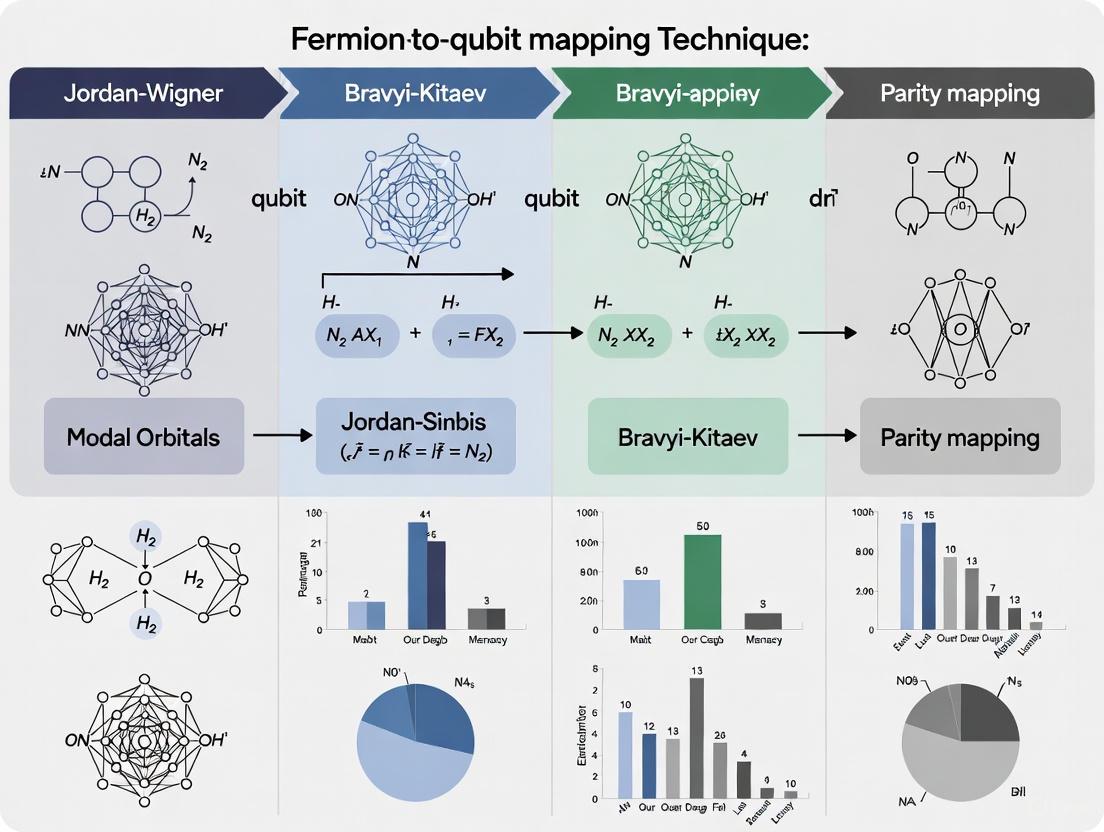
This article provides a comprehensive comparative analysis of advanced fermion-to-qubit mapping techniques, crucial for simulating molecular and materials systems on quantum computers.
Fermion-to-Qubit Mapping Techniques: A Comparative Analysis for Quantum Simulation in Drug Discovery and Materials Science
Abstract
This article provides a comprehensive comparative analysis of advanced fermion-to-qubit mapping techniques, crucial for simulating molecular and materials systems on quantum computers. We explore foundational concepts, from fundamental fermion statistics to the core principles of popular encodings like Jordan-Wigner and Bravyi-Kitaev. The analysis then delves into cutting-edge methodological frameworks, including Hamiltonian-adaptive and SAT-based compilers, and addresses critical troubleshooting aspects like qubit overhead and Pauli weight optimization. Finally, we validate these techniques through real-world applications in drug discovery and materials simulation, highlighting performance metrics and offering guidance for researchers and drug development professionals seeking to leverage quantum computation.
The Quantum Bridge: Understanding Fermions, Qubits, and Why Mapping Matters
Simulating fermionic systems is one of the most promising applications of quantum computing, with profound implications for drug development, materials science, and quantum chemistry [1] [2]. However, a fundamental challenge arises from the disparate statistical properties governing fermions and qubits. Fermionic systems, composed of electrons, protons, and neutrons, exhibit wavefunction antisymmetry under particle exchange, requiring anticommutation relations for their creation and annihilation operators [2]. In contrast, quantum computers are built from qubits that obey bosonic commutation relations. This statistical mismatch means that local fermionic operators translate to non-local qubit operators with high Pauli weight (acting on many qubits), creating significant implementation overhead on digital quantum devices [2] [3].
This article provides a comparative analysis of fermion-to-qubit mapping techniques, examining their theoretical foundations, experimental performance, and practical implications for research applications. We focus specifically on the crucial metrics of Pauli weight, circuit depth, and implementation costs that directly impact simulation accuracy and efficiency on near-term quantum hardware.
Mapping Fundamentals: From Fermionic Modes to Qubit Operators
The Core Challenge
Fermion-to-qubit encoding is an isometry that maps the Fock space of ℋ𝑓 to the Hilbert space of 𝑁𝑞 qubits ℋ𝑞 [4]. The central difficulty lies in preserving the fermionic anticommutation relations {𝑎𝑗,𝑎𝑘} = 0 and {𝑎𝑗,𝑎𝑘†} = 𝛿𝑗𝑘 within the qubit framework where Pauli operators typically commute [4] [2]. This requirement forces the mapping to introduce non-local dependencies, fundamentally constraining the potential locality of any encoding scheme [3].
Theoretical work has established that fully local mappings are only possible if the locality graph of the fermionic system is a tree [3]. For complex systems with cyclic connectivity (such as regular 2D lattices common in chemical systems), any exact encoding must introduce non-locality, meaning even simple fermionic computations translate to more complex qubit circuits with overhead that can scale with system size [3].
Established Mapping Techniques
Several theoretically-derived mappings form the foundation of fermionic simulation:
- Jordan-Wigner Transformation (JWT): The historically first mapping that encodes occupation information locally but requires 𝑂(𝑁) non-local string operators for interactions [2].
- Bravyi-Kitaev Transformation (BKT): Balances locality of occupation and parity information, achieving 𝑂(log𝑁) Pauli weight for single creation/annihilation operators [2].
- Ternary-Tree Mappings: A more recent formalism that encompasses and generalizes conventional mappings, providing a framework for understanding asymptotic optimality with Pauli weight of 𝑂(√𝑁) [1] [2].
The following diagram illustrates the fundamental workflow and challenge of fermion-to-qubit mapping:
Comparative Analysis of Mapping Approaches
Hamiltonian-Tailored Optimization Methods
Recent approaches have moved beyond one-size-fits-all mappings to develop techniques tailored to specific problem Hamiltonians:
Clifford Circuit-Based Heuristic Optimization: This approach reformulates the mapping problem as a Clifford circuit optimization task, using simulated annealing to minimize the average Pauli weight of the problem Hamiltonian [1] [2]. The method generates new mappings by applying Clifford circuits to existing ternary-tree mappings, preserving the fermionic algebra while exploring a broader space of possible encodings [2].
Fermihedral SAT Framework: This compiler-based approach formalizes all encoding constraints (anticommutivity, algebraic independence, vacuum state preservation) as a Boolean Satisfiability problem solvable with high-performance SAT solvers [5]. For larger-scale problems, it employs approximation techniques to manage the exponentially large clause space while maintaining near-optimal solutions [5].
Fermion Routing Advancements: Focused on the overhead from permuting fermionic modes, recent work has demonstrated that fermion routing can be performed in 𝑂(log²𝑁) depth without ancillas, measurements, or feedforward, and in 𝑂(log𝑁) depth when these resources are available [4]. Efficient mappings between product-preserving ternary-tree encodings further reduce this overhead [4].
Quantitative Performance Comparison
The table below summarizes key performance metrics across different mapping techniques:
| Mapping Approach | Pauli Weight Reduction | Key Advantages | Implementation Overhead |
|---|---|---|---|
| Jordan-Wigner (JWT) | Baseline (Reference) | Simple implementation; Minimal qubit count [2] | 𝑂(𝑁) string operators; High circuit depth |
| Bravyi-Kitaev (BKT) | Moderate improvement | 𝑂(log𝑁) weight for single operators [2] | Moderate implementation complexity |
| Ternary-Tree Mappings | Asymptotically optimal | Unified framework; Optimal for single operators [1] | Complex compilation; Not Hamiltonian-specific |
| Clifford-Based Optimization | 15-40% improvement [1] | Hamiltonian-tailored; Maintains term count [2] | 3-day optimization on single CPU [2] |
| Fermihedral SAT | 10-60% lower cost [5] | Formal guarantees; Potentially optimal | Exponential clauses; Requires approximations |
For specific model systems, optimized mappings demonstrate substantial improvements:
- 6×6 2D Nearest-Neighbor Hopping: >40% reduction in average Pauli weight compared to ternary-tree mappings [1] [2]
- 6×6 2D Hubbard Model: >20% reduction in average Pauli weight [1] [2]
- Hydrogen Chain (6-site): 10-20% improvement over conventional mappings [2]
Research Reagent Solutions: Essential Methodological Tools
The table below details key computational tools and their functions in mapping research:
| Research Tool | Function | Application Context |
|---|---|---|
| Clifford Circuits | Generate symmetry-preserving mapping transformations [1] [2] | Heuristic mapping optimization |
| SAT Solvers | Solve constrained optimization for optimal encoding [5] | Fermihedral compilation framework |
| Simulated Annealing | Heuristic search over Clifford circuit space [1] | Numerical mapping optimization |
| Ternary-Tree Framework | Theoretical construct for understanding mapping optimality [1] [4] | Mapping classification and analysis |
| fSWAP Networks | Permute fermionic modes while maintaining statistics [4] | Fermion routing in Jordan-Wigner encoding |
Experimental Protocols and Methodologies
Clifford-Based Optimization Workflow
The heuristic optimization approach follows a structured protocol:
- Initialization: Begin with a ternary-tree based mapping as the starting point [2]
- Circuit Parameterization: Represent the mapping transformation as a Clifford circuit with parametrized gates [1] [2]
- Cost Function Evaluation: Calculate the average Pauli weight of the problem Hamiltonian under the current mapping [2]
- Simulated Annealing: Iteratively propose random Clifford circuit modifications, accepting those that reduce cost according to annealing schedule [1] [2]
- Validation: Verify that the optimized mapping maintains all fermionic anticommutation relations [2]
This process typically runs for up to 3 days on a single CPU for systems with over 1,500 Hamiltonian terms [2]. The following diagram illustrates this optimization workflow:
SAT-Based Formal Verification
The Fermihedral framework employs a distinct methodological approach:
- Constraint Encoding: Translate fermionic constraints (anticommutivity, algebraic independence) into Boolean expressions [5]
- Cost Integration: Incorporate Hamiltonian implementation cost into the SAT problem [5]
- Clause Reduction: Apply techniques to manage exponential clause growth while maintaining solution quality [5]
- Solver Execution: Utilize high-performance SAT solvers to find the optimal encoding [5]
This approach provides formal guarantees of optimality for feasible problem sizes, with approximation techniques extending its reach to larger systems [5].
Implications for Quantum Simulation in Research
Impact on Practical Applications
The advancements in fermion-to-qubit mapping have direct implications for research applications:
- Quantum Chemistry: For a 6-site hydrogen chain (≈1,500 terms), optimized mappings reduce Pauli weight by 10-20%, directly translating to shallower circuits and improved simulation accuracy on noisy devices [2]
- Materials Science: For Hubbard models relevant to high-temperature superconductivity and catalyst design, 20-25% reductions in Pauli weight significantly enhance simulation feasibility [1] [2]
- Drug Development: More efficient mappings enable larger molecular simulations, potentially improving binding affinity calculations and reaction pathway analysis [5]
Experimental validation on IonQ's ion-trap device demonstrates that optimized encodings significantly increase simulation accuracy compared to conventional approaches [5].
Future Directions
The field continues to evolve along several research vectors:
- Hardware-Aware Mappings: Developing encodings that optimize for specific qubit connectivity and noise characteristics [6]
- Larger-Scale Optimization: Improving heuristic and exact methods to handle systems with thousands of fermionic modes [5]
- Specialized Encodings: Creating mappings optimized for specific computational tasks like Trotterization or variational algorithms [2]
- Machine Learning Approaches: Exploring data-driven techniques for mapping discovery and optimization [7]
The fundamental challenge of bridging fermionic and qubit statistics continues to drive innovation in quantum computation. While theoretical results establish fundamental limits on encoding locality, heuristic optimization methods demonstrate remarkable practical improvements, reducing Pauli weight by 15-40% for specific problem Hamiltonians [1] [2]. The emerging toolkit of Clifford-based optimization, SAT formalization, and efficient fermion routing provides researchers with powerful methods to tailor encodings to their specific systems of interest.
For drug development professionals and research scientists, these advancements translate to tangible benefits: reduced quantum resource requirements, improved simulation accuracy on current hardware, and expanded scope of simulatable systems. As quantum hardware continues to evolve, the co-design of algorithms, encodings, and device architectures promises to further narrow the gap between fermionic systems and their qubit representations, potentially unlocking new frontiers in computational chemistry and materials discovery.
Core Principles of Fermion-to-Qubit Encoding
Quantum simulation of fermionic systems is a leading application of quantum computing, with profound implications for quantum chemistry, materials science, and drug development [8] [9]. Unlike classical bits or distinguishable particles, fermions obey the Pauli exclusion principle and exhibit anticommutation relations. These fundamental properties must be preserved when mapping fermionic systems to qubit-based quantum processors [10] [11]. Fermion-to-qubit encodings provide the mathematical framework for this mapping, transforming fermionic creation ((ci^\dagger)) and annihilation ((ci)) operators into Pauli operators acting on qubits [11].
The need for these encodings stems from a fundamental incompatibility: qubits are distinguishable quantum systems, while fermions are indistinguishable particles with specific exchange statistics. Without proper encoding, the simulated dynamics would not capture the essential quantum behavior of fermionic systems. Research in this field has experienced a renaissance in recent decades, driven by advances in both classical simulation methods and the development of quantum hardware [11]. The choice of encoding significantly impacts simulation performance, affecting circuit depth, qubit count, gate complexity, and error susceptibility [8] [12].
Core Principles and Fundamental Challenges
The Anticommutation Problem
At the heart of fermion-to-qubit mapping lies the challenge of preserving the canonical anticommutation relations. For fermionic operators, these relations are:
[ {ci, cj^\dagger} = \delta{ij}, \quad {ci, cj} = 0, \quad {ci^\dagger, c_j^\dagger} = 0 ]
where ({A, B} = AB + BA) denotes the anticommutator [10]. In qubit space, where operators commute by default, preserving these relations requires careful construction. The most straightforward solution, the Jordan-Wigner transformation, achieves this by introducing non-local string operators whose weight scales with system size [8] [12].
Key Design Trade-offs
The development of fermion-to-qubit encodings involves navigating several fundamental trade-offs:
- Locality vs. Qubit Overhead: Local fermionic interactions should ideally map to local qubit operations. Achieving this often requires additional ancilla qubits, creating a trade-off between circuit complexity and qubit count [9] [12].
- Parallelization vs. Operator Structure: Efficient quantum algorithms require parallel gate execution. However, the structure of encoded operators can restrict which operations can be performed simultaneously [12].
- Code Distance vs. Stabilizer Weight: For error-corrected simulations, increasing the code distance provides better protection but typically increases stabilizer weights, complicating their measurement [13] [11].
These trade-offs have driven the development of diverse encoding strategies, each optimized for different hardware capabilities and simulation targets.
Comparative Analysis of Major Encoding Techniques
Established Encoding Methods
Table 1: Comparison of Major Fermion-to-Qubit Encodings
| Encoding Method | Qubit Overhead | Operator Locality | Parallelization Potential | Best-Suited Applications |
|---|---|---|---|---|
| Jordan-Wigner (JW) [8] [12] | 1:1 (minimal) | Non-local in 2D/3D ((O(N)) weight) | Limited by string collisions | Small systems, 1D chains |
| Compact Encoding (CE) [8] | Moderate (ancillas) | Local | High with optimized compilation | 2D Fermi-Hubbard model |
| Bravyi-Kitaev (BK) [12] | 1:1 (minimal) | (O(\log N)) weight | Limited by common qubits | Moderate-sized systems |
| Ladder Encodings (LE) [13] [11] | Varies with distance | Local, tunable distance | High with topological defects | Fault-tolerant simulations |
| High-Distance Stabilizer Codes [9] | Significant | Local, high distance | Architecture-dependent | Error-corrected simulations |
Performance Metrics and Quantitative Comparison
Recent experimental and theoretical studies have provided quantitative comparisons between encoding strategies:
Table 2: Experimental Performance Comparison for 6×6 Fermi-Hubbard Model
| Encoding Method | Physical Qubits | Gate Reduction | Error Mitigation Efficiency | Experimental Platform |
|---|---|---|---|---|
| Jordan-Wigner | 36 | Baseline (0%) | Limited by global constraints | Trapped ions (Quantinuum H2) |
| Compact Encoding | 48 | 42% with corner hopping | Enhanced with local postselection | Trapped ions (Quantinuum H2) |
| Fermihedral [14] | System-dependent | Substantial reductions reported | Improved simulation accuracy | IonQ devices |
The Compact Encoding demonstrated a 42% reduction in gate cost for simulating fermionic hopping on a square lattice compared to Jordan-Wigner, enabled by a "corner hopping" compilation scheme [8]. This efficiency gain translated to experimental improvements in adiabatic ground state preparation of a spinless Fermi-Hubbard model.
Theoretical Scaling Behavior
Table 3: Asymptotic Scaling of Different Encodings
| Encoding Method | Depth Overhead | Ancilla Requirements | Gate Complexity | Recent Improvements |
|---|---|---|---|---|
| Standard Jordan-Wigner | (O(N)) | None | (O(N)) per term | - |
| Optimized JW [12] | (O(\log^2 N)) (ancilla-free) | None | (O(\log^2 N)) | Fermionic permutation circuits |
| Ancilla-assisted JW [12] | (O(\log N)) | (O(N)) | (O(\log N)) | Measurement and feedforward |
| Compact Encoding [8] | Constant for 2D local models | Moderate | Constant for local terms | Topological defect embedding |
Recent theoretical breakthroughs have shown that the Jordan-Wigner encoding can achieve (O(\log^2 N)) depth overhead for arbitrary fermionic models without ancillas, exponentially improving the previously believed (O(N)) overhead [12]. This is achieved through sophisticated fermionic swap networks that effectively rearrange the fermionic mode ordering between Trotter steps.
Experimental Protocols and Validation Methodologies
Benchmarking Fermionic Encodings
Experimental validation of fermion-to-qubit encodings requires standardized benchmarking protocols. A representative methodology used in recent studies involves:
Protocol 1: Adiabatic Ground State Preparation [8]
- System Initialization: Prepare the system in a checkerboard product state corresponding to a classical fermionic configuration.
- Adiabatic Evolution: Implement time evolution under the Fermi-Hubbard Hamiltonian with linearly ramped parameters:
- Initial parameters: (Vi = 8.0), (ti = 0)
- Final parameters: (Vf = 2.3), (tf = 1)
- Evolution path: (V(s) = Vi - s(Vi - V_f)), (t(s) = s), where (s \in [0,1])
- Trotter Decomposition: Split evolution into (T) first-order Trotter steps: [ U = U(1)U\left(\frac{T-1}{T}\right) \cdots U\left(\frac{1}{T}\right) ] where (U(s) = U{\text{int}}(s)U{\text{hop}}(s)) separates interaction and hopping terms.
- Observable Measurement: Measure local fermionic observables and compare with classical benchmarks.
This protocol was used to demonstrate the superiority of Compact Encoding over Jordan-Wigner for a 6×6 Fermi-Hubbard model on a trapped-ion quantum computer [8].
Error Mitigation Techniques
Specialized error mitigation methods have been developed for fermionic encodings:
Local Postselection: Leverages conserved quantities (stabilizers) inherent to certain encodings to identify and discard erroneous measurement outcomes while retaining more data than global postselection [8].
Observable Extrapolation: Extrapolates local observables based on their sensitivity to errors, particularly effective in encodings where local fermionic operators map to local qubit operators [8].
Compilation Optimization Strategies
Advanced compilation techniques significantly impact encoding performance:
Corner Hopping: A compilation scheme specific to the Compact Encoding that reduces the gate cost of simulating fermionic hopping on a square lattice by 42% by optimizing the order of fermionic operations [8].
Fermihedral Framework: A compiler that reformulates fermion-to-qubit encoding as a Boolean satisfiability problem, discovering optimal encodings for specific Hamiltonians that substantially reduce implementation costs, gate counts, and circuit depth [14].
Fermionic Permutation Circuits: A recent technique that achieves (O(\log^2 N)) depth overhead in Jordan-Wigner encoding by implementing arbitrary fermionic permutations between Trotter layers [12].
Advanced Encoding Frameworks and Future Directions
High-Distance and Fault-Tolerant Encodings
Recent research has developed encoding families with arbitrarily scalable code distances:
Ladder Encodings (LE): A family of one-dimensional encodings that can be embedded into surface codes with topological defects, allowing systematic increase of code distance without growing stabilizer weights [13] [11].
Perforated Encodings: Encode two fermionic spin modes within the same surface code structure, optimizing for fermionic Hamiltonians with spin degrees of freedom [11].
3D High-Distance Codes: The first constructions simultaneously achieving high distance, constant stabilizer weights, and locality preservation for 3D fermionic systems [9].
These encoding families bridge the gap between near-term noisy quantum simulations and fully fault-tolerant quantum computation by providing a smooth path toward error-corrected fermionic simulation.
Fermion-Qubit Fault-Tolerant Computing
A emerging paradigm combines native fermionic operations with qubit-based error correction:
Fermionic Repetition Codes: Correct phase errors using native fermionic operations before mapping to qubits [15].
Fermionic Color Codes: Extend protection to both phase and loss errors while maintaining a universal fermionic gate set [15].
Qubit-Fermion Interfaces: Enable qubit-controlled fermionic operations, crucial for advanced quantum algorithms while maintaining the efficiency of native fermionic operations [15].
This approach demonstrates exponential improvements for key subroutines like the fermionic fast Fourier transform, reducing circuit depth from (O(N)) to (O(\log N)) [15].
Table 4: Key Research Reagents and Computational Tools for Fermionic Encoding Research
| Tool/Resource | Type | Function | Application Context |
|---|---|---|---|
| Fermihedral [14] | Compiler Framework | Discovers optimal encodings via Boolean satisfiability | Customized encoding for specific Hamiltonians |
| Surface Code Patches [13] [11] | Quantum Hardware Primitive | Provides topological protection for encoded fermions | Fault-tolerant fermionic simulation |
| Trapped-Ion Quantum Computers [8] | Experimental Platform | High-fidelity gate operations for encoding validation | Experimental benchmarking of encodings |
| fSWAP Networks [12] | Circuit Compilation Technique | Implements fermionic permutations with low overhead | Depth optimization for Jordan-Wigner |
| Corner Hopping [8] | Compilation Scheme | Reduces gate cost for 2D hopping terms | Compact Encoding optimization |
| Edge-Vertex Formalism [11] | Mathematical Framework | Intermediate representation between Dirac and Majorana operators | Encoding design and analysis |
The field of fermion-to-qubit encodings has progressed from fundamental mappings to sophisticated, optimized frameworks that preserve fermionic statistics while minimizing quantum resource overhead. The choice of encoding significantly impacts simulation performance, with different encodings optimizing for distinct hardware capabilities and simulation targets.
Recent advances demonstrate promising directions: exponentially reduced overhead through advanced compilation techniques, encoding families with scalable code distances for fault tolerance, and hybrid approaches that leverage native fermionic operations where available. As quantum hardware continues to advance, the development of specialized encodings tailored to specific physical systems and hardware architectures will play a crucial role in enabling practical quantum simulations of fermionic systems for drug development and materials discovery.
The optimal encoding choice remains context-dependent, balancing factors including target Hamiltonian structure, available qubit count, gate fidelities, and error correction capabilities. Future research will likely focus on adaptive encodings that optimize this balance for specific applications and hardware platforms.
Quantum simulation of fermionic systems is a cornerstone application of quantum computing, spanning the fields of quantum chemistry, condensed matter physics, and high-energy physics [16] [17]. Since quantum computers inherently operate on qubits, representing fermionic systems requires a mathematical transformation that maps fermionic creation and annihilation operators to Pauli operators acting on qubits [18]. This translation is highly non-trivial due to the need to preserve the fundamental anticommutation relations of fermionic operators, which ensures the antisymmetry of the fermionic wavefunction in accordance with the Pauli exclusion principle [18] [19].
The development of efficient fermion-to-qubit mappings represents an active area of research, balancing the competing demands of qubit count, gate complexity, and operator locality [17]. The two most fundamental transformations in this domain are the Jordan-Wigner transformation (JWT) and the Bravyi-Kitaev transformation (BKT), which form the foundation for more advanced mapping techniques [16] [18]. This guide provides a comparative analysis of these foundational approaches, examining their mathematical formulations, resource requirements, and performance characteristics to inform researchers and development professionals working at the intersection of quantum computation and molecular simulation.
Mathematical Foundations
Jordan-Wigner Transformation
The Jordan-Wigner transformation (JWT) provides an intuitive approach to mapping fermionic operators to qubit operators by directly storing the occupation number of each fermionic mode in a corresponding qubit [18] [19]. Under this transformation, the fermionic annihilation and creation operators are mapped to qubit operators as follows:
[ap \mapsto \frac{1}{2} (Xp + iYp) \otimes{k
where (Xp), (Yp), and (Zp) are Pauli operators acting on qubit (p) [19]. The key feature of this mapping is the string of (Z) operators (\otimes{k
The JWT establishes a direct correspondence between fermionic basis states and computational basis states of the qubits, where the fermionic state (|n0, n1, ..., n{N-1}\rangle) is represented by the computational basis state (|z0, z1, ..., z{N-1}\rangle) with (zp = np) for all (p) [19]. While conceptually straightforward, this mapping results in non-local qubit operators, with the Pauli weight (number of non-identity Pauli operators in a term) of a single fermionic operator scaling as (O(N)) for a system with (N) modes [17] [19].
Bravyi-Kitaev Transformation
The Bravyi-Kitaev transformation (BKT) represents a more sophisticated approach that stores fermionic information non-locally across qubits to achieve better asymptotic scaling [17] [20]. In this mapping, even-labeled qubits store the occupation number of orbitals, while odd-labeled qubits store the parity of preceding orbitals through partial sums of occupation numbers [18]. This hybrid scheme results in a more efficient representation where the Pauli weight of a single fermionic operator scales as (O(\log N)), offering significant advantages for larger systems [20].
The Bravyi-Kitaev transformation defines creation and annihilation operators with a combination of Pauli (X), (Y), and (Z) operators that depends on the binary representation of the mode index [18]. For a given mode (j), the transformation involves:
- Update set: Qubits whose occupation number needs to be updated when a fermion is created or annihilated at mode (j)
- Parity set: Qubits whose parity determines the phase factor when acting on mode (j)
- Flip set: Qubits that need to be flipped when the occupation of mode (j) changes [20]
The mathematical formulation of the BKT is more complex than the JWT, but it substantially reduces the locality of the resulting qubit operators, particularly for systems with a large number of modes [18] [20].
Performance Comparison
Theoretical and Empirical Resource Requirements
The theoretical scaling differences between the JWT and BKT translate to concrete practical implications for quantum simulation. Empirical studies across diverse molecular systems confirm the superior efficiency of the Bravyi-Kitaev transformation in terms of gate counts and operator weights [16] [20].
Table 1: Comparison of Key Performance Metrics
| Metric | Jordan-Wigner Transformation | Bravyi-Kitaev Transformation |
|---|---|---|
| Qubit count | (N) (minimum required) [17] | (N) (minimum required) [17] |
| Pauli weight of single operator | (O(N)) [17] [19] | (O(\log N)) [17] [20] |
| Gate count for single fermionic operation | (O(N)) [20] | (O(\log N)) [20] |
| Typical gate count reduction | Reference | ~50% or more for larger systems [16] |
| Experimental realization complexity | Higher due to long Pauli strings [18] | Lower due to more local operators [18] |
A comprehensive study comparing these transformations across 86 molecular systems demonstrated that the BKT is typically at least as efficient as the canonical JWT, with substantially reduced gate counts when performing limited circuit optimizations [16]. For the specific case of molecular hydrogen in a minimal basis, the quantum circuit for simulating a single Trotter time-step of the BKT-derived Hamiltonian required fewer gate applications than the equivalent circuit derived from the JWT [20].
Table 2: Empirical Data from Comparative Studies
| System Characteristics | Jordan-Wigner Gate Count | Bravyi-Kitaev Gate Count | Reduction |
|---|---|---|---|
| H₂ in minimal basis | Reference value | Lower than JWT [20] | Significant [20] |
| Small molecules (near-term devices) | High | Moderate [16] | Approximately 50% or better [16] |
| Large systems (classically intractable) | Prohibitively high | Substantially lower [16] | Increases with system size [16] |
Parity-Based Mapping as an Intermediate Approach
It is worth noting the parity mapping as an alternative approach that stores the parity of orbitals instead of occupation numbers [18]. In this scheme, the (j)-th qubit stores the parity (sum modulo 2 of occupation numbers) of all orbitals up to (j) [18]. While this approach doesn't improve the (O(N)) scaling of operator weights, it enables the tapering off of two qubits by leveraging symmetries in molecular Hamiltonians, effectively reducing the qubit count required for simulation [18].
The transformation rules for the parity mapping are given by:
[aj^\dagger = \frac{1}{2}(Z{j-1} \otimes Xj - iYj) \otimes{k>j} Xk \quad \text{and} \quad aj = \frac{1}{2}(Z{j-1} \otimes Xj + iYj) \otimes{k>j} Xk]
where the long (Z) strings of the JWT are replaced by (X) strings [18]. Although this doesn't improve locality, the ability to remove two qubits through symmetry arguments makes the parity mapping practically useful for near-term quantum simulations where qubit count is severely constrained [18].
Experimental Protocols and Methodologies
Comparative Analysis Framework
Rigorous comparison of fermion-to-qubit mapping techniques requires a standardized experimental framework. The methodology employed in foundational studies typically involves multiple steps from Hamiltonian generation to resource quantification [16] [18]:
Molecular System Selection: Studies typically examine a diverse set of molecular systems spanning different geometries and electron counts. For example, the comprehensive analysis by Tranter et al. evaluated 86 molecular systems to ensure statistical significance [16].
Hamiltonian Generation: The electronic structure problem is first solved classically to obtain the second-quantized fermionic Hamiltonian in the form:
[H = \sum{pq} h{pq} ap^\dagger aq + \frac{1}{2} \sum{pqrs} h{pqrs} ap^\dagger aq^\dagger ar as]
where (h{pq}) and (h{pqrs}) are one- and two-electron integrals computed in a chosen basis set [16] [18].
Qubit Hamiltonian Generation: The fermionic Hamiltonian is mapped to a qubit Hamiltonian using each transformation technique (JWT, BKT, etc.). This involves substituting each fermionic operator with its qubit representation [18].
Circuit Construction: Quantum circuits for time evolution or ground state estimation are constructed using approaches such as Trotter-Suzuki decomposition or variational quantum eigensolver (VQE) ansatze [18].
Resource Quantification: The number of quantum gates (particularly non-Clifford gates like T gates), total Pauli weight, circuit depth, and qubit count are measured for each mapping [16] [18].
Diagram 1: Experimental workflow for comparing fermion-to-qubit mapping techniques
Key Experimental Considerations
When designing experiments to evaluate mapping techniques, researchers should control for several critical factors:
Basis set selection: The choice of molecular orbital basis significantly impacts the efficiency of quantum simulation. Common approaches include minimal basis sets (STO-3G) for initial testing and larger basis sets for more accurate results [16] [18].
Active space selection: For larger molecules, restricting the simulation to an active space of chemically relevant orbitals reduces computational requirements while maintaining accuracy [16].
Term ordering: The order in which fermionic modes are assigned to qubits can impact the efficiency of both JWT and BKT. Recent research has framed optimal ordering as a quadratic assignment problem to minimize Pauli weights [17].
Measurement strategies: The choice of mapping affects the measurement overhead for variational algorithms, as different mappings produce Hamiltonians with varying numbers of Pauli terms and weights [16].
Implementation and Practical Guidance
Research Reagent Solutions
Table 3: Essential Tools for Fermion-to-Qubit Mapping Research
| Tool/Category | Specific Examples | Function/Purpose |
|---|---|---|
| Quantum SDKs | PennyLane [18], OpenFermion [19] | Provides built-in functions for applying JWT, BKT, and other mappings to fermionic operators |
| Electronic Structure Packages | PySCF, Psi4, OpenMolcas | Compute one- and two-electron integrals for molecular Hamiltonians |
| Visualization Tools | Custom DOT scripts (Graphviz) | Diagram transformation workflows and operator relationships |
| Classical Simulators | Qiskit Aer, PennyLane DefaultQubit | Test and validate quantum circuits before hardware deployment |
| Resource Estimation Tools | Custom scripts, Qiskit ResourceEstimator | Quantify gate counts, qubit requirements, and circuit depth |
Implementation Workflow
The practical implementation of fermion-to-qubit mappings follows a systematic process that can be implemented across various software frameworks. The following diagram illustrates the logical relationships and decision points when selecting and applying these transformations:
Diagram 2: Implementation decision workflow for selecting mapping techniques
Code Examples
Practical implementation of these transformations is facilitated by modern quantum software development kits. The following examples illustrate basic usage:
Jordan-Wigner in PennyLane:
Bravyi-Kitaev in PennyLane:
Jordan-Wigner in OpenFermion:
The dramatic reduction in operator complexity between JWT and BKT is evident even in these simple examples, with the BKT version involving fewer qubits and more localized operations [18].
The comparative analysis of Jordan-Wigner and Bravyi-Kitaev transformations reveals a fundamental trade-off between conceptual simplicity and operational efficiency in fermion-to-qubit mappings. While the Jordan-Wigner transformation offers an intuitive approach that directly mirrors the occupation number basis, its (O(N)) scaling of operator weights presents significant practical limitations for quantum simulation of all but the smallest molecular systems.
The Bravyi-Kitaev transformation, with its (O(\log N)) scaling, provides a theoretically superior approach that substantially reduces gate counts and improves locality [16] [20]. Empirical studies across diverse molecular systems confirm that BKT typically outperforms JWT, particularly as system size increases toward classically intractable regimes [16].
For researchers and development professionals implementing quantum simulations of fermionic systems, the choice of mapping technique depends critically on the target system size, available quantum hardware, and specific application requirements. Small-scale simulations may benefit from the conceptual clarity of JWT, while larger systems will increasingly require the efficiency of BKT. Emerging techniques that optimize over fermionic orderings or incorporate limited numbers of ancilla qubits promise further improvements, potentially offering a favorable balance between qubit count and gate complexity for the constrained quantum devices of the near future [17].
The Critical Role of Pauli Operators and Strings in Hamiltonian Representation
In the pursuit of simulating quantum systems on quantum computers, the representation of fermionic Hamiltonians using Pauli operators emerges as both a fundamental necessity and a significant bottleneck. When simulating electrons in molecules or materials, the fermionic creation and annihilation operators that naturally describe these systems must be translated into operations that quantum hardware can understand—specifically, tensor products of Pauli operators (X, Y, Z) and the identity. These tensor products, known as Pauli strings, carry the algebraic structure of fermionic anticommutation relations but introduce substantial computational overhead through their non-locality.
The length of these Pauli strings, often referred to as their Pauli weight, directly determines the complexity of quantum circuits required for simulation. Higher-weight terms require more complex entangling operations and deeper circuits, which is particularly problematic for today's noisy intermediate-scale quantum (NISQ) devices. This challenge has catalyzed the development of various fermion-to-qubit mapping techniques, each attempting to balance circuit depth, qubit count, and architectural constraints while faithfully preserving the underlying fermionic physics. This article provides a comparative analysis of these mapping techniques, examining their theoretical foundations, practical performance, and suitability for different applications in quantum chemistry and materials science.
Fermion-to-Qubit Mapping Techniques: A Comparative Framework
Multiple mapping strategies have been developed to transform fermionic Hamiltonians into qubit representations, each with distinct trade-offs between Pauli weight, qubit requirements, and implementation complexity. The three most established techniques—Jordan-Wigner, Parity, and Bravyi-Kitaev—form the core of this comparison, alongside newer optimized approaches.
Table 1: Comparison of Major Fermion-to-Qubit Mapping Techniques
| Mapping Technique | Key Principle | Typical Pauli Weight | Qubit Requirements | Key Advantages | Key Limitations |
|---|---|---|---|---|---|
| Jordan-Wigner | Maps occupation number directly to qubit state; uses Z-strings to track parity | O(N) [12] [18] | N qubits for N modes | Simple, intuitive implementation; minimal qubit count [18] | High Pauli weight; non-local interactions [18] |
| Parity | Stores parity information locally in qubit state | O(N) [18] | N qubits for N modes | Simplifies parity constraints; enables qubit tapering [18] | Still requires long operator strings (X-strings instead of Z-strings) [18] |
| Bravyi-Kitaev | Hybrid approach storing both occupation and parity information non-locally | O(log N) [12] | N qubits for N modes | Lower asymptotic Pauli weight; more local interactions [18] | More complex transformation logic [18] |
| Optimal Enumeration | Optimizes fermionic mode ordering to minimize string length | 13.9-37.9% reduction vs. standard JW [21] | N qubits (or N+2 with ancillas) | Significant improvement without ancilla qubits; polynomial reductions possible [21] | Optimization problem dependent on lattice geometry [21] |
| Slater Determinant Mapping | Maps entire Slater determinants to individual qubits | Lower circuit depth but higher qubit count [22] | Scales with number of important determinants [22] | Simpler circuits; NISQ-compatible; demonstrated for 22-29 qubit systems [22] | Exponential qubit scaling in worst case [22] |
The following workflow illustrates how these different mapping approaches transform fermionic operators into qubit representations:
Diagram 1: Fermion-to-Qubit Mapping Workflow. This diagram illustrates how different mapping techniques transform fermionic operators into Pauli string representations with varying Pauli weights.
Technical Deep Dive: Mapping Methodologies
The Jordan-Wigner transformation establishes a direct correspondence between fermionic occupation states and computational basis states of qubits. It represents fermionic creation and annihilation operators as:
[
a{j}^{\dagger} = \frac{1}{2}(Xj - iYj) \otimes{k
The Bravyi-Kitaev transformation employs a more sophisticated approach that stores both parity and occupation information in a non-local pattern across qubits. This mapping uses a binary tree structure to encode relationships between fermionic modes, resulting in Pauli strings of logarithmic length—a significant asymptotic improvement [12] [18]. For example, in this mapping, a creation operator might be represented as: [ a{5}^{\dagger} = \frac{1}{2}(Z4 \otimes Z3 \otimes X5 \otimes X{7}) - \frac{i}{2}(Z3 \otimes Y5 \otimes X{7}) ] which demonstrates the reduced locality compared to Jordan-Wigner [18].
Optimal enumeration techniques represent a different approach, focusing not on changing the fundamental mapping but on optimizing the ordering of fermionic modes to minimize Pauli weight. For square lattice systems, Mitchison and Durbin's enumeration pattern can reduce the average Pauli weight of Hamiltonian terms by 13.9% compared to standard Jordan-Wigner, and with two ancilla qubits, reductions of 37.9% are achievable [21].
Experimental Protocols and Performance Benchmarks
Nuclear Shell Model Case Study
A 2025 study implemented a novel Slater determinant (SD) mapping approach for nuclear shell model calculations, where each qubit represents an entire Slater determinant rather than individual single-particle states [22]. This method traded increased qubit count for significantly reduced circuit depth, making it particularly suitable for NISQ devices.
Table 2: Experimental Results for SD Mapping on Nuclear Systems [22]
| Nucleus | Qubit Count | Circuit Depth | Error (Before Mitigation) | Error (After ZNE) |
|---|---|---|---|---|
| ⁶Li | 4 | Shallow | Not reported | < 4% |
| ⁷Li | 6 | Shallow | Not reported | < 4% |
| ⁸Li | 6 | Shallow | Not reported | < 4% |
| ⁹Li | 8 | Shallow | Not reported | < 4% |
| ¹⁸F | 13 | Shallow | Not reported | < 4% |
| ²¹⁰Po | 22 | Shallow | Not reported | < 4% |
| ²¹⁰Pb | 29 | Shallow | Not reported | < 4% |
Experimental Protocol: The research employed the Variational Quantum Eigensolver (VQE) algorithm with the following methodology [22]:
- Hamiltonian Encoding: Nuclear shell model Hamiltonians were encoded using the SD mapping approach
- Circuit Implementation: Quantum circuits were designed with minimal depth compared to traditional mappings
- Hardware Execution: Circuits were run on IBM's
ibm_pittsburghprocessor and noisy simulator (FakeFez backend) - Error Mitigation: Zero-Noise Extrapolation (ZNE) via two-qubit gate folding was applied to mitigate errors
- Validation: Results were compared to classical shell model predictions for accuracy assessment
The study demonstrated that despite increased qubit requirements (up to 29 qubits for heavier nuclei), the reduced circuit complexity enabled successful implementation on current hardware with less than 4% deviation from theoretical predictions after error mitigation [22].
Advanced Algorithmic Approaches
Recent theoretical work has dramatically improved the asymptotic overhead of fermionic simulation. A 2025 breakthrough demonstrated that fermionic permutations in the Jordan-Wigner encoding can be implemented in circuit depth O(log²N) without ancillas, exponentially improving the previous O(N) overhead [12]. With O(N) ancillas and mid-circuit measurement, this can be further reduced to O(logN) depth [12].
Experimental Implications: These algorithmic advances enable more efficient implementation of key quantum chemistry subroutines. For example, the fermionic fast Fourier transform (FFFT) can now be implemented with:
- O(log²N) depth overhead without ancillas (exponential improvement)
- O(1) depth overhead with ancillas [12]
This has profound implications for simulating quantum chemistry Hamiltonians in the plane-wave basis, where a single Trotter step can now be implemented in polylog depth with O~(N) qubits [12].
Table 3: Essential Research Tools and Solutions for Mapping Experiments
| Tool/Resource | Function | Example Applications | Implementation Considerations |
|---|---|---|---|
| Jordan-Wigner Transform | Maps fermionic operators to Pauli strings with Z-based parity tracking | Small systems; pedagogical applications; 1D chains [18] | Linear Pauli weight; suitable for systems with natural 1D ordering |
| Bravyi-Kitaev Transform | Reduces Pauli weight via hybrid occupation/parity encoding | Medium-sized molecules; NISQ applications [18] | Logarithmic Pauli weight; more complex implementation |
| Optimal Enumeration Algorithms | Minimizes Pauli weight through mode ordering optimization | Lattice systems; material science simulations [21] | Geometry-dependent; can reduce weight by 13.9-37.9% |
| Slater Determinant Mapping | Maps configurations rather than individual states | Nuclear physics; systems with manageable determinant spaces [22] | Trading qubit count for circuit depth; NISQ-compatible |
| Joint Measurement Strategies | Efficiently estimates fermionic observables | Quantum chemistry Hamiltonians; variational algorithms [23] | Reduces measurement overhead; compatible with error mitigation |
| fSWAP Networks | Enables efficient fermionic permutation | Fully connected models; all-to-all interactions [12] | O(log²N) depth for arbitrary permutations |
Emerging Trends and Future Directions
The field of fermion-to-qubit mapping is rapidly evolving, with several promising research directions emerging. Measurement strategies tailored specifically for fermionic observables are achieving reduced measurement overhead, with one recent approach estimating all quadratic and quartic Majorana terms using only O(N²log(N)/ε²) measurement rounds [23]. When implemented on rectangular qubit lattices, this strategy requires only O(N¹ᐧ⁵) two-qubit gates and O(√N) depth, substantially improving on previous approaches [23].
The Hamiltonian simulation-based quantum-selected configuration interaction (HSB-QSCI) method represents another innovative approach, sampling important Slater determinants from quantum states generated by real-time evolution rather than variational optimization [24]. This technique has demonstrated remarkable efficiency, capturing over 99.18% of correlation energies while considering only about 1% of all Slater determinants in 36-qubit systems [24].
These advances, combined with new theoretical insights about the fundamental overhead of fermionic simulation, suggest that we are approaching a threshold where quantum computers can meaningfully outperform classical methods for specific fermionic simulation problems. The optimal choice of mapping technique increasingly depends on the specific problem structure, available hardware, and target precision, necessitating careful comparative analysis for each application domain.
The critical role of Pauli operators and strings in Hamiltonian representation underscores a fundamental challenge in quantum simulation: bridging the gap between fermionic physics and qubit-based computation. Our comparative analysis reveals that no single mapping technique dominates across all applications; rather, researchers must strategically select approaches based on their specific requirements.
For NISQ-era applications with limited qubit counts and significant noise constraints, the Bravyi-Kitaev transformation offers a balanced compromise between qubit efficiency and Pauli weight reduction. When simulating specific lattice geometries, optimal enumeration techniques provide significant improvements without additional qubit overhead. For problems where the important Hilbert space sector is manageable, the Slater determinant mapping approach demonstrates promising results by trading qubit count for circuit depth.
As quantum hardware continues to evolve, the interplay between algorithmic advances and device capabilities will likely yield further innovations in fermion-to-qubit mapping. The exponential reductions in overhead recently demonstrated theoretically [12] suggest that even more efficient representations may be forthcoming, potentially enabling practical quantum advantage for fermionic simulation in the near future.
Fermion-to-qubit mappings are foundational to quantum simulation, enabling the study of molecular and materials science on quantum computers. These mappings translate the anti-commuting operators of fermionic systems into the Pauli operators of qubits. The efficiency of this translation directly impacts the feasibility of quantum simulations. This guide provides a comparative analysis of mapping techniques, focusing on three critical properties: locality (how non-local the resulting qubit operators are), qubit count (the number of physical qubits required), and circuit complexity (the depth and number of gates needed for simulation). The optimal choice of mapping is not universal but depends on the specific fermionic Hamiltonian and the constraints of the target quantum hardware.
Comparative Analysis of Mapping Techniques
The following tables summarize the key characteristics and performance metrics of major fermion-to-qubit mappings.
Table 1: Characteristics of Major Fermion-to-Qubit Mappings
| Mapping Name | Type | Key Idea | Locality (Pauli Weight) | Qubit Count | Ancilla Qubits Required? |
|---|---|---|---|---|---|
| Jordan-Wigner (JW) [12] [10] | Non-local | Encodes modes along a 1D chain with non-local parity strings. | $O(N)$ [12] | $N$ [10] | No |
| Bravyi-Kitaev (BK) [12] [25] | Non-local | Uses a binary tree structure to reduce operator weight. | $O(\log N)$ [12] | $N$ [25] | No |
| Ternary Tree [25] | Non-local | Uses a ternary tree structure for optimal Pauli weight. | $\lceil \log_3(2n+1)\rceil$ [25] | $N$ | No |
| Ancilla-Assisted Local [12] [26] | Local | Uses auxiliary qubits to store parity information, removing non-local strings. | $O(1)$ (constant) [26] | $>N$ [12] | Yes ($O(N)$) [12] |
| Qudit-Based [26] | Local | Uses multi-level quantum systems (qudits) to internalize parity information. | Fully local [26] | Fewer physical systems (but higher-dimensional) [26] | No (encoded in levels) |
| Hybrid [27] | Hybrid | Parametrized family that interpolates between JW and BK properties. | Intermediate | $N$ [27] | No |
Table 2: Performance Comparison for Key Simulation Tasks
| Mapping / Property | Theoretical Worst-Case Depth Overhead (vs. Fermionic Computer) | Performance in Specific Models | Key Trade-offs |
|---|---|---|---|
| Jordan-Wigner (JW) | $O(N)$ [12] | Poor parallelization for non-1D models [12]. | Simple but suffers from non-locality; no ancilla cost. |
| Bravyi-Kitaev (BK) | $O(N)$ (due to parallelization issues) [12] | Better gate count than JW for some models, but similar depth overhead [12]. | Reduced weight per operator, but limited parallelization. |
| Ancilla-Assisted | $O(1)$ for geometrically local models [12] | Enables constant-depth simulation of geometrically local interactions [12]. | Exchanges circuit depth for a linear space (qubit) overhead. |
| Advanced JW (with fSWAP) | $O(\log^2 N)$ (ancilla-free) [12] | Enables Fermionic Fast Fourier Transform in $O(\log^2 N)$ depth [12]. | Maintains low qubit count while exponentially improving depth. |
| Heuristically Optimized | Varies (tailored to Hamiltonian) | 15-40% improvement in average Pauli weight for intermediate Hamiltonians [1]. | Offers custom performance but requires an optimization step. |
Experimental Protocols for Mapping Evaluation
To objectively compare mappings, researchers employ standardized evaluation protocols focusing on concrete metrics.
Protocol 1: Average Pauli Weight Measurement
This protocol quantifies the locality of a mapping by measuring the average number of qubits on which the mapped Hamiltonian terms act.
- Input: A target fermionic Hamiltonian, ( H = \sum\alpha h\alpha P\alpha ), where ( P\alpha ) are fermionic terms.
- Mapping: Apply the fermion-to-qubit mapping ( \mathcal{E} ) to transform each ( P\alpha ) into a Pauli string ( \mathcal{E}(P\alpha) ) on qubits.
- Measurement: For each Pauli string ( \mathcal{E}(P_\alpha) ), calculate its weight (number of non-identity Pauli operators).
- Calculation: Compute the average Pauli weight across all terms, ( \frac{1}{L} \sum{\alpha=1}^L \text{weight}(\mathcal{E}(P\alpha)) ), where ( L ) is the total number of terms.
- Output: A single number representing the average Pauli weight. A lower value indicates better locality [1].
Protocol 2: Trotterized Time Evolution Gate Count
This protocol evaluates the practical circuit complexity of implementing a time-evolution step for a specific model.
- System Selection: Choose a benchmark model (e.g., the 2D Fermi-Hubbard model on an ( N \times N ) lattice).
- Trotterization: Decompose the time-evolution operator ( e^{-iHt} ) into a product of exponentials of individual Hamiltonian terms (a Trotter step).
- Circuit Compilation: For each mapping, compile the circuit for a single Trotter step.
- Metric Collection: Tally the total number of two-qubit gates (typically the most expensive operations) and the overall circuit depth.
- Comparison: Compare the gate counts and depths across different mappings for the same model and lattice size [26] [27].
Figure 1: Experimental workflow for evaluating and comparing fermion-to-qubit mappings, from Hamiltonian input to performance metrics.
Visualization of Mapping Relationships and Trade-offs
The landscape of fermion-to-qubit mappings can be understood as a spectrum trading off qubit count against circuit complexity (locality).
Figure 2: A conceptual map showing the relationships and evolution between different families of fermion-to-qubit mappings.
Table 3: Key "Research Reagent" Solutions for Fermion-to-Qubit Mapping Studies
| Tool / Resource | Function / Purpose | Example Use-Case |
|---|---|---|
| ZX-Calculus Framework [28] | A graphical language to unify and reason about different mappings, proving equivalences. | Translating a ternary tree mapping into an encoder circuit. |
| Heuristic Numerical Optimizer [1] | An algorithm (e.g., simulated annealing) to find low-Pauli-weight mappings for a specific Hamiltonian. | Designing a custom mapping for a complex molecular Hamiltonian. |
| Fermionic SWAP (fSWAP) Gate [12] [26] | A gate that exchanges the states of two fermionic modes while preserving anti-symmetry. | Routing fermions in the JW encoding to improve operator locality in a circuit. |
| Stabilizer Formalism [10] | A method to describe and work with the constraints of local fermion-to-qubit encodings. | Identifying and enforcing the gauge constraints in an ancilla-assisted mapping. |
| Ternary Tree Data Structure [25] | An optimal tree structure for constructing mappings with minimal Pauli weight. | Implementing a mapping for efficiently learning k-fermion reduced density matrices. |
The choice of a fermion-to-qubit mapping is a critical decision that balances the competing resources of a quantum computer. Non-local mappings like Jordan-Wigner are simple and ancilla-free but incur high circuit depth overhead. Ancilla-assisted local mappings solve the locality problem, enabling constant-depth simulation for local Hamiltonians, at the cost of a larger qubit footprint. Hybrid and heuristically optimized mappings offer a middle ground, tailoring the encoding to the problem.
Current research demonstrates that significant improvements are possible. Advanced compilation of the Jordan-Wigner encoding with fSWAP networks can exponentially reduce its worst-case overhead [12], while qudit-based approaches present a novel path to full locality without ancillas [26]. There is no single "best" mapping; the optimal choice is dictated by the problem Hamiltonian, the available number of qubits, and the error budget of the hardware. Future work will likely involve further hybridization and hardware-aware co-design to push the boundaries of feasible quantum simulation.
Advanced Encoding Frameworks: From Ternary Trees to SAT Solvers and Real-World Pipelines
Simulating fermionic systems is a cornerstone application of quantum computing, with profound implications for quantum chemistry, materials science, and drug discovery. However, quantum computers operate on qubits, not fermions, necessitating a critical translation step known as fermion-to-qubit mapping. The efficiency of this mapping directly determines the feasibility and resource requirements of quantum simulations. Traditional mappings like Jordan-Wigner (JW) and Bravyi-Kitaev (BK) have provided foundational approaches but incur significant overheads, particularly for large systems. The Hamiltonian-Adaptive Ternary Tree (HATT) framework represents a targeted optimization approach that generates fermion-to-qubit mappings specifically adapted to the problem Hamiltonian, achieving substantial reductions in simulation overhead.
This comparative analysis examines the HATT framework against alternative state-of-the-art mapping techniques, evaluating their performance characteristics, resource requirements, and implementation considerations. We present quantitative experimental data and detailed methodologies to provide researchers with a comprehensive understanding of the current landscape in fermion-to-qubit mapping optimization.
The HATT Framework: Core Architecture and Methodology
Conceptual Foundation and Algorithmic Structure
The Hamiltonian-Adaptive Ternary Tree (HATT) framework introduces a systematic approach for compiling optimized fermion-to-qubit mappings tailored to specific fermionic Hamiltonians. Unlike static mappings that apply uniformly to all problems, HATT utilizes a ternary tree structure and a bottom-up construction procedure to generate Hamiltonian-aware mappings that minimize the Pauli weight of the resulting qubit Hamiltonian [29]. This reduction in Pauli weight directly translates to lower quantum simulation circuit overhead, a critical bottleneck in near-term quantum devices.
The framework operates through several key mechanisms. First, it analyzes the specific interaction terms within the target fermionic Hamiltonian. Using this structural information, it constructs a ternary tree mapping that minimizes the non-locality of the resulting qubit operators. Importantly, HATT retains the vacuum state preservation property essential for physical simulations while reducing algorithmic complexity from O(N⁴) to O(N³) through optimized implementation [29]. This balance of performance and correctness makes it particularly valuable for practical quantum simulations.
Experimental Protocol and Implementation Details
Implementing HATT for comparative analysis involves a structured workflow:
Hamiltonian Analysis: The target fermionic Hamiltonian is decomposed into its constituent interaction terms, identifying the connectivity pattern between fermionic modes.
Tree Construction: A ternary tree structure is built from the bottom up, with fermionic modes positioned to minimize the distance between interacting modes in the mapping.
Mapping Generation: The framework generates the complete fermion-to-qubit mapping by traversing the optimized tree structure and applying the transformation rules.
Circuit Compilation: The resulting qubit Hamiltonian is compiled into quantum gates using standard compilation techniques, with circuit depth and gate count recorded for comparison.
Validation: The mapping is validated by verifying preservation of anti-commutation relations and vacuum state properties.
Evaluation experiments typically involve applying this protocol to benchmark Hamiltonians from quantum chemistry and condensed matter physics, with performance metrics compared against alternative mappings under controlled conditions.
Comparative Performance Analysis
Quantitative Performance Metrics
The following tables summarize comprehensive performance comparisons between HATT and alternative fermion-to-qubit mapping approaches across multiple benchmark problems and system sizes.
Table 1: Circuit Overhead Comparison for Different Fermion-to-Qubit Mappings
| Mapping Approach | Ancilla Qubits | Worst-case Depth Overhead | Average Pauli Weight Reduction | Key Limitations |
|---|---|---|---|---|
| HATT Framework [29] | 0 | O(N³) algorithmic complexity | 5-20% | Hamiltonian-specific optimization required |
| Jordan-Wigner [12] | 0 | O(N) | Baseline | High non-locality for non-linear geometries |
| Bravyi-Kitaev [12] | 0 | O(N) | Moderate improvement | Limited parallelization due to common qubits |
| Log-overhead Ancilla Scheme [12] | O(N) | O(log²N) without ancillas, O(logN) with ancillas | Not specified | High qubit overhead |
| Dynamic Encoding [30] | O(N) | O(logN) | Not specified | Requires mid-circuit measurement and feedforward |
| Qudit Mapping [26] | 0 (uses qudits) | Varies with architecture | Significant for specific systems | Requires qudit hardware |
Table 2: Application-Specific Performance Metrics for N-mode Systems
| Application Domain | HATT Performance | Best Alternative | Performance Gap |
|---|---|---|---|
| General Fermionic Systems [29] | 5-20% reduction in Pauli weight, gate count, and circuit depth | BK: Moderate improvement | Significant for structured Hamiltonians |
| Fermionic Fast Fourier Transform [12] | Not specified | Log-overhead: O(log²N) without ancillas, O(1) with ancillas | HATT not specialized for FFFT |
| Geometrically Local Models [12] | Not specified | Ancilla-based: O(1) overhead | Specialized approaches superior for specific geometries |
| Noise Resistance [29] | Excellent demonstrated on IonQ quantum computer | Varies by implementation | Competitive noise resilience |
Resource Requirement Analysis
The practical implementation of fermion-to-qubit mappings requires careful consideration of resource constraints, particularly for near-term devices with limited qubit counts and coherence times.
Qubit Overhead: HATT requires zero ancilla qubits, operating within the same qubit count as Jordan-Wigner (N qubits for N modes) [29]. This provides a significant advantage over ancilla-based approaches that require O(N) additional qubits [12] [30], which may be prohibitive for early fault-tolerant devices where qubit count is often more expensive than circuit depth due to exponential error suppression [12].
Gate Complexity: Evaluations demonstrate that HATT reduces gate counts by 5-20% compared to standard mappings [29]. While this improvement is modest compared to the asymptotic advantages of recently proposed logarithmic-overhead schemes [12], it provides consistent benefits across various fermionic systems without introducing algorithmic complexity or specialized hardware requirements.
Scalability: HATT demonstrates excellent scalability to larger systems [29], making it suitable for problems of practical interest in drug development and materials science. The O(N³) algorithmic complexity represents a significant reduction from the original O(N⁴) implementation while remaining higher than the O(N log N) gate complexity of the most advanced dynamic encoding schemes [30].
Alternative Mapping Approaches
Asymptotically Superior Schemes
Recent breakthroughs have demonstrated fermion-to-qubit mappings with exponentially better asymptotic overhead than traditional approaches. These schemes achieve O(log²N) depth overhead without ancillas and O(logN) with O(N) ancillas, dramatically improving on the O(N) overhead of JW and BK mappings [12]. This represents a fundamental advancement in the asymptotic scaling of fermionic simulation complexity.
The key innovation enabling these improvements involves reformulating time evolution using fSWAP networks with efficient compilation techniques inspired by neutral-atom qubit routing [12]. This approach allows arbitrary permutation of fermionic modes between Trotter layers with circuit depth of only O(log²N), effectively rearranging modes to maintain locality of interactions throughout the simulation.
Dynamical and Hardware-Aware Mappings
Alternative approaches leverage dynamical fermion-to-qubit mappings, where the encoding is modified during computation to maintain locality of operations [30]. These methods typically require O(N) ancilla qubits, mid-circuit measurements, and classical feedforward, but achieve O(logN) overhead while maintaining full parallelism [30].
Hardware-specific mappings have also demonstrated practical success, such as the implementation of Kitaev's honeycomb model as a fermion-to-qubit mapping on neutral-atom quantum computers [31]. This approach utilizes long-range entangled states to encode fermionic statistics, effectively leveraging the topological order native to the hardware platform.
Qudit-Based Approaches
Beyond qubit-based mappings, recent work has explored fermion-to-qudit mappings that leverage multi-level quantum systems to reduce operator non-locality [26]. These approaches can naturally address the locality problem for electron-like fermions by exploiting increased dimensionality to host ancilla-like degrees of freedom within each qudit, avoiding non-local parity strings entirely.
Research Reagent Solutions: Essential Methodological Tools
Table 3: Essential Research Tools for Fermion-to-Qubit Mapping Implementation
| Research Tool | Function/Purpose | Example Implementation |
|---|---|---|
| Ternary Tree Structures | Organizes fermionic modes to minimize operator weight | HATT framework [29] |
| fSWAP Networks | Enables reordering of fermionic modes between operations | Logarithmic-overhead scheme [12] |
| Mid-circuit Measurement & Feedforward | Dynamically updates encoding during computation | Dynamic encoding approaches [30] |
| Plaquette Operators | Verifies preservation of fermionic anticommutation relations | Kitaev honeycomb implementation [31] |
| Qudit Gate Sets | Implements operations on multi-level quantum systems | Local fermion-to-qudit mappings [26] |
| Classical Feedforward Control | Applies conditional operations based on measurement outcomes | Dynamic encoding [30], Kitaev model [31] |
Visualization of Key Framework Components
HATT Ternary Tree Structure
HATT Ternary Tree Organization - The ternary tree structure in HATT groups fermionic modes to minimize operator weight in the resulting qubit Hamiltonian through bottom-up construction.
Fermionic Permutation Circuit
Dynamic Encoding via Permutations - Fermionic permutation circuits enable dynamic reencoding between gate layers to maintain operator locality, achievable in O(log²N) depth.
Performance Scaling Comparison
Performance Scaling Relationships - Comparative asymptotic scaling of different fermion-to-qubit mapping approaches, showing HATT's position between traditional and cutting-edge schemes.
The HATT framework represents a significant advancement in Hamiltonian-adaptive fermion-to-qubit mappings, providing consistent 5-20% improvements across diverse fermionic systems without ancillary resource requirements. While newer approaches offer superior asymptotic scaling, HATT maintains practical advantages for current-generation quantum devices and specific Hamiltonian structures.
For researchers and drug development professionals, selection of fermion-to-qubit mapping strategies should consider:
- Problem Size: HATT provides excellent performance for intermediate-scale problems where constant-factor improvements are significant
- Hamiltonian Structure: Strongly structured Hamiltonians benefit most from HATT's adaptive approach
- Hardware Constraints: Qubit-limited scenarios favor HATT's zero-ancilla requirement
- Implementation Complexity: HATT offers favorable tradeoffs between performance and implementation effort
Future research directions include combining HATT's Hamiltonian adaptivity with the asymptotic advantages of logarithmic-overhead schemes, potentially yielding mappings that excel in both constant factors and scaling behavior. As quantum hardware continues to evolve, the optimal fermion-to-qubit mapping strategy will likely remain context-dependent, with HATT occupying an important niche in the growing ecosystem of quantum simulation tools.
The simulation of fermionic systems, fundamental to understanding molecular structures and materials in drug development, is a promising application for quantum computers. A significant challenge in this endeavor is the fermion-to-qubit mapping problem, where the non-local anti-commutation relations of fermionic operators must be encoded onto the local degrees of freedom of qubits. The efficiency of this encoding directly impacts the feasibility and resource requirements of quantum simulations. This guide provides a comparative analysis of advanced compiler frameworks, with a focused examination of Fermihedral—a novel method leveraging Boolean Satisfiability (SAT) solvers for optimal encoding—against other contemporary techniques like heuristic Clifford circuit optimization. We objectively compare their performance, supported by experimental data on gate counts, circuit depth, and simulation accuracy, providing researchers with a clear understanding of the current state-of-the-art.
Fermion-to-Qubit Mapping: Core Concepts and Challenges
Fermion-to-qubit encoding is a crucial step in harnessing quantum computing for the efficient simulation of Fermionic quantum systems, such as those encountered in molecular electronics and drug discovery research [14]. The core challenge stems from the fundamental difference between fermions, which obey anti-commutation relations, and qubits, which are distinguishable quantum bits. A successful mapping must preserve the algebraic structure of the original fermionic Hamiltonian while being efficiently executable on a quantum device.
The performance of a mapping is typically gauged by the properties of the resulting qubit Hamiltonian, particularly the Pauli weight—the number of non-identity Pauli matrices in a term. Lower Pauli weights generally lead to quantum circuits with fewer entangling gates, which are often the most error-prone and expensive operations on near-term quantum hardware [32]. Key mapping strategies have included the Jordan-Wigner transformation, which can lead to non-local operators with high Pauli weight, and the Bravyi-Kitaev transformation, which offers a balance between locality and operator weight [33]. More recent approaches focus on designing problem-tailored mappings that optimize for the specific Hamiltonian of interest, rather than relying on a one-size-fits-all transformation [1].
Methodology: Comparative Analysis Framework
To ensure an objective and scientifically rigorous comparison, we established a framework for evaluating the different compiler methodologies based on the following experimental protocols and metrics.
Experimental Protocols and Metrics
Benchmarking Hamiltonians: The methodologies were tested on a suite of fermionic Hamiltonians representative of problems in quantum chemistry and condensed matter physics. This includes small-molecule electronic structure Hamiltonians [32] and lattice models like the Fermi-Hubbard model with both nearest-neighbor hopping and on-site interactions [1]. These systems are directly relevant for simulating molecular structures in pharmaceutical research.
Performance Metrics: The primary quantitative metrics for comparison are:
- Average Pauli Weight: The average number of non-identity Pauli matrices per term in the mapped Hamiltonian. This directly influences simulation costs.
- Entangling Gate Count: The total number of two-qubit gates (e.g., CNOT gates) required to implement a single Trotter step or variational ansatz. This is a critical resource metric on near-term devices.
- Circuit Depth: The length of the critical path in the compiled quantum circuit, affecting execution time and fidelity.
- Simulation Accuracy: For studies involving real hardware, the accuracy is measured by comparing the computed expectation values or energies to exact classical results or experimental data [14].
Implementation Details:
- Fermihedral translates the mapping problem into a SAT problem using Pauli algebra to encode the constraints of a valid fermion-to-qubit mapping. It employs high-performance SAT solvers to find the optimal mapping and uses strategies to handle larger-scale systems where an exact solution is computationally prohibitive [14].
- Clifford-based Heuristic frames the problem as an optimization over Clifford circuits. It uses simulated annealing to minimize the average Pauli weight of the problem Hamiltonian, exploring the space of Clifford transformations to find efficient mappings [1].
- Conventional Mappings include established, non-tailored encodings like Jordan-Wigner, Bravyi-Kitaev, and ternary-tree-based mappings, which serve as a baseline for performance improvement [1].
The Scientist's Toolkit: Essential Research Reagents
The following table details key computational "reagents" and tools essential for work in this field.
Table 1: Key Research Tools and Resources for Fermion-to-Qubit Encoding
| Item Name | Function / Explanation |
|---|---|
| High-Performance SAT Solver | Software that solves Boolean Satisfiability problems; used by Fermihedral to find optimal encodings by exploring exponentially large search spaces of possible mappings [14]. |
| Clifford Circuit Simulator | A tool to simulate and manipulate Clifford circuits, which are used by the heuristic method to generate and test potential mappings. Clifford circuits are classically simulable, enabling efficient exploration [1]. |
| Pauli Algebra Library | A software library that handles the multiplication, commutation, and anti-commutation relations of Pauli operators. This is fundamental for formulating the constraints in both SAT and heuristic approaches [14]. |
| Quantum Chemistry Package (e.g., PySCF) | Used to generate the second-quantized electronic structure Hamiltonians of small molecules, which serve as primary benchmark problems for evaluating mapping techniques [32]. |
| Variational Quantum Algorithm (VQA) Framework | A software framework (e.g., Pennylane, Cirq) used to implement and test the compiled circuits on simulators and real quantum hardware, measuring performance metrics like gate count and accuracy [14]. |
Comparative Performance Analysis
This section presents a detailed, data-driven comparison of the performance of Fermihedral and the Clifford-based heuristic against conventional encoding methods.
Quantitative Performance Data
The following tables summarize the experimental results reported for the different compilation strategies.
Table 2: Performance Comparison for Molecular and Lattice Simulations
| Mapping Method | Test System | Reduction in Avg. Pauli Weight | Reduction in Gate Count/Depth | Key Experimental Findings |
|---|---|---|---|---|
| Fermihedral | Diverse Fermionic Systems | Not Explicitly Quantified | "Substantial reductions" in gate counts and circuit depth [14] | Showcased superior implementation costs; real-device experiments on IonQ's quantum processor demonstrated enhanced simulation accuracy [14]. |
| Clifford-based Heuristic | 6x6 Nearest-Neighbor Hopping Model | >40% improvement [1] | Not Explicitly Quantified | Outperformed all ternary-tree mappings, which are considered optimal for single operators, for specific interaction Hamiltonians [1]. |
| Clifford-based Heuristic | 6x6 Hubbard Model | >20% improvement [1] | Not Explicitly Quantified | For Hamiltonians with intermediate complexity, optimized mappings yielded 15% to 40% improvements in average Pauli weight [1]. |
| Other Optimized Compilation | Small-Molecule Simulations | Not Applicable | Up to 24% savings in entangling-gate counts [32] | Achieved savings with no loss of accuracy, demonstrating the impact of non-quantum optimization algorithms applied to quantum circuit compilation [32]. |
Table 3: Characteristics of Compilation Strategies
| Methodology | Core Approach | Key Strength | Key Limitation / Cost |
|---|---|---|---|
| Fermihedral | SAT-solving with Pauli algebra [14] | Provable optimality for a given set of constraints; effective for mid-sized problems. | Can face exponential scaling; requires approximate strategies for very large systems [14]. |
| Clifford-based Heuristic | Simulated annealing over Clifford circuits [1] | High flexibility and scalability; finds high-quality mappings for complex Hamiltonians where analytic methods fail. | Solution is heuristic, not guaranteed to be the global optimum [1]. |
| Conventional (e.g., Bravyi-Kitaev) | Fixed, analytic transformation [33] | Simplicity and predictability; no computational overhead for compilation. | Not tailored to specific problems, generally outperformed by optimized methods [1]. |
Workflow and Logical Relationships
The following diagram illustrates the high-level logical workflow and key decision points shared by advanced compilation methods like Fermihedral and the Clifford-based heuristic.
Fermihedral's SAT-Based Architecture
Fermihedral's specific approach involves a sophisticated translation of physical constraints into a logical framework. The following diagram details its internal architecture.
The comparative data indicates that both Fermihedral and the Clifford-based heuristic represent significant advancements over conventional, fixed fermion-to-qubit mappings. Fermihedral's use of a SAT solver allows it to navigate the complex constraint space of the encoding problem with the potential for finding provably optimal solutions for moderate-sized problems, a crucial feature for reliable research outcomes [14]. Its demonstrated ability to enhance simulation accuracy on real quantum hardware underscores its practical value for near-term experimental research in drug development [14].
On the other hand, the Clifford-based heuristic offers a powerful and more scalable alternative [1]. Its impressive >40% improvement in Pauli weight for certain lattice models demonstrates that heuristic numerical optimization is an effective method for tailoring mappings to specific Hamiltonians. Its ability to outperform ternary-tree mappings—previously considered optimal for single operators—in specific scenarios reveals a nuanced landscape where problem-specific optimization can uncover non-obvious advantages [1].
In conclusion, the move towards formal method compilers for fermion-to-qubit encoding is a pivotal development for the field. While Fermihedral provides a rigorous SAT-based framework for optimal encoding, other heuristic approaches offer complementary strengths in scalability and performance. For researchers and scientists, particularly those focused on simulating molecular systems for drug development, the choice of compiler is no longer trivial. Leveraging these advanced tools can lead to substantial resource savings and higher accuracy, directly impacting the feasibility of achieving a quantum advantage in simulating complex fermionic systems. The continued development and refinement of these compilers will be integral to unlocking the full potential of quantum computing in material science and pharmaceutical research.
Algorithmic Enumeration and Mode Ordering for Free Performance Gains
Simulating fermionic systems is a cornerstone problem with profound implications for quantum chemistry, materials science, and drug development. However, quantum computers operate on qubits, not fermions, necessitating an encoding process known as fermion-to-qubit mapping. The efficiency of this mapping directly determines the feasibility and resource requirements of quantum simulations. While traditional mappings like Jordan-Wigner, Parity, and Bravyi-Kitaev have established foundations, recent research has revealed that algorithmic enumeration and strategic mode ordering can yield significant performance improvements without additional quantum resources [21]. This comparative analysis examines how these "free" gains are achieved through mathematical optimization rather than physical qubit overhead, providing researchers with practical methodologies for enhancing simulation efficiency.
The fundamental challenge stems from the non-local nature of fermionic interactions. When mapped to qubits, these interactions can generate long sequences of Pauli operators that increase circuit depth and gate counts. The key insight driving recent advances is that the ordering scheme used to enumerate fermionic modes significantly impacts the locality of the resulting qubit Hamiltonian [21]. By treating enumeration as an optimization parameter rather than a fixed convention, researchers can achieve polynomial reductions in simulation overhead, making previously intractable problems accessible to near-term quantum devices.
Comparative Analysis of Mapping Techniques
Conventional Fermion-to-Qubit Mappings
The three predominant fermion-to-qubit mappings constitute the baseline against which optimized enumeration strategies are evaluated:
Jordan-Wigner Transformation: This mapping stores fermionic occupation numbers directly in qubit states but requires lengthy strings of Z-gates to maintain anti-commutation relations. The creation and annihilation operators are represented as:
[a{j}^{\dagger} = \frac{1}{2}(Xj - iYj) \otimes{k
While conceptually straightforward, the non-locality of these operators results in high Pauli weights for interactions between distant modes [18].
Parity Transformation: This approach stores parity information (sum of occupation numbers modulo 2) locally while distributing occupation information non-locally. Although it replaces Jordan-Wigner's Z-strings with X-strings, it offers the advantage of enabling qubit tapering, which can reduce qubit counts by exploiting symmetries [18].
Bravyi-Kitaev Mapping: This hybrid approach stores both parity and occupation information non-locally, achieving a logarithmic scaling of operator weight compared to the linear scaling of Jordan-Wigner. For a system with 10 qubits, the operator for (a_{5}^{\dagger}) requires only 4 qubit operations compared to 6 for Jordan-Wigner [18].
Enumeration-Optimized Mappings
Recent research has demonstrated that optimizing the enumeration scheme for specific problem Hamiltonians can significantly enhance all conventional mappings:
Optimal Jordan-Wigner via Enumeration: By discovering optimal fermionic mode orderings for specific lattice geometries, researchers have achieved Jordan-Wigner transformations with 13.9% shorter average Pauli weights compared to naive numbering schemes [21]. This improvement comes without additional ancilla qubits, representing a "free" performance gain through mathematical optimization.
Algorithmically Enumerated Mappings: Through systematic enumeration of possible fermion-qubit mappings, researchers have established frameworks that generate all possible locality-preserving mappings in two dimensions [34]. This has led to the discovery of super-compact encodings using as few as 1.25 qubits per fermion on square lattices, outperforming all previously known methods.
Heuristically Optimized Mappings: Translating the mapping problem to a Clifford circuit optimization problem enables the use of simulated annealing to minimize average Pauli weight. This approach has yielded 15-40% improvements in Pauli weight for Hamiltonians with intermediate complexity [35].
Table 1: Performance Comparison of Fermion-to-Qubit Mapping Techniques
| Mapping Technique | Qubit Efficiency | Operator Locality | Optimal Use Case |
|---|---|---|---|
| Standard Jordan-Wigner | 1 qubit/fermion | O(N) Pauli weight | Simple implementations |
| Parity Mapping | 1 qubit/fermion (taperable) | O(N) Pauli weight | Systems with symmetry |
| Bravyi-Kitaev | 1 qubit/fermion | O(log N) Pauli weight | General purpose use |
| Enumeration-Optimized JW | 1 qubit/fermion | 13.9% improvement in Pauli weight | 2D lattice systems |
| Super-Compact Encoding | 1.25 qubits/fermion | Varies with geometry | Square lattices |
| Heuristically Optimized | 1 qubit/fermion | 15-40% improvement in Pauli weight | Specific problem Hamiltonians |
Experimental Protocols and Methodologies
Benchmarking Framework for Mapping Efficiency
To quantitatively evaluate mapping performance, researchers employ standardized benchmarking protocols centered on key metrics:
Average Pauli Weight: This fundamental metric calculates the average number of non-identity Pauli matrices in the qubit Hamiltonian terms. Lower values indicate more local interactions and easier implementation. For a Hamiltonian (H) with terms (H_i), the average Pauli weight is computed as:
[W{avg} = \frac{1}{N}\sum{i=1}^{N} w(H_i)]
where (w(H_i)) counts the Pauli matrices in term (i) [21] [35].
Qubit-Fermion Ratio: This space efficiency metric measures the number of qubits required per fermionic mode. While conventional mappings maintain a 1:1 ratio, advanced enumeration schemes can achieve more favorable ratios through structural optimization [34].
Circuit Depth Complexity: The asymptotic scaling of circuit depth for implementing time evolution operators provides a practical measure of computational efficiency, with enumeration-optimized mappings often achieving exponential reductions in space-time overhead [30].
Lattice Enumeration Optimization
For fermionic systems arranged on two-dimensional lattices, specific experimental methodologies have been developed:
Mitchison-Durbin Enumeration: This specialized enumeration pattern for square lattices minimizes the average Pauli weight of Jordan-Wigner transformations by optimizing the path through which fermionic modes are numbered. Implementation involves:
- Representing the lattice as a graph with fermionic modes at vertices
- Applying the Mitchison-Durbin numbering pattern to minimize operator strings
- Mapping fermionic operators to qubit operators using the optimized enumeration
- Benchmarking against naive row-major or column-major ordering [21]
Qubit Reduction Techniques: For systems with (n) fermionic modes in cellular arrangements, researchers have developed enumeration patterns that yield (n^{1/4}) improvement in average Pauli weight over naive schemes. The experimental protocol involves identifying symmetries in the Hamiltonian and constructing enumeration schemes that preserve these symmetries while minimizing non-locality [21].
Heuristic Numerical Optimization
For Hamiltonians where analytical enumeration solutions are unknown, heuristic approaches provide a practical alternative:
Clifford Circuit Translation: The mapping optimization problem is translated to a Clifford circuit design problem, where each possible mapping corresponds to a Clifford transformation that reduces Pauli weight [35].
Simulated Annealing Implementation: The optimization process follows these steps:
- Initialize with a conventional mapping (e.g., Jordan-Wigner)
- Define cost function as average Pauli weight of the problem Hamiltonian
- Generate new mapping candidates via Clifford operations
- Accept or reject candidates based on Metropolis criterion
- Iterate until convergence to optimized mapping [35]
Table 2: Experimental Results for Different Fermionic Systems
| System Hamiltonian | Baseline Mapping | Optimized Mapping | Performance Gain |
|---|---|---|---|
| 6×6 Nearest-Neighbor Hopping | Jordan-Wigner | Heuristically Optimized | >40% reduction in Pauli weight |
| 6×6 Hubbard Model | Jordan-Wigner | Heuristically Optimized | >20% reduction in Pauli weight |
| Rectangular Lattice | Naive Jordan-Wigner | Mitchison-Durbin Enumeration | 13.9% reduction in Pauli weight |
| General 2D Systems | Bravyi-Kitaev | Super-Compact Encoding | 1.25 qubits/fermion efficiency |
| Arbitrary Connectivity | Static Encoding | Dynamical Encoding | O(log N) space-time overhead |
Technical Implementation and Workflows
Dynamical Fermion-to-Qubit Mappings
A groundbreaking advancement in enumeration optimization is the development of dynamical mappings that adapt during computation:
Diagram 1: Workflow for Dynamical Fermionic Encoding
The dynamical approach achieves dramatic efficiency improvements by changing the fermion-to-qubit mapping during computation so that each operation acts on adjacent modes in the current encoding. The key insight is that tunneling between fermionic modes (i) and (j) can be simulated with just one two-qubit gate if the modes are adjacent in the current Jordan-Wigner ordering ((|m(i) - m(j)| = 1)) [30].
The permutation operations (\mathcal{F}_p) that transform between encodings are implemented using a sophisticated compiler that leverages non-local qubit connectivity, mid-circuit measurements, and classical feedforward. This compiler achieves an asymptotic gate cost of (O(N\log N)) and depth of (O(\log N)), representing an exponential improvement over previous methods [30].
Interleave-Based Permutation Implementation
The core technical innovation enabling efficient dynamical mappings is the interleave operation:
Diagram 2: Interleave-Based Permutation Compilation
This compilation strategy is based on a mergesort-like recursive structure where arbitrary permutations are broken down into fundamental interleave operations. Each interleave implements crossings between two groups of modes (A and B) and can be executed with (O(N)) two-qubit gates in (O(1)) depth, making the overall permutation efficient both in gate count and circuit depth [30].
The Scientist's Toolkit: Essential Research Reagents
Table 3: Key Computational Tools for Enumeration-Optimized Mappings
| Tool/Technique | Function | Implementation Considerations |
|---|---|---|
| Sparse Access Oracles | Encode Hamiltonian sparsity as quantum circuits | Size: (poly\log N) gates [36] |
| Block-Encoding Framework | Represent matrices as blocks of unitaries | Enables efficient extraction of physical quantities [36] |
| Clifford Circuit Optimizer | Transform mapping to reduce Pauli weight | Uses simulated annealing heuristics [35] |
| Fast Permutation Compiler | Implement (\mathcal{F}_p) with (O(N\log N)) gates | Requires non-local connectivity [30] |
| Interleave Operation | Specialized permutation for mode rearrangement | (O(N)) gates, (O(1)) depth implementation [30] |
| Mitchison-Durbin Pattern | Optimal enumeration for square lattices | 13.9% Pauli weight reduction [21] |
Algorithmic enumeration and mode ordering represent a paradigm shift in fermion-to-qubit mappings, offering significant performance gains without additional physical resources. The comparative analysis presented demonstrates that optimization strategies can reduce Pauli weights by 13.9-40% and achieve qubit-fermion ratios as low as 1.25:1 for specific systems. These improvements directly translate to reduced circuit depths and improved feasibility for near-term quantum simulations.
The most promising future direction lies in dynamical encoding strategies that adapt the mapping during computation to maintain locality for each operation. When combined with reconfigurable qubit architectures supporting non-local connectivity, these approaches can achieve (O(\log N)) space-time overhead, effectively closing the computational gap between fermionic and qubit models [30].
For researchers in quantum chemistry and drug development, these advancements enable more realistic simulations of molecular systems on emerging quantum hardware. By strategically incorporating enumeration optimization into existing quantum simulation workflows, scientists can extend the reach of computational studies to larger molecular systems and more accurate electronic structure calculations, potentially accelerating the drug discovery pipeline.
Hybrid Mapping Strategies for Near-Term Material Simulation
Quantum simulation of fermionic systems is a leading application of quantum computers, promising breakthroughs in understanding materials, quantum chemistry, and condensed matter physics [37] [12]. The fundamental challenge lies in representing fermionic systems, which obey anticommutation relations, on quantum computers that operate with qubits. This requires fermion-to-qubit mappings—mathematical transformations that encode fermionic creation and annihilation operators as Pauli operators on qubits. The choice of mapping significantly impacts the practical feasibility of simulations on near-term quantum hardware by determining key resource requirements: circuit depth, qubit count, and gate complexity [21].
While the Jordan-Wigner transformation (JWT) represents the simplest approach, its tendency to produce non-local operators with weight scaling linearly with system size in higher dimensions makes it prohibitively expensive for many practical applications [12] [38]. More sophisticated mappings like Bravyi-Kitaev offer improved locality but introduce parallelization challenges that limit their practical advantages [12]. In response to these limitations, researchers have developed hybrid mapping strategies that combine the strengths of different approaches while mitigating their weaknesses. These hybrids leverage physical insights about material systems to optimize resource requirements, bringing realistic material simulations closer to feasibility on current noisy intermediate-scale quantum (NISQ) devices [37].
This comparison guide provides an objective assessment of leading hybrid fermion-to-qubit mapping strategies, evaluating their performance characteristics, resource requirements, and suitability for near-term material simulation applications.
Comparative Analysis of Hybrid Mapping Approaches
Key Hybrid Mapping Strategies and Their Performance
Table 1: Comparison of Major Hybrid Fermion-to-Qubit Mapping Strategies
| Mapping Strategy | Core Innovation | Qubit Overhead | Circuit Depth Scaling | Key Advantages | Implemented Demonstrations |
|---|---|---|---|---|---|
| Wannier-Localized Hybrid [37] [39] | JW + compact encoding with Wannier basis | Moderate (system-size dependent) | O(1) per Trotter layer (size-independent) | 6-order magnitude depth reduction; preserves locality | SrVO₃ simulation: 180 qubits, depth 884 (vs. 7.5×10⁸ with JW) |
| Ancilla-Assisted Enumeration-Optimized [21] [12] | JW with optimal fermion enumeration + ancillas | Low to Moderate (0-2 ancillas) | O(log²N) without ancillas; O(logN) with O(N) ancillas | 37.9% Pauli weight reduction; polynomial overhead reduction | Rectangular lattice systems; all-to-all connected models |
| High-Distance Error-Correcting Codes [38] | Concatenated small-distance mapping + fermionic color codes | High (error correction overhead) | Not explicitly reported | Arbitrarily large code distance; constant stabilizer weights; 3D locality preservation | 2D/3D stabilizer codes with guaranteed distance scaling |
| Ternary Tree Optimal Mapping [25] | Ternary tree structure for optimal Pauli weight | Minimal (no ancillas) | Not explicitly reported | Log(2n+1) qubit support; optimal average Pauli weight | k-fermion reduced density matrix learning |
Quantitative Performance Metrics
Table 2: Experimental Performance Data Across Mapping Strategies
| Performance Metric | Standard Jordan-Wigner | Wannier-Localized Hybrid | Ancilla-Assisted Optimized | Error-Correcting Codes |
|---|---|---|---|---|
| Average Pauli Weight | O(N) in higher dimensions | Physically compact | 13.9-37.9% reduction over JW | Constant, distance-independent |
| Trotter Step Depth | O(N) to O(N²) | Depth-independent system size | O(log²N) without ancillas | Implementation dependent |
| Qubit Requirements | N qubits for N modes | Moderate overhead | N + O(1) to N + O(N) | Substantial overhead for error correction |
| Locality Preservation | 1D only | 2D/3D via Wannier functions | Enumeration-dependent | 2D and 3D with constant weights |
| Error Correction | None native | Not primary focus | Not primary focus | High-distance guaranteed |
Experimental Protocols and Methodologies
Wannier-Localized Hybrid Mapping Protocol
The most comprehensively documented hybrid approach combines several innovative techniques to achieve orders-of-magnitude improvement in circuit depth [37] [39]. The methodology proceeds through these carefully orchestrated stages:
Active Space Identification in Bloch Basis: Leverage translational symmetry of materials Hamiltonians to identify a relevant subspace around the Fermi level using maximally localized Wannier functions, significantly reducing Hilbert space dimension [37].
Hamiltonian Truncation: Discard small interaction terms in the Wannier basis while preserving physical accuracy, reducing the number of terms in the product formula implementation [37].
Hybrid Fermion-to-Qubit Encoding: Employ a novel mapping combining compact encoding for intercell interactions with Jordan-Wigner transformation for intracell terms, creating a structure that preserves spatial locality [37].
Optimized Fermionic Swap Network: Implement a dynamically optimized swap network that maximizes parallelization while respecting the Hamiltonian's connectivity pattern [37].
Efficient Measurement Protocol: Combine commuting measurements with qubitwise commuting measurements to minimize measurement overhead in variational algorithms [37].
This protocol was validated on the transition-metal oxide SrVO₃, demonstrating reduction from 7.5×10⁸ to 884 circuit depth for a single Trotter layer—approximately six orders of magnitude improvement [39].
Figure 1: Experimental workflow for Wannier-localized hybrid mapping strategy
Ancilla-Assisted Enumeration Protocol
Recent breakthroughs in fermion enumeration demonstrate that the ordering scheme for fermionic modes significantly impacts simulation efficiency [21] [12]. The experimental methodology for this approach involves:
Optimal Enumeration Pattern Identification: For square lattice arrangements, Mitchison and Durbin's enumeration pattern minimizes average Pauli weight in Jordan-Wigner transformations [21].
Ancilla Integration Strategy: Carefully introduce a minimal number of ancilla qubits (as few as two) to enable more efficient parity information management [21].
Permutation Circuit Construction: Build circuits that perform fermionic permutations in O(log²N) depth using fSWAP networks, enabling efficient reordering between Trotter layers [12].
Parallelization Optimization: Arrange modes to maximize parallel execution of Hamiltonian terms, addressing the fundamental limitation of conventional encodings [12].
This protocol achieves O(log²N) depth overhead without ancillas and O(logN) with O(N) ancillas, exponentially improving over the O(N) overhead of standard Jordan-Wigner transformation [12].
Table 3: Key Research Reagents and Computational Tools for Mapping Experiments
| Tool/Resource | Function/Purpose | Example Implementations | Application Context |
|---|---|---|---|
| Maximally Localized Wannier Functions | Generate physically compact basis sets for materials Hamiltonians | Wannier90 software package | Active space construction for material-specific mappings [37] |
| Fermionic Swap Networks (fSWAP) | Enable fermion mode reordering for enhanced parallelization | Custom compilers leveraging fSWAP gates | Ancilla-assisted and enumeration-optimized mappings [12] |
| Quantum Circuit Compilers | Transform abstract fermionic operations into executable quantum circuits | Benchpress evaluation framework; Custom material-aware compilers [40] | Circuit depth optimization for specific hardware constraints [39] |
| Fermionic Color Codes | Provide error correction structure for fermionic simulations | 2D fermionic color code implementations | High-distance error-correcting mappings [38] |
| Ternary Tree Structures | Implement optimal Pauli weight mappings | Custom tree-based enumeration algorithms | Reduced density matrix learning applications [25] |
| Superconducting Quantum Processors | Experimental testbeds for mapping validation | 16+ qubit processors with tunable couplings [41] | Protocol validation and performance benchmarking |
Figure 2: Decision framework for selecting appropriate hybrid mapping strategies
Hybrid mapping strategies represent significant advances toward practical quantum simulation of materials on near-term devices. The Wannier-localized approach demonstrates that six orders of magnitude reduction in circuit depth is achievable by incorporating materials-specific physical insights [37] [39]. Simultaneously, algorithmic advances in fermion enumeration and permutation reveal that the fundamental overhead for fermionic simulation may be exponentially lower than previously believed [12].
For researchers selecting mapping strategies, the optimal choice depends heavily on specific constraints and objectives. The Wannier-localized hybrid offers dramatic depth reduction for concrete material systems, while enumeration-optimized approaches provide strong asymptotic guarantees. Error-correcting mappings address critical fault-tolerance requirements but incur substantial qubit overhead [38]. As quantum hardware continues evolving toward higher qubit counts and improved fidelities, these hybrid strategies will likely converge, enabling physically-informed, fault-tolerant, and resource-efficient simulation of complex materials previously beyond computational reach.
The trajectory of progress suggests that specialized mappings incorporating physical insights will be essential for demonstrating practically useful quantum advantage in materials simulation, potentially before the advent of fully fault-tolerant quantum computation [37] [41].
The integration of quantum computing into pharmaceutical research marks a paradigm shift in computational drug discovery. This comparison guide objectively evaluates the performance of a novel hybrid quantum computing pipeline against established classical computational methods, with a specific focus on its application in calculating Gibbs free energy for prodrug activation and simulating covalent bond interactions in drug-target complexes. Framed within a broader thesis on fermion-to-qubit mapping techniques, this analysis demonstrates that the quantum pipeline achieves comparable accuracy to classical methods like Density Functional Theory (DFT) for real-world drug design problems, while simultaneously highlighting critical performance differentiators and current limitations. The findings underscore the potential of quantum computing to address specific, computationally intensive tasks in pharmaceutical workflows, providing a benchmark for future development.
Quantum computing holds transformative potential for molecular simulation, promising to overcome the exponential scaling limitations of classical computational chemistry methods. However, moving from proof-of-concept studies to practical integration requires demonstrating tangible value against established benchmarks. This guide presents a comparative analysis of a hybrid quantum computing pipeline, evaluating its performance on two critical tasks in drug discovery: determining Gibbs free energy profiles for prodrug activation and simulating covalent bond interactions for targeted cancer therapies. The pipeline's core relies on the Variational Quantum Eigensolver (VQE) algorithm, and its performance is intrinsically linked to the efficiency of the fermion-to-qubit mapping employed—a process that translates the electronic structure problem into a language executable on quantum hardware. By comparing results from this quantum pipeline to classical standards like Hartree-Fock (HF) and Complete Active Space Configuration Interaction (CASCI), this analysis provides a foundational reference for researchers and drug development professionals assessing the readiness of quantum technologies for practical application.
Comparative Analysis of Fermion-to-Qubit Mapping Techniques
The choice of fermion-to-qubit mapping is a critical first step that significantly impacts the quantum circuit's complexity and the simulation's feasibility on near-term hardware. Different mappings offer trade-offs between qubit connectivity, gate depth, and the number of required two-qubit gates.
Table: Comparison of Fermion-to-Qubit Mapping Techniques
| Mapping Technique | Key Principle | Qubit Requirements | Operator Weight / Locality | Advantages | Disadvantages |
|---|---|---|---|---|---|
| Jordan-Wigner (JW) [42] [12] | Modes mapped linearly along a 1D chain; encodes occupancy and phase. | $N$ qubits for $N$ modes. | $O(N)$ | Simple to implement; minimal qubit count. | High overhead ($O(N)$) for non-local terms; limited parallelization [12]. |
| Bravyi-Kitaev (BK) [12] | Uses a binary tree structure for parity information. | $N$ qubits for $N$ modes. | $O(\log N)$ | Reduced operator weight compared to JW. | Operators often share a common qubit, restricting parallelization [12]. |
| Ancilla-Assisted Mappings [12] [21] | Uses extra ancilla qubits to improve parallelism and locality. | $N + O(N)$ ancillas. | Can be reduced to $O(1)$ for local models. | Enables better parallelization; can achieve $O(\log N)$ or constant overhead [12]. | High qubit overhead, which can be prohibitive for fault-tolerant systems [12]. |
| Physically-Inspired/Entanglement-Aware Mappings [43] | Tailors the mapping based on physical properties of the target state to reduce entanglement. | $N$ qubits for $N$ modes. | Varies | Can enhance performance for both classical (DMRG) and quantum (VQE) simulations of specific molecules [43]. | Requires a priori knowledge of the system; mapping is problem-specific. |
| Optimal Enumeration & Ternary Tree [12] [21] | Optimizes the ordering of fermionic modes or uses ternary tree structures. | $N$ qubits (or with minimal ancillas). | Can achieve $O(\log^2 N)$ overhead without ancillas [12]. | Exponentially reduced overhead; no or low qubit cost. | Algorithmic complexity in finding the optimal ordering or structure. |
Experimental Protocols & Performance Benchmarks
The hybrid quantum pipeline was tested on two real-world drug discovery challenges. The following protocols detail the methodologies and present a comparative analysis of the results.
Protocol 1: Gibbs Free Energy Profile for Prodrug Activation
- Objective: Precisely determine the energy barrier for the carbon-carbon (C–C) bond cleavage in a $\beta$-lapachone prodrug, a critical step for its anticancer activation [42].
- System: Simulation of five key molecules involved in the C–C bond cleavage process.
- Classical Methodology:
- Conformational Optimization: Molecular structures were first optimized.
- Single-Point Energy & Solvation: Energy calculations were performed using HF and CASCI methods with the 6-311G(d,p) basis set. The solvation effect in the human body was modeled using the Polarizable Continuum Model (PCM) [42].
- Quantum Methodology:
- Active Space Approximation: The quantum simulation reduced the complex system to a manageable two-electron/two-orbital active space.
- VQE Setup: The VQE algorithm used a hardware-efficient $R_y$ ansatz with a single layer, run on a 2-qubit superconducting quantum device.
- Error Mitigation: Standard readout error mitigation techniques were applied to improve measurement accuracy [42].
- Performance Comparison:
- Result: The quantum computing results, using the active space approximation and VQE, were consistent with the CASCI reference energy, which is considered the exact solution within the active space.
- Interpretation: This demonstrates the pipeline's capability to achieve chemical accuracy for the prodrug activation energy barrier, matching the performance of more computationally expensive classical methods on this reduced problem [42].
Protocol 2: Covalent Bond Simulation in KRAS G12C Inhibition
- Objective: Accurately simulate the covalent bond interaction between the Sotorasib (AMG 510) drug and the KRAS G12C protein mutant to enhance understanding of drug-target interactions [42].
- System: The KRAS G12C protein in complex with the covalent inhibitor Sotorasib.
- Methodology:
- QM/MM Framework: A hybrid Quantum Mechanics/Molecular Mechanics (QM/MM) simulation was employed. The system was partitioned, with the quantum region (covalent binding site) simulated on the quantum computer and the remainder treated with classical molecular mechanics.
- Quantum Workflow: A specialized hybrid quantum computing workflow was implemented to calculate molecular forces within the QM region during the QM/MM simulation [42].
- Performance Outcome:
- Result: The pipeline successfully facilitated a detailed examination of the covalent inhibition mechanism.
- Interpretation: This establishes the potential of the quantum pipeline to handle complex, biologically relevant systems like protein-ligand interactions, providing a tool for post-design computational validation that is intractable for purely classical QM/MM with high-level quantum methods [42].
Table: Summary of Experimental Performance Benchmarks
| Protocol | Classical Method & Key Result | Quantum Pipeline & Key Result | Comparative Performance |
|---|---|---|---|
| Prodrug $\beta$-lapachone C–C Bond Cleavage | CASCI/HF with PCM: Provides a reference energy barrier consistent with wet-lab validation [42]. | VQE with Active Space: Achieved energy results consistent with CASCI, the exact solution in the active space [42]. | The quantum pipeline achieved chemical accuracy for the reduced system, matching classical benchmark performance. |
| Covalent Inhibition of KRAS G12C by Sotorasib | Classical QM/MM: Standard for studying drug-target interactions, but computational cost limits quantum method accuracy [42]. | Hybrid QM/MM with Quantum Workflow: Enabled simulation of covalent bond interactions in a real-world cancer drug target [42]. | The pipeline demonstrated feasibility on a complex biological system, a key step towards practical application. |
Workflow Visualization of the Hybrid Quantum Pipeline
The following diagram illustrates the integrated classical-quantum workflow used in the benchmarked studies, from problem definition to result analysis.
Hybrid Quantum Computing Workflow for Drug Discovery
This table details the key computational "reagents" and resources that form the foundation of the hybrid quantum pipeline discussed in this guide.
Table: Key Research Reagent Solutions for Quantum Drug Discovery
| Tool / Resource | Type | Function in the Pipeline |
|---|---|---|
| Variational Quantum Eigensolver (VQE) [42] | Quantum Algorithm | Hybrid algorithm used to find the ground state energy of a molecule. Resilient to some noise, making it suitable for near-term quantum devices. |
| Polarizable Continuum Model (PCM) [42] | Solvation Model | Models the solvation effect of the human body environment (e.g., water) in quantum chemical calculations, critical for biological accuracy. |
| Active Space Approximation [42] | Computational Method | Reduces the computational complexity of a molecular system by focusing on a subset of crucial electrons and orbitals, enabling simulation on limited-qubit devices. |
| QM/MM (Quantum Mechanics/Molecular Mechanics) [42] | Hybrid Simulation Method | Partitions a system (e.g., a protein-ligand complex) to model the chemically active site with quantum mechanics and the surrounding environment with molecular mechanics. |
| Hardware-Efficient Ansatz [42] | Quantum Circuit | A parameterized quantum circuit designed to match the connectivity and gate set of specific quantum hardware, helping to minimize circuit depth and errors. |
| TenCirChem Package [42] | Software Library | A Python library used to implement the entire quantum computational workflow, facilitating tasks like VQE execution and ansatz construction. |
| Jordan-Wigner / Bravyi-Kitaev Encoding [42] [12] | Fermion-to-Qubit Mapping | The foundational techniques for translating fermionic operators (electrons) into qubit operators (Pauli matrices), enabling quantum simulation. |
| Readout Error Mitigation [42] | Error Correction | A technique to correct for measurement errors on quantum hardware, improving the accuracy of the results obtained from noisy devices. |
The comparative analysis presented in this guide indicates that hybrid quantum computing pipelines have matured beyond abstract theory and can now deliver chemically accurate results for targeted, real-world problems in drug discovery. The benchmarked pipeline successfully computed Gibbs free energy profiles for prodrug activation and handled the complexity of covalent bond simulation in a therapeutically relevant target, performing on par with classical methods like CASCI for reduced active spaces.
The future scalability and acceleration of these pipelines are inextricably linked to advancements in fermion-to-qubit mappings. Recent theoretical breakthroughs suggesting exponential reductions in simulation overhead—from $O(N)$ to $O(\log^2 N)$—are particularly promising [12]. Future research should focus on integrating these advanced mappings into applied pipelines and expanding the scope of simulations to larger, pharmaceutically relevant molecular systems to fully unlock the potential of quantum computing in revolutionizing drug discovery.
Optimizing Quantum Simulations: Tackling Pauli Weight, Qubit Overhead, and Algorithmic Efficiency
The efficient simulation of fermionic systems, crucial for advancements in quantum chemistry and materials science, requires mapping fermionic operators to quantum circuits. The performance of these simulations hinges on three primary cost metrics: Pauli weight, which refers to the number of qubits a Pauli operator non-trivially acts upon; circuit depth, which determines the parallel execution time; and gate count, which impacts overall resource usage. Different fermion-to-qubit mapping techniques offer distinct trade-offs between these metrics, influencing their suitability for various quantum computing applications and hardware architectures. Research has shown that the optimal choice of mapping can dramatically affect the feasibility and efficiency of quantum simulations, especially as system sizes scale.
The fundamental challenge stems from the non-local anti-commutation relations of fermionic operators, which must be preserved when mapping to qubits. This often introduces overhead in the form of long Pauli strings that increase circuit depth and gate count. The quest for optimal mappings involves minimizing this overhead while maintaining computational accuracy, a problem that has spawned multiple innovative approaches from the quantum computing research community. Understanding the comparative performance of these techniques across key cost metrics provides researchers with critical insights for selecting appropriate methodologies for specific simulation tasks.
Comparative Analysis of Mapping Techniques
Established Fermion-to-Qubit Mappings
Jordan-Wigner Transformation: As one of the earliest and most straightforward mappings, the Jordan-Wigner transformation maintains simplicity but suffers from significant overhead in certain metrics. In this encoding, fermionic operators map to Pauli strings with weight scaling linearly with the number of modes (O(N)), resulting in high Pauli weight [12]. For circuit depth, it exhibits O(N) overhead in the worst case due to parallelization restrictions, though individual term implementation can be compressed to O(log N) depth [12]. The gate count varies with implementation but generally remains moderate due to the mapping's direct structure.
Bravyi-Kitaev Transformation: This approach offers improvements in some metrics while introducing compromises in others. The Bravyi-Kitaev mapping reduces Pauli weight to O(log N) for individual operators through a more sophisticated binary tree structure [25]. However, this local operator improvement doesn't always translate to better circuit depth, which still faces O(N) overhead in practice due to shared qubits in operator mappings that prevent parallel implementation [12]. The gate count typically falls between Jordan-Wigner and more advanced techniques, offering a middle ground for various applications.
Ternary Tree Mappings: Recent advances in ternary tree-based encodings have pushed the boundaries of optimality for Pauli weight. These mappings achieve Pauli operators acting nontrivially on ⌈log₃(2n+1)⌉ qubits, which is provably optimal in the sense that it's impossible to construct Pauli operators acting nontrivially on less than log₃(2n) qubits on average [25]. This represents a significant theoretical advancement, though practical circuit implementations must also consider other cost metrics for overall performance assessment.
Recent Advancements and Performance Comparisons
Table 1: Comparative Performance of Fermion-to-Qubit Mapping Techniques
| Mapping Technique | Pauli Weight | Circuit Depth Overhead | Gate Count Efficiency | Qubit Requirements |
|---|---|---|---|---|
| Jordan-Wigner | O(N) [12] | O(N) worst case [12] | Moderate | M qubits for M modes [44] |
| Bravyi-Kitaev | O(log N) [25] | O(N) in practice [12] | Moderate to Good | M qubits for M modes [44] |
| Ternary Tree | ⌈log₃(2n+1)⌉ [25] | Varies with implementation | Good for specific operations | M qubits for M modes [44] |
| Ancilla-Assisted | O(log N) to O(1) | O(log N) with O(N) ancillas [12] | Higher due to ancilla management | M + O(N) qubits [12] |
| Succinct Data Structures | Similar to JW/BK | O(log M log log M) depth [44] | O(ℐ) gates [44] | ℐ + o(ℐ) qubits [44] |
Recent research has yielded exponential improvements in overhead requirements. For the Jordan-Wigner encoding, new compilation approaches using fSWAP networks have demonstrated the ability to reduce worst-case depth overhead from O(N) to O(log² N) without ancillas, and further to O(log N) when introducing O(N) ancillas with measurement and feedforward [12]. This represents a breakthrough in understanding the asymptotic efficiency of fermionic simulation, suggesting that the Jordan-Wigner encoding may be closer to optimal than previously believed when properly optimized.
The development of succinct data structures for fermion encodings has addressed space complexity while maintaining efficient gate operations. These approaches can represent fermionic systems using near-optimal qubit counts (ℐ + o(ℐ) where ℐ = ⌈log(𝑀𝐹)⌉ is the information-theoretic minimum) while enabling rotations generated by creation-annihilation operators with O(ℐ) gate complexity and O(log M log log M) depth [44]. This represents a polynomial improvement in both space and gate complexity compared to prior specialized encodings, particularly beneficial for systems where the number of fermions F is much smaller than the number of modes M.
Table 2: Exponential Improvement in Fermionic Fast Fourier Transform (FFFT) Implementation
| Implementation Method | Depth Overhead | Ancilla Requirements | Reference |
|---|---|---|---|
| Previous Ancilla-Free | O(N) [12] | None | [12] |
| New Ancilla-Free | O(log² N) [12] | None | [12] |
| With Ancillas | O(log N) [12] | O(N) [12] | [12] |
| Optimal with Ancillas | O(1) [12] | O(N) [12] | [12] |
For the fermionic fast Fourier transform (FFFT), a key subroutine in materials simulation, these new methods enable implementation with overhead O(log² N) without ancillas and O(1) with ancillas, improving exponentially over the best previously known ancilla-free algorithm [12]. This dramatic improvement highlights how algorithmic advances can fundamentally reshape the cost landscape for crucial quantum simulation components.
Experimental Protocols and Performance Validation
Benchmarking Methodologies for Quantum Compilation
Rigorous benchmarking of quantum compilation techniques requires standardized methodologies and metrics. The Benchpress framework has emerged as a comprehensive solution, consisting of over 1,000 tests that measure key performance metrics for operations on quantum circuits composed of up to 930 qubits and O(10⁶) two-qubit gates [40]. This framework enables unified evaluation across multiple quantum software development kits (SDKs), providing objective performance comparisons for circuit construction, manipulation, and compilation.
Benchmarking protocols typically focus on three key areas: circuit construction time, which measures how quickly SDKs can build various circuit types; manipulation capabilities, assessing operations like gate decomposition and basis transformation; and transpilation performance, evaluating how effectively circuits are optimized for specific target hardware [40]. These tests employ diverse circuit families including Hamiltonian simulation circuits, quantum volume circuits, and random circuits with varying entanglement patterns to ensure comprehensive assessment across different use cases.
Performance evaluation must account for multiple competing metrics: circuit depth (critical for execution on noisy hardware), gate count (particularly two-qubit gates which often have higher error rates), and compilation time itself [40]. The Benchpress framework captures all these metrics simultaneously, enabling researchers to understand trade-offs between different optimization objectives and select appropriate tools for their specific requirements.
Experimental Results for Pauli-Based Optimization
Recent experimental results demonstrate significant advances in Pauli-based circuit optimization. The PCOAST (Pauli-based Circuit Optimization, Analysis, and Synthesis Toolchain) framework implements optimizations based on the commutative properties of Pauli strings, adapting techniques to mixed unitary and non-unitary circuits via generalized preparation and measurement nodes parameterized by Pauli strings [45]. When evaluated against leading quantum compilers Qiskit and tket, PCOAST reduces total gate count by 32.53% and 43.33% on average respectively, two-qubit gates by 29.22% and 20.58%, and circuit depth by 42.02% and 51.27% [45].
Reinforcement learning approaches have shown particular promise for Pauli network synthesis. In direct comparisons on 6-qubit random Pauli Networks against state-of-the-art heuristic methods, RL-based resynthesis yields over 2× reduction in two-qubit gate count while executing in under 10 milliseconds per circuit [46]. When integrated into a collect-and-resynthesize pipeline as a Qiskit transpiler pass, this approach demonstrates average improvements of 20% in two-qubit gate count and depth, reaching up to 60% for many instances across the Benchpress benchmark [46]. These results highlight how machine learning techniques can substantially enhance circuit optimization while maintaining practical compilation times.
The Scientist's Toolkit: Research Reagent Solutions
Table 3: Essential Tools for Fermion-to-Qubit Mapping Research
| Tool/Resource | Function | Application Context |
|---|---|---|
| Benchpress Benchmark Suite [40] | Standardized performance evaluation of quantum SDKs | Comparing compilation metrics across different software platforms |
| PCOAST Framework [45] | Pauli-based circuit optimization | Reducing gate counts and circuit depth in fermionic simulations |
| Reinforcement Learning Synthesis [46] | Automated circuit optimization | Rapid resynthesis of Pauli networks with reduced gate counts |
| fSWAP Network Compilation [12] | Depth reduction for fermionic circuits | Achieving exponential improvement in circuit depth overhead |
| Ternary Tree Encodings [25] | Optimal Pauli weight implementation | Minimizing the number of qubits affected by fermionic operators |
| Succinct Data Structures [44] | Space-efficient fermion representation | Near-optimal qubit usage while maintaining efficient operations |
The Benchpress framework provides researchers with a comprehensive tool for evaluating quantum software performance across multiple dimensions. Its open-source nature and modular design allow for consistent, reproducible benchmarking of circuit construction, manipulation, and compilation tasks [40]. By supporting tests with up to 930 qubits and millions of gates, it enables performance assessment at scales relevant to near-term quantum applications.
Specialized optimization tools like PCOAST and RL-based synthesis implement novel algorithms for circuit improvement. PCOAST leverages the commutative properties of Pauli strings to expose optimization opportunities, particularly effective for mixed unitary and non-unitary circuits [45]. The RL-based approach demonstrates how learned heuristics can outperform traditional algorithmic methods for specific optimization tasks, achieving significant reductions in two-qubit gate counts with minimal compilation time overhead [46].
Advanced compilation techniques like fSWAP networks represent crucial tools for depth reduction in fermionic simulation. By strategically permuting fermionic modes between Trotter layers using circuits of only O(log² N) depth, these methods enable parallelization comparable to native fermionic quantum computers for arbitrary fermionic models [12]. This approach has fundamentally altered the understanding of overhead limitations in Jordan-Wigner-based simulations.
The comparative analysis of fermion-to-qubit mapping techniques reveals a complex landscape of trade-offs between Pauli weight, circuit depth, and gate count. While no single approach dominates across all metrics, recent advancements have substantially improved the efficiency of fermionic simulations on quantum hardware. The exponential reduction in depth overhead for Jordan-Wigner encoding, from O(N) to O(log² N), challenges previous assumptions about its limitations and demonstrates the power of sophisticated compilation techniques [12].
Future research directions include further refinement of machine learning-assisted compilation, development of application-specific mappings that leverage problem structure, and creation of standardized benchmarking methodologies tailored to fermionic simulation tasks. As quantum hardware continues to evolve, with improvements in qubit count, connectivity, and gate fidelities, the optimal choice of fermion-to-qubit mapping may shift accordingly. Researchers should therefore consider both current performance characteristics and algorithmic scalability when selecting mapping techniques for long-term simulation projects.
The emergence of comprehensive benchmarking tools like Benchpress provides the foundation for more objective comparison of mapping techniques and optimization strategies [40]. By enabling reproducible, standardized evaluation across multiple quantum software platforms, these tools help advance the entire field toward more efficient and practical quantum simulation of fermionic systems, ultimately accelerating progress in quantum chemistry, materials science, and drug development.
The simulation of fermionic systems is a cornerstone application of quantum computing, spanning quantum chemistry, condensed matter physics, and high-energy physics [17]. The fundamental challenge lies in representing fermionic interactions, which exhibit non-local anti-commutation relations, on a quantum computer governed by qubits and Pauli algebra. This translation is achieved through fermion-to-qubit mappings, which dictate the resource overhead and practical feasibility of quantum simulation [17]. The quantum hardware landscape, characterized by limited qubit counts and gate fidelities, has spurred the development of diverse mapping strategies. These strategies largely bifurcate into a fundamental trade-off: ancilla-free mappings, which conserve qubits, versus ancilla-assisted mappings (or local encodings), which leverage extra qubits to reduce circuit complexity [17]. This guide provides a comparative analysis of these approaches, underpinned by experimental data and methodologies, to inform researchers and development professionals in selecting optimal strategies for specific resource constraints and application demands.
Fundamental Concepts and the Qubit Resource Landscape
Fermion-to-qubit mappings are isometries that encode the state of fermionic modes into the state of qubits. The algebra of fermionic creation (( ai^\dagger )) and annihilation (( ai )) operators must be mapped to multi-qubit Pauli operators (( {I, X, Y, Z}^{\otimes n} )) in a way that preserves their anti-commutation relations [4]. A critical metric for evaluating these mappings is the Pauli weight, which refers to the number of qubits on which a Pauli operator acts non-trivially. Lower Pauli weights generally translate to quantum circuits with fewer gates and lower depth, which is crucial for execution on noisy near-term devices [17] [21].
The core resource management dilemma is illustrated in the table below, which contrasts the two overarching philosophies:
Table 1: Core Characteristics of Mapping Paradigms
| Feature | Ancilla-Free Mappings | Ancilla-Assisted Mappings (Local Encodings) |
|---|---|---|
| Qubit Count | Minimum (( N ) qubits for ( N ) modes) | Increased (( >N ) qubits for ( N ) modes) |
| Primary Goal | Minimize qubit usage | Minimize Pauli weight/gate complexity |
| Paul i Weight Scaling | Typically logarithmic or linear in ( N ) (mapping-dependent) | Constant (independent of ( N )) |
| Key Trade-off | Higher gate complexity per fermionic term | Linear overhead in ancilla qubit count [17] |
This dichotomy is not absolute. Recent research focuses on hybrid approaches that occupy a middle ground, using a small, constant number of ancilla qubits to achieve significant reductions in Pauli weight without the linear overhead of full local encodings [17] [21].
Comparative Analysis of Mapping Techniques
Ancilla-Free Mappings
Ancilla-free mappings use exactly ( N ) qubits to represent ( N ) fermionic modes. Their performance is highly dependent on the chosen fermionic ordering and the underlying mathematical structure of the encoding.
Table 2: Comparison of Ancilla-Free Mappings
| Mapping | Key Principle | Typical Pauli Weight | Key Advantages | Key Disadvantages |
|---|---|---|---|---|
| Jordan-Wigner (JW) | Fermionic order defines a 1D chain; non-locality via string of ( Z ) operators [4]. | ( O(N) ) | Conceptually simple, easy to implement [17]. | High Pauli weight leads to high gate complexity. |
| Bravyi-Kitaev (BK) | Uses parity and occupancy information based on a binary tree structure [17]. | ( O(\log N) ) | Better asymptotic scaling than JW [17]. | More complex transformation than JW. |
| Ternary Tree | Generalizes BK using a ternary tree to encode Majorana operators [25]. | ( \lceil \log_3(2n+1) \rceil ) [25] | Proven optimal for average Pauli weight among ancilla-free schemes [25]. | Complex classical precomputation. |
A critical, low-cost optimization for any ancilla-free mapping is fermionic order optimization. The Pauli weight of Hamiltonian terms depends on the order in which fermionic modes are assigned to qubits. Research has shown that framing this as a Quadratic Assignment Problem (QAP) allows for the discovery of orderings that significantly reduce total and maximum Pauli weight. For instance, on a square lattice, an optimized ordering for the Jordan-Wigner transformation reduced the average Pauli weight by 13.9% compared to naive schemes [21]. This optimization is "free" as it requires no additional quantum resources.
Ancilla-Assisted Mappings
Ancilla-assisted mappings, or local encodings, break the non-local Pauli strings by distributing their information across additional "ancilla" qubits. The goal is to ensure that any local fermionic operator maps to a Pauli operator acting on only a constant number of qubits.
Table 3: Comparison of Mapping Strategies with Ancilla Qubits
| Strategy | Ancilla Qubit Count | Pauli Weight Reduction | Key Insights |
|---|---|---|---|
| Full Local Encodings | Scales linearly with ( N ) (e.g., ( cN ), where ( c<1 )) [17]. | Constant (independent of ( N )) [17]. | Solves the locality problem but qubit overhead is often prohibitive for near-term devices. |
| Incremental JW Ancillization | Constant number (e.g., 2 to 10) [17] [21]. | Up to 67% reduction for 64 modes with 10 ancillas [17]. | Strikes a balance, offering dramatic improvements without linear qubit scaling. Outperforms best ancilla-free mappings. |
| Fermion Routing | ( \Theta(N) ) for ( O(\log N) ) depth, or 0 for ( O(\log^2 N) ) depth [4]. | Reduces circuit depth for simulating permutations. | Focuses on reducing the overhead from qubit connectivity constraints, not directly on Pauli weight. |
The "incremental ancillization" of the Jordan-Wigner transformation is a particularly promising hybrid approach. By strategically adding a small number of ancilla qubits and re-optimizing the fermionic ordering (again via QAP), long Pauli strings in the Hamiltonian can be canceled out. This method demonstrably outperforms even the best-optimized ancilla-free mappings like the Ternary Tree transformation for a given qubit budget [17].
Experimental Protocols and Performance Data
Protocol A: Fermionic Order Optimization via Quadratic Assignment
This protocol is a classical pre-processing step applicable to any "linear encoding" (e.g., JW, BK, Ternary Tree).
- Problem Formulation: Represent the fermionic system as an interaction graph where vertices are modes and edges represent Hamiltonian interactions (e.g., hopping terms).
- Cost Matrix Definition: Define a cost function ( c(i, j, k, l) ) that estimates the Pauli weight of a Hamiltonian term between modes ( i ) and ( j ) when they are placed at positions ( k ) and ( l ) in the qubit ordering.
- QAP Solver: Employ a combinatorial optimization solver (e.g., a heuristic or integer program solver) to find the permutation of fermionic modes ( \pi ) that minimizes the total cost ( \sum_{i,j} c(i, j, \pi(i), \pi(j)) ).
- Mapping Application: Apply the chosen fermion-to-qubit mapping (JW, BK, etc.) using the optimized ordering ( \pi ).
Supporting Data: A study applying this to JW on 2D lattice systems found orderings that reduced the average Pauli weight by 13.9% versus a naive row-major order. When applied to other mappings like Bravyi-Kitaev and Ternary Tree, the optimization yielded further, though less dramatic, improvements [17] [21].
Protocol B: Incremental Ancilla Addition to Jordan-Wigner
This protocol generalizes the two-ancilla strategy to a variable number of ancillas.
- Initialization: Start with a standard or order-optimized Jordan-Wigner mapping for ( N ) modes on ( N ) qubits.
- Ancilla Insertion: Select a number of ancilla qubits ( A ) (e.g., 2 to 10). The problem of optimally placing these ancillas to interrupt long Pauli strings is again formulated as a Quadratic Assignment Problem.
- String Cancellation: The QAP solution identifies an ordering of modes and ancillas such that the Pauli ( Z ) strings from Majorana operators cancel out in the Hamiltonian terms, thereby reducing their weight.
- Mapping Derivation: Derive the new transformation rules for the creation and annihilation operators based on the new layout.
Supporting Data: For a 64-mode fermionic system, adding 10 ancilla qubits led to a 67% reduction in total Pauli weight compared to the standard JW transformation. This hybrid mapping also outperformed the best-known ancilla-free mappings [17].
Table 4: Quantitative Performance Comparison Across Strategies
| Mapping Strategy | Number of Modes | Qubit Count | Total Pauli Weight / Avg. Pauli Weight | Key Experimental Finding |
|---|---|---|---|---|
| JW (Naive Order) | Square Lattice | ( N ) | Baseline | Serves as a reference point for improvement [21]. |
| JW (Optimized Order) | Square Lattice | ( N ) | 13.9% reduction (avg. weight) | Optimizing order is a resource-free improvement [21]. |
| Ternary Tree | ( N ) | ( N ) | ( O(\log N) ), optimal for ancilla-free | Proven optimal average Pauli weight [25]. |
| JW + 2 Ancillas | Square Lattice | ( N + 2 ) | 37.9% reduction (avg. weight) | Small constant ancillas can have a large impact [21]. |
| JW + 10 Ancillas | 64 | 74 | 67% reduction (total weight) | Outperforms all ancilla-free mappings in the study [17]. |
Diagram 1: Decision workflow for selecting a mapping strategy based on resource constraints.
The Scientist's Toolkit: Research Reagent Solutions
The following table details key computational "reagents" and methodologies essential for implementing the mapping strategies discussed in this guide.
Table 5: Essential Research Tools and Methods
| Tool / Method | Function / Purpose | Relevant Context |
|---|---|---|
| Quadratic Assignment Problem (QAP) Solver | Finds the optimal fermionic/ancilla ordering to minimize Pauli weight. The core classical optimization routine [17] [21]. | Essential for Protocol A and Protocol B. |
| Combinatorial Optimization Heuristics | Provides practical, near-optimal solutions to the QAP for large system sizes where exact solutions are intractable [17]. | Used within Protocol A and B. |
| Classical Shadow Estimation | A protocol for efficiently learning properties of a quantum state from randomized measurements, useful for verifying simulation outputs [47]. | Application verification and property prediction. |
| Kernel Ridge Regression (KRR) | A classical machine learning algorithm used to predict quantum observables or ground state properties from quantum computer data [47]. | Analyzing results from quantum simulations. |
| Parity Measurement (via Circuit Recompilation) | An error mitigation technique that involves rewriting measurement circuits to directly measure in the parity basis, improving result fidelity [47]. | Enhancing data quality from noisy hardware. |
Diagram 2: The fundamental trade-off between qubit count and gate complexity drives the choice of mapping strategy.
The choice between ancilla-free and ancilla-assisted fermion-to-qubit mappings is not a binary one but a continuum of resource management strategies. For researchers operating under strict qubit number constraints, order-optimized ancilla-free mappings like the Ternary Tree transformation offer the best performance. However, when the quantum architecture allows even a modest increase in qubit count, hybrid mappings that augment the Jordan-Wigner transformation with a constant number of ancillas can deliver superior reductions in Pauli weight and gate complexity, as evidenced by a 67% reduction in total Pauli weight [17]. The prevailing trend in the field is toward these pragmatic, optimized hybrid approaches that carefully balance the dual scarcities of qubits and gate fidelity in the NISQ and early fault-tolerant eras. The application of classical combinatorial optimization, such as the Quadratic Assignment Problem, is a critical enabler for discovering these high-performance mappings.
Exploiting Locality and Problem Structure for Exponential Depth Reduction
Fermion-to-qubit mapping is a foundational step in quantum simulations of electronic structures, crucial for advancing research in quantum chemistry, materials science, and drug discovery. The efficiency of these simulations is heavily influenced by the choice of mapping, which transforms the non-local fermionic Hamiltonian into a qubit-operable form. Different mapping strategies exploit the inherent locality and structure of the target problem to varying degrees, leading to significant differences in the quantum circuit depth and resource requirements. This guide provides a comparative analysis of leading fermion-to-qubit mapping techniques, focusing on their theoretical underpinnings, performance characteristics, and practical implementation protocols. Recent breakthroughs demonstrate that a sophisticated exploitation of problem structure can reduce the circuit depth overhead from linear to polylogarithmic scaling, offering an exponential improvement for simulating fermionic systems on quantum hardware.
Comparative Analysis of Fermion-to-Qubit Mapping Techniques
The following table summarizes the key characteristics and performance metrics of prominent fermion-to-qubit mappings.
Table 1: Comparison of Fermion-to-Qubit Mapping Techniques
| Mapping Technique | Key Principle | Qubit Overhead | Worst-Case Depth Overhead | Ancilla Qubits Required | Optimal Use Case |
|---|---|---|---|---|---|
| Jordan-Wigner (JW) [12] | Linear chain ordering of fermionic modes. | (N) | (O(N)) (Standard); (O(\log^2 N)) (Advanced) [12] | None | General-purpose simulations; systems with inherent linear connectivity. |
| Bravyi-Kitaev (BK) [12] | Binary tree structure to reduce operator weight. | (N) | (O(N)) [12] | None | Simulations where operator weight is the primary concern. |
| Ternary Tree Mapping [25] | Ternary tree structure for optimal Pauli weight. | (N) | (O(\log^2 N)) (when mapped to JW) [12] | None | Learning reduced density matrices; optimal average Pauli weight. |
| Physically-Inspired Mappings [43] | Tailors mapping to reduce entanglement in target states. | (N) | Varies by system | None | Ground state simulations of specific molecules (e.g., LiH, H₂). |
| Dynamic Jordan-Wigner (DJW) [48] | Reconfigurable mapping using mid-circuit measurement. | (N) | (O(\log N)) | (O(N)) [12] | Fermionic Fast Fourier Transform (FFFT); large-scale, structured simulations. |
Performance Benchmarks and Experimental Data
The theoretical depth overhead directly translates into tangible performance differences in quantum algorithms. The table below quantifies these advantages for key simulation tasks.
Table 2: Performance Benchmarks for Key Quantum Simulation Tasks
| Simulation Task | Best Previous Ancilla-Free Depth | Advanced JW Depth [12] | DJW with Ancillas Depth [12] [48] | Exponential Improvement Factor |
|---|---|---|---|---|
| General Fermionic Time Evolution | (O(N)) | (O(\log^2 N)) | (O(\log N)) | (O(N / \log^2 N)) |
| Fermionic Fast Fourier Transform (FFFT) | (O(N)) [12] | (O(\log^2 N)) [12] | (O(1)) [12] | (O(N)) |
| Quantum Chemistry (Plane-Wave Basis) | Polylog with (O(N^2)) qubits [12] | (O(\log^2 N)) with (O(N)) qubits [12] | Information Missing | Exponential qubit reduction |
The core reason for the (O(N)) overhead in standard JW and BK encodings is not solely the weight of individual terms but a parallelization restriction. In the worst case, only one Hamiltonian term can be applied at a time, whereas a native fermionic quantum computer could execute many terms in parallel [12]. Advanced methods break this restriction by dynamically permuting the ordering of fermionic modes between computational steps, ensuring that the necessary interactions are always between logically adjacent qubits, thus restoring parallelization [12].
Detailed Experimental Protocols
Protocol: Advanced Jordan-Wigner for Time-Evolution
This protocol implements a single Trotter step for a fermionic Hamiltonian (H = \sum{i,j} J{ij}(a^{\dagger}i aj + \text{h.c.})) with depth overhead (O(\log^2 N)) [12].
- Input: A fermionic Hamiltonian (H) and a time step (t).
- Circuit Construction:
- Step 1 - fSWAP Network Compilation: Compile a network of fermionic swap (fSWAP) gates. This network is designed to permute the (N) fermionic modes into a new order.
- Step 2 - Permutation Execution: Execute the compiled fSWAP network. This is achieved with a circuit of depth (O(\log^2 N)) that performs an arbitrary fermionic permutation on the JW-encoded qubits.
- Step 3 - Term Application: In the new ordering, the Hamiltonian terms are grouped such that all terms acting on logically adjacent qubits can be applied simultaneously. This matches the parallelism available to a native fermionic quantum computer.
- Step 4 - Inverse Permutation: Apply the inverse permutation to restore the original mode ordering, preparing the system for the next operation.
- Output: A quantum circuit implementing (\prod \exp(-i t J{ij}(a^{\dagger}i a_j + \text{h.c.}))).
Protocol: Dynamic Jordan-Wigner for FFFT
This protocol leverages ancillas and mid-circuit measurement to achieve constant depth for the Fermionic Fast Fourier Transform [12] [48].
- Input: A state of (N) fermionic modes.
- Circuit Construction:
- Step 1 - Dynamic Mapping: Instead of a static mapping, the fermion-to-qubit encoding is dynamically reconfigured during the computation using a technique called cascaded catalysis [48].
- Step 2 - Mid-Circuit Measurement & Feedforward: After specific gate operations, a subset of qubits is measured. The outcomes of these measurements are fed classically to control subsequent quantum gates. This allows for the rapid, conditional reordering of modes.
- Step 3 - Parallel Gate Application: This dynamic process ensures that all two-fermion gates required for the FFFT are applied locally at each step, eliminating the need for deep swap chains and enabling a highly parallelized circuit.
- Output: A quantum circuit implementing the FFFT with a depth of (O(1)) [12].
Workflow and Logical Diagrams
The following diagram illustrates the core logical workflow that enables exponential depth reduction in advanced fermion-to-qubit mappings, particularly the Dynamic Jordan-Wigner approach.
Figure 1: Workflow Contrasting Static and Dynamic Mapping Strategies. The left (red) path shows the traditional approach leading to linear overhead, while the right (green) path shows the advanced dynamic strategy that achieves logarithmic depth.
The Scientist's Toolkit: Research Reagent Solutions
This section details the essential "research reagents"—the key theoretical and algorithmic components—required to implement the advanced mappings discussed in this guide.
Table 3: Essential Components for Advanced Fermion-to-Qubit Mappings
| Research Reagent | Function | Implementation Example |
|---|---|---|
| fSWAP Gates | Swap the wavefunction of two fermionic modes while preserving antisymmetry. Used to reorder modes in the JW chain. | Core component of the permutation circuits in advanced JW, with networks compiled to depth (O(\log^2 N)) [12]. |
| Mid-Circuit Measurement | Measure a subset of qubits before the end of the circuit, extracting classical information. | Enables the conditional application of gates in the Dynamic JW mapping, allowing for rapid encoding changes [48]. |
| Classical Feedforward | Use the classical output from mid-circuit measurements to determine subsequent quantum operations. | Works in tandem with mid-circuit measurement to realize dynamic, conditional fermionic permutations [48]. |
| Ternary Tree Data Structure | A hierarchical structure for organizing fermionic modes to minimize the support of Pauli operators. | Basis for mappings where any single Majorana operator maps to a Pauli acting on (\lceil \log_3(2n+1) \rceil) qubits, optimal for average Pauli weight [25]. |
| Active Space Approximation | Reduces computational cost by restricting the simulation to a subset of chemically relevant molecular orbitals. | Used in hybrid quantum-classical workflows (e.g., VQE) for drug discovery to make problems tractable for current quantum devices [42]. |
The comparative analysis reveals a clear trajectory in the development of fermion-to-qubit mappings: from static, topology-agnostic encodings to dynamic, problem-aware strategies that exploit locality and structure. While the standard Jordan-Wigner and Bravyi-Kitaev mappings are foundational, they introduce a significant linear depth overhead that limits scalability. The advanced JW and Ternary Tree mappings demonstrate that a polylogarithmic overhead is achievable without ancilla qubits, offering an exponential improvement for ancilla-free simulations. For the most demanding applications, such as the Fermionic FFT, the Dynamic Jordan-Wigner mapping, despite requiring ancillas, sets a new benchmark with constant depth overhead. The choice of mapping is therefore critical and must be guided by the target problem's structure and the available quantum hardware resources, particularly the availability of ancilla qubits and mid-circuit measurement capabilities.
Simulating fermionic systems is a cornerstone application of quantum computing, with profound implications for quantum chemistry, materials science, and drug development [49] [12]. However, this potential is hampered by a fundamental challenge: the non-local anti-commutation relations governing fermionic operators must be encoded onto the local state space of qubits [50]. This translation requires fermion-to-qubit mappings, but often generates exponentially large constraint clauses in the form of complex Pauli strings with weights that scale with system size [18] [12]. These heavy Pauli strings represent a critical bottleneck, dramatically increasing circuit depth and qubit requirements for quantum simulations [12] [21].
This guide provides a comparative analysis of mapping techniques, from well-established to cutting-edge approaches, focusing on their efficacy in managing this bottleneck. We objectively compare performance through quantitative metrics and detail experimental methodologies, equipping researchers with the knowledge to select optimal mappings for specific applications in drug development and molecular simulation.
Mapping Techniques: Fundamental Approaches and Recent Innovations
Core Mapping Techniques
The field has developed several foundational mappings, each with distinct strategies for enforcing fermionic constraints.
Jordan-Wigner (JW) Mapping: This canonical mapping stores fermionic occupation numbers directly in qubit states. It enforces anti-commutation via strings of Pauli (Z) operators, leading to Pauli weights that scale linearly ((O(N))) with the number of modes, (N) [18] [12]. For example, the operator (a_{5}^{\dagger}) maps to a Pauli string acting on 6 qubits: (0.5 \cdot Z(0)Z(1)Z(2)Z(3)Z(4)X(5) - 0.5j \cdot Z(0)Z(1)Z(2)Z(3)Z(4)Y(5)) [18]. While simple, this non-locality is a primary source of the bottleneck for long-range interactions.
Parity Mapping: This approach stores the parity (sum mod 2 of occupation numbers) of orbitals in qubits [18]. While it solves the non-locality of parity information, it stores occupation information non-locally. Its performance is similar to JW, often replacing long (Z) strings with long (X) strings [18]. A key advantage is its compatibility with qubit tapering techniques, which can remove two qubits from the simulation by leveraging symmetries [18].
Bravyi-Kitaev (BK) Mapping: A hybrid approach, BK stores both occupation and parity information non-locally, leading to a logarithmic ((O(\log N))) scaling of Pauli weight for individual operators [18] [12] [25]. For instance, the same (a_{5}^{\dagger}) operator under BK mapping becomes (0.5 \cdot Z(4)Z(3)X(5)X(7.0) - 0.5j \cdot Z(3)Y(5)X(7.0)) [18], demonstrating improved locality. However, a significant limitation is that the mapped Pauli strings often share common qubits, restricting parallelization and limiting overall circuit depth improvements [12].
Advanced and Optimized Mapping Strategies
Recent research has moved beyond these standard mappings, developing strategies that actively optimize the encoding to minimize overheads.
Ternary Tree Mappings: These mappings, defined on ternary trees, are provably optimal for single Majorana operators, mapping them to Pauli operators acting on only (\lceil \log_3(2n+1)\rceil) qubits [25]. This establishes a fundamental lower bound for the average Pauli weight in any fermion-to-qubit mapping [25].
Mode Enumeration Optimization: The ordering of fermionic modes significantly impacts the efficiency of the JW transformation [21]. Research shows that re-ordering modes—treating it as a Quadratic Assignment Problem—can minimize the total and maximum Pauli weights in the problem Hamiltonian without ancillary qubits [51] [21]. For square lattice systems, optimized enumeration patterns have reduced average Pauli weights by 13.9% compared to naive schemes [21].
Ancilla-Assisted Mappings: Introducing a limited number of ancillary qubits can further reduce Pauli weight. One study demonstrated that adding just 10 ancilla qubits to JW transformations of 64-mode systems reduced total Pauli weight by up to 67%, outperforming ancilla-free methods [51].
Heuristic Clifford Circuit Optimization: A recent framework translates the mapping problem into a Clifford circuit optimization problem, using simulated annealing to minimize the average Pauli weight of a specific problem Hamiltonian [1]. This method has yielded 15% to 40% improvements in average Pauli weight for various models and has been shown to outperform even ternary-tree-based mappings for certain specific interaction Hamiltonians [1].
Comparative Performance Analysis
The following tables synthesize quantitative data from comparative studies, highlighting the performance trade-offs between different mapping techniques.
Table 1: Comparative Overview of Fermion-to-Qubit Mapping Techniques
| Mapping Technique | Qubit Overhead | Pauli Weight Scaling | Key Advantage | Key Limitation |
|---|---|---|---|---|
| Jordan-Wigner (JW) [18] [12] | (N) qubits for (N) modes | (O(N)) (Linear) | Conceptual simplicity, direct interpretation | High non-locality for non-adjacent modes |
| Parity Mapping [18] | (N) qubits for (N) modes | (O(N)) (Linear) | Allows for symmetry-based qubit tapering | Long Pauli strings persist ((X) instead of (Z)) |
| Bravyi-Kitaev (BK) [18] [12] [25] | (N) qubits for (N) modes | (O(\log N)) (Logarithmic) | Better locality for single operators | Restricted parallelization due to common qubits |
| Ternary Tree Mappings [25] | (N) qubits for (N) modes | (O(\log N)) (Logarithmic) | Provably optimal for single operators | May not be optimal for specific structured Hamiltonians |
| Optimized JW (via Enumeration) [21] | (N) qubits for (N) modes | Reduced (O(N)) | ~14% reduction in avg. Pauli weight for 2D lattices | Optimization is problem-specific |
| Ancilla-Assisted JW [51] | (N + A) qubits ((A) is ancilla count) | Significantly Reduced | Up to ~68% reduction in total Pauli weight | Requires scarce ancillary qubit resources |
| Heuristic Clifford Optimization [1] | (N) qubits for (N) modes | Highly Reduced (Problem-Specific) | 15-40% improvement for complex models | Computationally expensive classical optimization |
Table 2: Reported Performance Improvements from Advanced Mapping Strategies
| Strategy / Experiment | System Model | Reported Improvement | Key Metric |
|---|---|---|---|
| Mode Enumeration [21] | Fermions on square lattice | 13.9% reduction | Average Pauli Weight |
| Ancilla-Assisted Mappings [51] | General fermionic systems (64 modes) | Up to 67% reduction | Total Pauli Weight |
| Heuristic Clifford Optimization [1] | (6 \times 6) Nearest-Neighbor Hopping | >40% improvement | Average Pauli Weight |
| Heuristic Clifford Optimization [1] | (6 \times 6) Hubbard Model | >20% improvement | Average Pauli Weight |
| Advanced fSWAP Networks [12] | General fermionic models (JW) | (O(N) \rightarrow O(\log^2 N)) | Worst-case Depth Overhead |
Experimental Protocols and Methodologies
To ensure reproducibility and provide a clear framework for evaluation, this section details the core methodologies used in benchmarking mapping techniques.
Protocol for Pauli Weight Analysis and Mapping Optimization
This protocol is used to quantify the constraint clause bottleneck and test optimization strategies like heuristic Clifford circuit optimization [1] and mode enumeration [51] [21].
- Problem Hamiltonian Definition: Define the target fermionic Hamiltonian, (H), for a system of (N) modes (e.g., a Fermi-Hubbard model on a lattice [50]).
- Baseline Mapping Application: Transform (H) into a qubit Hamiltonian, (H_{qb}), using a standard mapping (e.g., JW, BK). Use library functions such as
jordan_wigner(),bravyi_kitaev(), orparity_transform()as found in packages like PennyLane [18] or QURI Parts [50]. - Pauli String Characterization: For each term in (H_{qb}), calculate its Pauli weight (the number of non-identity Pauli matrices in the string). Compute summary statistics, primarily the average Pauli weight across all terms [1].
- Optimization Loop: Apply a chosen optimization strategy:
- For Enumeration: Use a quadratic assignment solver to find a fermion mode ordering that minimizes the total or average Pauli weight of (H{qb}) [51] [21].
- For Heuristic Clifford Optimization: Represent the mapping as a Clifford circuit. Use simulated annealing to search over the Clifford group for a circuit that minimizes the average Pauli weight of the transformed (H{qb}) [1].
- Performance Comparison: Compare the average Pauli weight, maximum Pauli weight, and other relevant metrics (e.g., estimated circuit depth) between the optimized and baseline mappings.
Protocol for Quantum Circuit Depth Analysis
This methodology assesses the impact of mappings on the executable circuit depth for time-evolution, a critical metric for near-term devices [12].
- Trotterization: Select a Trotterization scheme (e.g., a first-order product formula) to approximate the time-evolution operator (U = \exp(-iHt)) [12].
- Term Sequencing: For a given mapping, analyze the Pauli strings of the Trotterized Hamiltonian terms to determine which can be executed in parallel and which must be executed sequentially due to non-commutativity or shared qubits [12].
- Circuit Compilation: Compile the sequence of term exponentials into native gates. For JW, this may involve constructing and compressing CNOT ladders or implementing fSWAP networks to permute modes and enable greater parallelization [12].
- Depth Calculation: Calculate the total circuit depth (the number of time steps assuming parallel gate execution) for a single Trotter step.
- Overhead Calculation: The depth overhead is defined as the circuit depth on a qubit quantum computer divided by the circuit depth on a hypothetical, native fermionic quantum computer. Compare this overhead across different mappings and compilation strategies [12].
Experimental Workflow for Mapping Optimization
The Scientist's Toolkit: Essential Research Reagents
This table catalogs key software tools and theoretical constructs essential for research and implementation in fermion-to-qubit mappings.
Table 3: Essential Research Reagents and Tools
| Tool / Construct | Type | Primary Function | Example Platforms/Libraries |
|---|---|---|---|
| Quantum Simulation SDKs | Software Library | Provides built-in functions for applying JW, BK, and other mappings to fermionic operators. | PennyLane [18], QURI Parts [50], OpenFermion |
| Fermionic Hamiltonians | Theoretical Model | Serves as the standard testbed for evaluating mapping performance (e.g., Pauli weight, circuit depth). | Fermi-Hubbard Model [50], Quantum Chemistry Hamiltonians [18] |
| Clifford Circuit Simulators | Software Tool | Enables the heuristic optimization of fermion-to-qubit mappings by searching over the Clifford group. | Custom frameworks built on stabilizer simulators [1] |
| Quadratic Assignment Solvers | Classical Optimizer | Finds optimal fermion mode orderings to minimize Pauli weight in JW-like mappings. | Commercial and open-source solvers (e.g., in Gurobi, SCIP) [51] [21] |
| fSWAP Network Compilers | Compilation Tool | Reduces circuit depth overhead in JW mapping by dynamically reordering fermionic modes. | Custom compilation passes [12] |
The bottleneck of exponentially large constraint clauses in fermion-to-qubit mapping is being aggressively tackled from multiple angles. While foundational mappings like Jordan-Wigner and Bravyi-Kitaev provide a starting point, problem-specific optimizations are proving to be profoundly impactful. Techniques such as mode enumeration and heuristic Clifford optimization offer significant reductions in Pauli weight without ancilla qubits, while strategic use of ancillas can achieve even greater gains [51] [21] [1]. Furthermore, advanced compilation strategies using fSWAP networks have demonstrated that the worst-case circuit depth overhead can be reduced exponentially, from (O(N)) to (O(\log^2 N)), for arbitrary fermionic models in the JW encoding [12].
The field is moving toward a paradigm where the choice of mapping is not a one-time decision but an optimization variable tailored to the specific Hamiltonian, hardware constraints, and algorithmic goals. For researchers in drug development, this evolving landscape means that quantum simulation of complex molecular systems is becoming increasingly feasible, provided they leverage these advanced techniques to overcome the historic bottleneck of constraint management. Future work will likely focus on refining heuristic optimizers and developing more integrated software tools that automatically select and implement the best mapping for a given problem.
For researchers simulating molecular systems for drug development, the scaling of an algorithm—how its computational cost grows with system size—is not merely a theoretical concern but a fundamental determinant of what problems are practically solvable. The simulation of fermionic systems, essential for predicting molecular properties and interactions, has long been hampered by algorithms with steep scaling laws, often ranging from O(N⁴) for exact methods to more efficient but still costly O(N³) approximations. This computational barrier has constrained the size and complexity of molecules that can be realistically studied in silico.
A pivotal innovation overcoming these limitations lies in the efficient mapping of fermionic operations to qubit-based quantum computations. The overhead associated with this fermion-to-qubit mapping has traditionally imposed a significant bottleneck, with worst-case depth overhead scaling linearly with N, O(N), for conventional techniques like the Jordan-Wigner encoding [12]. This article provides a comparative analysis of groundbreaking mapping techniques that are dramatically reducing this overhead, enabling simulations of chemically relevant systems previously beyond reach.
Performance Benchmarking: Quantifying the Scaling Revolution
The following tables synthesize key performance metrics from recent advances, comparing traditional and novel fermion-to-qubit mapping techniques. This data provides a clear, quantitative basis for evaluating their potential impact on quantum simulations for drug discovery.
Table 1: Comparative Scaling of Fermion-to-Qubit Mapping Techniques
| Mapping Technique | Key Innovation | Ancilla Qubits Required | Worst-Case Depth Overhead | Theoretical Lower Bound |
|---|---|---|---|---|
| Jordan-Wigner (Traditional) | Linear chain mapping | 0 | O(N) | Not Optimal |
| Bravyi-Kitaev | Reduced operator weight | 0 | O(N) [12] | Not Optimal |
| Ancilla-Assisted Schemes | Parallelization via ancillas | O(N) [12] | O(1) for geometric models [12] | Not Optimal |
| Ternary Tree Mapping | Optimal Pauli weight [25] | 0 | O(log²N) [12] | log₃(2n) on average [25] |
| This Work (JW + Permutations) | fSWAP networks & mode permutation [12] | 0 | O(log²N) [12] | Optimal for ancilla-free |
Table 2: Application to Key Quantum Simulation Subroutines
| Simulation Task | Hamiltonian / System | Best Previous Depth (Qubits) | New Depth with Advanced Mappings (Qubits) | Scaling Improvement |
|---|---|---|---|---|
| Single Trotter Step | Quantum Chemistry (Plane-Wave Basis) | Polylog (O(N²) qubits) [12] | Ũ(NT) (Ũ(N) qubits) [12] | Exponential qubit reduction |
| Fermionic Fast Fourier Transform (FFFT) | Materials Simulation [12] | O(N) (ancilla-free) [12] | O(log²N) (ancilla-free), Θ(1) (with ancillas) [12] | Exponential |
The data reveals a paradigm shift. While traditional mappings like Jordan-Wigner and Bravyi-Kitaev hit a fundamental O(N) overhead due to parallelization limits [12], the new ternary tree and permutation-based techniques break this barrier, achieving O(log²N) overhead without ancillas. This represents an exponential improvement in scaling. For critical subroutines like the Fermionic Fast Fourier Transform (FFFT), the overhead can be reduced to a constant, Θ(1), when ancillas are employed [12]. Furthermore, these advances enable the simulation of a quantum chemistry Hamiltonian in the plane-wave basis with Ũ(NT) depth using only Ũ(N) qubits, marking the first time such efficient scaling has been achieved and opening the door to simulating larger, more complex molecules relevant to pharmaceutical development [12].
Experimental Protocols & Methodologies
Core Protocol: Low-Overhead Fermionic Time Evolution
This methodology outlines the procedure for implementing time evolution under a fermionic Hamiltonian with dramatically reduced circuit depth, based on the reformulation of the Jordan-Wigner encoding using fSWAP networks and arbitrary mode permutations [12].
1. Problem Formulation: The objective is to implement a product-formula (Trotter) approximation of the time-evolution operator ( U = \exp(-iHt) ) for a fermionic Hamiltonian, such as ( H = \sum{i,j=1}^{N} J{ij}(a^{\dagger}i aj + \text{h.c.}) ). A first-order approximation is: ( U = \prod{i,j=1}^{N} \exp(-i t J{ij} (a^{\dagger}i aj + \text{h.c.})) + O(t^2) ) This approach generalizes to higher-order Trotter schemes and any fermion parity-conserving Hamiltonian without restrictions on locality [12].
2. Key Experimental Steps:
- Step A: Fermion-to-Qubit Mapping. Initialize the system by mapping the N-fermionic mode system to N qubits using the standard Jordan-Wigner encoding.
- Step B: Fermionic Permutation. Before applying each layer of Hamiltonian terms, compile a circuit of fSWAP gates to permute the ordering of the fermionic modes in the Jordan-Wigner encoding. This critical step is achieved in a circuit depth of O(log²N) by leveraging insights from neutral-atom qubit routing [12].
- Step C: Term Application. After permutation, the modes are arranged such that the Hamiltonian terms that were previously non-local and non-parallelizable can now be applied in parallel, matching the parallelism offered by a native fermionic quantum computer.
- Step D: Iteration. Repeat Steps B and C for each Trotter layer, dynamically reordering the modes as needed to maximize parallel execution for the subsequent set of Hamiltonian terms.
3. Controls and Validation: Validate the correctness of the simulation by comparing the output state for small, tractable systems (N < 10) against results from exact classical diagonalization. For larger systems, verify that measured observables (e.g., energy) converge with decreasing Trotter step size.
Experimental Workflow Visualization
The following diagram illustrates the core experimental protocol, highlighting the iterative permutation and application steps that enable the superior scaling.
The Scientist's Toolkit: Essential Research Reagents
This section catalogs the key conceptual and technical "reagents" required to implement and understand these advanced fermion simulation protocols.
Table 3: Key Research Reagents for Advanced Fermion Simulation
| Reagent / Tool | Function & Role in the Experiment |
|---|---|
| Jordan-Wigner Encoding | The foundational fermion-to-qubit mapping that represents fermionic creation/annihilation operators as Pauli matrices (qubit operators) on a linear chain of qubits. Serves as the base for the advanced protocols [12]. |
| fSWAP Gate | A fundamental quantum gate that swaps the states of two adjacent fermionic modes while incorporating a phase factor to maintain anti-symmetry. The building block of the permutation networks [12]. |
| Ternary Tree Structure | A specific hierarchical arrangement of the fermionic modes (or the qubits representing them) that is mathematically proven to be optimal for minimizing the Pauli weight in the mapping, enabling more efficient simulations [25]. |
| Ancilla Qubits | Auxiliary qubits that are not part of the core simulation space but can be used to achieve even lower depth overhead (O(log N)) at the cost of increased qubit count [12]. |
| Product Formula (Trotterization) | A classical algorithm for breaking down the complex quantum time-evolution operator into a sequence of simpler, implementable quantum gates. The number of "Trotter steps" controls the approximation error [12]. |
Logical Pathway to Exponential Speedup
The breakthrough in scaling, from O(N) to O(log²N), is not achieved by a single innovation but through a sequence of interconnected conceptual advances. The following diagram maps this logical pathway.
The empirical data and methodologies presented herein demonstrate a definitive leap in the efficiency of fermionic simulation. The movement from algorithmic scaling of O(N⁴) and O(N³) for classical approaches, and even O(N) for early quantum mappings, down to O(log²N) or better, fundamentally alters the feasibility landscape for computational drug development. These advanced fermion-to-qubit mapping techniques, particularly those leveraging dynamic permutations and optimal tree structures, resolve the long-standing parallelization problem that plagued previous methods.
For researchers and scientists, this translates to the potential for simulating larger molecular systems with higher accuracy on emerging quantum hardware, leveraging a qubit count that is now linear in the problem size. As these techniques mature and are integrated with error mitigation and fault-tolerant systems, they promise to unlock new frontiers in rational drug design and materials discovery, making the in-silico prediction of complex molecular interactions a more tangible reality.
Benchmarking Performance: Validation Metrics, Real-System Experiments, and Comparative Analysis
Fermion-to-qubit mapping is a foundational step in the quantum simulation of fermionic systems, with direct implications for the feasibility and efficiency of algorithms in quantum chemistry and materials science. The performance of these mappings is quantitatively assessed through key metrics: Pauli weight (the number of qubits a mapped operator acts on), quantum gate count, and overall circuit depth. This guide provides a comparative analysis of modern mapping techniques, presenting experimental data that benchmarks their performance against established methods. The continuous optimization of these metrics is crucial for reducing the resource overhead on both near-term and fault-tolerant quantum hardware.
Performance Metrics Comparison
The following table summarizes the performance improvements offered by various advanced fermion-to-qubit mapping techniques as demonstrated in recent research.
Table 1: Comparative Performance of Fermion-to-Qubit Mapping Techniques
| Mapping Technique | Key Innovation | Reported Performance Improvement | Experimental Context |
|---|---|---|---|
| Algorithmic Enumeration [21] [52] | Optimal fermion mode ordering for Jordan-Wigner | - 13.9% reduction in average Pauli weight vs. prior methods- 37.9% reduction with two ancilla qubits- (n^{1/4}) improvement over naïve schemes | Square lattice fermionic systems |
| HATT Framework [29] | Hamiltonian-Adaptive Ternary Tree | 5-20% reduction in Pauli weight, gate count, and circuit depth | Various Fermionic systems, evaluated on IonQ quantum computer |
| Treespilation [53] | Architecture- and state-optimized tree-based mappings | Up to 74% reduction in CNOT gate count | ADAPT-VQE simulations for chemical ground states (full connectivity) |
| Low-depth Strategy [54] | Novel operator decomposition & circuit compression paired with low-depth mappings | Up to 70% reduction in circuit depth per Trotter layer | Fermi-Hubbard and Hubbard-Kanamori models on square-grid hardware |
Detailed Experimental Protocols and Methodologies
Algorithmic Enumeration for Pauli Weight Reduction
The protocol for discovering optimal mappings via algorithmic enumeration involves a systematic approach to a previously overlooked degree of freedom: the ordering of fermionic modes [21] [52].
- Core Methodology: The research distinguishes between the unordered labelling of fermionic modes and the ordered labelling of qubits. It then algorithmically enumerates different permutations for assigning N fermionic modes to the N qubits.
- Cost Function Optimization: Each potential mapping is evaluated against a specific cost function. In the primary experiment, the cost function was the average Pauli weight of the Jordan-Wigner transformed Hamiltonian terms on a square lattice.
- Optimal Pattern Identification: Through this enumeration, the Mitchison and Durbin enumeration pattern was identified as optimal for 2D lattice geometries. This optimal ordering naturally shortens the qubit space distance between interacting fermionic modes, thereby reducing the length of the Pauli strings required to enforce anti-commutation relations in the JW transformation.
- Ancilla-Assisted Mappings: The methodology was extended by introducing a class of mappings that use only two ancilla qubits. These encodings create more efficient paths between modes, leading to a more significant reduction in the average Pauli weight without a substantial increase in qubit count [21].
HATT: Hamiltonian-Adaptive Compilation
The Hamiltonian Adaptive Ternary Tree (HATT) framework focuses on generating custom mappings tailored to a specific target Hamiltonian [29].
- Ternary Tree Structure: HATT utilizes a ternary tree to hierarchically map fermionic operators to qubit Pauli operators. This tree structure is more flexible than binary tree approaches, allowing for a better representation of the interaction graph of the Hamiltonian.
- Bottom-Up Construction: The mapping is built from the bottom up. The algorithm begins with the individual fermionic modes and iteratively combines them, at each step optimizing the local mapping to minimize the Pauli weight of the terms in the Hamiltonian that involve those modes.
- Algorithmic Complexity and Vacuum Preservation: The optimizations within the HATT framework reduce the computational complexity of the mapping process from (O(N^4)) to (O(N^3)), making it scalable to larger systems. Furthermore, the framework is designed to retain the important property of vacuum state preservation.
- Experimental Evaluation: The performance of HATT-generated mappings was evaluated through simulations of various Fermionic systems, showing consistent reductions in resource overhead. Experiments on the IonQ quantum computer further demonstrated improved noise resistance, linking the improved metrics to tangible algorithmic performance gains [29].
Treespilation for CNOT Count Reduction
The "treespilation" technique optimizes mappings for a specific target quantum state, moving beyond Hamiltonian-only optimization to reduce the cost of state preparation circuits [53].
- Foundation and Extension: The technique builds upon the Bonsai algorithm, which tailors tree-based mappings to the connectivity graph of the target quantum device to reduce SWAP gate overhead. Treespilation extends this by also optimizing the mapping for a specific fermionic state, such as a molecular ground state.
- Integration with VQE: The method was demonstrated within the ADAPT-VQE algorithm. A target state (e.g., a numerically computed ground state) is first identified. The treespilation algorithm then searches through a family of tree-based mappings to find the one that minimizes the number of CNOT gates required to prepare the qubit representation of that state.
- Pool Comparison: The performance was tested using different operator pools (Fermionic, Majoranic) in the ADAPT-VQE algorithm. The results showed that when combined with treespilation, these pools could outperform widely used non-Fermionic pools (like QEB and qubit pools) on both full and limited connectivity devices, in many cases eliminating the limited-connectivity overhead entirely [53].
Low-Depth Circuit Synthesis for Fermi-Hubbard Models
This methodology focuses on creating shallow quantum circuits for simulating fermionic models on quantum hardware with square connectivity, a common architecture [54].
- Mapping and Decomposition Synergy: The approach combines specifically chosen low-depth fermion-to-qubit mappings (e.g., the Derby-Klassen (DK) mapping) with a novel operator decomposition technique known as the XYZ-formalism.
- The XYZ-Formalism: This is a technique for decomposing fermionic hopping operators into native quantum gates. It is particularly effective at exploiting the structure of certain mappings to produce circuits with a high degree of gate cancellations and parallelism.
- Circuit Compression: After the initial circuit is synthesized using the XYZ-decomposition, additional compression techniques are applied to further reduce the circuit depth and two-qubit gate count.
- Application to Models: The protocol was applied to key models like the Fermi-Hubbard and multi-orbital Hubbard-Kanamori models. The combination of a well-suited mapping and the efficient decomposition/compression led to the shallowest circuits reported for a single Trotter step of these models [54].
Figure 1: A generalized workflow for developing and benchmarking optimized fermion-to-qubit mappings, synthesizing the common elements from recent research efforts.
The Scientist's Toolkit
This section outlines the essential computational tools, conceptual frameworks, and experimental components that form the foundation of advanced fermion-to-qubit mapping research.
Table 2: Essential Reagents and Resources for Mapping Research
| Tool/Resource | Function in Research |
|---|---|
| Fermionic Hamiltonians | Serve as the testbed for mapping performance. Common examples include the Fermi-Hubbard model [11] [54] and molecular electronic structure Hamiltonians [53]. |
| Cost Functions | A quantitative metric (e.g., average Pauli weight, estimated CNOT count) used to algorithmically evaluate and compare the performance of different mappings [21] [52]. |
| Algorithmic Enumeration | A systematic computational method for searching through possible mode orderings or encodings to find one that minimizes a chosen cost function [21]. |
| Tree-Based Mapping Frameworks | A versatile family of mappings (e.g., Bonsai, HATT) that use a tree data structure to represent the mapping, enabling optimization for both Hamiltonian locality and hardware connectivity [29] [53]. |
| XYZ-Formalism | A specific technique for decomposing fermionic hopping operators into quantum gates, which pairs effectively with certain mappings to minimize circuit depth [54]. |
| VQE/ADAPT-VQE Algorithms | Near-term quantum algorithms used as experimental platforms to test the performance of different mappings in preparing molecular ground states, with CNOT count as a key metric [53]. |
The experimental data clearly demonstrates that next-generation fermion-to-qubit mapping techniques offer substantial improvements over traditional methods like the Jordan-Wigner transformation. Reductions in Pauli weight, gate count, and circuit depth are not merely theoretical but are being actively realized through innovative approaches such as algorithmic enumeration, Hamiltonian-adaptive compilation, and state-aware treespilation. The choice of optimal mapping, however, is highly context-dependent, influenced by the target Hamiltonian, the intended quantum state, and the hardware architecture. Future research will likely focus on further tailoring these mappings to specific problem instances and integrating them more deeply with error mitigation and correction codes [11], pushing the boundaries of what is possible in the quantum simulation of fermionic systems.
Noise Resistance and Simulation Accuracy on Real Hardware (e.g., IonQ Experiments)
Simulating fermionic systems, such as those crucial for drug discovery and materials science, is a primary application for quantum computers. A critical first step in this simulation is the fermion-to-qubit mapping, which translates the problem into the native language of quantum processors [55]. The most known mapping, the Jordan-Wigner (JW) transformation, can lead to non-local qubit operators that require long-range interactions and increase circuit depth [55] [21]. Alternative local encodings, such as the Derby-Klassen (DK) and ternary tree (TT) encodings, address this locality issue at the cost of requiring more qubits [55]. A key feature of some local encodings, like the DK encoding, is the presence of local stabilizers—Pauli operators that act as the logical identity on the encoded fermionic modes. These stabilizers provide a built-in mechanism for error detection, as they can be measured to verify the quantum state remains in the correct encoded subspace [55].
The performance of these mappings is not merely theoretical; it is profoundly affected by the inherent noise present in all current quantum hardware. On real devices, every gate, state preparation, and measurement is susceptible to error, which can rapidly degrade the accuracy of a simulation [56]. Understanding how different encodings resist this noise is essential for choosing the right strategy for practical experiments. This guide provides a comparative analysis of fermionic encodings, using real hardware noise models from providers like IonQ to assess their performance and guide researchers in the drug development field toward more robust quantum simulations.
Comparative Analysis of Fermionic Encoding Techniques
The choice of fermion-to-qubit mapping involves a direct trade-off between qubit count, operator locality, and the availability of error detection or mitigation strategies. The following table summarizes the core characteristics of three prominent encodings.
Table 1: Key Characteristics of Fermionic Encodings
| Encoding Method | Qubit Overhead | Operator Locality | Key Features & Error Handling |
|---|---|---|---|
| Jordan-Wigner (JW) [55] | 1 qubit per fermionic mode | Non-local, high-weight operators | - Minimal qubit requirement.- High gate overhead due to non-locality.- Lacks built-in error detection. |
| Ternary Tree (TT) [55] | Constant factor increase | Local operators | - Improved locality over JW.- Reduces circuit depth for local interactions.- Lacks built-in error detection. |
| Derby-Klassen (DK) [55] | Constant factor increase | Local operators | - Local stabilizers for error detection.- Enables post-selection by discarding runs with stabilizer errors.- High sampling overhead due to post-selection. |
Experimental Protocols for Performance Benchmarking
To objectively compare the performance of these encodings on noisy hardware, a standardized experimental approach is required. The following workflow outlines a robust methodology based on current research practices.
Figure 1: A standardized workflow for benchmarking the performance of different fermionic encodings under realistic noise conditions.
1. Circuit Compilation: The quantum circuits for a chosen benchmark task (e.g., Trotterized time evolution of the Fermi-Hubbard model) are compiled for each encoding. For real hardware or hardware-aware simulators, circuits are translated into the native gate set of the target device (e.g., GPI, GPI2, and MS gates for IonQ) [56].
2. Noise Model Application: Simulations are executed using a depolarizing noise model. This model inserts noisy quantum channels after each gate operation. The Kraus operators for these channels are defined by gate error rates (r1q for one-qubit, r2q for two-qubit gates) derived from hardware characterization data [56]. For example, IonQ's aria-1 noise model uses r1q = 0.0005 and r2q = 0.0133 [56].
3. Error Mitigation: For encodings with error-detecting properties like DK, the stabilizers are measured at the end of the circuit. Results where any stabilizer measurement returns a -1 eigenvalue are discarded (post-selected), as they indicate a detectable error [55].
4. Result Comparison: The final outcome of the noisy (and potentially error-mitigated) simulation is compared against the result from an ideal, noiseless simulation. Common metrics for comparison include the state fidelity or the error in expectation values for key observables.
Performance Data on Realistic Noise Models
Using the experimental protocol above, the performance of different encodings can be quantified. The table below summarizes key performance metrics from simulations that incorporate realistic noise parameters from IonQ's hardware.
Table 2: Encoding Performance on IonQ Aria-1 Noise Model
| Encoding / Hardware Model | Key Performance Metric | Value / Observation | Experimental Context |
|---|---|---|---|
| Jordan-Wigner (JW) | Baseline for comparison | Higher error accumulation due to non-local operators leading to deeper circuits. | 2D Fermi-Hubbard model simulation [55]. |
| Ternary Tree (TT) | Improved locality | Reduced circuit depth vs. JW, leading to lower overall error in noisy simulations. | 2D Fermi-Hubbard model simulation [55]. |
| Derby-Klassen (DK) | Post-selection success rate | Drastically reduces error in accepted results, but successful samples can be <1% at larger scales, increasing sampling cost [55]. | 2D Fermi-Hubbard model simulation [55]. |
| IonQ Aria-1 (Noise Model) [56] | 1-qubit gate error rate (r1q) |
0.0005 | Hardware-calibrated depolarizing noise parameter. |
| IonQ Aria-1 (Noise Model) [56] | 2-qubit gate error rate (r2q) |
0.0133 | Hardware-calibrated depolarizing noise parameter. |
| IonQ Recent Fidelity Benchmark [57] | 2-qubit gate fidelity | >99.99% | Lab demonstration of "smooth gate" technique; represents the leading edge of current hardware capability. |
The Scientist's Toolkit: Essential Research Reagents
To conduct or evaluate experiments in this field, familiarity with the following "research reagents"—key software and hardware platforms—is essential.
Table 3: Essential Tools for Fermionic Simulation on Noisy Hardware
| Tool Name | Type | Primary Function | Relevance to Research |
|---|---|---|---|
| High-Performance Stabilizer Simulator [55] | Software | Classically simulates stabilizer circuits under Pauli noise models. | Enables large-scale (e.g., 18x18 fermionic lattice) benchmarking of error-detecting encodings like DK without prohibitive computational cost. |
| Amazon Braket / IonQ Cloud [58] [56] | Cloud Service / API | Provides access to quantum hardware and hardware-aware simulators. | Allows researchers to submit circuits to IonQ's simulators configured with aria-1 or forte-1 noise models to test encoding performance pre-hardware. |
IonQ Noise Models (aria-1, forte-1) [56] |
Calibrated Error Model | A depolarizing noise model that approximates the aggregate noise on specific IonQ QPUs. | Critical for generating realistic predictions of how an algorithm or encoding will perform on actual physical hardware. |
| Qiskit / Cirq w/ IonQ Plugins [56] | Software Library | Frameworks for building, optimizing, and submitting quantum circuits. | Facilitates the compilation of abstract fermionic simulation circuits into the native gates of target hardware like IonQ processors. |
The comparative analysis reveals a clear trade-off: while the Derby-Klassen (DK) encoding offers superior error detection through its local stabilizers, its practical utility on near-term devices is constrained by the exponentially large sampling overhead imposed by post-selection [55]. The ternary tree (TT) encoding presents a balanced alternative, improving upon Jordan-Wigner by reducing circuit depth without incurring the drastic sampling costs of DK.
For researchers in drug development, the implication is that careful co-design of the application problem, the fermionic encoding, and the target hardware is necessary. For small, shallow circuits, DK with post-selection may yield the most accurate results. For larger, more complex simulations (e.g., of large molecules), TT or optimized JW mappings might be the only feasible option with current quantum resources. The ongoing rapid improvement in hardware fidelity, as demonstrated by recent 99.99% 2-qubit gate fidelity milestones [57], will progressively relax these constraints, making error-detecting encodings like DK increasingly practical and moving the field closer to quantum advantage in computational chemistry and drug discovery.
Simulating fermionic systems is a cornerstone application of quantum computing, with profound implications for quantum chemistry, materials science, and drug development [12]. A critical preliminary step in such simulations is the fermion-to-qubit mapping, which encodes the anti-commuting operators of fermionic systems onto the qubits of a quantum processor. The efficiency of this mapping directly dictates the feasibility and resource requirements of the entire simulation [21] [2].
This guide provides a comparative analysis of traditional and advanced adaptive mapping techniques. We objectively compare their performance through structured data tables, detail the experimental protocols used to evaluate them, and provide essential research resources.
Comparative Performance Analysis
The following tables summarize the key characteristics and quantitative performance metrics of various mapping techniques.
Table 1: Characteristics of Fermion-to-Qubit Mapping Techniques
| Mapping Technique | Core Principle | Key Advantage | Key Disadvantage | Qubit Count |
|---|---|---|---|---|
| Jordan-Wigner (JW) [12] [2] | Modes labelled along a 1D chain; uses Pauli strings with O(N) support. | Conceptual simplicity; low qubit overhead (N qubits for N modes). | High depth overhead (O(N)) due to parallelization restrictions. | N |
| Bravyi-Kitaev (BK) [12] [2] | Uses a binary tree structure to reduce operator weight. | Reduces single-operator Pauli weight to O(log N). | Does not improve worst-case depth overhead for time evolution. | N |
| Ternary Tree (TT) [25] | Generalizes mappings using shallow ternary trees. | Asymptotically optimal Pauli weight for single operators (~log3(2n) qubits). | May not be optimal for specific problem Hamiltonians. | N |
| Adaptive (Heuristic Optimization) [2] | Uses Clifford circuits and optimization (e.g., simulated annealing) to tailor mapping to a specific Hamiltonian. | Can leverage Hamiltonian structure for superior performance. | Requires classical pre-computation; performance is heuristic. | N |
Table 2: Quantitative Performance Comparison
| Mapping Technique / Hamiltonian | Average Pauli Weight / Performance Improvement | Circuit Depth Overhead (Time Evolution) | Key Experimental Findings |
|---|---|---|---|
| Jordan-Wigner | N/A (Baseline) | O(N) (ancilla-free) [12] | Depth overhead stems from parallelization limits, not just operator weight [12]. |
| Bravyi-Kitaev | N/A (Baseline) | O(N) (ancilla-free) [12] | Pauli weight savings for single terms do not translate to depth savings for all terms [12]. |
| Ternary Tree | Optimal for single operators [25] | O(log² N) (ancilla-free) [12] | Establishes a theoretical lower bound for Pauli weight of single creation/annihilation operators [25]. |
| Adaptive (Heuristic) | |||
| ↳ 2D 6x6 NNH | ~40-45% reduction vs. TT [2] | Not Explicitly Measured | Demonstrates ability to exploit structural sparsity and intermediate complexity [2]. |
| ↳ 2D Hubbard | ~20-25% reduction vs. TT [2] | Not Explicitly Measured | Performance improvements persist even with on-site interactions [2]. |
| ↳ H2 Chain (6-site) | ~10-20% reduction vs. conventional [2] | Not Explicitly Measured | Discovered mappings were outside the ternary-tree class, revealing new possibilities [2]. |
| Ancilla-Assisted JW | 37.9% reduction in average Pauli weight for square lattices [21] | O(log N) (with O(N) ancillas) [12] | Trade-off: reduces depth overhead at the cost of increased qubit count [12]. |
Experimental Protocols & Workflows
This section details the general methodologies used to generate the performance data in the comparison tables.
Protocol for Evaluating Traditional and Ternary Tree Mappings
The performance of non-adaptive mappings is typically analyzed mathematically. For a given fermionic system with (n) modes, the performance is evaluated by:
- Applying the Mapping Transform: Each fermionic creation and annihilation operator (aj^\dagger), (aj) is transformed into its corresponding Pauli string (P_j) [2].
- Calculating Pauli Weight: The Pauli weight (number of non-identity Pauli matrices in (P_j)) is calculated for each operator. The average Pauli weight across all operators is a standard metric [2] [25].
- Analyzing Circuit Depth: The depth overhead for time evolution is determined by analyzing the parallelizability of the resulting qubit Hamiltonian terms. For example, recent work shows that by permuting fermionic modes between Trotter steps, JW depth overhead can be reduced to (O(\log^2 N)) without ancillas [12].
Protocol for Heuristic Optimization of Adaptive Mappings
The heuristic approach, as detailed in [2], frames the mapping design as a numerical optimization problem.
- Initialization: Start with an initial fermion-to-qubit mapping, often a ternary-tree-based mapping.
- Clifford Circuit Parametrization: Represent a new mapping as the adjoint action of a Clifford circuit (C) on the initial mapping. This generates a new, valid mapping.
- Cost Function Evaluation: For the target problem Hamiltonian (H), compute the cost function. A common choice is the average Pauli weight of all terms in the qubit Hamiltonian after the transformation by (C).
- Heuristic Search: Use a classical optimization algorithm (e.g., Simulated Annealing) to search over the space of Clifford circuits (C) to minimize the cost function.
- Validation: The resulting optimized mapping is applied to the Hamiltonian, and its performance metrics (average Pauli weight, etc.) are compared against conventional mappings.
The logical relationship between these protocols and the mapping design space can be visualized as follows:
The Scientist's Toolkit
Table 3: Essential Research Reagents & Computational Tools
| Item | Function in Mapping Research |
|---|---|
| Fermionic Hamiltonians (e.g., Hubbard, Quantum Chemistry) | Serve as the benchmark problems for testing and comparing mapping performance. Examples include nearest-neighbor hopping and models with all-to-all coupling [2]. |
| Clifford Circuits | A restricted class of quantum circuits used to parametrize the space of fermion-to-qubit mappings in heuristic approaches, enabling efficient classical simulation and optimization [2]. |
| Cost Function (e.g., Avg. Pauli Weight) | A quantitative metric, such as the average Pauli weight of the mapped Hamiltonian, is optimized to find the most efficient mapping for a given problem [2]. |
| Optimization Algorithm (e.g., Simulated Annealing) | A classical heuristic search algorithm used to navigate the space of Clifford circuits to minimize the chosen cost function [2]. |
| fSWAP Networks | A circuit compilation technique that changes the ordering of fermionic modes in the JW encoding, crucial for achieving low-depth (O(log² N)) time evolution [12]. |
The optimization of drug-like properties and the inhibition of challenging therapeutic targets represent two pivotal fronts in modern drug discovery. This case study conducts a comparative analysis of two sophisticated computational approaches applied to these distinct problems: prodrug activation energy profiling for enhancing pharmacokinetic properties and KRAS inhibitor simulation for targeting a once "undruggable" oncogene. Within the broader context of comparative analysis of fermion-to-qubit mapping techniques, these applications demonstrate how advanced computational simulations, including those inspired by quantum computing methodologies, are revolutionizing molecular design and optimization. The integration of in silico predictions with experimental validation is now a cornerstone of efficient drug development, enabling researchers to preemptively address issues of permeability, solubility, and target engagement before costly synthetic and clinical work begins [59] [60].
Prodrug Activation Energy Profiling
Theoretical Foundations and Design Goals
Prodrugs are bio-reversible derivatives of active drug molecules designed to improve upon the undesirable physicochemical, biopharmaceutical, or pharmacokinetic properties of the parent compound. The primary strategy involves temporarily masking key functional groups to enhance properties like membrane permeability and aqueous solubility, with the prodrug undergoing enzymatic or chemical transformation in vivo to release the active moiety [59]. The strategic importance of this approach is significant; approximately 13% of drugs approved by the U.S. FDA between 2012 and 2022 were prodrugs, with about 35% of prodrug design goals specifically aimed at enhancing permeability [59].
A critical parameter in prodrug design is activation energy profiling, which involves characterizing the thermodynamic and kinetic barriers of the conversion process. An optimal prodrug exhibits sufficient stability in circulation but undergoes efficient activation at the target site. Computational methods enable the prediction of these energy profiles early in the design phase, saving substantial resources.
Experimental Protocols for Permeability Assessment
The evaluation of prodrug permeability and the prediction of activation kinetics employ a multi-faceted experimental workflow that integrates both in silico and empirical methods:
- In Silico Determination Methods: Computational approaches assess permeability via passive diffusion using descriptors like the calculated logarithm of the octanol/water partition coefficient (logP). Techniques include the hydrophobic fragmental constant approach (Σf system), atom contribution method (ALOGP), and element contribution method (KLOGP). Physics-based molecular dynamics (MD) simulations model nanoscale systems to estimate permeability coefficients (Pe) using models like the homogeneous solubility–diffusion model. Filters such as the "rule of five" (molecular weight >500 Da, logP >5, >5 H-bond donors, >10 H-bond acceptors) provide initial permeability screens [59].
- Cell-Based Assays: Models like Caco-2 monolayers are used to determine the apparent permeability coefficient (Papp) by measuring drug flux between donor and receptor compartments [59].
- Parallel Artificial Membrane Permeability Assay (PAMPA): This high-throughput technique determines effective permeability coefficients (Pe) using artificial membranes, as demonstrated in the evaluation of the TLR7/8 agonist prodrug O-R848, which showed a ~34-fold reduction in Pe compared to the active drug R848 [61].
- In Situ Perfusion and Ex Vivo Methods: Techniques such as intestinal perfusion and ex vivo gut sacs provide complementary data on in vivo permeability (Peff) [59].
Table 1: Experimental Methods for Prodrug Permeability and Activation Profiling
| Method Type | Specific Technique | Key Measured Output | Application in Prodrug Design |
|---|---|---|---|
| In Silico | logP Calculation (ALOGP, KLOGP) | Partition coefficient | Early-stage prediction of passive permeability and lipophilicity [59] |
| In Silico | Molecular Dynamics (MD) Simulations | Permeability coefficient (Pe) | Modeling passive diffusion through membranes at an atomistic level [59] |
| In Vitro | Parallel Artificial Membrane Permeability Assay (PAMPA) | Effective permeability (Pe) | High-throughput screening of membrane permeability [61] |
| In Vitro | Cell-Based Models (e.g., Caco-2) | Apparent permeability (Papp) | Assessment of transcellular permeability and efflux [59] |
| In Vivo/Ex Vivo | Intestinal Perfusion, Gut Sacs | Effective permeability (Peff) | Correlating in vitro findings with in vivo absorption [59] |
Case Study: Single-Atom Engineering in Immunotherapy
A groundbreaking application of rational prodrug design is the Single Atom Engineering for Radiotherapy-Activated Prodrug (SAE-RAP) technique. This approach was used to mitigate the severe systemic toxicity of the potent TLR7/8 immune agonist R848. By introducing a single oxygen atom onto the quinoline nitrogen of R848 (creating the prodrug O-R848), researchers achieved several critical outcomes, the energy profile of which was characterized via computational docking and kinetic simulations [61]:
- Dramatic Activity Reduction: The half-maximal effective concentration (EC50) of O-R848 was over 4000-fold higher than that of R848, indicating successful blocking of immunostimulatory activity [61].
- Permeability Alteration: The effective permeability coefficient (Pe) of O-R848 was 0.43 ± 0.09, compared to 14.62 ± 1.31 for R848, a 34-fold reduction that contributes to lower systemic toxicity [61].
- Controlled Activation: The prodrug was efficiently activated by radiotherapy-generated hydrated electrons (e-aq), with an R848 release yield of approximately 120 nM per Gray (Gy) of radiation dose [61].
This case exemplifies how minimal structural alteration, guided by computational profiling, can create a prodrug with a favorable activation energy profile—stable during circulation but readily activated by a specific, localized external trigger.
Figure 1: Prodrug Activation Workflow for O-R848. The prodrug is administered systemically and activated locally by radiotherapy-generated hydrated electrons, enabling targeted immune activation with reduced systemic toxicity [61].
KRAS Inhibitor Simulation
Targeting the KRAS Oncogene
The KRAS protein is a small GTPase that regulates key cellular signaling pathways, including MAPK. Oncogenic KRAS mutations, particularly at codon 12 (e.g., G12C, G12D), result in a hyperactivated protein that drives tumor growth in pancreatic ductal adenocarcinoma, colorectal cancer, and lung adenocarcinoma. For decades, KRAS was considered "undruggable" due to its smooth surface and picomolar affinity for GTP/GDP, leaving no obvious pockets for small-molecule inhibitors [60] [62]. The breakthrough came with the discovery of a "cryptic pocket" beneath the switch-II region (SII-P) that becomes accessible upon ligand-induced structural changes [60].
Molecular Dynamics Simulation Protocols
Molecular dynamics (MD) simulation has been instrumental in characterizing KRAS dynamics and inhibitor binding. The following generalized protocol is adapted from recent studies on KRAS inhibitors [60] [62]:
- System Preparation: Obtain a protein-ligand complex structure from the RCSB Protein Data Bank (e.g., PDB IDs for sotorasib/6OIM, adagrasib/6UT0). Missing residues or loops are modeled, and protonation states are assigned at physiological pH.
- Force Field Parameterization: The protein (e.g., KRAS G12C or G12D) is parameterized using a standard biomolecular force field (e.g., AMBER, CHARMM). Small-molecule inhibitors are parameterized using tools like GAFF, with partial charges derived from quantum mechanical calculations.
- Solvation and Ionization: The complex is solvated in a periodic box of water molecules (e.g., TIP3P model). Ions are added to neutralize the system and achieve a physiologically relevant salt concentration (~150 mM NaCl).
- Equilibration: The system is minimized and gradually heated to the target temperature (e.g., 310 K). Positional restraints on the protein and ligand are gradually released during a short equilibration MD run (typically 1-10 ns).
- Production MD Simulation: Unrestrained MD simulations are performed for timescales ranging from hundreds of nanoseconds to microseconds (e.g., a total of 200 μs for G12C inhibitors, 12 μs for G12D inhibitors) [60] [62]. Long simulations are crucial for capturing KRAS's inherent flexibility and conformational changes.
- Trajectory Analysis: The simulated trajectory is analyzed for:
- Binding Stability: Root-mean-square deviation (RMSD) of the protein-ligand complex.
- Interaction Networks: Identification of persistent hydrogen bonds, salt bridges (e.g., with Asp12 in G12D), and hydrophobic contacts.
- Energetics: Calculation of binding free energies using methods like Molecular Mechanics/Generalized Born Surface Area (MM/GBSA).
- Differential Susceptibility: Assessment of how co-mutations (e.g., at Tyr96, His95) impact inhibitor affinity [60].
Comparative Analysis of KRAS(G12C) Inhibitors
MD simulations have provided critical insights into the binding modes and resistance mechanisms of clinical-stage KRAS(G12C) inhibitors, for which co-crystal structures are not publicly available. A comparative analysis of GDC-6036 (divarasib) and LY3537982 (olomorasib) revealed [60]:
- Binding Affinity: Both inhibitors show high affinity for KRAS(G12C), but their binding stability is differentially affected by resistance-associated co-mutations.
- Mutation Susceptibility: A co-mutation at Tyr96 reduces the affinity of both inhibitors. However, a mutation at His95 negatively impacts only GDC-6036, while LY3537982 maintains high activity [60].
- Isoform Selectivity: LY3537982 maintains high activity against other RAS isoforms with the G12C mutation, whereas GDC-6036 is more selective for KRAS(G12C) [60].
Table 2: Simulation-Derived Properties of KRAS(G12C) Inhibitors from MD Studies
| Inhibitor | Clinical Stage | Simulation-Derived Binding Affinity | Impact of His95 Mutation | Impact of Tyr96 Mutation | Activity vs. Other RAS G12C |
|---|---|---|---|---|---|
| GDC-6036 (Divarasib) | Phase III | High | Significant negative impact | Reduced affinity | Lower (KRAS selective) [60] |
| LY3537982 (Olomorasib) | Phase III | High | Minimal impact | Reduced affinity | Maintained high [60] |
Case Study: Unveiling KRAS G12D Inhibition
Targeting the KRAS G12D mutation presents a distinct challenge due to the absence of a cysteine residue for covalent binding. A recent study employed extensive MD simulations (totaling 12 μs) to evaluate and design non-covalent inhibitors [62]:
- Virtual Screening: Starting from known experimental candidates (THZ835, MTRX1133), researchers performed virtual screening to identify structurally similar compounds (CID146527942, CID132145180) with comparable predicted binding affinities.
- Stabilizing Interactions: The superior binding of CID_146527942 was attributed to the formation of a stable salt bridge with the key residue Asp12 in the KRAS G12D binding pocket, a novel dimension for stabilizing inhibitors against this mutation [62].
- Pharmacophore Modeling: The most stable inhibitor, THZ835, served as a pharmacophore model for structure-based drug design, guiding the optimization of future G12D inhibitors [62].
These simulations provide a structural roadmap for overcoming the challenges of inhibiting non-covalent KRAS mutants.
Figure 2: Molecular Dynamics Workflow for KRAS Inhibitor Simulation. The process involves preparing the molecular system, running long-timescale simulations, and analyzing the resulting trajectory to quantify binding stability and interactions [60] [62].
The Scientist's Toolkit: Essential Research Reagents and Software
The integration of robust computational and experimental tools is critical for success in both prodrug design and KRAS inhibition. The following table lists key software and reagents cited in the presented research.
Table 3: Essential Research Tools for Prodrug and KRAS Inhibitor Research
| Tool Name | Type | Primary Function | Role in Research |
|---|---|---|---|
| RDKit | Open-Source Software | Cheminformatics and Machine Learning | Manipulating molecular structures, computing descriptors (e.g., logP), and generating features for QSAR models in prodrug design [63]. |
| AutoDock Vina | Open-Source Software | Molecular Docking and Virtual Screening | Predicting bound conformations and binding affinities of ligands to protein targets like the KRAS SII-P pocket [63]. |
| Molecular Dynamics (MD) Software | Computational Suite | Atomistic Simulation | Simulating KRAS-inhibitor dynamics and calculating binding free energies (e.g., using AMBER, GROMACS) [60] [62]. |
| RAW-Blue Cells | Research Reagent | Cell-Based Assay System | Quantifying the activation of TLR7/8 signaling by agonists (e.g., R848) and prodrugs (e.g., O-R848) to determine EC50 values [61]. |
| PAMPA Plate | Research Reagent | High-Throughput Permeability Assay | Experimentally determining the effective permeability coefficient (Pe) of prodrug candidates across artificial membranes [61]. |
This comparative analysis demonstrates the powerful synergy between targeted computational simulation and empirical validation in solving complex drug discovery problems. Prodrug activation energy profiling, exemplified by the single-atom engineering of O-R848, provides a rational framework for controlling drug pharmacokinetics and toxicity, leveraging in silico predictions of permeability and activation kinetics. Simultaneously, KRAS inhibitor simulation using microsecond-scale molecular dynamics has unveiled critical binding modes, resistance mechanisms, and stabilizing interactions for a once intractable cancer target, directly informing the design of next-generation therapeutics. Together, these case studies underscore a central theme in modern pharmaceutical research: the integration of diverse computational methodologies—from quantum-inspired mappings to classical MD—is no longer ancillary but fundamental to the efficient and intelligent development of life-saving medicines.
This guide provides a comparative analysis of advanced computational techniques for simulating ground- and excited-state properties of molecular systems, with a specific focus on the role of fermion-to-qubit mapping strategies in quantum computational chemistry.
The accurate computational description of correlated electronic structure, particularly for excited states of many-electron systems, represents one of the grand challenges in contemporary materials science and drug development. These simulations enable researchers to predict molecular behavior in photochemical processes, material design, and pharmaceutical applications where excited-state dynamics play a crucial role. For the semiconductor industry, for instance, understanding photo-dissociation pathways of molecules like sulfonium-based photo-acid generators (PAGs) used in photolithography is essential for optimizing fabrication processes [64].
Over the last decade, quantum computing has emerged as a complementary framework to classical computational methods for simulating many-body quantum systems. Digital quantum computers theoretically allow simulation of the time-dependent Schrödinger equation at polynomial cost with controllable approximations, thus potentially accessing a vast class of excited-state properties that are challenging for classical computers. However, simulating fermionic systems on quantum hardware requires mapping fermionic states and operators to qubits, a process that significantly impacts simulation efficiency and accuracy [64] [26].
Comparative Analysis of Fermion-to-Qubit Mapping Techniques
Fundamental Mapping Approaches
Fermion-to-qubit mappings are essential for simulating electronic systems on quantum computers because they translate non-local fermionic interactions, governed by anti-commutation relations, into local qubit interactions that obey commutation relations. The following table summarizes core mapping techniques and their characteristics:
Table 1: Fundamental Fermion-to-Qubit Mapping Techniques
| Mapping Technique | Key Principle | Qubit Requirements | Operator Locality | Primary Applications |
|---|---|---|---|---|
| Jordan-Wigner (JW) | Direct mapping with non-local parity strings | 1 qubit per spin orbital | Non-local, O(n) Pauli weight | General quantum chemistry simulations [65] |
| Bravyi-Kitaev (BK) | Partial occupation-parity balancing | 1 qubit per spin orbital | O(log n) Pauli weight | Moderate-sized molecular systems [65] |
| Symmetry-Conserving Bravyi-Kitaev | Preserves spin symmetries explicitly | Reduced qubit count for fixed symmetry sectors | Similar to BK | Systems where symmetry exploitation is beneficial [65] |
| Entanglement Forging | Qubit represents spatial orbital (not spin orbital) | 50% reduction vs standard mappings | Varies with implementation | NISQ-era ground- and excited-state calculations [64] |
The Jordan-Wigner transformation represents the most straightforward mapping approach, where each spin orbital corresponds to one qubit. The creation and annihilation operators are mapped to qubit operators using the transformation: (cj^{\dagger} = Z{Ns}\otimes\cdots\otimes Z{j+1}\otimes\frac{1}{2}(Xj-iYj)) and (cj = Z{Ns}\otimes\cdots\otimes Z{j+1}\otimes\frac{1}{2}(Xj+iYj)), where the string of Z operators maintains the necessary anti-commutation relations [65].
Advanced and Optimized Mapping Strategies
Beyond the fundamental approaches, researchers have developed more sophisticated mapping techniques to enhance simulation performance:
Table 2: Advanced Mapping Strategies and Performance Improvements
| Mapping Strategy | Key Innovation | Performance Advantage | Experimental Validation |
|---|---|---|---|
| Ternary Tree Mapping | Logarithmic scaling of Pauli weight | Single Majorana operators map to Pauli operators acting on ⌈log₃(2n+1)⌉ qubits | Optimality proven for k-fermion reduced density matrix learning [25] |
| Clifford Circuit Optimization | Heuristic numerical optimization via simulated annealing | 15-40% improvement in average Pauli weight for intermediate-complexity Hamiltonians | Tested on 6×6 Hubbard models [1] |
| Mode Enumeration Optimization | Optimal fermionic mode ordering for specific lattices | 13.9% reduction in average Pauli weight for square lattices | Free overhead improvement without ancilla qubits [21] |
| Qudit-Based Mappings | Encoding in multi-level quantum systems (e.g., ququarts) | Fully local encoding of fermionic parity, reduced gate complexity | Validation for Fermi-Hubbard model simulations [26] |
| Exact Bosonization | Gauge constraints projecting onto toric code subspace | Enables supercompact encoding (1.25 qubits per fermion on square lattice) | Foundation for generating other 2D mappings [66] |
These advanced mappings address the critical challenge of operator locality in quantum simulations. While physical fermionic Hamiltonians are typically local, traditional mappings like Jordan-Wigner can map these local operators onto non-local Pauli string operators that scale with system size, particularly problematic for dimensional lattice Hamiltonians [26]. The development of localized approaches stores parity information locally rather than in non-local strings, significantly improving simulation efficiency.d>1d>1
Experimental Protocols and Performance Validation
Quantum Subspace Expansion with Entanglement Forging
A groundbreaking experimental protocol combining entanglement forging (EF) with quantum subspace expansion (QSE) was demonstrated on IBM's superconducting quantum processors for simulating the H₃S⁺ molecule, a minimal model for triply-bonded sulfur cations relevant to photolithography materials [64].
Methodology Overview:
- Qubit Reduction via Entanglement Forging: Unlike conventional quantum simulations where a qubit represents a spin-orbital, within EF a qubit represents a spatial orbital, reducing the required qubits by half
- Excited-State Access via QSE: The time-independent Schrödinger equation for ground and excited states is projected into a subspace spanned by single and double excitations on top of a reference wavefunction
- Error Mitigation: A sequence of error mitigation techniques was deployed to enable experimental demonstration on noisy hardware
Experimental Workflow:
The following diagram illustrates the key stages in this advanced quantum simulation protocol:
Key Performance Metrics:
- Successfully computed dipole structure factors and partial atomic charges along ground- and excited-state potential energy curves
- Revealed occurrence of homo- and heterolytic fragmentation pathways in photo-dissociation
- Demonstrated feasibility of excited-state property calculation on near-term quantum devices
Quantum Machine Learning for Excited-State Prediction
An alternative approach leveraging quantum machine learning (QML) demonstrates significant promise for data-efficient prediction of excited-state properties, potentially reducing resource requirements compared to direct simulation methods [67].
Methodology Overview:
- Architecture: Combines symmetry-invariant quantum neural networks (QNNs) with conventional neural networks
- Input: Uses only ground-state information for different geometric configurations
- Output: Predicts excited-state properties including transition energies and transition dipole moments
- NISQ Compatibility: Achieved through commuting operator measurements and parameterized observables
Experimental Validation:
- Benchmark Molecules: LiH, H₂, and rectangular H₄
- Performance: Outperformed classical models relying solely on classical features, particularly in low-data regimes
- Data Efficiency: Accurate predictions with only a few training data points, avoiding costly excited-state simulations
Table 3: Key Research Reagent Solutions for Fermion-to-Qubit Mapping Experiments
| Tool/Resource | Function/Purpose | Implementation Examples |
|---|---|---|
| OpenFermion | Python library for fermionic operator manipulation | Provides fundamental mappings (JW, BK, SCBK) and Hamiltonian conversion [65] |
| QURI Parts | Quantum computation framework with mapping utilities | Operator mapping, state mapping, and inverse state mapping operations [65] |
| Superconducting Quantum Processors | Hardware for experimental validation | IBM Falcon architecture for algorithm demonstration [64] |
| Ternary Tree Constructs | Optimal fermion-to-qubit mapping structure | Reduces Pauli weight for efficient measurement [25] |
| Clifford Circuit Optimization | Heuristic mapping improvement | Simulated annealing for average Pauli weight reduction [1] |
| Qudit-Based Hardware | Multi-level quantum systems for local encodings | Four-level ququarts for fully local fermionic parity encoding [26] |
The comparative analysis of fermion-to-qubit mapping techniques reveals a complex trade-space between qubit efficiency, operator locality, and implementation complexity. While foundational mappings like Jordan-Wigner provide straightforward implementations, advanced techniques offer significant advantages for specific applications:
Key Performance Insights:
- Qubit Efficiency: Advanced mappings like entanglement forging can reduce qubit requirements by 50% for specific simulations, while supercompact encodings theoretically approach 1.25 qubits per fermion [64] [66]
- Operator Locality: Optimized mappings reduce Pauli weight by 15-40% compared to conventional approaches, directly impacting measurement requirements and circuit depth [1]
- Hardware-Software Co-Design: The emergence of qudit-based processors (e.g., ququarts) enables fundamentally more local encodings, potentially overcoming inherent limitations of qubit-based mappings [26]
The experimental validation of these techniques on current quantum hardware, particularly for excited-state property calculation, demonstrates steady progress toward practical quantum computational chemistry applications. The combination of algorithmic advances, error mitigation strategies, and hardware development continues to expand the boundaries of what is computationally feasible for ground- and excited-state simulations in materials science and drug development.
Conclusion
The comparative analysis demonstrates a clear trajectory in fermion-to-qubit mapping: from generic, Hamiltonian-independent encodings to highly specialized, adaptive frameworks that dramatically reduce simulation overhead. Techniques like HATT and Fermihedral consistently achieve substantial improvements—5–60% reductions in Pauli weight, gate count, and circuit depth—directly translating to enhanced noise resistance and accuracy on current quantum hardware. For biomedical research, this progress is pivotal. It brings quantum-accelerated simulation of critical processes like prodrug activation and covalent inhibitor binding within practical reach. Future directions will involve tighter integration of these mappings with application-specific pipelines in drug discovery, enabling more accurate prediction of drug efficacy and safety, and ultimately accelerating the development of novel therapeutics. The continued co-design of algorithms and applications promises to unlock the full potential of quantum computing in tackling previously intractable problems in chemistry and biology.
References
- 1. Clifford circuit based heuristic optimization of fermion-to- ... [https://arxiv.org/abs/2502.11933]
- 2. Clifford circuit based heuristic optimization of fermion-to- ... [https://arxiv.org/html/2502.11933v1]
- 3. On the locality of qubit encodings of local fermionic modes [https://quantum-journal.org/papers/q-2025-02-25-1644/]
- 4. Low-depth fermion routing without ancillas [https://arxiv.org/html/2510.05099v2]
- 5. On the Optimal Compilation for Fermion-to-Qubit Encoding [https://arxiv.org/html/2403.17794v1]
- 6. an efficient qubit mapping method based on dynamic look ... [https://www.nature.com/articles/s41598-024-64061-0]
- 7. Data Article A dataset for quantum circuit mapping [https://www.sciencedirect.com/science/article/pii/S2352340921008027]
- 8. Experimental Demonstration of Break-Even for the ... [https://arxiv.org/html/2409.06789v1]
- 9. High-Distance Error-Correcting Codes for Fermion-to-Qubit ... [https://arxiv.org/abs/2509.00147]
- 10. Fermion-into-qubit code [https://errorcorrectionzoo.org/c/fermions_into_qubits]
- 11. Fermion-to-qubit encodings with arbitrary code distance [https://arxiv.org/html/2505.02916v2]
- 12. Simulating fermions with exponentially lower overhead [https://arxiv.org/html/2510.05099v1]
- 13. Fermion-to-qubit encodings with arbitrary code distance [https://arxiv.org/abs/2505.02916]
- 14. On the optimal compilation for fermion-to-qubit encoding [https://www.amazon.science/publications/fermihedral-on-the-optimal-compilation-for-fermion-to-qubit-encoding]
- 15. Fermion-qubit fault-tolerant quantum computing [https://arxiv.org/html/2411.08955v1]
- 16. A comparison of the Bravyi-Kitaev and Jordan-Wigner ... [https://arxiv.org/abs/1812.02233]
- 17. Optimal fermion-qubit mappings via quadratic assignment † [https://arxiv.org/html/2504.21636v1]
- 18. Mapping fermionic Hamiltonians to qubit Hamiltonians [https://pennylane.ai/qml/demos/tutorial_mapping]
- 19. The Jordan-Wigner and Bravyi-Kitaev Transforms [https://quantumai.google/openfermion/tutorials/jordan_wigner_and_bravyi_kitaev_transforms]
- 20. [1208.5986] The Bravyi-Kitaev transformation for quantum ... [https://arxiv.org/abs/1208.5986]
- 21. Discovering optimal fermion-qubit mappings through ... [https://quantum-journal.org/papers/q-2023-10-18-1145/]
- 22. A low-circuit-depth quantum computing approach to the ... [https://arxiv.org/html/2510.02124v2]
- 23. A simple and efficient joint measurement strategy for ... [https://www.nature.com/articles/s41534-025-00957-7]
- 24. Hamiltonian simulation-based quantum-selected ... [https://pubs.rsc.org/en/content/articlehtml/2025/cp/d5cp02202a]
- 25. Optimal fermion-to-qubit mapping via ternary trees with ... [https://quantum-journal.org/papers/q-2020-06-04-276/]
- 26. Local fermion-to-qudit mappings: a practical recipe for four- ... [https://arxiv.org/html/2412.05616v3]
- 27. Cambridge Researchers Develop Hybrid Mapping For ... [https://quantumzeitgeist.com/cambridge-researchers-develop-hybrid-mapping-for-efficient-quantum-computing-simulations/]
- 28. From Fermions to Qubits: A ZX-Calculus Perspective [https://pldi25.sigplan.org/details/wqs-2025-papers/10/From-Fermions-to-Qubits-A-ZX-Calculus-Perspective]
- 29. Hamiltonian Adaptive Ternary Tree for Optimizing Fermion ... [https://arxiv.org/abs/2409.02010]
- 30. Fast simulation of fermions with reconfigurable qubits [https://arxiv.org/html/2509.08898v1]
- 31. Probing the Kitaev honeycomb model on a neutral-atom ... [https://www.nature.com/articles/s41586-025-09475-0]
- 32. Ever more optimized simulations of fermionic systems on a ... [https://arxiv.org/abs/2303.03460]
- 33. Quantum circuits for solving local fermion-to-qubit mappings [https://quantum-journal.org/papers/q-2023-02-21-930/]
- 34. Equivalence between fermion-to-qubit mappings in two ... [https://arxiv.org/abs/2201.05153]
- 35. Clifford Circuit-Based Heuristic Optimization of Fermion-To- ... [https://pubmed.ncbi.nlm.nih.gov/40952041/]
- 36. Solving Free Fermion Problems on a Quantum Computer [https://arxiv.org/html/2409.04550v4]
- 37. Towards near-term quantum simulation of materials [https://www.nature.com/articles/s41467-023-43479-6]
- 38. High-Distance Error-Correcting Codes for Fermion-to-Qubit ... [https://arxiv.org/html/2509.00147v1]
- 39. Towards near-term quantum simulation of materials [https://arxiv.org/abs/2205.15256]
- 40. Benchmarking the performance of quantum computing ... [https://www.nature.com/articles/s43588-025-00792-y]
- 41. Quantum simulator could help uncover materials for high- ... [https://physics.mit.edu/news/quantum-simulator-could-help-uncover-materials-for-high-performance-electronics/]
- 42. A hybrid quantum computing pipeline for real world drug ... [https://www.nature.com/articles/s41598-024-67897-8]
- 43. Reducing Entanglement With Physically-Inspired Fermion- ... [https://arxiv.org/html/2311.07409v3]
- 44. Succinct Fermion Data Structures - DROPS - Schloss Dagstuhl [https://drops.dagstuhl.de/storage/00lipics/lipics-vol325-itcs2025/html/LIPIcs.ITCS.2025.32/LIPIcs.ITCS.2025.32.html]
- 45. [2305.10966] PCOAST: A Pauli-based Quantum Circuit Optimization Framework [https://arxiv.org/abs/2305.10966]
- 46. [2503.14448] Pauli Network Circuit Synthesis with Reinforcement Learning [https://arxiv.org/abs/2503.14448]
- 47. Machine learning on quantum experimental data toward ... [https://www.nature.com/articles/s41467-024-51932-3]
- 48. Qubit Simulation Achieves Exponential Speedup For ... [https://quantumzeitgeist.com/qubit-simulation-achieves-exponential-speedup-fermions/]
- 49. Quantum data encoding: a comparative analysis of classical ... [https://epjquantumtechnology.springeropen.com/articles/10.1140/epjqt/s40507-024-00285-3]
- 50. Fermion-qubit mappings - QURI Parts - QunaSys [https://quri-parts.qunasys.com/docs/tutorials/basics/mapping/]
- 51. Optimal fermion-qubit mappings via quadratic assignment [https://arxiv.org/abs/2504.21636]
- 52. [2110.12792] Discovering optimal fermion-qubit mappings ... [https://arxiv.org/abs/2110.12792]
- 53. and State-Optimised Fermion-to-Qubit Mappings [https://arxiv.org/html/2403.03992v1]
- 54. Low-depth simulations of fermionic systems on square-grid ... [https://quantum-journal.org/papers/q-2024-04-30-1327/]
- 55. Scalable Simulation of Fermionic Encoding Performance ... [https://arxiv.org/html/2506.06425v2]
- 56. Simulation with Noise Models [https://docs.ionq.com/guides/simulation-with-noise-models]
- 57. IonQ's 99.99% Breakthrough and What It Means for Q Day [https://postquantum.com/quantum-research/ionq-record-2025/]
- 58. Quantum Computing Companies in 2025 (76 Major Players) [https://thequantuminsider.com/2025/09/23/top-quantum-computing-companies/]
- 59. Prodrug Approach as a Strategy to Enhance Drug Permeability [https://pmc.ncbi.nlm.nih.gov/articles/PMC11946379/]
- 60. Binding modes of the KRAS(G12C) inhibitors GDC-6036 ... [https://www.nature.com/articles/s41598-025-07532-2]
- 61. Single atom engineering for radiotherapy-activated ... [https://www.nature.com/articles/s41467-025-60768-4]
- 62. Unveiling KRAS G12D inhibition: from molecular dynamics ... [https://pubmed.ncbi.nlm.nih.gov/40985047/]
- 63. Top 10 Open-Source Software Tools in the Pharmaceutical ... [https://intuitionlabs.ai/articles/top-10-opensource-software-pharma-industry]
- 64. Quantum chemistry simulation of ground- and excited-state ... [https://pubs.rsc.org/en/content/articlehtml/2023/sc/d2sc06019a]
- 65. Fermion-qubit mappings - QURI SDK - QunaSys [https://quri-sdk.qunasys.com/docs/tutorials/quri-parts/basics/mapping/]
- 66. Equivalence between fermion-to-qubit mappings in two ... [https://rqs.umd.edu/publications/equivalence-between-fermion-qubit-mappings-two-spatial-dimensions]
- 67. Data Efficient Prediction of excited-state properties using ... [https://arxiv.org/html/2412.09423v1]