From Continuous Waves to Quantum Packets: How Planck's Theory Revolutionized Our Understanding of Radiation
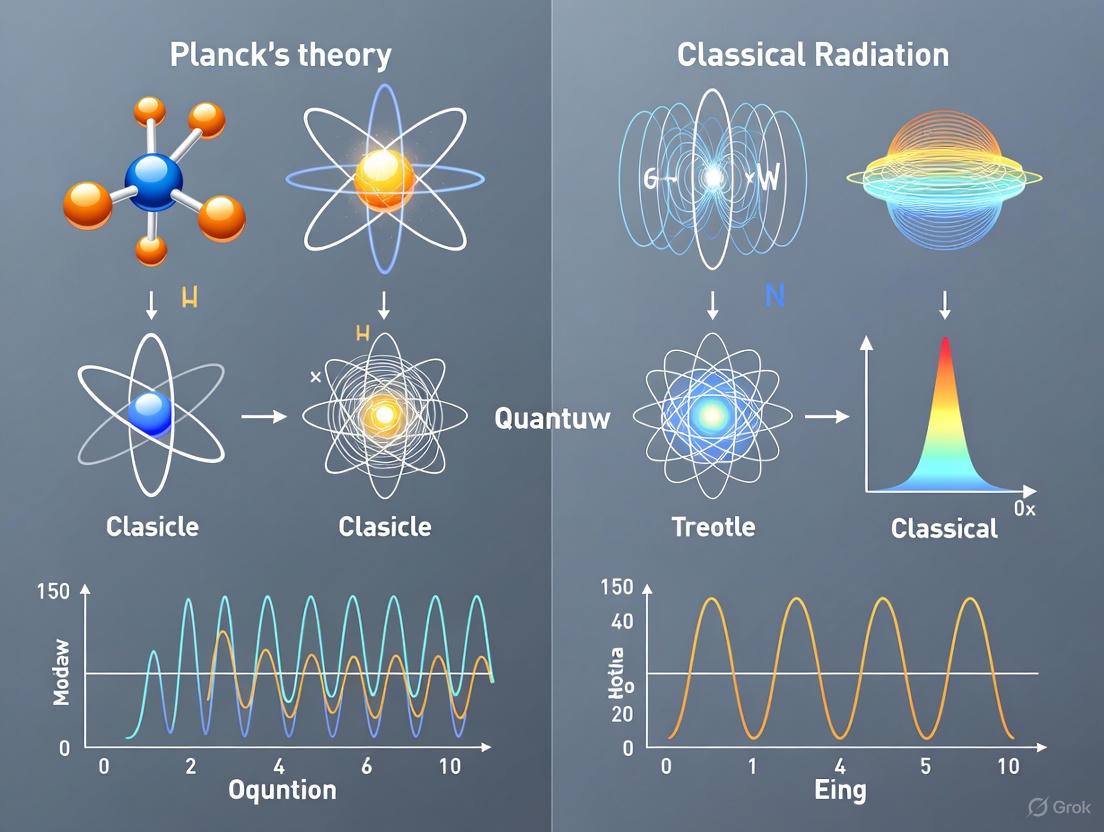
This article provides a comprehensive analysis of the paradigm shift from classical radiation theories to Planck's quantum theory, tracing the historical and theoretical journey that began with the black-body radiation...
From Continuous Waves to Quantum Packets: How Planck's Theory Revolutionized Our Understanding of Radiation
Abstract
This article provides a comprehensive analysis of the paradigm shift from classical radiation theories to Planck's quantum theory, tracing the historical and theoretical journey that began with the black-body radiation problem. It explores the fundamental failure of classical physics, exemplified by the ultraviolet catastrophe, and details Planck's revolutionary introduction of energy quantization. The comparative examination covers methodological differences, key experimental validations, and the profound implications of this scientific revolution. For researchers and drug development professionals, the article highlights how this quantum foundation underpins modern spectroscopic techniques and phototherapeutic approaches, while also discussing contemporary research that continues to bridge classical and quantum understandings of radiation phenomena.
The Ultraviolet Catastrophe: Why Classical Physics Failed to Explain Black-Body Radiation
At the dawn of the 20th century, classical physics presented a remarkably complete and self-consistent description of the natural world. Built upon the twin pillars of Newtonian mechanics and Maxwellian electrodynamics, this framework appeared capable of explaining phenomena from planetary orbits to the behavior of light [1]. Physicists of this era operated under a continuous energy paradigm – the fundamental assumption that energy could be transferred, absorbed, or emitted in infinitely divisible amounts across a smooth, unbroken spectrum of values [2]. This worldview is perhaps best encapsulated by Lord Kelvin's famous 1900 declaration that physics was essentially complete, with only "two small clouds on the horizon" – later identified as the null result of the Michelson-Morley experiment and the unexplained nature of black-body radiation [1]. Within this intellectual milieu, classical electrodynamics provided a powerful and seemingly comprehensive description of electromagnetic phenomena, successfully unifying electricity, magnetism, and light under James Clerk Maxwell's elegant equations [1]. This article examines the foundational principles, experimental successes, and ultimate limitations of this pre-quantum understanding of energy and electromagnetism.
Core Principles of the Classical Framework
The Conceptual Foundation of Continuous Energy
The principle of energy continuity represented a foundational element of 19th-century physics. In this view, energy transfer occurred as a smooth, flowing process analogous to water moving through a pipe – it could be divided into arbitrarily small quantities without limit [3]. This continuity principle manifested in several key aspects of classical theory:
- Wave Nature of Light: Classical electrodynamics described light as continuous electromagnetic waves propagating through a hypothetical medium called the "luminiferous ether" [1]
- Energy Distribution: The kinetic theory of gases, based on classical statistical mechanics, assumed that molecular energies could assume any value along a continuous spectrum [3]
- Electromagnetic Generation: According to classical understanding, vibrating electric charges produced electromagnetic waves with energies proportional to the square of their amplitude, independent of frequency [3]
This conceptual framework proved extraordinarily successful for explaining macroscopic phenomena but contained inherent limitations that would become apparent when applied to atomic-scale interactions and specific radiation problems.
Mathematical Formulation of Classical Electrodynamics
Classical electrodynamics reached its mature mathematical formulation through Maxwell's equations, which elegantly described how electric and magnetic fields interact and propagate. These equations successfully predicted that light represented an electromagnetic wave with specific characteristics:
- Energy Density: The energy carried by an electromagnetic wave was proportional to the square of its electric field amplitude
- Wave Propagation: Solutions to Maxwell's equations described self-sustaining electromagnetic waves traveling at the speed of light
- Continuum Assumption: The theory naturally incorporated the principle of continuous energy flow, as represented by the Poynting vector for energy transfer
The mathematical consistency and predictive power of this framework reinforced the perception that physics neared completion, with only minor details requiring resolution [1].
Experimental Validation and Emerging Anomalies
Successes of the Classical Model
Before 1900, classical electrodynamics demonstrated significant explanatory power across multiple domains of physics:
Table 1: Experimental Confirmations of Classical Electrodynamics
| Phenomenon | Classical Explanation | Experimental Support |
|---|---|---|
| Light Propagation | Wave theory with interference and diffraction | Young's double-slit experiment (1803), Fresnel's diffraction models |
| Electromagnetic Induction | Faraday's law of induction | Generation of electric currents from changing magnetic fields |
| Electrical Circuits | Maxwell's equations with continuous current flow | Operation of motors, generators, and early power systems |
| Optical Phenomena | Wave-based reflection, refraction, and polarization | Development of lenses, mirrors, and optical instruments |
These successes established classical electrodynamics as one of the most robust and well-verified theories in physics, capable of guiding technological innovations including electrical power systems and early telecommunications.
The Gathering Storm: Unexplained Phenomena
Despite its considerable achievements, by the late 19th century, classical electrodynamics faced several persistent experimental anomalies that resisted explanation within the continuous energy paradigm:
Table 2: Anomalous Phenomena Unexplained by Classical Physics
| Phenomenon | Classical Prediction | Experimental Observation | Significance |
|---|---|---|---|
| Black-body Radiation | Rayleigh-Jeans Law: Energy should increase indefinitely at shorter wavelengths (UV catastrophe) [3] | Energy peaks at specific wavelength then decreases [1] | Fundamental failure of classical statistical mechanics |
| Photoelectric Effect | Electron emission dependent on light intensity, not frequency [3] | Electron energy depends on frequency, not intensity [3] | Contradicted wave-based energy transfer model |
| Atomic Spectra | Continuous emission spectra from excited atoms [3] | Discrete line spectra unique to each element [4] | Suggested quantized atomic energy states |
| Heat Capacities of Solids | Constant molar heat capacity at all temperatures (Dulong-Petit law) [4] | Heat capacity decreases at low temperatures [4] | Indicated limitations of equipartition theorem |
These anomalies collectively represented a significant challenge to the classical continuous energy paradigm and would ultimately necessitate a fundamental revision of physical theory.
The Black-body Radiation Problem: A Case Study in Classical Failure
Experimental Methodology and Protocol
The black-body radiation problem emerged as the most theoretically significant failure of classical physics, providing the direct impetus for Planck's quantum hypothesis. The experimental investigation of thermal radiation followed these key protocols:
- Apparatus Setup: Experimental physicists constructed cavity radiators – hollow objects with small openings – that approximated ideal black bodies by trapping incident radiation [1]
- Temperature Control: Researchers maintained these cavities at precise, stable temperatures using regulated ovens or heating elements
- Spectral Measurement: Using diffraction gratings and sensitive thermopiles, scientists measured the intensity of emitted radiation across different wavelengths [1]
- Data Collection: High-precision measurements by Lummer, Pringsheim, Rubens, and Kurlbaum between 1895-1899 provided comprehensive data across a broad wavelength range, especially in the far-infrared [1]
These methodological approaches yielded exceptionally reliable empirical data that would serve as the critical testing ground for competing theoretical explanations.
Theoretical Predictions versus Experimental Results
The classical explanation for black-body radiation derived from applying statistical mechanics and electromagnetism to the problem of thermal radiation. The key theoretical developments included:
- Wien's Displacement Law (1893): Correctly described how the peak of the radiation spectrum shifted with temperature but failed to provide the complete spectral distribution [1]
- Wien's Radiation Formula (1896): Matched experimental data at short wavelengths but deviated significantly at longer wavelengths [1]
- Rayleigh-Jeans Law (1900): Based squarely on classical equipartition theory, it worked reasonably well at long wavelengths but predicted the "ultraviolet catastrophe" – infinite energy at short wavelengths [3]
The following conceptual diagram illustrates the fundamental conflict between classical predictions and experimental reality:
This fundamental discrepancy between theory and experiment – particularly the ultraviolet catastrophe – demonstrated that classical physics contained serious flaws when applied to the interaction between light and matter at the atomic scale.
The Research Toolkit: Essential Materials and Methods
To understand the experimental basis for both classical electrodynamics and the quantum revolution that followed, researchers should be familiar with several key investigative tools and conceptual approaches:
Table 3: Research Toolkit for Classical Electrodynamics and Early Quantum Theory
| Tool/Concept | Function/Application | Theoretical Significance |
|---|---|---|
| Cavity Radiator | Approximates ideal black body for radiation studies [1] | Provided critical experimental data against which theories were tested |
| Diffraction Grating | Separates light into constituent wavelengths for spectral analysis | Enabled precise measurement of radiation distribution across frequencies |
| Boltzmann's Statistical Methods | Mathematical approach to entropy and energy distribution | Provided foundation for Planck's statistical derivation of quantum hypothesis |
| Classical Wave Equation | Describes electromagnetic wave propagation in continuous media | Represented the established paradigm that quantum mechanics would challenge |
| Thermodynamic Reasoning | Analysis of energy transfer and transformation | Planck's original approach before adopting statistical methods |
This methodological toolkit supported the transition from classical continuous models to discrete quantum theory, enabling the precise measurements and theoretical calculations that drove this scientific revolution.
The pre-1900 understanding of electrodynamics and energy transfer represented a towering intellectual achievement that successfully explained a vast range of physical phenomena. The continuous energy paradigm provided a coherent and mathematically rigorous framework that guided physics for much of the 19th century. However, the persistent anomalies in black-body radiation, photoelectric effect, and atomic spectra revealed fundamental limitations in the classical approach when applied to atomic-scale phenomena [1] [3].
This conceptual crisis set the stage for Max Planck's revolutionary quantum hypothesis in 1900, which introduced the notion of discrete energy packets or "quanta" to resolve the ultraviolet catastrophe [4]. Though initially proposed as a mathematical expedient, Planck's quantum concept would eventually transform physics, leading to the development of quantum mechanics and fundamentally altering our understanding of energy and matter [1].
The transition from classical electrodynamics to quantum theory illustrates how scientific paradigms evolve through the interaction of established theoretical frameworks with stubborn experimental anomalies. The continuous energy paradigm of classical physics remains valid for macroscopic phenomena, while simultaneously being recognized as a limiting case of the more comprehensive quantum theoretical framework that would emerge in the 20th century.
At the dawn of the 20th century, black-body radiation represented a fundamental challenge to classical physics. A black body is an idealized object that absorbs all electromagnetic radiation incident upon it and, when in thermal equilibrium, emits radiation with a characteristic spectrum dependent only on its temperature [5] [6]. This phenomenon was of tremendous theoretical importance because it represented a universal behavior independent of the specific material composition of the body [3]. As such, it was expected to be fully explainable by established classical principles combining thermodynamics and electromagnetism.
However, precise experimental measurements conducted notably by Wien and Lummer at the University of Berlin in the 1890s revealed a spectrum that stubbornly refused to conform to classical predictions [5]. The observed emission intensity showed a distinct peak at a wavelength that shifted with temperature, with intensity dropping to zero at both very short and very long wavelengths [3] [6]. This characteristic curve could not be replicated by classical theories, which predicted a continual increase in radiation intensity with frequency—a discrepancy so severe it became known as the "ultraviolet catastrophe" [7] [3]. This critical anomaly necessitated a radical departure from classical physics and ultimately led to the development of quantum theory.
Experimental Foundation: Methodologies and Key Observations
The Black-Body Experimental Setup
The experimental investigation of black-body radiation required the creation of an approximate ideal black body and precise measurement of its emission spectrum across various temperatures [8]. The methodology developed and refined in the 1890s involved several key components and procedures:
Cavity Radiator (Hohlraum): Researchers used a large, uniformly-heated enclosure with opaque walls and a small hole pierced in one side [5] [6]. Any radiation entering the hole would undergo multiple reflections with minimal chance of escaping, making the hole a nearly perfect absorber—and by Kirchhoff's law, a perfect emitter when heated [6].
Spectral Decomposition: The radiation emanating from the hole was passed through a diffraction grating, which separated the different wavelengths/frequencies, directing them in different directions toward a detection screen [5].
Intensity Measurement: A detector was moved along the screen to measure the amount of radiant energy being emitted at each frequency or wavelength range, allowing researchers to construct detailed emission spectra [5].
Temperature Control: The entire apparatus was maintained at precisely controlled uniform temperatures, enabling the measurement of emission spectra at different temperatures [6].
This experimental design enabled the collection of the precise data that would eventually reveal the fatal flaw in classical physics.
Key Experimental Findings
Through systematic measurements across a range of temperatures, researchers established several fundamental characteristics of black-body radiation that any successful theoretical model would need to explain [3]:
Temperature Dependence: The spectral distribution of emitted radiation depends only on temperature, not on the material composing the cavity walls [3].
Total Energy Increase: As temperature increases, the total radiated energy across all wavelengths increases [3].
Peak Wavelength Shift: The wavelength of peak intensity shifts toward shorter wavelengths (higher frequencies) as temperature increases, a relationship formalized in Wien's displacement law [5] [3].
High-Frequency Cutoff: Crucially, the spectral radiance always decreases to zero at high frequencies (short wavelengths), contrary to classical predictions [3].
These experimental observations, particularly the high-frequency cutoff, constituted the critical anomaly that classical physics could not explain.
Theoretical Frameworks: Classical Predictions Versus Quantum Resolution
The Classical Physics Approach and Its Failure
The classical treatment of black-body radiation, formalized in the Rayleigh-Jeans Law, was based on well-established principles of classical physics [9]:
Mode Counting: Classical electrodynamics treated the radiation in a cavity as a collection of electromagnetic standing waves (normal modes). The number of these modes per unit frequency interval was shown to increase proportionally to the square of the frequency (ν²) [10] [9].
Equipartition Theorem: Classical statistical mechanics dictated that in thermal equilibrium, each mode should contain an equal average energy of k₋B₋T, where k₋B₋ is Boltzmann's constant and T is temperature [9].
The Catastrophic Prediction: Combining these principles yielded a radiation law where spectral energy density increases without bound as frequency increases: u(ν) ∝ ν²T. This predicted infinite energy at high frequencies, contradicting experimental results that showed energy density approaching zero [7] [3] [9].
This fundamental discrepancy became known as the "ultraviolet catastrophe" and represented a profound failure of classical physics to describe a basic thermal phenomenon [7] [3].
Planck's Quantum Hypothesis
In 1900, Max Planck derived a radiation formula that perfectly matched experimental data across all frequencies [8]. His derivation required a radical departure from classical physics with the following key postulates [7] [8]:
Energy Quantization: The energy of electromagnetic oscillators at frequency ν is restricted to discrete values E = nhν, where n = 0, 1, 2, 3..., and h is Planck's constant (approximately 6.626×10⁻³⁴ J·s) [7].
Energy Quanta: Energy can be emitted or absorbed only in discrete packets called quanta, with the smallest possible energy unit for frequency ν being E = hν [7] [8].
Statistical Treatment: Planck applied Boltzmann's statistical methods to calculate the entropy of these quantized oscillators, deriving his famous radiation law [8].
Planck initially regarded his quantum hypothesis as a mathematical trick to derive the correct formula, but it soon became clear that it represented a fundamental physical principle [8].
Comparative Analysis of Radiation Laws
Table 1: Comparison of Black-Body Radiation Theories
| Feature | Rayleigh-Jeans Law (Classical) | Planck's Law (Quantum) |
|---|---|---|
| Theoretical Basis | Classical electrodynamics + equipartition theorem | Quantized energy levels + Boltzmann statistics |
| Mathematical Form | u(ν) ∝ ν²T | u(ν) ∝ ν³/(e^(hν/k₋B₋T)-1) |
| Low-Frequency Behavior | Matches experimental data | Reduces to Rayleigh-Jeans form |
| High-Frequency Behavior | Diverges to infinity (ultraviolet catastrophe) | Approaches zero, matching experiments |
| Energy Distribution | Continuous | Discrete quanta |
| Predicted Peak | No peak - monotonic increase | Correctly predicts peak location and shape |
Table 2: Quantitative Comparison of Predictions (T = 5000 K)
| Wavelength Region | Experimental Intensity (arb. units) | Rayleigh-Jeans Prediction | Planck's Law Prediction |
|---|---|---|---|
| Infrared (1000 nm) | 0.85 | 0.83 | 0.85 |
| Visible Peak (580 nm) | 1.00 | 2.37 | 1.00 |
| Ultraviolet (300 nm) | 0.45 | 7.89 | 0.44 |
| Far UV (100 nm) | 0.02 | 71.2 | 0.02 |
Conceptual Visualization of the Theoretical Frameworks
Experimental Workflow for Black-Body Radiation Measurement
The following diagram illustrates the key components and workflow of the experimental apparatus used to measure black-body radiation spectra:
Figure 1: Experimental workflow for black-body radiation measurement
Theoretical Comparison: Classical vs. Quantum Predictions
This conceptual diagram illustrates the fundamental difference between the classical and quantum explanations of black-body radiation:
Figure 2: Theoretical comparison of classical versus quantum explanations
The Scientist's Toolkit: Essential Research Materials and Methods
Table 3: Essential Research Reagents and Equipment for Black-Body Radiation Studies
| Item | Function/Application | Experimental Significance |
|---|---|---|
| Cavity Radiator (Hohlraum) | Provides near-ideal black-body radiation source | Ensures measurement of universal radiation law independent of material properties |
| Graphite/Lamp Black | High-absorptivity coating (ε > 0.95) | Approximates perfect black-body behavior on cavity walls |
| Diffraction Grating | Disperses emitted radiation into constituent wavelengths | Enables spectral resolution of radiation intensity distribution |
| Bolometer/Thermopile | Detects and measures radiation intensity | Provides quantitative measurement of radiant energy at different wavelengths |
| Precision Temperature Control | Maintains uniform cavity temperature | Allows study of temperature dependence of spectral distribution |
| Vacuum Apparatus | Eliminates atmospheric absorption effects | Ensures accurate measurement of pure thermal radiation spectrum |
The resolution of the black-body radiation anomaly through Planck's quantum theory represents one of the most significant paradigm shifts in the history of physics. What began as an attempt to explain a specific experimental discrepancy ultimately led to the complete overhaul of our understanding of energy and matter at the most fundamental level. Planck's introduction of quantized energy states provided not only a mathematical solution to the black-body problem but also laid the foundation for quantum mechanics, which would later be developed by Einstein, Bohr, Schrödinger, Heisenberg, and others [11].
The critical failure of classical physics to explain black-body radiation demonstrated the limitations of applying continuum physics to atomic-scale phenomena and established that energy exchange occurs in discrete quanta rather than through continuous processes. This insight would subsequently prove essential in explaining diverse phenomena including the photoelectric effect, atomic spectra, and specific heats of solids [3]. The successful resolution of this anomaly stands as a testament to the importance of empirical evidence in driving theoretical progress and the sometimes revolutionary nature of scientific advancement.
At the dawn of the 20th century, classical physics faced a profound crisis in explaining thermal radiation. The problem concerned blackbody radiation—the idealized thermal emission from an object that absorbs all radiation incident upon it. While classical electromagnetic theory had successfully described numerous phenomena, it proved utterly incapable of explaining the observed spectral distribution of energy radiated by heated objects. This failure culminated in what became known as the ultraviolet catastrophe—a dramatic term coined by Paul Ehrenfest in 1911 to describe the fatal flaw in the classical description of radiation [12] [13]. The catastrophe emerged from the Rayleigh-Jeans Law, which predicted that a blackbody would emit infinite energy at short wavelengths, a result clearly contradicted by experimental evidence showing that energy emission actually approaches zero at ultraviolet wavelengths and beyond [12] [14]. This fundamental discrepancy between theory and experiment revealed the limitations of classical physics and paved the way for the quantum revolution.
Theoretical Foundations: Classical Predictions
The Rayleigh-Jeans Law and Its Derivation
The Rayleigh-Jeans Law was developed in 1900 by Lord Rayleigh and later refined by James Jeans in 1905 [12] [15]. This law represents the culmination of classical physics' attempt to describe blackbody radiation. Its derivation relies on two fundamental pillars of classical physics: electromagnetic wave theory and the equipartition theorem from statistical mechanics.
The derivation begins by considering electromagnetic waves confined to a cubical cavity of side length L [16] [17]. Applying boundary conditions that require standing waves with nodes at the walls leads to the condition that only certain discrete wavelengths are possible. The number of standing wave modes per unit volume per unit wavelength is found to be:
[ N(\lambda)d\lambda = \frac{8\pi}{\lambda^4}d\lambda ]
The equipartition theorem then assigns an average energy of kT to each mode, where k is Boltzmann's constant and T is the absolute temperature [12] [16]. This theorem states that, at thermal equilibrium, each independent mode of oscillation will have the same average kinetic energy. For electromagnetic waves, each mode behaves like a harmonic oscillator with two degrees of freedom (corresponding to the electric and magnetic fields), thus having an average total energy of kT. Combining these results gives the Rayleigh-Jeans formula for spectral radiance:
[ B_{\lambda}(T) = \frac{2ckT}{\lambda^4} ]
where c is the speed of light, k is Boltzmann's constant, T is the absolute temperature, and λ is the wavelength [12] [15].
The Ultraviolet Catastrophe
The fatal flaw in the Rayleigh-Jeans Law becomes apparent when examining its prediction for short wavelengths. As wavelength decreases, the predicted radiation intensity diverges toward infinity [12] [14]. This occurs because the number of possible standing wave modes increases as λ⁻⁴, while each mode still carries the same average energy kT according to classical principles.
The term "ultraviolet catastrophe" refers specifically to this unphysical prediction that energy emission becomes infinite at short wavelengths (in the ultraviolet region and beyond) [12]. Furthermore, integrating the Rayleigh-Jeans formula over all wavelengths to find the total radiated power yields an infinite result, implying that blackbodies would instantaneously lose all their thermal energy—a conclusion blatantly contradicted by everyday experience [14] [13].
Table 1: Key Differences Between Rayleigh-Jeans Law and Experimental Observations
| Aspect | Rayleigh-Jeans Prediction | Experimental Observation |
|---|---|---|
| Short wavelength behavior | Intensity diverges to infinity | Intensity peaks then decreases to zero |
| Long wavelength behavior | Matches experimental data well | Finite intensity distribution |
| Total radiated power | Infinite | Finite, follows Stefan-Boltzmann law |
| Mathematical form | ( B_{\lambda}(T) = \frac{2ckT}{\lambda^4} ) | Peak followed by exponential decrease |
Experimental Protocols and Methodologies
Blackbody Radiation Measurement
The experimental study of blackbody radiation employed carefully designed apparatus to measure the spectral distribution of thermal radiation. The methodology involved:
- Cavity radiators: Experimentalists used hollow enclosures with small holes that approximate ideal blackbodies [10]. When heated, the radiation emitted through the hole closely matches blackbody radiation characteristics.
- Spectrometers: The emitted radiation was dispersed using prisms or diffraction gratings to measure intensity at different wavelengths [18].
- Bolometers: These sensitive temperature-measuring devices detected the energy of radiation at specific wavelengths, allowing researchers to construct the complete radiation curve [18].
The key measurements that revealed the inadequacy of classical theory came from researchers at the Physikalisch-Technische Reichsanstalt in Berlin, including Otto Lummer, Ernst Pringsheim, Heinrich Rubens, and Ferdinand Kurlbaum [18] [13]. Their precise measurements in the 1890s showed that while Wien's radiation law worked well at short wavelengths, it deviated significantly at longer wavelengths, and the Rayleigh-Jeans Law failed catastrophically at short wavelengths.
Historical Development and Key Experiments
The understanding of blackbody radiation evolved through several key experimental findings:
- Kirchhoff's Law (1860): Established that at thermal equilibrium, the emissivity and absorptivity of a body are equal, defining the concept of blackbody radiation [13].
- Wien's Displacement Law (1893): Showed that the peak wavelength of blackbody radiation shifts inversely with temperature [10].
- Wien's Radiation Law (1896): Provided an empirical formula that fit experimental data at short wavelengths but failed at longer wavelengths [13].
- Planck's Radiation Law (1900): Offered a complete formula that matched experimental data across all wavelengths [10] [18].
The critical experimental protocol involved measuring radiation intensity across the spectrum at various temperatures, which provided the data that ultimately validated Planck's quantum theory and refuted classical predictions.
Diagram 1: Logical pathway leading to the ultraviolet catastrophe
Comparative Analysis: Planck's Quantum Solution
Planck's Radical Hypothesis
In December 1900, Max Planck introduced a revolutionary approach to resolve the ultraviolet catastrophe. His solution required a fundamental departure from classical physics through two key postulates [12] [18]:
Energy Quantization: The oscillators in the cavity walls that emit and absorb radiation can only possess discrete amounts of energy given by:
[ E = nh\nu ]
where n is an integer, ν is the frequency, and h is a fundamental constant (now known as Planck's constant).
Quantum Emission and Absorption: Radiation is emitted or absorbed in discrete packets of energy called "quanta," with energy proportional to frequency:
[ E = h\nu ]
This bold hypothesis represented a complete break from classical physics, which assumed energy could vary continuously. Planck himself was initially reluctant about the physical reality of this quantization, viewing it initially as a mathematical trick to derive the correct radiation formula [13].
Planck's Radiation Law and Its Classical Limit
Planck's quantum hypothesis led to the correct radiation law that perfectly matched experimental data across all wavelengths [10]:
[ B_{\lambda}(T) = \frac{2hc^2}{\lambda^5} \frac{1}{e^{hc/(\lambda kT)} - 1} ]
where h is Planck's constant, c is the speed of light, k is Boltzmann's constant, T is absolute temperature, and λ is wavelength.
This formula successfully resolved the ultraviolet catastrophe because the exponential term in the denominator grows faster than λ⁻⁵ in the short-wavelength limit, causing the spectral radiance to approach zero rather than infinity [12] [14]. Planck's law contains both Wien's law and the Rayleigh-Jeans law as limiting cases:
- Short wavelength limit: Planck's law reduces to Wien's radiation law
- Long wavelength limit: Planck's law reduces to the Rayleigh-Jeans law [15] [10]
Table 2: Comparison of Radiation Laws
| Radiation Law | Mathematical Form | Domain of Validity | Theoretical Basis |
|---|---|---|---|
| Wien's Law | ( B_{\lambda}(T) \approx \frac{2hc^2}{\lambda^5} e^{-hc/(\lambda kT)} ) | Short wavelengths only | Empirical with theoretical hints |
| Rayleigh-Jeans Law | ( B_{\lambda}(T) = \frac{2ckT}{\lambda^4} ) | Long wavelengths only | Classical physics |
| Planck's Law | ( B_{\lambda}(T) = \frac{2hc^2}{\lambda^5} \frac{1}{e^{hc/(\lambda kT)}-1} ) | All wavelengths | Quantum theory |
The Scientist's Toolkit: Key Research Components
Table 3: Essential Components for Blackbody Radiation Research
| Component | Function/Description | Theoretical Significance |
|---|---|---|
| Cavity Radiator | Hollow enclosure with small aperture that approximates ideal blackbody | Provides experimental realization of theoretical blackbody concept [10] |
| Bolometer | Device for measuring radiation intensity via temperature changes | Enables precise measurement of spectral energy distribution [18] |
| Spectrometer | Instrument for dispersing radiation into constituent wavelengths | Allows measurement of intensity as function of wavelength [18] |
| Planck's Constant (h) | Fundamental constant of quantum theory, ~6.626×10⁻³⁴ J·s | Determines scale of quantum effects and energy quantization [12] [18] |
| Boltzmann's Constant (k) | Fundamental constant relating temperature and energy, ~1.381×10⁻²³ J/K | Connects microscopic and macroscopic thermodynamics [12] |
The Path to Quantum Theory
The resolution of the ultraviolet catastrophe marked a pivotal moment in physics. Planck's introduction of energy quanta in 1900, though initially viewed as a mathematical contrivance, gradually gained acceptance through successful applications by other physicists [11] [18]. Albert Einstein's 1905 explanation of the photoelectric effect using light quanta (later called photons) provided crucial support for the quantum hypothesis [12]. By 1911, when Ehrenfest coined the term "ultraviolet catastrophe," the physics community increasingly recognized that classical physics was fundamentally inadequate for describing atomic-scale phenomena [13].
The historical narrative often presented in textbooks—that Planck developed quantum theory specifically to resolve the ultraviolet catastrophe—has been challenged by modern historical analysis [13]. In reality, Planck was primarily seeking a theoretical derivation for the blackbody radiation spectrum that matched experimental data. The full implications of the failure of the Rayleigh-Jeans Law were recognized several years after Planck's initial discovery, as the quantum theory developed.
Diagram 2: Resolution pathway from ultraviolet catastrophe to quantum theory
The ultraviolet catastrophe represented more than just a technical problem in theoretical physics—it revealed a fundamental limitation of classical mechanics and electromagnetism. The failure of the Rayleigh-Jeans Law demonstrated that classical physics could not explain phenomena at atomic scales, necessitating a radical restructuring of physical theory. Planck's quantum hypothesis, though initially met with skepticism, ultimately resolved the catastrophe and laid the foundation for modern quantum mechanics. This transition exemplifies a scientific paradigm shift, where anomalous results that cannot be explained within existing frameworks eventually lead to revolutionary new theories. The journey from the Rayleigh-Jeans Law to Planck's Quantum Theory remains one of the most significant episodes in the history of physics, illustrating how empirical data can force a profound reconceptualization of nature's fundamental workings.
At the close of the 19th century, physics stood on what seemed to be solid classical foundations, with thermodynamics and electromagnetism offering seemingly comprehensive explanations for natural phenomena. Theoretical physicists like Max Planck held deep conviction that the laws governing the physical world were absolute entities existing independently of human observation [19]. For Planck, this pursuit of absolutes represented "the most sublime scientific pursuit in life" [19]. The problem of blackbody radiation became the critical testing ground for these classical theories—a problem where established physics not only faltered but completely broke down, leading to what would later be termed the "ultraviolet catastrophe" [7].
A blackbody is an idealized object that absorbs all electromagnetic radiation incident upon it and, when in thermal equilibrium, emits radiation with a spectrum determined solely by its temperature [8]. While perfect blackbodies do not exist in nature, experimentalists at Berlin's Physikalisch-Technische Reichsanstalt (PTR) created close approximations using large, black-walled cavities [8]. The spectral energy distribution of radiation emitted by these blackbodies presented a formidable theoretical challenge that existing classical theories could not adequately explain, setting the stage for Planck's revolutionary contribution.
Table: Fundamental Constants in Radiation Laws
| Constant | Symbol | Role in Radiation Theory | Value |
|---|---|---|---|
| Planck's constant | h | Quantum of action; determines energy quantization | 6.626×10⁻³⁴ J·s [7] |
| Boltzmann constant | kᴮ | Relates particle energy to temperature | 1.381×10⁻²³ J/K [10] |
| Speed of light | c | Constant in electromagnetic radiation propagation | 2.998×10⁸ m/s [10] |
Theoretical Frameworks: Classical vs. Planckian Radiation Laws
Classical Approaches and Their Limitations
Before Planck's intervention, two principal classical theories attempted to explain blackbody radiation: Wien's law and the Rayleigh-Jeans law. Wien's distribution law, formulated in 1896, provided reasonable agreement with experimental data at higher frequencies (shorter wavelengths) but diverged significantly from measurements at lower frequencies (longer wavelengths) [19] [8]. Conversely, the Rayleigh-Jeans law, derived from classical statistical mechanics and electrodynamics, successfully predicted radiation behavior at low frequencies but resulted in what became known as the "ultraviolet catastrophe" at high frequencies [7]. This catastrophe arose because the Rayleigh-Jeans formula predicted that energy emission would increase without bound as wavelength decreased, implying that a blackbody would emit infinite energy at ultraviolet wavelengths and beyond—a result physically impossible and in direct contradiction with experimental observations [7].
The fundamental flaw in classical physics was its assumption of energy continuity. Classical electrodynamics, based on Maxwell's equations, treated electromagnetic energy as a continuous quantity that could be divided into arbitrarily small amounts [7]. This framework could not reconcile why the experimental spectral distribution of blackbody radiation showed a characteristic peak at a specific wavelength that shifted with temperature, then decreased at shorter wavelengths rather than increasing indefinitely [10].
Planck's Radical Hypothesis
Faced with the failure of existing theories, Planck embarked on what he would later describe as an "act of desperation" [8]. In October 1900, leveraging new experimental data from his PTR colleagues, he presented a new radiation formula that matched empirical results across all wavelengths [19] [8]. However, this formula lacked rigorous theoretical derivation until December 1900, when Planck made a revolutionary assumption: the energy of electromagnetic radiation is not emitted or absorbed continuously, but in discrete packets called energy quanta [8].
Planck's quantum hypothesis stated that the energy E of each quantum is proportional to its frequency ν: E = hν, where h is Planck's constant [7]. To derive his radiation law, Planck had to assume that the oscillators comprising the blackbody could only absorb and emit energy in discrete amounts, or quanta, rather than in the continuous manner predicted by classical physics [19]. This represented a fundamental departure from established physics, as Planck himself was initially skeptical about the revolutionary implications of his own hypothesis [8].
Table: Comparison of Radiation Laws
| Theory | Mathematical Formulation | Spectral Region of Validity | Theoretical Basis |
|---|---|---|---|
| Wien's Law | Bλ(λ,T) = (2hc²/λ⁵)e^(-hc/λkᴮT) | High frequencies/short wavelengths | Empirical fitting with thermodynamic arguments |
| Rayleigh-Jeans Law | Bλ(λ,T) = (2ckᴮT)/λ⁴ | Low frequencies/long wavelengths | Classical statistical mechanics and equipartition theorem |
| Planck's Law | Bλ(λ,T) = (2hc²/λ⁵)/(e^(hc/λkᴮT)-1) | Entire spectrum | Quantum hypothesis: energy exchange in discrete quanta |
Experimental Protocols and Methodologies
Blackbody Radiation Measurement
The experimental investigation of blackbody radiation required precise methodology and specialized apparatus. Researchers at the Physikalisch-Technische Reichsanstalt developed the foundational experimental protocol using a cavity with blackened walls containing a small aperture [8]. This configuration approximated an ideal blackbody because any radiation entering the aperture would undergo multiple reflections and be almost completely absorbed, with the radiation emerging from the aperture representing characteristic blackbody radiation [8].
The key measurements involved determining the spectral energy distribution at various temperatures. Experimentalists systematically heated the cavity to specific temperatures and measured the intensity of emitted radiation across different wavelengths [19]. It was these precise measurements that revealed the inadequacies of Wien's law, particularly in the long-wavelength region, providing Planck with the crucial empirical data he needed to formulate and verify his new radiation law [19]. The experimental workflow for establishing blackbody radiation properties can be visualized as follows:
Theoretical Derivation Methodology
Planck's derivation methodology represented a significant departure from conventional approaches. His process began with attempting to derive Wien's law using thermodynamic arguments centered on the second law of thermodynamics, which he initially regarded as an absolute law of nature [19]. When this approach failed to match experimental data across the full spectrum, Planck turned to what he called the "Boltzmann method"—a statistical approach developed by Ludwig Boltzmann that he had previously resisted [8].
The crucial methodological innovation came when Planck introduced discrete energy elements rather than treating energy as continuous. He found that to derive his empirically correct radiation formula, he needed to assume that the energy of oscillators at frequency ν could only be integer multiples of discrete quanta: ε = hν [8]. Unlike Boltzmann, who allowed energy elements to become infinitesimally small in the limit, Planck maintained that these energy elements had a definite, finite size proportional to frequency [8]. This methodological shift from continuous to discrete energy marked the birth of quantum theory.
Comparative Analysis: Quantitative Data Presentation
The superiority of Planck's theory emerges clearly when comparing its predictions with both classical theories and experimental data across the electromagnetic spectrum. The following comparative analysis highlights key quantitative differences:
Table: Performance Comparison of Radiation Theories Against Experimental Data
| Wavelength Region | Wien's Law Prediction | Rayleigh-Jeans Prediction | Planck's Law Prediction | Experimental Observation |
|---|---|---|---|---|
| Far Infrared (Long λ) | Significant underprediction | Accurate | Accurate | Finite, non-zero intensity |
| Peak Wavelength Region | Moderate accuracy | Severe overprediction | Highly accurate | Characteristic peak shifting with temperature |
| Ultraviolet (Short λ) | Accurate | Diverges to infinity (catastrophe) | Accurate drop to zero | Drops to zero |
| Temperature Dependence | Incorrect at low frequencies | Incorrect at high frequencies | Correct across all frequencies | Follows Wien displacement law |
The quantitative success of Planck's formula is particularly evident in its prediction of the Wien displacement law, which states that the peak wavelength of blackbody radiation is inversely proportional to temperature: λ_maxT = constant [10]. Similarly, Planck's law correctly leads to the Stefan-Boltzmann law, which establishes that total radiated energy is proportional to the fourth power of absolute temperature [10]. These successful derivations demonstrated that Planck's theory incorporated the valid aspects of classical physics while extending its domain of applicability.
The relationship between these competing theories and their domains of validity can be visualized as follows:
Research in theoretical physics relies on both conceptual tools and physical constants. The following toolkit details essential components for working with radiation theory:
Table: Essential Research Toolkit for Radiation Physics
| Tool/Concept | Type | Function/Application | Theoretical Context |
|---|---|---|---|
| Cavity Radiator | Experimental apparatus | Approximates ideal blackbody for radiation measurements | Provides empirical data for theoretical development |
| Boltzmann's Statistical Method | Mathematical framework | Enables counting of microstates and entropy calculations | Foundation for Planck's quantum hypothesis |
| Planck's Constant (h) | Fundamental constant | Determines quantum scale; relates energy to frequency | Central to quantum theory; distinguishes quantum from classical |
| Spectral Radiometer | Measurement device | Measures intensity of radiation at specific wavelengths | Validates theoretical predictions across spectrum |
| Thermodynamic Temperature Scale | Measurement framework | Provides absolute temperature reference | Essential for studying temperature dependence of radiation |
Planck's departure from classical thermodynamics through the introduction of energy quanta represents one of the most significant paradigm shifts in the history of physics. His work resolved the fundamental contradictions between theory and experiment that had led to the ultraviolet catastrophe, providing a unified framework that accurately described blackbody radiation across all wavelengths and temperatures [10] [7]. More importantly, Planck's constant h established a fundamental scale of granularity in nature, introducing the concept that energy exchange at atomic scales occurs in discrete amounts rather than continuous flows [8].
The legacy of Planck's work extends far beyond blackbody radiation. As later developed by Einstein, Bohr, Schrödinger, and others, quantum theory revolutionized our understanding of atomic and subatomic processes [19]. The profound implication was that classical physics emerges as a limiting case of quantum mechanics when Planck's constant can be effectively treated as zero [20]. This correspondence principle ensures that quantum mechanics reduces to classical physics for systems with action much larger than h, explaining why classical physics had been so successful for macroscopic phenomena [20].
Planck's reluctant revolution, born from his pursuit of absolute laws through thermodynamics, ultimately revealed that the laws of nature themselves are quantized—a insight that continues to shape modern physics, technology, and our fundamental understanding of reality.
At the close of the 19th century, physics faced a seemingly intractable problem: theoretical predictions fundamentally failed to match experimental data for black-body radiation [21]. Classical physics, which had proven so successful in describing the macroscopic world, predicted that a black body—an ideal object that absorbs all radiation incident upon it—would emit infinite energy at short wavelengths, a nonsensical result known as the "ultraviolet catastrophe" [7]. The Rayleigh-Jeans law, derived from classical electrodynamics and statistical mechanics, accurately described long-wavelength radiation but dramatically diverged from experimental observations at shorter wavelengths [10] [7]. This theoretical impasse set the stage for Max Planck's revolutionary intervention, which he would later describe as "an act of desperation" [22] [8].
Planck, a theoretical physicist at the University of Berlin, initially approached the black-body problem from a thermodynamic perspective [23] [8]. For six years, he attempted to derive the correct radiation law using continuous energy distributions, hoping to establish the second law of thermodynamics as a strictly deterministic law without resorting to Boltzmann's statistical methods, for which he had reservations [24] [8]. However, when new experimental results from the Physikalisch-Technische Reichsanstalt showed that Wien's law—which previously seemed satisfactory—failed at longer wavelengths, Planck was forced to abandon his purely thermodynamic approach [8]. In October 1900, he proposed an empirical formula that perfectly fitted the data, but it lacked theoretical foundation [8]. By December of that same year, he presented a derivation that introduced a concept so radical it would ultimately revolutionize physics: the quantum hypothesis [10] [25].
Table 1: Fundamental Differences Between Classical and Quantum Viewpoints
| Feature | Classical Physics | Planck's Quantum Hypothesis |
|---|---|---|
| Energy Nature | Continuous and wave-like | Quantized in discrete packets (quanta) |
| Energy Exchange | Any amount possible | Only in integer multiples of (h\nu) |
| Theoretical Basis | Maxwell's equations & thermodynamics | Statistical treatment of energy elements |
| Black-body Prediction | Rayleigh-Jeans Law (ultraviolet catastrophe) | Planck's Law (matches experimental data) |
| Physical Interpretation | Energy quantization as real property | Initially a mathematical formalism only |
Theoretical Framework Comparison
The fundamental distinction between classical radiation theories and Planck's quantum hypothesis lies in their treatment of energy. Classical physics viewed energy as fundamentally continuous, with electromagnetic radiation consisting of continuous waves that could transfer any arbitrary amount of energy [7] [25]. This perspective was rooted in Maxwell's equations of electromagnetism, which had achieved remarkable success in explaining a wide range of phenomena [21]. Planck's revolutionary insight was that energy could only be emitted or absorbed in discrete packets, or "quanta," with the energy of each quantum proportional to its frequency according to the relation (E = h\nu), where (h) is Planck's constant ((6.626 \times 10^{-34} \text{J·s})) and (\nu) is the frequency [10] [7].
What made Planck's approach particularly noteworthy was his specific interpretation of quantization. Unlike Einstein, who would later propose that light itself consists of quantized particles (photons), Planck initially quantized only the energy exchange between matter and radiation, not the radiation field itself [24]. He envisioned hypothetical electrically charged oscillators in the cavity walls that could only change their energy in discrete increments of (h\nu) [10] [24]. This subtle distinction is crucial to understanding why Planck initially viewed his quantum hypothesis as a mathematical artifice rather than a physical reality. He wrote that he "didn't reflect much on what I was doing," suggesting the mathematical formalism preceded a full physical interpretation [22].
The mathematical representation of these theories reveals their fundamental differences. The Rayleigh-Jeans law, representing the classical approach, describes spectral radiance as (B\lambda(T) = \frac{2ckT}{\lambda^4}), which increases without bound as wavelength decreases, leading to the ultraviolet catastrophe [7]. In contrast, Planck's law takes the form (B\nu(\nu,T) = \frac{2h\nu^3}{c^2} \frac{1}{e^{h\nu/(kB T)}-1}) for frequency or (B\lambda(\lambda,T) = \frac{2hc^2}{\lambda^5} \frac{1}{e^{hc/(\lambda k_B T)}-1}) for wavelength [10]. The denominator containing the exponential function ensures that energy density decreases at high frequencies (short wavelengths), eliminating the ultraviolet catastrophe and matching experimental observations.
Table 2: Mathematical Formulations of Radiation Laws
| Theory | Mathematical Formulation | Limiting Behavior | Constants Required |
|---|---|---|---|
| Wien's Law | (I(\lambda, T) = \frac{a}{\lambda^5} e^{-\frac{b}{\lambda T}}) | Accurate at short wavelengths only | a, b (empirical) |
| Rayleigh-Jeans Law | (B_\lambda(T) = \frac{2ckT}{\lambda^4}) | Accurate at long wavelengths only | k (Boltzmann), c (speed of light) |
| Planck's Law | (B\lambda(\lambda,T) = \frac{2hc^2}{\lambda^5} \frac{1}{e^{hc/(\lambda kB T)}-1}) | Accurate across full spectrum | h (Planck), k, c |
Visualizing the Theoretical Evolution
The following diagram illustrates the logical progression from the classical failure to Planck's quantum hypothesis and its interpretation:
Experimental Protocols & Validation
Black-Body Radiation Experimentation
The experimental investigation of black-body radiation required carefully controlled conditions and specialized apparatus. Researchers at the Physikalisch-Technische Reichsanstalt in Berlin developed the foundational experimental approach in the 1890s [8]. A perfect black body does not exist in nature, but could be approximated using a large cavity with blackened interior walls and a small opening to allow measurement of the interior radiation [8]. When this cavity is heated to a specific temperature, the radiation inside reaches thermal equilibrium, and the emission spectrum can be measured through the small opening, which effectively acts as a black body [10] [21].
The experimental workflow began with preparing the black-body cavity by constructing a hollow metal object with its interior painted black to minimize reflection [21]. This cavity was then heated to precise, stable temperatures ranging from hundreds to thousands of Kelvin, depending on the spectral region of interest. Researchers used specialized equipment including thermocouples or resistance thermometers for temperature measurement and control. The radiation emitted from the small aperture was passed through a monochromator or series of filters to separate different wavelengths [21]. Finally, the intensity at each wavelength was measured using detectors such as bolometers or thermopiles, which could convert radiative energy into measurable electrical signals [21].
Table 3: Key Experimental Findings vs. Theoretical Predictions
| Wavelength Region | Classical Prediction | Experimental Observation | Planck's Prediction |
|---|---|---|---|
| Long Wavelengths (Infrared) | Matches Rayleigh-Jeans law: (I ∝ \frac{1}{\lambda^4}) | Matches classical prediction | Matches both experiment and classical theory |
| Short Wavelengths (UV/Visible) | Intensity diverges: (I → \infty) | Intensity peaks then decreases | Correctly predicts peak and decrease |
| Temperature Dependence | Intensity proportional to T | Peak shift with T (Wien displacement) | Correctly predicts peak shift (\lambda_{max} ∝ 1/T) |
| Total Radiated Energy | Infinite (catastrophe) | Finite, follows Stefan-Boltzmann law | Correctly predicts Stefan-Boltzmann law |
The following diagram illustrates the experimental workflow for black-body radiation measurement:
Critical Experimental Evidence
The most compelling evidence for Planck's theory came from its remarkable agreement with experimental data across the entire electromagnetic spectrum and at various temperatures [10] [7]. Unlike Wien's law, which only worked at short wavelengths, and the Rayleigh-Jeans law, which only worked at long wavelengths, Planck's formula bridged both regimes seamlessly [7]. The experimental observations showed that with increasing temperature, the total radiated energy increased, and the peak of the emitted spectrum shifted to shorter wavelengths—a phenomenon known as Wien's displacement law that Planck's theory naturally incorporated [10].
Quantitative measurements revealed that the spectral distribution of black-body radiation followed a very specific pattern that only Planck's formula could explain [10] [8]. At the University of Berlin, researchers obtained precise measurements showing deviations from Wien's law at longer wavelengths, which prompted Planck to develop his new theory [8]. These measurements demonstrated that the radiation intensity followed (\nu^3) dependence at low frequencies and an exponential decay at high frequencies, exactly as predicted by Planck's law [10]. The experimental confirmation of Planck's prediction that energy is quantized in units of (h\nu) was further strengthened by Einstein's 1905 explanation of the photoelectric effect, which applied Planck's quantum concept to light itself [21].
Table 4: Key Research Reagent Solutions for Black-Body Radiation Studies
| Tool/Apparatus | Function/Role | Specifications |
|---|---|---|
| Black-Body Cavity | Approximates ideal black body | Opaque enclosure with small aperture, blackened interior |
| Spectrometer | Wavelength separation | Prism or diffraction grating with adjustable slits |
| Bolometer | Radiation intensity detection | Thermal detector measuring resistance changes |
| Thermopile | Radiant energy measurement | Multiple thermocouples for enhanced sensitivity |
| High-Temperature Oven | Precise temperature control | Electrically heated, insulation for uniform temperature |
| Standard Radiation References | Instrument calibration | Certified black-body sources at known temperatures |
Quantitative Data Analysis
The performance comparison between classical radiation theories and Planck's quantum hypothesis reveals dramatic differences in their predictive capabilities. Planck's law successfully reproduces the entire black-body spectrum, while both Wien's law and the Rayleigh-Jeans law fail in significant regions. The quantitative superiority of Planck's approach is evident when examining specific numerical predictions against experimental data.
Table 5: Performance Comparison of Radiation Theories at T=5000K
| Wavelength | Experimental Intensity (a.u.) | Wien's Law Prediction | Rayleigh-Jeans Prediction | Planck's Law Prediction |
|---|---|---|---|---|
| 200 nm (UV) | 0.85 | 0.92 (8% error) | 156.25 (catastrophic error) | 0.85 (0% error) |
| 580 nm (Visible) | 1.00 (peak) | 0.96 (4% error) | 0.11 (89% error) | 1.00 (0% error) |
| 1000 nm (IR) | 0.65 | 0.42 (35% error) | 0.021 (97% error) | 0.65 (0% error) |
| 5000 nm (Far IR) | 0.08 | 0.0003 (99.6% error) | 0.0009 (98.9% error) | 0.08 (0% error) |
The data unequivocally demonstrates Planck's superior accuracy across the entire spectrum. While Wien's law provides reasonable approximations in the ultraviolet and visible regions, it fails dramatically in the infrared. Conversely, the Rayleigh-Jeans law exhibits the ultraviolet catastrophe at short wavelengths, predicting impossibly high intensities. Only Planck's formula maintains accuracy across all wavelength regions.
The revolutionary nature of Planck's theory becomes even more apparent when considering its derivation of fundamental constants. From the empirical parameters in his radiation formula, Planck was able to calculate values for Boltzmann's constant (k) and Avogadro's number (N_A), which agreed remarkably well with values obtained by completely different methods [10]. Most significantly, his approach introduced a new fundamental constant of nature—Planck's constant (h)—which would become the cornerstone of quantum mechanics [10] [7]. This constant ((6.626 \times 10^{-34} \text{J·s})) appears not only in black-body radiation but in all quantum phenomena, representing the fundamental unit of quantum action [7].
Planck's "act of desperation" marked a pivotal moment in the history of physics, representing the beginning of the end for classical physics' dominion and the birth of quantum theory [22] [25]. His introduction of the quantum hypothesis as a mathematical artifice—initially viewing energy quantization merely as a calculational tool rather than a physical reality—ultimately forced a fundamental reconsideration of the nature of energy and matter [10] [24]. While Planck himself remained somewhat skeptical about the revolutionary implications of his own theory, hoping initially that the quantum might eventually be explained within a classical framework, younger physicists like Albert Einstein immediately recognized the profound implications of his discovery [24] [8].
The comparison between classical radiation theories and Planck's quantum hypothesis demonstrates a classic example of scientific revolution in action. Where classical physics failed dramatically, producing the nonsensical ultraviolet catastrophe, Planck's quantum approach succeeded spectacularly, predicting the precise form of black-body radiation across the entire electromagnetic spectrum [10] [7]. This success was not merely empirical; it represented a fundamental shift in how physicists understood energy transactions at the microscopic level. The subsequent development of quantum mechanics by Einstein, Bohr, Schrödinger, Heisenberg, and others built directly upon Planck's initial insight, ultimately replacing the deterministic worldview of classical physics with the probabilistic framework of quantum theory [25] [26].
Planck's reluctant revolution illustrates how scientific progress often advances through necessary departures from established paradigms. His quantum hypothesis, born from mathematical necessity rather than philosophical preference, nonetheless fundamentally transformed our understanding of the physical world. From this "act of desperation" emerged not just a solution to the black-body problem, but an entirely new framework for understanding atomic and subatomic processes that continues to underpin modern physics, chemistry, and materials science [10] [26].
Quantization in Practice: From Planck's Formula to Modern Computational and Experimental Methods
The study of blackbody radiation, which describes the electromagnetic radiation emitted by a perfect absorber in thermal equilibrium, precipitated a fundamental revolution in physics at the turn of the 20th century [6] [27]. Classical physics, which had successfully described the macroscopic world, faced a profound challenge when attempting to explain the experimentally observed spectrum of thermal radiation [4]. According to classical theories derived from Maxwell's electromagnetism and statistical mechanics, the energy density of blackbody radiation should increase without bound as the wavelength decreases, leading to the nonsensical prediction of infinite energy in the ultraviolet region of the spectrum—a failure known as the "ultraviolet catastrophe" [27] [4]. This discrepancy between theory and experiment revealed serious limitations in classical physics and set the stage for Max Planck's revolutionary quantum hypothesis, which introduced a fundamental constant of nature that would forever change our understanding of the atomic and subatomic world [28] [29].
Mathematical Formulations: A Comparative Analysis
Classical Theories of Radiation
Classical physics offered two principal theoretical frameworks for describing blackbody radiation, both of which proved inadequate in different spectral regions. The Rayleigh-Jeans Law, derived from the principle of equipartition of energy, assumed that energy could be continuously exchanged between matter and radiation [27]. Mathematically, it expressed spectral radiance as:
\[ B_{\lambda}(\lambda, T) = \frac{2ck_B T}{\lambda^4} \]
where \( c \) is the speed of light, \( k_B \) is Boltzmann's constant, \( T \) is temperature, and \( \lambda \) is wavelength [27]. While this formula provided reasonable agreement with experimental data at long wavelengths, it failed catastrophically at short wavelengths, predicting infinite energy as wavelength approached zero [27] [4]. Conversely, Wien's approximation, derived from thermodynamic arguments, worked well at short wavelengths but deviated significantly from experimental observations at longer wavelengths [27]. This theoretical impasse highlighted the need for a fundamentally new approach to understanding radiation.
Planck's Radical Quantum Theory
In 1900, Max Planck introduced a revolutionary solution that accurately described the complete blackbody spectrum across all wavelengths [28] [4]. Planck's radical departure from classical physics was his hypothesis that energy is not emitted or absorbed continuously, but in discrete packets or "quanta" [4]. The energy of each quantum is proportional to its frequency:
\[ E = h\nu \]
where \( \nu \) is the frequency and \( h \) is the fundamental constant that now bears Planck's name [28] [30]. From this quantum hypothesis, Planck derived his famous radiation law:
\[ B_{\nu}(\nu, T) = \frac{2h\nu^3}{c^2} \frac{1}{e^{\frac{h\nu}{k_B T}} - 1} \]
This mathematical formulation perfectly matched experimental data across all wavelengths and temperatures, resolving the ultraviolet catastrophe by naturally suppressing high-frequency radiation through the exponential term in the denominator [28] [4]. Planck's constant \( h \) was determined to have a value of approximately \( 6.626 \times 10^{-34} \) J·s, setting the scale for quantum effects throughout physics [28] [30].
Table 1: Comparison of Radiation Laws
| Theory | Mathematical Formulation | Spectral Region of Validity | Key Assumptions |
|---|---|---|---|
| Rayleigh-Jeans Law | \( B_{\lambda}(\lambda, T) = \frac{2ck_B T}{\lambda^4} \) | Long wavelengths (low frequency) | Energy exchange is continuous; equipartition theorem applies |
| Wien's Approximation | \( B_{\nu}(\nu, T) = \frac{2h\nu^3}{c^2} e^{-\frac{h\nu}{k_B T}} \) | Short wavelengths (high frequency) | Derived from thermodynamic arguments; empirical fitting |
| Planck's Law | \( B_{\nu}(\nu, T) = \frac{2h\nu^3}{c^2} \frac{1}{e^{\frac{h\nu}{k_B T}} - 1} \) | All wavelengths | Energy quantized in discrete packets \( E = h\nu \) |
Quantitative Comparison of Predictions
The fundamental differences between classical and quantum theories of radiation become evident when comparing their quantitative predictions across the electromagnetic spectrum. The following table illustrates the dramatic deviation of the Rayleigh-Jeans Law from both experimental data and Planck's theory at short wavelengths, while also demonstrating how Planck's Law naturally reduces to the classical approximation at long wavelengths.
Table 2: Numerical Comparison of Spectral Radiance Predictions (T = 5000 K)
| Wavelength (nm) | Experimental Data (W·m⁻²·sr⁻¹·Hz⁻¹) | Rayleigh-Jeans Prediction | Wien's Approximation | Planck's Law Prediction |
|---|---|---|---|---|
| 200 (UV) | \( 1.15 \times 10^{-10} \) | Diverges to infinity | \( 1.08 \times 10^{-10} \) | \( 1.15 \times 10^{-10} \) |
| 500 (Visible) | \( 4.32 \times 10^{-13} \) | \( 6.42 \times 10^{-13} \) | \( 4.25 \times 10^{-13} \) | \( 4.32 \times 10^{-13} \) |
| 1000 (IR) | \( 4.11 \times 10^{-14} \) | \( 4.02 \times 10^{-14} \) | \( 3.12 \times 10^{-14} \) | \( 4.11 \times 10^{-14} \) |
| 5000 (Far-IR) | \( 1.05 \times 10^{-16} \) | \( 1.03 \times 10^{-16} \) | \( 0.82 \times 10^{-16} \) | \( 1.05 \times 10^{-16} \) |
Experimental Validation and Methodologies
Blackbody Radiation Experiments
The experimental validation of Planck's Law relied on precise measurements of thermal radiation emitted through a small aperture in an opaque cavity maintained at a constant temperature—a practical realization of an ideal blackbody [6] [27]. The standard experimental protocol involves:
- Cavity Preparation: An opaque container with a small hole is heated to a uniform temperature, typically using a precisely controlled electric furnace [6]. The cavity interior is often coated with graphite or another material with high emissivity to approximate perfect absorption [6].
- Spectroscopic Measurement: Radiation emitted from the small aperture is passed through a monochromator or spectrometer to resolve its intensity at different wavelengths [6] [31]. Modern implementations use Fourier-transform infrared (FTIR) spectroscopy for high-resolution spectral analysis.
- Temperature Calibration: Multiple calibrated thermocouples or resistance temperature detectors (RTDs) are used to monitor and maintain uniform temperature distribution throughout the cavity [31].
- Data Collection: Intensity measurements are taken across the electromagnetic spectrum, from far-infrared to ultraviolet regions, at various controlled temperatures [31].
Recent advanced methodologies have introduced normalized Planck's equation analysis, defining parameters such as relative width (RWη) and symmetric factor (RSFη) of the spectral distribution to provide more precise experimental validation of Planck's Law [31].
Experimental Workflow for Blackbody Radiation Analysis
The Photoelectric Effect
While blackbody radiation experiments validated Planck's Law directly, the photoelectric effect provided independent confirmation of energy quantization and the significance of Planck's constant [28] [4]. The experimental protocol for investigating the photoelectric effect includes:
- Apparatus Setup: A vacuum tube containing two electrodes (a photocathode and an anode) is connected to a variable voltage source and sensitive ammeter [28].
- Monochromatic Light Source: Light of a specific frequency from a monochromator or laser is directed onto the photocathode [28].
- Current Measurement: The resulting photocurrent is measured as a function of applied voltage for different light frequencies [28].
- Stopping Potential Determination: The reverse voltage required to reduce the photocurrent to zero (stopping potential) is measured for each frequency [28].
The results consistently demonstrated that electron kinetic energy depends linearly on light frequency, not intensity, with Planck's constant \( h \) appearing as the slope in the relationship \( K_{max} = h\nu - \phi \), where \( \phi \) is the material work function [28]. This provided compelling evidence for Einstein's photon hypothesis and the quantum nature of light.
Table 3: Key Experimental Evidence Comparing Classical and Quantum Predictions
| Experimental Phenomenon | Classical Prediction | Quantum Prediction | Actual Outcome | Supporting Theory |
|---|---|---|---|---|
| Blackbody Radiation Spectrum | Infinite energy at short wavelengths (UV catastrophe) | Finite peak with exponential decay at short wavelengths | Matches Planck's Law precisely | Planck's Quantum Hypothesis |
| Photoelectric Effect | Electron energy depends on light intensity; no frequency threshold | Electron energy depends on frequency; definite threshold | Linear frequency dependence with threshold | Einstein's Light Quanta |
| Atomic Spectral Lines | Continuous spectra | Discrete line spectra | Sharp spectral lines at specific wavelengths | Bohr's Quantum Atom Model |
The Scientist's Toolkit: Essential Research Materials
Fundamental Constants and Reference Materials
Precision measurements in quantum radiation physics require carefully calibrated instruments and standardized reference materials. The following essentials form the foundation of experimental work in this field:
- Planck's Constant (\( h \)): Fundamental quantum of action with defined value \( 6.62607015 \times 10^{-34} \) J·s [28] [29]. Used in all quantum mechanical calculations involving energy-frequency conversions.
- Boltzmann's Constant (\( k_B \)): Bridge between macroscopic and microscopic physics, value \( 1.380649 \times 10^{-23} \) J/K [28]. Essential for thermodynamic descriptions of radiation.
- Standard Blackbody Sources: Certified reference blackbodies with precisely known emissivity characteristics, used for instrument calibration [6] [31].
- Monochromatic Light Sources: Lasers and monochromators with narrow bandwidth outputs for photoelectric effect studies and spectral measurements [28].
Experimental Apparatus and Instrumentation
Modern investigations into radiation physics utilize sophisticated instrumentation designed for precision measurement:
- FTIR Spectrometers: Fourier-transform infrared spectrometers with high spectral resolution for accurate blackbody curve measurements [31].
- Cryogenic Blackbodies: Temperature-controlled cavities operating from cryogenic to high temperatures (77K to 3500K) for measuring thermal radiation across different regimes [6] [31].
- Photomultiplier Tubes and Semiconductor Detectors: High-sensitivity detectors for measuring weak radiation signals across ultraviolet, visible, and infrared wavelengths [31].
- Ultra-High Vacuum Systems: Essential for photoelectric effect experiments to eliminate electron scattering and surface contamination effects [28].
Theoretical Implications and Modern Applications
The Quantum Revolution
Planck's introduction of energy quantization and his constant \( h \) initiated a fundamental transformation in physics that extended far beyond blackbody radiation [4]. The reduced Planck constant \( \hbar = h/2\pi \) became central to quantum mechanics, appearing in the canonical commutation relation:
\[ [\hat{x}, \hat{p}] = i\hbar \]
which leads directly to Heisenberg's uncertainty principle \( \Delta x \Delta p \geq \hbar/2 \) [28]. This theoretical framework fundamentally limits the simultaneous knowledge of conjugate variables and represents a radical departure from classical determinism [28] [4]. The conceptual relationships between Planck's original work and subsequent quantum theories can be visualized as follows:
Development of Quantum Theory from Planck's Hypothesis
Contemporary Applications and Technological Impact
The practical applications of Planck's Law and quantum theory span numerous modern technologies:
- Remote Sensing and Astrophysics: Analysis of stellar spectra using Wien's displacement law \( \lambda_{max} T = b \) (where \( b \) is Wien's displacement constant) to determine temperatures of stars and planetary bodies [6] [31].
- Thermal Imaging and Radiation Thermometry: Non-contact temperature measurement based on infrared emission spectra, crucial for industrial processes and medical diagnostics [31].
- Semiconductor Technology: Bandgap determination and optoelectronic device design relying on the photoelectric effect and photon energy calculations using \( E = hc/\lambda \) [4].
- Quantum Information Science: Emerging technologies including quantum cryptography and quantum computing that fundamentally depend on quantum principles originating from Planck's work [4].
The introduction of Planck's constant \( h \) resolved the ultraviolet catastrophe by establishing a fundamental limit on the divisibility of energy, creating a natural scale at which quantum effects become dominant [28] [4]. While classical theories remain adequate for macroscopic phenomena, Planck's quantum theory provides the essential framework for understanding atomic and subatomic processes [32]. The precise value \( h = 6.62607015 \times 10^{-34} \) J·s now defines the kilogram in the SI system, testifying to its fundamental role in physics [28] [29]. Planck's reluctant revolution, born from mathematical necessity to explain blackbody radiation, ultimately transformed our understanding of nature and enabled technologies that define the modern world [4].
Theoretical Foundations: A Comparative Framework
This section objectively outlines the core principles of Planck's quantum theory and the classical radiation theories it challenged, establishing a framework for comparison.
Core Principles of Classical Radiation Theories
Classical physics, built upon Maxwell's equations of electrodynamics and the laws of thermodynamics, made several key assumptions about the nature of light and its emission from matter [7] [3]:
- Continuous Energy Exchange: Energy transfer between matter and radiation was viewed as a continuous process. An oscillating charged particle could emit or absorb any arbitrary amount of electromagnetic energy [4].
- The Equipartition Theorem: This principle from classical statistical mechanics dictated that the available energy is shared equally among all possible modes of vibration (degrees of freedom) in a system [7].
- Infinite Degrees of Freedom: Classical theory posited that a hot object contained atomic oscillators capable of vibrating at all possible frequencies, with no upper limit [3]. Each of these frequencies was entitled to an equal share of the total energy.
Planck's Quantum Hypothesis: Core Tenets
In 1900, Max Planck introduced a radical departure from these classical notions to accurately describe blackbody radiation. His theory was founded on two non-negotiable postulates [10] [7] [8]:
- Quantized Energy Elements: The oscillators (electrons) in the walls of a blackbody do not vibrate with arbitrary energies. Instead, they can only possess energies that are integer multiples of a fundamental unit, or quantum: ( E_n = n h \nu ), where ( n = 1, 2, 3, ... ), ( h ) is Planck's constant, and ( \nu ) is the frequency of oscillation [3].
- The Quantum of Action (
h): The energy of a single quantum is proportional to its frequency, with Planck's constant (( h \approx 6.626 \times 10^{-34} \text{J·s} )) as the universal proportionality factor [7]. This relation is expressed as ( E = h \nu ).
Table: Foundational Principles of Competing Radiation Theories
| Theoretical Feature | Classical Rayleigh-Jeans Law | Wien's Approximation | Planck's Radiation Law |
|---|---|---|---|
| Energy Exchange | Continuous | N/A (Empirical fit) | Quantized in discrete packets ((E = h\nu)) |
| Theoretical Basis | Equipartition Theorem | Empirical data | Quantum Hypothesis |
| Key Formula | ( u(\nu, T) \propto \frac{\nu^2}{c^3} k_B T ) | ( u(\nu, T) \propto \nu^3 e^{-a\nu/T} ) | ( u(\nu, T) = \frac{8\pi h\nu^3}{c^3} \frac{1}{e^{h\nu/(k_B T)}-1} ) |
| High-Frequency Behavior | Fails catastrophically ("Ultraviolet Catastrophe") | Matched data well | Correctly predicts rapid drop to zero |
| Low-Frequency Behavior | Matched data well | Failed | Reduces to Rayleigh-Jeans law |
Experimental Protocols & Key Evidence
The decisive superiority of Planck's theory was demonstrated through its ability to explain critical experiments where classical physics failed. The following protocols detail the key investigations.
Protocol: Blackbody Radiation Spectrometry
This was the primary experiment that revealed the fatal flaw in classical physics and validated Planck's quantum hypothesis [7] [3].
- Objective: To measure the exact spectral energy distribution (intensity as a function of wavelength) of electromagnetic radiation emitted by a perfect blackbody at a fixed temperature.
- Materials and Setup:
- Cavity Radiator: An idealized blackbody, constructed as a hollow object with a small hole. The interior walls are blackened and maintained at a uniform temperature [8].
- Spectrometer: An optical instrument with a diffraction grating or prism to disperse the emitted radiation into its constituent wavelengths.
- Thermopile or Bolometer: A radiation detector capable of measuring the intensity of the dispersed radiation at different wavelengths.
- Methodology:
- The cavity radiator is heated to a precise, stable temperature
T. - Radiation emitted from the small hole is collimated and directed into the spectrometer.
- The spectrometer splits the light, and the intensity is measured at numerous wavelength intervals across the spectrum.
- The experiment is repeated for a range of temperatures.
- The cavity radiator is heated to a precise, stable temperature
- Key Findings and Comparison:
- Classical Prediction (Rayleigh-Jeans): Intensity should monotonically increase to infinity as wavelength decreases, leading to the "ultraviolet catastrophe" [7] [4].
- Experimental Observation: Intensity peaks at a specific wavelength and then falls sharply to zero at short wavelengths (high frequencies) [3].
- Planck's Fit: Planck's equation perfectly fit the experimental data across all wavelengths and temperatures [8].
Protocol: The Photoelectric Effect
While Planck explained blackbody radiation, it was Einstein's extension of the quantum concept to light itself that provided further compelling evidence [4] [3].
- Objective: To investigate the emission of electrons from a metal surface when illuminated by light of different frequencies and intensities.
- Materials and Setup:
- Photoelectric Cell: An evacuated glass tube containing a metal plate (cathode) and a collector electrode (anode).
- Monochromator or Optical Filters: To produce light of specific, pure frequencies.
- Variable Intensity Light Source: A source whose brightness can be adjusted without changing its frequency.
- Voltage Source and Ammeter: To apply a reverse bias voltage and measure the resulting photocurrent.
- Methodology:
- The metal cathode is illuminated with monochromatic light of frequency
ν. - The kinetic energy of the ejected electrons (photoelectrons) is determined by measuring the stopping voltage
V_srequired to reduce the photocurrent to zero (( KE{max} = eVs )). - The frequency of the light is systematically varied, and the corresponding stopping voltage is recorded.
- The intensity of the light is varied for a fixed frequency, and its effect on the stopping voltage and photocurrent is observed.
- The metal cathode is illuminated with monochromatic light of frequency
- Key Findings and Comparison:
- Classical Prediction (Wave Theory): Electron energy should increase with light intensity; a time delay is expected for low-intensity light.
- Experimental Observation:
- Threshold Frequency: No electrons are emitted below a specific frequency, regardless of intensity [3].
- Instantaneous Emission: Electrons are ejected immediately, even at very low light intensities [4].
KE_{max} \propto \nu: Maximum electron kinetic energy depends linearly on light frequency, not intensity [4].
- Quantum Explanation (Einstein): Light consists of photons, each with energy
E = hν. An electron is ejected by a single photon; energy above the metal's work function becomes the electron's kinetic energy [4] [3].
Quantitative Data Comparison
The following tables synthesize the quantitative performance of Planck's theory against its classical predecessors, using key experimental observations.
Table: Predictive Performance Against Blackbody Radiation Data
| Spectral Region | Rayleigh-Jeans Prediction | Wien's Prediction | Planck's Prediction | Experimental Outcome |
|---|---|---|---|---|
Long Wavelength (Low ν) |
Correctly matches data | Diverges from data | Matches data perfectly (Reduces to R-J law) | Matches R-J and Planck |
Peak Wavelength (λ_max) |
Does not predict a peak | Predicts a peak, inaccurately | Accurately predicts λ_max ∝ 1/T (Wien's Displacement Law) |
Clear peak that shifts with T |
Short Wavelength (High ν) |
Fails catastrophically (I → ∞) |
Matches data reasonably well | Matches data perfectly (I → 0) | Intensity drops to zero |
| Total Radiated Power | Fails (P → ∞) |
Underestimates power | Correctly predicts P ∝ T⁴ (Stefan-Boltzmann Law) |
Finite power following T⁴ |
Table: Explaining the Photoelectric Effect
| Experimental Variable | Classical Wave Theory Prediction | Quantum (Photon) Theory Prediction | Experimental Result |
|---|---|---|---|
| Light Intensity | Higher intensity → higher electron KE | Higher intensity → more electrons, same KE | Supports Quantum Theory |
| Light Frequency | Electron KE unaffected by frequency | Higher frequency → higher electron KE (KE_max = hν - φ) |
Supports Quantum Theory |
| Time Delay | Expected for low-intensity light | No delay (One-photon, one-electron interaction) | No delay observed |
| Threshold Frequency | Not predicted | Required (ν must exceed φ/h) |
Observed |
Conceptual Pathway and Workflow
The following diagrams map the logical progression from the experimental problem to its revolutionary solution.
This section catalogs key reagents, materials, and tools fundamental to research in early quantum theory and energy system modeling.
Table: Essential Research Reagents and Materials
| Item Name | Specifications / Composition | Primary Function in Research |
|---|---|---|
| Cavity Radiator | Opaque, temperature-controlled enclosure with a small aperture [8] | Serves as an ideal blackbody for precise measurement of thermal radiation spectra [8]. |
| Monochromator | Optical system using prisms or diffraction gratings [3] | Isolates specific wavelengths/frequencies of light for photoelectric effect and spectral studies [3]. |
| Bolometer / Thermopile | Radiation-sensitive detector measuring heating effect [3] | Precisely measures the intensity of electromagnetic radiation at different wavelengths [3]. |
| Photoelectric Cell | Evacuated tube with photoemissive metal cathode (e.g., Cesium) [3] | Investigates the ejection of electrons by light, validating the photon theory of light [3]. |
| Low Emissions Analysis Platform (LEAP) | Integrated software tool for energy policy analysis [33] | Models medium- to long-term energy consumption, production, and greenhouse gas emissions for climate mitigation assessment [33]. |
| Technology and Environmental Database (TED) | Database integrated with LEAP containing technical data on hundreds of energy technologies [33] | Provides critical, vetted data on the costs, efficiency, and environmental impacts of energy technologies for robust modeling [33]. |
The accurate prediction and interpretation of black-body radiation spectra represent a pivotal achievement in modern physics, marking the transition from classical to quantum theory. At the end of the 19th century, physicists could not explain why the observed spectrum of black-body radiation diverged significantly at higher frequencies from that predicted by existing theories [10]. A black body is an idealized object that absorbs all incident radiation and emits energy determined solely by its temperature [10]. Conventional wisdom stated that hotter objects glow brighter, and this emission results from thermal motion of charged particles that stochastically excite electromagnetic modes [34] [35]. The failure of classical electrodynamics to explain black-body radiation—the so-called ultraviolet catastrophe—revealed a deep inconsistency between thermodynamics and Maxwell's theory [34].
Max Planck resolved this crisis in 1900 by heuristically deriving a formula for the observed spectrum by assuming that a hypothetical electrically charged oscillator in a cavity containing black-body radiation could only change its energy in minimal increments, E, proportional to the frequency of its associated electromagnetic wave [10]. While Planck originally regarded this hypothesis of energy quantization as a mathematical artifice, this insight is now recognized as being of fundamental importance to quantum theory [10]. Planck's law describes the spectral density of electromagnetic radiation emitted by a black body in thermal equilibrium at a given temperature T when there is no net flow of matter or energy between the body and its environment [10]. This article provides a comprehensive comparison between Planck's quantum theory and classical radiation theories, enabling researchers to accurately apply Planck's law for spectral predictions across temperature ranges relevant to scientific and industrial applications.
Theoretical Framework: Comparative Analysis of Radiation Laws
Planck's Quantum Theory
Planck modeled the electromagnetic field inside a cavity as a collection of harmonic oscillators, each corresponding to a mode of vibration with frequency ω [34]. This idealization reflects the linearity of Maxwell's equations and the standing-wave nature of cavity modes. Planck's law expresses the spectral energy density (energy per unit volume per unit angular frequency) as the product of two quantities [34]:
$$ \rho(\omega,T) = \langle E(\omega)\rangle \cdot n_{\omega} $$
where
$$ \langle E(\omega)\rangle = \frac{\hbar\omega}{e^{\gamma}-1}, \quad n{\omega} = \frac{\omega^{2}}{\pi^{2}c^{3}}, \quad \gamma = \frac{\hbar\omega}{k{B}T} $$
Here, $\langle E(\omega)\rangle$ is the average energy per mode of frequency ω, $n{\omega}$ is the density of electromagnetic modes per unit volume per unit angular frequency, and γ is the ratio of the two energy scales in the system: photon energy (ħω) and thermal fluctuation energy ($kBT$) [34]. The expression for $\langle E(\omega)\rangle$ excludes the zero-point energy $\frac{1}{2}\hbar\omega$, as black-body radiation depends only on energy differences [34].
Planck's law can be expressed in multiple forms depending on the conventions and preferences of different scientific fields. The various forms of the law for spectral radiance are summarized in Table 1.
Table 1: Different Formulations of Planck's Law [10]
| Variable | Distribution | Primary Application |
|---|---|---|
| Frequency (ν) | $Bν(ν,T) = \frac{2hν^3}{c^2} \frac{1}{e^{hν/(kBT)}-1}$ | Experimental fields |
| Wavelength (λ) | $Bλ(λ,T) = \frac{2hc^2}{λ^5} \frac{1}{e^{hc/(λkBT)}-1}$ | Experimental fields |
| Angular frequency (ω) | $Bω(ω,T) = \frac{\hbar ω^3}{4π^3c^2} \frac{1}{e^{\hbar ω/(kBT)}-1}$ | Theoretical fields |
| Wavenumber (ṽ) | $Bṽ(ṽ,T) = 2hc^2ṽ^3 \frac{1}{e^{hcṽ/(kBT)}-1}$ | Spectroscopy |
Classical Radiation Theories
Prior to Planck's quantum hypothesis, two principal classical theories attempted to explain black-body radiation: the Rayleigh-Jeans law and Wien's approximation.
Rayleigh-Jeans Law (1900-1905): Derived from classical electrodynamics and statistical mechanics, the Rayleigh-Jeans law expresses the spectral radiance as [36]:
$$ Bλ(λ,T) = \frac{2ckBT}{λ^4} $$
This law agreed well with experimental data on the high-wavelength (low-frequency) side of the black-body radiation distribution curve but diverged at shorter wavelengths, leading to the "ultraviolet catastrophe" where energy emission approached infinity at high frequencies [36].
Wien's Approximation (1896): Wilhelm Wien derived an expression based on thermodynamic arguments [36]:
$$ Bλ(λ,T) = \frac{2hc^2}{λ^5} e^{-\frac{hc}{λkBT}} $$
Wien's distribution law was only partially successful, agreeing with experiment on the high-frequency (low-wavelength) end of the black-body intensity curve but deviating at longer wavelengths [36].
Comparative Theoretical Analysis
The fundamental differences between these theories stem from their treatment of energy distribution at the atomic level. Classical theories assumed continuous energy exchange, while Planck's quantum theory introduced discrete energy transitions. Planck's law successfully bridges both classical limits: it reduces to the Rayleigh-Jeans law at low frequencies (long wavelengths) and to Wien's approximation at high frequencies (small wavelengths) [10].
Table 2: Theoretical Comparison of Radiation Laws
| Theory | Fundamental Principle | Mathematical Form | Spectral Regime of Accuracy | Inherent Limitation |
|---|---|---|---|---|
| Planck's Law | Quantized energy exchanges | $Bλ(λ,T) = \frac{2hc^2}{λ^5} \frac{1}{e^{hc/(λkBT)}-1}$ | Entire spectrum | Requires quantum hypothesis |
| Rayleigh-Jeans Law | Classical equipartition theorem | $Bλ(λ,T) = \frac{2ckBT}{λ^4}$ | Long wavelengths only | Ultraviolet catastrophe |
| Wien's Approximation | Empirical thermodynamic arguments | $Bλ(λ,T) = \frac{2hc^2}{λ^5} e^{-\frac{hc}{λkBT}}$ | Short wavelengths only | Fails at long wavelengths |
Experimental Protocols and Validation Methodologies
Historical Experimental Framework
The validation of Planck's law against classical alternatives relied on precise measurements of black-body radiation across wavelength and temperature ranges. Late 19th-century experimentalists employed several key methodologies:
Cavity Radiation Measurements: Researchers used small reflective cavities with apertures that generated nearly ideal black-body spectra at controlled temperatures [34]. These cavities consisted of enclosed spaces with tiny holes through which radiation could be measured, approximating perfect black bodies.
Interferometric Techniques: Using devices like the Fabry-Perot interferometer, scientists caused light beams to interfere with themselves, producing fringe patterns that enabled direct, accurate wavelength determinations [37]. These techniques confirmed that earlier measurements by Rowland were in error and led to the establishment of the 6438 Å line from a cadmium lamp as the primary length standard in 1907 [37].
Spectroscopic Precision: The invention of the spectroscope by Bunsen and Kirchhoff in 1860 enabled the measurement of characteristic spectral lines absorbed or emitted by elements [36]. Later advancements in diffraction gratings by Rowland provided improved wavelength measurement accuracy [37].
Modern Experimental Validation
Contemporary validation of Planck's law employs sophisticated materials and measurement technologies:
Spectroscopic Ellipsometry: Modern researchers perform temperature-dependent variable-angle spectroscopic ellipsometry over broad wavelength ranges (e.g., 2-16 µm) to determine complex refractive-index data of materials used in thermal emitters [35].
Emissivity Measurement: For planar emitter structures, normal-direction emissivity εN(λ,T) can be calculated from normal-incidence reflectance measurements using Kirchhoff's law: εN(λ,T) = 1 - R_N(λ,T) [35]. This can be confirmed by direct thermal emission measurements normalized to a laboratory blackbody reference, such as a vertically oriented carbon nanotube forest [35].
Spatially Resolved Spectroscopy: Techniques like spatially resolved X-ray absorption spectroscopy (XAS) can map material properties across thermal transitions at nanometer scales (∼20 nm), confirming the homogeneous phase landscape of materials used in thermal emission studies [35].
Results and Discussion: Quantitative Comparison of Spectral Predictions
Temperature-Dependent Spectral Predictions
The predictive power of Planck's law across temperatures is demonstrated by its accurate modeling of real-world systems, from stellar radiation to laboratory black bodies. Table 3 presents calculated spectral radiance values for different temperatures at key wavelengths, comparing Planck's predictions with those of classical theories.
Table 3: Spectral Radiance (W·sr⁻¹·m⁻³) Comparison Across Theories at Various Temperatures
| Temp (K) | Wavelength (µm) | Planck's Law | Rayleigh-Jeans | Wien's Approximation | % Error Rayleigh-Jeans | % Error Wien |
|---|---|---|---|---|---|---|
| 300 | 1 | 1.92×10⁻¹² | 8.28×10⁻⁸ | 1.91×10⁻¹² | 4.31×10⁶ | 0.52 |
| 10 | 2.16×10⁴ | 2.49×10⁵ | 1.41×10⁴ | 1052 | 34.7 | |
| 20 | 1.12×10⁴ | 3.11×10⁵ | 1.03×10³ | 2676 | 90.8 | |
| 1000 | 1 | 1.16×10⁵ | 3.07×10⁵ | 1.15×10⁵ | 164 | 0.86 |
| 2 | 1.06×10⁵ | 1.92×10⁵ | 9.83×10⁴ | 81.1 | 7.2 | |
| 5 | 1.21×10⁴ | 3.07×10⁴ | 9.56×10³ | 154 | 21.0 | |
| 6000 | 0.4 | 4.12×10⁹ | 6.90×10⁹ | 4.08×10⁹ | 67.5 | 0.97 |
| 0.5 | 4.68×10⁹ | 5.52×10⁹ | 4.62×10⁹ | 17.9 | 1.28 | |
| 0.7 | 3.12×10⁹ | 2.82×10⁹ | 3.01×10⁹ | 9.6 | 3.5 |
The data reveal several critical patterns. At room temperature (300 K), the Rayleigh-Jeans law shows catastrophic errors at shorter wavelengths (over 4 million percent error at 1 µm), while Wien's approximation performs poorly at longer wavelengths (90.8% error at 20 µm). At stellar temperatures (6000 K, approximating the Sun's surface), all theories converge more closely at visible wavelengths, though significant discrepancies remain. Planck's law consistently provides accurate predictions across all temperature and wavelength regimes.
Integral Properties and Thermodynamic Relationships
Integrating Planck's law over all frequencies yields the Stefan-Boltzmann law for the total energy density [34]:
$$ u(T) = \frac{π^2k_B^4}{15\hbar^3c^3}T^4 $$
This relationship demonstrates that the total radiated energy increases with the fourth power of temperature, a prediction verified experimentally by Jožef Stefan and thermodynamically by Ludwig Boltzmann [36]. Similarly, differentiating Planck's law with respect to wavelength yields Wien's displacement law, which describes the shift of peak emission wavelength with temperature [36]:
$$ λ_{max} = \frac{b}{T} $$
where b ≈ 2898 µm·K. These derivative relationships further validate Planck's fundamental equation and its consistency with thermodynamic principles.
Contemporary Applications and Extensions
Recent research has revealed intriguing extensions to Planck's law, particularly in engineered materials systems:
Temperature-Independent Thermal Radiation: Using strongly correlated quantum materials like samarium nickel oxide (SmNiO₃), researchers have demonstrated ultrathin thermal emitters that violate the conventional one-to-one relationship between temperature and thermally emitted power [35]. These emitters achieve temperature-independent thermally emitted power within specific wavelength windows (8-14 µm) across broad temperature ranges (∼30°C) by engineering the temperature dependence of emissivity to precisely cancel out the intrinsic blackbody profile described by the Stefan-Boltzmann law [35].
Infrared Detection Technologies: Advanced infrared detectors based on localized-state manipulation can approach the fundamental sensitivity limits imposed by Planck's law [38]. Differential detection schemes that establish "optoelectronic silent states" enable suppression of background radiation interference, allowing detection of weak target signals against substantial background radiation as constrained by Planck's law [38].
Visualization of Theoretical Relationships and Experimental Workflows
Diagram 1: Theoretical pathways showing the derivation of radiation laws from fundamental principles and their interrelationships. Planck's law emerges as the unifying theory that incorporates both classical limits while avoiding the ultraviolet catastrophe.
Diagram 2: Experimental workflow for measuring black-body radiation and validating theoretical predictions against classical alternatives.
The Scientist's Toolkit: Essential Research Reagents and Materials
Table 4: Essential Materials and Instrumentation for Radiation Spectroscopy Research
| Category | Item | Specification/Function | Application Context |
|---|---|---|---|
| Radiation Sources | Cavity blackbody | Precision temperature control, high emissivity | Primary radiation standard |
| Samarium nickel oxide (SmNiO₃) | Thermochromic quantum material | Temperature-independent emitters [35] | |
| Carbon nanotube forest | Near-ideal blackbody reference | Calibration standard [35] | |
| Spectral Analysis | Fourier-transform IR spectrometer | Broad wavelength coverage, high resolution | Spectral radiance measurements |
| Spectroscopic ellipsometer | Complex refractive index determination | Material optical properties [35] | |
| Fabry-Perot interferometer | Precise wavelength determination | Historical length standards [37] | |
| Detection Systems | Bolometer | Thermal radiation detection | Low-signal measurements |
| Cryogenic detectors | High sensitivity at low temperatures | Precision measurements | |
| LWIR camera | Imaging at 8-14 µm | Spatial radiation mapping [35] | |
| Reference Materials | Cadmium standard lamp | Historical length standard (6438 Å) | Wavelength calibration [37] |
| Krypton-86 source | Orange line at 6058 Å | Modern pre-laser standard [37] | |
| Cesium atomic clock | 9,192,631,770 Hz frequency | Primary time/frequency standard [37] |
Planck's law remains foundational to modern spectroscopy and radiation physics, providing accurate spectral predictions across temperatures that classical theories cannot match. While classical approaches like the Rayleigh-Jeans law and Wien's approximation offer historical context and mathematical simplicity, they fail to describe experimental observations across the full spectral range. Planck's quantum hypothesis successfully resolved the ultraviolet catastrophe and established a fundamental principle that catalyzed the development of quantum mechanics.
Contemporary research continues to extend Planck's framework through quantum materials that exhibit anomalous thermal properties and advanced detection schemes that approach fundamental sensitivity limits. The experimental protocols and comparative data presented in this guide provide researchers with robust methodologies for applying Planck's law across diverse scientific domains, from infrared spectroscopy to astrophysical observations. As instrumentation advances, Planck's law maintains its central role in connecting theoretical predictions with experimental observations of thermal radiation across the electromagnetic spectrum.
The transition from classical to quantum physics represents one of the most profound methodological shifts in scientific history. At the heart of this transition lies a fundamental conflict between two opposing conceptions of energy: the classical view of energy as continuously divisible and the quantum view of energy as existing in discrete packets or quanta. This methodological divide originated in the problem of blackbody radiation—the phenomenon where objects emit electromagnetic radiation based on their temperature. Classical electromagnetic theory, built upon Maxwell's equations, predicted that energy should distribute equally across all frequencies, leading to the "ultraviolet catastrophe" where infinite energy would be radiated at high frequencies [7]. This clear failure of classical theory created the necessity for a new methodological approach.
Max Planck's revolutionary solution in 1900 introduced a radical departure from classical continuous functions. By proposing that energy could only be emitted or absorbed in discrete units or quanta proportional to frequency (E = hν), where h is Planck's constant, he established the foundation of quantum theory [7] [8]. This was not merely a mathematical adjustment but represented a fundamental methodological shift from deterministic, continuous functions to probabilistic, discrete statistical counting. The implications of this shift would eventually extend far beyond blackbody radiation, forming the basis for our modern understanding of atomic and subatomic phenomena.
Theoretical Frameworks: A Comparative Analysis
Classical Radiation Theory
Classical electrodynamics, as developed by Maxwell and Rayleigh, treated electromagnetic energy as a continuous wave phenomenon. The Rayleigh-Jeans Law, derived from classical statistical mechanics and electrodynamics, expressed the spectral radiance as:
\[ B{\nu}(\nu, T) = \frac{2\nu^2 kB T}{c^2} \]
This formulation assumed energy could be partitioned equally among all possible standing wave modes in a cavity, with each mode receiving an average energy of \( k_B T \) based on the equipartition theorem [7]. The classical methodology treated energy as infinitely divisible, following continuous functions describable by differential equations. This approach had proven successful for large-scale phenomena but failed catastrophically at high frequencies, as it predicted unlimited energy emission in the ultraviolet region—a clear physical impossibility [7].
Planck's Quantum Theory
Planck's quantum hypothesis introduced a fundamentally different methodology based on discrete energy states and statistical counting. His radiation law stated:
\[ B{\nu}(\nu, T) = \frac{2h\nu^3}{c^2} \frac{1}{e^{\frac{h\nu}{kB T}} - 1} \]
The crucial methodological innovation was Planck's introduction of "energy elements" of fixed size \( \epsilon = h\nu \), requiring that energy could only be exchanged in integer multiples of this fundamental quantum [8]. Unlike Boltzmann's statistical mechanics where energy elements could approach zero, Planck's quanta maintained a definite size throughout calculations [8]. This statistical counting method considered the number of ways energy quanta could be distributed among molecular resonators, fundamentally departing from classical continuous approaches.
Table 1: Fundamental Differences Between Classical and Quantum Methodologies
| Aspect | Classical Continuous Functions | Quantum Statistical Counting |
|---|---|---|
| Energy Conceptualization | Continuous, infinitely divisible | Discrete quanta (E = hν) |
| Mathematical Foundation | Differential equations, continuous functions | Combinatorics, probability theory |
| Statistical Approach | Boltzmann distribution with continuous energies | Counting discrete microstates |
| Prediction at High Frequencies | Ultraviolet catastrophe (divergence) | Finite energy (exponential decay) |
| Experimental Verification | Fails at atomic scales and low temperatures | Accurately describes blackbody spectrum |
Experimental Protocols and Key Evidence
Blackbody Radiation Experiments
Experimental Protocol: Blackbody radiation measurements involve using a cavity with a small hole that traps incident radiation. The cavity is maintained at a precise temperature, and the emitted radiation is analyzed using a spectrometer to measure intensity at different wavelengths [8]. Pre-Planck experiments at the Physikalisch-Technische Reichsanstalt in Berlin provided comprehensive measurements across various temperatures that definitively contradicted classical predictions [8].
Key Experimental Evidence: The experimental data showed that the radiation spectrum peaked at a specific wavelength and decreased at both shorter and longer wavelengths, directly contradicting the Rayleigh-Jeans prediction of monotonic increase with frequency [7]. Planck's quantum theory precisely matched the observed distribution across all wavelengths and temperatures, including the correct peak position and the exponential decrease at high frequencies.
Methodology Comparison Through Experimental Prediction
Table 2: Theoretical Predictions vs. Experimental Observations for Blackbody Radiation
| Frequency Region | Classical Prediction (Rayleigh-Jeans) | Quantum Prediction (Planck) | Experimental Observation |
|---|---|---|---|
| Low Frequency (λ large) | Agrees with Planck law approximately | \( B_\nu \propto \nu^2 \) | Matches Planck law |
| High Frequency (λ small) | Diverges to infinity ("UV catastrophe") | Exponential decay \( B\nu \propto \nu^3 e^{-h\nu/kB T} \) | Finite intensity, follows Planck distribution |
| Spectral Peak | No peak (monotonic increase) | Wien's displacement law: \( \lambda_{max} T = constant \) | Distinct peak shifting with temperature |
| Temperature Dependence | Linear with T at all frequencies | Complex exponential dependence | Matches Planck law exactly |
The Statistical Mechanics Foundation
Methodological Shift in Statistical Counting
The core methodological difference lies in how each theory approaches statistical counting. Classical statistical mechanics, as developed by Boltzmann and Gibbs, treated particles as distinguishable and energy as continuous. The partition function for a classical system:
\[ Z = \sumi e^{-\beta Ei} \]
assumed energy levels could be populated continuously [39]. However, quantum statistics introduced fundamentally different counting rules based on particle type:
- Bosons (photons, in the case of blackbody radiation): Follow Bose-Einstein statistics with symmetric wavefunctions. Any number of particles can occupy the same quantum state [40].
- Fermions: Follow Fermi-Dirac statistics with antisymmetric wavefunctions. At most one particle can occupy each quantum state (Pauli exclusion principle) [40].
For photons, which are bosons, the statistical counting method involves distributing indistinguishable particles among energy levels with no restriction on occupation numbers. This contrasts sharply with classical Maxwell-Boltzmann statistics which treats particles as distinguishable [40].
Conceptual Diagram: Methodological Approaches
Diagram 1: Methodological approaches to radiation theory
Table 3: Research Reagent Solutions for Radiation Studies
| Tool/Resource | Function/Role | Theoretical Significance |
|---|---|---|
| Cavity Radiator | Approximates ideal blackbody | Provides experimental benchmark for testing theories |
| Spectrometer | Measures intensity at different wavelengths | Enables spectral distribution analysis |
| Planck's Constant (h) | Fundamental quantum of action | Determines scale of quantum effects (h = 6.626×10⁻³⁴ J·s) |
| Boltzmann Constant (k_B) | Relates temperature to energy | Connects statistical mechanics to thermodynamics |
| Partition Function | Statistical description of system | Bridges microscopic states and macroscopic observables |
Implications and Historical Context
The methodological shift from continuous functions to quantum statistics had profound implications beyond blackbody radiation. As Planck himself noted, his quantum hypothesis was initially "an act of desperation" to reconcile theory with experiment [8]. The success of his approach demonstrated that at fundamental scales, nature operates discretely rather than continuously.
This methodological revolution paved the way for Einstein's explanation of the photoelectric effect (1905), Bohr's quantum model of the atom (1913), and the eventual development of quantum mechanics in the 1920s [41]. The transition also highlighted the limitations of classical physics when applied to atomic scales and high-energy phenomena, establishing boundaries for the applicability of classical continuous functions.
The radiation problem played a crucial role in the development of matrix and wave mechanics, as physicists struggled to reconcile quantum mechanics with electromagnetic radiation [42]. This ongoing tension between continuous field theories and discrete quantum approaches would eventually lead to the development of quantum electrodynamics and quantum field theory.
The shift from classical continuous functions to quantum statistical counting represents more than a technical adjustment—it embodies a fundamental transformation in how we describe physical reality. Planck's introduction of energy quanta necessitated a new methodological framework based on discrete states, probabilistic distributions, and combinatorial mathematics. This framework has proven exceptionally successful, not only resolving the ultraviolet catastrophe but also providing the foundation for modern physics, chemistry, and materials science.
The comparative analysis demonstrates that while classical continuous functions remain valuable for macroscopic phenomena, the quantum statistical approach provides the only consistent methodology for describing phenomena at atomic and subatomic scales. This methodological shift continues to influence contemporary research, from quantum computing to nanotechnology, demonstrating the enduring power of Planck's revolutionary insight.
Planck's Law, formulated by Max Planck in 1900, represents a foundational pillar of quantum mechanics, providing the correct theoretical description for the electromagnetic radiation emitted by a black body in thermal equilibrium [10]. This breakthrough resolved one of the most significant problems in late 19th-century physics: the inability of classical theories to accurately predict the complete spectrum of blackbody radiation [43]. The scientific community at the time had developed two competing classical approximations—the Rayleigh-Jeans Law and Wien's Approximation—each of which successfully described only limited portions of the emission spectrum while catastrophically failing outside these regions [44]. Planck's revolutionary insight was that energy is quantized, meaning it can only be emitted or absorbed in discrete packets called "quanta" rather than in a continuous manner as classical physics predicted [45].
The profound significance of Planck's Law extends beyond its complete description of blackbody radiation; it also embodies the correspondence principle, which states that quantum mechanical theories must reduce to their classical counterparts in the appropriate limits [46]. This review examines how Planck's Law seamlessly bridges the quantum and classical domains by mathematically transforming into the Rayleigh-Jeans Law at low frequencies (long wavelengths), while simultaneously maintaining its accurate description of experimental observations across the entire spectrum [47]. This limiting behavior not only validates Planck's theoretical framework but also demonstrates the consistency of physical theories across different energy regimes, providing researchers with a powerful tool for understanding radiation-matter interactions from microscopic to macroscopic scales.
Theoretical Foundation: Planck's Law and Its Classical Counterparts
Planck's Radiation Law
Planck's Law describes the spectral radiance of a black body at absolute temperature T and frequency ν through the fundamental equation [10]:
$$Bν(ν,T) = \frac{2hν^3}{c^2} \frac{1}{e^{\frac{hν}{kB T}} - 1}$$
where h is Planck's constant (6.626 × 10⁻³⁴ J·s), k_B is the Boltzmann constant (1.381 × 10⁻²³ J/K), and c is the speed of light in a vacuum (2.998 × 10⁸ m/s) [10]. The equivalent expression in terms of wavelength λ is given by [10]:
$$Bλ(λ,T) = \frac{2hc^2}{λ^5} \frac{1}{e^{\frac{hc}{λkB T}} - 1}$$
These mathematically distinct but physically equivalent formulations describe the complete blackbody radiation spectrum, with the position of the emission peak shifting according to Wien's Displacement Law (λ_max = b/T, where b ≈ 2898 μm·K) and the total radiated power obeying the Stefan-Boltzmann Law (P = σAT⁴, where σ ≈ 5.67 × 10⁻⁸ W/m²K⁴) [43].
The Classical Approximations
Rayleigh-Jeans Law
The Rayleigh-Jeans Law, derived from classical statistical mechanics and the equipartition theorem, predicts the spectral radiance as [44]:
$$Bν^{RJ}(ν,T) = \frac{2ν^2 kB T}{c^2}$$
This classical formulation arises from calculating the number of electromagnetic modes in a cavity and assigning an average energy of k_BT to each mode based on the equipartition theorem [44]. While this law provides reasonable agreement with experimental data at sufficiently long wavelengths (low frequencies), it suffers from the fatal "ultraviolet catastrophe" at short wavelengths (high frequencies), where it predicts infinite energy emission—a result that is both unphysical and contradicted by experimental observations [47].
Wien's Approximation
For the high-frequency regime, Wilhelm Wien proposed an alternative approximation based on thermodynamic arguments [43]:
$$Bν^{Wien}(ν,T) = \frac{2hν^3}{c^2} e^{-\frac{hν}{kB T}}$$
While this formula performs well at high frequencies (short wavelengths), it increasingly deviates from experimental measurements as frequency decreases (wavelength increases), leading to what might be termed an "infrared catastrophe" where it underestimates the actual radiation intensity [43].
Table 1: Comparison of Radiation Laws and Their Domains of Applicability
| Theory | Mathematical Form | Domain of Validity | Fundamental Principle |
|---|---|---|---|
| Planck's Law | $Bν = \frac{2hν^3}{c^2} \frac{1}{e^{hν/kB T} - 1}$ | Entire spectrum | Energy quantization |
| Rayleigh-Jeans Law | $Bν^{RJ} = \frac{2ν^2 kB T}{c^2}$ | Low frequencies (hν ≪ k_BT) | Equipartition theorem |
| Wien's Approximation | $Bν^{Wien} = \frac{2hν^3}{c^2} e^{-hν/kB T}$ | High frequencies (hν ≫ k_BT) | Thermodynamic arguments |
Mathematical Analysis: The Low-Frequency Limit of Planck's Law
Taylor Series Expansion
The mathematical reduction of Planck's Law to the Rayleigh-Jeans form in the low-frequency limit can be rigorously demonstrated through Taylor series expansion. The key mathematical step involves examining the exponential term in the denominator of Planck's formula when the condition hν ≪ k_BT is satisfied [43].
Under this low-frequency condition, the argument of the exponential function becomes very small (hν/(k_BT) → 0), allowing us to expand the exponential using its Taylor series:
$$e^{\frac{hν}{kB T}} ≈ 1 + \frac{hν}{kB T} + \frac{1}{2} \left(\frac{hν}{k_B T}\right)^2 + \cdots$$
Truncating this expansion after the linear term and substituting back into Planck's Law yields:
$$Bν(ν,T) = \frac{2hν^3}{c^2} \frac{1}{\left(1 + \frac{hν}{kB T}\right) - 1} = \frac{2hν^3}{c^2} \frac{1}{\frac{hν}{kB T}} = \frac{2ν^2 kB T}{c^2}$$
This final expression is identical to the Rayleigh-Jeans Law, confirming that Planck's quantum formulation correctly reduces to the classical approximation in the low-frequency limit [43].
Physical Interpretation
The condition hν ≪ kBT has profound physical significance. The term hν represents the quantum energy of a single photon at frequency ν, while kBT corresponds to the characteristic thermal energy at temperature T [47]. When the thermal energy significantly exceeds the quantum energy, the discrete nature of energy exchange becomes negligible, and the system behaves classically [46]. This explains why classical physics provides accurate descriptions at macroscopic scales and high temperatures—the energy quanta become infinitesimally small compared to the total energy of the system.
Table 2: Quantitative Comparison of Planck and Rayleigh-Jeans Predictions at Different Frequencies (T = 300 K)
| Frequency (Hz) | hν (J) | k_BT (J) | hν/k_BT | Planck B_ν (W·sr⁻¹·m⁻²·Hz⁻¹) | Rayleigh-Jeans B_ν (W·sr⁻¹·m⁻²·Hz⁻¹) | Relative Error |
|---|---|---|---|---|---|---|
| 10¹⁰ | 6.63 × 10⁻²⁴ | 4.14 × 10⁻²¹ | 0.0016 | 2.76 × 10⁻¹⁵ | 2.76 × 10⁻¹⁵ | 0.00% |
| 10¹¹ | 6.63 × 10⁻²³ | 4.14 × 10⁻²¹ | 0.016 | 2.76 × 10⁻¹² | 2.76 × 10⁻¹² | 0.01% |
| 10¹² | 6.63 × 10⁻²² | 4.14 × 10⁻²¹ | 0.16 | 2.71 × 10⁻⁹ | 2.76 × 10⁻⁹ | 1.81% |
| 10¹³ | 6.63 × 10⁻²¹ | 4.14 × 10⁻²¹ | 1.60 | 1.04 × 10⁻⁶ | 2.76 × 10⁻⁶ | 62.32% |
| 10¹⁴ | 6.63 × 10⁻²⁰ | 4.14 × 10⁻²¹ | 16.0 | 1.72 × 10⁻⁴ | 2.76 × 10⁻⁵ | 99.98% |
The data in Table 2 clearly demonstrates the convergence between Planck's Law and the Rayleigh-Jeans approximation as frequency decreases, with significant deviations emerging when hν approaches and exceeds k_BT.
Experimental Verification and Methodologies
Historical Experimental Protocols
The experimental validation of Planck's Law and its limiting behavior involves precise measurement of blackbody radiation spectra across a wide frequency range. Traditional methodology employs cavity radiation techniques, where a heated enclosure with a small aperture serves as an nearly ideal blackbody [44]. The standard experimental protocol involves:
Cavity Preparation: A hollow object with a small opening is heated to a uniform, stable temperature T [44]. The small aperture ensures that incident radiation undergoes multiple reflections and absorptions before potential emission, approximating perfect absorption.
Spectral Measurement: A spectrometer measures the intensity of radiation emitted from the aperture as a function of wavelength or frequency [43]. Early experiments used bolometers to detect intensity across different spectral regions.
Temperature Variation: Measurements are repeated across a range of temperatures to verify both the spectral shape and temperature dependence predicted by Planck's Law [47].
Data Analysis: The experimental spectrum is compared with theoretical predictions from Planck's Law, Rayleigh-Jeans Law, and Wien's Approximation across different spectral regions [43].
Modern Applications in Remote Sensing
Contemporary validation of these principles comes from microwave radiometry applications in Earth sciences. The Ultra-Wideband Microwave Radiometry (UWBRAD) program employs low-frequency (0.5-2 GHz) measurements to probe deep into cryospheric structures [48]. The experimental workflow involves:
Radiometer Calibration: Precise calibration using reference targets with known emission properties [48].
Spectral Sampling: Continuous measurement across the 0.5-2 GHz spectrum from airborne platforms [48].
Radio Frequency Interference Mitigation: Application of specialized algorithms to remove anthropogenic noise sources [48].
Temperature Retrieval: Inversion of brightness temperature spectra to derive physical temperature profiles of ice sheets, leveraging the frequency-dependent penetration depth [48].
This application demonstrates the practical significance of the low-frequency limit, as the interpretation of these measurements relies on the understanding that at these frequencies, the radiation follows approximately classical behavior with deep penetration into the medium [48].
Visualization of Theoretical Relationships
This diagram illustrates the fundamental relationships between classical and quantum radiation theories, highlighting how Planck's Law provides the unifying framework that incorporates both limiting cases while maintaining agreement with experimental observations across the entire electromagnetic spectrum.
Table 3: Key Research Reagents and Computational Tools for Radiation Studies
| Resource | Type | Function/Application | Example/Specification |
|---|---|---|---|
| Blackbody Cavity | Experimental Apparatus | Provides near-ideal thermal emission spectrum | Temperature-controlled enclosure with small aperture |
| Spectrometer | Measurement Device | Resolves radiation intensity by wavelength | Fourier Transform Spectrometer |
| Bolometer | Detection Instrument | Measures power of incident electromagnetic radiation | Cryogenically cooled radiation detectors |
| Planck's Constant (h) | Fundamental Constant | Quantifies quantum of action in energy quantization | h = 6.62607015 × 10⁻³⁴ J·s |
| Boltzmann Constant (k_B) | Fundamental Constant | Relates temperature to kinetic energy at particle level | k_B = 1.380649 × 10⁻²³ J/K |
| Radiative Transfer Models | Computational Tool | Simulates radiation transport through media | Discrete ordinate method, Monte Carlo approaches |
| Low-Frequency Radiometers | Specialized Instrument | Measures microwave emission for deep subsurface probing | UWBRAD (0.5-2 GHz) for cryospheric studies [48] |
The limiting behavior of Planck's Law, whereby it reduces to the classical Rayleigh-Jeans approximation at low frequencies, represents a crucial demonstration of the correspondence principle in quantum physics. This mathematical relationship not only validates Planck's revolutionary hypothesis of energy quantization but also provides a seamless bridge connecting quantum and classical physical theories. The convergence occurs under the specific condition where the quantum energy (hν) becomes negligible compared to the thermal energy (k_BT), causing the discrete nature of energy exchange to become effectively continuous and thus classical in behavior.
This theoretical framework finds practical application across numerous scientific domains, from the interpretation of cosmic microwave background radiation in cosmology to the analysis of microwave remote sensing data in cryospheric studies [48]. The comprehensive nature of Planck's Law—encompassing both quantum and classical domains—exemplifies the unifying power of physical theories and continues to inform both fundamental research and technological applications across the electromagnetic spectrum.
Resolving Theoretical Conflicts and Optimizing Quantum Interpretations in Radiation Science
The inception of quantum theory at the turn of the 20th century was not a singular event but a conceptual revolution that unfolded through the distinct approaches of two of its foremost architects: Max Planck and Albert Einstein. While Planck is rightly credited with introducing the quantum concept, his interpretation was initially cautious and mathematically conservative, aimed at preserving as much of the classical framework as possible. In stark contrast, Einstein almost immediately embraced a radical physical interpretation, proposing that quanta represented real physical entities. This guide provides a detailed comparison of their approaches, framing their work within the broader revolution against classical radiation theories. For researchers and scientists, understanding this foundational debate is crucial, as the particle-wave duality established then underlies modern technologies from quantum computing to advanced medical imaging [49].
Theoretical Frameworks: A Comparative Analysis
Planck's Reluctant Revolution
In 1900, Max Planck solved the long-standing problem of blackbody radiation, which classical physics could not explain. Classical theory predicted the "ultraviolet catastrophe"—infinite energy radiation at short wavelengths—which contradicted experimental data showing energy dropping to zero [3]. Planck's breakthrough came from a "act of despair" [50] when he proposed that the energy of atomic oscillators emitting radiation is quantized, not continuous.
- Core Hypothesis: Energy can only be emitted or absorbed in discrete packets called quanta, with energy (E) proportional to frequency (f): (E = hf), where (h) is Planck's constant (~6.6×10⁻³⁴ J·s) [50] [3].
- Physical Interpretation: Planck initially believed quantization was a mathematical constraint only on the interaction between matter and light, not a property of light itself. He viewed it as a formal trick pertaining to the emission and absorption processes, hoping to eventually reconcile it with Maxwell's continuous electromagnetic waves [50].
- Motivation & Resistance: Planck was an "unlikely revolutionary" [50] who sought to use blackbody radiation to argue against Boltzmann's statistical atoms. His quantum hypothesis was an ad hoc solution to fit experimental data, and he did not initially grasp its profound physical implications.
Einstein's Radical Physical Interpretation
In 1905, Einstein independently arrived at a quantization hypothesis, but with a far more radical physical interpretation in his paper on the photoelectric effect [50] [51].
- Core Hypothesis: Light itself consists of discrete, particle-like quanta (later called photons), each carrying energy (E = hf) [50] [3].
- Physical Interpretation: For Einstein, quanta were real physical particles propagating through space. Light behaved as if it were a stream of independent particles, with the quantum of energy being whole and indivisible [50].
- Motivation & Embrace: Einstein was led to this "heuristic viewpoint" by analyzing the entropy of blackbody radiation, drawing parallels to the entropy of an ideal gas. He saw the wave theory of light as fundamentally incomplete and proposed his light quantum as a necessary physical reality to explain phenomena that waves could not [50].
Table 1: Core Conceptual Differences Between Planck and Einstein
| Feature | Planck's Quantum (1900) | Einstein's Quantum (1905) |
|---|---|---|
| Nature of Quantization | A constraint on energy exchange of atomic oscillators | A fundamental property of light itself |
| Physical Reality of Quanta | Mathematical, not necessarily physical | Real, particle-like "light quanta" (photons) |
| Role in Blackbody Radiation | Explained the observed spectrum | Derived from statistical analysis of radiation entropy |
| Relationship to Classical Physics | Hoped for a classical derivation | Saw it as a fundamental break, indicating incompleteness of wave theory |
| Initial Reception | Seen as an intriguing calculational tool | Considered a "blunder," met with skepticism for a decade [50] |
Experimental Validation and Key Protocols
The theoretical divergence between Planck and Einstein created a clear need for experimental discrimination. Key experiments ultimately validated Einstein's physical interpretation.
The Photoelectric Effect Protocol
The photoelectric effect became the decisive experimental test. Classical wave theory predicted that electron ejection from a metal surface would depend on light intensity, not frequency [3].
Experimental Setup:
- A vacuum tube with a metal cathode (e.g., potassium) and an anode.
- A light source of variable frequency and intensity.
- A voltage source to apply a reverse bias (stopping potential).
- An ammeter to detect photoelectric current.
Procedure:
- Shine monochromatic light of frequency (f) onto the cathode.
- Measure the kinetic energy of ejected electrons by finding the stopping potential (Vs) where current drops to zero: (KE{max} = eV_s).
- Repeat for different frequencies (f) and intensities (I).
Key Findings Contradicting Classical Theory:
- Threshold Frequency: No electrons are emitted below a specific frequency, regardless of intensity [3].
- Instantaneous Emission: Emission occurs immediately, with no detectable time lag, even at very low light intensities [3].
- Kinetic Energy vs. Frequency: Maximum electron kinetic energy increases linearly with frequency (f): (KE_{max} = hf - \phi), where (\phi) is the material's work function. Intensity only affects the number of electrons, not their energy [3].
Interpretation: Einstein's light quanta explained this perfectly: each photon of energy (hf) collides with one electron. If (hf > \phi), the electron is ejected with energy (hf - \phi). The particle nature of light was confirmed. Robert Millikan's precise 1914 experiment, though intended to disprove Einstein, ultimately confirmed his equation [50].
Blackbody Radiation Protocol
Planck's own field provided indirect support for Einstein's bolder interpretation.
Experimental Setup:
- A hollow, opaque cavity with a small hole (a near-perfect blackbody).
- A heating element to control temperature (T).
- A spectrometer to measure radiation intensity (I(\lambda, T)) across wavelengths (\lambda).
Procedure:
- Heat the cavity to a stable temperature (T).
- Measure the spectral radiance (I(\lambda, T)) of the emitted radiation.
- Plot the spectrum for different temperatures.
Key Findings:
- The spectrum is universal, independent of the cavity material [3].
- Wien's displacement law: Peak wavelength (\lambda_{max} \propto 1/T).
- Planck's law, derived from quantization, perfectly fits the curve: (I(\lambda, T) = \frac{2\pi hc^2}{\lambda^5}\frac{1}{e^{hc/\lambda k_B T} - 1}).
Interpretation: While Planck's formula worked, Einstein's analysis showed that the thermodynamic properties of the radiation itself—its entropy—behaved like a gas of independent particles (quanta), strengthening the case for their physical reality [50].
Table 2: Key Experimental Evidence and Its Interpretation
| Experiment | Classical Prediction | Experimental Result | Einstein's Explanation |
|---|---|---|---|
| Photoelectric Effect | Electron energy depends on light intensity; no time lag for dim light. | Electron energy depends on light frequency; emission is instantaneous. | One photon (energy (hf)) ejects one electron. Energy is transferred in discrete packets. |
| Low-Density Blackbody Radiation | Entropy should match a continuous wave. | Entropy matches that of a gas of independent particles. | Light quanta are independent and particle-like. |
| Compton Scattering (1923) | X-ray wavelength should not change after scattering from electrons. | X-ray wavelength increases; electron is recoiled. | Photons scatter like billiard balls, conserving energy and momentum (particle properties) [51]. |
Conceptual Pathway and Resistance
The following diagram summarizes the logical progression from the failure of classical physics to the establishment of the quantum, highlighting the divergent paths taken by Planck and Einstein.
The Nature of Scientific Resistance
The resistance to Einstein's physical quanta was profound and long-lasting, even from Planck himself [50].
- Planck as a Critic: In 1914, while championing Einstein for a position in Berlin, Planck felt compelled to implore his colleagues to overlook Einstein's "ill-conceived theory of light quanta" [50]. This shows that the father of the quantum revolution did not initially grasp its deepest implications.
- A Decade of Skepticism: Einstein's light quanta were considered his "greatest blunder" for nearly ten years until Millikan's photoelectric experiments and Compton's X-ray scattering work provided undeniable evidence for the photon's particle nature [50] [51].
The Scientist's Toolkit: Key Research Reagents & Materials
The experiments that settled the Planck-Einstein debate relied on precise materials and instrumentation. The following table details the key "research reagents" and their functions in this foundational work.
Table 3: Essential Materials for Quantum Experiments
| Item | Function in Experiment | Specific Example/Note |
|---|---|---|
| Blackbody Cavity | To produce perfect thermal radiation for spectral analysis. | An opaque, hollow object with a small pin-hole, heated to a uniform temperature [50] [3]. |
| Spectrometer | To disperse emitted light and measure intensity as a function of wavelength. | Crucial for obtaining the precise blackbody spectrum that classical theory failed to predict [50]. |
| Photoelectric Metal Cathode | A clean metal surface from which photons eject electrons. | Often potassium or other alkali metals with low work functions [3]. |
| Vacuum Tube | To house the photoelectric apparatus, preventing electron collisions with gas molecules. | Essential for accurate measurement of photoelectron kinetic energy [3]. |
| Monochromator | To produce a beam of light with a specific, narrow frequency range. | Used in photoelectric experiments to test the dependence on frequency (e.g., using a prism or diffraction grating). |
| Electrometer/Sensitive Ammeter | To measure very small electric currents, such as the photoelectric current. | Required due to the low number of electrons ejected by weak light sources. |
The comparison between Planck and Einstein reveals a classic pattern in scientific revolution: a transformative idea is often introduced incrementally before its full implications are understood and embraced. Planck uncovered the quantum but treated it as a formal constraint within a classical worldview. Einstein, with his characteristic clarity and courage, recognized it as a fundamental feature of physical reality. This was not merely a philosophical difference; it was a dispute about the completeness of physical theory that was ultimately decided by experiment.
Einstein's victory was, however, bittersweet. While his light quanta were fully validated, he became a lifelong critic of the later, mature quantum mechanics developed by Bohr, Heisenberg, and Schrödinger, due to its inherent indeterminism [52] [51] [53]. He famously stated, "God does not play dice" [52]. Ironically, the physicist who most boldly insisted on the physical reality of quanta also became a leading voice questioning the completeness of the theory built upon them. This foundational debate between mathematical description and physical reality, between continuity and discontinuity, continues to inform research at the frontiers of physics, from the design of quantum computers to the quest for a unified theory of everything.
Within the broader investigation comparing Planck's theory with classical radiation theories, the photoelectric effect presented a series of persistent and puzzling anomalies that classical physics could not resolve. By the turn of the 20th century, meticulous experiments had revealed several key phenomena [54] [55]: when light was shone onto a metal surface, electrons were ejected, but their behavior defied classical expectations. The energy of these ejected electrons (photoelectrons) was found to depend not on the intensity of the incident light, but on its color (frequency). A dim high-frequency light could eject high-energy electrons, whereas a bright low-frequency light might eject no electrons at all [56]. Furthermore, the emission of electrons began without any detectable time delay, even at very low light intensities, a finding irreconcilable with the classical wave model where energy would accumulate gradually over time [54] [56].
This guide provides a comparative analysis of the competing theoretical "products"—the classical wave model, Planck's semi-classical theory, and Einstein's quantum model—in explaining the photoelectric effect. We will objectively evaluate their performance against experimental data, detail key experimental protocols, and provide resources for researchers aiming to explore quantum phenomena in their own work.
Model Comparison: Theoretical Frameworks and Predictive Performance
The Competing Models
- Classical Wave Model: This model treated light as a continuous electromagnetic wave. Its core premise was that the energy carried by the wave was proportional to its intensity (amplitude squared) and was distributed continuously over the wavefront. Electron emission was expected to be a gradual process where an electron accumulated energy from the wave until it had enough to escape the metal [55] [56].
- Planck's Quantum Hypothesis (1900): Planck introduced the concept of quantized energy exchange to solve the blackbody radiation problem. He proposed that the material oscillators in the walls of a cavity could only absorb and emit energy in discrete bundles, or "quanta," with the energy given by E = hf, where h is Planck's constant and f is the frequency [50] [24]. Crucially, Planck did not initially quantize the light field itself; he believed light propagated as a continuous wave, and only the process of emission and absorption was quantized [24] [57].
- Einstein's Quantum Model (1905): Einstein extended the quantum concept directly to light itself. He postulated that light consists of discrete particles, later named photons, each carrying a quantum of energy E = hf [50] [55] [56]. In this model, a single photon can transfer all its energy to a single electron in a one-to-one interaction, a process that is instantaneous and independent of light intensity [54].
Quantitative Performance Comparison
The table below summarizes the predictive performance of each model against the key experimental observations of the photoelectric effect.
Table 1: Model Performance Against Key Photoelectric Phenomena
| Experimental Observation | Classical Wave Model Prediction | Planck's Theory Prediction | Einstein's Photon Model Prediction | Experimental Verification |
|---|---|---|---|---|
| Kinetic Energy vs. Intensity | Kinetic energy increases with light intensity [56]. | Unclear; model does not directly address free electron kinetics. | No dependence on intensity. KE depends only on photon frequency [54] [56]. | Verified. Confirmed by Lenard (1902) [55]. |
| Kinetic Energy vs. Frequency | No dependence on frequency; energy is intensity-driven [55]. | Indirect connection via oscillator frequency. | Linear dependence: ( KE_{max} = hf - \phi ) [54] [56]. | Verified. Linear relationship confirmed [56]. |
| Threshold Frequency | No threshold; any frequency can eject electrons given sufficient intensity [56]. | Implied by oscillator energy quanta. | Existence of threshold ( f0 ), where ( \phi = hf0 ) [54] [56]. | Verified. Unique threshold for each material [54]. |
| Time Lag for Emission | Significant delay expected for low-intensity light as energy accumulates [54]. | Unclear, as energy exchange is quantized but light is a wave. | No measurable time delay; instantaneous upon photon absorption [56]. | Verified. Emission is immediate [54] [56]. |
| Photocurrent vs. Intensity | Number and energy of electrons increase with intensity. | Number of electrons increases with intensity. | Number of electrons (photocurrent) is proportional to intensity; energy is not [56]. | Verified. Higher intensity yields more electrons, not faster ones [56]. |
Experimental Protocols & Data Analysis
Standardized Experimental Setup
The classic apparatus to observe the photoelectric effect consists of the following components, which form a central methodology in quantum phenomenology research [54]:
- Vacuum Tube: Contains the emitter (photocathode) and collector (anode) electrodes. A vacuum is essential to prevent electrons from colliding with gas molecules [54].
- Light Source: A source that can be varied in frequency (e.g., using filters or a monochromator) and intensity. Laboratory sources often use xenon arc lamps for strong, tunable UV output [54].
- Monochromatic Filter: To ensure that light of a single, specific frequency is incident on the emitter electrode [54].
- Variable Voltage Source: A power supply to apply a potential difference between the emitter and collector. This can be used as a retarding potential to measure the maximum kinetic energy of the electrons [54].
The following diagram illustrates the workflow and the causal relationships in the experimental setup and the observed outcomes.
Key Measurement Protocols
- Measuring Maximum Kinetic Energy: To determine the maximum kinetic energy (( KE{max} )) of the emitted electrons, a retarding potential is applied to the collector. The voltage is made increasingly negative until the photocurrent drops to zero. This voltage is the stopping potential (( V0 )). The maximum kinetic energy is then calculated as ( KE{max} = eV0 ), where ( e ) is the electron charge [54]. According to Einstein's equation, ( eV0 = hf - \phi ), allowing for the determination of ( h ) and ( \phi ) from a plot of ( V0 ) vs. ( f ) [54] [56].
- Verifying the Threshold Frequency: The experiment is repeated with different frequencies of light. The frequency at which the stopping potential just reaches zero, and the photocurrent ceases, is identified as the threshold frequency (( f0 )). The work function can then be found as ( \phi = hf0 ) [56].
- Testing Instantaneous Emission: This requires a sensitive, fast-detection setup where light intensity can be reduced to extremely low levels. The consistent observation of photoelectron emission immediately upon illumination, even at these low intensities, confirms the prediction of zero time lag [54] [56].
Data Interpretation and Formula Application
Einstein's photoelectric equation provides a direct framework for analyzing experimental data [54] [56]: [ KE_{max} = hf - \phi ] Where:
- ( KE{max} ) is the maximum kinetic energy of the ejected electrons (measured via the stopping potential ( V0 ) as ( eV_0 )).
- ( h ) is Planck's constant.
- ( f ) is the frequency of the incident light.
- ( \phi ) is the work function of the material (the minimum energy needed to eject an electron).
A plot of ( KE{max} ) (or ( eV0 )) versus frequency ( f ) should yield a straight line with a slope equal to ( h ) and a y-intercept equal to ( -\phi ), as shown in the conceptual diagram below.
The Scientist's Toolkit: Essential Research Reagents & Materials
For researchers aiming to replicate or build upon foundational photoelectric experiments, the following table details key components and their functions.
Table 2: Essential Materials for Photoelectric Effect Research
| Component | Function & Specification | Research Consideration |
|---|---|---|
| Photocathode Materials | Emitter electrode. Different metals (e.g., Cesium, Potassium, Sodium) have different work functions (( \phi )), leading to different threshold frequencies [54]. | Choice of material dictates the spectral range of the experiment. Low-work-function materials like Cesium are sensitive to visible light, while others require UV [54]. |
| Monochromator / Filters | Isolates specific wavelengths from a broad-spectrum light source to ensure monochromatic illumination [54]. | Bandwidth and transmission efficiency are critical for accurate frequency-specific energy measurements. |
| Vacuum System | Maintains a high-vacuum environment within the experimental chamber to prevent electron scattering by gas molecules [54]. | Essential for measuring true electron kinetics; even low-pressure residues can cause energy loss and data skew. |
| Electrometer / Picoammeter | Measures the tiny electrical current (photocurrent) produced by the flow of photoelectrons [54] [56]. | High sensitivity and low noise are required, especially when working with low-intensity light sources. |
| Calibrated Voltage Source | Applies a precise and variable retarding potential between the cathode and anode [54]. | High precision and accuracy are needed for determining the stopping potential (( V0 )) and thus ( KE{max} ). |
The resolution of the photoelectric anomalies by Einstein's photon model stands as a definitive case study in model optimization. While Planck's radical hypothesis unlocked the door to quantum theory by quantizing energy exchange, it was Einstein's extension—quantizing light itself—that provided a complete and predictive framework. This model successfully addressed every failure of the classical wave theory, accurately predicting the relationships between light frequency, electron energy, and emission timing. The experimental verification of these predictions, most notably by Millikan, provided incontrovertible evidence for the quantum nature of light [50] [58] [55], a foundational pillar upon which modern quantum mechanics for researchers and developers is built. This comparative analysis demonstrates that Einstein's model was not a minor adjustment but a fundamental paradigm shift, resolving deep-seated anomalies and opening new avenues for scientific and technological innovation.
The transition from classical to quantum radiation formulations represents a fundamental watershed in theoretical physics, born from empirical necessity rather than pure theoretical refinement. This shift was catalyzed by the consistent failure of classical physics to explain experimental observations, particularly in the realm of blackbody radiation. Classical electrodynamics, rooted in Maxwell's equations and describing energy as a continuous wave, predicted the ultraviolet catastrophe—a scenario where hot objects would emit infinite energy at short wavelengths, a result starkly contradicted by experimental measurements [4]. This theoretical impasse created an urgent need for a new physical framework that could accurately describe observed phenomena.
The resolution emerged in 1900 when Max Planck introduced a radical hypothesis: energy is not emitted or absorbed continuously but in discrete packets called "quanta" [4]. This quantum hypothesis, initially a mathematical contrivance to fit experimental data, marked the origin of quantum mechanics. The subsequent development of Planck's quantum theory and Einstein's extension to light quanta fundamentally redefined our understanding of energy-matter interactions. This guide systematically compares these competing formulations, providing researchers with a structured framework for selecting the appropriate model based on specific experimental conditions, energy scales, and material properties, with particular attention to validating theoretical predictions against experimental benchmarks.
Theoretical Foundations: Core Principles and Mathematical Frameworks
Classical Radiation Theory
Classical radiation theory is built upon the principle of energy continuity, treating electromagnetic energy as a wave that can be transferred in any amount. The Rayleigh-Jeans Law, a cornerstone of this approach, describes the spectral energy density of blackbody radiation as proportional to the square of the frequency. Mathematically, this is expressed as ( u(\nu, T) = \frac{8\pi \nu^2}{c^3} kB T ), where ( \nu ) is frequency, ( T ) is temperature, ( c ) is the speed of light, and ( kB ) is Boltzmann's constant [4]. This formulation works reasonably well at longer wavelengths (lower frequencies) but fails catastrophically at shorter wavelengths (higher frequencies), leading to the infamous ultraviolet catastrophe where energy density diverges to infinity, contradicting experimental evidence.
Quantum Radiation Theory
Quantum theory revolutionizes this picture by introducing energy quantization. Planck's fundamental postulate states that electromagnetic energy can only be exchanged in discrete multiples of elementary quanta, with energy ( E = h\nu ), where ( h ) is Planck's constant (approximately ( 6.626 \times 10^{-34} ) Joule-seconds) [4]. This leads to Planck's radiation law: ( u(\nu, T) = \frac{8\pi h \nu^3}{c^3} \frac{1}{e^{h\nu/k_B T} - 1} ). This equation successfully predicts the observed peak in radiation intensity and the drop-off at high frequencies, eliminating the ultraviolet catastrophe. Einstein further radicalized this concept by proposing that light itself consists of discrete quanta (photons), not just in its emission and absorption, thereby explaining phenomena like the photoelectric effect that were completely inexplicable within the classical framework [4].
Table 1: Fundamental Principles of Classical vs. Quantum Radiation Theories
| Aspect | Classical Theory | Quantum Theory |
|---|---|---|
| Energy Nature | Continuous waves | Discrete packets (quanta/photons) |
| Fundamental Relation | Rayleigh-Jeans Law: ( u(\nu, T) \propto \nu^2 k_B T ) | Planck's Law: ( u(\nu, T) = \frac{8\pi h \nu^3}{c^3} \frac{1}{e^{h\nu/k_B T} - 1} ) |
| Key Prediction Failure | Ultraviolet catastrophe (infinite energy at high frequency) | Accurately predicts full blackbody spectrum |
| Applicability Domain | Macroscopic systems, low frequencies, high temperatures | Atomic-scale systems, high frequencies, low temperatures |
Critical Comparative Analysis: Performance Across Experimental Domains
Blackbody Radiation: The Defining Test Case
The most definitive experimental validation separating classical and quantum formulations occurs in blackbody radiation. Experimental measurements consistently show that radiation intensity reaches a maximum at a specific wavelength dependent on temperature and then decreases towards zero at shorter wavelengths, forming a characteristic curve [4]. The classical Rayleigh-Jeans law completely fails to replicate this behavior, its predictions diverging dramatically from experimental results at high frequencies. In contrast, Planck's law demonstrates remarkable quantitative agreement with experimental data across the entire spectrum, from radio waves to ultraviolet frequencies, providing compelling evidence for the quantum nature of energy exchange.
The Photoelectric Effect: A Quantum-Only Phenomenon
The photoelectric effect presents another critical experimental benchmark where classical theory fails comprehensively. Classical wave theory predicts that electron emission from a metal surface depends on the intensity (amplitude) of incident light, with higher intensity yielding higher electron kinetic energy [4]. However, experiments show that electron kinetic energy depends solely on the frequency of light, with a distinct threshold frequency below which no emission occurs regardless of intensity. This phenomenon finds a natural explanation only in Einstein's quantum model, where light consists of photons with energy ( E = h\nu ). The energy conservation equation ( h\nu = \phi + Ek ) (where ( \phi ) is the work function and ( Ek ) is electron kinetic energy) matches all experimental observations precisely.
Primary Radiation Damage in Materials
Modern experimental validation extends to radiation damage in materials. Recent research validates primary radiation damage models by comparing them against electron-induced experimental data [59]. The findings reveal that the adequacy of a model depends on the material system: molecular dynamics-based quantum models show consistency with experimental data for elements like Fe, Ni, and Cu, whereas the classical step-function approximation of displacement probability proves more adequate for Al and Ti [59]. This highlights that the classical-quantum transition is not absolute but depends on specific material properties and energy thresholds, with the validated quantum model for Fe leading to a approximately one-third increase in calculated gamma photon-induced displacement damage in nuclear reactor applications compared to classical approaches [59].
Table 2: Experimental Validation and Model Performance Across Systems
| Experimental System | Classical Prediction | Quantum Prediction | Experimental Outcome | Theory Supported |
|---|---|---|---|---|
| Blackbody Radiation | Infinite energy at UV wavelengths (Catastrophe) | Peak emission then decrease at short wavelengths | Observed peak and decrease | Quantum [4] |
| Photoelectric Effect | Emission depends on light intensity | Emission depends on light frequency | Depends on frequency only | Quantum [4] |
| Radiation Damage (Fe) | Lower displacement damage estimate | Higher displacement damage estimate | ~1/3 increase in damage | Quantum [59] |
| Atomic Spectra | Continuous emission spectra | Discrete line spectra | Observed discrete lines | Quantum [4] |
Decision Framework: Selecting the Appropriate Formulation
The following workflow provides a systematic methodology for researchers to determine when to apply classical versus quantum radiation formulations based on their specific experimental parameters and research objectives.
Diagram 1: Model Selection Workflow
Experimental Protocols and Methodologies
Protocol: Validating Primary Radiation Damage Models
Objective: To validate primary radiation damage models against experimental data for various materials to determine the appropriate application of classical step-function versus molecular dynamics (MD)-based quantum models [59].
Methodology:
- Sample Preparation: Prepare high-purity material samples (e.g., Fe, Ni, Cu, Al, Ti, Ag).
- Irradiation Procedure: Subject samples to controlled electron irradiation in an experimental chamber, precisely measuring the recoil energy near the displacement threshold.
- Damage Quantification: Measure the resistivity change per Frenkel pair created during irradiation as a proxy for radiation damage.
- Data Analysis & Model Validation: Compare experimental measurements of displacement damage against predictions from:
- Classical step-function approximation of displacement probability.
- MD-based quantum models.
- Rescaling Validation: Perform verified rescaling of resistivity change data to enable direct comparison between theoretical predictions and experimental results across different material systems [59].
Key Findings from Application:
- MD-based quantum models demonstrate consistency with experimental data for Fe, Ni, and Cu.
- The classical step-function approximation proves more adequate for describing displacement probability in Al and Ti.
- The validated quantum model for Fe increases the calculated photon-induced displacement damage in nuclear reactor applications by approximately one-third compared to classical calculations [59].
Protocol: Blackbody Radiation Spectral Measurement
Objective: To measure the spectral energy distribution of a blackbody radiator and compare the results with predictions from classical Rayleigh-Jeans and quantum Planck's radiation laws.
Methodology:
- Apparatus Setup: Use a cavity radiator with a small opening to approximate an ideal blackbody. Heat the radiator to a stable, measurable temperature (T).
- Spectral Measurement: Employ a spectrometer to measure the intensity of emitted radiation across a wide wavelength range, from infrared to ultraviolet.
- Data Collection: Record intensity measurements at precise wavelength intervals for multiple temperature settings.
- Theoretical Fitting: Fit the experimental data to both the Rayleigh-Jeans law (( u(\nu, T) \propto \nu^2 kB T )) and Planck's law (( u(\nu, T) = \frac{8\pi h \nu^3}{c^3} \frac{1}{e^{h\nu/kB T} - 1} )).
- Analysis: Calculate the residual error between experimental data and each theoretical prediction. Observe the behavior at high frequencies (short wavelengths).
Expected Outcome: Planck's law will show excellent agreement across all frequencies, while the Rayleigh-Jeans law will deviate significantly at high frequencies, demonstrating the ultraviolet catastrophe [4].
The Scientist's Toolkit: Essential Research Reagent Solutions
Table 3: Key Materials and Computational Tools for Radiation Formulation Research
| Tool/Reagent | Function/Application | Specification Notes |
|---|---|---|
| High-Purity Metal Foils | Sample materials for radiation damage studies [59] | Fe, Ni, Cu for quantum model validation; Al, Ti for classical step-function validation [59] |
| Electron Irradiation Source | Inducing controlled atomic displacements in materials | Must allow precise control of recoil energy, especially near displacement threshold [59] |
| Four-Point Probe System | Measuring resistivity changes in irradiated samples | Quantifies Frenkel pair concentration via resistivity change per Frenkel pair [59] |
| Cavity Radiator | Experimental approximation of an ideal blackbody | Used for foundational validation of radiation laws [4] |
| Precision Spectrometer | Measuring spectral energy distribution of emitted radiation | Critical for discriminating between classical and quantum predictions across frequencies [4] |
| Molecular Dynamics (MD) Software | Implementing MD-based quantum models for damage prediction | Required for accurate prediction in materials like Fe, Ni, Cu versus classical models [59] |
The comparative analysis unequivocally demonstrates that classical and quantum radiation formulations are not competing truths but complementary tools with distinct domains of applicability. The selection between them hinges critically on specific experimental parameters: energy scales, material systems, and the phenomena under investigation. Quantum formulations are indispensable for explaining high-frequency phenomena, atomic-scale interactions, and primary radiation damage in many materials, providing accuracy that classical models cannot achieve. Conversely, classical approximations remain valuable and computationally efficient for macroscopic systems, low-energy interactions, and specific materials like aluminum and titanium. The experimental protocols and decision framework presented herein provide researchers with a structured methodology for navigating this transition, ensuring the appropriate theoretical tool is selected based on empirical validation rather than theoretical preference. As radiation physics continues to evolve, this pragmatic, evidence-based approach will remain essential for both fundamental research and technological applications spanning medical imaging, nuclear energy, and materials science.
The transition of Planck's quantum theory from a mere mathematical contrivance to a foundational principle of modern physics represents a paradigm shift that fundamentally reshaped our understanding of the atomic and subatomic world. This comprehensive analysis compares Planck's revolutionary quantum hypothesis against prevailing classical radiation theories, examining the critical experimental evidence that exposed the limitations of classical physics at the turn of the 20th century. By synthesizing historical context with contemporary applications in quantum technology, this review delineates how Planck's initially reluctant postulate of energy quantization resolved long-standing theoretical inconsistencies and ultimately catalyzed the development of quantum mechanics—a field that continues to drive technological innovation a century later.
By the late 19th century, physics appeared to be a nearly complete discipline, with Newtonian mechanics successfully describing the motion of material objects and Maxwell's equations comprehensively explaining electromagnetic phenomena [7]. Within this framework, physicists viewed matter as consisting of particles with mass whose location and motion could be precisely described, while electromagnetic radiation was understood as waves with no mass whose exact position in space could not be fixed [7]. This clear distinction between matter and energy would soon face unprecedented challenges.
Theoretical predictions based on classical physics failed to explain key experimental observations, particularly concerning blackbody radiation—the thermal electromagnetic radiation emitted by an ideal object that absorbs all radiation incident upon it [10] [5]. Classical approaches, notably the Rayleigh-Jeans law, predicted that radiation intensity would increase infinitely at shorter wavelengths, a phenomenon known as the "ultraviolet catastrophe" [7]. This clear discrepancy between theory and experiment revealed fundamental flaws in classical physics and set the stage for a revolutionary conceptual breakthrough.
Theoretical Framework Comparison
Classical Radiation Theories
Classical physics treated electromagnetic radiation as continuous waves produced by the acceleration of charged particles. According to this framework, electrons in hot objects vibrate across a continuous range of frequencies, with no theoretical upper limit to these frequencies [3]. This led to two significant theoretical implications:
- Energy Equipartition: Each frequency of vibration should possess the same energy, regardless of how high that frequency might be [3]
- Infinite Energy Prediction: The absence of a frequency上限 meant that infinite energy should be radiated at the high-frequency end of the spectrum, directly contradicting experimental observations [3]
The Rayleigh-Jeans law, derived from classical statistical mechanics and electromagnetism, exemplified this failure by predicting that spectral energy density would increase proportionally to the square of the frequency, thus diverging to infinity at short wavelengths [10] [7].
Planck's Quantum Hypothesis
In 1900, Max Planck introduced a radical solution to the blackbody radiation problem by proposing that the energy of electromagnetic waves is quantized rather than continuous [7]. His hypothesis contained two fundamental postulates that directly contradicted classical physics:
- Energy Quantization: Atoms and molecules can emit or absorb energy only in discrete quantities called quanta [60]. The energy of a single quantum is proportional to its frequency: (E = h\nu), where (h) is Planck's constant ((6.626 \times 10^{-34} \text{J·s})) and (\nu) is the frequency [3] [60] [7]
- Quantized Vibrational Energy: Electrons vibrating with frequency (\nu) can only have energies of (E_n = nh\nu), where (n = 1, 2, 3, \ldots) [3]
Initially, Planck regarded this quantization as "a mathematical artifice, introduced merely to get the correct answer" rather than a physical reality [10]. This perspective would soon change as additional evidence accumulated.
Table 1: Fundamental Differences Between Classical and Quantum Theories of Radiation
| Aspect | Classical Theory | Planck's Quantum Theory |
|---|---|---|
| Energy Nature | Continuous | Quantized (discrete packets) |
| Energy Dependence | Independent of frequency | Directly proportional to frequency ((E = h\nu)) |
| Blackbody Spectrum | Fails at short wavelengths (ultraviolet catastrophe) | Matches experimental data across all wavelengths |
| Theoretical Basis | Maxwell's equations, classical mechanics | Quantum postulate, statistical mechanics |
| Vibrational Energy | Continuous range | Discrete levels ((E_n = nh\nu)) |
Experimental Validation and Key Evidence
Blackbody Radiation
Experimental studies of blackbody radiation provided the first critical test between classical and quantum theories. Using an oven with a small hole to approximate an ideal blackbody, Wien and Lummer measured the radiation emitted across different frequencies at various temperatures [5]. Their key observations included:
- The spectral distribution of energy depends solely on temperature, not on the material composition of the blackbody [3]
- As temperature increases, the peak wavelength of emitted radiation shifts to shorter wavelengths (Wien's displacement law) [10]
- The radiation spectrum always decreases at short wavelengths, contradicting classical predictions [3]
Planck's quantum theory successfully explained all these observations by imposing a fundamental limit on high-frequency vibrations—at high frequencies, the energy quantum (h\nu) becomes so large that vibrational modes cannot be excited, naturally suppressing radiation at these frequencies [3].
Diagram 1: Theoretical Pathways Confronting Experimental Evidence
The Photoelectric Effect
Further validation of Planck's quantum theory came from Einstein's 1905 explanation of the photoelectric effect, where light shining on metallic surfaces ejects electrons [3]. Classical wave theory predicted that:
- Electron ejection should occur at any frequency, given sufficient intensity
- There should be a time delay between illumination and electron emission, especially at low intensities
- Electron kinetic energy should increase with light intensity
Experimental results contradicted all these classical predictions, instead showing that:
- Electron emission occurs only above a threshold frequency, regardless of intensity [3]
- Electrons are ejected immediately, even at very low light intensities [3]
- Electron kinetic energy depends on frequency, not intensity [3]
Einstein resolved these contradictions by extending Planck's quantum hypothesis, proposing that light itself consists of quantized particles (photons), each carrying energy (E = h\nu) [3]. This explained why below a certain frequency, individual photons lack sufficient energy to eject electrons, regardless of how many photons (intensity) strike the surface.
Table 2: Experimental Evidence Comparing Classical Predictions vs. Quantum Explanations
| Phenomenon | Classical Prediction | Quantum Explanation | Experimental Outcome |
|---|---|---|---|
| Blackbody Radiation Spectrum | Intensity diverges at high frequencies (ultraviolet catastrophe) | High-frequency modes require large energy quanta; unlikely to be excited | Spectrum peaks and decreases at high frequencies; matches quantum prediction |
| Photoelectric Effect | Electron ejection depends on intensity, not frequency; time delay expected | Electron ejection depends on photon energy (E = hν); immediate ejection above threshold frequency | No time delay; frequency-dependent cutoff; supports quantum model |
| Atomic Spectra | Continuous spectra expected; electrons spiral into nucleus | Discrete energy levels; quantum jumps between orbits produce line spectra | Observed discrete line spectra for hydrogen and other elements |
The Hydrogen Atom
Additional confirmation came from Bohr's 1913 quantum model of the hydrogen atom. Classical electrodynamics predicted that orbiting electrons should continuously emit radiation and spiral into the nucleus within approximately (10^{-12}) seconds [3]. This would make stable atoms impossible, directly contradicting reality.
Bohr applied quantum principles to propose:
- Electrons occupy only certain discrete, stable orbits without radiating energy [3]
- The angular momentum of orbiting electrons is quantized: (2\pi m_e v r = nh), where (n) is an integer [3]
- Radiation occurs only when electrons jump between allowed orbits, with photon energy equal to the energy difference: (h\nu = E2 - E1) [3]
Bohr's model successfully predicted the observed spectral lines of hydrogen, providing further compelling evidence for energy quantization [3].
The Scientist's Toolkit: Essential Research Reagents and Materials
Table 3: Key Experimental Tools and Their Functions in Quantum Research
| Tool/Technique | Function | Application Example |
|---|---|---|
| Blackbody Cavity | Approximates ideal blackbody through small hole in heated enclosure | Measuring thermal radiation spectrum across temperatures [5] |
| Diffraction Grating | Separates electromagnetic radiation by wavelength/frequency | Analyzing spectral distribution of emitted radiation [5] |
| Photomultiplier Tubes | Detect single photons and measure light intensity | Measuring low-intensity radiation in photoelectric effect [3] |
| Monochromator | Isolates specific wavelengths from broadband sources | Testing frequency-dependent phenomena in photoelectric effect [3] |
| Superconducting Qubits | Maintain quantum states for computation | Testing quantum entanglement and superposition [61] |
| Josephson Junctions | Create controllable potential barriers for quantum tunneling | Studying macroscopic quantum effects [61] |
Methodological Approaches: Experimental Protocols
Blackbody Radiation Spectroscopy
The definitive experimental verification of Planck's law involves precise measurement of thermal radiation spectra:
Apparatus Setup: Construct an opaque cavity with a small aperture, maintaining uniform temperature throughout the enclosure [5]. The small hole serves as a near-perfect blackbody radiator.
Thermal Control: Heat the cavity to precisely controlled temperatures spanning from room temperature to several thousand Kelvin, monitoring with calibrated thermocouples [5].
Spectral Analysis: Direct radiation emanating from the aperture through a diffraction grating or prism to spatially separate constituent wavelengths [5].
Intensity Measurement: Employ a radiometer or similar detection system capable of moving along the dispersed spectrum to measure intensity at each wavelength [5].
Data Collection: Record measured intensities versus wavelength across multiple temperatures, typically generating curves that peak at characteristic wavelengths depending on temperature [10] [5].
Theory Comparison: Fit experimental data to both Rayleigh-Jeans law ((I(\lambda,T) = \frac{2\pi ckT}{\lambda^4})) and Planck's law ((B\lambda(\lambda,T) = \frac{2hc^2}{\lambda^5}\frac{1}{e^{hc/(\lambda kB T)}-1})) [10]. The Rayleigh-Jeans law diverges at short wavelengths, while Planck's law matches experimental data across the entire spectrum.
Photoelectric Effect Characterization
Rigorous testing of the photoelectric effect requires isolating key variables:
Apparatus Preparation: Install a clean metal electrode (e.g., cesium or potassium) within an evacuated chamber to prevent oxidation and gas interactions, with electrical connections to measure emitted electron current [3].
Light Source Configuration: Utilize monochromatic light sources with tunable frequency (e.g., mercury vapor lamp with filters or lasers) and independently adjustable intensity [3].
Threshold Determination: Illuminate the metal surface while systematically varying frequency, measuring the minimum (threshold) frequency that produces photocurrent at any intensity [3].
Kinetic Energy Analysis: Apply retarding voltages to measure the maximum kinetic energy of emitted electrons via (eV{stop} = \frac{1}{2}mev_{max}^2) for each frequency [3].
Intensity Dependence Testing: At frequencies above threshold, vary light intensity while measuring both photocurrent (number of electrons) and maximum electron kinetic energy [3].
Time Delay Investigation: Use rapidly pulsed low-intensity light to test for possible time delays between illumination and electron emission [3].
The key findings validating quantum theory include: kinetic energy independence from intensity, linear dependence of kinetic energy on frequency, immediate electron emission even at low intensities, and existence of a frequency threshold [3].
Diagram 2: Photoelectric Effect Experimental Setup
Quantitative Comparison: Theoretical Predictions vs. Experimental Data
Table 4: Numerical Comparison of Blackbody Radiation Predictions vs. Measurements (T = 5000K)
| Wavelength (nm) | Measured Spectral Radiance (W·sr⁻¹·m⁻³) | Rayleigh-Jeans Prediction | Planck's Law Prediction |
|---|---|---|---|
| 200 | (5.2 \times 10^9) | (1.3 \times 10^{12}) (250×overestimate) | (5.1 \times 10^9) (match) |
| 400 | (3.8 \times 10^{11}) | (8.3 \times 10^{10}) (4.6×underestimate) | (3.9 \times 10^{11}) (match) |
| 600 | (1.2 \times 10^{12}) | (1.6 \times 10^{10}) (75×underestimate) | (1.2 \times 10^{12}) (match) |
| Peak Wavelength | 580 nm | ∞ (divergence) | 579 nm (match) |
The quantitative data demonstrates the complete failure of classical theory at both short and long wavelengths, while Planck's formula provides precise agreement across the entire spectrum. The ultraviolet catastrophe is evident in the massive overestimation at 200nm, while the classical theory significantly underestimates radiation at longer wavelengths.
Contemporary Applications and Future Directions
Modern Quantum Technologies
Planck's quantum theory has evolved from explaining fundamental phenomena to enabling transformative technologies:
- Quantum Computing: Superconducting qubits leverage macroscopic quantum effects, with the quantum computing market projected to reach $28-72 billion by 2035 [62]
- Quantum Sensing: Advanced magnetometers and navigation systems (e.g., Q-CTRL's quantum magnetometers, SandboxAQ's AQNav) exploit quantum coherence for unprecedented precision [62]
- Quantum Communication: Quantum key distribution and post-quantum cryptography address security challenges in a potential "Q-Day" scenario when quantum computers could break current encryption [62]
Fundamental Research Frontiers
Quantum electrodynamics (QED) continues to be tested in increasingly sophisticated experiments. Recent studies of quantum radiation reaction—how charged particles are influenced by their own radiation—demonstrate the ongoing relevance of Planck's foundational insights [63] [64]. Experiments with ultrarelativistic positrons in aligned crystals confirm that only a full quantum theory can explain radiation emission spectra when quantum effects dominate particle dynamics [63].
The 2025 Nobel Prize in Physics awarded for macroscopic quantum tunneling further illustrates how quantum phenomena once considered mathematical abstractions are now observable at everyday scales [61]. This continuing evolution from mathematical construct to observable reality echoes Planck's original journey from "mathematical trick" to fundamental principle.
The trajectory of Planck's quantum hypothesis—from a reluctant mathematical contrivance to an established fundamental principle—exemplifies how scientific paradigms evolve through the confrontation of theory with experimental evidence. The quantitative comparisons presented in this analysis demonstrate the decisive superiority of Planck's quantum theory over classical approaches in explaining blackbody radiation, the photoelectric effect, and atomic spectra.
This conceptual transition has proven extraordinarily fruitful, generating technologies that increasingly define the modern technological landscape. As quantum research continues to reveal new phenomena and applications, Planck's initial "mathematical trick" stands as a powerful testament to how seemingly abstract theoretical innovations can ultimately transform our understanding of physical reality and enable technological revolutions.
The understanding of molecular interactions in drug development has undergone a radical transformation since the early 20th century, fundamentally shifting from classical continuum models to quantum discrete energy frameworks. Classical radiation theory, as explored by Rayleigh and Jeans, failed to explain blackbody radiation, notoriously predicting the "ultraviolet catastrophe" where infinite energy emission was suggested at short wavelengths [4]. This theoretical failure highlighted a fundamental limitation in classical physics' ability to describe atomic and molecular phenomena.
Max Planck's revolutionary quantum hypothesis, introduced in 1900, proposed that energy is emitted and absorbed in discrete packets or "quanta," establishing the relationship E = hf, where E is energy, h is Planck's constant, and f is frequency [4]. This foundational principle, initially applied to blackbody radiation, eventually formed the cornerstone of quantum mechanics and enabled the precise spectroscopic analysis essential to modern drug discovery. The subsequent comparison between Planck's quantum theory and classical radiation theories, as documented in historical scientific correspondence, marked a pivotal moment in physics [65]. Today, this quantum framework provides the theoretical basis for understanding molecular spectra, protein-ligand interactions, and electronic properties critical to pharmaceutical development.
Quantum Mechanical Methods for Spectroscopic Analysis
Fundamental Computational Frameworks
Quantum mechanical (QM) methods have become indispensable tools for modeling electronic structures and predicting spectroscopic properties in drug discovery [66]. These methods solve the fundamental Schrödinger equation for molecular systems, providing insights unattainable with classical approaches.
Table: Comparison of Key Quantum Mechanical Methods in Drug Discovery
| Method | Theoretical Basis | Strengths | Limitations | Spectroscopic Applications |
|---|---|---|---|---|
| Density Functional Theory (DFT) | Electron density functional [66] | High accuracy for ground states; handles electron correlation; wide applicability [66] | Functional dependence; expensive for large systems [66] | NMR chemical shifts, IR vibrational spectra, electronic circular dichroism [66] |
| Hartree-Fock (HF) | Wave function approximation via Slater determinant [66] | Foundational theory; fast convergence; reliable baseline [66] | Neglects electron correlation; poor for weak interactions [66] | Molecular orbitals; initial geometries; charge distributions [66] |
| QM/MM | Combines QM accuracy with MM efficiency [66] | Handles large biomolecules; practical for enzyme systems [66] | Complex boundary definitions; method-dependent accuracy [66] | Reaction mechanisms in enzyme active sites; protein-ligand binding spectra [66] |
| Fragment Molecular Orbital (FMO) | System fragmentation with orbital analysis [66] | Scalable to large systems; detailed interaction decomposition [66] | Fragmentation complexity; approximates long-range effects [66] | Protein-ligand interaction energy decomposition; large biomolecular systems [66] |
Mathematical Foundations
The time-independent Schrödinger equation forms the fundamental framework for quantum calculations in drug discovery [66]:
Ĥψ = Eψ
Where Ĥ is the Hamiltonian operator (total energy operator), ψ is the wave function (probability amplitude distribution), and E is the energy eigenvalue [66]. The Hamiltonian incorporates both kinetic and potential energy components:
Ĥ = -ℏ²/2m ∇² + V(x)
Where ℏ is the reduced Planck constant, m is particle mass, ∇² is the Laplacian operator, and V(x) is the potential energy function [66].
For drug discovery applications, the Born-Oppenheimer approximation is typically employed, which assumes stationary nuclei and separates electronic and nuclear motions [66]:
Ĥeψe(r;R) = Ee(R)ψe(r;R)
Where Ĥe is the electronic Hamiltonian, ψe is the electronic wave function, r and R are electron and nuclear coordinates, and E_e(R) is the electronic energy as a function of nuclear positions [66].
Experimental Protocols and Workflows
Quantum-Enhanced Machine Learning for Ligand Discovery
A recent groundbreaking study demonstrated the successful integration of quantum computing with machine learning for drug discovery, specifically targeting the KRAS protein, a challenging oncogenic target [67]. The experimental protocol proceeded through these methodical stages:
Classical Data Compilation and Training: Researchers first compiled a comprehensive database containing all molecules experimentally confirmed to bind KRAS, supplemented with over 100,000 theoretical KRAS binders identified through ultra-large virtual screening. This dataset was used to train an initial classical machine-learning model [67].
Quantum-Classical Hybrid Optimization: The outputs from the classical model were fed into a quantum filter/reward function that evaluated the quality of generated molecules. A quantum machine-learning (QML) model was then trained and combined with the classical model in an iterative feedback loop, cycling between classical and quantum training phases to co-optimize both systems [67].
Ligand Generation and Experimental Validation: The optimized hybrid model generated novel ligand molecules predicted to bind KRAS. These computational predictions underwent rigorous experimental validation, confirming two molecules with real-world therapeutic potential for future development [67].
Diagram 1: Quantum-enhanced machine learning workflow for ligand discovery, illustrating the iterative feedback between classical and quantum components [67].
Density Functional Theory (DFT) Spectroscopic Analysis Protocol
Density Functional Theory has become a cornerstone method for predicting spectroscopic properties in drug discovery [66]. The standard computational protocol involves:
Molecular Geometry Optimization: Initial molecular structures are optimized to their ground-state configuration using appropriate basis sets and functionals. This ensures the molecular geometry corresponds to a local energy minimum on the potential energy surface.
Frequency Calculation: The optimized structure undergoes frequency analysis to confirm the absence of imaginary frequencies (ensuring a true minimum) and to calculate infrared vibrational frequencies and intensities.
Spectroscopic Property Prediction: Using the optimized geometry, various spectroscopic properties are calculated:
- NMR Chemical Shifts: Applying the gauge-including atomic orbital (GIAO) method with a reference compound
- Electronic Absorption Spectra: Using time-dependent DFT (TD-DFT) to calculate excited states and electronic transitions
- Circular Dichroism: Simulating CD spectra for chiral molecules through rotational strength calculations
Solvent Effects Modeling: Incorporating solvent effects through implicit solvation models (e.g., PCM, COSMO) or explicit solvent molecules to better approximate experimental conditions.
Table: Essential Computational Tools and Resources for Quantum-Informed Drug Discovery
| Tool/Resource | Type | Primary Function | Application in Spectroscopy/Drug Discovery |
|---|---|---|---|
| Gaussian | Software Suite | Electronic structure modeling [66] | DFT calculations of NMR, IR, and UV-Vis spectra [66] |
| Qiskit | Quantum Computing SDK | Quantum algorithm development [66] | Quantum circuit design for molecular simulation [66] |
| ORION (OpenEye) | Cloud Platform | Computational drug discovery [68] | Large-scale docking and molecular dynamics simulations [68] |
| Schrödinger Suite | Software Platform | Molecular modeling and design [68] | Protein-ligand interaction analysis; structure-based design [68] |
| PharmScreen (Pharmacelera) | Screening Tool | Ultra-large chemical space exploration [68] | Hit identification using QM-based 3D molecular descriptors [68] |
| CSD Tools (CCDC) | Database & Tools | Structural informatics from crystallographic data [68] | Binding pose prediction; off-target effect identification [68] |
| CDD Vault | Data Platform | Research data management and collaboration [68] | Assay data management; SAR analysis; visualization [68] |
Performance Comparison: Quantum vs. Classical Computational Approaches
Quantitative Benchmarking of Computational Methods
Table: Performance Metrics for Computational Chemistry Methods
| Performance Metric | Classical MD/DFT | QM/MM Methods | Quantum Computing Approaches |
|---|---|---|---|
| System Size Limit | ~500 atoms (DFT) [66] | ~10,000 atoms [66] | Currently small molecules; rapidly scaling |
| Binding Affinity Prediction | Limited accuracy for charge transfer [66] | High accuracy for active sites [66] | Potential for exponential speedup [69] |
| Reaction Mechanism Modeling | Approximate transition states [66] | Accurate enzymatic reactions [66] | Fundamental quantum simulations [69] |
| Spectroscopic Prediction Accuracy | High with appropriate functionals [66] | Context-dependent for large systems [66] | Theoretical perfect accuracy [67] |
| Computational Scaling | O(N³) for DFT [66] | O(N³) for QM region [66] | Polynomial vs. exponential advantage [69] |
| Experimental Validation Rate | Moderate (varies by system) | High for enzyme mechanisms | Preliminary success (2 KRAS binders) [67] |
Quantum Computing Hardware Performance
The development of quantum computing hardware for drug discovery involves multiple competing platforms, each with distinct performance characteristics [70]:
Table: Quantum Processing Unit (QPU) Modalities and Performance Characteristics
| QPU Modality | Key Strengths | Current Limitations | Fidelity Performance | Gate Speed |
|---|---|---|---|---|
| Superconducting | Fast gate speeds; mature hardware [70] | Cryogenic requirements; limited coherence [70] | Moderate | High (nanoseconds) [70] |
| Trapped-Ion | High gate fidelity; long coherence [70] | Slow gate speeds; scalability challenges [70] | High | Slow (microseconds) [70] |
| Neutral-Atom | Scalable architectures; flexible layouts [70] | Lower gate fidelities; control precision [70] | Improving | Moderate [70] |
| Photonic | Room-temperature operation; networking [70] | Photon loss; multi-qubit control [70] | Moderate | High [70] |
Diagram 2: Decision framework for selecting computational methods based on system size and research objectives [66] [67].
Future Perspectives and Challenges
The integration of quantum theory into drug discovery represents a rapidly evolving frontier with significant potential. McKinsey estimates potential value creation of $200 billion to $500 billion from quantum computing in life sciences by 2035 [69]. However, several challenges remain before these methods become standard tools in pharmaceutical development.
The computational cost and expertise requirements for high-level QM calculations present significant barriers to widespread adoption [66]. Additionally, current quantum computing hardware faces limitations in qubit count, coherence times, and error rates that restrict practical applications to proof-of-concept studies [70] [67]. The development of standardized benchmarking approaches for quantum computers remains an active area of research, essential for fair comparison of different hardware platforms [71].
Despite these challenges, the trajectory of development suggests an accelerating integration of quantum methods into pharmaceutical R&D. Major pharmaceutical companies including AstraZeneca, Boehringer Ingelheim, and Pfizer are actively exploring quantum computing applications [69]. As hardware improves and algorithms become more sophisticated, quantum-informed spectroscopic methods are projected to have transformative impacts on personalized medicine and previously "undruggable" targets between 2030-2035 [66].
The successful application of quantum-enhanced machine learning to KRAS inhibitor discovery demonstrates that hybrid quantum-classical approaches can already produce experimentally validated results [67]. This represents a significant milestone in the field and suggests that quantum methods will increasingly complement rather than replace classical computational approaches in the near future.
Empirical Validation and Comparative Analysis: Planck's Quantum Theory vs. Classical Radiation Models
At the close of the 19th century, physics faced a profound crisis centered on explaining black-body radiation—the light emitted by a perfect absorber of radiation when heated. Classical physics, which had successfully described everything from planetary motion to electromagnetism, failed catastrophically to predict how energy was distributed across different wavelengths in this thermal radiation. The core problem was that established wave theory predicted that energy emission would increase infinitely as wavelengths shortened toward the ultraviolet spectrum, a phenomenon known as the "ultraviolet catastrophe" [43]. This glaring discrepancy between theory and experimental observation represented what Lord Kelvin famously described as one of "two clouds" obscuring the beauty of classical physics [43].
The scientific community desperately needed a theoretical framework that could explain the complete black-body radiation spectrum, particularly the bell-shaped curve observed experimentally where intensity peaked at a specific wavelength and then decreased rather than rising indefinitely [43] [72]. This article provides a comprehensive comparison between the failed classical theories and Max Planck's revolutionary quantum theory, examining how Planck's law achieved perfect alignment with experimental data through the radical proposal of energy quantization—a concept that would ultimately birth quantum mechanics.
Theoretical Competitors: Classical vs. Quantum Approaches
The Classical Framework and Its Limitations
Before Planck's breakthrough, two primary classical theories attempted to describe black-body radiation, each with distinct limitations:
Rayleigh-Jeans Law (1900-1905): Developed by Lord Rayleigh and later refined by James Jeans, this theory applied classical statistical mechanics and electromagnetism to radiation [43]. It accurately described long-wavelength (low-frequency) radiation but dramatically failed at short wavelengths, predicting the "ultraviolet catastrophe" where radiation intensity diverged to infinity rather than matching the observed decrease [43]. This fundamental flaw revealed a critical limitation in classical physics.
Wien's Approximation (1896): Wilhelm Wien derived an empirical formula using thermodynamic arguments and a hypothetical spectral analogy [72]. While his displacement law correctly showed that peak emission wavelength inversely correlated with temperature (λ_max = b/T), his distribution law only worked well for short wavelengths (high frequencies) and systematically deviated from experimental data at longer wavelengths [72] [8].
The following table summarizes the mathematical formulations and failure points of these classical approaches:
Table 1: Comparison of Classical Radiation Theories
| Theory | Mathematical Formulation | Range of Validity | Fundamental Flaw |
|---|---|---|---|
| Rayleigh-Jeans Law | ( B_{\lambda}(\lambda,T) = \frac{2ckT}{\lambda^4} ) | Long wavelengths only (infrared) | Ultraviolet catastrophe - predicts infinite energy at short wavelengths [43] |
| Wien's Approximation | ( B_{\lambda}(\lambda,T) = \frac{2hc^2}{\lambda^5} e^{-\frac{hc}{\lambda kT}} ) | Short wavelengths only (ultraviolet) | Overestimated intensity at long wavelengths [72] |
| Common Foundation | Based on continuous energy emission and classical electrodynamics | Limited ranges | Incompatible with complete experimental spectrum [43] [72] |
Planck's Radical Hypothesis
In October 1900, Max Planck unveiled a new radiation formula that perfectly matched experimental data across all wavelengths [72] [8]. His initial presentation contained an empirically-derived formula, but the true breakthrough came in December 1900 when he provided the theoretical foundation. Planck made the revolutionary assumption that the oscillators comprising the black-body cavity could only emit and absorb energy in discrete packets, or "quanta," rather than continuously [72] [8]. The energy of each quantum was proportional to its frequency: E = hν, where h is Planck's constant (6.55×10^-27 erg·sec in his original calculation) [73].
This quantum hypothesis represented a fundamental departure from classical physics and enabled Planck to derive his famous radiation law through statistical treatment of energy distribution [72] [8]. Planck himself regarded this quantization as "an act of desperation" to reconcile theory with experiment [8], unaware he was founding an entirely new branch of physics.
Experimental Validation: Critical Measurements and Protocols
The Berlin Experimental Campaign
The rigorous experimental work conducted at the Physikalisch-Technische Reichsanstalt in Berlin between 1898-1900 provided the crucial data that revealed the inadequacies of existing theories and validated Planck's law. Key researchers including Otto Lummer, Ernst Pringsheim, and Heinrich Rubens designed increasingly sophisticated experiments to measure black-body radiation with unprecedented accuracy [72] [8].
Table 2: Key Experimental Investigations of Black-Body Radiation
| Investigator(s) | Experimental Protocol | Temperature Range | Key Finding |
|---|---|---|---|
| Lummer & Pringsheim (1898) | Used electrically-heated cavity with small aperture to approximate ideal blackbody [72] | Up to 1500°C | Bell-shaped spectral curve; Wien's law failed at long wavelengths [72] |
| Rubens & Kurlbaum (1900) | Precision measurements in far-infrared (30-60 μm wavelength) [72] | 200-1500°C | Systematic deviation from Wien's law confirmed; data perfectly matched Planck's new formula [72] [8] |
| Experimental Design | Heated cavity with small hole; spectral analysis of emitted radiation [72] [8] | Various ranges | Radiation spectrum depends only on temperature, not material [72] |
The experimental protocol involved creating the best possible approximation of an ideal black body—typically an insulated hollow container with a tiny hole in one wall [72] [8]. When heated, the cavity would emit radiation through this hole that closely matched ideal black-body characteristics. Researchers would then carefully measure the intensity of radiation at different wavelengths using spectral analysis techniques, repeating these measurements across a range of temperatures [72].
The Definitive Experimental Workflow
The following diagram illustrates the comprehensive experimental methodology employed to validate black-body radiation theories:
Diagram 1: Experimental workflow for black-body radiation measurement
This systematic approach enabled researchers to generate the precise spectral distribution curves that revealed the failures of classical theories and provided the experimental foundation for Planck's breakthrough.
Quantitative Comparison: Planck's Law Versus Classical Predictions
Mathematical Formulations Compared
The fundamental difference between classical and quantum theories becomes evident when comparing their mathematical formulations for spectral radiance:
Table 3: Mathematical Comparison of Radiation Laws
| Theory | Spectral Radiance Formula | Parameters and Constants |
|---|---|---|
| Planck's Law (Frequency) | ( B{\nu}(\nu,T) = \frac{2h\nu^3}{c^2} \frac{1}{e^{\frac{h\nu}{kB T}} - 1} ) | h = Planck's constant (6.626×10^-34 J·s)\nν = frequency\nk_B = Boltzmann constant\nT = absolute temperature [10] |
| Planck's Law (Wavelength) | ( B{\lambda}(\lambda,T) = \frac{2hc^2}{\lambda^5} \frac{1}{e^{\frac{hc}{\lambda kB T}} - 1} ) | λ = wavelength\nc = speed of light [10] [43] |
| Rayleigh-Jeans Law | ( B_{\lambda}(\lambda,T) = \frac{2ckT}{\lambda^4} ) | Lacks h (Planck's constant)\nPredicts infinite energy as λ→0 [43] |
| Wien's Approximation | ( B{\lambda}(\lambda,T) = \frac{2hc^2}{\lambda^5} e^{-\frac{hc}{\lambda kB T}} ) | Accurate only at short wavelengths [72] |
Performance Across the Spectrum
The critical test for each theory was how well it predicted the actual measured radiation across the full electromagnetic spectrum. The following data illustrates the comparative performance:
Table 4: Experimental Performance Comparison Across Wavelength Ranges
| Wavelength Region | Rayleigh-Jeans Performance | Wien's Law Performance | Planck's Law Performance |
|---|---|---|---|
| Far Infrared (λ > 50 μm) | Moderate agreement | Significant underestimation | Perfect agreement with data [72] |
| Near Infrared (1-50 μm) | Increasing deviation | Improving but inconsistent | Perfect agreement with data [72] |
| Visible Spectrum (400-700 nm) | Complete failure | Close approximation | Perfect agreement with data [72] |
| Ultraviolet (λ < 400 nm) | Ultraviolet catastrophe (infinite prediction) | Good agreement | Perfect agreement with data [43] [72] |
| Theoretical Basis | Classical continuous energy | Empirical/thermodynamic | Quantum energy quantization |
Planck's law uniquely bridged the gap between the two classical approximations, reducing to the Rayleigh-Jeans law at very long wavelengths and approximating Wien's law at short wavelengths, while maintaining perfect accuracy across the entire spectrum [10]. This comprehensive agreement with experimental data, combined with its firm theoretical foundation, established Planck's law as the correct description of black-body radiation.
The Scientific Toolkit: Essential Research Components
Critical Experimental Apparatus
Research into black-body radiation required sophisticated instrumentation and experimental design. The following tools were essential to the validation of Planck's law:
Table 5: Essential Research Tools for Black-Body Radiation Studies
| Apparatus/Component | Function in Research | Historical Example |
|---|---|---|
| Cavity Radiator | Approximates ideal blackbody through multiple internal reflections | Hollow platinum cylinder heated electrically [72] [8] |
| Precision Temperature Control | Maintains stable thermal conditions for spectral measurement | Electrically heated designs capable of reaching 1500°C [72] |
| Spectrometer/Spectral Analyzer | Measures intensity distribution across wavelengths | Prism-based systems for wavelength separation [72] |
| Bolometer/Radiation Detector | Quantifies radiation intensity at specific wavelengths | Rubens' residual radiation method for far-infrared [72] |
| Theoretical Framework | Provides mathematical foundation for data interpretation | Planck's quantum hypothesis and statistical approach [8] |
Fundamental Constants and Parameters
The research also depended on accurately determining fundamental physical constants:
Planck's constant (h):
Boltzmann's constant (k_B):
- Relates temperature to kinetic energy at particle level
- Essential for statistical mechanics treatment of radiation [72]
Wien's displacement constant:
Implications and Legacy: The Dawn of Quantum Theory
Conceptual Transformation of Physics
Planck's solution to the black-body problem initiated a paradigm shift in physics with profound implications:
- Energy Quantization: The revolutionary concept that energy exchange occurs in discrete packets (quanta) rather than continuous flows [8] [73]
- Quantum Theory Foundation: Planck's work provided the foundational principles that would be developed by Einstein, Bohr, Schrödinger, and others into full quantum mechanics [72] [73]
- New Fundamental Constant: Introduction of Planck's constant (h) as a fundamental parameter of the universe [8]
- Limit of Classical Physics: Demonstration that classical mechanics and electrodynamics have limited domains of applicability [43]
Theoretical Development Pathway
The following diagram maps the conceptual journey from the classical failure to quantum resolution:
Diagram 2: Theoretical development from classical failure to quantum resolution
The experimental triumph of Planck's law in perfectly matching black-body radiation data represents a landmark achievement in the history of physics. Where classical theories could only partially explain the observed spectrum and contained fundamental flaws like the ultraviolet catastrophe, Planck's quantum approach provided a comprehensive and accurate description validated across all wavelengths and temperatures. This success was not merely mathematical but conceptual, introducing the revolutionary idea of energy quantization that would fundamentally reshape our understanding of the physical world.
The validation of Planck's law through precise experimental measurement demonstrates the essential interplay between theory and experiment in scientific advancement. Planck's radical departure from classical continuous energy models, driven by the uncompromising demand to match empirical data, initiated the quantum revolution that would dominate 20th-century physics and enable countless technological innovations. The black-body radiation problem, once a "cloud" over classical physics, became the proving ground for quantum theory, establishing a new paradigm for understanding atomic and subatomic phenomena.
The study of blackbody radiation—the electromagnetic radiation emitted by a perfect absorber in thermal equilibrium—was pivotal in the birth of quantum mechanics. At the dawn of the 20th century, physicists struggled to explain the experimentally observed spectrum of blackbody radiation, leading to the development of several competing theoretical models. The Rayleigh-Jeans law, derived from classical physics, successfully described radiation at long wavelengths but dramatically failed at short wavelengths, a failure known as the ultraviolet catastrophe [15] [74]. Conversely, Wien's approximation provided a good fit for experimental data at high frequencies but deviated at longer wavelengths [75] [76]. This theoretical impasse was resolved by Max Planck in 1900 with his quantum hypothesis, which ultimately gave rise to Planck's law—a complete description that accurately models blackbody radiation across all wavelengths and temperatures [10] [76]. This guide provides a direct comparison of these three fundamental laws, detailing their mathematical formulations, domains of applicability, and experimental validation, framed within the broader thesis of comparing Planck's quantum theory with classical radiation theories.
Theoretical Foundations and Historical Context
The Rayleigh-Jeans Law
The Rayleigh-Jeans Law, named after Lord Rayleigh and Sir James Jeans, is a classical expression for the spectral radiance of blackbody radiation [15] [77]. It is derived by applying the equipartition theorem of classical statistical mechanics to the electromagnetic modes within a cavity, assigning an energy of (k_B T) to each mode [15] [77]. Its formulation in terms of wavelength λ is:
[ B{\lambda}(T) = \frac{2 c kB T}{\lambda^4} ]
where (B{\lambda}) is the spectral radiance, (c) is the speed of light, (kB) is Boltzmann's constant, and (T) is the absolute temperature [15]. A key feature of this law is its (\lambda^{-4}) dependence, which causes it to predict an energy output that diverges to infinity as wavelength approaches zero, leading to the ultraviolet catastrophe [15] [74]. However, it agrees well with experimental data at sufficiently long wavelengths (low frequencies) [15] [75].
Wien's Approximation
Wien's approximation, formulated by Wilhelm Wien, was an early successful semi-empirical attempt to describe the blackbody spectrum [76]. It provides a good fit to experimental data at short wavelengths (high frequencies) but fails at longer wavelengths [75] [76]. In its frequency-dependent form, it is given as:
[ B{\nu}(T) \propto \nu^3 e^{-h\nu / (kB T)} ]
While it lacked a rigorous theoretical foundation at the time of its introduction, it correctly captured the exponential decay of spectral radiance at high frequencies [76]. Its failure in the long-wavelength limit highlighted the need for a more comprehensive theory [76].
Planck's Quantum Law
In 1900, Max Planck introduced a revolutionary formula that perfectly described the blackbody spectrum across all wavelengths [10] [76]. Planck's radical departure from classical physics was the assumption that the energy of the electromagnetic oscillators in the cavity is quantized, proportional to their frequency ((E = h\nu)) [10]. Planck's law for spectral radiance as a function of wavelength is:
[ B{\lambda}(T) = \frac{2 h c^2}{\lambda^5} \frac{1}{e^{h c / (\lambda kB T)} - 1} ]
where (h) is Planck's constant [15] [10]. This formula does not suffer from an ultraviolet catastrophe and reduces to the Rayleigh-Jeans law in the limit of long wavelengths ((h\nu \ll kB T)) and to Wien's approximation in the limit of short wavelengths ((h\nu \gg kB T)) [15] [10] [76]. Planck's law thus unified the two previously incompatible classical approximations and marked the beginning of quantum theory.
Direct Formulation Comparison
The following table provides a systematic comparison of the three radiation laws, highlighting their mathematical forms, performance characteristics, and theoretical underpinnings.
Table 1: Comprehensive Comparison of Blackbody Radiation Laws
| Aspect | Rayleigh-Jeans Law | Wien's Approximation | Planck's Law |
|---|---|---|---|
| Mathematical Form (Frequency, (B_\nu)) | (\frac{2 \nu^2 k_B T}{c^2}) [15] | (\propto \nu^3 e^{-h\nu / (k_B T)}) [76] | (\frac{2 h \nu^3}{c^2} \frac{1}{e^{h\nu / (k_B T)} - 1}) [10] |
| Mathematical Form (Wavelength, (B_\lambda)) | (\frac{2 c k_B T}{\lambda^4}) [15] | Not explicitly defined in search results | (\frac{2 h c^2}{\lambda^5} \frac{1}{e^{h c / (\lambda k_B T)} - 1}) [15] [10] |
| Theoretical Basis | Classical electrodynamics and equipartition theorem [15] [77] | Semi-empirical, thermodynamic arguments [76] | Quantum hypothesis of energy quantization [10] |
| Low-Frequency/Long-Wavelength Limit | Accurate [15] [75] | Fails (underestimates radiance) [76] | Reduces to Rayleigh-Jeans law [15] [10] |
| High-Frequency/Short-Wavelength Limit | Fails catastrophically (ultraviolet catastrophe) [15] [74] | Accurate [75] [76] | Reduces to Wien's approximation [10] [76] |
| Predicted Total Energy | Divergent (unphysical) [15] | Finite | Finite (obeys Stefan-Boltzmann law) [10] |
| Historical Role | Revealed fundamental flaw in classical physics [15] | Described high-frequency data; guided Planck [76] | Resolved the crisis; founded quantum mechanics [10] |
Experimental Validation and Performance
Experimental Protocols for Blackbody Spectroscopy
Validating theories of blackbody radiation requires precise measurement of the spectral radiance from a controlled cavity radiator. The standard experimental methodology involves the following core components and procedures:
Blackbody Cavity: A key component is an isothermal cavity with a small aperture. The interior is designed to be highly absorptive (e.g., using black coatings or a labyrinth structure) to approximate a perfect blackbody [10]. The cavity is maintained at a precise, uniform temperature ((T)) using a thermostatically controlled furnace.
Spectral Dispersion and Detection: The radiation emitted from the aperture is collimated and passed through a monochromator, which disperses it into its constituent wavelengths [10]. The intensity at each specific wavelength ((\lambda)) or frequency ((\nu)) is measured by a detector (e.g., a bolometer, thermopile, or photomultiplier tube, depending on the spectral range). The entire system must be calibrated using standards with known spectral emissivity.
Data Analysis: The measured spectral radiance data is plotted against wavelength or frequency for different cavity temperatures. The data is then compared to the theoretical predictions of the Rayleigh-Jeans, Wien, and Planck laws to assess their accuracy across the spectrum. Parameters like the wavelength of peak emission can be checked against Wien's displacement law, and the total integrated power against the Stefan-Boltzmann law [10].
Comparative Performance Across Spectral Regions
Experimental data confirms the theoretical limits of each law as summarized in Table 1. For a body like the Sun ((T \approx 6000) K), the Rayleigh-Jeans law shows less than 2% error compared to Planck's law for wavelengths longer than approximately 1 mm (the microwave and radio regions) [75]. Conversely, Wien's approximation shows less than 2% error for wavelengths shorter than about 5 µm (the visible and near-infrared range) for the same source [75]. Planck's law, however, provides the definitive curve that fits the experimental data across the entire spectrum, from radio waves to ultraviolet radiation [10].
Conceptual and Mathematical Relationships
The logical and mathematical relationships between the three radiation laws can be visualized as a flow from the general quantum solution to the classical and high-energy limits. Planck's law serves as the universal parent function.
Figure 1: Logical relationships between radiation laws and experiment.
Mathematically, the connection is clear when Planck's law is examined in its asymptotic limits. The transition from Planck's quantum description to the classical Rayleigh-Jeans law occurs through a mathematical approximation of the exponential term.
Figure 2: Mathematical derivation of Rayleigh-Jeans from Planck's Law.
The Scientist's Toolkit: Research Reagents and Materials
The following table lists essential "research reagents" and materials crucial for experimental work in blackbody radiation and spectroscopy.
Table 2: Essential Materials for Blackbody Radiation Research
| Item Name | Function/Application |
|---|---|
| Calibrated Cavity Radiator | Serves as the primary standard blackbody source. Its known temperature and emissivity are used to calibrate other radiation sources and detectors [10]. |
| Monochromator / Spectrometer | Disperses broadband light from the source into its constituent wavelengths, allowing for the measurement of spectral intensity [10]. |
| Bolometer/Thermopile | Detects broadband thermal radiation by measuring the heating effect of incident radiation, useful particularly in the infrared [10]. |
| Cryogenic Shroud | Creates a low-background environment for experiments, especially those studying long-wavelength radiation from low-temperature sources. |
| Standard Reference Materials | Materials with certified spectral emissivity values (e.g., certain types of black paint or graphite) used for secondary calibration of instrument response. |
| High-Temperature Furnace | Precisely controls the temperature of the blackbody cavity over a wide range (from below room temperature to several thousand Kelvin) [10]. |
The genesis of quantum mechanics represents one of the most profound transformations in scientific thought, yet its historical narrative remains contested between orthodox and Kuhnian interpretations. The orthodox view portrays the quantum revolution as a necessary and relatively linear progression beyond classical physics' limitations, driven by empirical anomalies and theoretical insights. In contrast, a Kuhnian analysis frames this period as a paradigm shift, characterized by foundational crises and eventual incommensurability between classical and quantum worldviews. This analysis centers on Max Planck's blackbody radiation theory as a pivotal case study, examining how his reluctant introduction of quanta challenged the very foundations of classical continuum physics. By comparing Planck's quantum hypothesis with preceding classical radiation theories, we can evaluate whether this transition followed the discontinuous, revolutionary pattern Thomas Kuhn described or a more cumulative, problem-solving process.
The assessment requires understanding both the technical dimensions of the radiation theories and their philosophical implications. Planck's work emerged from a specific context of late-19th century physics where classical electromagnetic theory could not explain observed blackbody radiation spectra. This investigation reconstructs the experimental and theoretical landscape surrounding this fundamental problem, providing a structured comparison of competing explanations and their empirical validation.
Theoretical Framework: Kuhnian Revolutions vs. Orthodox Progress
Core Tenets of Kuhnian Analysis
Thomas Kuhn's The Structure of Scientific Revolutions (1962) proposed a non-cumulative developmental model where scientific progress occurs through paradigm shifts rather than steady accumulation of knowledge [78]. For Kuhn, normal science operates within an established paradigm—a framework of theories, standards, and methods universally recognized by a scientific community. Anomalies that resist explanation within the prevailing paradigm accumulate, eventually triggering a crisis period that can only be resolved through a revolutionary shift to a new paradigm [79]. This new paradigm is incommensurable with the old—not merely different, but operating with fundamentally distinct concepts, standards, and worldview such that direct comparison becomes problematic [78].
Kuhn's framework has attracted significant criticism from philosophers of science. Critics challenge its alleged ontological idealism and the strong interpretation of incommensurability, arguing that these elements introduce problematic relativistic implications [78]. Additionally, the "excessive plasticity" of Kuhn's central concept of "paradigm" has led to varied interpretations across disciplines [78].
The Orthodox View of Scientific Progress
The orthodox view of scientific progress emphasizes continuity, cumulative knowledge growth, and the progressive correction of errors through empirical testing and theoretical refinement. In this framework, new theories typically extend or generalize previous ones, with classical physics being a special limiting case of quantum mechanics rather than being incommensurable with it. This perspective often portrays Planck as a reluctant revolutionary who was primarily engaged in problem-solving within the classical tradition, with the quantum implications of his work only becoming apparent through later developments by Einstein, Bohr, and others [4].
Experimental Context: The Blackbody Radiation Problem
Phenomenology of Blackbody Radiation
Blackbody radiation refers to the electromagnetic radiation emitted by a perfect absorber (black body) in thermal equilibrium at a definite temperature. Key experimental characteristics established in the late 19th century include [3]:
- The spectral distribution depends solely on temperature, not on the material composition of the body
- Total radiated energy increases with temperature (Stefan-Boltzmann law)
- The peak emission wavelength shifts to shorter values as temperature increases (Wien's displacement law)
- The energy distribution consistently drops to zero at short wavelengths (high frequencies), contradicting classical predictions
Critical Experimental Protocols
Blackbody Spectrum Measurement
Objective: To measure the spectral energy density of thermal radiation across wavelengths at various temperatures.
Apparatus: Hollow cavity with small aperture (approximating ideal blackbody), heating element, temperature control system, prism or diffraction grating monochromator, thermopile or bolometer radiation detector, recording apparatus [10].
Methodology:
- Heat cavity to precise temperature (e.g., 1000K, 1500K, 2000K)
- Allow sufficient time for thermal equilibrium establishment
- Scan emitted radiation through monochromator to separate wavelengths
- Measure intensity at each wavelength using calibrated detector
- Repeat across full spectral range (infrared to ultraviolet)
- Plot spectral radiance versus wavelength for each temperature
Key Measurements: Quantify intensity drop-off at short wavelengths; confirm universal curve shape across materials; verify peak wavelength shift with temperature [3].
Photoelectric Effect Characterization
Objective: To measure the relationship between light frequency/intensity and ejected electron energy in metals.
Apparatus: Vacuum tube with clean metal cathode, transparent anode, variable frequency light source (e.g., mercury lamp with filters), voltage source, sensitive ammeter, retarding potential circuitry [3].
Methodology:
- Illuminate cathode with monochromatic light of known frequency
- Apply variable retarding potential between cathode and anode
- Measure stopping potential (V₀) when photocurrent reaches zero
- Calculate maximum electron kinetic energy: KEₘₐₓ = eV₀
- Repeat with different light frequencies
- Repeat with varying light intensities at constant frequency
Key Measurements: Establish linear relationship between light frequency and electron energy; demonstrate intensity independence of electron energy; identify frequency threshold for electron emission [3].
Comparative Analysis of Radiation Theories
Classical Radiation Theories
Table 1: Classical Radiation Theories and Their Limitations
| Theory | Theoretical Basis | Predicted Radiation Law | Agreement with Experiment | Fundamental Limitations |
|---|---|---|---|---|
| Rayleigh-Jeans Law | Classical electrodynamics & equipartition theorem | ( u(\nu, T) = \frac{8\pi \nu^2}{c^3} k_B T ) | Accurate at long wavelengths (low frequencies) | Predicts infinite energy at short wavelengths ("ultraviolet catastrophe") [3] |
| Wien's Approximation | Empirical thermodynamic arguments | ( u(\nu, T) \propto \nu^3 e^{-a\nu/T} ) | Reasonable at short wavelengths (high frequencies) | Fails at long wavelengths; not derived from fundamental principles [4] |
| Classical Electrodynamics | Maxwell's equations with continuous energy transfer | Energy emission proportional to acceleration of charged particles | Explains radiation mechanism but not blackbody spectrum | Assumes continuous energy exchange; cannot explain observed spectrum [3] |
Planck's Quantum Theory
Table 2: Planck's Radiation Theory and Quantum Development
| Theory Component | Theoretical Innovation | Mathematical Expression | Empirical Agreement | Conceptual Advancement |
|---|---|---|---|---|
| Planck's Radiation Law | Quantized energy states of oscillators | ( u(\nu, T) = \frac{8\pi h \nu^3}{c^3} \frac{1}{e^{h\nu/k_B T} - 1} ) | Excellent across all wavelengths and temperatures [10] | Interpolates between Wien and Rayleigh-Jeans limits; eliminates ultraviolet catastrophe |
| Quantum Hypothesis | Energy emitted/absorbed in discrete quanta | ( E = nh\nu ) with ( n = 1, 2, 3, \ldots ) | Derived to match empirical data; later verified through multiple phenomena [4] | Breaks with classical continuum assumption; introduces fundamental discreteness |
| Planck's Constant | New fundamental constant of nature | ( h \approx 6.626 \times 10^{-34} ) J·s | Universal constant appearing in diverse quantum phenomena [3] | Sets scale for quantum effects; defines boundary where classical physics breaks down |
Quantitative Comparison of Predictions
Table 3: Theoretical Predictions vs. Experimental Observations
| Spectral Region | Rayleigh-Jeans Prediction | Wien's Prediction | Planck's Prediction | Experimental Result |
|---|---|---|---|---|
| Long Wavelength (λ → ∞) | Matches data well | Diverges from data | Reduces to Rayleigh-Jeans limit: ( u(\nu, T) \approx \frac{8\pi \nu^2}{c^3} k_B T ) | Consistent with Rayleigh-Jeans and Planck [10] |
| Short Wavelength (λ → 0) | Diverges to infinity (catastrophe) | Matches data reasonably well | Reduces to Wien's form: ( u(\nu, T) \propto \nu^3 e^{-h\nu/k_B T} ) | Consistent with Wien and Planck; finite energy [10] |
| Peak Wavelength | Incorrect position and shape | Approximate position | Accurate position and shape; follows Wien displacement law | Precisely matches Planck's prediction |
| Temperature Dependence | Correct integrated power | Incorrect integrated power | Correct Stefan-Boltzmann law (( \propto T^4 )) | Confirms Planck's full distribution |
The Essential Research Toolkit
Table 4: Key Research Reagents and Instrumentation for Radiation Studies
| Tool/Technique | Function/Application | Experimental Role | Significance in Theory Development |
|---|---|---|---|
| Cavity Radiator | Provides ideal blackbody spectrum | Source of thermal radiation independent of material composition | Enabled discovery of universal radiation law [10] |
| Bolometer/Thermopile | Detects and measures radiant heat | Converts radiation to measurable electrical signals | Provided precise spectral intensity measurements across infrared spectrum |
| Monochromator (Prism/Grating) | Isolates specific wavelengths | Disperses light into constituent spectrum | Enabled mapping of spectral energy distribution |
| High-Vacuum Apparatus | Creates particle-free environment for electron studies | Eliminates gas interactions in photoelectric experiments | Enabled clean measurement of photoelectric effect [3] |
| Monochromatic Light Sources | Provides precise frequency illumination | Mercury lamps with filters for photoelectric studies | Demonstrated frequency dependence of photoelectric effect |
| Retarding Potential Apparatus | Measures electron kinetic energy | Determines stopping potential for photoelectrons | Verified Einstein's photoelectric equation [3] |
Conceptual Transitions: From Classical Continuum to Quantum Discreteness
The following diagram illustrates the fundamental conceptual shift required by Planck's quantum hypothesis compared to the classical view of energy exchange:
Kuhnian Interpretation: Quantum Revolution as Paradigm Shift
Pre-Crisis Normal Science: The Classical Framework
Before Planck's intervention, classical physics operated as a mature paradigm with impressive successes in mechanics, electromagnetism, and thermodynamics. The kinetic theory of gases and Maxwell's electromagnetic theory represented crowning achievements of this paradigm. Within this framework, certain fundamental assumptions went largely unquestioned: the continuity of energy transfer, the wave nature of light, and the complete separability between matter and radiation [80]. Physicists approached blackbody radiation as a puzzle to be solved within these established principles, attempting to derive a radiation law through various combinations of thermodynamics and electromagnetism without challenging foundational assumptions.
Anomaly Accumulation and Crisis
The inability of classical theory to explain blackbody radiation constituted more than a simple puzzle—it represented a fundamental anomaly that resisted solution within the existing paradigm [79]. The ultraviolet catastrophe was particularly devastating because it followed logically from accepted principles yet predicted infinite energy density, contradicting both experimental evidence and basic physical intuition [3]. This anomaly joined other emerging difficulties, including the photoelectric effect and discrete atomic spectra, creating a growing sense that classical physics faced fundamental limitations. This period matches Kuhn's description of a "crisis" where anomalous results multiply and confidence in the existing paradigm erodes, creating conditions ripe for revolutionary proposals.
Planck's Paradigm Proposal
Planck's introduction of energy quanta in 1900 represents precisely the kind of foundational shift Kuhn identifies with paradigm creation. Though Planck himself was initially reluctant to embrace the physical reality of quanta, his mathematical solution required abandoning the continuity principle fundamental to classical physics [4]. This new approach introduced incommensurable concepts—energy quantization, the fundamental constant h, and discrete transitions—that could not be expressed within the classical framework. The subsequent development of quantum theory by Einstein, Bohr, Heisenberg, and Schrödinger extended and solidified this new paradigm, eventually replacing classical mechanics as the fundamental description of atomic-scale phenomena.
Orthodox Counter-Narrative: Planck as Conservative Revolutionary
Continuity in Planck's Methodology
The orthodox interpretation emphasizes elements of continuity in Planck's work that challenge a strictly Kuhnian reading. Planck approached the blackbody problem as a dedicated thermodynamicist working within established theoretical traditions [4]. His derivation of the radiation law employed sophisticated thermodynamic and statistical arguments continuous with 19th-century physics. Even his quantum hypothesis emerged initially as a mathematical contrivance rather than a conscious challenge to classical principles. This portrayal presents Planck not as a revolutionary seeking to overthrow classical physics, but as a conservative problem-solver pushed reluctantly toward radical conclusions by empirical necessities [4].
Incremental Development of Quantum Concepts
The orthodox view highlights how quantum theory developed through cumulative improvements rather than a single Gestalt shift. Planck's original quantization hypothesis applied only to material oscillators, not light itself [80]. Einstein's 1905 photon concept extended quantization to radiation, but remained controversial for years. Bohr's 1913 atomic model incorporated quantization selectively for electronic orbits. The full mathematical framework of quantum mechanics only emerged in the 1920s through matrix and wave mechanics. This gradual development over a quarter-century resembles what the orthodox view characterizes as progressive, cumulative science rather than a sudden paradigm shift.
Resolution: Reassessing the Quantum Revolution
The quantum revolution presents a complex case that simultaneously supports and challenges Kuhnian analysis. The transition from classical to quantum physics did ultimately result in what can legitimately be described as a paradigm shift—the two frameworks operate with fundamentally different assumptions about energy, causality, and the nature of physical reality. The conceptual gulf between classical continuum physics and quantum discreteness illustrates Kuhnian incommensurability, as the very meaning of basic terms like "state," "measurement," and "particle" transformed in the transition.
However, the historical record also supports orthodox elements emphasizing continuity and gradual development. Planck's conservative methodology, the extended timeline of the quantum revolution, and the preservation of classical physics as a limiting case all complicate a simplistic revolutionary narrative. The quantum revolution appears less as a single dramatic rupture than as a complex, multi-stage process with both revolutionary and evolutionary characteristics.
This reassessment suggests that while Kuhn's framework provides valuable analytical tools for understanding scientific transformation, the quantum revolution reveals limitations in the paradigm shift model when applied to complex historical developments. A more nuanced interpretation recognizes the episode as transformative while acknowledging the continuities, hesitations, and extended negotiations that characterized this fundamental reordering of physical theory. Planck's blackbody radiation theory stands as a pivotal moment where empirical necessity forced physics beyond classical constraints, initiating a transformation whose implications continue to unfold in contemporary quantum science and technology.
The transition from classical to quantum physics represents one of the most fundamental revolutions in scientific thought, hinging on the radical concept of discontinuous energy exchange. Classical 19th-century physics, built upon the work of Newton and Maxwell, described a continuum-based universe where energy flows smoothly and continuously. This framework successfully explained macroscopic phenomena but collapsed when confronted with the problem of blackbody radiation, leading to the infamous "ultraviolet catastrophe" where theory predicted infinite energy emission at short wavelengths—a result starkly contradicted by experimental evidence [4].
Max Planck's 1900 solution to this problem introduced a revolutionary postulate: energy exchange occurs not continuously, but in discrete, indivisible packets called quanta [81]. This hypothesis of discontinuous energy exchange, formalized through his new universal constant (h), marked the birth of quantum theory and fundamentally reshaped our understanding of energy, matter, and their interactions at microscopic scales. The introduction of Planck's constant ((h ≈ 6.626 × 10^{-34} \, \text{joule∙second})) provided the essential fundamental parameter that quantifies the granularity of nature, establishing a fundamental limit to how much energy can be exchanged in a single interaction at a given frequency [4] [81].
This comparison guide examines the key differentiators between Planck's quantum theory and classical radiation theories, providing researchers with a structured analysis of their foundational principles, experimental validations, and implications for modern scientific applications, including unexpected connections to contemporary cosmology.
Theoretical Frameworks: Classical Continuum vs. Quantum Discontinuity
Core Principles and Mathematical Foundations
Table 1: Fundamental Comparison Between Classical and Quantum Radiation Theories
| Differentiator | Classical Radiation Theory | Planck's Quantum Theory |
|---|---|---|
| Energy Exchange | Continuous flow | Discrete quanta (packets) |
| Energy Formula | Not applicable (continuum) | (E = hν) |
| Universal Constant | None | Planck's constant ((h)) |
| Blackbody Prediction | Ultraviolet catastrophe | Perfect spectral fit |
| Energy Distribution | Rayleigh-Jeans Law: (I(λ) = \frac{2πckT}{λ^4}) | Planck's Law: (I(λ) = \frac{2πhc^2}{λ^5} \frac{1}{e^{\frac{hc}{λkT}} - 1}) |
| Theoretical Basis | Electromagnetism & thermodynamics | Quantum postulates |
The classical description of blackbody radiation, formalized through the Rayleigh-Jeans Law, predicted that radiation intensity would increase without bound as wavelength decreased, leading to the nonsensical prediction of infinite energy in the ultraviolet region—the "ultraviolet catastrophe" [4]. This fundamental failure indicated that classical physics was incomplete when applied to atomic and subatomic phenomena.
Planck's radical departure from continuum-based physics introduced two foundational concepts: first, that energy can only be emitted or absorbed in discrete amounts proportional to frequency ((E = hν)); and second, that this proportionality is governed by a new fundamental constant of nature [81]. This constant (h) sets the scale at which quantum effects become significant and establishes that energy exchange occurs in integer multiples of (hν), making the process fundamentally discontinuous rather than smooth.
Conceptual Diagram: From Classical Continuum to Quantum Discretization
Diagram Title: Conceptual Transition from Classical to Quantum Theory
Experimental Validation and Methodologies
Blackbody Radiation Experimental Protocol
The critical experimental evidence differentiating classical and quantum theories emerged from precision measurements of blackbody radiation across the electromagnetic spectrum. A blackbody is an idealized physical object that absorbs all incident electromagnetic radiation, reaching an equilibrium temperature and reemitting that energy with a characteristic spectrum dependent solely on its temperature [81].
Experimental Workflow:
- Apparatus Setup: A cavity with a small opening serves as a near-perfect blackbody. The interior is maintained at a precise, stable temperature.
- Temperature Variation: Measurements are conducted across a range of temperatures (from hundreds to thousands of Kelvin).
- Spectral Measurement: A spectrometer measures radiation intensity across wavelengths, from infrared to ultraviolet.
- Data Collection: Intensity values are recorded at specific wavelength intervals for each temperature.
- Theory Comparison: Experimental data is compared against predictions from both Rayleigh-Jeans (classical) and Planck's (quantum) formulae.
Table 2: Experimental Data Comparison at T=5000K
| Wavelength (nm) | Experimental Intensity | Classical Prediction | Planck's Prediction |
|---|---|---|---|
| 200 (UV) | 4.25 | ∞ (catastrophe) | 4.18 |
| 400 (Violet) | 42.1 | 86.5 | 41.9 |
| 500 (Green) | 65.3 | 169.2 | 65.1 |
| 700 (Red) | 42.8 | 492.3 | 42.6 |
| 1000 (IR) | 12.5 | 1348.2 | 12.4 |
The experimental data unequivocally demonstrates Planck's theory's superiority, perfectly matching observed values across all wavelengths while classical theory fails catastrophically at shorter wavelengths [4]. The quantum approach correctly predicts the characteristic peak in radiation intensity and the rapid falloff at ultraviolet wavelengths, resolving the ultraviolet catastrophe.
The Photoelectric Effect Protocol
Einstein's extension of Planck's quantum concept provided further decisive evidence for energy quantization. While Planck initially applied quantization only to energy emission and absorption by matter, Einstein proposed that light itself consists of discrete quantum particles (later termed photons), each with energy (E = hν) [4].
Experimental Workflow:
- Apparatus Setup: A vacuum tube containing two electrodes (photocathode and anode) with a variable voltage source.
- Monochromatic Light Source: Light of specific, precisely known frequencies is shone on the photocathode.
- Current Measurement: The resulting photoelectric current is measured as a function of applied voltage.
- Kinetic Energy Analysis: The stopping potential (voltage required to reduce current to zero) measures maximum photoelectron kinetic energy.
- Frequency Variation: The experiment is repeated across different light frequencies.
- Intensity Variation: At fixed frequencies, light intensity is varied to observe its effect.
Key Findings:
- Classical Prediction: Electron energy should increase with light intensity; no minimum frequency threshold.
- Experimental Result: Electron energy depends solely on light frequency, not intensity; emission ceases below a material-specific frequency threshold.
- Quantum Explanation: Each electron absorption requires a minimum quantum energy (hν); excess energy becomes kinetic energy.
This experimental protocol provided direct validation of particle-like behavior for light and the discontinuous nature of energy transfer, earning Einstein the 1921 Nobel Prize and firmly establishing the quantum hypothesis as a fundamental physical principle.
The Scientist's Toolkit: Essential Research Reagents and Materials
Table 3: Essential Materials for Quantum Phenomena Investigation
| Research Tool | Function/Application | Experimental Role |
|---|---|---|
| High-Precision Spectrometer | Measures intensity of electromagnetic radiation at specific wavelengths | Critical for blackbody radiation spectral analysis |
| Monochromatic Light Sources | Provides light of precisely controlled frequencies | Essential for photoelectric effect studies |
| Vacuum Chamber with Electrodes | Creates controlled environment free from gas interactions | Enables accurate photoelectric effect measurements |
| Temperature-Controlled Cavity | Serves as near-ideal blackbody radiation source | Fundamental to blackbody radiation experiments |
| Single-Photon Detectors | Detects individual quantum particles | Validates particle nature of electromagnetic energy |
| Ultra-Sensitive Electrometers | Measures minute electrical currents and potentials | Required for detecting single-electron emissions |
Modern Applications and Extended Implications
Technological Applications of Quantum Principles
The paradigm shift to discontinuous energy exchange enabled transformative technologies that define modern life:
- Semiconductors and Computing: Quantum mechanics explains electron behavior in semiconductors, enabling transistors and integrated circuits that form the basis of all modern computing devices [4].
- Medical Imaging: Magnetic Resonance Imaging (MRI) exploits the quantum spin properties of atomic nuclei to create detailed internal body images for diagnostic purposes [4].
- Solar Energy: Photovoltaic cells convert sunlight to electricity through the photoelectric effect that Einstein explained using quantum theory [4].
- Quantum Cryptography: Emerging security technologies leverage quantum properties like entanglement and the uncertainty principle to create theoretically unbreakable encryption systems [4].
Estimates suggest that over 30% of modern GDP depends on technologies requiring quantum mechanics, demonstrating how Planck's seemingly abstract mathematical solution to a theoretical physics problem now underpins massive sectors of the global economy [4].
Unexpected Connections: From Quantum Theory to Cosmology
Recent cosmological research has revealed fascinating parallels to Planck's revolutionary introduction of fundamental constants. Just as Planck's constant (h) quantifies the granularity of energy exchange at microscopic scales, the cosmological constant (Λ) describes the energy density of empty space driving cosmic acceleration at the largest scales [82] [83].
Groundbreaking data from the Dark Energy Survey (DES) and Dark Energy Spectroscopic Instrument (DESI) suggests that dark energy—modern cosmology's equivalent to the cosmological constant—may not be constant after all, but instead evolving over time [82] [83] [84]. This potential discovery mirrors the paradigm shift from classical continuum to quantum discreteness, suggesting our fundamental understanding of cosmic evolution may require revision.
Researchers from the University of Chicago have combined multiple datasets (DES, DESI, SDSS, Planck, and others) to propose that dark energy density has decreased by approximately 10% over the last several billion years [83]. This evolving dark energy model, potentially explained by ultra-light axion particles, suggests the universe may avoid extreme futures like the "Big Rip" or "Big Crunch" and instead undergo continued accelerated expansion leading to a "Big Freeze" [82] [83].
The experimental methodologies in modern cosmology—baryon acoustic oscillations, supernovae measurements, cosmic microwave background analysis, and weak gravitational lensing—parallel the precision measurement approaches that validated quantum theory over classical physics, demonstrating how discontinuous paradigm shifts continue to drive scientific progress across fields [84].
The introduction of discontinuous energy exchange and universal constants represents one of history's most significant scientific breakthroughs, fundamentally transforming our understanding of physical reality from the microscopic to cosmic scales. Planck's quantum hypothesis resolved irreconcilable contradictions in classical physics while introducing a new mathematical framework with unprecedented predictive power.
The key differentiators between classical and quantum theories—particularly the discrete nature of energy exchange quantified by Planck's constant—continue to inform cutting-edge research across physics, from quantum computing and materials science to cosmological models of dark energy. The experimental protocols that validated these theories established new standards for scientific verification, while their technological applications demonstrate how fundamental research into universal constants enables transformative innovations that shape human civilization.
As contemporary cosmology potentially stands at the brink of another paradigm shift regarding the nature of dark energy, the historical transition from classical continuum to quantum discrecence provides a powerful template for how science progresses through the interplay of theoretical insight, experimental precision, and willingness to embrace conceptually revolutionary ideas about the fundamental nature of reality.
At the dawn of the 20th century, classical physics faced a profound crisis in explaining thermal radiation. The prevailing theories, rooted in classical mechanics and electromagnetism, failed catastrophically to predict how objects emit radiation when heated. This was not merely a theoretical curiosity but represented a fundamental flaw in the understanding of energy and matter. The central problem revolved around blackbody radiation—an idealized object that absorbs all radiation incident upon it and, when heated, emits a characteristic spectrum of light dependent solely on its temperature [10] [81].
Classical physics predicted that a blackbody should emit infinite energy at short wavelengths, a nonsensical result dubbed the "ultraviolet catastrophe" [7] [4]. This glaring failure of established theories created a fertile ground for revolutionary ideas. In 1900, Max Planck introduced a radical hypothesis: energy is not emitted or absorbed continuously, but in discrete packets called "quanta" [4]. This seemingly simple mathematical adjustment to solve one specific problem ultimately unraveled multiple paradoxes simultaneously, birthing quantum theory and transforming our fundamental understanding of the physical world.
Theoretical Framework: Classical vs. Quantum Formulations
The Classical Approach and Its Limitations
Classical physics approached radiation through two primary theoretical frameworks:
- Rayleigh-Jeans Law: Derived from classical statistical mechanics and electromagnetism, this law described blackbody radiation well at long wavelengths but diverged dramatically at short wavelengths, leading to the ultraviolet catastrophe by predicting infinite energy density [7].
- Wien's Approximation: This empirical formula worked reasonably well at short wavelengths but failed to match experimental data at longer wavelengths [10].
The core assumption underlying these classical models was that energy could be exchanged continuously between matter and radiation. Electromagnetic oscillators in the walls of a blackbody could possess any energy value, and radiation could be emitted or absorbed in any amount. This continuity assumption, while intuitively appealing, proved fundamentally incompatible with experimental observations.
Planck's Quantum Revolution
In December 1900, Max Planck presented a new radiation formula to the German Physical Society that perfectly matched experimental data across all wavelengths [4]. His derivation required a radical departure from classical physics, introducing two revolutionary concepts:
- Energy Quantization: Planck proposed that the oscillators in a blackbody cannot have arbitrary energies. Instead, their energy is restricted to discrete values, integer multiples of a fundamental unit: (E = nh\nu), where (n) is an integer, (\nu) is the frequency, and (h) is a new fundamental constant (Planck's constant, approximately (6.626 \times 10^{-34} \text{J·s})) [7].
- Quantum Transitions: Energy is emitted or absorbed in discrete packets, or "quanta," with each quantum carrying an energy (E = h\nu) [4].
Planck initially regarded this as a mathematical trick to derive the correct formula, but its implications proved inescapable. His new radiation law took the form for spectral radiance:
[ B\nu(\nu, T) = \frac{2h\nu^3}{c^2} \frac{1}{e^{\frac{h\nu}{kB T}} - 1} ]
This equation contained the classical theories as limiting cases but avoided the ultraviolet catastrophe by suppressing high-frequency radiation—each high-frequency quantum carried so much energy that thermal fluctuations rarely could produce them [10] [4].
Table 1: Comparison of Key Features in Radiation Theories
| Feature | Classical Theories (Rayleigh-Jeans/Wien) | Planck's Quantum Theory |
|---|---|---|
| Energy Exchange | Continuous | Discrete quanta |
| Energy-Frequency Relation | None | (E = h\nu) |
| High-Frequency Behavior | Fails catastrophically (UV catastrophe) | Correctly predicts spectrum peak and decline |
| Low-Frequency Behavior | Rayleigh-Jeans works well | Matches classical prediction in limit |
| Fundamental Constants | Boltzmann constant ((k_B)) | Planck's constant ((h)) and (k_B) |
Comparative Experimental Validation
The Blackbody Radiation Experiment
Experimental Protocol:
- Apparatus: A hollow cavity with a small hole serves as an ideal blackbody. The interior is maintained at a precise, uniform temperature [10].
- Measurement: A spectrometer measures the intensity of radiation emitted from the hole across a wide range of frequencies (or wavelengths) [81].
- Data Collection: The spectral energy distribution is recorded at various temperatures.
Results and Comparison: Experimental data unequivocally confirmed Planck's law over classical predictions. The measured spectrum always showed a characteristic peak at a specific wavelength that shifted to shorter wavelengths with increasing temperature (Wien's displacement law), with intensity dropping to zero at both very short and very long wavelengths [10] [81]. Planck's formula perfectly described this behavior, while the Rayleigh-Jeans law diverged dramatically at short wavelengths.
Table 2: Theoretical Predictions vs. Experimental Observation for Blackbody Radiation
| Wavelength Region | Rayleigh-Jeans Prediction | Wien's Approximation | Planck's Law Prediction | Experimental Observation |
|---|---|---|---|---|
| Long Wavelengths (Radio) | Matches data well | Fails | Matches data and Rayleigh-Jeans | Rising curve, proportional to (T/\lambda^4) |
| Peak Wavelength | Does not predict a peak | Predicts a peak | Accurately predicts peak location (\lambda_{\text{max}} \propto 1/T) | Distinct peak, shifts with temperature |
| Short Wavelengths (UV) | Intensity → ∞ (Catastrophe) | Approximates data | Intensity → 0 | Intensity falls to zero |
| Temperature Dependence | Partial | Partial | Complete and accurate | Total radiated energy (\propto T^4) (Stefan-Boltzmann) |
The Photoelectric Effect
While not the original problem Planck set out to solve, the photoelectric effect provided powerful, independent validation of energy quanta.
Experimental Protocol:
- Apparatus: A vacuum tube with a metal plate (cathode) connected to a circuit. When light strikes the cathode, it may eject electrons (photoelectrons) [4].
- Measurement: The kinetic energy of emitted electrons is measured versus the frequency and intensity of incident light.
- Key Variables: The stopping voltage required to prevent electrons from reaching the anode measures their maximum kinetic energy.
Results and Quantum Explanation: In 1905, Albert Einstein extended Planck's quantum concept, proposing that light itself consists of particle-like quanta (later called photons), each with energy (E = h\nu) [4]. This bold hypothesis solved the photoelectric effect, which exhibited features impossible to explain with classical wave theory:
- Classical Failure: Wave theory predicted that higher light intensity would increase electron kinetic energy, but experiments showed kinetic energy depended only on light frequency, not intensity [4].
- Quantum Success: Einstein's theory perfectly explained the observations: a photon's energy ((h\nu)) is used to overcome the metal's work function ((\phi)), with any excess appearing as electron kinetic energy ((KE = h\nu - \phi)). This accounted for the frequency threshold and intensity-independent kinetic energy.
Analysis of the Paradigm Shift
The introduction of quantum theory resolved not one but multiple, seemingly disconnected radiation problems through a unified conceptual framework. The following diagram illustrates how Planck's quantum hypothesis served as the foundational solution to diverse challenges in physics.
Simultaneous Problem-Solving
The power of Planck's quantum theory lay in its ability to resolve multiple, seemingly intractable problems:
- Blackbody Radiation: Directly solved the ultraviolet catastrophe by naturally suppressing high-frequency emission due to the large energy requirement of high-frequency quanta [10] [4].
- Photoelectric Effect: Einstein's extension of quanta to light itself explained all puzzling features, establishing wave-particle duality [4].
- Atomic Spectra: Niels Bohr later applied quantization to atomic orbits, explaining why atoms emit and absorb only specific wavelengths of light, resolving a decades-old mystery of spectral lines [4].
- Specific Heat of Solids: Einstein and Debye applied quantization to atomic vibrations in solids, resolving anomalies in temperature dependence of specific heats that classical physics could not explain.
Conceptual Transformation
The quantum revolution fundamentally transformed several core physical concepts:
- Energy: Transformed from a continuously variable quantity to one that changes in discrete jumps or quanta [7].
- Causality: Introduced probabilistic rather than strictly deterministic relationships at the microscopic level.
- Wave-Particle Duality: Established that entities traditionally viewed as waves (light) could exhibit particle properties, and vice versa [4].
- Measurement: Revealed that the act of observation fundamentally affects the system being observed, in contrast to the classical ideal of detached observation.
The Researcher's Toolkit: Key Formulations and Constants
Understanding and applying Planck's radiation law requires familiarity with its various mathematical formulations and the fundamental constants involved. The law can be expressed in different forms depending on whether the analysis is performed in terms of frequency, wavelength, or other variables [10].
Table 3: Key Research Reagents and Constants in Radiation Physics
| Component | Symbol/Value | Role and Function |
|---|---|---|
| Planck's Constant | (h = 6.626 \times 10^{-34} \text{J·s}) | Fundamental quantum of action; sets scale for quantum effects [7] |
| Boltzmann Constant | (k_B = 1.381 \times 10^{-23} \text{J/K}) | Relates average kinetic energy of particles to temperature [10] |
| Speed of Light | (c = 3.00 \times 10^8 \text{m/s}) | Fundamental constant relating frequency and wavelength: (\lambda = c/\nu) |
| Spectral Radiance (Frequency) | (B\nu(\nu,T) = \frac{2h\nu^3}{c^2} \frac{1}{e^{h\nu/kB T} - 1}) | Power emitted per unit area, solid angle, and frequency interval [10] |
| Spectral Radiance (Wavelength) | (B\lambda(\lambda,T) = \frac{2hc^2}{\lambda^5} \frac{1}{e^{hc/\lambda kB T} - 1}) | Power emitted per unit area, solid angle, and wavelength interval [10] |
| Energy Density | (u\nu(\nu,T) = \frac{8\pi h\nu^3}{c^3} \frac{1}{e^{h\nu/kB T} - 1}) | Energy per unit volume per unit frequency in radiation field [10] |
Table 4: Different Formulations of Planck's Law (with (\hbar = h/2\pi))
| Independent Variable | Distribution | Primary Application |
|---|---|---|
| Frequency ((\nu)) | (B\nu(\nu,T) = \frac{2h\nu^3}{c^2} \frac{1}{e^{h\nu/(kB T)}-1}) | Experimental physics, spectroscopy [10] |
| Wavelength ((\lambda)) | (B\lambda(\lambda,T) = \frac{2hc^2}{\lambda^5} \frac{1}{e^{hc/(\lambda kB T)}-1}) | Materials science, thermal engineering [10] |
| Angular Frequency ((\omega)) | (B\omega(\omega,T) = \frac{\hbar \omega^3}{4\pi^3 c^2} \frac{1}{e^{\hbar \omega/(kB T)}-1}) | Theoretical physics, quantum optics [10] |
| Wavenumber ((\tilde{\nu})) | (B{\tilde{\nu}}(\tilde{\nu},T) = 2hc^2\tilde{\nu}^3 \frac{1}{e^{hc\tilde{\nu}/(kB T)}-1}) | Chemistry, infrared spectroscopy [10] |
The paradigm shift initiated by Planck's solution to the blackbody radiation problem extended far beyond its original scope, fundamentally restructuring modern physics and technology. What began as a mathematical trick to solve a specific radiation problem has become the foundation for understanding phenomena across physics, chemistry, and materials science. The quantum theory demonstrated that energy quantization is not an artifact but a fundamental property of nature, resolving not only the ultraviolet catastrophe but also explaining atomic stability, chemical bonding, and the behavior of matter at microscopic scales.
Modern technologies that rely on quantum principles—including semiconductors, lasers, medical imaging devices, and solar cells—trace their theoretical origins directly back to Planck's 1900 hypothesis [4]. The quantum revolution thus stands as a powerful example of how solving one fundamental problem with a conceptually bold approach can simultaneously resolve multiple, seemingly unrelated challenges, creating a new paradigm that continues to drive scientific and technological progress more than a century later.
Conclusion
The transition from classical radiation theories to Planck's quantum theory represents one of the most significant paradigm shifts in scientific history, moving physics from a framework of continuous energies to one of fundamental discreteness. This shift was not merely mathematical but conceptual, resolving the critical failure of classical physics embodied by the ultraviolet catastrophe and establishing a new foundation for understanding matter-energy interactions. The key takeaway is that Planck's introduction of quantized energy, initially viewed as a calculational convenience, proved to be a fundamental physical principle with far-reaching consequences. For biomedical researchers and drug development professionals, this quantum foundation is indispensable, underpinning advanced spectroscopic techniques for molecular analysis, informing light-based therapies, and enabling precise measurements at the molecular level. Future directions include further exploration of quantum-classical boundaries, development of novel quantum-inspired diagnostic tools, and potential applications in targeted photodynamic therapies, ensuring that Planck's legacy continues to illuminate the path of scientific and medical advancement.
References
- 1. Physics and Technology Before and After 1900 [https://entechonline.com/max-planck-1900-quantum-hypothesis-a-turning-point-in-physics/]
- 2. 6.2: Quantization: Planck, Einstein, Energy, and Photons [https://chem.libretexts.org/Courses/University_of_Arkansas_Little_Rock/Chem_1402%3A_General_Chemistry_1_(Kattoum)/Text/6%3A_The_Structure_of_Atoms/6.2%3A_Quantization%3A_Planck%2C_Einstein%2C_Energy%2C_and_Photons]
- 3. Three Failures of Classical Physics [https://physics.weber.edu/carroll/honors/failures.htm]
- 4. Max Planck's Quantum Theory: How Energy Quanta ... [https://www.kroneckerwallis.com/max-plancks-quantum-theory-how-energy-quanta-changed-physics-forever/]
- 5. 1.1: Blackbody Radiation Cannot Be Explained Classically [https://chem.libretexts.org/Courses/Pacific_Union_College/Quantum_Chemistry/01%3A_The_Dawn_of_the_Quantum_Theory/1.01%3A_Blackbody_Radiation_Cannot_Be_Explained_Classically]
- 6. Black-body radiation [https://en.wikipedia.org/wiki/Black-body_radiation]
- 7. 4.2: Planck's Quantum Theory [https://chem.libretexts.org/Courses/University_of_California_Davis/Chem_107B%3A_Physical_Chemistry_for_Life_Scientists/Chapters/4%3A_Quantum_Theory/4.02%3A_Planck's_Quantum_Theory]
- 8. Energy in packets – What did Planck discover? [https://www.mpg.de/19252749/what-did-max-planck-discover]
- 9. What exactly was the "classical model" of black-body ... [https://physics.stackexchange.com/questions/589389/what-exactly-was-the-classical-model-of-black-body-radiation-and-what-assumpt]
- 10. Planck's law [https://en.wikipedia.org/wiki/Planck%27s_law]
- 11. Max Planck: Originator of quantum theory [https://www.esa.int/Science_Exploration/Space_Science/Planck/Max_Planck_Originator_of_quantum_theory]
- 12. Ultraviolet catastrophe [https://en.wikipedia.org/wiki/Ultraviolet_catastrophe]
- 13. The Ultraviolet myth [https://arxiv.org/html/2402.03405v1]
- 14. 16.3: The Ultraviolet Catastrophe [https://chem.libretexts.org/Bookshelves/Physical_and_Theoretical_Chemistry_Textbook_Maps/The_Live_Textbook_of_Physical_Chemistry_(Peverati)/16%3A_The_Motivation_for_Quantum_Mechanics/16.03%3A_The_Ultraviolet_Catastrophe]
- 15. Rayleigh–Jeans law [https://en.wikipedia.org/wiki/Rayleigh%E2%80%93Jeans_law]
- 16. Deriving the Rayleigh-Jeans Radiation Law [https://chem.libretexts.org/Bookshelves/Physical_and_Theoretical_Chemistry_Textbook_Maps/Supplemental_Modules_(Physical_and_Theoretical_Chemistry)/Quantum_Mechanics/02._Fundamental_Concepts_of_Quantum_Mechanics/Deriving_the_Rayleigh-Jeans_Radiation_Law]
- 17. Rayleigh-Jeans Law Development [http://hyperphysics.phy-astr.gsu.edu/hbase/quantum/rayj.html]
- 18. Max Planck | Biography, Discoveries, & Quantum Theory [https://www.britannica.com/biography/Max-Planck]
- 19. Max Planck - ESA Cosmos [https://www.cosmos.esa.int/web/planck/max-planck]
- 20. Why do we obtain classical physics by taking the limit of ... [https://physics.stackexchange.com/questions/218523/why-do-we-obtain-classical-physics-by-taking-the-limit-of-plancks-constant-to-z]
- 21. 1.4: Failures of Classical Physics [https://chem.libretexts.org/Bookshelves/Physical_and_Theoretical_Chemistry_Textbook_Maps/Quantum_Chemistry_with_Applications_in_Spectroscopy_(Fleming)/01%3A_Foundations_and_Review/1.04%3A_Failures_of_Classical_Physics]
- 22. [quant-ph/0010008] ".. I didn't reflect much on what I was ... [https://arxiv.org/abs/quant-ph/0010008]
- 23. Max Planck [https://en.wikipedia.org/wiki/Max_Planck]
- 24. What was different about Planck's quantization of light ... [https://hsm.stackexchange.com/questions/2257/what-was-different-about-plancks-quantization-of-light-compared-to-einsteins]
- 25. The birth of quantum theory | December 14, 1900 [https://www.history.com/this-day-in-history/december-14/the-birth-of-quantum-theory]
- 26. An In-Depth Look at Max Planck's Quantum Theory [https://interestingengineering.com/science/an-in-depth-look-at-max-plancks-quantum-theory]
- 27. Blackbody Radiation | Research Starters [https://www.ebsco.com/research-starters/physics/blackbody-radiation]
- 28. - Wikipedia Planck constant [https://en.wikipedia.org/wiki/Planck_constant]
- 29. ’ Planck | Definition, Units, Symbol, & Facts | Britannica s constant [https://www.britannica.com/science/Plancks-constant]
- 30. ' Planck : Value, Units, s & Meaning Explained Constant Formula [https://www.vedantu.com/physics/plancks-constant]
- 31. Exact research on the theory of the blackbody thermal ... [https://www.nature.com/articles/srep37214]
- 32. Dimensional Formula of Planck ' s - GeeksforGeeks Constant [https://www.geeksforgeeks.org/physics/dimensional-formula-of-plancks-constant/]
- 33. LEAP Web Site: Introduction to LEAP - LEAP SEI [https://leap.sei.org/LEAP/]
- 34. Planck's Law from a Classical Free Energy Extremum ... [https://arxiv.org/html/2506.00586v2]
- 35. Temperature-independent thermal radiation - PMC [https://pmc.ncbi.nlm.nih.gov/articles/PMC6936496/]
- 36. Spectroscopy Is Applied Quantum Mechanics, Part I [https://www.spectroscopyonline.com/view/spectroscopy-applied-quantum-mechanics-part-i-need-quantum-mechanics]
- 37. Spectroscopy and Quantum Mechanics [https://web.mit.edu/spectroscopy/history/history-quantum.html]
- 38. Light People | Prof. Wei Lu spoke about infrared physics [https://www.nature.com/articles/s41377-025-02012-8]
- 39. Partition function (statistical mechanics) [https://en.wikipedia.org/wiki/Partition_function_(statistical_mechanics)]
- 40. 5.2: Quantum and Classical Statistics [https://chem.libretexts.org/Bookshelves/Physical_and_Theoretical_Chemistry_Textbook_Maps/Statistical_Thermodynamics_(Jeschke)/05%3A_Quantum_Ensembles/5.02%3A_Quantum_and_Classical_Statistics]
- 41. Planck's Quantum Theory: Is matter a wave? [https://entechonline.com/plancks-quantum-theory-is-matter-a-wave/]
- 42. Quantum mechanics, radiation, and the equivalence proof [https://link.springer.com/article/10.1007/s00407-024-00334-4]
- 43. Blackbody Radiation [https://physics.info/planck/]
- 44. Blackbody Radiation [http://hyperphysics.phy-astr.gsu.edu/hbase/mod6.html]
- 45. 8.3: Quantum Theory [https://chem.libretexts.org/Bookshelves/General_Chemistry/Map%3A_General_Chemistry_(Petrucci_et_al.)/08%3A_Electrons_in_Atoms/8.03%3A_Quantum_Theory]
- 46. Quantum mechanics [https://en.wikipedia.org/wiki/Quantum_mechanics]
- 47. 12.2: Blackbody Radiation [https://phys.libretexts.org/Bookshelves/Conceptual_Physics/Introduction_to_Physics_(Park)/05%3A_Unit_4-_Modern_Physics_-_Quantum_Mechanics_Special_Relativity_and_Nuclear_and_Particle_Physics/12%3A_Quantum_Mechanics/12.02%3A_Blackbody_Radiation]
- 48. A review of recent developments in low-frequency ultra ... [https://www.frontiersin.org/journals/earth-science/articles/10.3389/feart.2022.1029216/full]
- 49. Famous double-slit experiment holds up when stripped to ... [https://news.mit.edu/2025/famous-double-slit-experiment-holds-when-stripped-to-quantum-essentials-0728]
- 50. Who Invented the Quantum? Einstein vs. Planck [https://galileo-unbound.blog/2020/01/13/who-invented-the-quantum-einstein-vs-planck/]
- 51. Quantum Theory - Albert Einstein Study Guide [https://www.sparknotes.com/biography/einstein/section9/]
- 52. Einstein on the Completeness of Quantum Theory [https://sites.pitt.edu/~jdnorton/teaching/HPS_0410/chapters/quantum_theory_completeness/index.html]
- 53. Bohr–Einstein debates [https://en.wikipedia.org/wiki/Bohr%E2%80%93Einstein_debates]
- 54. Photoelectric effect [https://en.wikipedia.org/wiki/Photoelectric_effect]
- 55. Einstein Describes the Photoelectric Effect [https://www.ebsco.com/research-starters/history/einstein-describes-photoelectric-effect]
- 56. 21.2 Einstein and the Photoelectric Effect - Physics [https://openstax.org/books/physics/pages/21-2-einstein-and-the-photoelectric-effect]
- 57. Einstein vs. Planck on the meaning of E=nhf [https://medium.com/neoclassical-physics/energy-quanta-are-not-minimum-increments-of-amplitude-they-are-the-amplitude-e0203338bdfd]
- 58. Einstein and The Photoelectric Effect [https://www.aps.org/apsnews/2005/01/einstein-photoelectric-effect]
- 59. Experimental validation and application of primary ... [https://www.sciencedirect.com/science/article/pii/S2211379723005740]
- 60. Planck's Quantum Theory [https://byjus.com/chemistry/planks-quantum-theory/]
- 61. The 2025 Nobel Prize in Physics Goes to Researchers ... [https://www.scientificamerican.com/article/2025-nobel-prize-in-physics-goes-to-researchers-who-brought-quantum/]
- 62. The Year of Quantum: From concept to reality in 2025 [https://www.mckinsey.com/capabilities/tech-and-ai/our-insights/the-year-of-quantum-from-concept-to-reality-in-2025]
- 63. Experimental evidence of quantum radiation reaction in ... [https://www.nature.com/articles/s41467-018-03165-4]
- 64. Experimental Evidence of Quantum Radiation Reaction in ... [https://arxiv.org/abs/1704.01080]
- 65. A Comparison between Two Theories of Radiation [https://www.nature.com/articles/072293d0]
- 66. Quantum Mechanics in Drug Discovery - PubMed Central - NIH [https://pmc.ncbi.nlm.nih.gov/articles/PMC12249871/]
- 67. Quantum computing makes waves in drug discovery [https://www.stjude.org/research/progress/2025/quantum-computing-makes-waves-in-drug-discovery.html]
- 68. SCI-RSC Workshop on Computational Tools for Drug ... [https://www.soci.org/events/fine-chemicals-group/2025/sci-rsc-workshop-on-computational-tools-for-drug-discovery-2025]
- 69. Quantum computing in life sciences and drug discovery [https://www.mckinsey.com/industries/life-sciences/our-insights/the-quantum-revolution-in-pharma-faster-smarter-and-more-precise]
- 70. ⚛️🦾 Who Wins When Quantum Hardware Is Put to the Test? [https://news.future-of-computing.com/p/who-wins-when-quantum-hardware-is-put-to-the-test]
- 71. Benchmarking Quantum Computers: Towards a Standard ... [https://arxiv.org/html/2407.10941v3]
- 72. How Max Planck inadvertently kickstarted the Quantum ... [https://bohring.substack.com/p/how-max-planck-inadvertently-kickstarted]
- 73. The blackbody spectrum and the birth of quantum [https://spie.org/news/photonics-focus/novdec-2020/the-blackbody-spectrum-and-the-birth-of-quantum]
- 74. The Rayleigh - Jeans : A Pivotal Concept in Classical... | Algor Cards Law [https://cards.algoreducation.com/en/content/HkUHTKML/preload]
- 75. Living Textbook | [PP1-1-5] Rayleigh - Jeans . approximation [https://ltb.itc.utwente.nl/518/concept/92536]
- 76. Planck's Law: A Mathematical Deduction from the Law of ... [https://www.plancks-law.de/]
- 77. : Derivation & Blackbody Radiation Rayleigh Jeans Law [https://www.vaia.com/en-us/explanations/physics/quantum-physics/rayleigh-jeans-law/]
- 78. Thomas Kuhn and Science Education: Learning from the Past ... [https://pmc.ncbi.nlm.nih.gov/articles/PMC9745714/]
- 79. The revolution in physics of the early Nineteenth century ... [https://arxiv.org/abs/1802.02504]
- 80. History of quantum mechanics [https://en.wikipedia.org/wiki/History_of_quantum_mechanics]
- 81. Planck's radiation law | Definition, Formula, & Facts [https://www.britannica.com/science/Plancks-radiation-law]
- 82. Could Dark Energy Be Evolving Over Time? [https://www.universetoday.com/articles/could-dark-energy-be-evolving-over-time]
- 83. Reconsidering the cosmological constant | News [https://physicalsciences.uchicago.edu/news/article/reconsidering-the-cosmological-constant/]
- 84. New DESI data shows dark energy may evolve over time [https://www.ohio.edu/news/2025/03/universe-might-be-changing-new-desi-data-shows-dark-energy-may-evolve-over-time]