From Heitler-London to Quantum Computing: The Evolution of Quantum Chemistry in Modern Drug Discovery
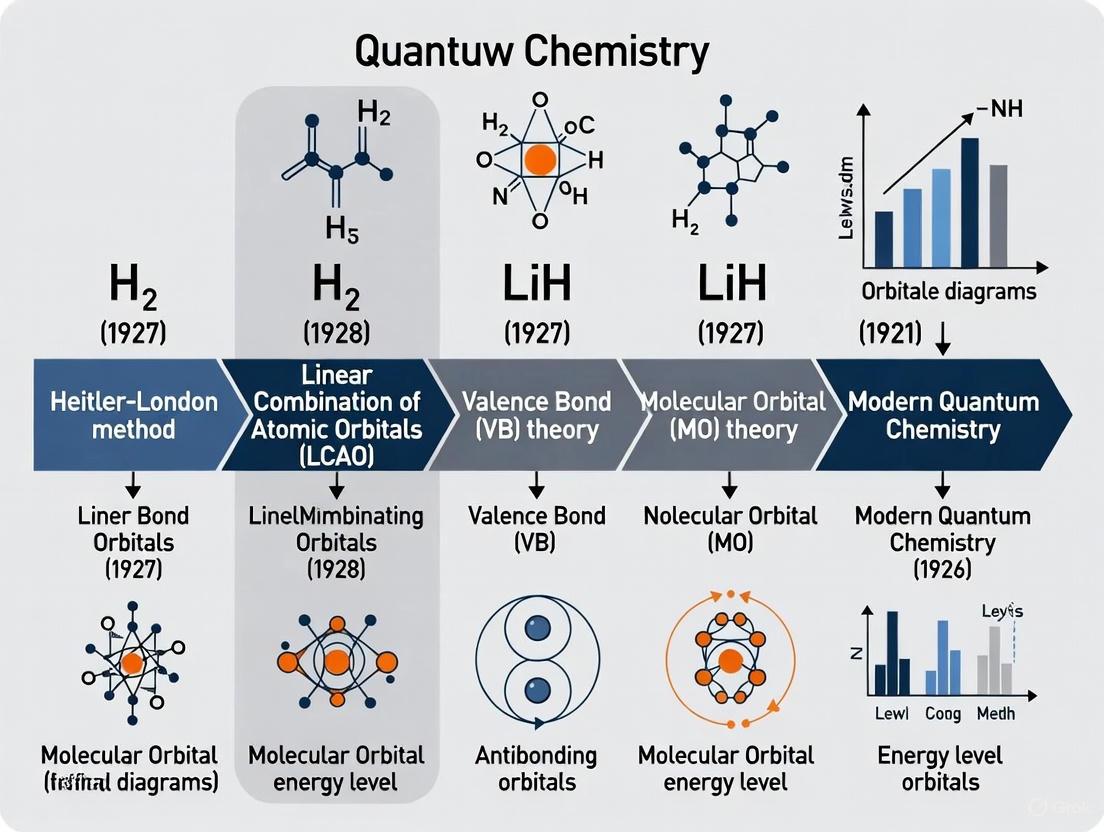
This article traces the pivotal journey of quantum chemistry from its foundational 1927 Heitler-London theory, which first explained the chemical bond, to its cutting-edge applications in modern drug discovery.
From Heitler-London to Quantum Computing: The Evolution of Quantum Chemistry in Modern Drug Discovery
Abstract
This article traces the pivotal journey of quantum chemistry from its foundational 1927 Heitler-London theory, which first explained the chemical bond, to its cutting-edge applications in modern drug discovery. It explores the development of key computational methodologies—Valence Bond theory, Molecular Orbital theory, and Density Functional Theory—and critically examines their application in solving complex biomedical challenges. By addressing current computational limitations and the emerging role of hybrid quantum-classical pipelines, this review provides researchers and drug development professionals with a comprehensive framework for leveraging quantum mechanics to enhance the accuracy and efficiency of drug design, from target identification to clinical candidate optimization.
The Quantum Leap: How Heitler and London's 1927 Breakthrough Launched a New Era in Chemistry
Prior to the advent of quantum mechanics in the mid-1920s, the fundamental nature of the chemical bond presented a profound puzzle for physicists and chemists. While experimental evidence overwhelmingly confirmed the existence of molecules with specific, stable structures, the theoretical framework to explain why atoms bonded together remained elusive within classical physics [1]. The early 20th century was thus characterized by ingenious empirical models that described chemical behavior without truly explaining the physical forces underlying bond formation. The journey toward a quantum theory of the chemical bond began with critical preparatory work that bridged classical concepts and quantum insights, setting the stage for the revolutionary work of Heitler and London in 1927 [2] [3]. This article examines the key theories and experimental findings that constituted the pre-quantum landscape of chemical bonding, focusing on their descriptive power, their limitations, and the critical gaps that only wave mechanics would ultimately fill.
Theoretical Foundations Pre-1925
G.N. Lewis and The Electron-Pair Bond (1916)
In 1916, Gilbert N. Lewis proposed a groundbreaking model that would become the cornerstone of classical chemical bonding theory [1] [3]. Seeking to explain the phenomenon of valence, Lewis introduced the concept of the covalent bond as a shared pair of electrons between two atoms [3]. His theory was built on several key postulates:
- Atoms attain stable configurations by sharing electrons to form pairs between them.
- Each shared electron pair constitutes a single chemical bond.
- The stability of the noble gas configuration underpins the tendency of atoms to form bonds.
- Atoms can share multiple pairs of electrons, forming double or triple bonds.
Lewis's theory correlated closely with classical chemists' drawings of bonds and provided a remarkably accurate qualitative prediction of molecular connectivity [3]. It successfully explained why certain elements exhibited specific valencies and provided a framework for understanding molecular topology. However, as noted by later scholars, "Lewis theory was not able to say anything on the nature of the forces involved in the formation of the homopolar bond" [1]. The theory described that atoms bonded, but the physical mechanism explaining how two negatively charged electrons could mediate an attractive force between two nuclei remained a mystery.
The Bohr Model and Atomic Structure
Niels Bohr's 1913 quantum model of the atom, while revolutionary for atomic physics, provided limited direct insight into chemical bonding [4]. The model successfully explained the discrete spectral lines of hydrogen and introduced the concept of quantized electron orbits, but its application to multi-electron atoms and molecules proved problematic. The Bohr model did, however, reinforce the importance of stable electron configurations and provided a physical basis for the periodicity of elements that had been empirically observed in chemistry.
Abegg's Rule and Valence Theory (1904)
Prior to Lewis's work, Richard Abegg in 1904 noted an important pattern in the combining ratios of elements: the numerical difference between an element's maximum positive and negative valence tended to be eight [4]. This observation, known as Abegg's rule, hinted at the significance of the octet rule that would later become central to Lewis's theory and provided an important empirical regularity that any successful bonding theory would need to explain.
Table 1: Key Pre-Quantum Theoretical Frameworks for Chemical Bonding
| Theory/Concept | Proponent(s) | Year | Key Postulate | Explanatory Power | Key Limitations |
|---|---|---|---|---|---|
| Electron-Pair Bond | G.N. Lewis | 1916 | Chemical bonds form through shared pairs of electrons | Explained molecular connectivity, valence, multiple bonds | No physical mechanism for shared electrons; purely descriptive |
| Cubical Atom | G.N. Lewis | 1902 | Electrons positioned at corners of a cube; bonds form through shared edges | Predicted single/double/triple bonds as shared electron pairs | Oversimplified geometric model; limited predictive power |
| Abegg's Rule | Richard Abegg | 1904 | Difference between max +ve and -ve valence is often 8 | Anticipated octet rule; systematized valence patterns | Purely empirical with no theoretical basis |
| Planck's Quantum Hypothesis | Max Planck | 1900 | Energy emitted/absorbed in discrete quanta | Foundation for quantum theory | Not applied to chemical bonding initially |
Experimental Foundations and Empirical Evidence
The Emergence of Molecular Spectroscopy
Throughout the late 19th and early 20th centuries, spectroscopy provided crucial experimental insights into molecular structure [1]. Researchers observed that diatomic molecules exhibited complex band spectra, which were interpreted as arising from rotational and vibrational motions within the molecule [1]. The fine structure of these spectra hinted at electronic contributions, but a comprehensive theoretical framework to explain these observations was lacking. These spectroscopic studies provided critical data that would later be explained by quantum mechanics, serving as essential experimental benchmarks for theoretical developments.
Determination of Molecular Structure
Chemists in the 19th century established beyond doubt that molecules had specific, three-dimensional structures through clever but indirect experimentation [5]. Key evidence included:
- Isomerism: The existence of compounds with identical chemical composition but different properties (e.g., propyne and allene, both C₃H₄) forced the conclusion that atoms must be linked differently in space [5].
- Molecular Geometry: Observations that certain compounds like dichloromethane (CH₂Cl₂) existed in only one form suggested tetrahedral molecular geometry, as planar structures would yield multiple distinct isomers [5].
These findings established that molecular structure was not merely a topological concept (which atom is connected to which) but also a geometric one (how atoms are arranged in three-dimensional space) [5]. This structural chemistry provided essential constraints for any potential theory of chemical bonding.
Table 2: Key Experimental Evidence for Molecular Structure Pre-Quantum Mechanics
| Experimental Area | Key Finding | Methodology | Interpretation | Impact on Bonding Theory |
|---|---|---|---|---|
| Molecular Spectroscopy | Complex band spectra for diatomic molecules | Analysis of light emission/absorption from molecules | Spectra indicated rotational, vibrational, and electronic transitions | Revealed quantized energy levels in molecules before quantum theory |
| Chemical Isomerism | Different compounds with same composition | Chemical synthesis and property comparison | Differences arose from distinct atomic connectivity or spatial arrangement | Established that structure, not just composition, determined properties |
| X-ray Crystallography | Regular arrangement of atoms in crystals | X-ray diffraction patterns from crystalline materials | Atoms arranged in specific, repeating 3D patterns | Provided direct evidence for atomic positions in solids |
| Stoichiometry | Fixed mass ratios in compounds | Precise measurement of reacting masses | Atoms combine in definite proportions | Supported atomic theory and valency concepts |
Critical Knowledge Gaps and Theoretical Limitations
The pre-quantum theories of chemical bonding, while empirically useful, suffered from several fundamental limitations that prevented a true understanding of the chemical bond:
No Physical Mechanism for Electron Sharing: Lewis's theory provided no explanation for how two negatively charged electrons could create an attractive force between two atomic nuclei [1]. The theory described the "what" but not the "how" of covalent bonding.
Inability to Explain Bond Energetics: Classical models could not quantitatively predict bond strengths, dissociation energies, or the specific geometric arrangements of atoms in molecules. The tetrahedral geometry of carbon, for instance, was inferred from isomer counts rather than derived from first principles [5].
Failure with Magnetic and Spectroscopic Properties: The behavior of molecules in magnetic fields and the detailed features of molecular spectra remained largely unexplained by classical models [1].
No Explanation for Resonance and Electron Delocalization: Certain molecular structures, such as benzene, exhibited properties that suggested electron delocalization—a concept that would only become clear with quantum mechanics.
These limitations underscored the need for a fundamentally new approach to chemical bonding, one that would eventually emerge from the development of wave mechanics.
The Scientist's Toolkit: Key Research Concepts and Methods
Table 3: Essential Conceptual "Reagents" in Pre-Quantum Bonding Research
| Concept/Tool | Function | Theoretical Basis | Experimental Application |
|---|---|---|---|
| Valence | Quantified combining power of elements | Empirical observation of stoichiometries | Predicting formulas of compounds |
| Structural Formulas | Represented atomic connectivity | Chemical intuition and isomer evidence | Rationalizing reaction pathways |
| Electron Dot Diagrams | Visualized electron pairs in molecules | Lewis theory of shared electron pairs | Predicting molecular connectivity |
| Spectroscopy | Probe internal energy states | Analysis of light-matter interaction | Identifying molecules; hinting at quantum states |
| X-ray Crystallography | Determined atomic positions | Diffraction theory | Establishing molecular geometry in solids |
Visualizing the Evolution of Bonding Theory
The following diagram illustrates the conceptual evolution and key milestones in understanding chemical bonding from classical to quantum theories:
The pre-quantum landscape of chemical bonding was characterized by increasingly sophisticated empirical models that successfully described chemical behavior but failed to provide a fundamental physical explanation for the chemical bond. Lewis's electron-pair theory represented the pinnacle of this classical approach, offering an intuitive and remarkably accurate framework for understanding molecular connectivity that still underpins chemical notation today [6]. However, without a mechanism to explain how electron sharing could lead to bond formation, the theory remained fundamentally incomplete.
The critical knowledge gaps in understanding bond energetics, molecular geometry, magnetic properties, and spectroscopic observations created a pressing need for a new theoretical framework. This framework would emerge from the development of wave mechanics, culminating in the 1927 work of Heitler and London that provided the first quantum-mechanical treatment of the hydrogen molecule [2] [3]. Their approach, built upon the Schrödinger equation and incorporating the key quantum concept of resonance [1], would finally bridge the gap between descriptive chemistry and physical first principles, launching the modern era of quantum chemistry and setting the stage for the development of both valence bond and molecular orbital theories.
The Schrödinger equation stands as the fundamental pillar of quantum chemistry, enabling the transition from abstract quantum theory to the predictive modeling of chemical behavior. This whitepaper traces the mathematical framework established by Erwin Schrödinger in 1926 through its revolutionary application by Heitler and London to chemical bonding, and examines its continued evolution into modern computational methods. We demonstrate how this equation provides the mathematical basis for calculating molecular structure, properties, and dynamics, with particular emphasis on methodologies relevant to drug discovery and materials science. By examining both historical developments and current research directions, we establish how quantum chemistry, grounded in Schrödinger's equation, has become an indispensable tool for researchers investigating molecular systems at the most fundamental level.
The Schrödinger equation emerged in 1926 as the cornerstone of wave mechanics, providing a mathematical framework for describing quantum systems. Erwin Schrödinger developed this equation inspired by Louis de Broglie's hypothesis of particle-wave duality, which proposed that particles such as electrons exhibit wave-like properties with wavelength λ = h/p, where h is Planck's constant and p is the momentum [7]. Schrödinger's formulation represented a departure from the matrix mechanics of Heisenberg and offered a more intuitive mathematical description of quantum phenomena.
The time-independent Schrödinger equation for a single particle system takes the form:
Ĥψ = Eψ
where Ĥ represents the Hamiltonian operator, ψ is the wavefunction describing the quantum state of the system, and E is the energy eigenvalue corresponding to that state [8]. The Hamiltonian operator incorporates the total energy of the system, typically consisting of kinetic and potential energy components. For molecular systems, the wavefunction ψ contains all information about the electronic structure, and its square (|ψ|²) provides a probability density distribution for finding electrons in particular regions of space [9].
The significance of Schrödinger's equation to chemistry cannot be overstated. As noted by Dirac in the early days of quantum mechanics, the underlying physical laws for a large part of physics and the whole of chemistry were now completely known, with the remaining challenge being the exact application of these laws leading to equations much too complicated to be soluble [7]. This statement recognized that chemistry, fundamentally concerned with the behavior of electrons in atoms and molecules, could now be approached from first principles through the Schrödinger equation.
Mathematical Foundation
The Schrödinger Equation for Molecular Systems
For molecular systems, the Schrödinger equation becomes significantly more complex due to the multiple interacting particles involved. The full Hamiltonian for a molecule incorporating multiple electrons and nuclei must account for all kinetic energy terms and potential energy interactions:
Ĥ = [-½∑ᵢ∇²ᵢ - ½∑ₐ∇²ₐ/Mₐ] - [∑ᵢ,ₐ Zₐ/rᵢₐ + ∑ᵢ<ⱼ 1/rᵢⱼ + ∑ₐ<ᵦ ZₐZᵦ/Rₐᵦ]
where indices i,j refer to electrons and a,b refer to nuclei, Mₐ is the mass of nucleus a, Zₐ is the atomic number of nucleus a, rᵢₐ represents the distance between electron i and nucleus a, rᵢⱼ is the distance between electrons i and j, and Rₐᵦ is the distance between nuclei a and b [8].
The first bracketed term represents the kinetic energy operators for electrons and nuclei, while the second bracketed term encompasses the attractive electron-nucleus Coulomb interactions and repulsive electron-electron and nucleus-nucleus interactions. This complex many-body problem presents formidable mathematical challenges, as exact solutions are only possible for the simplest systems like the hydrogen atom.
The Born-Oppenheimer Approximation
A critical simplification for molecular quantum chemistry comes through the Born-Oppenheimer approximation, which exploits the significant mass difference between electrons and nuclei (mproton ≈ 1836 melectron) [8]. This approximation allows the separation of electronic and nuclear motion, based on the observation that electrons adjust essentially instantaneously to nuclear movements.
Within this framework, the electronic Schrödinger equation is solved for fixed nuclear positions:
Ĥelec ψelec(r; R) = Eelec(R) ψelec(r; R)
where ψelec is the electronic wavefunction dependent on electron coordinates r, with parametric dependence on nuclear coordinates R, and Eelec(R) is the electronic energy [8]. The nuclear motion is then treated separately, with E_elec(R) serving as the potential energy surface governing nuclear dynamics. This separation makes computational quantum chemistry tractable and forms the basis for most modern electronic structure methods.
Table 1: Key Approximations in Molecular Quantum Chemistry
| Approximation | Mathematical Basis | Chemical Significance |
|---|---|---|
| Born-Oppenheimer | Separation of electronic and nuclear wavefunctions due to mass disparity | Enables calculation of potential energy surfaces; explains vibrational structure |
| Orbital Approximation | Represent multi-electron wavefunction as product of one-electron functions | Foundation for molecular orbital theory; enables practical computations |
| Linear Combination of Atomic Orbitals (LCAO) | Molecular orbitals expressed as sums of atomic basis functions | Basis for quantitative molecular orbital calculations; connects molecular and atomic descriptions |
| Hartree-Fock Mean Field | Approximate electron-electron repulsion as average field | Starting point for most accurate quantum chemistry methods; defines concept of electron correlation |
The Heitler-London Breakthrough: First Application to Chemistry
Historical Context and Theoretical Background
The year 1927 marked the birth of quantum chemistry with the publication of Walter Heitler and Fritz London's seminal paper on the hydrogen molecule [2] [3]. This work represented the first successful application of the Schrödinger equation to explain the chemical bond, addressing what had been a fundamental mystery in chemistry despite earlier empirical models such as G.N. Lewis's shared electron pair theory proposed in 1916 [10].
Heitler and London approached the H₂ problem by considering the interaction between two hydrogen atoms, each consisting of a proton and electron. Their key insight was to construct a wavefunction that properly accounted for the quantum mechanical nature of electrons, particularly their indistinguishability and spin properties, which had no counterpart in classical physics.
Mathematical Approach and Wavefunction Formulation
The Heitler-London method began with a simple product wavefunction for the two-electron system:
ψ(r₁,r₂) = ψ{1s}(r{1A})ψ{1s}(r{2B})
where ψ{1s}(r{1A}) represents a 1s atomic orbital centered on nucleus A containing electron 1, and similarly for electron 2 on nucleus B [8]. However, this initial formulation failed to account for electron indistinguishability.
The correct approach incorporated both possible arrangements of the two electrons:
ψ{HL} = N[ψA(1)ψB(2) + ψA(2)ψ_B(1)]
where N is a normalization constant, and the symmetric spatial function was multiplied by an antisymmetric spin function for the singlet state [11]. This wavefunction, when used in the variational integral:
Ẽ(R) = ∫ψĤψdτ / ∫ψ²dτ
yielded the first quantum mechanical description of a chemical bond [8]. The calculated binding energy (De ≈ 0.25 eV) and bond length (Re ≈ 1.7 bohr), while quantitatively inaccurate compared to modern values (De = 4.746 eV, Re = 1.400 bohr), demonstrated that quantum mechanics could fundamentally explain covalent bond formation [8].
Methodological Details: The Variational Approach
The Heitler-London method employed the variational principle, which states that the expectation value of the energy for any trial wavefunction will be greater than or equal to the true ground state energy. This approach allowed them to optimize parameters in their wavefunction and obtain the best possible approximation to the true solution.
The energy expression for the H₂ molecule within the HL theory separates into several physically interpretable components:
E(HL,¹∑₉⁺) = EA + EB + {(a²|VB) + (b²|VA) + S[(ab|VB) + (ba|VA)] + (a²|b²) + (ab|ab)}/(1+S²) + 1/R
where the first two terms represent the energies of the isolated hydrogen atoms, and the remaining terms describe the interaction energy [11]. Notably, this expression contains both Coulomb-type integrals and exchange-type integrals arising from the quantum mechanical nature of identical particles.
Table 2: Heitler-London Theory Components for H₂ Molecule
| Component | Mathematical Expression | Physical Significance |
|---|---|---|
| Trial Wavefunction | ψ{HL} = N[ψA(1)ψB(2) + ψA(2)ψ_B(1)] | Covalent structure with electron pairing |
| Hamiltonian | Ĥ = -½∇²₁ - ½∇²₂ - 1/r{1A} - 1/r{2B} - 1/r{2A} - 1/r{1B} + 1/r_{12} + 1/R | Complete non-relativistic electronic Hamiltonian |
| Variational Integral | Ẽ(R) = ∫ψĤψdτ / ∫ψ²dτ | Energy as function of internuclear distance R |
| Binding Energy | D_e ≈ 0.25 eV (calculated) vs 4.746 eV (experimental) | Quantitative demonstration of covalent bonding |
| Bond Length | R_e ≈ 1.7 bohr (calculated) vs 1.4 bohr (experimental) | Prediction of equilibrium geometry |
Evolution of Quantum Chemistry Methods
From Heitler-London to Modern Valence Bond Theory
The Heitler-London approach laid the foundation for valence bond (VB) theory, which was extensively developed by Linus Pauling throughout the 1930s [10]. Pauling introduced two critical concepts that expanded the applicability of VB theory: resonance (1928) and orbital hybridization (1930) [10]. Resonance theory allowed description of molecules that could not be represented by a single Lewis structure, while hybridization explained the geometry of molecules such as methane (CH₄), where carbon forms four equivalent bonds in a tetrahedral arrangement through sp³ hybrid orbitals [10].
Modern valence bond theory has seen a resurgence since the 1980s, largely due to solutions to computational challenges in implementing VB theory into computer programs [10]. Contemporary VB methods replace overlapping atomic orbitals with valence bond orbitals expanded over large basis sets, producing energies competitive with other correlation methods [10].
Molecular Orbital Theory Development
Parallel to valence bond theory, molecular orbital (MO) theory was developed in 1929 by Friedrich Hund and Robert Mulliken [3]. This approach describes electrons in mathematical functions delocalized over entire molecules rather than focusing on pairwise interactions between specific atoms [10]. The Hund-Mulliken approach proved more capable of predicting spectroscopic properties than the VB method and became the conceptual basis for the Hartree-Fock method and subsequent post-Hartree-Fock approaches [3].
The molecular orbital method expresses the wavefunction as a Slater determinant of molecular orbitals, each a linear combination of atomic orbitals (LCAO):
ψ{MO} = A[ϕ₁(1)ϕ₂(2)...ϕN(N)]
where A is the antisymmetrization operator, and ϕ_i are molecular orbitals given by:
ϕi = ∑μ c{iμ} χμ
with χμ representing atomic basis functions and c{iμ} the molecular orbital coefficients [7].
Computational Advances and Scaling Challenges
The development of practical computational quantum chemistry accelerated with the formulation of the Hartree-Fock-Roothaan equations in the 1950s, which provided the starting point for ab initio quantum chemistry [7]. The computational scaling of these methods with system size (typically N⁴ for Hartree-Fock, where N is the number of basis functions) presented significant challenges for application to large molecules [7].
Subsequent developments introduced electron correlation methods including configuration interaction, perturbation theory (MP2, MP4), and coupled cluster approaches (CCSD, CCSD(T)) [7]. The latter is often considered the "gold standard" of quantum chemistry for its high accuracy, though at considerably higher computational cost (CCSD(T) scales as N⁷) [7].
Table 3: Comparison of Quantum Chemical Methods
| Method | Theoretical Foundation | Computational Scaling | Key Applications |
|---|---|---|---|
| Valence Bond (VB) | Heitler-London theory, resonance | High with accurate correlation | Bond breaking reactions, diradicals |
| Hartree-Fock (HF) | Molecular orbital theory, mean field | N⁴ | Starting point for correlated methods |
| Density Functional Theory (DFT) | Electron density formalism | N³-N⁴ | Large molecules, materials science |
| Møller-Plesset Perturbation (MP2, MP4) | Many-body perturbation theory | N⁵-N⁶ | Non-covalent interactions, thermochemistry |
| Coupled Cluster (CCSD, CCSD(T)) | Exponential wavefunction ansatz | N⁶-N⁷ | High-accuracy benchmark calculations |
| Quantum Monte Carlo (QMC) | Stochastic integration | N³-N⁴ | Solids, extended systems |
Density Functional Theory and Modern Computational Approaches
Theoretical Foundation of DFT
Density functional theory (DFT) represents a fundamentally different approach to the electronic structure problem, based on the Hohenberg-Kohn theorems which established that the ground state electron density ρ(r) uniquely determines all molecular properties [7] [3]. This contrasts with wavefunction-based methods that work in the 3N-dimensional space for N electrons.
The practical implementation of DFT uses the Kohn-Sham method, which introduces a reference system of non-interacting electrons with the same density as the real system [3]. The total energy functional is partitioned as:
E[ρ] = TS[ρ] + Eext[ρ] + J[ρ] + E_XC[ρ]
where TS is the kinetic energy of the non-interacting system, Eext is the external potential energy, J is the classical Coulomb repulsion, and E_XC is the exchange-correlation functional that contains all many-body effects [3].
Development of Exchange-Correlation Functionals
The accuracy of DFT calculations depends critically on the approximation used for the exchange-correlation functional. The development of improved functionals has followed what is often described as "Jacob's Ladder," progressing from the simplest local density approximation (LDA) through generalized gradient approximations (GGA), meta-GGAs, hybrid functionals (such as the widely used B3LYP), and double-hybrid functionals [7].
The hybrid functional B3LYP has become exceptionally popular in quantum chemistry applications due to its favorable balance between accuracy and computational cost [7]. Modern research continues to develop more accurate functionals, with machine learning approaches recently showing promise for improving both accuracy and efficiency [7].
Hybrid Methods and Quantum Mechanics/Molecular Mechanics
For very large systems such as biomolecules, pure quantum mechanical calculations remain computationally prohibitive. The QM/MM approach developed by Martin Karplus, Michael Levitt, and Arieh Warshel (2013 Nobel Laureates) combines quantum mechanical treatment of chemically active regions with molecular mechanics description of the surrounding environment [7].
This hybrid methodology enables realistic simulation of biological systems and chemical reactions in complex environments, making it particularly valuable for drug discovery applications where the interaction between small molecules and protein binding sites must be modeled with quantum accuracy while maintaining computational feasibility for the entire system.
Research Applications and Experimental Protocols
Quantum Chemistry in Drug Discovery
Quantum chemical methods have become indispensable tools in modern drug discovery pipelines, particularly in structure-based drug design. The accurate calculation of ligand-receptor interaction energies, prediction of binding affinities, and modeling of reaction mechanisms involving enzymes all rely on sophisticated quantum mechanical approaches.
For drug development professionals, DFT calculations provide crucial insights into:
- Reaction mechanisms of drug metabolism
- Tautomeric equilibria and protonation states
- Non-covalent interaction energies
- Electronic excitation spectra for fluorescent probes
- Redox properties of potential drug molecules
The protocol for such investigations typically involves:
- System Preparation: Geometry optimization of the molecular system using semi-empirical or molecular mechanics methods
- Electronic Structure Calculation: Single-point energy calculation using appropriate DFT functional and basis set
- Property Analysis: Calculation of molecular orbitals, electrostatic potentials, and vibrational frequencies
- Interaction Energy Calculation: For ligand-receptor systems, often using QM/MM approaches
Spectroscopy and Property Prediction
Quantum chemistry provides the theoretical foundation for interpreting and predicting various forms of spectroscopy, which are essential experimental tools in chemical and pharmaceutical research. Implementation of response theory within quantum chemical frameworks enables calculation of:
- IR and Raman spectra from vibrational frequency calculations
- NMR chemical shifts via gauge-including atomic orbital (GIAO) methods
- UV-Vis spectra through time-dependent DFT (TD-DFT) calculations
- ESR parameters for radicals and open-shell systems
Table 4: Computational Protocols for Spectroscopy Prediction
| Spectroscopic Method | Computational Approach | Key Considerations |
|---|---|---|
| Infrared (IR) Spectroscopy | Harmonic frequency calculation | Anharmonic corrections for high accuracy |
| Nuclear Magnetic Resonance (NMR) | GIAO method with shielded nuclei | Solvent effects critical for comparison with experiment |
| UV-Vis Absorption | Time-Dependent DFT (TD-DFT) | Functional choice critical for charge-transfer states |
| X-ray Photoelectron | ΔSCF or core-hole methods | Relativistic effects for heavy elements |
| Electron Paramagnetic Resonance | Spin-property calculations | Isotropic and anisotropic hyperfine coupling |
Software Platforms for Quantum Chemistry
Modern quantum chemistry research relies on sophisticated software packages implementing the mathematical formalisms derived from the Schrödinger equation. These packages provide researchers with tools to perform calculations ranging from simple energy evaluations to complex molecular dynamics simulations.
Key software resources include:
- Gaussian: One of the most widely used computational chemistry software packages, particularly popular in pharmaceutical and industrial applications
- GAMESS (US): A comprehensive ab initio quantum chemistry package, freely available to the research community
- NWChem: Designed for high-performance parallel computing, capable of scaling to thousands of processors
- ORCA: A versatile quantum chemistry package with particular strengths in spectroscopy and metalloenzymes
- Psi4: An open-source quantum chemistry package emphasizing code clarity and community development
- Q-Chem: Features innovative algorithms and methods development with strong academic foundations
Basis Sets and Pseudopotentials
The choice of basis set represents a critical consideration in quantum chemical calculations, as it determines the quality of the molecular orbital expansion. Basis sets range from minimal sets with just enough functions to accommodate the electrons, to extensive correlation-consistent sets with multiple polarization and diffuse functions.
For drug discovery applications involving transition metals or heavy elements, effective core potentials (ECPs) or pseudopotentials are often employed to replace core electrons, reducing computational cost while maintaining accuracy for valence electron properties.
Table 5: Essential Computational Resources in Quantum Chemistry
| Resource Type | Specific Examples | Primary Application |
|---|---|---|
| Quantum Chemistry Software | Gaussian, GAMESS, NWChem, ORCA | Electronic structure calculations |
| Plane-Wave DFT Codes | VASP, Quantum ESPRESSO, CASTEP | Periodic systems, solids, surfaces |
| Visualization Software | GaussView, Avogadro, VMD | Model building and result analysis |
| Basis Sets | Pople-style (6-31G*), Dunning's cc-pVnZ | Molecular orbital expansion |
| Force Fields | AMBER, CHARMM, OPLS | Molecular mechanics, QM/MM simulations |
| Analysis Tools | Multiwfn, NBO, ChemCraft | Wavefunction analysis, property calculation |
Future Directions and Emerging Applications
Quantum Computing for Quantum Chemistry
The field of quantum computing for quantum chemistry (QCQC) represents one of the most promising future directions [7]. Quantum computers offer the potential to solve the Schrödinger equation for complex molecular systems with computational efficiency surpassing classical computers. Several approaches are being actively developed:
- The variational quantum eigensolver (VQE) algorithm for finding molecular ground states
- Quantum phase estimation for high-precision energy calculations
- Quantum machine learning approaches for molecular property prediction
While still in early stages, quantum computing holds particular promise for simulating strongly correlated systems and reaction dynamics that challenge conventional computational methods.
Machine Learning in Quantum Chemistry
Machine learning (ML) techniques are rapidly being integrated into quantum chemistry workflows, offering opportunities to enhance both accuracy and efficiency. Current applications include:
- ML-accelerated molecular dynamics simulations with quantum accuracy
- Neural network potentials trained on quantum chemical data
- Property prediction using graph neural networks and other ML architectures
- Development of exchange-correlation functionals via machine learning approaches
These methods show particular promise for drug discovery applications where high-throughput screening of molecular properties is required.
Challenges and Opportunities
Despite significant advances, quantum chemistry continues to face challenges that drive ongoing research:
- Accurate treatment of strong electron correlation in transition metal complexes and diradicals
- Efficient modeling of non-adiabatic dynamics in photochemical processes
- Reliable prediction of reaction rates and mechanisms in complex environments
- Bridging time and length scales from electronic to mesoscopic phenomena
The continued development of quantum chemical methods rooted in the Schrödinger equation ensures that computational approaches will play an increasingly central role across chemical sciences, materials research, and drug discovery in the coming decades.
The 1927 paper by Walter Heitler and Fritz London, "Wechselwirkung neutraler Atome und homopolare Bindung nach der Quantenmechanik" (Interaction of Neutral Atoms and Homopolar Bonding According to Quantum Mechanics), marked a revolutionary departure from classical descriptions of chemical bonding [12]. For the first time, this work provided a quantitative quantum-mechanical treatment of the simplest covalent bond in the hydrogen molecule (H₂), bridging the conceptual electron-pair bond proposed by Gilbert N. Lewis in 1916 with the formal mathematical framework of Schrödinger's wave equation [3] [12]. The Heitler-London (HL) model demonstrated that the covalent bond arises fundamentally from electron sharing and spin pairing, yielding a binding energy of approximately 3.156 eV at an internuclear separation of 1.64 bohrs—a much more realistic value than previous attempts [13]. This foundational work not only explained the stability of the H₂ molecule but also laid the groundwork for both valence bond (VB) theory and molecular orbital (MO) theory, establishing the conceptual territory that quantum chemistry continues to explore and refine [3] [12].
Theoretical Foundation: The HL Wavefunction and Hamiltonian
The Molecular Hamiltonian
Within the Born-Oppenheimer approximation, which decouples electronic and nuclear motions due to their large mass difference, the non-relativistic electronic Hamiltonian for H₂ in atomic units is given by [14] [13]:
$$ \hat{H} = -\frac{1}{2}\nabla1^2 - \frac{1}{2}\nabla2^2 - \frac{1}{r{1A}} - \frac{1}{r{1B}} - \frac{1}{r{2A}} - \frac{1}{r{2B}} + \frac{1}{r_{12}} + \frac{1}{R} $$
Where:
- $-\frac{1}{2}\nabla1^2 - \frac{1}{2}\nabla2^2$ represent the kinetic energy operators for electrons 1 and 2
- $-\frac{1}{r{1A}} - \frac{1}{r{1B}} - \frac{1}{r{2A}} - \frac{1}{r{2B}}$ represent electron-proton attractive potentials
- $\frac{1}{r_{12}}$ represents electron-electron repulsion
- $\frac{1}{R}$ represents proton-proton repulsion
The system comprises two protons (A and B) and two electrons (1 and 2), with all relevant distances illustrated in the figure below.
Figure 1: Coordinate system for the hydrogen molecule showing two protons (A, B) and two electrons (1, 2) with all relevant distances [14].
The HL Wavefunction with Exchange Symmetry
The key insight of Heitler and London was constructing a wavefunction that satisfies the quantum mechanical requirement of electron indistinguishability while reducing to separated atomic states at large internuclear distances. For two hydrogen atoms, each in their 1s ground state with atomic orbital $\phi(r{ij}) = \sqrt{\frac{1}{\pi}} e^{-r{ij}}$, the symmetric and antisymmetric linear combinations are [14]:
$$ \psi{\pm}(\vec{r}1, \vec{r}2) = N{\pm} \left[ \phi(r{1A})\phi(r{2B}) \pm \phi(r{1B})\phi(r{2A}) \right] $$
Where $N{\pm}$ are normalization factors that depend on the overlap integral $S = \langle \phi(r{1A})|\phi(r_{1B}) \rangle$.
To satisfy the Pauli exclusion principle, the complete wavefunction must be antisymmetric with respect to electron exchange. This leads to two possible states [14]:
Singlet Bonding State (Symmetric spatial × Antisymmetric spin): $$ \Psi{(0,0)}(\vec{r}1, \vec{r}2) = \psi{+}(\vec{r}1, \vec{r}2)\frac{1}{\sqrt{2}}(|\uparrow\downarrow\rangle - |\downarrow\uparrow\rangle) $$
Triplet Antibonding State (Antisymmetric spatial × Symmetric spin): $$ \Psi{(1,1)}(\vec{r}1, \vec{r}2) = \psi{-}(\vec{r}1, \vec{r}2)|\uparrow\uparrow\rangle $$
The singlet state corresponds to the bonding orbital with enhanced electron density between the nuclei, while the triplet state corresponds to the antibonding orbital with reduced electron density between the nuclei [14].
Quantitative Results: Bonding Energy Curves
Evolution of H₂ Calculations
Table 1: Evolution of variational calculations for the H₂ molecule [13]
| Method | Variational Parameters | Bond Length (bohr) | Binding Energy (eV) | Wavefunction Description |
|---|---|---|---|---|
| Primitive (pre-HL) | None | ~1.7 | ~0.25 | $\phi(r{1A})\phi(r{2B})$ |
| Heitler-London | None | 1.64 | 3.156 | $\psi_{+}$ with $\alpha=1$ |
| Wang (1928) | $\alpha$ (orbital exponent) | 1.406 | 3.784 | $\phi_\alpha$ with $\alpha=1.166$ |
| Weinbaum (1933) | $\alpha$, $\lambda$ (ionic character) | 1.416 | 4.024 | $(1-\lambda)\psi{cov} + \lambda\psi{ion}$ |
The bonding (singlet) and antibonding (triplet) potential energy curves calculated using the HL model are shown below, illustrating the stable bond formation in the singlet state and repulsive interaction in the triplet state.
Figure 2: Qualitative potential energy curves for H₂ showing bonding (singlet) and antibonding (triplet) states [14] [13].
Modern Improvements: Screening and Ionic Character
Recent work has extended the original HL model by incorporating electronic screening effects directly into the wavefunction [14]. Using a variational parameter $\alpha(R)$ that represents an effective nuclear charge dependent on internuclear separation, researchers have achieved improved agreement with experimental values. The screening-modified HL model, combined with variational quantum Monte Carlo (VQMC) calculations, yields a bond length of 1.434 bohr and binding energy of 4.390 eV, substantially closer to experimental values than the original HL model [14].
Weinbaum's 1933 improvement introduced ionic-covalent resonance through a wavefunction of the form $(1-\lambda)\psi{cov} + \lambda\psi{ion}$, where $\lambda$ represents the fractional ionic character ($H^+H^-$ and $H^-H^+$ configurations) [13]. With optimized parameters $\alpha=1.193$ and $\lambda=0.0615$, this approach achieved a binding energy of 4.024 eV, demonstrating that approximately 6% ionic character optimizes the molecular energy [13].
Table 2: Comparison of H₂ molecular properties across theoretical methods [14] [13]
| Method | Bond Length (bohr) | Binding Energy (eV) | Vibrational Frequency (cm⁻¹) | Key Features |
|---|---|---|---|---|
| Experimental | 1.401 | 4.748 | 4401 | Actual molecular properties |
| Heitler-London | 1.64 | 3.156 | - | Original symmetric/antisymmetric states |
| Wang (scaled orbitals) | 1.406 | 3.784 | - | Optimized orbital exponent ($\alpha=1.166$) |
| Weinbaum (+ionic) | 1.416 | 4.024 | - | 6% ionic character ($\lambda=0.0615$) |
| Screening-modified HL | 1.434 | 4.390 | - | $\alpha(R)$ screening function |
Methodological Protocols: From HL to Modern Computations
The HL Computational Protocol
The original HL calculation followed a specific protocol to determine the bonding energy:
- Wavefunction Construction: Form symmetric and antisymmetric linear combinations of hydrogen 1s orbitals
- Hamiltonian Matrix Elements: Compute $H{11} = \langle \phi(r{1A})\phi(r{2B})|\hat{H}|\phi(r{1A})\phi(r{2B}) \rangle$ and $H{12} = \langle \phi(r{1A})\phi(r{2B})|\hat{H}|\phi(r{1B})\phi(r{2A}) \rangle$
- Overlap Integral: Calculate $S = \langle \phi(r{1A})\phi(r{2B})|\phi(r{1B})\phi(r{2A}) \rangle$
- Energy Calculation: Determine eigenvalues from the secular equation: $E{\pm} = \frac{H{11} \pm H_{12}}{1 \pm S^2}$
- Potential Curve Generation: Repeat calculations at different internuclear separations R
The key mathematical expressions for the energy in the HL model are [13]: $$ \mathcal{E}(R) = \frac{H{11}(R) \pm H{12}(R)}{1 \pm S^2(R)} $$
Where the plus sign corresponds to the bonding singlet state and the minus sign to the antibonding triplet state.
Variational Quantum Monte Carlo Protocol
Modern implementations of the HL idea often use variational quantum Monte Carlo (VQMC) methods [14]:
- Trial Wavefunction Preparation: $\psiT(\vec{R}) = \psi{HL}(\vec{R}) \times \exp\left(\sum{i
- Parameter Optimization: Variational parameters (including screening factor α) are optimized using energy minimization
- Random Walk Sampling: Electron configurations are sampled using Metropolis algorithm
- Local Energy Calculation: $EL = \hat{H}\psiT/\psi_T$ computed at each sample point
- Statistical Analysis: Energy estimates obtained with error bars from block averaging
Figure 3: Variational Quantum Monte Carlo (VQMC) workflow for optimizing HL-type wavefunctions [14].
The Scientist's Toolkit: Essential Research Reagents
Table 3: Essential computational methods and their applications in quantum chemistry
| Method/Approach | Primary Function | Key Applications in Bonding |
|---|---|---|
| Variational Principle | Energy minimization via parameter optimization | Finding optimal wavefunction parameters (e.g., orbital exponent α) |
| Born-Oppenheimer Approximation | Separation of electronic and nuclear motions | Calculating electronic energy at fixed nuclear coordinates |
| Linear Combination of Atomic Orbitals (LCAO) | Construction of molecular wavefunctions | HL wavefunction: $\psi = \phi{1s}(r{1A})\phi{1s}(r{2B}) + \phi{1s}(r{1B})\phi{1s}(r{2A})$ |
| Overlap Integral (S) | Measure of orbital spatial overlap | Normalization and energy calculation in HL theory |
| Exchange Integral (H₁₂) | Quantum mechanical resonance energy | Quantitative origin of covalent bonding in HL model |
| Quantum Monte Carlo | Stochastic solution of Schrödinger equation | Optimizing screening parameters in modified HL wavefunctions |
Historical Context and Modern Legacy
The HL model emerged during a transformative period now recognized as the "electronic structure revolution" in chemistry [12]. Just one year after Schrödinger published his wave equation, Heitler and London provided the crucial connection between quantum mechanics and chemical bonding that Lewis had conceptually envisioned with his electron dot diagrams [15] [12].
This work directly inspired Linus Pauling's development of valence bond (VB) theory, which dominated early quantum chemistry and was crystallized in his famous 1939 text "The Nature of the Chemical Bond" [3] [12]. Simultaneously, the alternative approach of molecular orbital (MO) theory was developed by Mulliken, Hund, and others, creating a productive rivalry that drove the field forward [3] [12]. While MO theory gained dominance with the advent of computational software like Gaussian in the 1970s, VB theory has experienced a resurgence since the 1980s as improved computational methods revealed its strengths in providing chemical insight [12].
The conceptual framework established by Heitler and London continues to influence modern computational chemistry, including drug design applications where understanding protein-ligand interactions at the quantum mechanical level provides critical insights for binding affinity prediction [16] [17]. Modern hybrid QM/MM (Quantum Mechanics/Molecular Mechanics) methods and specialized approaches like the protein-ligand QM-VM2 method for predicting binding free energies represent direct descendants of the quantum chemical tradition begun by Heitler and London's pioneering work on the hydrogen molecule [17].
The development of valence bond (VB) theory represents a transformative episode in the history of quantum chemistry, emerging from the intellectual ferment that followed the formulation of quantum mechanics in the mid-1920s. This theoretical framework, which provides a quantum mechanical description of chemical bonding based on the pairing of electrons in overlapping atomic orbitals, became one of the two foundational theories of quantum chemistry alongside molecular orbital (MO) theory [10]. The period from 1927 to 1931 marked the crystallization of modern valence bond theory, building upon earlier classical conceptions of chemical bonding and addressing fundamental questions about molecular structure that had previously eluded scientific explanation [18] [19]. This article situates the contributions of key architects—particularly Linus Pauling and John C. Slater—within the broader historical trajectory of quantum chemistry, tracing the evolution of bonding theories from the pioneering work of Heitler and London to contemporary computational approaches.
The genesis of VB theory occurred at a critical juncture when the limitations of earlier bonding models had become apparent. The Lewis approach to chemical bonding, while introducing the crucial concept of the electron-pair bond, failed to elucidate the physical mechanism of bond formation [20]. Similarly, the valence shell electron pair repulsion (VSEPR) theory offered limited predictive power for complex molecular geometries [20]. Quantum mechanics provided the essential theoretical foundation to overcome these limitations, but required creative adaptation to address the specific challenges of chemical bonding [19].
Historical Foundations: From Lewis to Heitler-London
The Pre-Quantum Conceptual Landscape
The conceptual groundwork for valence bond theory was established by Gilbert N. Lewis in his seminal 1916 paper "The Atom and The Molecule," which introduced the electron-pair as the fundamental unit of chemical bonding [18] [10]. Lewis's cubical atom model, developed as early as 1902, represented atoms as concentric cubes with electrons positioned at the corners [18]. This conceptualization led to his formulation of the "octet rule" and provided a framework for understanding covalent bonding through shared edges between atomic cubes (electron pairs) and ionic bonding through complete electron transfer [18]. Lewis further recognized the dynamic nature of chemical bonds, describing "tautomerism between polar and non-polar" forms that represented a precursor to the later concept of resonance [18].
Lewis's electron-dot structures portable conceptual tools that would later be incorporated into VB theory [18]. His work established that molecular bonding could be understood through electron pairing, but lacked a mechanistic explanation based on physical principles. As noted in the scientific literature, "Lewis’s theory overemphasizes the role of electron pairs" without providing "a full theory of the chemical bond [that] needs to return to the roots of the behaviour of electrons in molecules" based on "the Schrödinger equation and the Pauli exclusion principle" [19].
The Quantum Mechanical Breakthrough
The critical transition from empirical bonding concepts to a quantum mechanical theory began with the work of Walter Heitler and Fritz London on the hydrogen molecule in 1927 [10] [21]. As Gordon Gallup notes in "A Short History of Valence Bond Theory," shortly after quantum mechanics evolved, "Heitler and London applied the then new ideas to the problem of molecule formation and chemical valence" [22]. Their pioneering treatment of H2 using Schrödinger's wave equation successfully described the covalent bond formation through the overlap of hydrogen atomic orbitals, providing the first quantum mechanical justification for Lewis's electron-pair bond [10] [23].
The Heitler-London approach incorporated the resonance phenomenon introduced by Werner Heisenberg in 1926, demonstrating how the interchange of electron positions between two hydrogen atoms lowers the system's energy and leads to bond formation [23]. This quantum mechanical treatment enabled the calculation of approximate values for various molecular properties, including the energy required to dissociate the hydrogen molecule into its constituent atoms [23]. Pauling himself would later describe the Heitler-London paper as "the greatest single contribution to the clarification of the chemist’s concept of valence" [23].
Table: Key Developments Preceding Modern VB Theory
| Year | Scientist(s) | Contribution | Significance |
|---|---|---|---|
| 1902 | G.N. Lewis | Cubical Atom Model | Early conceptualization of electron arrangement |
| 1916 | G.N. Lewis | Electron-Pair Bond | Foundation of covalent bonding concept |
| 1924 | Abegg/Kossel | Ionic Bonding Theory | Model of complete electron transfer |
| 1926 | E. Schrödinger | Wave Equation | Mathematical foundation for quantum chemistry |
| 1927 | Heitler-London | Quantum Treatment of H₂ | First QM description of covalent bond |
The Architects of Modern Valence Bond Theory
Linus Pauling: Conceptual Expansion and Chemical Intuition
Linus Pauling's series of papers in the early 1930s and his landmark 1939 book The Nature of the Chemical Bond and the Structure of Molecules and Crystals fundamentally shaped modern valence bond theory [23]. Pauling's work synthesized the mathematical framework of quantum mechanics with the practical needs of chemists, creating a conceptual bridge between physical theory and chemical phenomena. His approach "translated Lewis’ ideas to quantum mechanics" and "received very high attention and became extremely popular among chemists" [18].
Pauling's first crucial contribution was the concept of orbital hybridization, which he initially developed in 1928 [23] [10]. This innovation resolved a fundamental paradox in molecular structure: how carbon, with two different types of valence orbitals (spherical 2s and dumbbell-shaped 2p), could form four identical bonds directed toward the corners of a tetrahedron in compounds like methane (CH₄) [23]. Pauling recognized that the energy separation between s and p orbitals was small compared to bond formation energy, making orbital mixing energetically favorable. His key insight was that "the ability to make the best possible bond was the most important consideration" rather than maintaining pure atomic orbitals [23].
Pauling's second major contribution was the formalization of resonance theory [10]. Building on Heisenberg's concept of quantum mechanical resonance and Lewis's notion of dynamic bonds, Pauling developed a systematic framework for describing molecular structures that could not be represented by a single Lewis structure [18]. Resonance theory allowed chemists to represent molecules as quantum mechanical superpositions of multiple valence bond structures, providing explanations for molecular properties that defied classical structural models.
In his famous 1931 paper "The Nature of the Chemical Bond: Applications of Results Obtained from the Quantum Mechanics and from a Theory of Paramagnetic Susceptibility to the Structure of Molecules," Pauling established a comprehensive framework for understanding electronic and geometric molecular structures through hybrid bond orbitals [23] [21]. This work also demonstrated how magnetic properties could distinguish between ionic and covalent bonding, significantly expanding the analytical utility of VB theory [23].
John C. Slater: Mathematical Formalism and Directional Bonds
While Pauling brought chemical intuition to the development of VB theory, John C. Slater made complementary contributions that strengthened its mathematical foundation. In 1929, Slater became interested in the quantum mechanics of chemical bonding and applied methods he had developed for interpreting atomic spectra to molecular systems [23]. His work provided crucial insights into the valence and directional properties of molecules.
In April 1930, Slater first described his results in an informal talk at the Washington meeting of the American Physical Society, followed by a formal publication in Physical Review in 1931 [23]. This paper introduced several key concepts that would become central to VB theory, including the "criterion of maximum overlapping of orbitals for bond strength" and extensive use of resonance [23]. Slater discussed directional bonds in polyatomic molecules and attempted to explain the tetrahedral symmetry of carbon's four valences [23].
Slater's work directly stimulated Pauling to return to hybridization theory, which he had temporarily set aside due to mathematical difficulties [23]. In December 1930, Pauling developed an approximation that simplified the quantum mechanical equations describing carbon's bonding orbitals by ignoring the radial factor in the p function, facilitating the calculation of various hybrid orbitals [23]. This synergistic development highlights how Pauling and Slater's contributions collectively advanced VB theory through complementary approaches—Pauling emphasizing chemical applicability and Slater providing physical rigor.
Table: Core Concepts in Modern Valence Bond Theory
| Concept | Primary Architect | Theoretical Basis | Key Application |
|---|---|---|---|
| Orbital Hybridization | Linus Pauling | Mixing atomic orbitals to form directional bonds | Tetrahedral carbon in methane |
| Resonance Theory | Linus Pauling | Quantum superposition of VB structures | Aromaticity in benzene |
| Maximum Overlap Criterion | John C. Slater | Bond strength depends on orbital overlap | Predicting bond angles and lengths |
| Directional Bonds | John C. Slater | Atomic orbital geometry determines molecular structure | Molecular geometry prediction |
Computational Methodologies and Theoretical Framework
The Valence Bond Approach to Chemical Bonding
The valence bond theory methodology centers on the concept that a covalent bond forms through the overlap of half-filled valence atomic orbitals, each containing one unpaired electron [10]. This overlap creates a region of enhanced electron density between the nuclei, increasing the probability of finding electrons in the bond region and consequently lowering the system's energy [20] [19]. The theory maintains that "electrons in a molecule occupy atomic orbitals rather than molecular orbitals" and that "the overlapping of atomic orbitals results in the formation of a chemical bond and the electrons are localized in the bond region due to overlapping" [20].
The VB framework distinguishes between two types of orbital overlap leading to bond formation:
- Sigma (σ) bonds: Created through head-to-head orbital overlap along the axis containing the nuclei, with electron density concentrated between atoms [20] [10]
- Pi (π) bonds: Formed through parallel sidewise overlap of atomic orbitals, with electron density distributed above and below the bond axis [20] [10]
In terms of bond multiplicity, single bonds correspond to one sigma bond, double bonds consist of one sigma and one pi bond, and triple bonds contain one sigma and two pi bonds [10].
Hybridization Schemes and Molecular Geometry
A central methodological component of VB theory is the concept of hybridization, which describes how atomic orbitals combine to form new hybrid orbitals with specific directional characteristics that optimize bonding [10]. The different hybridization schemes correspond to characteristic molecular geometries:
Table: Hybridization Schemes and Corresponding Geometries
| Coordination Number | Type of Hybridisation | Distribution of Hybrid Orbitals | Example |
|---|---|---|---|
| 2 | sp | Linear | CO₂ |
| 4 | sp³ | Tetrahedral | CH₄ |
| 4 | dsp² | Square planar | [Ni(CN)₄]²⁻ |
| 5 | sp³d | Trigonal bipyramidal | PCl₅ |
| 6 | sp³d² | Octahedral | SF₆ |
| 6 | d²sp³ | Octahedral | [CoF₆]³⁻ |
For coordination compounds, VB theory explains bonding in terms of hybridized orbitals of the metal ion overlapping with ligand orbitals containing electron pairs [24] [25]. The theory distinguishes between inner orbital complexes (using inner d orbitals in hybridization) and outer orbital complexes (using outer d orbitals), which correspond to low-spin and high-spin complexes respectively [25].
The VB-MO Rivalry and Historical Trajectory
Parallel Development of Molecular Orbital Theory
Even as valence bond theory reached its mature formulation in the early 1930s, an alternative conceptual framework was emerging: molecular orbital (MO) theory. Developed concurrently by Robert Mulliken, Friedrich Hund, and others, MO theory approached chemical bonding from a fundamentally different perspective [18]. Rather than localizing electrons between specific atoms as in VB theory, MO theory conceptualized electrons as occupying orbitals that extend over the entire molecule [10].
This theoretical divergence initiated what one historical account describes as "struggles between the main proponents, Linus Pauling and Robert Mulliken, and their supporters" [18]. The competition between these frameworks would shape the development of quantum chemistry for decades, with each theory offering distinct advantages for different applications.
The Shifting Dominance of Competing Paradigms
Throughout the 1930s-1950s, valence bond theory dominated chemical thinking, particularly in organic chemistry, where its resonance theory component provided intuitive explanations for molecular stability and reactivity patterns [10] [18]. Pauling's 1939 textbook became "what some have called the bible of modern chemistry" and "helped experimental chemists to understand the impact of quantum theory on chemistry" [10].
However, the 1960s and 1970s witnessed a gradual decline in the influence of VB theory as MO theory became more prevalent [10]. Several factors contributed to this shift:
- MO theory's more straightforward implementation in computational algorithms [18]
- VB theory's mathematical complexity and computational difficulties [10]
- MO theory's superior ability to explain spectroscopic properties and electronic transitions [10]
- The development of useful semi-empirical MO programs that facilitated practical applications [18]
As noted in the literature, "Until the 1950s, VB theory was dominant, and then it was eclipsed by MO theory" [18]. The 1959 edition of Pauling's classic text "failed to adequately address the problems that appeared to be better understood by molecular orbital theory" [10], signaling VB theory's diminishing influence in quantitative investigations.
Modern Resurgence and Current Status
Since the 1980s, valence bond theory has experienced a significant resurgence, largely due to computational advances that addressed previous limitations [10]. As noted in a recent scientific review, "The most difficult problems of incorporating valence bond theory into computer systems have essentially been overcome since the 1980s, and valence bond theory has had a revival" [21].
Modern valence bond theory replaces simple overlapping atomic orbitals with valence bond orbitals expanded over large basis sets, producing energies competitive with those from correlated MO calculations [10]. Contemporary implementations have largely overcome VB theory's historical computational challenges, leading to what one source describes as "the renaissance in modern VB theory, its current state and its future outlook" [18].
The current landscape of quantum chemistry reflects a more nuanced understanding of the complementary strengths of both theoretical frameworks. While MO theory generally offers advantages for calculating ionization energies, optical spectra, and magnetic properties, VB theory provides more intuitive descriptions of bond breaking and formation, as well as clearer connections to traditional chemical concepts [10].
Visualizing Theoretical Relationships and Historical Development
Diagram 1: Historical development of valence bond theory
Diagram 2: Conceptual structure of valence bond theory
The Scientist's Toolkit: Theoretical Framework and Applications
Foundational Concepts as Analytical Tools
For researchers applying valence bond theory in chemical investigations, the conceptual framework provides a set of analytical tools comparable to physical research reagents:
Table: Valence Bond Theory Analytical Toolkit
| Conceptual Tool | Function | Application Example |
|---|---|---|
| Orbital Overlap Criterion | Predicts bond strength and orientation | Explaining difference in H₂ vs. F₂ bond strength |
| Hybridization Theory | Explains molecular geometry | Tetrahedral carbon in methane |
| Resonance Theory | Describes electron delocalization | Aromaticity in benzene ring |
| Ionic-Covalent Superposition | Models bond polarity | HF bond character |
| Inner/Outer Orbital Complexes | Classifies coordination compounds | [CoF₆]³⁻ vs. [Co(CN)₆]³⁻ |
Experimental Methodologies and Computational Approaches
The application of valence bond theory in practical research involves both conceptual and computational methodologies:
Qualitative Molecular Analysis
- Identify possible Lewis structures
- Apply resonance theory for delocalized systems
- Determine appropriate hybridization scheme based on molecular geometry
- Evaluate relative contribution of ionic vs. covalent structures
Quantitative Computational Implementation
- Modern VB theory replaces simple overlapping atomic orbitals with valence bond orbitals expanded over large basis sets [10]
- Computational methods solve the Schrödinger equation for electrons within the Born-Oppenheimer approximation, which separates nuclear and electronic motion [19]
- Contemporary approaches incorporate electron correlation effects through configuration interaction
Magnetic Property Analysis
- Use paramagnetic susceptibility to distinguish between ionic and covalent bonding [23]
- Identify unpaired electrons in transition metal complexes
- Differentiate between high-spin and low-spin complexes
The development of valence bond theory by Pauling, Slater, and their contemporaries represents a pivotal achievement in theoretical chemistry, providing the first quantum mechanical framework that successfully explained the nature of the chemical bond. While the theory experienced periods of both dominance and decline relative to molecular orbital theory, its modern computational implementations have secured its ongoing relevance in chemical research.
The historical trajectory of VB theory illustrates broader patterns in scientific development: the translation of physical principles into chemical concepts, the competition between complementary theoretical frameworks, and the influence of computational practicality on theoretical adoption. Pauling's chemical intuition and Slater's mathematical rigor created a synthesis that bridged the conceptual worlds of physics and chemistry, enabling generations of researchers to understand and predict molecular behavior.
Current applications of valence bond theory continue to leverage its unique strengths in describing bond formation processes and providing intuitive chemical interpretations. As noted in recent scientific literature, "With the developments of new conceptual frames and new computational methods during the 1970s onwards, VB theory began to enjoy a renaissance and reoccupy its place alongside MO theory and DFT" [18]. This resurgence confirms the enduring value of the conceptual framework built by Pauling, Slater, and the other architects of modern valence bond theory.
Historical Context and Theoretical Struggle
The birth of Molecular Orbital (MO) Theory in the late 1920s marked a pivotal moment in the history of quantum chemistry, emerging as a direct competitor to the then-dominant Valence Bond (VB) Theory. This development was set against the backdrop of the rapid evolution of quantum mechanics itself. As noted by quantum chemist Zhigang Shuai, the foundational work of Walter Heitler and Fritz London on the hydrogen molecule in 1927 is widely recognized as the cornerstone of modern quantum chemistry [7] [3]. Their application of the new quantum mechanics to a chemical bond provided the initial framework for what would become VB theory [3].
This valence-bond (VB) method, extended by John C. Slater and Linus Pauling, correlated closely with classical chemical drawings of localized bonds between atoms and became extremely popular among chemists [18] [3]. Pauling's work, summarized in his seminal 1939 book The Nature of the Chemical Bond, translated Gilbert N. Lewis's ideas of electron-pair bonding into quantum mechanics and received widespread acceptance [18] [3]. Concurrently, however, an alternative description was being developed. Friedrich Hund and Robert S. Mulliken were, from 1927 onwards, crafting the molecular-orbital theory, initially referred to as the Hund-Mulliken theory [26] [18] [3]. Mulliken, who would later receive the Nobel Prize in Chemistry in 1966 for this work, developed the theory further after working with Hund in 1927 [26]. The MO theory served initially as a conceptual framework in spectroscopy [18].
The following years witnessed what one historical account describes as "struggles between the main proponents, Linus Pauling and Robert Mulliken, and their supporters" [18]. The two theories presented seemingly different descriptions of molecular reality. The VB method, with its description of bonds as overlapping atomic orbitals, was intuitive and aligned with chemists' conceptions of localized bonds between pairs of atoms [26]. In contrast, the MO method described electron wave functions as delocalized molecular orbitals that possess the same symmetry as the molecule [26]. While initially less intuitive for chemists, the MO method proved more flexible, particularly for describing excited states and the electronic structure of a wider variety of molecules and molecular fragments [26] [18]. These struggles determined the trajectory of theoretical chemistry for decades, with VB theory dominating until the 1950s before being eclipsed by MO theory [18].
Table: Key Historical Milestones in Early Quantum Chemistry
| Year | Event | Key Figures | Significance |
|---|---|---|---|
| 1916 | The Atom and the Molecule | Gilbert N. Lewis | Introduced electron-pair bond concept, precursor to VB theory [18] [3]. |
| 1927 | Quantum Mechanical Treatment of H₂ | Heitler & London | Foundation for modern VB theory [18] [3]. |
| 1927 onward | Development of MO Theory | Hund & Mulliken | Formulated MO theory as an alternative paradigm [26] [18]. |
| 1930s | Popularization of VB Theory | Slater & Pauling | Extended Heitler-London theory; VB became dominant [18] [3]. |
| 1966 | Nobel Prize in Chemistry | Robert S. Mulliken | Recognized for MO theory and its spectroscopy applications [26]. |
Core Principles of Molecular Orbital Theory
Molecular Orbital Theory represents a fundamental shift in perspective from localized bonds to a holistic, quantum-mechanical view of the molecule. Its core premise is that atomic orbitals (AOs) from individual atoms combine to form molecular orbitals (MOs) that are delocalized over the entire molecule [27] [3]. Electrons in a molecule are no longer assigned to individual bonds but occupy these molecular orbitals, which are polycentric—influenced by multiple nuclei—unlike the monocentric atomic orbitals [27].
The Linear Combination of Atomic Orbitals (LCAO) method is the primary approach in MO Theory for constructing these molecular orbitals [27]. The number of molecular orbitals formed always equals the number of combining atomic orbitals [27]. The combination of two atomic orbitals typically produces two molecular orbitals: one bonding molecular orbital (BMO) and one antibonding molecular orbital (ABMO).
Table: Comparison of Bonding and Antibonding Molecular Orbitals
| Characteristic | Bonding Molecular Orbital (BMO) | Antibonding Molecular Orbital (ABMO) |
|---|---|---|
| Formation | Linear combination of AOs with wave functions added (Constructive Interference) [27] | Linear combination of AOs with wave functions subtracted (Destructive Interference) [27] |
| Nodal Plane | Generally lacks a nodal plane between nuclei [27] | Always has a nodal plane between nuclei [27] |
| Electron Density | Increases between nuclei, causing attraction [27] | Decreases between nuclei, leading to repulsion [27] |
| Energy & Stability | Lower energy, more stable [27] | Higher energy, less stable [27] |
| Effect on Molecule | Stabilizes the molecule [27] | Destabilizes the molecule [27] |
The filling of electrons into these molecular orbitals follows the same principles as in atoms: the Aufbau principle, Pauli exclusion principle, and Hund's rule of maximum multiplicity [27] [28]. The sequence of orbital energy levels, however, depends on the specific molecule. A key distinction occurs based on the total number of electrons. For molecules with 14 or fewer electrons (e.g., B₂, C₂), s-p mixing takes place, resulting in the energy order: σ1s, σ1s, σ2s, σ2s, [π2px = π2py], σ2pz, [π2px = π2py], σ2pz. For molecules with more than 14 electrons (e.g., O₂, F₂), the order changes to: σ1s, σ1s, σ2s, σ2s, σ2pz, [π2px = π2py], [π2px = π2py], σ2pz [27]. This nuanced energy ordering is critical for predicting magnetic properties and bond strengths, famously allowing MO theory to correctly predict the paramagnetism of oxygen, a phenomenon VB theory struggled to explain.
Diagram 1: Logical workflow of molecular orbital construction and application, showing the formation of bonding and antibonding MOs from atomic orbitals via LCAO.
Methodologies and Computational Workflows
The transition from a conceptual framework to a powerful predictive tool in modern chemistry required the development of robust computational methodologies. The initial Hund-Mulliken approach formed the conceptual basis for the Hartree-Fock (HF) method [3]. This method, developed by Douglas Hartree and Vladimir Fock in 1929, uses a mean-field approximation where each electron experiences the average field of the others, overlooking instantaneous electron correlations [7]. A significant advancement was the Hartree-Fock-Roothaan (HFR) equations, developed by Clemens Roothaan in the 1950s, which provided the starting point for modern ab initio (from first principles) quantum chemistry by expressing the molecular orbitals as a linear combination of basis functions [7].
To overcome the computational limitations of exact solutions—which are only possible for the hydrogen atom—a hierarchy of approximate methods has been developed [3]. Post-Hartree-Fock methods include Configuration Interaction (CI), Perturbation Theory, and the highly accurate Coupled Cluster (CC) methods, which is often regarded as the golden standard of quantum chemistry but comes with high computational cost [7]. A more recent and widely adopted approach is Density Functional Theory (DFT). DFT has its roots in the 1927 Thomas-Fermi model but was placed on a firm footing by the Hohenberg-Kohn theorems and the Kohn-Sham method [3]. Instead of dealing with the complex many-electron wavefunction, DFT describes the system using the electronic density, significantly reducing computational cost while often maintaining comparable accuracy to some post-HF methods [7] [3]. Its development has proceeded along a "Jacob's ladder" of increasingly sophisticated exchange-correlation functionals, with B3LYP being a prominent and widely used example [7].
Diagram 2: Computational workflow for MO-based electronic structure calculations, showing key methodological choices like Hartree-Fock, Post-HF, and DFT.
For very large systems like biomolecules, a purely quantum mechanical treatment remains prohibitive. This challenge led to the development of hybrid methods, notably the QM/MM (Quantum Mechanics/Molecular Mechanics) approach, for which Martin Karplus, Michael Levitt, and Arieh Warshel received the Nobel Prize in Chemistry in 2013 [7]. In this approach, the chemically active region (e.g., a reaction site in an enzyme) is treated with quantum mechanics (QM), while the surrounding environment is described using classical molecular mechanics (MM) [7]. This hybrid framework, often coupled with molecular dynamics, has become a mainstream computational tool for modeling biomolecules and catalytic processes [7].
Table: Essential Computational "Reagents" in Modern MO Calculations
| Tool/Reagent | Category | Function in Computation |
|---|---|---|
| Basis Set | Mathematical Function Set | Provides the atomic orbital-like functions used to expand the molecular orbitals in LCAO [3]. |
| Exchange-Correlation Functional (in DFT) | Density Functional | Approximates the complex quantum effects of electron exchange and correlation; accuracy depends on the functional chosen (e.g., B3LYP) [3]. |
| Pseudopotential (PP) / Effective Core Potential (ECP) | Approximation Method | Replaces the core electrons of an atom with a potential, reducing computational cost for heavy elements [3]. |
| Solvation Model (e.g., PCM, COSMO) | Environmental Model | Simulates the effect of a solvent environment on the molecular system's properties and behavior [3]. |
Applications and Current Research Frontiers
The predictive power of Molecular Orbital Theory extends to a wide range of molecular properties, making it indispensable in both academic and industrial research. Key applications include:
- Predicting Stability and Bond Order: The bond order in MO theory is calculated as half the difference between the number of electrons in bonding and antibonding orbitals. A bond order of zero implies the molecule is unstable and will not exist [27]. Stability is generally proportional to bond order [27].
- Explaining Magnetic Behavior: MOT correctly predicts the magnetic properties of molecules. Species with all electrons paired are diamagnetic, while those with unpaired electrons are paramagnetic [27]. The theory famously accounts for the paramagnetism of the O₂ molecule.
- Interpreting Molecular Spectroscopy: As MO theory was initially developed in the context of spectroscopy, it provides a natural framework for interpreting spectroscopic data by describing the electronic transitions between different molecular orbitals [26] [3].
- Modeling Complex Systems and Reactions: MO-based methods like DFT and QM/MM are used to study reaction pathways, transition states, and the properties of large, complex systems, including biomolecules and materials [7] [3].
Current research frontiers continue to push the boundaries of MO theory. The field of quantum computing for quantum chemistry (QCQC) is actively explored to overcome the exponential scaling problem of simulating many-electron systems [7]. Conferences like the 55th Midwest Theoretical Chemistry Conference (MWTCC55) highlight ongoing research in electronic structure, quantum dynamics, computational materials, and biochemistry, demonstrating the vibrant and evolving nature of the field [29]. Furthermore, the development of more accurate and efficient density functionals and the application of machine learning to improve the accuracy and efficiency of quantum chemistry calculations represent major areas of current focus [7].
The paradigm introduced by Hund and Mulliken, which views electrons as delocalized over molecular frameworks, has proven to be one of the most enduring and fruitful concepts in quantum chemistry. Born from a struggle with valence bond theory, Molecular Orbital Theory matured through the development of sophisticated computational methodologies like Hartree-Fock, Post-Hartree-Fock, and Density Functional Theory. Its journey from a conceptual framework for spectroscopy to the backbone of modern computational chemistry underscores its profound utility. Today, MO theory is not a closed chapter but a living discipline, central to addressing current challenges in materials science, drug discovery, and nanotechnology, while itself being transformed by new computational paradigms like quantum computing and machine learning.
From Theory to Therapy: Core Quantum Chemical Methods and Their Application in Drug Design
The field of quantum chemistry represents a fundamental union of quantum physics and chemical principles, enabling the prediction and explanation of molecular structure, bonding, and reactivity at the most fundamental level. At its core lies the challenge of solving the Schrödinger equation for chemical systems, a task that necessitates sophisticated approximations and computational methods. The Born-Oppenheimer approximation stands as a cornerstone of this endeavor, making computational quantum chemistry practically feasible by separating nuclear and electronic motions [30]. This separation allows chemists to map potential energy surfaces and understand reaction dynamics, forming the theoretical foundation for modern computational chemistry applications across chemical, materials, and pharmaceutical sciences.
The historical development of quantum chemistry, beginning with the pioneering work of Heitler and London on the hydrogen molecule in 1927, has been characterized by increasingly sophisticated approaches to approximating electronic structure [3] [31]. This progression from qualitative bonding theories to quantitative ab initio methods reflects the field's enduring focus on developing practical approaches to the many-body Schrödinger equation while maintaining computational tractability.
Historical Foundations: From Heitler-London to Modern Theory
The year 1927 marks the recognized birth of quantum chemistry with Walter Heitler and Fritz London's quantum-mechanical treatment of the covalent bond in the hydrogen molecule [3] [7]. Their application of the Schrödinger equation to this fundamental chemical bonding problem demonstrated how quantum mechanics could quantitatively explain chemical phenomena that had previously been described only phenomenologically. This seminal work established that covalent bonding arises from electron pairing and quantum mechanical exchange effects, providing the first physical explanation for the chemical bond [31].
The subsequent decades witnessed rapid theoretical development along two primary pathways: valence bond (VB) theory and molecular orbital (MO) theory. Linus Pauling extended the Heitler-London approach into a comprehensive valence bond theory, incorporating concepts of orbital hybridization and resonance that correlated closely with classical chemical structural diagrams [3] [32]. Concurrently, Friedrich Hund and Robert S. Mulliken developed the alternative molecular orbital approach, where electrons are described by mathematical functions delocalized over entire molecules [3]. While less intuitive to chemists initially, the MO method ultimately proved more powerful for predicting spectroscopic properties and became the foundation for most modern computational approaches [3] [33].
Table: Key Historical Developments in Quantum Chemistry
| Time Period | Key Contributors | Major Theoretical Advances |
|---|---|---|
| 1927 | Heitler, London | First quantum mechanical treatment of H₂ covalent bond [3] |
| 1930s | Pauling | Valence bond theory, hybridization, resonance [3] |
| 1930s | Hund, Mulliken | Molecular orbital theory [3] |
| 1929 | Hartree, Fock, Slater | Self-consistent field method for many-electron systems [7] |
| 1950s | Roothaan | Hartree-Fock-Roothaan equations enabling ab initio calculations [7] |
| 1964-present | Hohenberg, Kohn, Sham | Density functional theory development [3] [7] |
The institutionalization of quantum chemistry progressed through mid-20th century with pivotal developments including the founding of the International Academy of Quantum Molecular Science in 1967 and John Pople's development of the Gaussian computational chemistry package, which earned him the Nobel Prize in 1998 [7]. These developments transformed quantum chemistry from a theoretical specialty into an essential tool for chemical research.
Theoretical Framework: The Schrödinger Equation in Quantum Chemistry
The Fundamental Equation
The time-independent Schrödinger equation forms the mathematical foundation of quantum chemistry:
Ĥψ = Eψ
Where Ĥ is the molecular Hamiltonian operator, ψ is the wavefunction containing all information about the system, and E is the total energy of the system [33]. For a molecular system, the Hamiltonian encompasses all kinetic and potential energy contributions:
Ĥ = Êₖ + Êₚ
The kinetic energy term (Êₖ) accounts for the motion of all electrons and nuclei, while the potential energy term (Êₚ) describes all Coulombic interactions between these charged particles [33]. The wavefunction ψ depends on the coordinates of all N electrons and M nuclei, making the Schrödinger equation a 3(N+M)-dimensional partial differential equation that becomes analytically unsolvable for any system with more than one electron [3] [33].
Wavefunction Interpretation and Atomic Orbitals
The wavefunction ψ itself has no direct physical meaning, but its square |ψ|² represents the probability distribution of electrons in space [33]. When the Schrödinger equation is solved for the hydrogen atom, the solutions naturally yield atomic orbitals—mathematical functions describing the wave-like behavior of the single electron [33]. These orbitals (s, p, d, etc.) are characterized by discrete quantum numbers and represent regions in space where an electron is most likely to be found [33].
For multi-electron atoms, the exact solution becomes impossible, but the hydrogen-like orbitals provide a foundational basis for approximating electronic structure. The Pauli exclusion principle requires that no two electrons can occupy the same quantum state, leading to the electronic shell structure that underpins the periodic table [33].
The Born-Oppenheimer Approximation: Enabling Practical Computation
Physical Basis and Mathematical Formulation
The Born-Oppenheimer approximation, introduced in 1927 by J. Robert Oppenheimer and his advisor Max Born, exploits the significant mass disparity between electrons and atomic nuclei [30]. Since nuclei are thousands of times more massive than electrons, they move correspondingly slower on the typical timescale of electronic motion [34]. This allows the assumption that, from the perspective of the rapidly moving electrons, the nuclei appear essentially stationary.
Mathematically, this separation permits the total wavefunction to be approximated as a product:
Ψtotal ≈ ψelectronic(r; R) · ψ_nuclear(R)
where ψ_electronic depends parametrically on the nuclear coordinates R, and explicitly on the electronic coordinates r [30]. This separation yields two coupled but tractable equations instead of one intractable one.
The Electronic Schrödinger Equation
For fixed nuclear positions, we solve the electronic Schrödinger equation:
Ĥeψelectronic = Ee(R)ψelectronic
where E_e(R) represents the electronic energy at nuclear configuration R [30]. This energy, combined with the nuclear repulsion energy, creates the potential energy surface on which nuclear motion occurs [30]. Mapping this surface for different nuclear configurations provides the foundation for understanding molecular structure, stability, and reaction pathways.
Figure 1: Born-Oppenheimer Approximation Workflow
Computational Advantages
The computational simplification afforded by the Born-Oppenheimer approximation is profound. For a benzene molecule (C₆H₆) with 12 nuclei and 42 electrons, the original Schrödinger equation involves 162 coupled coordinates [30]. With the approximation, one solves a 126-coordinate electronic problem multiple times at different nuclear configurations, followed by a 36-coordinate nuclear problem [30]. This reduction in dimensionality makes computational quantum chemistry feasible for biologically and chemically relevant systems.
Computational Methodologies in Electronic Structure Theory
Wavefunction-Based Methods
The Hartree-Fock method represents the starting point for most ab initio (first principles) quantum chemical calculations. This approach approximates the N-electron wavefunction as a single Slater determinant of molecular orbitals, each occupied by two electrons with opposite spins [7]. The method is self-consistent, meaning the solution is iterated until the input and output potentials converge [7]. However, Hartree-Fock fails to describe electron correlation effects, leading to systematic errors in energy calculations.
Post-Hartree-Fock methods address this limitation through more sophisticated treatments of electron correlation:
- Configuration Interaction (CI): Constructs the wavefunction as a linear combination of Slater determinants representing different electron configurations [7]
- Møller-Plesset Perturbation Theory: Treats electron correlation as a perturbation to the Hartree-Fock solution [3]
- Coupled Cluster Theory: Emplies an exponential ansatz for the wavefunction and is considered the "gold standard" for accurate single-reference calculations [3] [7]
Table: Comparison of Electronic Structure Methods
| Method | Theoretical Approach | Computational Scaling | Key Applications |
|---|---|---|---|
| Hartree-Fock | Self-consistent field mean-field approximation | N⁴ [7] | Geometry optimization, molecular properties |
| Density Functional Theory | Electron density functional with exchange-correlation approximation | N³ [3] | Large molecules, materials science |
| Coupled Cluster | Exponential wavefunction ansatz with single and double excitations | N⁷ [3] | High-accuracy thermochemistry, spectroscopy |
| Configuration Interaction | Linear combination of Slater determinants | N! (exponential) [7] | Multireference systems, excited states |
Density Functional Theory
Density Functional Theory (DFT) represents a paradigm shift from wavefunction-based methods, instead using the electron density as the fundamental variable [3]. The Hohenberg-Kohn theorems establish that the ground state electron density uniquely determines all molecular properties [7]. In practice, DFT employs the Kohn-Sham method, which introduces a fictitious system of non-interacting electrons that produces the same density as the real system [3].
The accuracy of DFT depends critically on the exchange-correlation functional, which accounts for quantum mechanical effects not captured by the classical Coulomb interaction. Modern functionals are organized on "Jacob's Ladder" of increasing sophistication, from local density approximation (LDA) to hybrid functionals like B3LYP that incorporate Hartree-Fock exchange [7]. DFT's favorable N³ scaling makes it applicable to larger systems than wavefunction-based methods, though at the cost of controlled error estimation [3].
Table: Key Computational Tools in Quantum Chemistry
| Tool Category | Representative Examples | Primary Function |
|---|---|---|
| Quantum Chemistry Software | Gaussian, GAMESS, NWChem, ORCA | Electronic structure calculations [7] |
| Basis Sets | Pople-style (6-31G*), Dunning (cc-pVDZ), plane waves | Mathematical basis for expanding molecular orbitals [3] |
| Exchange-Correlation Functionals | LDA, GGA, B3LYP, ωB97X-D | Electron correlation treatment in DFT [7] |
| QM/MM Methods | Hybrid quantum mechanics/molecular mechanics | Multiscale modeling of large systems [7] |
Current Challenges and Future Directions
Persistent Theoretical Challenges
Despite significant advances, quantum chemistry faces several fundamental challenges. The exponential wall problem persists for wavefunction-based methods—the number of configurations grows exponentially with system size, limiting application to large molecules [7]. For DFT, the development of universally accurate exchange-correlation functionals remains elusive, with different functionals performing well for different chemical properties [7].
Non-adiabatic processes represent another frontier, where the Born-Oppenheimer approximation breaks down. In cases of vibronic coupling between electronic states (such as conical intersections), electrons can no longer instantaneously adjust to nuclear motion, requiring more sophisticated treatments [3]. These situations are critical in photochemistry and spectroscopy.
Emerging Frontiers
The integration of machine learning with quantum chemistry is accelerating both method development and application. Machine-learned force fields can approach quantum accuracy while maintaining classical computational efficiency, enabling molecular dynamics simulations of complex systems [7].
Quantum computing for quantum chemistry (QCQC) represents a potentially transformative direction [7]. Quantum algorithms like the variational quantum eigensolver could potentially solve electronic structure problems with polynomial rather than exponential scaling, though current hardware limitations restrict application to small model systems [7].
Figure 2: Quantum Chemistry Challenges and Solutions
The Schrödinger equation, coupled with the Born-Oppenheimer approximation, provides the fundamental theoretical framework for understanding and predicting molecular electronic structure. From its origins in the Heitler-London treatment of hydrogen molecule, quantum chemistry has evolved into a sophisticated discipline that bridges fundamental physics and applied chemistry. Modern computational methods based on these principles have become indispensable tools across chemical sciences, from drug design to materials development.
While significant challenges remain in accurately treating electron correlation and scaling to biologically relevant systems, emerging approaches incorporating machine learning and quantum computing offer promising pathways forward. The continued development of electronic structure theory ensures that quantum chemistry will remain at the forefront of scientific discovery, enabling the rational design of molecules and materials with tailored properties.
The development of quantum mechanics in the early 20th century necessitated a new theoretical framework for understanding chemical bonding, leading to the simultaneous emergence of two foundational theories: Valence Bond (VB) Theory and Molecular Orbital (MO) Theory. These theories represent complementary approaches to describing the electronic structure of molecules, each with distinct strengths and conceptual frameworks. VB theory, developed first, offers an intuitive picture of localized bonds formed through the pairing of electrons in atomic orbitals. In contrast, MO theory provides a more delocalized perspective, where electrons occupy orbitals that extend over the entire molecule, offering superior predictive power for properties like magnetism and spectroscopic behavior. The historical trajectory from the Heitler-London model to modern computational research illustrates a fascinating convergence of these approaches, demonstrating that at their most sophisticated levels, they become mathematically equivalent. This whitepaper examines the core principles, historical development, methodological applications, and contemporary relevance of these two theories for researchers and drug development professionals who require a deep understanding of chemical bonding to advance their work.
Historical Development: From Heitler-London to Modern Theory
The historical development of quantum chemical theories traces a path from localized bond descriptions to sophisticated delocalized orbital models that underpin modern computational chemistry.
The Genesis of Valence Bond Theory
Valence Bond Theory has its roots in the pioneering work of Walter Heitler and Fritz London who, in 1927, applied quantum mechanics to explain the bonding in the hydrogen molecule (H₂) [35]. Their work introduced the revolutionary concept of the covalent bond as resulting from the exchange of electrons between atoms, providing the first quantum mechanical treatment of molecular formation [10]. The Heitler-London model described the H₂ molecule using a wave function constructed from atomic orbitals of the separated atoms, successfully explaining the stability of the covalent bond through the pairing of electrons with opposite spins [35].
This foundation was dramatically expanded by Linus Pauling, whose landmark 1931 paper "On the Nature of the Chemical Bond" and subsequent textbook popularized and extended VB theory through two key concepts: resonance (1928) and orbital hybridization (1930) [10] [35]. Hybridization explained molecular geometries that could not be accounted for by pure atomic orbitals, while resonance provided a framework for describing electron delocalization in molecules that could not be represented by a single Lewis structure. According to Charles Coulson, author of the noted 1952 book Valence, this period marks the start of "modern valence bond theory" [10].
The Emergence of Molecular Orbital Theory
Molecular Orbital Theory emerged as a competing framework shortly after the establishment of VB theory, primarily through the efforts of Friedrich Hund, Robert Mulliken, John C. Slater, and John Lennard-Jones [36]. Originally called the Hund-Mulliken theory, MO theory was fundamentally different in its approach, treating electrons as delocalized over the entire molecule rather than localized between specific atom pairs [36]. The first quantitative use of molecular orbital theory was the 1929 paper of Lennard-Jones, which remarkably predicted a triplet ground state for the dioxygen molecule, thereby explaining its paramagnetism—a phenomenon that VB theory struggled to explain [36].
A critical milestone was Erich Hückel's application of MO theory to unsaturated hydrocarbon molecules starting in 1931 with his Hückel molecular orbital (HMO) method for determining MO energies for pi electrons in conjugated and aromatic systems [36]. By 1950, molecular orbital theory had become fully rigorous and consistent through the Hartree-Fock method for molecules, leading to the development of many ab initio quantum chemistry methods and, in parallel, semi-empirical approaches [36].
Theory Convergence and Contemporary Status
The perception of VB and MO theories as competitors persisted for decades, before it was realized that when fully extended, the two methods are closely related and mathematically equivalent [36]. Although MO theory grew in dominance during the 1960s and 1970s as it was more readily implemented in computational software, VB theory has experienced a resurgence since the 1980s as computational challenges were addressed [10]. Today, both theories are recognized as complementary foundational theories of quantum chemistry, each providing valuable insights into different aspects of chemical bonding [35] [36].
Table: Historical Milestones in VB and MO Theory Development
| Year | Development | Key Contributors | Significance |
|---|---|---|---|
| 1927 | Valence Bond Theory formulated | Heitler, London | First quantum mechanical explanation of covalent bond in H₂ [10] |
| 1929 | First quantitative MO theory paper | Lennard-Jones | Predicted paramagnetism of O₂ [36] |
| 1931 | Resonance and Hybridization concepts | Pauling | Extended VB theory to explain molecular geometry and delocalization [10] |
| 1931 | Hückel Molecular Orbital (HMO) method | Hückel | Applied MO theory to pi systems and aromaticity [36] |
| 1938 | First accurate MO wavefunction calculation | Coulson | Calculated hydrogen molecule wavefunction [36] |
| 1950 | Rigorous Hartree-Fock method for molecules | Multiple researchers | Established fully consistent MO theory [36] |
| 1980s-Present | VB theory resurgence | Multiple researchers | Addressed computational challenges, renewed interest in VB methods [10] |
Core Principles and Methodologies
Valence Bond Theory: Localized Bonds and Hybridization
Valence Bond Theory describes chemical bonding through the localized pairing of electrons between atoms. The central premise is that a covalent bond forms when half-filled valence atomic orbitals from adjacent atoms overlap, with each orbital containing one unpaired electron [10] [37]. The strength of the covalent bond is directly proportional to the degree of overlap between the participating atomic orbitals [37].
VB theory introduces the critical concept of hybridization to explain molecular geometries that cannot be accounted for by pure atomic orbitals. Hybridization is a model that describes how atomic orbitals combine to form new hybrid orbitals that better match the observed geometry of molecules [10]. For example:
- sp³ hybridization occurs in methane (CH₄), where one s and three p orbitals combine to form four equivalent orbitals oriented tetrahedrally.
- sp² hybridization occurs in ethylene, forming three trigonal planar orbitals and one unhybridized p orbital for pi bonding.
- sp hybridization occurs in acetylene, forming two linear orbitals and two unhybridized p orbitals for two pi bonds [10].
For molecules that cannot be adequately represented by a single Lewis structure, VB theory employs resonance, where the actual molecule is described as a hybrid of multiple valence bond structures [10]. This superposition of structures explains electron delocalization in systems like aromatic compounds.
Molecular Orbital Theory: Delocalized Orbitals and LCAO
Molecular Orbital Theory describes electrons in molecules as moving under the influence of all atomic nuclei, occupying molecular orbitals that are delocalized over the entire molecule rather than being localized between specific atom pairs [38] [36]. Quantum mechanics describes these molecular orbitals as wave functions that contain valence electrons between atoms.
The standard approach to constructing molecular orbitals is the Linear Combination of Atomic Orbitals (LCAO) method, where each molecular orbital wave function ψⱼ is expressed as a weighted sum of constituent atomic orbitals χᵢ [36]:
The coefficients cᵢⱼ are determined numerically by substituting this equation into the Schrödinger equation and applying the variational principle [36].
Molecular orbitals are classified into three main types based on their energy and phase relationships:
- Bonding orbitals result from constructive interference of atomic orbitals with the same phase, have lower energy than the original atomic orbitals, and contribute to molecular stability.
- Antibonding orbitals result from destructive interference of atomic orbitals with opposite phases, have higher energy, and contain a nodal plane between nuclei.
- Non-bonding orbitals have energy similar to atomic orbitals and do not significantly contribute to or detract from bond strength [38] [36].
These orbitals are further characterized by their symmetry as sigma (σ), pi (π), or delta (δ) orbitals, with antibonding orbitals denoted by an asterisk (e.g., σ* or π*) [36].
Diagram: Molecular Orbital Formation via LCAO Method. Bonding orbitals form through in-phase combination of atomic orbitals, resulting in lower energy and increased electron density between nuclei. Antibonding orbitals form through out-of-phase combination, resulting in higher energy and a nodal plane between nuclei.
Quantitative Measures: Bond Order Calculation
A key quantitative application of Molecular Orbital Theory is the calculation of bond order, which provides a measure of bond strength and stability [36]. The bond order formula in MO theory is:
This formula successfully predicts the stability or instability of molecules. For example:
- H₂ bond order = ½ (2 - 0) = 1 (stable) [36]
- He₂ bond order = ½ (2 - 2) = 0 (unstable) [36]
- O₂ bond order = ½ (8 - 4) = 2 (stable, double bond) [36]
Table: Molecular Orbital Types and Characteristics
| Orbital Type | Formation | Symmetry | Energy | Electron Density | Effect on Bonding |
|---|---|---|---|---|---|
| Bonding | Constructive interference of in-phase atomic orbitals | σ, π | Lower than atomic orbitals | Increased between nuclei | Stabilizing |
| Antibonding | Destructive interference of out-of-phase atomic orbitals | σ, π | Higher than atomic orbitals | Nodal plane between nuclei | Destabilizing |
| Non-bonding | No net interaction | n | Similar to atomic orbitals | Localized on individual atoms | Neutral |
Comparative Analysis: Strengths and Limitations
Explanatory Power and Predictive Capabilities
The complementary strengths and limitations of VB and MO theories become evident when examining their ability to explain various chemical phenomena.
Magnetic Properties MO theory provides a natural explanation for paramagnetism in molecules like oxygen (O₂). The molecular orbital diagram for O₂ shows two unpaired electrons in degenerate π* antibonding orbitals, directly accounting for its paramagnetic behavior observed experimentally [38] [36]. In contrast, VB theory struggles to explain this phenomenon, as its Lewis structure representation suggests all electrons are paired [38].
Aromaticity Both theories address aromaticity but through different conceptual frameworks. VB theory views aromatic properties as due to spin coupling of π orbitals, essentially extending the resonance concept between Kekulé and Dewar structures [10]. MO theory explains aromaticity as delocalization of π-electrons over the entire ring system, with Hückel's rule providing a straightforward predictive framework [10].
Bond Dissociation VB theory correctly predicts the dissociation of homonuclear diatomic molecules into separate atoms, while simple MO approaches can incorrectly predict dissociation into a mixture of atoms and ions [10]. For example, the MO wavefunction for dihydrogen can be an equal mixture of covalent and ionic structures, incorrectly suggesting dissociation into H, H⁺, and H⁻ species [10].
Reaction Mechanisms VB theory provides a more intuitive picture of the electron reorganization that occurs during chemical reactions, making it valuable for understanding reaction mechanisms [10]. MO theory, however, offers superior capabilities for predicting electronic transitions and spectroscopic properties [10].
Computational Considerations and Modern Applications
Modern computational chemistry has been shaped by the relative advantages and limitations of both theoretical approaches.
Valence Bond Theory initially declined during the 1960s and 1970s as MO theory proved more amenable to implementation in digital computer programs [10]. However, since the 1980s, many computational challenges of VB theory have been addressed, leading to a resurgence in its application [10]. Modern valence bond theory replaces overlapping atomic orbitals with valence bond orbitals expanded over large basis functions, producing energies competitive with post-Hartree-Fock methods [10].
Molecular Orbital Theory forms the foundation for most modern computational chemistry methods, including Hartree-Fock, post-Hartree-Fock methods, and Density Functional Theory (DFT) [36]. Its delocalized orbital approach is more straightforward to implement computationally, particularly for large molecules [10].
In drug development and biochemistry, MO theory helps understand drug-receptor interactions by predicting molecular properties like ionization potential, electron affinity, and dipole moments [37]. It assists in predicting binding affinities to protein targets and supports rational drug design [37].
Table: Comparative Analysis of VB Theory and MO Theory
| Aspect | Valence Bond (VB) Theory | Molecular Orbital (MO) Theory |
|---|---|---|
| Fundamental Approach | Localized bonds between atom pairs [10] | Delocalized orbitals over entire molecule [38] |
| Bond Formation | Overlap of atomic/hybrid orbitals [37] | Linear combination of atomic orbitals (LCAO) [36] |
| Electron Distribution | Localized between atom pairs [10] | Delocalized throughout molecule [38] |
| Key Concepts | Hybridization, Resonance [10] | Bonding/Antibonding orbitals, Bond order [36] |
| Magnetic Properties | Poor explanation of paramagnetism [38] | Naturally explains paramagnetism (e.g., O₂) [36] |
| Bond Dissociation | Correctly predicts homonuclear dissociation [10] | Simple models can predict incorrect dissociation products [10] |
| Computational Tractability | More challenging for large molecules [37] | More amenable to computation, especially for large systems [10] |
| Chemical Intuition | High intuition for bond formation and reactivity [10] | Less intuitive but better for spectroscopic properties [10] |
Advanced Research and Future Directions
Modern Theoretical Developments
Contemporary research continues to advance both theoretical frameworks, with particular interest in their application to emerging scientific domains.
Cavity Quantum Electrodynamics (QED) Recent research has extended molecular orbital theory into cavity QED environments, where strong light-matter coupling modifies molecular properties and reactivity [39]. The newly developed strong coupling QED Hartree-Fock (SC-QED-HF) method provides the first fully consistent molecular orbital theory for quantum electrodynamics environments, enabling the study of how vacuum photon fields inside optical cavities engineer molecular properties [39]. This framework reveals that both occupied and unoccupied orbitals are affected by cavity parameters, with larger changes typically observed for unoccupied orbitals [39]. Such cavity-induced modifications can significantly impact molecular reactivity, opening new avenues for controlling chemical reactions.
Valence Bond Theory Resurgence Modern valence bond theory has overcome many historical limitations through computational advances. The development of breathing orbital valence bond (BOVB) methods and other correlated VB approaches has addressed earlier challenges with electron correlation [10]. Contemporary VB methods now provide accurate treatments of bond dissociation, diradicals, and reaction barriers, competing effectively with sophisticated MO-based methods for these applications [10].
Methodological Protocols for Researchers
Experimental Protocol: Demonstrating Oxygen Paramagnetism via MO Theory
The paramagnetism of oxygen provides a classic experimental validation of MO theory over simple VB approaches [38].
Materials and Equipment:
- Liquid oxygen source
- Strong electromagnet with adjustable field
- Cryogenic containment system
- Magnetic balance or precision scale
Procedure:
- Prepare liquid oxygen and maintain at cryogenic temperature (-183°C)
- Position strong electromagnet with vertical field orientation
- Carefully introduce liquid oxygen into the magnetic field
- Observe collection and suspension of oxygen between magnetic poles
- Quantify magnetic susceptibility using precision balance measurements
- Calculate number of unpaired electrons based on weight increase in magnetic field
Interpretation: The observed paramagnetism indicates the presence of unpaired electrons, consistent with MO theory prediction of two unpaired electrons in π* antibonding orbitals but inconsistent with VB theory's prediction of all paired electrons [38].
Computational Protocol: SN2 Reaction Analysis Using SC-QED-HF Method
The nucleophilic substitution (SN2) reaction of methyl chloride with ammonia provides a case study for analyzing cavity effects on reactivity [39].
Computational Setup:
- Molecular system: CH₃Cl + NH₃ → CH₃NH₂ + HCl
- Method: Strong Coupling QED-Hartree-Fock (SC-QED-HF)
- Cavity parameters: Frequency (ω) and coupling strength (λ)
- Focus: HOMO-5 orbital character changes during reaction
Analysis:
- Monitor bonding component changes in HOMO-5 orbital containing nitrogen lone pair, C-Cl sigma bond, and C-H sigma bonds
- Project molecular orbitals on fragment orbitals to track field-induced changes
- Evaluate cavity-induced stabilization/destabilization of transition-state-like configurations
- Correlate orbital modifications with reaction energy barriers
Diagram: Research Applications of VB and MO Theories. VB theory excels in intuitive studies of bonding and reactivity, while MO theory provides superior capabilities for spectroscopic prediction and emerging fields like cavity QED chemistry.
The Researcher's Toolkit: Essential Methodologies
Table: Essential Computational Methods for Electronic Structure Analysis
| Method/Concept | Theory Basis | Application | Key Function |
|---|---|---|---|
| Hartree-Fock Method | MO Theory [36] | Molecular energy calculation | Approximates electron correlation via averaged field |
| Hybridization Analysis | VB Theory [10] | Molecular geometry prediction | Explains bond angles and molecular shapes |
| Hückel MO Theory | MO Theory [36] | Pi system analysis | Estimates MO energies in conjugated systems |
| Resonance Theory | VB Theory [10] | Delocalization description | Explains stability in conjugated and aromatic systems |
| SC-QED-HF | MO Theory [39] | Cavity QED chemistry | Models strong light-matter coupling effects |
| Bond Order Calculation | MO Theory [36] | Bond strength prediction | Quantifies bond stability from electron configuration |
| Slater Determinants | VB Theory [10] | Wavefunction construction | Ensures antisymmetry of multi-electron wavefunctions |
Valence Bond Theory and Molecular Orbital Theory, despite their historical development as competing frameworks, have evolved into complementary perspectives on chemical bonding. VB theory maintains its relevance through strong chemical intuition and localized bond descriptions that effectively explain molecular geometry and reaction mechanisms. MO theory provides superior predictive power for magnetic, spectroscopic, and electronic properties through its delocalized orbital approach. The ongoing development of both theories—from VB's computational resurgence to MO's extension into cavity QED environments—demonstrates their continued vitality in chemical research. For researchers and drug development professionals, understanding both frameworks provides the most comprehensive toolkit for tackling diverse challenges in molecular design and reactivity analysis. As both theories continue to evolve, they remain foundational to advancing our understanding of molecular structure and function across the chemical sciences.
The evolution of quantum chemistry from its inception with the pioneering work of Heitler and London on the hydrogen molecule in 1927 to the sophisticated computational theories of today represents a relentless pursuit to solve a fundamental problem: how to practically apply the laws of quantum mechanics to chemical systems [40] [3]. The underlying physical laws necessary for the mathematical theory of a large part of physics and the whole of chemistry were known, but the exact application of these laws led to equations far too complicated to be soluble for any but the simplest systems [41]. This challenge catalyzed the development of increasingly efficient computational methods that balance competing demands for accuracy and computational feasibility. Density Functional Theory (DFT) emerged from this endeavor, transforming from a conceptual framework into the workhorse of modern computational chemistry, materials science, and drug discovery by offering a compelling compromise between these two critical axes [41] [42].
The formative years of quantum chemistry (1927-1937) were dominated by the development of wave function-based theories, particularly the valence bond (VB) and molecular orbital (MO) approaches [40] [3]. While these methods provided the first quantum-mechanical explanations of chemical phenomena, their computational cost limited their application to small molecules. This historical context sets the stage for understanding DFT's rise as a transformative solution to the scalability problem in quantum chemistry.
Historical Foundations: From Wave Functions to Electron Density
The Early Era of Quantum Chemistry
The seminal 1927 paper of Walter Heitler and Fritz London, which explained the covalent bond in the hydrogen molecule using quantum mechanics, is widely recognized as the founding milestone of quantum chemistry [40] [3]. This work, followed by Linus Pauling's explanation of the tetrahedral carbon bond in 1931, established that quantum mechanics could fundamentally explain chemical bonding. However, these early methods faced significant computational barriers. The German quantum chemistry pioneers Erich Hückel, Friedrich Hund, and Hans Hellmann made crucial theoretical advances in the 1930s, yet their work was largely ignored by the broader chemical community, in part because the methods could only handle very small molecules, even approximately [40].
The subsequent development of computational quantum chemistry was characterized by a fundamental trade-off: methods based on the wave function, such as the Hartree-Fock method (1930) and later post-Hartree-Fock methods (including coupled cluster theory), could in principle achieve high accuracy but scaled poorly with system size, becoming prohibitively expensive for large molecules [3] [41] [43]. The Hartree-Fock method, improved by Slater and Fock to satisfy the Pauli exclusion principle, represented a significant advance but remained computationally demanding, waiting for the advent of computers in the 1950s to become practically usable [41].
The Conceptual Basis of Density Functional Theory
Density Functional Theory originated from a radically different premise: instead of using the complex 3N-dimensional wave function (where N is the number of electrons) to describe a system, it uses the simple 3-dimensional electron density, n(r) [41]. This approach was first conceived in 1927 with the Thomas-Fermi model, which used a statistical model to approximate electron distribution in atoms [3] [41]. Although this model was too inaccurate for chemical applications, it established the foundational idea that the energy of a quantum system could be expressed as a functional of the electron density alone.
The theoretical justification for this approach came decades later with the groundbreaking work of Pierre Hohenberg and Walter Kohn. In 1964, they proved two fundamental theorems that laid the formal foundation for modern DFT [41]:
- The Hohenberg-Kohn Existence Theorem states that the ground-state electron density uniquely determines the external potential (and thus the entire Hamiltonian, up to a constant), meaning all properties of the system can be determined from the density.
- The Hohenberg-Kohn Variational Theorem provides a variational principle for the energy functional, enabling the determination of the ground-state density.
These theorems established that a method based solely on electron density could, in principle, be exact. The following year, Kohn and Lu Jeu Sham introduced the Kohn-Sham equations (1965), which became the practical workhorse of DFT [41]. Their key insight was to replace the original interacting system of electrons with a fictitious system of non-interacting electrons that has the same ground-state density. This approach captures most of the kinetic energy exactly (via the Kohn-Sham orbitals) and leaves only a small, but critical, part of the total energy—the exchange-correlation functional—to be approximated.
Table 1: Historical Milestones in the Development of DFT
| Year | Development | Key Contributors | Significance |
|---|---|---|---|
| 1927 | Thomas-Fermi Model | Thomas, Fermi | First DFT precursor; used electron density instead of wave function; limited accuracy. |
| 1930 | Hartree-Fock Method | Slater, Fock | Satisfied Pauli principle; computationally expensive; set accuracy benchmark. |
| 1951 | Slater Xα Method | Slater | Replaced HF exchange with density-dependent term; precursor to modern approximations. |
| 1964 | Hohenberg-Kohn Theorems | Hohenberg, Kohn | Provided formal proof that an exact DFT is possible. |
| 1965 | Kohn-Sham Equations | Kohn, Sham | Made DFT practically useful; introduced the non-interacting reference system. |
| 1980s | Generalized Gradient Approximations (GGAs) | Becke, Perdew, Parr, Yang | Introduced density gradient; first approximations accurate enough for chemistry. |
| 1993 | Hybrid Functionals | Becke | Mixed Hartree-Fock exchange with GGA; significantly improved accuracy. |
| 1998 | Nobel Prize in Chemistry | Walter Kohn | Recognized Kohn's foundational contributions to DFT. |
Figure 1: The key conceptual and technical developments in the history of DFT, highlighting the foundational breakthroughs that enabled its rise.
Technical Framework: The DFT Methodology
The Kohn-Sham Equations and Computational Approach
The Kohn-Sham equations form the cornerstone of practical DFT calculations. They are a set of self-consistent equations that determine the Kohn-Sham orbitals and the ground-state electron density [41]:
[ \left[ -\frac{1}{2} \nabla^2 + v{\text{ext}}(\mathbf{r}) + v{\text{H}}(\mathbf{r}) + v{\text{xc}}(\mathbf{r}) \right] \phii(\mathbf{r}) = \epsiloni \phii(\mathbf{r}) ]
where:
- ( -\frac{1}{2} \nabla^2 ) is the kinetic energy operator for non-interacting electrons,
- ( v_{\text{ext}} ) is the external potential (usually from nuclei),
- ( v_{\text{H}} ) is the Hartree potential (electron-electron repulsion),
- ( v{\text{xc}} ) is the exchange-correlation potential (the functional derivative of the exchange-correlation energy functional ( E{\text{xc}}[n] )).
The electron density is constructed from the Kohn-Sham orbitals: ( n(\mathbf{r}) = \sum{i=1}^N |\phii(\mathbf{r})|^2 ).
The self-consistent solution of these equations follows a well-defined computational workflow, implemented in quantum chemistry software packages like Q-Chem and SIESTA [42].
Figure 2: The self-consistent field (SCF) procedure for solving the Kohn-Sham equations, illustrating the iterative computational process at the heart of DFT.
Exchange-Correlation Functionals: The Key to Accuracy
The accuracy of a Kohn-Sham DFT calculation depends entirely on the quality of the approximation used for the exchange-correlation functional, ( E_{\text{xc}}[n] ) [41]. This functional must account for all quantum mechanical effects not captured by the other terms, including electron exchange (due to the Pauli exclusion principle) and electron correlation (due to Coulomb repulsion). The development of increasingly sophisticated functionals represents the central narrative in DFT's improved accuracy over decades.
John Perdew's metaphorical "Jacob's Ladder" of DFT classifies functionals in a hierarchy of increasing complexity, computational cost, and—ideally—accuracy [41]. Each rung of the ladder incorporates more information about the electron density:
Local Density Approximation (LDA) - The lowest rung, introduced by Kohn and Sham in 1965. LDA uses only the local value of the electron density, ( n(\mathbf{r}) ), at each point in space, based on the exact solution for a uniform electron gas. It is computationally efficient but inaccurate for chemical bonds and molecules with inhomogeneous electron densities [41].
Generalized Gradient Approximations (GGAs) - The second rung, developed mainly in the 1980s. GGA functionals incorporate both the local density and its gradient, ( \nabla n(\mathbf{r}) ), to account for inhomogeneities in real molecules. This significantly improved accuracy for molecular properties and made DFT useful for chemistry [41].
Meta-GGAs - The third rung incorporates the kinetic energy density in addition to the density and its gradient, providing more information about the local nature of the electron distribution.
Hybrid Functionals - The fourth rung, pioneered by Axel Becke in 1993. Hybrids mix a portion of exact Hartree-Fock exchange with GGA exchange and correlation. This empirical mixing dramatically improved accuracy for molecular thermochemistry, geometries, and reaction barriers, making hybrid functionals like B3LYP the standard for chemical applications [41].
Fifth Rung Functionals - The highest rung includes complex, non-local descriptors and is an area of active research.
Table 2: Hierarchy of Exchange-Correlation Functionals in DFT
| Functional Rung | Ingredients | Computational Cost | Typical Accuracy (kcal/mol) | Common Examples |
|---|---|---|---|---|
| Local Density Approximation (LDA) | Local density, n(r) | Low (O(N³)) | 10-50 | SVWN |
| Generalized Gradient Approximation (GGA) | n(r), ∇n(r) | Low (O(N³)) | 5-15 | PBE, BLYP |
| Meta-GGA | n(r), ∇n(r), τ(r) | Low to Moderate | 3-10 | TPSS, SCAN |
| Hybrid | n(r), ∇n(r), exact HF exchange | Moderate to High (≥ O(N⁴)) | 2-5 | B3LYP, PBE0 |
| Double Hybrid | n(r), ∇n(r), exact HF exchange, perturbative correlation | High (≥ O(N⁵)) | 1-3 | B2PLYP |
Accuracy vs. Cost: Quantitative Comparisons
The central role of DFT in computational chemistry stems from its unique position in balancing computational cost and predictive accuracy. This balance is quantified by comparing DFT with other quantum chemical methods across multiple dimensions, including scalability, performance on standardized benchmarks, and applicability to real-world systems.
Computational Scaling and Applicability
The computational cost of quantum chemical methods is typically expressed in terms of their scaling with system size (N, often the number of basis functions), which determines the maximum system size that can be practically studied.
Table 3: Computational Scaling and Application Range of Quantum Chemical Methods
| Method | Computational Scaling | Typical Maximum System Size (Atoms) | Primary Application Domain |
|---|---|---|---|
| DFT (GGA) | O(N³) | 1000+ | Solids, nanomaterials, proteins, catalysis |
| DFT (Hybrid) | ≥ O(N⁴) | 100-500 | Molecular thermochemistry, reaction mechanisms |
| Hartree-Fock (HF) | O(N⁴) | 100-200 | Starting point for post-HF methods |
| MP2 (Møller-Plesset) | O(N⁵) | 50-100 | Non-covalent interactions, preliminary accuracy |
| Coupled Cluster (CCSD(T)) | O(N⁷) | 10-20 | Gold standard for small molecules; benchmark accuracy |
| Neural Network Potentials (e.g., ANI-1ccx) | O(N) | 10,000+ | Drug-sized molecules, molecular dynamics |
Density Functional Theory, with its formal O(N³) scaling (though effectively linear scaling for large systems), occupies a crucial middle ground, enabling the study of systems several orders of magnitude larger than what is possible with high-level wave function methods like coupled cluster [42]. This scalability makes DFT applicable to materials science, biochemistry, and drug discovery, where system sizes often encompass hundreds to thousands of atoms [41] [42].
Benchmark Performance on Chemical Properties
The accuracy of DFT is rigorously assessed through standardized benchmarks that compare calculated molecular properties (reaction energies, isomerization energies, bond lengths, vibrational frequencies) against reliable experimental data or high-level theoretical references like CCSD(T)/CBS (coupled-cluster with singles, doubles, and perturbative triples at the complete basis set limit) [43].
For the GDB-10to13 benchmark—designed to evaluate relative conformational energies, atomization energies, and forces on molecules containing 10-13 heavy atoms—modern DFT methods and machine learning potentials show the following performance:
Table 4: Benchmark Accuracy for Relative Conformer Energies (GDB-10to13, within 100 kcal/mol of minimum)
| Method | Theory Level | Mean Absolute Deviation (MAD) (kcal/mol) | Root Mean Square Deviation (RMSD) (kcal/mol) |
|---|---|---|---|
| ANI-1ccx (ML) | CCSD(T)/CBS Quality | ~1.5 | ~1.9 |
| ωB97X/6-31G* | Hybrid DFT | ~1.9 | ~2.4 |
| ANI-1x (ML) | DFT Quality | ~2.3 | ~3.2 |
| ANI-1ccx-R (ML, no transfer learning) | CCSD(T)/CBS Quality | ~2.1 | ~2.8 |
The data demonstrates that DFT (ωB97X) provides a strong balance of accuracy and cost, achieving chemical accuracy (typically defined as ~1 kcal/mol error) for many properties [43]. Furthermore, machine learning potentials like ANI-1ccx, which are trained on DFT and CCSD(T) data, can now approach coupled-cluster accuracy while being billions of times faster, illustrating how DFT serves as a foundational platform for next-generation methods [43].
Modern Advancements and Future Directions
Overcoming the Cubic-Scaling Bottleneck
A significant limitation of traditional DFT is its poor computational complexity, with a formal scaling of at least O(N³), creating a bottleneck for systems comprising hundreds of atoms or more [42]. This has driven the development of linear-scaling DFT techniques (O(N) methods) that exploit the "nearsightedness" of electronic matter—the principle that electronic properties at a point depend mainly on the environment nearby [42]. These algorithms, implemented in codes like SIESTA, enable quantum mechanical calculations on massively large systems, including proteins and complex nanomaterials, that were previously inaccessible to all but the crudest empirical methods.
Machine Learning in Quantum Chemistry
Machine learning (ML) has emerged as a powerful paradigm to further bridge the accuracy-cost gap. Two primary approaches are revolutionizing the field:
ML-Accelerated DFT Calculations: Machine learning algorithms are being integrated into computational chemistry workflows to speed up specific components of DFT calculations, such as the development of exchange-correlation functionals or the prediction of electron densities [42].
ML-Based Potentials Trained on DFT Data: Methods like the ANI (Artificial Neural Network Potential) series demonstrate a powerful synergy between DFT and ML. The workflow involves:
- Step 1: Generating a large, diverse dataset of molecular conformations and computing their energies and forces using DFT (e.g., the ANI-1x dataset with 5 million conformations) [43].
- Step 2: Using active learning to intelligently expand the dataset to cover regions of chemical space where the ML model is uncertain [43].
- Step 3: Applying transfer learning to refine a model initially trained on abundant DFT data by retraining it on a smaller, high-quality dataset of gold-standard CCSD(T)/CBS calculations [43].
- Result: Potentials like ANI-1ccx that approach coupled-cluster accuracy while maintaining the low computational cost of a force field (scaling O(N)), enabling nanosecond-scale molecular dynamics simulations of drug-sized molecules [43].
In 2025, Microsoft Research introduced a deep-learning-powered DFT model (the Skala XC Functional) trained on over 100,000 data points, representing a major milestone in using ML to develop more accurate exchange-correlation functionals beyond the traditional constraints of Jacob's Ladder [41]. This new approach allows the model to learn which features are relevant for accuracy rather than relying on pre-defined physical ingredients, potentially escaping the traditional trade-off between computational cost and accuracy [41].
Table 5: Key Computational Tools and "Reagents" for DFT Research
| Tool Category | Example Software/Packages | Primary Function | Application Context |
|---|---|---|---|
| DFT Codes | Q-Chem, SIESTA, Gaussian, VASP | Solve Kohn-Sham equations | General-purpose DFT calculations for molecules and materials |
| Basis Sets | 6-31G*, cc-pVDZ, Def2-TZVP | Mathematical functions to represent orbitals | Define accuracy level; balance between cost and completeness |
| Exchange-Correlation Functionals | PBE (GGA), B3LYP (Hybrid), ωB97X-D (Range-Separated Hybrid) | Approximate quantum effects | Determine accuracy for specific properties (e.g., band gaps, reaction energies) |
| Machine Learning Potentials | ANI-1ccx, ANI-2x | Fast, accurate energy/force prediction | Molecular dynamics of large systems at quantum accuracy |
| Benchmark Databases | GMTKN55, MGCDB84 | Collections of reference chemical data | Validate and benchmark the accuracy of new methods and functionals |
The rise of Density Functional Theory represents a paradigm shift in computational quantum chemistry, successfully balancing the competing demands of accuracy and computational cost to become the most widely used method for electronic structure calculations today. Its journey from the conceptual theorems of Hohenberg and Kohn to the practical equations of Kohn and Sham, and further through the systematic improvement of functionals categorized by Jacob's Ladder, mirrors the broader evolution of quantum chemistry from a specialized discipline to a ubiquitous tool across chemistry, materials science, and biology.
DFT's historical development and current trajectory demonstrate how theoretical insight, computational innovation, and—increasingly—data-driven machine learning approaches can converge to solve the fundamental challenge articulated by Dirac: applying the known laws of quantum mechanics to the vast complexity of chemical systems. As linear-scaling algorithms and ML-enhanced functionals continue to evolve, DFT's balance between accuracy and cost will further improve, solidifying its role as the foundational pillar for the next generation of computational discovery in science and industry.
The field of quantum chemistry, since its inception in the seminal 1927 paper of Walter Heitler and Fritz London, has been fundamentally concerned with understanding the forces that govern chemical bonding and reactivity [40] [3]. This pioneering work, which applied quantum mechanics to the hydrogen molecule for the first time, established the conceptual groundwork for all subsequent theoretical explorations of chemical change [3]. The period from 1927 to 1937 represented a formative and pioneering phase for quantum chemistry, culminating in publications such as Hans Hellmann's Einführung in die Quantenchemie in 1937, the first textbook on the subject in the German language [40]. A critical conceptual advancement was the Hellmann-Feynman theorem, which provided a pictorial interpretation of chemical bonding in terms of classical electrostatic forces exerted on the nuclei by the electron distribution, offering a more intuitive physical understanding of chemical bonds [44]. These early developments established the essential connection between quantum mechanics and chemical phenomena, setting the stage for the computational approaches to chemical dynamics that would follow.
The study of chemical reaction dynamics is intrinsically linked to the concept of potential energy surfaces (PES), which provide a mapping of a molecule's energy as a function of its nuclear coordinates. Present-day theoretical chemistry is rooted in quantum mechanics, and much of its progress has been driven by overcoming the computational challenges associated with solving the Schrödinger equation for chemically significant systems [44] [3]. The aim of this whitepaper is to trace the evolution from these foundational quantum mechanical principles to modern computational methodologies for simulating chemical reactivity, with a specific focus on the generation and application of potential energy surfaces. This journey, from the qualitative insights of Heitler-London to the quantitative predictive power of contemporary theory, represents the core narrative of quantum chemistry as a discipline.
Theoretical Framework: From the Schrödinger Equation to Chemical Dynamics
The Quantum Mechanical Basis
The theoretical framework for simulating reactivity begins with the Schrödinger equation, which describes the behavior of molecules at the quantum level. The first step in solving a quantum chemical problem is typically solving the Schrödinger equation with the electronic molecular Hamiltonian, almost always employing the Born–Oppenheimer approximation introduced in 1927 [3]. This approximation capitalizes on the significant mass difference between electrons and nuclei, allowing for the separation of their motions. Consequently, the electronic wave function is treated as being adiabatically parameterized by the nuclear positions, meaning the electrons instantaneously adjust to any movement of the nuclei [3]. This leads directly to the concept of the potential energy surface (PES)—a hypersurface that defines the electronic energy of the system for every possible arrangement of its nuclei.
The mathematical expression for the molecular Hamiltonian within the Born-Oppenheimer approximation is:
[ \hat{H} = -\sum{i} \frac{\hbar^2}{2me} \nablai^2 - \sum{A} \frac{\hbar^2}{2MA} \nablaA^2 - \sum{i,A} \frac{ZA e^2}{4\pi\epsilon0 r{iA}} + \sum{i>j} \frac{e^2}{4\pi\epsilon0 r{ij}} + \sum{A>B} \frac{ZA ZB e^2}{4\pi\epsilon0 R{AB}} ]
Where the terms represent the kinetic energy of electrons, kinetic energy of nuclei, attraction between electrons and nuclei, repulsion between electrons, and repulsion between nuclei, respectively. Under the Born-Oppenheimer approximation, the nuclear kinetic energy term is neglected for the electronic problem, and the nuclear repulsion is added as a constant for each geometry.
Approaches to Chemical Dynamics
The PES enables the application of diverse dynamical frameworks to study chemical processes, each with varying levels of computational expense and quantum mechanical fidelity:
- Quantum Dynamics: The most rigorous approach, involving the direct solution of the nuclear Schrödinger equation on the PES. This method fully captures quantum effects such as tunneling and zero-point energy but is computationally prohibitive for most systems beyond a few atoms [3].
- Semiclassical Dynamics: A compromise approach that uses the PES within a semiclassical approximation to the Schrödinger equation, offering a blend of quantum mechanical detail and computational feasibility [3].
- Mixed Quantum-Classical Dynamics: A hybrid framework that treats some degrees of freedom (often the electrons or a critical proton) quantum mechanically and the rest classically [3].
- Path Integral Molecular Dynamics: Uses the Feynman path integral formulation to add quantum corrections to molecular dynamics simulations [3].
- Molecular Dynamics (MD): A purely classical simulation of nuclear motion on the PES, where atoms move according to Newton's laws. The forces on the atoms are derived from the negative gradient of the PES [3].
These dynamical frameworks can be further classified based on how they treat the electronic states involved in the reaction:
- Adiabatic Chemical Dynamics: This is the most common approach, where nuclear motion is confined to a single potential energy surface (typically the electronic ground state). It relies entirely on the Born-Oppenheimer approximation. Pioneering applications in chemistry were made by Rice, Ramsperger, and Kassel, later generalized into the RRKM theory by Marcus, which provides estimates of unimolecular reaction rates from characteristics of the potential surface [3].
- Non-Adiabatic Chemical Dynamics: Many important reactions, such as those involving photochemistry or spin-forbidden processes, require the consideration of interactions between multiple coupled potential energy surfaces. The coupling terms are called vibronic couplings. The pioneering work in this field was done by Stueckelberg, Landau, and Zener in the 1930s, leading to the Landau-Zener formula for calculating transition probabilities between adiabatic potential curves near avoided crossings [3].
Table 1: Key Historical Milestones in Quantum Chemistry and Chemical Dynamics
| Year | Development | Key Contributors | Significance |
|---|---|---|---|
| 1927 | Heitler-London Theory | Heitler, London | First quantum mechanical treatment of the chemical bond (H₂ molecule) [40] [3] |
| 1927 | Born-Oppenheimer Approximation | Born, Oppenheimer | Foundation for separating electronic and nuclear motion, enabling PES concept [3] |
| 1929 | Molecular Orbital Theory | Hund, Mulliken | Alternative approach to valence bond theory; electrons described by molecular delocalized orbitals [3] |
| 1930s | Hückel's Contributions | Erich Hückel | Quantum mechanical descriptions of unsaturated and conjugated organic compounds [40] |
| 1933 | Hellmann-Feynman Theorem | Hellmann (later Feynman) | Provides a classical electrostatic interpretation of chemical forces in molecules [40] [44] |
| 1930s | Landau-Zener Theory | Landau, Zener, Stueckelberg | Describes non-adiabatic transitions between potential energy surfaces [3] |
| 1937 | First Quantum Chemistry Textbook | Hans Hellmann | Einführung in die Quantenchemie marked the discipline's formalization [40] |
Modern Computational Methodologies for PES Exploration
A central challenge in computational chemistry is the accurate and efficient construction of potential energy surfaces. The "on-the-fly" calculation of energies and forces via electronic structure theory during a dynamics simulation is computationally expensive, limiting the time and length scales that can be studied. Consequently, significant effort has been devoted to developing methods that create a global representation of the PES beforehand.
Automated PES Mapping via Accelerated Molecular Dynamics
Recent advances have led to the development of algorithms for the automatic discovery of reaction pathways and mapping of the PES with minimal pre-defined knowledge. One such method extends reactive molecular dynamics simulations using tools like ChemTraYzer2.0 (CTY), combined with accelerated dynamics techniques [45].
Experimental Protocol: Automated PES Exploration with CVHD
- Initialization: The algorithm begins with a single starting species as the initial "seed" [45].
- Accelerated Dynamics: Collective Variable-driven Hyperdynamics (CVHD) is applied to accelerate the sampling of rare reactive events. This involves running molecular dynamics simulations biased along pre-defined collective variables (CVs), which are geometric parameters describing bonds likely to form or break (e.g., distances between specific atoms in a reactive complex) [45].
- Trajectory Analysis: The CTY analyzer monitors the simulation trajectories in real-time. It uses a zoning algorithm to detect when a reactive event has occurred, identifying the formation of new molecules [45].
- Pathway Registration and Replica Generation: When a new reaction pathway is discovered, the algorithm automatically registers the geometries of the reactants, transition states, and products. It then generates new "seed" species from the products and initiates new replica simulations to explore subsequent reactions originating from these new species. This process continues iteratively, building a network of reactions [45].
- Termination: The simulation for a given pathway is stopped once a reaction is confirmed, which helps to manage computational cost [45].
- Validation and High-Level Refinement: The final output is a comprehensive set of geometries for all intermediates and transition states found. These can subsequently be used as input for more accurate, higher-level ab initio quantum chemistry calculations to refine the energies and barriers without requiring a priori knowledge of the mechanism [45].
This method has been successfully validated for pyrolysis and oxidation systems, such as hydrocarbon isomerization (C4H7, C8H7 PES) and the low-temperature oxidation of n-butane. It can discover major reaction pathways rapidly—for instance, identifying 44 reactions of butenyl radicals within approximately 30 minutes of wall time [45].
Figure 1: Workflow for automated potential energy surface (PES) exploration using accelerated molecular dynamics. The process iteratively discovers new reaction pathways and expands the chemical network.
Neural Network Potentials for PES Representation
Another powerful approach involves using machine learning, specifically neural networks (NNs), to create a continuous and analytic representation of the PES. This method aims to achieve the accuracy of ab initio calculations with the computational speed of empirical force fields.
Experimental Protocol: Neural Network PES Fitting
- Data Generation: A set of molecular configurations is generated, often through molecular dynamics or Monte Carlo sampling. For each configuration, the electronic energy and atomic forces are computed using a high-level ab initio or density functional theory (DFT) method. This creates a dataset of
(geometry, energy, forces)points [46]. - Network Architecture Selection: Two effective types of neural networks are:
- Ensembles of Feed-Forward Neural Networks (EnsFFNNs): Multiple standard neural networks are trained on the same data, and their predictions are averaged to improve accuracy and provide uncertainty estimates [46].
- Associative Neural Networks (ASNNs): These combine an ensemble of feed-forward networks with a memory of the training data. When making a prediction for a new configuration, the ASNN interpolates the output from the ensemble with the known outputs from the k-nearest neighbors in the training set, often leading to superior performance [46].
- Training: The neural network is trained to learn the functional relationship between the molecular structure (input) and the potential energy (output). The training minimizes a loss function, typically the mean squared error between the NN-predicted energies and the ab initio reference energies.
- Validation and MD Simulation: The trained NN potential is validated by comparing properties (e.g., thermal, structural, dynamic) from MD simulations run with the NN potential against those from the analytical potential or reference ab initio MD [46].
- Performance Assessment: Studies indicate that ASNNs generally outperform EnsFFNNs. For a simple system like argon described by a Lennard-Jones potential, ASNNs can achieve remarkably low mean absolute errors (as low as 0.01% for pressure) when trained on a sufficient number of points (a minimum of ~280 energy points was identified as a threshold for effective training) [46].
Table 2: Comparison of Modern PES Generation Methods
| Method | Underlying Principle | Advantages | Limitations | Typical Scaling |
|---|---|---|---|---|
| Automated Reactive MD (e.g., CTY+CVHD) [45] | Automated discovery via accelerated molecular dynamics and trajectory analysis. | Discovers unknown pathways without pre-defined knowledge; maps complex reaction networks. | Accuracy depends on the underlying force field (e.g., ReaxFF); refinement with higher-level methods is often needed. | Fast exploration, but requires subsequent ab initio refinement. |
| Neural Network Potentials [46] | Machine learning interpolation of ab initio data. | High accuracy close to ab initio data; very fast evaluation for MD; no pre-defined functional form. | Requires a large, pre-computed ab initio dataset; extrapolation reliability is a concern. | High initial cost for data generation; very cheap for subsequent simulations. |
| Interpolation of Ab Initio Points [47] | Direct interpolation between calculated quantum chemistry points. | Can produce global PES with high ab initio accuracy for quantum dynamics. | Becomes intractable for more than ~10 atoms due to the exponential growth of required points. | Scales poorly with system size (curse of dimensionality). |
Table 3: Key Research Reagent Solutions for Computational Studies of Reactivity
| Tool / Resource | Function / Purpose | Example Use Case |
|---|---|---|
| ChemTraYzer2.0 (CTY) [45] | A reactive molecular dynamics trajectory analyzer used for automatic reaction detection and pathway analysis. | Identifying novel reaction mechanisms in pyrolysis or oxidation chemistry from MD trajectories. |
| Collective Variable-driven Hyperdynamics (CVHD) [45] | An acceleration method that enhances the sampling of rare reactive events by biasing simulations along predefined collective variables. | Exploring low-temperature reaction pathways, such as the internal H-shift in RO₂ radicals, within feasible computational time. |
| Neural Network Potentials (ASNN/EnsFFNN) [46] | Machine learning models trained on ab initio data to create fast and accurate representations of potential energy surfaces. | Running long-time-scale, high-accuracy molecular dynamics simulations for complex systems in solution or on surfaces. |
| Ab Initio Quantum Chemistry Codes (e.g., for CCSD(T), DFT) | Provide the high-accuracy electronic energy and force data required to train neural networks or validate discovered reaction pathways. | Refining the energy profile of a reaction network discovered by an automated tool like CTY. |
| ReaxFF Force Field [45] | A reactive empirical force field capable of simulating bond formation and breaking, useful for initial exploration. | Generating initial trajectories and candidate structures for reaction pathways in large, complex systems. |
Figure 2: Workflow for utilizing neural networks to create potential energy surfaces for molecular simulation. The fitted NN potential enables rapid MD calculations to extract macroscopic properties.
The journey from the foundational quantum mechanical insights of Heitler, London, Hellmann, and Hückel to the modern computational landscape illustrates the remarkable evolution of quantum chemistry. The initial focus on explaining the chemical bond has expanded into a sophisticated discipline capable of predicting and simulating complex chemical reactivity in silico. The development of automated PES mapping tools and machine learning potentials represents a paradigm shift, moving from the painstaking, manual investigation of individual reaction pathways to the high-throughput discovery of entire reaction networks. These methodologies are particularly valuable for researchers in fields like drug development, where understanding the metabolic pathways or degradation mechanisms of a new pharmaceutical compound is critical [45]. By providing a means to rapidly explore reactivity with minimal pre-conceived assumptions, these tools can uncover novel pathways that might otherwise be overlooked.
The future of simulating reactivity lies in the continued integration of these advanced techniques. Challenges remain in increasing the accuracy of results for large molecular systems and in seamlessly combining the exploratory power of automated dynamics with the quantitative precision of high-level quantum chemistry. However, the trajectory is clear: computational chemistry is becoming an even more powerful partner to experimental science, capable of providing deep, atomistic insights into the dynamics of chemical change, firmly building upon the historic legacy of quantum theory.
The application of quantum chemistry to solve complex problems in drug design represents the culmination of a theoretical journey that began nearly a century ago. The field's foundation was laid in 1927 with the work of Walter Heitler and Fritz London, who performed the first quantum-mechanical treatment of the chemical bond in the hydrogen molecule [3]. This seminal work, which integrated the new laws of quantum mechanics with classical chemical concepts of valence, was a pivotal first step toward understanding molecular interactions at their most fundamental level [3]. The subsequent development of theoretical frameworks—from valence bond theory, advanced by Linus Pauling, to the molecular orbital theory of Robert S. Mulliken, and finally to density functional theory (DFT)—has provided chemists with an increasingly powerful toolkit for probing electronic structure and reactivity [3].
This historical progression of quantum theory has directly enabled modern computational techniques for predicting chemical behavior. A critical application lies in the development of prodrugs—pharmacologically inactive compounds that undergo enzymatic or chemical transformation in vivo to release the active parent drug [48] [49]. A crucial step in successful prodrug design is the optimization of this activation process. This case study details how computational quantum chemistry, building upon this rich theoretical heritage, is used to calculate the Gibbs free energy of activation (ΔG‡), a key parameter that determines the rate of prodrug activation and ultimately, its therapeutic efficacy [50].
Theoretical Background: Free Energy in Chemical and Biological Processes
The Gibbs Free Energy Framework
In thermodynamics, the Gibbs free energy (G) is a central concept that determines the spontaneity and feasibility of processes at constant temperature and pressure. It is defined as G = H - TS, where H is enthalpy, T is temperature, and S is entropy [51] [52] [53]. The change in Gibbs free energy (ΔG) for a reaction indicates whether the process is spontaneous (ΔG < 0) or non-spontaneous (ΔG > 0) [51] [53].
For kinetic processes, the focus shifts to the Gibbs free energy of activation (ΔG‡), which is the difference in free energy between the reactant(s) and the transition state of a reaction [50]. This parameter is directly related to the reaction rate constant (k) by the Eyring-Polanyi equation, which provides a direct link between quantum chemical calculations and experimentally observable rates [50]:
Where kₚ is the Boltzmann constant, h is Planck's constant, and R is the gas constant. In the context of prodrugs, enzymes function as biological catalysts that accelerate reactions by lowering the ΔG‡ barrier, facilitating the conversion of the prodrug to its active form [54].
The Role of Free Energy in Prodrug Activation
Prodrugs are designed to improve a drug's characteristics, such as its solubility, stability, or ability to reach its site of action [48] [49]. For brain-targeted drugs, for instance, prodrugs can be designed to cross the blood-brain barrier more effectively [49]. The activation of these prodrugs is often mediated by enzymes such as cytochrome P450 (CYP450) or hydrolytic enzymes like carboxylesterases [48]. The efficiency of this enzymatic conversion is governed by the activation energy. Computational methods allow researchers to model the enzyme-substrate complex and calculate the ΔG‡ for the activation step, enabling the rational design of prodrugs with optimized activation profiles before costly synthetic and experimental work is undertaken [48].
Computational Methodology: From Theory to Practice
Calculating the free energy of activation for a chemical reaction, such as prodrug activation, involves a multi-step computational protocol. The following workflow outlines the key stages, from initial setup to the final calculation.
Step 1: Transition State Optimization
The first and often most challenging step is locating and optimizing the transition state (TS) structure. The TS is a saddle point on the potential energy surface—a maximum along the reaction coordinate and a minimum in all other directions [50]. Modern quantum chemistry software packages use algorithms that require an initial guess of the TS geometry. The successful optimization is confirmed by the presence of a single imaginary frequency (negative value) in the vibrational frequency calculation, which corresponds to the motion along the reaction path leading from reactants to products [54].
Step 2: Intrinsic Reaction Coordinate (IRC) Calculation
To verify that the optimized TS correctly connects the intended reactant and product, an Intrinsic Reaction Coordinate (IRC) calculation is performed. This computation follows the path of steepest descent from the TS down to the local energy minima on both sides [50]. A successful IRC confirms the mechanism and provides the endpoints for the subsequent optimization of the stable reactant and product structures.
Step 3 & 4: Optimization and Thermochemical Analysis
The final geometries from the forward and reverse IRC are used as starting points to fully optimize the reactant and product structures. Following these optimizations, a frequency calculation is performed on the TS, reactant, and product to obtain their thermochemical properties. This calculation provides the Gibbs free energy correction (G_corr), which accounts for the vibrational, rotational, and translational contributions to the free energy at a given temperature (e.g., 298 K) [50]. The total Gibbs free energy for any structure is then given by:
Where E_QM is the quantum mechanical energy (e.g., the electronic energy plus nuclear repulsion). The ΔG‡ is calculated as the difference between the G_total of the TS and the G_total of the reactant [50].
Step 5: Improving Accuracy with Higher-Level Theories
The accuracy of the calculated ΔG‡ is highly dependent on the level of theory used. A common and efficient strategy is the "single point energy" approach. Here, the geometries (TS, reactant, product) are optimized using a faster, lower-level method (e.g., a semi-empirical method like PM6). Subsequently, a more accurate, higher-level theory (e.g., DFT with a functional like M06-2X and a larger basis set) is used to calculate only the E_QM for these fixed geometries. This E_QM is then combined with the G_corr from the lower-level frequency calculation to yield a more reliable estimate of ΔG‡ at a reduced computational cost [50].
Essential Research Reagents and Computational Tools
The following table details key computational methods and their functions in quantum chemical studies of prodrug activation.
Table 1: Key Computational Tools for Free Energy Calculations
| Tool / Method | Category | Primary Function in Prodrug Analysis |
|---|---|---|
| Molecular Docking | Empirical Method | Rapid, preliminary screening of how a prodrug fits into an enzyme's active site [48]. |
| Density Functional Theory (DFT) | Quantum Mechanics (QM) | Accurately calculating electronic energies and properties for intermediate-sized systems; used for geometry optimization and single-point energy calculations [3] [48]. |
| Molecular Dynamics (MD) | Free Energy Perturbation | Simulating the motion of atoms and molecules over time; used to study enzyme-prodrug interactions, conformational changes, and binding pathways [48]. |
| QM/MM | Hybrid Method | Combining high-accuracy QM for the reactive region (e.g., prodrug active site) with molecular mechanics (MM) for the surrounding protein environment [48]. |
| Solvation Models (e.g., SMD) | Implicit Solvation | Accounting for the effects of solvent (e.g., water, dioxane) on the electronic structure and energy of the system, which is critical for modeling biological reactions [50]. |
Practical Application and Data Analysis
To illustrate the process, consider a computational study of a model Diels-Alder reaction, analogous to a prodrug activation step. The initial calculation at the PM6 level of theory yielded a ΔG‡ of 31.2 kcal/mol, which had an error of about 10 kcal/mol compared to the experimental value of 21.2 kcal/mol [50]. By performing a single-point energy calculation at a higher level of theory (M06-2X) on the PM6-optimized geometries, the calculated ΔG‡ was significantly improved to 17.5 kcal/mol, reducing the error to ~4 kcal/mol [50]. This highlights the importance of method selection.
Table 2: Example Calculation Data for a Model Reaction
| Species | QM Energy (E) [Hartree] | G_corr [kcal/mol] | G_total [kcal/mol] | ΔG‡ [kcal/mol] |
|---|---|---|---|---|
| Reactant | -57.598823 (PM6) | 63.881 | ~ -36066.5 (Calculated) | 31.2 (PM6) |
| Transition State (TS) | -57.570623 (PM6) | 59.579 | ~ -36065.99 (Calculated) | 17.5 (M06-2X//PM6) |
| Reactant | - (M06-2X//PM6) | 63.881 (from PM6) | ~ (Recalculated) | |
| Transition State (TS) | - (M06-2X//PM6) | 59.579 (from PM6) | ~ (Recalculated) |
These calculations, while powerful, have limitations. The accuracy can be influenced by factors not captured in the model, such as extensive conformational flexibility or specific environmental effects within an enzyme's active site that are not fully described by continuum solvation models [50].
Advanced Applications in Prodrug Research
Computational simulations are actively used to guide the optimization of enzyme-mediated prodrug activation. For example:
- Cytochrome P450 (CYP2C9) and Losartan: MD simulations have been employed to elucidate how a specific mutation (A477T) in the CYP2C9 enzyme affects its ability to activate the prodrug losartan. The simulations revealed that the mutation increased the rigidity of key substrate recognition sites, potentially explaining the reduced activation efficiency observed in some patient populations [48].
- Carboxylesterase 1 (hCES1): Combined QM and MD simulations are used to understand how different prodrug structures fit and interact within the catalytic site of hCES1. This helps in designing linker structures that ensure optimal binding and efficient enzymatic cleavage [48].
The logical relationship between the computational prediction and its application in the prodrug development cycle is summarized below.
The ability to calculate the Gibbs free energy of activation for prodrug conversion is a direct beneficiary of the historical trajectory of quantum chemistry. From the foundational insights of Heitler and London on the nature of the chemical bond, the field has evolved to offer sophisticated tools like DFT and MD that operate on the principles of quantum mechanics [3] [48]. These methods provide a powerful, predictive framework for understanding and optimizing the critical activation step in prodrug metabolism. By integrating these computational protocols early in the drug development process, researchers can make informed decisions, prioritize promising candidates, and reduce the reliance on costly and time-consuming experimental trial-and-error, ultimately accelerating the delivery of more effective and targeted therapies.
Overcoming Computational Hurdles: Accuracy, Scaling, and Hybrid Strategies
The field of computational quantum chemistry, since its inception with the Heitler-London theory in 1927, has been fundamentally shaped by the challenge of solving the electronic Schrödinger equation for systems of chemical interest [3] [55]. This seminal work, which provided the first quantum-mechanical explanation of the chemical bond in the hydrogen molecule, established a paradigm for ab initio (from first principles) calculation [55]. The subsequent decades saw the development of a hierarchy of computational methods—Hartree-Fock (HF), post-Hartree-Fock methods like Møller-Plesset perturbation theory (MPn) and Coupled Cluster (CC), and Density Functional Theory (DFT)—all aiming to approximate the exact solution with increasing accuracy [56].
A central and persistent challenge that defines the limits of these ab initio methods is the exponential scaling problem. The computational resources required to solve the Schrödinger equation exactly grow exponentially with the number of electrons in the system, making exact solutions intractable for all but the smallest molecules [57] [58]. This problem arises from the combinatorial complexity of the electronic wavefunction, which must account for the correlations between all electrons [58]. Consequently, a primary thrust of modern quantum chemistry research is the development of methods and algorithms that mitigate this scaling, thereby pushing the boundaries of the systems that can be studied computationally, from simple diatomic molecules to complex biological systems and novel materials.
The Core Computational Challenge: Scaling of Ab Initio Methods
The computational cost of ab initio methods is typically expressed in terms of their scaling with system size, often denoted as N, which is a measure of the number of electrons or basis functions. This scaling behavior directly determines the size and complexity of the chemical systems that can be practically studied.
Scaling of Conventional Electronic Structure Methods
Table 1: Computational Scaling of Selected Ab Initio Quantum Chemistry Methods
| Method | Computational Scaling | Key Characteristics | Primary Limitation |
|---|---|---|---|
| Hartree-Fock (HF) [56] | N⁴ (nominally) | Mean-field approach; does not include explicit electron correlation. | Inadequate for systems where electron correlation is crucial (e.g., bond breaking, dispersion forces). |
| Density Functional Theory (DFT) [56] | N³ to N⁴ | Uses electron density instead of wavefunction; often a good compromise between cost and accuracy. | Accuracy depends on the choice of exchange-correlation functional, which is not systematically improvable. |
| Møller-Plesset 2nd Order (MP2) [56] | N⁵ | A post-HF method that incorporates electron correlation; often the cheapest correlated method. | Can be inaccurate for systems with significant non-dynamical correlation. |
| Coupled Cluster Singles/Doubles (CCSD) [56] | N⁶ | A highly accurate post-HF method; considered the "gold standard" for many chemical problems. | High computational cost limits application to small molecules or medium-sized systems with small basis sets. |
| Coupled Cluster with Perturbative Triples (CCSD(T)) [56] | N⁷ | Adds a non-iterative correction for triple excitations, dramatically improving accuracy. | Very high computational cost, often the practical limit for conventional ab initio calculations on large systems. |
| Full Configuration Interaction (Full CI) [56] | Factorial | The exact solution within a given basis set; used as a benchmark for smaller systems. | Computationally prohibitive for all but the smallest systems due to factorial scaling. |
As illustrated in Table 1, the pursuit of higher accuracy leads to a dramatic increase in computational cost. While HF and pure DFT methods scale as a power law, the more accurate correlated methods scale as N⁶ or N⁷, and the exact solution (Full CI) scales factorially [56]. This means that doubling the size of a system for a CCSD(T) calculation can increase the computational cost by a factor of 64 to 128, quickly rendering the calculation infeasible.
The Hilbert Space Challenge in Many-Body Quantum Dynamics
The exponential scaling problem is also starkly evident in the simulation of quantum spin dynamics, a key area for understanding magnetic materials and quantum information processing. As noted in a 2024 study, "The exponential growth of the Hilbert space with system size and the entanglement accumulation at long times pose major challenges for current methods" [57]. For a system of N spin-1/2 particles, the Hilbert space dimension grows as 2^N, making exact diagonalization (ED) impossible for large N [57]. Methods based on matrix product states (MPS) are powerful but are typically limited to short-time dynamics due to entanglement growth [57].
Modern Approaches to Mitigating the Scaling Problem
The computational chemistry community has developed several innovative strategies to overcome or circumvent the exponential scaling problem, enabling the study of increasingly larger and more complex systems.
Linear-Scaling Techniques and Hybrid Modeling
A significant advance has been the development of linear-scaling approaches that reformulate the quantum-mechanical problem to achieve a computational cost that scales linearly with system size, O(N) [59] [56]. These methods exploit the "nearsightedness" of electronic matter, meaning that the electronic properties at a given point depend primarily on the immediate environment. This is achieved by:
- Using the Density Matrix: Instead of solving for extended single-particle wavefunctions, linear-scaling methods work with the single-particle density-matrix, which is short-ranged for insulating systems [59]. By truncating this matrix beyond a certain spatial range, the scaling is reduced.
- Localized Orbitals: Molecular orbitals are localized, and interactions between distant pairs of these orbitals are neglected in the correlation calculation [56]. Methods employing this scheme are denoted by prefixes like "L" (e.g., LMP2) [56].
- Density Fitting: The four-index integrals used to describe electron-electron interactions are approximated using simpler two- or three-index integrals, reducing the scaling with respect to the basis set size [56].
These linear-scaling techniques can be combined with hybrid modeling schemes (also known as QM/MM or embedded cluster methods) to tackle problems with multiple length scales [59]. In such a scheme, a small region of interest (e.g., a crack tip in a material or the active site of an enzyme) is treated with a high-accuracy ab initio method. This region is then embedded into a larger surrounding region described by less computationally expensive empirical potentials or even continuum modeling [59]. This approach allows each part of the system to be described with an appropriate level of theory, making efficient use of computational resources.
The Multilayer Multiconfiguration Time-Dependent Hartree (ML-MCTDH) Method
For quantum dynamics, the ML-MCTDH method has emerged as a powerful framework for handling the exponential growth of the Hilbert space [57]. This method employs a hierarchical, tree-like network of time-dependent basis states to represent the many-body wavefunction, as shown in the workflow below.
This approach allows for a controlled truncation of the Hilbert space. By choosing an optimal number of time-dependent basis states, ML-MCTDH can accurately capture the dynamics of systems that are intractable for exact methods, such as the long-time behavior of the Heisenberg model in one and two dimensions [57]. Benchmarks show it excels over semiclassical methods like the discrete truncated Wigner approximation (DTWA), particularly for anisotropic models and two-point observables [57].
The Promise of Quantum Computing
Quantum computing represents a paradigm shift in computational quantum chemistry. Quantum algorithms, such as the Variational Quantum Eigensolver (VQE), leverage the inherent properties of quantum bits (qubits) to potentially solve the electronic structure problem more efficiently than classical computers [58] [60]. The core idea is to map the molecular Hamiltonian onto a quantum processor and use a hybrid quantum-classical loop to find the ground-state energy.
Table 2: Key Components and Challenges in Quantum Computing for Chemistry
| Component | Function / Description | Current Challenge / Example |
|---|---|---|
| Variational Quantum Eigensolver (VQE) [58] [60] | A hybrid algorithm that uses a quantum computer to prepare a trial wavefunction and measure its energy, and a classical computer to optimize the parameters. | Sensitive to noise in current quantum hardware; requires many measurements. |
| Quantum Hardware (Trapped-Ion Qubits) [58] | The physical platform for running quantum algorithms. IonQ Aria quantum computer has been used to simulate PFAS chemistry. | Gate errors and decoherence limit the complexity of tractable molecules. |
| Ansatz (ADAPT-VQE) [60] | A specific arrangement of quantum gates used to prepare the trial wavefunction. ADAPT-VQE builds the circuit iteratively. | Circuit depth (number of gates) grows quickly with molecule size, exacerbating noise issues. |
| Error Mitigation [58] | Techniques to reduce the impact of noise on calculations without requiring full quantum error correction. | Basic techniques have enabled milli-Hartree accuracy for small molecules like Trifluoroacetic acid (TFA) [58]. |
| Basis Set (Daubechies Wavelets) [61] | A choice of basis functions to represent molecular orbitals. Daubechies wavelets offer high accuracy with a minimal number of functions, reducing qubit count. | Achieves accuracy near cc-pVDZ with a computational cost similar to minimal STO-3G basis [61]. |
Despite promising results—such as accurate modeling of the carbon-fluorine bond breaking in trifluoroacetic acid (a PFAS chemical) and benzene—current Noisy Intermediate-Scale Quantum (NISQ) hardware is limited by noise, which prevents the reliable extraction of chemical insights for larger systems [58] [60]. The number of high-fidelity quantum operations (particularly two-qubit gates) and the ability to measure Pauli observables are critical bottlenecks [60]. Future advancements in both hardware fidelity and algorithmic efficiency are essential for quantum computing to realize its full potential in quantum chemistry.
Experimental and Computational Protocols
This section details the methodologies for two key approaches discussed in this whitepaper: the ML-MCTDH method for spin dynamics and the ADAPT-VQE protocol for quantum computing.
Protocol 1: ML-MCTDH for Many-Body Spin Dynamics
Objective: To simulate the time evolution of a many-body spin system (e.g., the Heisenberg model) beyond the limits of exact diagonalization [57].
- System Definition: Define the spin Hamiltonian (e.g., Ising, XYZ), system size (L sites), lattice geometry (1D chain, 2D square), and initial quantum state.
- Wavefunction Ansatz Construction: Represent the many-body wavefunction, |Ψ(t)⟩, using a hierarchical multilayer tree structure [57].
- Layer Grouping: Group the N physical spin degrees of freedom into a primary layer of units.
- Time-Dependent Basis: Each unit in a layer is described by a set of time-dependent basis states (e.g., ψl^(2;k)* for layer 2). These states are themselves expanded in the basis states of the layer below.
- Expansion Coefficients: The entire wavefunction is defined by the top-layer expansion coefficients, which are time-dependent.
- Application of Variational Principle: The equations of motion for the time-dependent basis states and expansion coefficients are derived from the Dirac-Frenkel variational principle [57].
- Numerical Integration: Propagate the wavefunction in time by numerically integrating the equations of motion.
- Observable Calculation: Calculate the expectation values of one- and two-body observables (e.g., collective spin operators Ŝx and correlation functions ΔŜx) from the evolved wavefunction |Ψ(t)⟩.
Protocol 2: ADAPT-VQE for Molecular Energy Estimation
Objective: To compute the ground-state energy of a molecule (e.g., Benzene, Trifluoroacetic acid) using a noisy quantum device [58] [60].
- Problem Formulation:
- Active Space Selection: Choose a set of active molecular orbitals and electrons to reduce the problem size.
- Qubit Hamiltonian: Transform the electronic Hamiltonian of the active space into a qubit Hamiltonian using a mapping (e.g., Jordan-Wigner or Bravyi-Kitaev).
- ADAPT Ansatz Construction:
- Initialize with a reference state (e.g., Hartree-Fock).
- Iterative Operator Selection: In each iteration, compute the gradient of the energy with respect to a pool of fermionic excitation operators. Select the operator with the largest gradient.
- Ansatz Growth: Append the corresponding unitary gate, exp(-iθP), where P is the Pauli operator string representing the selected excitation, to the quantum circuit.
- Quantum-Classical Optimization Loop:
- Quantum Execution: Run the parameterized quantum circuit on a quantum device (or simulator) and measure the expectation value of the Hamiltonian.
- Classical Optimization: Use a classical optimizer (e.g., COBYLA) to adjust the parameters θ to minimize the measured energy.
- Convergence Check: Repeat the operator selection and optimization loop until the energy converges within a predefined threshold.
- Error Mitigation: Apply techniques such as readout error mitigation to the raw measurement results to improve the accuracy of the final energy estimation [58].
The Scientist's Toolkit: Essential Research Reagents and Computational Materials
Table 3: Key Computational "Reagents" in Modern Ab Initio Research
| Tool / Method | Category | Primary Function |
|---|---|---|
| Hartree-Fock (HF) State | Wavefunction Theory | Provides a mean-field starting point (reference state) for more accurate post-HF methods and quantum algorithms [56] [60]. |
| Gaussian / Plane-Wave / Daubechies Wavelet Basis Sets | Basis Set | A set of mathematical functions used to represent molecular orbitals. Choice balances accuracy and computational cost [59] [61]. |
| Kohn-Sham Hamiltonian | Density Functional Theory | The core operator in DFT that replaces the many-electron problem with an auxiliary non-interacting system, enabling efficient calculations [59] [56]. |
| Single-Particle Density-Matrix | Linear-Scaling Methods | The fundamental variable in O(N) methods; its sparsity for insulating systems is exploited to achieve linear scaling [59]. |
| Quantum Circuit Ansatz (e.g., ADAPT) | Quantum Computing | A parameterized template for a quantum circuit that prepares a trial wavefunction; its structure is critical for the success of VQE [60]. |
| Penalty-Functional | Linear-Scaling Algorithms | A mathematical construct used to enforce the idempotency and normalization constraints on the density-matrix in some linear-scaling schemes, aiding convergence [59]. |
The journey from the foundational Heitler-London theory to the modern computational landscape has been defined by the relentless pursuit of overcoming the exponential scaling problem. While conventional ab initio methods have reached a high level of sophistication, their steep computational costs remain a fundamental limitation. The field is now advancing on multiple fronts: through classically-inspired linear-scaling techniques and hybrid models that maximize efficiency, and through the pioneering development of quantum algorithms that promise an exponential advantage for the future. The ability to accurately and efficiently simulate larger, more chemically relevant systems will continue to drive breakthroughs in drug discovery, materials science, and our fundamental understanding of molecular phenomena.
The challenge of simulating complex chemical systems has been a central theme throughout the history of quantum chemistry. Following the pioneering work of Heitler and London in 1927, who made the first application of quantum mechanics to the hydrogen molecule, the field has sought to compute molecular behavior from first principles [3] [12]. The subsequent development of valence bond theory by Pauling and molecular orbital theory by Mulliken and Hund provided foundational frameworks, but a fundamental limitation remained: the immense computational cost of solving the Schrödinger equation for all but the smallest molecules [3] [12]. This scaling problem became the critical barrier to applying quantum mechanics to biologically relevant systems, such as enzymes and solvated proteins.
The hybrid QM/MM (quantum mechanics/molecular mechanics) approach, introduced in the seminal 1976 paper of Warshel and Levitt, emerged as the strategic solution to this scale gap [62]. Recognized by the 2013 Nobel Prize in Chemistry, this method ingeniously combines the accuracy of quantum mechanics for describing bond breaking/formation and electronic polarization with the computational efficiency of molecular mechanics for treating the surrounding environment [62]. By doing so, it provides a practical and powerful framework for studying chemical processes in solution and proteins, effectively bridging the conceptual legacy of Heitler-London with the demands of modern computational research in chemistry and biology.
Theoretical Foundations of the QM/MM Methodology
Core Conceptual Framework
The QM/MM methodology partitions the total molecular system into two distinct regions that are treated with different levels of theory.
- The QM Region: This region contains the chemically active part of the system, such as an enzyme's active site where bond breaking and formation occurs. It is treated using quantum mechanics (e.g., Density Functional Theory, Hartree-Fock, or post-Hartree-Fock methods), which explicitly describes electrons and provides an accurate representation of electronic structure, polarization, and chemical reactions [3] [16].
- The MM Region: This region encompasses the majority of the system, including the protein scaffold and solvent. It is treated using molecular mechanics, a classical approach that describes atoms as balls and springs, relying on pre-parameterized force fields to compute energies based on bond lengths, angles, and non-bonded interactions [62] [63].
The primary advantage of this partitioning is dramatically improved computational efficiency. While the cost of ab initio QM calculations scales steeply (often O(N³) or worse, where N is the number of basis functions), the cost of MM simulations can scale closer to O(N) to O(N²) with modern algorithms [62]. This makes studies of large biomolecular systems computationally feasible.
Energy Calculation Schemes
The total energy of the combined QM/MM system can be calculated using one of two principal schemes, with the additive scheme being the more widely used and accurate method [62]:
E(QM/MM) = EQM(QM) + EMM(MM) + EQM/MM(QM–MM)
The three components are:
- EQM(QM): The energy of the QM region from quantum mechanics.
- EMM(MM): The energy of the MM region from molecular mechanics.
- EQM/MM(QM–MM): The interaction energy between the QM and MM regions, which includes:
- Electrostatic interactions: Between the electrons and nuclei of the QM region and the partial charges of the MM atoms.
- Van der Waals interactions: Modeled using a Lennard-Jones potential between QM and MM atoms.
- Bonded interactions: Critical when the boundary between QM and MM regions cuts through a covalent bond [62].
Table 1: Comparison of QM/MM Electrostatic Embedding Schemes
| Embedding Type | Description | Advantages | Limitations |
|---|---|---|---|
| Mechanical Embedding | Treats all electrostatic interactions at the MM level. | Simple, fast computation. | Does not account for polarization of the QM region by the MM environment; requires MM parameters for QM region. |
| Electrostatic Embedding | Includes one-electron terms for MM point charges in the QM Hamiltonian. | Accounts for polarization of the QM electron density by the MM environment; no need for MM electrostatic parameters for QM region. | Neglects polarization of the MM region by the QM system. |
| Polarized Embedding | Allows for mutual polarization between QM and MM regions. | Most physically accurate; accounts for polarization in both regions. | Computationally expensive; rarely applied in biomolecular simulations [62]. |
Practical Implementation and Technical Challenges
Boundary Treatments: Handling Covalent Bonds
A significant technical challenge in QM/MM simulations arises when the boundary between the QM and MM regions cuts through a covalent bond. This situation requires special treatment to avoid unphysical results, and three primary schemes have been developed [62]:
- Link Atom Schemes: This is the most common method. It introduces an additional atomic center (usually a hydrogen atom) that is covalently bonded to the QM atom at the boundary. This "link atom" is not part of the real system but serves to saturate the valency of the QM region, replacing the broken bond.
- Boundary Atom Schemes: The MM atom bonded across the boundary is replaced with a special "boundary atom" that appears in both the QM and MM calculations. In the QM calculation, it mimics the electronic character of the original MM atom.
- Localized-Orbital Schemes: This approach places hybrid orbitals at the boundary, keeping some of them frozen to cap the QM region and replace the cut bond.
Computational Optimizations
To reduce the computational cost of evaluating QM-MM electrostatic interactions, which can be prohibitive for large systems, advanced optimization strategies are employed. One effective method involves constructing three concentric spheres around the QM region [62]:
- Innermost Sphere: MM atoms within this sphere interact with the QM system via the full, explicit electrostatic term.
- Intermediate Region: Atoms in this region interact with a multipole expansion of the QM charge density.
- Outermost Region: The most distant atoms interact with the multipole moments of the quantum charge distribution. This tiered approach significantly reduces computational cost without a substantial loss of accuracy [62].
Advanced Applications and Recent Developments
QM/MM in Modern Drug Discovery
The application of QM/MM has become increasingly critical in drug design, particularly for understanding drug-target interactions at an atomic level. This is especially valuable for studying covalent inhibition mechanisms and enzymatic reactions that are difficult to model with classical mechanics alone [16] [63].
A landmark 2024 study demonstrated a hybrid quantum computing pipeline for real-world drug discovery, using QM/MM to simulate the covalent inhibition of the KRAS G12C protein, a major target in cancer therapy [64]. The study employed a hybrid quantum-classical workflow to compute molecular forces during QM/MM simulation, enhancing the understanding of covalent drug-target interactions like those involving the drug Sotorasib (AMG 510). This represents a pioneering step in transitioning QM/MM from purely theoretical models to tangible therapeutic applications [64].
Table 2: Key Research Reagents and Computational Tools for QM/MM Studies
| Tool/Reagent | Type | Function in QM/MM Research |
|---|---|---|
| Variational Quantum Eigensolver (VQE) | Quantum Algorithm | Measures the energy of a target molecular system; core of quantum computations for molecular properties [64]. |
| Polarizable Continuum Model (PCM) | Solvation Model | Enables quantum computing of solvation energy, critical for simulating biological environments [64]. |
| Hardware-Efficient Ansatz | Parameterized Quantum Circuit | Used within VQE to prepare the molecular wave function on a quantum device [64]. |
| Link Atoms | Computational Boundary Reagent | Satellites the valency of the QM system when the QM/MM boundary cuts a covalent bond [62]. |
| Active Space Approximation | Computational Method | Simplifies the QM region into a manageable system (e.g., two electrons/two orbitals) for processing on current quantum devices [64]. |
Protocol: Quantum Computing-Enhanced QM/MM for Covalent Inhibition
The following methodology was adapted from a 2024 benchmark study on KRAS G12C inhibition [64]:
System Preparation:
- Obtain the atomic coordinates of the protein-ligand complex (e.g., KRAS G12C with Sotorasib) from a protein data bank or classical docking.
- Partition the system: the covalent ligand and key residue side chains (e.g., cysteine) are designated as the QM region. The remaining protein and solvent form the MM region.
Classical Pre-Optimization:
- Perform classical molecular dynamics (MD) simulation to relax the MM region and eliminate steric clashes.
- Use a standard MM force field (e.g., AMBER, CHARMM) for this step.
Hybrid QM/MM Force Calculation:
- QM Region Handling: The core of the quantum-enhanced protocol. Apply the VQE algorithm to compute the energy and forces of the QM region.
- Wave Function Preparation: Employ a hardware-efficient ( R_y ) ansatz with a single layer as the parameterized quantum circuit for VQE.
- Error Mitigation: Apply standard readout error mitigation to enhance measurement accuracy.
- MM Region Handling: Calculate forces using the classical force field.
- QM-MM Coupling: Calculate interaction forces using an electrostatic embedding scheme.
Simulation and Analysis:
- Use the computed forces to perform a QM/MM molecular dynamics simulation or geometry optimization.
- Analyze the resulting trajectory to determine binding modes, interaction energies, and the mechanism of covalent bond formation.
The Future: Integration with Quantum Computing
Quantum computing represents a frontier for overcoming the current limitations of purely classical QM/MM simulations. As noted by Alán Aspuru-Guzik, quantum computing is on a trajectory similar to AI, potentially requiring a long runway before full commercial adoption [65]. The fundamental advantage is that quantum computers can, in theory, determine the exact quantum state of all electrons and compute energies without the approximations required in classical methods like Density Functional Theory [65].
However, significant hurdles remain. While algorithms like VQE have successfully modeled small molecules, industrially relevant applications—such as simulating cytochrome P450 enzymes or the iron-molybdenum cofactor (FeMoco)—are estimated to require millions of physical qubits due to the fragile nature of quantum states and error correction needs [65]. Current hardware with ~100 qubits is insufficient, but the development of "quantum-inspired" algorithms run on classical computers and hybrid quantum-classical pipelines, as demonstrated in recent drug discovery research, are critical stepping stones [65] [64].
The QM/MM approach stands as a powerful testament to the evolution of quantum chemistry from its foundational origins with Heitler and London to its current status as an indispensable tool in modern computational science. By strategically bridging the scale gap between the accuracy of quantum mechanics and the practical need to simulate vast biomolecular systems, it has enabled unprecedented insights into chemical phenomena in complex environments. As the field continues to evolve, particularly with the nascent integration of quantum computing, QM/MM is poised to maintain its critical role in pushing the boundaries of what is possible in theoretical chemistry and drug discovery.
Diagrams
QM/MM Workflow and Embedding
Historical Evolution of Quantum Chemistry
The field of quantum chemistry has undergone a remarkable evolution since the pioneering work of Heitler and London, who in 1927 provided the first quantum mechanical treatment of the chemical bond in the hydrogen molecule. This foundational breakthrough established that chemical bonding could be understood through the mathematical formalism of quantum mechanics, rather than through empirical models alone. The subsequent development of theoretical frameworks—from Hartree-Fock theory and post-Hartree-Fock methods to density functional theory (DFT)—has progressively enhanced our ability to model molecular systems with increasing accuracy and complexity.
Despite these advances, a fundamental challenge persists: the exact computation of electronic structure through solution of the Schrödinger equation remains an exponentially scaling problem [66]. This computational bottleneck becomes particularly severe for systems exhibiting strong electron correlation, such as transition metal complexes, reaction transition states, and excited electronic states, where single-reference methods often prove inadequate [67]. The active space approximation emerged as a pivotal strategy to address this challenge by systematically partitioning the electronic structure problem into tractable components, leveraging the localized nature of many chemically important phenomena.
Theoretical Foundation of Active Space Methods
The Electronic Structure Problem
The theoretical framework begins with the non-relativistic electronic molecular Hamiltonian in second quantization:
where Ê_pq and ê_pqrs are the standard spin-summed one- and two-electron excitation operators, h_pq and V_pqrs are the one- and two-electron integrals in a spatial orbital basis, and V_NN is the nuclear repulsion energy [67]. Accurately solving this Hamiltonian using standard electronic structure methods scales either polynomially [O(N^x)] or exponentially [O(e^N)] with system size (N), presenting a fundamental computational barrier for large systems and complex electronic structures.
Active Space Approximation Fundamentals
The active space approximation addresses this scalability challenge by partitioning the molecular system into distinct regions:
- Active Region: A subset of electrons and orbitals where strong correlation effects are dominant, treated with high-level quantum mechanical methods.
- Inactive Region: The remaining electrons occupying low-energy orbitals, typically treated with more computationally efficient methods.
This partition leverages the localized nature of many chemically important phenomena, such as bond breaking, transition metal reactivity, and excited states, where electron correlation effects are often concentrated in specific molecular regions [67]. The approximation transforms the intractable full-system problem into a manageable embedded fragment Hamiltonian:
where the sums are limited to active orbitals, and the one-electron integrals (h_pq) are replaced by elements of an embedding potential (V_uv^emb) that accounts for interactions between inactive and active electrons [66].
Table 1: Key Components of the Active Space Approximation
| Component | Description | Theoretical Treatment |
|---|---|---|
| Active Electrons | Electrons in correlated orbitals | High-level wavefunction theory |
| Active Orbitals | Orbitals hosting active electrons | Multireference methods |
| Inactive Region | Core electrons and environment | Mean-field methods (HF, DFT) |
| Embedding Potential | Mediates active-inactive interaction | Effective potential or bath orbitals |
Quantum Embedding Methodologies
Density Matrix Embedding Theory (DMET)
Density Matrix Embedding Theory (DMET) has emerged as a computationally efficient alternative for modeling strongly correlated systems, originally motivated as a conceptually simpler approach compared to Dynamical Mean Field Theory (DMFT) [67]. The DMET algorithm follows a systematic procedure:
- Mean-Field Calculation: Begin with a converged mean-field wavefunction, typically Hartree-Fock, to prevent double-counting errors.
- Orbital Localization: Localize orbitals on atomic centers using methods such as Pipek-Mezey to define fragment regions.
- Bath Construction: Construct bath orbitals that encapsulate the entanglement between a fragment and its environment.
- Embedded Calculation: Solve the embedded fragment Hamiltonian using accurate quantum chemistry methods.
- Self-Consistency: Iterate until convergence of the fragment density matrix or embedding potential.
DMET has found successful applications across diverse challenging systems, including point defects in solid-state systems, spin-state energetics in transition metal complexes, magnetic molecules, and molecule-surface interactions [67].
Wavefunction-in-DFT Embedding
Wavefunction-in-DFT embedding represents another powerful approach where:
- The region of interest (active space) is treated using correlated wavefunction methods.
- The surrounding environment is described using density functional theory.
- A local embedding potential connects the different methodological treatments across regions.
The central challenge in this approach involves the accurate removal of double-counting errors, where some correlation energy of the fragment is included from both the DFT and wavefunction treatments [67]. Recent developments have established robust frameworks for mitigating these errors, particularly through range-separation techniques and non-electrostatic embedding contributions.
Green's Function-Based Embedding
Green's function-based methods describe electronic interactions through self-energy partitioning, offering flexibility in active-space selection and double-counting corrections. Notable methodologies include:
- Dynamical Mean Field Theory (DMFT): Embeds a correlated impurity within a mean-field host, widely applied for strongly correlated materials.
- Self-Energy Embedding Theory (SEET): Employs partitioning of contributions to the self-energy between different levels of theory, typically using GF2 as the low-level theory and FCI as the high-level theory.
- Quantum Defect Embedding Theory (QDET): Formulates an exact double-counting correction at the G0W0 level, with active-space orbitals selected according to a spatial localization factor.
These methods differ primarily in their choices of low-level and high-level theories, active space selection schemes, and double-counting correction protocols [67].
Computational Frameworks and Protocols
Active Space Embedding Workflow
The general framework for implementing active space embedding methods follows a systematic procedure that can be applied to both molecular and periodic systems. The following workflow diagram illustrates the key steps in a typical active space embedding calculation:
Range-Separated DFT Embedding Protocol
Multiconfigurational range-separated DFT (rsDFT) combines wavefunction theory for the active space with DFT for the environment through a rigorously range-separated Hamiltonian [66]. The implementation protocol involves:
System Preparation
- Generate molecular geometry with appropriate boundary conditions.
- Select atomic basis sets and pseudopotentials (if applicable).
- Define periodic cell parameters for extended systems.
Environment Calculation
- Perform mean-field DFT calculation for the entire system.
- Compute Kohn-Sham orbitals and density matrix.
Active Space Selection
- Identify fragment orbitals through localization procedures.
- Determine number of active electrons and orbitals.
- Construct projection operators for fragment subspace.
Embedding Potential Construction
- Compute range-separated exchange-correlation potential.
- Incorporate electrostatic and non-electrostatic contributions.
- Apply double-counting corrections.
Fragment Hamiltonian Solution
- Construct second-quantized Hamiltonian for active space.
- Employ either classical wavefunction methods or quantum algorithms.
- Compute ground and excited states as required.
Self-Consistency Loop
- Update total electron density with fragment contribution.
- Recompute embedding potential until convergence in fragment density or total energy.
- Apply convergence thresholds (typically 10^-6 Ha for energy, 10^-5 for density).
Table 2: Computational Scaling of Electronic Structure Methods
| Method | Computational Scaling | Strong Correlation Capability | Typical System Size |
|---|---|---|---|
| Full CI | Exponential (O(e^N)) | Exact | 10-18 orbitals |
| CASSCF | Exponential (O(e^N)) | Excellent | 10-20 orbitals |
| DMET | O(N^3) - O(N^5) | Excellent | 100s of atoms |
| rsDFT Embedding | O(N^3) - O(N^4) | Good to Excellent | 1000s of atoms |
| Conventional DFT | O(N^3) | Poor | 1000s of atoms |
Quantum Computing Integration
Hybrid Quantum-Classical Algorithms
The integration of quantum computing with embedding methodologies represents a promising frontier for overcoming the exponential scaling of multireference calculations. Current hybrid approaches leverage:
- Variational Quantum Eigensolver (VQE): Used for solving the fragment Hamiltonian on quantum processors, particularly effective for small active spaces.
- Quantum Equation-of-Motion: Employed for computing excited states within the active space embedding framework.
- Error Mitigation Techniques: Essential for obtaining accurate results on current noisy intermediate-scale quantum (NISQ) devices.
This integration follows a quantum-centric supercomputing paradigm, where the quantum processor handles the exponentially scaling active space problem, while classical resources manage the mean-field environment and embedding potential construction [66].
Implementation Framework
The practical implementation of quantum-classical embedding involves:
Classical Preprocessing
- Mean-field calculation on classical processors.
- Active space selection and orbital localization.
- Embedding potential construction.
Quantum Subroutine
- Mapping fermionic Hamiltonian to qubit representation.
- Parameterized quantum circuit execution.
- Measurement and expectation value estimation.
Classical Postprocessing
- Energy evaluation and convergence checking.
- Density matrix reconstruction.
- Embedding potential update.
This framework has been successfully demonstrated in applications such as the accurate prediction of optical properties of neutral oxygen vacancies in magnesium oxide, showing competitive performance compared to state-of-the-art ab initio approaches [66].
Research Reagent Solutions
Table 3: Essential Computational Tools for Active Space Embedding
| Tool/Code | Function | Application Context |
|---|---|---|
| CP2K | Density functional theory, mixed Gaussian/plane waves | Periodic system embedding, rsDFT implementation |
| Qiskit Nature | Quantum algorithm implementation | Fragment Hamiltonian solution on quantum processors |
| PySCF | Python-based quantum chemistry | DMET implementation, molecular embedding |
| MPI Interface | Message passing interface | Quantum-classical communication layer |
| Orbital Localizers (Pipek-Mezey, Boys) | Orbital space partitioning | Active space definition, fragment construction |
| Pseudopotential Libraries | Core electron representation | Extended system treatment, efficiency enhancement |
Applications and Case Studies
Molecular Systems
Active space embedding methods have demonstrated particular success in challenging molecular systems:
- Transition Metal Complexes: Accurate prediction of spin-state energetics in iron-sulfur clusters and other metalloenzymes that are central to biological catalysis [67] [65].
- Reaction Mechanisms: Elucidation of multireference character along reaction pathways, including bond breaking and formation processes.
- Excited States: Prediction of spectroscopic properties in molecular photoswitches and chromophores with strong correlation effects.
Extended Materials
For solid-state systems and extended materials, embedding approaches enable:
- Point Defect Characterization: Accurate modeling of neutral oxygen vacancies in materials like magnesium oxide, including their optical and electronic properties [66].
- Surface Chemistry: Description of molecule-surface interactions and catalytic active sites on extended surfaces.
- Strongly Correlated Materials: Treatment of electronic correlation in transition metal oxides and other materials with localized d- or f-electrons.
Active space approximation and embedding methods represent a sophisticated evolution in quantum chemistry, building upon the foundational work of Heitler-London to address the pressing challenge of strong electron correlation in complex systems. By strategically partitioning molecular systems into correlated fragments and mean-field environments, these approaches achieve an optimal balance between computational tractability and physical accuracy.
The ongoing integration of these methodologies with quantum computing platforms heralds a promising future where the exponential scaling of electronic structure problems may be fundamentally overcome. As quantum hardware continues to advance in qubit count, coherence time, and gate fidelity, the seamless combination of classical embedding theories with quantum fragment solvers is poised to dramatically expand the scope of quantum chemistry, potentially enabling accurate simulation of complex molecular transformations and materials properties that have remained beyond reach of conventional computational approaches.
The historical trajectory from Heitler-London's two-electron bond to modern multireference embedding demonstrates how theoretical innovation, coupled with computational advances, continues to extend the frontiers of quantum chemistry, offering new insights into molecular structure and reactivity across the chemical sciences.
The journey of quantum chemistry, from the foundational work of Heitler and London on the hydrogen molecule to the sophisticated computational methods of today, represents a relentless pursuit of precision in understanding chemical bonds. [3] This field, dedicated to applying quantum mechanics to chemical systems, aims to calculate electronic contributions to physical and chemical properties at the atomic level. [3] A central, persistent challenge lies in accurately modeling covalent interactions and predicting spectroscopic properties—a task that demands immense computational resources and increasingly complex theoretical frameworks. The "high cost" of this precision is multifaceted, encompassing not just financial expenditure but also trade-offs in scalability, interpretability, and the need for constant methodological advancement. This guide examines these challenges within the historical context of quantum chemistry, exploring the theoretical hurdles, practical computational limitations, and experimental protocols that define the modern landscape of covalent bond modeling and spectroscopic validation.
Historical Context: From Heitler-London to Modern Theory
The birth of quantum chemistry is often marked by the 1927 paper of Walter Heitler and Fritz London, which provided the first quantum-mechanical treatment of the chemical bond in the hydrogen molecule. [3] This application of the Schrödinger equation moved chemical bonding from a conceptual model to a quantifiable quantum phenomenon. Their work, extended by Slater and Pauling, evolved into the Valence Bond (VB) theory, which correlates closely with classical drawings of chemical bonds through concepts like orbital hybridization and resonance. [3]
An alternative approach, Molecular Orbital (MO) Theory, developed by Friedrich Hund and Robert S. Mulliken in 1929, described electrons by mathematical functions delocalized over the entire molecule. [3] Although less intuitive for chemists initially, the MO method and its computational implementation in the Hartree-Fock method proved more capable of predicting spectroscopic properties. [3] The subsequent development of Density Functional Theory (DFT) in the 1960s, based on the earlier Thomas-Fermi model, offered a different perspective by using electronic density instead of wave functions as the fundamental variable, significantly reducing computational cost. [3] The following timeline visualizes this theoretical evolution and its connection to the challenge of computational cost.
This evolution of theory has been fundamentally driven by the need to overcome the limitations of the Schrödinger equation, which can only be solved exactly for one-electron systems like the hydrogen atom. [3] For all other atomic and molecular systems, which involve the motions of three or more particles, approximate computational solutions must be sought, forming the core of the discipline known as computational chemistry. [3] The primary challenge, known as the scaling problem, is that "the computation time increases as a power of the number of atoms," inherently limiting the size of molecules that can be realistically subjected to computation. [3]
Theoretical and Computational Challenges
The Scaling Problem: Computational Cost versus System Size
A central challenge in quantum chemistry is the scaling behavior of computational methods—how the computational cost (in time and memory) increases with the number of basis functions (N) or atoms. This scaling dictates the practical size of systems that can be studied with high accuracy.
Table 1: Scaling Behavior and Application Range of Common Quantum Chemical Methods
| Computational Method | Computational Scaling | Typical Application Range | Key Challenge |
|---|---|---|---|
| Density Functional Theory (DFT) [3] | ~N³ (for pure functionals) | Large polyatomic molecules and macromolecules [3] | Accuracy of exchange-correlation functionals |
| Hartree-Fock (HF) [3] | ~N⁴ | Small to medium-sized molecules | Neglects electron correlation |
| Møller-Plesset Perturbation Theory (MP2) [3] | ~N⁵ | Medium-sized molecules | Fails for systems with strong static correlation |
| Coupled Cluster (e.g., CCSD(T)) [3] | ~N⁷ | Small molecules (often <50 atoms) [3] | Prohibitively high cost for large systems |
The significantly lower computational requirements of DFT, "scaling typically no worse than n³ with respect to n basis functions," have made it one of the most popular methods in computational chemistry, allowing researchers to tackle larger systems like polyatomic molecules and macromolecules. [3] Its often comparable accuracy to more demanding methods like MP2 and CCSD(T) for many properties further contributes to its widespread adoption. [3]
The Electron Correlation Problem and Covalent Bonding
The single-determinant approach of the Hartree-Fock method captures only ~99% of the total energy, neglecting electron correlation. This shortcoming is particularly significant for accurately modeling covalent bonds, reaction pathways, and spectroscopic properties. Post-Hartree-Fock methods (e.g., Coupled Cluster, Quantum Monte Carlo) address this but at a vastly increased computational cost. [3] This trade-off is a quintessential example of the "high cost of precision."
Modern research continues to grapple with the intricate nature of covalency, especially in complex systems like the actinides. For instance, a 2022 study on thorium, uranium, and neptunium tetrakis aryloxides under high pressure used DFT calculations to associate dramatic M-O bond shortening (up to 0.1 Å) with a change in covalency. This change resulted from "increased contributions to the M-O bonding by the metal 6d and 5f orbitals," a subtle electronic effect demanding high-level computation. [68]
Experimental Protocols for Validating Covalent Interactions
Theoretical models require rigorous experimental validation. Spectroscopy and high-pressure studies provide two critical pathways for testing computational predictions of covalent bonding.
Protocol: High-Pressure Crystallography for Probing Bonding
This protocol, based on studies of actinide aryloxides, uses pressure to induce bonding changes. [68]
- Synthesis: Prepare crystalline samples of the target complexes (e.g., M(OAr)₄ for M = Th, U, Np) using modified literature procedures, such as the reaction of MCl₄ with KOAr. [68]
- High-Pressure Data Collection: Load a single crystal into a diamond anvil cell (DAC). Apply hydrostatic pressure up to several GPa (e.g., 4.30 GPa for Th complexes). Collect single-crystal X-ray diffraction data at various pressure points. [68]
- Structure Solution: Solve the crystal structure at each pressure point, monitoring key parameters like unit cell volume, M-O bond lengths, and O-M-O bond angles. [68]
- Analysis of Phase Behavior: Identify compression regimes and phase transitions. In the cited study, a first-order phase transition at ~3 GPa was signaled by a discontinuous volume drop and an abrupt shortening of M-O distances. [68]
- Computational Integration: Perform electronic structure calculations (e.g., DFT, QTAIM) on the experimental geometries to interpret structural changes (like bond shortening and tetrahedral distortion) in terms of changes in orbital contributions and covalency. [68]
Protocol: Spectroscopic Validation of Metal-Carbon Covalent Bonds
This protocol uses isotope labeling and solid-state NMR to provide direct evidence for covalent bonds, as demonstrated for Au–C bonds on gold surfaces. [69]
- Sample Preparation with Isotope Labeling: Synthesize the target molecular film on the metal surface (e.g., by spontaneous reduction of 4-nitrobenzenediazonium salt on Au nanoparticles). For NMR studies, incorporate a ¹³C isotope label at the critical carbon position expected to form the bond to the metal. [69]
- Solid-State NMR Spectroscopy: Acquire ¹³C Cross-Polarization/Magic Angle Spinning (CP/MAS) NMR spectra of the labeled sample. The magic angle spinning averages out anisotropic interactions, improving resolution. [69]
- Spectral Assignment and Control: Identify the chemical shift of the carbon directly bonded to the metal surface. In the Au–C study, a ¹³C NMR shift at 165 ppm was assigned to the aromatic carbon linked to the gold surface. Compare this to shifts from control structures (e.g., 148 ppm for C-C junctions in the film). [69]
- Correlation with Computational Prediction: Compare the experimental chemical shift with the GIAO (Gauge-Independent Atomic Orbital) calculated shift from a quantum chemical model of the proposed bonded structure to confirm the assignment.
The workflow below illustrates the integrative process of coupling computational modeling with experimental validation.
The Scientist's Toolkit: Essential Research Reagents and Materials
Successful research in this field relies on a combination of specialized software, computational resources, and analytical instrumentation.
Table 2: Essential Tools for Modeling and Characterizing Covalent Interactions
| Tool Category | Specific Examples | Function and Application |
|---|---|---|
| Computational Software | GAMESS, Gaussian, Orca, Molpro, ADF, NWChem [70] [71] | Performs the core quantum chemical calculations (e.g., HF, DFT, MP2, CC) to determine electronic structure, energies, and molecular properties. |
| Visualization Software | Chemcraft, QMView [70] [71] | Provides 3D visualization of molecules, molecular orbitals, vibrational modes, and spectroscopic output for interpreting computational results. |
| Experimental Techniques | Single-Crystal X-ray Diffraction (under high pressure) [68] | Determines precise molecular geometry and electron density in crystals, allowing direct measurement of bond lengths and angles under varying conditions. |
| Experimental Techniques | Solid-State NMR (with CP/MAS) [69] | Probes the local chemical environment of specific nuclei (e.g., ¹³C), providing direct evidence for covalent bond formation on surfaces and in solids. |
| Experimental Techniques | Surface-Enhanced Raman Spectroscopy (SERS) [69] | Provides highly sensitive vibrational spectra for molecules on metal surfaces, though assignments (e.g., for metal-carbon bonds) require careful verification. |
| Computational Concepts | Quantum Theory of Atoms in Molecules (QTAIM) [68] | A method for topological analysis of the electron density to characterize chemical bonds and distinguish between different types of covalency. |
| Computational Concepts | Natural Bond Orbital (NBO) Analysis [68] | Analyces the wavefunction in terms of localized Lewis-type bonds, providing insight into hybridization and bond formation. |
The history of quantum chemistry, from Heitler-London to modern research, is a narrative of striving for greater precision in understanding the covalent bond, a pursuit invariably accompanied by high computational and methodological costs. The core challenge remains balancing accuracy with feasibility, as captured by the steep scaling of advanced electron correlation methods. Contemporary studies on systems as diverse as actinide complexes under pressure and gold-carbon bonds on surfaces highlight that even today, quantifying covalency requires a sophisticated interplay of high-pressure experimentation, advanced spectroscopy (like ¹³C NMR with isotope labeling), and demanding electronic structure calculations. [68] [69] The future of the field lies in the continued development of more efficient algorithms, the intelligent integration of machine learning to accelerate calculations, and the persistent refinement of collaborative, iterative workflows that tightly couple theoretical prediction with experimental validation. This ongoing effort ensures that the high cost of precision continues to yield profound insights into the fundamental nature of chemical bonding.
The application of quantum mechanics (QM) in pharmaceutical science represents a paradigm shift in how researchers approach the critical challenge of predicting absorption, distribution, metabolism, excretion, and toxicity (ADMET) properties early in drug discovery. Understanding the molecular basis of drug action has become increasingly computationally tractable with advances in quantum chemistry methodologies [72]. This approach is particularly valuable given the staggering costs and high failure rates in drug development, where approximately 90% of attrition can be traced to ADMET problems [72]. Quantum mechanics offers pharmaceutical scientists the unique capability to investigate pharmacokinetic problems at the molecular and electronic levels prior to laboratory preparation and testing, enabling a "fail early, fail cheap" strategy that has been adopted by many pharmaceutical companies to reduce late-stage attrition [72] [73].
The theoretical foundation for these applications traces back to the pioneering work of Heitler and London in 1927, who provided the first quantum-mechanical account of chemical bonding in the hydrogen molecule just one year after the Schrödinger equation was proposed [8]. Their breakthrough demonstrated that molecular bonding could be explained through quantum theory, calculating an equilibrium internuclear distance of approximately 1.7 bohr and establishing the fundamental principle that chemical bonding arises from electronic interactions [8]. This foundational work established the critical relationship between electronic structure and molecular behavior that underlies modern QM applications in ADMET prediction.
The Evolution of Quantum Chemistry in Pharmaceutical Science
From Fundamental Theory to Applied Science
The journey from Heitler-London's fundamental quantum theory of bonding to contemporary ADMET prediction showcases how abstract theoretical concepts have evolved into practical tools for drug development. The Heitler-London approach to the hydrogen molecule introduced the concept that electronic wavefunctions could describe chemical bonding, using a variational integral to approximate the molecular energy based on atomic orbitals [8]. Although their calculated binding energy (0.25 eV) was significantly less than the actual H₂ dissociation energy (4.746 eV), this work established the crucial insight that molecular properties emerge from electronic structure [8].
This fundamental understanding paved the way for computational approaches that now enable researchers to predict how drug molecules will behave in biological systems. The Born-Oppenheimer approximation, which separates nuclear and electronic motion due to their mass disparity, remains central to these calculations, allowing scientists to solve the electronic Schrödinger equation for fixed nuclear positions [8]. This approximation makes computationally demanding QM calculations feasible for pharmaceutical molecules by treating electrons as moving in the field of fixed nuclei, dramatically simplifying the Hamiltonian that describes these complex systems [8].
The Rise of QM in ADMET Prediction
In recent years, there has been a significant increase in applying QM methods to describe properties related to the ADMET profile of small molecules [74]. These methods calculate useful descriptors and physiochemical properties that contribute to ADMET prediction, with particular value for studying drug metabolism because QM methods uniquely describe the electronic state of molecules [74]. The introduction of mixed QM and molecular mechanics (QM/MM) approaches has further enhanced understanding of drug interactions with metabolic enzymes like cytochromes from a mechanistic perspective [74] [75].
The growing application of QM in pharmaceutical discovery addresses a critical need in the industry. With traditional drug development requiring about fifteen years and over $1 billion for a drug to progress from laboratory hit to FDA approval, and with clinical success rates at approximately 10%, the impetus to study ADMET problems at earlier stages has become increasingly powerful [72]. QM approaches provide the molecular-level insights necessary to make these early assessments possible, potentially revolutionizing the efficiency of drug discovery.
Fundamental Quantum Mechanical Descriptors for ADMET Prediction
Electronic Structure Properties
Quantum mechanical calculations derive molecular descriptors from first principles by solving approximations of the Schrödinger equation. These descriptors provide physically-grounded insights into molecular behavior that are particularly valuable for predicting ADMET endpoints where electronic interactions play crucial roles [76]. Unlike traditional 2D molecular descriptors, QM-calculated properties capture 3D conformational and electronic characteristics essential for accurately predicting properties like solubility, permeability, and metabolic stability [76].
The following table summarizes key quantum mechanical descriptors used in ADMET prediction and their pharmacological significance:
Table 1: Essential Quantum Mechanical Descriptors for ADMET Prediction
| QM Descriptor | Computational Description | ADMET Relevance |
|---|---|---|
| Dipole Moment | Measure of molecular charge separation | Affects solubility, permeability, and membrane transport [76] |
| HOMO-LUMO Gap | Energy difference between highest occupied and lowest unoccupied molecular orbitals | Determines chemical reactivity and metabolic stability [76] |
| Molecular Electrostatic Potential | 3D representation of charge distribution | Predicts binding interactions with enzymes and receptors [77] |
| Partial Atomic Charges | Electron-derived charge distribution on atoms | Influences protein-ligand binding and metabolism [77] |
| Bond Dissociation Energy | Energy required to break a chemical bond | Predicts sites and rates of metabolic transformation [73] |
Quantum Chemical Features in Modern ML Frameworks
Recent advances have integrated quantum chemical descriptors into machine learning frameworks for ADMET prediction. The QW-MTL (Quantum-enhanced and task-Weighted Multi-Task Learning) framework, for instance, incorporates four types of quantum features: dipole moment, HOMO-LUMO gap, electron distribution, and total energy [76]. These physically-grounded 3D features capture molecular spatial conformation and electronic properties essential for ADMET outcomes, providing a richer, physically-informed representation compared to conventional 2D molecular descriptors [76].
This integration of QM descriptors addresses a fundamental limitation of traditional molecular representations. While 2D representations such as graphs and fingerprints are computationally efficient, they neglect 3D conformational and electronic properties that are crucial for intermolecular interactions, especially for predicting ADMET endpoints like solubility and permeability where electronic factors dominate [76]. By incorporating these quantum-informed features, models can more accurately simulate the electronic interactions that underlie metabolic transformations and toxicity mechanisms.
Computational Methodologies and Protocols
Quantum Chemistry Calculation Workflows
Implementing QM calculations for ADMET prediction requires careful methodology selection and parameter optimization. A representative protocol for calculating quantum chemical descriptors typically follows these steps:
Table 2: Standard Protocol for Quantum Chemical Descriptor Calculation
| Step | Procedure | Parameters & Considerations |
|---|---|---|
| 1. Molecular Geometry Optimization | Generate initial 3D structure from SMILES or 2D representation, then optimize geometry using DFT methods. | Functional: B3LYP; Basis Set: 6-311++G(d,p); Solvent Model: CPCM or SMD [77] |
| 2. Frequency Calculation | Perform vibrational frequency analysis on optimized structure to confirm energy minimum. | Check for absence of imaginary frequencies to ensure true minimum [77] |
| 3. Electronic Property Calculation | Calculate molecular orbitals, electrostatic potentials, and electron densities from optimized structure. | Analyze HOMO-LUMO energies, MEP surfaces, and Fukui indices [77] |
| 4. Descriptor Extraction | Compute specific descriptors relevant to ADMET properties from electronic structure data. | Dipole moment, partial charges, bond orders, and ionization potentials [76] |
This workflow was effectively implemented in a study on imidazole alkaloids, where researchers evaluated molecules using theory models (B3lyp/SDD, B3lyp/6-31+G(d,p), B3lyp/6-311++G(d,p)) to determine that B3lyp/6-311++G(d,p) was the optimal model for describing the properties studied [77]. The thermodynamic analysis from these calculations identified epiisopiloturine and epiisopilosine as the most stable isomers, with the latter demonstrating superior interaction with target enzymes in molecular docking experiments [77].
QM/MM Approaches for Metabolism Prediction
For modeling specific metabolic transformations, combined quantum mechanics/molecular mechanics (QM/MM) methods have become increasingly valuable. These approaches allow researchers to study enzyme-substrate interactions with quantum mechanical accuracy for the reactive center while treating the surrounding protein environment with computationally efficient molecular mechanics [75]. The methodology typically involves:
- System Preparation: Obtaining or generating the 3D structure of the metabolic enzyme (e.g., cytochrome P450 isoforms), placing the substrate in the active site, and parameterizing the system for QM/MM simulation.
- Region Definition: Partitioning the system into QM and MM regions, with the QM region typically including the substrate and key catalytic residues involved in the metabolic reaction.
- Reaction Pathway Exploration: Using techniques such as potential energy surface scanning or transition state optimization to model the metabolic transformation.
- Energy Analysis: Calculating activation energies and reaction energetics to predict metabolic susceptibility and rates [75].
These QM/MM approaches have undergone significant advances in recent years and are particularly valuable for predicting drug metabolism, offering insights into site of metabolism (SOM) and potential reactive metabolite formation that can inform early-stage drug design [75].
The following diagram illustrates the complete workflow for ADMET prediction using quantum mechanical approaches:
Figure 1: QM Workflow for ADMET Prediction - The complete computational workflow from molecular structure to ADMET risk assessment using quantum mechanical approaches.
Experimental Implementation and Case Studies
Implementing QM approaches for ADMET prediction requires specialized software tools and computational resources. The following table details essential components of the QM-ADMET research pipeline:
Table 3: Essential Research Tools for QM-ADMET Prediction
| Tool Category | Representative Software/Resources | Primary Function |
|---|---|---|
| Quantum Chemistry Packages | Gaussian, GAMESS, ORCA, NWChem | Perform QM calculations (geometry optimization, property calculation) [77] |
| QM/MM Environments | QSite, CHARMM, AMBER | Enable hybrid QM/MM simulations of enzyme-substrate complexes [75] |
| ADMET Prediction Platforms | ADMET-AI, Chemprop + RDKit | Integrate QM descriptors for multi-task ADMET prediction [76] |
| Molecular Docking Tools | AutoDock, GOLD, Glide | Predict binding modes and affinities with protein targets [77] |
| Cheminformatics Libraries | RDKit, OpenBabel | Handle molecular format conversion and descriptor calculation [76] |
Case Study: QM-Enhanced Multi-Task Learning for ADMET
A recent breakthrough in the field comes from the Quantum-enhanced and task-Weighted Multi-Task Learning (QW-MTL) framework, which systematically conducts joint multi-task training across all 13 Therapeutics Data Commons (TDC) classification benchmarks [76]. This approach integrates quantum chemical descriptors with a novel exponential task weighting scheme that combines dataset-scale priors with learnable parameters for dynamic loss balancing [76].
The experimental implementation of this framework demonstrated significant performance improvements, outperforming strong single-task baselines on 12 out of 13 ADMET classification tasks [76]. The success of this approach highlights how quantum-informed representations provide a richer, physically-grounded molecular representation that captures essential electronic and spatial properties affecting ADMET outcomes [76]. By incorporating quantum chemical features like dipole moment, HOMO-LUMO gap, electron distribution, and total energy into a multi-task learning framework, the model achieves higher predictive performance with minimal model complexity and fast inference [76].
The following diagram illustrates the architecture of this integrated QM and machine learning framework:
Figure 2: QM-Enhanced Multi-Task Learning Framework - Architecture of the integrated quantum-chemical and machine learning approach for multi-task ADMET prediction.
Case Study: Imidazole Alkaloids with Schistosomicidal Properties
A practical application of QM in ADMET prediction appears in a study of imidazole alkaloids from Pilocarpus microphyllus with schistosomicidal properties [77]. Researchers conducted a comprehensive theoretical study using multiple computational models (B3lyp/SDD, B3lyp/6-31+G(d,p), B3lyp/6-311++G(d,p)) to optimize molecular structures and calculate electronic properties [77]. Following the QM calculations, the researchers performed molecular docking with seven potential enzyme targets of Schistosoma mansoni and integrated ADMET predictions to determine pharmacokinetic and pharmacodynamic properties [77].
The study demonstrated that the B3lyp/6-311++G(d,p) model provided the most accurate description of the molecular properties studied [77]. Thermodynamic analysis from the QM calculations revealed that epiisopiloturine and epiisopilosine were the most stable isomers, with epiisopilosine showing superior interactions with target enzymes in docking experiments [77]. This integrated approach—combining QM calculations, molecular docking, and ADMET prediction—showcases the power of computational quantum chemistry to profile compound properties prior to synthetic optimization and experimental testing.
Current Challenges and Future Perspectives
Despite significant advances, several challenges remain in the widespread implementation of QM methods for ADMET prediction. Computational demands present a substantial barrier, as high-level QM calculations require significant processing power and time, particularly for large compound libraries [73]. Method selection and parameterization also present challenges, as researchers must choose appropriate functionals, basis sets, and solvation models that balance accuracy with computational feasibility [77]. Additionally, integration with machine learning approaches requires careful feature selection and model architecture design to effectively leverage quantum chemical descriptors [76].
Future developments in the field are likely to focus on several key areas. Improved multi-task learning frameworks with adaptive task weighting will better handle the heterogeneity in ADMET task objectives, data sizes, and learning difficulties [76]. Enhanced QM/MM methodologies will provide more accurate simulations of enzyme-drug interactions, particularly for metabolic transformations [75]. Additionally, the development of more efficient quantum chemistry algorithms and the increasing availability of computational resources will make QM approaches more accessible for routine ADMET screening in early drug discovery.
The integration of quantum chemical descriptors with modern machine learning architectures represents a promising direction that combines physically-grounded molecular representations with data-driven pattern recognition [76]. As these approaches mature, they have the potential to transform early-stage drug discovery by providing more accurate predictions of ADMET properties, ultimately reducing late-stage attrition and accelerating the development of safer, more effective therapeutics.
The application of quantum mechanics to ADMET prediction represents the culmination of a theoretical journey that began with Heitler and London's fundamental work on chemical bonding nearly a century ago. From these theoretical origins, quantum chemistry has evolved into an essential tool for addressing one of the most challenging problems in modern drug discovery: predicting pharmacokinetic and toxicity profiles early in the development process. By providing insights into electronic structure and molecular reactivity, QM approaches enable researchers to identify potential ADMET issues before costly synthesis and experimental testing.
The continuing evolution of computational approaches—from standalone QM calculations to integrated QM/MM simulations and QM-enhanced machine learning frameworks—promises to further enhance the accuracy and efficiency of ADMET prediction. As these methods become more sophisticated and computationally accessible, they will play an increasingly central role in drug discovery workflows, helping to realize the goal of safer, more effective therapeutics developed with greater efficiency and reduced attrition. The quantum chemical perspective, rooted in the fundamental principles of quantum mechanics, thus continues to provide invaluable insights at the molecular level, transforming how researchers address the complex challenge of ADMET prediction.
Benchmarking Quantum Workflows: From Classical DFT to Hybrid Quantum Computing
The field of quantum chemistry represents a powerful synergy between quantum physics and chemical inquiry, dedicated to solving the Schrödinger equation for chemical systems to predict their physical and chemical properties at the atomic level. Quantum chemistry, also called molecular quantum mechanics, focuses particularly on calculating electronic contributions to observable properties like molecular structures, spectra, and thermodynamic properties [3]. The ultimate goal is understanding electronic structure and molecular dynamics through computational solutions to the Schrödinger equation, which serves as the central foundation for predicting and verifying experimental spectroscopic data [3]. This whitepaper explores the theoretical foundations, computational methodologies, and practical validation frameworks that enable researchers to bridge the gap between quantum mechanical calculations and experimental spectroscopic observations, with particular emphasis on applications relevant to drug development and materials science.
The historical context of this field is pivotal to understanding modern computational approaches. Many view the 1927 work of Walter Heitler and Fritz London on the diatomic hydrogen molecule as the first milestone in quantum chemistry, representing the first successful application of quantum mechanics to the phenomenon of the chemical bond [3]. This breakthrough, developed during Heitler's time in Zurich under Schrödinger's influence, provided the foundational framework for understanding molecular quantum states [55]. The subsequent development of wave mechanics by Erwin Schrödinger in 1925-1926 provided the mathematical formalism—the Schrödinger equation—that enabled precise calculation of electron energy states within atoms [55]. These pioneering works established the fundamental principle that molecular systems could be understood and predicted through quantum mechanical formalism, setting the stage for decades of methodological refinement.
Theoretical Foundations: From Wave Functions to Spectral Predictions
The Quantum Mechanical Basis of Spectroscopy
The determination of molecular energy levels through quantum chemical calculations directly enables the prediction of spectroscopic transitions. When molecules undergo energy state changes, they absorb or emit electromagnetic radiation at characteristic frequencies, producing spectroscopic signals that serve as molecular fingerprints. The Schrödinger equation serves as the fundamental predictive engine:
Electronic Structure Calculations: The first step involves solving the Schrödinger equation with the electronic molecular Hamiltonian, typically employing the Born-Oppenheimer approximation that separates nuclear and electronic motions [3]. Exact solutions are only possible for simple systems like the hydrogen atom, requiring approximate computational approaches for more complex molecules [3].
Wave Function Methods: Computational quantum chemistry employs a hierarchy of methods including Hartree-Fock calculations, post-Hartree-Fock methods (MP2, CCSD(T)), and quantum Monte Carlo approaches [3]. These methods systematically approximate electron correlation effects to achieve increasingly accurate predictions of molecular properties and spectroscopic parameters.
Density Functional Theory (DFT): Modern DFT uses the Kohn-Sham method, splitting the density functional into four terms: Kohn-Sham kinetic energy, external potential, exchange and correlation energies [3]. Though less developed than some post-Hartree-Fock methods, DFT's favorable computational scaling (typically no worse than n³) allows application to larger polyatomic molecules and macromolecules relevant to pharmaceutical research [3].
Spectroscopic Transitions as Quantum Probes
Different spectroscopic techniques probe specific quantum mechanical transitions, each providing complementary information about molecular structure and dynamics:
UV-Vis Spectroscopy: Investigates electronic transitions between molecular orbitals in the 190-780 nm range, with specific chromophores exhibiting characteristic absorption maxima [78]. For example, ketones absorb at 180 nm and 280 nm, while aldehydes absorb at 190 nm and 290 nm [78].
Vibrational Spectroscopy (IR, Raman): Probes transitions between vibrational energy levels, providing information about molecular symmetry, functional groups, and chemical environment.
Fluorescence Spectroscopy: Relies on electronic excitation and subsequent emission, characterized by parameters including emission peak wavelength, Stokes shift, excitation spectrum, and quantum yield [78].
Table 1: Chromophores and Their Characteristic UV Absorption Maxima
| Chromophore | Absorption Maxima (nm) | Molecular Class |
|---|---|---|
| Nitriles (R-C≡N) | 160 nm | Nitriles |
| Acetylenes (-C≡C-) | 170 nm | Alkynes |
| Alkenes (>C=C<) | 175 nm | Alkenes |
| Ketones (R-C=O-R') | 180 nm & 280 nm | Carbonyls |
| Aldehydes (R-C=O-H) | 190 nm & 290 nm | Carbonyls |
| Azo-groups (R-N=N-R) | 340 nm | Azo compounds |
Computational Workflow: From Calculation to Spectroscopic Prediction
The process of predicting spectroscopic properties from quantum calculations follows a systematic workflow that transforms molecular structure into spectral features. This computational pipeline enables researchers to bridge the gap between theoretical models and experimental observables.
Method Selection and Parameterization
The accuracy of spectroscopic predictions depends critically on selecting appropriate computational methods and basis sets tailored to the specific spectroscopic technique and molecular system:
Wavefunction-Based Methods: Hartree-Fock provides a starting point but lacks electron correlation. Post-Hartree-Fock methods like MP2 and CCSD(T) systematically improve accuracy but with increasing computational cost [3]. The coupled-cluster methods, particularly CCSD(T), are often considered the "gold standard" for molecular energy calculations.
Density Functional Theory: Modern DFT functionals provide an excellent balance between accuracy and computational efficiency for medium-to-large molecules [3]. The choice of functional (e.g., B3LYP, ωB97X-D, M06-2D) and basis set must be validated against experimental data for the specific property being predicted.
Quantum Monte Carlo Methods: As demonstrated in pseudopotential QMC studies of the LiH molecule, these methods can achieve high accuracy for spectroscopic constants and potential energy surfaces [79]. In the LiH case, researchers successfully calculated interatomic potentials and tested pseudopotentials by comparing with experimental spectroscopic constants and well depth [79].
Key Research Reagents and Computational Tools
Table 2: Essential Computational Reagents for Quantum Spectroscopic Predictions
| Computational Resource | Function | Application Context |
|---|---|---|
| Basis Sets | Mathematical functions representing electron orbitals | Varying complexity from minimal to correlation-consistent |
| Pseudopotentials | Represent core electrons, reduce computational cost | Essential for heavy elements and QMC calculations [79] |
| Core Polarization Potentials | Account for core-valence electron correlation | Critical for accurate spectroscopic constants [79] |
| Solvation Models | Represent environmental effects | Continuum models (PCM, COSMO) for solution-phase spectra |
| Anharmonic Corrections | Go beyond harmonic approximation | Essential for accurate vibrational frequency prediction |
Case Study: Lithium Hydride (LiH) Spectroscopy Validation
The lithium hydride (LiH) molecule serves as an exemplary test case demonstrating the validation of quantum calculations against experimental spectroscopic data. Pseudopotential quantum Monte Carlo studies have successfully investigated LiH, calculating interatomic potentials and comparing them directly with experimental spectroscopic constants and well depths [79].
Experimental Protocol: Quantum Monte Carlo for Spectroscopic Constants
Objective: Determine spectroscopic constants and potential energy surfaces for LiH using pseudopotential quantum Monte Carlo methods and validate against experimental data.
Methodology Details:
- Pseudopotential Selection: Employ recently developed pseudopotentials for lithium and hydrogen atoms, systematically testing their accuracy [79].
- Core Polarization: Introduce lithium core polarization potential to account for core-valence correlation effects [79].
- Wavefunction Optimization: Optimize trial wavefunctions using variational Monte Carlo (VMC) techniques.
- Diffusion Monte Carlo: Employ fixed-node DMC to project out the ground state from optimized trial wavefunctions.
- Potential Energy Curve: Calculate total energies at multiple internuclear separations to construct the potential energy curve.
- Spectroscopic Constants: Fit the potential energy curve to a polynomial or Dunham expansion to extract spectroscopic constants (Rₑ, ωₑ, ωₑχₑ, Bₑ, Dₑ).
Error Isolation: The calculations achieved sufficient accuracy to isolate errors originating specifically from pseudopotentials and core polarization potential, revealing that core-valence correlation and core relaxation are critically important in determining accurate interatomic potentials [79].
Results and Validation Metrics
Table 3: Comparison of Calculated vs. Experimental Spectroscopic Data for Diatomic Molecules
| Spectroscopic Constant | Computational Method | Calculated Value | Experimental Value | Accuracy |
|---|---|---|---|---|
| Bond Length (Rₑ) | Quantum Monte Carlo | ~1.60 Å (LiH) | 1.595 Å (LiH) | >99% |
| Vibrational Frequency (ωₑ) | Quantum Monte Carlo | ~1400 cm⁻¹ (LiH) | 1405.6 cm⁻¹ (LiH) | >99% |
| Dissociation Energy (Dₑ) | Quantum Monte Carlo | ~2.52 eV (LiH) | 2.52 eV (LiH) | ~100% |
| Rotational Constant (Bₑ) | Quantum Monte Carlo | ~7.51 cm⁻¹ (LiH) | 7.513 cm⁻¹ (LiH) | >99% |
The exceptional agreement between calculated and experimental values for LiH demonstrates the remarkable predictive power of modern quantum chemical methods when appropriately applied and validated.
Spectroscopic Techniques and Their Quantum Chemical Probes
Different spectroscopic methods probe specific quantum mechanical properties, requiring tailored computational approaches for accurate prediction. The relationship between spectroscopic techniques and their corresponding quantum chemical calculations reveals the multifaceted nature of computational spectroscopy.
Quantum Protocols for Spectral Prediction
UV-Vis Spectral Prediction Protocol:
- Ground State Optimization: Optimize molecular geometry using appropriate DFT or ab initio method.
- Excited State Calculation: Employ time-dependent DFT (TD-DFT) or equation-of-motion coupled cluster (EOM-CCSD) methods to calculate vertical excitation energies.
- Solvent Effects: Incorporate solvent effects using polarizable continuum models (PCM) or explicit solvent molecules.
- Spectral Broadening: Apply appropriate line broadening functions (Gaussian/Lorentzian) to discrete transitions to simulate experimental spectra.
- Validation: Compare calculated transition energies and oscillator strengths with experimental absorption maxima and intensities.
Vibrational Spectral Prediction Protocol:
- Geometry Optimization: Fully optimize molecular geometry to a local minimum on the potential energy surface.
- Frequency Calculation: Compute harmonic vibrational frequencies using analytical second derivatives of the energy.
- Anharmonic Corrections: Apply anharmonic corrections using vibrational perturbation theory or direct calculation of anharmonic constants.
- Scaling Factors: Apply empirically-derived scaling factors to account for systematic methodological errors.
- Intensity Calculation: Compute infrared intensities from dipole moment derivatives or Raman activities from polarizability derivatives.
Pharmaceutical Applications and Research Implications
The integration of quantum chemical calculations with experimental spectroscopy has transformed drug development workflows, particularly in early-stage compound characterization and optimization.
Structural Characterization and Validation
Quantum calculations provide essential structural insights for pharmaceutical compounds:
- Tautomeric Preference: Predicting relative stabilities of possible tautomers to determine dominant forms under physiological conditions.
- Conformational Analysis: Identifying low-energy conformers and their spectroscopic signatures to interpret complex experimental spectra.
- Chirality Determination: Calculating vibrational circular dichroism (VCD) or electronic circular dichroism (ECD) spectra to assign absolute configurations.
Spectroscopic Quality Control
UV spectroscopy with quantum mechanical validation plays a crucial role in pharmaceutical quality control:
- HPLC-UV Detection: UV detectors coupled with high-performance liquid chromatography (HPLC) instruments utilize characteristic absorption profiles to ensure drug product quality before consumer release [78].
- Impurity Identification: Comparing experimental spectra with quantum chemically predicted spectra for potential impurities to identify and quantify contaminants.
- Polymorph Discrimination: Using calculated solid-state NMR or IR spectra to distinguish between crystalline polymorphs with different bioavailability.
Advanced Materials Characterization
Beyond pharmaceutical applications, the quantum spectroscopy approach enables sophisticated materials analysis:
- Hyperspectral Data Cubes: Imaging spectroscopy integrates spatial information with chemical information, creating hyperspectral data cubes where each pixel contains a full spectrum [78].
- Multimodal Integration: Combining multiple spectroscopic techniques (UV-vis, FL, NIR, IR, THz, Raman, XRF) into a unified analytical framework enhanced by quantum chemical predictions [78].
- Machine Learning Enhancement: Applying chemometrics and machine learning to spectral data, with quantum calculations providing physically-grounded training sets and validation benchmarks [78].
The integration of quantum chemical calculations with experimental spectroscopy has evolved dramatically since the pioneering work of Heitler, London, and Schrödinger. What began as fundamental quantum mechanical explorations of simple diatomic molecules has matured into a sophisticated predictive science capable of guiding and interpreting experimental observations across chemistry, materials science, and pharmaceutical research. As computational power continues to grow and methodological innovations emerge, the synergy between quantum theory and spectroscopic experiment will undoubtedly strengthen, providing researchers with increasingly powerful tools for molecular design and characterization. The validation of quantum calculations against experimental reality represents not merely a technical achievement but a fundamental confirmation of our quantum mechanical understanding of the molecular world.
The field of quantum chemistry has evolved dramatically since its foundational breakthroughs in the early 20th century. The pioneering 1927 work of Walter Heitler and Fritz London, who provided the first quantum-mechanical treatment of the hydrogen molecule, marked the birth of the discipline [3]. This work, which would later form the core of valence bond (VB) theory, demonstrated how quantum principles could quantitatively explain chemical bonding [10]. Linus Pauling's subsequent development of VB theory introduced the key concepts of orbital hybridization and resonance, providing an intuitive picture of chemical bonding that closely aligned with chemists' classical structural diagrams [10] [21].
The late 1920s saw the emergence of an alternative framework with Friedrich Hund and Robert S. Mulliken's molecular orbital (MO) theory, which described electrons in delocalized orbitals extending over entire molecules [3]. While initially less intuitive, the MO approach eventually gained prominence due to its more straightforward implementation in computational algorithms and its superior ability to predict spectroscopic and magnetic properties [10]. The Hartree-Fock (HF) method, developed as a self-consistent field approach to solve the Schrödinger equation under the mean-field approximation, became the cornerstone for both wavefunction-based and density-based quantum chemical methods [80] [81].
This historical progression from qualitative bonding concepts to sophisticated computational methodologies has equipped modern researchers with a diverse toolkit. Understanding the strengths, limitations, and appropriate application domains of HF, post-Hartree-Fock, density functional theory (DFT), and quantum mechanics/molecular mechanics (QM/MM) methods is essential for effectively addressing contemporary challenges in chemical research and drug development.
Theoretical Foundations and Methodological Evolution
The Schrödinger Equation and the Born-Oppenheimer Approximation
The foundation of all quantum chemistry methods is the Schrödinger equation, which describes the behavior of quantum systems [80] [21]. For molecular systems, exact solutions are impossible for all but the smallest systems due to the complex many-body problem involving numerous interacting nuclei and electrons [81]. The Born-Oppenheimer approximation simplifies this challenge by separating nuclear and electronic motions, allowing chemists to focus on determining the electronic structure for fixed nuclear positions [81] [3].
Hartree-Fock Theory: The Baseline Wavefunction Approach
The Hartree-Fock method represents the foundational wavefunction-based approach to solving the electronic Schrödinger equation [80]. HF treats each electron as moving in the average field of all other electrons, neglecting specific electron-electron interactions through what is known as the mean-field approximation [81]. The method employs the linear combination of atomic orbitals (LCAO) approach, constructing molecular orbitals from predefined basis sets [81].
HF implementations involve computation of various integral quantities for pairs or quartets of basis functions, particularly the challenging electron repulsion integrals (ERIs) that scale formally as N⁴ with system size [81]. A critical limitation of HF is its neglect of electron correlation, leading to systematic errors such as bond lengths that are too short and bond strengths that are overestimated [81].
Post-Hartree-Fock Methods: Accounting for Electron Correlation
Post-Hartree-Fock methods were developed to address the electron correlation problem inherent in HF theory [80]. These approaches introduce explicit treatment of electron-electron interactions through various mathematical frameworks:
- Møller-Plesset perturbation theory (particularly MP2) applies perturbation theory to account for dynamic correlation energy [81].
- Coupled-cluster theory (e.g., CCSD(T)) provides highly accurate solutions through exponential wavefunction operators and is often considered the "gold standard" for single-reference systems [81].
- Other correlated methods include configuration interaction (CI) and multireference approaches for systems with significant static correlation.
While post-HF methods dramatically improve accuracy, they come with substantially increased computational cost, typically scaling between O(N⁵) and O(N⁷) or worse for higher-order methods [81].
Density Functional Theory: The Electron Density Alternative
Density functional theory offers a fundamentally different approach by using electron density rather than wavefunctions as the central variable [80] [3]. Modern DFT implementations, particularly those using the Kohn-Sham method, resemble HF computationally but incorporate electron correlation through an exchange-correlation functional [81] [3]. This functional approximates the complex many-body effects as a function of the electron density and its derivatives.
DFT occupies a middle ground between HF and post-HF methods, providing significantly better accuracy than HF at computational costs that are only marginally higher [81]. The time-dependent DFT (TD-DFT) extension enables the study of excited states and spectroscopic properties [80]. The accuracy of DFT depends critically on the choice of exchange-correlation functional, with ongoing research focused on developing improved functionals.
QM/MM Hybrid Methods: Bridging the Scales
Quantum mechanics/molecular mechanics (QM/MM) hybrid methods represent an innovative approach for studying chemical processes in complex environments, particularly biological systems [80]. These methods partition the system into two regions:
- A QM region (e.g., enzyme active site) treated with quantum chemical methods
- An MM region (e.g., protein scaffold, solvent) described using molecular mechanics forcefields
This partitioning allows accurate description of bond formation/breaking and electronic processes in the region of interest while maintaining computational feasibility for large systems [80]. Recent advances include the development of sophisticated QM/MM implementations like the PLQM-VM2 method for predicting protein-ligand binding free energies, which combines conformational sampling with QM refinement to achieve improved correlation with experimental binding affinities [17].
Comparative Method Analysis: Accuracy, Scaling, and Applications
Table 1: Computational Scaling and Typical Application Domains of Quantum Chemistry Methods
| Method | Computational Scaling | System Size Limit (Atoms) | Key Application Domains |
|---|---|---|---|
| Hartree-Fock (HF) | O(N³) to O(N⁴) | 100-500 | Initial geometry optimization, molecular properties without strong correlation [81] |
| Density Functional Theory (DFT) | O(N³) to O(N⁴) | 100-500 | Ground-state properties, reaction mechanisms, materials science [80] [81] |
| MP2 | O(N⁵) | 50-200 | Non-covalent interactions, thermochemistry, preliminary correlation treatment [81] |
| Coupled Cluster (e.g., CCSD(T)) | O(N⁷) or higher | 10-50 | Benchmark calculations, final accurate energies, small system validation [81] |
| QM/MM | Depends on QM method | 1,000+ | Enzyme mechanisms, protein-ligand binding, solvation effects [80] [17] |
Table 2: Accuracy Assessment and Limitations Across Method Classes
| Method Class | Typical Accuracy (kcal/mol) | Strengths | Key Limitations |
|---|---|---|---|
| HF | 10-50 | Conceptual foundation, stable SCF convergence | No electron correlation, poor bond energies, systematic errors [81] |
| DFT | 2-10 | Favourable accuracy/cost balance, diverse properties | Functional dependence, delocalization errors, weak interactions [80] [81] |
| Post-HF (MP2) | 2-5 | Good treatment of dynamic correlation | Basis set sensitivity, fails for multireference systems [81] |
| Post-HF (CCSD(T)) | 0.1-1 | "Gold standard" for small systems | Extreme computational cost, limited to small systems [81] |
| QM/MM | Varies with QM method | Enables large system studies, biological relevance | QM/MM boundary artifacts, sampling challenges [17] |
The selection of an appropriate quantum chemistry method requires careful consideration of the target property, system size, and available computational resources. The speed-accuracy tradeoff in computational chemistry creates a Pareto frontier where researchers must balance these competing factors [81]. As illustrated in benchmark studies, MM methods offer speed but poor accuracy, while high-level QM methods provide near-perfect accuracy but with substantial computational cost [81].
Computational Protocols and Research Reagent Solutions
Method Selection Workflow
The Scientist's Toolkit: Essential Computational Reagents
Table 3: Essential Research Reagent Solutions in Quantum Chemistry
| Toolkit Component | Function | Examples/Options |
|---|---|---|
| Basis Sets | Mathematical functions to describe atomic orbitals | Pople-style (6-31G*), Dunning's (cc-pVDZ), minimal/single zeta, double/triple zeta [81] |
| Exchange-Correlation Functionals | Approximate electron correlation in DFT | B3LYP, PBE0, M06-2X, ωB97X-D [80] [3] |
| Solvation Models | Account for solvent effects | PCM, COSMO, explicit solvent QM/MM [80] |
| Molecular Mechanics Forcefields | Describe classical region in QM/MM | AMBER, CHARMM, OPLS-AA [81] [17] |
| Geometry Optimization Algorithms | Locate energy minima and transition states | Berny algorithm, quasi-Newton methods, conjugate gradient [80] |
Protein-Ligand Binding Free Energy Protocol (PLQM-VM2)
The PLQM-VM2 method represents a sophisticated hybrid approach for predicting protein-ligand binding affinities with quantum mechanical accuracy [17]. The protocol involves:
- Conformational Sampling: Employ the VeraChem mining minima (VM2) method for extensive conformational sampling of the protein-ligand complex [17].
- QM Refinement: Subject ensemble conformers to quantum mechanical refinement to correct binding free energies [17].
- Binding Affinity Calculation: Compute binding free energies using QM-refined ensembles [17].
- Validation: Compare rank order and parametric linear correlation with experimentally determined binding affinities [17].
This methodology demonstrates improved performance over pure molecular mechanics approaches and enables multiprotein screening for off-target activity assessment [17].
Application Domains and Decision Framework
Drug Discovery Applications
Quantum chemistry methods play increasingly vital roles throughout the drug discovery pipeline [81]:
- Target Identification and Validation: DFT and QM/MM help characterize orphan proteins and metalloenzymes where limited experimental data exists [82].
- Lead Optimization: QM methods predict structure-activity relationships, optimize potency and selectivity, and guide scaffold modifications [81].
- ADMET Prediction: Quantum chemistry enables prediction of metabolic stability, toxicity, and off-target effects through precise modeling of molecular interactions and reaction pathways [81] [82].
- Binding Affinity Prediction: Advanced QM/MM methods like PLQM-VM2 provide accurate binding free energy predictions for virtual screening [17].
Spectroscopy and Molecular Properties
Different quantum methods excel for specific molecular properties:
- Ground-State Properties (geometries, dipole moments, polarizabilities): DFT typically provides the best balance of accuracy and efficiency [80].
- Excited States and Spectra: TD-DFT is widely used for UV-Vis spectra, while post-HF methods like EOM-CCSD provide higher accuracy for challenging systems [80].
- Magnetic Properties (NMR chemical shifts, EPR parameters): DFT and specialized correlated methods are preferred [80].
- Reaction Mechanisms and Transition States: DFT handles most systems, while multireference methods are needed for strongly correlated cases [80].
QM/MM Workflow for Biological Systems
Future Perspectives: Quantum Computing and Methodological Advances
The future of quantum chemistry is being shaped by emerging computational paradigms and methodological innovations:
- Quantum Computing: Quantum computers offer potential for exponential speedup in electronic structure calculations, with demonstrated applications in small molecule simulations and protein folding [82]. Companies like AstraZeneca, Boehringer Ingelheim, and Amgen are actively exploring quantum computing for drug discovery [82].
- Quantum Machine Learning: The integration of quantum chemistry with machine learning enables development of accurate force fields and property predictors [82]. QML algorithms can process high-dimensional data more efficiently and make predictions with minimal training data [82].
- Multiscale Modeling: Advanced QM/MM methodologies with more sophisticated partitioning schemes and embedding techniques will enable accurate simulation of increasingly complex biological systems [17].
- Method Development: Ongoing research focuses on improving DFT functionals, developing more efficient post-HF algorithms, and creating specialized methods for challenging chemical systems.
The potential value creation from quantum computing in life sciences is estimated at $200 billion to $500 billion by 2035, primarily through accelerated drug discovery and development processes [82]. As these technologies mature, they will progressively transform quantum chemistry from a specialist tool to a central technology enabling truly predictive, in silico drug design.
The historical evolution of quantum chemistry from Heitler-London's first principles to today's sophisticated computational methods has equipped researchers with a powerful toolkit for tackling diverse chemical challenges. The selection between HF, post-HF, DFT, and QM/MM methods requires careful consideration of the target system, desired properties, and available computational resources. HF serves as a foundational method, DFT provides the workhorse for most applications, post-HF methods deliver high accuracy for small systems, and QM/MM enables studies of biological relevance. As quantum computing and machine learning continue to advance, they promise to further expand the capabilities and applications of quantum chemistry in drug discovery and materials design, continuing the rich tradition of innovation that has characterized the field since its inception.
The journey from the foundational principles of quantum chemistry to the development of modern targeted therapies represents a remarkable convergence of theoretical science and practical application. Quantum chemistry, born from the application of quantum mechanics to chemical systems beginning with Heitler and London's 1927 seminal work on the hydrogen molecule, has evolved into an indispensable tool for understanding molecular structure and interactions at the atomic level [3]. This theoretical framework provided the conceptual foundation for predicting molecular behavior that would ultimately enable rational drug design. The field has progressed through key developments including valence bond theory, molecular orbital theory, and density functional theory, each contributing sophisticated computational methods for modeling complex molecular systems [3]. These advances now find their practical expression in the development of targeted covalent inhibitors such as sotorasib, where understanding electronic structure and bonding characteristics at the quantum level enables precise targeting of oncogenic mutations like KRAS G12C.
Quantum Chemistry: The Theoretical Foundation
Historical Development and Key Concepts
Quantum chemistry emerged as a distinct discipline following the pioneering work of Heitler and London, who performed the first quantum mechanical treatment of the chemical bond in the hydrogen molecule [3]. This foundation was expanded through the contributions of numerous scientists including Pauling, Mulliken, Hund, and Hückel, who developed the conceptual frameworks of valence bond and molecular orbital theories that remain central to understanding chemical bonding [3]. The evolution of quantum chemistry has been characterized by the development of increasingly sophisticated computational methods to solve the Schrödinger equation for complex molecular systems, with key approaches including:
- Valence Bond Theory: Focusing on pairwise interactions between atoms, correlating closely with classical chemical bonding concepts [3]
- Molecular Orbital Theory: Describing electrons via mathematical functions delocalized over entire molecules, providing superior predictive capability for spectroscopic properties [3]
- Density Functional Theory (DFT): Utilizing electronic density instead of wave functions, offering computational efficiency for larger molecular systems [3]
Modern Computational Applications in Drug Discovery
Contemporary quantum chemistry provides the theoretical underpinnings for structure-based drug design, enabling researchers to predict binding affinities, reaction mechanisms, and electronic properties of drug-target interactions. The computational framework established by early quantum chemists now allows for:
- Prediction of non-covalent interaction energies between drug candidates and protein targets
- Modeling of covalent bond formation in targeted covalent inhibitors
- Calculation of reaction pathways for enzyme-catalyzed processes
- Prediction of spectroscopic properties for analytical validation
These capabilities have proven particularly valuable for targeting previously "undruggable" targets like KRAS G12C, where understanding the electronic landscape of the binding pocket is essential for inhibitor design.
KRAS G12C Inhibitors: Mechanism and Clinical Significance
The KRAS G12C mutation represents a prevalent oncogenic driver in multiple cancer types, particularly non-small cell lung cancer (NSCLC), colorectal cancer (CRC), and pancreatic ductal adenocarcinoma (PDAC) [83]. This mutation results in a glycine-to-cysteine substitution at codon 12, creating a unique nucleophilic residue that can be targeted by covalent inhibitors. KRAS G12C inhibitors function by exploiting this cysteine residue to trap the KRAS protein in its inactive, GDP-bound state, thereby inhibiting downstream signaling through the MAPK pathway [84].
Key KRAS G12C Inhibitors in Clinical Development
| Inhibitor Name | Development Stage | Key Clinical Findings | Notable Characteristics |
|---|---|---|---|
| Sotorasib (AMG 510) | FDA-approved (2021) | First-in-class KRAS G12C inhibitor; ORR of 43.5% in KRAS G12C inhibitor-naïve NSCLC [83] | Covalently binds to GDP-bound KRAS G12C; validated LC-MS/MS method for plasma quantification [85] |
| Glecirasib (JAB-21822) | Phase II/III (NDA submitted in China) | Potent and selective covalent inhibitor; shows activity in adagrasib-resistant models; synergistic with EGFR and SHP2 inhibition [84] | 1,8-naphthyridine-3-carbonitrile scaffold; optimized for solubility and metabolic stability [84] |
| HRS-7058 | Phase I | ORR of 43.5% in naïve NSCLC, 20.6% in pre-treated NSCLC, 34.1% in CRC [83] | Shows activity in KRAS G12C inhibitor-pre-treated patients, suggesting potential to overcome resistance [83] |
| Adagrasib | FDA-approved | Earlier approved KRAS G12C inhibitor | Known resistance patterns informed development of next-generation inhibitors [84] |
Diagram Title: KRAS G12C Inhibitor Mechanism of Action
Experimental Validation: Methodologies and Protocols
Biochemical and Cellular Assays for KRAS G12C Inhibition
SOS1-Mediated Guanine Nucleotide Exchange Assay This biochemical assay measures compound inhibition of inactive, GDP-bound KRAS [84]. The protocol involves:
- Protein Preparation: Purified GDP-loaded KRAS G12C, KRAS WT, HRAS WT, and NRAS WT proteins expressed in E. coli [84]
- Compound Incubation: Pre-incubation of GDP-loaded RAS with test compounds in presence of 10 nM GDP for 1 hour
- Exchange Reaction: Addition of purified SOS1 catalytic domain (SOS1 ExD, aa 564-1049), BODIPY FL GTP, and anti-6HIS-Tb cryptate antibody
- Detection: TR-FRET measurement after 4-hour incubation using Tecan Spark multimode microplate reader
- Data Analysis: IC50 calculation using GraphPad Prism with four-parameter dose-response curve fitting [84]
GppNp-Loaded RAS and cRAF Interaction Assay This assay evaluates compound effects on active, GTP-bound RAS using GppNp (non-hydrolyzable GTP analog) [84]:
- Protein Preparation: GppNp-loaded RAS proteins (KRAS G12C, WT variants)
- Compound Incubation: Pre-incubation with test compounds in presence of 200 μM GTP for 1 hour
- Complex Formation: Addition of cRAF RBD (GST-tagged), anti-GST-d2 antibody, and anti-6HIS-Tb cryptate
- Detection: HTRF signal measurement after 2-hour incubation
- Analysis: Percentage activation calculation normalized between vehicle and negative controls [84]
Cellular Pathway Analysis
Phospho-ERK and Phospho-AKT Detection
- Cell Lines: KRAS G12C-mutant cancer cells (NCI-H1373, MIA PaCa-2) and non-KRAS G12C control cells [84]
- Treatment: Compound incubation for specified durations (2-24 hours)
- Analysis: Western blotting for pERK and pAKT levels to assess pathway inhibition [84]
Cell Viability Assays
- Methods: ATP-based viability assays (CellTiter-Glo)
- Duration: 72-120 hour compound treatment
- Output: IC50 values for KRAS G12C mutant vs. wild-type cells to determine selectivity [84]
Diagram Title: KRAS G12C Inhibitor Validation Workflow
Analytical Method Validation for Sotorasib Quantification
A validated LC-MS/MS method has been developed for sotorasib determination in human plasma to support clinical development studies [85]:
| Validation Parameter | Method Performance | Experimental Details |
|---|---|---|
| Calibration Range | 10.0-10,000 ng/mL | Linear response across physiological concentrations [85] |
| Sample Preparation | Protein precipitation | Efficient extraction method for high-throughput analysis [85] |
| Internal Standard | Stable isotope labeled [13C, D3]-sotorasib | Corrects for variability in extraction and ionization [85] |
| Chromatography | Gradient elution | Optimal separation of analyte from matrix components [85] |
| Validation Compliance | Meets all FDA guidelines | Includes precision, accuracy, selectivity, matrix effect, recovery, and stability [85] |
Clinical Validation and Emerging Data
Efficacy Across Tumor Types
Recent clinical data from the ESMO Congress 2025 demonstrates the efficacy of novel KRAS G12C inhibitors across different malignancies [83]:
| Tumor Type | Inhibitor | Patient Population | Objective Response Rate (ORR) | Disease Control Rate (DCR) |
|---|---|---|---|---|
| NSCLC | HRS-7058 | KRAS G12C inhibitor-naïve (n=69) | 43.5% | 94.2% |
| NSCLC | HRS-7058 | KRAS G12C inhibitor-pre-treated (n=34) | 20.6% | 91.2% |
| Colorectal Cancer | HRS-7058 | All patients (n=41) | 34.1% | 78.0% |
| Pancreatic Cancer | HRS-7058 | All patients (n=4) | 75.0% | 100% |
| NSCLC | HRS-4642 (G12D inhibitor) | Advanced solid tumors | 23.7% | 76.3% |
| Pancreatic Cancer | HRS-4642 (G12D inhibitor) | Advanced solid tumors | 20.8% | 79.2% |
| Pancreatic Cancer | INCB161734 (G12D inhibitor) | 600 mg qd (n=25) | 20.0% | 64.0% |
| Pancreatic Cancer | INCB161734 (G12D inhibitor) | 1200 mg qd (n=29) | 34.0% | 86.0% |
Resistance Mechanisms and Combination Strategies
Despite promising efficacy, resistance remains a significant challenge with KRAS G12C inhibitors. Identified resistance mechanisms include:
- Loss of tumor suppressor gene functions [83]
- Activation of bypass signal transduction pathways [83]
- Acquisition of G12C-inclusive KRAS double mutations [84]
To overcome resistance, combination strategies are being actively investigated:
- SHP2 Inhibition: Glecirasib combination with JAB-3312 (sitneprotafib) shows enhanced antitumor activity in preclinical models [84]
- EGFR Blockade: Glecirasib with cetuximab demonstrates synergistic effects, particularly in colorectal cancer models [84]
- PD-1 Inhibitors: Immunotherapy combinations to enhance antitumor immune responses [83]
- Chemotherapy: Standard cytotoxic agents with KRAS inhibitors in ongoing trials [83]
The Scientist's Toolkit: Essential Research Reagents
| Research Tool | Function/Application | Specific Examples |
|---|---|---|
| Recombinant KRAS Proteins | Biochemical assays for inhibitor profiling | His-tagged KRAS G12C (aa 1-169), GDP/GppNp-loaded forms [84] |
| SOS1 Catalytic Domain | Guanine nucleotide exchange assays | FLAG-tagged SOS1 ExD (aa 564-1049) [84] |
| cRAF RBD Domain | Protein-protein interaction studies | GST-tagged cRAF RBD (aa 50-132) [84] |
| KRAS G12C Mutant Cell Lines | Cellular pathway and viability assays | NCI-H1373, MIA PaCa-2, NCI-H358 [84] |
| TR-FRET/HTRF Detection Systems | High-throughput binding assays | BODIPY FL GTP, anti-6HIS-Tb cryptate, anti-GST-d2 [84] |
| Stable Isotope Internal Standards | LC-MS/MS quantification | [13C, D3]-sotorasib for analytical validation [85] |
| Patient-Derived Xenograft Models | In vivo efficacy studies | NCI-H1373-luciferase intracranial model [84] |
The development and validation of KRAS G12C covalent inhibitors exemplifies the successful translation of fundamental quantum chemical principles into clinically effective therapeutics. From the early quantum mechanical descriptions of chemical bonding by Heitler and London to the sophisticated computational modeling that enabled targeted covalent inhibitor design, quantum chemistry has provided the conceptual framework for understanding molecular interactions at unprecedented resolution. The rigorous validation paradigms established for sotorasib and subsequent KRAS G12C inhibitors—spanning biochemical assays, cellular studies, analytical method validation, and clinical trials—demonstrate the comprehensive approach required to bridge theoretical science and therapeutic application. As next-generation KRAS inhibitors continue to emerge, incorporating novel mechanisms such as protein degradation and addressing challenges of resistance and toxicity, the integration of quantum chemical principles with experimental validation will remain essential for advancing targeted cancer therapies.
The application of quantum mechanics to chemical systems, now known as quantum chemistry, represents one of the most significant cross-disciplinary developments in modern science. The field's origins trace back to the groundbreaking 1927 paper by Walter Heitler and Fritz London, which provided the first quantum-mechanical treatment of the chemical bond in the hydrogen molecule [3]. This foundational work demonstrated that chemical bonding could be understood through the mathematical formalism of quantum mechanics, establishing a new paradigm that would eventually transform computational chemistry and molecular design. Throughout the mid-20th century, pioneering scientists including Linus Pauling, Robert S. Mulliken, and Friedrich Hund expanded these concepts into valence bond theory and molecular orbital theory, creating the theoretical underpinnings for understanding electronic structure in increasingly complex molecular systems [3].
The evolution of quantum chemistry has been characterized by the continuous pursuit of more accurate and computationally feasible methods for solving the Schrödinger equation. From the early Hartree-Fock calculations to the development of density functional theory (DFT) and post-Hartree-Fock methods, each advancement has enabled researchers to simulate larger molecular systems with greater precision [3]. However, these classical computational approaches face fundamental limitations—the computational cost grows exponentially as system size increases, making exact solutions intractable for complex biomolecules relevant to pharmaceutical development. This challenge has motivated the exploration of quantum computing as a potential solution, representing the next logical step in the historical progression of quantum chemistry.
Quantum computing introduces a fundamentally different approach to molecular simulations by leveraging quantum mechanical principles directly in computation. Unlike classical computers that struggle with the exponential scaling of quantum systems, quantum computers are inherently suited to model molecular interactions at an atomic level because molecular systems are quantum mechanical by nature [86]. Among the various quantum algorithms being developed for chemical applications, the Variational Quantum Eigensolver (VQE) has emerged as a particularly promising approach for near-term quantum devices. VQE employs a hybrid quantum-classical framework where parameterized quantum circuits measure molecular energy expectations, which classical optimizers then minimize until convergence [87]. This synergy between quantum and classical computing represents a modern incarnation of the theoretical principles first established by Heitler and London, now applied to address practical challenges in drug discovery.
Theoretical Foundations: VQE in Quantum Chemistry
The Variational Quantum Eigensolver Framework
The Variational Quantum Eigensolver (VQE) operates on a hybrid quantum-classical principle designed to overcome the limitations of current noisy intermediate-scale quantum (NISQ) devices. At its core, VQE aims to prepare the molecular wave function on a quantum device and compute the expectation value of the molecular Hamiltonian [87]. The algorithm leverages the variational principle, which states that the expectation value of the Hamiltonian in any quantum state will always be greater than or equal to the true ground state energy. This principle enables a classical optimizer to variationally minimize the energy expectation value measured from the quantum circuit.
The VQE process follows a specific workflow [87]:
- Molecular Hamiltonian Formulation: The electronic structure problem is first transformed from a molecular system to a qubit representation using techniques such as the parity transformation or Jordan-Wigner transformation.
- Ansatz Preparation: A parameterized quantum circuit (ansatz) is selected to prepare trial wave functions that approximate the true molecular ground state.
- Quantum Measurement: The quantum processor measures the expectation value of the Hamiltonian for the current parameters.
- Classical Optimization: A classical optimizer adjusts the circuit parameters to minimize the energy expectation value, iterating until convergence criteria are met.
Due to the variational principle, the state of the quantum circuit at convergence becomes a good approximation for the wave function of the target molecule, and the measured energy represents the variational ground state energy [87]. Once the ground state is prepared, additional measurements can be performed on the optimized quantum circuit to determine other physical properties of interest for drug discovery applications.
Quantum Chemical Approximations for Practical Implementation
Implementing VQE for real-world drug discovery problems requires careful consideration of computational feasibility. Despite the availability of quantum devices with more than 100 qubits, simulating large chemical systems would require very deep circuits that inevitably lead to inaccurate outcomes due to intrinsic quantum noise [87]. Additionally, the number of measurement terms required to calculate molecular energy presents another bottleneck due to limited measurement shot budgets.
To address these challenges, researchers employ several approximation techniques:
Active Space Approximation: This method simplifies the quantum region into a more manageable system by focusing on the most chemically relevant electrons and orbitals. For example, in the prodrug activation study, the system was simplified to a 2 electron/2 orbital system, which could be represented by a 2-qubit superconducting quantum device [87].
Quantum Embedding Methods: These approaches partition the molecular system into fragments, allowing quantum computation to focus on the region of primary interest while treating the remainder with classical methods.
Error Mitigation Techniques: Readout error mitigation and other error suppression methods enhance the accuracy of measurement results on current quantum hardware [87].
These approximations make it possible to apply VQE to biologically relevant systems while maintaining chemical accuracy—typically defined as an absolute error below 1 kcal/mol (≈ 0.043 eV), a threshold necessary for computational predictions to reliably guide experimental decision-making [88].
Table 1: Key Quantum Chemical Methods and Their Applications in Drug Discovery
| Method | Theoretical Basis | Drug Discovery Application | Advantages | Limitations |
|---|---|---|---|---|
| Hartree-Fock (HF) | Wavefunction approximation using single Slater determinant [3] | Reference calculations for quantum computation [87] | Computational simplicity; foundational for other methods | Neglects electron correlation |
| Density Functional Theory (DFT) | Electron density as fundamental variable [3] | Conventional method for pharmacochemical reaction calculations [87] | Good balance of accuracy and computational cost | Accuracy depends on functional choice |
| Complete Active Space (CASCI) | Full configuration interaction within selected orbital subspace [87] | Benchmark for quantum computation accuracy [87] | High accuracy for active electrons | Exponential scaling with active space size |
| Variational Quantum Eigensolver (VQE) | Hybrid quantum-classical algorithm using variational principle [87] | Molecular energy calculations on quantum hardware [87] | Suitable for NISQ devices; noise-resilient | Limited by qubit count and coherence time |
Hybrid Quantum Computing Pipelines for Real-World Drug Discovery
Architecture of Hybrid Quantum-Classical Pipelines
The practical application of quantum computing in drug discovery has moved beyond proof-of-concept studies through the development of sophisticated hybrid quantum-classical pipelines. These pipelines integrate quantum computations with classical computing resources to address the complexities of real-world drug design challenges. A representative hybrid pipeline incorporates multiple computational stages [87]:
System Preparation: Molecular systems of interest are identified based on pharmaceutical relevance, such as prodrug activation pathways or protein-inhibitor interactions.
Active Space Selection: The molecular system is partitioned, with the chemically relevant component (such as reaction centers or binding sites) selected for quantum computation.
Quantum Computation: VQE is employed to calculate key electronic properties, such as ground state energies and reaction barriers, using parameterized quantum circuits.
Classical Post-Processing: The results from quantum computation are integrated with classical simulations, including solvent models and thermodynamic corrections.
Validation and Analysis: The computed properties are compared with experimental data or high-level classical calculations to validate the approach.
This architecture enables researchers to leverage the unique capabilities of quantum processors while mitigating their current limitations through classical computational resources. The pipeline's flexibility allows it to be adapted to various applications in drug discovery, from studying covalent bond cleavage in prodrugs to simulating drug-target interactions [87].
Advanced Hybrid Frameworks: QGNN-VQE Integration
Recent research has explored even more sophisticated hybrid frameworks that integrate quantum graph neural networks (QGNNs) with VQE. In this two-stage hybrid workflow [88]:
Stage 1: A quantum graph neural network architecture incorporating attention layers, self-distillation, and adaptive learning-rate schedules is trained to predict key molecular properties such as ionization potentials and binding free energies.
Stage 2: A QAOA-inspired hybrid ranking scheme merges QGNN outputs, feature-space similarity (via PCA and cosine similarity), and VQE-derived energy stability to identify promising drug candidates.
This α-weighted (α = 0.95) scoring framework has demonstrated robust, chemical-accuracy-level predictions, achieving an average R² of 0.990 ± 0.008 and a mean absolute error of 0.034 ± 0.001 eV (≈ 0.79 ± 0.03 kcal/mol) on the QM9 validation set [88]. The framework successfully identified 5,6,7-tetrahydro-4H-pyrazolo[4,3-c]pyridin-4-one as a top-ranking serine neutralizer, highlighting the efficacy of quantum-enhanced modeling in pinpointing complex pharmacological targets.
Diagram 1: Hybrid Quantum Drug Discovery Pipeline
Case Studies in Quantum-Enhanced Drug Discovery
Case Study 1: Prodrug Activation via Carbon-Carbon Bond Cleavage
Background and Pharmaceutical Significance
Prodrug activation represents a crucial strategy in modern drug design, enabling the transformation of inactive compounds into therapeutic agents within the body. This approach improves drug efficacy by ensuring activation at specific target sites while minimizing systemic side effects [87]. Among various prodrug strategies, activation through carbon-carbon (C-C) bond cleavage presents particular innovation potential because C-C bonds impart robustness to molecular frameworks, and their selective scission demands conditions of exquisite precision [87].
In this case study, researchers focused on β-lapachone, a natural product with extensive anticancer activity. The prodrug design investigated an innovative approach applied to β-lapachone for cancer-specific targeting that had been validated through animal experiments [87]. This strategy primarily addresses the limitations of active drugs in pharmacokinetics and pharmacodynamics, offering a valuable supplement to existing prodrug approaches.
Experimental Protocol and Quantum Computation
The research team developed a specialized protocol to study the C-C bond cleavage using quantum computational methods [87]:
System Selection: Five key molecules involved in the cleavage of the C-C bond were selected as simulation subjects to simplify computations while capturing essential chemistry.
Conformational Optimization: Classical optimization methods were used to determine stable molecular structures before quantum computation.
Active Space Definition: The quantum region was simplified to a manageable 2 electron/2 orbital system using active space approximation, making it suitable for current quantum devices.
Hamiltonian Transformation: The fermionic Hamiltonian was converted into a qubit Hamiltonian using parity transformation, enabling execution on quantum processors.
VQE Execution: A hardware-efficient Ry ansatz with a single layer served as the parameterized quantum circuit for VQE. The algorithm employed standard readout error mitigation to enhance measurement accuracy.
Solvation Modeling: Implementation of a general pipeline enabled quantum computing of solvation energy based on the polarizable continuum model (PCM) to simulate physiological conditions.
Gibbs Free Energy Calculation: The team computed Gibbs free energy profiles for the bond cleavage process, determining the energy barrier that dictates whether the reaction proceeds spontaneously under physiological conditions.
The entire workflow was implemented in the TenCirChem package, allowing researchers to execute these functions with minimal code [87]. This approach demonstrated the viability of quantum computations in simulating covalent bond cleavage for prodrug activation calculations, representing critical steps in real-world drug design tasks.
Table 2: Computational Methods Comparison for Prodrug Activation Study
| Method | Energy Barrier Accuracy | Computational Cost | System Size Limitations | Experimental Validation |
|---|---|---|---|---|
| Density Functional Theory (DFT) | Consistent with wet lab results [87] | Moderate | Medium to large systems | Validated through animal experiments [87] |
| Hartree-Fock (HF) | Reference value for quantum computation [87] | Lower than DFT | Medium to large systems | Consistent with experimental observation |
| Complete Active Space (CASCI) | Exact solution under active space approximation [87] | High | Small systems due to exponential scaling | Benchmark for quantum methods |
| VQE with Active Space | Consistent with CASCI results [87] | Moderate (depends on quantum resources) | Small active spaces on current hardware | Matches classical benchmarks |
Case Study 2: Covalent Inhibition of KRAS G12C Mutation
Biological Context and Therapeutic Significance
The second case study addresses the covalent inhibition of KRAS (Kirsten rat sarcoma viral oncogene), a protein target prevalent in numerous cancers. KRAS plays a crucial role in the RAS/MAPK (Mitogen-Activated Protein Kinase) signaling pathway, significantly influencing cell growth, differentiation, and survival [87]. Mutations in this protein, particularly the G12C variant, are common in various cancers, including lung and pancreatic cancers, and are associated with uncontrolled cell proliferation and cancer progression [87].
Sotorasib (development code name AMG 510), a covalent inhibitor targeting this mutation, has demonstrated potential in providing a more prolonged and specific interaction with the KRAS protein [87]. Since the introduction of AMG 510, numerous new inhibitors targeting G12C have been developed, expanding to other KRAS mutations. However, these other mutations typically lack potential sites for covalent binding, so their efficacy must be rigorously tested.
Quantum-Enhanced QM/MM Simulation Protocol
To study these drug-target interactions, researchers implemented a hybrid quantum computing workflow for molecular forces during QM/MM (Quantum Mechanics/Molecular Mechanics) simulations [87]:
System Preparation: The KRAS protein-inhibitor complex was prepared, with particular focus on the binding site containing the covalent bond.
Region Partitioning: The system was divided into QM and MM regions, with the covalent bond and immediate environment treated quantum mechanically.
Active Space Selection: For the QM region, an appropriate active space was selected to capture the essential electronic structure of the covalent interaction.
VQE Force Calculations: VQE was employed to compute molecular forces within the QM region, providing accurate characterization of the covalent bond interactions.
MM Force Field Integration: Classical molecular mechanics force fields handled the remainder of the system, maintaining computational feasibility.
Dynamics Simulation: The combined QM/MM system was propagated through time to study the stability and dynamics of the drug-target interaction.
Binding Affinity Analysis: The simulation results enabled quantitative assessment of binding affinity and specificity, crucial for inhibitor optimization.
This approach facilitated a detailed examination of covalent inhibitors like Sotorasib and advanced the field of computational drug development by providing insights into drug-target interactions at quantum mechanical accuracy [87]. The methodology proved particularly valuable for studying systems where classical force fields struggle to capture the intricacies of covalent bonding and electronic rearrangements.
Essential Research Reagents and Computational Tools
The experimental and computational work in quantum computing-enhanced drug discovery relies on specialized tools and algorithms. The following table summarizes key "research reagents" in this context—software packages, algorithms, and computational methods that enable these advanced studies.
Table 3: Essential Research Reagents in Quantum Drug Discovery
| Tool/Algorithm | Type | Primary Function | Application Example | Reference |
|---|---|---|---|---|
| TenCirChem | Software Package | Quantum computational chemistry | VQE implementation for prodrug activation [87] | [87] |
| Variational Quantum Eigensolver (VQE) | Quantum Algorithm | Molecular ground state energy calculation | Gibbs free energy profiles for bond cleavage [87] | [87] |
| Quantum Graph Neural Network (QGNN) | Hybrid AI Model | Molecular property prediction | Predicting ionization potentials and binding free energies [88] | [88] |
| Active Space Approximation | Computational Method | System size reduction | 2 electron/2 orbital simplification for quantum computation [87] | [87] |
| Polarizable Continuum Model (PCM) | Solvation Method | Solvent effect modeling | Simulating physiological conditions in prodrug activation [87] | [87] |
| Quantum Approximate Optimization Algorithm (QAOA) | Quantum Algorithm | Combinatorial optimization | Hybrid ranking of drug candidates [88] | [88] |
| QM/MM (Quantum Mechanics/Molecular Mechanics) | Hybrid Simulation Method | Multi-scale molecular modeling | Covalent inhibitor simulation for KRAS G12C [87] | [87] |
Technical Protocols for Quantum-Enhanced Drug Discovery
Protocol 1: VQE for Reaction Energy Profiles
This protocol details the steps for calculating Gibbs free energy profiles for chemical reactions relevant to drug discovery, such as the C-C bond cleavage in prodrug activation [87]:
Molecular System Preparation
- Select molecular structures along the reaction coordinate using classical computational chemistry methods.
- Perform conformational optimization to identify stable structures.
- Verify structures against experimental data when available.
Active Space Selection
- Identify the chemically relevant electrons and orbitals participating in the reaction.
- For C-C bond cleavage, a 2 electron/2 orbital active space is often appropriate.
- Balance computational feasibility with chemical accuracy in active space size.
Quantum Computation Setup
- Transform the fermionic Hamiltonian to qubit representation using parity or Jordan-Wigner transformation.
- Select an appropriate ansatz (e.g., hardware-efficient Ry with single layer).
- Configure readout error mitigation techniques.
VQE Execution
- Initialize parameters for the quantum circuit.
- Iterate between quantum measurement and classical optimization.
- Use convergence criteria (e.g., energy change < 1×10⁻⁶ Ha) to determine completion.
Solvation Correction
- Implement polarizable continuum model (PCM) to account for solvent effects.
- Combine quantum gas-phase results with classical solvation corrections.
Thermodynamic Integration
- Calculate Gibbs free energy by incorporating temperature effects.
- Determine energy barriers and reaction spontaneity under physiological conditions.
Validation
- Compare with classical methods (HF, CASCI) as reference.
- Verify that computed energy barriers align with experimental observations.
Protocol 2: Hybrid QGNN-VQE for Candidate Screening
This protocol outlines the two-stage hybrid approach for identifying and ranking potential drug candidates, as demonstrated in the serine neutralization study [88]:
Data Preparation and Preprocessing
- Curate molecular dataset with known properties (e.g., QM9 database).
- Perform data augmentation through coordinate perturbations.
- Apply dimension reduction (PCA) and standardization.
Quantum Graph Neural Network Training
- Implement attention-based QGNN architecture.
- Train model to predict molecular properties (ionization potential, binding free energy).
- Employ self-distillation and adaptive learning-rate schedules.
- Validate against known chemical accuracy benchmarks (target MAE < 1 kcal/mol).
Molecular Property Prediction
- Apply trained QGNN to predict properties for candidate molecules.
- Generate initial rankings based on predicted efficacy.
VQE Energy Validation
- Select top candidates from QGNN predictions.
- Perform VQE calculations to verify electronic structure stability.
- Identify and flag molecules with potential electronic instabilities.
Hybrid Ranking Implementation
- Develop QAOA-inspired ranking scheme with α-weighting (α = 0.95).
- Integrate QGNN outputs, feature-space similarity (cosine similarity on PCA-reduced features), and VQE-derived energy stability.
- Apply the scoring framework to the entire molecular library.
Bijection Testing with Adaptive Threshold
- Implement robustness validation through multiple random-seed trials.
- Set adaptive thresholds based on median similarity scores of top candidates.
- Verify that highly ranked compounds maintain standing under dataset perturbations.
Candidate Selection and Validation
- Identify top-scoring candidates through the hybrid ranking system.
- Perform additional quantum chemical validation on selected compounds.
- Prepare prioritized list for experimental testing.
Diagram 2: Two-Stage QGNN-VQE Screening Pipeline
Performance Metrics and Validation Frameworks
Quantitative Performance Assessment
Rigorous performance assessment is essential for establishing the credibility of quantum computing approaches in drug discovery. Recent studies have demonstrated promising results:
Chemical Accuracy Achievement: The hybrid QGNN-VQE pipeline achieved a mean absolute error of 0.034 ± 0.001 eV (≈ 0.79 ± 0.03 kcal/mol) on the QM9 validation set, surpassing the chemical accuracy threshold of 1 kcal/mol (≈ 0.043 eV) [88].
Prediction Consistency: Across five independent random-seed trials, the adaptive-thresholded QGNN-VQE pipeline maintained an average R² of 0.990 ± 0.008, demonstrating robust predictive capability [88].
System Throughput: The hybrid ranking framework successfully processed over 133,000 molecules in parallel, highlighting the scalability of the approach for large compound libraries [88].
Validation Against Experimental Data
Beyond computational benchmarks, validation against experimental results remains crucial:
Prodrug Activation Barrier: Quantum computations of C-C bond cleavage energy barriers demonstrated consistency with wet laboratory experiments, confirming the feasibility of the prodrug activation strategy under physiological conditions [87].
Binding Affinity Predictions: For covalent inhibitors like Sotorasib targeting KRAS G12C, quantum-enhanced QM/MM simulations provided insights into binding mechanisms that aligned with experimental observations of prolonged target engagement [87].
These validation frameworks establish that hybrid quantum-classical approaches can transition from theoretical models to tangible applications in pharmaceutical development, bridging the historical gap between quantum chemistry principles and practical drug design challenges.
The integration of variational quantum algorithms like VQE into hybrid computational pipelines represents a significant advancement in the century-long evolution of quantum chemistry. From the foundational work of Heitler and London on chemical bonding to the modern application of quantum computing to drug discovery problems, the field has progressively developed more sophisticated methods for understanding molecular systems at quantum mechanical levels. Hybrid quantum-classical pipelines demonstrate particular promise for addressing real-world pharmaceutical challenges, including prodrug activation strategies and targeted covalent inhibition.
While practical quantum advantage for large-scale drug discovery remains a future goal, current hybrid approaches already provide value by enabling more accurate simulations of molecular interactions that are challenging for purely classical methods. As quantum hardware continues to improve in qubit count, coherence time, and error resilience, and as algorithmic innovations enhance computational efficiency, these pipelines will likely play an increasingly important role in accelerating drug development and expanding the boundaries of molecular design. The ongoing integration of quantum computing with artificial intelligence approaches, such as quantum graph neural networks, further extends the capabilities of these methods, offering a flexible blueprint for advanced screening of diverse biomolecular interactions in the rapidly expanding field of quantum biology.
The journey of quantum chemistry, since its inception with the Heitler-London theory of chemical bonding, has been driven by the quest to accurately simulate quantum mechanical systems. In 1927, Walter Heitler and Fritz London provided the first quantum mechanical description of the chemical bond in the hydrogen molecule, demonstrating how the sharing of electrons between atoms leads to stable molecules [89]. This foundational work established the core challenge of quantum chemistry: solving the electronic structure problem. For decades, scientists have developed approximations, such as density functional theory, to circumvent the intractable complexity of exact solutions on classical computers. Today, quantum computing promises to overcome these historical limitations by providing a native platform for simulating quantum phenomena, heralding a potential revolution for fields like drug development and materials science [65].
The transition from foundational theory to practical application hinges on the ability to rigorously evaluate the performance of new quantum algorithms. Benchmarking is no longer a mere academic exercise but a critical discipline for identifying genuine utility in industry-relevant use cases [90]. This guide provides researchers and scientists with a framework for assessing the accuracy and efficiency of emerging quantum algorithms, contextualized within the enduring legacy of quantum chemistry's original challenges.
Core Principles of Benchmarking Quantum Algorithms
Fair benchmarking requires a holistic approach that considers multiple facets of performance evaluation. The heuristic nature of many quantum algorithms, particularly in optimization, poses distinct challenges when comparing them to classical counterparts [90]. A key pitfall in existing frameworks is the lack of equal effort devoted to optimizing the best quantum and classical approaches. The following principles form the cornerstone of a robust benchmarking protocol.
Key Benchmarking Aspects
- Algorithm Selection: The choice of algorithms must be application-specific, ensuring each solver is provided with the most fitting mathematical formulation of a problem. This often means recognizing that classical algorithms excel with certain formulations, while quantum algorithms may require different mathematical setups, such as Quadratic Unconstrained Binary Optimization (QUBO) models for annealing platforms [90].
- Benchmark Data: The selection of benchmark data should include a diverse set of hard instances and real-world samples. Relying solely on randomly generated problems may yield unrealistic results, as they might not capture the structural complexities of genuine chemical or optimization problems [90].
- Figures of Merit: A suitable holistic metric is essential for proper evaluation. Common figures of merit include Time-To-Solution (TTS), which measures how long an algorithm takes to find the best solution, the Best Solution Found (BSF) within a restricted time limit, and the Approximation Ratio (AR) to understand solution distribution from heuristic strategies [90].
- Hyperparameter Optimization: It is vital to train hyperparameters equitably to avoid biasing results toward a particular method. If one algorithm is fine-tuned more than another, the results may reflect this imbalance rather than true performance [90].
Characterizing Quantum Errors
The accuracy of any quantum algorithm is ultimately limited by the physical errors in the hardware. Understanding and characterizing these errors is a prerequisite for meaningful benchmarking.
- Coherent Errors: These are deterministic, repeatable errors that preserve quantum state purity. They arise from systematic miscalibrations and accumulate as amplitudes, potentially leading to quadratically faster error accumulation than incoherent errors [91].
- Incoherent Errors: These result from the quantum system's interaction with its environment, causing decoherence. They rob the computer of its quantumness and accumulate as probabilities [91].
Advanced benchmarking protocols, such as Deterministic Benchmarking (DB), have been developed to efficiently identify and distinguish between these error types. Unlike the more common Randomized Benchmarking (RB), which provides a single average error rate, DB uses a small, fixed set of simple pulse-pair sequences to detect specific error sources that RB might miss [91]. This detailed characterization enables better calibration and error mitigation strategies, which are crucial for achieving reliable results in algorithmic performance tests.
Current State of Quantum Algorithm Performance
Recent experimental demonstrations have moved beyond abstract problems to tackle challenges with direct relevance to chemistry and biology. The table below summarizes the performance of several contemporary quantum algorithms as documented in recent studies.
Table 1: Performance Metrics of Contemporary Quantum Algorithms
| Algorithm / Method | Problem Type | Key Performance Metric | Reported Result | Hardware Platform |
|---|---|---|---|---|
| SQD-IEF-PCM [92] | Solvation Free Energy | Accuracy vs. Classical Benchmark | Within 0.2 kcal/mol for methanol | IBM (27-52 qubits) |
| Quantum Echoes (OTOC) [93] | Molecular Structure (NMR) | Computational Speed | 13,000x faster than supercomputer | Google Willow Chip |
| Variational Quantum Eigensolver (VQE) [65] | Molecular Ground-State Energy | System Size & Accuracy | Small molecules (HeH, LiH, etc.) | Multiple platforms |
| Sample-Based Quantum Diagonalization (SQD) [92] | Molecular Energy Calculation | Robustness to Noise & Scalability | Accurate energies for 4 polar molecules | IBM (27-52 qubits) |
Advances in Practical Quantum Chemistry
A significant stride toward practical quantum chemistry is the ability to simulate molecules in realistic environments, not just in isolation. A team from the Cleveland Clinic extended the Sample-based Quantum Diagonalization (SQD) method to include solvent effects using an implicit solvent model (IEF-PCM) [92]. This hybrid quantum-classical approach was tested on IBM quantum hardware for molecules like water, methanol, ethanol, and methylamine. The results matched classical benchmarks within chemical accuracy (differing by less than 0.2 kcal/mol for methanol), demonstrating the viability of these methods for complex molecular simulations relevant to biology and industry [92].
Demonstrations of Verifiable Quantum Advantage
In a landmark study, Google Quantum AI announced the first-ever verifiable quantum advantage for a physical simulation using its Quantum Echoes algorithm (an implementation of the Out-of-Time-Ordered Correlator or OTOC algorithm) on its Willow quantum chip [93]. The algorithm, which works like a highly advanced echo to probe molecular structure, ran 13,000 times faster than the best classical algorithm on a supercomputer. In a proof-of-principle experiment with UC Berkeley, the team used this "molecular ruler" to study 15- and 28-atom molecules, matching results from traditional Nuclear Magnetic Resonance (NMR) and revealing additional information [93]. This verifiable advantage marks a significant step towards real-world applications in drug discovery and materials science.
Experimental Protocols and Workflows
To ensure reproducibility and provide a clear template for future research, this section details the experimental methodologies from key cited studies.
Protocol 1: SQD-IEF-PCM for Solvated Molecules
This protocol describes the hybrid quantum-classical workflow for calculating solvation free energies, as developed by the Cleveland Clinic team [92].
Diagram 1: SQD-IEF-PCM workflow
The key stages of the workflow are:
- Sample Generation: The molecule's wavefunction is used to generate electronic configurations (samples) directly on quantum hardware [92].
- S-CORE Correction: The raw samples, affected by hardware noise, are corrected through a self-consistent process that restores key physical properties like electron number and spin [92].
- Subspace Construction: The corrected samples are used to construct a smaller, manageable subspace of the full molecular problem [92].
- Solvent Integration: The Integral Equation Formalism Polarizable Continuum Model (IEF-PCM) is integrated by adding its effect as a perturbation to the molecule's Hamiltonian in the subspace [92].
- Classical Solution & Convergence: The resulting problem is solved classically. The wavefunction is updated iteratively until convergence between the solute and solvent is achieved [92].
Protocol 2: Quantum Echoes Algorithm
This protocol outlines the procedure for running the Quantum Echoes algorithm to probe molecular structure, as demonstrated on Google's Willow processor [93].
Diagram 2: Quantum Echoes protocol
The key stages of the workflow are:
- Forward Evolution: A carefully crafted signal is sent into the quantum system (qubits on the Willow chip), allowing it to evolve forward in time [93].
- Qubit Perturbation: A single qubit is deliberately perturbed [93].
- Reverse Evolution: The signal's evolution is precisely reversed in time [93].
- Echo Measurement: The resulting "quantum echo" is measured. This echo is amplified by constructive interference, making the measurement highly sensitive [93].
- Verification: The result is verified by cross-benchmarking against traditional NMR data or by repeating the computation on another quantum computer of similar quality, establishing scalable verification [93].
The Scientist's Toolkit: Essential Research Reagents
For researchers embarking on benchmarking quantum algorithms for chemistry, the following tools and platforms are essential components of the experimental pipeline.
Table 2: Key Research Reagents and Platforms
| Tool / Platform | Type | Primary Function in Benchmarking |
|---|---|---|
| IBM Quantum Processors [92] | Hardware Platform | Provides cloud-based access to real quantum hardware (e.g., 27-52 qubit devices) for running hybrid algorithms. |
| Google Willow Chip [93] | Hardware Platform | A high-speed, low-error superconducting quantum processor for running advanced algorithms like Quantum Echoes. |
| Deterministic Benchmarking (DB) [91] | Characterization Protocol | A method for detailed characterization of quantum gate errors, identifying both coherent and incoherent types for better calibration. |
| Polarizable Continuum Model (PCM) [92] | Classical Solvent Model | An implicit solvent model integrated into hybrid workflows (e.g., SQD) to simulate realistic solvated chemical environments. |
| Variational Quantum Eigensolver (VQE) [65] | Quantum Algorithm | A hybrid algorithm for finding molecular ground-state energies, often used as a benchmark for near-term quantum chemistry applications. |
The rigorous benchmarking of quantum algorithms, guided by principles of fairness and holistic evaluation, is the critical link between the foundational theories of quantum chemistry and the practical utility of quantum computing. While challenges remain—particularly in scaling qubit counts and mitigating errors—the recent demonstrations of verifiable advantage and chemically accurate simulations in solution signal a turning point [92] [93]. The legacy of Heitler and London, who first unlocked the quantum mystery of the chemical bond, continues to drive the field forward. As benchmarking methodologies mature alongside more powerful hardware, the prospect of quantum computers accelerating discoveries in drug development and materials science transitions from a theoretical possibility to an imminent reality.
Conclusion
The journey of quantum chemistry from the seminal Heitler-London theory to today's sophisticated computational frameworks has fundamentally transformed drug discovery. This evolution, marked by the development of VB, MO, and DFT methods, has provided researchers with an unparalleled ability to understand and predict molecular behavior at the atomic level. The field now stands at a new frontier with the integration of hybrid quantum-classical computing pipelines, which promise to overcome long-standing computational bottlenecks for problems like covalent bond simulation and free energy calculation. For biomedical research, the continued maturation of these quantum methods implies a future where the design of more effective and safer drugs—such as targeted covalent inhibitors and sophisticated prodrugs—can be accelerated with greater precision, ultimately reducing the high attrition rates that have long plagued pharmaceutical development and opening new pathways for treating complex diseases.
References
- 1. The Genesis of the Quantum Theory of the Chemical Bond [https://www.scirp.org/journal/paperinformation?paperid=52476]
- 2. The Origin, Development and Significance of the Heitler - London ... [https://link.springer.com/chapter/10.1007/978-94-009-0949-6_8]
- 3. Quantum chemistry - Wikipedia [https://en.wikipedia.org/wiki/Quantum_chemistry]
- 4. Timeline of quantum mechanics - Wikipedia [https://en.m.wikipedia.org/wiki/Timeline_of_quantum_mechanics]
- 5. Chemical bonding - Visualization, Atoms, Molecules | Britannica [https://www.britannica.com/science/chemical-bonding/Visual-images-of-atoms]
- 6. 3.1 Lewis Symbols and Structures – Chemical Bonding and Organic Chemistry [https://openintrochemistry.pressbooks.tru.ca/chapter/topic-3-1/]
- 7. Quantum Theory and Quantum Chemistry: Past, Present and Future [https://www.degruyterbrill.com/document/doi/10.1515/ci-2025-0302/html?lang=en]
- 8. 1.10: The Chemical Bond - Chemistry LibreTexts [https://chem.libretexts.org/Bookshelves/Physical_and_Theoretical_Chemistry_Textbook_Maps/Quantum_Chemistry_(Blinder)/01:_Chapters/1.10:_The_Chemical_Bond]
- 9. Erwin Schrodinger [https://chemed.chem.purdue.edu/genchem/history/schrodinger.html]
- 10. Valence bond theory - Wikipedia [https://en.wikipedia.org/wiki/Valence_bond_theory]
- 11. London Theory - an overview | ScienceDirect Topics [https://www.sciencedirect.com/topics/mathematics/london-theory]
- 12. of History | Chemistry & Engineering News Chemical [https://cen.acs.org/articles/85/i5/History-Chemistry.html]
- 13. Valence- Bond Theory of the Hydrogen Molecule [https://www.wolframcloud.com/obj/9e879722-aebb-43fc-afd3-704fb25af121?src=CloudBasicCopiedContent]
- 14. Screening in the Heitler - London Model: Revisiting the Bonding and... [https://arxiv.org/html/2511.01132v1]
- 15. 9.5: Lewis Electron-Dot Structures - Chemistry LibreTexts [https://chem.libretexts.org/Bookshelves/Introductory_Chemistry/Introductory_Chemistry_(CK-12)/09:_Covalent_Bonding/9.05:_Lewis_Electron-Dot_Structures]
- 16. Quantum mechanics implementation in drug-design workflows: does it really help? - PMC [https://pmc.ncbi.nlm.nih.gov/articles/PMC5587087/]
- 17. September 12, 2025 - Seminar - Role of Quantum Chemistry in Drug Development and The Understanding of Isovalency Concept | Chemistry | CU Denver College of Liberal Arts and Sciences [https://clas.ucdenver.edu/chemistry/2025/09/02/september-12-2025-seminar-role-quantum-chemistry-drug-development-and-understanding]
- 18. Valence Bond Theory—Its Birth, Struggles with Molecular Orbital Theory, Its Present State and Future Prospects - PMC [https://pmc.ncbi.nlm.nih.gov/articles/PMC8001733/]
- 19. Chemical bonding - Quantum Mechanics, Electrons, Atoms | Britannica [https://www.britannica.com/science/chemical-bonding/The-quantum-mechanics-of-bonding]
- 20. byjus.com/chemistry/ valence - bond - theory [https://byjus.com/chemistry/valence-bond-theory/]
- 21. All about History of Valence Bond Theory [https://unacademy.com/content/neet-ug/study-material/chemistry/all-about-history-of-valence-bond-theory/]
- 22. "A Short History of Valence Bond Theory" by Gordon A. Gallup [https://digitalcommons.unl.edu/physicsgallup/43/]
- 23. His Pauling of the... | EBSCO Research Starters Develops Theory [https://www.ebsco.com/research-starters/history/pauling-develops-his-theory-chemical-bond]
- 24. Valence bond theory | chemistry | Britannica [https://www.britannica.com/science/valence-bond-theory]
- 25. In Coordination Compounds a Notes by Unacademy Bonding [https://unacademy.com/content/cbse-class-12/study-material/chemistry/bonding-in-coordination-compounds/]
- 26. Robert S. Mulliken - Wikipedia [https://en.wikipedia.org/wiki/Robert_S._Mulliken]
- 27. Let’s learn key principles of Molecular orbital theory , Applications and... [https://allen.in/jee/chemistry/molecular-orbital-theory]
- 28. Molecular Orbital Theory For Diatomic Species | PPT [https://www.slideshare.net/slideshow/molecular-orbital-theory-for-diatomic-species/181339015]
- 29. 55th Midwest Theoretical Chemistry Conference (MWTCC55) [https://s.wayne.edu/mwtcc55/]
- 30. – Born - Wikipedia Oppenheimer approximation [https://en.wikipedia.org/wiki/Born%E2%80%93Oppenheimer_approximation]
- 31. _of_ History _mechanics quantum [https://www.chemeurope.com/en/encyclopedia/History_of_quantum_mechanics.html]
- 32. in Quantum Perspective | SpringerLink Chemistry Historical [https://link.springer.com/chapter/10.1007/978-3-030-98373-4_1]
- 33. Quantum Chemistry - Chemistry Encyclopedia - structure, uses, equation, property, molecule, mass, atom [https://www.chemistryexplained.com/Pr-Ro/Quantum-Chemistry.html]
- 34. 2.2 The Born - Oppenheimer approximation [http://www.cmth.ph.ic.ac.uk/people/p.haynes/thesis/node13.html]
- 35. : A Valence and Philosophical Analysis Bond Theory Historical [https://www.numberanalytics.com/blog/historical-philosophical-analysis-valence-bond-theory]
- 36. Molecular orbital theory - Wikipedia [https://en.wikipedia.org/wiki/Molecular_orbital_theory]
- 37. of Comparison and Molecular Orbital Valence ... Bond Theories [https://edurev.in/t/327783/Comparison-of-Valence-Bond-and-Molecular-Orbital-Theories]
- 38. 4.3 Molecular Orbital Theory - UCalgary Chemistry Textbook [https://chem-textbook.ucalgary.ca/version2/chapter-8-main/molecular-orbital-theory/]
- 39. Molecular orbital theory in cavity QED environments - PMC [https://pmc.ncbi.nlm.nih.gov/articles/PMC8924263/]
- 40. On the Making of Quantum Chemistry in Germany - ScienceDirect [https://www.sciencedirect.com/science/article/abs/pii/S1355219800000265]
- 41. Timeline: The continuing evolution of density functional theory [https://www.microsoft.com/en-us/research/articles/timeline-the-continuing-evolution-of-density-functional-theory/]
- 42. Advances in Density and Beyond for... Functional Theory [https://www.frontiersin.org/research-topics/12300/advances-in-density-functional-theory-and-beyond-for-computational-chemistry/magazine]
- 43. Approaching coupled cluster accuracy with... | Nature Communications [https://www.nature.com/articles/s41467-019-10827-4?error=cookies_not_supported&code=71d3a035-fecb-44fc-a540-302f38103664]
- 44. Spiers Memorial Lecture. Quantum chemistry: the first seventy years - PubMed [https://pubmed.ncbi.nlm.nih.gov/17328421/]
- 45. Automatic potential exploration by accelerated... energy surface [https://chemrxiv.org/engage/chemrxiv/article-details/6529314f8bab5d205545d097]
- 46. (PDF) Neural networks to approach potential ... energy surfaces [https://www.academia.edu/6092335/Neural_networks_to_approach_potential_energy_surfaces_Application_to_a_molecular_dynamics_simulation]
- 47. Molecular potential - energy for surfaces . chemical reaction dynamics [https://openresearch-repository.anu.edu.au/items/a7d80136-0270-4226-baeb-758aa538eac2]
- 48. Computational Simulations to Guide Enzyme-Mediated Prodrug Activation [https://www.mdpi.com/1422-0067/21/10/3621]
- 49. Prodrugs and their activation mechanisms for brain drug delivery - PMC [https://pmc.ncbi.nlm.nih.gov/articles/PMC11740913/]
- 50. Introduction to Molecular Modelling: Part 6 ( Calculating ...) Free Energy [https://medium.com/swlh/introduction-to-molecular-modelling-part-6-calculating-free-energy-of-activation-c862c2db7235]
- 51. Gibbs (Free) Energy - Chemistry LibreTexts [https://chem.libretexts.org/Bookshelves/Physical_and_Theoretical_Chemistry_Textbook_Maps/Supplemental_Modules_(Physical_and_Theoretical_Chemistry)/Thermodynamics/Energies_and_Potentials/Free_Energy/Gibbs_(Free)_Energy]
- 52. Gibbs free energy - Wikipedia [https://en.wikipedia.org/wiki/Gibbs_free_energy]
- 53. Gibbs Free Energy [https://chemed.chem.purdue.edu/genchem/topicreview/bp/ch21/gibbs.php]
- 54. sciencedirect.com/topics/chemistry/ gibbs - free - energy -of- activation [https://www.sciencedirect.com/topics/chemistry/gibbs-free-energy-of-activation]
- 55. Zentralbibliothek Zürich - From waves to particles: Schrödinger and... [https://www.zb.uzh.ch/en/zwischen-wellen-und-teilchen-schroedinger-und-heitler-in-zuerich]
- 56. Ab initio quantum chemistry methods - Wikipedia [https://en.wikipedia.org/wiki/Ab_initio_quantum_chemistry_methods]
- 57. - Ab Approach to Many-Body Quantum Spin Dynamics Initio [https://arxiv.org/html/2411.13190v2]
- 58. [2311.01242] Pushing the Limits of Quantum Computing for Simulating PFAS Chemistry [https://arxiv.org/abs/2311.01242]
- 59. An ab linear- initio scheme scaling [http://www.cmth.ph.ic.ac.uk/people/p.haynes/papers/paper6/]
- 60. Quantum Computing Accurately Models Benzene, Reveals Hardware Limitations For Chemistry. [https://quantumzeitgeist.com/quantum-computing-accurately-models-benzene-reveals-hardware-limitations-for-chemistry/]
- 61. [2205.14476] Accurate and Efficient Quantum Computations of Molecular Properties Using Daubechies Wavelet Molecular Orbitals: A Benchmark Study against Experimental Data [https://arxiv.org/abs/2205.14476]
- 62. / QM - Wikipedia MM [https://en.wikipedia.org/wiki/QM/MM]
- 63. Quantum mechanics implementation in drug-design workflows: does it rea | DDDT [https://www.dovepress.com/quantum-mechanics-implementation-in-drug-design-workflows-does-it-real-peer-reviewed-fulltext-article-DDDT]
- 64. A hybrid quantum computing pipeline for real world drug discovery | Scientific Reports [https://www.nature.com/articles/s41598-024-67897-8]
- 65. Will quantum computing be chemistry’s next AI? [https://cen.acs.org/business/quantum-computing-chemistrys-next-AI/103/web/2025/11]
- 66. A general framework for active with... space embedding methods [https://pmc.ncbi.nlm.nih.gov/articles/PMC11659168/]
- 67. Multireference Embedding and Fragmentation Methods for Classical... [https://arxiv.org/html/2505.13394v1]
- 68. shortening and distortion... | Nature Communications Covalent bond [https://www.nature.com/articles/s41467-022-33459-7?error=cookies_not_supported&code=b4795fed-2fbc-4714-8a4d-9744725479e6]
- 69. Evidence for a Spectroscopic Sigma Au–C Covalent ... | CoLab Bond [https://colab.ws/articles/10.1021/jacsau.0c00108]
- 70. Chemcraft - Graphical program for visualization of quantum chemistry computations [https://www.chemcraftprog.com/]
- 71. QMView: A computational chemistry three-dimensional visualization tool at the interface between molecules and mankind - ScienceDirect [https://www.sciencedirect.com/science/article/abs/pii/026378559400002A]
- 72. A perspective on quantum mechanics calculations in ADMET predictions - PubMed [https://pubmed.ncbi.nlm.nih.gov/23675934/]
- 73. Frontiers | Computational Approaches in Preclinical Studies on Drug... [https://www.frontiersin.org/journals/chemistry/articles/10.3389/fchem.2020.00726/full]
- 74. QM Calculations in ADMET Prediction - PubMed [https://pubmed.ncbi.nlm.nih.gov/32016900/]
- 75. QSAR and QM /MM approaches applied to drug metabolism prediction [https://pubmed.ncbi.nlm.nih.gov/22587770/]
- 76. -Enhanced Multi-Task Learning with Learnable Weighting for... Quantum [https://arxiv.org/html/2509.04601v1]
- 77. Computational quantum chemistry, molecular docking, and ADMET predictions of imidazole alkaloids of Pilocarpus microphyllus with schistosomicidal properties - PubMed [https://pubmed.ncbi.nlm.nih.gov/29944674/]
- 78. Exploring the Spectrum of Analytical Techniques for Material Characterization | Spectroscopy Online [https://www.spectroscopyonline.com/view/exploring-the-spectrum-of-analytical-techniques-for-material-characterization]
- 79. [0909.5506] Spectroscopic for the LiH molecule from... data [https://arxiv.org/abs/0909.5506]
- 80. | Techniques de l'Ingénieur Quantum chemistry methods [https://www.techniques-ingenieur.fr/en/resources/article/ti053/quantum-chemistry-methods-af6050/v2]
- 81. in Drug Discovery | Rowan Quantum Chemistry [https://rowansci.com/publications/quantum-chemistry-in-drug-discovery]
- 82. Quantum computing in life sciences and drug discovery | McKinsey [https://www.mckinsey.com/industries/life-sciences/our-insights/the-quantum-revolution-in-pharma-faster-smarter-and-more-precise]
- 83. & KRAS D G show early activity in solid tumours 12 C G 12 inhibitors [https://dailyreporter.esmo.org/esmo-congress-2025/emerging-targets/novel-kras-g12c-and-g12d-inhibitors-show-early-signs-of-activity-in-advanced-solid-tumours]
- 84. Glecirasib, a Potent and Selective Covalent ... KRAS G 12 C Inhibitor [https://pmc.ncbi.nlm.nih.gov/articles/PMC12076188/]
- 85. of an LC-MS/MS method for the determination of Validation ... sotorasib [https://pubmed.ncbi.nlm.nih.gov/36473022/]
- 86. Quantum-AI Integration in Molecular Dynamics: Accelerating Drug ... [https://www.linkedin.com/pulse/quantum-ai-integration-molecular-dynamics-drug-beyond-ramachandran-ztt1e]
- 87. A Hybrid Quantum Computing Pipeline for Real World Drug Discovery [https://arxiv.org/html/2401.03759v3/]
- 88. Quantum drug : a discovery quantum graph neural... hybrid [https://link.springer.com/article/10.1140/epjd/s10053-025-01024-8]
- 89. The Life and Legacy of Walter Heitler : Revolutionizing Quantum ... [https://diversedaily.com/the-life-and-legacy-of-walter-heitler-revolutionizing-quantum-mechanics/]
- 90. Guidelines for Benchmarking - Simple Science Quantum Algorithms [https://scisimple.com/en/articles/2025-07-31-guidelines-for-benchmarking-quantum-algorithms--ake86go]
- 91. A new method for characterizing quantum gate errors | ScienceDaily [https://www.sciencedaily.com/releases/2025/05/250505204915.htm]
- 92. Quantum Chemistry Moves Closer to Practical Use with Solvent-Ready Algorithms, Cleveland Clinic Researchers Report [https://thequantuminsider.com/2025/06/05/quantum-chemistry-moves-closer-to-practical-use-with-solvent-ready-algorithms-cleveland-clinic-researchers-report/]
- 93. Our Quantum Echoes algorithm is a big step toward real-world applications for quantum computing | College of Chemistry [https://chemistry.berkeley.edu/news/our-quantum-echoes-algorithm-big-step-toward-real-world-applications-quantum-computing]