From Thomas-Fermi to Modern Applications: The Evolving Landscape of Density Functional Theory
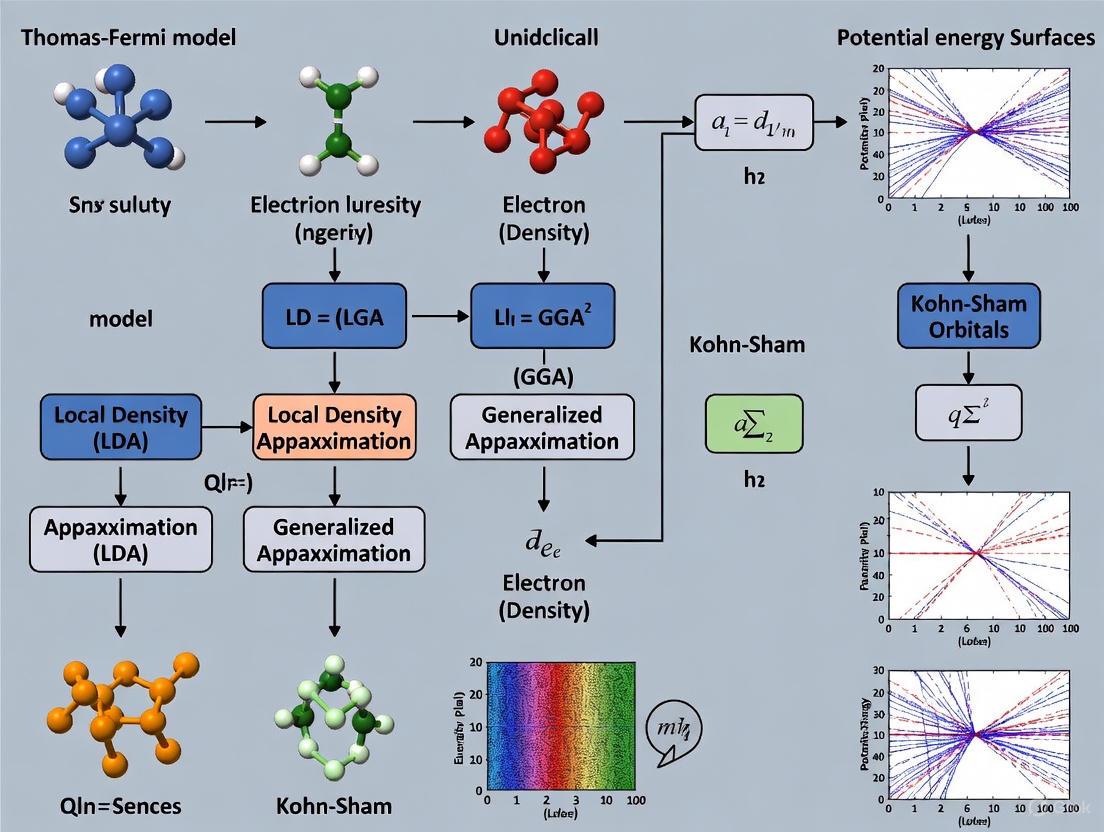
This article provides a comprehensive overview of the development of Density Functional Theory (DFT) from its origins in the Thomas-Fermi model to its current status as a cornerstone of computational...
From Thomas-Fermi to Modern Applications: The Evolving Landscape of Density Functional Theory
Abstract
This article provides a comprehensive overview of the development of Density Functional Theory (DFT) from its origins in the Thomas-Fermi model to its current status as a cornerstone of computational chemistry, physics, and materials science. It explores the foundational theorems that established DFT's theoretical basis, the methodological breakthroughs in exchange-correlation functionals that enabled practical applications, and the ongoing challenges in accuracy and optimization. The content highlights modern validation techniques and comparative analyses with other quantum-chemical methods, concluding with an examination of emerging trends, including machine learning and the specific implications of these advancements for biomedical research and drug discovery.
The Theoretical Bedrock: Tracing DFT from Thomas-Fermi to Hohenberg-Kohn
The Thomas-Fermi (TF) model, independently proposed by Llewellyn Thomas and Enrico Fermi in 1927, represents a seminal breakthrough in the quantum mechanical treatment of many-electron systems [1] [2]. Developed shortly after the introduction of the Schrödinger equation, this statistical model provided the first successful attempt to describe electronic structure using electron density rather than complex wave functions [1] [3]. The TF model emerged during a period of intense theoretical development in quantum mechanics, with Dirac notably observing in 1926 that the fundamental physical laws for chemistry were completely known but practically unsolvable for many-electron systems [3]. In this context, the Thomas-Fermi approach offered a computationally tractable, albeit approximate, method for describing electrons in atoms by treating them as a uniform electron gas distributed throughout the atom [4].
The core innovation of the TF model lies in its foundational premise: that in each small volume element ΔV within an atom, electrons can be treated as being distributed uniformly, akin to a homogeneous electron gas [1] [5]. This semiclassical approximation ignored the individual motions of electrons and their spin [2], but established the crucial concept that electronic properties could be determined from the electron density alone. The model effectively translates the quantum mechanical problem into a form where the electron density n(r) becomes the fundamental variable determining all ground-state properties [1] [5]. This conceptual leap established the philosophical foundation upon which modern density functional theory would eventually be built, despite the quantitative limitations of the original TF approach [1] [6].
Table 1: Historical Context of the Thomas-Fermi Model
| Year | Development | Key Contributors | Significance |
|---|---|---|---|
| 1926 | Schrödinger Equation | Erwin Schrödinger | Established quantum mechanical foundation for electronic structure |
| 1927 | Thomas-Fermi Model | L. Thomas, E. Fermi | First density-based quantum model for many-electron systems |
| 1927 | Hartree Method | Douglas Hartree | Approximate wavefunction-based approach |
| 1930 | Thomas-Fermi-Dirac Model | Paul Dirac | Added exchange energy to TF model |
| 1930 | Hartree-Fock Method | J. C. Slater, V. Fock | Incorporated Pauli principle into Hartree method |
| 1964 | Hohenberg-Kohn Theorems | P. Hohenberg, W. Kohn | Established theoretical foundation for modern DFT |
| 1965 | Kohn-Sham Equations | W. Kohn, L. J. Sham | Practical computational framework for DFT |
Theoretical Foundations and Mathematical Framework
Fundamental Assumptions and Electron Density Formulation
The Thomas-Fermi model rests upon several key physical assumptions that enable the description of a many-electron system through its electron density alone. First, the model assumes that the effective potential V(r) is spherically symmetric and depends only on the distance from the nucleus [5]. Second, it treats electrons as being uniformly distributed within each small volume element ΔV, while allowing the electron density to vary between different volume elements [1]. Third, the model employs a semiclassical phase-space approach, where pairs of electrons are distributed uniformly within each six-dimensional phase-space volume element h³ [5]. This statistical treatment effectively fills the available momentum states up to the Fermi momentum pF(r) at each point in space, creating a position-dependent Fermi sphere [1].
The relationship between electron density and Fermi momentum forms the cornerstone of the TF theory. For a small volume element ΔV at position r, the number of electrons ΔN occupying that volume is given by the number of momentum states up to pF(r) multiplied by two to account for spin degeneracy [1]:
This equation can be inverted to express the Fermi momentum in terms of the electron density [5]:
The local density approximation is inherent in this formulation, as the Fermi momentum and all derived quantities depend solely on the local electron density, without reference to the density at neighboring points or the global wavefunction [6]. This locality approximation, while computationally advantageous, represents a significant physical simplification that limits the accuracy of the TF model for real atomic and molecular systems [1].
Kinetic Energy Functional
The Thomas-Fermi model provides a particularly elegant expression for the kinetic energy of a many-electron system. By considering the classical kinetic energy of electrons filling a Fermi sphere in momentum space up to pF(r), and integrating over all volume elements, one obtains the famous TF kinetic energy functional [1] [6]:
where C({}_{kin}) is the Fermi constant [1]:
In atomic units (ħ = mₑ = e = 1), this constant simplifies to c({}_{F}) = 3(3π²)²/³/10 [5]. The kinetic energy density t(r) at each point in space is therefore proportional to the 5/3 power of the electron density [1]:
This density-powered functional relationship demonstrates the remarkable economy of the TF approach, expressing a quantum mechanical property (kinetic energy) directly in terms of the electron density without requiring wavefunctions or orbitals [1]. The 5/3 power law derives fundamentally from the geometry of the Fermi sphere in momentum space and represents a universal relationship for a non-interacting electron gas at zero temperature [6].
Total Energy Functional
The total energy in the Thomas-Fermi model incorporates three principal components: kinetic energy, electron-nucleus attraction, and electron-electron repulsion. For an atom with nuclear charge Z, the complete energy functional takes the form [1] [4]:
The three terms correspond to [1]:
- Kinetic energy of the electrons (T)
- Electron-nucleus potential energy (U({}_{eN})) due to Coulomb attraction
- Electron-electron repulsion energy (U({}_{ee})) in the classical Hartree approximation
The energy expression is remarkable for being formulated exclusively in terms of the electron density n(r), without any reference to individual electron wavefunctions [1] [5]. This establishes the TF model as the first true density functional theory, predating the formal theoretical foundation provided by the Hohenberg-Kohn theorems by nearly four decades [3]. The functional must be minimized subject to the constraint that the total integrated electron density equals the number of electrons N [1]:
Table 2: Components of the Thomas-Fermi Energy Functional
| Energy Component | Mathematical Expression | Physical Interpretation | Dependence on Density | ||
|---|---|---|---|---|---|
| Kinetic Energy | ( C_{kin} \int [n(\mathbf{r})]^{5/3} d^3r ) | Energy of non-interacting electron gas | n⁵/³ | ||
| Electron-Nucleus Attraction | ( -Z \int \frac{n(\mathbf{r})}{r} d^3r ) | Coulomb attraction to nucleus | n¹ | ||
| Electron-Electron Repulsion | ( \frac{1}{2} \iint \frac{n(\mathbf{r})n(\mathbf{r}')}{ | \mathbf{r} - \mathbf{r}' | } d^3r d^3r' ) | Classical Coulomb repulsion (Hartree) | n² |
The Thomas-Fermi Equation and Its Solution
Derivation via Variational Principle
The Thomas-Fermi equation is derived by applying the variational principle to the energy functional under the constraint of fixed total electron number. Introducing a Lagrange multiplier μ to enforce the normalization constraint, one seeks to minimize [1]:
Performing the functional derivative δΩ/δn(r) = 0 yields the fundamental equation of the TF model [1]:
Here, μ represents the electronic chemical potential (constant throughout space), V({}{N})(r) is the nuclear potential, and the integral term represents the Hartree potential due to electron-electron repulsion [1]. For an atomic system with V({}{N})(r) = -Ze²/r, the equation can be recast into a dimensionless form through appropriate variable substitutions [6].
The electron density n(r) can be expressed in terms of the total potential V(r) = V({}{N})(r) + V({}{H})(r), where V({}_{H})(r) is the Hartree potential [1]:
This expression highlights the semiclassical nature of the TF model, where electrons occupy regions where their chemical potential exceeds the local potential energy [1].
Dimensionless Form and Numerical Solution
For the case of a neutral atom, the TF equation can be transformed into a universal dimensionless form through the substitutions [1] [6]:
where φ(x) is a dimensionless function characterizing the screening of the nuclear potential by the electron cloud. Substituting these expressions into the TF equation yields the celebrated Thomas-Fermi differential equation [1] [6]:
This dimensionless equation is universal for all neutral atoms, independent of atomic number Z, subject to the boundary conditions φ(0) = 1 and φ(∞) = 0 [1] [6]. The function φ(x) describes how the nuclear potential is screened by the electron cloud, with φ(0) = 1 representing unscreened nuclear potential at the origin, and φ(∞) = 0 representing complete screening at large distances [6].
The TF equation is nonlinear and cannot be solved analytically in closed form. Bush and Caldwell obtained the first numerical solution in 1931 using the differential analyzer at MIT [6]. Sommerfeld later derived an approximate analytical solution [6]:
The electron density for a neutral atom can be approximated as a simple exponential function normalized to the total number of electrons [6]:
The following diagram illustrates the theoretical relationships and computational workflow of the Thomas-Fermi model:
Computational Protocols and Methodologies
Protocol: Implementing the Thomas-Fermi Atom Calculation
The following step-by-step protocol details the computational procedure for solving the Thomas-Fermi equation for a neutral atom and obtaining the electron density distribution and total energy.
Initialization Phase
- Define atomic parameters: Specify atomic number Z and electron number N (N = Z for neutral atoms).
- Set physical constants: Planck's constant h, electron mass mₑ, electron charge e, or use atomic units (ħ = mₑ = e = 1).
- Calculate derived constants: Compute the Fermi constant C({}_{kin}) = 3h²(3/π)²/³/(40mₑ) in appropriate units.
Numerical Solution Phase
- Transform to dimensionless variables:
- Compute scaling parameter b = (1/4)(9π²/(2Z))¹/³ a₀
- Define dimensionless distance x = r/b
- Define dimensionless potential φ(x) through μ - V(r) = (Ze²/r)φ(r/b)
- Implement numerical solver for TF equation:
- Discretize the dimensionless TF equation d²φ/dx² = φ³/²/√x
- Apply boundary conditions: φ(0) = 1, φ(∞) = 0
- Use finite difference method with approximately 1000 grid points
- Employ Newton-Raphson iteration for convergence tolerance of 10⁻⁸
Post-Processing Phase
- Transform back to physical variables:
- Compute electron density n(r) = (8π/3h³)[2mₑ(Ze²/b)φ(x)/x]³/²
- Calculate kinetic energy T({}{TF}) = C({}{kin} ∫ n⁵/³(r) d³r
- Compute potential energy components U({}{eN}) and U({}{ee})
- Obtain total energy E({}{TF}) = T({}{TF}) + U({}{eN}) + U({}{ee}
Validation Phase
- Verify numerical accuracy:
- Check normalization condition ∫ n(r) d³r = N
- Confirm convergence with respect to grid size
- Compare with known solutions for limiting cases
Protocol: Electron Density Analysis in Materials
This protocol adapts the Thomas-Fermi approach for analyzing electron density distributions in materials, leveraging the local density approximation for computational efficiency.
System Preparation
- Define crystal structure: Specify lattice vectors and atomic positions.
- Construct electron density grid: Create three-dimensional grid spanning unit cell with resolution of at least 0.05 Å per grid point.
Thomas-Fermi Calculation
- Compute total electron density:
- Initialize n(r) as sum of isolated atom densities
- For each grid point, calculate n(r) = (8π/3h³)p({}_{F})³(r)
- Solve self-consistent field equations:
- Calculate electrostatic potential from Poisson equation ∇²V(r) = -4πn(r)
- Update Fermi momentum p({}_{F})(r) from effective potential
- Iterate until electron density converges (Δn/n < 10⁻⁵)
Analysis and Visualization
- Calculate derived properties:
- Kinetic energy density t(r) = C({}_{kin}[n(r)]⁵/³
- Local electronic pressure P(r) = (2/3)t(r)
- Visualize results:
- Generate contour plots of electron density
- Create volumetric maps of kinetic energy density
- Plot line profiles along crystallographic directions
Table 3: Research Reagent Solutions for Thomas-Fermi Calculations
| Reagent/Software | Function/Purpose | Implementation Notes |
|---|---|---|
| Thomas-Fermi Solver | Numerical solution of TF equation | Finite difference method with Newton-Raphson iteration |
| Poisson Equation Solver | Electrostatic potential calculation | Fast Fourier Transform (FFT) or multigrid methods |
| Atomic Density Generator | Initial electron density guess | Superposition of isolated atom densities |
| Visualization Suite | Analysis of electron density distributions | ParaView, VESTA, or custom MATLAB/Python scripts |
| Convergence Analyzer | Monitoring SCF convergence | Automated tolerance checking and iteration control |
Extensions and Refinements to the Basic Model
Thomas-Fermi-Dirac Model
In 1930, Paul Dirac augmented the Thomas-Fermi model by incorporating a quantum mechanical exchange term, creating the Thomas-Fermi-Dirac (TFD) model [1] [3]. Dirac derived a local approximation for the exchange energy based on the homogeneous electron gas [6] [3]:
where C({}_{X}) = (3/4)(3/π)¹/³ in atomic units [6]. This exchange energy functional arises from the Pauli exclusion principle, which prevents electrons with parallel spins from occupying the same spatial location, thereby reducing their Coulomb repulsion [1]. The addition of this term modestly improved the accuracy of the model, particularly for aspects of electronic structure related to spin effects [1]. When incorporated into the total energy functional, the TFD model becomes [6]:
The corresponding Euler-Lagrange equation includes an additional exchange potential term [6]:
Despite this improvement, the TFD model remained insufficient for accurate quantitative predictions in chemistry, as it still failed to capture atomic shell structure and molecular bonding [1] [3].
Correlation Energy and Further Developments
Eugene Wigner addressed another limitation of the TF model in 1934 by proposing an approximate form for the correlation energy, which captures the interaction among electrons with opposite spins [1]. Wigner's local correlation functional took the form [1]:
where ε({}_{C})(n) is the correlation energy per electron of a homogeneous electron gas with density n. Wigner's expression, while approximate, provided a reasonable estimation of correlation effects for high-density systems [1].
The following diagram illustrates the historical evolution and theoretical relationships between different density-based models:
Applications and Modern Relevance
Contemporary Applications in Materials Science
Despite its quantitative limitations for molecular systems, the Thomas-Fermi model maintains relevance in several specialized domains of modern physics and materials science. The approach offers analytical tractability that enables researchers to extract qualitative trends and scaling relationships that would be obscured in more complex computational frameworks [1]. In materials physics, TF theory provides insights into the behavior of electrons under extreme conditions, such as in high-pressure physics where electron densities become relatively uniform [4]. The model serves as a foundation for developing equations of state for matter under extreme compression, where all materials theoretically approach a Thomas-Fermi-like state [4].
Another significant application lies in orbital-free density functional theory, where the TF kinetic energy functional serves as a component in more sophisticated approximations for the kinetic energy [1]. While the pure TF functional lacks the accuracy needed for most chemical applications, it provides the foundational form that is refined in modern kinetic energy density functionals. These orbital-free approaches offer computational advantages for large systems where traditional Kohn-Sham methods become prohibitively expensive [1] [5].
The TF model also finds application in the construction of interatomic potentials for molecular dynamics simulations. Based on the Thomas-Fermi-Dirac model, Abrahamson developed Born-Mayer-type potentials applicable to combinations of 104 elements at internuclear separations between approximately 0.08 and 0.42 nm [5]. These statistical potentials derived from electron distribution models provide efficient alternatives to quantum mechanical calculations for certain simulation contexts.
Limitations and Critical Assessment
The Thomas-Fermi model, while conceptually groundbreaking, suffers from several fundamental limitations that restrict its quantitative accuracy. Most notably, the model fails to predict chemical bonding - it was proven by Teller that no molecules are stable within the pure TF framework [6]. This catastrophic failure stems from the inability of the model to describe the directional covalent bonds that underlie molecular formation.
The model also lacks atomic shell structure, predicting monotonically decreasing electron densities without the oscillations corresponding to atomic orbitals [1] [5]. Furthermore, it does not exhibit Friedel oscillations in solids, which are characteristic oscillations in electron density around impurities in metals [1] [5]. These deficiencies originate from the local density approximation for kinetic energy, which neglects the quantum mechanical nature of electron motion and the nonlocal effects of the Pauli exclusion principle [1].
The TF model is quantitatively correct only in the limit of infinite nuclear charge, where the electron cloud becomes increasingly homogeneous and the semiclassical approximation becomes exact [1]. For realistic systems with finite nuclear charges, the model provides only rough qualitative trends. The incorrect asymptotic behavior of the electron density (decaying exponentially rather than as r⁻⁶ for neutral atoms) further limits its accuracy for describing long-range interactions [1] [6].
Table 4: Performance Assessment of Thomas-Fermi Model
| Property | TF Prediction | Exact/Experimental Result | Discrepancy |
|---|---|---|---|
| Molecular Bonding | No stable molecules | Molecules stable | Qualitative failure |
| Atomic Shell Structure | Monotonic density decay | Oscillatory shell structure | Missing feature |
| Kinetic Energy | Overestimated | Exact QM result | 10-50% error |
| Exchange Energy | Completely missing (TF)~ | Exact value | 100% error (TF) |
| Total Atomic Energy | ~0.76Z⁷/³ hartrees | ~0.59Z⁷/³ hartrees | ~30% overestimate |
| Density Asymptotics | Exponential decay | r⁻⁶ decay for neutral atoms | Incorrect tail behavior |
The Thomas-Fermi model represents a pioneering effort in the development of quantum mechanical methods for many-electron systems, establishing the fundamental principle that electronic properties could be determined from electron density alone [1] [3]. While quantitatively limited, its conceptual framework directly inspired the formal foundation of modern density functional theory established by Hohenberg, Kohn, and Sham [3]. The TF model introduced several key concepts that remain central to computational materials physics and chemistry, including the local density approximation, density-based kinetic energy functionals, and the self-consistent field approach for determining electron distributions [6] [3].
The historical trajectory from the Thomas-Fermi model to modern DFT illustrates how a conceptually rich but quantitatively limited theory can stimulate decades of research that ultimately yields practical computational tools [3]. Contemporary DFT, now enhanced with machine learning approaches as demonstrated by Microsoft Research's Skala functional, continues to evolve beyond the limitations of traditional Jacob's Ladder classifications [3]. Yet this progress builds upon the foundational insight of Thomas and Fermi that electron density provides a sufficient variable for describing quantum mechanical systems. Their 1927 model thus stands as a testament to the power of simple physical ideas to inspire scientific advances far beyond their original limitations, continuing to influence computational approaches to electronic structure nearly a century after its introduction.
The development of density functional theory (DFT) represents a paradigm shift in quantum mechanics, transitioning from wavefunction-based descriptions to a more computationally tractable density-based formalism. Prior to 1964, the dominant approaches for describing many-electron systems included the Thomas-Fermi model (1927) and its extension by Dirac (1930), which represented the first attempts to describe quantum mechanical systems solely through electron density rather than many-body wavefunctions [3] [6]. These early models, while pioneering, suffered from significant limitations in accuracy—the original Thomas-Fermi model could not account for molecular bonding, and its kinetic energy description was quantitatively poor [6]. The Hartree-Fock method (1930) and Slater's Xα method (1951) provided important intermediate developments but still relied either explicitly or implicitly on orbital constructions [3]. It was against this backdrop that Hohenberg and Kohn introduced their landmark theorems in 1964, establishing for the first time a rigorous foundation for density functional theory and demonstrating that an exact theory based solely on electron density was not merely an approximation but a formally exact representation of quantum mechanics [3].
Table 1: Key Historical Developments Preceding the Hohenberg-Kohn Theorems
| Year | Development | Key Innovators | Significance |
|---|---|---|---|
| 1927 | Thomas-Fermi Model | Thomas, Fermi | First statistical model using electron density instead of wavefunctions [3] |
| 1930 | Thomas-Fermi-Dirac Model | Dirac | Added exchange term to Thomas-Fermi model [3] |
| 1930 | Hartree-Fock Method | Slater, Fock | Incorporated Pauli principle but required orbital solutions [3] |
| 1951 | Slater Xα Method | Slater | Replaced Hartree-Fock exchange with density-dependent approximation [3] |
The Fundamental Theorems: A Formal Foundation
The First Hohenberg-Kohn Theorem
The first Hohenberg-Kohn theorem establishes a foundational principle: the ground-state electron density uniquely determines the external potential (and thus the entire Hamiltonian) of a many-electron system [7] [8]. Formally stated, "the ground state of any interacting many-particle system with a given fixed inter-particle interaction is a unique functional of the electron density n(r)" [7]. This represents a profound simplification, as the electron density depends on only three spatial variables (x, y, z), regardless of system size, while the many-body wavefunction depends on 3N variables for an N-electron system.
The mathematical formulation expresses the ground state energy E as a functional of the ground state density n₀(r):
E = E[n₀] = ⟨Ψ[n₀]|T̂ + V̂ + Û|Ψ[n₀]⟩ [7]
where T̂ represents the kinetic energy operator, V̂ the external potential operator, and Û the electron-electron interaction operator. The theorem demonstrates that the ground state wavefunction can be written as a unique functional of the ground state density, Ψ₀ = Ψ[n₀], enabling the calculation of all ground-state properties [7] [8].
The Second Hohenberg-Kohn Theorem
The second Hohenberg-Kohn theorem provides the variational principle essential for practical applications [7]. It states that "the electron density that minimizes the energy of the overall functional is the true electron density corresponding to the full solution of the Schrödinger equation" [7]. This establishes a crucial methodology: if the true functional form is known, one can find the ground state electron density by minimizing the energy functional with respect to the density.
The universal functional F[n] can be decomposed as:
F[n] = T[n] + Vₑₑ[n] [8]
where T[n] is the kinetic energy functional and Vₑₑ[n] is the electron-electron interaction functional. The total energy functional for a specific system with external potential v(r) then becomes:
E[v; n] = F[n] + ∫v(r)n(r)d³r [8]
The variational principle guarantees that the minimum value of this functional, obtained with the correct n(r), gives the exact ground-state energy.
Diagram 1: Logical structure of Hohenberg-Kohn theorems
Technical Implementation: From Theorems to Practical Computation
The v-Representability and N-Representability Challenges
A significant technical challenge emerged from the original Hohenberg-Kohn formulation: the v-representability problem. The theorems initially applied only to densities that could be obtained from some external potential (v-representable densities) [8]. This limitation was addressed through the constrained search approach developed by Levy and Lieb, which expanded the theory to N-representable densities—those obtainable from some antisymmetric wavefunction [8] [9].
The constrained search formulation defines a universal functional as:
F[n] = min⟨Ψ|T̂ + V̂ₑₑ|Ψ⟩ for Ψ → n(r)
where the minimization searches all wavefunctions Ψ that yield the fixed density n [8] [9]. This approach guarantees that F[n] + V[n] ≥ E₀ for N-representable densities, establishing a variational principle applicable to computational methods.
The Kohn-Sham Equations: A Practical Computational Framework
In 1965, Kohn and Sham introduced a practical computational scheme that remains the foundation of modern DFT calculations [3]. The key insight was to replace the original interacting system with an auxiliary non-interacting system that has the same ground-state density [9]. This approach isolates the problematic components of the universal functional into an exchange-correlation term.
The Kohn-Sham energy functional is expressed as:
EKS[n] = TS[n] + ∫vₑₓₜ(r)n(r)d³r + EH[n] + EXC[n]
where TS[n] is the kinetic energy of the non-interacting reference system, EH[n] is the classical Hartree electron-electron repulsion energy, and EXC[n] is the exchange-correlation functional that captures all many-body effects [9].
Table 2: Components of the Kohn-Sham Energy Functional
| Functional Component | Mathematical Form | Physical Significance | Treatment in KS Scheme | ||
|---|---|---|---|---|---|
| Non-interacting Kinetic Energy | Tₛ[n] = Σ⟨φᵢ | -½∇² | φᵢ⟩ | Kinetic energy of reference system | Calculated exactly via orbitals |
| External Potential | ∫vₑₓₜ(r)n(r)d³r | Electron-nucleus attraction | Calculated exactly | ||
| Hartree Energy | Eₕ[n] = ½∫∫[n(r₁)n(r₂)/ | r₁-r₂ | ]d³r₁d³r₂ | Classical electron repulsion | Calculated exactly |
| Exchange-Correlation | EₓC[n] | Quantum many-body effects | Approximated (LDA, GGA, hybrids) |
The minimization of the Kohn-Sham energy functional leads to the Kohn-Sham equations:
[-½∇² + vₑ₆(r) + vₕ(r) + vₓC(r)]φᵢ(r) = εᵢφᵢ(r)
where vₑ₆ is the external potential, vₕ is the Hartree potential, and vₓC is the exchange-correlation potential [9]. These single-particle equations are solved self-consistently to obtain the ground-state density and energy.
Research Reagent Solutions: Computational Tools for DFT Implementation
Table 3: Essential Computational Tools and Methods in Modern DFT
| Tool Category | Specific Examples | Function/Purpose | Theoretical Basis | ||
|---|---|---|---|---|---|
| Kinetic Energy Functionals | Thomas-Fermi (TTF), von Weizsäcker (TvW) | Orbital-free DFT calculations [10] | TTF ∼ ∫n⁵⁄³(r)d³r; TvW ∼ ∫ | ∇n¹⁄²(r) | ²d³r [10] |
| Exchange-Correlation Functionals | LDA, GGA, Hybrids (B3LYP, PBE0) | Approximate many-body quantum effects [3] | LDA: uniform electron gas; GGA: adds density gradient; Hybrids: mix HF exchange [3] | ||
| Basis Sets | Plane waves, Localized orbitals, Gaussians | Expand Kohn-Sham orbitals | Balance between completeness and computational efficiency | ||
| Pseudopotentials | Norm-conserving, Ultrasoft, PAW | Replace core electrons | Reduce computational cost while maintaining accuracy |
Experimental Protocols: Computational Methodology
Protocol 1: Self-Consistent Solution of Kohn-Sham Equations
The standard approach for DFT calculations involves an iterative self-consistent field procedure:
Initialization: Generate initial guess for electron density nᵢₙᵢₜᵢₐₗ(r), typically from atomic orbital superposition
Potential Construction: Calculate effective potential vₑ𝒻𝒻(r) = vₑₓₜ(r) + vₕ(r) + vₓC(r)
Orbital Solution: Solve Kohn-Sham equations for occupied orbitals {φᵢ(r)}
Density Update: Construct new density nₙₑw(r) = Σ|φᵢ(r)|²
Mixing & Convergence: Mix nₙₑw(r) with previous density; check convergence of total energy and density
Iteration: Repeat steps 2-5 until self-consistency is achieved (typically 10-50 iterations)
This protocol ensures that the input and output densities are consistent, satisfying the Hohenberg-Kohn condition for the ground state [7] [9].
Protocol 2: Orbital-Free DFT Implementation
For systems where computational efficiency is paramount, orbital-free DFT provides an alternative:
Functional Selection: Choose appropriate kinetic energy functional (e.g., TF, vW, or modern nonlocal functionals)
Direct Minimization: Minimize energy functional E[n] = F[n] + ∫vₑₓₜ(r)n(r)d³r with respect to density
Density Representation: Represent density on spatial grid or with appropriate basis functions
Constrained Optimization: Maintain density normalization ∫n(r)d³r = N during optimization
This approach is computationally more efficient but requires accurate kinetic energy density functionals, which remain an active research area [10] [11].
Diagram 2: Kohn-Sham self-consistent field cycle
Advanced Applications and Contemporary Developments
Extensions of the Basic Framework
The Hohenberg-Kohn theorems have been extended beyond their original formulation to address various physical scenarios:
- Time-Dependent DFT (TDDFT): For excited states and time-dependent phenomena [12]
- Finite-Temperature DFT: For systems at non-zero temperatures [9]
- Relativistic DFT: For systems containing heavy elements where relativistic effects become important [12]
- Magnetic Fields: For systems in external magnetic fields [9]
These extensions demonstrate the remarkable flexibility of the density functional approach while maintaining the core principles established by Hohenberg and Kohn.
Modern Functional Development: Climbing Jacob's Ladder
The accuracy of practical DFT calculations depends critically on the approximation used for the exchange-correlation functional. Perdew's metaphor of "Jacob's Ladder" classifies functionals in a hierarchy of increasing complexity and accuracy [3]:
- Local Density Approximation (LDA): Uses only local density n(r) [3]
- Generalized Gradient Approximation (GGA): Incorporates density gradient |∇n(r)| [3]
- Meta-GGAs: Adds kinetic energy density τ(r)
- Hybrid Functionals: Mix in exact exchange from Hartree-Fock [3]
- Double Hybrids: Include both exact exchange and perturbative correlation
Recent developments include machine-learned functionals that potentially bypass traditional approximations, representing an exciting frontier in DFT development [3].
The 1964 Hohenberg-Kohn theorems established density functional theory as a formally exact theory, providing the rigorous foundation that transformed DFT from approximate models into a powerful computational framework with unprecedented accuracy and efficiency. By demonstrating that all ground-state properties are uniquely determined by the electron density, Hohenberg and Kohn enabled the development of computational methods that have revolutionized materials science, chemistry, and drug discovery [12]. The Kohn-Sham equations, built directly upon this foundation, remain the workhorse of first-principles electronic structure calculations across scientific disciplines. As functional development continues and computational power increases, the principles established in 1964 continue to guide new generations of researchers in pushing the boundaries of quantum mechanical simulation.
Historical Context: From Thomas-Fermi to a Practical Foundation
The development of the Kohn-Sham equations in 1965 represents the pivotal moment when density functional theory (DFT) transitioned from a conceptual framework to a practical computational tool. This breakthrough was rooted in addressing the fundamental limitations of earlier models, beginning with the Thomas-Fermi model developed in 1927 [1] [3]. The Thomas-Fermi model provided the first quantum mechanical theory that used electron density alone to describe many-body systems, employing a statistical approach to approximate electron distribution in atoms [1] [4]. However, this model suffered from critical inaccuracies: it failed to reproduce essential electronic structure features like shell structure in atoms and Friedel oscillations in solids, and most significantly, it lacked an exchange-energy term accounting for the Pauli exclusion principle [1].
In 1930, Paul Dirac added an exchange energy term to the Thomas-Fermi model, creating the Thomas-Fermi-Dirac model, but it remained too inaccurate for practical chemical applications [3]. The field transformed in 1964 with the Hohenberg-Kohn theorems, which provided the rigorous mathematical foundation for DFT by proving that all ground-state properties of a many-electron system are uniquely determined by its electron density [3] [13]. While theoretically profound, this formulation remained practically difficult to implement until 1965, when Walter Kohn and Lu Jeu Sham introduced their revolutionary equations that made DFT computationally feasible [14] [3].
Table 1: Evolution of Key Density-Based Quantum Models
| Model/Theory | Year | Key Proponents | Fundamental Advancement | Primary Limitations |
|---|---|---|---|---|
| Thomas-Fermi Model | 1927 | Thomas, Fermi | First statistical model using electron density instead of wave functions [1] [3] | No exchange energy; inaccurate for molecules; no shell structure [1] |
| Thomas-Fermi-Dirac | 1930 | Dirac | Added exchange energy term [3] | Still insufficient accuracy for chemical applications [3] |
| Hohenberg-Kohn Theorems | 1964 | Hohenberg, Kohn | Rigorous proof that density uniquely determines all properties [3] [13] | Practical implementation difficulties [3] |
| Kohn-Sham Equations | 1965 | Kohn, Sham | Mapping to non-interacting system with exact kinetic energy treatment [14] [3] | Unknown exchange-correlation functional [14] |
Theoretical Foundation: The Kohn-Sham Framework
Core Conceptual Mapping
The Kohn-Sham equations fundamentally reimagined the many-electron problem by introducing an ingenious mapping procedure. Rather than directly solving the intractable problem of interacting electrons, Kohn and Sham proposed a fictitious system of non-interacting particles that exactly reproduces the electron density of the real interacting system [14]. This approach effectively decouples the formidable challenges of electron-electron interactions while maintaining the physically meaningful electron density distribution.
The Hamiltonian for this reference system is constructed such that the electrons experience an effective local potential ( v_{\text{eff}}(\mathbf{r}) ) rather than the complex many-body interactions of the original system [14]. The beauty of this construction lies in its mathematical tractability—the wavefunction for non-interacting electrons can be represented exactly as a single Slater determinant of orbitals, and the kinetic energy can be computed precisely from these orbitals [14] [13].
Mathematical Formulation
The Kohn-Sham equations are derived from the total energy functional for the real interacting system [14]:
[ E[\rho] = Ts[\rho] + \int d\mathbf{r} \, v{\text{ext}}(\mathbf{r}) \rho(\mathbf{r}) + E{\text{H}}[\rho] + E{\text{xc}}[\rho] ]
In this expression:
- ( T_s[\rho] ) represents the kinetic energy of the non-interacting reference system
- ( v_{\text{ext}}(\mathbf{r}) ) is the external potential (typically electron-nuclei interactions)
- ( E_{\text{H}}[\rho] ) is the Hartree (Coulomb) energy representing electron-electron repulsion
- ( E_{\text{xc}}[\rho] ) is the exchange-correlation energy, which captures all remaining electronic interactions
Minimization of this energy functional with respect to the orbitals, subject to orthogonality constraints, leads to the Kohn-Sham eigenvalue equations [14]:
[ \left(-\frac{\hbar^2}{2m}\nabla^2 + v{\text{eff}}(\mathbf{r})\right)\varphii(\mathbf{r}) = \varepsiloni \varphii(\mathbf{r}) ]
where the effective potential is given by:
[ v{\text{eff}}(\mathbf{r}) = v{\text{ext}}(\mathbf{r}) + e^2\int \frac{\rho(\mathbf{r}')}{|\mathbf{r} - \mathbf{r}'|} \, d\mathbf{r}' + \frac{\delta E_{\text{xc}}[\rho]}{\delta \rho(\mathbf{r})} ]
The electron density is constructed from the occupied Kohn-Sham orbitals:
[ \rho(\mathbf{r}) = \sum{i}^{N} |\varphii(\mathbf{r})|^2 ]
These equations must be solved self-consistently because the effective potential depends on the density, which in turn depends on the orbitals [15].
Diagram 1: Theoretical foundation of Kohn-Sham DFT
Energy Component Analysis
The Kohn-Sham approach achieves its practical utility by capturing the majority of the total energy in computationally tractable terms, leaving only the exchange-correlation energy as an unknown that requires approximation.
Table 2: Components of the Kohn-Sham Total Energy Functional
| Energy Component | Mathematical Expression | Physical Significance | Treatment in KS Scheme | ||
|---|---|---|---|---|---|
| Non-interacting Kinetic Energy | ( Ts[\rho] = \sum{i=1}^N \int d\mathbf{r} \, \varphii^*(\mathbf{r}) \left(-\frac{\hbar^2}{2m}\nabla^2\right) \varphii(\mathbf{r}) ) | Kinetic energy of reference non-interacting system | Exact via orbitals [14] | ||
| External Potential Energy | ( \int d\mathbf{r} \, v_{\text{ext}}(\mathbf{r}) \rho(\mathbf{r}) ) | Electron-nuclei attractions | Exact [14] | ||
| Hartree Energy | ( E_{\text{H}}[\rho] = \frac{e^2}{2} \int d\mathbf{r} \int d\mathbf{r}' \, \frac{\rho(\mathbf{r}) \rho(\mathbf{r}')}{ | \mathbf{r} - \mathbf{r}' | } ) | Classical electron-electron repulsion | Exact [14] |
| Exchange-Correlation Energy | ( E_{\text{xc}}[\rho] ) | All quantum mechanical electron interactions | Requires approximation [14] |
Computational Protocol: Kohn-Sham SCF Implementation
Self-Consistent Field Procedure
The solution of the Kohn-Sham equations follows an iterative self-consistent field (SCF) approach, which ensures that the input and output densities converge to a consistent solution [15]. The detailed protocol consists of the following steps:
Initialization
- Construct the molecular structure with nuclear coordinates and atomic numbers
- Select an appropriate basis set for expanding the Kohn-Sham orbitals
- Choose an exchange-correlation functional approximation (LDA, GGA, hybrid, etc.)
- Generate an initial guess for the electron density ( \rho^{(0)}(\mathbf{r}) ), typically from superposition of atomic densities
SCF Iteration Cycle (for iteration k = 0, 1, 2, ... until convergence)
Construct the effective potential using the current density: [ v{\text{eff}}^{(k)}(\mathbf{r}) = v{\text{ext}}(\mathbf{r}) + e^2\int \frac{\rho^{(k)}(\mathbf{r}')}{|\mathbf{r} - \mathbf{r}'|} \, d\mathbf{r}' + v{\text{xc}}^{(k)}(\mathbf{r}) ] where ( v{\text{xc}}^{(k)}(\mathbf{r}) = \frac{\delta E{\text{xc}}[\rho]}{\delta \rho(\mathbf{r})} \bigg|{\rho=\rho^{(k)}} ) [14]
Solve the Kohn-Sham eigenvalue problem: [ \left(-\frac{\hbar^2}{2m}\nabla^2 + v{\text{eff}}^{(k)}(\mathbf{r})\right)\varphii^{(k)}(\mathbf{r}) = \varepsiloni^{(k)} \varphii^{(k)}(\mathbf{r}) ] This is typically implemented as a matrix diagonalization in a basis set representation [15]
Calculate the new electron density from the occupied orbitals: [ \rho^{(k+1)}(\mathbf{r}) = \sum{i}^{\text{occupied}} |\varphii^{(k)}(\mathbf{r})|^2 ]
Check for convergence by comparing ( \rho^{(k+1)} ) and ( \rho^{(k)} ) and examining the energy change
- If not converged, prepare the next density using mixing schemes (linear, Kerker, etc.) and continue iterations
Post-SCF Analysis
- Compute the total energy using the converged density and orbitals
- Calculate molecular properties, forces, and other observables
- Perform population analysis, visualize orbitals, and interpret results
Diagram 2: Kohn-Sham self-consistent field workflow
Key Computational Considerations
The numerical implementation of the Kohn-Sham equations requires careful attention to several computational aspects:
Basis Sets: The choice of basis functions for expanding Kohn-Sham orbitals significantly impacts accuracy and efficiency. Common choices include plane waves for periodic systems, Gaussian-type orbitals for molecular systems, and numerical atomic orbitals [15]
Integration Grids: Accurate numerical integration is essential for evaluating the exchange-correlation potential, particularly for molecular systems. Adaptive grids with higher density near nuclei are typically employed
Convergence Acceleration: Density mixing schemes and advanced algorithms like direct inversion in iterative subspace (DIIS) are crucial for achieving SCF convergence in challenging systems
Parallelization: Modern implementations leverage massive parallelization to distribute the computational load across Kohn-Sham orbital bands, k-points, and real-space grids
Research Reagent Solutions: Computational Components
The practical application of Kohn-Sham DFT requires several "computational reagents" that together enable accurate simulations of electronic structure problems.
Table 3: Essential Computational Components for Kohn-Sham DFT Simulations
| Component | Function | Common Examples |
|---|---|---|
| Exchange-Correlation Functional | Approximates quantum mechanical electron interactions | LDA, PBE (GGA), B3LYP (hybrid), HSE (screened hybrid) [3] |
| Basis Set | Expands Kohn-Sham orbitals in finite representation | Plane waves, Gaussian-type orbitals, numerical atomic orbitals, augmented waves [15] |
| Pseudopotentials | Represents core electrons and nuclei, reducing computational cost | Norm-conserving, ultrasoft, PAW (Projector Augmented Wave) methods |
| Integration Grids | Enables numerical integration of exchange-correlation potential | Lebedev, Becke, Mura-Knowles grids for molecular systems |
| SCF Convergence Algorithms | Accelerates and stabilizes self-consistent field iterations | DIIS, Kerker mixing, charge density mixing, preconditioners |
Applications in Drug Development and Materials Science
The Kohn-Sham formulation has become the cornerstone of modern computational materials science and drug development due to its favorable balance between accuracy and computational efficiency. Key application areas include:
Pharmaceutical Applications
In drug discovery, Kohn-Sham DFT enables researchers to:
- Calculate binding energies between drug candidates and protein targets
- Predict reaction pathways and activation energies for drug metabolism
- Simulate electronic properties of pharmacophores and their interactions
- Model redox potentials and spectroscopic properties of pharmaceutical compounds
Materials Design
For materials science, the method provides insights into:
- Band structures and electronic density of states for semiconductors
- Catalytic activity and surface reactivity of heterogeneous catalysts
- Mechanical properties and defect formation energies in solids
- Magnetic properties and spin-dependent phenomena
The continued evolution of exchange-correlation functionals, including recent machine-learning approaches, promises to further enhance the predictive power of Kohn-Sham DFT for these applications [3].
Comparative Analysis: Thomas-Fermi vs. Kohn-Sham Formulations
The fundamental advancement of the Kohn-Sham approach becomes evident when comparing its theoretical structure and practical performance against the original Thomas-Fermi model.
Table 4: Comprehensive Comparison: Thomas-Fermi vs. Kohn-Sham Formulations
| Aspect | Thomas-Fermi Model | Kohn-Sham DFT |
|---|---|---|
| Kinetic Energy Treatment | Approximate functional of density only: ( T{TF}[\rho] = CF \int \rho^{5/3}(\mathbf{r}) d\mathbf{r} ) [1] | Exact treatment via non-interacting orbitals: ( Ts[\rho] = \sum{i=1}^N \int d\mathbf{r} \, \varphii^*(\mathbf{r}) \left(-\frac{\hbar^2}{2m}\nabla^2\right) \varphii(\mathbf{r}) ) [14] |
| Exchange-Correlation | Initially absent; later added as Dirac exchange: ( EX^{Dirac}[\rho] = CX \int \rho^{4/3}(\mathbf{r}) d\mathbf{r} ) [1] [3] | Comprehensive ( E_{xc}[\rho] ) with systematic approximations (LDA, GGA, hybrids, etc.) [14] [3] |
| Electron Density Features | Fails to capture shell structure, bond breaking, density oscillations [1] | Correctly reproduces atomic shell structure, chemical bonding, Friedel oscillations [14] |
| Computational Cost | Very low (direct minimization) | Moderate (SCF iteration with matrix diagonalization) |
| Predictive Accuracy | Qualitative trends only; quantitatively poor [1] | Quantitative for many properties; widely used in materials and chemical simulations [3] |
| Molecular Applications | Unsuccessful for molecular bonding [1] [4] | Standard method for molecular structure, bonding, and reactivity [15] [3] |
The critical distinction lies in the kinetic energy treatment. While Thomas-Fermi uses a local density approximation for kinetic energy that fails to capture essential quantum effects, Kohn-Sham computes the kinetic energy exactly for a non-interacting system with the same density as the real system [14] [1]. This fundamental improvement enables the Kohn-Sham approach to describe chemical bonding, molecular structures, and materials properties with quantitative accuracy, making it the foundation for modern computational materials science and drug development.
The development of the Thomas–Fermi (TF) model in 1927 by Llewellyn Thomas and Enrico Fermi marked a revolutionary shift in quantum mechanics, representing the first serious attempt to describe many-electron systems using only the electron density instead of the complex N-electron wavefunction [1] [5]. This semiclassical approach emerged shortly after the introduction of the Schrödinger equation and established the foundational principle that would eventually evolve into modern density functional theory (DFT) [5]. The TF model fundamentally assumed that electrons are distributed uniformly within each small volume element ΔV, enabling the derivation of a kinetic energy functional expressed solely in terms of the electron density n(r) [1].
While philosophically profound, the original Thomas–Fermi model suffered from severe quantitative limitations. It failed to reproduce essential electronic structure features such as atomic shell structure and Friedel oscillations in solids [1]. Most significantly, the model lacked any representation of exchange energy arising from the Pauli exclusion principle and completely neglected electron correlation effects [1] [5]. These critical shortcomings restricted the model's accuracy to the limiting case of infinite nuclear charge, rendering it inadequate for quantitative predictions in realistic molecular systems [1] [5].
The introduction of the Local Density Approximation (LDA) within the formal framework established by the Hohenberg–Kohn theorems provided the crucial bridge between the conceptual foundation of the Thomas–Fermi model and practically useful computational methods. By incorporating knowledge from the homogeneous electron gas (HEG), LDA became the first practical exchange-correlation functional that enabled realistic electronic structure calculations for materials and molecules [5].
Table 1: Historical Evolution from Thomas-Fermi to LDA
| Theoretical Model | Key Approximation | Strengths | Limitations |
|---|---|---|---|
| Thomas-Fermi (1927) | Kinetic energy as functional of density only [1] | First density-based model; conceptual simplicity [1] [5] | No exchange or correlation; incorrect atomic shell structure [1] |
| Thomas-Fermi-Dirac (1930) | Adds local exchange energy [1] | Improved accuracy over TF [1] | Still missing correlation energy; quantitative limitations [1] |
| Hohenberg-Kohn (1964) | Proof that density determines all ground state properties [16] | Formal foundation for DFT [16] | No practical functionals provided |
| Kohn-Sham (1965) | Introduces non-interacting reference system [16] | Exact kinetic energy via orbitals [16] | Requires approximation for exchange-correlation functional |
| LDA (1960s) | Exchange-correlation from homogeneous electron gas [5] | First practical functional; computational efficiency [16] [5] | Underestimates lattice constants; overbinds molecules [17] |
Theoretical Foundation of LDA
The Homogeneous Electron Gas Reference System
The fundamental ansatz of the Local Density Approximation is that the exchange-correlation energy at each point in space can be approximated by the value for a homogeneous electron gas of the same density [5]. Mathematically, this is expressed as:
[ E{XC}^{LDA}[n] = \int n(\mathbf{r}) \varepsilon{XC}^{HEG}(n(\mathbf{r})) d\mathbf{r} ]
where (\varepsilon_{XC}^{HEG}(n)) is the exchange-correlation energy per particle of a homogeneous electron gas with density n. This quantity is typically separated into exchange and correlation contributions:
[ \varepsilon{XC}^{HEG}(n) = \varepsilon{X}^{HEG}(n) + \varepsilon_{C}^{HEG}(n) ]
For the exchange part, an exact analytical expression exists derived from the Hartree-Fock method for the HEG:
[ \varepsilon_{X}^{HEG}(n) = -\frac{3}{4}\left(\frac{3}{\pi}\right)^{1/3} n^{1/3} ]
The correlation component (\varepsilon_{C}^{HEG}(n)) is considerably more complex and must be determined through highly accurate quantum Monte Carlo simulations of the homogeneous electron gas, with the results parameterized as a function of density for practical computations [5].
Mathematical Formulation and Key Equations
The LDA derives its mathematical structure from the Thomas–Fermi–Dirac model but incorporates it within the Kohn–Sham framework. In the Kohn–Sham DFT approach, the LDA exchange-correlation potential is obtained through the functional derivative:
[ v{XC}^{LDA}(\mathbf{r}) = \frac{\delta E{XC}^{LDA}[n]}{\delta n(\mathbf{r})} = \varepsilon{XC}^{HEG}(n(\mathbf{r})) + n(\mathbf{r})\frac{\partial \varepsilon{XC}^{HEG}(n)}{\partial n}\bigg|_{n=n(\mathbf{r})} ]
This potential enters the Kohn–Sham equations as an effective one-electron operator:
[ \left[-\frac{1}{2}\nabla^2 + v{ext}(\mathbf{r}) + v{Hartree}(\mathbf{r}) + v{XC}^{LDA}(\mathbf{r})\right] \phii(\mathbf{r}) = \epsiloni \phii(\mathbf{r}) ]
where (v{ext}) is the external potential (typically from nuclei), (v{Hartree}) is the classical electrostatic Hartree potential, and (\phii) are the Kohn–Sham orbitals that reproduce the exact density of the interacting system through (n(\mathbf{r}) = \sum{i}^{occupied} |\phi_i(\mathbf{r})|^2).
Figure 1: LDA Computational Workflow. The diagram illustrates the self-consistent procedure for solving Kohn-Sham equations with the LDA functional, connecting the inhomogeneous real system to the homogeneous electron gas reference.
Computational Protocols and Methodology
Implementation in Materials Science
The application of LDA in computational materials science follows well-established protocols centered around the plane-wave pseudopotential method [16]. This approach leverages periodic boundary conditions to model crystalline systems and requires careful attention to several computational parameters.
Basic Computational Setup:
- Software Packages: Vienna Ab initio Simulation Package (VASP), Quantum ESPRESSO [16] [17]
- Basis Set: Plane-wave basis with kinetic energy cutoff (typically 400-800 eV) [16]
- k-point Sampling: Monkhorst-Pack scheme for Brillouin zone integration [16]
- Convergence Criteria: Force convergence < 0.01 eV/Å, energy convergence < 10^-5 eV [17]
System-Specific Parameters for LDA: For the L10-MnAl compound studied in recent research, the following LDA-specific parameters were employed [17]:
- Exchange-Correlation Functional: Ceperley-Alder parameterized by Perdew and Zunger [17]
- k-point Mesh: 13×13×13 for structural optimization
- Plane-Wave Cutoff: 600 eV
- Pseudopotentials: Projector augmented-wave (PAW) method
Table 2: LDA Performance in Materials Property Prediction
| Material Property | LDA Performance | Typical Error | Comparison to GGA |
|---|---|---|---|
| Lattice Constants | Systematic underestimation [17] | 1-3% too short [17] | GGA tends to overestimate [17] |
| Cohesive Energy | Overbinding [17] | Overestimates by 10-20% | GGA provides better agreement [17] |
| Bulk Modulus | Overestimation [17] | 5-10% too high | GGA generally more accurate [17] |
| Electronic Band Gap | Severe underestimation [16] | 50-100% error | Comparable error to GGA [16] |
| Magnetic Moments | Reasonable prediction [17] | 5-15% error | GGA often superior [17] |
Step-by-Step LDA Calculation Protocol
Protocol 1: Structural Optimization Using LDA
This protocol outlines the standard procedure for determining the ground-state geometry of a crystalline material using LDA.
Initial Structure Preparation
- Obtain initial crystal structure from experimental data or database
- Define lattice vectors and atomic positions
- Set up periodic boundary conditions
Computational Parameters
- Select LDA functional (e.g., Ceperley-Alder-Perdew-Zunger)
- Choose appropriate pseudopotentials for all elements
- Set plane-wave cutoff energy based on convergence tests
- Determine k-point mesh using Monkhorst-Pack scheme
Self-Consistent Field (SCF) Calculation
- Perform initial SCF calculation to obtain electron density
- Use iterative diagonalization (Davidson, RMM-DIIS)
- Employ density mixing schemes (Pulay, Kerker) for convergence
Ionic Relaxation
- Calculate Hellmann-Feynman forces on all atoms
- Update atomic positions using optimization algorithm (BFGS, conjugate gradient)
- Repeat SCF calculation with new coordinates until forces are below tolerance (typically 0.01 eV/Å)
Property Extraction
- Extract optimized lattice parameters
- Calculate total energy, electronic density of states, band structure
- Determine derived properties: elastic constants, phonon spectra
Protocol 2: Electronic Structure Analysis with LDA
This protocol describes the procedure for calculating electronic properties once the ground-state structure is determined.
Converged Density Utilization
- Use the converged electron density from Protocol 1
- Ensure SCF convergence to at least 10^-6 eV in total energy
Band Structure Calculation
- Identify high-symmetry points in the Brillouin zone
- Perform non-self-consistent calculation along k-point paths
- Extract eigenvalue spectrum to plot band structure
Density of States (DOS) Analysis
- Use denser k-point mesh for accurate DOS (e.g., 21×21×21)
- Apply Gaussian or tetrahedron smearing for k-point integration
- Project DOS onto atomic orbitals for projected DOS (PDOS)
Post-Processing
- Analyze band gaps at high-symmetry points
- Identify orbital contributions to specific bands
- Calculate Fermi surface for metallic systems
Comparative Performance Analysis
LDA vs GGA in Magnetic Materials
Recent investigations of the L10-MnAl compound provide a compelling case study for comparing LDA and GGA performance in predicting materials properties [17]. This rare-earth-free permanent magnet candidate has been extensively studied using both functionals, revealing systematic differences in predictive accuracy.
Structural Properties: For L10-MnAl, LDA calculations yield lattice parameters a = 3.784 Å and c = 3.378 Å, representing a typical LDA underestimation compared to experimental values (a = 3.897 Å, c = 3.531 Å) [17]. The GGA approach with the PBE functional provides improved agreement with experiments (a = 3.852 Å, c = 3.451 Å), demonstrating GGA's tendency to correct LDA's overbinding [17].
Electronic and Magnetic Properties: Both LDA and GGA correctly predict the metallic character of L10-MnAl, but exhibit significant differences in their description of specific magnetic properties [17]. The magnetic moment per Mn atom calculated with LDA (2.08 μB) shows greater deviation from experimental values (approximately 2.4-2.7 μB) compared to GGA results (2.32 μB) [17]. This performance trend extends to the compound's bulk modulus, where LDA's characteristic overestimation (132 GPa) exceeds GGA's prediction (118 GPa), with both exceeding experimental measurements [17].
Performance Across Material Classes
The reliability of LDA varies significantly across different classes of materials, with systematic trends emerging from decades of computational experiments.
Metallic Systems: LDA generally performs reasonably well for simple metals and their bulk properties due to the similarity of their electron gas to the HEG reference system. The approximation captures the dominant s- and p-electron delocalization in these systems, providing adequate predictions of lattice constants (despite slight underestimation) and cohesive energies.
Semiconductors and Insulators: LDA's performance deteriorates significantly for semiconductors and insulators, most notably through the systematic band gap underestimation problem [16]. For zinc-blende CdS and CdSe compounds, LDA severely underestimates band gaps compared to experimental values, a limitation shared with GGA functionals [16]. This "band gap problem" stems from LDA's incomplete description of the exchange interaction and derivative discontinuities in the exchange-correlation potential.
Molecular Systems: For molecular systems, LDA typically overestimates binding energies and underestimates bond lengths, consistent with its general overbinding tendency. This makes LDA less suitable for predicting reaction energies and molecular geometries compared to GGA or hybrid functionals, though its computational efficiency maintains its utility for large systems where qualitative trends are sufficient.
Figure 2: DFT Functional Evolution. The historical development of exchange-correlation functionals from Thomas-Fermi to modern hybrid approaches, showing the conceptual improvements at each stage.
The Scientist's Toolkit: Research Reagent Solutions
Table 3: Essential Computational Tools for LDA Calculations
| Tool Category | Specific Examples | Function | Application Notes |
|---|---|---|---|
| DFT Software Packages | VASP, Quantum ESPRESSO, ABINIT [16] [17] | Solves Kohn-Sham equations with LDA functional | VASP offers excellent pseudopotential libraries; Quantum ESPRESSO is open-source [16] |
| Pseudopotential Libraries | GBRV, PSLibrary, VASP PAW datasets [16] | Replaces core electrons with effective potential | Ultra-soft pseudopotentials reduce computational cost; PAW provides high accuracy [16] |
| Visualization Tools | VESTA, XCrySDen, VMD | Analyzes crystal structures and electron densities | Critical for interpreting computational results and preparing publications |
| Convergence Testing Scripts | AiiDA, ASE, custom Python scripts | Automates parameter testing | Essential for ensuring results are physically meaningful, not numerical artifacts |
| High-Performance Computing | SLURM, PBS workload managers | Enables parallel computation | LDA calculations scale efficiently to thousands of CPU cores |
The Local Density Approximation represents the crucial first practical step in the journey from the conceptual framework of the Thomas–Fermi model to modern, predictive density functional theory. While its quantitative limitations are well-documented—systematic underestimation of lattice constants, overbinding of molecular complexes, and severe band gap underestimation—LDA established the foundational paradigm of mapping the inhomogeneous real system to a local homogeneous electron gas reference [5] [17].
Despite being superseded by more sophisticated functionals like GGA and hybrids for quantitative predictive work, LDA maintains relevance in specific domains where its computational efficiency and reasonable accuracy for metallic systems remain advantageous [17]. Furthermore, the mathematical structure of LDA continues to inform next-generation functional development, serving as the reference point for understanding the impact of gradient corrections and exact exchange mixing.
The historical trajectory from Thomas–Fermi through LDA to contemporary functionals demonstrates the progressive refinement of exchange-correlation approximations, with each generation building upon the physical insights of its predecessors while addressing their most significant limitations. In this context, LDA remains an essential component of the materials modeling toolkit and a critical milestone in the ongoing development of accurate, computationally efficient electronic structure methods.
Density Functional Theory (DFT) represents one of the most successful theoretical frameworks in quantum chemistry and materials science, enabling researchers to predict the electronic structure and properties of molecules and materials through computational methods. The foundational journey of DFT began nearly a century ago with semiclassical approximations and has evolved into a sophisticated computational approach that balances accuracy with computational efficiency. This evolution has been marked by key theoretical breakthroughs and methodological innovations that have progressively enhanced the accuracy and expanded the applicability of DFT across scientific disciplines. The core principle underlying DFT is that the complex many-electron wave function, which depends on 3N spatial coordinates for an N-electron system, can be replaced with the electron density—a function of only three spatial coordinates—as the fundamental variable determining all ground-state properties [13] [18]. This revolutionary concept has transformed computational approaches to electronic structure calculations, making studies of large systems with hundreds of atoms computationally feasible while maintaining reasonable accuracy [18].
The development of DFT has followed a path of continuous refinement, with each milestone building upon previous insights to address limitations and expand capabilities. From its origins in the Thomas-Fermi model to the current era of machine-learning-enhanced functionals, DFT's journey exemplifies how theoretical frameworks evolve through the collaborative efforts of scientists across decades and disciplines [3]. This article traces these key developments through structured timelines, detailed methodological protocols, and practical research tools, providing a comprehensive resource for scientists engaged in electronic structure calculations and their applications in drug discovery and materials science.
Historical Timeline of DFT Development
Foundational Period (1920s-1960s)
Table 1: Key Developments in the Foundational Period of DFT
| Year | Development | Key Contributors | Significance |
|---|---|---|---|
| 1926 | Schrödinger Equation | Erwin Schrödinger | Established quantum mechanical foundation for electronic structure [3] |
| 1927 | Thomas-Fermi Model | Llewellyn Thomas, Enrico Fermi | First statistical model using electron density instead of wavefunction [3] [1] |
| 1930 | Thomas-Fermi-Dirac Model | Paul Dirac | Added exchange term to Thomas-Fermi model [3] |
| 1951 | Slater Xα Method | John C. Slater | Simplified Hartree-Fock exchange using adjustable parameter α [3] |
| 1964 | Hohenberg-Kohn Theorems | Pierre Hohenberg, Walter Kohn | Provided rigorous foundation proving density uniquely determines properties [3] [13] |
| 1965 | Kohn-Sham Equations | Walter Kohn, Lu Jeu Sham | Introduced practical computational framework with non-interacting reference system [3] |
The earliest precursor to modern DFT emerged in 1927 with the Thomas-Fermi model, which approximated the distribution of electrons in an atom using a statistical approach that treated electrons as a non-interacting Fermi gas in a local potential [1] [18]. This model calculated the kinetic energy using a local density approximation derived from the uniform electron gas, combining it with the external potential from the nucleus and the classical Coulomb repulsion between electrons [18]. While pioneering in its use of electron density as the fundamental variable, the Thomas-Fermi model suffered from significant limitations—it failed to capture atomic shell structure, performed poorly for molecules, and could not describe bonding accurately due to its neglect of quantum exchange effects and the crude approximation of kinetic energy [1] [18].
Paul Dirac enhanced the model in 1930 by incorporating a density-dependent exchange term, but the approach remained too inaccurate for most chemical applications [3] [1]. The field required a more rigorous theoretical foundation, which arrived in 1964 with the Hohenberg-Kohn theorems. These theorems established that (1) the ground-state electron density uniquely determines all properties of a many-electron system, and (2) the ground-state energy can be obtained by minimizing an energy functional with respect to the density [13] [18]. This provided the formal justification for using density as the fundamental variable. The following year, Kohn and Sham introduced their revolutionary equations, which mapped the interacting many-electron system onto a fictitious system of non-interacting electrons with the same density [3] [13]. This approach decomposed the energy functional into computable components, with all the challenging many-body effects relegated to the exchange-correlation functional, which became the focus of subsequent development efforts [3] [13].
Modern Computational Era (1980s-Present)
Table 2: Key Developments in the Modern Computational Era of DFT
| Year | Development | Key Contributors | Significance |
|---|---|---|---|
| 1980s | Generalized Gradient Approximations (GGAs) | Axel Becke, John Perdew, Robert Parr, Weitao Yang | Improved accuracy by including density gradient [3] |
| 1993 | Hybrid Functionals | Axel Becke | Mixed Hartree-Fock exchange with GGA functionals [3] |
| 1998 | Nobel Prize in Chemistry | Walter Kohn | Recognized foundational contributions to DFT [3] |
| 2001 | Jacob's Ladder of DFT | John Perdew | Classification scheme for functionals by accuracy/cost [3] |
| 2025 | Deep-Learning-Powered DFT | Microsoft Research | Used neural networks trained on large datasets to improve accuracy [3] |
The 1980s witnessed a crucial advancement with the development of Generalized Gradient Approximations (GGAs), which improved upon the Local Density Approximation (LDA) by including the gradient of the electron density in addition to its value at each point [3]. This allowed the functionals to account for the non-uniformity of electron density in real atoms and molecules, significantly improving accuracy for molecular geometries, bond energies, and reaction barriers [3] [18]. GGAs marked the point where DFT became sufficiently accurate for chemical applications, beginning its rise to prominence as the workhorse method of computational chemistry [3].
In 1993, Axel Becke introduced hybrid functionals, which mixed a fraction of exact Hartree-Fock exchange with GGA exchange-correlation functionals [3]. This approach further improved accuracy for many chemical properties, particularly atomization energies, reaction barriers, and electronic excited states, albeit at increased computational cost [3] [19]. The B3LYP functional became particularly influential in quantum chemistry due to its improved accuracy for molecular systems [18]. The growing proliferation of functionals led John Perdew to introduce "Jacob's Ladder of DFT" in 2001, a classification scheme that organized functionals in a hierarchy from least to most sophisticated, with each "rung" adding more complex ingredients to improve accuracy [3].
The most recent milestone comes from Microsoft Research, which in 2025 introduced a deep-learning-powered DFT model trained on over 100,000 data points [3]. This approach allows the model to learn which features are relevant for accuracy rather than relying on the physically motivated ingredients of Jacob's ladder, potentially escaping the traditional trade-off between computational cost and accuracy [3]. This development points toward a new era where machine learning techniques enhance or potentially replace traditional functional development.
Theoretical and Computational Framework
The Kohn-Sham Equations Methodology
The Kohn-Sham approach represents the practical implementation of DFT that enabled its widespread adoption. The fundamental concept involves replacing the original interacting many-electron system with an auxiliary system of non-interacting electrons that generates the same electron density [13] [18]. This ingenious mapping transforms an intractable many-body problem into a manageable single-particle problem.
The Kohn-Sham total energy functional takes the form:
Where:
- ( T_s[\rho] ) is the kinetic energy of the non-interacting reference system
- The second term represents the interaction with the external potential (typically from nuclei)
- The third term is the classical Hartree (Coulomb) repulsion
- ( E_{\text{xc}}[\rho] ) is the exchange-correlation functional that captures all quantum many-body effects [18]
The corresponding Kohn-Sham equations for the auxiliary system are:
With the effective potential:
And the exchange-correlation potential:
The electron density is constructed from the occupied Kohn-Sham orbitals:
These equations must be solved self-consistently because the effective potential depends on the density, which in turn depends on the orbitals [13] [18].
Computational Implementation Protocol
Protocol 1: Self-Consistent Field Procedure for Kohn-Sham DFT
Initialization
- Generate initial guess for electron density ( \rho^{(0)}(\mathbf{r}) )
- Common approaches: superposition of atomic densities, Hartree-Fock calculation, or previous calculation results
Effective Potential Construction
- Compute Hartree potential: ( V_H(\mathbf{r}) = \int \frac{\rho(\mathbf{r}')}{|\mathbf{r} - \mathbf{r}'|} d\mathbf{r}' )
- Calculate exchange-correlation potential: ( V{\text{xc}}(\mathbf{r}) = \frac{\delta E{\text{xc}}[\rho]}{\delta \rho(\mathbf{r})} )
- Construct total effective potential: ( V{\text{eff}}(\mathbf{r}) = V{\text{ext}}(\mathbf{r}) + VH(\mathbf{r}) + V{\text{xc}}(\mathbf{r}) )
Kohn-Sham Equation Solution
- Solve ( \left[-\frac{1}{2} \nabla^2 + V{\text{eff}}(\mathbf{r})\right] \phii(\mathbf{r}) = \epsiloni \phii(\mathbf{r}) )
- Typically implemented using basis set expansion (plane waves, Gaussians) or real-space grids
- Diagonalize Kohn-Sham Hamiltonian to obtain orbitals ( \phii ) and eigenvalues ( \epsiloni )
Density Update
- Construct new electron density from occupied orbitals: ( \rho^{\text{new}}(\mathbf{r}) = \sum{i=1}^{N} fi |\phi_i(\mathbf{r})|^2 )
- ( f_i ) represents orbital occupancy (typically 0, 1, or 2 for restricted calculations)
Convergence Check
- Compare new density with previous iteration (( \rho^{\text{new}} ) vs ( \rho^{\text{old}} ))
- Common convergence criteria: density change, energy change, or potential change below threshold
- If not converged, employ mixing scheme (linear, Pulay, Kerker) to generate new input density and return to step 2
Property Calculation
Visualization of DFT Theoretical Framework
Research Reagent Solutions: Computational Tools for DFT
Table 3: Essential Computational Tools and Methods for DFT Research
| Tool Category | Specific Examples | Function/Purpose | Key Applications |
|---|---|---|---|
| Exchange-Correlation Functionals | LDA, GGA (PBE), Meta-GGA, Hybrid (B3LYP, HSE), Range-Separated | Approximate quantum many-body effects; Determine accuracy/cost balance [3] [19] | Materials properties, Molecular geometries, Reaction energies |
| Basis Sets | Plane Waves, Gaussian-Type Orbitals, Numerical Orbitals, Slater-Type Orbitals | Represent Kohn-Sham orbitals; Balance between completeness and computational cost [19] | Solid-state calculations (plane waves), Molecular systems (Gaussians) |
| Pseudopotentials/PAW | Norm-Conserving, Ultrasoft, Projector Augmented Wave (PAW) | Replace core electrons; Reduce computational cost; Handle strong potentials [13] | Systems with heavy elements, Transition metals, Periodic systems |
| Software Packages | VASP, Quantum ESPRESSO, Gaussian, NWChem, ABINIT | Implement DFT algorithms; Provide user interfaces; Post-processing tools [19] | Electronic structure calculations, Molecular dynamics, Spectroscopy |
| Solvation Models | PCM, COSMO, SMD | Implicit treatment of solvent effects; Improve accuracy for solution-phase systems [19] | Drug design, Solution chemistry, Electrochemistry |
The "research reagents" of computational DFT consist of the mathematical tools and approximations that enable practical calculations. Exchange-correlation functionals form the most crucial component, as they determine the accuracy and applicability of the method. The Local Density Approximation (LDA), developed alongside the Kohn-Sham equations, assumes the exchange-correlation energy at each point equals that of a uniform electron gas with the same density [3] [13]. While reasonable for simple metals and solid-state physics, LDA proved inadequate for chemistry applications due to its overbinding tendency and poor description of molecular properties [3].
Generalized Gradient Approximations (GGAs) significantly improved upon LDA by including the gradient of the density, better capturing the non-uniformity of electron distribution in real systems [3] [19]. Functionals like PBE (Perdew-Burke-Ernzerhof) became workhorses for materials science, offering improved lattice constants, bond lengths, and surface energies. Hybrid functionals, such as B3LYP, incorporated a fraction of exact Hartree-Fock exchange with GGA, dramatically improving performance for molecular systems, particularly for atomization energies, reaction barriers, and electronic properties [3] [18] [19]. The most recent development involves machine-learning-powered functionals that learn the exchange-correlation mapping from large datasets, potentially surpassing the accuracy of traditional physically motivated functionals [3].
Basis sets represent another critical component, with the choice depending on the system type. Plane waves naturally describe periodic systems and are commonly used in materials science, while Gaussian-type orbitals excel for molecular calculations due to their efficient integral evaluation. Pseudopotentials or the Projector Augmented Wave (PAW) method handle the strong potentials of atomic cores, allowing researchers to focus computational resources on the chemically active valence electrons [13].
Advanced Applications and Future Directions
Applications in Complex Systems
DFT has expanded beyond its original scope to address increasingly complex systems and phenomena. In drug discovery and biochemistry, DFT calculations provide insights into protein-ligand interactions, reaction mechanisms in enzymes, and spectroscopic properties of biological molecules [18]. The favorable accuracy-to-cost ratio of DFT enables studies on systems with hundreds of atoms, bridging the gap between small-molecule quantum chemistry and biological complexity.
In materials science, DFT has become indispensable for predicting band structures, defect properties, surface chemistry, and magnetic ordering [13] [18]. The method has successfully guided the design of novel materials for applications in catalysis, energy storage, and electronic devices. Recent extensions have even applied DFT to strongly correlated systems like fractional quantum Hall systems, traditionally considered beyond the reach of standard DFT approaches [20]. These applications incorporate composite fermion theory within the DFT framework to model topological order and fractional statistics [20].
Time-Dependent DFT (TDDFT), based on the Runge-Gross theorem, extends the methodology to excited states and response properties [19]. This has become the standard approach for calculating UV-Vis spectra, photoexcitation processes, and other electronic excited state phenomena in large systems where wavefunction-based methods would be prohibitively expensive.
Current Challenges and Limitations
Despite its remarkable success, DFT faces several persistent challenges. The self-interaction error, where an electron incorrectly interacts with itself, remains problematic for describing charge transfer processes, band gaps in semiconductors, and strongly correlated systems [13] [18]. Van der Waals (dispersion) interactions pose another significant challenge, as traditional functionals often fail to capture these weak but crucial forces [13]. While empirical corrections and non-local functionals have been developed to address this limitation, a fully satisfactory solution within the DFT framework remains elusive.
The band gap problem exemplifies the limitations of approximate functionals. Standard DFT calculations systematically underestimate band gaps in semiconductors and insulators, sometimes by 30-50% [13]. This fundamental issue stems from the derivative discontinuity of the exchange-correlation functional and presents significant challenges for predicting electronic and optical properties of materials.
Strongly correlated systems, such as transition metal oxides and f-electron materials, continue to challenge standard DFT approaches [13] [20]. The single-determinant nature of the Kohn-Sham reference system struggles to capture the multi-reference character essential for describing these materials, necessitating more sophisticated approaches like DFT+U or dynamical mean-field theory.
Emerging Frontiers
The future of DFT development appears to be following multiple parallel paths. Machine learning approaches represent perhaps the most revolutionary direction, with neural networks learning the exchange-correlation functional from high-fidelity data [3] [18]. These approaches can potentially escape the traditional trade-offs of Jacob's Ladder by identifying relevant features directly from data rather than relying on physically motivated ingredients.
Another promising direction involves the development of more sophisticated beyond-DFT methods that incorporate wavefunction concepts while maintaining computational efficiency. Approaches like the random phase approximation (RPA), double-hybrid functionals, and other multi-determinant methods aim to address specific limitations while remaining applicable to reasonably large systems [19].
The ongoing refinement of DFT methodologies continues to expand its applicability to new classes of problems and materials. As computational power increases and algorithms improve, DFT calculations on systems with thousands of atoms are becoming routine, opening new possibilities for studying complex materials, interfaces, and biological systems. The continuous evolution of DFT ensures it will remain a cornerstone of computational science, providing insights into the quantum mechanical behavior of matter across disciplines.
Beyond LDA: Functionals, Algorithms, and Real-World Applications
The theoretical foundation of density functional theory (DFT) originates from the pioneering Thomas–Fermi model, developed in 1927, which represented the first quantum mechanical approach to describe many-electron systems solely through the electron density [1]. This model formulated the kinetic energy as a functional of the density alone, specifically as ( T = C{\text{kin}} \int [n(\mathbf{r})]^{5/3} d^{3}r ), where ( C{\text{kin}} ) is a constant derived from fundamental physical constants [1]. While revolutionary for its time, the Thomas-Fermi model suffered from significant inaccuracies, most notably its failure to reproduce atomic shell structure or molecular bonding, primarily because it did not incorporate the exchange energy arising from the Pauli exclusion principle or electron correlation effects [1].
The journey of functional development is often conceptualized as "Jacob's Ladder," where each progressive rung incorporates more complex physical ingredients to achieve better accuracy [21]. The Local Density Approximation (LDA) formed the first practical rung, but the development of the Generalized Gradient Approximation (GGA), Meta-GGA, and Hybrid functionals has enabled DFT to achieve predictive accuracy for a vast range of molecular and material properties. This protocol outlines the theoretical underpinnings, practical application, and performance benchmarking of these advanced functionals, providing researchers with guidelines for their implementation in electronic structure calculations.
Theoretical Framework and Evolution of Jacob's Ladder
From GGA to Meta-GGA: Incorporating Additional Density Variables
Generalized Gradient Approximation (GGA) functionals improve upon LDA by including the gradient of the electron density (( \nabla n )) in the exchange-correlation functional [21]. This allows GGA to account for non-uniform electron densities, significantly improving the description of molecular bonds and atomization energies. Popular GGA functionals include the Perdew-Burke-Ernzerhof (PBE) functional [22] [23], and the BLYP functional, which combines Becke's 1988 exchange functional with Lee-Yang-Parr correlation [22].
Meta-Generalized Gradient Approximation (meta-GGA) functionals constitute the next rung on Jacob's Ladder by incorporating either the kinetic energy density (( \tau )) or the Laplacian of the density (( \nabla^2 n )) as additional variables [24] [21]. The kinetic energy density is defined in terms of the Kohn-Sham orbitals, making meta-GGAs implicit orbital functionals. This additional ingredient enables meta-GGAs to detect different chemical environments—such as atoms, bonds, and surfaces—more effectively than GGAs, leading to improved accuracy for reaction barriers, bond lengths, and band gaps without a substantial increase in computational cost compared to hybrid functionals [21].
Table 1: Key Characteristics of DFT Functional Types
| Functional Type | Basic Ingredient | Additional Variables | Representative Functionals | Typical Application Areas |
|---|---|---|---|---|
| GGA | Electron density (( n )) | Density gradient (( \nabla n )) | PBE [22], BLYP [22], BP86 [22] | General solid-state calculations, molecular geometry optimization |
| Meta-GGA | Electron density (( n )) | Kinetic energy density (( \tau )) or Laplacian (( \nabla^2 n )) | SCAN [24], TPSS [22] [24], M06-L [22] [24], B97M-V [22] | Reaction barriers, materials band gaps, surface chemistry |
| Hybrid | Kohn-Sham orbitals | Exact (Hartree-Fock) exchange | B3LYP [25] [26] [23], PBE0 [25] [23], HSE [25] [23] | Molecular thermochemistry, electronic properties, defect states |
Hybrid Functionals: Incorporating Exact Exchange
Hybrid functionals mix a portion of exact, nonlocal Hartree-Fock exchange with semilocal DFT exchange [25] [23]. The most general form implemented in modern codes is:
[ E{\mathrm{xc}}^{\mathrm{hybrid}} = a{\mathrm{SR}} E{\mathrm{x,SR}}^{\mathrm{HF}}(\mu) + a{\mathrm{LR}} E{\mathrm{x,LR}}^{\mathrm{HF}}(\mu) + (1-a{\mathrm{SR}})E{\mathrm{x,SR}}^{\mathrm{SL}}(\mu) + (1-a{\mathrm{LR}})E{\mathrm{x,LR}}^{\mathrm{SL}}(\mu) + E{\mathrm{c}}^{\mathrm{SL}} ]
where ( a{\mathrm{SR}} ) and ( a{\mathrm{LR}} ) are the mixing parameters for short-range (SR) and long-range (LR) exact exchange, and ( \mu ) is the range-separation parameter [23]. The popular PBE0 functional uses a fixed 1:3 ratio of HF to PBE exchange (( a = 1/4 )) across all ranges [25] [23], while the Heyd-Scuseria-Ernzerhof (HSE) functional employs range separation, applying exact exchange only in the short-range to improve computational efficiency for metallic systems [25]. The M06 suite of functionals from the Truhlar group offers different percentages of exact exchange (0% in M06-L, 27% in M06, 54% in M06-2X) parameterized for different applications [25].
Computational Protocols and Implementation
Protocol 1: Implementing Meta-GGA Calculations in Solid-State Codes
Objective: To perform a self-consistent electronic structure calculation for a periodic solid using a meta-GGA functional.
Materials and Software:
- Code: VASP (Vienna Ab initio Simulation Package) [24]
- Functional: SCAN, r²SCAN, or TPSS meta-GGA [24]
- Pseudopotentials: POTCAR files suitable for meta-GGA calculations [24]
- Computational Resources: High-performance computing cluster
Procedure:
- Pseudopotential Selection: Use PAW (Projector Augmented-Wave) pseudopotentials specifically designed for meta-GGA functionals. Standard PBE pseudopotentials may lack the required accuracy for hard functionals like M06-L or MBJ [24].
- INCAR Parameters:
- Set the meta-GGA functional type:
METAGGA = SCAN(or R2SCAN, TPSS, etc.) [24] - Enable aspherical contributions:
LASPH = .TRUE.[24] - Set a plane-wave energy cutoff (ENCUT); for Laplacian-dependent meta-GGAs (e.g., SCAN-L), avoid values above 800 eV due to potential numerical instability [24]
- Use appropriate K-point mesh for Brillouin zone sampling
- Set the meta-GGA functional type:
- Calculation Execution:
- Run a standard DFT self-consistent field cycle. The code will evaluate the kinetic energy density during the calculation.
- Post-Processing:
- Analyze the total energy, electronic density of states, and other properties of interest.
Troubleshooting:
- For numerical instabilities with SCAN, switch to its regularized version r²SCAN [24].
- If results appear unphysical, test with a harder PAW potential that includes more states in the valence [24].
Protocol 2: Benchmarking Hydrogen Bonding Energies with Diverse DFAs
Objective: To assess the accuracy of various DFT functionals for predicting interaction energies in quadruple hydrogen-bonded molecular dimers [27].
Materials and Software:
- Code: Psi4 quantum chemistry package [27]
- Systems: 14 dimers with DDAA–AADD or DADA–ADAD hydrogen-bonding motifs [27]
- Reference Data: CCSD(T)-cf complete basis set limit energies [27]
- Basis Sets: def2-SVP, def2-TZVP, def2-TZVPP, def2-QZVPP from the Karlsruhe family [27]
- DFAs: 152 density functional approximations, including GGA, meta-GGA, and hybrid types [27]
Procedure:
- Geometry Preparation: Use pre-optimized TPSSh-D3/def2-TZVPP dimer and monomer geometries [27].
- Single-Point Energy Calculations:
- For each DFA, compute the single-point energy of the dimer (( E{AB} )) and the isolated monomers (( EA ) and ( EB )) at the same geometry.
- Use the expression: ( \Delta E = E{AB} - (EA + EB) )
- Basis Set Superposition Error (BSSE) Correction:
- Apply the counterpoise correction method to eliminate BSSE [27].
- Recalculate monomer energies using the dimer basis set: ( EA^{CP} ) and ( EB^{CP} )
- Compute BSSE = ( (EA^{CP} - EA) + (EB^{CP} - EB) )
- Obtain corrected binding energy: ( \Delta E_{corr} = \Delta E + BSSE )
- Grid Settings: In Psi4, use the default (75,302) exchange-correlation grid (75 radial points, 302 angular points). For VV10 non-local correlation, use the (50,146) default grid [27].
- Accuracy Assessment: Compare ( \Delta E_{corr} ) to the reference CCSD(T)-cf values. Calculate mean absolute errors (MAE) and root-mean-square errors (RMSE) across the dataset.
Expected Outcomes:
- Recent benchmarking identified the B97M-V functional with D3BJ dispersion correction as the top-performing functional for quadruple hydrogen bonds [27].
- Other Berkeley functionals (e.g., B97M-rV) and Minnesota 2011 functionals with additional dispersion corrections also show excellent performance [27].
- GGA functionals generally show larger errors compared to meta-GGAs and hybrids for these non-covalent interactions.
Table 2: Essential Computational Materials for DFT Calculations
| Research Reagent / Material | Function / Purpose | Implementation Notes |
|---|---|---|
| Plane-Wave Basis Set | Expands Kohn-Sham orbitals for periodic systems | Accuracy controlled by energy cutoff (ENCUT); higher for meta-GGAs [24] |
| Gaussian Basis Set (e.g., def2-TZVPP) | Expands molecular orbitals in quantum chemistry codes | Triple-ζ with polarization functions recommended for accuracy [27] |
| Pseudopotentials (PAW/PP) | Represents core electrons, reduces computational cost | Must be compatible with meta-GGA functionals for accurate results [24] |
| Numerical Integration Grid | Evaluates exchange-correlation potential | Meta-GGAs require higher-quality grids than GGAs (e.g., 75 radial, 302 angular points in Psi4) [27] [21] |
| Dispersion Correction (e.g., D3, VV10) | Accounts for long-range van der Waals interactions | Critical for non-covalent interactions like hydrogen bonding [27] |
Results and Performance Benchmarking
Accuracy Assessment for Hydrogen Bonding
The comprehensive benchmark study of quadruple hydrogen-bonded dimers provides critical insights into functional performance for non-covalent interactions [27]. The top-performing functionals were predominantly from the Berkeley family, with B97M-V (with D3BJ dispersion) showing the smallest deviations from the CCSD(T)-cf reference values [27]. This study highlights that systematic benchmarking against highly accurate reference data is essential for functional selection in specific applications like supramolecular chemistry or drug development, where hydrogen bonding plays a crucial role.
Comparative Performance Across Functional Types
Meta-GGA functionals generally provide superior accuracy for diverse molecular and solid-state properties compared to GGAs, approaching the accuracy of hybrid functionals for many properties while maintaining lower computational cost [21]. The SCAN meta-GGA, in particular, satisfies all known constraints for a semilocal functional and provides excellent results for both molecules and solids [24]. However, for properties sensitive with exact exchange, such as band gaps or reaction barriers involving transition states, hybrid functionals like PBE0 or HSE typically outperform pure meta-GGAs [25] [23].
Advanced Applications and Emerging Directions
Partially Deorbitalized Meta-GGAs
A recent innovation in meta-GGA development addresses the computational complexity associated with the kinetic energy density dependence. The "partially deorbitalized" approach uses the exact Kohn-Sham τ as input for the energy functional but approximates the functional derivative δExc/δρ when calculating the potential [28]. This strategy preserves the non-locality of the functional while ensuring a local multiplicative potential, facilitating implementation in electronic structure codes and providing a pathway to gauge the quality of approximate kinetic energy functionals [28].
Machine Learning Enhancements
Modern computational platforms are increasingly integrating machine learning approaches to enhance the predictive power of DFT calculations and reduce computational time [21]. These advancements make sophisticated meta-GGA and hybrid functional calculations more accessible to researchers across disciplines, including drug development professionals studying complex molecular interactions.
Diagram 1: Evolution of DFT Functionals on Jacob's Ladder. Each rung incorporates more sophisticated physical ingredients to improve accuracy, starting from the basic Thomas-Fermi model and progressing to advanced hybrid functionals.
The methodological progression from GGA to meta-GGA and hybrid functionals represents significant advances in Jacob's Ladder of DFT development. Meta-GGA functionals provide an excellent balance between computational cost and accuracy for many chemical applications, while hybrid functionals remain the gold standard for properties sensitive to exact exchange. The protocols outlined herein provide researchers with practical guidance for implementing these functionals in both molecular and solid-state calculations, with specific benchmarking recommendations for critical applications like hydrogen bonding in drug development. As functional development continues, with innovations such as partially deorbitalized meta-GGAs and machine-learning-enhanced approaches, the accuracy and applicability of DFT are expected to expand further, solidifying its role as an indispensable tool in modern scientific research.
Density Functional Theory (DFT) represents a cornerstone of computational quantum chemistry, with its historical foundation firmly rooted in the Thomas-Fermi model. Developed in 1927, this pioneering model first introduced the concept of expressing the energy of a many-electron system solely as a functional of its electron density, bypassing the intractable complexity of the many-electron wavefunction [1] [4]. While the Thomas-Fermi model itself was limited in accuracy—it failed to reproduce atomic shell structure and did not account for exchange and correlation effects adequately—it established the foundational principle that the electronic density is sufficient to determine a system's properties [1] [4]. This seminal idea laid the essential groundwork for the Hohenberg-Kohn theorems [4] and the subsequent development of Kohn-Sham DFT [29], which ultimately made accurate electronic structure calculations feasible.
The logical extension of DFT to address electronically excited states, crucial for understanding photochemical processes and optical properties, is Time-Dependent Density Functional Theory (TD-DFT). As the most widely used electronic structure method for investigating excited states, TD-DFT offers a powerful combination of computational efficiency and semi-quantitative accuracy [30] [31]. This article details the practical application of TD-DFT, providing structured protocols and analytical tools for researchers, particularly those in drug development, to investigate excited state dynamics and properties.
Theoretical and Practical Foundations of TD-DFT
Core Theoretical Framework
TD-DFT extends the core principles of ground-state DFT to handle time-dependent external potentials, such as oscillating electromagnetic fields. Formally, it rests on the Runge-Gross theorem, which proves a one-to-one mapping between the time-dependent electron density and the time-dependent external potential. In practical calculations, the most common approach involves linear-response theory, which allows for the determination of vertical electronic excitation energies and the properties of excited states by analyzing the linear response of the ground-state electron density to a perturbation [30] [31].
Quantitative Descriptors for Excited-State Characterization
A critical aspect of applying TD-DFT is the quantitative description of the nature of electronic excitations. Density-based indexes have been developed to characterize and quantify the extent of charge transfer (CT), which is vital for diagnosing the reliability of TD-DFT results, especially given its known limitations with long-range charge-transfer excitations [30] [31].
Table 1: Key Density-Based Indexes for Excited-State Analysis
| Index Name | Mathematical Definition | Physical Interpretation | Key Applications | ||
|---|---|---|---|---|---|
| DCT | ( D_{CT} = \left | \mathbf{R}{B^{+}} - \mathbf{R}{B^{-}} \right | ) [31] | Distance between barycenters of density depletion ((B^-)) and augmentation ((B^+)) zones. | Quantifies average charge separation distance in a transition; useful for push-pull dyes [31]. |
| Λ | ( \Lambda = \sqrt{\int [\Delta\rho(\mathbf{r})]^2 d\mathbf{r} } ) [31] | Root-mean-square of the density change upon excitation. | Measures spatial delocalization of the transition; larger values indicate more diffuse excitations [31]. | ||
| Charge-Transfer Diagnostic | Based on the underlying transition density [30] | Provides a well-defined statistical measure of electron-hole separation and exciton delocalization. | Recommends over ad hoc metrics for quantifying charge-transfer character and identifying problematic TD-DFT cases [30]. |
These descriptors help move beyond qualitative orbital pictures, offering robust, quantifiable metrics to validate and interpret TD-DFT outcomes.
Workflow for TD-DFT Simulation and Analysis
The following diagram outlines a standard protocol for a TD-DFT investigation, from initial structure preparation to the final analysis of the excited states.
Figure 1. Standard workflow for a TD-DFT study, incorporating geometry validation and charge-transfer diagnostics.
Computational Protocols
This protocol is designed for calculating the energies and characterizing the nature of the first few excited states of a molecule.
- Application: Initial screening of chromophores, understanding UV-Vis spectra, and identifying potential charge-transfer states.
- Software Requirements: Quantum chemistry package with TD-DFT capabilities (e.g., Gaussian, GAMESS, ORCA, Q-Chem).
- Step-by-Step Procedure:
- Ground-State Optimization: Optimize the molecular geometry using a suitable DFT functional (e.g., B3LYP, PBE0, ωB97X-D) and a basis set (e.g., 6-31+G(d)). Confirm it is a true minimum via a frequency calculation (no imaginary frequencies).
- TD-DFT Input Preparation: Specify the number of excited states to calculate (e.g., 10-15) and the desired theoretical level (functional and basis set, often the same as in Step 1). For systems suspected of having significant long-range CT, consider using range-separated functionals.
- Run Calculation: Execute the TD-DFT job.
- Analysis:
- Extract vertical excitation energies (eV) and oscillator strengths.
- Analyze the dominant orbital transitions (e.g., HOMO→LUMO) for each state.
- Use built-in or external tools to compute density-based indexes like ( D_{CT} ) and ( \Lambda ) (see Table 1) to quantify CT character.
- Troubleshooting: If the calculated excitation energies are significantly underestimated (a common issue with standard functionals for CT states), switch to a range-separated functional (e.g., CAM-B3LYP) and repeat the calculation. Always cross-verify the nature of the state with the computed descriptors.
Protocol 2: Excited-State Potential Energy Surface (PES) Mapping
This protocol involves mapping the evolution of the excited state along a specific nuclear coordinate, such as a bond rotation or proton transfer.
- Application: Studying photochemical reaction pathways, identifying conical intersections, and investigating fluorescence quenching mechanisms.
- Software Requirements: Software capable of performing relaxed PES scans or constrained optimizations in the excited state (e.g., Gaussian, ORCA).
- Step-by-Step Procedure:
- Define Reaction Coordinate: Identify a key internal coordinate (e.g., a dihedral angle, bond length) to be constrained.
- Perform Relaxed Scan: For a series of fixed values of the reaction coordinate, optimize all other geometric parameters on the excited-state PES. This typically requires a TD-DFT geometry optimization.
- Track State Properties: At each point on the scan, record the total energy of the excited state and the ground state. Simultaneously, compute the ( D_{CT} ) index to monitor how the charge distribution evolves along the pathway [31].
- Locate Critical Points: Search for energy minima on the excited-state PES (optimized excited-state geometries) and for crossing points between states.
- Troubleshooting: Be aware that TD-DFT can fail in regions where states are nearly degenerate or near conical intersections. The use of density-based indexes can help signal such events through abrupt changes in character.
The Scientist's Toolkit: Essential Research Reagents and Computational Solutions
Table 2: Key Computational Tools and "Reagents" for TD-DFT Studies
| Item Name/Type | Function / Purpose | Example Variants / Basis Sets |
|---|---|---|
| Exchange-Correlation Functional | Determines the treatment of quantum mechanical exchange and correlation effects; critical for accuracy. | GGA (PBE), Hybrid (B3LYP, PBE0), Range-Separated (CAM-B3LYP, ωB97X-D) [29]. |
| Basis Set | A set of mathematical functions representing molecular orbitals; impacts accuracy and cost. | Pople-style (6-31G(d), 6-311+G(d,p)), Correlation-consistent (cc-pVDZ), Karlsruhe (def2-SVP, def2-TZVP) [29] [32]. |
| Solvation Model | Accounts for the effect of a solvent environment on molecular properties and energies. | Implicit Models: PCM (Polarizable Continuum Model), SMD [29]. |
| Charge-Transfer Diagnostic Tool | Software or script to compute descriptors (e.g., ( D_{CT} ), ( \Lambda )) from output files. | Multiwfn, TheoDORE [31]. |
Applications in Drug Discovery and Development
The application of TD-DFT in rational drug design is a rapidly advancing field, providing insights that go beyond the capabilities of classical molecular mechanics.
Elucidating Inhibition Mechanisms of SARS-CoV-2 Targets
DFT and TD-DFT have been pivotal in the fight against COVID-19, enabling detailed studies of drug candidates targeting key viral enzymes. For instance, the main protease (Mpro) has a catalytic dyad (Cys-His) that can be inhibited by covalent inhibitors. TD-DFT can model the electronic transitions involved in the charge redistribution during the formation of the covalent adduct. Furthermore, studying the UV-Vis spectra of potential drugs like remdesivir (an RNA-dependent RNA polymerase inhibitor) and comparing them to experimental data helps validate the electronic structure models and can provide information about the drug's stability and electronic environment [29]. These quantum mechanical investigations offer a more profound understanding of inhibition mechanisms at the electronic level, complementing structural data from crystallography.
Rational Design of Bone-Targeting Bisphosphonate Complexes
TD-DFT is instrumental in optimizing drug delivery systems. A recent study investigated bisphosphonate drugs (e.g., alendronic acid) chelated to transition metals (Mn2+, Fe2+, Co2+) and conjugated to carbon nanotubes (CNTs) as a bone treatment strategy [32]. In such research, TD-DFT is used to calculate the UV-VIS spectra of the complexes, helping to characterize their electronic properties. Analysis of the HOMO-LUMO gap via DFT/TD-DFT provides a measure of the chemical stability and reactivity of the drug-carrier complex, which is crucial for predicting its behavior in the biological environment and ensuring effective release at the target site [32].
Table 3: Summary of TD-DFT Applications in Drug Development
| Drug/Target System | Biological Target | Primary Role of TD-DFT | Key Insights Gained |
|---|---|---|---|
| Remdesivir & Analogs [29] | SARS-CoV-2 RdRp | Simulation of UV-Vis spectra; analysis of electronic transitions. | Validation of electronic structure; understanding of stability and reactivity. |
| Mpro Inhibitors [29] | SARS-CoV-2 Main Protease | Characterization of electronic changes during covalent inhibition; analysis of charge transfer in the active site. | Elucidation of the inhibition mechanism at the electronic level. |
| Bisphosphonate-Metal-CNT Complexes [32] | Bone Tissue (Osteoclasts) | Calculation of HOMO-LUMO gaps and UV-Vis spectra of drug-carrier complexes. | Assessment of complex stability and electronic properties for optimized drug delivery. |
The evolution of electronic structure theory from the rudimentary Thomas-Fermi model to the sophisticated framework of TD-DFT represents a profound advancement in our ability to probe and predict the behavior of matter. TD-DFT has successfully expanded the purview of density-based calculations to the critical realm of electronic excitations and dynamics. As demonstrated by its growing utility in fields like drug discovery—from elucidating antiviral mechanisms to designing targeted delivery systems—TD-DFT provides an indispensable tool for linking microscopic electronic structure to macroscopic observable properties. The continued development of more accurate functionals, coupled with robust analytical tools like density-based indexes, ensures that TD-DFT will remain at the forefront of computational chemistry, enabling scientists to tackle ever more complex challenges in photochemistry, materials science, and rational drug design.
Orbital-Free DFT and the Promise of Linear Scaling
The theoretical foundation for describing molecular structure and chemical bonding was profoundly established with the advent of quantum mechanics in the early 20th century. Following the first ab initio explanation of the covalent bond in the hydrogen molecule by Walter Heitler and Fritz London in 1927, Paul A.M. Dirac famously stated in 1929 that "The underlying physical laws necessary for the mathematical theory of a large part of physics and the whole of chemistry are thus completely known, and the difficulty is only that the exact application of these laws leads to equations much too complicated to be soluble" [33]. This statement underscored a fundamental challenge: developing feasible approximations for these laws. In this context, Orbital-Free Density Functional Theory (OFDFT) represents a compelling path in the evolution of quantum chemistry, hearkening back to the original, pure formulation of density functional theory as envisioned by the Hohenberg-Kohn theorems before the introduction of orbitals in the Kohn-Sham framework [10] [34]. OFDFT is a quantum mechanical approach for electronic structure determination based directly on functionals of the electronic density, most closely related to the historic Thomas-Fermi model [10]. Its primary advantage lies in its potential for computational efficiency, offering a scaling of computational cost that is linear with system size, thereby enabling the study of significantly larger systems than those accessible with conventional Kohn-Sham DFT [35] [36].
Theoretical Foundations: From Thomas-Fermi to Modern Kinetic Energy Functionals
The Hohenberg-Kohn Framework and the Kinetic Energy Challenge
The Hohenberg-Kohn theorems guarantee the existence of a functional of the electron density that yields the total energy of a system of atoms [10]. Minimizing this functional with respect to the density provides the ground-state density, from which all properties can be derived. However, while the theorems confirm the existence of such a functional, they offer no guidance on its specific form. In practice, the density functional is known exactly except for two terms: the exchange-correlation energy and, most critically for OFDFT, the kinetic energy of the interacting electrons [10]. The lack of a universally accurate kinetic energy density functional (KEDF) represents the most significant challenge in making OFDFT broadly applicable.
Historical and Modern Kinetic Energy Density Functionals
The development of KEDFs has followed a historical path of increasing sophistication, which can be summarized in the table below.
Table 1: Evolution of Kinetic Energy Density Functionals in OFDFT
| Functional Name | Historical Period | Mathematical Form | Key Features and Limitations |
|---|---|---|---|
| Thomas-Fermi (TF) [10] | 1927 | ( T{\text{TF}}[n] = C{\text{TF}} \int [n(\mathbf{r})]^{\frac{5}{3}} d^3r ) | Based on the homogeneous electron gas; Local Density Approximation (LDA); Limited accuracy. |
| von Weizsäcker (vW) [10] | 1935 | ( T_{\text{vW}}[n] = \frac{1}{8} \int \frac{\nabla n(\mathbf{r}) \cdot \nabla n(\mathbf{r})}{n(\mathbf{r})} d^3r ) | Lower bound on the true KEDF; exact for one- and two-electron systems; Generalized Gradient Approximation. |
| Pauli Kinetic Energy [10] | - | ( T{\text{P}}[n] \equiv T{\text{S}}[n] - T_{\text{vW}}[n] ) | Links the Kohn-Sham system to a fictitious bosonic system; crucial for describing multi-electron systems. |
| Nonlocal (NL) KEDFs [10] [34] | 1990s+ | ( T{\text{NL}}[n] = C{\text{NL}} \iint d^3r d^3r' n(\mathbf{r})^\alpha Kn n(\mathbf{r}')^\beta ) | State-of-the-art; includes density correlations at a distance; improved accuracy for solids and clusters. |
A common modern formulation combines these components into a single functional [36]: [ Ts[n] = T{\text{TF}}[n] + \lambda \cdot T{\text{W}}[n] + T{\text{NL}}[n] ] The choice of the parameter (\lambda) has been a point of contention, balancing accuracy for rapidly-varying versus slowly-varying density perturbations [36].
The following diagram illustrates the logical relationship between different physical systems and the kinetic energy functionals that connect them.
The Linear Scaling Advantage and Computational Efficiency
Fundamental Reasons for Linear Scaling
The most compelling advantage of OFDFT over Kohn-Sham DFT is its linear scaling with system size. This arises from a fundamental difference in the primary computational object. In Kohn-Sham DFT, the cost is dominated by the determination of the Kohn-Sham orbitals, which are one-particle wavefunctions. The number of these orbitals increases with the number of electrons, N, and the orthogonality constraint between them leads to a computational cost that scales cubically (O(N³)) [36].
In contrast, OFDFT's key quantity is the particle density, n(r), a scalar 3D field [35]. When the number of particles, N, increases, the density field changes but remains a 3D field, requiring the same amount of computer storage. The size of the density object itself scales linearly with the simulation volume, not with the particle count [35]. Because the density is the sole variable, the minimization of the energy functional avoids the costly orthogonalization step required for orbitals, leading to an overall computational cost that scales linearly (O(N)) with system size [36].
Comparison to Other Linear-Scaling Methods
It is crucial to distinguish OFDFT's linear scaling from other so-called "linear-scaling DFT" approaches. Many conventional linear-scaling methods rely on the nearsightedness of matter, exploiting the fact that the density matrix decays exponentially in real-space for insulators. This allows for truncation and leads to linear scaling. However, this property does not hold for metallic systems, where the density matrix decays slowly [35].
OFDFT does not use the density matrix and is not subject to this constraint. This makes it particularly promising for simulating large metallic systems, where it has found some of its most successful applications (e.g., liquid sodium) [35]. The linear scaling in OFDFT is a direct consequence of its fundamental variable—the density—and is not dependent on the electronic structure of the material being studied.
Protocols for Orbital-Free DFT Calculation
The Levy-Perdew-Sahni (LPS) Equation and Workflow
In OFDFT, the analogue to the Kohn-Sham equations is the Levy-Perdew-Sahni (LPS) equation [10]. This is an effective bosonic Schrödinger equation derived from the Euler-Lagrange equation of DFT: [ \left( -\frac{1}{2}\Delta + vS(\mathbf{r}) + vP(\mathbf{r}) \right) \sqrt{n(\mathbf{r})} = \mu \sqrt{n(\mathbf{r})} ] Here, (vS) is the total external and Hartree potential, (vP) is the Pauli potential (the functional derivative of the Pauli kinetic energy), and (\mu) is the chemical potential. The square root of the density, (\sqrt{n(\mathbf{r})}), acts as the effective wavefunction for the fictitious bosonic system.
A standard self-consistent OFDFT calculation follows the workflow below.
Protocol: Application to Solid-State Systems
The following protocol outlines a typical OFDFT study, as performed in investigations of solid Al and Si [37].
System Preparation and Pseudopotential Selection
- Action: Define the crystal structure (e.g., face-centered cubic for Al, diamond cubic for Si) and lattice parameters. Select appropriate local pseudopotentials to describe the electron-ion interaction.
- Rationale: OFDFT's formal foundation in a bosonic system necessitates the use of local pseudopotentials. The quality of the pseudopotential is critical for obtaining physically meaningful results.
Functional Selection and Setup
- Action: Choose a kinetic energy functional. For solid-state applications, this is often a nonlocal functional like the Wang-Govind-Carter (WGC) or Huang-Carter (HC) functional [34] [37].
- Rationale: Simple functionals like Thomas-Fermi or pure von Weizsäcker are inadequate for describing solids with covalent bonding (like Si) or the response properties of metals. Nonlocal functionals are designed to reproduce the correct linear response of the uniform electron gas.
Self-Consistent Field (SCF) Minimization
- Action: Implement the SCF loop as shown in Figure 2. The LPS equation is solved iteratively, typically on a real-space grid or using a plane-wave basis set, until the energy and density converge.
- Rationale: The SCF procedure finds the ground-state density that minimizes the total energy functional. Convergence thresholds must be set tightly (e.g., 10⁻⁶ eV for energy, 10⁻⁵ for density changes) to ensure an accurate result.
Calculation of Target Properties
- Action: From the converged density, compute the total energy. Perform calculations at multiple volumes to fit an equation of state and determine the equilibrium lattice constant, bulk modulus, and cohesive energy.
- Rationale: These properties are key metrics for validating the accuracy of the OFDFT approximation against Kohn-Sham DFT results and experimental data.
The Scientist's Toolkit: Essential Research Reagents
Table 2: Key Computational Tools and "Reagents" for OFDFT Research
| Item / "Reagent" | Category | Function and Purpose | Example Implementations |
|---|---|---|---|
| Kinetic Energy Density Functional (KEDF) | Core Functional | Approximates the kinetic energy of the interacting electron system as a functional of the density; determines accuracy. | Thomas-Fermi-von Weizsäcker (TFvW), Wang-Teter (WT), Huang-Carter (HC) [10] [34]. |
| Local Pseudopotential | Core Potential | Describes the interaction between valence electrons and the ion core; must be local for formal consistency in OFDFT. | Empirical, neutral atom, or optimized pseudopotentials. |
| Software Package | Platform | Provides the computational engine for performing SCF calculations, solving the LPS equation, and computing properties. | DFTpy [10], PROFESS [34]. |
| Machine-Learned KEDF | Emerging Tool | Uses ML models (Kernel Ridge Regression, Neural Networks) to learn highly accurate KEDFs from Kohn-Sham data [34] [36]. | Convolutional Neural Networks (CNNs), Kernel Ridge Regression (KRR) with derivative information [34]. |
| Real-Space Grid / Plane-Wave Basis Set | Numerical Basis | Represents the electron density and other fields in the computer for numerical computation. | Fast Fourier Transforms (FFT) for efficient switching between real and reciprocal space. |
Current Frontiers and Machine Learning Enhancement
A major frontier in OFDFT development is the integration of machine learning (ML) to create more accurate and transferable kinetic energy functionals [34] [36]. The standard protocol for developing an ML-based KEDF involves:
Data Generation: Solve the Kohn-Sham equations for a set of representative, small systems (e.g., model 1D potentials, clusters, or bulk unit cells under deformation) to generate a database of "exact" densities, kinetic energies, and—crucially—functional derivatives [34].
Model Training with Derivatives: Train an ML model (e.g., a convolutional neural network or kernel ridge regression model) to map the electron density to the kinetic energy. A key innovation for stability in SCF calculations is to include the functional derivative, δT/δn(r), explicitly in the training cost function [34]: [ C = \sumj |Tj^{\text{ML}} - Tj^{\text{KS}}|^2 + \gamma \sumj \left|\left|\frac{\delta T^{\text{ML}}[nj]}{\delta n} - \frac{\delta T^{\text{KS}}[nj]}{\delta n}\right|\right|^2 ] This ensures the ML functional has not only the correct energy but also the correct potential, leading to stable convergence.
Validation and Application: The trained ML functional is validated on unseen systems. Recent work demonstrates ML functionals that decompose the energy into local (in real space) and nonlocal (in reciprocal space) parts, showing more than an order-of-magnitude improvement in the accuracy of frozen-phonon energies compared to traditional functionals [36].
Orbital-Free Density Functional Theory stands as a promising path toward truly scalable first-principles quantum mechanical simulations. Its foundation, rooted in the original Thomas-Fermi vision, has been radically transformed by more sophisticated nonlocal kinetic energy functionals and, most recently, by data-driven machine learning models. While challenges remain—particularly in achieving universal accuracy across all chemical bonding environments—the promise of linear scaling offers a compelling route to access system sizes that are currently beyond the reach of conventional Kohn-Sham DFT. As research in this field accelerates, OFDFT is poised to become an increasingly powerful tool for simulating complex materials, from large metallic clusters to nanostructures, thereby expanding the frontiers of computational chemistry and materials science.
The development of modern materials science and computational chemistry is deeply rooted in the evolution of Density Functional Theory (DFT), a journey that began with the pioneering Thomas-Fermi model. Proposed in 1927, the Thomas-Fermi model was the first to express the energy of an electronic system as a functional of electron density alone, establishing the core principle that would underpin DFT [4]. This model used a uniform electron gas approximation to describe the kinetic energy of electrons, providing a foundational but rudimentary framework for understanding many-electron systems [38] [4].
Despite its groundbreaking nature, the original Thomas-Fermi model had significant limitations, particularly its neglect of exchange-correlation effects between electrons and its insufficient treatment of kinetic energy, which made it inadequate for predicting chemical bonding and molecular properties [4]. These shortcomings persisted until 1964, when Hohenberg and Kohn established their famous theorems, providing the rigorous mathematical foundation for modern DFT [38]. The subsequent introduction of the Kohn-Sham equations in 1965 created a practical computational framework by mapping the complex interacting system of electrons onto a fictitious system of non-interacting particles [38]. This theoretical evolution, from the semi-classical Thomas-Fermi approximation to the sophisticated computational framework of modern DFT, has enabled the accurate prediction of electronic structures that now drives innovation across drug discovery, catalysis, and advanced materials science [39].
DFT in Drug Discovery
In pharmaceutical research, DFT provides invaluable insights into molecular interactions at the atomic level, enabling researchers to understand and predict how potential drug molecules interact with biological targets. By calculating electronic properties, reaction energies, and interaction pathways, DFT helps in rational drug design by identifying key interaction sites and optimizing molecular structures for enhanced efficacy and reduced side effects [39]. This approach significantly accelerates the drug discovery process by reducing reliance on traditional trial-and-error methods.
Key Protocols and Workflows
Protocol 1: Calculating Drug-Target Interaction Energies
- Objective: To determine the binding affinity and stability of a drug candidate with its biological target (e.g., an enzyme or receptor).
- Methodology:
- System Preparation: Obtain or build the 3D molecular structures of the drug candidate and the target protein's active site.
- Geometry Optimization: Perform full optimization of the isolated drug molecule and the relevant protein binding pocket using DFT methods to find their most stable structures.
- Complex Formation: Construct a model of the drug-target complex.
- Energy Calculation: Calculate the single-point energy for the optimized complex (
E_complex) and the isolated, optimized drug (E_drug) and target (E_target). - Interaction Energy Determination: Compute the interaction energy as:
ΔE = E_complex - (E_drug + E_target). A more negative ΔE indicates a stronger, more favorable interaction.
- DFT Parameters: Commonly used functionals include B3LYP; basis set choice (e.g., 6-31G*) depends on system size and accuracy requirements.
Protocol 2: Mapping Molecular Electrostatic Potential (MESP)
- Objective: To visualize regions of a drug molecule that are susceptible to electrophilic or nucleophilic attack, which often correspond to reactive sites.
- Methodology:
- Structure Optimization: Fully optimize the geometry of the drug molecule using DFT.
- Electron Density Calculation: Perform a single-point energy calculation on the optimized structure to obtain the electron density.
- MESP Generation: Calculate the electrostatic potential on an electron density isosurface.
- Analysis: Visualize the MESP map, where different colors indicate different electrostatic potentials (e.g., red for electron-rich/negative regions, blue for electron-deficient/positive regions).
Research Reagent Solutions
Table 1: Essential Computational Tools for DFT in Drug Discovery
| Reagent/Tool | Function | Example Use Case |
|---|---|---|
| Exchange-Correlation Functional (e.g., B3LYP) | Approximates quantum mechanical effects of electron exchange and correlation. | Balances accuracy and computational cost for organic drug-like molecules. |
| Basis Set | A set of mathematical functions that describe the atomic orbitals of electrons. | 6-31G* for initial screening; larger, polarized sets for final accuracy. |
| Solvation Model | Implicitly models the effects of a solvent environment on the molecular system. | Critical for simulating physiological conditions in aqueous solution. |
| Quantum Chemistry Software | Software package that implements DFT algorithms. | Used for geometry optimization, frequency, and energy calculations. |
DFT in Catalysis
DFT has revolutionized the field of catalysis by enabling the precise analysis of reaction mechanisms and the identification of active sites on catalytic surfaces [38]. This is particularly valuable for developing non-poble metal catalysts and optimizing reactions critical for clean energy, such as the hydrogen evolution reaction (HER), oxygen evolution reaction (OER), and carbon dioxide reduction reaction (CO2RR) [38]. For instance, DFT calculations can predict how a catalyst surface binds reaction intermediates, a key descriptor of catalytic activity, allowing for the rational design of more efficient and cost-effective catalysts.
Key Protocols and Workflows
Protocol 1: Calculating Adsorption Energies of Reaction Intermediates
- Objective: To determine the strength with which a reaction intermediate binds to a catalyst surface, a key parameter in predicting catalytic activity.
- Methodology:
- Surface Model: Create a periodic slab model to represent the catalyst surface.
- Surface Optimization: Optimize the geometry of the clean surface.
- Adsorbate Optimization: Optimize the geometry of the free intermediate molecule.
- Adsorption System Optimization: Place the intermediate on the surface and optimize the entire system.
- Energy Calculation: Calculate the adsorption energy as:
E_ads = E_(surface+adsorbate) - (E_surface + E_adsorbate).
Protocol 2: Locating Transition States and Energy Barriers
- Objective: To identify the transition state (TS) of an elementary reaction step and determine its activation energy.
- Methodology:
- Initial and Final State Optimization: Optimize the geometries of the reactant and product states for the reaction step.
- TS Search: Use methods like the Nudged Elastic Band (NEB) or dimer method to locate the saddle point connecting the reactant and product.
- TS Verification: Perform a frequency calculation on the suspected TS structure; it must have one, and only one, imaginary frequency corresponding to the reaction coordinate.
- Barrier Calculation: The activation energy is
E_a = E_TS - E_reactant.
Research Reagent Solutions
Table 2: Essential Computational Tools for DFT in Catalysis
| Reagent/Tool | Function | Example Use Case |
|---|---|---|
| Periodic DFT Code | Software designed for calculations with periodic boundary conditions. | Modeling extended catalyst surfaces like metals, oxides, or 2D materials. |
| Pseudopotential/PAW | Replaces core electrons with an effective potential, reducing computational cost. | Essential for studying catalysts containing heavy elements. |
| Molecule Adsorption Sampler | Automated tool to generate multiple initial adsorption configurations. | Efficiently finding the most stable binding geometry on a surface. |
| Microkinetic Modeling Software | Uses DFT-derived energies to simulate the overall reaction rate and selectivity. | Bridging the gap between elementary steps and macroscopic catalyst performance. |
DFT in 2D Materials Research
DFT is indispensable for exploring and designing two-dimensional (2D) materials like graphene, transition metal dichalcogenides (TMDs), and MXenes [39] [38]. It is used to quantify their electronic structure, optical properties, and molecular interactions [39]. A major application is band gap engineering, where DFT calculations guide the intentional introduction of defects or heteroatoms (e.g., nitrogen, boron) into a carbon lattice to tailor electronic properties for specific applications in electronics, sensing, and catalysis [39] [38]. The combination of DFT with machine learning (ML) is a powerful new paradigm, enabling high-throughput screening and the discovery of novel 2D materials with targeted functionalities [40].
Key Protocols and Workflows
Protocol 1: Band Structure and Density of States Calculation
- Objective: To determine the electronic band gap and electronic states of a 2D material.
- Methodology:
- Structure Optimization: Fully optimize the unit cell of the 2D material, including lattice parameters and atomic positions.
- Self-Consistent Field (SCF) Calculation: Perform a converged SCF calculation on the optimized structure to obtain the ground-state charge density.
- Non-SCF Calculation: Use the converged charge density to compute the electronic eigenvalues along high-symmetry paths in the Brillouin zone (for band structure) and on a dense k-point grid (for Density of States - DOS).
- Analysis: Plot the band structure to visualize the valence and conduction bands and calculate the band gap. Plot the DOS to identify the contribution of specific atomic orbitals to the electronic states.
Protocol 2: Modeling Defect and Doping Effects
- Objective: To predict how point defects (vacancies) or heteroatom doping alter the properties of a pristine 2D material.
- Methodology:
- Supercell Construction: Build a sufficiently large supercell of the pristine material to isolate the defect from its periodic images.
- Defect Introduction: Create the defect (e.g., remove an atom) or substitute a host atom with a dopant atom.
- Structure Optimization: Optimize the defective supercell, allowing atoms around the defect to relax.
- Property Analysis: Calculate the formation energy of the defect, and re-calculate electronic properties (band structure, DOS) to see the effect of the defect (e.g., introduction of gap states).
Research Reagent Solutions
Table 3: Essential Computational Tools for DFT in 2D Materials
| Reagent/Tool | Function | Example Use Case |
|---|---|---|
| vdW-Inclusive Functional | Accounts for long-range van der Waals dispersion forces. | Correctly modeling the binding in layered 2D materials and heterostructures. |
| Hybrid Functional (e.g., HSE06) | Mixes a portion of exact Hartree-Fock exchange with DFT exchange. | Providing a more accurate prediction of electronic band gaps. |
| DFT+U | Adds a Hubbard-like term to better treat strongly correlated electrons. | Studying 2D materials with localized d- or f-electrons (e.g., magnetic 2D materials). |
| ML Potentials | Machine-learned interatomic potentials trained on DFT data. | Performing large-scale molecular dynamics simulations at near-DFT accuracy. |
Navigating Challenges and Enhancing Accuracy in DFT Calculations
Historical Context: From Thomas-Fermi to Modern DFT
The challenge of approximating the exchange-correlation (XC) functional is a central problem with deep historical roots in quantum mechanics. The journey began with the Thomas–Fermi (TF) model, developed in 1927 by Llewellyn Thomas and Enrico Fermi, which was the first quantum mechanical theory to describe many-body systems using only the electron density [1]. This model formulated the total energy of an electronic system as a functional of the electron density alone, bypassing the need for the complex many-electron wavefunction [1] [4].
In the TF model, the kinetic energy of electrons was derived by treating the electron gas locally as a uniform non-interacting gas, resulting in the functional form ( T{TF}[\rho] = CF \int \rho^{5/3}(\mathbf{r}) d\mathbf{r} ), where ( CF = \frac{3h^2}{40me} \left( \frac{3}{\pi} \right)^{2/3} ) [1]. The total energy functional included classical Coulomb interactions between electrons and the attraction to the nucleus but critically omitted quantum mechanical exchange and correlation effects [1] [4]. This fundamental limitation meant that the original TF model could not predict atomic shell structure or chemical bonding, restricting its practical accuracy while establishing the conceptual foundation for density-based approaches [1].
The TF model's limitations were partially addressed by Dirac's 1930 addition of an exchange energy term and later by Wigner's correlation energy term [1]. However, these improvements still fell short of the accuracy required for predictive quantum chemistry. The true theoretical foundation for modern density functional theory was established decades later with the Hohenberg-Kohn theorems in 1964, which rigorously proved that the ground state energy of a many-electron system is a unique functional of its electron density [13] [4]. This was followed by the Kohn-Sham formalism in 1965, which introduced a practical computational framework by mapping the interacting system of electrons onto a fictitious non-interacting system with the same density, thereby isolating the challenge to approximating the unknown XC functional [13].
The XC Functional in Modern DFT
Theoretical Framework
In the Kohn-Sham DFT framework, the total energy functional is expressed as:
[ E[\rho] = Ts[\rho] + \int \rho(\mathbf{r})V{ext}(\mathbf{r})d\mathbf{r} + \frac{1}{2} \int \frac{\rho(\mathbf{r})\rho(\mathbf{r}')}{|\mathbf{r}-\mathbf{r}'|}d\mathbf{r}d\mathbf{r}' + E_{XC}[\rho] ]
where ( Ts[\rho] ) is the kinetic energy of the non-interacting Kohn-Sham system, the second term represents the external potential, the third term is the classical Hartree electron-electron repulsion, and ( E{XC}[\rho] ) is the exchange-correlation functional that captures all remaining quantum mechanical effects [13].
The critical challenge arises because the exact mathematical form of ( E_{XC}[\rho] ) remains unknown, and all practical DFT calculations must employ approximations. The accuracy of any DFT calculation is predominantly determined by the quality of its XC functional approximation [13].
Jacob's Ladder of Functional Approximations
DFT functionals are often conceptually organized into a hierarchy of increasing complexity and accuracy known as "Jacob's Ladder," progressing from simple local density approximations to sophisticated hybrid and beyond approaches.
Table 1: Hierarchy of Exchange-Correlation Functional Approximations in DFT
| Functional Rung | Approximation Type | Description | Key Limitations |
|---|---|---|---|
| Local Density Approximation (LDA) | Local | Uses XC energy from uniform electron gas; depends only on local density ( \rho(\mathbf{r}) ) [13] | Inaccurate for inhomogeneous systems; overbinds molecules |
| Generalized Gradient Approximation (GGA) | Semi-local | Incorporates both density ( \rho(\mathbf{r}) ) and its gradient ( \nabla\rho(\mathbf{r}) ) [4] | Improved but still limited for dispersion forces, charge transfer |
| Meta-GGA | Semi-local | Adds kinetic energy density or Laplacian of density | Better for structural properties but computationally more costly |
| Hybrid Functionals | Non-local | Mixes exact Hartree-Fock exchange with DFT exchange-correlation [41] | Improved accuracy but significantly increased computational cost |
| Beyond Hybrid | Non-local | Incorporates full non-locality; double hybrids; random phase approximation | Computational cost approaches wavefunction methods |
Current Research and Recent Advances
Machine Learning Approaches
A groundbreaking development in addressing the XC functional challenge comes from deep learning methodologies. Researchers at Microsoft have recently developed Skala, a deep learning-based XC functional that bypasses traditional hand-crafted features by learning representations directly from data [42] [43]. This approach achieves chemical accuracy (errors below 1 kcal/mol) for atomization energies of small molecules while retaining the computational efficiency typical of semi-local DFT [42].
Skala's performance is enabled by training on an unprecedented volume of high-accuracy reference data generated using computationally intensive wavefunction-based methods. Notably, the functional systematically improves with additional training data covering diverse chemistry, demonstrating the scalability of this approach [43]. When incorporating additional high-accuracy data beyond atomization energies, Skala achieves accuracy competitive with the best-performing hybrid functionals across general main-group chemistry, at the computational cost of semi-local DFT [42].
Specialized Functional Development
Concurrently, researchers continue to develop specialized functionals for specific applications. The recently proposed cQTP25 functional exemplifies this approach, designed specifically to enhance accuracy for core-electron ionization energy predictions as measured by X-ray photoelectron spectroscopy (XPS) [41]. This functional differs from other Quantum Theory Project functionals by optimizing range-separation parameters through targeted restriction of the orbital space to core 1s electrons only [41].
Benchmarking demonstrates that cQTP25 delivers superior performance for core-level spectroscopy predictions, followed closely by QTP00 and QTP17 functionals, highlighting how targeted physical insights can still drive functional improvements for specific applications [41].
Table 2: Comparison of Recent XC Functional Developments
| Functional | Type | Key Innovation | Target Applications | Performance Highlights |
|---|---|---|---|---|
| Skala [42] [43] | Deep learning | Learns representations directly from data; scalable with training data | General main-group chemistry; molecular atomization | Chemical accuracy (<1 kcal/mol) for atomization energies; computational cost of semi-local DFT |
| cQTP25 [41] | Range-separated hybrid | Optimized for core electrons; restricted orbital space | Core-electron ionization; X-ray photoelectron spectroscopy | Best performance for 1s ionization energies; outperforms QTP00 and QTP17 for core levels |
Experimental Protocols for XC Functional Development
Protocol 1: Development of Machine-Learned Functionals
Objective: To create and validate a deep learning-based XC functional using high-accuracy reference data.
Workflow:
- Reference Data Generation: Employ high-level ab initio methods (e.g., coupled-cluster theory, quantum Monte Carlo) to compute accurate electronic properties for a diverse set of molecular structures [42].
- Architecture Design: Implement a neural network architecture that takes electron density features as input and outputs exchange-correlation energies [42] [43].
- Training Procedure: Optimize network parameters by minimizing the difference between predicted and reference energies across the training dataset.
- Validation: Assess functional performance on held-out test molecules not included in training.
- Benchmarking: Compare predictions against experimental data and other established functionals across diverse chemical properties [42].
Protocol 2: Specialized Functional Parameterization
Objective: To optimize an XC functional for specific electronic properties, such as core-electron ionization energies.
Workflow:
- Target Identification: Select specific electronic properties for optimization (e.g., core-level 1s ionization energies) [41].
- Functional Selection: Choose a base functional form with adjustable parameters (e.g., range-separation parameters in hybrid functionals).
- Parameter Space Restriction: Physically constrain parameters based on target properties (e.g., restrict orbital space to core electrons) [41].
- Systematic Optimization: Variationally optimize parameters to minimize errors against experimental or high-level theoretical reference data.
- "Delta-SCF Validation": Validate performance using both direct Kohn-Sham eigenvalue comparisons and ΔSCF methods that compute total energy differences [41].
The Scientist's Toolkit: Research Reagent Solutions
Table 3: Essential Computational Tools for XC Functional Development
| Tool/Resource | Function | Application Note |
|---|---|---|
| High-Accuracy Reference Data | Provides training and benchmarking targets for functional development [42] | Generated via computationally intensive ab initio methods; critical for machine learning approaches |
| Neural Network Architectures | Learns complex mappings from electron density to XC energy [42] [43] | Enables data-driven functional representation beyond hand-crafted forms |
| Range-Separation Schemes | Separates electron-electron interaction into short- and long-range components [41] | Improves description of charge transfer and core-level properties |
| Benchmarking Suites | Standardized test sets for evaluating functional performance across diverse chemistry | Enables systematic comparison of different functionals |
| Wavefunction-Based Methods | Provides gold-standard reference data where experimental data is limited [42] | Coupled-cluster and quantum Monte Carlo methods serve as accuracy benchmarks |
The unknown exchange-correlation functional remains the central challenge in density functional theory, with historical roots extending to the original Thomas-Fermi model. While the fundamental theoretical framework established by Hohenberg, Kohn, and Sham provides an exact foundation, practical applications continue to depend on increasingly sophisticated approximations. Recent advances in deep learning, exemplified by the Skala functional, demonstrate a promising path forward by leveraging large datasets to achieve chemical accuracy without sacrificing computational efficiency. Simultaneously, targeted approaches like cQTP25 show how physical insights can drive specialized functional development. As these methodologies mature and integrate, they hold significant potential to advance predictive modeling across chemistry, materials science, and drug development.
Limitations of Semiclassical Approximations and Shell Effects
Density functional theory (DFT) stands as a cornerstone method in computational chemistry and physics for predicting the electronic structure of molecules and materials. [44] Its development trajectory originates from early semiclassical approximations, most notably the Thomas-Fermi model, which pioneered the use of electron density as the fundamental variable yet suffered from significant limitations. [44] [4] This application note examines the core constraints of these semiclassical approaches, focusing specifically on their failure to capture shell effects—the quantized energy levels that dictate atomic periodicity and chemical bonding. [44] Framed within the broader thesis of DFT's evolution from its Thomas-Fermi foundations, we detail protocols for quantifying these limitations and provide resources to guide modern computational research, particularly for professionals in materials science and drug development who rely on accurate electronic structure calculations.
Theoretical Background and Historical Context
The journey from the Thomas-Fermi model to modern DFT represents a paradigm shift in how scientists approach the quantum many-body problem. [3]
The Thomas-Fermi Model: A Semiclassical Foundation
In 1927, Thomas and Fermi proposed a statistical model to approximate electron distribution in atoms, marking the first serious attempt to describe quantum systems using electron density rather than wave functions. [44] [4] Their model was based on a uniform electron gas approximation, where the kinetic energy functional takes the form:
$$ T{TF}[\rho] = CF \int \rho^{5/3}(\mathbf{r}) d\mathbf{r} $$ where $C_F = \frac{3}{10}(3\pi^2)^{2/3} \approx 2.817 $. [4]
The total energy functional in the Thomas-Fermi model incorporates nuclear-electron and electron-electron Coulomb interactions:
$$ E{TF}[\rho(\mathbf{r})] = CF \int \rho^{5/3}(\mathbf{r}) d\mathbf{r} - Z \int \frac{\rho(\mathbf{r})}{r} d\mathbf{r} + \frac{1}{2} \iint \frac{\rho(\mathbf{r}1)\rho(\mathbf{r}2)}{|\mathbf{r}1-\mathbf{r}2|} d\mathbf{r}1 d\mathbf{r}2 $$
where $Z$ represents the nuclear charge. [4] This formulation dramatically simplified the electronic structure problem but came at a significant cost to accuracy, as it entirely ignored the exchange and correlation effects between electrons and employed a crude approximation for kinetic energy. [44] [4]
The Hohenberg-Kohn Theorems and Formal Foundation
Modern DFT began with the groundbreaking work of Hohenberg and Kohn in 1964, who established two fundamental theorems that provided a rigorous foundation for density-based methods. [44] [3] The first theorem demonstrates that the ground-state electron density uniquely determines the external potential (and thus all properties of the system), while the second theorem provides a variational principle for the energy functional. [44] These theorems confirmed that a method based solely on electron density could, in principle, be exact, but did not specify the exact form of the universal functional. [44] [3]
The Kohn-Sham Framework and Shell Effects
In 1965, Kohn and Sham introduced a practical computational framework that circumvented the limitations of the Thomas-Fermi model by mapping the interacting system onto a fictitious system of non-interacting electrons. [44] [3] The Kohn-Sham equations:
$$ \left[-\frac{\hbar^2}{2m}\nabla^2 + V{eff}(\mathbf{r})\right] \phii(\mathbf{r}) = \epsiloni \phii(\mathbf{r}) $$
where $$ V{eff}(\mathbf{r}) = V(\mathbf{r}) + \int \frac{n(\mathbf{r}')}{|\mathbf{r}-\mathbf{r}'|} d\mathbf{r}' + V{XC}[n(\mathbf{r})] $$
reintroduce orbital concepts, thereby capturing shell effects that were completely absent in the pure semiclassical approximation. [44] The Kohn-Sham approach decomposes the kinetic energy into an exactly computable orbital-based component while relegating all quantum many-body complexities to the exchange-correlation functional, $V_{XC}$. [44] This strategic division allows DFT to accurately describe the shell structure essential for reproducing the periodic table and chemical bonding. [44]
Table 1: Key Milestones in DFT Development from Semiclassical to Quantum Treatments
| Year | Development | Key Innovators | Treatment of Shell Effects |
|---|---|---|---|
| 1927 | Thomas-Fermi Model | Thomas, Fermi | Absent - purely semiclassical |
| 1930 | Thomas-Fermi-Dirac Model | Dirac | Partial exchange but no shells |
| 1964 | Hohenberg-Kohn Theorems | Hohenberg, Kohn | Theoretical foundation |
| 1965 | Kohn-Sham Equations | Kohn, Sham | Incorporated via orbitals |
| 1980s | Generalized Gradient Approximations | Becke, Perdew, Parr | Improved shell structure description |
| 1993 | Hybrid Functionals | Becke | Better orbital-dependent exchange |
| 2020s | Machine Learning Functionals | Microsoft Research et al. | Data-driven shell accuracy |
Core Limitations of Semiclassical Approximations
Failure to Reproduce Atomic Shell Structure
The most significant limitation of semiclassical approximations like the Thomas-Fermi model is their complete inability to capture atomic shell structure, which manifests in several critical failures:
- No binding in molecules: Thomas-Fermi theory cannot describe chemical bonding, predicting molecules as unstable rather than energetically favorable configurations. [44]
- Incorrect atomic charge densities: The model fails to reproduce the fundamental shell structure of atoms, lacking the peaks in radial density corresponding to principal quantum numbers. [44]
- Absence of Friedel oscillations: In metals, Thomas-Fermi fails to produce the characteristic oscillations in electron density around impurities that are essential for understanding many material properties. [44]
These deficiencies stem from the local density approximation for kinetic energy, which smears out the quantized nature of electron energy levels that give rise to shell effects in real quantum systems.
Neglect of Exchange and Correlation Effects
The original Thomas-Fermi model completely ignores quantum mechanical exchange and correlation effects between electrons: [44] [4]
- No Pauli exclusion principle: The initial model treated electrons as a classical gas without accounting for the antisymmetry requirement of quantum wavefunctions.
- Missing exchange holes: The model lacks the characteristic reduction in probability for same-spin electrons to approach each other.
- Inadequate correlation effects: Coulomb correlation between electrons of opposite spins is entirely absent.
While Dirac later added an approximate local exchange term, the combined Thomas-Fermi-Dirac model remained insufficient for accurate quantum mechanical calculations, particularly for molecular systems. [44] [3]
Quantitative Accuracy Limitations
The accuracy limitations of semiclassical approximations become evident when comparing key physical properties with experimental data or more sophisticated quantum calculations:
Table 2: Accuracy Comparison of Semiclassical vs. Modern DFT for Selected Atomic Properties
| Property | Thomas-Fermi Model | Thomas-Fermi-Dirac | Kohn-Sham DFT (LDA) | Experimental/Exact |
|---|---|---|---|---|
| Atomic Binding Energies | No binding predicted | No binding predicted | ~5-10% error | Reference |
| Kinetic Energy | ~10% overestimation | Similar error | ~1-2% error | Reference |
| Ionization Potentials | Not defined | Not accurately reproducible | ~10% error | Reference |
| Electron Density at Nucleus | Divergent | Divergent | Accurate exponential decay | Reference |
| Shell Structure in ρ(r) | Completely absent | Completely absent | qualitatively correct | Reference |
The quantitative failures extend beyond these basic properties to fundamental challenges in describing negative ions, excited states, and material band gaps—limitations that persist to some degree even in modern DFT approximations but were catastrophic in early semiclassical approaches. [44]
Protocol for Quantifying Shell Effect Limitations
Workflow for Comparative Analysis
The following protocol provides a systematic methodology for evaluating the impact of semiclassical approximations on shell effects in electronic structure calculations:
Step-by-Step Experimental Methodology
Step 1: System Selection and Computational Setup
- Test systems: Select a series of atoms (e.g., He, Ne, Ar) and simple diatomic molecules (e.g., H₂, N₂, O₂) that exhibit clear shell structure and binding effects.
- Computational parameters: For Thomas-Fermi calculations, implement the energy functional with numerical integration on a radial grid for atoms or 3D grid for molecules. For Kohn-Sham DFT, use established codes (Quantum ESPRESSO, Gaussian, ORCA) with consistent grid settings.
- Basis sets: For Kohn-Sham calculations, employ polarized triple-zeta basis sets for accurate wavefunction representation.
Step 2: Thomas-Fermi Implementation
- Code the Thomas-Fermi energy functional including the Dirac exchange correction: $$ E{TFD}[\rho] = CF \int \rho^{5/3}(\mathbf{r}) d\mathbf{r} - Z \int \frac{\rho(\mathbf{r})}{r} d\mathbf{r} + \frac{1}{2} \iint \frac{\rho(\mathbf{r}1)\rho(\mathbf{r}2)}{|\mathbf{r}1-\mathbf{r}2|} d\mathbf{r}1 d\mathbf{r}2 - CX \int \rho^{4/3}(\mathbf{r}) d\mathbf{r} $$ where $CX = \frac{3}{4}\left(\frac{3}{\pi}\right)^{1/3}$.
- Solve the Euler-Lagrange equation numerically using iterative methods until self-consistency is achieved (energy change < 10⁻⁶ Hartree).
Step 3: Kohn-Sham DFT Calculations
- Perform Kohn-Sham calculations with local density approximation (LDA) and generalized gradient approximation (GGA) functionals.
- Record total energies, orbital eigenvalues, and electron densities for comparative analysis.
- Ensure full convergence of self-consistent field iterations (energy change < 10⁻⁸ Hartree).
Step 4: Shell Effect Quantification Metrics
- Radial density analysis: Calculate and compare radial distribution functions $P(r) = 4\pi r^2 \rho(r)$ to identify shell structure peaks.
- Energy level statistics: Analyze Kohn-Sham orbital energy spacings and compare with Hartree-Fock or experimental ionization potentials.
- Binding energy calculations: For molecular systems, compute dissociation curves and binding energies: $$ E{\text{binding}} = E{AB} - (EA + EB) $$
- Density difference analysis: Calculate $\Delta \rho(\mathbf{r}) = \rho{KS}(\mathbf{r}) - \rho{TF}(\mathbf{r})$ to visualize regions where semiclassical approximations fail.
Step 5: Data Analysis and Visualization
- Generate comparative plots of radial densities highlighting the presence/absence of shell structure.
- Create contour plots of density differences to identify regions of maximum discrepancy.
- Tabulate energy errors and shell-related properties for systematic comparison.
The Scientist's Toolkit: Research Reagent Solutions
Table 3: Essential Computational Tools for Semiclassical and DFT Studies
| Tool/Resource | Type | Primary Function | Application in Shell Effect Studies |
|---|---|---|---|
| Quantum ESPRESSO | Software Suite | Plane-wave DFT calculations | Kohn-Sham calculations for periodic systems |
| Gaussian/ORCA | Quantum Chemistry Software | Molecular DFT calculations | Atomic and molecular Kohn-Sham references |
| LibXC | Library | Exchange-correlation functionals | Access to LDA, GGA, hybrid functionals |
| Thomas-Fermi Solver | Custom Code | Semiclassical implementation | Reference Thomas-Fermi calculations |
| VESTA | Visualization Software | Electron density plotting | 3D visualization of shell effects |
| pymol | Visualization Software | Molecular visualization | Comparative density plots |
Advanced Protocols: Beyond Basic Limitations
Protocol for Shell Effect Decomposition Analysis
For researchers investigating specific components of shell effects, this advanced protocol enables decomposition of various contributions:
Step 1: Kinetic Energy Component Analysis
- Compute the exact Kohn-Sham kinetic energy: $Ts = -\frac{1}{2}\sumi^{\text{occ}} \langle \phii | \nabla^2 | \phii \rangle$
- Compare with Thomas-Fermi kinetic energy: $T{TF}[\rho] = CF \int \rho^{5/3}(\mathbf{r}) d\mathbf{r}$
- Calculate the kinetic energy density deviation: $\Delta t(\mathbf{r}) = ts(\mathbf{r}) - t{TF}(\mathbf{r})$
Step 2: Exchange-Correlation Hole Analysis
- Compute the system-averaged exchange hole for both Thomas-Fermi-Dirac and Kohn-Sham approaches
- Quantify the depth and range of the exchange hole as indicators of shell structure description quality
- Analyze the correlation hole contribution using post-DFT methods (MP2, CCSD)
Step 3: Response Function Analysis
- Calculate the static density response function: $\chi(\mathbf{r}, \mathbf{r}') = \frac{\delta \rho(\mathbf{r})}{\delta V_{\text{ext}}(\mathbf{r}')}$
- Compare the non-local response of Kohn-Sham with local Thomas-Fermi response
- Relate response function features to shell structure and chemical reactivity
Protocol for Modern Functional Development
For research teams developing improved exchange-correlation functionals that better capture shell effects:
Step 1: Shell-Sensitive Benchmarking
- Curate a benchmark set of shell-sensitive properties: atomic shell peaks, molecular bond dissociation energies, band gaps
- Calculate reference values using high-level wavefunction methods (CCSD(T), QMC)
- Quantify errors across different rungs of Jacob's Ladder of DFT functionals
Step 2: Machine Learning Enhancement
- Implement neural network functionals trained on shell-resolved properties
- Incorporate shell-structure descriptors into functional development:
- Density Laplacian: $\nabla^2 \rho(\mathbf{r})$
- Kinetic energy density: $\tau(\mathbf{r}) = \frac{1}{2}\sumi^{\text{occ}} |\nabla \phii(\mathbf{r})|^2$
- Hartree potential response kernel
Step 3: Solid-State and Molecular Validation
- Test developed functionals across diverse systems: atoms, molecules, solids, surfaces
- Validate shell structure reproduction through density and electronic density of states comparisons
- Assess performance for technologically relevant properties: band gaps, reaction barriers, intermolecular interactions
The limitations of semiclassical approximations in capturing shell effects represent fundamental challenges in electronic structure theory that have driven DFT development from the Thomas-Fermi model to modern sophisticated functionals. [44] [3] [4] While the Kohn-Sham framework successfully reintroduced shell structure through its orbital-based approach, the pursuit of more accurate and efficient approximations continues, particularly for complex systems in drug development and materials design. [3] Emerging approaches, including machine-learned functionals and hybrid quantum-classical methods, show promise in transcending traditional trade-offs between computational cost and accuracy, potentially enabling more reliable prediction of shell-sensitive properties in biologically relevant systems and advanced materials. [3] The protocols and analyses presented here provide a foundation for researchers to quantify, understand, and ultimately overcome the limitations that have constrained semiclassical approaches since their inception in the early days of quantum theory.
Strategies for Strongly Correlated Electron Systems
The development of density functional theory (DFT) from its origins in the Thomas-Fermi model to its current state represents a profound evolution in computational materials science. The original Thomas-Fermi model, proposed in 1927, established the groundbreaking concept that electron density could serve as the fundamental variable determining a quantum system's properties [4]. This model expressed energy as a functional of electron density alone, bypassing the need for complex many-electron wavefunctions [4]. However, this early approach suffered from significant limitations—it provided a very rough model that ignored exchange-correlation effects between electrons and offered insufficient accuracy for molecular systems [4].
The Hohenberg-Kohn theorems of 1964 and subsequent Kohn-Sham equations broke the constraints of the original Thomas-Fermi energy functional, creating the modern DFT framework [4] [13]. While DFT has become an enormously successful computational tool across physics, chemistry, and materials science, it faces particular challenges in describing strongly correlated electron systems [13]. These systems, where electron-electron interactions dominate over kinetic energy, exhibit fascinating phenomena like high-temperature superconductivity, magnetism, and metal-insulator transitions that conventional one-electron models cannot adequately capture [45].
Table: Historical Development of Density Functional Approaches
| Model/Theory | Year | Key Advancement | Limitation for Correlated Systems |
|---|---|---|---|
| Thomas-Fermi Model | 1927 | First density functional; established electron density as fundamental variable | No exchange-correlation; too approximate for practical use |
| Hohenberg-Kohn Theorems | 1964 | Provided rigorous foundation: (1) Density determines all properties; (2) Variational principle for exact density | Existence proofs without practical functionals |
| Kohn-Sham DFT | 1965 | Introduced orbital-based approach for kinetic energy; universal exchange-correlation functional | Standard approximations (LDA, GGA) fail for strong correlations |
| Modern DFT Extensions | 1990s-present | Hybrid functionals, DFT+U, DMFT | Improved but still limited predictive power for correlated materials |
Theoretical Foundations and Current Challenges
Strongly correlated electron systems represent a fundamental challenge in condensed matter physics where the interactions between electrons are so significant that they produce emergent phenomena not explainable by conventional band theory [45]. The essential physics arises from the competition between kinetic energy, which favors electron delocalization, and electron-electron repulsion, which tends to localize electrons [46]. This competition gives rise to a rich tapestry of quantum phases including high-temperature superconductivity, quantum spin liquids, strange metal behavior, and Mott transitions [45] [46].
The Hubbard model serves as a foundational theoretical framework for understanding these systems, capturing the essential physics of electrons hopping between lattice sites while experiencing on-site repulsion [45]. Despite decades of intensive research, our predictive power for strongly correlated materials remains limited, and a unified theoretical perspective has remained elusive [46]. As researchers have noted, this may reflect an "Anna Karenina Principle" in effect—where "all non-interacting systems are alike; each strongly correlated system is strongly correlated in its own way" [46].
The relationship between DFT and strongly correlated systems represents a particular challenge. While DFT has been spectacularly successful for many materials classes, it sometimes does not properly describe strongly correlated systems, with limitations in calculating band gaps, ferromagnetism in semiconductors, and describing Mott insulating behavior [13]. These limitations stem from the difficulty in constructing accurate exchange-correlation functionals for systems where electron localization and strong interactions dominate the physics.
Computational and Experimental Strategies
Advanced Computational Methodologies
Dynamical Mean-Field Theory (DMFT) Integration
DMFT has emerged as a powerful approach for bridging the gap between traditional DFT and strongly correlated systems. This method maps the quantum many-body problem onto an impurity model subject to a self-consistency condition, effectively capturing local temporal fluctuations missing in conventional DFT.
Protocol: DFT+DMFT Implementation
- Initial DFT Calculation: Perform a standard DFT calculation using standard approximations (LDA/GGA) to obtain Kohn-Sham orbitals and energies
- Projection to Correlated Subspace: Construct localized orbitals (Wannier functions) for the correlated electrons (typically d or f electrons)
- Impurity Solver Selection: Choose appropriate quantum impurity solver (QMC, exact diagonalization, NRG) based on system size and temperature requirements
- Self-Consistency Loop:
- Solve impurity problem to obtain self-energy Σ(iω)
- Construct lattice Green's function G(k,iω)
- Enforce self-consistency through momentum summation
- Update impurity hybridization function
- Convergence Check: Monitor total energy, spectral function, and self-energy until convergence criteria met
- Observables Calculation: Compute one-particle (spectral function, band structure) and two-particle (response functions) properties
Table: Quantum Impurity Solvers for DMFT
| Solver Method | Principles | Strengths | Computational Cost |
|---|---|---|---|
| Continuous-Time Quantum Monte Carlo (CT-QMC) | Stochastic sampling of Feynman diagrams; hybridization expansion | Handles full Coulomb vertex; wide temperature range | O(β^3) for hybridization expansion; severe sign problem for some systems |
| Exact Diagonalization (ED) | Finite cluster approximation of bath; Lanczos algorithm | Zero-temperature properties; direct real-frequency data | Limited by bath sites (typically 4-6); discrete bath spectrum |
| Numerical Renormalization Group (NRG) | Iterative diagonalization with logarithmic discretization | Excellent for low-energy scales; Kondo physics | Exponential scaling with channels; high-memory requirements |
Wavefunction-Based Correlation Methods
For systems where DMFT remains computationally challenging, embedding strategies that combine wavefunction methods with DFT provide alternative routes.
Protocol: Multi-Configurational Pair-DFT Protocol
- System Partitioning: Identify strongly correlated region (typically transition metal centers or f-electron systems) and weakly correlated environment
- Active Space Selection: Determine appropriate active space (e.g., 3d orbitals for transition metals) using chemical intuition or automated tools
- High-Level Calculation: Perform multi-configurational self-consistent field (MCSCF) or selected configuration interaction (sCI) calculation on active space
- Embedding Potential Construction: Derive embedding potential from DFT calculation on full system
- Observables Extraction: Calculate correlated density matrix and one- and two-body properties for comparison with experiment
Experimental Probes and Validation Strategies
Experimental characterization provides essential validation for computational predictions and often reveals unexpected correlated behavior.
Protocol: Resonant Inelastic X-Ray Scattering (RIXS) for Correlation Mapping
- Sample Preparation: Prepare high-quality single crystals with clean surfaces; characterize with Laue diffraction and transport measurements
- Beline Alignment: Align to relevant absorption edges (L-edge for 3d transitions, M-edge for 4f systems)
- Energy Scan Protocol:
- Set incident energy to resonance maximum
- Scan emitted photon energy with meV resolution
- Repeat for multiple incident energies across resonance
- Data Analysis:
- Subtract non-resonant background
- Normalize to incident flux
- Extract dispersion relations and excitation spectra
- Comparison to Theory: Contrast experimental spectra with DFT+DMFT calculated dynamic structure factor
Protocol: Quantum Oscillation Measurements in High Magnetic Fields
- Sample Mounting: Precisely align crystal axes relative to magnetic field direction; ensure good thermal contact
- Temperature Sweeps: Measure resistivity or magnetization from 1.5K to 30K at fixed field
- Field Sweeps: Ramp field to maximum available (45T+ pulsed, 20T DC) at fixed temperatures
- Oscillation Extraction:
- Subtract polynomial background from raw data
- Perform Fast Fourier Transform to extract frequency components
- Analyze temperature and field dependence of oscillation amplitudes
- Fermi Surface Reconstruction: Compare extracted frequencies to DFT-predicted Fermi surface cross-sections; deviations indicate correlation effects
The Scientist's Toolkit: Essential Research Reagents and Materials
Table: Key Computational and Experimental Reagents for Correlated Systems Research
| Reagent/Material | Function/Role | Technical Specifications | Correlation Probe |
|---|---|---|---|
| Wannier90 Code | Maximally-localized Wannier function construction | Plane-wave DFT input; projection and spread minimization | Basis for DMFT; tight-binding parameters |
| TRIQS/DFTTools Toolkit | DFT+DMFT implementation framework | C++/Python infrastructure; CT-QMC solvers | Self-energy analysis; phase diagram mapping |
| Single Crystal Samples | High-quality correlated material platforms | Flux-grown; characterized by XRD, EDX | Intrinsic properties without disorder effects |
| High Magnetic Field Facilities | Extreme condition measurements | >20T DC fields; >45T pulsed fields | Quantum oscillations; field-induced phases |
| Synchrotron Beamlines | High-resolution spectroscopic probes | <10meV resolution RIXS; polarized light | Charge, spin, orbital excitations |
Emerging Frontiers and Future Directions
The field of strongly correlated electron systems continues to evolve rapidly, with several emerging frontiers presenting particular promise. Moiré materials, including twisted van der Waals heterostructures, have emerged as a novel platform where correlation effects can be tuned through twist angle, providing unprecedented control over interaction strengths [47]. These systems exhibit rich phase diagrams including Mott insulating states, unconventional superconductivity, and generalized Wigner crystals.
The strange metal problem remains a central challenge, with materials exhibiting linear-in-temperature resistivity over wide ranges defying conventional Fermi liquid understanding [47]. Recent theoretical advances suggest connections to quantum criticality and Planckian dissipation limits, though a complete theoretical framework remains elusive [46] [47].
Protocol: Twist Angle Engineering in Moiré Heterostructures
- Heterostructure Fabrication:
- Mechanical exfoliation of 2D materials (graphene, TMDs)
- Deterministic transfer with precision alignment stage
- Twist angle control to ±0.1° precision
- Electrical Characterization:
- Temperature-dependent resistivity (1.5K-300K)
- Gate voltage sweeps to tune carrier density
- Magnetic field response for Landau level spectroscopy
- Local Probe Measurements:
- Scanning tunneling spectroscopy at 4K and below
- Mapping of moiré superlattice and electronic structure
- Theoretical Modeling:
- Continuum model Hamiltonian construction
- Hartree-Fock and exact diagonalization for interaction effects
- Comparison to experimental density of states and transport
The journey from the Thomas-Fermi model to modern strategies for strongly correlated electron systems represents both tremendous progress and significant ongoing challenges. While the original density functional concept established a powerful paradigm, its limitations in describing strong correlations have driven the development of sophisticated multi-scale and embedding approaches. The integration of DMFT with DFT, advanced quantum impurity solvers, and high-resolution experimental probes has created a rich toolkit for investigating correlation-driven phenomena.
Future progress will likely require even deeper integration of theoretical insights from complementary approaches—including quantum field theory, advanced numerical simulations, and machine learning—with high-precision experimental measurements across multiple probes. The development of a truly predictive framework for strongly correlated electron systems remains an ambitious goal, but one whose achievement would transform our understanding of quantum materials and enable the design of novel materials with tailored electronic properties.
Basis Set Selection and Convergence Considerations
Historical Context: From Thomas-Fermi to Modern Density Functional Theory
The development of density functional theory (DFT) finds its origins in the Thomas-Fermi model, proposed in 1927, which represented the first attempt to describe electronic systems using electron density rather than wavefunctions [4]. This pioneering model was based on the uniform electron gas and expressed kinetic energy as a functional of electron density: TTF[ρ] = CF ∫ ρ5/3(r)dr, where ${C_F} = \frac{3}{{10}}{(3{\pi ^2})^{2/3}} = 2.817$ [4]. While the Thomas-Fermi model provided the foundational concept of density functionals, it suffered from significant limitations, particularly its neglect of exchange-correlation effects between electrons, resulting in inadequate accuracy for molecular systems [4].
The groundbreaking work of Hohenberg and Kohn in 1964 established the rigorous theoretical framework for DFT, demonstrating that all ground-state properties of a many-electron system are uniquely determined by its electron density [4] [13]. This theoretical advancement was subsequently made practical through the Kohn-Sham equations, which introduced a reference system of non-interacting electrons moving in an effective potential, thereby making the problem tractable [13]. The accuracy of modern Kohn-Sham DFT calculations depends critically on two fundamental choices: the approximation for the exchange-correlation functional and the selection of the basis set used to represent the Kohn-Sham orbitals [13] [48] [49].
Basis Sets in DFT: Fundamental Concepts and Trade-offs
Basis Set Hierarchy and Composition
In DFT calculations, molecular orbitals are typically constructed as linear combinations of atom-centered basis functions [48] [49]. The choice of basis set represents a critical compromise between computational efficiency and accuracy, with larger basis sets providing better resolution of the electron distribution at increased computational cost [48] [49]. Most electronic structure codes offer a hierarchy of predefined basis sets, ranging from minimal to extensive:
- SZ (Single Zeta): Minimal basis set containing only the essential orbitals, useful for quick test calculations but generally inaccurate for production work [48].
- DZ (Double Zeta): Twice as many orbitals as SZ, computationally efficient but lacking polarization functions, making descriptions of virtual orbital spaces inadequate [48].
- DZP (Double Zeta + Polarization): Includes polarization functions, suitable for geometry optimizations of organic systems [48].
- TZP (Triple Zeta + Polarization): Offers the optimal balance between performance and accuracy, generally recommended for most applications [48].
- TZ2P (Triple Zeta + Double Polarization): Provides qualitatively similar but quantitatively better descriptions than TZP, particularly for virtual orbital spaces [48].
- QZ4P (Quadruple Zeta + Quadruple Polarization): The most extensive standard basis set, primarily used for benchmarking [48].
The composition of these basis sets typically involves numerical atomic orbitals (NAOs) augmented with Slater-type orbitals (STOs) or Gaussian-type orbitals (GTOs), with specific options available for different elements [48].
Quantitative Accuracy and Computational Cost
The relationship between basis set size, accuracy, and computational expense can be quantified through systematic benchmarking. The following table summarizes this trade-off using data from carbon nanotube calculations, where energy error is defined as the absolute error in formation energy per atom relative to the QZ4P reference [48]:
Table 1: Basis Set Performance Comparison for Carbon Nanotube Calculations
| Basis Set | Energy Error (eV/atom) | CPU Time Ratio (Relative to SZ) |
|---|---|---|
| SZ | 1.8 | 1.0 |
| DZ | 0.46 | 1.5 |
| DZP | 0.16 | 2.5 |
| TZP | 0.048 | 3.8 |
| TZ2P | 0.016 | 6.1 |
| QZ4P | Reference | 14.3 |
It is important to note that errors in absolute energies are often systematic and may partially cancel when calculating energy differences, such as reaction barriers or conformational energy differences [48]. For instance, when comparing energy differences between carbon nanotube variants with the same number of atoms, the basis set error becomes smaller than 1 milli-eV/atom with a DZP basis set—significantly lower than the absolute error in individual energies [48].
The Diffuse Function Dilemma: Accuracy vs. Sparsity
The addition of diffuse functions to basis sets presents a particular challenge—termed the "conundrum of diffuse basis sets"—where they are essential for accuracy but detrimental to computational efficiency [50]. Diffuse functions are crucial for accurately describing non-covalent interactions (NCIs), as demonstrated by benchmark studies showing that basis sets with diffuse functions (e.g., def2-TZVPPD, aug-cc-pVTZ) significantly reduce errors in NCI calculations [50]. However, these diffuse functions dramatically reduce the sparsity of the one-particle density matrix (1-PDM), essentially eliminating usable sparsity and increasing computational requirements [50]. This "curse of sparsity" manifests as delayed onset of linear-scaling regimes and larger cutoff errors in sparse treatments [50].
Protocol for Basis Set Selection and Convergence Testing
Systematic Approach to Basis Set Selection
Figure 1: Basis set selection and convergence workflow
Detailed Methodology for Convergence Testing
Protocol 1: Basis Set Convergence for Energetic Properties
Initial Setup:
Systematic Expansion:
Convergence Criteria:
- Monitor the target property (energy, forces, band gap) with each basis set expansion.
- Consider the property converged when changes between successive basis sets fall below a predetermined threshold (e.g., 1 meV/atom for energies) [48].
Error Assessment:
Protocol 2: Charge Mixing Optimization for SCF Convergence
Parameter Identification:
- Identify key charge mixing parameters in your DFT code (e.g., mixing amplitude, history steps) [51].
Bayesian Optimization Setup:
- Define the objective function as the number of SCF iterations to convergence [51].
- Set appropriate bounds for each mixing parameter based on code documentation.
Optimization Execution:
- Run Bayesian optimization using 20-50 initial evaluations, depending on parameter space dimensionality [51].
- For each parameter set, perform a complete SCF calculation on a representative system.
Validation:
Special Considerations for Specific Applications
Drug Discovery and Molecular Interactions:
- For non-covalent interactions prevalent in drug-target binding, use at least triple-zeta basis sets with diffuse functions (e.g., def2-TZVPPD, aug-cc-pVTZ) [50].
- When employing QM/MM methods for large systems, balance basis set quality with computational cost, potentially using different basis sets for different regions [49] [52].
Periodic Systems and Solid-State Materials:
- For band structure calculations, include polarization functions as they significantly improve descriptions of virtual orbitals [48].
- Consider k-point convergence in conjunction with basis set convergence, as these are interdependent in periodic calculations.
Large Systems and Linear-Scaling DFT:
- When using linear-scaling DFT methods, avoid highly diffuse basis sets as they severely impact sparsity and computational efficiency [50].
- For pre-optimization of structures, use smaller basis sets (DZ or DZP) before final calculations with higher-quality basis sets [48].
Research Reagent Solutions: Essential Computational Tools
Table 2: Key Computational Tools for Basis Set Management in DFT Calculations
| Tool/Resource | Function | Application Context |
|---|---|---|
| Predefined Basis Sets (SZ, DZ, DZP, TZP, TZ2P, QZ4P) [48] | Standardized collections of basis functions for different accuracy levels | Quick setup of calculations with known accuracy/efficiency trade-offs |
| Frozen Core Approximation [48] | Treats core orbitals as fixed, reducing computational cost | Calculations involving heavy elements where core electrons are not chemically active |
| Bayesian Optimization Algorithms [51] | Automates parameter optimization for faster SCF convergence | Reducing computational cost in high-throughput screening and large systems |
| Diffuse-Augmented Basis Sets (e.g., aug-cc-pVXZ, def2-XVPPD) [50] | Additional diffuse functions for accurate description of electron tails | Non-covalent interactions, excited states, and anion systems |
| Basis Set Exchange Platform [50] | Repository for accessing and comparing different basis sets | Finding specialized basis sets for specific elements or applications |
| Complementary Auxiliary Basis Sets (CABS) [50] | Improves accuracy with compact basis sets by correcting basis set incompleteness | Maintaining accuracy while preserving sparsity in large-system calculations |
Advanced Considerations and Future Directions
The field of basis set development continues to evolve, with current research addressing the fundamental trade-offs between accuracy, sparsity, and computational efficiency. Recent investigations into the "conundrum of diffuse basis sets" have revealed that the detrimental impact on sparsity is more severe than previously recognized, affecting even the real-space representation of the one-particle density matrix [50]. This has stimulated the development of alternative approaches, such as the CABS singles correction combined with compact, low quantum-number basis sets, which show promise for maintaining accuracy while preserving better sparsity characteristics [50].
Emerging methodologies in quantum chemistry for drug discovery highlight the growing importance of efficient yet accurate computational protocols [53] [49]. As DFT applications expand to increasingly complex systems, including those relevant to pharmaceutical development, the careful selection and validation of basis sets becomes ever more critical. The integration of machine learning approaches with traditional quantum chemistry methods may offer future pathways for mitigating basis set limitations, potentially providing accurate predictions with reduced computational cost [54].
The historical progression from the simple Thomas-Fermi model to modern DFT underscores the critical importance of basis set selection in determining the reliability of computational predictions [4]. By adhering to systematic convergence testing protocols and understanding the specific basis set requirements for different applications, researchers can ensure both the efficiency and accuracy of their computational investigations across diverse scientific domains, from materials science to drug discovery.
The Rise of Machine Learning for Functional Design and Correction
The journey of density functional theory (DFT) began nearly a century ago with the pioneering work of Thomas and Fermi, who developed a statistical model to approximate electron distribution in atoms using only the electron density instead of the complex many-electron wavefunction [4] [3]. This Thomas-Fermi model, while revolutionary in concept, proved too inaccurate for practical chemical applications as it failed to capture essential quantum effects and provided only a crude approximation of the kinetic energy functional [4]. The field transformed dramatically with the Hohenberg-Kohn theorems of 1964, which established a rigorous theoretical foundation for DFT by proving that the ground state energy of a quantum system is uniquely determined by its electron density [3]. The subsequent Kohn-Sham equations provided a practical framework that reintroduced orbitals as computational tools, effectively separating the known from the unknown in the energy functional [3].
Despite these theoretical advances, the accuracy of Kohn-Sham DFT remained limited by approximations to the exchange-correlation functional, leading to the development of increasingly sophisticated but imperfect approximations such as the local density approximation (LDA), generalized gradient approximations (GGA), and hybrid functionals [3]. The longstanding challenge has been the kinetic energy functional, which in orbital-free DFT (OF-DFT) must be expressed directly in terms of the electron density without recourse to orbitals. Traditional approaches based on the Thomas-Fermi model and its extensions, such as the von Weizsäcker correction, achieved only limited accuracy [55] [4]. The emergence of machine learning (ML) has ushered in a new paradigm, enabling researchers to learn accurate energy functionals directly from data, finally realizing the promise of computationally efficient and accurate orbital-free methods across diverse chemical and physical systems [55] [56] [57].
Machine Learning Revolution in Functional Development
Fundamental Approaches and Key Advances
Machine learning has transformed functional development by employing data-driven strategies to approximate the exact but unknown energy functionals guaranteed by the Hohenberg-Kohn theorems. Unlike traditional human-designed functionals based on physical intuitions and mathematical constraints, ML functionals learn the mapping from electron density to energy through statistical training on high-quality quantum chemical data [55] [57]. This approach has demonstrated remarkable success in overcoming limitations that plagued conventional orbital-free DFT for decades.
Table 1: Key Machine Learning Approaches for Density Functional Development
| ML Approach | Key Features | Demonstrated Applications | Performance Highlights |
|---|---|---|---|
| Linear Regression Models | Simple, interpretable models with physical descriptors [55] | 1D kinetic energy density functionals [55] | 4-6 parameters achieving orders of magnitude improvement over TF/vW [55] |
| Kernel Ridge Regression (KRR) | Non-parametric, measures similarity between densities [56] [58] | Nuclear ground states and deformation effects [56] [58] | Accurate description of spherical ^16^O and deformed ^20^Ne nuclei [56] |
| Neural Networks | High-capacity models capturing complex patterns [57] | Organic molecules in QM9 dataset [57] | Chemical accuracy (∼1 kcal/mol) across diverse organic molecules [57] |
| Equivariant Architectures | Built-in rotational and translational symmetry [57] | Molecular energies and densities [57] | Meaningful electron densities through variational optimization [57] |
| Deep Learning Functionals | Leverages large datasets (100,000+ points) [3] | Broad chemical space exploration [3] | Escapes traditional accuracy-cost tradeoff [3] |
A critical breakthrough came with the development of physics-guided machine learning (PGML), which incorporates physical laws and constraints into the learning process [55]. For kinetic energy functionals, this involves using training data derived from analytically solvable potential models and ensuring the learned functionals satisfy essential physical constraints such as non-negativity and compliance with the differential virial theorem [55]. Remarkably, even simple linear models with only 4-6 parameters, when trained on diverse potential systems, can outperform traditional Thomas-Fermi and von Weizsäcker functionals by several orders of magnitude [55]. As the training incorporates more varied potentials, the learned coefficients approach the known theoretical values of these established functionals, validating the robustness of the ML approach [55].
Addressing the Shell Correction Challenge
Quantum shell effects represent one of the most challenging phenomena for orbital-free DFT as they are intrinsically linked to single-particle orbital structures [56] [58]. In nuclear physics, this challenge is particularly pronounced in deformed nuclei, where traditional orbital-free approaches like the Thomas-Fermi method and its extensions fail to capture shell and deformation effects [56]. Semi-classical approaches invariably predict spherical ground states, lacking the quantum shell effects essential for accurate description of nuclear properties [58].
Machine learning has recently overcome this longstanding limitation. Researchers have developed ML-based orbital-free energy density functionals capable of accurately describing both spherical ^16^O and deformed ^20^Ne nuclei, including their ground-state properties and potential energy curves [56] [58]. By employing kernel ridge regression to map nucleon density to kinetic and spin-orbit energies, and combining these with interaction energies from established Skyrme functionals, this approach successfully tames the complex shell effects in deformed nuclei [56]. This represents the first instance where a fully orbital-free functional has captured these intricate quantum phenomena, demonstrating that the orbital-free framework is not merely a theoretical concept but a practical tool for complex quantum systems [58].
Experimental Protocols and Implementation
Protocol: Developing ML-Based Kinetic Energy Functionals for 1D Systems
This protocol outlines the methodology for developing machine-learned kinetic energy density functionals (KEDF) for one-dimensional systems, based on the approach described in [55].
3.1.1 Data Generation and Preparation
- Select Potential Classes: Choose diverse, analytically solvable potential models including harmonic oscillators, infinite wells, and Morse potentials to ensure broad coverage of possible density profiles [55].
- Generate Training Data: For each potential, solve the Schrödinger equation analytically to obtain exact electron densities ρ(r) and corresponding kinetic energy densities t(r) [55].
- Create Feature Vectors: Transform densities into feature vectors containing the density and its derivatives, respecting the physical constraint that in 1D, the kinetic energy density can only depend on the density and its first derivative [55].
- Split Dataset: Partition data into training (80%), validation (10%), and test sets (10%), ensuring no overlap of potential types between sets.
3.1.2 Model Selection and Training
- Choose Functional Form: Implement a linear model with 4-6 parameters based on the kinetic energy density expansion: t(r) = a₁ρ^5/3^(r) + a₂(∇ρ(r))^2^/ρ(r) + ... [55].
- Training Procedure: Optimize parameters using standard linear regression techniques to minimize the mean squared error between predicted and exact kinetic energy densities [55].
- Physical Constraints: Incorporate physical constraints such as non-negativity of the kinetic energy density during training [55].
- Validation: Monitor performance on validation set to prevent overfitting.
3.1.3 Testing and Evaluation
- Unbiased Testing: Evaluate trained model on completely unseen potential types such as 3-Gaussian-dip potentials and Morse potentials not used in training [55].
- Performance Metrics: Calculate mean relative accuracy compared to traditional Thomas-Fermi and von Weizsäcker functionals [55].
- Transferability Assessment: Test model on systems with different numbers of occupied states to evaluate generalization capability [55].
Diagram 1: Workflow for developing ML-based kinetic energy functionals
Protocol: ML-OFDFT for Nuclear Systems with Shell Effects
This protocol details the methodology for constructing machine learning orbital-free density functionals capable of capturing nuclear shell and deformation effects, based on [56] and [58].
3.2.1 Training Data Generation from Kohn-Sham Solutions
- Nuclear Selection: Include both spherical (e.g., ^16^O) and deformed (e.g., ^20^Ne) nuclei in the training set to ensure coverage of different symmetry types [56].
- Kohn-Sham Calculations: Perform constrained and unconstrained Kohn-Sham calculations to obtain ground state densities and energies across various deformation parameters [56] [58].
- Potential Perturbation: Generate additional training samples by applying perturbations to the effective potential in the Kohn-Sham equations (V~eff~ = V~eff~ + Δ^t^) to create diverse density profiles beyond the ground state [57].
- Data Representation: Represent nucleon densities on a spatial grid, ensuring rotational symmetry handling for spherical nuclei [58].
3.2.2 ML Functional Construction
- Kernel Ridge Regression: Employ KRR with physical kernel functions to map nucleon density ρ(r) to the sum of kinetic and spin-orbit energies: E~kin+so~^ML^[ρ] = Σ~i=1~^m^ ω~i~K(ρ~i~, ρ) [56] [58].
- Weight Determination: Solve for weights ω~i~ using the equation ω = (K + λI)^-1^E, where K is the kernel matrix, λ is the regularization parameter, and E contains the reference energies [56].
- Interaction Energy Integration: Combine the ML-learned kinetic and spin-orbit energies with the interaction energy from established Skyrme functionals to form the complete orbital-free energy functional [56] [58].
3.2.3 Self-Consistent Implementation
- Density Optimization: Implement variational density optimization by minimizing the total energy functional E~tot~[ρ] = E~kin~[ρ] + E~int~[ρ] with respect to the density [56] [57].
- Convergence Criteria: Establish convergence thresholds for both energy and density changes between iterations (typically ΔE < 10^-6^ MeV and Δρ < 10^-5^ fm^-3^) [56].
- Property Calculation: Compute ground-state properties including binding energies, charge radii, and deformation parameters from the optimized densities [56] [58].
Performance Comparison and Quantitative Assessment
The performance of machine-learned functionals has been systematically evaluated across multiple domains, from electronic systems to nuclear physics. The quantitative improvements over traditional approaches demonstrate the transformative potential of ML in functional design.
Table 2: Performance Comparison of ML-Based Functionals vs Traditional Approaches
| System Type | Traditional Method | ML Approach | Key Performance Metrics | Improvement Factors |
|---|---|---|---|---|
| 1D Electronic Systems [55] | Thomas-Fermi + von Weizsäcker | Linear regression with 4-6 parameters | Mean relative accuracy for kinetic energy | Several orders of magnitude better than TF/vW [55] |
| Organic Molecules (QM9) [57] | Human-designed GGA/hybrid functionals | Equivariant atomistic ML (STRUCTURES25) | Energy errors (chemical accuracy) | Achieves ~1 kcal/mol accuracy [57] |
| Spherical Nuclei (^16^O, ^40^Ca) [56] | Thomas-Fermi + ETF corrections | Kernel ridge regression | Density profiles, binding energies | Reproduces Kohn-Sham solutions with high accuracy [56] |
| Deformed Nuclei (^20^Ne) [58] | ETF with shell corrections | ML orbital-free EDF | Deformation parameters, potential energy curves | First fully orbital-free description of deformed nuclei [58] |
| Molecular Densities [57] | Standard OF-DFT | ML with augmented training | Density optimization convergence | Enables variational optimization to meaningful densities [57] |
The remarkable performance of ML functionals stems from their ability to capture complex patterns in the density-energy relationship that elude traditional analytic approximations. For instance, in the QM9 dataset of organic molecules, ML functionals achieve chemical accuracy (∼1 kcal/mol) across molecules with up to nine heavy atoms (C, O, N, F), demonstrating transferability across diverse chemical environments [57]. In nuclear systems, ML functionals successfully reproduce the characteristic depression in the central density of ^16^O and the deformed density distribution of ^20^Ne, including its distinctive peanut-shaped profile—features that semi-classical functionals completely fail to capture [56] [58].
Successful implementation of machine learning for functional development requires specialized computational tools and resources. The following toolkit outlines essential components for researchers entering this rapidly evolving field.
Table 3: Essential Research Reagents and Computational Resources
| Resource Category | Specific Tools/Methods | Function/Purpose | Implementation Notes |
|---|---|---|---|
| Data Generation | Kohn-Sham DFT codes [57] | Generate training data (densities, energies) | Use established codes (Gaussian, Quantum ESPRESSO, ABINIT) |
| Potential Perturbation | Modified SCF iterations [57] | Create diverse density profiles beyond ground states | Add potential perturbations Δ^t^ to V~eff~ during SCF |
| ML Architectures | Kernel ridge regression [56] [58] | Learn density to energy mapping | Particularly effective for nuclear systems |
| ML Architectures | Equivariant neural networks [57] | Incorporate physical symmetries | Built-in rotational and translational invariance |
| Representation | Atom-centered basis functions [57] | Compact density representation | More efficient than real-space grids |
| Optimization | Variational density optimization [57] | Find ground state density | Requires well-behaved energy functional with true minimum |
| Validation | QM9 dataset [57] | Benchmark molecular energy accuracy | 134k organic molecules with up to 9 heavy atoms |
| Validation | Solvable model potentials [55] | Test 1D kinetic energy functionals | Harmonic oscillators, infinite wells, Morse potentials |
The integration of machine learning with density functional theory represents a paradigm shift in functional development, finally enabling the accurate orbital-free approaches envisioned by the original Hohenberg-Kohn theorems. Current research directions focus on improving the transferability and robustness of ML functionals, reducing computational costs, and expanding applications to more complex systems including excited states, time-dependent phenomena, and strongly correlated materials [57] [20].
Future developments will likely involve more sophisticated incorporation of physical constraints and symmetries, active learning approaches for efficient data generation, and integration with emerging quantum computing methods. The successful application of ML to nuclear shell effects suggests that similarly intractable problems in electronic structure theory, such as strong correlation in transition metal complexes and f-electron systems, may soon be amenable to accurate orbital-free treatment [56] [58]. As the field progresses, ML-powered functionals promise to make large-scale quantum simulations more accessible, potentially transforming materials design, drug discovery, and our fundamental understanding of quantum many-body systems [57] [3].
The journey from the simple statistical model of Thomas and Fermi to today's sophisticated machine-learned functionals demonstrates how computational power combined with physical insight can overcome limitations that persisted for nearly a century. While challenges remain in ensuring broad transferability and interpretability, machine learning has unequivocally opened new pathways to achieving the original promise of density functional theory: accurate quantum simulations based on electron density alone.
Benchmarking DFT: Validation Against Experiment and Competing Methods
Density Functional Theory (DFT) represents one of the most successful theoretical frameworks in modern computational science, bridging physics, chemistry, and materials science. Its development from the early Thomas-Fermi model to sophisticated machine-learning enhanced functionals exemplifies the dynamic evolution of a scientific paradigm. The Thomas-Fermi model, proposed in the 1920s, established the foundational concept that the energy of a quantum system could be expressed as a functional of the electron density alone, albeit with severe limitations in accuracy [19] [59]. This seminal idea lay dormant for several decades until the formulation of the Hohenberg-Kohn theorems in 1964 provided the rigorous mathematical foundation for DFT, demonstrating that the ground state energy is indeed a unique functional of the electron density [19] [56] [59]. The subsequent Kohn-Sham equations introduced an auxiliary system of non-interacting particles that reproduced the same density as the interacting system, making practical computations feasible [59].
This theoretical evolution has been matched by extraordinary growth in application and impact across scientific disciplines. A comprehensive bibliometric analysis reveals DFT's remarkable trajectory from theoretical construct to indispensable tool in drug development, materials design, and chemical analysis. The exponential increase in DFT publications—surpassing 114,000 documents in the CAplus database by 2014—attests to its pervasive influence [19]. For research scientists and drug development professionals, understanding this quantitative impact provides valuable insights into methodological trends, collaborative networks, and future directions in computational science.
Bibliometric Data Analysis: Quantitative Impact Assessment
Publication Volume and Temporal Trends
The expansion of DFT research represents one of the most dramatic growth patterns in computational science. Bibliometric data extracted from the Chemical Abstracts Plus (CAplus) database reveals an extraordinary exponential growth trajectory from the first practical implementations to contemporary applications. By 2014, the database contained 114,138 documents where DFT played a major role, with these publications containing 4,412,152 non-distinct cited references to earlier scientific work [19]. This substantial citation network demonstrates both the depth and breadth of DFT's intellectual foundations.
Analysis of publication patterns reveals distinct evolutionary phases in DFT development. The period from 1965-1989 represents the foundational era, with the pioneering theoretical works establishing core principles. From 1990-2005, rapid methodological expansion occurred, particularly with the development of hybrid functionals and improved exchange-correlation approximations. The contemporary period from 2005-present exhibits both maturation and diversification, with applications spanning pharmaceuticals, nanomaterials, and machine learning approaches [19] [60]. This growth trajectory shows no signs of plateauing, indicating continued methodological innovation and application to new scientific challenges.
Table 1: Historical Development of Density Functional Theory
| Time Period | Key Theoretical Advances | Primary Applications | Representative References |
|---|---|---|---|
| 1927-1964 | Thomas-Fermi model, Statistical approaches | Simple metals, Atoms | Thomas (1927), Fermi (1928) [19] |
| 1964-1984 | Hohenberg-Kohn theorems, Kohn-Sham equations | Quantum chemistry, Solid state physics | Hohenberg & Kohn (1964), Kohn & Sham (1965) [19] [59] |
| 1985-1999 | Gradient corrections (GGA), Hybrid functionals | Molecular systems, Catalysis | Becke (1988), Perdew (1986) [19] |
| 2000-2015 | Meta-GGA, van der Waals functionals, TD-DFT | Nanomaterials, Drug design, Spectroscopy | Perdew (2004), Runge & Gross (1984) [19] |
| 2016-Present | Machine-learning functionals, Orbital-free DFT | High-throughput screening, Nuclear physics | Brockherde et al. (2017), ML-orbital-free (2025) [56] [60] |
Reference Publication Year Spectroscopy (RPYS) analysis of the DFT literature reveals distinctive citation patterns that identify seminal contributions to the field. The RPYS method analyzes the publication years of references cited by papers within a specific research field, with pronounced peaks indicating publications of particular significance [19]. This quantitative approach provides an objective complement to expert historical narratives by aggregating citation decisions across the entire research community.
The RPYS analysis reveals three distinct categories of seminal references in DFT development. First, surprisingly, some 19th century experimental studies of physical and chemical phenomena continue to be referenced frequently in contemporary DFT publications, primarily as benchmark systems for testing theoretical approximations [19]. Second, fundamental quantum-chemical papers from the 1900-1950 period predate DFT itself but established foundational concepts. Third, papers introducing widely-used DFT approximations, basis sets, and computational techniques form the most substantial category of impactful references [19].
Notably, the foundational papers by Hohenberg and Kohn (1964) and Kohn and Sham (1965) show no evidence of "obliteration by incorporation"—a phenomenon where seminal works become so embedded in a field that they are no longer explicitly cited. Instead, these papers appear as pronounced peaks in the RPYS analysis, indicating their continued recognition as foundational references [19]. Since the 1990s, only a few pronounced peaks occur in the citation landscape, with notable exceptions including Becke's 1993 functional and Perdew's 1996 contributions, which introduced widely-adopted exchange-correlation approximations [19].
Table 2: Most Influential Seminal Works in DFT Development
| Reference | Publication Year | Contribution Type | Contemporary Significance |
|---|---|---|---|
| Hohenberg & Kohn | 1964 | Foundational theorems | Established theoretical foundation of DFT [19] [59] |
| Kohn & Sham | 1965 | Computational methodology | Introduced practical computational framework [59] |
| Becke | 1988, 1993 | Exchange functionals | Developed hybrid functional approach [19] |
| Perdew & colleagues | 1986, 1996 | Gradient corrections | Introduced GGA and meta-GGA functionals [19] |
| Runge & Gross | 1984 | Time-dependent DFT | Extended DFT to excited states and dynamics [19] |
| Kresse & colleagues | 1990s | Computational implementation | Developed VASP software package [19] |
Methodological Trends and Computational Efficiency
The evolution of DFT methodologies reveals a consistent trajectory toward increased accuracy while maintaining computational efficiency. The computational cost of different DFT approaches varies significantly, with important implications for their application to drug development and materials design. Traditional Kohn-Sham DFT scales as O(N³) with system size, which limits application to very large systems such as protein-ligand complexes [56]. In contrast, orbital-free DFT approaches scale as O(N), offering potentially dramatic computational savings, though historically with compromised accuracy [56].
Recent advances in machine-learning assisted DFT have begun to bridge this accuracy-efficiency gap. Machine learning approaches can be categorized into three complementary strategies: (1) machine-learned density functionals for exchange and correlation, (2) structure-dependent machine-learned Hamiltonian corrections, and (3) Δ-ML approaches that learn corrections to be applied to DFT results as post-processing steps [60]. These approaches hold the promise of achieving chemical accuracy with computational costs comparable to standard DFT calculations.
A notable breakthrough reported in 2025 demonstrates the application of machine-learning based orbital-free DFT to resolve shell effects in deformed atomic nuclei—a longstanding textbook challenge [56]. This approach uses kernel ridge regression to map nucleon density onto both kinetic and spin-orbit energies, creating a fully orbital-free energy density functional that successfully describes complex nuclear shell and deformation effects [56]. Such advances suggest a promising trajectory for applying similar approaches to electronic structure calculations in pharmaceutical contexts.
Experimental Protocols: Methodologies for Bibliometric Analysis
Reference Publication Year Spectroscopy (RPYS) Protocol
Objective: To identify seminal publications and historical roots in DFT research through quantitative analysis of citation patterns.
Materials and Software:
- CRExplorer software (v2.0 or higher) for reference analysis [19]
- CAplus database access via STN or alternative scientific database (Web of Science, Scopus)
- Data visualization tools (e.g., Python matplotlib, R ggplot2)
Procedure:
Data Collection:
- Search CAplus database using index terms: "DFT", "density functional theory", "d functional theory", "TDDFT", "TD-DFT", "time-dependent density functional theory" [19]
- Export complete bibliographic records for all identified documents, including cited references
- For large datasets (>100,000 publications), implement sampling strategy to ensure computational feasibility
Reference Processing:
- Import publication set into CRExploner
- Extract and cluster all cited references, merging equivalent references
- Apply threshold filters to reduce background noise:
- 1800-1899: Remove references occurring <10 times
- 1900-1949: Remove references occurring <10 times
- 1950-1989: Remove references occurring <100 times
- 1990-2012: Remove references occurring <100 times [19]
Statistical Analysis:
- Generate reference publication year distribution (RPYS spectrogram)
- Identify pronounced peaks indicating frequently cited publications
- Cross-reference peak publications with expert knowledge to interpret significance
- Analyze temporal patterns in citation networks
Data Interpretation:
- Classify seminal papers into categories: historical experimental, foundational quantum-chemical, methodological advances
- Assess evidence for "obliteration by incorporation" of foundational works
- Identify key methodological transitions through citation network analysis
Troubleshooting:
- For database access limitations, consider using CrossRef or OpenCitation data as alternatives
- When handling large reference sets (>4 million references), implement distributed computing approaches
- Validate automated reference clustering through manual inspection of sample records
Machine Learning-Enhanced DFT Protocol
Objective: To improve the accuracy of density functional approximations through machine learning approaches trained on high-quality reference data.
Materials and Software:
- Quantum chemistry software (Gaussian, ORCA, PySCF) for reference calculations
- Machine learning frameworks (TensorFlow, PyTorch, scikit-learn)
- Benchmark datasets (QM9, MGDB, Materials Project)
Procedure:
Training Data Generation:
- Select diverse set of molecular or materials systems representative of target application domain
- Perform high-level quantum chemistry calculations (CCSD(T), QMC) for accurate reference energies and properties
- Compute DFT properties using standard functionals for comparison
- Calculate electronic densities and relevant descriptors for all systems
Model Construction:
- Choose machine learning architecture appropriate for functional approximation:
- Neural networks for non-local functionals
- Kernel ridge regression for kinetic energy functionals [56]
- Gaussian process regression for uncertainty quantification
- Input features may include electron density, density gradient, kinetic energy density
- Output target is typically the difference between high-level reference and DFT values (Δ-learning)
- Choose machine learning architecture appropriate for functional approximation:
Model Training:
- Implement k-fold cross-validation to assess model performance
- Apply regularization techniques to prevent overfitting
- Incorporate physical constraints (e.g., coordinate invariance, size extensivity)
- Validate transferability to systems outside training set
Functional Implementation:
- Integrate trained model into DFT code as custom functional
- Perform self-consistent calculations with ML-enhanced functional
- Benchmark against standard functionals for accuracy and computational efficiency
Validation:
- Calculate formation energies, reaction barriers, and electronic properties for validation set
- Compare performance to standard DFT functionals and high-level reference methods
- Assess computational overhead introduced by ML component
Computational Software and Methodologies
Table 3: Essential Computational Tools for DFT Research
| Tool Category | Representative Examples | Primary Function | Application Context |
|---|---|---|---|
| DFT Software Packages | VASP, Gaussian, Quantum ESPRESSO, ORCA | Self-consistent electronic structure calculations | Materials screening, Molecular property prediction [19] |
| Plane-Wave Codes | VASP, CASTEP, ABINIT | Periodic boundary condition calculations | Solid-state materials, Surfaces, Catalysis [19] |
| Molecular Codes | Gaussian, ORCA, NWChem | Finite system calculations | Molecular energetics, Drug design [19] |
| Data Analysis Tools | CRExplorer, VESTA, ChemCraft | Bibliometric analysis, Visualization | Research planning, Results interpretation [19] |
| Machine Learning Frameworks | TensorFlow, PyTorch, scikit-learn | Neural network functionals, Δ-learning | Accuracy improvement, Functional development [56] [60] |
Quantum Chemistry Databases:
- QM9: 134k stable small organic molecules with CCSD(T) properties [60]
- MGDB: Minnesota Gaussian Basis Set Database for method benchmarking [60]
- Materials Project: Computational materials data for inorganic compounds
Experimental Reference Data:
- Structural databases: Cambridge Structural Database (CSD), Inorganic Crystal Structure Database (ICSD)
- Spectroscopic data: NIST Computational Chemistry Comparison and Benchmark Database (CCCBDB)
- Thermochemical data: Active Thermochemical Tables (ATcT), NIST Chemistry WebBook
Emerging Frontiers and Future Directions
The bibliometric analysis of DFT reveals several promising research directions that are likely to shape future development. Machine learning enhancement of functionals continues to advance, with recent demonstrations showing that neural network functionals trained on accurate densities and energies of just three molecules can perform as well as human-designed functionals for 150 test molecules, exhibiting remarkable generalization ability [56]. The DeepMind DM21 functional, trained on thousands of molecular systems, outperforms most other hybrid functionals on standard molecular benchmarks, demonstrating the potential of large-scale ML approaches [56].
The ongoing development of orbital-free DFT represents another frontier, particularly for large systems where conventional Kohn-Sham calculations become computationally prohibitive. Recent successes in nuclear physics, where machine-learning based orbital-free DFT resolved shell effects in deformed nuclei, suggest similar approaches could be applied to electronic systems [56]. For drug development professionals, this could enable accurate modeling of protein-ligand interactions and solvation effects at significantly reduced computational cost.
Hybrid methodologies that combine DFT with other theoretical approaches are also emerging as important directions. These include embedding techniques that treat different regions of a system at different theoretical levels, as well as approaches that combine DFT with molecular dynamics for simulating reactive processes [60]. As these methodologies mature, they promise to extend the applicability of DFT to increasingly complex phenomena relevant to pharmaceutical development and materials design.
The continuing growth in DFT publications, coupled with methodological innovations, suggests that density-based approaches will remain central to computational chemistry and materials science for the foreseeable future. The quantitative bibliometric analysis presented here provides both a historical perspective on this development and a foundation for anticipating future trajectories in this rapidly evolving field.
The journey of density functional theory (DFT) from its foundational Thomas-Fermi model to its current sophisticated forms represents one of the most significant developments in computational quantum chemistry and materials science. This evolution has been marked by a systematic climb up Perdew's "Jacob's Ladder", where each rung introduces greater complexity and experimental accuracy by incorporating additional physical ingredients. The local density approximation (LDA) forms the first rung, utilizing only the local electron density. The generalized gradient approximation (GGA) ascends to the second rung by incorporating the density gradient, while hybrid functionals occupy the fourth rung by mixing in exact Hartree-Fock exchange. This progression reflects the ongoing quest to balance computational efficiency with predictive accuracy, particularly for applications in drug development where predicting ligand-protein binding affinities with errors less than 1 kcal/mol can determine successful drug candidates [61].
For researchers in drug development and materials science, selecting the appropriate functional remains challenging due to the inherent trade-offs between computational cost and accuracy. This application note provides a structured benchmarking framework, presenting quantitative performance data across multiple chemical domains and detailing experimental protocols for validating density functional approximations. By establishing clear benchmarking methodologies and performance metrics, we aim to equip scientists with the necessary tools to make informed decisions about functional selection for their specific applications, from predicting molecular interactions in drug design to calculating electronic properties in materials science.
Theoretical Framework: The Hierarchy of Density Functionals
Mathematical Foundations Across Jacob's Ladder
The conceptual framework of density functional approximations follows a systematic hierarchy where each level introduces additional physical ingredients to improve accuracy:
Local Density Approximation (LDA): The foundational functional depends exclusively on the local electron density: E^LDAxc = E^LDAxc[n(r⃗)] . Common implementations include Slater exchange with VWN5 correlation (SVWN5) or PW92 correlation [22].
Generalized Gradient Approximation (GGA): This class incorporates the density gradient to account for inhomogeneities: E^GGAxc = E^GGAxc[n(r⃗), ∇⃗n(r⃗)] . Popular GGA functionals include PBE (PBEx + PBEc), BLYP (Becke exchange + LYP correlation), and revPBE [62].
Meta-GGA: These functionals introduce additional dependence on the kinetic energy density or the Laplacian of the density: E^mGGAxc = E^mGGAxc[n(r⃗), ∇⃗n(r⃗), ∇²n(r⃗), τ(r⃗)] . Examples include TPSS, SCAN, and M06-L [62].
Hybrid Functionals: These mix a portion of exact Hartree-Fock exchange with DFT exchange-correlation: E^GHxc = cx E^EXX + E^DFT_xc[n(r⃗), ...] . Range-separated hybrids (RSH) further divide the exchange interaction into short-range and long-range components [63]. The HSE06 functional is particularly notable for its computational efficiency in solid-state calculations [64].
Key Functional Implementations
The Libxc library provides a comprehensive collection of these functionals, offering over 50 LDA, 100 GGA, and numerous meta-GGA and hybrid functionals in a standardized implementation [63]. This library ensures consistent functional performance across different computational packages including Quantum ESPRESSO, VASP, and CP2K [63]. For drug discovery applications, dispersion corrections are often essential, with Grimme's D3, D3-BJ, and D4(EEQ) corrections available in codes like BAND to capture long-range van der Waals interactions [62].
Performance Benchmarking: Quantitative Comparisons
Non-Covalent Interactions in Molecular Systems
Non-covalent interactions (NCIs) play a crucial role in drug design, particularly in ligand-protein binding. The QUID (QUantum Interacting Dimer) benchmark framework, comprising 170 equilibrium and non-equilibrium molecular dimers, provides robust assessment data. Using "platinum standard" references from coupled cluster (LNO-CCSD(T)) and quantum Monte Carlo (FN-DMC) methods, this benchmark achieves an exceptional agreement of 0.5 kcal/mol between these fundamentally different computational approaches [61].
Table 1: Performance of Density Functional Approximations for Molecular Properties
| Functional Class | Specific Functional | Non-Covalent Interaction Error (kcal/mol) | Band Gap Error (eV) | Computational Cost |
|---|---|---|---|---|
| LDA | SVWN5 | High (>5) | Severe underestimation | Low |
| GGA | PBE | Moderate (~2-4) | Significant underestimation | Low-medium |
| GGA with dispersion | PBE-D3 | Low (~1-2) | - | Low-medium |
| meta-GGA | SCAN | Low (~1-2) | Moderate | Medium |
| Hybrid | HSE06 | Low (~1-2) | Low (~0.3-0.4) | High |
| Hybrid with dispersion | PBE0-D3 | Very Low (<1) | - | High |
For non-covalent interactions in ligand-pocket systems, several dispersion-inclusive density functional approximations provide accurate energy predictions, though their atomic van der Waals forces may differ in magnitude and orientation [61]. Semiempirical methods and empirical force fields generally require improvements in capturing NCIs for out-of-equilibrium geometries [61].
Electronic Properties in Solid-State Systems
Accurate prediction of band gaps remains a significant challenge for density functional approximations. A systematic benchmark evaluating 472 non-magnetic materials reveals distinct performance patterns across functional classes [65].
Table 2: Band Gap Prediction Performance for Solids
| Method | Mean Absolute Error (eV) | Systematic Bias | Computational Cost |
|---|---|---|---|
| LDA | ~1.0 | Severe underestimation | Low |
| GGA (PBE) | ~0.9 | Significant underestimation | Low |
| meta-GGA (mBJ) | ~0.4 | Moderate underestimation | Medium |
| Hybrid (HSE06) | ~0.3-0.4 | Slight underestimation | High |
| G₀W₀-PPA | ~0.4 | Moderate underestimation | Very high |
| QPG₀W₀ | ~0.2 | Slight underestimation | Very high |
| QSGW | ~0.3 | Overestimation (~15%) | Extremely high |
| QSGW^ | ~0.1 | Minimal systematic error | Extremely high |
The benchmark shows that G₀W₀ calculations using the plasmon-pole approximation (PPA) offer only marginal accuracy gains over the best DFT functionals like mBJ and HSE06, despite their higher computational cost [65]. Replacing PPA with full-frequency integration dramatically improves predictions, nearly matching the accuracy of QSGW^ calculations [65].
Experimental Protocols for Benchmarking
Protocol 1: Benchmarking Non-Covalent Interactions in Molecular Dimers
Purpose: To assess the performance of density functionals for predicting interaction energies in systems relevant to drug design, particularly ligand-pocket interactions [61].
Materials and Software Requirements:
- Molecular structures of the QUID dataset (42 equilibrium and 128 non-equilibrium dimers)
- Quantum chemistry software with Libxc integration (e.g., ORCA, Psi4, Quantum ESPRESSO)
- High-performance computing resources
Procedure:
- System Preparation: Obtain QUID dimer structures representing diverse binding motifs (aliphatic-aromatic, H-bonding, π-stacking) with elements H, N, C, O, F, P, S, and Cl.
- Reference Calculations: Compute reference interaction energies using LNO-CCSD(T) or FN-DMC methods. These methods should achieve agreement within 0.5 kcal/mol for the "platinum standard" reference [61].
- Functional Evaluation: For each density functional candidate:
- Perform geometry optimization at the PBE0+MBD level, keeping heavy atoms of the small monomer and binding site frozen.
- Calculate interaction energies using single-point calculations with the target functional.
- Include appropriate dispersion corrections (D3, D4, or MBD) when not included in the functional.
- Error Analysis: Compute mean absolute errors (MAE) and root mean square errors (RMSE) relative to reference values.
- Force Evaluation: Compare the magnitude and orientation of atomic van der Waals forces for accurate functionals.
Validation: The functional performance should be consistent across equilibrium and non-equilibrium geometries (sampled along dissociation pathways with dimensionless factor q from 0.90 to 2.00) [61].
Protocol 2: Band Gap Benchmarking for Solid-State Systems
Purpose: To evaluate the accuracy of density functionals and many-body perturbation theory methods for predicting band gaps of semiconductors and insulators [65].
Materials and Software Requirements:
- Crystal structures from the ICSD database
- DFT packages with hybrid functional capability (HONPAS, VASP, Quantum ESPRESSO)
- GW implementation (Yambo, Questaal)
- Experimental band gap reference data
Procedure:
- System Selection: Curate a dataset of 472 non-magnetic semiconductors and insulators with reliable experimental band gaps.
- Geometry Optimization: Perform initial structure optimization using PBE functional.
- DFT Calculations:
- Compute band gaps using LDA, GGA (PBE), meta-GGA (mBJ), and hybrid (HSE06) functionals.
- Use consistent computational parameters (k-point mesh, plane-wave cutoff, convergence criteria).
- GW Calculations:
- Perform G₀W₀ calculations with PPA starting from LDA and PBE wavefunctions.
- Conduct full-frequency QPG₀W₀ calculations without PPA.
- Implement self-consistent QSGW and QSGW^ methods for highest accuracy.
- Accuracy Assessment: Calculate MAE and systematic bias relative to experimental values.
- Statistical Analysis: Identify outliers and flag potentially questionable experimental measurements.
Validation: QSGW^ calculations should be accurate enough to identify problematic experimental data, providing a validation mechanism for both computation and experiment [65].
DFT Benchmarking Workflow
Research Reagent Solutions: Essential Computational Tools
Table 3: Essential Software and Libraries for DFT Benchmarking
| Tool Name | Type | Primary Function | Relevance to Benchmarking |
|---|---|---|---|
| Libxc | Functional Library | Provides standardized implementation of 500+ functionals | Ensures consistent functional performance across codes [63] |
| QUID Dataset | Benchmark Database | 170 molecular dimers with reference interaction energies | Validation of NCIs in drug-like systems [61] |
| HONPAS | DFT Software | Efficient hybrid functional calculations for large systems | HSE06 calculations with 10,000+ atoms [64] |
| DeepH | Machine Learning Extension | Predicts Hamiltonians bypassing SCF iterations | Accelerates hybrid functional calculations [64] |
| Grimme D4(EEQ) | Dispersion Correction | Adds van der Waals interactions to DFT | Essential for molecular interaction accuracy [62] |
| Quantum ESPRESSO | DFT Software Suite | Plane-wave pseudopotential DFT and GW calculations | Solid-state band gap benchmarking [65] |
| Yambo | Many-Body Perturbation Tool | GW and BSE calculations | High-accuracy band gap references [65] |
Advanced Applications and Emerging Trends
Machine Learning Accelerated Hybrid Functional Calculations
Recent advances in machine learning are dramatically reducing the computational cost of high-accuracy hybrid functional calculations. The DeepH method, when interfaced with HONPAS, enables hybrid functional calculations for systems containing more than ten thousand atoms by learning the mapping between atomic structures and DFT Hamiltonians, effectively bypassing the costly self-consistent field iterations [64]. This approach maintains the accuracy of HSE06 while reducing computational overhead, particularly beneficial for complex systems like twisted van der Waals bilayers of graphene and MoS₂ [64].
DFT Method Evolution Hierarchy
Addressing Systematic Errors Across Chemical Spaces
The systematic benchmarking reveals persistent challenges across functional classes:
LDA limitations: Severe underestimation of band gaps (~1.0 eV MAE) and overbinding in molecular complexes due to inadequate treatment of electron self-interaction and lack of non-local correlations [65].
GGA improvements: PBE and related functionals improve lattice constants and molecular geometries but maintain significant band gap underestimation (~0.9 eV MAE) and variable performance for NCIs without empirical dispersion corrections [65].
Hybrid functional advantages: HSE06 provides excellent band gap prediction (~0.3-0.4 eV MAE) and good performance for NCIs, though computational costs limit application to small systems without specialized acceleration techniques [65] [64].
Beyond DFT approaches: GW methods, particularly full-frequency QPG₀W₀ and QSGW^, provide exceptional accuracy (~0.1-0.2 eV MAE for band gaps) but remain computationally prohibitive for routine application [65].
For drug development applications, the QUID benchmark demonstrates that several dispersion-inclusive density functional approximations can achieve chemical accuracy (<1 kcal/mol error) for interaction energies, though careful validation against high-level reference data remains essential [61].
The systematic benchmarking of density functional approximations reveals a complex accuracy-efficiency landscape where functional selection must align with specific application requirements. For drug discovery applications focusing on ligand-protein interactions, dispersion-corrected hybrid functionals like PBE0-D3 provide an optimal balance, while for solid-state band gap predictions, HSE06 offers the best compromise for routine applications. Emerging methodologies, particularly machine learning-accelerated approaches and advanced many-body perturbation theories, promise to redefine these trade-offs by dramatically reducing computational costs while maintaining high accuracy.
The evolution from Thomas-Fermi's simple local approximation to today's sophisticated hybrid functionals and beyond represents an ongoing pursuit of systematically improvable accuracy in electronic structure theory. As benchmark datasets expand and computational methods advance, the integration of machine learning with first-principles physics offers the potential to overcome current limitations, potentially realizing the long-sought goal of universally accurate, computationally efficient electronic structure methods applicable across the diverse chemical space of modern materials science and drug development.
{#context}
DFT vs. Wavefunction Methods: A Cost-Accuracy Trade-off Analysis
Density Functional Theory (DFT) and wavefunction-based methods represent two fundamental paradigms in computational quantum chemistry for solving the electronic structure of molecules and materials. The development of DFT, traceable from the Thomas-Fermi model, has been driven by the quest to balance computational cost with predictive accuracy. This application note provides a structured comparison between these approaches, detailing their theoretical foundations, practical performance, and protocols for application, particularly within drug development and materials science. The core trade-off remains: wavefunction methods offer systematic improvability and high accuracy at immense computational cost, while DFT provides practical, computationally efficient solutions at the expense of uncontrolled approximations, a dichotomy modern machine learning approaches are beginning to bridge [3] [60].
Historical Foundation: From Thomas-Fermi to Modern DFT
The evolution of DFT from its origins in the Thomas-Fermi model illustrates a continuous effort to enhance accuracy while managing computational expense.
The Thomas-Fermi Model (1927): Thomas and Fermi introduced the first quantum mechanical model to describe many-electron systems using electron density alone, bypassing the complex many-body wavefunction [3] [1]. Their key approximation was to treat the kinetic energy of electrons locally using the formula for a uniform electron gas: ( T{TF}[\rho] = C{\text{kin}} \int \rho^{5/3}(\mathbf{r}) d\mathbf{r} ), where ( C_{\text{kin}} ) is a constant [1]. This model was a pioneering step in density-based theory but was too inaccurate for chemical applications as it neglected quantum exchange and correlation effects, could not describe molecular bonding, and failed to reproduce atomic shell structure [1] [4].
The Hohenberg-Kohn Theorems (1964): This work placed DFT on a rigorous theoretical footing [3] [13]. The first theorem proves that the ground-state electron density uniquely determines the external potential and thus all properties of the system [13] [66]. The second theorem provides a variational principle, stating that the energy functional is minimized by the true ground-state density [13] [67].
The Kohn-Sham Equations (1965): Kohn and Sham introduced a practical framework by replacing the original interacting system with an auxiliary system of non-interacting electrons that generate the same density [3] [13]. This move cleverly transfers the majority of the kinetic energy into an exactly solvable form, leaving all the many-body complexities within the exchange-correlation (XC) functional, ( E_{XC}[\rho] ) [13] [67]. The challenge of DFT is thus shifted to approximating this universal but unknown functional.
Table: Key Historical Milestones in DFT Development
| Year | Milestone | Key Innovators | Significance |
|---|---|---|---|
| 1927 | Thomas-Fermi Model | Thomas, Fermi | First density-based quantum model; precursor to modern DFT [3] [1]. |
| 1964 | Hohenberg-Kohn Theorems | Hohenberg, Kohn | Provided rigorous proof that density uniquely determines system properties [3] [13]. |
| 1965 | Kohn-Sham Equations | Kohn, Sham | Introduced practical orbital-based approach; cornerstone of modern DFT [3] [13]. |
| 1980s-1990s | Generalized Gradient Approximations (GGAs) & Hybrid Functionals | Becke, Perdew, others | Dramatically improved accuracy for molecules, making DFT useful in chemistry [3] [67]. |
| 1998 | Nobel Prize in Chemistry | Walter Kohn | Recognition for development of density functional theory [3]. |
| 2020s | Machine-Learning Enhanced DFT | Microsoft, various research groups | Use of deep learning to escape traditional accuracy-cost trade-off [3] [60] [68]. |
Methodological Comparison: DFT and Wavefunction Approaches
Fundamental Principles
Density Functional Theory (DFT) uses the electronic density ( \rho(\mathbf{r}) ) as the central variable, a function of only three spatial coordinates. The total energy is expressed as a functional of the density: ( E[\rho] = Ts[\rho] + E{ext}[\rho] + J[\rho] + E{XC}[\rho] ), where ( Ts ) is the kinetic energy of non-interacting electrons, ( E{ext} ) is the external potential, ( J ) is the classical Coulomb repulsion, and ( E{XC} ) is the exchange-correlation functional that encapsulates all non-classical and many-body effects [13] [67] [66]. The accuracy of DFT almost entirely hinges on the quality of the approximation used for ( E_{XC} ).
Wavefunction Methods use the many-electron wavefunction ( \Psi(\mathbf{r}1, \mathbf{r}2, ..., \mathbf{r}_N) ) as the fundamental quantity, which depends on 3N variables. These methods seek to solve the electronic Schrödinger equation directly through systematic approximations [68]. The Hartree-Fock (HF) method is the starting point, but it neglects electron correlation. Post-HF methods like Møller-Plesset Perturbation Theory (MP2), Coupled-Cluster (CC), and Configuration Interaction (CI) add increasingly sophisticated descriptions of electron correlation, leading to higher accuracy but vastly increased computational cost [68].
The Jacob's Ladder of DFT Functionals
The accuracy of DFT calculations depends on the choice of the exchange-correlation functional. These are often classified via "Jacob's Ladder", ascending from simple, inexpensive approximations towards the heaven of chemical accuracy [3] [67].
Diagram: The "Jacob's Ladder" of DFT functionals, illustrating the path from simple to more complex and accurate approximations, now extended by machine-learning (ML) approaches [3] [67].
Quantitative Cost-Accuracy Trade-off Analysis
The following table summarizes the key performance metrics for common electronic structure methods.
Table: Cost-Accuracy Comparison of Electronic Structure Methods
| Method | Computational Scaling | Typical Cost (Relative to HF) | Key Strengths | Key Limitations |
|---|---|---|---|---|
| Hartree-Fock (HF) | ( N^4 ) | 1x | No self-interaction error; variational | No dynamic electron correlation [67] |
| DFT (LDA/GGA) | ( N^3 ) | 1-2x | Good efficiency/accuracy balance; solids | Self-interaction error; delocalization error [13] [60] |
| DFT (Hybrid, e.g., B3LYP) | ( N^4 ) | 5-10x | Improved accuracy for molecules | Higher cost; poor for metallic systems [60] [67] |
| MP2 | ( N^5 ) | 10-20x | Accounts for dispersion | Fails for degenerate systems; not variational |
| CCSD(T) | ( N^7 ) | 100-1000x | "Gold standard"; high accuracy for molecules | Prohibitive cost for large systems [68] |
Application Protocols for Computational Studies
Protocol 1: Geometry Optimization and Energy Calculation of a Small Molecule
Objective: To determine the stable geometry and ground-state energy of a drug-like organic molecule (e.g., resorcinol).
Workflow Overview:
Diagram: Standard workflow for determining a molecule's stable geometry and accurate energy.
Step-by-Step Procedure:
Initial Structure and Method Selection:
- Generate a reasonable 3D starting structure using a molecular builder or chemical database.
- Functional/Basis Set Selection: For initial screening, use a GGA functional (e.g., PBE) with a medium-quality basis set (e.g., 6-31G*). For higher accuracy, select a hybrid functional (e.g., B3LYP) with a triple-zeta basis set (e.g., def2-TZVP) [67] [66].
Geometry Optimization:
- Use the chosen functional and basis set to minimize the total energy with respect to all nuclear coordinates.
- Convergence Criteria: Set thresholds for forces (e.g., < 0.001 Hartree/Bohr), energy change (e.g., < (10^{-5}) Hartree), and displacement [66]. This is typically done using a Self-Consistent Field (SCF) procedure [3] [66].
Frequency Calculation:
- Perform a vibrational frequency analysis on the optimized geometry using the same level of theory.
- Purpose: Confirm the structure is a minimum (all frequencies real) and obtain thermodynamic corrections [66].
High-Accuracy Single-Point Energy:
- Using the optimized geometry, perform a final "single-point" energy calculation with a higher-level method.
- Options: Use a hybrid or range-separated hybrid functional, a larger basis set, or a wavefunction method like MP2 or CCSD(T) if computationally feasible [68]. Alternatively, apply a machine-learning ( \Delta )-correction (see Protocol 3) [60] [68].
Analysis:
- Analyze the molecular orbitals, electrostatic potential, and atomic charges to interpret chemical reactivity [66].
Protocol 2: Calculating Reaction Energy Profiles in Catalysis
Objective: To compute the energy profile (reactants, intermediates, transition states, products) for an elementary reaction step on a catalyst surface.
Workflow Overview:
Diagram: Protocol for mapping the energy landscape of a catalytic reaction.
Step-by-Step Procedure:
Model the Catalyst:
- For heterogeneous catalysis, construct a periodic slab model of the catalyst surface. For homogeneous catalysis, use a cluster model including the metal center and ligands [69].
- Software Note: Periodic systems typically use plane-wave basis sets and Projector Augmented-Wave (PAW) pseudopotentials [69] [66].
Locate Intermediates:
- Optimize the geometry of the reactant, product, and any stable intermediate complexes adsorbed on the catalyst surface [69].
Locate Transition States (TS):
- Use methods like the Nudged Elastic Band (NEB) or dimer method to find the saddle point connecting two intermediates.
- Convergence: Ensure the optimized TS has one imaginary vibrational frequency corresponding to the reaction mode [69].
Intrinsic Reaction Coordinate (IRC):
- Follow the IRC from the TS downhill to confirm it connects the correct reactant and product intermediates.
Energy Profile Construction:
- Calculate the total energy for all stationary points (intermediates, TS) relative to the initial reactant. The energy difference between the TS and the prior intermediate gives the activation barrier [69].
Protocol 3: Applying Machine Learning for Accuracy Correction (( \Delta )-Learning)
Objective: To correct DFT energies to coupled-cluster (CCSD(T)) accuracy at a computational cost similar to DFT.
Step-by-Step Procedure:
Generate Training Data:
- Perform DFT geometry optimizations and single-point calculations on a diverse set of molecular configurations (e.g., 1000s of structures from MD simulations) [60] [68].
- Compute accurate reference energies (e.g., CCSD(T)) for a subset of these configurations (e.g., 100s of structures). This is the primary computational bottleneck, but the dataset is reusable [68].
Train the ML Model:
- Use a machine learning model (e.g., Kernel Ridge Regression, Neural Networks) to learn the difference (( \Delta )) between the high-level reference energy and the DFT energy: ( E{CCSD(T)} = E{DFT} + \Delta E_{ML} ) [60] [68].
- The input to the model (descriptor) is typically the electron density or features derived from it [68].
Deploy the ML Model:
- For a new molecule or configuration, run a standard DFT calculation.
- Feed the resulting electron density into the trained ML model to predict the ( \Delta E_{ML} ) correction.
- Obtain the corrected, high-accuracy energy: ( E{Corrected} = E{DFT} + \Delta E_{ML} ) [68].
Table: Key Research Reagent Solutions in Computational Chemistry
| Tool / "Reagent" | Function / Purpose | Examples & Notes |
|---|---|---|
| Exchange-Correlation Functional | Approximates quantum mechanical exchange & correlation energies. | LDA: Simple, inaccurate for molecules [67]. GGA (PBE, BLYP): Good general-purpose [3] [66]. Hybrid (B3LYP, PBE0): Better for molecules, higher cost [3] [67]. |
| Basis Set | Set of functions to represent molecular orbitals. | Plane-Waves: For periodic solids [66]. Gaussian-Type Orbitals (e.g., 6-31G*): For molecules [66]. Larger basis sets improve accuracy but increase cost. |
| Pseudopotential (PP) | Represents core electrons to reduce computational cost. | Norm-Conserving / Ultrasoft PPs: Used with plane waves [66]. Effective Core Potentials (ECPs): Used for heavy elements in molecular codes. |
| ML ( \Delta )-Correction Model | Corrects DFT energies to higher-accuracy levels. | Trained on CCSD(T) data; enables "quantum chemical accuracy" at DFT cost [60] [68]. |
| Solvation Model | Models the effect of a solvent environment. | Implicit Models (PCM, COSMO): Treat solvent as a continuum [69]. Explicit Models: Include individual solvent molecules, more expensive. |
The trade-off between computational cost and accuracy defines the choice between DFT and wavefunction methods. While wavefunction methods like CCSD(T) remain the gold standard for small systems, DFT's favorable scaling makes it the workhorse for large and complex systems in materials science and drug discovery. The future of the field lies in transcending this traditional trade-off. Machine learning, particularly through deep-learned functionals and ( \Delta )-learning protocols, is emerging as a powerful tool to directly address the accuracy bottleneck of DFT without incurring prohibitive computational costs [3] [60] [68]. These advancements, built upon the foundational journey from the Thomas-Fermi model, promise to unlock new frontiers in predictive computational chemistry.
The journey from the Thomas-Fermi model to modern density functional theory (DFT) represents a paradigm shift in computational materials science. Initially proposed in 1927, the Thomas-Fermi model provided the first quantum mechanical treatment utilizing electron density as its fundamental variable, expressing kinetic energy as a functional of electron density and laying the groundwork for all subsequent density-based approaches [4] [70]. Despite its pioneering status, this model suffered from crucial limitations: it ignored electronic exchange and correlation effects, treated electrons as a uniform gas, and produced inaccurate molecular descriptions that prevented realistic bonding calculations [4] [70]. The foundational work of Hohenberg, Kohn, and Sham in the 1960s established the theoretical bedrock for modern DFT by proving that all ground-state properties are uniquely determined by electron density, thereby transforming the many-body problem into a tractable single-body problem [13].
Contemporary DFT development remains critically dependent on validation against experimental data to refine exchange-correlation functionals and correct systematic errors. This application note examines current methodologies for benchmarking computational predictions against experimental observables—particularly lattice constants, bond energies, and band gaps—to guide researchers in validating and improving theoretical models. Such validation is especially crucial for strongly correlated systems like metal oxides, where standard DFT approximations often fail to accurately describe electronic properties [71]. The integration of machine learning with established computational frameworks now offers promising pathways to accelerate this validation cycle while maintaining accuracy [71].
Computational and Experimental Methodologies
Advanced DFT Frameworks for Accurate Property Prediction
Modern DFT implementations employ sophisticated beyond-DFT approaches to overcome the limitations of standard functionals:
DFT+U for Strongly Correlated Systems: The DFT+Hubbard U (DFT+U) approach introduces an on-site Coulomb interaction term (U) to correct the self-interaction error in standard DFT, which is particularly beneficial for metal oxides [71]. Recent studies demonstrate that applying U corrections to both metal d/f-orbitals (Ud/f) and oxygen p-orbitals (Up) significantly enhances the accuracy of predicted band gaps and lattice parameters [71]. For instance, optimal (Up, Ud/f) pairs identified for various metal oxides include: (8 eV, 8 eV) for rutile TiO₂, (3 eV, 6 eV) for anatase TiO₂, and (7 eV, 12 eV) for c-CeO₂ [71].
Hybrid Functionals: Hybrid functionals such as HSE06 mix a portion of exact Hartree-Fock exchange with DFT exchange to improve band gap predictions. For double perovskites like Cs₂AgBiBr₆ and Cs₂AgBiI₆, HSE06 provides band gap values (2.322 eV and 1.526 eV, respectively) that closely align with experimental measurements compared to standard GGA functionals [72].
Experimental Validation Techniques
X-ray Photoelectron Spectroscopy (XPS): This technique measures core-level binding energies and chemical states, providing crucial information about surface composition and purity. For pristine sample characterization, exfoliation under ultra-high vacuum ensures removal of air-contaminated layers [73]. In MPS₃ (M = Mn, Fe, Co, Ni) studies, high-resolution XPS spectra confirm the presence of characteristic multiplet structures for Ni²⁺ species with peaks at 854.4 and 871.7 eV, while S-2p spectra show spin-orbit split peaks at 161.9 and 163.3 eV [73].
Ultraviolet Photoelectron Spectroscopy (UPS): UPS determines fundamental electronic properties including ionization potential and work function by measuring kinetic energy distributions of photoelectrons excited by UV radiation [73]. The ionization potential is determined by linearly extrapolating the onset of the spectrum and identifying its intersection with the background in the valence band region [73].
Optical Absorption Spectroscopy: This method directly measures band gaps by identifying absorption edges corresponding to electronic transitions. For MPS₃ materials, absorption spectra reveal transitions between metal ion states and surrounding sulfur ligand p states (charge-transfer transitions) or between 3d states of the same ion (d-d transitions) [73].
Table 1: Experimental Techniques for DFT Validation
| Technique | Measured Properties | Key Applications in Validation | Sample Requirements |
|---|---|---|---|
| XPS | Core-level binding energies, elemental composition, chemical states | Surface purity verification, chemical environment analysis | Pristine surfaces (UHV exfoliation preferred) |
| UPS | Ionization potential, work function, valence band maximum | Band alignment studies, interface engineering | Clean surfaces free of contamination |
| Optical Absorption | Band gap, excitonic features, transition energies | Electronic structure verification, gap measurement | Thin films or transparent crystals |
| X-ray Diffraction | Lattice parameters, crystal structure, phase identification | Structural optimization validation | High-quality crystalline samples |
Integrated Workflow for Combined Computational-Experimental Validation
The following diagram illustrates the iterative validation protocol combining computational and experimental approaches:
Case Studies: Quantitative Comparison of Theoretical and Experimental Data
Metal Oxides: Band Gap and Lattice Constant Prediction
Comprehensive DFT+U investigations of metal oxides reveal the critical importance of dual U parameter corrections (Up and Ud/f) for accurate property prediction:
Table 2: Optimal Hubbard U Parameters and Resulting Properties for Selected Metal Oxides
| Material | Optimal (Up, Ud/f) (eV) | Predicted Band Gap (eV) | Experimental Band Gap (eV) | Lattice Constant Deviation (%) |
|---|---|---|---|---|
| Rutile TiO₂ | (8, 8) | 3.05 | 3.00-3.10 | <0.5% |
| Anatase TiO₂ | (3, 6) | 3.23 | 3.20-3.30 | <0.7% |
| c-ZnO | (6, 12) | 3.40 | 3.37-3.44 | <0.9% |
| c-CeO₂ | (7, 12) | 3.10 | 3.00-3.19 | <0.6% |
| c-ZrO₂ | (9, 5) | 5.00 | 4.96-5.20 | <0.8% |
The tabulated data demonstrates that carefully parameterized DFT+U calculations can achieve remarkable agreement with experimental values, with band gap deviations typically below 0.1 eV and lattice constant errors under 1% [71]. This accuracy is particularly notable for strongly correlated systems where standard DFT functionals significantly underestimate band gaps.
Double Perovskites: Halogen Substitution Effects
Investigations of lead-free double perovskites for photovoltaic applications highlight the capability of hybrid functionals to capture substitutional effects:
Table 3: Property Comparison for Cs₂AgBiY₆ Double Perovskites
| Property | Cs₂AgBiBr₆ (HSE06) | Cs₂AgBiBr₆ (Experimental) | Cs₂AgBiI₆ (HSE06) | Cs₂AgBiI₆ (Experimental) |
|---|---|---|---|---|
| Lattice Constant (Å) | 11.043 | 11.00-11.05 | 11.854 | 11.80-11.86 |
| Band Gap (eV) | 2.322 | 2.25-2.65 | 1.526 | 1.50-1.60 |
| Bulk Modulus (GPa) | 25.2 | 24.5-26.0 | 19.5 | 18.8-20.1 |
| Optical Band Gap (eV) | 2.213 | 2.19-2.25 | 1.494 | 1.45-1.55 |
The data illustrates successful prediction of band gap reduction with iodine substitution, a crucial consideration for solar cell applications where optimal band gaps range from 1.3-1.7 eV [72]. The HSE06 functional accurately captures this trend while maintaining structural parameter accuracy.
Magnetic van der Waals Materials: MPS₃ Family
Experimental characterization of MPS₃ (M = Mn, Fe, Co, Ni) layered materials provides validation data for magnetic and electronic properties:
Table 4: Experimental Electronic Properties of MPS₃ Materials
| Material | Ionization Potential (eV) | Optical Band Gap (eV) | Magnetic Order | Electron Affinity (eV) |
|---|---|---|---|---|
| MnPS₃ | 6.0 | 2.90-3.10 | Antiferromagnetic | 2.90-3.10 |
| FePS₃ | 5.4 | 1.50-1.70 | Antiferromagnetic | 3.70-3.90 |
| CoPS₃ | 6.1 | 1.60-1.80 | Antiferromagnetic | 4.30-4.50 |
| NiPS₃ | 6.2 | 1.40-1.65 | Antiferromagnetic | 4.55-4.80 |
The ionization potentials determined through UPS measurements provide critical reference data for band alignment studies in heterostructure design [73]. These experimental values enable realistic modeling of interface charge transfer and potential profiling in device applications.
The Scientist's Toolkit: Essential Research Reagents and Materials
Table 5: Key Computational and Experimental Resources for DFT Validation
| Resource Category | Specific Tools/Methods | Primary Function | Application Context |
|---|---|---|---|
| Computational Codes | VASP, CASTEP | Ab initio DFT calculations | Electronic structure, structural optimization |
| Exchange-Correlation Functionals | PBE, rPBE, HSE06 | Approximate exchange-correlation energy | Balance between accuracy and computational cost |
| Beyond-DFT Methods | DFT+U, ACBN0, cRPA | Address strong electron correlations | Metal oxides, magnetic materials |
| Experimental Characterization | XPS/UPS, Optical Absorption | Measure electronic properties | Band gap, ionization potential, work function |
| Structural Analysis | XRD, TEM | Determine crystal structure | Lattice parameters, phase identification |
Detailed Experimental Protocols
XPS/UPS Measurement Protocol for Electronic Structure Validation
Purpose: To determine elemental composition, chemical states, ionization potentials, and work functions for DFT validation.
Materials and Equipment:
- Ultra-high vacuum (UHV) chamber (base pressure < 5×10⁻¹⁰ mbar)
- X-ray source (Al Kα = 1486.6 eV or Mg Kα = 1253.6 eV)
- He I UV source (21.2 eV) for UPS
- Electron energy analyzer with ≤0.1 eV resolution
- Sample holder with heating/cooling capabilities
- In situ sample cleavage/exfoliation apparatus
Procedure:
- Sample Preparation: Mount single crystals on sample holders using conductive epoxy. Transfer to UHV system immediately after growth or storage in inert atmosphere.
- Surface Cleaning: Perform in situ cleavage or exfoliation using top-post method to expose pristine surfaces. Avoid air exposure which causes surface contamination.
- XPS Measurements:
- Acquire survey spectra (0-1100 eV binding energy) to identify elemental composition.
- Collect high-resolution spectra for core levels (metal 2p/3p, P 2p, S 2p) with pass energy 20-50 eV.
- Use flood gun for charge compensation if needed for insulating samples.
- Reference spectra to adventitious carbon (C 1s = 284.8 eV) or internal standards.
- UPS Measurements:
- Apply -5 to -10 V sample bias to observe secondary electron cutoff.
- Acquire valence band region with high sensitivity to determine valence band maximum.
- Use He I radiation (21.2 eV) with pass energy 2-5 eV for high resolution.
- Data Analysis:
- Determine work function from cutoff energy: Φ = hν - (Ecutoff - EFermi)
- Calculate ionization potential: IP = hν - (EVBM - Ecutoff)
- Use linear extrapolation for valence band onset determination.
Validation Notes: For MPS₃ materials, expect Ni 2p₃/₂ at 854.4 eV, S 2p₃/₂ at 161.9 eV, and P 2p₃/₂ at 131.4 eV [73]. Ionization potentials range from 5.4 eV (FePS₃) to 6.2 eV (NiPS₃) [73].
Optical Absorption Band Gap Determination Protocol
Purpose: To measure optical band gaps for comparison with computationally predicted electronic band gaps.
Materials and Equipment:
- UV-Vis-NIR spectrophotometer with integrating sphere
- Cryostat for temperature-dependent measurements (optional)
- Thin film samples or transparent single crystals
- Spectralon or BaSO₄ reference standards
Procedure:
- Sample Preparation: Prepare thin films via mechanical exfoliation or controlled crystallization. Optimal thickness: 0.5-5 μm for transmission measurements.
- Baseline Collection: Measure reference standard to establish 100% transmission baseline.
- Spectrum Acquisition: Collect absorption spectra across relevant range (typically 200-1500 nm). Use appropriate slit widths for balance between resolution and signal-to-noise.
- Data Processing:
- Convert transmission to absorption coefficient: α = -ln(T)/d, where d is thickness.
- Plot (αhν)ⁿ vs. hν (Tauc plot) where n = 2 for direct gaps, 1/2 for indirect gaps.
- Determine band gap by linear extrapolation to (αhν)ⁿ = 0.
- Peak Assignment: Identify characteristic transitions (d-d, charge transfer) based on expected electronic structure.
Validation Notes: For MPS₃ materials, optical gaps range from 1.3-3.5 eV with distinct transition types depending on metal cation [73]. Expected values: MnPS₃ (2.90-3.10 eV), FePS₃ (1.50-1.70 eV), CoPS₃ (1.60-1.80 eV), NiPS₃ (1.40-1.65 eV).
The rigorous validation of DFT predictions against experimental data for lattice constants, bond energies, and band gaps represents a cornerstone of modern computational materials science. As demonstrated across metal oxides, double perovskites, and van der Waals magnets, the synergy between computation and experiment enables not only parameter refinement but also fundamental understanding of electronic structure-property relationships.
Future developments will likely focus on increasing automation of the validation cycle through machine learning approaches that can rapidly map parameter spaces and identify optimal computational settings [71]. Such advancements promise to accelerate the design of tailored materials for specific applications—from photovoltaics to quantum technologies—while maintaining the physical rigor afforded by first-principles methodologies. The continuous refinement of this feedback loop ensures that DFT remains an indispensable tool in the quest for predictive materials design.
Density Functional Theory (DFT) represents a cornerstone in the computational study of quantum many-body systems. Its development can be traced back to the pioneering Thomas-Fermi (TF) model, which in the 1920s first proposed that the energy of an atom could be expressed as a functional of the electron density alone [1] [70]. The TF model utilized a local density approximation for the kinetic energy, deriving it from the uniform electron gas model. While revolutionary for its time, this approach produced significant inaccuracies, most notably its failure to reproduce shell effects in atoms—the periodic variations in properties that emerge from the quantum mechanical organization of electrons into shells [1] [70].
The formal foundation of modern DFT was established by the Hohenberg-Kohn theorems, which rigorously proved that the ground state energy of a many-body system is indeed a unique functional of its density [56] [13]. While these theorems guarantee the existence of an exact density functional, they provide no guidance on its actual form. The subsequent Kohn-Sham (KS) scheme addressed this challenge by reintroducing orbitals as auxiliary constructs to compute the kinetic energy accurately, thereby successfully capturing shell effects but at a significantly increased computational cost that scales as O(N³) with system size [56] [11].
Orbital-Free DFT (OF-DFT) returns to the original vision of the Hohenberg-Kohn theorem by expressing the energy solely as a functional of the density [11]. This approach offers a compelling computational advantage with O(N) scaling, making it potentially suitable for large systems such as superheavy nuclei or the neutron-rich matter found in the inner crust of neutron stars [11]. However, until recently, a long-standing challenge has persisted: practical OF-DFT functionals could not describe nuclear shell effects, resulting in smooth, spherical densities devoid of quantum mechanical features [56] [11]. This case study details how machine learning (ML) has finally resolved this decades-old problem, enabling OF-DFT to describe the complex shell and deformation effects in atomic nuclei.
The Core Challenge: Shell Effects in Nuclear OF-DFT
The Nature and Importance of Nuclear Shell Effects
Shell effects are fundamental quantum phenomena arising from significant energy gaps in the single-particle energy spectrum near the Fermi level [56]. In atomic nuclei, these effects are intimately connected to nuclear deformation, which stems from the spontaneous symmetry breaking of the nuclear mean field. The accurate description of shell effects is crucial as they provide additional binding energy and enhance the stability of the system [56]. Magic numbers—such as 2, 8, 20, 28, 50, 82, and 126—represent proton or neutron counts associated with particularly stable nuclei and serve as direct evidence of this shell structure [74].
Historical Failures of Traditional Orbital-Free Functionals
Traditional OF-DFT attempts in nuclear physics have predominantly relied on semi-classical approximations like the Thomas-Fermi (TF) functional and its extensions, such as the Extended Thomas-Fermi (ETF) functional, often combined with the von Weizsäcker (vW) correction [56] [11]. These functionals take a local or semi-local form, meaning the kinetic energy density at a point depends only on the density and its derivatives at that same point.
A critical limitation of these conventional approaches is that all nuclei are predicted to be spherical in their ground states, and the resulting ground-state densities are smooth, completely lacking the characteristic oscillations and deformations associated with quantum shell effects [56] [11]. Previous methods to incorporate these effects, such as the Strutinsky shell correction technique, required the auxiliary use of single-particle orbitals, thereby violating the pure orbital-free principle [56]. This persistent failure led to a common misconception that OF-DFT was inherently incapable of describing nuclear shell effects, despite the formal guarantees of the Hohenberg-Kohn theorem [11].
Machine Learning Solution: Methodology and Protocols
ML-Enhanced Orbital-Free Density Functional Theory
The core innovation involves using machine learning to construct the missing parts of the orbital-free energy density functional. In the ML-based OF-DFT framework, the total energy is expressed as a functional of the density alone:
E_tot[ρ] = E_kin[ρ] + E_int[ρ] [56]
Here, the interaction energy (E_int) can be taken from a standard nuclear energy density functional (e.g., the Skyrme functional), while the machine learning model is trained to represent the combined kinetic and spin-orbit energy term (E_kin+so) as a functional of the nucleon density [56]. This approach directly addresses the most significant hurdle in OF-DFT: finding an accurate and transferable kinetic energy density functional.
Detailed Experimental Protocol: Kernel Ridge Regression for OF-DFT
The following protocol outlines the key methodology adapted from recent successful implementations [56].
Protocol 1: Constructing an ML-OF-DFT Functional for Nuclei
Objective: To build a machine-learning-based orbital-free energy density functional capable of resolving nuclear shell and deformation effects.
Materials and Input Data:
- Training Data: A set of high-fidelity nuclear densities {ρi(r)} and their corresponding kinetic+spin-orbit energies {Ei^(kin+so)}. This data is typically generated from converged Kohn-Sham DFT calculations for a selection of training nuclei [56].
- Representation: The nucleon density ρ(r) discretized on a spatial grid.
- ML Model: Kernel Ridge Regression (KRR) or Neural Networks.
Procedure:
- Data Generation:
- Perform Kohn-Sham DFT calculations for selected training nuclei (e.g., 4He, 16O, 40Ca) using a well-established energy density functional.
- Extract the self-consistent ground-state densities {ρ_i(r)} and the corresponding kinetic energy
E_kinand spin-orbit energyE_sovalues for each nucleus. - The target value for the ML model is the sum
E_i^(kin+so) = E_kin,i + E_so,i.
Feature Engineering (KRR-specific):
- In KRR, each training density ρ_i(r) itself serves as a feature vector in a high-dimensional space. A kernel function
K(ρ_i, ρ)is used to measure the similarity between two densities.
- In KRR, each training density ρ_i(r) itself serves as a feature vector in a high-dimensional space. A kernel function
Model Training:
- The ML functional for the kinetic and spin-orbit energy is constructed as:
E_kin+so^ML[ρ] = Σ_i ω_i K(ρ_i, ρ)[56] - Determine the weights ω_i by solving the linear system:
ω = (K + λI)^(-1) E_kin+sowhereKis the kernel matrix with elementsK_ij = K(ρ_i, ρ_j),E_kin+sois the vector of target energies,Iis the identity matrix, andλis a regularization parameter to prevent overfitting [56].
- The ML functional for the kinetic and spin-orbit energy is constructed as:
Validation:
- Validate the trained ML functional on nuclei not included in the training set.
- Perform self-consistent OF-DFT calculations using the new functional and compare the predicted ground-state properties (total energy, density profiles, root-mean-square radii) and potential energy surfaces against benchmark Kohn-Sham results and experimental data where available.
Workflow and Logical Relationship
The following diagram illustrates the integrated workflow of the ML-OF-DFT approach, highlighting the interplay between the traditional Kohn-Sham framework for data generation and the novel ML-driven orbital-free simulation.
Key Research Reagents and Computational Tools
Table 1: Essential Research Reagents and Computational Tools for ML-DFT in Nuclear Physics
| Tool/Component | Type | Function in the Workflow | Example/Note |
|---|---|---|---|
| Skyrme Energy Density Functional | Physics Model | Provides the interaction energy term E_int[ρ] in the total energy functional. |
SkP parametrization is used in [56]. |
| Kohn-Sham DFT Solver | Software/Code | Generates high-fidelity training data (densities and energies) for the ML model. | Used in the initial data generation phase [56]. |
| Kernel Ridge Regression (KRR) | Machine Learning Model | Constructs the non-explicit functional for E_kin+so[ρ] by learning from data. |
A core component for mapping density to energy [56]. |
| Neural Networks | Machine Learning Model | Alternative to KRR for learning complex functionals; can be more flexible but less interpretable. | Also employed in nuclear ML-DFT [11] [75]. |
| Nucleon Density ρ(r) | Primary Variable | The central input to the ML model and the sole variable in the OF-DFT calculation. | Discretized on a spatial grid. |
Results and Validation: Quantitative Performance
The application of ML-OF-DFT has yielded ground-state properties and potential energy curves for both spherical and deformed nuclei with remarkable accuracy.
Table 2: Representative Performance of ML-OF-DFT for Nuclear Ground-State Properties
| Nucleus | Property | ML-OF-DFT Result | Kohn-Sham Benchmark | Experimental Data | Notes |
|---|---|---|---|---|---|
| 16O (Spherical) | Total Energy | Accurate reproduction | Excellent agreement | - | Demonstrates capability for spherical magic nucleus [56]. |
| 20Ne (Deformed) | Total Energy | Accurate reproduction | Excellent agreement | - | Prototypical deformed nucleus; key test case [56]. |
| 20Ne | Density Profile | Oscillations present | Matched | - | Shell effects (oscillations in density) are captured [56]. |
| 16O, 20Ne | Potential Energy Curve | Correct minima and trends | Reproduced | - | Constrained calculations confirm deformation properties [56]. |
Alternative and Complementary Approaches
While ML-based functionals show great promise, other strategies are also being explored to overcome the same fundamental challenges.
Non-Local Orbital-Free Density Functional Theory
An alternative to the "black-box" nature of complex ML functionals is the development of physically interpretable non-local kinetic energy functionals [11]. In this approach, the kinetic energy at a point depends on the density in a finite region around that point, expressed through an integral operator:
T_nl[ρ] = ∫ d³r₁ d³r₂ ... ρ^α₁(r₁) ρ^α₂(r₂) ... K(r₁, r₂, ...) [11]
The kernel K can be designed to satisfy exact physical constraints, such as those derived from linear response theory. This method has been shown to produce a nucleon localization function—an indicator of shell effects—that is consistent with the exact Kohn-Sham solution [11].
Quantum Computing for the Nuclear Shell Model
The nuclear shell model, a complementary approach to DFT, faces an exponential scaling problem with increasing particle number. Quantum computing offers a path to circumvent this limitation. Recent work has focused on designing variational quantum eigensolver (VQE) algorithms to find nuclear ground states on quantum processors [76]. This involves mapping the nuclear shell-model Hamiltonian onto qubits, preparing an initial state, and iteratively optimizing a parameterized quantum circuit to minimize the energy expectation value. This approach has successfully reproduced classical benchmark results for light and medium-mass nuclei, including neon and calcium isotopes [76].
The logical flow of this method is summarized below.
The integration of machine learning with orbital-free density functional theory has successfully resolved the long-standing challenge of describing quantum shell effects in atomic nuclei within a pure density-functional framework [56]. This breakthrough affirms the practical power of the Hohenberg-Kohn theorem and opens new computational avenues for studying large nuclear systems, such as superheavy elements and the complex phases of nuclear matter in neutron star crusts, where conventional Kohn-Sham calculations become prohibitively expensive.
Future developments in this field are likely to focus on several key areas: improving the transferability and interpretability of ML-generated functionals, potentially by combining them with physically motivated non-local approaches [11]; expanding the scope of applications to include excited states and nuclear dynamics; and exploring the synergies between classical ML-DFT and emerging quantum computing algorithms for nuclear physics [76] [77]. Together, these advanced computational strategies are poised to dramatically enhance the predictive power of nuclear theory, guiding experimental efforts at rare-isotope beam facilities worldwide [74].
Conclusion
The journey of Density Functional Theory from the rudimentary Thomas-Fermi model to a sophisticated computational powerhouse demonstrates a remarkable interplay between theoretical insight and practical problem-solving. The foundational Hohenberg-Kohn theorems guaranteed the existence of an exact solution, while the methodological development of increasingly complex functionals has steadily closed the gap between theory and reality. Despite persistent challenges in describing strong correlations, the field is being revolutionized by machine learning, which offers a path to designing more accurate and efficient functionals beyond the traditional Jacob's Ladder hierarchy. For biomedical and clinical research, these advancements promise significant implications: more reliable prediction of drug-target interactions, accelerated design of novel therapeutics, and deeper understanding of complex biomolecular systems at an atomic level. The future of DFT lies in its continued integration with data-driven approaches, pushing the boundaries of predictive power in material and life sciences.
References
- 1. Thomas–Fermi model [https://en.wikipedia.org/wiki/Thomas%E2%80%93Fermi_model]
- 2. Thomas-Fermi Model Overview | PDF [https://www.scribd.com/document/477656942/thomas-fermi-model]
- 3. Timeline: The continuing evolution of density functional ... [https://www.microsoft.com/en-us/research/articles/timeline-the-continuing-evolution-of-density-functional-theory/]
- 4. Thomas-Fermi Model - an overview [https://www.sciencedirect.com/topics/earth-and-planetary-sciences/thomas-fermi-model]
- 5. Thomas-Fermi Model - an overview [https://www.sciencedirect.com/topics/chemistry/thomas-fermi-model]
- 6. Thomas-Fermi Model - an overview [https://www.sciencedirect.com/topics/physics-and-astronomy/thomas-fermi-model]
- 7. Hohenberg-Kohn Theorem - an overview [https://www.sciencedirect.com/topics/engineering/hohenberg-kohn-theorem]
- 8. Hohenberg–Kohn theorems [https://kthpanor.github.io/echem/docs/elec_struct/hohenberg.html]
- 9. Density functional. Theory and application to atoms and ... [https://www.sciencedirect.com/science/article/abs/pii/S0370157397000835]
- 10. Orbital-free density functional theory [https://en.wikipedia.org/wiki/Orbital-free_density_functional_theory]
- 11. Non-local orbital-free density functional theory knocks on ... [https://arxiv.org/html/2510.22546v1]
- 12. Density functional theory across chemistry, physics and biology [https://pmc.ncbi.nlm.nih.gov/articles/PMC3928866/]
- 13. Density functional theory [https://en.wikipedia.org/wiki/Density_functional_theory]
- 14. Kohn–Sham equations [https://en.wikipedia.org/wiki/Kohn%E2%80%93Sham_equations]
- 15. 5.2 Kohn-Sham Density Functional Theory [https://manual.q-chem.com/5.1/sec-Kohn-Sham.html]
- 16. Density functional theory study of mechanical, thermal, and ... [https://www.nature.com/articles/s41598-025-26168-w]
- 17. Investigating the influence of exchange correlation ... [https://www.sciencedirect.com/science/article/abs/pii/S0921452625000432]
- 18. Density functional theory [https://grokipedia.com/page/Density_functional_theory]
- 19. A comprehensive analysis of the history of DFT based on the ... [https://pmc.ncbi.nlm.nih.gov/articles/PMC6873586/]
- 20. Developments in the applications of density functional ... [https://arxiv.org/html/2504.14558v2]
- 21. Meta-GGA Functionals in Quantum Chemistry - Rowan Scientific [https://rowansci.com/topics/meta-gga-functionals]
- 22. 5.3.5 Exchange-Correlation Functionals [https://manual.q-chem.com/6.2/sect_DFTexchangecorrelation.html]
- 23. Hybrid functionals: formalism - VASP Wiki [https://www.vasp.at/wiki/Hybrid_functionals:_formalism]
- 24. METAGGA - VASP Wiki [https://www.vasp.at/wiki/METAGGA]
- 25. Hybrid functionals [https://en.wikipedia.org/wiki/Hybrid_functionals]
- 26. Density Functional (DFT) Methods [https://gaussian.com/dft/]
- 27. Density functional for quadruple hydrogen bonds... benchmark [https://pubs.rsc.org/en/content/articlehtml/2025/cp/d5cp00836k]
- 28. Partially deorbitalized meta-GGA [https://www.sciencedirect.com/science/article/pii/S2950463524000024]
- 29. Applications of density functional theory in COVID-19 drug ... [https://pmc.ncbi.nlm.nih.gov/articles/PMC8695517/]
- 30. Visualizing and characterizing excited states from time- ... [https://pubs.rsc.org/en/content/articlelanding/2024/cp/d3cp04226j]
- 31. Exploring excited states using Time Dependent Density ... [https://www.sciencedirect.com/science/article/abs/pii/S0010854515001435]
- 32. Application of DFT/TD-DFT Frameworks in the Drug ... [https://www.mdpi.com/2624-8549/5/1/27]
- 33. from the first steps to linear-scaling electronic structure methods [https://pmc.ncbi.nlm.nih.gov/articles/PMC12645584/]
- 34. Machine Learning Approaches toward Orbital-free Density ... [https://pmc.ncbi.nlm.nih.gov/articles/PMC7482319/]
- 35. Why does orbital-free DFT scale linearly with system size? [https://mattermodeling.stackexchange.com/questions/119/why-does-orbital-free-dft-scale-linearly-with-system-size]
- 36. Orbital-free density functionals based on real and ... [https://www.nature.com/articles/s41524-025-01643-0]
- 37. Orbital-free density functional theory: Linear scaling ... [https://collaborate.princeton.edu/en/publications/orbital-free-density-functional-theory-linear-scaling-methods-for]
- 38. DFT-assisted low-dimensional carbon-based ... [https://pmc.ncbi.nlm.nih.gov/articles/PMC10619919/]
- 39. Density Functional Theory (DFT) - STM Journals [https://journals.stmjournals.com/jomsd/article=2025/view=215185/]
- 40. When Machine Learning Meets 2D Materials: A Review - PMC [https://pmc.ncbi.nlm.nih.gov/articles/PMC10987159/]
- 41. cQTP25: A New Exchange-Correlation Functional for Core- ... [https://chemrxiv.org/engage/chemrxiv/article-details/6891824cfc5f0acb52cbdde6]
- 42. [2506.14665] Accurate and scalable exchange-correlation ... [https://arxiv.org/abs/2506.14665]
- 43. Accurate and scalable exchange-correlation with deep ... [https://www.microsoft.com/en-us/research/publication/accurate-and-scalable-exchange-correlation-with-deep-learning/]
- 44. 密度泛函理论- 维基百科,自由的百科全书 [https://zh.wikipedia.org/zh-hans/%E5%AF%86%E5%BA%A6%E6%B3%9B%E5%87%BD%E7%90%86%E8%AB%96]
- 45. Strongly Correlated Electron Systems [https://www.nature.com/research-intelligence/nri-topic-summaries/strongly-correlated-electron-systems-micro-2122]
- 46. The Future of the Correlated Electron Problem [https://arxiv.org/html/2010.00584v4]
- 47. Boulder School 2025: Dynamics of Strongly Correlated ... [https://www.colorado.edu/conference/bss/2025/boulder-school-2025]
- 48. Basis set — BAND 2025.1 documentation - SCM [https://www.scm.com/doc/BAND/Accuracy_and_Efficiency/Basis_Set.html]
- 49. Quantum Chemistry in Drug Discovery - Rowan Scientific [https://rowansci.com/publications/quantum-chemistry-in-drug-discovery]
- 50. The Conundrum of Diffuse Basis Sets: A Blessing for ... [https://arxiv.org/html/2502.04631v1]
- 51. Simple approach to more efficient density functional theory ... [https://www.sciencedirect.com/science/article/abs/pii/S2352214325000115]
- 52. A hybrid quantum computing pipeline for real world drug ... [https://www.nature.com/articles/s41598-024-67897-8]
- 53. Quantum mechanical-based strategies in drug discovery [https://www.sciencedirect.com/science/article/pii/S0959440X24000976]
- 54. EMFF-2025: a general neural network potential for ... [https://www.nature.com/articles/s41524-025-01809-w]
- 55. Highly accurate machine learning model for kinetic energy ... [https://www.sciencedirect.com/science/article/pii/S0375960121004850]
- 56. Machine learning orbital-free density functional theory ... [https://www.nature.com/articles/s42005-025-02234-7]
- 57. Stable and Accurate Orbital-Free DFT Powered by ... [https://arxiv.org/html/2503.00443v1]
- 58. Machine learning orbital-free density functional theory [https://arxiv.org/html/2412.20739v1]
- 59. sciencedirect.com/topics/physics-and-astronomy/ density - functional ... [https://www.sciencedirect.com/topics/physics-and-astronomy/density-functional-theory]
- 60. Machine learning for accuracy in density functional ... [https://arxiv.org/html/2311.00196v2]
- 61. Extending quantum-mechanical benchmark accuracy to ... [https://www.nature.com/articles/s41467-025-63587-9]
- 62. Density Functional (XC) — BAND 2025.1 documentation - SCM [https://www.scm.com/doc/BAND/Model_Hamiltonians/Density_Functional.html]
- 63. Libxc - a library of exchange-correlation functionals for density ... [https://libxc.gitlab.io/]
- 64. Combining DeepH with HONPAS for accurate and efficient ... [https://pubs.rsc.org/en/content/articlehtml/2025/dd/d5dd00128e]
- 65. A systematic benchmark for band gaps of solids [https://arxiv.org/html/2508.05247v1]
- 66. | Applications of Scientific... | Fiveable Density functional theory [https://fiveable.me/applications-of-scientific-computing/unit-10/density-functional-theory/study-guide/JjJ60uk2Amtb9o0i]
- 67. The "Charlotte's Web" of Density - Functional | Rowan Theory [https://rowansci.com/publications/the-charlottes-web-of-dft?trk=public_post_comment-text]
- 68. Quantum chemical accuracy from density functional ... [https://www.nature.com/articles/s41467-020-19093-1]
- 69. methods applied to homogeneous and... Density functional theory [https://pubs.rsc.org/en/content/articlehtml/2024/cp/d4cp00266k]
- 70. 13.5: From Thomas-Fermi Theory to Density Functional ... [https://eng.libretexts.org/Bookshelves/Electrical_Engineering/Electro-Optics/Direct_Energy_(Mitofsky)/13%3A_Thomas-Fermi_Analysis/13.05%3A_From_Thomas_Fermi_Theory_to_Density_Functional_Theory]
- 71. Integrating density functional theory with machine learning ... [https://pubs.rsc.org/en/content/articlehtml/2025/cp/d4cp03397c]
- 72. DFT-based (HSE06) investigation of band gap engineering [https://www.sciencedirect.com/science/article/abs/pii/S277301232400089X]
- 73. Experimental and theoretical band alignment study of MPS ... [https://www.nature.com/articles/s41699-025-00578-w]
- 74. Physicists Reveal Evolution of Shell Structure Using ... [https://english.cas.cn/newsroom/research_news/phys/202409/t20240914_689559.shtml]
- 75. Machine learning for the prediction of converged energies ... [https://www.sciencedirect.com/science/article/pii/S0370269323001156]
- 76. Nuclear shell-model simulation in digital quantum computers [https://www.nature.com/articles/s41598-023-39263-7]
- 77. A Transferable Machine Learning Approach to Predict ... [https://arxiv.org/html/2511.03726v1]