Multi-Configuration Self-Consistent Field (MCSCF) Theory: A Comprehensive Guide for Computational Researchers
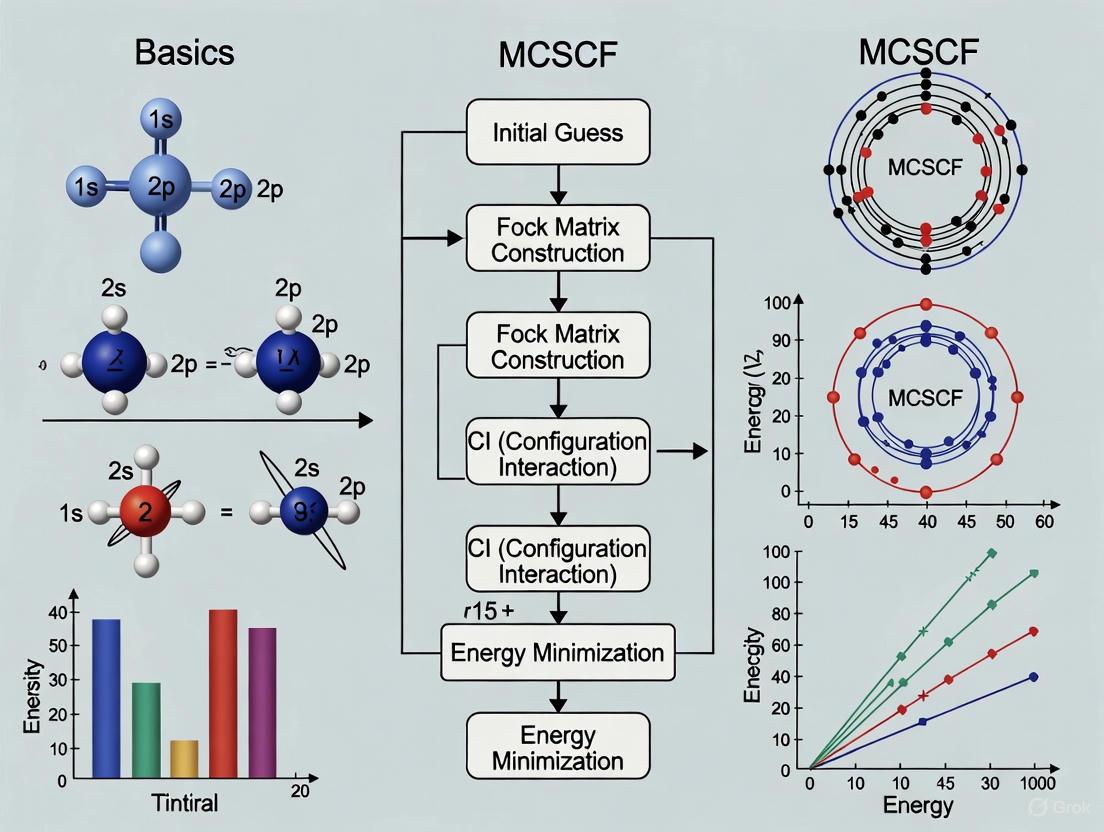
This article provides a comprehensive exploration of Multi-Configuration Self-Consistent Field (MCSCF) theory, a cornerstone method in quantum chemistry for treating strongly correlated molecular systems where single-reference approaches like Hartree-Fock fail.
Multi-Configuration Self-Consistent Field (MCSCF) Theory: A Comprehensive Guide for Computational Researchers
Abstract
This article provides a comprehensive exploration of Multi-Configuration Self-Consistent Field (MCSCF) theory, a cornerstone method in quantum chemistry for treating strongly correlated molecular systems where single-reference approaches like Hartree-Fock fail. Tailored for researchers, scientists, and drug development professionals, it covers foundational principles—from the limitations of single-determinant methods to the mathematical structure of MCSCF. The guide details core methodologies like CASSCF and RASSCF, along with practical strategies for active space selection and orbital optimization. It further addresses computational challenges, troubleshooting convergence, and explores advanced stochastic methods and hybrid approaches. Finally, it offers a comparative analysis of MCSCF against other electronic structure methods, validating its predictive power for applications in biomedical research, including the study of transition metal complexes and photochemical processes relevant to drug discovery.
Beyond Hartree-Fock: Unveiling the Foundations of MCSCF Theory for Strong Correlation
This technical guide examines the fundamental limitations of single-reference quantum chemical methods, using hydrogen molecule (H₂) dissociation as a paradigmatic case study. Through detailed quantitative analysis, we demonstrate how methods rooted in Hartree-Fock theory fail catastrophically at bond separation, necessitating multi-configurational approaches. We present comprehensive computational evidence showing how multi-configuration self-consistent field (MCSCF) methods, particularly complete active space SCF (CASSCF), provide physically correct descriptions of bond breaking processes. The theoretical framework is supported by historical context, quantitative benchmarks, and practical implementation guidelines for researchers investigating molecular systems with significant static correlation effects.
Quantum chemistry provides the fundamental theoretical framework for understanding molecular structure and bonding, yet the computational description of chemical bond dissociation remains challenging for many widely-used electronic structure methods. The hydrogen molecule represents the simplest system exhibiting this fundamental limitation, serving as an critical test case for methodological development.
Single-reference methods, which build upon a single dominant electronic configuration (typically the Hartree-Fock determinant), provide excellent descriptions of molecular systems near their equilibrium geometries. However, as demonstrated by early theoretical work on H₂, these methods fail qualitatively when chemical bonds are broken, yielding unphysical dissociation products and dramatically incorrect energetics [1]. This failure stems from the inherently multi-configurational character of molecular wavefunctions at stretched bond lengths, where multiple electronic configurations become near-degenerate in energy.
Multi-configuration self-consistent field (MCSCF) theory addresses this fundamental limitation by simultaneously optimizing both the molecular orbital coefficients and the configuration interaction expansion coefficients [1]. This approach forms the foundation for accurately modeling bond dissociation processes, excited states, and other electronically complex systems where single-reference methods prove inadequate. Within this framework, the complete active space SCF (CASSCF) method provides a systematic approach for constructing multi-configurational wavefunctions [2].
Theoretical Background
The Single-Reference Ansatz and Its Limitations
The Hartree-Fock (HF) method approximates the N-electron wavefunction as a single Slater determinant constructed from molecular orbitals that are optimized to minimize the total energy. For the hydrogen molecule at equilibrium geometry, this approach provides a reasonable description, predicting a bond length of 0.735 Å (compared to the experimental value of 0.746 Å) and a bond energy of 350 kJ/mol (compared to the experimental 432 kJ/mol) [1].
However, the HF wavefunction for H₂ contains unphysical ionic terms that persist even at large internuclear separation:
[ \Phi1 = N1^2\left[1sA(\mathbf{r}1)1sA(\mathbf{r}2) + 1sA(\mathbf{r}1)1sB(\mathbf{r}2) + 1sB(\mathbf{r}1)1sA(\mathbf{r}2) + 1sB(\mathbf{r}1)1sB(\mathbf{r}2)\right]\Theta_{2,0} ]
This expression contains terms where both electrons are located on the same atom (ionic terms: H⁺H⁻), which should disappear upon dissociation to neutral hydrogen atoms (H· + H·) [1]. The persistence of these terms leads to an unphysical description of the dissociated system with significantly higher energy than the correct dissociation products.
Multi-Configurational Framework
The MCSCF method addresses this limitation by employing a linear combination of configuration state functions (CSFs) or determinants:
[ |\Psi\rangle = \sum{I}^{N{\rm det}} c{I} | \PhiI \rangle ]
where both the CI coefficients (c_I) and the molecular orbital coefficients are variationally optimized [2]. For the H₂ dissociation problem, a minimal multi-configurational description includes both the bonding (φ₁)² and antibonding (φ₂)² configurations:
[ \Psi{\text{MC}} = C1\Phi1 + C2\Phi_2 ]
where Φ₁ = (φ₁)² and Φ₂ = (φ₂)², with φ₁ = N₁(1sA + 1sB) and φ₂ = N₂(1sA - 1sB) [1]. This approach allows for a correct description of dissociation: at equilibrium geometry, C₁ ≈ 1 and C₂ ≈ 0, while at large separations, C₁ and C₂ become comparable.
Table 1: Comparison of Theoretical Approaches for H₂ Dissociation
| Method | Theoretical Approach | Description of Dissociation | Computational Cost |
|---|---|---|---|
| Hartree-Fock | Single determinant | Incorrect (dissociation to H⁺ + H⁻) | Low |
| Configuration Interaction | Multiple determinants, fixed orbitals | Correct in principle, but slow convergence | Medium to High |
| Valence Bond | Non-orthogonal basis | Correct, but mathematically complex | Medium |
| MCSCF/CASSCF | Multiple determinants, optimized orbitals | Correct and systematic | High |
The H₂ Dissociation Case Study
Historical Context and Quantitative Benchmarks
The theoretical prediction of the hydrogen dissociation energy has been a century-long challenge for quantum chemistry, serving as a critical benchmark for methodological development. Early work by Heitler and London in 1927 demonstrated the stability of the hydrogen molecule using the Schrödinger equation, achieving approximately 60% of the observed dissociation energy (D₀) through hand calculations [3].
Subsequent advances by James and Coolidge in 1933 provided remarkably accurate results within 0.5% of current measurements, using only pencil and paper [3]. The advent of digital computers enabled more sophisticated treatments, with Kolos and Wolniewicz in the 1960s incorporating coupled electronic and nuclear motion along with relativistic effects [3]. Their theoretical value of 36117.4 cm⁻¹ initially disagreed with the experimental value of 36113.6 cm⁻¹, creating tension between theory and experiment that was only resolved when improved experiments confirmed the theoretical prediction [3].
Recent advances have incorporated quantum electrodynamics corrections, with Piszczatowski et al. (2009) achieving spectacular agreement: theoretical prediction of 36118.0695(10) cm⁻¹ versus experimental value of 36118.0696(4) cm⁻¹ [3]. This represents a difference of only 1 unit at the ninth decimal place, demonstrating the remarkable precision achievable with modern multi-reference approaches.
Table 2: Historical Development of H₂ Dissociation Energy Predictions
| Year | Researchers | Method | D₀ Value (cm⁻¹) | Accuracy Note |
|---|---|---|---|---|
| 1927 | Heitler-London | Approximate Schrödinger equation | ~60% of experimental | First application to chemical problem |
| 1933 | James-Coolidge | Extended Schrödinger solution | Within 0.5% of modern value | Pencil and paper calculations |
| 1964 | Kolos-Wolniewicz | Variational with relativity | 36117.4 | Initially disputed, later validated |
| 2009 | Liu et al. | Hybrid approach | 36118.06962 ± 0.00037 | New experimental benchmark |
| 2009 | Piszczatowski et al. | With QED corrections | 36118.0695(10) | Near-perfect agreement with experiment |
Computational Methodology for H₂ Dissociation
The accurate computation of H₂ dissociation requires careful treatment of both static and dynamic electron correlation. The CASSCF approach provides a systematic framework for this problem:
Active Space Selection: For H₂, the minimal active space includes the bonding (σ) and antibonding (σ*) molecular orbitals formed from the 1s atomic orbitals, with two active electrons. This defines a CAS(2,2) calculation [1].
Wavefunction Optimization: The MCSCF energy expression incorporates contributions from core, active, and virtual orbitals:
[ E = \sum{tu}^{\mathbf{A}} f^{\mathrm{c}}{tu} \, D{tu} + \frac{1}{2} \sum{tuvw}^{\mathbf{A}} (tu|vw)\, \overline{D}{tu,vw} + E{\mathrm{c}} + E_{\mathrm{nuc}} ]
where (f^{\mathrm{c}}{pq}) are closed-shell Fock matrix elements, (D{tu}) and (\overline{D}{tu,vw}) are the one- and two-body reduced density matrices, and (E{\mathrm{c}}) and (E_{\mathrm{nuc}}) are the closed-shell and nuclear repulsion energies, respectively [2].
Orbital Optimization: The molecular orbitals are optimized simultaneously with the CI coefficients through an iterative process that minimizes the total energy with respect to both sets of parameters [2].
Figure 1: Electronic Structure Evolution During H₂ Dissociation
Beyond H₂: Generalization to Complex Systems
Extended Applications
The principles demonstrated for H₂ dissociation extend to more complex chemical systems. Multi-reference methods are essential for:
Molecular Ground States with Quasi-Degeneracy: Systems where the ground state is nearly degenerate with low-lying excited states require multi-configurational treatments [1].
Transition Metal Complexes: Compounds like Cr₂ have ground electronic states that cannot be described by single-reference methods due to significant static correlation [4].
Surface Chemistry: The dissociation of H₂ on metal surfaces, such as Cu(111), involves complex potential energy surfaces that benefit from multi-reference treatments [5].
Photochemical Processes: Excited state dynamics in systems like thymine involve multiple electronic states and conical intersections that require multi-configurational methods for accurate description [6].
Practical Implementation Considerations
Active Space Selection: The choice of active electrons and orbitals represents a critical step in MCSCF calculations. The CASSCF approach provides a systematic framework, but the exponential scaling with active space size necessitates careful selection of the most relevant orbitals [1].
Restricted Active Space (RAS): For larger systems, the RASSCF method provides a compromise by restricting the number of electrons in certain orbital subspaces or limiting excitation levels [1].
Dynamic Correlation Treatment: MCSCF captures static correlation effects but must be combined with additional methods (e.g., MRCI, CASPT2) to account for dynamic correlation for quantitative accuracy [1].
Figure 2: MCSCF Two-Step Optimization Workflow
Research Reagent Solutions
Table 3: Essential Computational Tools for Multi-Reference Studies
| Tool/Code | Methodology | Application Scope | Key Features |
|---|---|---|---|
| Forte | MCSCF, CASSCF, RASSCF | General molecular systems | Two-step algorithm, analytic gradients [2] |
| NEWTON-X | Surface hopping dynamics | Photochemistry and excited states | Nonadiabatic coupling, multiple electronic structure methods [7] |
| Custom CC | EOM-CCSD, EOM-SCCSD | High-accuracy excited states | Conical intersection treatment, wavefunction dynamics [6] |
| DFT Codes | B3LYP, ab initio DFT | Surface adsorption studies | H₂ adsorption on clusters, dissociation pathways [8] |
The dissociation of the hydrogen molecule provides a compelling case study demonstrating the fundamental limitations of single-reference quantum chemical methods. While these methods perform adequately near equilibrium geometries, they fail catastrophically at describing bond dissociation processes, yielding unphysical products and incorrect energetics.
Multi-configurational self-consistent field methods, particularly CASSCF, address these limitations by incorporating multiple electronic configurations with optimized orbitals, providing both qualitatively correct and quantitatively accurate descriptions of bond breaking. The historical development of increasingly accurate predictions for the H₂ dissociation energy highlights the critical importance of these methods in computational chemistry.
For researchers investigating molecular systems with significant static correlation, including dissociating bonds, transition metal complexes, and excited state processes, multi-reference methods provide an essential theoretical framework that transcends the limitations of single-reference approaches. As computational power increases and methodological developments continue, these approaches will play an increasingly important role in predicting and understanding complex chemical phenomena across diverse applications from materials science to drug development.
The Multi-Configuration Self-Consistent Field (MCSCF) method represents a cornerstone of quantum chemistry for modeling molecular systems where static correlation effects are significant. This approach elegantly combines two powerful quantum mechanical principles: the configuration interaction (CI) method for capturing electron correlation through multi-determinant wavefunctions, and orbital optimization for refining the one-electron basis functions to self-consistently represent the correlated electronic state. Unlike single-determinant Hartree-Fock theory, which fails for systems with nearly degenerate orbitals such as transition metal complexes and molecules at dissociation limits, MCSCF provides a robust framework for accurate electronic structure calculations by simultaneously optimizing both the CI coefficients and the molecular orbitals [9] [10].
The fundamental theoretical framework of MCSCF expands upon the Hartree-Fock approach by expressing the total electronic wavefunction as a linear combination of Slater determinants, represented as:
[ \Psi{\text{MCSCF}} = \sum{I} CI \PhiI ]
where ( \PhiI ) are Slater determinants (configuration state functions) and ( CI ) are the configuration interaction coefficients. This multi-configurational ansatz is particularly crucial for modeling degenerate ground states, bond breaking processes, and excited electronic states where a single electronic configuration proves insufficient. The MCSCF method directly addresses the limitation of conventional Hartree-Fock theory by allowing electrons to correlate their motions through the combination of multiple electronic configurations while simultaneously optimizing the orbital shapes to best represent these correlated states [9].
Theoretical Foundation and Mathematical Formulation
The MCSCF Wavefunction and Energy Expression
The MCSCF method treats both the CI expansion coefficients ((CI)) and the molecular orbital coefficients ((X{\mu i})) as variational parameters. The molecular orbitals are typically expanded in a basis set ( \chi_\mu ) as:
[ \phii = \sum{\mu} X{\mu i} \chi\mu ]
The total energy expression within the MCSCF framework takes the form:
[ E = \frac{\langle \Psi{\text{MCSCF}} | H | \Psi{\text{MCSCF}} \rangle}{\langle \Psi{\text{MCSCF}} | \Psi{\text{MCSCF}} \rangle} = \sum{IJ} CI CJ \langle \PhiI | H | \Phi_J \rangle ]
which can be regarded as a function of both the CI coefficients (cI) and the MO expansion coefficients (X{\mu i}) [9]. The energy expression is of the form:
[ E(0) = \sum{pq} h{pq} \gamma{pq} + \frac{1}{2} \sum{pqrs} g{pqrs} \Gamma{pqrs} ]
where ( \gamma{pq} ) and ( \Gamma{pqrs} ) are one- and two-particle density matrices, respectively, and ( h{pq} ) and ( g{pqrs} ) are the one- and two-electron integrals [9]. This energy functional must be minimized with respect to both orbital rotation parameters and CI coefficients, creating a complex optimization problem that requires sophisticated algorithms.
Complete Active Space SCF Implementation
The most common MCSCF implementation is the Complete Active Space SCF (CASSCF) method, which divides the molecular orbitals into three sets: inactive orbitals (doubly occupied in all configurations), active orbitals (with variable occupation across configurations), and virtual orbitals (unoccupied in all configurations). The CAS wavefunction generates all possible electron configurations that can be formed from the set of active orbitals, making it equivalent to a Full CI procedure within a subset of the molecular orbitals [10].
Table 1: CASSCF Orbital Classification and Occupation
| Orbital Type | Electron Occupation | Role in Wavefunction | Variational Treatment |
|---|---|---|---|
| Inactive (Core) | Always doubly occupied | Provides reference energy | Not correlated |
| Active | Variable occupation (0-2 electrons) | Captures static correlation | Fully correlated (FCI) |
| Virtual | Always unoccupied | Provides flexibility | Not correlated |
The CASSCF method is defined by two crucial parameters: the number of active orbitals (ncas) and the number of active electrons (nelecas). For example, in a CASSCF calculation of the oxygen molecule (with two unpaired electrons), one might specify ncas = 6, nelecas = (5,3) to indicate 6 active orbitals with 5 alpha and 3 beta electrons in the active space [10].
Computational Methodology and Optimization Framework
The Orbital Optimization Problem
The MCSCF optimization process involves determining the optimal unitary transformation of the molecular orbitals and the optimal CI coefficients. The orbital rotation parameters are defined through a unitary matrix:
[ U = \exp(R), \quad R = -R^\dagger ]
where ( R ) is an anti-Hermitian matrix whose elements ( R_{ri} ) serve as independent variational parameters that map the old orthonormal MO set into a new orthonormal set through the transformation ( \tilde{X} = XU ) [9].
The energy minimization is typically approached by expanding the energy in a Taylor series about the current trial value:
[ E^{(2)}(x) = E(0) + g^\dagger x + \frac{1}{2} x^\dagger H x ]
where ( g ) represents the gradient vector and ( H ) is the Hessian matrix with components:
[ gi = \frac{\partial E}{\partial xi}, \quad H{ij} = \frac{\partial^2 E}{\partial xi \partial x_j} ]
The simple Newton-Raphson method attempts to find the minimum of this quadratic expression by solving the linear system ( Hx + g = 0 ) [9]. However, the energy does not depend quadratically on the parameters ( x ), requiring an iterative process with careful convergence control.
Optimization Strategies and Convergence
Three primary classes of orbital optimization methods have been identified for selected configuration interaction approaches, which also apply to MCSCF:
- Uncoupled methods that neglect coupling between CI coefficients and orbital parameters
- Fully coupled methods that explicitly account for all couplings
- Quasi-fully coupled methods that approximate the coupling terms for computational efficiency
Recent research has demonstrated that accounting for the coupling between CI coefficients and orbital parameters is crucial for fast convergence. The accelerated diagonal Newton and Broyden-Fletcher-Goldfarb-Shanno (BFGS) methods are recommended as quasi-fully coupled approaches that balance computational cost with convergence reliability [11].
Table 2: MCSCF Optimization Methods and Characteristics
| Optimization Method | Coupling Treatment | Convergence Rate | Computational Cost | Recommended Use Cases |
|---|---|---|---|---|
| Uncoupled | Neglected | Slow | Low | Initial explorations |
| Fully Coupled | Complete | Fast | High | Small systems |
| Quasi-Fully Coupled (BFGS) | Approximate | Moderate-Fast | Moderate | Production calculations |
| Accelerated Diagonal Newton | Approximate | Fast | Moderate | Challenging convergence |
The similarity between the MCSCF energy expression structure and that of the multi-configuration Dirac-Hartree-Fock (MCDHF) method suggests that relativistic extensions are theoretically feasible, though computationally formidable [9].
Active Space Selection Strategies
The selection of an appropriate active space represents one of the most critical and challenging aspects of MCSCF calculations. The active space must be chosen to capture the essential electron correlation effects while maintaining computational tractability. Several strategies exist for active space selection:
Default Selection: Choosing orbitals around the Fermi level matching the specified number of orbitals and electrons. This approach often proves suboptimal and may lead to poor convergence [10].
Manual Selection via MO Indices: Selecting specific molecular orbital indices based on chemical intuition and visual analysis of localized orbitals. This method provides maximum control but requires significant expertise [10].
Symmetry-Based Selection: Specifying the number of orbitals in each symmetry group, particularly useful for systems with high symmetry. This approach can be combined with natural orbital analysis from lower-level calculations [10].
Automated Selection (AVAS and DMETCAS): Using algorithms like AVAS (Automated Valence Active Space) and DMETCAS (Density Matrix Embedding Theory) to select active spaces based on targeted atomic orbitals. These methods provide systematic approaches for complex systems [10].
Visualization of chosen active orbitals before commencing expensive calculations is strongly recommended. This typically involves dumping MO coefficients to a molden file and visualizing with programs like JMol to ensure the active space contains chemically relevant orbitals [10].
Practical Implementation and Computational Workflow
The following diagram illustrates the complete MCSCF computational workflow, integrating both the CI and orbital optimization components:
Research Reagent Solutions: Computational Tools
Table 3: Essential Computational Tools for MCSCF Calculations
| Tool Category | Specific Examples | Function in MCSCF Research |
|---|---|---|
| Electronic Structure Packages | PySCF, DIRAC, Molpro | Provide implementation of MCSCF algorithms and workflows |
| Basis Sets | cc-pVDZ, cc-pVTZ, ANO-RCC | Define atomic orbital basis for molecular orbital expansion |
| CI Solvers | DMRG, FCIQMC, Selected CI | Solve electronic Schrödinger equation within active space |
| Visualization Tools | JMol, Molden | Analyze molecular orbitals and active space composition |
| Orbital Localization | Pipek-Mezey, Boys | Generate chemically intuitive orbitals for active space selection |
Relationship Between MCSCF Components
The diagram below illustrates the fundamental relationship between the configuration interaction and orbital optimization components in MCSCF theory:
Advanced Methodologies and Specialized Applications
Frozen Orbital Techniques
To reduce computational cost in MCSCF calculations, orbitals can be frozen during the orbital optimization process. This technique is particularly valuable for large molecular systems where full optimization becomes prohibitive. Frozen orbitals can be specified either as a count of the lowest orbitals to freeze or as a specific list of orbital indices (0-based). These may include occupied, virtual, or even active orbitals, providing flexibility in balancing computational cost against accuracy requirements [10].
Spin State Control
MCSCF methods naturally accommodate different spin states through careful specification of alpha and beta electrons in the active space. While the FCI solver in implementations like PySCF is typically spin-adapted, direct control of spin multiplicity is not always available. However, the Sz value (spin projection) can be controlled by adjusting the ratio of alpha to beta electrons in the active space, which indirectly controls the spin multiplicity in most cases [10]. For example, starting from an Sz=0 RHF calculation, a triplet state can be targeted by specifying an active space with unequal alpha and beta electrons, such as (5,3) for 5 alpha and 3 beta electrons [10].
Relativistic Extensions
The structural similarity between the MCSCF energy expression and the multi-configuration Dirac-Hartree-Fock (MCDHF) energy expression suggests that relativistic extensions are theoretically feasible. The only significant attempt to implement this for relativistic molecular structure to date is that of Jensen et al. using the quaternion representation in the DIRAC code [9]. This represents an active area of research, particularly for systems containing heavy elements where relativistic effects become substantial.
The MCSCF method stands as a powerful approach that combines configuration interaction with orbital optimization to address the critical challenge of static correlation in quantum chemistry. By simultaneously optimizing both the CI coefficients and molecular orbitals, MCSCF provides a robust framework for studying chemically complex systems such as transition metal complexes, diradicals, and molecules at dissociation limits. The complete active space (CAS) implementation, particularly through CASSCF, represents the most widely used flavor of MCSCF, offering a systematic approach to active space definition. Ongoing methodological developments continue to enhance the applicability of MCSCF to larger molecular systems through techniques such as selected CI solvers, orbital freezing, and automated active space selection, ensuring its continued relevance for cutting-edge research in computational chemistry and drug development.
Multi-configuration self-consistent field (MCSCF) theory represents a cornerstone of quantum chemistry, providing a sophisticated framework for accurately describing molecular electronic structure in chemically complex situations where single-reference methods like Hartree-Fock and density functional theory fail. This advanced computational approach is particularly indispensable for modeling bond dissociation processes, studying excited states, and analyzing systems with significant multi-configurational character [1]. The power of the MCSCF method stems from its simultaneous optimization of both the configuration interaction (CI) coefficients that define the wavefunction expansion and the molecular orbital coefficients that form the single-particle basis [1]. This dual optimization presents unique mathematical challenges that are addressed through the careful formulation and implementation of the method's energy expression and its derivatives—the gradient and Hessian.
Within the broader context of multi-configuration self-consistent field theory research, understanding these fundamental mathematical objects is prerequisite to both effectively implementing the method and creatively extending it to new chemical applications. For researchers and drug development professionals, this knowledge enables the rational application of MCSCF methods to challenging problems in molecular design and mechanistic studies where electron correlation effects play a decisive role. This technical guide provides a comprehensive examination of the key mathematical formalism underlying MCSCF theory, with particular emphasis on the energy expression and its first and second derivatives, which drive the optimization algorithms essential for obtaining accurate solutions.
Theoretical Foundation of MCSCF Theory
The MCSCF Wavefunction and Energy Functional
The MCSCF wavefunction is constructed as a linear combination of configuration state functions (CSFs) or Slater determinants, providing the theoretical flexibility to describe multiple electronic configurations simultaneously. This wavefunction can be formally expressed as:
[|\Psi \rangle = \sum{I}^{N{\rm det}} c{I} | \PhiI \rangle]
where (cI) represents the CI coefficient for each Slater determinant (\PhiI) in the expansion [2]. The molecular orbitals used to construct these determinants are typically classified into three distinct subsets: core orbitals ((\mathbf{C})), which remain doubly occupied in all configurations; active orbitals ((\mathbf{A})), which possess variable occupation numbers across different configurations; and virtual orbitals ((\mathbf{V})), which remain unoccupied in all configurations [2]. This orbital partitioning scheme creates a versatile framework for balancing computational cost with electronic structure accuracy.
The MCSCF method distinguishes itself from other quantum chemical approaches through its treatment of both the CI coefficients ((cI)) and the molecular orbital coefficients ((C{\mu p})) as independent optimization parameters [1]. The molecular orbitals are expressed as linear combinations of atomic basis functions, (| \phip \rangle = \sum{\mu}^{\rm AO} C{\mu p} | \chi{\mu} \rangle), with the optimization performed subject to orthonormality constraints enforced through a unitary transformation, ({\bf U} = \exp({\bf R})), where ({\bf R}^\dagger = -{\bf R}) is an anti-Hermitian matrix [2]. This dual optimization paradigm allows the MCSCF method to simultaneously capture both static correlation through the configuration interaction and dynamic correlation through orbital relaxation effects.
Chemical Applications and Limitations
The MCSCF approach demonstrates particular utility in chemical situations where the single-configuration approximation of Hartree-Fock theory proves inadequate. A classic example occurs in the dissociation of the hydrogen molecule (H₂), where the Hartree-Fock method fails to properly describe the separation into two hydrogen atoms, persistently maintaining ionic terms that lead to unphysical dissociation products [1]. The MCSCF wavefunction corrects this deficiency by incorporating both the bonding configuration ((\varphi1))² and the anti-bonding configuration ((\varphi2))², with the coefficients (C1) and (C2) adjusting appropriately across the potential energy surface—(C1 \approx 1) and (C2 \approx 0) near equilibrium geometry, with both coefficients becoming comparable in magnitude at large internuclear separations [1].
Beyond bond dissociation problems, MCSCF methods find extensive application in studying molecular systems with nearly degenerate electronic states, open-shell radicals, diradicals, and excited state potential energy surfaces. The complete active space SCF (CASSCF) variant, in particular, has become a gold standard for investigating photochemical reactions and spectroscopic properties of transition metal complexes [1]. However, these methods face significant computational challenges, as the number of configuration state functions grows combinatorially with the size of the active space. This limitation has prompted the development of restricted active space (RAS) and generalized active space (GAS) approaches that employ more selective configuration selection schemes to manage computational expense while maintaining accuracy for the electronic phenomena of interest [1].
The MCSCF Energy Expression
Mathematical Formulation
The MCSCF energy expression provides the fundamental variational principle for optimizing both the orbital and configuration parameters. This energy functional can be compactly represented as:
[E = \sum{tu}^{\bf A} f^{\rm c}{tu} \, D{tu} + \frac{1}{2} \sum{tuvw}^{\bf A} (tu|vw)\, \overline{D}{tu,vw} + E{\rm c} + E_{\rm nuc}]
In this formulation, several specialized components contribute to the total energy [2]:
- (f^{\rm c}{tu} = h{tu} + \sum{i}^{\bf C} [2 (tu|ii) - (ti|iu)]) represents the closed-shell Fock matrix elements, which incorporate the one-electron integrals ((h{tu})) and two-electron integrals ((pq|rs)) in chemists' notation.
- (D{tu} = \sum{IJ} cI cJ \langle \PhiI | \hat{E}{tu} | \PhiJ \rangle) defines the one-body reduced density matrix (1-RDM), where (\hat{E}{tu} = \sum{\sigma}^{\uparrow \downarrow} a^\dagger{t\sigma} a{u_\sigma}) is the unitary group generator.
- (\overline{D}{tu,vw} = \frac{1}{2} (D{tu,vw} + D_{ut,vw})) represents the symmetrized two-body reduced density matrix (2-RDM), possessing the same 8-fold symmetry as the two-electron integrals.
- (E{\rm c} = \sum{j}^{\bf C} (h{jj} + f^{\rm c}{jj})) constitutes the closed-shell energy contribution from the core orbitals.
- (E_{\rm nuc}) signifies the nuclear repulsion energy.
Table 1: Components of the MCSCF Energy Expression
| Component | Mathematical Expression | Physical Significance | ||
|---|---|---|---|---|
| Core Fock Matrix | (f^{\rm c}{tu} = h{tu} + \sum_{i}^{\bf C} [2 (tu | ii) - (ti | iu)]) | Effective one-electron energy including core electron screening |
| 1-RDM | (D{tu} = \sum{IJ} cI cJ \langle \Phi_I | \hat{E}_{tu} | \Phi_J \rangle) | Electron density distribution in active space |
| Symmetrized 2-RDM | (\overline{D}{tu,vw} = \frac{1}{2} (D{tu,vw} + D_{ut,vw})) | Two-electron correlation effects with proper symmetry | ||
| Closed-Shell Energy | (E{\rm c} = \sum{j}^{\bf C} (h{jj} + f^{\rm c}{jj})) | Constant energy from doubly occupied core orbitals | ||
| Nuclear Repulsion | (E_{\rm nuc}) | Classical electrostatic repulsion between nuclei |
Orbital Classification and Notation
The MCSCF formalism employs a systematic orbital indexing convention that reflects the different roles orbitals play in the wavefunction expansion:
- Core orbitals ((\mathbf{C})): Represented by indices (i, j), these orbitals remain doubly occupied in all configuration state functions, providing a computationally efficient representation of chemically inert electron pairs.
- Active orbitals ((\mathbf{A})): Denoted by indices (t, u, v, w), these orbitals possess variable occupation numbers across different configurations, enabling the description of electron correlation effects and bond-breaking processes.
- Virtual orbitals ((\mathbf{V})): Labeled by indices (a, b), these orbitals remain unoccupied in all configurations but provide crucial flexibility for orbital optimization.
- General orbitals: Represented by indices (p, q, r, s), these encompass all orbital types when generic operations are described [2].
This classification scheme creates a hierarchical structure that maximizes computational efficiency while maintaining essential physical accuracy. The active space, in particular, can be selected through various protocols, with the complete active space (CAS) approach including all possible electron distributions within a designated set of active orbitals and electrons, while restricted active space (RAS) methods impose additional constraints to manage computational cost for larger molecular systems [1].
The MCSCF Gradient
Orbital and CI Gradients
The MCSCF gradient consists of two distinct components: the orbital gradient and the CI gradient. The orbital gradient quantifies the sensitivity of the energy to infinitesimal unitary transformations of the molecular orbitals, while the CI gradient captures the energy response to variations in the configuration interaction coefficients. Formally, the orbital gradient elements can be expressed as:
[\frac{\partial E}{\partial \kappa{pq}} = \langle \Psi | [\hat{H}, \hat{E}{pq}] | \Psi \rangle = 2(F{pq} - F{qp})]
where (\kappa{pq}) represents the orbital rotation parameters, (\hat{E}{pq}) is the unitary group generator, and (F{pq}) denotes the generalized Fock matrix with elements (F{pq} = h{pq} + \sum{rs} [(pq|rs) - \frac{1}{2} (ps|rq)] D_{rs}) [2]. The CI gradient takes the form:
[\frac{\partial E}{\partial cI} = 2\langle \PhiI | \hat{H} | \Psi \rangle - 2Ec_I]
which represents the residual vector in the configuration interaction eigenvalue problem. At convergence, both gradient components must vanish within numerical tolerance, indicating that a stationary point has been located on the multidimensional energy surface.
Analytic Gradient Implementation
The implementation of analytic MCSCF gradients provides significant computational advantages over finite-difference approaches, particularly for molecular systems with many degrees of freedom. The total gradient implementation incorporates multiple physically distinct contributions:
- Nuclear Repulsion Gradient: Calculated directly from the derivative of the classical point-charge expression.
- Core Hamiltonian Gradient: Derives from the derivative one-electron integrals.
- Lagrangian Contribution: Incorporates the response of the wavefunction to nuclear displacement through the orbital rotation Lagrangian.
- Two-Electron Contribution: Originates from the derivative two-electron integrals [2].
Table 2: Components of the MCSCF Analytic Gradient
| Gradient Component | Physical Origin | Implementation Notes |
|---|---|---|
| Nuclear Repulsion | Classical nuclear electrostatic forces | Direct analytic computation |
| Core Hamiltonian | Derivative of one-electron integrals | Includes kinetic energy and nuclear attraction derivatives |
| Lagrangian | Wavefunction response to nuclear displacement | Ensures orbital orthonormality constraints are maintained |
| Two-Electron | Derivative of electron repulsion integrals | Most computationally intensive component |
The Forte implementation follows an atomic-orbital-driven algorithm that efficiently handles these gradient components, though certain limitations exist for specific integral types. For instance, while density-fitted (DF) and Cholesky-decomposed integrals are fully supported for energy computations, small discrepancies have been observed between analytic and finite-difference gradients due to issues with DF derivative integrals in the underlying Psi4 framework [2]. Additionally, analytic gradient calculations remain unavailable for custom integrals read from FCIDUMP files, representing a current limitation in implementation versatility.
The MCSCF Hessian
Mathematical Structure
The MCSCF Hessian provides the second derivative information essential for characterizing the nature of stationary points and implementing efficient second-order optimization algorithms. The full Hessian matrix can be partitioned into orbital-orbital, orbital-CI, and CI-CI blocks, reflecting the coupled nature of the optimization problem:
[\mathbf{H} = \begin{pmatrix} \frac{\partial^2 E}{\partial \kappa{pq} \partial \kappa{rs}} & \frac{\partial^2 E}{\partial \kappa{pq} \partial cI} \ \frac{\partial^2 E}{\partial cI \partial \kappa{pq}} & \frac{\partial^2 E}{\partial cI \partial cJ} \end{pmatrix}]
The orbital-orbital block, known as the orbital Hessian, has elements:
[\frac{\partial^2 E}{\partial \kappa{pq} \partial \kappa{rs}} = \langle \Psi | [[\hat{H}, \hat{E}{pq}], \hat{E}{rs}] | \Psi \rangle + \text{additional terms}]
which involve computationally challenging double commutators. The CI-CI block corresponds to the Hamiltonian matrix in the basis of configuration state functions, shifted by the energy:
[\frac{\partial^2 E}{\partial cI \partial cJ} = 2\langle \PhiI | \hat{H} | \PhiJ \rangle - 2E\delta_{IJ}]
The orbital-CI cross terms complete the Hessian matrix by coupling the orbital and configuration optimization parameters. Efficient computation of the Hessian typically exploits its sparse block structure and employs diagonal approximations, such as the orbital diagonal Hessian, which has been refined in implementations based on theoretical work reported in Theor. Chem. Acc. (1997) and J. Chem. Phys. (2020) [2].
Applications in Optimization
The Hessian matrix plays multiple critical roles in MCSCF computations beyond enabling second-order convergence optimization algorithms. Eigenvalue analysis of the Hessian provides definitive characterization of stationary points, distinguishing minima (all eigenvalues positive), transition states (one negative eigenvalue), and higher-order saddle points. Additionally, the Hessian offers valuable insight into the coupling between different degrees of freedom in the wavefunction optimization, guiding the development of more efficient computational strategies.
In practical implementations, the full Hessian is often too computationally expensive to construct explicitly, particularly for large active spaces or extensive basis sets. Consequently, quasi-Newton methods such as L-BFGS, which build approximate inverse Hessians from gradient information across iterations, have proven highly effective for MCSCF optimizations [2]. These approaches typically achieve superlinear convergence while avoiding the substantial computational cost associated with exact Hessian construction and inversion.
Computational Implementation and Protocols
The Two-Step MCSCF Algorithm
Modern implementations of MCSCF theory, such as that found in the Forte package, employ sophisticated two-step algorithms that iteratively optimize the CI coefficients and molecular orbitals in alternating sequences. This approach, illustrated in the following computational workflow, efficiently handles the coupled nature of the optimization problem:
Diagram 1: MCSCF Two-Step Algorithm
Each macro iteration consists of a full CI optimization followed by an orbital optimization cycle. The CI optimization solves the configuration interaction problem for fixed molecular orbitals, generating improved wavefunction coefficients and corresponding reduced density matrices. The subsequent orbital optimization employs these density matrices to compute the orbital gradient and possibly Hessian information, updating the molecular orbitals to lower the energy while maintaining orthonormality through unitary transformations [2]. This process repeats until both the energy and orbital gradient converge within user-specified thresholds, typically requiring 5-10 macro iterations for well-behaved systems.
Convergence Monitoring and Troubleshooting
Successful MCSCF computations require careful monitoring of convergence metrics to identify and address potential optimization difficulties. The Forte implementation provides comprehensive iteration summaries that track both the CI energy and orbital energy across macro iterations, along with the orbital gradient norm and the number of micro iterations required for each orbital optimization cycle [2]. A properly converging calculation typically exhibits exponential decay in both the energy change and gradient norm, with the orbital gradient decreasing by approximately an order of magnitude each iteration in the final stages of convergence.
Table 3: MCSCF Convergence Diagnostics
| Convergence Metric | Well-Behaved Progression | Problematic Pattern |
|---|---|---|
| Energy Change | Exponential decay | Oscillations or stagnation |
| Orbital Gradient | Steady decrease | Plateaus or increases |
| Micro Iterations | Decreasing in final cycles | Consistently high count |
| CI-Orbital Coupling | Diminishing energy differences | Persistent large discrepancies |
Common convergence problems include oscillatory behavior between different electronic configurations, slow convergence due to nearly degenerate orbitals, and convergence to saddle points rather than true minima. Remedial strategies include improving the initial orbital guess, adjusting the active space composition, employing level shifting techniques, and utilizing more robust optimization algorithms with enhanced Hessian treatment. The L-BFGS implementation in Forte has demonstrated particular effectiveness for challenging optimization problems, as it constructs improved approximations to the inverse Hessian from gradient information across multiple iterations [2].
Research Reagent Solutions: Computational Tools
Table 4: Essential Computational Components for MCSCF Calculations
| Component | Function | Implementation Example |
|---|---|---|
| Integral Evaluation | Compute one- and two-electron integrals | Psi4 integral infrastructure, Density fitting |
| CI Solver | Diagonalize Hamiltonian in CSF basis | Full CI, Selected CI, DMRG |
| Orbital Optimizer | Minimize energy with respect to MO coefficients | Newton-Raphson, L-BFGS |
| Density Matrix | Compute 1- and 2-particle reduced density matrices | RDMs from CI wavefunction |
| Molecular Orbitals | Initial guess and representation | Canonical HF, Natural orbitals |
| Basis Sets | Atomic orbital basis functions | cc-pVDZ, cc-pVTZ, correlation-consistent sets |
The computational tools required for successful MCSCF investigations encompass both theoretical components and practical software implementations. The Forte package, integrated with the Psi4 quantum chemistry suite, provides a comprehensive implementation of the MCSCF method supporting complete active space (CAS), restricted active space (RAS), and generalized active space (GAS) approaches [2]. This implementation leverages efficient integral evaluation through Psi4's infrastructure, supporting conventional, density-fitted, and Cholesky decomposition approaches for handling the challenging two-electron integrals. The code supports energy computations for all available integral types in Forte, though gradient computations show limitations with certain specialized integral representations [2].
Input configuration for MCSCF calculations requires careful specification of the orbital active space, convergence parameters, and methodological details. A typical input structure includes definition of the molecular system, specification of the SCF reference wavefunction, and configuration of the MCSCF-specific parameters through the Forte module, including frozen core restrictions, active space definition, and convergence thresholds for both the CI and orbital optimization steps [2]. Proper selection of these parameters, particularly the active space composition, represents one of the most critical factors in obtaining physically meaningful results from MCSCF computations.
The mathematical formalism underlying MCSCF theory—centered on the energy expression, gradient, and Hessian—provides the essential foundation for one of quantum chemistry's most powerful tools for modeling complex electronic structure phenomena. The variational optimization of both molecular orbitals and configuration interaction coefficients creates a flexible framework capable of accurately describing chemical systems where single-reference methods fail completely. The continued refinement of computational implementations, particularly through improved optimization algorithms and more efficient integral handling, has progressively expanded the range of molecular systems accessible to high-level MCSCF treatment.
For researchers and drug development professionals, understanding these fundamental mathematical objects enables both the judicious application of existing MCSCF methods and the informed interpretation of computational results. As methodological advances continue to reduce computational costs and improve algorithmic reliability, MCSCF approaches are poised to play an increasingly important role in the first-principles design of molecular materials and the mechanistic analysis of complex chemical transformations. The ongoing development of MCSCF theory and its implementations represents a vibrant research area at the intersection of theoretical chemistry, applied mathematics, and computational science.
In quantum chemistry, the Hartree-Fock (HF) method provides a foundational model for understanding molecular electronic structure by approximating the many-electron wavefunction with a single Slater determinant. This single-configuration approach assumes electrons move independently in an average field generated by all others [9]. However, this mean-field approximation systematically neglects electron correlation, the instantaneous adjustments electrons make to avoid each other due to Coulomb repulsion [12]. While adequate for many closed-shell systems near equilibrium geometry, the HF method fails dramatically in chemically important situations where multiple electronic configurations become nearly degenerate, necessitating a more sophisticated approach: Multi-Configuration Self-Consistent Field (MCSCF) theory.
The MCSCF method addresses this fundamental limitation by constructing the electronic wavefunction as a linear combination of multiple configuration state functions (CSFs) or Slater determinants, while simultaneously optimizing both the molecular orbitals and the configuration interaction (CI) coefficients to minimize the total energy [1] [13]. This variational optimization allows MCSCF to effectively capture static correlation (also called non-dynamical electron correlation), which arises when near-degeneracies among configurations make a single-reference description qualitatively incorrect [12] [14]. This technical guide examines the specific chemical scenarios where MCSCF becomes indispensable, providing researchers with clear protocols for identifying these critical situations in molecular systems relevant to drug development and materials science.
Theoretical Foundations: Correlation Effects and MCSCF Methodology
Classifying Electron Correlation
Electron correlation effects are qualitatively divided into two distinct classes, each with different physical origins and computational requirements [14]:
Static (Non-dynamical) Correlation: This long-wavelength, low-energy correlation arises when multiple electron configurations are nearly degenerate in energy and contribute significantly to the ground state wavefunction. It is prevalent in systems with small HOMO-LUMO gaps, such as those undergoing bond breaking, in diradicals, or in transition metal complexes with near-degenerate d-orbitals [13] [14]. Static correlation is the primary challenge for single-reference methods, as the HF description becomes qualitatively incorrect in these scenarios.
Dynamical Correlation: This short-wavelength, high-energy correlation accounts for the fine-scale, instantaneous adjustments electrons make to avoid one another due to Coulomb repulsion. While essential for quantitative accuracy (typically contributing 1-2% of the total energy), dynamical correlation can be adequately treated using post-Hartree-Fock methods on top of a qualitatively correct reference state [13] [14].
Table 1: Comparison of Electron Correlation Types
| Feature | Static Correlation | Dynamical Correlation |
|---|---|---|
| Origin | Near-degeneracy of multiple configurations | Instantaneous Coulomb repulsion between electrons |
| Energy Contribution | Large, qualitative (can be eV scale) | Smaller, quantitative (1-2% of total energy) |
| Primary Methods | MCSCF, CASSCF | CI, MP2, CC, CASPT2 |
| Chemical Manifestations | Bond breaking, diradicals, transition metals | London dispersion, binding energy corrections |
The MCSCF Wavefunction and Optimization
The MCSCF wavefunction addresses the limitations of single-determinant approaches through a sophisticated mathematical framework:
where ΦI represents the I-th Slater determinant or configuration state function, and CI are the variational CI coefficients that weight each configuration's contribution [13]. The molecular orbitals used to construct these determinants are partitioned into three sets: (1) core orbitals that remain doubly occupied in all configurations, (2) active orbitals that allow variable occupations to generate different configurations, and (3) virtual orbitals that remain unoccupied [13]. This partitioning enables focused treatment of essential electron correlations within the active space.
The MCSCF energy minimization is performed simultaneously with respect to both the CI coefficients (C_I) and the molecular orbital coefficients through unitary transformations parameterized by an anti-Hermitian matrix (κ) [13]. The self-consistent field condition requires solving the coupled CI eigenvalue problem (HC = ESC) alongside orbital gradient equations derived from the generalized Brillouin theorem, which enforces that matrix elements between the MCSCF wavefunction and singly excited configurations vanish [13]. This iterative optimization continues until both the orbitals and CI coefficients achieve self-consistency.
When is MCSCF Essential? Key Chemical Scenarios
Bond Dissociation Processes
The dissociation of chemical bonds represents a classic scenario where MCSCF becomes indispensable. The Hartree-Fock method fails dramatically in describing bond breaking because it cannot properly describe the correct dissociation limits [1] [13].
For the H₂ molecule, the restricted HF method places both electrons in the bonding σg orbital even at large internuclear distances, yielding an incorrect dissociation limit with approximately 6 eV higher energy than the proper dissociation into two neutral hydrogen atoms [13]. This error occurs because HF cannot access the degenerate σg and σ_u configurations needed for proper left-right electron delocalization. The MCSCF solution incorporates both the bonding (φ₁) and anti-bonding (φ₂) orbitals in a two-configuration wavefunction [1]:
where Φ₁ corresponds to the (φ₁)² configuration and Φ₂ to (φ₂)². Near equilibrium geometry, C₁ ≈ 1 and C₂ ≈ 0, recovering the HF description. At large separations, C₁ and C₂ become comparable, properly describing the dissociation into two neutral hydrogen atoms [1]. This multi-configurational description restores the correct physical behavior throughout the entire potential energy surface.
Table 2: Performance of Different Methods for H₂ Dissociation
| Method | Bond Length (Å) | Dissociation Energy (kJ/mol) | Dissociation Limit |
|---|---|---|---|
| Experimental | 0.746 | 432 | H• + H• |
| Hartree-Fock | 0.735 | 350 | H⁺ + H⁻ (incorrect) |
| MCSCF | ~0.746 | ~432 | H• + H• (correct) |
Systems with Near-Degenerate Electronic States
Molecular systems with nearly degenerate frontier orbitals require MCSCF for proper description, as they exhibit significant multi-reference character that makes single-reference methods qualitatively inadequate. These include:
Diradicals: Molecules with two unpaired electrons in nearly degenerate molecular orbitals, such as oxygen molecules, trimethylenemethane, and various carbenes [13].
Transition metal complexes: Systems with near-degenerate d-orbitals, particularly in first-row transition metals where crystal field splitting creates closely spaced energy levels [13].
Fused N-heterocyclic compounds: Chromophores like cyclazines and heptazines that exhibit nearly degenerate singlet and triplet states, making them potential candidates for organic light-emitting diodes (OLEDs) [15].
In these systems, the HOMO-LUMO gap becomes small enough that multiple electronic configurations contribute significantly to the ground state wavefunction. The HF method, limited to a single determinant, cannot properly describe this near-degeneracy effect, leading to inaccurate predictions of molecular properties, reaction barriers, and spectroscopic behavior [13] [15].
Excited States and Conical Intersections
MCSCF is particularly valuable for studying photochemical processes involving excited states and conical intersections. The complete active space SCF (CASSCF) variant, which performs a full configuration interaction within a selected active space of orbitals and electrons, provides a systematic treatment of static correlation for both ground and excited states [1] [13]. This capability is crucial for investigating:
- Photochemical reaction pathways involving multiple electronic states
- Conical intersections where potential energy surfaces cross
- Singlet-triplet gaps in molecules with potential for thermally activated delayed fluorescence (TADF) [15]
For N-heterocyclic chromophores like heptazine derivatives, the near-degeneracy of S₁ and T₁ states creates challenges for single-reference methods. MCSCF-based approaches properly balance static and dynamic correlation effects to accurately predict singlet-triplet energy gaps that control reverse intersystem crossing rates in potential OLED materials [15].
MCSCF Methodologies and Protocols
Active Space Selection Strategies
The performance of MCSCF calculations critically depends on appropriate selection of the active space, which consists of active orbitals and active electrons. Several systematic approaches have been developed:
Complete Active Space SCF (CASSCF): Includes all electronic configurations that can be formed by distributing a specified number of electrons in a specified number of orbitals [1]. For example, CASSCF(11,8) for nitric oxide (NO) distributes 11 valence electrons among 8 molecular orbitals [1]. While chemically intuitive, CASSCF suffers from exponential growth in computational cost with active space size.
Restricted Active Space SCF (RASSCF): Applies restrictions on excitations to manage computational cost for larger active spaces [1]. Common partitions include:
- RAS1: Allows at most double excitations
- RAS2: Complete active space within specified orbitals
- RAS3: Allows at most a fixed number of electrons (usually 2)
Full Valence Active Space: Comprises the union of valence levels occupied in the single determinant reference and those that are empty. The number of occupied valence orbitals is defined by the sum of valence electron counts for each atom [14].
1:1 (Perfect Pairing) Active Space: Contains the same number of empty correlating orbitals as occupied valence orbitals, creating a one-to-one correspondence between occupied and virtual orbitals [14].
Diagram 1: Active Space Selection Workflow. This flowchart outlines the decision process for selecting appropriate active spaces in MCSCF calculations, balancing chemical intuition with computational feasibility.
Computational Implementation and Workflow
A typical MCSCF calculation follows an iterative self-consistent field procedure:
Initial Orbitals: Generate starting molecular orbitals, typically from a Hartree-Fock calculation [13].
CI Expansion: Construct the Hamiltonian matrix in the basis of selected configurations and solve the CI eigenvalue problem (HC = ESC) to obtain optimized CI coefficients [13].
Orbital Optimization: Update molecular orbitals through unitary transformations parameterized by an anti-Hermitian matrix to minimize the energy with respect to orbital rotations [13].
Convergence Check: Evaluate the gradient and Hessian with respect to both CI and orbital parameters. If not converged, return to step 2 [9].
The energy minimization can be viewed as a second-order optimization problem, where the energy is expanded in a Taylor series [9]:
where g represents the gradient vector and H the Hessian matrix. The Newton-Raphson method finds the minimum by solving the linear system Hx + g = 0 [9]. Convergence challenges often require specialized techniques such as level shifting, trust region methods, or approximate Hessians [9].
Diagram 2: MCSCF Self-Consistent Field Iteration Cycle. The computational workflow illustrates the iterative process of alternating between CI coefficient optimization and orbital updates until self-consistency is achieved.
The Scientist's Toolkit: Essential Research Reagents
Table 3: Computational Tools for MCSCF Calculations
| Tool Category | Representative Examples | Function and Application |
|---|---|---|
| Basis Sets | STO-3G, 6-31G, cc-pVDZ, cc-pVTZ | Spatial functions for expanding molecular orbitals; quality crucial for correlation treatment [9] |
| Active Space Definitions | CAS(e,m), RAS subspaces | Specify electrons and orbitals for multi-configurational treatment; balance accuracy and cost [1] |
| Orbital Localization | Pipek-Mezey, Boys localization | Generate chemically intuitive orbitals for active space selection |
| Convergence Accelerators | DIIS, trust region methods | Improve SCF convergence for challenging systems [9] |
| Analytical Gradients | MCSCF gradient expressions | Enable geometry optimization and transition state location |
| Dynamic Correlation Corrections | CASPT2, MRCI, SC-NEVPT2 | Add dynamical correlation on top of MCSCF reference [15] |
Practical Applications and Case Studies
Cyclazine Chromophores for OLED Materials
N-heterocyclic chromophores like cyclazines and heptazines present challenging cases with nearly degenerate singlet (S₁) and triplet (T₁) states, making them potential candidates for third-generation OLED materials [15]. Experimental studies indicate these systems have S₁-T₁ energy gaps that are nearly degenerate or slightly inverted [15].
Standard single-reference methods like time-dependent density functional theory (TD-DFT) typically fail to predict these near-degeneracies, while MCSCF-based approaches like CASSCF properly capture the static correlation essential for describing the multi-reference character of these excited states [15]. Supplementing CASSCF with dynamic correlation methods such as strongly-contracted N-electron valence perturbation theory (SC-NEVPT2) or CASPT2 further refines the energy predictions [15].
Protocol for cyclazine excited state analysis:
- Perform geometry optimization at appropriate level of theory
- Select active space encompassing π-system of the heterocyclic framework
- Conduct state-specific CASSCF calculations for S₀, S₁, and T₁ states
- Apply dynamic correlation correction (e.g., SC-NEVPT2)
- Validate results against experimental spectra where available
Transition Metal Complex Characterization
Transition metal complexes pose significant challenges for quantum chemical methods due to the near-degeneracy of d-orbitals and the importance of both static and dynamic correlation. MCSCF provides an essential tool for investigating:
- Spin state energetics and crossover phenomena
- Oxidation states and redox potentials
- Reaction mechanisms involving metal-centered intermediates
Protocol for transition metal complex analysis:
- Identify metal d-orbitals and ligand frontier orbitals for active space
- Include all metal d-electrons in active space
- Consider state-averaged MCSCF for multiple electronic states
- Apply dynamic correlation correction for quantitative accuracy
- Compute spectroscopic properties for experimental validation
Limitations and Complementary Methods
While MCSCF excels at treating static correlation, it has limitations. The computational cost grows exponentially with active space size, making calculations with more than approximately 18 electrons in 18 orbitals computationally challenging [1] [13]. Additionally, standard MCSCF captures only partial dynamical correlation.
To address these limitations, MCSCF is often combined with other methods:
Multireference Perturbation Theory: Methods like CASPT2 and NEVPT2 add dynamical correlation through second-order perturbation theory on the CASSCF reference [15].
Multireference Configuration Interaction (MRCI): Includes additional electron excitations beyond the active space [12].
Density Matrix Renormalization Group (DMRG): Enables treatment of larger active spaces for strongly correlated systems [13].
For systems with predominantly dynamic correlation, single-reference methods like coupled-cluster (CCSD(T)) often provide better accuracy with lower computational cost. Therefore, careful assessment of the system's electronic structure is essential for method selection.
Multi-Configuration Self-Consistent Field theory provides an essential computational framework for treating quantum chemical systems where single-configuration methods fail. Its unique capability to describe static correlation makes it indispensable for bond dissociation processes, systems with near-degenerate electronic states, diradicals, transition metal complexes, and excited state phenomena. While the computational demands of MCSCF are significant, particularly for large active spaces, its role in generating qualitatively correct reference states ensures its continued importance in quantum chemistry. For researchers in drug development and materials science, recognizing the scenarios where MCSCF becomes essential - particularly when dealing with bond breaking, near-degeneracy effects, or complex electronic transitions - enables more accurate predictions of molecular properties and reactivities that single-reference methods would miss. As computational power increases and methodological advances continue, MCSCF and its extensions remain cornerstone methods for tackling the most challenging problems in theoretical chemistry.
Implementing MCSCF: From Active Space Selection to Practical Applications in Biomedicine
Multi-configurational self-consistent field (MCSCF) theory represents a cornerstone of quantum chemistry for modeling molecular systems where single-reference wavefunction methods fail. The Complete Active Space Self-Consistent Field (CASSCF) method is a specific, powerful realization of MCSCF that performs a Full Configuration Interaction (FCI) calculation within a strategically selected subspace of molecular orbitals. This approach makes it the gold standard for treating static correlation effects in molecules with quasi-degenerate electronic states, bond-breaking situations, and open-shell systems where Hartree-Fock and density functional theory prove inadequate [1]. The fundamental strength of CASSCF lies in its ability to simultaneously optimize both the expansion coefficients of the configuration state functions and the molecular orbital coefficients, providing a qualitatively correct reference wavefunction that can serve as the foundation for more accurate multireference perturbation theory or configuration interaction treatments [16].
CASSCF occupies a crucial methodological position between single-determinant Hartree-Fock theory and sophisticated correlation methods. Unlike Hartree-Fock, which represents the wavefunction by a single Slater determinant, CASSCF employs a linear combination of configuration state functions (CSFs) or determinants to approximate the exact electronic wavefunction [1]. This multi-configurational approach enables CASSCF to describe bond dissociation correctly, model excited states, and handle degenerate electronic situations where a single determinant provides a poor zeroth-order description. The method has become particularly valuable in computational drug discovery for studying transition states in enzymatic reactions, modeling photochemical processes relevant to photodynamic therapy, and investigating metalloenzyme mechanisms where transition metal centers exhibit strong electron correlation effects [17] [18].
Theoretical Foundation of CASSCF
Mathematical Formalism
The CASSCF wavefunction is expressed as a linear combination of configuration state functions (CSFs) adapted to a specific total spin symmetry:
[\left| \PsiI^S \right\rangle = \sum{k} C{kI} \left| \Phik^S \right\rangle]
Here, (\left| \PsiI^S \right\rangle) represents the CASSCF N-electron wavefunction for electronic state *I* with total spin *S*, (\left| \Phik^S \right\rangle) are the configuration state functions, and (C{kI}) are the configuration expansion coefficients [16]. Each CSF is constructed from a common set of orthonormal molecular orbitals (\psi{i}(\mathbf{r})), which are themselves expanded in a basis set (\psi{i}(\mathbf{r}) = \sum{\mu} c{\mu i} \phi{\mu}(\mathbf{r})), where (c_{\mu i}) represents the molecular orbital coefficients [16].
The energy of the CASSCF wavefunction is given by the Rayleigh quotient:
[E(\mathbf{c},\mathbf{C}) = \frac{\left\langle \PsiI^S \left| \hat{H}{\text{BO}} \right| \PsiI^S \right\rangle}{\left\langle \PsiI^S | \Psi_I^S \right\rangle}]
which represents an upper bound to the true non-relativistic Born-Oppenheimer energy [16]. The CASSCF method is fully variational, with the energy minimized with respect to both the CI coefficients ((C{kI})) and the MO coefficients ((c{\mu i})):
[\frac{\partial E(\mathbf{c},\mathbf{C})}{\partial c{\mu i}} = 0, \quad \frac{\partial E(\mathbf{c},\mathbf{C})}{\partial C{kI}} = 0]
This dual optimization distinguishes CASSCF from configuration interaction methods, where orbitals remain fixed, and from Hartree-Fock, where only a single determinant is considered [1].
Orbital Spaces and the Active Space Concept
In CASSCF calculations, the molecular orbital space is partitioned into three distinct subspaces:
- Inactive (core) orbitals: Doubly occupied in all configuration state functions
- Active orbitals: Orbitals with variable occupation numbers across different CSFs
- External (virtual) orbitals: Unoccupied in all CSFs [16]
The special feature of a CASSCF wavefunction is the assignment of a fixed number of electrons to each subspace. The active space electrons are distributed among all possible configurations that can be formed within the active orbitals, constituting a Full CI within this subspace [16]. This specific formulation is denoted as CASSCF(n,m), where n is the number of active electrons and m is the number of active orbitals.
Table 1: CASSCF Orbital Space Definitions and Characteristics
| Orbital Space | Electron Occupation | Role in Calculation | Typical Characteristics |
|---|---|---|---|
| Inactive (Core) | Doubly occupied in all CSFs | Frozen in electron correlation | Strongly occupied (occupation ≈ 2.0) |
| Active | Variable occupation (0-2) | Full CI treatment | Partial occupation (0.02-1.98) |
| External (Virtual) | Unoccupied in all CSFs | Not included in correlation | Weakly occupied (occupation ≈ 0.0) |
The selection of active space orbitals typically targets those directly involved in the chemical process of interest, such as frontier orbitals in photochemistry, bonding orbitals in dissociation studies, or d-orbitals in transition metal complexes. The inactive orbitals often represent core electrons that remain largely unchanged during chemical processes, while the external orbitals remain unoccupied [10].
Computational Implementation and Protocols
Active Space Selection Methodologies
Selecting an appropriate active space represents the most critical step in CASSCF calculations, with the accuracy of results heavily dependent on this choice. Several established strategies exist for active space selection:
Default Fermi-level Selection: The most minimal approach automatically selects orbitals around the Fermi level matching the specified number of orbitals and electrons. While computationally straightforward, this method often proves unreliable for systems with significant static correlation [10].
Manual Orbital Selection: Based on visual analysis of molecular orbitals, particularly using localized orbitals. Users specify molecular orbital indices corresponding to chemically relevant orbitals [10]. For example:
Symmetry-Adapted Selection: In systems with high symmetry, specifying the number of orbitals in each irreducible representation ensures proper spatial symmetry in the wavefunction [10].
Automated Selection (AVAS/DMET): Algorithms like AVAS (Automated Valence Active Space) and DMET (Density Matrix Embedding Theory) automatically generate active spaces based on targeted atomic orbitals [10]:
Table 2: Active Space Selection Strategies and Applications
| Selection Method | Key Features | Best Applications | Limitations |
|---|---|---|---|
| Manual Selection | Based on chemical intuition and orbital visualization | Well-understood systems, prototypical reactions | Requires expertise, time-consuming |
| Symmetry-Based | Preserves point group symmetry | High-symmetry molecules, symmetric transition states | Limited to symmetric systems |
| Natural Orbitals | Uses MP2/CISD natural orbitals with occupation analysis | Systems with clear occupation patterns | Dependent on quality of reference calculation |
| Automated (AVAS/DMET) | Algorithmic selection based on target AOs | Large systems, high-throughput studies | May include chemically irrelevant orbitals |
CASSCF Workflow and Optimization
The following diagram illustrates the core CASSCF computational workflow:
Diagram 1: CASSCF Self-Consistent Field Optimization Workflow
The CASSCF optimization process follows a two-step iterative procedure. In the CASCI step, the CI coefficients are optimized for fixed molecular orbitals. In the orbital optimization step, the MO coefficients are updated for fixed CI coefficients [2]. This process continues until both the energy and wavefunction parameters converge to within specified thresholds.
Convergence in CASSCF calculations can be challenging due to the presence of multiple local minima in the orbital-CI parameter space. Several techniques improve convergence reliability:
- Orbital canonicalization: Final orbitals are typically natural orbitals in the active space, while internal and external spaces diagonalize the CASSCF Fock matrix [16]
- Convergence aids: Second-order convergence methods using orbital Hessians can improve convergence but require substantial computational resources [16]
- Step control: Methods like the augmented Hessian (Newton-Raphson) approach help navigate difficult convergence landscapes [16]
The maximum feasible active space size in conventional CASSCF is approximately 16-18 orbitals due to factorial growth in the number of CSFs. For larger active spaces, approximate FCI solvers like Density Matrix Renormalization Group (DMRG) or Adaptive Sampling Configuration Interaction (ASCI) must be employed [19].
Advanced CASSCF Formulations and Extensions
State-Averaged CASSCF and Excited States
For studying excited states, conical intersections, and avoided crossings, state-averaged CASSCF (SA-CASSCF) provides a powerful framework. In SA-CASSCF, the orbitals are optimized for the average energy of multiple states rather than a single state [16]. The averaged one- and two-particle density matrices are constructed as:
[\Gamma{q}^{p(\text{av})} = \sumI wI \Gamma{q}^{p(I)}]
[\Gamma{qs}^{pr(\text{av})} = \sumI wI \Gamma{qs}^{pr(I)}]
where (w_I) are user-defined weights for each state (summing to unity) [16]. This approach ensures a balanced description of multiple electronic states and prevents root flipping during optimization.
SA-CASSCF is particularly valuable for mapping potential energy surfaces, especially in regions where states become nearly degenerate. The method enables proper description of conical intersections, which play crucial roles in photochemical reactions and radiationless decay processes [20].
Restricted Active Space SCF (RASSCF)
The Restricted Active Space SCF (RASSCF) method extends CASSCF by partitioning the active space into three sections [1] [20]:
- RAS1 space: Contains orbitals that are generally doubly occupied, with limited excitations allowed
- RAS2 space: Equivalent to the CASSCF active space, with all possible electron distributions
- RAS3 space: Contains orbitals that are generally unoccupied, with limited excitations allowed
This partitioning allows calculations with larger orbital spaces by restricting the number of excitations from RAS1 and into RAS3. RASSCF is specified with the RAS(a,b,c,d) keyword, where a indicates the maximum number of holes allowed in RAS1 containing b orbitals, and c indicates the maximum number of particles allowed in RAS3 containing d orbitals [20].
CASSCF in Drug Discovery and Chemical Applications
Pharmaceutical Applications
CASSCF and its extensions have become invaluable tools in computational drug discovery, particularly for modeling complex electronic structures that challenge single-reference methods:
- Metalloenzyme inhibitors: CASSCF accurately describes the electronic structure of transition metal cofactors in enzymes, enabling rational design of metalloenzyme inhibitors [17]
- Photodynamic therapy agents: The method models excited states of photosensitizers used in cancer treatments [18]
- Covalent inhibitor mechanisms: CASSCF characterizes bond formation and cleavage processes in covalent inhibition [17]
- Reaction mechanism elucidation: The method provides reliable insights into enzymatic reaction mechanisms, particularly for radical intermediates and transition states [18]
In drug discovery pipelines, CASSCF often serves as the high-level theory component in multi-scale modeling approaches, providing benchmark accuracy for specific electronic structure problems that inform force field parameterization and machine learning models [18].
Industrial Software Implementation
CASSCF is implemented in major quantum chemistry software packages, each with specific capabilities:
Table 3: CASSCF Implementation in Computational Chemistry Software
| Software Package | Key Features | Active Space Limits | Specialized Capabilities |
|---|---|---|---|
| ORCA | Efficient ICE-CI and DMRG solvers | ~14 orbitals (exact), ~50 (approx.) | Spectroscopy, magnetic properties |
| PySCF | Python-based, high extensibility | System-dependent | Interface to external solvers, automation |
| Gaussian | User-friendly, integrated workflows | ~16 orbitals | Conical intersections, spin-orbit coupling |
| Forte | Advanced CI solvers, analytic gradients | System-dependent | DMRG, selected CI, generalized active spaces |
Practical Computational Protocols
Step-by-Step CASSCF Calculation Protocol
A robust CASSCF calculation follows these essential steps:
System Preparation
- Obtain molecular coordinates from crystallography or geometry optimization
- Select appropriate basis set (generally triple-zeta quality or higher with polarization functions)
- Determine molecular point group symmetry
Initial Wavefunction Generation
- Perform Hartree-Fock or DFT calculation to generate initial orbitals
- Analyze orbital energies, occupations, and symmetries
- For open-shell systems, consider UHF or ROHF references
Active Space Selection
- Identify chemically relevant orbitals through visualization
- Consider symmetry requirements and orbital degeneracies
- Verify active space size is computationally feasible
CASSCF Calculation Setup
- Specify number of active electrons and orbitals: CASSCF(n,m)
- Define state averaging if studying multiple states
- Set convergence thresholds (typically 10^-6 to 10^-8 Eh for energy)
Calculation Execution and Monitoring
- Monitor convergence of energy and orbital rotation gradients
- Check for oscillatory behavior indicating convergence difficulties
- Verify final natural orbital occupations (should be between ~0.02-1.98)
Result Analysis
- Examine final wavefunction composition and dominant configurations
- Analyze natural orbitals and their occupations
- Compute properties of interest (gradients, densities, spectroscopic properties)
Research Reagent Solutions
Table 4: Essential Computational Tools for CASSCF Research
| Tool Category | Specific Solutions | Function in CASSCF Workflow |
|---|---|---|
| Electronic Structure Packages | ORCA, PySCF, Gaussian, Forte, Molpro | Provide CASSCF implementations with various CI solvers |
| Orbital Visualization | GaussView, JMol, Molden, VMD | Enable orbital inspection and active space selection |
| Basis Sets | cc-pVDZ, cc-pVTZ, ANO-RCC, def2-SVP, def2-TZVP | Define one-electron basis for molecular orbital expansion |
| Wavefunction Analysis | Multiwfn, Luscus, Sherrill-Group Tools | Analyze wavefunction composition and properties |
| High-Performance Computing | SLURM, PBS, OpenMPI, GNU/Linux clusters | Provide computational resources for large active spaces |
Future Directions and Methodological Advances
The evolution of CASSCF methodology continues with several promising research directions:
- Large active spaces: Approximate FCI solvers like DMRG, ASCI, and FCIQMC enable active spaces with 50+ orbitals, dramatically expanding application domains [19]
- Dynamic correlation treatments: Methods like CASPT2 and MRCI add dynamic correlation to CASSCF reference states, approaching chemical accuracy [1]
- Machine learning integration: Neural network potentials trained on CASSCF data promise to extend high accuracy to larger systems and longer time scales [18]
- Quantum computing: Quantum algorithms like VQE offer potential future acceleration for CASSCF calculations [18]
These advances position CASSCF as an increasingly versatile method that continues to address challenging electronic structure problems across chemical, biological, and materials sciences.
Multi-Configuration Self-Consistent Field (MCSCF) theory represents a cornerstone of quantum chemistry for treating systems with significant static correlation, where single-reference methods like Hartree-Fock and density functional theory fail. These challenging cases include molecular ground states quasi-degenerate with low-lying excited states, bond-breaking situations, and open-shell systems like diradicals and polyradicals [1]. The MCSCF wavefunction is constructed as a linear combination of configuration state functions (CSFs) or determinants, with simultaneous optimization of both the CI coefficients and the molecular orbital coefficients [2] [1]. This dual optimization distinguishes MCSCF from both configuration interaction (which fixes the orbitals) and Hartree-Fock (which uses a single determinant) [1].
Within the MCSCF framework, the Complete Active Space SCF (CASSCF) method represents a special case where a full configuration interaction expansion is performed within a specified active space of n electrons in m orbitals [21] [22]. While conceptually elegant, CASSCF suffers from exponential growth in the number of CSFs with active space size, imposing a practical limit of approximately 18 electrons in 18 orbitals for conventional implementations [22]. This limitation has motivated the development of more flexible approaches, notably the Restricted Active Space SCF (RASSCF) and Generalized Active Space SCF (GASSCF) methods, which enable treatment of larger systems through intelligent restriction of the configuration space [23] [21] [22].
Theoretical Foundation of RASSCF and GASSCF
RASSCF Methodology
The RASSCF method extends beyond CASSCF through a partitioning of the occupied molecular orbitals into distinct categories [23] [21]:
- Inactive orbitals: Orbitals that remain doubly occupied in all configuration state functions.
- Active orbitals: Further subdivided into three separate groups:
- RAS1 orbitals: Orbitals that are doubly occupied except for a maximum number of holes allowed in this subspace.
- RAS2 orbitals: Orbitals where all possible occupations are allowed (equivalent to the traditional CAS space).
- RAS3 orbitals: Orbitals that remain unoccupied except for a maximum number of electrons allowed in this subspace [23] [21].
This partitioning scheme enables versatile wavefunction construction. CASSCF calculations can be performed by placing orbitals exclusively in the RAS2 space [23]. A single-reference singles-doubles CI (SD-CI) wavefunction is obtained by allowing a maximum of 2 holes in RAS1 and 2 electrons in RAS3 with an empty RAS2 space, with obvious extensions to SDT- and SDTQ-CI [23] [24]. Multireference CI wavefunctions emerge when orbitals are also added to the RAS2 space [23].
The mathematical formulation of MCSCF energy expression provides the foundation for both CASSCF and RASSCF:
[E = \sum{tu}^{\mathbf{A}} f^{\mathrm{c}}{tu} \, D{tu} + \frac{1}{2} \sum{tuvw}^{\mathbf{A}} (tu|vw)\, \overline{D}{tu,vw} + E{\mathrm{c}} + E_{\mathrm{nuc}}]
where (f^{\mathrm{c}}{pq} = h{pq} + \sum{i}^{\mathbf{C}} [2 (pq|ii) - (pi|iq)]) represents closed-shell Fock matrix elements, ((pq|rs)) are the MO two-electron integrals in chemists' notation, (D{tu}) and (\overline{D}{tu,vw}) are the one- and symmetrized two-body reduced density matrices, (E{\mathrm{c}}) is the closed-shell energy, and (E_{\mathrm{nuc}}) is the nuclear repulsion energy [2].
GASSCF Methodology
The GASSCF approach constitutes a further generalization of the active space concept, offering more flexible restrictions than RASSCF [23] [22]. In GASSCF, the active orbitals are partitioned into distinct subspaces with accumulated minimum and maximum electron occupation numbers applied to each subspace [22]. Within each subspace, all possible spin- and symmetry-adapted CSFs satisfying these occupation constraints are included, optionally with a restricted set of intersubspace excitations [22]. This flexibility enables treatment of larger active spaces while maintaining computational tractability by systematically removing less important CSFs from the full CI expansion [22].
Table 1: Comparison of Active Space Methods in MCSCF
| Method | Orbital Partitioning | Configuration Selection | Typical Applications |
|---|---|---|---|
| CASSCF | Active and inactive spaces only | All possible configurations within active space | Small molecules with strong static correlation |
| RASSCF | Inactive, RAS1, RAS2, RAS3 | Restrictions on holes (RAS1) and electrons (RAS3) | Larger systems requiring multireference treatment |
| GASSCF | Multiple arbitrary subspaces | Occupation restrictions per subspace | Very large systems with specific correlation patterns |
Computational Strategies for Larger Systems
Active Space Selection and Optimization
The strategic selection of active spaces represents a critical step in both RASSCF and GASSCF calculations. For RASSCF, the distribution of orbitals among RAS1, RAS2, and RAS3 spaces significantly impacts both accuracy and computational cost [23] [24]. A recommended strategy begins with a smaller basis set to define orbitals, followed by basis set expansion using tools like EXPBAS to generate input orbitals for final calculations [23] [21].
Convergence of the orbital optimization procedure is generally reliable for CASSCF-type wavefunctions but can become problematic for excited states, particularly when several states are close in energy [23] [21]. In such cases, optimizing orbitals for the average energy of several electronic states often improves convergence behavior [23]. Additionally, convergence may slow when orbitals in RAS1 and RAS3 are included, and the method is not optimal for SDCI calculations with extensive RAS1 and RAS3 spaces [23].
The initial orbital guess profoundly influences both convergence and the final solution. Different choices may lead to convergence to different local minima [23] [21]. Possible orbital sources include other calculation types (e.g., SCF), generated by GUESSORB, or from previous RASSCF calculations on similar systems [21]. The CORE keyword, which creates orbitals from scratch, should be used only when other possibilities fail [23].
Technical Implementation and Wavefunction Control
The RASSCF program in MOLCAS employs the split Graphical Unitary Group Approach (GUGA) formalism but utilizes determinant-based algorithms to solve the configuration interaction problem [23] [21]. To maintain proper spin symmetry, transformation to a determinant basis occurs only in the innermost program loops for evaluating σ-vectors in the Davidson procedure and computing two-body density matrices [23]. The current implementation handles CASSCF wavefunctions up to approximately 10^7 CSFs, limited primarily by available dynamic memory [23] [21].
Orbital optimization employs the super-CI method with quasi-Newton updates to improve convergence [23] [21]. The code lacks explicit CI-orbital coupling in the current version, except for coupling introduced through the quasi-Newton update [23].
Table 2: Common RASSCF Wavefunction Types Through RAS Space Manipulation
| Wavefunction Type | Holes in RAS1 | RAS2 Orbitals | Electrons in RAS3 |
|---|---|---|---|
| SD-CI | 2 | 0 | 2 |
| SDT-CI | 3 | 0 | 3 |
| SDTQ-CI | 4 | 0 | 4 |
| Multireference SD-CI | 2 | n | 2 |
| Multireference SD(T)-CI | 3 | n | 2 |
Specialized input options can constrain orbital rotation degrees of freedom. The SUPSYM keyword prevents specific orbitals from rotating with each other, particularly useful when molecular symmetry exceeds the point group available in the computational system [23] [21]. For linear molecules, the LINEAR keyword automatically maintains symmetry adaptation, while spherical symmetry can be enforced for single atoms using the ATOM keyword [23].
Practical Protocols and Workflow
Input Preparation and Orbital Specification
Successful RASSCF calculations require two types of orbital specifications: coefficient arrays describing molecular orbitals (CMO data), and orbital specifications defining the numbers of inactive, RAS1, RAS2, and RAS3 orbitals per symmetry type [23] [21]. When keywords like FROZEN, INACTIVE, RAS1, RAS2, or RAS3 are used, all orbital specifications are assumed to come from input, with unspecified values determined by default rules [21].
The LUMORB or FILEORB keywords instruct the program to fetch CMO data from an INPORB file, typically containing typeindex information for orbital specifications [21]. The LUSCUS program enables graphical orbital visualization and active space selection, producing files with .GvOrb extension that can serve as INPORB with proper orbital ordering [24].
The following diagram illustrates the complete orbital space partitioning and electron excitation rules in RASSCF:
The workflow for obtaining CMO data follows a specific hierarchy. When explicit keywords are used: CORE creates orbitals from scratch (not recommended); LUMORB or FILEORB uses INPORB; JOBIPH uses JOBOLD or JOBIPH [21]. Without these keywords, default behavior includes searching for RASSCF orbitals on RUNFILE, then SCF orbitals, then GUESSORB orbitals, and finally creating orbitals from scratch if nothing is found [21].
Convergence Optimization Techniques
Convergence difficulties may arise in several scenarios, particularly for excited states or when the wavefunction approaches convergence criteria [24]. Several strategies can address these challenges:
Level shifting: The LEVShift keyword improves convergence, with calculations sometimes failing to converge without it [24]. The default value of 0.5 is often sufficient.
Iteration control: Increasing maximum iterations for macro and super-CI Davidson procedures beyond default values (200,100) using the ITERations keyword [24].
Tight convergence: For nearly converged wavefunctions or when decreasing convergence thresholds below defaults, the TIGHt option containing Davidson diagonalization thresholds can help, with the first parameter potentially decreased to 1.0d-06 [24].
State averaging: When calculating multiple roots, the CIROot keyword specifies the number of roots and their weights unless equal weighting is used [24].
The following workflow diagram illustrates the complete RASSCF calculation process with convergence optimization:
Advanced Applications and Case Studies
Oligoacenes and Open-Shell Systems
The application of RASSCF and GASSCF methods to oligoacenes demonstrates their capabilities for treating large, strongly correlated systems. Oligoacenes (linearly fused benzene rings) develop increasing open-shell character with molecular length, presenting significant challenges for electronic structure methods [22]. These systems are particularly important for understanding singlet fission processes in photovoltaic materials [22].
Recent breakthroughs have enabled GASSCF calculations with unprecedented active spaces of 50 electrons in 50 orbitals for oligoacenes ranging from naphthalene to dodecacene [22]. These calculations revealed singlet ground states for all oligoacenes up to dodecacene, resolving previous uncertainties about possible singlet-triplet crossovers [22]. The GASSCF approach successfully captured the polyradical character of longer acenes, with approximately two unpaired spins for every five rings [22].
Stochastic-CASSCF for Very Large Active Spaces
The MOLCAS implementation includes Stochastic-CASSCF capabilities, which enable treatment of extremely large active spaces that would be intractable with conventional methods [21]. This approach has demonstrated feasibility for systems with approximately 40 electrons in 40 orbitals, significantly expanding the range of addressable chemical systems [21]. The stochastic method maintains the formal structure of CASSCF while employing statistical techniques to manage the exponential scaling of the configuration space.
Core-Hole States and X-ray Transitions
RASSCF provides specialized capabilities for calculating states with deep core holes, such as those relevant for X-ray transitions [21]. These calculations require separate treatment of core-hole states and full-core states due to their dramatically different orbital characteristics and high excitation energies [21]. The RASSCF implementation includes techniques to prevent orbital optimization from inappropriately filling the core hole during the optimization process [21].
The Scientist's Toolkit: Essential Research Reagents
Table 3: Essential Computational Tools for RASSCF/GASSCF Research
| Tool/Component | Function | Implementation Examples |
|---|---|---|
| Orbital Visualizer | Graphical selection of active spaces | LUSCUS/GV program producing .GvOrb files [21] [24] |
| Orbital File Converter | Format transformation between calculations | OUTOrbital and ORBOnly keywords for JOBIPH to RASORB conversion [21] |
| Symmetry Adaptation | Enforcement of spatial symmetry constraints | LINEAR keyword for linear molecules, ATOM for spherical symmetry [23] |
| Convergence Accelerator | Improvement of SCF convergence | LEVShift keyword for level shifting [24] |
| Wavefunction Analyzer | Extraction of state-specific information | RASSI for state interactions and spin-orbit coupling [25] |
| Dynamic Correlation Corrector | Post-SCF correlation energy addition | CASPT2, RASPT2, GASPT2, MC-PDFT methods [22] |
Integration with Correlation Methods
While RASSCF and GASSCF methods effectively capture static correlation, they incorporate only a fraction of the dynamic correlation essential for chemical accuracy [22]. Several post-SCF approaches address this limitation:
Multiconfiguration Pair-Density Functional Theory (MC-PDFT): This hybrid approach combines MCSCF wavefunctions with density functional theory, using the on-top pair density from the reference wavefunction to compute correlation energy [22]. MC-PDFT has demonstrated excellent performance for oligoacene singlet-triplet splittings at computational costs significantly lower than perturbation-based methods [22].
Perturbation Theory Methods: Complete active space second-order perturbation theory (CASPT2) and its restricted active space (RASPT2) and generalized active space (GASPT2) extensions incorporate dynamic correlation through Rayleigh-Schrödinger perturbation theory [22]. While potentially highly accurate, these methods face computational scaling challenges for large systems [22].
Spin-Orbit Coupling: The Restricted Active Space State Interaction (RASSI) method enables computation of spin-orbit coupling between electronic states using an effective one-electron spin-orbit Hamiltonian with atomic mean field integrals [25]. This approach can handle hundreds of states and has been applied across the periodic system [25].
RASSCF and GASSCF methods represent powerful extensions of the multiconfigurational SCF framework, enabling treatment of chemical problems intractable with conventional CASSCF. Through intelligent partitioning of the orbital space and systematic restriction of the configuration expansion, these approaches combine computational feasibility with accurate description of static correlation. Integration with dynamic correlation methods like MC-PDFT and perturbation theory provides a comprehensive framework for addressing challenging electronic structure problems across diverse chemical systems, from open-shell organic molecules to transition metal complexes and excited state processes. Continued development of these methods, particularly in stochastic approaches and efficient dynamic correlation treatments, promises further expansion of their applicability to increasingly complex molecular systems.
Multi-configurational self-consistent field (MCSCF) theory represents a cornerstone of quantum chemistry for treating systems with strong static correlation, where single-reference methods like Hartree-Fock and density functional theory fail. The MCSCF method can be thought of as an extension of the Hartree-Fock method that combines configuration interaction (where the wave function expansion is varied) with orbital optimization (where the molecular orbitals are varied) [1]. This powerful approach generates qualitatively correct reference states for molecules in challenging electronic situations, including bond-breaking processes, excited states, and systems with quasi-degenerate electronic configurations [1].
The complete active space self-consistent field (CASSCF) method represents a special form of MCSCF that serves as a particularly important approach [16]. In CASSCF, the linear combination of configuration state functions includes all configurations that arise from distributing a specific number of electrons in a specific number of orbitals [1]. This method provides a solid basis for more advanced treatments like multi-reference configuration interaction (MRCI) and multi-reference perturbation theory (MR-PT) [16]. The CASSCF wavefunction is written as |ΨI^S⟩ = ∑k CkI|Φk^S⟩, where |ΨI^S⟩ is the N-electron wavefunction for state I with total spin S, |Φk^S⟩ are configuration state functions, and CkI are the configuration expansion coefficients [16].
A fundamental challenge in CASSCF calculations is the proper selection of the active space, which consists of the orbitals and electrons that will be treated with the full configuration interaction method. The combinatorial growth of the configuration state functions with the number of active orbitals and electrons ultimately limits the feasible active space size to approximately 14-18 orbitals in practical calculations [16] [26]. This limitation makes active space selection both crucial and challenging, particularly for complex molecular systems. As noted in one guide, "Multiconfigurational methods are where the training wheels come off, you can no longer use a 'black-box' combination of method and basis set – you have to think about the chemical problem" [27].
Theoretical Framework of Active Space Methods
Mathematical Foundation of CASSCF
In the CASSCF method, the molecular orbital space is partitioned into three distinct subspaces: inactive (core) orbitals that remain doubly occupied in all configuration state functions, active orbitals with variable occupation numbers across different CSFs, and external (virtual) orbitals that remain unoccupied in all CSFs [16]. The energy of the CASSCF wavefunction is given by the Rayleigh quotient E(c,C) = ⟨ΨI^S|ĤBO|ΨI^S⟩/⟨ΨI^S|ΨI^S⟩, which represents an upper bound to the true total energy [16]. The CASSCF method is fully variational, with the energy made stationary with respect to variations in both molecular orbital coefficients (c) and CI coefficients (C).
The energy expression can be rewritten in terms of density matrices as EI(c,C) = ∑pq Γq^p(I) hpq + ∑pqrs Γqs^pr(I) (pq|rs), where Γq^p(I) and Γqs^pr(I) are the one- and two-particle reduced density matrices for state I [16]. For state-averaged calculations, which are often necessary for studying multiple electronic states simultaneously, the density matrices are averaged using user-defined weights: Γq^p(av) = ∑I wI Γq^p(I) with the constraint that ∑I wI = 1 [16].
Orbital Optimization Challenges
Optimizing CASSCF wavefunctions presents significant computational challenges compared to single-reference methods. The underlying reason is that variations in orbital coefficients (c) and CI coefficients (C) can be strongly coupled, and the energy functional may possess many local minima in the (c,C) parameter space [16]. Consequently, the choice of starting orbitals becomes critically important for successful convergence.
After transformation to natural orbitals, active space orbitals can be classified by their occupation numbers, which vary between 0.0 and 2.0. Convergence problems frequently occur when orbitals with occupation numbers close to zero or close to 2.0 are included in the active space [16]. Optimal convergence is typically achieved when occupation numbers fall between approximately 0.02 and 1.98, as the energy becomes only weakly dependent on rotations between internal and active orbitals when the active orbital is almost doubly occupied, and similarly for rotations between external and weakly occupied active orbitals [16].
Table: Key Characteristics of Orbital Types in CASSCF Calculations
| Orbital Type | Occupation Number | Role in CASSCF | Convergence Considerations |
|---|---|---|---|
| Inactive (Core) | ~2.0 | Doubly occupied in all CSFs | Fixed, not optimized in active space |
| Active | 0.02-1.98 | Variable occupation in CSFs | Primary optimization target |
| Weakly Occupied Active | <0.02 | Near-virtual character | Can cause convergence difficulties |
| Strongly Occupied Active | >1.98 | Near-core character | Can cause convergence difficulties |
| External (Virtual) | ~0.0 | Unoccupied in all CSFs | Fixed, not optimized in active space |
Manual Active Space Selection Strategies
Chemical Intuition and Bonding Analysis
The traditional approach to active space selection relies heavily on chemical intuition and understanding of the specific chemical process under investigation. As emphasized in practical guides, "you have to think about the chemical problem" and consider which bonds break or form, and which orbitals become populated during the chemical process of interest [27]. For typical organic molecules, this often involves identifying frontier orbitals (HOMO, LUMO), orbitals involved in bond breaking/formation, and any orbitals with partial occupation character.
For example, in the study of carbonyl compounds and their photochemical behavior, a reasonable (8,7) active space might include [27]:
- C-O σ and σ* orbitals
- C=O π and π* orbitals
- O n orbital of the lone pair
- γC-H σ and σ* orbitals
This selection captures the essential orbitals involved in the Norrish-Type II reaction pathway, where hydrogen abstraction occurs from the γ-position to the carbonyl group. For unsaturated species, the active space should be expanded to include the π and π* orbitals of the unsaturated moiety, potentially requiring a (12,10) active space, though computational constraints may necessitate strategic substitutions of less critical orbitals [27].
Natural Bond Orbital Analysis
Natural bond orbitals (NBOs) provide particularly valuable orbitals for active space selection because they correspond to chemical intuition and are localized to the reactive space, unlike canonical molecular orbitals which are often delocalized and difficult to interpret [27]. The process typically begins with generating NBOs at the Hartree-Fock level with a minimal basis set (e.g., STO-3G), which facilitates convergence and interpretability.
The key step involves examining both the character of the NBOs from their density distribution and their occupation numbers according to the NBO population analysis. Any molecular orbitals with occupation numbers that differ significantly from the ideal values of 0 (virtual) or 2 (occupied) are strong candidates for inclusion in the active space [27]. This approach directly identifies orbitals with multi-configurational character that require correlation treatment beyond the single-reference approximation.
The workflow for manual active space selection using NBOs typically involves [27]:
- Generating NBOs at the HF/minimal basis set level
- Visualizing the orbitals to identify those involved in the chemical process
- Examining occupation numbers to identify orbitals with non-integer occupation
- Including correlated pairs of bonding and anti-bonding orbitals
- Rotating the selected orbitals into the active space using the
Guess=(Read,Alter)keyword in quantum chemistry packages
Automated Active Space Selection Methods
Atomic Valence Active Space (AVAS) Method
The Atomic Valence Active Space (AVAS) approach provides an automated procedure for generating active spaces by projecting molecular orbitals onto a targeted atomic orbital subspace [28] [29]. Given a projector operator P̂, AVAS constructs projected overlap matrices for doubly occupied and virtual orbitals separately from a restricted Hartree-Fock wavefunction [28].
The method computes Sij = ⟨i|P̂|j⟩ for i,j ∈ {doubly occupied orbitals} and S̄ab = ⟨a|P̂|b⟩ for a,b ∈ {virtual orbitals}, where the projector matrix is given by Pμν = ∑pq ⟨μ|p⟩(ρ⁻¹)pq ⟨q|ν⟩ with p,q ∈ {target valence atomic orbitals} [28]. The matrix ρ⁻¹ is the inverse of the target AO overlap matrix ρpq = ⟨p|q⟩. When the AVAS_DIAGONALIZE option is enabled, AVAS diagonalizes the matrices Sij and S̄ab and rotates orbitals separately such that the Hartree-Fock energy remains unaffected [28].
The AVAS procedure outputs eigenvalues that represent the extent to which each molecular orbital projects onto the target atomic orbital space. Orbitals with the largest eigenvalues (typically above a threshold of 0.3-1.0) are selected as active orbitals [28] [29]. The method is particularly valuable for transition metal complexes, where automated selection of metal d-orbitals and ligand valence orbitals is essential for balanced active spaces.
Table: Comparison of Automated Active Space Selection Methods
| Method | Key Principle | Input Requirements | Strengths | Limitations |
|---|---|---|---|---|
| AVAS | Projection onto target AOs | Target atomic orbitals | Preserves chemical interpretability | Dependent on AO selection |
| AEGISS | Orbital entropy + AO projections | None (fully automated) | Balanced automation and reliability | Newer, less established |
| Natural Orbitals | MP2/CISD occupation numbers | Initial single-reference calculation | Identifies strongly correlated orbitals | Requires prior calculation |
| Active Space Finder | Electron entanglement analysis | Molecular structure | Multiple suggestions provided | Requires external installation |
Entropy-Based and Hybrid Approaches
Recent advances in automated active space selection include hybrid approaches that combine multiple selection criteria. The AEGISS (Atomic orbital and Entropy-based Guided Inference for Space Selection) method represents a novel approach that unifies orbital entropy analysis with atomic orbital projections to guide the construction of chemically and physically meaningful active spaces [30]. This integrated scheme aims to provide more consistent and flexible selection of active orbitals while retaining automation and scalability.
The AEGISS method is inspired by both the AVAS and AutoCAS approaches and is specifically designed to perform reliably across a wide range of molecular systems, including challenging cases with strong static correlation such as Ru(II)-complexes relevant to photodynamic therapy [30]. The method has been developed as an intuitive package that can interface with both standard quantum chemistry and quantum computing applications, making it accessible to a broad research community.
Another automated tool, the Active Space Finder (ASF) developed by HQS Quantum Simulations in collaboration with Covestro, provides a powerful set of functions for (semi-)automatic selection of active spaces [31]. This tool analyzes the interaction and entanglement of electrons in the orbitals to enable deeper understanding of molecular systems, and provides multiple suggestions for active orbitals, allowing users to choose the most suitable option for their specific needs [31].
Practical Protocols and Workflows
AVAS Protocol for Formaldehyde
The following protocol illustrates the application of the AVAS method to formaldehyde (H₂CO) to identify an active space spanning the 2p_x orbitals of carbon and oxygen atoms [28]:
- Molecular Specification: Define the molecular structure with careful attention to orientation (using the
noreorientkeyword to preserve coordinate alignment) - Base Calculation: Perform a restricted Hartree-Fock calculation with a standard basis set (e.g., cc-pVDZ)
- AVAS Configuration: Set the target subspace to ["C(2px)","O(2px)"]
- Diagonalization: Enable
avas_diagonalizeto rotate orbitals based on projected overlaps - Threshold Setting: Set
avas_sigmato 1.0 to include orbitals with significant projection - Active Space Identification: Examine output for suggested restricted_docc and active orbital counts
- CASCI/CASSCF Calculation: Use the AVAS-generated active space for subsequent multi-reference calculations
The AVAS procedure for formaldehyde typically identifies three active orbitals of B1 symmetry with projected overlap eigenvalues of approximately 0.97, 0.99, and 0.02, corresponding to the bonding, antibonding, and a secondary virtual orbital of the target symmetry [28].
Natural Orbital Workflow for Complex Systems
For complex systems where chemical intuition may be insufficient, a natural orbital workflow provides an alternative systematic approach [10]:
- Initial Calculation: Perform an MP2 or CISD calculation with a moderate basis set
- Natural Orbitals: Generate natural orbitals and their occupation numbers from the correlated calculation
- Occupation Analysis: Identify orbitals with fractional occupation numbers (typically between 0.02 and 1.98)
- Orbital Visualization: Examine the spatial distribution of candidate natural orbitals
- Active Space Construction: Select orbitals and electrons based on occupation numbers and chemical relevance
- CASSCF Calculation: Perform the CASSCF calculation using the selected active space
- Validation: Verify that the resulting CASSCF natural orbitals have reasonable occupation numbers
This approach is particularly valuable for systems where the chemically important orbitals are not necessarily near the HOMO-LUMO frontier, as natural orbital occupation numbers directly identify strongly correlated orbitals.
Diagram: Active Space Selection Workflow. The diagram illustrates the integrated workflow combining both manual and automated strategies for active space selection.
Table: Essential Computational Tools for Active Space Selection
| Tool/Resource | Function | Implementation | Key Features |
|---|---|---|---|
| AVAS | Automated active space selection | Molpro, PySCF, Forte | Projection onto target AOs |
| Active Space Finder | Semi-automated selection | Standalone tool (HQS) | Electron entanglement analysis |
| Natural Orbitals | Correlation analysis | Most quantum packages | Identification of correlated orbitals |
| NBO Analysis | Localized orbital generation | Gaussian, ORCA | Chemically intuitive orbitals |
| AEGISS | Entropy-based selection | Standalone package | Hybrid AO projection + entropy |
Active space selection remains both a challenge and an opportunity in multi-reference electronic structure theory. While automated methods like AVAS and AEGISS are making significant advances in reducing the expert knowledge required for appropriate active space selection, chemical intuition and understanding of the specific system under study continue to play a crucial role. The ideal approach often combines automated tools with researcher expertise, using computational methods to generate candidate active spaces that are then validated based on chemical principles.
The field is rapidly evolving, with increasing interest in applications to complex molecular systems including transition metal complexes, excited state processes, and biochemical systems. The development of robust, automated active space selection methods is particularly crucial for the growing interface between quantum chemistry and quantum computing, where reducing problems to their most important degrees of freedom is essential for implementation on near-term quantum devices [31] [30]. As these methods continue to mature, they promise to make multi-reference quantum chemistry more accessible to non-specialists while enabling more accurate treatments of increasingly complex molecular systems.
The integration of orbital entropy measures, as implemented in the AEGISS method, represents a particularly promising direction for future development [30]. By quantifying the correlation structure of molecular systems, these approaches can provide more systematic and physically motivated active space selection, potentially leading to more transferable protocols across diverse chemical systems. As these tools become more sophisticated and user-friendly, they will increasingly support the broader adoption of multi-reference methods throughout chemical and pharmaceutical research.
The Complete Active Space Self-Consistent Field (CASSCF) method represents a cornerstone of multiconfigurational quantum chemistry, providing a powerful framework for studying molecular systems with significant static electron correlation. As an extension of the Hartree-Fock method, CASSCF enables the simultaneous optimization of both configuration interaction (CI) coefficients and molecular orbital (MO) coefficients, offering a qualitatively correct wavefunction that serves as the foundation for more accurate treatments of dynamic electron correlation [32] [16]. Within the broader context of multi-configuration self-consistent field (MCSCF) theory, CASSCF implements a specific approach where a fixed number of electrons is distributed in all possible ways among a carefully selected set of active orbitals [33] [34]. This method has become indispensable for investigating strongly correlated systems, including transition metal complexes, diradicals, and molecules during bond-breaking processes, where single-reference methods like Hartree-Fock or density functional theory fail dramatically [32].
The fundamental challenge addressed by CASSCF is the optimal balancing of orbital optimization with configuration interaction, as these two aspects are strongly coupled in the variational space [32] [16]. The mathematical foundation of CASSCF involves applying the variational principle to a mixture of configurations constructed from a common orthonormal set of orbitals [34]. The optimization of configuration mixing coefficients leads to a standard eigenvalue problem, while the optimization of the orbitals produces equations that closely resemble the Hartree-Fock equations but are adapted to a more complex electronic environment [34]. This dual optimization process creates a computational landscape with multiple local minima, making the convergence behavior of CASSCF calculations considerably more challenging than that of single-determinant methods [16].
Theoretical Foundation of the CASSCF Method
Wavefunction Formulation and Energy Expression
The CASSCF wavefunction for a state (I) with total spin (S) is expressed as:
[\left| \PsiI^S \right\rangle = \sum{k} { C{kI} \left| \Phik^S \right\rangle} ]
In this formulation, (\left| \Phik^S \right\rangle) represents configuration state functions (CSFs)—linear combinations of Slater determinants adapted to total spin (S)—while (C{kI}) denotes the CI expansion coefficients [32] [16]. These CSFs are constructed from a common set of orthonormal molecular orbitals (\psi{i} (\mathrm{\mathbf{r}})), which are themselves expanded in a basis set: (\psi{i} (\mathrm{\mathbf{r}})=\sum{\mu}{c{\mu i} \phi{\mu} (\mathrm{\mathbf{r}})}) [16]. The MO coefficients (c{\mu i}) thus constitute the second set of variational parameters in the CASSCF method.
The energy of the CASSCF wavefunction is given by the Rayleigh quotient:
[E(\mathrm{\mathbf{c}},\mathrm{\mathbf{C}}) = \frac{\left\langle \Psi{I}^{S} \left| \hat{H}{\text{BO}} \right| \Psi{I}^{S} \right\rangle}{\left\langle \Psi{I}^{S} | \Psi_{I}^{S} \right\rangle} ]
which provides an upper bound to the true non-relativistic Born-Oppenheimer energy [16]. The CASSCF method is fully variational, meaning the energy is made stationary with respect to variations in both the MO coefficients ((c{\mu i})) and the CI coefficients ((C{kI})):
[\frac{\partial E(\mathrm{\mathbf{c}},\mathrm{\mathbf{C}})}{\partial c{\mu i}} = 0, \quad \frac{\partial E(\mathrm{\mathbf{c}},\mathrm{\mathbf{C}})}{\partial C{kI}} = 0 ]
Despite being variational, CASSCF calculations are not designed to yield total energies close to the exact molecular energy; rather, their purpose is to provide qualitatively correct wavefunctions that serve as robust starting points for subsequent treatments of dynamic electron correlation [32] [16].
Orbital Spaces and Active Space Selection
A critical aspect of CASSCF calculations is the division of the molecular orbital space into three distinct subspaces:
- Inactive orbitals: Doubly occupied in all configuration state functions
- Active orbitals: Variable occupation numbers across different CSFs
- External orbitals: Unoccupied in all CSFs [32] [16]
The active space, denoted as CAS((N),(M)) for (N) electrons distributed among (M) orbitals, constitutes a full configuration interaction (FCI) problem within the active subspace [32]. The selection of an appropriate active space represents one of the most critical and challenging steps in CASSCF calculations, as it directly determines which static correlation effects can be captured [35]. The number of CSFs grows extremely rapidly with the size of the active space, with the practical limit for exact FCI solvers typically around 14 active orbitals (approximately one million CSFs) [32] [16]. For larger active spaces, approximate FCI solvers such as the Density Matrix Renormalization Group (DMRG) must be employed [36] [16].
Table 1: CASSCF Orbital Subspaces and Their Characteristics
| Orbital Space | Electron Occupation | Mathematical Properties | Typical Canonicalization |
|---|---|---|---|
| Inactive (Internal) | Doubly occupied in all CSFs | Invariant under unitary transformations | Diagonalize CASSCF Fock matrix |
| Active | Variable occupation (0 to 2 electrons) | Invariant under unitary transformations | Natural orbitals (diagonalize one-particle density matrix) |
| External (Virtual) | Unoccupied in all CSFs | Invariant under unitary transformations | Diagonalize CASSCF Fock matrix |
The CASSCF Convergence Cycle: A Detailed Workflow
Macro-Iteration Structure and Core Algorithm
The CASSCF optimization process typically follows a two-step procedure known as the macro-iteration cycle [32]. In each macro-iteration, the algorithm first solves the CAS-CI problem within the current molecular orbitals, determining the optimal CI coefficients for the active space. Subsequently, the orbital coefficients are updated using a unitary transformation matrix (\mathrm{\mathbf{U}}):
[\mathrm{\mathbf{c}}^{\text{new}} = \mathrm{\mathbf{c}}^{\text{old}} \mathrm{\mathbf{U}}]
where the unitary matrix is parametrized using an antisymmetric matrix (\mathrm{\mathbf{X}}):
[\mathrm{\mathbf{U}} = \exp(\mathrm{\mathbf{X}}), \quad X{pq} = -X{qp}]
The elements (X_{pq}) correspond to non-redundant orbital rotations between different subspaces [32]. This process iterates until convergence criteria are satisfied, typically when the energy change falls below a threshold (default ETol = 1e-8 in ORCA) or the orbital gradient becomes sufficiently small (default GTol = 1e-5) [32].
Diagram 1: CASSCF macro-iteration workflow (title: CASSCF Convergence Cycle)
Convergence Challenges and Optimization Methods
CASSCF wavefunctions are considerably more difficult to optimize than their single-determinant counterparts due to strong coupling between orbital rotations and CI coefficients, resulting in an energy functional with many local minima in the (c,C) space [32] [16]. Convergence problems frequently occur when the active space contains orbitals with occupation numbers close to 0.0 or 2.0, as the energy becomes only weakly dependent on rotations between internal and active orbitals (for nearly doubly occupied active orbitals) or between external and weakly occupied active orbitals [32] [16]. Ideally, active orbitals should have occupation numbers between approximately 0.02 and 1.98 to ensure robust convergence [32].
Two primary classes of optimization methods are employed in CASSCF calculations. First-order methods require only a subset of transformed integrals ((tu|vx)) where (t,u,v,x) are active orbitals, making them computationally efficient and applicable to larger systems [32]. Second-order methods, such as the augmented Hessian (Newton-Raphson) approach, solve an eigenvalue problem:
[ \begin{pmatrix} 0 & \mathbf{g} \ \mathbf{g} & \mathbf{H} \end{pmatrix} \begin{pmatrix} 1 \ \mathbf{t} \end{pmatrix} = \varepsilon \begin{pmatrix} 1 \ \mathbf{t} \end{pmatrix} ]
where (\mathbf{g}) is the orbital gradient, (\mathbf{H}) is the orbital Hessian, and (\mathbf{t}) contains the rotation angles [16]. While second-order methods offer superior convergence properties, they require more extensive integral sets ((pq|xy)) and ((px|qy)) where (p,q) are internal or active orbitals and (x,y) are any orbitals, increasing computational cost and limiting application to smaller systems [32] [16].
Table 2: CASSCF Convergence Methods and Their Characteristics
| Method Type | Key Components | Integral Requirements | Convergence Behavior | System Size Suitability | ||
|---|---|---|---|---|---|---|
| First-Order | Orbital gradient | ((tu | vx)) with (t,u,v,x) active | Linear convergence | Larger systems (100+ atoms) | |
| Second-Order (Augmented Hessian) | Orbital gradient + Hessian | ((pq | xy)), ((px | qy)) with (p,q) internal/active; (x,y) any | Quadratic convergence | Small to medium systems |
| TRAH Solver | Trust-region augmented Hessian | Full two-electron integral list | Very robust, avoids divergence | Challenging cases with near-degenerate orbitals |
Practical Implementation and Protocol
Initial Orbital Selection and Active Space Construction
The choice of starting orbitals profoundly influences CASSCF convergence, potentially determining whether the calculation converges to a global minimum, local minimum, or fails to converge entirely [32] [16]. Common strategies for generating initial orbitals include:
- Unrestricted Hartree-Fock (UHF) orbitals: Often preferred due to symmetry breaking that can provide better initial guesses for active spaces, particularly when followed by stability analysis and potential restart [35].
- Restricted Hartree-Fock (RHF) orbitals: Suitable for closed-shell systems without strong static correlation.
- State-averaged CASSCF orbitals: When targeting multiple states, initial orbitals from a state-averaged calculation with a minimal active space can provide improved starting points [16].
- Natural orbitals from correlated calculations: MP2 natural orbitals (without orbital relaxation to avoid unphysical eigenvalues) provide excellent initial guesses, with selection based on occupation number thresholds [35].
For active space construction, recent advances in automated selection methods have significantly improved reproducibility and reduced user bias [35]. The Density Matrix Renormalization Group (DMRG) with low-accuracy settings can efficiently identify important orbitals through analysis of entanglement measures or natural orbital occupation numbers [36] [35]. For excited states, particular care must be taken to ensure the active space is balanced across all states of interest, which may require specialized recanonicalization procedures beyond standard ground-state approaches [35].
Handling Convergence Difficulties: Advanced Techniques
When standard CASSCF procedures fail to converge, several advanced techniques can be employed:
- Damping and level shifting: These techniques reduce the magnitude of orbital updates or shift problematic eigenvalues of the Hessian, respectively, to prevent oscillatory behavior or divergence [32].
- Trust region methods: The TRAH (trust-region augmented Hessian) solver restricts orbital updates to a trusted region where the quadratic approximation remains valid, providing particularly robust convergence for challenging cases [32].
- State averaging: Optimizing orbitals for an average of several states with appropriate weights can improve convergence by smoothing the energy landscape [16]. The average energy is computed using weighted density matrices:
[\Gamma{q}^{p(\text{av})} = \sumI wI \Gamma{q}^{p(I)}, \quad \Gamma{qs}^{pr(\text{av})} = \sumI wI \Gamma{qs}^{pr(I)}, \quad \sumI wI = 1]
- Gradual active space expansion: Beginning with a minimal active space and systematically expanding it using natural orbitals from converged calculations can help avoid convergence traps [35].
Diagram 2: CASSCF convergence troubleshooting (title: Convergence Troubleshooting Strategy)
Advanced Applications and Computational Tools
Large-Scale CASSCF with DMRG and GPU Acceleration
Recent algorithmic advances coupled with hardware developments have dramatically expanded the scope of feasible CASSCF calculations. The integration of density matrix renormalization group (DMRG) as a CASCI solver enables treatment of active spaces with dozens of orbitals, far beyond the limits of conventional full CI solvers [36]. When combined with GPU acceleration, this DMRG-SCF approach can handle active spaces of unprecedented size, with demonstrated applications up to CAS(82,82) for polycyclic aromatic hydrocarbons and iron-sulfur clusters [36].
The key advantage of DMRG-SCF lies in its ability to perform highly accurate CI calculations with large bond dimensions, which is critical for obtaining reliably converged CASSCF energies and orbitals [36]. For challenging systems like iron-sulfur complexes, the optimized orbitals show greater sensitivity to DMRG parameters than less correlated systems, emphasizing the need for well-converged reference calculations [36]. This approach reduces the challenges associated with active space selection, potentially opening new avenues for investigating complex strongly correlated molecular systems [36].
Table 3: Computational Tools for Advanced CASSCF Calculations
| Tool/Resource | Primary Function | Key Features | Application Context |
|---|---|---|---|
| DMRG-SCF | CASCI solver for large active spaces | Handles active spaces with 50+ orbitals; GPU-accelerated; Scalable to thousands of orbitals | Strongly correlated systems (transition metal clusters, polyaromatics) |
| Automatic Active Space Selection | Objective orbital selection | Utilizes MP2 natural orbitals or DMRG entanglement measures; Minimizes user bias | High-throughput studies; Standardized benchmarking |
| TRAH Solver | Robust orbital optimization | Trust-region method; Avoids divergence; Handles near-degenerate cases | Problematic convergence cases; Potential energy surfaces |
| State-Averaging | Balanced treatment of multiple states | User-defined weights; Average density matrix formulation | Excited states; Conical intersections; Spectroscopic properties |
| Local Correlation Methods | Dynamic correlation correction | DLPNO, LPNO approximations; Scalable to large systems | Accurate energetics post-CASSCF |
Error Analysis and Validation Protocols
For production calculations, rigorous error analysis is essential to ensure reliable results. Key considerations include:
- Active space dependence: Systematically varying the active space composition and size to assess the stability of results, particularly for properties of interest [36] [35].
- DMRG parameter sensitivity: For DMRG-SCF calculations, verifying convergence with respect to bond dimension and other numerical parameters [36].
- Basis set effects: Examining basis set convergence, potentially employing composite schemes or extrapolation techniques.
- Dynamic correlation treatment: Comparing results from different post-CASSCF methods (NEVPT2, CASPT2, MRCI) to estimate uncertainties [35].
The development of benchmark sets like the QUEST database for excitation energies provides valuable reference data for validating computational protocols [35]. For automatic active space selection methods, performance should be evaluated against established benchmarks to ensure transferability and reliability across diverse chemical systems [35].
The CASSCF method remains an essential tool for studying strongly correlated molecular systems, with its practical implementation requiring careful attention to orbital optimization workflows and convergence behavior. The core challenge lies in the simultaneous optimization of CI and MO coefficients, which creates a complex energy landscape with multiple local minima. Successful applications depend on appropriate active space selection, robust initial orbital guesses, and methodical handling of convergence difficulties. Recent advances in DMRG-SCF methodologies, combined with GPU acceleration and automated active space selection, have significantly expanded the scope of addressable problems in quantum chemistry. These developments promise to make high-level multireference calculations more accessible and reproducible, potentially transforming their application to complex systems in catalysis, photochemistry, and materials science. As computational resources continue to grow and algorithms become more sophisticated, CASSCF and its extensions are poised to play an increasingly important role in predicting and understanding molecular properties across diverse areas of chemical research.
Transition metal complexes (TMCs) and open-shell systems represent a frontier in modern therapeutic development, offering unique properties for catalysis, imaging, and treatment of diseases. Their versatility stems from a vast chemical space characterized by unique electronic structure properties, including accessible spin states and diverse coordination geometries [37]. However, this complexity introduces significant challenges for computational modeling. Conventional electronic structure methods like standard density functional theory (DFT) often fail to accurately describe these systems due to the presence of strong electron correlation effects, multi-reference character, and near-degenerate states that are inadequately captured by single-reference methods [37] [1].
Multi-configuration self-consistent field (MCSCF) theory addresses these limitations by allowing the wave function to become a linear combination of multiple determinants, providing a qualitatively correct reference state for molecules where Hartree-Fock and DFT are inadequate [1]. This capability is particularly crucial in drug development contexts where understanding electronic structure at the mechanistic level can inform the design of metallopharmaceuticals, catalysts for pharmaceutical synthesis, and bio-mimetic compounds. The MCSCF method, particularly in its complete active space (CASSCF) formulation, enables researchers to properly model bond-breaking situations, excited states, and the complex electronic structures characteristic of open-shell TMCs [10]. This technical guide explores the application of multi-configuration methods to transition metal systems in pharmaceutical contexts, providing both theoretical foundation and practical protocols for drug development researchers.
Theoretical Foundation: MCSCF for Complex Electronic Structures
The Limitation of Single-Reference Methods
Traditional quantum chemical methods rely on a single-determinant description of molecular wavefunctions, which proves inadequate for systems with significant static correlation. For the simple case of H₂ molecule dissociation, the Hartree-Fock model fails dramatically at separation distances, incorrectly describing dissociation to H· + H· by persisting with ionic terms that correspond to H⁺ + H⁻ dissociation [1]. This fundamental limitation extends to transition metal complexes in drug development, where metal-ligand bonding, redox processes, and excited states often involve significant multi-reference character.
The MCSCF approach addresses this by combining configuration interaction with orbital optimization. In mathematical terms, the MCSCF wavefunction is expressed as:
[ \Psi{\text{MC}} = \sum{I} C{I} \Phi{I} ]
where ΦI represents different configuration state functions and CI are their coefficients, both of which are optimized self-consistently [1]. This multi-configurational treatment captures static correlation effects essential for describing bond dissociation, diradicals, and the open-shell systems prevalent in transition metal chemistry.
Active Space Selection Strategies
The accuracy of MCSCF calculations critically depends on the selection of the active space, defined by the number of active electrons and orbitals. The complete active space (CAS) approach generates all possible electron configurations that can be formed from a specified set of active orbitals, effectively performing a full configuration interaction within this subspace [10]. Proper active space selection requires careful consideration of the metal d-orbitals, ligand donor orbitals, and any potentially reactive orbitals involved in the chemical process under investigation.
Diagram 1: Workflow for active space selection in MCSCF calculations, highlighting the iterative nature of orbital analysis and validation.
For TMCs, common active spaces include the metal d-orbitals and relevant ligand orbitals. For example, a first-row transition metal complex might employ a CAS(n,5) space focusing on the five metal d-orbitals, while more sophisticated treatments might include sigma-donor and pi-acceptor ligand orbitals [10]. PySCF's MCSCF module provides multiple strategies for active space selection, including:
- Default energy-based selection: Automatically selects orbitals around the Fermi level [10]
- Manual orbital specification: User-defined orbital indices based on chemical intuition and visualization [10]
- Symmetry-adapted selection: Specification of orbitals by irreducible representation in symmetric systems [10]
- Automated algorithms: AVAS and DMET-CAS methods that select active spaces based on atomic orbital targets (e.g., 'Fe 3d', 'C 2pz') [10]
Visual validation of active orbitals is strongly recommended before proceeding with production calculations, using tools like Molden file generation and visualization software such as JMol [10].
Computational Protocols for Pharmaceutical TMC Modeling
Modeling Open-Shell Transition Metal Complexes
Transition metal complexes in drug development often exhibit open-shell configurations, with notable examples including Co(II), Ni(II), and Cu(II) complexes with demonstrated anti-tuberculosis, anti-inflammatory, antibacterial, and antifungal activities [38]. Accurate modeling of these systems requires careful attention to spin state and active space definition.
For a typical octahedral transition metal complex with pharmaceutical relevance, the following protocol provides a robust approach:
Diagram 2: Stepwise computational protocol for modeling open-shell transition metal complexes, from initial structure to final wavefunction analysis.
Implementation in PySCF for a Zn(II) complex, similar to those with demonstrated anti-tuberculosis activity [38], would follow this pattern:
For spin state control, MCSCF allows explicit specification of alpha and beta electrons in the active space, enabling studies of different spin multiplicities even when starting from a restricted HF reference [10]:
Advanced Methods for Pharmaceutical Applications
For the complex electronic structure challenges in drug development, several advanced MCSCF strategies have proven valuable:
- Multi-state CASPT2 (MS-CASPT2): Extends CASSCF with perturbation theory for dynamic correlation, essential for accurate excitation energies and spectroscopic properties [1]
- Restricted Active Space (RASSCF): Reduces computational cost by restricting excitations within specific orbital subspaces [1]
- Density Matrix Renormalization Group (DMRG): Enables extremely large active spaces for complex TMCs with strong correlation [10]
These methods are particularly relevant for studying photophysical properties in photodynamic therapy agents, reaction mechanisms in catalytic drug synthesis, and spin-crossover phenomena in magnetic therapeutics.
Research Reagent Solutions: Computational Tools for TMC Modeling
Table 1: Essential Software Tools for MCSCF Modeling of Transition Metal Complexes
| Tool Name | Type | Key Features for TMC Modeling | Application in Drug Development |
|---|---|---|---|
| PySCF [10] | Quantum Chemistry Package | Python-based, CASSCF/CASCI, customizable active space, DMRG interface | Flexible protocol development for novel TMC therapeutics |
| QIDO Platform [39] | Commercial Quantum Chemistry | Integrated active space approach, automated reaction coordinate mapping | Catalyst/enzyme design, reaction mechanism elucidation |
| InQuanto [39] | Quantum Computing Software | Quantum emulators, up to 10x higher accuracy for complex molecules | High-accuracy screening of TMC drug candidates |
| Psi4 [40] | Quantum Chemistry Package | Cloud-optimized, various molecular modeling integrations | High-throughput screening of TMC libraries |
| IBM Quantum [41] | Quantum Computing | Qiskit Runtime, quantum hardware access, error mitigation | Future applications in high-accuracy TMC simulation |
Table 2: Specialized Datasets for TMC Drug Development Research
| Dataset Name | Content Focus | Size | Utility in Drug Development |
|---|---|---|---|
| tmCAT [42] | Catalytically active TMCs | 21,631 compounds | Design of synthetic catalysts for pharmaceutical manufacturing |
| tmPHOTO [42] | Photophysically active TMCs | 4,599 compounds | Development of photodynamic therapy agents and imaging probes |
| tmBIO [42] | Biologically relevant TMCs | 2,782 compounds | Screening and design of metallodrugs and diagnostic agents |
| tmSCO [42] | Spin-crossover TMCs | 983 compounds | Design of stimuli-responsive drug delivery systems |
Case Study: Anti-Tuberculosis Zinc Complex
Recent research demonstrates the pharmaceutical relevance of TMC modeling, with Zn(II) complexes showing remarkable anti-tuberculosis activity. The complex [Zn(L1)₂(H₂O)₂] (where L1 is a heterocyclic Schiff base ligand) demonstrated significant potency with MIC value of 0.0040 ± 0.0007 μmol/mL against tuberculosis, approximately three times more effective than streptomycin [38].
Computational studies including DFT, molecular docking, and molecular electrostatic potential analysis complemented experimental findings, validating the bioactivity and suggesting potential mechanisms of action [38]. For such systems, MCSCF provides more accurate electronic structure description than standard DFT, particularly for potential energy surfaces involving bond dissociation or excited states relevant to drug mechanism.
The workflow for such investigations typically integrates multiple computational approaches:
Diagram 3: Integrated computational-experimental workflow for pharmaceutical TMC development, showing feedback between modeling and experimental validation.
Future Directions: Quantum Computing and Machine Learning
The field of TMC modeling for drug development is rapidly evolving with two particularly promising directions: quantum computing and machine learning.
Quantum Computing for Quantum Chemistry
Quantum computing platforms like Amazon Braket, IBM Quantum, and Quantinuum's InQuanto are increasingly targeting chemical simulation applications [41] [43] [39]. The variational quantum eigensolver (VQE) algorithm, a hybrid quantum-classical approach, is particularly suited for MCSCF-like calculations on future quantum hardware [41]. Companies like Quantinuum are developing specialized platforms (QIDO) that integrate high-performance quantum chemistry workflows with quantum computing, targeting faster drug and materials discovery [39].
Machine Learning Accelerated Discovery
Machine learning approaches are dramatically accelerating TMC discovery by enabling rapid screening of vast chemical spaces [37]. However, ML model quality is highly dependent on reference data, creating strong synergy with MCSCF methods:
- High-quality datasets: Curated sets like tmCAT, tmPHOTO, tmBIO, and tmSCO provide application-specific training data [42]
- Neural network potentials: ML-based force fields enable accurate molecular dynamics at quantum chemical accuracy [37]
- Active learning frameworks: MCSCF calculations provide high-fidelity training data for ML models that then rapidly screen chemical space [37]
These approaches are particularly valuable for navigating the vast design space of TMCs, which is characterized by combinatorial variety in metal centers, ligand environments, coordination geometries, and oxidation states [37].
Multi-configuration self-consistent field methods provide an essential theoretical foundation for modeling transition metal complexes and open-shell systems in drug development. By properly handling multi-reference character and strong electron correlation, MCSCF enables accurate prediction of electronic structure, reactivity, and spectroscopic properties that are crucial for pharmaceutical applications. As computational resources grow and methods like quantum computing and machine learning mature, the integration of high-level quantum chemistry with drug discovery pipelines promises to accelerate the development of novel metallopharmaceuticals, catalytic synthetic methods, and diagnostic agents.
The protocols, tools, and case studies presented in this technical guide provide researchers with practical approaches for applying these advanced electronic structure methods to challenges in pharmaceutical development, from initial discovery to mechanistic understanding of drug action.
Solving Computational Challenges: Convergence, Active Space Selection, and Advanced MCSCF Methods
Overcoming Convergence Failures in Orbital Optimization
Orbital optimization stands as a cornerstone computational procedure in electronic structure theory, enabling the prediction of molecular properties and chemical reactivities. The process of solving the self-consistent field (SCF) equations represents a fundamental challenge across multiple computational chemistry methodologies, including Hartree-Fock (HF), Kohn-Sham density functional theory (KS-DFT), and multi-configuration approaches. Despite decades of algorithmic refinements, convergence failures persist, particularly for systems with complex electronic structures, unusual spin configurations, or near-degeneracies. These challenges become especially pronounced within the context of multi-configuration self-consistent field (MC-SCF) theory, where simultaneous optimization of orbital coefficients and configuration interaction (CI) coefficients introduces additional complexity. This technical guide examines the root causes of convergence failures and systematizes robust solutions, providing researchers with a comprehensive framework for overcoming these persistent challenges.
Theoretical Foundations of SCF Convergence
The SCF method constitutes an iterative procedure where one begins with an initial guess for the orbitals and computes a corresponding Fock matrix, which in turn determines a new set of orbitals through solution of a generalized eigenvalue problem [44]. Mathematically, this process seeks a fixed point where the orbitals used to construct the Fock matrix are identical to those obtained from its diagonalization. The Roothaan-Hall equations formalize this as:
F({P})C = SCE
where F is the Fock matrix, C contains the orbital coefficients, S is the overlap matrix of the basis functions, and E is a diagonal matrix of orbital energies [44]. The density matrix P builds the Fock matrix and is itself constructed from the orbital coefficients, creating the self-consistency requirement. The variational nature of this problem ensures that any solution to these equations represents a critical point on the energy landscape, though not necessarily the global minimum corresponding to the true ground state [45].
Convergence failures typically arise from two primary sources: (1) inappropriate initial guesses that lie far from the true solution, and (2) intrinsic properties of the electronic Hamiltonian that create a complex energy landscape with multiple local minima and saddle points. The latter proves particularly problematic in MC-SCF calculations, where the active space selection critically influences the optimization topography.
Table 1: Common Sources of SCF Convergence Problems
| System Characteristic | Underlying Issue | Manifestation in SCF Cycles |
|---|---|---|
| Small HOMO-LUMO Gap | Near-degeneracies leading to state reordering | Oscillatory behavior between electronic configurations |
| Metallic Systems | Zero band gap with continuous density of states at Fermi level | Charge sloshing and persistent density fluctuations |
| Antiferromagnetic Coupling | Competing spin configurations with similar energies | Spin density oscillations between different orderings |
| Large/Elongated Cells | Ill-conditioned Coulomb problem in non-cubic geometries | Slow convergence of long-range electrostatic interactions |
| Multi-reference Character | Significant configuration interaction beyond single determinant | Orbital optimization instability in CASSCF procedures |
Problematic System Classes and Diagnostic Indicators
Small-Gap and Metallic Systems
Systems with vanishing or minimal HOMO-LUMO gaps present exceptional challenges for SCF convergence. The fundamental issue stems from the ease with which electrons can redistribute between near-degenerate states, leading to dramatic changes in the density matrix between iterations—a phenomenon known as "charge sloshing" [46]. In metallic systems, where the density of states at the Fermi level remains finite, this problem becomes particularly acute. The discontinuous nature of integer occupation numbers in conventional SCF schemes exacerbates these issues, as minor changes in orbital energies can trigger complete reorganization of the occupied space.
Strongly Correlated and Antiferromagnetic Materials
Systems exhibiting strong electron correlation, particularly those with antiferromagnetic coupling, frequently demonstrate pathological convergence behavior. As highlighted in community experiences, "HSE06 + noncollinear magnetism + antiferromagnetism" creates an exceptionally difficult convergence scenario [47]. The simultaneous optimization of charge and spin densities in the presence of competing magnetic interactions creates a complex optimization landscape with multiple local minima. Similar challenges emerge in systems with pronounced multi-reference character, where a single Slater determinant provides an inadequate description of the electronic structure.
Structurally Anisotropic and Low-Dimensional Systems
Elongated simulation cells with significant aspect ratios introduce numerical instabilities in the SCF procedure. As documented in plane-wave calculations, cells with dimensions such as "5.8 × 5.0 × ~70 angstroms" present substantial convergence challenges [47]. The root cause lies in the ill-conditioning of the Coulomb problem in non-cubic geometries, where conventional density mixing schemes become inefficient for handling long-range electrostatic interactions. Similar issues emerge in low-dimensional systems such as slabs, nanowires, and surfaces, where electrostatic interactions decay differently than in bulk materials.
Open-Shell and High-Spin Molecular Systems
Molecular systems with unpaired electrons, particularly those with high spin multiplicities, often exhibit convergence difficulties. The presence of partially occupied degenerate or near-degenerate orbitals creates multiple nearly degenerate determinants that compete during the SCF procedure. Community experience indicates that "unusual spin systems" frequently cause convergence failures [47]. Additionally, the choice between restricted open-shell, unrestricted, and noncollinear approaches introduces additional complexity, as each formalism presents distinct numerical challenges.
Methodological Solutions and Algorithms
Advanced Density and Fock Matrix Mixing Schemes
The choice of mixing algorithm critically influences SCF convergence stability. Direct inversion in the iterative subspace (DIIS) represents the most widely employed acceleration technique, but numerous enhancements have been developed for challenging cases:
- Energy DIIS (EDIIS): Combines energy considerations with DIIS to provide more robust convergence [45]
- Augmented DIIS (ADIIS): Extends DIIS with additional constraints to prevent oscillatory behavior [45]
- Optimal Damping Algorithm (ODA): Implements a variational approach to step size selection [45]
- Kerker Mixing: Particularly effective for metallic systems and elongated cells [47]
For antiferromagnetic systems with noncollinear magnetism, dramatically reduced mixing parameters (e.g., AMIX = 0.01, BMIX = 1e-5) have proven effective, albeit at the cost of increased iteration counts [47].
Fractional Occupation Methods
For small-gap systems, fractional occupation schemes provide a powerful stabilization approach. The pseudo-Fractional Occupation Number (pFON) method implements a Fermi-Dirac distribution:
nₚ = (1 + e^{(εₚ-ε_F)/kT})⁻¹
where εₚ represents the orbital energy, ε_F the Fermi energy, and kT the electronic temperature [46]. This approach "smears" orbital occupations around the Fermi level, effectively averaging over multiple nearly degenerate electronic configurations and dampening oscillatory behavior.
Table 2: pFON Implementation Parameters for Small-Gap Systems
| Parameter | Function | Recommended Setting |
|---|---|---|
| OCCUPATIONS | Activates pFON calculation | 2 (pseudo-fractional) |
| FONTSTART | Initial electronic temperature (K) | 300-1000 K |
| FONTEND | Final electronic temperature (K) | 0 K (ground state) or 300 K |
| FON_NORB | Number of active orbitals around Fermi level | Number of valence orbitals |
| FONETHRESH | DIIS error threshold for freezing occupations | 5 (10⁻⁵ error) |
Second-Order Optimization Methods
For MC-SCF calculations, second-order optimization algorithms provide superior convergence characteristics. These methods employ microiterations to iteratively solve augmented Hessian problems for orbital updates [48]. The Newton-Raphson algorithm, utilizing both the molecular orbital gradient and Hessian, enables quadratic convergence near the solution [49]. Implementation requires explicit equations for response density matrices, the MO gradient, and the MO Hessian, which have been reported in both spin-orbital and closed-shell spin-adapted forms [49].
System-Specific Stabilization Techniques
- Meta-GGA Functionals: The Minnesota functionals (e.g., M06-L) demonstrate particular convergence challenges, sometimes requiring revised functional forms or specialized algorithms [47]
- Anisotropic Systems: For elongated cells, reduced mixing parameters (β=0.01) or specialized mixing schemes like "local-TF" mixing can restore convergence, though often at the cost of increased iteration counts [47]
- Initial Guess Strategies: For nuclear-electronic orbital (NEO) calculations, "a minimal-basis protonic guess works well" according to library implementations [45]
- Stepwise vs. Simultaneous Optimization: The "stepwise SCF algorithm requires less computational time than the simultaneous SCF algorithm" for multi-component systems [45]
Implementation Protocols
Protocol for Small-Gap Metallic Systems
- Initial Setup: Begin with a standard integer occupation calculation to identify the HOMO-LUMO gap
- pFON Activation: Enable pseudo-fractional occupations with OCCUPATIONS=2
- Temperature Selection: Set FONTSTART=300-1000 K based on the system's metallic character
- Orbital Selection: Designate FON_NORB to include all valence orbitals
- Convergence Control: Set FONETHRESH=5 to freeze occupations once the DIIS error reaches 10⁻⁵
- Algorithm Selection: Choose FONTMETHOD=1 for temperature scaling or =2 for constant decrement
- SCF Cycle: Execute with reduced mixing parameters (AMIX=0.02-0.05) if standard values fail
Protocol for Antiferromagnetic Materials
- Spin Configuration: Initialize with the predicted antiferromagnetic ordering
- Mixing Parameters: Drastically reduce mixing parameters (AMIX=0.01, AMIXMAG=0.01, BMIX=1e-5, BMIXMAG=1e-5)
- Solvers: Employ the Davidson solver (ALGO=Fast in VASP)
- Smearing: Implement Methfessel-Paxton order 1 smearing of 0.2 eV
- Convergence Expectations: Anticipate extended SCF cycles (160+ iterations)
- Stability Analysis: Perform a posteriori stability check to verify the solution corresponds to a minimum
Protocol for MC-SCF Orbital Optimization
- Active Space Selection: Carefully choose active orbitals based on preliminary calculations
- Orbital Guess: Generate initial orbitals from preceding Hartree-Fock calculation
- Algorithm Selection: Employ the second-order algorithm with microiterations
- Convergence Thresholds: Set macroiteration (thresh=1.0e-8) and microiteration (thresh_micro=5.0e-6) criteria
- CI Optimization: At each macroiteration, optimize CI coefficients using FCI calculations
- Orbital Update: Solve augmented Hessian problems during microiterations
- Restart Capability: Enable restart_cas=true to preserve orbital progress
SCF Convergence Troubleshooting Workflow: A systematic diagnostic and resolution pathway for addressing common SCF convergence failures.
Software Infrastructure and Research Reagents
The development of reusable, open-source libraries represents a significant advancement in addressing SCF convergence challenges. Libraries such as OpenOrbitalOptimizer provide standardized implementations of convergence acceleration algorithms, including DIIS, EDIIS, ADIIS, and ODA [45]. This library architecture enables consistent implementation across multiple electronic structure packages and facilitates method development.
Table 3: Essential Computational Research Reagents for Orbital Optimization
| Tool/Algorithm | Function | Implementation Considerations |
|---|---|---|
| DIIS (Direct Inversion in Iterative Subspace) | Extrapolates Fock matrix to accelerate convergence | Requires storage of multiple previous Fock matrices |
| EDIIS (Energy DIIS) | Combines energy and gradient information for stabilization | More robust but computationally demanding |
| ODA (Optimal Damping Algorithm) | Implements optimal step size control | Prevents overshoot in problematic systems |
| pFON (Pseudo-Fractional Occupation Numbers) | Smears occupations around Fermi level | Essential for metallic and small-gap systems |
| Second-Order MC-SCF | Provides quadratic convergence in active space optimization | Requires orbital Hessian evaluation |
| Stability Analysis | Verifies solution corresponds to true minimum | Critical for multi-reference systems |
SCF Convergence Acceleration Process: Integration of advanced algorithms within the standard self-consistent field procedure to overcome convergence barriers.
Convergence failures in orbital optimization represent a multifaceted challenge requiring both systematic diagnosis and specialized algorithmic interventions. The approaches detailed in this guide—from fractional occupation methods for small-gap systems to reduced mixing schemes for antiferromagnetic materials—provide a robust toolkit for addressing these persistent challenges. As methodological developments continue, particularly in the realms of multi-configuration theory and strongly correlated systems, the integration of these advanced convergence techniques becomes increasingly essential for pushing the boundaries of computational chemistry and materials design. The ongoing development of reusable, open-source libraries promises to democratize access to these sophisticated algorithms, ultimately accelerating research across chemistry, materials science, and drug development.
In the field of computational quantum chemistry, the multi-configuration self-consistent field (MCSCF) method provides a powerful framework for accurately describing electronic structures, particularly for systems exhibiting strong electron correlation. The MCSCF approach optimizes both the configuration state function (CSF) coefficients and the molecular orbital (MO) coefficients simultaneously to obtain the best possible wavefunction within a given active space [9]. This method finds application in studying complex electronic phenomena such as bond breaking, excited states, and open-shell systems where single-reference methods like Hartree-Fock often fail.
However, the computational cost of MCSCF calculations grows exponentially with system size, presenting a significant bottleneck for practical applications. Two primary strategies have emerged to mitigate these computational demands: the use of frozen orbitals that restrict the orbital optimization space, and the truncation of configuration interaction (CI) spaces to include only the most relevant electron configurations. This technical guide examines the theoretical foundations, implementation details, and recent advancements of these strategies within the context of MCSCF theory, providing researchers with practical methodologies for balancing computational cost with accuracy requirements.
Theoretical Foundations of MCSCF Methodology
The MCSCF wavefunction is expressed as a linear combination of configuration state functions (CSFs):
[ \Psi{\text{MCSCF}} = \sum{I} CI \PhiI ]
where (CI) represents the configuration coefficients and (\PhiI) represents the Slater determinants constructed from a set of molecular orbitals [9]. The energy expression takes the form:
[ E = \frac{\langle \Psi{\text{MCSCF}} | \hat{H} | \Psi{\text{MCSCF}} \rangle}{\langle \Psi{\text{MCSCF}} | \Psi{\text{MCSCF}} \rangle} ]
The optimization of both the CI coefficients and MO coefficients is typically achieved through a second-order convergence method, which involves expanding the energy in a Taylor series [9]:
[ E^{(2)}(\mathbf{x}) = E^{(0)} + \mathbf{g}^\dagger \mathbf{x} + \frac{1}{2} \mathbf{x}^\dagger \mathbf{H} \mathbf{x} ]
where (\mathbf{g}) is the gradient vector, (\mathbf{H}) is the Hessian matrix, and (\mathbf{x}) represents the orbital rotation parameters. The Newton-Raphson method is then employed to find the minimum by solving the linear system:
[ \mathbf{Hx} + \mathbf{g} = 0 ]
This formulation provides the mathematical foundation for understanding how constraints such as frozen orbitals and CI space truncation affect the optimization process and final results.
Frozen Orbital Strategies
Fundamental Concepts and Implementation
The frozen orbital approximation reduces computational cost by partitioning the molecular orbital space into active and inactive regions, with only the active orbitals participating in the MCSCF optimization process. This approach significantly decreases the number of variational parameters in the calculation, leading to substantial computational savings while retaining accuracy for carefully chosen active spaces.
In practice, the frozen core approximation treats the innermost atomic orbitals as non-varying, which is physically justified by the minimal participation of core electrons in chemical bonding and excited state phenomena. Similarly, high-energy virtual orbitals can be frozen or entirely excluded from the correlation space, as they typically contribute minimally to electron correlation effects.
Table 1: Classification of Orbital Types in Frozen Core Approximations
| Orbital Type | Electronic Character | Treatment in Calculation | Physical Justification |
|---|---|---|---|
| Core Orbitals | Innermost atomic orbitals | Frozen (fixed coefficients) | Minimal participation in chemical bonding |
| Active Orbitals | Valence and frontier orbitals | Fully optimized in MCSCF | Primary contributors to chemical properties |
| Virtual Orbitals | Unoccupied orbitals | Truncated or frozen | Minimal contribution to correlation energy |
Freeze-and-Release Optimization for Excited States
A sophisticated implementation of the frozen orbital strategy is the "freeze-and-release" direct optimization method for excited electronic states [50]. This approach addresses the challenge of optimizing excited states, which typically correspond to saddle points on the electronic energy landscape and are prone to variational collapse to lower-energy solutions.
The freeze-and-release protocol consists of two distinct phases:
Freeze Phase: The energy is minimized while freezing the orbitals directly involved in the excitation, particularly crucial for charge transfer excitations where significant electron density rearrangement occurs.
Release Phase: A fully unconstrained saddle point optimization is performed to refine both the frozen and remaining orbitals to their optimal values.
This methodology has demonstrated particular success for intramolecular and intermolecular charge transfer excited states, where conventional algorithms like the maximum overlap method (MOM) often fail due to convergence to spurious, charge-delocalized solutions [50]. For intermolecular charge transfer, this approach provides the correct (1/R) dependency of the energy on donor-acceptor separation without requiring long-range exact exchange, a notable limitation of conventional time-dependent density functional theory.
Frozen Natural Orbitals for Quantum Algorithms
The frozen natural orbital (FNO) approach has gained renewed importance in the context of quantum computing applications for quantum chemistry [51]. In this methodology, a preliminary calculation is performed with a large basis set, followed by the construction of natural orbitals from the resulting density matrix. A subset of these orbitals is then frozen or entirely discarded based on their occupation numbers, creating a reduced active space for subsequent quantum algorithms like quantum phase estimation (QPE).
Research demonstrates that employing FNOs derived from large basis sets can reduce the Hamiltonian 1-norm ((\lambda)) by up to 80% and decrease the number of required orbitals by 55%, while maintaining accuracy in ground state energy calculations [51]. This substantial reduction directly translates to decreased computational costs in quantum algorithms, where resource requirements scale with both orbital count and the Hamiltonian 1-norm.
Diagram 1: FNO generation workflow for quantum algorithms.
Configuration Interaction Space Truncation
Seniority-Based Truncation Methods
Seniority number, defined as the count of unpaired electrons in a given electronic configuration, provides an alternative approach to truncating CI spaces [52]. Unlike traditional excitation-level-based truncation, seniority partitioning offers a more physically motivated scheme for capturing strong electron correlation effects.
Recent advances include the development of seniority-restricted coupled cluster (sr-CC) methods, which constrain the excitation operators in the cluster expansion to specific seniority sectors [52]. This framework encompasses several specialized approaches:
- sr-CCSD(0): Includes all single excitations while restricting double excitations to those preserving seniority zero (no unpaired electrons)
- sr-CCSDTQ(0): Applies seniority-zero restriction only to the quadruple excitation operator while keeping single, double, and triple excitations unrestricted
These methods bridge the gap between pair-coupled cluster doubles (pCCD), which is limited to seniority-zero wavefunctions, and conventional coupled cluster theory, offering a balanced compromise between computational cost and accuracy for strongly correlated systems.
Table 2: Seniority-Based Truncation Methods and Their Characteristics
| Method | Seniority Restriction | Excitations Included | Computational Scaling | Applicability |
|---|---|---|---|---|
| pCCD | Ω=0 (strict) | Paired doubles only | Reduced | Strongly correlated systems |
| sr-CCSD(0) | Ω=0 for doubles | Singles + seniority-zero doubles | Moderate | Static correlation |
| sr-CCSDTQ(0) | Ω=0 for quadruples | Full through triples + restricted quadruples | High | Dynamic correlation |
| Full CI | None | All possible excitations | Factorial | Exact within basis |
Quantum-Selected Configuration Interaction
Quantum-selected configuration interaction (QSCI) represents a hybrid quantum-classical approach that leverages quantum computers to identify important electron configurations for inclusion in a truncated CI space [53] [54]. This method addresses the exponential scaling problem of conventional CI by constructing a compact yet relevant subspace of Slater determinants.
The QSCI protocol involves three key steps:
State Preparation: An approximate wavefunction is prepared using quantum algorithms such as the variational quantum eigensolver (VQE) or Hamiltonian simulation.
Quantum Sampling: Repeated measurements in the computational basis identify frequently occurring electron configurations, indicating their importance in the target state.
Classical Diagonalization: A subspace Hamiltonian is constructed from the selected configurations and diagonalized on a classical computer to obtain the final energy and wavefunction.
The Hamiltonian simulation-based QSCI (HSB-QSCI) variant generates important configurations through real-time evolution of simple initial wavefunctions like Hartree-Fock, avoiding the challenging variational optimization required in VQE [53]. This approach has demonstrated efficiency in capturing over 99.18% of correlation energies while considering only about 1% of all Slater determinants in 36-qubit systems.
Perturbative Correction for Truncated Spaces
To address the accuracy limitations of severely truncated CI spaces, multireference perturbation theory (MRPT) can be incorporated following the initial CI calculation. The QSCI-PT method combines quantum-selected CI with generalized multiconfiguration quasi-degenerate perturbation theory (GMC-QDPT) to incorporate dynamic electron correlation effects missing in the truncated space [54].
The methodology involves:
- Performing QSCI to obtain a reference wavefunction and select important configurations
- Extending the configuration space by adding electron configurations derived from the QSCI-selected parents
- Applying GMC-QDPT to incorporate dynamic correlation effects
This combined approach has shown significant improvement in accuracy for challenging systems like the excited states of aromatic molecules, where electron correlation plays a crucial role in determining energy gaps and other properties [54].
Diagram 2: HSB-QSCI workflow with optional perturbative correction.
Computational Protocols and Methodologies
Protocol for Freeze-and-Release Excited State Calculations
The freeze-and-release method for excited state optimization follows a detailed computational protocol [50]:
Initial Guess Generation:
- Perform ground state calculation to obtain reference orbitals
- Identify orbitals involved in the target excitation
- Generate initial guess for excited state orbitals
Freeze Phase Optimization:
- Constrain orbitals directly involved in the electronic excitation
- Minimize energy with respect to all other orbital rotations
- Use direct optimization algorithms with computational scaling equivalent to ground state calculations
Release Phase Optimization:
- Remove all orbital constraints
- Perform unconstrained saddle point optimization
- Employ trust-radius based algorithms to control step size and ensure convergence
Convergence Validation:
- Verify stability of the solution through frequency analysis
- Confirm excited state character through property analysis
- Compare with alternative methods where feasible
This protocol has been successfully applied to intramolecular and intermolecular charge transfer excited states of organic molecules and molecular dimers using generalized gradient approximation functionals, demonstrating robust performance where conventional methods fail [50].
Basis Set Selection and Optimization Strategies
The choice of basis set significantly impacts the effectiveness of both frozen orbital and CI truncation strategies. Two primary categories of basis functions are employed in modern computational chemistry:
- Slater-type orbitals (STOs): ( \chi{\lambda} = N{nlm\zeta} Y_{lm}(\theta, \varphi) r^{n-1} \exp(-\zeta r) )
- Gaussian-type orbitals (GTOs): ( \chi{\lambda} = N{abc\alpha} x^a y^b z^c \exp(-\alpha r^2) )
While STOs provide more physically accurate representation of electron cusp behavior at nuclei, GTOs are computationally more efficient for integral evaluation [9]. Contracted GTOs (CGTOs), which fix linear combinations of primitive Gaussians, offer a compromise between accuracy and efficiency.
Basis set optimization techniques can directly minimize the Hamiltonian 1-norm for quantum algorithms by adjusting Gaussian exponents and contraction coefficients [51]. Although this approach typically yields modest reductions of up to 10% in the 1-norm, it can provide system-specific improvements that enhance computational efficiency, particularly when combined with FNO strategies.
Table 3: Basis Set Strategies for Cost-Effective MCSCF Calculations
| Basis Set Type | Description | Advantages | Limitations | Recommended Use |
|---|---|---|---|---|
| Minimal Basis | One basis function per core/valence atomic orbital | Computational efficiency | Limited accuracy | Preliminary calculations |
| Double/Triple Zeta | Multiple functions per atomic orbital | Improved flexibility and accuracy | Increased cost | Production calculations |
| Polarized Basis | Includes higher angular momentum functions | Describes distortion effects | Further cost increase | Accuracy-critical applications |
| FNO-Enhanced | Derived from large basis preliminary calculation | Optimal balance of cost/accuracy | Requires two-step process | Quantum algorithm applications |
Table 4: Key Research Reagent Solutions for MCSCF Calculations
| Tool/Resource | Function | Implementation Considerations |
|---|---|---|
| Direct MCSCF Algorithms | Simultaneous optimization of CI and MO coefficients | Requires efficient handling of Hessian matrix |
| Seniority-Based Truncation | Selective inclusion of electron configurations | Maintains size consistency while reducing cost |
| Frozen Natural Orbitals | Basis set reduction while preserving correlation | Occupation number threshold must be optimized |
| Quantum Sampling Methods | Identification of important configurations | Mitigates noise effects in NISQ devices |
| Perturbative Corrections | Accounting for dynamic correlation | Can be applied to truncated CI spaces |
| Basis Set Optimization | Minimizing resource requirements for target accuracy | System-dependent optimization strategies |
The strategic implementation of frozen orbital approximations and configuration interaction space truncation methods enables practical application of MCSCF theory to chemically significant systems while maintaining acceptable computational costs. The freeze-and-release methodology provides a robust approach for challenging excited state calculations, particularly for charge transfer systems where conventional methods struggle. Similarly, seniority-based truncation schemes and quantum-selected CI methods offer systematic approaches to managing the exponential scaling of electron correlation treatment.
Future developments in this field will likely focus on improved automated active space selection, more sophisticated truncation criteria based on physical properties beyond energy, and tighter integration between classical and quantum computational approaches. The ongoing integration of machine learning techniques, as demonstrated by deep learning-inspired optimization methods for natural orbital functional theory [55], presents a promising direction for further enhancing the efficiency and applicability of these cost-reduction strategies.
As computational resources continue to evolve and quantum hardware advances, the balance between approximation and accuracy will progressively shift, enabling high-level MCSCF treatments of increasingly complex molecular systems relevant to drug development, materials design, and fundamental chemical research.
{# The User's Question}
::: {.active}
The Active Space Bottleneck: Why New Methods Were Needed
:::
Multiconfigurational Self-Consistent Field (MCSCF) methods, particularly the Complete Active Space (CASSCF) approach, are fundamental for studying molecular systems with strong electron correlation, such as those involved in bond breaking or excited states with degenerate configurations [1]. In CASSCF, a set of active orbitals and electrons is selected, and a Full Configuration Interaction (FCI) calculation is performed within this space, while the orbitals themselves are optimized self-consistently [56]. However, the computational cost of the FCI step scales exponentially with the size of the active space, imposing a severe limit. Traditional methods typically hit a practical wall at around 18 electrons in 18 orbitals [56], rendering many chemically important systems—like metal-porphyrins crucial in biochemistry or complex catalytic clusters—inaccessible to high-accuracy ab initio treatment.
This limitation, known as the "exponential wall," motivated the development of advanced algorithms that could leverage high-performance computing and stochastic methods. The integration of the Full Configuration Interaction Quantum Monte Carlo (FCIQMC) method as the eigensolver within the CASSCF framework emerged as a groundbreaking solution, first successfully implemented in 2015-2016 [57] [58]. FCIQMC stochastically samples the FCI wave function, avoiding the need to store the entire, exponentially large wave function in memory [57] [56]. This innovation, often called Stochastic-CASSCF, dramatically reduces the combinatorial bottleneck. Where conventional CASSCF fails, the stochastic approach can handle active spaces of 32 electrons in 29 orbitals, or even 96 electrons in 159 orbitals for subsequent correlation treatments, using only modest computational resources [57] [56]. This capability has opened the door to the high-accuracy study of complex molecular systems that were previously out of reach.
::: {.active}
Core Methodological Framework: FCIQMC-CASSCF and Stochastic-GAS
:::
FCIQMC as a Stochastic Eigensolver
The FCIQMC algorithm is a projective method that stochastically propagates the imaginary-time Schrödinger equation to find the ground-state CI wave function [56]. It represents the wave function with a population of "walkers" that occupy Slater determinants. The algorithm proceeds through three main steps:
- Spawning: Walkers on a determinant |Dᵢ⟩ attempt to spawn new walkers to connected determinants |Dⱼ⟩ (where ⟨Dᵢ|Ĥ|Dⱼ⟩ ≠ 0).
- Death/Clone: Walkers on a determinant |Dᵢ⟩ can die or clone themselves based on the diagonal Hamiltonian matrix element ⟨Dᵢ|Ĥ|Dᵢ⟩.
- Annihilation: Walkers of opposite signs on the same determinant annihilate each other, which controls the sign problem [56] [59].
A key development was the "initiator" approximation (i-FCIQMC), which significantly improves convergence with a manageable number of walkers by imposing rules on where new walkers can be spawned [59]. The adaptive shift method further refines this by reducing the initiator bias, enabling near-FCI quality results for larger systems [59]. Within the CASSCF cycle, FCIQMC replaces deterministic diagonalization, providing the CI energies and coefficients needed for orbital optimization without ever building the full Hamiltonian matrix [57].
The Super-CI Orbital Optimization and Stochastic Density Matrices
With the CI problem solved stochastically by FCIQMC, the orbital optimization step proceeds using an approximated Super-CI method [57]. The key quantities required for orbital rotation are the one- and two-body Reduced Density Matrices (RDMs) [56]. In the stochastic methodology, these RDMs are sampled over the course of the FCIQMC simulation [57] [56]. A major advantage of this approach is that the Super-CI step depends only on the size of the orbital basis, not the CI expansion, making the orbital optimization independent of the active space size [57]. Furthermore, no orbital Hessian is computed, which removes limitations on the size of the basis set that can be used [57].
Generalized Active Space (GAS) Extensions
The stochastic approach has been generalized beyond a single active space to the Stochastic-GAS method [56]. This allows users to define multiple active subspaces and impose restrictions on the allowed electron occupations between them, using either local or cumulative constraints [56]. This is not just a cost-reduction technique; it is a powerful tool to probe specific electron correlation pathways by intentionally excluding certain configurations [56]. For instance, it can be used to quantify the effect of correlation-enhanced π-backdonation in Fe(II)-porphyrins [56]. The GAS constraints are efficiently encoded using the precomputed heat bath (PCHB) algorithm, introducing nearly no runtime overhead [56].
::: {.active}
Computational Workflow
:::
The following diagram illustrates the integrated FCIQMC-CASSCF procedure for optimizing both the electronic wavefunction and the molecular orbitals for a massive active space.
::: {.active}
Quantitative Benchmarks and Applications
:::
The power of the Stochastic-CASSCF and Stochastic-GAS methods is best demonstrated by their application to problems that are intractable for conventional approaches. The table below summarizes key benchmarks from the literature.
| System Studied | Active Space Size (Electrons, Orbitals) | Key Methodological Advance | Principal Outcome |
|---|---|---|---|
| Fe(II)-porphyrin model [56] | (32, 34) for reference; 96e⁻ in 159 MOs for MRCISD | Uncontracted stochastic MRCISD with large reference | Recovered dynamic correlation; differentially stabilized the $^{3}E{g}$ state over $^{5}A{1g}$ [56] |
| Stack of five benzene molecules [56] | [5・(6, 6)] (GAS) | Stochastic-GASSCF | Demonstrated applicability to fragment-based chemical systems [56] |
| Free-base porphyrin, Mg(II) porphyrin, Fe(II) porphyrin [57] | Up to (32, 29) | FCIQMC-CASSCF | Treated systems in orbital expansions up to 916 contracted functions with modest resources [57] |
| Fe${4}$S${4}$ cluster [56] | [4・(5, 5)] (GAS) | Highly truncated stochastic-GAS wave functions | Elucidated spin-ladder energetics and competing spin-exchange & charge-transfer mechanisms [56] |
| Biologically relevant system [60] | (24, 24) | Stochastic NEVPT2 with FCIQMC active space | Faithfully sampled perturbative energy to chemical accuracy with a small number of walkers [60] |
::: {.active}
The Scientist's Toolkit: Essential Computational Reagents
:::
Implementing and running these advanced calculations requires a suite of sophisticated software and hardware "reagents." The following table details the key components.
| Tool / Resource | Category | Primary Function in Research |
|---|---|---|
| FCIQMC (in e.g., NECI) [59] | Algorithm / Software | Serves as the stochastic CI eigensolver; enables FCI-quality solutions for massive active spaces without full diagonalization. |
| Stochastic-GAS [56] | Algorithm / Software | Allows construction and optimization of preselected, truncated CI wave functions across multiple subspaces to target specific correlation effects. |
| Super-CI Method [57] | Algorithm | Optimizes molecular orbitals using stochastically sampled density matrices, making the step independent of CI expansion size. |
| Precomputed Heat Bath (PCHB) [56] | Algorithm | An excitation generator that efficiently encodes GAS constraints, removing runtime overhead for enforcing occupation restrictions. |
| Adaptive Shift [59] | Algorithm | A modification to the FCIQMC shift that dramatically reduces the initiator error, improving accuracy with fewer walkers. |
| Exascale Supercomputers (e.g., Frontier) [61] | Hardware | Provides the massive parallel computing power (CPU/GPU) required for system-size and time-resolved quantum chemistry simulations. |
| EXESS (Extreme-scale Electronic Structure System) [61] | Software | A code specifically designed for exascale architectures (like Frontier) to perform massive quantum molecular dynamics simulations. |
| Stochastic Perturbation Theory (e.g., NEVPT2) [60] | Algorithm / Software | Adds a layer of dynamic correlation on top of a stochastic multireference wave function, which is crucial for quantitative accuracy. |
::: {.active}
Future Directions and Integration with Emerging Paradigms
:::
The field continues to evolve rapidly, with several clear trajectories for future development. A major focus is the seamless integration of these stochastic multireference methods with external dynamic correlation techniques. For instance, FCIQMC can be used as an active-space solver to generate reference wave functions for uncontracted Multireference Configuration Interaction (MRCI) or perturbation theories like NEVPT2 [56] [60]. Demonstrations have shown that NEVPT2 energies can be stochastically sampled to chemical accuracy even for very large active spaces like (24,24) [60].
Another significant trend is the move towards efficient embedding. The FCIQMC method has been combined with the tailored distinguishable cluster (TDC) approach, where FCIQMC provides externally-corrected cluster amplitudes for a strongly correlated active space, while a computationally efficient coupled-cluster method handles the rest of the system [59]. This "best of both worlds" strategy aims for high accuracy across both static and dynamic correlation regimes.
Finally, the entire field is being pushed forward by the co-design of algorithms for exascale and emerging hardware. The successful porting of quantum chemistry codes like EXESS to GPU-based exascale supercomputers such as Frontier demonstrates the potential for unprecedented simulations involving millions of electrons [61]. Looking further ahead, research is already exploring the integration of quantum computing, machine learning, and bootstrap embedding techniques to enhance the scalability and efficiency of these fundamental electronic structure methods [62].
Spin State Control and Handling Open-Shell Systems Correctly
Multi-configuration self-consistent field (MCSCF) theory represents a cornerstone of quantum chemistry for treating electronic structures where single-configuration methods fail. This approach provides the essential theoretical framework for accurately describing open-shell systems and controlling spin states, which are critical in diverse chemical contexts from transition metal catalysis to molecular magnetism. Unlike conventional Hartree-Fock (HF) or density functional theory (DFT) methods that express the wavefunction as a single Slater determinant, MCSCF employs a linear combination of configuration state functions (CSFs) or determinants to approximate the exact electronic wavefunction [1]. This multi-configurational description becomes indispensable when studying molecular ground states that are quasi-degenerate with low-lying excited states or situations involving bond-breaking, where the limitations of single-reference methods become pronounced [1].
The fundamental strength of MCSCF lies in its simultaneous optimization of both the configuration expansion coefficients (CI coefficients) and the molecular orbital (MO) coefficients [1] [2]. This dual optimization allows the wavefunction to adapt to challenging electronic situations that routinely arise in open-shell systems. In the MCSCF formalism, the total wavefunction is expressed as |Ψ⟩ = ΣI cI |ΦI⟩, where cI represents the coefficient for Slater determinant Φ_I [2]. The molecular orbitals are typically partitioned into three subsets: core orbitals (doubly occupied), active orbitals (partially occupied), and virtual orbitals (unoccupied) [2]. This partitioning creates a flexible framework that can be tailored to specific chemical challenges, particularly the accurate treatment of spin states and open-shell systems that are ubiquitous in catalytic and photochemical processes relevant to pharmaceutical development.
Theoretical Foundations of Open-Shell Systems
Limitations of Single-Reference Methods
Traditional single-reference quantum chemical methods exhibit significant limitations when applied to open-shell systems. The Hartree-Fock model, while adequate for closed-shell systems at equilibrium geometries, fails dramatically in describing dissociation processes with open-shell products [1]. This failure stems from the inherent single-determinant nature of HF theory, which cannot properly describe the correct dissociation limits. For instance, in the H₂ molecule, the HF wavefunction at large separations incorrectly contains terms describing both electrons located at one atom, corresponding to unphysical dissociation to H⁺ + H⁻ rather than the correct H· + H· products [1]. This fundamental limitation underscores the necessity for multi-configurational approaches in systems with significant static correlation effects.
The challenges intensify for transition metal complexes, where near-degenerate d-orbitals often lead to multiple low-lying spin states with similar energies. Single-reference methods like DFT struggle with such systems due to their inherent difficulty in treating spin contamination and accurately capturing exchange interactions. The development of MCSCF methods directly addresses these limitations by providing a mathematically rigorous framework for handling the quasi-degeneracy effects that plague single-reference approaches. Through the inclusion of multiple electronic configurations, MCSCF theory can properly describe bond-breaking processes, excited states, and the complex electronic structures characteristic of open-shell systems [1].
Spin States in Quantum Chemistry
In quantum chemistry, the spin state of a system is defined by the total spin quantum number S, with the multiplicity given by 2S+1. Open-shell systems, characterized by unpaired electrons, present unique challenges for computational treatment due to the presence of multiple spin states that may be close in energy. The accurate description of these spin states is crucial for predicting molecular properties, reactivity, and spectroscopic behavior. MCSCF theory provides a natural framework for handling these systems through its ability to simultaneously describe multiple electronic configurations with different spin couplings.
The energy differences between spin states, often mere kcal/mol, require methods that can treat both dynamic and static correlation effects with high accuracy. While single-reference methods like unrestricted HF (UHF) can nominally describe open-shell systems, they frequently suffer from spin contamination, where the wavefunction becomes contaminated by components of higher spin states. MCSCF methods circumvent this issue by working within well-defined spin-adapted configuration state functions, ensuring pure spin states throughout the calculation. This capability makes MCSCF indispensable for studying spin-crossover compounds, molecular magnets, and transition metal catalysts where spin state control is paramount.
MCSCF Methodologies and Implementations
Complete Active Space SCF (CASSCF)
The Complete Active Space SCF (CASSCF) method represents a particularly important MCSCF approach where the linear combination of CSFs includes all configurations that arise from distributing a specific number of electrons among a particular set of orbitals [1]. This full-optimized reaction space approach ensures a balanced treatment of all relevant configurations within the active space. The notation CASSCF(n,m) denotes a calculation with n electrons distributed among m molecular orbitals [1]. For example, CASSCF(11,8) for nitric oxide (NO) would involve distributing 11 valence electrons among 8 molecular orbitals, generating all possible electronic configurations within this active space.
The CASSCF method involves two coupled optimization problems: the optimization of CI coefficients for a given set of orbitals, and the optimization of MO coefficients for given reduced density matrices (RDMs). The MCSCF energy can be expressed as:
E = Σ{tu} f^c{tu} D{tu} + ½ Σ{tuvw} (tu|vw) D̄{tu,vw} + Ec + E_nuc
where f^c{pq} represents the closed-shell Fock matrix elements, D{tu} and D̄{tu,vw} are the one- and two-body reduced density matrices, and Ec and E_nuc are the closed-shell and nuclear repulsion energies, respectively [2]. This energy expression highlights the dependence on both the one- and two-body RDMs, which are computed from the optimized CI coefficients.
Restricted Active Space SCF (RASSCF)
As the number of CSFs grows rapidly with the size of the active space, the computational cost of CASSCF can become prohibitive for larger systems. The Restricted Active Space SCF (RASSCF) method addresses this limitation by allowing researchers to restrict the number of electrons in certain subspaces or limit the excitation levels considered [1]. For instance, one might allow only single and double excitations from a strongly occupied subset of active orbitals, or restrict the number of electrons to at most 2 in another subset of active orbitals [1]. This selective configuration generation significantly reduces the computational burden while maintaining accuracy for the chemical processes of interest.
RASSCF is particularly valuable for studying large molecular systems where a full CASSCF treatment is computationally infeasible. The method provides flexibility in tailoring the active space to specific research questions, such as focusing on particular metal centers in metalloproteins or specific conjugated subsystems in organic radicals. This adaptability makes RASSCF suitable for drug development applications where system sizes often preclude full CASSCF treatments, yet accurate description of open-shell character is essential for understanding mechanism and reactivity.
Table 1: Comparison of MCSCF Active Space Variants
| Method | Active Space Definition | Configurations | Typical Applications |
|---|---|---|---|
| CASSCF | All distributions of n electrons in m orbitals | All possible | Small molecules, diradicals, complete reaction pathways |
| RASSCF | Restricted electron distributions and/or excitation levels | Selected subsets | Larger systems, metalloproteins, focused active spaces |
| GASSCF | Multiple groups with restricted electron transfers between groups | User-defined restrictions | Complex systems with multiple centers, mixed-valence compounds |
Orbital Optimization Procedures
The optimization of molecular orbitals in MCSCF calculations follows a sophisticated iterative procedure. The orbitals are updated using an exponential parameterization: |φp^{new}⟩ = Σs |φs^{old}⟩ Usp, where U = exp(R) with R^† = -R [2]. This unitary transformation ensures the preservation of orbital orthonormality throughout the optimization process. Modern implementations, such as that in the Forte package, employ an atomic-orbital-driven two-step MCSCF algorithm based on JK builds, largely following the approach of Hohenstein et al. with improvements in the orbital diagonal Hessian [2].
The optimization procedure typically alternates between CI steps (optimizing CI coefficients for fixed orbitals) and orbital steps (optimizing orbitals for fixed RDMs). This two-step process is repeated until convergence in both the energy and orbital gradient is achieved. The orbital optimization step has been enhanced in implementations like Forte through the use of L-BFGS iterations to obtain better approximations to the orbital Hessian, accelerating convergence [2]. The efficiency of these optimization procedures is critical for applying MCSCF methods to chemically relevant systems, particularly for drug development applications where multiple conformational states may need to be characterized.
Computational Workflows and Protocols
MCSCF Calculation Setup
Implementing MCSCF calculations requires careful attention to several critical parameters. The following workflow outlines a standardized protocol for MCSCF studies of open-shell systems:
System Preparation: Begin with geometry optimization at an appropriate level of theory (often DFT) to establish a realistic molecular structure. Ensure the molecular charge and spin multiplicity correctly represent the target electronic state.
Active Space Selection: The choice of active space is the most crucial step in MCSCF calculations. For transition metal complexes, this typically includes the metal d-orbitals and relevant ligand donor orbitals. For organic diradicals, the active space should include the frontier orbitals involved in the radical character. Tools for automated active space selection (e.g, AVAS, DMRG-based methods) can assist in challenging cases.
Reference Calculation: Perform an initial SCF calculation (typically RHF or ROHF) to generate starting orbitals for the MCSCF procedure. The quality of these initial orbitals significantly impacts convergence behavior.
MCSCF Iteration: Execute the MCSCF calculation using a two-step procedure alternating between CI and orbital optimization. Monitor both the energy convergence and the orbital gradient to ensure proper convergence.
Analysis: Examine the natural orbitals and their occupations to verify the active space adequacy. Calculate properties of interest (spin densities, spectroscopic parameters) from the converged wavefunction.
Active Space Selection Methodology
Selecting an appropriate active space is both critical and challenging in MCSCF calculations. The following protocol provides a systematic approach for active space selection:
Initial Assessment: Perform a preliminary DFT calculation with a moderate basis set to identify candidate orbitals through natural bond orbital (NBO) analysis or orbital energy examination.
Orbital Characterization: Classify orbitals as core, active, or virtual based on occupation numbers and chemical intuition. Core orbitals (typically below -2.0 Ha) can be frozen to reduce computational cost.
Incremental Expansion: Begin with a minimal active space and systematically increase its size while monitoring the energy and wavefunction stability. Significant energy changes upon active space expansion indicate inadequate initial selection.
Validation: Verify the active space adequacy by checking natural orbital occupations. Ideally, natural orbitals should have occupations distinctly different from 2 or 0, with no occupations near 1.0 (indicating strong static correlation).
Cost-Benefit Analysis: Balance computational feasibility against chemical accuracy. For large systems, consider RASSCF as an alternative to full CASSCF.
Table 2: Recommended Active Spaces for Common Open-Shell Systems
| System Type | Electrons | Orbitals | Specific Orbitals | Rationale |
|---|---|---|---|---|
| Organic Diradical | 2 | 2 | Two frontier molecular orbitals | Describes two unpaired electrons in near-degenerate orbitals |
| Transition Metal (Fe³⁺) | 5 | 5 | Five metal d-orbitals | Describes high-spin d⁵ configuration |
| Transition Metal (Ni²⁺) | 8 | 5 | Five metal d-orbitals | Describes d⁸ configuration with multiple low-lying states |
| Binuclear Metal Center | Varies | 10 | Metal d-orbitals from both centers | Describes magnetic exchange between centers |
Convergence Techniques for Challenging Systems
SCF convergence in open-shell systems can be challenging due to near-degeneracies and multiple local minima. Several specialized techniques can enhance convergence:
Damping: Apply damping to the Fock matrix before DIIS acceleration begins. For example, setting mf.damp = 0.5 and mf.diisstartcycle = 2 in PySCF applies 50% damping in the first cycle with DIIS starting at the second cycle [63].
Level Shifting: Increase the gap between occupied and virtual orbitals to stabilize the orbital update. Level shifting is particularly helpful for systems with small HOMO-LUMO gaps [63].
Fractional Occupations: Implement fractional occupancies to facilitate convergence in small-gap systems. Smearing techniques that set fractional occupancies according to a temperature function can also be employed [63].
Second-Order Methods: Utilize second-order SCF (SOSCF) methods like the co-iterative augmented hessian (CIAH) method to achieve quadratic convergence in orbital optimization [63].
These techniques can be combined and adjusted throughout the calculation process to achieve convergence in even the most challenging open-shell systems.
The Scientist's Toolkit: Essential Research Reagents
Table 3: Computational Tools for MCSCF Calculations
| Tool/Reagent | Function | Implementation Examples |
|---|---|---|
| Initial Guess Generators | Provide starting orbitals for SCF procedure | 'minao', 'atom', 'huckel' guesses in PySCF [63] |
| DIIS Accelerators | Extrapolate Fock matrix to accelerate convergence | EDIIS, ADIIS implementations [63] |
| Orbital Hessian | Guide orbital optimization direction | L-BFGS approximations, exact Hessian evaluations [2] |
| Integral Direct Methods | Compute electron repulsion integrals without storage | AO-driven algorithms, density fitting [2] |
| Stability Analysis | Verify solution corresponds to minimum, not saddle point | Internal and external stability checks [63] |
| RDMS | Compact representation of correlated wavefunction | 1- and 2-particle density matrices [2] |
Advanced Applications and Analysis
Analytic Gradients and Property Calculation
Modern MCSCF implementations support the calculation of analytic energy gradients, enabling geometry optimizations and frequency calculations for multi-configurational wavefunctions. The gradient computation involves multiple components: the nuclear repulsion energy derivatives, core Hamiltonian gradient, Lagrangian contributions, and two-electron contributions [2]. For example, in a CO molecule CASSCF(6,6) calculation, these components can be computed and summed to yield the total gradient, which can be validated against finite-difference results [2].
The availability of analytic gradients dramatically expands the applicability of MCSCF methods to complex molecular systems where geometry optimization is essential. This capability is particularly valuable for studying reaction pathways involving open-shell intermediates or transition states with multi-reference character. Additionally, MCSCF gradients enable the calculation of molecular properties such as dipole moments, spin densities, and various spectroscopic parameters that are crucial for comparing computational results with experimental observations.
Stability Analysis and Wavefunction Validation
A critical aspect of MCSCF calculations is verifying that the converged wavefunction represents a true minimum rather than a saddle point on the electronic energy landscape. Stability analysis detects both internal instabilities (convergence to an excited state) and external instabilities (energy could be lowered by loosening wavefunction constraints) [63]. For instance, restricted Hartree-Fock solutions may be unstable toward unrestricted solutions in strongly correlated systems.
Systematic stability analysis should be performed after MCSCF convergence to ensure the physical meaningfulness of the results. This involves constructing and diagonalizing the orbital Hessian matrix or applying perturbative tests to detect lower-energy solutions in the vicinity. For drug development applications, where computational predictions inform experimental efforts, such validation procedures are essential for establishing confidence in the theoretical results.
Hybrid Approaches and Multireference Perturbation Theory
While MCSCF provides excellent treatment of static correlation, its description of dynamic correlation can be incomplete. This limitation has led to the development of hybrid approaches that use MCSCF wavefunctions as reference states for more accurate methods. Multi-reference perturbation theories like CASPT2 (complete active space perturbation theory) and multireference configuration interaction (MRCI) methods build upon MCSCF reference states to recover dynamic correlation energy [1].
These hybrid methods are particularly valuable for drug development applications where quantitative accuracy is essential for predicting binding energies, reaction barriers, and spectroscopic properties. The combination of MCSCF reference with subsequent correlation treatments represents the state-of-the-art for computational studies of open-shell systems in complex chemical environments. This multi-layer approach balances computational feasibility with chemical accuracy, making it suitable for the complex molecular systems encountered in pharmaceutical research.
In multi-configuration self-consistent field (MCSCF) theory, the selection of an active space constitutes a critical step that fundamentally determines the calculation's physical meaningfulness. Traditional reliance on chemical intuition for selecting active orbitals and electrons often proves inadequate, particularly for systems with strong correlation or complex electronic structures. This technical guide examines the theoretical foundation of active space selection challenges and presents a novel, automated protocol using dipole moments as a physically observable verification metric. We detail methodologies for implementing this protocol, complete with quantitative benchmarks and workflow visualizations, providing researchers with a robust framework for validating active spaces in computational drug development and materials science.
Multi-configuration self-consistent field (MCSCF) theory represents a cornerstone of quantum chemistry for treating systems with strong electron correlation, where single-reference methods like Hartree-Fock and density functional theory fail. The MCSCF method optimizes both the linear combination of configuration state functions (CSFs) and the molecular orbital coefficients simultaneously to generate qualitatively correct reference states [1]. This approach is particularly indispensable for modeling molecular ground states quasi-degenerate with low-lying excited states, bond-breaking situations, transition metal complexes, and diradicals relevant to pharmaceutical development and materials science [1] [64].
The MCSCF wavefunction is expressed as: [|\Psi \rangle = \sum{I}^{N{\rm det}} c{I} | \PhiI \rangle] where (cI) represents the coefficient for Slater determinant (\PhiI) [2]. In practice, molecular orbitals are partitioned into three subsets: core (doubly occupied), active (partially occupied), and virtual (unoccupied) [2]. The active space, denoted as (ne, no) where ne is the number of active electrons and no is the number of active orbitals, contains the electrons and orbitals treated with explicit multiconfigurational accuracy [64].
The central challenge in MCSCF calculations remains the selection of an appropriate active space. Traditional approaches based on chemical intuition—such as including all valence electrons and orbitals or focusing on π systems and potential bonding orbitals—often produce unsatisfactory results [64]. An improperly chosen active space can lead to physically meaningless outcomes, while excessively large active spaces quickly become computationally intractable. As the number of CSFs grows exponentially with active space size, efficient and chemically meaningful selection becomes paramount for practical applications in drug discovery where molecular size prohibits exhaustive calculation.
Theoretical Foundation: Why Active Space Selection Matters
The Fundamental Challenge of Strong Correlation
Strong electron correlation manifests in numerous chemically important scenarios, including bond dissociation, excited states with multi-reference character, open-shell systems, and transition metal complexes prevalent in catalytic drug synthesis. Single-determinant methods like Hartree-Fock fail dramatically in these cases because they cannot represent the correct physical behavior at dissociation limits or properly describe near-degenerate electronic states [1].
For example, consider the H₂ molecule dissociation problem. At equilibrium geometry, the Hartree-Fock description with a doubly-occupied bonding orbital proves adequate. However, as the bond stretches, the Hartree-Fock wavefunction incorrectly describes dissociation to H⁺ + H⁻ with higher energy rather than the correct H· + H· products with equivalent electrons [1]. The MCSCF approach resolves this by introducing a multi-configurational wavefunction that combines bonding and antibonding configurations: [ \Psi{\text{MC}} = C{1}\Phi{1} + C{2}\Phi{2} ] where (\Phi{1}) and (\Phi_{2}) represent the (φ₁)² and (φ₂)² configurations, respectively [1]. This allows a smooth transition from covalent bonding at equilibrium (C₁ ≈ 1, C₂ ≈ 0) to dissociated products (C₁ ≈ C₂).
Consequences of Improper Active Space Selection
Selecting an inappropriate active space introduces two primary failure modes:
Insufficient Active Space: Excluding orbitals essential for correlation treatment produces qualitatively incorrect wavefunctions that cannot capture the essential physics, leading to inaccurate potential energy surfaces, excitation energies, and reaction barriers.
Excessively Large Active Space: Including unnecessary orbitals exponentially increases computational cost without improving accuracy, potentially introducing numerical instability and making calculations computationally prohibitive for drug-sized molecules.
The manual selection process presents particular challenges for molecules where chemical intuition provides unclear guidance, such as those with Rydberg states, complex transition metal active sites, or polyradical character. This selection problem has historically impeded reliable high-throughput multireference calculations in pharmaceutical development pipelines [64].
Verification Methodologies: Ensuring Chemical Meaningfulness
Traditional Approaches and Limitations
Traditional active space selection relies heavily on chemical intuition, often following rules such as including all electrons and orbitals from π bonds, lone pairs, and corresponding antibonding orbitals [64]. The complete active space (CAS) approach systematically includes all possible electron distributions within a selected set of orbitals, while restricted active space (RAS) methods apply constraints to reduce computational cost [1].
Alternative selection schemes have included:
- Orbital Entropy Measures: Using entanglement and orbital entropy to identify orbitals most relevant to electron correlation.
- Occupation Number Analysis: Including orbitals with natural occupation numbers deviating significantly from 2 or 0.
- Machine Learning Approaches: Training models on known systems to predict active spaces for similar molecules.
- Fragment-Based Methods: Adapting intuitive rules from molecular fragments to larger systems [64].
Each method carries limitations, particularly regarding transferability across diverse molecular classes and dependence on initial orbital guesses that may bias the final active space.
Dipole Moment Verification Protocol
A novel verification protocol leverages physical observables, particularly dipole moments, to assess active space quality. This approach exploits the relationship between electron density—from which dipole moments are derived as first moments—and wavefunction quality [64].
Table 1: Dipole Moment Verification Protocol Components
| Component | Description | Implementation Consideration |
|---|---|---|
| Ground-State Protocol | Selects active space producing CASSCF dipole closest to experimental reference | Requires molecules with nonzero ground-state dipole moments |
| Excited-State Protocol | Uses excited-state dipole moments to guide selection | Applicable when ground-state data unavailable |
| Reference Database | NIST (dipole moments) and QUEST (excitation energies) | Provides experimental benchmarks for validation |
| Active Space Screening | Test multiple candidate active spaces in parallel | Enables comparative assessment before high-level calculation |
The underlying hypothesis states that an active space accurately reproducing experimental dipole moments likely provides a qualitatively correct reference wavefunction, leading to reliable excitation energies and other properties in subsequent multireference calculations [64]. This connection is particularly logical for multiconfiguration pair-density functional theory (MC-PDFT), where the electron density from the reference wavefunction directly determines the dynamic correlation energy evaluation [64].
Experimental Protocols and Workflows
Automated Active Space Selection with Dipole Moments
The following detailed protocol implements the dipole moment verification approach for automated active space selection:
Step 1: Molecular Dataset Preparation
- Select molecules meeting criteria: nonzero ground-state dipole moment, available experimental data, singlet ground state, charge neutrality [64]
- Perform geometry optimization at M06-2X/ANO-RCC-VTZP level with frequency analysis to confirm local minima [64]
- Obtain reference dipole moments from NIST database and excitation energies from QUEST database [64]
Step 2: Candidate Active Space Generation
- Define range of active space sizes (e.g., varying electron and orbital counts)
- Generate orbital initial guesses using restricted active space self-consistent field (RASSCF) or unrestricted Hartree-Fock calculations [64]
- Consider both minimal chemical intuition spaces and systematically expanded spaces
Step 3: Parallel CASSCF Calculations
- Perform CASSCF calculations for all candidate active spaces
- Compute ground-state dipole moments for each active space
- Record computational cost factors (iteration count, convergence behavior)
Step 4: Dipole Moment Analysis and Selection
- Compare computed dipole moments with experimental references
- Select active space producing most accurate dipole moment
- Apply practical constraints: discard active spaces exceeding computational limits while maintaining accuracy [64]
Step 5: Validation with Target Properties
- Use selected active space for higher-level calculations (CAS-PDFT, CASPT2)
- Compute vertical excitation energies and compare with QUEST reference data
- Validate protocol effectiveness across molecular test set
Workflow for Dipole-Based Active Space Selection
Implementation Considerations
Successful implementation requires attention to several technical aspects:
Computational Efficiency: The protocol requires multiple CASSCF calculations but executes them in parallel, potentially reducing time-to-solution compared to troubleshooting failed single large calculations [64].
Molecular Constraints: The current methodology applies to molecules with nonzero ground-state dipole moments. Extension to symmetric systems requires alternative observables.
Active Space Size Management: The relationship between active space size and property accuracy is not always monotonic. The protocol identifies the point of diminishing returns where larger active spaces cease improving property prediction [64].
Software Implementation: The Forte software package implements efficient MCSCF algorithms using atomic-orbital-driven two-step approaches with JK build, supporting various integral types including density-fitted and Cholesky-decomposed integrals [2].
Data Presentation and Analysis
Quantitative Benchmarking
The dipole verification protocol was validated on a dataset of 25 molecules with 51 different active space sizes each, totaling 1275 active spaces [64]. Performance was assessed by comparing vertical excitation energies from subsequent CAS-PDFT and CASPT2 calculations with reference data.
Table 2: Performance Metrics for Dipole Verification Protocol
| Metric | Performance | Comparative Advantage |
|---|---|---|
| Excitation Energy Accuracy | Reliable for first 3 excitations | Superior to chemical intuition for complex systems |
| Computational Efficiency | >10× time-to-solution reduction vs. largest possible active space | Enables studies on drug-sized molecules |
| Transferability | Effective for potential energy surface scans and transition metal spin states | Applicable across diverse chemical spaces |
| Automation Level | No manual parameter decisions required | Enables high-throughput computational screening |
Case Study: CO Molecule
A CASSCF(6,6)/cc-pCVDZ calculation on carbon monoxide with 2 frozen-core orbitals demonstrates typical MCSCF behavior:
Table 3: MCSCF Convergence for CO Molecule
| Iteration | CI Energy (Hartree) | Orbital Energy (Hartree) | Orbital Gradient | Micro Iterations |
|---|---|---|---|---|
| 1 | -112.799334478817 | -112.835855509518 | 1.9581×10⁻³ | 4 |
| 4 | -112.871805690190 | -112.871829079776 | 9.6320×10⁻⁴ | 4 |
| 8 | -112.871834862954 | -112.871834862958 | 1.4635×10⁻⁷ | 2 |
The convergence profile shows rapid energy stabilization with decreasing orbital gradients, characteristic of well-behaved MCSCF calculations [2].
The Scientist's Toolkit: Research Reagent Solutions
Table 4: Essential Computational Tools for Active Space Research
| Tool/Resource | Function | Application Context |
|---|---|---|
| Forte | Open-source MCSCF implementation with analytic gradients | Primary computational engine for multireference calculations |
| Psi4 | Quantum chemistry package providing infrastructure | Integral computation, SCF references, and molecular geometry management |
| NIST Database | Experimental dipole moment repository | Validation benchmark for ground-state properties |
| QUEST Database | Curated excitation energy database | Validation benchmark for excited-state properties |
| Color Contrast Analyser | Accessibility tool for visualization verification | Ensuring readability of computational results in publications |
| ANO-RCC-VTZP Basis Sets | Correlation-consistent atomic orbital basis | Balanced accuracy/efficiency for property calculations |
| CASSCF/CASPT2 | Multireference electronic structure methods | Reference calculations and dynamic correlation treatment |
Workflow Visualization: From Selection to Verification
Complete Active Space Research Workflow
Verifying that an active space is chemically meaningful represents a critical step in reliable multireference calculations. The dipole moment verification protocol provides a physically grounded, automated approach that transcends limitations of chemical intuition-based selection. By leveraging simple experimental observables to guide complex wavefunction construction, this methodology offers a robust pathway to accurate prediction of molecular properties in drug development and materials science.
Implementation requires careful attention to computational workflow and validation metrics, but delivers substantial rewards in enhanced reliability and reduced human intervention. As computational chemistry continues to address increasingly complex molecular systems, such automated verification protocols will become essential components of the computational drug discovery toolkit, ensuring that active space selections produce not just mathematically possible but chemically meaningful results.
Benchmarking MCSCF: Validation, Comparison with Other Methods, and Predictive Power
MCSCF as a Robust Reference for Multireference Perturbation Theory (e.g., CASPT2) and CI (MRCI)
Multi-Configuration Self-Consistent Field (MCSCF) theory represents a cornerstone of quantum chemistry for treating molecular systems with significant static correlation. This technical guide provides an in-depth examination of MCSCF methodology as a robust reference for advanced multireference approaches, particularly Complete Active Space Perturbation Theory (CASPT2) and Multireference Configuration Interaction (MRCI). We detail theoretical foundations, practical implementation strategies, active space selection protocols, and systematic integration with dynamic correlation methods. The whitepaper serves as a comprehensive resource for researchers and computational chemists requiring high-accuracy electronic structure calculations for challenging chemical systems such as transition metal complexes, diradicals, and bond-breaking processes.
Multi-Configuration Self-Consistent Field (MCSCF) generalizes the Hartree-Fock approach by expressing the electronic wavefunction as a linear combination of multiple configuration state functions (CSFs) or Slater determinants while simultaneously optimizing both the configuration coefficients and molecular orbitals [1]. This dual optimization enables MCSCF to describe quasi-degenerate systems and bond dissociation processes where single-reference methods like Hartree-Fock and density functional theory fail catastrophically. The fundamental strength of MCSCF lies in its ability to capture static correlation effects through explicit configuration interaction within an active orbital space, providing qualitatively correct reference wavefunctions for subsequent treatments of dynamic correlation [1].
The MCSCF wavefunction can be expressed as: [|\Psi \rangle = \sum{I}^{N{\rm det}} c{I} | \PhiI \rangle,] where (cI) represents the configuration coefficient for Slater determinant (\PhiI) [2]. In practical implementations, molecular orbitals are partitioned into three subsets: core orbitals (doubly occupied in all configurations), active orbitals (with variable occupation across configurations), and virtual orbitals (unoccupied in all configurations) [2]. This partitioning dramatically reduces computational cost while maintaining accuracy for the chemically relevant electrons and orbitals.
MCSCF methods, particularly the Complete Active Space (CASSCF) variant, have become indispensable for modeling photochemical processes, transition metal catalysis, and open-shell systems where multiple electronic configurations contribute significantly to the wavefunction. The optimized MCSCF wavefunctions and orbitals provide the essential foundation for more accurate multireference perturbation theory and configuration interaction methods that incorporate dynamic electron correlation [1].
Theoretical Foundations
Wavefunction Parameterization and Energy Expression
The MCSCF energy functional provides the theoretical framework for simultaneous optimization of orbital and configuration parameters. For a wavefunction expanded in (N_{\rm det}) determinants, the energy can be expressed as:
[E = \sum{tu}^{\bf A} f^{\rm c}{tu} \, D{tu} + \frac{1}{2} \sum{tuvw}^{\bf A} (tu|vw)\, \overline{D}{tu,vw} + E{\rm c} + E_{\rm nuc},]
where (f^{\rm c}{pq}) represents the closed-shell Fock matrix elements, ((pq|rs)) are the two-electron integrals in chemists' notation, (D{tu}) and (\overline{D}{tu,vw}) are the one-body and symmetrized two-body reduced density matrices, (E{\rm c}) is the closed-shell energy contribution, and (E_{\rm nuc}) is the nuclear repulsion energy [2]. The indices (t,u,v,w) refer specifically to active orbitals where electron correlation is explicitly treated.
The MCSCF optimization involves two coupled sets of parameters: (1) the CI coefficients ({cI}) that determine the configuration weights, and (2) the molecular orbital coefficients ({C{\mu p}}) that define the orbital shapes in terms of atomic basis functions [2]. The orbital rotation parameters are typically expressed through an anti-Hermitian matrix R with ({\bf U} = \exp({\bf R})) effecting unitary transformations that maintain orthonormality throughout the optimization [2].
Orbital Partitioning Schemes
The division of molecular orbitals into subspaces follows specific physical reasoning:
- Core orbitals: Strongly occupied orbitals (typically with occupation numbers near 2.0) that remain doubly occupied in all configurations, representing chemically inert electrons.
- Active orbitals: Partially occupied orbitals where electron correlation occurs, with occupation numbers typically between 0.0 and 2.0. These orbitals often correspond to frontier orbitals in chemical reactions.
- Virtual orbitals: Unoccupied orbitals with negligible occupation across all configurations.
This orbital partitioning enables MCSCF to focus computational resources on the electronically active regions of the molecule, providing an optimal balance between accuracy and computational feasibility.
Implementation and Optimization Strategies
Two-Step Optimization Algorithm
Modern MCSCF implementations typically employ a two-step optimization procedure that alternates between CI coefficient optimization and orbital rotation. As implemented in packages like Forte and PySCF, this approach performs successive macro-iterations, each consisting of a CI eigenvalue step followed by multiple orbital rotation micro-iterations [2]. The algorithm can be visualized as follows:
The CI optimization step solves the configuration interaction problem for fixed orbitals, generating updated CI coefficients and reduced density matrices. The subsequent orbital optimization step uses these density matrices with approximate orbital Hessians to determine improved molecular orbitals through limited-memory BFGS (L-BFGS) updates [2]. This separation of optimization steps enhances numerical stability while enabling algorithm specialization for each subproblem.
Convergence Acceleration and Hessian Approximations
Efficient MCSCF optimization requires careful handling of the orbital Hessian matrix, which exhibits significant condition number problems due to the different energy scales of various orbital rotations. Modern implementations employ preconditioned conjugate gradient methods and direct inversion in iterative subspace techniques to accelerate convergence [2]. The orbital Hessian can be partitioned by orbital subspace pairs (core-active, core-virtual, active-virtual, active-active), with each block having distinct mathematical characteristics that inform the optimization strategy [2].
Practical convergence is typically monitored through both the energy change between iterations and the norm of the orbital gradient, with thresholds on the order of (10^{-8}) Hartree for energy and (10^{-6}) for gradient norms providing robust convergence criteria [2].
Active Space Selection Methodologies
Complete Active Space (CAS) Specification
The Complete Active Space (CASSCF) approach represents the most systematic MCSCF variant, generating all possible electron configurations from distributing a specified number of active electrons among a set of active orbitals [10] [1]. A CASSCF calculation is denoted as CASSCF(n,m), where n represents the number of active electrons and m the number of active orbitals. This approach eliminates the arbitrariness in configuration selection but faces exponential scaling with active space size.
Table 1: Active Space Selection Strategies
| Strategy | Description | Applicability | Implementation |
|---|---|---|---|
| Default Fermi Level | Automatically selects orbitals around HOMO-LUMO gap | Simple systems with minimal static correlation | myhf.CASSCF(ncas, nelecas) in PySCF [10] |
| Manual MO Selection | User-specified orbital indices based on chemical insight | Systems with well-separated active spaces | sort_mo([5,6,8,9]) in PySCF [10] |
| Symmetry-Based | Orbitals selected by irreducible representations | High-symmetry molecules | sort_mo_by_irrep() with ncas dictionary [10] |
| Automated (AVAS) | Projection onto target atomic orbitals | Transition metal complexes | avas.avas(mf, ao_labels) in PySCF [10] |
| Natural Orbitals | Using MP2/CISD natural orbital occupations | Systems with significant dynamic correlation | make_natural_orbitals(mymp) from MP2 [10] |
Practical Guidelines for Active Space Selection
Selecting an appropriate active space remains one of the most challenging aspects of MCSCF calculations. These guidelines facilitate robust active space selection:
- Visual Inspection: Always visualize candidate active orbitals using Molden or similar tools before proceeding with production calculations [10].
- Chemical Intuition: Include all valence orbitals involved in bond breaking/forming or near-degeneracy effects.
- Natural Orbital Analysis: Use MP2 or CISD natural orbitals and their occupation numbers to identify strongly (occupation ~2.0) and weakly (occupation <0.1) occupied orbitals [10].
- Incremental Expansion: Systematically increase active space size while monitoring energy convergence and state character.
- Symmetry Considerations: Preserve molecular symmetry by including complete sets of degenerate orbitals.
For transition metal complexes, a minimal active space typically includes the metal d-orbitals and ligand donor orbitals, while organic diradicals require at least two electrons in two orbitals for proper description.
MCSCF as a Reference for Dynamic Correlation Methods
Multireference Perturbation Theory (CASPT2)
The Complete Active Space Perturbation Theory (CASPT2) method adds second-order perturbation theory treatment of dynamic correlation on top of a CASSCF reference wavefunction [1]. This combined approach successfully addresses both static and dynamic correlation effects, making it one of the most accurate and widely used quantum chemical methods for molecular spectroscopy and excited state chemistry.
The CASPT2 method utilizes the CASSCF wavefunction as the zeroth-order reference and incorporates dynamic correlation through the Rayleigh-Schrödinger perturbation formalism. The first-order wavefunction includes excitations out of the active space, capturing electron correlation effects from the remaining molecular orbitals. Proper application requires careful attention to intruder state problems, often addressed through level shift techniques or imaginary shift operators.
Multireference Configuration Interaction (MRCI)
Multireference Configuration Interaction (MRCI) methods employ the MCSCF wavefunction as a reference for more extensive CI expansions, typically including all single and double excitations out of the active space [1] [65]. This approach provides extremely accurate potential energy surfaces but at significantly higher computational cost than perturbation theory.
The MRCI method can be expressed as: [|\Psi{\text{MRCI}}\rangle = \sum{I}^{\text{ref}} cI |\PhiI\rangle + \sum{S} cS |\PhiS\rangle + \sum{D} cD |\PhiD\rangle,] where the first sum runs over reference configurations from the MCSCF calculation, and the subsequent sums include all single and double excitations from these references. The Davidson correction (+Q) often applies to MRCI energies to approximate higher-order excitations and improve size-consistency [65].
Table 2: Multireference Methods Building on MCSCF References
| Method | Dynamic Correlation Treatment | Computational Cost | Key Applications |
|---|---|---|---|
| CASPT2 | Second-order perturbation theory | (O(N^5- N^6)) | Spectroscopy, excited states [1] |
| MRCI | Configuration interaction | (O(N^6- N^8)) | Accurate PECs, binding energies [65] |
| MRCI+Q | MRCI with Davidson correction | Similar to MRCI | Size-consistent PECs [65] |
| CASPT3 | Third-order perturbation theory | (O(N^8)) | High-accuracy benchmarks |
| NEVPT2 | N-electron valence perturbation theory | (O(N^5- N^6)) | Intruder-state free applications |
Spin-Orbit Coupling and Relativistic Effects
For heavy elements, MCSCF references enable incorporation of spin-orbit coupling effects through state-interaction or direct four-component approaches. As demonstrated in recent MRCI studies of gold monotelluride (AuTe), MCSCF references successfully reproduce experimental energy ordering when both second-order spin-orbit coupling and dynamic correlation are included [65]. The ground state of AuTe was identified as (\Omega = 3/2[(1)^2\Pi_{3/2}]) through such methodology, with spin-orbit effects arising from mutual cancellation of contributions from gold and tellurium atoms [65].
Computational Protocols and Input Specifications
Standard MCSCF Workflow
A robust MCSCF protocol involves multiple stages of calculation, from initial guess to final property computation:
Input Specification Examples
Practical MCSCF calculations require careful parameter specification. Below are exemplary input configurations for popular quantum chemistry packages:
Forte Input Example (CO molecule, CASSCF(6,6)/cc-pCVDZ):
This input performs a CASSCF calculation on CO with 6 electrons in 6 active orbitals and 2 frozen core orbitals [2].
PySCF Input Example (O₂ molecule, CASSCF(6,6)):
This PySCF example performs a CASSCF calculation for the triplet ground state of O₂ with proper spin specification [10].
Table 3: Essential Software and Basis Sets for MCSCF Calculations
| Resource | Type | Key Features | Typical Applications |
|---|---|---|---|
| PySCF | Quantum chemistry package | Python-based, flexible active spaces | Protocol development, education [10] |
| Forte | MCSCF specialty code | Analytic gradients, DMRG interface | Spectroscopy, property calculation [2] |
| cc-pVDZ | Basis set | Double-zeta correlation-consistent | Main-group element calculations [2] |
| cc-pCVDZ | Basis set | Core-valence double-zeta | Transition metal calculations [2] |
| ANO | Basis set | Atomic natural orbitals | Heavy elements, relativistic effects |
| Molden | Visualization software | Orbital visualization | Active space verification [10] |
Applications and Case Studies
Bond Dissociation and Diradical Systems
MCSCF methods provide the only qualitatively correct description of bond dissociation processes where single-reference methods fail. For the H₂ molecule, MCSCF correctly describes dissociation into two hydrogen atoms, while Hartree-Fock erroneously yields H⁺ + H⁻ at large separations [1]. The MCSCF wavefunction for H₂ smoothly transitions from dominant (φ₁)² configuration at equilibrium to equal mixture of (φ₁)² and (φ₂)² configurations at dissociation, properly representing the diradical character [1].
Transition Metal Complexes and Spectroscopy
Transition metal complexes represent ideal applications for MCSCF-based methods due to their inherent multiconfigurational character. As demonstrated in recent MRCI studies of gold monotelluride (AuTe), MCSCF references successfully reproduce experimental spectroscopic constants when combined with spin-orbit coupling treatments [65]. The methodology correctly predicted the ground state as Ω = 3/2[(1)²Π₃/₂] and provided insights into gold-chalcogen bonding nature [65].
Pharmaceutical Applications: Oxaprozin Solubility Prediction
While not directly using MCSCF, machine learning approaches to pharmaceutical problems demonstrate the importance of accurate reference data. In predicting Oxaprozin solubility in supercritical CO₂, boosted Gaussian process regression achieved R²-score of 0.998, highlighting the value of high-quality reference data for predictive modeling in drug development [66]. Such applications could potentially benefit from MCSCF-derived reference data for molecular properties in future implementations.
MCSCF methodology continues to evolve, with ongoing developments in several key areas: (1) Large active spaces through density matrix renormalization group (DMRG) and selected CI techniques; (2) Relativistic implementations for heavy elements; (3) Linear scaling methods for extended systems; (4) Automated active space selection through machine learning approaches; and (5) Embedding methods for complex environments.
As a reference for multireference perturbation theory and configuration interaction, MCSCF provides the essential foundation for accurate treatment of electronically complex molecular systems. Its unique ability to simultaneously optimize orbitals and configuration coefficients makes it indispensable for challenging chemical problems involving quasi-degeneracy, bond breaking, and open-shell systems. When properly combined with dynamic correlation methods like CASPT2 and MRCI, MCSCF-based approaches represent the gold standard for quantitative prediction of molecular electronic structure and properties.
The continued development of efficient MCSCF algorithms and their integration with emerging computational technologies ensures that these methods will remain at the forefront of quantum chemistry for the foreseeable future, particularly for applications in catalysis, photochemistry, and molecular design where electronic complexity precludes simpler approaches.
Selecting an appropriate quantum chemistry method requires a careful balance between computational cost and the required accuracy for the chemical problem at hand. This guide provides a quantitative comparison of common electronic structure methods—Density Functional Theory (DFT), Møller-Plesset Second-Order Perturbation Theory (MP2), and Coupled-Cluster theory—framed within the context of multi-configurational systems. We present structured data on accuracy and scaling, detailed protocols for key benchmark experiments, and visual workflows to aid researchers in making informed decisions for simulating complex molecular systems, particularly in drug development.
A fundamental challenge in computational chemistry is the steep scaling of computational cost with system size for highly accurate methods. Kohn-Sham Density Functional Theory (KS-DFT) offers an attractive balance, with relatively low N³–N⁴ computational scaling making it applicable to large systems, though its accuracy is dependent on the chosen exchange-correlation functional [67] [68]. Møller-Plesset Second-Order Perturbation Theory (MP2), with its N⁵ scaling, provides a more systematic account of electron correlation and is particularly valuable for non-covalent interactions, but suffers from slow basis set convergence [69] [70]. The Coupled-Cluster Singles, Doubles, and perturbative Triples (CCSD(T)) method is considered the "gold standard" for single-reference systems, delivering benchmark accuracy for small molecules, but its N⁷ scaling severely limits application to larger systems [68] [71].
For systems with significant static correlation—such as transition metal complexes, bond-breaking processes, and molecules with near-degenerate electronic states—Multi-Configuration Self-Consistent Field (MCSCF) theory provides a crucial foundation [33] [9]. MCSCF wavefunctions are constructed from a linear combination of electronic configurations (Slater determinants), providing the flexibility to describe these challenging multi-configurational systems [33] [9]. While this guide focuses on the quantitative comparison of single-reference methods, their performance must be understood in relation to the MCSCF framework, as standard DFT and MP2 can fail dramatically for strongly correlated systems where MCSCF is necessary.
Quantitative Comparison of Methods
The following tables summarize the key performance characteristics of DFT, MP2, and Coupled-Cluster methods, providing a baseline for method selection. It is important to note that these benchmarks primarily apply to systems well-described by a single electronic configuration.
Table 1: Formal Computational Scaling and Typical Application Range
| Method | Formal Computational Scaling | Typical System Size (Atoms) | Key Strengths |
|---|---|---|---|
| DFT (e.g., B3LYP-D3) | N³ to N⁴ [68] | Hundreds to thousands [71] | General-purpose, efficient for geometries and frequencies [70] |
| MP2 / RI-MP2 | N⁵ [70] | Tens to a hundred [72] | Good for non-covalent interactions [70] |
| CCSD(T) | N⁷ [71] | ~10 or fewer [71] | "Gold standard" accuracy for single-reference systems [71] |
| Local MP2 | ~N² to N³ [72] | Can extend beyond standard MP2 [72] | Makes large-system MP2 calculations feasible [72] |
| MC-PDFT | Similar to MCSCF [67] | Larger than CCSD(T) [67] | Handles strong (static) correlation accurately [67] |
Table 2: Quantitative Accuracy Benchmarks (Mean Absolute Deviations in kcal/mol) [70]
| Method | Basic Properties | Reaction Energies | Non-Covalent Interactions | Complete Set |
|---|---|---|---|---|
| MP2/CBS | 5.7 | 3.6 | 0.90 | 3.6 |
| B3LYP-D3/(aug-)def2-QZVP | 5.0 | 4.7 | 1.10 | 3.7 |
| DSD-BLYP-D3/(aug-)def2-QZVP | 2.4 | 2.1 | 0.24 | 1.6 |
Notes on Table 2: "Basic Properties" include atomization energies, ionization potentials, and proton affinities. The data demonstrates that while MP2 excels for non-covalent interactions, its performance on basic properties like atomization energies is surpassed by dispersion-corrected DFT. Double-hybrid functionals like DSD-BLYP-D3 offer a significant accuracy improvement across all categories [70].
Detailed Experimental Protocols
To ensure reproducibility and guide the implementation of the methods discussed, we outline two critical computational protocols: one for benchmarking binding energies and another for a novel hybrid approach that combines low-cost and high-accuracy methods.
Protocol 1: Benchmarking Binding Energies for Non-Covalent Interactions
This protocol is designed to generate reliable binding energies for weakly bound complexes, such as those relevant to drug-target interactions.
- System Preparation: Generate an initial geometry for the non-covalent complex (e.g., a ligand bound to a protein fragment or a small molecule cluster).
- Geometry Optimization:
- Method: Use a dispersion-corrected DFT functional, such as B3LYP-D3 or ωB97X-D, in combination with a triple-zeta basis set (e.g.,
def2-TZVP) [70]. - Software: This can be performed in standard quantum chemistry packages like ORCA or Gaussian.
- Convergence: Ensure geometry optimization convergence criteria are tightly set (e.g., tight optimization and standard grid for numerical integration).
- Method: Use a dispersion-corrected DFT functional, such as B3LYP-D3 or ωB97X-D, in combination with a triple-zeta basis set (e.g.,
- Single-Point Energy Calculations: Using the optimized geometry, perform more accurate single-point energy calculations for the complex and its isolated monomers. The following methods should be compared:
- Reference Method: RI-MP2/
def2-TZVP[70]. - Higher-Level Method: If computationally feasible, use a double-hybrid functional like RI-B2PLYP-D3/
def2-TZVP, which has a similar cost to RI-MP2 but often superior accuracy [70]. - Basis Set Superposition Error (BSSE) Correction: Apply the counterpoise (CP) correction to all single-point calculations to account for BSSE [69].
- Reference Method: RI-MP2/
- Binding Energy Calculation: Calculate the binding energy (ΔEbind) as: ΔEbind = Ecomplex - (EmonomerA + EmonomerB) + ECP_correction.
Protocol 2: Δ-Learning for CCSD(T)-Accuracy Molecular Dynamics
This protocol leverages machine learning to perform molecular dynamics simulations at Coupled-Cluster quality, a task that would be otherwise prohibitively expensive [68].
- Training Set Generation:
- Run a preliminary DFT-based molecular dynamics (MD) simulation (e.g., using the PBE functional) to sample a diverse set of molecular geometries.
- For a select subset of these geometries (e.g., 100-1000 configurations), perform highly accurate CCSD(T) single-point energy calculations. This is the computationally expensive step that creates the training data.
- Machine Learning Model Training:
- Input Features: Use the electron density from the DFT calculations (PBE) for each geometry as the input descriptor for the model [68].
- Target Variable: Train a model (e.g., Kernel Ridge Regression) to learn the difference between the CCSD(T) and DFT energies: ΔE = ECCSD(T) - EDFT. This "Δ-learning" approach significantly reduces the amount of training data required compared to learning the total energy directly [68].
- Symmetry Exploitation: Incorporate molecular point group symmetries to artificially augment the training dataset, further improving data efficiency [68].
- Production MD Simulation:
- For new MD simulations, perform a standard DFT calculation to get EDFT and the electron density.
- Pass the DFT density to the trained machine learning model to predict the ΔE correction.
- The final, corrected energy is: EML-CC = EDFT + ΔEML. The forces for the MD can be obtained by differentiating this composite energy [68].
Visualizing Method Selection and Workflows
The following diagrams, generated using the DOT language, illustrate the logical relationships between methods and the experimental protocols described above.
Diagram 1: A decision tree for selecting a quantum chemistry method based on system size and accuracy requirements. CCSD(T) is restricted to small systems, while DFT is the only choice for large systems unless reduced-scaling variants of MP2 or machine-learned corrections are employed [71] [68] [72].
Diagram 2: Workflow for achieving CCSD(T) accuracy in molecular dynamics (MD) simulations using machine learning (Δ-Learning). This protocol allows for the generation of highly accurate MD trajectories by correcting inexpensive DFT energies with a pre-trained model, bypassing the prohibitive cost of direct CCSD(T) dynamics [68].
The Scientist's Toolkit: Essential Computational Reagents
This section details key "research reagents" in computational chemistry—the software, methods, and basis sets that are essential for performing the experiments described in this guide.
Table 3: Key Research Reagent Solutions
| Reagent / Solution | Type | Primary Function | Key Considerations |
|---|---|---|---|
| Dispersion-Corrected Functionals (e.g., B3LYP-D3, ωB97X-D) | DFT Functional | Provides general-purpose accuracy, including for van der Waals interactions. | Often the best balance of cost/accuracy for geometry optimizations of large systems [70]. |
| Double-Hybrid Functionals (e.g., B2PLYP-D3, DSD-BLYP-D3) | DFT Functional | Achieves higher accuracy than standard DFT, often surpassing MP2. | Cost is dominated by the MP2-like component, making it similar to an MP2 calculation [70]. |
| Correlation-Consistent Basis Sets (cc-pVnZ, aug-cc-pVnZ) | Basis Set | Systematically approaches the complete basis set (CBS) limit for wavefunction methods. | Crucial for MP2 and CC methods; the "aug-" (augmented) versions are important for anion and non-covalent interactions [69]. |
| Resolution-of-Identity (RI) Approximation | Computational Technique | Dramatically accelerates methods like MP2 and double-hybrid DFT. | Implemented as "RI-MP2"; significantly reduces compute time and memory requirements with minimal accuracy loss [70]. |
| Multi-Configuration Pair-DFT (MC-PDFT) | Hybrid Method | Calculates accurate energies for strongly correlated systems at a lower cost than high-level wavefunction methods. | Uses an MCSCF wavefunction for the on-top pair density, then a functional for the energy; good for transition metal complexes [67]. |
| Atom-Calibrated Basis-set Extrapolation (ACBE) | Extrapolation Technique | Obtains near-CBS limit MP2 energies from small basis set calculations. | Improves accuracy for large-system studies where large basis sets are computationally prohibitive [69]. |
The field of computational chemistry is rapidly evolving with new methods that challenge traditional accuracy-cost trade-offs. Multi-Configuration Pair-Density Functional Theory (MC-PDFT) and its latest functionals like MC23 offer a promising path for strongly correlated systems, achieving high accuracy without the steep cost of high-level multi-reference methods [67]. Furthermore, the integration of machine learning, as demonstrated by the Δ-DFT and MEHnet approaches, is poised to be a transformative force [68] [71]. These techniques enable the extraction of CCSD(T)-level insights from DFT-cost calculations, allowing for highly accurate molecular dynamics simulations and the screening of large molecular libraries. As these advanced methods mature and become more widely available in standard software packages, they will empower researchers in drug development and materials science to tackle increasingly complex problems with greater predictive power.
Within the framework of multi-configuration self-consistent field (MC-SCF) theory, the validation of computed wave functions through the calculation of physical properties is a crucial step for ensuring theoretical accuracy and physical meaning. Such properties, including spin expectation values, provide direct insight into the electronic structure and are essential for comparing computational results with experimental observations. This technical guide details the formal relationship between density matrices and the calculation of spin expectation values, providing robust methodologies for their computation within MC-SCF calculations. The accurate determination of these properties is fundamental for reliable applications in areas such as drug development, where understanding electronic spin states can be critical for investigating metalloprotein reactivity or photochemical pathways.
Theoretical Foundations
The Density Matrix Formalism
In quantum mechanics, the density matrix, denoted as ρ, is the most general representation of a quantum system's state, capable of describing both pure states and statistical mixtures (mixed states). For a system that can be in a number of different quantum states |ψᵢ⟩, each with a probability pᵢ, the density matrix is defined as [73]: $$ \rho = \sumi pi |\psii\rangle\langle\psii| $$ A valid density matrix must satisfy three key physical constraints [74] [73]: First, it must be Hermitian (ρ = ρ†), ensuring its eigenvalues are real. Second, it must be positive semidefinite (ρ ≥ 0), guaranteeing non-negative probabilities. Third, it must have a trace of one (Tr(ρ) = 1), confirming the total probability sums to unity.
The expectation value of an observable represented by an operator A is given by the trace of the product of the operator and the density matrix [73]: $$ \langle A \rangle = \text{Tr}(A\rho) $$ This formula is foundational for extracting physical properties from the density matrix formalism.
Spin Operators and Expectation Values
For spin systems, the spin operator along the z-direction, Σz, is defined using the Pauli matrices. For a single electron, it is Σz = (ℏ/2) σz, where σz is the third Pauli matrix. In a multi-electron framework, such as a four-component Dirac wave function, the generalized spin operator is often constructed as [75]: $$ \Sigmaz = \frac{\hbar}{2} \begin{pmatrix} \sigmaz & 0 \ 0 & \sigmaz \end{pmatrix} $$ The expectation value of the spin is then calculated using the fundamental trace relation [75]: $$ \langle \sigmaz \rangle = \text{Tr}(\Sigma_z \rho) $$ It is critical to ensure that the wave function or density matrix is properly normalized. The expectation value should be computed as ⟨Σz⟩ = ⟨Ψ|Σz|Ψ⟩ / ⟨Ψ|Ψ⟩. Failure to account for normalization can lead to unphysical results that depend on arbitrary numerical parameters like the volume of integration [75].
Table 1: Key Mathematical Properties of Density Matrices and Spin Operators
| Concept | Mathematical Definition | Physical Significance |
|---|---|---|
| Density Matrix | (\rho = \sumi pi |\psii\rangle\langle\psii|) | Encodes all physically accessible information about a quantum state [73]. |
| Hermiticity | (\rho = \rho^\dagger) | Ensures expectation values are real numbers [74]. |
| Positivity | (\rho \geq 0) | Guarantees non-negative probabilities for measurement outcomes [74]. |
| Unit Trace | (\text{Tr}(\rho) = 1) | Normalizes the total probability of the system to one [74]. |
| Spin Expectation | (\langle \sigmaz \rangle = \text{Tr}(\Sigmaz \rho)) | Gives the average value of a spin measurement along the z-axis [75]. |
Calculation Methodologies in MC-SCF Theory
Multi-Configuration Wave Functions and Active Spaces
MC-SCF methods are designed to describe systems where electron correlation effects are strong. The Complete Active Space SCF (CASSCF) method is a prominent MC-SCF approach that selects a number of active orbitals and active electrons to form an active space, denoted as CAS(n, m) for n electrons in m orbitals [56]. Within this active space, a full configuration interaction (FCI) expansion is performed, generating all possible electronic configurations (Slater determinants or CSFs) by distributing the n electrons among the m orbitals.
The total MC-SCF wave function is a linear combination of these configurations. The corresponding density matrix of the system is built from this multi-configurational wave function. While conceptually simple, the CASSCF wave function size grows exponentially with the active space size, limiting its practical application to active spaces of about 18 orbitals in conventional implementations [56].
Advanced MC-SCF Variants
To overcome the limitations of CASSCF, several advanced methods have been developed:
- Restricted Active Space SCF (RASSCF): Partitions the active space into three subspaces: RAS1 (doubly occupied), RAS2 (fully correlated), and RAS3 (empty), with restrictions on the number of holes in RAS1 and particles in RAS3 [56].
- Generalized Active Space SCF (GASSCF): Allows the definition of multiple active subspaces with flexible constraints on the cumulative or local occupation numbers of electrons in each subspace, enabling a more controlled truncation of the CI space [56].
- Stochastic Approaches: Methods like Stochastic-CASSCF and Stochastic-GAS use the Full CI Quantum Monte Carlo (FCIQMC) algorithm to stochastically optimize MC-SCF wave functions, circumventing the exponential scaling of conventional methods and allowing for the treatment of very large active spaces [56].
Protocols for Calculating Spin Expectation Values
Protocol 1: From a Known Wave Function
This protocol is applicable when the multi-configurational wave function |Ψ⟩ is explicitly known.
- Wave Function Preparation: Obtain the normalized MC-SCF wave function, |Ψ⟩, typically as a linear combination of Slater determinants or Configuration State Functions (CSFs).
- Operator Construction: Build the appropriate spin operator Σz for the system under study. For non-relativistic calculations, this might be the S² or Sᵣ operator. For relativistic 4-component calculations, the operator shown in Section 2.2 is required [75].
- Matrix Element Calculation: Compute the matrix elements ⟨Ψ|Σz|Ψ⟩ by evaluating the action of Σz on each component of the wave function and computing the inner product.
- Normalization Check: Confirm the normalization by computing ⟨Ψ|Ψ⟩. If the wave function is already normalized, this value is 1.
- Final Computation: The spin expectation value is ⟨σz⟩ = ⟨Ψ|Σz|Ψ⟩ / ⟨Ψ|Ψ⟩.
Protocol 2: Using Reduced Density Matrices (RDMs)
This approach is more efficient and common in MC-SCF calculations, as it leverages reduced density matrices.
- RDM Sampling: During the MC-SCF calculation (e.g., using a stochastic or deterministic solver), sample the one- and two-body Reduced Density Matrices (RDMs) [56]. For spin expectation values, the one-body RDM is often sufficient.
- Trace Calculation: The expectation value is computed by taking the trace of the product of the spin operator and the one-body RDM (γ[(1)]): ⟨σz⟩ = Tr(Σz γ[(1)]).
- Stochastic Averaging: In stochastic methods like FCIQMC, the RDMs are sampled over multiple iterations. Ensure convergence by monitoring the running average of the computed expectation value [56].
Special Considerations for Open-Shell Systems
For open-shell molecules, the choice of computational approach is critical:
- Spin-Unrestricted Formalism: Alpha and beta spin orbitals are spatially different, and the wave function is a single determinant but not an eigenfunction of the S² operator. The expectation value of S² must be computed and reported, as deviation from the exact value (Sₑₓₐ𝒸ₜ² = (|Nₐ - Nբ|/2)(|Nₐ - Nբ|/2 + 1)) indicates spin contamination [76].
- Restricted Open-Shell (ROSCF): Alpha and beta orbitals are spatially identical, but occupations differ. This method produces wave functions that are eigenfunctions of S² and S_z, avoiding spin contamination [76].
Diagram 1: Workflow for calculating spin expectation values in MC-SCF theory.
Computational Workflow and Research Tools
The following diagram illustrates the integrated computational workflow for property calculation within a stochastic MC-SCF framework, highlighting the role of density matrices.
Diagram 2: Integrated workflow for stochastic MC-SCF calculation and property validation.
Table 2: Research Reagent Solutions: Computational Tools for MC-SCF and Property Calculation
| Tool / Concept | Function in Calculation | Relevance to Thesis Research |
|---|---|---|
| Active Space (e.g., CAS, GAS) | Defines the set of orbitals and electrons for multi-configurational treatment. | Core concept for modeling strong correlation; selection is critical for accuracy [56]. |
| FCIQMC Solver | Stochastic eigensolver to compute CI coefficients for large active spaces. | Enables treatment of systems prohibitive for conventional diagonalization (e.g., > 30 orbitals) [56]. |
| Reduced Density Matrix (RDM) | Compact representation containing all one-body (and two-body) expectation values. | Essential for efficient computation of properties like spin and for orbital relaxation [56]. |
| Spin Operator (Σ_z) | The quantum mechanical observable for spin polarization. | Must be defined correctly for the specific Hamiltonian (e.g., non-relativistic vs. 4-component) [75]. |
| Stochastic-GAS | A method combining FCIQMC with flexible GAS constraints on the wave function. | Allows systematic study of specific correlation pathways and reduces computational cost [56]. |
The calculation of spin expectation values from density matrices provides a robust mechanism for validating MC-SCF wave functions. The integration of advanced methods, such as stochastic algorithms and generalized active spaces, has significantly expanded the range of systems accessible to accurate quantum chemical treatment. By adhering to the formal properties of density matrices and employing the protocols outlined herein, researchers can reliably compute and interpret spin-related properties, thereby strengthening the foundation for applications in drug development and materials science. Future directions in this field will likely focus on enhancing the efficiency of RDM sampling and improving the systematicity of active space selection for complex systems.
The accurate prediction of spin-state energetics in transition metal complexes, particularly Fe(II)-porphyrins, represents one of the most challenging problems in computational quantum chemistry. These complexes serve as crucial model systems for understanding biological processes including oxygen transport in hemoglobin, electron transfer in cytochromes, and catalytic cycles in cytochrome P450 enzymes [77] [78]. The electronic structure of Fe(II)-porphyrins is characterized by closely spaced spin states—primarily singlet, triplet, and quintet states—where even small errors in computational methods can lead to incorrect ground-state predictions and flawed mechanistic interpretations [77] [78].
This case study examines the current state of quantum chemical methods for predicting spin-state energetics within the context of multi-configuration self-consistent field theory research. We present a comprehensive analysis of methodological performance based on benchmark data, provide detailed experimental and computational protocols, and offer practical guidance for researchers navigating this complex landscape. The challenges are particularly pronounced for Fe(II)-porphyrins due to the subtle balance of dynamic and static electron correlation effects, which necessitates sophisticated theoretical treatments beyond standard density functional approximations [77].
The Computational Challenge
Iron(II) porphyrin (FeP) exemplifies the fundamental challenge in spin-state prediction. Experimental evidence confirms a triplet ground state, yet computational methods yield conflicting predictions. Multiconfigurational wave function-based methods frequently predict a quintet ground state, while density functional approximations vary in their predictions between triplet and quintet states depending on the specific functional employed [77]. This discrepancy highlights the critical importance of electron correlation treatment.
The recent development of Global Natural Orbital Functional (GNOF) methods aims to provide a balanced treatment between static and dynamic correlation. In the case of FeP, GNOF correlates 186 electrons in 465 orbitals when using a double-ζ basis set, significantly expanding system sizes amenable to multiconfigurational treatment [77]. Results demonstrate that while earlier Piris Natural Orbital Functionals (PNOF5, PNOF7s, PNOF7) predict the quintet state as lower in energy than the triplet, the incorporation of dynamic correlation via second-order Møller-Plesset corrections (NOF-MP2) reverses this ordering, correctly predicting the triplet ground state [77].
Method Performance Benchmarking
Recent comprehensive benchmarking efforts provide quantitative assessment of quantum chemistry methods for spin-state energetics. The SSE17 benchmark set, derived from experimental data of 17 transition metal complexes including Fe(II), Fe(III), Co(II), Co(III), Mn(II), and Ni(II) systems, offers unprecedented statistical reliability for method evaluation [79] [80].
Table 1: Performance of Quantum Chemistry Methods for Spin-State Energetics (SSE17 Benchmark)
| Method Category | Specific Method | Mean Absolute Error (kcal/mol) | Maximum Error (kcal/mol) | Key Findings |
|---|---|---|---|---|
| Coupled Cluster | CCSD(T) | 1.5 | -3.5 | Outperforms all tested multireference methods |
| Double-Hybrid DFT | PWPB95-D3(BJ) | <3.0 | <6.0 | Best performing DFT methods |
| Double-Hybrid DFT | B2PLYP-D3(BJ) | <3.0 | <6.0 | Best performing DFT methods |
| Traditional DFT | B3LYP*-D3(BJ) | 5-7 | >10 | Poor performance despite previous recommendations |
| Traditional DFT | TPSSh-D3(BJ) | 5-7 | >10 | Poor performance despite previous recommendations |
| Multireference WFT | CASPT2 | Not specified | Not specified | Outperformed by CCSD(T) |
| Multireference WFT | MRCI+Q | Not specified | Not specified | Outperformed by CCSD(T) |
| Multireference WFT | CASPT2/CC | Not specified | Not specified | Outperformed by CCSD(T) |
| Multireference WFT | CASPT2+δMRCI | Not specified | Not specified | Outperformed by CCSD(T) |
The benchmark results reveal several critical insights. The coupled cluster CCSD(T) method demonstrates superior performance with the lowest mean absolute error (1.5 kcal/mol) and maximum error (-3.5 kcal/mol), outperforming all tested multireference methods [79] [80]. Contrary to some previous suggestions, using Kohn-Sham instead of Hartree-Fock orbitals does not consistently improve CCSD(T) accuracy for spin-state energetics [79].
Among density functional theory methods, double-hybrid functionals (PWPB95-D3(BJ) and B2PLYP-D3(BJ)) emerge as the best performing with MAEs below 3 kcal/mol and maximum errors within 6 kcal/mol [79] [80]. Surprisingly, DFT methods traditionally recommended for spin states (B3LYP*-D3(BJ) and TPSSh-D3(BJ)) perform significantly worse with MAEs of 5-7 kcal/mol and maximum errors exceeding 10 kcal/mol [79].
Table 2: Performance of Natural Orbital Functional Methods for Fe(II)-Porphyrin
| Method | Static Correlation Treatment | Dynamic Correlation Treatment | Predicted Ground State | Key Features |
|---|---|---|---|---|
| PNOF5 | Electron-pairing based | Intrapair dynamic correlation | Quintet | Strictly N-representable |
| PNOF7 | Electron-pairing based | Intrapair dynamic correlation | Quintet | Generating wave function unknown |
| NOF-MP2 | PNOF7s reference | MP2 corrections | Triplet | Prevents spurious influence of nondynamic correlation |
| GNOF | Global NOF | Balanced static and dynamic | Triplet | Correlates all electrons in all orbitals |
Experimental Protocols and Characterization
Synthesis of Fe(II)-Porphyrin Complexes
The synthesis of well-defined Fe(II)-porphyrin complexes requires careful handling under inert atmospheres to prevent oxidation. The "picket fence" porphyrin (meso-tetrakis(4α-o-(pivalamidophenyl)porphyrin), H₂TpivPP) is particularly valuable as it prevents μ-oxo dimer formation and stabilizes anionic ligands [81] [82].
Protocol: Synthesis of [K(2,2,2-crypt)][FeII(TpivPP)Cl]·C₆H₅Cl
- Begin with [FeIII(TpivPP)(SO₃CF₃)(H₂O)] precursor (100 mg, 0.081 mmol) in a Schlenk flask
- Add 10 mL distilled chlorobenzene and 1 mL zinc amalgam as reducing agent
- Stir under argon atmosphere for 1 hour at room temperature until solution turns red
- Filter the resulting [FeII(TpivPP)] solution into a second Schlenk flask containing:
- 10 mL chlorobenzene
- 150 mg (0.39 mmol) cryptand-222
- 200 mg (2.68 mmol) KCl
- Stir the mixture for 2 hours to allow complex formation
- Grow crystals by gradual diffusion of n-hexane into the chlorobenzene solution [82]
Characterization Techniques:
- UV-Vis Spectroscopy: Typical features for high-spin Fe(II) porphyrins include peaks at approximately 440 nm (Soret band), 568 nm, and 612 nm [82]
- FTIR Spectroscopy: Characteristic peaks include ν(N-H)porphyrin (~3417 cm⁻¹), ν(C-H)porphyrin (2958-2812 cm⁻¹), ν(C=O)porphyrin (1680 cm⁻¹), and δ(CCH)porphyrin (987 cm⁻¹) [82]
- X-ray Crystallography: Provides definitive structural parameters including Fe-Np bond lengths (typically ~2.11 Å for high-spin Fe(II)) and displacement from porphyrin plane (Fe-PC ~0.57 Å) [82]
Computational Methodology
Protocol: CCSD(T) Calculations for Spin-State Energetics
- Geometry Optimization: Optimize molecular structures for each spin state using a reliable functional such as B3LYP-D3 with appropriate basis sets (def2-TZVP or similar)
- Single-Point Energy Calculations:
- Use DLPNO-CCSD(T) method for larger systems to reduce computational cost
- Employ correlation-consistent basis sets (cc-pVTZ, cc-pVQZ) with appropriate core-valence treatment
- Apply complete basis set (CBS) extrapolation where feasible
- Vibrational Frequency Analysis: Calculate zero-point energy corrections and thermal contributions for adiabatic energy differences
- Environmental Effects: Include solvation effects using implicit solvation models (PCM, SMD) or explicit solvent molecules when necessary [78]
Protocol: Multireference Calculations for Fe(II)-Porphyrins
- Active Space Selection: For Fe(II)-porphyrins, use CASSCF(8,11) active space including:
- Five Fe 3d orbitals
- Four porphyrin π and π* orbitals
- Two axial ligand orbitals (if present)
- State-Averaged Calculations: Include all relevant spin states in state-averaged CASSCF
- Dynamic Correlation: Apply CASPT2 or NEVPT2 to include dynamic correlation effects
- Relativistic Effects: Include scalar relativistic effects via Douglas-Kroll-Hess Hamiltonian or similar approaches [77]
Computational Workflow for Spin-State Prediction
The Scientist's Toolkit: Essential Research Reagents and Materials
Table 3: Essential Research Reagents for Fe(II)-Porphyrin Studies
| Reagent/Material | Function/Purpose | Application Notes |
|---|---|---|
| H₂TpivPP (Picket Fence Porphyrin) | Prevents μ-oxo dimer formation; stabilizes anionic ligands | Critical for studying monomeric Fe(II) complexes with anionic axial ligands [81] |
| Cryptand-222 | Solubilizes potassium cations; enables crystal growth | Facilitates isolation of crystalline complexes for X-ray characterization [82] |
| Zinc Amalgam | Reduces Fe(III) to Fe(II) precursors | Essential for generating Fe(II) oxidation state under inert atmosphere [82] |
| Chlorobenzene | Reaction solvent | Purified by washing with sulfuric acid and distillation over P₂O₅ [81] |
| Potassium Salts (KCl, KHCO₃) | Source of anionic axial ligands (Cl⁻, HCO₃⁻) | Recrystallized twice from distilled water and dried before use [81] |
| Nitrogenous Bases (Imidazole, Pyridine) | Neutral axial ligands for coordination studies | Distilled or purified before use to prevent unwanted side reactions [83] |
Emerging Methods and Future Directions
The field of spin-state prediction is rapidly evolving with several promising developments:
Machine Learning Approaches: Recent releases of massive computational datasets like Meta's Open Molecules 2025 (OMol25) contain over 100 million quantum chemical calculations, including extensive coverage of transition metal complexes [84]. Neural network potentials (NNPs) trained on these datasets, such as the Universal Model for Atoms (UMA), show promise in providing DFT-level accuracy at significantly reduced computational cost [84].
Advanced Natural Orbital Functionals: The development of GNOF methods represents significant progress in balancing static and dynamic correlation. These methods now enable the correlation of all electrons in all available orbitals for systems as large as Fe(II)-porphyrin (186 electrons in 465 orbitals with double-ζ basis sets) [77].
Experimental Benchmark Sets: The SSE17 benchmark and related efforts provide crucial reference data for method development and validation. These datasets emphasize the importance of deriving reference values from experimental data (spin-crossover enthalpies and spin-forbidden transition energies) appropriately corrected for vibrational and environmental effects [80].
Benchmark-Driven Method Development Cycle
Based on the current benchmark data and methodological developments, we recommend the following protocols for accurate prediction of spin-state energetics in Fe(II)-porphyrin systems:
For Highest Accuracy: Use CCSD(T) with large basis sets and appropriate corrections for core-valence correlation. DLPNO-CCSD(T) implementations make this feasible for systems of moderate size.
For Practical Applications: Double-hybrid DFT functionals (PWPB95-D3(BJ), B2PLYP-D3(BJ)) provide the best balance of accuracy and computational cost for spin-state energetics.
For Multiconfigurational Systems: GNOF and NOF-MP2 methods show promise for balanced treatment of static and dynamic correlation, correctly predicting the triplet ground state of Fe(II)-porphyrin.
For Large Systems: Neural network potentials trained on high-quality datasets like OMol25 are emerging as viable alternatives, providing DFT-level accuracy with significantly reduced computational cost.
Essential Considerations: Always include vibrational corrections and environmental effects (solvation, crystal packing) when comparing computational results with experimental data.
The field continues to advance rapidly, with new methodological developments and benchmark sets providing increasingly reliable tools for predicting spin-state energetics in biologically and catalytically relevant iron porphyrin systems.
Multi-Configuration Self-Consistent Field (MC-SCF) theory represents a cornerstone of quantum chemistry for investigating molecular systems where static electron correlation dominates the electronic structure. Despite its theoretical power, the method faces two fundamental limitations: severe scalability constraints and the critical challenge of incorporating dynamic electron correlation. This technical guide provides an in-depth analysis of these limitations, surveying the mathematical foundations of MC-SCF approaches, the computational bottlenecks that restrict their application to large systems, and the state-of-the-art methodologies for capturing dynamic correlation effects beyond active space treatments. Through quantitative analysis of computational demands and systematic comparison of correlation methods, this review equips researchers with a comprehensive framework for selecting appropriate MC-SCF protocols in drug development and molecular design applications.
Multi-Configuration Self-Consistent Field (MC-SCF) theory extends beyond the single-reference Hartree-Fock approach by expressing the electronic wavefunction as a linear combination of multiple electronic configurations (Slater determinants) constructed from a common orthonormal set of orbitals, with simultaneous optimization of both the configuration mixing coefficients and the orbital shapes [9] [33]. This dual optimization is crucial for accurately describing systems with significant static correlation (also termed multireference character), where multiple configurations contribute nearly equally to the wavefunction. Such situations arise in bond-breaking processes, open-shell transition metal complexes, diradicals, and various excited electronic states [85] [86].
The most prevalent MC-SCF method is the Complete Active Space SCF (CASSCF) approach, which partitions the orbital space into three distinct subspaces: (1) inactive orbitals (doubly occupied in all configurations), (2) active orbitals (with variable occupation), and (3) virtual orbitals (unoccupied in all configurations) [86]. The multideterminantal expansion is generated by distributing all active electrons among all possible permutations within the active orbital space, effectively performing a full configuration interaction (FCI) within this restricted subspace [86]. While this approach has become the gold standard for treating static correlation, its application to realistic molecular systems—particularly those relevant to pharmaceutical development—faces two interconnected fundamental challenges:
Scalability Limitations: The factorial scaling of the FCI problem with respect to the number of active electrons and orbitals restricts practical CASSCF calculations to active spaces of approximately 18-20 orbitals and electrons with current computational resources [86]. This active space size is often insufficient for large conjugated systems, transition metal clusters, or multiple chromophores commonly encountered in drug-like molecules.
Dynamic Correlation Treatment: While CASSCF captures static correlation within the active space, it neglects a significant portion of the dynamic correlation energy arising from the instantaneous Coulomb repulsion between electrons [85] [87]. This missing correlation energy is essential for achieving quantitative accuracy in energy differences, reaction barriers, and spectroscopic properties, necessitating post-CASSCF correlation treatments that further increase computational complexity [85].
Mathematical Foundations and Computational Formalism
The MC-SCF wavefunction is expressed as ( |\Psi{\text{MCSCF}}\rangle = \sumI CI |I\rangle ), where ( CI ) represents configuration interaction (CI) coefficients and ( |I\rangle ) denotes configuration state functions (CSFs) or Slater determinants [86]. The energy expectation value ( E = \frac{\langle \Psi|\hat{H}|\Psi\rangle}{\langle \Psi|\Psi\rangle} ) is variationally optimized with respect to both the molecular orbital rotation parameters (( \kappa )) and the CI coefficients (( C_I )) [86]:
[ E = \min_{\kappa, C} \frac{\langle \Psi|\hat{H}|\Psi\rangle}{\langle \Psi|\Psi\rangle} ]
The orbital rotations are typically parameterized using an exponential transformation with an anti-Hermitian operator ( \hat{\kappa} ), defined as ( \hat{\kappa} = \sum{p>q} \kappa{pq} \hat{E}{pq}^- = \sum{p>q} \kappa{pq} (\hat{E}{pq} - \hat{E}{qp}) ), where ( \hat{E}{pq} ) is the spin-traced singlet excitation operator [86].
Modern implementations often employ second-order optimization algorithms that expand the energy as a Taylor series in the variational parameters [9]:
[ E^{(2)}(x) = E(0) + g^\dagger x + \frac{1}{2}x^\dagger Hx ]
where ( g ) represents the gradient vector, ( H ) is the Hessian matrix, and ( x ) collectively denotes the orbital and CI parameters [9]. The Newton-Raphson method attempts to locate the minimum by solving the linear system ( Hx + g = 0 ), but this approach faces convergence difficulties that necessitate specialized techniques such as trust region optimization or level shifting [9].
Table 1: Key Mathematical Components in MC-SCF Theory
| Component | Mathematical Representation | Computational Significance |
|---|---|---|
| Wavefunction | ( |\Psi{\text{MCSCF}}\rangle = \sumI C_I |I\rangle ) | Linear combination of configurations |
| Orbital Parametrization | ( \hat{\kappa} = \sum{p>q} \kappa{pq} \hat{E}_{pq}^- ) | Ensures orbital orthonormality during optimization |
| Energy Expansion | ( E^{(2)}(x) = E(0) + g^\dagger x + \frac{1}{2}x^\dagger Hx ) | Basis for second-order optimization algorithms |
| CI Eigenproblem | ( \mathbf{H}^{CI} \mathbf{C} = E\mathbf{C} ) | Determines optimal configuration mixing coefficients |
The Scalability Challenge in MC-SCF Calculations
The computational cost of MC-SCF calculations grows combinatorially with the size of the active space, creating a fundamental scalability barrier. For a CASSCF calculation with N active electrons distributed among M active orbitals (denoted CAS(N,M)), the number of configuration state functions scales factorially with both N and M [86]. This combinatorial explosion limits practical applications to active spaces of approximately 20 electrons in 20 orbitals, despite algorithmic advances and increasing computational resources [86].
The primary computational bottlenecks in large-scale MC-SCF calculations include:
CI Expansion Size: The number of determinants in a full CI calculation within the active space grows as the binomial coefficient ( \binom{M}{N/2}^2 ) for singlet states, creating an exponential scaling that rapidly exhausts memory and processing capabilities [86].
Integral Transformation: The transformation of two-electron integrals from the atomic orbital basis to the molecular orbital basis scales formally as O(N⁵), though this can be reduced with density fitting or Cholesky decomposition techniques [86].
Hessian Construction: The orbital optimization step requires elements of the orbital Hessian matrix, whose computation and diagonalization become prohibitive for large active spaces and extensive atomic basis sets [9].
Recent research has aimed to mitigate these limitations through various approaches. Density matrix renormalization group (DMRG) techniques can handle larger active spaces (up to ~50 orbitals) but at a higher computational cost than conventional CASSCF for small active spaces [86]. Selected CI methods and tensor factorization approaches offer promising alternatives for extending the accessible active space sizes while maintaining computational feasibility [85].
Table 2: Computational Scaling of MC-SCF Method Components
| Method Component | Computational Scaling | Memory Scaling | Primary Bottleneck |
|---|---|---|---|
| Full CI in Active Space | Factorial with active space size | Factorial with active space size | Exponential growth of configuration count |
| Integral Transformation | O(N⁵) | O(N⁴) | Two-electron integral processing |
| Orbital Optimization | O(N³) - O(N⁴) | O(N²) | Hessian matrix construction and diagonalization |
| Gradient Evaluation | O(N² × Nₛ²) | O(N²) | N: basis functions, Nₛ: active orbitals |
Dynamic Correlation Beyond the Active Space
While MC-SCF methods effectively capture static correlation within the active space, they neglect dynamic correlation effects originating from the instantaneous Coulomb repulsion between electrons [85] [87]. This dynamic correlation, which accounts for 99% of the total correlation energy, is essential for achieving chemical accuracy (∼1 kcal/mol) in energy predictions [85]. The missing dynamic correlation energy can be incorporated through various post-MCSCF methods:
Multireference Perturbation Theory: Approaches such as CASPT2 and NEVPT2 add second-order perturbation theory corrections on top of the CASSCF reference wavefunction, providing a good balance between accuracy and computational cost [85].
Multireference Configuration Interaction (MRCI): These methods include additional electron excitations from the reference CASSCF wavefunction, offering high accuracy but with steep computational scaling [87].
Multireference Coupled Cluster (MRCC): MRCC methods provide a size-extensive treatment of dynamic correlation but involve complex implementation and high computational demands [85].
The pursuit of quantitatively accurate electron correlation calculations for large strongly correlated systems presents significant challenges in treating both static correlation within extensive active spaces and incorporating dynamic correlation effects from the external space [85]. Recent methodological advances have focused on approaches that circumvent the computational burden associated with high-order reduced density matrices, which are typically required in dynamic correlation treatments [85].
Diagram 1: Methodologies for electron correlation treatment in quantum chemistry. The workflow begins with an MC-SCF reference wavefunction for static correlation, followed by dynamic correlation treatment through various post-SCF methodologies.
Methodological Advances and Research Reagent Solutions
The research community has developed numerous computational "reagent" solutions to address the dual challenges of scalability and dynamic correlation in MC-SCF calculations. These methodological tools form an essential toolkit for researchers investigating complex molecular systems:
Table 3: Research Reagent Solutions for MC-SCF Challenges
| Method/Technique | Primary Function | Key Features | Applicability |
|---|---|---|---|
| Wavefunction Alignment Loss (WALoss) | Hamiltonian prediction | Reduces energy error, accelerates SCF convergence [88] | Large molecule DFT calculations |
| Density Matrix Renormalization Group (DMRG) | Active space extension | Handles larger active spaces (~50 orbitals) [86] | Strongly correlated systems |
| CI/DFT Hybrid Approach | Dynamic correlation treatment | Combines CI wavefunction with DFT orbitals [87] | Valence and core-excited states |
| Cholesky Decomposition | Integral handling | Compresses two-electron integrals [86] | Large basis set calculations |
| Richardson Extrapolation | Chain propagator accuracy | Improves numerical integration in SCFT [89] | Polymer system modeling |
Recent work by Li et al. introduced a Wavefunction Alignment Loss (WALoss) function that performs a basis change on the predicted Hamiltonian to align it with the observed one, serving as a surrogate for orbital energy differences [88]. This approach achieved a remarkable reduction in total energy prediction error by a factor of 1347 and accelerated self-consistent field calculations by 18%, setting new benchmarks for accurate predictions in larger molecular systems [88].
The CI/DFT hybrid method represents another innovative approach that leverages density functional theory molecular orbitals as a basis for configuration interaction calculations [87]. This methodology exploits the flexibility and inherent electron correlation of DFT orbitals compared to canonical Hartree-Fock analogs, demonstrating particular strength for modeling core-excited states where the inclusion of double excitations is crucial for accurate predictions in molecules with strong electron correlation effects [87].
MC-SCF theory, particularly in its CASSCF formulation, remains an indispensable tool for studying molecular systems with strong static correlation effects. However, its practical application to drug development and materials design is constrained by fundamental scalability limitations and the necessity of incorporating dynamic electron correlation for quantitative accuracy. The combinatorial explosion of the configuration interaction problem within the active space restricts conventional implementations to systems of approximately 20 electrons in 20 orbitals, while the neglect of dynamic correlation introduces systematic errors in energy predictions.
Future methodological developments will likely focus on several promising directions: (1) advanced tensor factorization and compression techniques to reduce the computational burden of high-order density matrices; (2) machine learning approaches for Hamiltonian prediction and active space selection; (3) embedding schemes that combine high-level MC-SCF treatments for chemically active regions with more efficient methods for the molecular environment; and (4) improved hybrid methodologies that seamlessly blend wavefunction and density-based approaches for balanced treatment of static and dynamic correlation.
As these computational technologies mature, they will progressively extend the applicability of MC-SCF methods to larger and more complex molecular systems, ultimately enhancing their utility in rational drug design and molecular engineering. The integration of physical principles with data-driven approaches represents a particularly promising pathway toward overcoming the current limitations of these powerful quantum chemical methods.
Conclusion
Multi-Configuration Self-Consistent Field theory stands as an indispensable tool in the computational chemist's arsenal, providing a formally rigorous and systematically improvable framework for tackling strongly correlated systems that are ubiquitous in biomedical research, from metalloenzyme catalysis to photodynamic therapy agents. The key takeaways underscore that a solid foundational understanding enables the correct application of methodologies like CASSCF and RASSCF, while adept troubleshooting and leveraging modern stochastic solvers are crucial for pushing the boundaries of system size. Looking forward, the ongoing development of more efficient active space selection algorithms, hybrid methods that seamlessly blend MCSCF with dynamic correlation, and the increasing power of stochastic solvers promise to make high-accuracy multireference calculations more accessible. This progress will significantly enhance their impact on drug development by enabling more reliable predictions of reaction mechanisms, spectroscopic properties, and the electronic structure of complex biomolecules, ultimately guiding the design of more effective therapeutics.
References
- 1. Multi-configurational self-consistent field [https://en.wikipedia.org/wiki/Multi-configurational_self-consistent_field]
- 2. MCSCF: Multi-Configuration Self-Consistent Field - Forte [https://forte.readthedocs.io/en/latest/methods/mcscf.html]
- 3. Predicting The Hydrogen Dissociation Energy [https://www.arturorobertazzi.it/2023/03/predicting-the-hydrogen-dissociation-energy-the-100-year-battle-of-quantum-chemistry-vs-experiment/]
- 4. What are the references in multi-reference methods? [https://mattermodeling.stackexchange.com/questions/6447/what-are-the-references-in-multi-reference-methods]
- 5. A comparison of quantum and classical dynamics of H2 ... [https://www.sciencedirect.com/science/article/pii/0039602896006322]
- 6. Photoinduced hydrogen dissociation in thymine predicted ... [https://www.nature.com/articles/s41467-024-54436-2]
- 7. Multi-reference vs. single-reference quantum chemical ... [http://ui.adsabs.harvard.edu/abs/2015APS..MARQ26001L/abstract]
- 8. Theoretical investigation of adsorption and dissociation ... [https://www.sciencedirect.com/science/article/abs/pii/S0360319911010391]
- 9. Multi-Configuration Self-Consistent Field Calculation [https://www.sciencedirect.com/topics/chemistry/multi-configuration-self-consistent-field-calculation]
- 10. Multi-configuration self-consistent field (MCSCF) [https://pyscf.org/user/mcscf.html]
- 11. Orbital Optimization in Selected Configuration Interaction ... [https://arxiv.org/abs/2104.02587]
- 12. Electronic correlation [https://en.wikipedia.org/wiki/Electronic_correlation]
- 13. Multi-configurational self-consistent field [https://grokipedia.com/page/Multi-configurational_self-consistent_field]
- 14. 6.10.1 Introduction [https://manual.q-chem.com/5.2/Ch6.S10.SS1.html]
- 15. Benchmark Computations of Nearly Degenerate Singlet ... [https://arxiv.org/html/2311.17602v2]
- 16. ORCA 6.0 Manual [https://www.faccts.de/docs/orca/6.0/manual/contents/detailed/casscf.html]
- 17. Quantum Mechanics in Drug Discovery - PubMed Central - NIH [https://pmc.ncbi.nlm.nih.gov/articles/PMC12249871/]
- 18. Advancing predictive modeling in computational chemistry ... [https://link.springer.com/article/10.1007/s44371-025-00363-0]
- 19. CASSCF with Extremely Large Active Spaces using the ... [https://arxiv.org/abs/1912.08379]
- 20. CASSCF [https://gaussian.com/cas/]
- 21. 4.2.47. RASSCF — Molcas Manual (version 25.10) [https://molcas.gitlab.io/OpenMolcas/sphinx/users.guide/programs/rasscf.html]
- 22. Generalized-active-space pair-density functional theory [https://pmc.ncbi.nlm.nih.gov/articles/PMC5433034/]
- 23. 8.41 rasscf [https://www.molcas.org/documentation/manual/node109.html]
- 24. 3.3.7. RASSCF — A Multi Configurational Self-Consistent ... [https://molcas.gitlab.io/OpenMolcas/sphinx/tutorials/tut_rasscf.html]
- 25. The restricted active space (RAS) state interaction ... [https://www.sciencedirect.com/science/article/abs/pii/S0009261402004980]
- 26. 6.19.1 Introduction‣ 6.19 Complete Active Space Methods ... [https://manual.q-chem.com/5.4/subsec_casscf_intro.html]
- 27. Selecting an active space | Keiran Rowell [https://keiran-rowell.github.io/guide/2023-04-12-picking-an-active-space/]
- 28. Atomic Valence Active Space (AVAS) - Forte - Read the Docs [https://forte.readthedocs.io/en/latest/methods/avas.html]
- 29. Atomic valence active spaces (AVAS ... [https://www.molpro.net/manual/doku.php?id=automated_construction_of_atomic_valence_active_spaces]
- 30. [2508.10671] AEGISS -- Atomic orbital and Entropy-based ... [https://arxiv.org/abs/2508.10671]
- 31. HQS Introduces an Update to the Open-Source Tool Active ... [https://quantumsimulations.de/news/update-active-space-finder-collaborating-with-covestro]
- 32. 3.13. Complete and Incomplete Active Space Self ... [https://orca-manual.mpi-muelheim.mpg.de/contents/modelchemistries/CASSCF.html]
- 33. [PDF] Multi-Configuration Self-Consistent-Field Theory [https://www.semanticscholar.org/paper/Multi-Configuration-Self-Consistent-Field-Theory*)-Hinze-Roothaan/18bbd4b47a2646f7d9192c9d9b358f36be9f66e5]
- 34. Multi-Configuration Self-Consistent-Field Theory [https://ui.adsabs.harvard.edu/abs/1967PThPS..40...37H/abstract]
- 35. Performance of Automatic Active Space Selection for ... [https://arxiv.org/html/2511.05732v1]
- 36. Orbital optimization of large active spaces via AI-accelerators [https://arxiv.org/html/2503.20700v1]
- 37. generating high-quality datasets of transition metal ... [https://www.sciencedirect.com/science/article/abs/pii/S2211339825001017]
- 38. Exploration of newly synthesized transition metal(II ... [https://pmc.ncbi.nlm.nih.gov/articles/PMC11559369/]
- 39. Mitsui, QSimulate, and Quantinuum Launch “QIDO” [https://www.quantinuum.com/press-releases/mitsui-qsimulate-and-quantinuum-launch-qido-a-quantum-integrated-chemistry-platform-targeting-faster-drug-and-materials-discovery]
- 40. Quantum Mechanics Software Tools [https://www.eyesopen.com/quantum-mechanics]
- 41. Top Quantum Computing Software Tools & 2025 Trends [https://www.spinquanta.com/news-detail/quantum-computing-software]
- 42. Leveraging natural language processing to curate ... [https://pubs.rsc.org/en/content/articlelanding/2025/fd/d4fd00087k]
- 43. Quantum Computing Companies in 2025 (76 Major Players) [https://thequantuminsider.com/2025/09/23/top-quantum-computing-companies/]
- 44. An Overview of Self-Consistent Field Calculations Within ... [https://pmc.ncbi.nlm.nih.gov/articles/PMC7179435/]
- 45. OpenOrbitalOptimizer—a reusable open source library for ... [https://arxiv.org/html/2503.23034v1]
- 46. 4.5.10 Small-Gap Systems [https://manual.q-chem.com/5.2/Ch4.S5.SS10.html]
- 47. Difficult cases for converging Kohn-Sham SCF calculations [https://mattermodeling.stackexchange.com/questions/495/difficult-cases-for-converging-kohn-sham-scf-calculations]
- 48. Complete active space self-consistent field (CASSCF) [https://nubakery.org/multi/casscf.html]
- 49. Quadratically convergent algorithm for orbital optimization ... [https://pubmed.ncbi.nlm.nih.gov/21932872/]
- 50. Freeze-and-release direct optimization method for ... [https://arxiv.org/html/2501.18568v2]
- 51. Improving the runtime of quantum phase estimation for ... [https://arxiv.org/html/2509.05733v1]
- 52. A new family of seniority-restricted coupled cluster methods [https://arxiv.org/html/2509.15314v1]
- 53. Hamiltonian simulation-based quantum-selected ... [https://pubs.rsc.org/en/content/articlehtml/2025/cp/d5cp02202a]
- 54. Enhancing Accuracy of Quantum-Selected Configuration ... [https://pmc.ncbi.nlm.nih.gov/articles/PMC12423809/]
- 55. Deep learning techniques, a game-changer for quantum ... [https://mappingignorance.org/2025/06/05/deep-learning-techniques-a-game-changer-for-quantum-chemistry/]
- 56. Stochastic Generalized Active Space Self-Consistent Field [https://pmc.ncbi.nlm.nih.gov/articles/PMC8757470/]
- 57. Combining the Complete Active Self-Consistent Field Method... Space [https://pubmed.ncbi.nlm.nih.gov/26808894/]
- 58. Stochastic Multiconfigurational Self-Consistent Field Theory [http://www.compchemhighlights.org/2015/10/stochastic-multiconfigurational-self.html]
- 59. FCIQMC-Tailored Distinguishable Cluster Approach - PMC [https://pmc.ncbi.nlm.nih.gov/articles/PMC7482318/]
- 60. Efficient and Stochastic Multireference Perturbation Theory ... [https://arxiv.org/abs/1911.11042]
- 61. Game-changing quantum chemistry calculations push new ... [https://www.ornl.gov/news/game-changing-quantum-chemistry-calculations-push-new-boundaries-exascale-frontier]
- 62. Quantum modeling for breakthroughs in materials science ... [https://news.mit.edu/2025/quantum-modeling-breakthroughs-materials-science-sustainable-energy-ernest-opoku-1119]
- 63. Self-consistent field (SCF) methods [https://pyscf.org/user/scf.html]
- 64. Automated Active Space Selection with Dipole Moments - PMC [https://pmc.ncbi.nlm.nih.gov/articles/PMC10629219/]
- 65. Multireference configuration interaction study of potential ... [https://pubmed.ncbi.nlm.nih.gov/40741844/]
- 66. Development a novel robust method to enhance ... [https://pmc.ncbi.nlm.nih.gov/articles/PMC9338996/]
- 67. New method improves quantum chemistry simulations [https://pme.uchicago.edu/news/new-method-improves-quantum-chemistry-simulations]
- 68. Quantum chemical accuracy from density functional ... [https://www.nature.com/articles/s41467-020-19093-1]
- 69. Accurate extrapolation of MP2 correlation energies for ... [https://arxiv.org/html/2504.03239v1]
- 70. Which is better for binding energies: DFT-D3 or RI-MP2? [https://mattermodeling.stackexchange.com/questions/11460/which-is-better-for-binding-energies-dft-d3-or-ri-mp2]
- 71. New computational chemistry techniques accelerate the ... [https://news.mit.edu/2025/new-computational-chemistry-techniques-accelerate-prediction-molecules-materials-0114]
- 72. Optimizing a local correlation algorithm for second order ... [https://chemrxiv.org/engage/chemrxiv/article-details/68a4b921a94eede15482df61]
- 73. Kernel density matrices for probabilistic deep learning [https://link.springer.com/article/10.1007/s42484-025-00299-9]
- 74. Machine Learning approach to reconstruct Density ... [https://arxiv.org/html/2410.11145v3]
- 75. Spin expectation values in Dirac theory [https://physics.stackexchange.com/questions/369156/spin-expectation-values-in-dirac-theory]
- 76. Electronic Configuration — ADF 2025.1 documentation - SCM [https://www.scm.com/doc/ADF/Input/Electronic_Configuration.html]
- 77. Electron Correlation in the Iron(II) Porphyrin by Natural Orbital ... [https://pmc.ncbi.nlm.nih.gov/articles/PMC9996833/]
- 78. Toward accurate spin-state energetics of transition metal ... [https://www.sciencedirect.com/science/article/abs/pii/S0898883818300370]
- 79. Performance of Quantum Chemistry Methods for ... [https://chemrxiv.org/engage/chemrxiv/article-details/66a8b15cc9c6a5c07a792487]
- 80. Performance of quantum chemistry methods for a benchmark ... [https://pubs.rsc.org/en/content/articlehtml/2024/sc/d4sc05471g]
- 81. Comprehensive Synthesis and Characterization of a Novel ... [https://www.frontiersin.org/journals/chemistry/articles/10.3389/fchem.2025.1666671/abstract]
- 82. Synthesis, X-ray crystallography, spectroscopic ... [https://www.frontiersin.org/journals/chemistry/articles/10.3389/fchem.2025.1607585/full]
- 83. Studies on the binding of CO to low-spin [Fe(II)(Por)L2 ... [https://pmc.ncbi.nlm.nih.gov/articles/PMC9938061/]
- 84. Exploring Meta's Open Molecules 2025 (OMol25) & Universal ... [https://www.rowansci.com/blog/exploring-open-molecules-2025]
- 85. Describing dynamic electron correlation beyond a large ... [https://pubs.rsc.org/en/content/articlelanding/2025/cp/d5cp00998g]
- 86. A Complete Active Space Self-Consistent Field Approach ... [https://pmc.ncbi.nlm.nih.gov/articles/PMC12288015/]
- 87. and core-excited states in molecules [https://arxiv.org/html/2509.08245v1]
- 88. Enhancing the Scalability and Applicability of Kohn-Sham ... [https://proceedings.iclr.cc/paper_files/paper/2025/hash/035a73893121b4534bb3314e831050b1-Abstract-Conference.html]
- 89. A finite element approach to self-consistent field theory ... [https://www.sciencedirect.com/science/article/abs/pii/S0021999116306064]