Optimizing Molecular Geometry with QAOA: Protocols for Quantum-Enhanced Drug Discovery
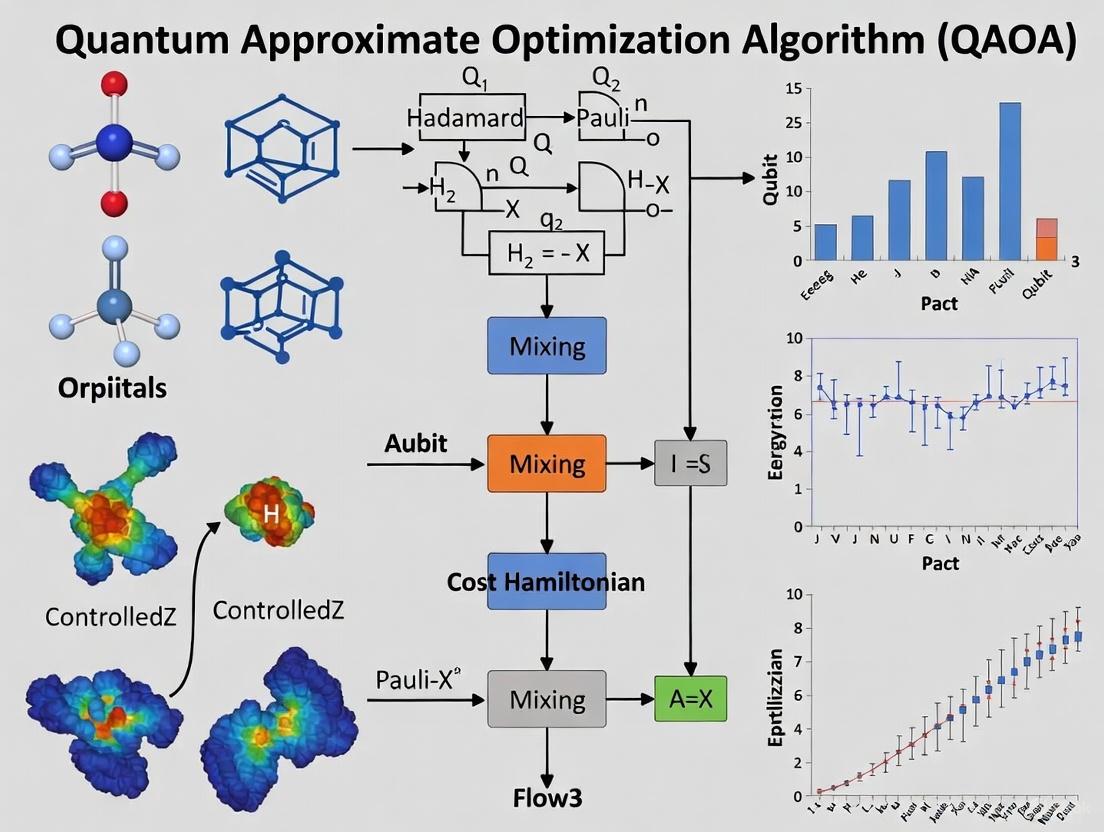
This article explores the application of the Quantum Approximate Optimization Algorithm (QAOA) to the complex challenge of molecular geometry optimization, a critical task in computational chemistry and drug design.
Optimizing Molecular Geometry with QAOA: Protocols for Quantum-Enhanced Drug Discovery
Abstract
This article explores the application of the Quantum Approximate Optimization Algorithm (QAOA) to the complex challenge of molecular geometry optimization, a critical task in computational chemistry and drug design. We provide a foundational understanding of how QAOA leverages quantum superposition and entanglement to navigate complex molecular energy landscapes. The piece details specific methodological protocols, including novel variants like DC-QAOA and Prog-QAOA, for simulating molecular systems and docking. It addresses key practical challenges such as parameter optimization and noise mitigation on current hardware, and presents a comparative analysis of QAOA's performance against classical methods, highlighting recent evidence of scaling advantages. Aimed at researchers and drug development professionals, this review synthesizes the current state and future potential of QAOA to accelerate and refine molecular optimization in biomedical research.
Quantum Principles for Molecular Systems: The Foundation of QAOA in Chemistry
The Challenge of Molecular Geometry Optimization in Classical Computational Chemistry
Molecular geometry optimization, the process of determining the three-dimensional arrangement of atoms that minimizes a molecule's total energy, represents a foundational challenge in computational chemistry. This process is crucial for predicting molecular properties, understanding chemical reactions, and accelerating drug discovery pipelines. The core of this challenge lies in navigating the high-dimensional, nonconvex potential energy surface (PES) to locate local or global minima corresponding to stable molecular conformations. Classical computational methods for this task, while highly sophisticated, face significant scalability limitations when dealing with large, flexible molecules such as proteins or drug-like compounds. These limitations necessitate novel approaches, and within this context, quantum-inspired algorithms, particularly the Quantum Approximate Optimization Algorithm (QAOA), emerge as a promising research direction. This application note details the classical challenges, formalizes the core problem, and explores the potential integration of QAOA protocols to advance the field of molecular geometry optimization for research scientists and drug development professionals.
Background and Problem Formulation
The Molecular Distance Geometry Problem (MDGP)
At its heart, molecular geometry optimization can be framed as a Molecular Distance Geometry Problem (MDGP). The MDGP seeks to determine the three-dimensional configuration of a molecule consistent with a set of experimental and theoretical interatomic distance constraints [1]. Formally, it is defined using a weighted graph ( G=(V,E,d) ), where ( V ) represents atoms, ( E ) the pairs with known distances, and ( d: E \to \mathbb{R}_{>0} ) assigns those distances. The problem requires finding a realization ( x: V \to \mathbb{R}^{3} ) such that:
[ \|xu - xv\| = d_{u,v}, \quad \forall {u,v} \in E ]
where ( \|\cdot\| ) denotes the Euclidean norm [1]. In practical experimental settings, such as Nuclear Magnetic Resonance (NMR) spectroscopy, distances are often available only within uncertainty bounds, leading to the interval variant (iDMDGP), where one seeks a configuration ( X = [x1, \ldots, xn] \in \mathbb{R}^{3 \times n} ) satisfying:
[ d^{L}{i,j} \leq \|xi - xj\| \leq d^{U}{i,j}, \quad \forall {i,j} \in E ]
Here, ( [d^{L}{i,j}, d^{U}{i,j}] ) defines the lower and upper bounds for the distance between atoms ( i ) and ( j ) [1]. The Discretizable MDGP (DMDGP) is an NP-hard subclass that exhibits a rich combinatorial structure, enabling efficient exploration via algorithms like Branch-and-Prune (BP) by leveraging an appropriate atom ordering and stereochemical constraints [1].
Protein Backbone Geometry
For proteins, the backbone geometry is primarily determined by torsion angles (( \phi, \psi, \omega )), while covalent bond lengths and bond angles are typically fixed to standard values [1]. This torsion-angle space provides a more efficient search domain compared to Cartesian coordinates. The variability arises solely from these torsion angles, and typical values for ( \omega ) are available in structural data, which can be converted into distances across three bonds (( d_{i-3,i} )) to complete the model used in discretizable approaches [1].
Classical Computational Challenges and Limitations
Classical computational methods for geometry optimization face several intrinsic challenges that limit their efficiency and scalability, particularly for large biological molecules.
- Combinatorial Explosion: The number of local minima on the PES grows exponentially with the number of degrees of freedom (e.g., torsion angles), making an exhaustive search for the global minimum infeasible [1].
- Rugged Energy Landscapes: The PES of complex molecules is often characterized by a vast number of closely spaced local minima separated by low barriers, causing classical optimizers to become trapped in suboptimal configurations.
- Noise and Uncertainty: Classical gradient-based optimizers can be misled by numerical noise or inaccuracies in the potential energy model, hindering convergence [2].
- High-Dimensionality: Each atom contributes three spatial degrees of freedom, resulting in a search space with 3N dimensions for a molecule with N atoms, presenting a significant challenge for sampling and optimization.
Table 1: Classical Optimization Methods and Their Limitations in Molecular Geometry Optimization
| Method Class | Examples | Key Challenges |
|---|---|---|
| Gradient-Based | L-BFGS, FIRE | Susceptible to getting stuck in local minima; performance degrades with noisy PES [2]. |
| Hessian-Based | Newton-Raphson | Computationally expensive for large molecules; requires accurate second derivatives. |
| Combinatorial | Branch-and-Prune (BP) | Limited to discretizable problems (DMDGP); struggles with wide interval bounds [1]. |
| Stochastic | Monte Carlo, Genetic Algorithms | Require extensive sampling; slow convergence; guarantee of finding global minimum is asymptotic. |
A Quantum-Inspired Perspective: The QAOA Protocol
The Quantum Approximate Optimization Algorithm (QAOA) is a hybrid quantum-classical variational algorithm designed to solve combinatorial optimization problems [3] [4]. Its potential application to molecular geometry optimization involves mapping the classical cost function (e.g., the deviation from distance constraints or the total energy) onto a quantum Hamiltonian.
QAOA Formulation
QAOA prepares a parameterized quantum state through a circuit of depth ( p ): [ |\psi(\boldsymbol{\gamma}, \boldsymbol{\beta})\rangle = \prod{k=1}^{p} e^{-i\betak HM} e^{-i\gammak H_C} |+\rangle^{\otimes n} ] where:
- ( H_C ) is the cost Hamiltonian encoding the optimization problem (e.g., the energy or distance constraints).
- ( HM ) is the mixer Hamiltonian, typically the transverse field ( \sumi X_i ), which drives transitions between classical states.
- ( \boldsymbol{\gamma} = (\gamma1, \ldots, \gammap) ) and ( \boldsymbol{\beta} = (\beta1, \ldots, \betap) ) are variational parameters optimized by a classical routine [4] [5].
The objective is to minimize the expectation value ( C(\boldsymbol{\gamma}, \boldsymbol{\beta}) = \langle \psi(\boldsymbol{\gamma}, \boldsymbol{\beta}) | HC | \psi(\boldsymbol{\gamma}, \boldsymbol{\beta}) \rangle ), which, in the limit of large ( p ), can approximate the ground state of ( HC ) [4].
Protocol: Hybrid Classical-Quantum Co-optimization
A novel framework for molecular geometry optimization integrates Density Matrix Embedding Theory (DMET) with the Variational Quantum Eigensolver (VQE) in a co-optimization procedure [6]. This protocol is a prime example of how QAOA-like hybrid strategies can be applied.
Diagram 1: Quantum-classical co-optimization workflow, adapting DMET and VQE/QAOA for geometry optimization [6].
Detailed Protocol Steps:
Initialization and Fragmentation:
- Input: An initial guess for the molecular geometry (Cartesian coordinates or internal coordinates).
- Fragmentation: Use Density Matrix Embedding Theory (DMET) to partition the large molecule into smaller, manageable fragments. This drastically reduces the number of qubits required for the subsequent quantum simulation [6].
Quantum Subroutine Execution:
- For each fragment, a parameterized quantum circuit (e.g., based on VQE or QAOA) is executed to prepare the quantum state of the embedded fragment problem.
- The energy expectation value ( \langle H_C \rangle ) is measured for the current geometry and parameters.
Classical Co-optimization:
- A classical optimizer (e.g., L-BFGS) uses the energy and gradient information (which can be computed efficiently using the Hellmann-Feynman theorem) to simultaneously update both the molecular geometry and the quantum variational parameters [6].
- This co-optimization bypasses the need for expensive, nested self-consistent loops, accelerating convergence.
Convergence Check:
- The procedure iterates until the geometry converges, as determined by standard criteria (e.g., maximum force component, energy change, and step size) [7]. If converged, the optimized geometry is output; otherwise, the loop continues.
Experimental Validation and Performance
This co-optimization framework has been validated on benchmark molecules like H₄ and H₂O₂, and successfully extended to glycolic acid (C₂H₄O₃), a molecule previously considered intractable for direct quantum geometry optimization [6]. The results demonstrate that the framework can achieve accuracy comparable to classical reference methods while substantially reducing quantum resource demands.
Table 2: Key Research Reagent Solutions for Quantum-Classical Geometry Optimization
| Item / Component | Function / Role | Implementation Example |
|---|---|---|
| Cost Hamiltonian (H_C) | Encodes the problem's objective function (e.g., molecular energy) into a quantum operator. | Ising model from DMET fragment calculation [6]. |
| Mixer Hamiltonian (H_M) | Drives transitions between computational basis states, exploring the solution space. | Transverse field mixer ( \sumi Xi ) [5]. |
| Classical Optimizer | Iteratively updates variational parameters and/or molecular geometry based on quantum outputs. | L-BFGS, Sella, geomeTRIC [2] [6]. |
| Graph Embedding | Encodes molecular topological information into a format suitable for the quantum model. | FEATHER algorithm for graph representation [8]. |
| Convergence Criteria | Defines the stopping conditions for the geometry optimization loop. | Maximum force, energy change, and step size thresholds [7]. |
Classical Optimization Protocols and Benchmarking
For classical geometry optimization, the choice of optimizer and convergence criteria is critical.
Protocol: Standard Classical Geometry Optimization
Diagram 2: Standard workflow for classical geometry optimization.
Detailed Protocol Steps:
- Initialization: Provide an initial molecular geometry.
- Energy and Gradient Calculation: Use an electronic structure method (e.g., DFT, HF) or a Neural Network Potential (NNP) to compute the total energy and nuclear gradients (forces) at the current geometry.
- Optimization Step: A classical optimizer (see Table 3) uses the energy and gradient information to propose a new, lower-energy geometry.
- Convergence Check: The optimization is considered converged when all the following criteria are met [7]:
- The energy change between steps is smaller than
Convergence%Energy× number of atoms. - The maximum nuclear gradient is smaller than
Convergence%Gradients. - The root mean square (RMS) of the gradients is smaller than 2/3 ×
Convergence%Gradients. - The maximum Cartesian step is smaller than
Convergence%Step. - The RMS of the steps is smaller than 2/3 ×
Convergence%Step.
- The energy change between steps is smaller than
- Frequency Analysis: Upon convergence, a frequency calculation is performed on the final geometry to confirm it is a true local minimum (no imaginary frequencies).
Benchmarking Classical Optimizers
Recent benchmarks highlight the performance variation across different optimizers when coupled with NNPs [2].
Table 3: Benchmarking Results of Optimizers with Neural Network Potentials (NNPs) on 25 Drug-like Molecules [2]
| Optimizer | Number Successfully Optimized (Out of 25) | Average Number of Steps (if Successful) | Number of True Minima Found |
|---|---|---|---|
| ASE/L-BFGS | 22 - 23 | ~100 - 120 | 16 - 18 |
| ASE/FIRE | 20 | ~105 - 160 | 11 - 15 |
| Sella | 15 - 24 | ~73 - 107 | 8 - 17 |
| Sella (Internal) | 20 - 25 | ~14 - 23 | 15 - 24 |
| geomeTRIC (cart) | 7 - 12 | ~159 - 195 | 5 - 8 |
| geomeTRIC (tric) | 1 - 20 | ~11 - 115 | 1 - 17 |
The data indicates that the performance of an optimizer is highly dependent on the specific NNP and the use of internal coordinates. For instance, Sella with internal coordinates demonstrated both a high success rate and a low average step count, making it a robust choice [2].
Molecular geometry optimization remains a formidable challenge in classical computational chemistry due to the combinatorial explosion and ruggedness of the potential energy surface, particularly for large, flexible molecules. While classical algorithms and powerful optimizers like L-BFGS and Sella continue to be workhorses, their scalability is inherently limited. The exploration of quantum-inspired algorithms, such as QAOA and hybrid quantum-classical co-optimization frameworks, represents a promising frontier. These approaches, leveraging techniques like DMET to reduce resource demands, offer a potential pathway to overcome classical bottlenecks. The integration of robust classical optimization protocols with emerging quantum algorithms is poised to significantly accelerate and enhance the reliability of molecular structure prediction, with profound implications for drug discovery and materials science.
Core Principles of QAOA
The Quantum Approximate Optimization Algorithm (QAOA) is a highly promising variational quantum algorithm designed to find approximate solutions to combinatorial optimization problems that are classically intractable. It operates on Noisy Intermediate-Scale Quantum (NISQ) devices through a hybrid quantum-classical optimization routine [9].
The algorithm prepares a parameterized quantum state by applying a sequence of quantum circuits. For a given combinatorial optimization problem, a cost Hamiltonian (HC) is defined such that its ground state encodes the problem's solution. A second, non-commuting mixer Hamiltonian (HM) is also defined. The QAOA circuit consists of p layers, each applying the cost and mixer unitaries with parameters γ and β respectively [9] [10]:
The quantum computer prepares this state and measures the expectation value of the cost Hamiltonian. A classical optimizer then adjusts the parameters γ and β to minimize this expectation value. Theoretically, the approximation ratio improves with increasing layers p, recovering adiabatic evolution in the p → ∞ limit [9].
QAOA for Molecular Geometry Optimization
Molecular geometry optimization, which seeks stable molecular configurations with minimal energy, can be framed as a combinatorial optimization problem suitable for QAOA [9]. In this context, the cost Hamiltonian encodes the molecular energy landscape derived from the electronic structure problem.
Problem Mapping and Algorithm Selection
Table: Key Considerations for Molecular Geometry Optimization with QAOA
| Consideration | Description | Relevance to Molecular Geometry |
|---|---|---|
| Problem Formulation | Mapping the optimization problem to a quantum-mechanical Hamiltonian | Molecular energy minimization maps naturally to finding the ground state of a chemical Hamiltonian [9]. |
| QUBO Formulation | Many combinatorial problems can be cast as Quadratic Unconstrained Binary Optimization (QUBO) problems [9]. | Molecular degrees of freedom (e.g., torsion angles) can be discretized and encoded in a QUBO [9]. |
| Algorithm Variants | Choosing between standard QAOA, warm-starts, constrained versions, or noise-resilient variants [9]. | Molecular problems may require preserving molecular symmetries through constrained mixers [9]. |
The time-indexed representation used for Job Shop Scheduling Problems demonstrates how complex optimization problems with constraints can be successfully mapped to a cost Hamiltonian embeddable into QAOA [11].
Experimental Protocols and Workflows
End-to-End Parameter Optimization Protocol
High-quality parameter selection is crucial for QAOA performance, especially with limited quantum resources. The following workflow, optimized for shot-frugal scenarios, integrates multiple techniques for robust parameter setting [12]:
This protocol emphasizes using optimizers with simple internal models (e.g., linear) that perform best in shot-limited settings. It has been demonstrated to be robust to small amounts of hardware noise while achieving significant improvements in approximation ratio [12].
Alternative Parameter Strategies: Linear Ramp QAOA
As an alternative to costly parameter optimization, Linear Ramp QAOA (LR-QAOA) uses fixed parameters following a linear schedule, eliminating the classical optimization loop. The parameters are defined as [13]:
for i = 0, ..., p-1, where Δγ and Δβ are scanned for a given problem size and fixed across instances. Simulations suggest the success probability scales as P(x*) ≈ 2^(-η(p)N_q + C), where η(p) decreases with increasing p, indicating better performance with more layers [13].
Table: Comparison of QAOA Parameter Strategies
| Strategy | Key Principle | Advantages | Limitations |
|---|---|---|---|
| Classically Optimized Parameters [12] | Hybrid quantum-classical optimization loop | Potential for higher solution quality per instance | Computationally expensive; requires many circuit executions |
| Fixed Linear Ramp (LR-QAOA) [13] | Fixed parameters following linear schedule | No classical optimization; consistent across instances | May not achieve instance-specific optimum |
| Parameter Transfer [14] | Reuse parameters from similar problems | Reduces need for expensive re-optimization | Dependent on similarity between problem instances |
The Scientist's Toolkit
Table: Essential Research Reagents and Computational Resources for QAOA Experiments
| Resource Category | Specific Tool/Platform | Function/Role in QAOA Research |
|---|---|---|
| Quantum Simulators | PennyLane [10], JuliQAOA [14] | Simulate QAOA circuits classically; test algorithms before hardware deployment |
| Quantum Hardware | IBM Quantum [14], IonQ [13], Quantinuum [13] | Execute QAOA circuits on real quantum processors |
| Classical Optimizers | COBYLA, Basin-hopping [14] | Adjust QAOA parameters to minimize cost function |
| Problem Libraries | NetworkX [10], Qiskit Optimization | Provide standard combinatorial problems (MaxCut, Vertex Cover) for benchmarking |
| Visualization Tools | Matplotlib [10], custom plotting libraries | Analyze algorithm performance, convergence, and solution quality |
Multi-Objective Optimization Extensions
Many real-world optimization problems, including molecular design, involve balancing multiple competing objectives. QAOA has been extended to multi-objective optimization (MOO) by approximating the Pareto front of optimal trade-offs [14].
For problems like multi-objective weighted MaxCut (MO-MAXCUT) with m objective functions, the approach uses randomized convex combinations of the objectives. This allows sampling a variety of good solutions to approximate the Pareto front without explicitly solving numerous single-objective problems [14].
The workflow for multi-objective QAOA involves:
- Defining multiple cost Hamiltonians for different objectives
- Using parameter transfer to avoid retraining for each weight combination
- Sampling with different convex combinations of objectives
- Analyzing the resulting set of non-dominated solutions
This approach demonstrates potential for quantum computers to address complex multi-objective optimization problems relevant to molecular design where trade-offs between different molecular properties must be balanced [14].
Future Research Directions
Key research directions for advancing QAOA in molecular optimization include developing more problem-specific ansatze, improving parameter optimization strategies, enhancing noise resilience, and establishing theoretical performance guarantees [9]. The integration of problem structure into algorithm design, as seen in hardware-tailored implementations, will be particularly important for achieving quantum advantage with near-term devices [14] [9].
The Quantum Approximate Optimization Algorithm (QAOA) is a hybrid quantum-classical algorithm designed to find approximate solutions to combinatorial optimization problems, a category that includes molecular geometry optimization [15]. The algorithm's performance is governed by the interplay of three fundamental quantum principles: superposition, which allows the exploration of multiple molecular configurations simultaneously; entanglement, which creates quantum correlations between atomic positions to encode complex cost functions; and quantum interference, which amplifies probability amplitudes corresponding to optimal molecular geometries while suppressing non-optimal ones [16] [15].
For research in molecular geometry optimization, QAOA offers a framework to navigate the high-dimensional energy landscapes of molecular systems. By encoding the molecular energy function into a problem Hamiltonian, the algorithm prepares a parameterized quantum state where low-energy configurations correspond to stable molecular geometries [3]. The iterative quantum-classical optimization cycle fine-tunes parameters to minimize the expected energy, guiding the search toward thermodynamically favorable molecular configurations with applications in rational drug design and materials science [15].
Foundational Principles and Their Role in QAOA
Quantum Superposition
Quantum superposition enables a quantum system to exist in multiple states simultaneously. In QAOA for molecular geometry optimization, this principle is leveraged to explore a vast landscape of possible molecular configurations in parallel [15]. The algorithm initializes a register of qubits in a uniform superposition over all computational basis states, representing all possible molecular configurations under consideration. This initial state can be represented as:
[ |\psi0\rangle = \frac{1}{\sqrt{2^n}}\sum{z=0}^{2^n-1} |z\rangle ]
where (n) represents the number of qubits encoding the molecular configuration space, and each state (|z\rangle) corresponds to a specific molecular geometry [16]. This simultaneous encoding of all possible solutions provides QAOA with a distinct advantage over classical algorithms that must explore configurations sequentially, particularly for complex molecular systems with many degrees of freedom.
Quantum Entanglement
Quantum entanglement creates non-classical correlations between qubits, where the quantum state of each qubit cannot be described independently of the others. In QAOA, entanglement is crucial for encoding the complex relationships between different parts of a molecule's geometry [15]. The cost Hamiltonian (HC), which encodes the molecular energy function, introduces entanglement between qubits representing interacting atomic positions. Similarly, the mixer Hamiltonian (HM) creates entanglement that facilitates transitions between different molecular configurations while preserving constraints [16].
For molecular geometry optimization, entanglement enables the quantum processor to model the coordinated nature of atomic interactions, where the position of one atom influences the energetically favorable positions of nearby atoms. This correlation is essential for accurately capturing the potential energy surface of the molecule and for ensuring that the quantum optimization respects the stereochemical constraints of the molecular system [3].
Quantum Interference
Quantum interference is the phenomenon where probability amplitudes of quantum states combine constructively or destructively. In QAOA, this principle is harnessed to amplify the probability of measuring optimal molecular configurations while suppressing non-optimal ones [15]. The alternating application of the cost and mixer unitaries, parameterized by (\gamma) and (\beta), creates interference patterns that steer the quantum state toward solutions that minimize the molecular energy.
The cost unitary (e^{-i\gamma HC}) applies phase shifts to different computational basis states based on their cost function values (molecular energies), while the mixer unitary (e^{-i\beta HM}) redistributes probability amplitudes between states [3]. Through careful parameter optimization, these operations create constructive interference for low-energy molecular geometries and destructive interference for high-energy configurations, effectively increasing the probability of sampling near-optimal solutions upon measurement [16] [15].
QAOA Protocol for Molecular Geometry Optimization
Problem Formulation and Hamiltonian Construction
The first step in applying QAOA to molecular geometry optimization involves encoding the molecular energy function into a cost Hamiltonian. For a molecule with (N) atoms, the potential energy surface can be expressed as a function of atomic coordinates. To formulate this as a combinatorial optimization problem suitable for QAOA, the continuous configuration space must be discretized, often through a grid-based approach or by considering a finite set of plausible conformers.
The molecular Hamiltonian can be mapped to a quantum spin Hamiltonian using techniques such as the Jordan-Wigner or Bravyi-Kitaev transformation [13]. For direct discretization of molecular geometries, the problem can be formulated as a Quadratic Unconstrained Binary Optimization (QUBO) problem, which is then transformed into an Ising Hamiltonian:
[
HC = \sum{i} hi Zi + \sum{i
where (Zi) represents the Pauli-Z operator on qubit (i), (hi) represents the external field terms, and (J{ij}) represents the coupling interactions between qubits [3] [13]. The mixer Hamiltonian (HM) is typically chosen as a transverse field operator:
[ HM = \sum{i} X_i ]
where (X_i) is the Pauli-X operator on qubit (i), though constrained mixers may be employed for problems with specific molecular geometry constraints [16].
QAOA Parameter Optimization Strategies
Optimizing the parameters (\vec{\gamma} = (\gamma1, \ldots, \gammap)) and (\vec{\beta} = (\beta1, \ldots, \betap)) for QAOA with (p) layers is crucial for achieving high-quality solutions in molecular geometry optimization. Two primary approaches exist: instance-specific optimization and fixed-parameter protocols.
Instance-specific optimization employs classical optimizers to tailor parameters for specific molecular systems. In the shot-limited regime common to near-term quantum devices, optimizers with simple internal models (e.g., linear) have demonstrated superior performance [3]. The optimization typically minimizes the expectation value of the cost Hamiltonian:
[ \min{\vec{\gamma}, \vec{\beta}} \langle \psi(\vec{\gamma}, \vec{\beta}) | HC | \psi(\vec{\gamma}, \vec{\beta}) \rangle ]
where (|\psi(\vec{\gamma}, \vec{\beta})\rangle) is the quantum state prepared by the QAOA circuit [3].
Fixed-parameter protocols, such as the Linear Ramp QAOA (LR-QAOA), use predetermined parameter schedules without instance-specific optimization [13]. For LR-QAOA, parameters are defined as:
[ \gammai = \Delta\gamma \cdot (i - 1/2), \quad \betai = \Delta\beta \cdot (p - i + 1/2) ]
for (i = 1, \ldots, p), where (\Delta\gamma) and (\Delta\beta) are constants determined empirically or through connection to quantum annealing [13]. This approach reduces the classical computational overhead and avoids optimization challenges like barren plateaus, making it suitable for applications where quantum resources are limited.
Table 1: QAOA Parameter Optimization Strategies for Molecular Geometry Optimization
| Strategy | Classical Overhead | Robustness to Noise | Solution Quality | Best For |
|---|---|---|---|---|
| Instance-Specific Optimization | High | Moderate | High with adequate shots | Small molecules, high-precision calculations |
| Fixed-Parameter Protocols (LR-QAOA) | Low | High | Moderate to high | Large molecules, limited quantum resources |
Measurement and Error Mitigation
Accurate measurement of the expectation value (\langle H_C \rangle) is essential for guiding the classical optimizer in QAOA. For molecular geometry optimization, this requires sufficient sampling (shots) to minimize statistical uncertainty. The Chernoff Bound can be used to estimate the number of shots needed to achieve a desired precision level [17].
Error mitigation techniques are particularly important for molecular applications due to the sensitivity of energy calculations to small errors. Readout error mitigation, zero-noise extrapolation, and dynamical decoupling can help reduce the impact of noise on current quantum devices [3]. For molecular systems where precise energy differences are critical (e.g., determining stable conformers), these techniques can significantly improve the reliability of QAOA results.
Experimental Protocols and Workflows
Molecular Geometry Optimization Protocol
Table 2: Experimental Protocol for Molecular Geometry Optimization Using QAOA
| Step | Procedure | Technical Specifications | Output | |
|---|---|---|---|---|
| 1. Problem Encoding | Map molecular coordinates to binary variables; Construct cost Hamiltonian | Use Bravyi-Kitaev transformation for fermionic systems; QUBO for spatial discretization | Cost Hamiltonian (H_C) | |
| 2. Circuit Initialization | Prepare initial state ( | \psi_0\rangle); Define QAOA layers (p) | Use Hadamard gates for superposition; Select (p) based on quantum resources | Parameterized quantum circuit |
| 3. Parameter Optimization | Run hybrid quantum-classical loop; Optimize (\gamma), (\beta) | Use COBYLA or BFGS optimizer; Allocate shots based on Chernoff Bound | Optimal parameters (\gamma^), (\beta^) | |
| 4. Solution Extraction | Measure final state; Sample computational basis states | Use at least 10,000 shots for reliable statistics; Apply error mitigation | Probability distribution over molecular geometries | |
| 5. Classical Validation | Compare with classical methods; Verify molecular stability | Use density functional theory (DFT) or molecular mechanics | Validated molecular geometries |
Quantum Circuit Implementation
The QAOA circuit for molecular geometry optimization implements the unitary operation:
[ |\psi(\vec{\gamma}, \vec{\beta})\rangle = \prod{k=1}^{p} e^{-i\betak HM} e^{-i\gammak HC} |\psi0\rangle ]
where (p) represents the number of QAOA layers [3]. The circuit depth is proportional to (p) and the structure of the cost Hamiltonian, with two-qubit gates required for each interaction term in (H_C).
For current noisy intermediate-scale quantum (NISQ) devices, circuit compilation techniques that minimize two-qubit gate count and depth are essential. This may involve leveraging native gate sets of target hardware, using fermionic swap networks to reduce overhead, or employing hardware-efficient ansatzes that respect connectivity constraints [3] [13].
Visualization of QAOA Workflows
QAOA Parameter Optimization Framework
QAOA Optimization Workflow: This diagram illustrates the hybrid quantum-classical feedback loop for optimizing QAOA parameters for molecular geometry optimization.
Quantum Circuit Structure for Molecular Optimization
QAOA Quantum Circuit Structure: This diagram shows the quantum circuit implementation for molecular geometry optimization, highlighting the alternating application of cost and mixer unitaries.
Table 3: Essential Research Tools for QAOA in Molecular Geometry Optimization
| Tool Category | Specific Tools/Platforms | Function in Research | Implementation Notes |
|---|---|---|---|
| Quantum Hardware | Trapped-ion (Quantinuum, IonQ), Superconducting (IBM) | Execute QAOA circuits with high fidelity | Trapped-ion offers higher connectivity; superconducting has faster gates [3] [13] |
| Classical Optimizers | COBYLA, BFGS, L-BFGS-B, SPSA | Optimize QAOA parameters (γ, β) | For shot-limited scenarios, simple models perform best [3] [16] |
| Quantum Software | Qiskit, Cirq, PennyLane, Classiq | Design, simulate, and optimize quantum circuits | Classiq offers high-level abstraction; Qiskit provides hardware access [15] [17] |
| Chemical Informatics | OpenFermion, PSI4, RDKit | Map molecular systems to quantum Hamiltonians | OpenFermion specializes in electronic structure problems [13] |
| Error Mitigation | Zero-noise extrapolation, Readout mitigation | Improve accuracy of expectation values | Essential for achieving chemical accuracy on NISQ devices [3] |
Performance Metrics and Benchmarking
Quantitative Performance Analysis
Table 4: Performance Metrics for QAOA in Optimization Applications
| Metric | Definition | Reported Values | Molecular Optimization Relevance |
|---|---|---|---|
| Approximation Ratio | Ratio between obtained solution quality and optimal solution | Up to 56.61% improvement in noiseless simulation; 46.88% under hardware noise [3] | Measures how close QAOA solution is to global minimum energy |
| Time-to-Solution (TTS) | Expected time to find optimal solution with probability 0.99 | Scaling advantage over classical algorithms like SA, Tabu [13] | Important for comparing efficiency against classical conformer search |
| Success Probability | Probability of measuring optimal solution | Follows (P(x^*) \approx 2^{-\eta(p)N_q + C}); η(10)=0.22, η(100)=0.05 for MaxCut [13] | Indicates likelihood of finding ground state geometry |
| Effective Number of Layers (p_eff) | Optimal depth before noise dominates | p_eff=10-50 on current hardware [13] | Guides circuit depth selection for molecular problems |
Hardware Performance Considerations
Current quantum hardware implementations of QAOA have demonstrated scalability up to 109 qubits and circuit depths of p=100, requiring up to 21,200 CNOT gates [13]. For molecular geometry optimization, the choice of hardware platform involves trade-offs between connectivity, gate fidelity, and qubit count.
Trapped-ion processors have demonstrated robust performance for QAOA circuits with up to 32 qubits and 5 layers, showing resilience to small amounts of hardware noise [3]. The performance of QAOA on noisy devices follows a characteristic pattern where solution quality improves with circuit depth until reaching an optimum point (p_eff), beyond which noise dominates and performance deteriorates [13]. Understanding this trade-off is crucial for selecting appropriate circuit depths for molecular optimization problems on specific hardware platforms.
Future Directions and Research Opportunities
The application of QAOA to molecular geometry optimization is still in its early stages, with several promising research directions. The development of problem-specific mixers that incorporate molecular symmetries could enhance algorithm performance [16]. Hybrid approaches that combine QAOA with classical molecular dynamics simulations may leverage the strengths of both paradigms [15]. As quantum hardware continues to improve, with advances in error correction such as the color code offering more efficient logical operations [18] [19], the scale and complexity of addressable molecular systems will increase accordingly.
For drug development professionals, these advances promise more efficient exploration of conformational space and more accurate prediction of molecular properties, potentially accelerating the drug discovery process. The integration of quantum optimization with classical molecular modeling tools represents a promising path toward practical quantum advantage in computational chemistry and pharmaceutical research.
The accurate and efficient determination of molecular energy landscapes represents a fundamental challenge in computational chemistry and drug discovery. These landscapes, which describe how the energy of a molecular system varies with its geometry, are central to predicting reaction pathways, binding affinities, and stable conformations. Classical computational methods, such as density functional theory (DFT) and coupled cluster calculations, provide valuable insights but face exponential scaling limitations when dealing with complex molecular systems or simulating quantum effects with high accuracy. This computational bottleneck has motivated the exploration of quantum computing as a potentially transformative technology for molecular simulations.
The Quantum Approximate Optimization Algorithm (QAOA) has emerged as a promising gate-based quantum approach for tackling combinatorial optimization problems, including those found in molecular systems. Originally developed for classical optimization problems, QAOA's framework can be adapted to navigate molecular energy landscapes by treating molecular geometry optimization as a combinatorial problem where discrete structural parameters must be configured to minimize the system's energy. Unlike quantum annealing, which gradually evolves a quantum system toward its lowest energy state, QAOA operates through alternating parameterized cost and mixer Hamiltonians, making it particularly suitable for gate-based quantum processors that are increasingly available through cloud platforms.
This application note establishes a comprehensive protocol for applying QAOA to molecular geometry optimization, framed within broader research on developing practical quantum solutions for computational chemistry. We present detailed methodologies, resource requirements, and experimental protocols specifically tailored for researchers, scientists, and drug development professionals seeking to leverage quantum advantage in molecular simulations.
Theoretical Foundation: Problem Hamiltonians for Molecular Systems
Mapping Molecular Structure to Qubit Representations
The foundation of any quantum optimization approach is the faithful encoding of the molecular optimization problem into a quantum framework. For molecular geometry optimization, this involves representing both the electronic structure and nuclear coordinates in a discrete manner compatible with qubit-based quantum processors. The problem Hamiltonian (H_C) encapsulates the energy landscape of the molecular system, with its ground state corresponding to the optimal molecular geometry.
A common approach represents molecular degrees of freedom, such as torsion angles or bond length discretization, using binary variables. For a molecule with M configurable structural parameters, each discretized into N possible values, the total configuration space scales as N^M, creating a combinatorial optimization problem that quickly becomes intractable for classical computers as M increases. This discrete representation enables the mapping of the molecular energy function to a quantum Ising model or Quadratic Unconstrained Binary Optimization (QUBO) formulation:
[ HC = \frac{1}{2} \sum{(i,j) \in E} (I - Zi Zj) ]
where Zi and Zj represent Pauli-Z operators acting on qubits i and j, and E represents the interactions between different molecular degrees of freedom [20]. For more complex molecular interactions involving multiple bodies, higher-order terms may be required, extending the formulation to Higher-Order Unconstrained Binary Optimization (HUBO) problems, which can be mapped to qubit Hamiltonians using additional ancillary qubits or reduction techniques [8].
The QAOA Framework for Molecular Energy Minimization
The QAOA algorithm prepares a parameterized quantum state through alternating applications of problem-specific and mixer Hamiltonians. For a molecular system with p layers, the quantum state is expressed as:
[ |\psi(\bm{\gamma}, \bm{\beta})\rangle = \prod{k=1}^p e^{-i\betak HM} e^{-i\gammak H_C} |+\rangle ^{\otimes n} ]
where ( \bm{\gamma} = (\gamma1, \ldots, \gammap) ) and ( \bm{\beta} = (\beta1, \ldots, \betap) ) are variational parameters, HC is the cost Hamiltonian encoding the molecular energy landscape, and HM is the mixer Hamiltonian that facilitates transitions between different computational basis states [8]. The mixer Hamiltonian typically takes the form ( HM = \sumi Xi ), where Xi represents Pauli-X operators that create superpositions between different molecular configurations.
The optimal parameters ( \bm{\gamma}^* ), ( \bm{\beta}^* ) are those that minimize the expectation value of the cost Hamiltonian:
[ C(\bm{\gamma}, \bm{\beta}) = \langle \psi(\bm{\gamma}, \bm{\beta}) | H_C | \psi(\bm{\gamma}, \bm{\beta}) \rangle ]
This minimization is performed using classical optimization routines in a hybrid quantum-classical feedback loop, with the quantum processor preparing and measuring the states, and the classical processor updating the parameters to steer the system toward the minimal energy configuration [3].
Experimental Protocols and Methodologies
End-to-End Protocol for Shot-Limited Molecular Optimization
Current quantum processing units (QPUs) operate under significant constraints, particularly regarding the number of circuit executions (shots) available for parameter optimization. This limitation is especially pronounced for molecular systems where energy evaluations require precise measurement. An optimized end-to-end protocol for shot-limited QAOA implementation incorporates several key techniques [3]:
Table: Components of Shot-Limited QAOA Protocol for Molecular Systems
| Protocol Component | Implementation for Molecular Optimization | Purpose |
|---|---|---|
| Parameter Initialization | Use transfer learning from similar molecular classes or empirical patterns | Reduces number of optimization iterations needed |
| Problem Rescaling | Normalize energy ranges based on molecular size and interaction strengths | Improves numerical stability and optimizer performance |
| Optimizer Selection | Employ derivative-free optimizers with simple internal models (e.g., linear) | More effective in high-noise, limited-shot regimes |
| Budget Allocation | Distribute shots between exploration and exploitation phases strategically | Maximizes information gain per shot |
| Iterative Refinement | Progressive narrowing of parameter search space | Concentrates shots on promising parameter regions |
The protocol begins with initialization using chemically-informed parameters, either derived from similar molecular systems or based on molecular complexity metrics. For weighted molecular interactions (e.g., varying bond strengths), problem rescaling applies appropriate normalization to prevent parameter dominance. The optimization then proceeds with shot-frugal algorithms, with the total shot budget allocated across exploration and refinement phases.
LR-QAOA for Molecular Geometry Optimization
As an alternative to fully optimized variational parameters, the Linear Ramp QAOA (LR-QAOA) approach uses fixed parameter schedules that linearly evolve from initial to final values. This method eliminates the classical optimization loop, significantly reducing the required number of shots and mitigating challenges like barren plateaus and local minima [13].
For molecular systems, the LR-QAOA schedule can be expressed as:
[ \gammak = \Delta\gamma \cdot k, \quad \betak = \Delta\beta \cdot (p-k) ]
where k ranges from 1 to p (the number of QAOA layers), and ( \Delta\gamma ), ( \Delta\beta ) are instance-independent constants determined empirically for classes of molecular problems. This approach mimics a discretized quantum annealing schedule, with theoretical guarantees of performance for certain problem classes [13].
Experimental results across multiple quantum hardware platforms indicate that LR-QAOA achieves an empirical scaling law for success probability:
[ P(x^*) \approx 2^{-\eta(p) N_q + C} ]
where ( \eta(p) ) decreases with increasing p, N_q is the number of qubits, and C is a constant dependent on the molecular instance [13]. This favorable scaling demonstrates particular promise for larger molecular systems.
Dynamic Adaptive Phase Operators for Complex Molecular Interactions
For molecular systems with complex, multi-body interactions, the Dynamic Adaptive Phase Operator (DAPO) framework provides a mechanism for constructing problem-tailored phase operators that reduce quantum resource requirements [20]. Unlike standard QAOA with fixed phase operators, DAPO dynamically constructs phase operators for each layer based on the output of previous layers:
- Initialization: Begin with a standard QAOA layer using the full molecular problem Hamiltonian
- Measurement and Analysis: Measure the output state to identify promising molecular configurations
- Hamiltonian Simplification: Use the measured information to simplify the problem Hamiltonian for the next layer, focusing on the most relevant interactions
- Neighborhood Search: Apply classical post-processing to refine the solution and guide further Hamiltonian simplification
- Iteration: Repeat steps 2-4 for each subsequent layer
This approach reduces the number of required two-qubit gates (particularly RZZ gates) by focusing quantum resources on the most critical molecular interactions identified during the optimization process. For molecular problems, this translates to concentrating on bond rotations or angle adjustments that most significantly impact the total energy [20].
Visualization of QAOA Workflows for Molecular Optimization
End-to-End QAOA Protocol for Molecular Systems
QAOA Protocol for Molecular Optimization
This workflow illustrates the complete hybrid quantum-classical optimization loop for molecular geometry problems. The process begins with problem formulation, proceeds through iterative quantum circuit execution and classical parameter optimization, and concludes with the identification of optimal molecular configurations.
Dynamic Adaptive Phase Operator Workflow
Dynamic Adaptive Phase Operator Flow
The DAPO workflow demonstrates the iterative process of dynamically simplifying the problem Hamiltonian based on intermediate measurements. This approach reduces quantum resource requirements while maintaining solution quality for molecular optimization problems.
Quantum Resource Requirements and Scaling
Resource Estimation for Molecular QAOA Implementation
The implementation of QAOA for molecular geometry optimization requires careful consideration of quantum resources, which directly impact feasibility on current and near-term quantum hardware. The table below summarizes key resource requirements and their scaling behavior for molecular problems of varying sizes:
Table: Quantum Resource Requirements for Molecular QAOA Implementation
| Resource Metric | Small Molecule\n(5-10 Qubits) | Medium System\n(15-25 Qubits) | Large System\n(30+ Qubits) | Scaling Behavior |
|---|---|---|---|---|
| Number of Qubits | 5-10 | 15-25 | 30-100 | O(M·log N) for M parameters with N discretizations |
| Circuit Depth (p=10) | 50-100 layers | 150-250 layers | 300-1000 layers | O(p·(GC + GM)) where GC, GM are gate counts |
| Number of 2-Qubit Gates | 50-200 | 500-2000 | 3000-20000 | Depends on molecular connectivity |
| Optimization Shots | 10^3-10^4 | 10^4-10^5 | 10^5-10^6 | O(1/ε^2) for target precision ε |
| Coherence Time Requirements | 10-100 μs | 100-500 μs | 0.5-5 ms | Increases with circuit depth and gate count |
These estimates assume typical molecular problems with discretized structural parameters mapped to qubit representations. The actual resource requirements vary based on molecular complexity, the chosen encoding scheme, and the specific QAOA variant employed.
Advanced QAOA Variants for Resource Reduction
Several QAOA enhancements have been developed specifically to address the resource challenges in molecular optimization:
Prog-QAOA (Program-based QAOA) eliminates the reliance on direct binary optimization problem representation by designing classical programs for computing the objective function and certifying constraints, which are then compiled to quantum circuits. This approach achieves near-optimal resource utilization with respect to qubit count, gate count, and circuit depth for problems like molecular conformation searching [21].
QAOA-GPT applies generative pre-trained transformers to learn mappings between molecular graph representations and optimized quantum circuits. Once trained, the model can generate high-quality QAOA circuits and parameters for new molecular instances in a single forward pass, completely bypassing the resource-intensive classical optimization loop [8].
Table: Essential Research Reagents and Computational Resources for Molecular QAOA
| Resource Category | Specific Solutions | Function in Molecular QAOA Research |
|---|---|---|
| Quantum Processing Units | Trapped-ion (IonQ Aria, Quantinuum H2), Superconducting (IBM Brisbane, Kyoto, Osaka) | Hardware execution of QAOA circuits with varying qubit counts and connectivity |
| Quantum Software Frameworks | Qiskit, Amazon Braket, Cirq | Circuit construction, simulation, and quantum device management |
| Classical Optimizers | COBYLA, L-BFGS-B, SPSA, Bayesian Optimization | Parameter optimization in hybrid quantum-classical loop |
| Molecular Encoding Tools | OpenFermion, Qiskit Nature, TEQUILA | Mapping molecular Hamiltonians to qubit representations |
| Graph Embedding Algorithms | FEATHER, Graph Neural Networks | Encoding molecular topological information for ML-enhanced parameter prediction |
| Error Mitigation Techniques | Zero-Noise Extrapolation, Probabilistic Error Cancellation | Improving result quality on noisy quantum hardware |
| Classical Simulation Tools | JUQCS-G, QASM Simulator, TensorNetwork | Algorithm verification and small-scale experimentation |
This toolkit encompasses the essential hardware, software, and algorithmic components required for implementing QAOA protocols for molecular geometry optimization. The selection of specific resources should align with the target molecular system size, available quantum hardware access, and research objectives.
The application of QAOA to molecular geometry optimization represents a promising pathway toward practical quantum advantage in computational chemistry and drug discovery. By encoding molecular energy landscapes into problem Hamiltonians and leveraging both fixed-parameter and adaptive QAOA protocols, researchers can navigate complex conformational spaces more efficiently than with classical approaches alone.
The experimental protocols and resource analyses presented in this application note provide a foundation for implementing molecular QAOA across various quantum hardware platforms. As quantum processors continue to improve in scale and fidelity, and as quantum algorithms become more sophisticated through techniques like machine learning enhancement and dynamic operator construction, we anticipate increasingly impactful applications in molecular design and optimization.
Future research directions should focus on developing more efficient molecular-to-qubit encodings, optimizing noise resilience for chemical accuracy targets, and creating specialized QAOA variants for specific molecular problem classes. The integration of quantum optimization with classical molecular dynamics frameworks also presents promising opportunities for hybrid approaches that leverage the respective strengths of both computational paradigms.
The Role of Variational Quantum Eigensolver (VQE) and QAOA in Chemical Simulations
Quantum computing holds significant promise for revolutionizing computational chemistry by enabling the simulation of molecular systems at a quantum mechanical level with high accuracy. Such simulations are fundamental to advancing drug discovery and materials design [22]. On current Noisy Intermediate-Scale Quantum (NISQ) devices, Variational Quantum Algorithms (VQAs) have emerged as the leading framework for achieving practical results. These hybrid quantum-classical algorithms are particularly well-suited to the constraints of modern quantum hardware, as they do not require full error correction and are resilient to certain types of noise [23].
Among VQAs, the Variational Quantum Eigensolver (VQE) is specifically designed to find the ground state energy of a quantum system, a central task in quantum chemistry [24] [23]. Its close relative, the Quantum Approximate Optimization Algorithm (QAOA), while originally conceived for combinatorial optimization, is increasingly being explored for chemical simulation tasks, often within broader research initiatives such as those focused on molecular geometry optimization [13] [3]. These algorithms leverage a parameterized quantum circuit (ansatz) to prepare trial quantum states, while a classical optimizer adjusts the parameters to minimize the expectation value of the system's Hamiltonian [24] [25]. This synergy creates a robust framework for tackling the electronic structure problem, which is classically intractable for large molecules.
Theoretical Foundations and Algorithmic Structures
The Variational Quantum Eigensolver (VQE) Framework
The VQE algorithm is fundamentally grounded in the variational principle of quantum mechanics. This principle states that for a given system Hamiltonian H, the expectation value of the energy in any quantum state |Ψ(θ)〉 will always be greater than or equal to the true ground state energy E_g [24]. The core objective of VQE is to minimize this expectation value, as formalized in the equation below, where the parametrized ansatz state is denoted |Ψ(θ)〉 = Û(θ)|Ψ_0〉.
In practice, the molecular Hamiltonian must be transformed into a form executable on a quantum computer. This is typically achieved via the Jordan-Wigner or Bravyi-Kitaev transformation, which maps fermionic operators to Pauli spin operators acting on qubits [25]. The VQE workflow involves a hybrid loop: the quantum processor prepares the ansatz state and measures the expectation values of the Pauli terms constituting the Hamiltonian, while the classical processor uses these measurements to compute the total energy and update the circuit parameters θ to lower the energy [24] [22].
The Quantum Approximate Optimization Algorithm (QAOA) Protocol
While VQE employs problem-inspired ansätze, QAOA typically uses a problem-specific mixer and a cost Hamiltonian. The QAOA state is prepared by alternately applying the cost Hamiltonian H_P (which encodes the problem) and a mixer Hamiltonian H_M for p layers [13] [3]. The state preparation follows a specific sequence, beginning from a known initial state |ψ_0〉.
The parameters γ = [γ_1, ..., γ_p] and β = [β_1, ..., β_p] are variationally optimized by a classical optimizer to minimize the objective 〈ψ(γ, β)| H_P |ψ(γ, β)〉 [3]. For chemistry problems, H_P is the molecular Hamiltonian itself. A significant development is the Linear Ramp QAOA (LR-QAOA) protocol, which fixes the parameters {γ_i, β_i} to a linear schedule, eliminating the need for costly classical optimization and demonstrating improved scaling with problem size [13].
Application Protocols for Molecular Simulation
VQE Protocol for Ground State Energy Calculation
This protocol details the steps for calculating the ground state energy of a molecule, such as the H₂ molecule, using VQE [25].
Step-by-Step Experimental Procedure:
Problem Formulation:
- Input: Define the molecular geometry (e.g., atomic species and coordinates) and a basis set (e.g., STO-3G).
- Action: Classically compute the electronic Hamiltonian of the molecule in the second quantization framework under the Born-Oppenheimer approximation.
- Output: A fermionic Hamiltonian.
Qubit Mapping:
- Input: The fermionic Hamiltonian.
- Action: Apply a transformation (e.g., Jordan-Wigner) to map the fermionic operators to a qubit Hamiltonian, which is a linear combination of Pauli strings (e.g.,
ZZII,XIXI, etc.). - Output: Qubit Hamiltonian
H = Σ c_i P_i, wherec_iare coefficients andP_iare Pauli terms.
Ansatz Selection and Initialization:
- Input: The qubit Hamiltonian and a reference state (e.g., Hartree-Fock).
- Action: Prepare a parameterized quantum circuit (ansatz). For chemical applications, the Unitary Coupled-Cluster Singles and Doubles (UCCSD) ansatz is a common, physically motivated choice [25]. Initialize the parameters
θ.
Hybrid Quantum-Classical Optimization Loop:
- a. Quantum Execution: Prepare the ansatz state
|Ψ(θ)〉on the quantum processor. For each Pauli termP_iin the Hamiltonian, measure its expectation value〈P_i〉. - b. Classical Computation: Reconstruct the total energy
E(θ) = Σ c_i 〈P_i〉on the classical computer. - c. Classical Optimization: Use a classical optimizer (e.g., BFGS, SPSA, or gradient-based methods like the Parameter-Shift Rule) to determine new parameters
θ_newthat minimizeE(θ)[24] [25]. - d. Parameter Update: Feed
θ_newback to the quantum processor. Iterate steps (a) to (d) until convergence in energy is achieved.
- a. Quantum Execution: Prepare the ansatz state
Result Extraction:
- The converged energy value
E_minis the VQE estimate for the molecular ground state energy. The corresponding parametersθ_optdescribe the approximate ground state.
- The converged energy value
The following workflow diagram illustrates this hybrid computational process:
LR-QAOA Protocol for Optimization-Based Chemistry
The Linear Ramp QAOA protocol is an emerging alternative that uses a fixed, non-optimized parameter schedule, making it suitable for large-scale problems where shot-efficient optimization is challenging [13].
Step-by-Step Experimental Procedure:
Problem Encoding:
- Input: The molecular Hamiltonian
H_Pderived from the molecular geometry and basis set. - Action: Encode
H_Pas the cost Hamiltonian for QAOA. Select a mixer HamiltonianH_M(typically the transverse field sumΣ X_i).
- Input: The molecular Hamiltonian
Parameter Schedule Initialization:
- Input: The number of QAOA layers
p. - Action: Instead of optimizing, set the parameters to a fixed linear ramp schedule. For instance, define
γ_i = (i/(p-1)) * Δ_γandβ_i = (1 - i/(p-1)) * Δ_βfori = 0 to p-1, whereΔ_γandΔ_βare scanned once for a given problem size and then reused across instances [13].
- Input: The number of QAOA layers
Circuit Execution:
- Input: Fixed parameters
{γ_i, β_i}. - Action: Execute the QAOA circuit with
players on the quantum processor. Sample from the output state to obtain a set of candidate solutions (bitstrings).
- Input: Fixed parameters
Result Analysis:
- Input: Measured bitstrings.
- Action: Evaluate the energy
〈H_P〉for the output distribution. The success probability is quantified by the probability of measuring the ground state bitstringx*, which is found to scale asP(x*) ≈ 2^{-η(p) * N_q + C}, whereη(p)decreases with more layersp,N_qis the number of qubits, andCis a constant [13].
Performance Data and Comparative Analysis
The performance of VQE and QAOA is characterized by their accuracy in estimating ground state energies and their resource efficiency. The tables below summarize key performance metrics and a comparison of optimization methods based on recent studies.
Table 1: Performance Metrics of VQE and QAOA from Recent Studies
| Algorithm | Application / Use Case | Problem Scale (Qubits) | Reported Performance / Observation | Citation |
|---|---|---|---|---|
| VQE | H₂ Molecule Ground State | 4 | Standard benchmark problem; successfully implemented on simulators and hardware with various ansätze. | [25] |
| VQE | Ising Model / Many-Body Systems | N/A | Proposed hybrid optimizer (QN-SPSA+PSR) improves convergence speed and stability. | [24] |
| LR-QAOA | Various COPs (MaxCut, MIS, TSP) & Chemistry | 10 - 42 (Simulation), 109 (Hardware) | Success probability scales as P(x*) ≈ 2^{-η(p) * N_q + C}; η(10)=0.22, η(100)=0.05 for Weighted MaxCut. |
[13] |
| QAOA | 3-regular MaxCut | 20 - 32 (Hardware) | With parameter fine-tuning, achieved 46.88%-56.61% relative approximation ratio improvement. | [3] |
Table 2: Comparison of Classical Optimization Methods in VQAs
| Optimization Method | Type | Key Characteristics | Best Suited For | |
|---|---|---|---|---|
| Gradient-Based (PSR) | Quantum Gradient | Provides exact gradients; precise but can be costly in shot count for each parameter. | High-precision simulations with manageable parameter counts. | |
| Gradient-Free (SPSA) | Classical Stochastic | Approximates gradient with only two energy evaluations regardless of parameter number; efficient but noisy. | Noisy environments and circuits with a large number of parameters. | [24] |
| Hybrid (QN-SPSA+PSR) | Quantum-Classical Hybrid | Combines computational efficiency of approximate metric (QN-SPSA) with precise gradient from PSR. | Improving stability and convergence speed while maintaining low resource consumption. | [24] |
| Fixed Parameters (LR-QAOA) | Pre-defined Schedule | Eliminates classical optimization loop; uses fixed linear ramp parameters. | Large-scale problems where shot-efficient optimization is prohibitive. | [13] |
Successful execution of VQE and QAOA experiments for chemical simulation requires a combination of software, hardware, and methodological components. The following table details these essential "research reagents."
Table 3: Essential Research Reagents and Resources for VQE/QAOA Experiments
| Category | Item | Function and Description | |
|---|---|---|---|
| Software & Libraries | Quantum SDKs (Qiskit, Cirq, PennyLane) | Provide tools for constructing molecular Hamiltonians, designing quantum circuits, and managing the hybrid computation loop. | [25] |
| Classical Optimizers (BFGS, SPSA, COBYLA) | Classical algorithms that drive the parameter update by minimizing the energy expectation value. | [24] [25] | |
| Hardware Platforms | NISQ Processors (Superconducting, Trapped-Ion) | Physical quantum devices from vendors like IBM, IonQ, and Quantinuum used to execute the parameterized quantum circuits. | [13] [3] |
| HPC Simulators | Classical high-performance computing systems that emulate quantum processors for algorithm development and verification without hardware noise. | [25] | |
| Methodological Components | Molecular Hamiltonian | The target operator whose ground state energy is sought. Derived from molecular geometry and a chosen basis set. | [25] [22] |
| Ansatz (e.g., UCCSD) | A parameterized quantum circuit that generates trial wave functions intended to span the region of the true ground state. | [25] | |
| Qubit Mapping (Jordan-Wigner) | A transformation that encodes the fermionic degrees of freedom of a molecule into spin operators for qubit-based computation. | [25] | |
| Parameter Shift Rule (PSR) | A technique to compute exact gradients of quantum circuits by evaluating the circuit at shifted parameter values. | [24] |
VQE and QAOA represent the forefront of algorithmic innovation, enabling researchers to run meaningful quantum simulations on today's imperfect hardware. The development of robust protocols, such as the LR-QAOA with its fixed parameter schedules and hybrid optimizers like QN-SPSA+PSR, is crucial for enhancing the stability, convergence speed, and scalability of these algorithms [24] [13]. As demonstrated by hardware experiments on platforms from IBM, IonQ, and Quantinuum, these algorithms can already handle problems involving over 100 qubits, showing a measurable, non-classical improvement over random sampling [13].
The future of VQE and QAOA in chemical simulations is intrinsically linked to advancements in both hardware and software. Key research directions will focus on developing more expressive and compact ansätze to minimize circuit depth, creating more shot-efficient and noise-resilient classical optimizers, and refining problem-specific protocols like LR-QAOA for quantum chemistry. Integrating these algorithms into a seamless workflow for molecular geometry optimization will be a significant step toward practical quantum advantage in drug discovery and materials science [22].
Implementing QAOA Protocols: From Theory to Molecular Docking
Designing the QAOA Circuit for Molecular Hamiltonian Simulation
The Quantum Approximate Optimization Algorithm (QAOA) is a widely-studied method for solving combinatorial optimization problems on Noisy Intermediate-Scale Quantum (NISQ) devices [10]. While typically applied to problems like MaxCut or graph coloring, QAOA also shows significant promise for quantum chemistry applications, particularly for molecular Hamiltonian simulation and geometry optimization [26]. This application note details a specialized QAOA protocol adapted for molecular systems, framing it within broader research on molecular geometry optimization.
Unlike combinatorial problems that use uniform superposition initial states and standard mixers, the molecular Hamiltonian variant utilizes chemistry-informed components: the Hartree-Fock state as initializer and a problem-specific mixer Hamiltonian [26]. This approach demonstrates how quantum optimization algorithms can be adapted from their original formulation to address critical challenges in chemical simulation and drug development.
Theoretical Framework and Molecular Adaptation
QAOA Fundamentals
QAOA operates by alternating application of cost and mixer Hamiltonians to create a parameterized quantum state [10]. For a number of layers (p), the algorithm constructs the circuit:
[|\psi(\vec{\gamma}, \vec{\beta})\rangle = \prod{i=1}^{p} e^{-i\betai HM} e^{-i\gammai HC}|\psi0\rangle]
where (HC) is the cost Hamiltonian encoding the optimization problem, (HM) is the mixer Hamiltonian, and (\vec{\gamma}), (\vec{\beta}) are variational parameters optimized to minimize (\langle H_C \rangle) [10] [27].
Molecular Hamiltonian Implementation
For molecular systems, the cost Hamiltonian is derived from the molecular electronic structure Hamiltonian:
[HC = \sum{pq} h{pq} ap^\dagger aq + \frac{1}{2} \sum{pqrs} h{pqrs} ap^\dagger aq^\dagger ar a_s]
where (h{pq}) and (h{pqrs}) are one- and two-electron integrals, and (ap^\dagger), (aq) are fermionic creation and annihilation operators [26]. This Hamiltonian must be mapped to qubit representations using transformations such as Jordan-Wigner or Bravyi-Kitaev.
Table: Key Modifications for Molecular Hamiltonian Simulation
| Standard QAOA Component | Molecular Adaptation | Chemical Significance | |
|---|---|---|---|
| Uniform superposition initial state ( | +\rangle^{\otimes n}) | Hartree-Fock reference state | Provides chemically relevant starting point closer to true ground state [26] |
| Transverse field mixer (HM = \sumi X_i) | Hartree-Fock Hamiltonian as mixer | Maintains chemical relevance throughout evolution [26] | |
| Combinatorial cost Hamiltonian (e.g., MaxCut) | Molecular electronic Hamiltonian | Encodes electronic energy landscape for geometry optimization [26] |
Protocol Specification
Circuit Design Workflow
The following diagram illustrates the complete QAOA workflow for molecular Hamiltonian simulation:
Molecular-Specific Components
Initial State Preparation
The algorithm initializes in the Hartree-Fock state rather than the uniform superposition common in combinatorial optimization [26]. For a system with (N) electrons and (M) spatial orbitals, this corresponds to the single Slater determinant with the lowest (N) orbitals occupied:
[|\psi0\rangle = |\text{Hartree-Fock}\rangle = \prod{i=1}^{N} a_i^\dagger |\text{vacuum}\rangle]
This initial state provides a chemically relevant starting point that is typically closer to the true ground state than a uniform superposition.
Mixer Hamiltonian
The standard transverse field mixer is replaced by the Hartree-Fock Hamiltonian [26]:
[HM = H{\text{HF}} = \sum{pq} F{pq} ap^\dagger aq]
where (F_{pq}) are Fock matrix elements. This maintains chemical relevance throughout the state evolution and potentially improves convergence for molecular systems.
Linear Ramp Parameter Strategy
Recent research suggests that fixed linear ramp schedules can effectively replace expensive parameter optimization [13]. For (p) layers, the parameters follow:
[\gammai = \gamma{\text{max}} \cdot \frac{i}{p}, \quad \betai = \beta{\text{max}} \cdot \left(1 - \frac{i}{p}\right)]
for (i = 1, \ldots, p). This approach mimics quantum annealing schedules and demonstrates favorable scaling while avoiding challenging classical optimization landscapes [13].
Table: LR-QAOA Performance Scaling for Molecular Systems
| Number of Layers (p) | Success Probability Scaling | Effective Temperature | Implementation Considerations |
|---|---|---|---|
| 10 | (P \approx 2^{-0.22N_q + C}) [13] | Higher | Shallow circuits, less sensitive to noise |
| 100 | (P \approx 2^{-0.05N_q + C}) [13] | Lower | Deeper circuits, better theoretical performance |
| Variable | (T \sim 1/p) [27] | Tunable | Balance between coherence time and accuracy |
Experimental Methodology
Hamiltonian Encoding Procedure
Molecular Input Specification: Define nuclear coordinates, basis set, and electron count for the target molecular system.
Electronic Structure Calculation: Compute one- and two-electron integrals (h{pq}) and (h{pqrs}) using classical electronic structure methods (HF or DFT).
Fermion-to-Qubit Mapping: Transform the electronic Hamiltonian to qubit representation using Jordan-Wigner or Bravyi-Kitaev transformation:
[HC = \sumj cj Pj]
where (Pj) are Pauli strings and (cj) are coefficients.
- Circuit Compilation: Decompose the time evolution operators (e^{-i\gammai HC}) and (e^{-i\betai HM}) into native gate sequences using Trotterization [10].
Optimization and Measurement Protocol
Parameter Initialization: For linear ramp QAOA, initialize (\vec{\gamma}), (\vec{\beta}) according to the annealing-inspired schedule [13].
Circuit Execution: Run the parameterized circuit on quantum hardware or simulator.
Energy Estimation: Measure the expectation value (\langle H_C \rangle) through repeated sampling:
[\langle HC \rangle = \sumj cj \langle Pj \rangle]
Parameter Update (if using variational optimization): Use classical optimizers (COBYLA, SPSA) to update parameters based on energy measurements.
Convergence Check: Repeat until energy convergence or maximum iterations reached.
Performance Validation
For molecular systems like CH(2) and H(2)O in basis sets of 8 orbitals, this protocol has demonstrated high overlap with true ground states using moderate numbers of QAOA layers [26]. The algorithm's performance can be quantified by:
- Ground state overlap: (|\langle \psi{\text{QAOA}} | \psi{\text{exact}} \rangle|^2)
- Energy error: (|E{\text{QAOA}} - E{\text{exact}}|)
- Convergence rate with increasing (p)
The Scientist's Toolkit
Table: Essential Research Reagents and Computational Resources
| Resource | Specification | Function in Protocol |
|---|---|---|
| Quantum Simulation Software | PennyLane [10], Qiskit | Provides QAOA implementation, circuit construction, and classical optimization interfaces |
| Electronic Structure Packages | PySCF, Psi4, Gaussian | Computes molecular integrals and Hartree-Fock reference for Hamiltonian generation |
| Qubit Mapping Tools | OpenFermion, Tequila | Handles fermion-to-qubit transformations for molecular Hamiltonians |
| Chemical Basis Sets | 6-31G, cc-pVDZ, STO-3G | Defines atomic orbital basis for molecular integral calculation |
| Classical Optimizers | COBYLA, SPSA, L-BFGS | Optimizes QAOA parameters to minimize energy expectation value |
| Quantum Hardware/Simulators | IBM Quantum, IonQ, Quantinuum | Executes QAOA circuits and returns measurement results |
This application note has detailed a specialized QAOA protocol adapted for molecular Hamiltonian simulation, demonstrating how quantum optimization algorithms can be tailored for quantum chemistry applications. By incorporating chemistry-specific components—Hartree-Fock initial states, problem-informed mixers, and linear ramp parameter strategies—this approach provides a promising pathway for molecular geometry optimization research.
The protocol maintains implementation practicality for current NISQ devices while establishing a foundation for scaling to larger molecular systems as quantum hardware advances. Future work will focus on incorporating molecular constraints directly into the QAOA framework and developing more efficient measurement strategies tailored for chemical Hamiltonians.
Within the pursuit of molecular geometry optimization for drug development, quantum algorithms offer a promising path for navigating the complex energy landscapes of molecular systems. The Quantum Approximate Optimization Algorithm (QAOA) has emerged as a leading gate-based algorithm for such combinatorial optimization problems [28]. This application note details two advanced QAOA variants, Digitized Counterdiabatic QAOA (DC-QAOA) and Linear-Ramp Program-based QAOA (Prog-QAOA), which enhance the standard algorithm by providing strategies for parameter selection and circuit construction that can improve performance on near-term quantum hardware. These protocols are presented as tools for researchers and scientists aiming to tackle the computationally intensive task of molecular geometry optimization.
Algorithmic Frameworks and Comparative Analysis
Core Principles of QAOA
The Quantum Approximate Optimization Algorithm (QAOA) is a hybrid quantum-classical variational algorithm designed for solving combinatorial optimization problems. The algorithm prepares a parameterized quantum state by applying a sequence of ( p ) layers, where each layer consists of a phase separator operator, ( UP(C,\gamma) = e^{-i\gamma C} ), which encodes the cost function, and a mixer operator, ( UM(B,\beta) = e^{-i\beta B} ), which drives transitions between states [28]. The quantum computer prepares and measures this state, and a classical optimizer adjusts the parameters ( {\gamma, \beta} ) to minimize the expectation value of the cost function [28]. The final state is given by: [ |\psip\rangle = UM(B,\betap)UP(C,\gammap)\cdots UM(B,\beta1)UP(C,\gamma_1)|s\rangle ] where ( |s\rangle ) is the initial state, typically an equal superposition of all computational basis states [28].
Advanced Variants: DC-QAOA and Prog-QAOA
Digitized Counter-Diabatic QAOA (DC-QAOA) enhances the QAOA ansatz by incorporating counter-diabatic (CD) driving protocols. This integration, inspired by shortcuts to adiabaticity, aims to reduce quantum resource requirements while maintaining high solution quality [29]. DC-QAOA has demonstrated superior performance over traditional QAOA, showing robustness across various iteration counts and layer depths, and is particularly effective for problems like the Bin Packing Problem (BPP) and MaxCut [29]. Several variants exist, including the original DC-QAOA, CD-inspired ansatz, and the notably robust CD-mixer ansatz [29].
Linear-Ramp Program-based QAOA (Prog-QAOA) adopts a fixed, non-variational approach by defining the parameters ( {\gammai, \betai} ) with a linear ramp schedule, eliminating the need for classical optimization [13]. This protocol, analogous to a digitized version of quantum annealing with a linear schedule, has shown a scaling advantage over classical algorithms like simulated annealing and Tabu Search for combinatorial problems such as Weighted MaxCut [13]. The performance scales as ( P(x^*) \approx 2^{-\eta(p) N_q + C} ), where ( \eta(p) ) decreases with increasing layers ( p ), indicating that more layers lead to a higher probability of success [13].
Table 1: Comparative Analysis of Advanced QAOA Variants
| Feature | DC-QAOA | Linear-Ramp Prog-QAOA |
|---|---|---|
| Core Principle | Incorporates counter-diabatic driving terms into the ansatz [29] | Uses fixed, linearly increasing γ and decreasing β parameters [13] |
| Parameter Selection | Defined by the specific CD protocol and ansatz variant (e.g., CD-mixer) [29] | Fixed by the linear schedule; no classical optimization loop [13] |
| Key Advantage | Faster convergence, reduced circuit depth, high accuracy [29] | Eliminates optimization challenges like barren plateaus; scalable [13] |
| Performance Scaling | — | ( P(x^*) \approx 2^{-\eta(p) N_q + C} ), with η(10)=0.22, η(100)=0.05 for WMaxcut [13] |
| Hardware Demonstrations | 10-item Bin Packing on IBM quantum computers [29] | Up to 109 qubits on IonQ, Quantinuum, and IBM devices [13] |
Performance and Scaling Behavior
Numerical and experimental studies demonstrate the performance of these advanced QAOA variants across multiple problem types. For Prog-QAOA, simulations on problems including Maximum Independent Set (MIS), Bin Packing (BPP), and Weighted MaxCut (WMaxcut) with up to 42 qubits and 400 layers reveal that the success probability scales exponentially as ( P(x^*) \approx 2^{-\eta(p) N_q + C} ), where the exponent factor ( \eta(p) ) decreases with the number of layers ( p ) [13]. For instance, in Weighted MaxCut instances, ( \eta(p) ) improves from 0.22 at ( p=10 ) to 0.05 at ( p=100 ) [13]. This translates to a significantly higher success probability for a given problem size when using a deeper circuit.
Comparisons with classical algorithms like Simulated Annealing (SA), Tabu Search, and Branch-and-Bound (B&B) show a scaling advantage for LR-QAOA in solving random instances of WMaxcut [13]. Furthermore, hardware executions on quantum processors from IonQ, Quantinuum, and IBM with up to 109 qubits and circuits containing 21,200 CNOT gates have proven the practical viability of the protocol, with an identified "effective number of layers" ( p{\text{eff}} ) that maximizes performance on each device (e.g., ( p{\text{eff}} = 10 ) on IBM and IonQ, and ( p_{\text{eff}} = 50 ) on Quantinuum H2-1) [13].
DC-QAOA, particularly the CD-mixer ansatz variant, has demonstrated robust performance and high accuracy in approximating exact solutions for the one-dimensional Bin Packing Problem (1dBPP) [29]. It has also been successfully applied to other combinatorial problems like MaxCut and portfolio optimization [29]. The CD terms enable faster convergence and reduced circuit depth, which is crucial for experiments on real, noisy hardware [29].
Table 2: Quantitative Performance of Linear-Ramp Prog-QAOA on Weighted MaxCut [13]
| Number of Layers (p) | Exponent Factor η(p) | Scaling of Success Probability vs. Random Guessing (2^(-N_q)) |
|---|---|---|
| 10 | 0.22 | ( 2^{-0.22 N_q + C} ) |
| 100 | 0.05 | ( 2^{-0.05 N_q + C} ) |
Experimental Protocols
Protocol 1: Linear-Ramp Prog-QAOA for Combinatorial Problems
This protocol outlines the application of Prog-QAOA using a fixed linear-ramp schedule for parameters.
- Step 1: Problem Encoding. Formulate the target combinatorial optimization problem (e.g., molecular energy minimization, MaxCut) as a cost Hamiltonian ( C ) in Ising or QUBO form [13] [17].
- Step 2: Parameter Schedule Definition. For a circuit of ( p ) layers, define the parameters as: [ \gammai = \Delta \gamma \cdot i, \quad \betai = \Delta \beta \cdot (p - i) \quad \text{for } i = 0, 1, ..., p-1 ] where ( \Delta \gamma ) and ( \Delta \beta ) are small, constant increments. These values can be scanned for a single problem instance of a given size and then reused for other instances with the same number of qubits [13].
- Step 3: Quantum Circuit Execution. Prepare the initial state ( |s\rangle = |+\rangle^{\otimes Nq} ). Apply ( p ) layers of the circuit, where the ( i)-th layer consists of ( UP(C, \gammai) = e^{-i \gammai C} ) followed by ( UM(B, \betai) = e^{-i \betai B} ), with ( B = \sum{j=1}^{Nq} Xj ) as the standard mixer [13].
- Step 4: Measurement and Analysis. Measure the final state in the computational basis. The probability of finding the ground state (optimal solution) is expected to scale as ( P(x^*) \approx 2^{-\eta(p) N_q + C} ) [13]. For timing comparisons, the Time-to-Solution (TTS) can be used as a metric [13].
Protocol 2: DC-QAOA with CD-Mixer Ansatz for Optimization
This protocol details the implementation of the DC-QAOA, specifically the high-performing CD-mixer ansatz variant.
- Step 1: Ansatz Selection. Choose the DC-QAOA variant. The CD-mixer ansatz, which integrates the counter-diabatic term into the mixer Hamiltonian, has shown superior performance and robustness [29].
- Step 2: Circuit Construction. Construct the parameterized quantum circuit. The structure includes the initial Hamiltonian, cost Hamiltonian, and the CD-informed mixer. The specific form of the mixer is derived from the counter-diabatic driving protocol appropriate for the problem [29].
- Step 3: Parameter Optimization. Unlike Prog-QAOA, DC-QAOA typically remains a variational algorithm. Use a classical optimizer to tune the parameters (angles) of the quantum circuit to minimize the expectation value of the cost Hamiltonian ( C ) [29].
- Step 4: Solution Extraction. Run the optimized circuit and measure the output state. Analyze the solution quality by comparing the obtained energy or solution to the known optimum or to solutions from classical methods [29].
Table 3: Key Resources for Experimental Implementation of Advanced QAOA
| Resource / Tool | Function / Description | Example Use Case |
|---|---|---|
| Classical Simulator (JUQCS-G) | Simulates large-scale quantum circuits on GPU clusters, enabling algorithm testing and tuning [13]. | Simulating LR-QAOA with up to 42 qubits and p=400 layers [13]. |
| Quantum Processing Units (QPUs) | Execute quantum circuits; device-specific noise characteristics determine the "effective depth" ( p_{\text{eff}} ) [13]. | Running LR-QAOA on IBM, IonQ, and Quantinuum devices [13]. |
| Noise Model (Depolarizing) | Models the effect of noise on circuit performance, often based on two-qubit gate counts and a device-specific parameter [13]. | Predicting the performance decay of LR-QAOA on real hardware [13]. |
| CD-Mixer Ansatz | A specific DC-QAOA variant where the counter-diabatic term is integrated into the mixer Hamiltonian, enhancing robustness [29]. | Solving the 1D Bin Packing Problem with high accuracy on IBM quantum computers [29]. |
| Fixed Linear Ramp Schedule | A predefined, non-variational sequence of γ and β parameters that increases linearly and decreases linearly, respectively [13]. | Implementing Prog-QAOA for Weighted MaxCut without a classical optimization loop [13]. |
Application in Molecular Geometry Optimization
The primary challenge in molecular geometry optimization is finding the atomic configuration that corresponds to the global minimum of the molecular potential energy surface, a complex, high-dimensional combinatorial landscape. QAOA can be applied to this problem by encoding molecular degrees of freedom (e.g., torsion angles discretized into conformational states) into a cost Hamiltonian, the ground state of which represents the optimal geometry [29].
- DC-QAOA for Protein Folding and Molecular Docking: The DC-QAOA framework has shown promise in addressing protein folding problems [29]. The algorithm's ability to converge faster and with shorter circuit depths is critical for modeling the complex interactions and large search spaces of biological molecules on current hardware.
- Prog-QAOA for High-Throughput Screening: The fixed-parameter approach of Prog-QAOA makes it suitable for high-throughput screening of multiple molecular conformations or different small molecules in drug discovery pipelines. Once a successful parameter schedule is established for a class of molecules, it can be applied without the costly overhead of re-optimization for each new instance [13].
- Multi-Objective Optimization for 6G-Enabled Drug Discovery: In the context of emerging technologies like 6G networks, multi-objective routing problems have been mapped to QAOA [17]. This methodology can be extended to multi-objective molecular optimization, where researchers must balance conflicting objectives such as binding affinity, solubility, and synthetic accessibility. The QUBO formulation and QAOA can handle such complex, constrained optimization landscapes [17].
Molecular docking, a critical process in structure-based drug discovery, involves predicting the optimal binding configuration of a small molecule (ligand) to a target protein. The accuracy of these predictions directly impacts the success of drug development efforts. This process is computationally challenging due to the complexity and size of biomolecular systems, where the search space grows exponentially with the number of degrees of freedom [30].
Classical computational approaches, including molecular dynamics simulations and genetic algorithms, often struggle with scalability and computational efficiency for large and complex systems. The emergence of hybrid classical-quantum computing offers a novel paradigm to address these challenges. The Quantum Approximate Optimization Algorithm (QAOA) represents a promising hybrid technique for tackling combinatorial optimization problems inherent in molecular docking [30] [31].
This case study explores the application of an advanced variant, the Digitized Counterdiabatic QAOA (DC-QAOA), to molecular docking problems. Framed within broader research on QAOA protocols for molecular geometry optimization, we examine how incorporating counterdiabatic (CD) terms enhances algorithm performance, particularly in the Noisy Intermediate-Scale Quantum (NISQ) era. DC-QAOA integrates principles from Shortcut to Adiabaticity (STA) to accelerate convergence and improve solution quality, demonstrating significant potential for advancing computational drug discovery [32] [33].
Problem Formulation: Molecular Docking as Combinatorial Optimization
The molecular docking problem is reformulated as a combinatorial optimization problem, specifically a maximum-vertex-weight clique problem (MVWCP). This transformation involves a structured workflow that maps physical molecular interactions into a graph-theoretic framework [34] [35].
Workflow Transformation
The following diagram illustrates the six key steps involved in transforming the molecular docking problem into a quantum-optimizable format:
Graph-Based Representation
- Labeled Distance Graphs (LAGs): The protein and ligand are first represented as two separate LAGs of sizes N and M, respectively. Each node corresponds to a pharmacophore—a chemical group governing binding interactions. Edge weights represent distances between these pharmacophores [34].
- Binding Interaction Graph (BIG): A bipartite graph of size M×N is created where each node represents a potential interaction pair (one pharmacophore from the ligand and another from the protein). Edges in the BIG connect nodes representing interactions that can feasibly coexist. Consequently, cliques in this graph correspond to sets of mutually possible binding interactions [34] [35].
- QUBO Formulation: The MVWCP is converted into a Quadratic Unconstrained Binary Optimization (QUBO) problem. Each vertex in the BIG is assigned a binary variable indicating its inclusion in the solution. The objective function maximizes the sum of vertex weights (representing interaction strengths) while enforcing constraints that prevent non-adjacent vertices from being selected together [35].
DC-QAOA Protocol Implementation
Theoretical Foundation
The Digitized Counterdiabatic QAOA (DC-QAOA) enhances standard QAOA by incorporating additional CD terms. These terms are derived from counterdiabatic driving in shortcut-to-adiabaticity protocols, which suppress non-adiabatic transitions during quantum evolution, leading to faster convergence and improved performance with fewer circuit layers [32] [33].
Standard QAOA operates by applying alternating layers of cost and mixer Hamiltonians:
[|\psi(\boldsymbol{\gamma}, \boldsymbol{\beta})\rangle = \prod{k=1}^{p} e^{-i\betak HM} e^{-i\gammak H_C} |s\rangle]
where (HC) is the cost Hamiltonian encoding the optimization problem, (HM) is the mixer Hamiltonian facilitating state transitions, (p) is the number of layers, and (\boldsymbol{\gamma}, \boldsymbol{\beta}) are variational parameters [31].
DC-QAOA introduces additional unitaries derived from the counterdiabatic driving terms:
[|\psi{\text{DC-QAOA}}\rangle = \prod{k=1}^{p} e^{-i\alphak H{\text{CD}}} e^{-i\betak HM} e^{-i\gammak HC} |s\rangle]
where (H{\text{CD}}) represents the counterdiabatic term, often implemented using nested commutators of the cost and mixer Hamiltonians, and (\alphak) are additional variational parameters [32].
Quantum Circuit Implementation
The DC-QAOA circuit structure extends the standard QAOA ansatz by incorporating additional parameterized gates corresponding to the CD terms. The following diagram illustrates the quantum circuit structure for DC-QAOA:
Hamiltonian Construction
For the molecular docking problem, the problem Hamiltonian is constructed as follows [34]:
[H = \frac{1}{2}\sum{i \in V}wi(\sigma^zi - 1) + \frac{P}{4} \sum{(i,j) \notin E, i \neq j} (\sigma^zi -1)(\sigma^zj - 1)]
where:
- The first term encodes vertex weights (w_i) (representing pharmacophore interaction strengths)
- The second term introduces penalties (P) for including non-adjacent vertices in the putative clique
- (V) is the set of vertices, (E) is the set of edges in the BIG
- (\sigma^z_i) is the Pauli-Z operator on qubit (i)
GPU-Accelerated Simulation
Given current NISQ device limitations, the protocol employs GPU-accelerated classical simulation of quantum circuits. This approach leverages the parallel processing capabilities of GPUs to simulate quantum states and operations, enabling the study of larger problem instances than currently feasible on actual quantum hardware [30].
Research Reagent Solutions
Table 1: Essential Research Reagents and Computational Resources for DC-QAOA Molecular Docking
| Category | Specific Solution/Platform | Function/Role in Protocol |
|---|---|---|
| Quantum Software | NVIDIA CUDA-Q [34] | Quantum-classical hybrid programming framework for implementing DC-QAOA circuits |
| Classical Optimizer | BFGS, COBYLA [35] | Classical optimization algorithms for tuning variational parameters (γ, β, α) |
| Hardware Accelerator | GPU Clusters [30] | Parallel processing for efficient simulation of quantum circuits and state evolution |
| Algorithmic Enhancement | Warm-Start Technique [30] [35] | Initializes quantum algorithm with classical solutions to reduce quantum resource requirements |
| Counterdiabatic Ansatz | Nested Commutator Formulation [32] | Specific implementation of CD terms to enhance convergence properties |
| Problem Encoding | Binding Interaction Graph (BIG) [34] | Encodes molecular docking problem as a graph for quantum processing |
Experimental Parameters
Researchers have tested the DC-QAOA protocol on molecular docking instances of varying complexity:
Table 2: Quantitative Performance Data for DC-QAOA Molecular Docking
| Instance Size (Nodes) | Algorithm Variant | Circuit Depth | Key Performance Metrics | Comparative Advantage |
|---|---|---|---|---|
| 14-17 nodes [30] | DC-QAOA with warm-start | Variable layers | Binding interactions represent anticipated exact solution [30] | Largest published instance (previous max: 12 nodes [30]) |
| 6-8 nodes (BIG 1 & 2) [34] | DC-QAOA vs standard QAOA | 3-8 layers | Implemented with penalty terms (P=6, P=8) [34] | Demonstrated practical implementation workflow |
| General scaling [32] | DC-QAOA(NC) vs QAOA | Equal CNOT gates | Outperforms QAOA for >16 qubits [32] | Exponential performance advantage in noise resilience |
| Bin Packing (reference) [33] | DC-QAOA variants | Reduced depth | 40% higher feasibility ratio vs QAOA [33] | 7-8x fewer measurements for comparable precision |
Results and Discussion
Performance Analysis
DC-QAOA demonstrates significant improvements over standard QAOA for molecular docking applications. The incorporation of counterdiabatic terms enables faster convergence and higher solution quality with comparable or reduced quantum resources [32] [33].
For problem instances exceeding 16 qubits, DC-QAOA with nested commutator implementation (DC-QAOA(NC)) achieves better performance using fewer two-qubit gates compared to standard QAOA. This cross-over point is particularly relevant for scaling to realistic molecular docking problems requiring larger qubit counts [32].
In a direct comparison where one-layer DC-QAOA(NC) and three-layer QAOA used the same number of CNOT gates, researchers observed an exponential performance advantage for DC-QAOA(NC), highlighting its suitability for large-scale quantum optimization tasks [32].
Warm-Start Enhancement
The warm-start technique significantly enhances DC-QAOA performance for molecular docking. By initializing the quantum algorithm with solutions obtained from classical methods, researchers reduce the number of quantum operations required to reach optimal solutions. This approach is particularly valuable in the NISQ era, where minimizing quantum circuit depth is crucial due to noise and decoherence effects [30] [35].
Experimental results indicate that warm-starting improves convergence rates, leading to faster optimization with fewer iterations. The resulting frequency histograms from sampled bitstrings align closely with expected ground truth, confirming that the DC-QAOA scheme effectively identifies maxima in binding graphs [35].
Noise Resilience
Under realistic noise conditions, DC-QAOA exhibits significantly improved robustness compared to standard QAOA. Benchmarking on models like the Sherrington-Kirkpatrick model demonstrates that DC-QAOA maintains higher fidelity as problem size scales, making it particularly suitable for implementation on current noisy quantum devices [32].
This enhanced noise resilience stems from the effective dimensions introduced by counterdiabatic driving terms, which reduce non-diagonal transitions and improve algorithm stability [32].
The application of DC-QAOA to molecular docking represents a significant advancement in quantum computational methods for drug discovery. By reformulating molecular docking as a maximum-vertex-weight clique problem and leveraging counterdiabatic principles, researchers have demonstrated a viable path toward quantum-enhanced optimization of biomolecular interactions.
The key advantages of DC-QAOA for molecular docking include:
- Enhanced performance for problems exceeding 16 qubits
- Improved noise resilience on NISQ devices
- Reduced quantum resource requirements through warm-start techniques
- Faster convergence with fewer circuit layers
Future research directions should focus on scaling to larger problem instances, experimental validation on actual quantum hardware, and further refinement of counterdiabatic term selection and parameter optimization strategies. As quantum hardware continues to advance, DC-QAOA protocols are poised to play an increasingly important role in accelerating drug discovery and development processes.
This case study establishes DC-QAOA as a promising framework for molecular docking optimization within the broader context of QAOA protocols for molecular geometry optimization, highlighting its potential to overcome fundamental limitations of classical computational approaches in structural bioinformatics.
Mapping Molecular Geometry and Docking onto Combinatorial Optimization Problems
The prediction of molecular docking configurations, crucial for drug discovery, can be formulated as a combinatorial optimization problem to identify the dominant binding mode between a ligand and a protein. This application note details the methodology for mapping this problem for execution via the Quantum Approximate Optimization Algorithm (QAOA), specifically employing a Digitized-Counterdiabatic variant (DC-QAOA). We provide a complete experimental protocol, from problem encoding to result interpretation, framed within the broader research on robust QAOA protocols for molecular geometry optimization.
Molecular docking is a pivotal process in structure-based drug design, aimed at predicting the optimal orientation of a small molecule (ligand) when bound to a target macromolecule (protein). The primary challenge stems from the vast conformational space arising from the ligand's and protein's geometric degrees of freedom. Classically, this involves computationally expensive molecular dynamics simulations or heuristic scoring functions.
This document outlines a novel approach that frames molecular docking as a maximum weighted clique problem on a specially constructed Binding Interaction Graph (BIG). The solution to this combinatorial problem corresponds to the most stable ligand-protein configuration. We demonstrate how to solve this problem using QAOA, a hybrid quantum-classical algorithm suitable for Noisy Intermediate-Scale Quantum (NISQ) devices. We further incorporate a Linear Ramp (LR-QAOA) protocol, which uses fixed parameter schedules to mitigate the challenges of classical parameter optimization, aligning with research into universal QAOA protocols [13] [36].
Problem Mapping Methodology
The core of this approach is the reduction of the physical docking problem into a graph problem solvable by a quantum computer.
The following diagram illustrates the end-to-end process for solving molecular docking via DC-QAOA.
Constructing the Binding Interaction Graph (BIG)
The BIG is the central mathematical construct that encodes the docking problem [34].
- Input: Experimental 3D structures of the protein and the ligand (e.g., from PDB files).
- Identify Pharmacores: Key chemical groups (e.g., hydrogen bond donors/acceptors, hydrophobic patches) are identified on both molecules. These define the nodes of the initial graphs.
- Create Labeled Distance Graphs (LAGs): Two graphs, ( G{\text{protein}} ) and ( G{\text{ligand}} ), are created. Each node represents a pharmacore. Edge weights represent the spatial distance between the pharmacores they connect.
- Build the BIG: A new graph, the BIG, is constructed where:
- Nodes: Each node represents a potential interaction between a protein pharmacore and a ligand pharmacore. It is a tuple ( (pi, lj) ).
- Edges: An edge exists between two BIG nodes ( (pi, lj) ) and ( (pk, lm) ) if the two potential interactions they represent can geometrically coexist. This is determined by ensuring the distances ( d(pi, pk) ) and ( d(lj, lm) ) in their respective LAGs are approximately equal, within a defined tolerance.
- Node Weights: Each node ( (pi, lj) ) is assigned a weight ( w_{ij} ) based on the predicted binding affinity strength of that specific pharmacore interaction.
In this representation, a clique (a subset of nodes where every two distinct nodes are connected by an edge) in the BIG corresponds to a set of mutually compatible ligand-protein interactions. The maximum weighted clique therefore represents the set of interactions that defines the most stable, geometrically feasible binding configuration.
Hamiltonian Formulation
The maximum weighted clique problem on the BIG is mapped to a cost Hamiltonian ( H_C ) for QAOA. The goal is to find the ground state of this Hamiltonian, which is equivalent to finding the maximum weighted clique [34].
The Hamiltonian is formulated as:
[HC = \frac{1}{2}\sum{i \in V} wi (I - \sigma^zi) + \frac{P}{4} \sum{(i,j) \notin E, i \neq j} (\sigma^zi - I)(\sigma^z_j - I)]
- Term 1 (Vertex Weight): ( \frac{1}{2}\sum{i \in V} wi (I - \sigma^zi) ). This term contributes energy (cost) for every node ( i ) included in the solution (qubit in state ( |1\rangle )), proportional to its negative weight ( wi ). Minimizing the energy thus favors including high-weight nodes.
- Term 2 (Penalty for Non-Edges): ( \frac{P}{4} \sum{(i,j) \notin E, i \neq j} (\sigma^zi - I)(\sigma^z_j - I) ). This term adds a large positive energy penalty ( P ) if two nodes ( i ) and ( j ) that are not connected by an edge in the BIG are both included in the solution. This enforces the clique constraint.
The mixer Hamiltonian ( HM ) is typically the standard non-commuting sum of Pauli-X operations on all qubits: ( HM = \sumi \sigma^xi ) [10].
QAOA Protocols and Experimental Implementation
DC-QAOA Circuit Design
The Digitized-Counterdiabatic QAOA enhances the standard algorithm by introducing additional unitaries derived from counterdiabatic driving, which helps suppress transitions away from the ground state during evolution, potentially improving performance with fewer layers [37] [34].
The parameterized quantum circuit for a ( p )-layer DC-QAOA is:
[|\psi(\vec{\gamma}, \vec{\beta}, \vec{\alpha})\rangle = \prod{k=1}^{p} e^{-i\alphak H{CD}} e^{-i\betak HM} e^{-i\gammak H_C} |+\rangle^{\otimes n}]
Where ( H{CD} ) is the counterdiabatic drive term, often chosen as ( H{CD} = \sumi \sigma^yi ). The following diagram details the corresponding quantum circuit.
LR-QAOA and Parameter Setting
A significant challenge in vanilla QAOA is the classical optimization of parameters ( (\vec{\gamma}, \vec{\beta}) ). The Linear Ramp QAOA (LR-QAOA) protocol addresses this by using fixed, pre-defined parameter schedules [13] [36].
For LR-QAOA, the parameters for layer ( i ) are defined as: [ \gammai = \Delta \gamma \cdot (1 - i/p) ] [ \betai = \Delta \beta \cdot (i/p) ] The counterdiabatic parameter ( \alphai ) in DC-QAOA can be set similarly, e.g., ( \alphai = \Delta \alpha \cdot (1 - i/p) ). The values ( \Delta \gamma, \Delta \beta, \Delta \alpha ) are not extensively optimized per instance but are scanned once for a given problem size and fixed for all subsequent instances of that size. This protocol has shown to be effective across diverse combinatorial problems [13] [36].
Research Reagent Solutions
The table below lists the essential computational "reagents" required to implement this protocol.
| Item Name | Function/Description | Example/Note |
|---|---|---|
| Protein Data Bank (PDB) Files | Source of initial 3D atomic coordinates for the protein and ligand. | RCSB PDB entry for the complex of interest (e.g., SARS-CoV-2 Mpro) [37]. |
| Molecular Visualization/Docking Suite | Software to identify pharmacores and analyze final predicted structures. | Tools like UCSF Chimera, AutoDock Tools, or Schrodinger Maestro. |
| Binding Interaction Graph (BIG) Constructor | Custom script/software to generate the BIG from the molecular structures. | Input: Pharmacore lists & coordinates. Output: BIG graph with nodes/edges/weights. |
| Quantum Simulation Framework | Platform to construct and simulate the QAOA circuit and Hamiltonian. | CUDA-Q [34], PennyLane [10], Qiskit. |
| Classical Optimizer (For non-LR QAOA) | Algorithm to optimize QAOA parameters ( (\vec{\gamma}, \vec{\beta}, \vec{\alpha}) ). | COBYLA, L-BFGS-B, SPSA. Not required for pure LR-QAOA protocol. |
| NISQ Quantum Processing Unit (QPU) | Physical quantum hardware for final circuit execution. | IBM Brisbane, IonQ Aria, Quantinuum H-Series [13] [36]. |
Experimental Protocol and Data Analysis
Step-by-Step Protocol
System Preparation:
- Obtain PDB files for the target protein and ligand.
- Using a molecular suite, pre-process the structures (add hydrogens, assign charges) and identify key pharmacores.
Graph Construction (Classical):
- Run the BIG constructor script. For the provided example (BIG 1) [34]:
- Nodes: 6 pharmacore pairs.
- Edges: 12, as listed in the code.
- Non-Edges: 3 specific pairs
[0,3], [1,4], [2,5]. - Weights:
[0.6686, 0.6686, 0.6686, 0.1453, 0.1453, 0.1453]. - Penalty (P): Set to
6.0.
- Run the BIG constructor script. For the provided example (BIG 1) [34]:
Hamiltonian Generation (Classical):
- Translate the BIG into the cost Hamiltonian ( H_C ) using the defined function (e.g.,
ham_clique). - Print the Hamiltonian to verify the number and type of terms.
- Translate the BIG into the cost Hamiltonian ( H_C ) using the defined function (e.g.,
Circuit Execution (Quantum):
- Option A (Simulation): Run the DC-QAOA circuit on a quantum simulator for a chosen number of layers (
num_layers = 3for BIG 1) and shots (e.g., 1000). - Option B (QPU): Execute the circuit on available quantum hardware. For large problems (e.g., 109 qubits, p=100), this involves significant resource requirements (e.g., 21,200 CNOT gates) [36].
- Option A (Simulation): Run the DC-QAOA circuit on a quantum simulator for a chosen number of layers (
Result Analysis (Classical):
- Aggregate measurement results to get a probability distribution over bitstrings.
- The bitstring(s) with the highest probability should correspond to the maximum weighted clique.
- Map the solution bitstring back to the BIG nodes to identify the winning set of pharmacore interactions.
- Use this set to build the predicted 3D structure of the ligand-protein complex.
Performance Metrics and Data
The table below summarizes key quantitative findings from related LR-QAOA experiments on combinatorial problems, indicating expected performance scales.
| Metric | Experimental Finding / Value | Context / Conditions |
|---|---|---|
| Success Probability Scaling | ( P(x^*) \approx 2^{-\eta(p) N_q + C} ) [13] | Random COP instances; ( \eta(p) ) decreases with ( p ). |
| Scalability Example (W-MaxCut) | ( \eta(10)=0.22 ), ( \eta(100)=0.05 ) [13] | Improvement in scaling exponent with more layers (p). |
| Hardware Execution Scale | 109 qubits, p=100, 21,200 CNOT gates [36] | LR-QAOA on IBM Kyoto/Osaka for W-MaxCut. |
| Performance on 25-Qubit Problem | Success probability = 0.08 at p=50 [13] | W-MaxCut on Quantinuum H2-1 QPU. |
| Effective Layers (p_eff) on IBM | p_eff = 10 [13] | Point beyond which noise typically dominates on these specific devices. |
This application note provides a comprehensive guide for researchers to map molecular docking problems onto a quantum combinatorial optimization framework using QAOA. The integration of the LR-QAOA protocol offers a pragmatic path for experimentation on current NISQ devices by simplifying the parameter optimization challenge. As quantum hardware continues to improve, this methodology holds significant promise for accelerating the discovery of novel therapeutics by more efficiently navigating the complex conformational landscape of molecular interactions.
The Quantum Approximate Optimization Algorithm (QAOA) is a leading hybrid quantum-classical algorithm designed to solve combinatorial optimization problems, a category that includes molecular geometry optimization and docking in drug discovery [3] [38]. In a hybrid QAOA workflow, a parameterized quantum circuit prepares a state whose energy corresponds to the cost function of the optimization problem. A classical computer then iteratively optimizes these parameters to minimize the energy, steering the quantum system toward the optimal solution [3] [39]. This protocol is particularly suited for the Noisy Intermediate-Scale Quantum (NISQ) era, as it can produce approximate solutions using relatively shallow quantum circuits [38]. For molecular geometry optimization, the problem can be mapped to a classical Hamiltonian, and the QAOA circuit is employed to approximate its ground state, which corresponds to the most stable molecular configuration [38] [39].
Theoretical Foundation and Problem Mapping
Mapping Molecular Docking to a Quantum-Solvable Problem
A critical step in applying QAOA to molecular docking is reformulating the biological problem into a form amenable to quantum computation. A prominent method involves mapping the docking problem onto a Binding Interaction Graph (BIG) [38]. In this graph-based representation:
- Vertices represent potential interaction pairs between pharmacophore points on the ligand
(v_l)and the protein(v_p). A pharmacophore is a set of structural features in a molecule responsible for its biological interaction. - Edges connect two vertices
(v_li, v_pi) - (v_lj, v_pj)if their corresponding pharmacophore distance pairs are geometrically compatible, meaning the interaction can co-exist in a single docking pose [38].
The task of finding the most probable docking conformation is equivalent to finding the maximum vertex weight clique within the BIG. A clique is a subset of vertices where every two distinct vertices are connected by an edge, representing a set of mutually compatible interactions. Solving the Maximum Vertex Weight Clique Problem (MVWCP) on this graph identifies the set of interactions that maximize the overall binding affinity, thus revealing the optimal docking pose [38].
Formulating the QAOA Cost Hamiltonian
Once the BIG is constructed, the MVWCP is encoded into a quantum-mechanical cost Hamiltonian H_C, whose ground state energy corresponds to the solution of the optimization problem. For the MVWCP, the cost Hamiltonian can be formulated as [38]:
[ HC = -\sum{i} wi (1 - \sigmai^z)/2 + \lambda \sum{(i,j) \notin E} (1 - \sigmai^z)/2 \cdot (1 - \sigma_j^z)/2 ]
The QAOA circuit is then constructed using this cost Hamiltonian H_C and a mixing Hamiltonian H_M (typically a transverse field). The circuit creates a parameterized quantum state:
|ψ(γ, β)〉 = [e^{-iβ_p H_M} e^{-iγ_p H_C} ... e^{-iβ_1 H_M} e^{-iγ_1 H_C}] |ψ_0〉
where γ and β are variational parameters optimized by a classical computer to minimize the expectation value 〈ψ(γ, β)| H_C |ψ(γ, β)〉 [3] [38].
Detailed Protocol for Hybrid Workflow Integration
Implementing a hybrid QAOA protocol for practical deployment requires a structured workflow that efficiently coordinates quantum and classical resources. The following diagram and table outline the integrated protocol and system components.
Figure 1: Hybrid quantum-classical workflow for molecular docking. The protocol integrates classical pre-processing, quantum circuit execution, and classical optimization in an iterative loop.
Table 1: Core Components of a Hybrid Quantum-Classical Compute (HQCC) System
| Component | Function | Example Technologies |
|---|---|---|
| Quantum Processing Unit (QPU) | Executes parameterized QAOA circuits; performs quantum state preparation and measurement. | Trapped-ion processors [3] [39], Neutral-atom processors (e.g., QuEra) [40] |
| Classical Optimizer | Iteratively adjusts QAOA parameters (γ, β) to minimize the energy expectation value ⟨H_C⟩. |
Derivative-free optimization (DFO) methods [3] |
| Hybrid Orchestrator | Manages and schedules workloads across heterogeneous QPU and CPU/GPU resources. | Dell Quantum Intelligent Orchestrator (QIO) [40] |
| HPC Cluster | Provides powerful classical computing for pre/post-processing, simulation, and data analysis. | Dell PowerEdge servers with NVIDIA GPUs [40] |
Stage 1: Classical Pre-processing and Problem Mapping
- Pharmacophore Selection: Identify key pharmacophore points (e.g., hydrogen bond donors/acceptors, charged groups, hydrophobic centers) on both the protein and ligand structures. The number of selected points determines the problem size and should be chosen considering current quantum hardware limitations [38].
- Construct the Binding Interaction Graph (BIG):
- For the protein and ligand, create a Labeled Distance Graph (LDG) where vertices are pharmacophore points and edges are weighted by the Euclidean distances between them.
- Generate the BIG where each vertex is a protein-ligand pharmacophore pair
(v_l, v_p). Connect two vertices with an edge if the absolute difference in their corresponding intra-molecular distances is within a flexibility thresholdτ[38].
- Formulate QUBO and Cost Hamiltonian: Encode the MVWCP on the BIG into a Quadratic Unconstrained Binary Optimization (QUBO) problem. Convert the QUBO formulation into a cost Hamiltonian
H_Csuitable for the QAOA circuit [38] [17].
Stage 2: Quantum-Classical Execution Loop
- Circuit Preparation: Initialize the quantum system in a reference state
|ψ_0〉, typically the uniform superposition state|+〉^{⊗N}[39]. - Parameter Initialization: Initialize QAOA parameters
(γ, β). Strategies include using fixed, instance-independent parameters [3] or parameters from previously solved similar instances. - Iterative Optimization Loop:
- Quantum Execution: Run the QAOA circuit with the current parameters
(γ, β)on the QPU. - Classical Computation: Estimate the expectation value
⟨H_C⟩from the measurement outcomes (samples). - Parameter Update: The classical optimizer computes new parameters
(γ', β')to lower⟨H_C⟩. - This loop continues until convergence or a predetermined shot budget is exhausted [3].
- Quantum Execution: Run the QAOA circuit with the current parameters
Advanced Protocol: Digitized-Counterdiabatic QAOA (DC-QAOA)
For improved performance on complex problems, an advanced variant called DC-QAOA can be employed. This protocol enhances the standard QAOA ansatz by incorporating counterdiabatic (CD) driving terms, which help suppress non-adiabatic transitions during the state evolution. This often leads to faster convergence and higher-quality solutions with the same or shallower circuit depth p compared to conventional QAOA [38].
Application to Molecular Docking: Experimental Protocols and Data
The hybrid QAOA workflow has been validated in studies applying it to specific protein-ligand systems.
Experimental Validation and Performance Metrics
Table 2: Performance of QAOA in Molecular Docking and Optimization [38]
| System / Metric | Description | Result / Value |
|---|---|---|
| Biological Systems Tested | SARS-CoV-2 Mpro with PM-2-020B; DPP-4 with piperidine fused imidazopyridine 34; HIV-1 gp120 with JP-III-048. | Successful docking pose identification [38] |
| Algorithm Comparison | DC-QAOA vs. conventional QAOA. | DC-QAOA delivered more accurate and biologically relevant results with superior circuit depth and optimization efficiency [38] |
| Performance Metric (η) | (E - E_max)/(E_gs - E_max), where E is the energy found by QAOA and E_gs is the true ground-state energy. |
>94% performance (η) above the critical point in quantum Hamiltonian optimization [39] |
| System Scalability | Observation of performance as the number of qubits increases. | Negligible performance degradation and almost constant runtime scaling observed for systems of up to 40 qubits [39] |
Case Study: Protocol for Docking SARS-CoV-2 Mpro
- Target Preparation: Obtain the 3D crystal structure of the SARS-CoV-2 main protease (Mpro) and the ligand (PM-2-020B) from public databases.
- Pharmacophore Identification:
- For Mpro, identify key residues in the active site (e.g., His41, Cys145, Glu166).
- For the ligand, identify corresponding functional groups capable of interacting with the protein's pharmacophores.
- BIG Construction: With
nligand andmprotein pharmacophores, construct a BIG withN = n × mvertices. Establish edges based on geometric complementarity between distance pairs in the protein and ligand LDGs. - QAOA Execution:
- Execute the hybrid loop using a quantum simulator or hardware.
- Utilize a shot-frugal optimizer, as simpler optimizers with linear internal models have been shown to perform best under shot-limited conditions [3].
- Pose Reconstruction: The bitstring resulting from measuring the final quantum state corresponds to the solution clique in the BIG. Map this clique back to the spatial arrangement of the ligand relative to the protein to generate the predicted docking pose.
The Scientist's Toolkit: Research Reagent Solutions
Table 3: Essential Resources for Hybrid Quantum-Classical Molecular Docking Research
| Reagent / Resource | Function / Purpose | Specifications / Notes |
|---|---|---|
| Quantum Hardware | Provides the physical qubits for executing the QAOA circuit. | Trapped-ion systems (e.g., 32-qubit, 5-layer QAOA demonstrations [3]); Neutral-atom systems with qubit shuttling and parallel gates [40]. |
| Classical Optimizer | The classical algorithm that adjusts QAOA parameters to minimize energy. | Derivative-free optimization (DFO) methods are recommended for shot-limited scenarios [3]. |
| Hybrid Orchestration Middleware | Manages job scheduling, data flow, and resource allocation between classical and quantum resources. | Agostic platforms like the Dell Quantum Intelligent Orchestrator (QIO) integrated into HPC environments [40]. |
| Software & Frameworks | Provides the tools for problem mapping, circuit compilation, and simulation. | Qiskit framework [17]; Custom software for BIG construction and analysis [38]. |
| HPC Infrastructure | The classical computing backbone for pre-/post-processing and quantum simulation benchmarks. | Dell PowerEdge servers with NVIDIA GPUs, integrated networking [40]. |
Overcoming Practical Hurdles: Parameter Strategies and Noise Mitigation
The Parameter Optimization Challenge in QAOA
The Quantum Approximate Optimization Algorithm (QAOA) is a prominent variational quantum algorithm designed to find approximate solutions to combinatorial optimization problems. The algorithm operates by preparing a parameterized quantum state through the application of alternating operators: a phase separator (encoding the classical cost function) and a mixer (facilitating transitions between states). A fundamental theoretical guarantee ensures that as the number of QAOA layers (p) approaches infinity, the algorithm can converge to the exact solution [3] [41].
However, near-term quantum devices operate under severe constraints of noise and limited coherence times, making the execution of deep quantum circuits impractical. The performance of QAOA is critically dependent on the effective optimization of its classical parameters (often denoted as γ and β). The challenge lies in finding high-quality parameters that yield good solutions within a limited shot budget (number of circuit executions) and before quantum noise dominates. This challenge is particularly acute in practical applications like molecular docking for drug discovery, where high precision is required [3] [38].
Comparative Analysis of QAOA Parameterization Strategies
The table below summarizes the key parameterization strategies, their core principles, and associated trade-offs.
Table 1: Comparison of QAOA Parameterization Strategies
| Strategy | Core Principle | Number of Parameters | Key Advantages | Key Challenges |
|---|---|---|---|---|
| Standard QAOA [3] | Uses one γ and one β parameter per layer p. |
2p |
Simpler classical optimization due to lower-dimensional parameter space. | Often requires a higher circuit depth (p) to achieve high-quality solutions, making it more vulnerable to noise. |
| Multi-Angle QAOA (MA-QAOA) [42] [43] | Assigns independent parameters to each cost term and mixer component per layer. | p × (Number of Cost Terms + Number of Qubits) |
Achieves a significantly higher approximation ratio at the same depth; can reduce required circuit depth by a factor of ~4, making it more NISQ-friendly [43]. | Drastic increase in the number of classical parameters, which can complicate the optimization landscape. |
| Digitized-Counterdiabatic QAOA (DC-QAOA) [38] | Incorporates additional "counterdiabatic" driving terms to the ansatz, inspired by shortcuts to adiabaticity. | 3p (for the studied variant) |
Surpasses conventional QAOA in optimization efficiency and can provide more accurate results for complex problems like molecular docking [38]. | Introduces a more complex circuit structure that may require tailored compilation and optimization strategies. |
The following diagram illustrates the fundamental workflow difference between the Standard QAOA and the more parameter-rich MA-QAOA ansatz.
Figure 1: A comparison of the ansatz creation workflow for Standard QAOA versus Multi-Angle QAOA (MA-QAOA). MA-QAOA uses many fine-grained parameters (γ⃗, β⃗) per layer compared to the two coarse-grained parameters (γ, β) in the standard approach.
Application to Molecular Docking via Maximum Clique
A compelling application of QAOA in pharmaceutical research is solving the molecular docking problem, which aims to predict the optimal binding posture of a ligand to a target protein. This problem can be mapped to a classical combinatorial optimization problem known as the Maximum Vertex Weight Clique Problem (MVWCP) [38].
Protocol: Mapping Molecular Docking to a QAOA-Cost Hamiltonian
Objective: To approximate the ground state of a cost Hamiltonian H_C whose ground state encodes the solution to the MVWCP derived from a protein-ligand system.
Step-by-Step Workflow:
Construct Labeled Distance Graphs (LDGs):
- For both the protein and the ligand, represent selected pharmacophore points (e.g., hydrogen bond donors/acceptors, charged atoms) as vertices in a graph.
- Connect vertices with edges, weighted by the Euclidean distance between the corresponding pharmacophore points.
Generate the Binding Interaction Graph (BIG):
- Create a new graph where every vertex represents a potential interaction pair, i.e., a protein pharmacophore and a ligand pharmacophore. This results in
N = n × mvertices, wherenandmare the number of pharmacophores in the ligand and protein, respectively. - Connect two vertices in the BIG if their corresponding pharmacophore pairs are geometrically compatible. Compatibility is typically determined by a distance threshold (e.g.,
|d₁ - d₂| < τ), whered₁andd₂are distances in the protein and ligand LDGs, andτis a flexibility constant.
- Create a new graph where every vertex represents a potential interaction pair, i.e., a protein pharmacophore and a ligand pharmacophore. This results in
Define the Cost Hamiltonian (
H_C):- The MVWCP on the BIG can be formulated as a QUBO. The goal is to minimize the cost function
C(z) = -Σᵢ wᵢ zᵢ + P Σ_{(i,j)∉E} zᵢ zⱼ, wherezᵢis a binary variable indicating whether vertexiis in the clique,wᵢis the vertex weight (representing interaction strength), and the penalty termPenforces that non-adjacent vertices are not both selected. - This QUBO is then transformed into a cost Hamiltonian
H_Cby substituting binary variableszᵢwith Pauli-Z operators:zᵢ → (1 - Zᵢ)/2[44] [38].
- The MVWCP on the BIG can be formulated as a QUBO. The goal is to minimize the cost function
Execute QAOA:
- Prepare the QAOA state
|γ, β⟩ = Πₖ U_X(βₖ) U_C(γₖ) |+⟩^⊗nusing the definedH_Cand a standard mixerU_X. - Optimize the parameters
γandβto minimize the expectation value⟨γ, β| H_C |γ, β⟩.
- Prepare the QAOA state
Sample and Interpret:
- Measure the final state
|γ, β⟩in the computational basis. The most frequent bitstring corresponds to the predicted maximum clique, which identifies the most likely set of interacting pharmacophores and thus the optimal docking pose [38].
- Measure the final state
Protocols for Shot-Frugal Parameter Optimization
A significant practical bottleneck is the high number of circuit executions ("shots") required for reliable parameter optimization. The following protocol is designed for a shot-frugal setting.
Protocol: End-to-End Parameter Setting with Limited Budget
Objective: To find high-quality QAOA parameters for a given problem instance using a minimal number of measurement shots.
Workflow:
Initialization with Fixed Angles:
- Begin with instance-independent, pre-computed "fixed" angles. These can be derived from theoretical analysis for infinite-size limits or empirical results from representative instances [3].
Problem Rescaling (for weighted problems):
- Rescale the weights of the problem instance (e.g., in a weighted MaxCut) to improve the conditioning of the optimization landscape and make fixed angles a more effective starting point [3].
Fine-Tuning with Derivative-Free Optimization:
- Use a derivative-free optimizer (DFO) with a simple internal model (e.g., linear) for fine-tuning. Complex models can overfit when data is noisy and scarce.
- Allocate the majority of the shot budget to the final fine-tuning stages where the optimizer is close to a good solution, rather than spending heavily on initial exploratory steps [3].
Table 2: Key Components for Shot-Frugal Optimization
| Component | Description | Rationale |
|---|---|---|
| Fixed Angle Initialization | Using pre-computed, instance-independent parameters as a starting point. | Dramatically reduces the number of optimization iterations needed by starting near a good solution [3]. |
| Linear Model DFO | A classical optimizer that builds a simple linear model of the objective function. | Proven to perform best in high-noise, data-scarce regimes compared to optimizers with more complex models [3]. |
| Budget Allocation Strategy | Dynamically assigning more shots to later optimization iterations. | Improves final solution quality within a fixed total shot budget by reducing sampling error at the most critical stage [3]. |
Table 3: Key Research Reagents and Computational Tools for QAOA R&D
| Item / Resource | Function / Description | Relevance to Protocol |
|---|---|---|
| Trapped-Ion Quantum Processor | A type of quantum hardware known for high-fidelity gates and all-to-all connectivity. | Used for experimental execution of QAOA circuits with up to 40 qubits, demonstrating robustness to small hardware noise [3] [39]. |
| IBM Quantum Heavy-Hex Based Processors | Superconducting quantum processors with a specific sparse connectivity topology. | Used for executing QAOA for multi-objective optimization; problem graphs are often mapped to this native topology to minimize circuit depth [14]. |
| JuliQAOA | A high-performance, Julia-based classical simulator for QAOA. | Used for large-scale numerical experiments and optimizing QAOA parameters via statevector simulation before hardware deployment [14]. |
| SymPy | A Python library for symbolic mathematics. | Used to symbolically construct and manipulate cost functions for complex problems (e.g., with penalty terms) before they are converted into a quantum circuit [44]. |
| Qulacs | A fast quantum circuit simulator for quantum circuit design and testing. | Provides the environment for prototyping, testing, and analyzing QAOA circuits and their performance on classical hardware [45]. |
Within the field of molecular geometry optimization, the computational burden of simulating complex chemical reactions and molecular systems grows exponentially with system size, presenting a significant challenge for classical computers. The Quantum Approximate Optimization Algorithm (QAOA) has emerged as a promising hybrid quantum-classical approach to address such combinatorial optimization problems [46]. However, a major bottleneck for the practical deployment of QAOA is the classical optimization overhead required to identify high-quality variational parameters, especially for deep circuits. This application note details two efficient protocols—Fixed Linear Ramp Schedules and Parameter Transferability—that drastically reduce this classical resource requirement, thereby enhancing the feasibility of applying QAOA to molecular geometry optimization on current noisy intermediate-scale quantum (NISQ) devices.
Theoretical Foundation and Key Concepts
Quantum Approximate Optimization Algorithm (QAOA)
QAOA solves combinatorial optimization problems by constructing a parameterized quantum state that approximates the solution. The algorithm involves alternating applications of a cost Hamiltonian ((HC)), which encodes the problem objective, and a mixer Hamiltonian ((HM)), which explores the solution space [31]. For a circuit with (p) layers, the parameterized state is prepared as: [|\psi(\boldsymbol{\gamma}, \boldsymbol{\beta})\rangle = \prod{k=1}^{p} e^{-i\betak HM} e^{-i\gammak HC} |+\rangle ^{\otimes n}] where (\boldsymbol{\gamma} = (\gamma1, \ldots, \gammap)) and (\boldsymbol{\beta} = (\beta1, \ldots, \betap)) are the variational parameters optimized to minimize the expectation value (\langle \psi(\boldsymbol{\gamma}, \boldsymbol{\beta}) | HC | \psi(\boldsymbol{\gamma}, \boldsymbol{\beta}) \rangle) [8]. In molecular geometry optimization, (H_C) represents the energy landscape of the molecular system [46].
Fixed Linear Ramp Schedules
The Fixed Linear Ramp (LR-QAOA) protocol constrains the (2p) parameters to follow a strict linear relationship with respect to the layer index (l) [47]. This reduces the parameter space from (2p) dimensions to only four, independent of the number of layers: [ \gammal = \gamma{\text{slope}} \frac{l}{p} + \gamma{\text{intercept}} ] [ \betal = \beta{\text{slope}} \frac{l}{p} + \beta{\text{intercept}} ] This linearization draws inspiration from quantum annealing schedules and provides a radical simplification that eliminates the need for instance-specific classical optimization [47] [13].
Parameter Transferability
Parameter transferability leverages the observation that optimized QAOA parameters, particularly those from linear ramp schedules, often perform effectively across different problem instances and even problem types [47] [13]. This allows parameters pre-optimized for a source problem to be applied directly to a target problem without any new classical optimization, reducing the optimization cost by orders of magnitude [47]. For molecular systems, this suggests that parameters optimized for one molecular geometry could be effectively transferred to optimize the geometry of a different, but structurally similar, molecule.
Performance Data and Scaling Analysis
Scaling of Success Probability with System Size
Extensive simulations across diverse combinatorial optimization problems, including weighted MaxCut and others relevant to molecular systems, demonstrate that the success probability of LR-QAOA follows a predictable scaling law [13]: [ P(x^) \approx 2^{-\eta(p) N_q + C} ] where (P(x^)) is the probability of measuring the optimal solution, (N_q) is the number of qubits, (\eta(p)) is a scaling exponent that decreases with increasing circuit depth (p), and (C) is a constant.
Table 1: Scaling Exponent (\eta(p)) for LR-QAOA on Weighted MaxCut Problems [13]
| Number of Layers (p) | Scaling Exponent ((\eta(p))) |
|---|---|
| 10 | 0.22 |
| 100 | 0.05 |
The data in Table 1 shows that increasing the circuit depth (p) significantly improves the scaling exponent, meaning the success probability decreases less sharply as the problem size (number of qubits) increases.
Performance Comparison with Classical Optimizers
LR-QAOA has demonstrated a scaling advantage in Time-to-Solution (TTS) compared to classical algorithms such as Simulated Annealing, Tabu Search, and Branch-and-Bound when solving random instances of complex problems like weighted MaxCut [13]. This advantage is crucial for computationally intensive tasks like exploring complex molecular energy landscapes.
Hardware Performance and Effective Depth
Experiments on real quantum hardware (e.g., IBM, IonQ, Quantinuum) have identified an effective number of layers, (p_{\text{eff}}), beyond which hardware noise dominates and performance degrades [13].
Table 2: Effective Layer Number ((p_{\text{eff}})) on Various Quantum Processors [13]
| Quantum Processor | Effective Layers ((p_{\text{eff}})) |
|---|---|
| IBM Devices (e.g., Brisbane) | 10 |
| IonQ Aria | 10 |
| Quantinuum H2-1 | 50 |
This indicates that while deeper circuits are theoretically more powerful, the current hardware limitations must be considered when designing protocols for practical applications like molecular geometry optimization.
Experimental Protocols
Protocol 1: Implementing Fixed Linear Ramp QAOA
This protocol describes how to implement the LR-QAOA for a molecular geometry optimization problem.
1. Problem Encoding:
- Map the molecular geometry optimization problem onto a cost Hamiltonian (H_C) whose ground state corresponds to the optimal molecular configuration [46] [21]. For complex molecules, this may involve a Higher-Order Unconstrained Binary Optimization (HUBO) formulation [8].
- Define the standard mixer Hamiltonian (HM = \sumj X_j).
2. Parameter Schedule Initialization:
- Choose a target circuit depth (p).
- Initialize the four linear parameters ((\gamma{\text{slope}}, \gamma{\text{intercept}}, \beta{\text{slope}}, \beta{\text{intercept}})). Empirical values or those from prior successful runs on similar problems can be used. A typical starting point is a simple linear ramp from 0 to a final value for (\gamma) and from (\pi/4) to 0 for (\beta) [47] [13].
3. Quantum Circuit Execution:
- Prepare the initial state (|+\rangle^{\otimes n}).
- For each layer (l = 0) to (p-1):
- Calculate (\gammal) and (\betal) using the linear equations.
- Apply the unitary (e^{-i\gammal HC}).
- Apply the unitary (e^{-i\betal HM}).
- Measure the resulting quantum state in the computational basis to obtain a candidate solution (a bitstring).
4. Result Analysis:
- Repeat the circuit execution multiple times ("shots") to build statistics.
- Evaluate the quality of the results by calculating the expectation value (\langle H_C \rangle) or by identifying the lowest-energy measurement outcome.
Protocol 2: Transferring Optimized Parameters
This protocol outlines the steps for transferring pre-optimized parameters to a new problem instance, a process critical for efficient high-throughput molecular screening.
1. Source Parameter Selection:
- Obtain a set of pre-optimized parameters ((\boldsymbol{\gamma}^, \boldsymbol{\beta}^)). These could be:
- Parameters from a linear ramp schedule optimized for a different, smaller instance of the same problem class.
- Instance-independent "fixed" parameters from literature [12].
- Parameters predicted by a machine learning model (e.g., a Graph Neural Network or Transformer) trained on optimized graph-circuit pairs [48] [8].
2. Problem Instance Normalization:
- To improve transferability, especially between problems with different energy scales, normalize the cost Hamiltonian of the target problem. This can involve rescaling (H_C) so that the absolute values of its coefficients lie within a standard range (e.g., [-1,1]) [47] [12].
3. Direct Application and Evaluation:
- Apply the sourced parameters ((\boldsymbol{\gamma}^, \boldsymbol{\beta}^)) directly to the target problem's QAOA circuit.
- Execute the circuit and evaluate performance using the expectation value (\langle H_C \rangle) or approximation ratio.
- Fine-tuning can be performed optionally. In shot-frugal settings, optimizers with simple internal models (e.g., linear) have been shown to perform best for this fine-tuning step [12].
Table 3: Key Resources for QAOA Protocol Implementation in Molecular Research
| Resource / Reagent | Function and Description |
|---|---|
| Cost Hamiltonian (H_C) | Encodes the molecular energy landscape or other optimization problem into a quantum operator. Its ground state is the solution [46] [31]. |
| Mixer Hamiltonian (H_M) | A non-commuting operator (e.g., (\sum X_i)) that drives transitions between classical states, facilitating exploration of the solution space [31]. |
| Linear Parameter Set | The four parameters ((\gamma{\text{slope}}, \gamma{\text{intercept}}, \beta{\text{slope}}, \beta{\text{intercept}})) that define the fixed schedule, drastically reducing classical overhead [47]. |
| Graph Embedding (FEATHER) | A method to encode topological information of a problem (e.g., molecular graph) into a feature vector for machine learning-based parameter prediction [8]. |
| Pre-trained GAT/GPT Model | A Graph Attention Network or Generative Pre-trained Transformer model that predicts high-quality QAOA parameters for a new problem instance, enabling zero-shot parameter transfer [48] [8]. |
| Shot Budget Optimizer | A classical optimizer (e.g., linear model-based) designed to work efficiently with a limited number of quantum circuit executions, crucial for fine-tuning on real hardware [12]. |
Fixed Linear Ramp Schedules and Parameter Transferability represent a paradigm shift in executing QAOA, moving away from costly instance-specific optimization towards efficient, reusable protocols. For researchers in molecular geometry optimization and drug development, these strategies offer a practical pathway to leverage current quantum hardware. By significantly reducing the classical computational overhead and providing robust, scalable performance, these protocols make the application of QAOA to complex molecular systems more feasible than ever before, potentially accelerating the discovery of new materials and therapeutic compounds.
The Quantum Approximate Optimization Algorithm (QAOA) is a leading variational quantum algorithm designed to find approximate solutions to combinatorial optimization problems, which are classically intractable. Its hybrid quantum-classical structure makes it a promising candidate for deployment on Noisy Intermediate-Scale Quantum (NISQ) devices. For researchers in molecular geometry optimization and drug development, QAOA presents a potential pathway for tackling complex problems such as protein folding and molecular conformation analysis [9].
A significant challenge in implementing QAOA on current hardware is the shot-limited setting, where the number of available circuit executions (shots) is severely restricted due to hardware constraints such as qubit coherence times, gate fidelity, and slow measurement cycles, particularly on atomic platforms like trapped-ion processors [3]. This application note details an end-to-end protocol, synthesized from recent research, for obtaining high-quality QAOA parameters under such shot-limited conditions, providing a practical framework for scientific researchers aiming to utilize near-term quantum hardware.
The proposed protocol integrates several techniques to reduce the cost of parameter optimization, including intelligent parameter initialization, problem rescaling, and a shot-frugal fine-tuning process [3]. The overall workflow is designed to maximize the use of a limited shot budget.
End-to-End QAOA Parameter Optimization Protocol
The diagram below illustrates the integrated workflow for obtaining high-quality parameters with a limited number of quantum circuit executions.
Core Components of the Protocol
Parameter Initialization and Problem Rescaling
The protocol begins by initializing the QAOA parameters with instance-independent or "fixed" parameters, which have been derived for various problem classes in the infinite-size limit [3]. For weighted problem instances, a rescaling step is applied to mitigate large variations in optimal parameters caused by the weight distributions [3]. This initialization strategy provides a strong starting point close to the optimum, significantly reducing the number of optimization iterations and shots required for convergence.
Optimizer Selection and Hyperparameter Tuning
A key finding from large-scale numerical experiments is that in the shot-limited regime, optimizers with the simplest internal models demonstrate superior performance. Specifically, derivative-free optimization (DFO) methods with linear internal models outperform more complex alternatives [3]. This is because they are less susceptible to the high stochastic noise present when expectation values are estimated with a small number of shots. The protocol involves pre-tuning hyperparameters for these optimizers to ensure robust performance without further configuration for new problem instances.
Shot Budget Allocation Strategy
Effective allocation of a constrained total shot budget is critical. The protocol requires a pre-defined shot budget for the entire optimization run. This budget is strategically allocated across optimization iterations, balancing the need for sufficient measurement precision at each point with the necessity to explore the parameter space adequately. The optimal allocation is determined empirically through numerical simulations [3].
Experimental Validation & Performance Data
The described end-to-end protocol has been validated in both simulation and on actual quantum hardware. The table below summarizes key performance metrics from these experiments, demonstrating the protocol's robustness.
Table 1: Performance of the Shot-Limited QAOA Protocol on Trapped-Ion Hardware
| Problem Instance | QAOA Layers (p) | Qubits (n) | Relative AR Improvement (Noiseless Sim.) | Relative AR Improvement (Hardware) |
|---|---|---|---|---|
| 3-regular MaxCut | 5 | 20 | 56.61% | 46.88% |
| Other instances | Larger p | Up to 32 | Significant gains observed | Robust to small noise |
Key: AR = Approximation Ratio. Data adapted from [3].
The results show that the protocol achieves significant performance gains in noiseless simulation and, importantly, retains much of this performance under realistic hardware noise levels. This demonstrates its practical viability for NISQ devices. However, as circuit size (qubit count and depth) increases, hardware noise can eventually dominate, leading to a deterioration in performance [3].
The Scientist's Toolkit
Implementing the shot-limited optimization protocol requires a combination of classical and quantum resources. The following table lists the essential "research reagents" for this workflow.
Table 2: Essential Research Reagents and Resources
| Item | Function / Description | Example/Note |
|---|---|---|
| Quantum Hardware | Executes the parameterized QAOA circuit. | Trapped-ion processors; architectures with higher connectivity reduce SWAP overhead [3] [49]. |
| Classical Optimizer | Updates QAOA parameters ((\gamma, \beta)) to minimize energy. | Derivative-free optimizers with simple (e.g., linear) internal models [3]. |
| Fixed Angle Parameters | Provides high-quality initial parameters, reducing optimization load. | Instance-independent parameters for common problems like MaxCut [3] [9]. |
| Shot Budget Manager | Allocates a limited number of circuit executions across iterations. | A key component for managing resource constraints [3]. |
| QUBO Formulation | Encodes the computational problem for QAOA. | The standard input format for the algorithm's cost Hamiltonian [50] [17]. |
Resource Scaling and Considerations
Understanding how resource requirements grow with problem complexity is crucial for experimental planning. The number of measurements needed to obtain a result from the idealized noiseless circuit grows exponentially with the problem size (n), the problem graph degree (d_G), and the QAOA ansatz depth (p) [49]. This relationship is summarized in the diagram below, which maps the logical and hardware factors that influence total time to solution.
The primary implication is that for large, dense problems, the required number of shots can become prohibitively high. Mitigation strategies include selecting hardware with higher qubit connectivity (d_H) to reduce the number of SWAP gates and utilizing algorithm modifications that achieve higher performance with fewer layers (p) [49].
This application note has outlined a comprehensive, shot-frugal protocol for optimizing QAOA parameters on resource-constrained quantum hardware. By leveraging fixed parameter initialization, simple classical optimizers, and a strategic shot budget allocation, researchers can significantly improve algorithm performance under strict experimental limitations. This methodology provides a tangible path forward for exploring quantum-enhanced optimization in critical research domains such as molecular geometry optimization, offering a practical tool for scientists navigating the current NISQ landscape.
Mitigating Noise and Decoherence in NISQ-Era Quantum Processors
Noisy Intermediate-Scale Quantum (NISQ) processors represent the current state of quantum computing, characterized by qubit counts ranging from dozens to hundreds and the absence of full fault tolerance [51] [52]. In this regime, quantum decoherence and various noise sources fundamentally limit algorithmic performance, particularly for hybrid quantum-classical algorithms like the Quantum Approximate Optimization Algorithm (QAOA). Quantum decoherence refers to the process by which a quantum system loses its coherent quantum behavior due to interactions with its environment, causing qubits to transition from superposition states into classical states [53] [54]. This phenomenon, along with other noise sources, directly impacts the circuit depth and computational fidelity achievable on NISQ devices, presenting significant challenges for practical applications such as molecular geometry optimization [55].
For researchers focusing on molecular geometry optimization using QAOA protocols, understanding and mitigating these effects is paramount. The fragile quantum states required for computation can be disrupted by multiple environmental factors, including thermal fluctuations, electromagnetic interference, material defects, and control signal noise [53] [54]. These disruptions lead to information loss and computational errors that can invalidate results, especially for complex quantum chemistry simulations where high precision is required [55]. The following sections provide a comprehensive overview of noise characterization, mitigation strategies, and specific protocols tailored for implementing robust QAOA circuits for molecular geometry optimization on contemporary NISQ hardware.
Characterizing Noise and Decoherence in Quantum Hardware
Fundamental Causes and Effects
Quantum decoherence in NISQ processors arises from multiple sources, each contributing to the degradation of quantum information:
- Environmental Interactions: Qubits interact with external particles such as photons and phonons, or magnetic fields, leading to the collapse of wavefunction superpositions. Even minimal interactions effectively "measure" the system, destroying quantum coherence [53].
- Imperfect Isolation: Despite advanced shielding techniques, stray electromagnetic signals, thermal noise, and vibrations can penetrate qubit isolation systems, limiting coherence times [53].
- Material Defects: Microscopic imperfections in qubit substrates, such as atomic vacancies or grain boundaries, create localized charge or magnetic fluctuations that disturb qubit behavior [53].
- Control Signal Noise: Precisely timed pulses for qubit manipulation can be distorted by electronic noise or external interference, introducing unwanted transitions and accelerating decoherence [53].
The impact of these noise sources manifests primarily through limited circuit depth and difficulties in scaling quantum systems. Decoherence introduces noise that collapses quantum states prematurely, restricting the number of operations that can be performed before calculations become corrupted [53]. As system size increases, each additional qubit introduces more potential failure points, making coherence preservation exponentially challenging across all qubits [53].
Platform-Specific Noise Considerations
Different quantum hardware platforms exhibit distinct noise characteristics and coherence properties relevant for QAOA implementation:
- Superconducting Qubits: Feature fast gate speeds but generally demonstrate higher sensitivity to noise and shorter coherence times compared to other platforms [54]. Performance is significantly affected by thermal noise and control signal imperfections.
- Trapped Ion Qubits: Typically exhibit longer coherence times but slower gate operations, presenting different optimization trade-offs for QAOA circuits [56] [54].
- Rydberg Atom Arrays: Emerging platform with promising coherence properties, though performance can be affected by atom position uncertainties and laser control errors [51].
Table 1: Representative Coherence Metrics Across Quantum Platforms (2024-2025)
| Platform | Reported Coherence Times | Single-Qubit Gate Fidelity | Two-Qubit Gate Fidelity |
|---|---|---|---|
| Superconducting | 0.6 milliseconds (best-performing) [56] | 99.9% [56] | 99.0-99.9% [56] |
| Trapped Ion | Up to hours (for memory) [56] | >99.9% [56] | 99.9% [56] |
| Photonic | Naturally resistant (travel distance) [54] | N/A | N/A |
Error Mitigation Strategies for QAOA Circuits
Quantum Error Correction and Encoding
Advanced quantum error correction (QEC) techniques represent the long-term solution to decoherence, though they require significant qubit overhead:
- Surface Codes: Topological codes that provide a promising path toward fault tolerance, with recent demonstrations of exponential error reduction as qubit counts increase [56].
- Algorithmic Fault Tolerance: Techniques such as those demonstrated by QuEra researchers can reduce quantum error correction overhead by up to 100 times, moving practical quantum computing timelines forward [56].
- Decoherence-Free Subspaces (DFS): Encoding qubit states in specific combinations immune to collective noise, such as common-mode phase noise. Quantinuum has demonstrated DFS codes that extend quantum memory lifetimes more than 10 times compared to single physical qubits [53] [56].
Hardware-Level Error Suppression
Multiple hardware-based strategies help extend coherence times and reduce error rates in QAOA implementations:
- Cryogenic Systems: Operating quantum processors at extremely low temperatures (near absolute zero) reduces thermal noise that disrupts qubit states. Dilution refrigerators are commonly used for superconducting qubits to prolong coherence times [53] [54].
- Electromagnetic and Vibrational Shielding: Advanced isolation techniques protect qubits from environmental interference, a major cause of decoherence [53].
- Material Engineering: Using high-purity materials and improved fabrication techniques to minimize microscopic imperfections that introduce noise [53] [54].
- Dynamic Decoupling Techniques: Applying sequences of control pulses to suppress environmental interactions, such as those implemented in IBM Quantum's T-Rex and Q-CTRL's Automated Deterministic Error Suppression [52].
Algorithmic and Compilation Optimizations
Software-level approaches can significantly mitigate noise effects in QAOA circuits without physical hardware modifications:
- Noise-Aware Compilation: Distributed QAOA frameworks that identify and avoid low-fidelity qubits with high two-qubit gate errors (typically >0.01) when decomposing large problems into smaller subproblems [52].
- Optimal Depth Selection: Implementing regularized model selection algorithms to identify the optimal QAOA circuit depth where noise effects begin to outweigh benefits from increased depth [57].
- Linear Ramp QAOA (LR-QAOA): Using fixed parameter schedules rather than expensive variational optimization to reduce total circuit executions and associated noise exposure [13].
Table 2: Quantum Error Mitigation Techniques and Their Applications
| Technique | Mechanism | Implementation Overhead | Suitable for QAOA? |
|---|---|---|---|
| Zero Noise Extrapolation (ZNE) | Extrapolates to zero-error from data at multiple noise levels [55] | Moderate (requires repeated circuit executions) | Yes [55] |
| Decoherence-Free Subspaces | Encodes information in states immune to collective noise [53] | Low to Moderate (requires specific circuit designs) | Limited applicability |
| Noise-Aware Circuit Distribution | Partitions problems across high-fidelity qubits [52] | Moderate (requires multi-QPU coordination) | Yes [52] |
| Dynamic Decoupling | Pulse sequences to suppress qubit-environment interactions [52] | Low (control sequence modification) | Yes |
Experimental Protocols for Molecular Geometry Optimization
Noise-Resilient QAOA Implementation Protocol
The following protocol provides a structured approach for implementing noise-aware QAOA for molecular geometry optimization:
Problem Formulation and Hamiltonian Encoding
- Encode the molecular geometry optimization problem into a cost Hamiltonian Hc, where the ground state corresponds to the optimal configuration [55].
- Select a mixer Hamiltonian Hm = Σσix that does not commute with Hc [51].
- For the trihydrogen cation (H3+) benchmark problem, use electron=2, charge=1, with initial spatial coordinates as optimization parameters [55].
Device Characterization and Noise Profiling
- Obtain current calibration data from target quantum hardware, including:
- Single-qubit gate error rates
- Two-qubit gate error rates (e.g., CNOT gates)
- Qubit coherence times (T1, T2)
- Readout error rates [55]
- Construct a noise model using predefined noise channels (amplitude damping, depolarizing, phase damping) based on device characteristics [55].
- Obtain current calibration data from target quantum hardware, including:
Circuit Implementation with Error Awareness
- Initialize the system in |+⟩⊗N state [51].
- Apply p alternating layers of unitaries: Uc(γ) = e^{-iγHc} and Um(β) = e^{-iβHm} [51].
- For LR-QAOA, use fixed parameters following a linear schedule: γi = Δγ·i, βi = Δβ·(p-i) for i=1,...,p [13].
- For variational QAOA, employ the Quantum Natural Gradient (QNG) optimizer, which demonstrates faster convergence and greater robustness against noise compared to Vanilla Gradient Descent [51].
Measurement and Error Mitigation
Classical Optimization Loop
Optimal Depth Selection Methodology
Identifying the optimal QAOA depth is crucial for balancing algorithmic performance against noise accumulation:
- Initialize with a maximum feasible depth p_max based on hardware constraints and coherence times.
- Apply proximal gradient descent with l1-regularization to promote parameter sparsity [57].
- Iterate through regularization parameters to efficiently locate the depth where performance peaks.
- Validate selected depth using cross-validation with different molecular configurations.
- For LR-QAOA, empirical results indicate optimal depths around p=10-100 depending on hardware platform and problem size [13].
This approach significantly reduces the number of experiments compared to exhaustive search while ensuring optimal performance under realistic noise conditions [57].
Essential Research Reagents and Computational Tools
Table 3: Research Reagent Solutions for Noise-Aware QAOA Implementation
| Tool/Category | Specific Examples | Primary Function | Application in QAOA |
|---|---|---|---|
| Quantum Cloud Services | Amazon Braket, IBM Quantum [55] | Quantum hardware access and hybrid job management | Execute QAOA circuits with priority QPU access [55] |
| Error Mitigation Libraries | Mitiq, Qiskit Ignis [55] | Implement ZNE and other error mitigation techniques | Reduce noise effects on expectation values [55] |
| Quantum SDKs | PennyLane, Qiskit, Cirq [55] | Quantum circuit definition and optimization | Design QAOA circuits and optimization loops [55] |
| Benchmarking Tools | HamilToniQ Benchmarking Toolkit [52] | Performance quantification across hardware | Evaluate QAOA performance across configurations [52] |
| Noise Simulation | Braket Noise Model, Qiskit Aer [55] | Realistic noise simulation using calibration data | Pre-test QAOA performance under expected noise [55] |
Managing noise and decoherence in NISQ-era quantum processors remains a critical challenge for practical molecular geometry optimization using QAOA protocols. By implementing the comprehensive strategies outlined in this application note—including hardware-aware circuit design, advanced error mitigation, and optimal depth selection—researchers can significantly enhance algorithmic performance on current quantum hardware. The integration of noise resilience directly into QAOA protocols, through techniques such as fixed-parameter schedules and distributed execution, provides a pragmatic path forward for demonstrating tangible quantum utility in computational chemistry and drug development applications.
Recent breakthroughs in quantum error correction, including demonstrations of exponential error reduction as qubit counts increase, suggest a promising trajectory toward increasingly robust quantum computation [56]. As hardware continues to evolve with improved coherence times and gate fidelities, the protocols detailed here will serve as essential foundations for harnessing the full potential of quantum processors for molecular geometry optimization and other quantum chemistry applications.
Warm-Starting Techniques and Algorithm-Specific Error Detection Schemes
The Quantum Approximate Optimization Algorithm (QAOA) serves as a promising framework for tackling NP-Hard problems, with potential applications extending to molecular geometry optimization in computational chemistry and drug discovery. Realizing this potential on current noisy intermediate-scale quantum (NISQ) devices requires strategies that mitigate two primary challenges: the efficient initialization of the quantum circuit to avoid barren plateaus and convergence issues, and the protection of the computation from decoherence and gate errors. This application note details two synergistic approaches to address these challenges: warm-starting techniques that embed high-quality classical solutions into the quantum initialization, and algorithm-specific error detection schemes that improve computational fidelity. We frame these methodologies within the context of a research program aiming to establish a robust QAOA protocol for determining molecular conformations, a critical step in rational drug design.
Warm-Starting QAOA
Warm-starting modifies the standard QAOA protocol by initializing the quantum state to a non-uniform superposition that is biased toward a high-quality approximate solution obtained from a classical algorithm. This approach allows the quantum algorithm to inherit the performance guarantees of the classical method and begin its search in a more promising region of the state space.
Theoretical Foundation and Protocols
The principle of warm-starting leverages the output of classical relaxations of combinatorial problems. A prominent method involves using the solution from the Goemans-Williamson (GW) randomized rounding algorithm, a seminal method for MaxCut with a well-understood performance guarantee [58] [59]. The relaxed solution is used to prepare an initial state that is a biased superposition, rather than the uniform superposition ( \vert +\rangle^{\otimes n} ) used in standard QAOA.
Protocol: Warm-Start Initialization via GW Rounding
- Classical Relaxation: Given a problem instance, formulate and solve its Semidefinite Programming (SDP) relaxation.
- Randomized Rounding: Apply the Goemans-Williamson algorithm to the SDP solution to generate a high-quality, feasible binary solution string ( \boldsymbol{z}^* ).
- State Preparation: Construct the initial quantum state ( \vert \psi0\rangle ) by preparing each qubit in a state biased toward the classical solution: ( \vert \psi0\rangle = \bigotimes{i=1}^{k} \left( \cos\left(\frac{\thetai}{2}\right) \vert 0\rangle + e^{i\phii}\sin\left(\frac{\thetai}{2}\right) \vert 1\rangle \right) ) where the angles ( \thetai ) are chosen such that the probability of measuring the classical bit value ( zi^* ) is significantly amplified. For example, one can set ( \thetai = \frac{\pi}{2}(1 - zi^) ) for a suitable mapping of ( z_i^ ) to ({\pm 1}) [58].
This warm-start approach has been successfully integrated with XY mixers for problems like the Traveling Salesperson Problem (TSP), where the mixer is designed to preserve constraints [59]. The combined protocol of warm-start initialization with an XY mixer ansatz enables a constraint-preserving quantum evolution that is biased toward high-quality classical solutions from the outset.
Performance Data and Analysis
Experimental results demonstrate that warm-starting is particularly beneficial for low-depth QAOA circuits, where the limited quantum processing time is most effectively utilized.
Table 1: Performance of Warm-Started QAOA for Combinatorial Problems
| Problem Type | Graph Size (Qubits) | Warm-Start Method | Key Performance Metric | Result |
|---|---|---|---|---|
| Portfolio Optimization [58] | N/A | SDP Relaxation | Performance at low depth (p=1,2) | Significant improvement over standard QAOA |
| MAXCUT [58] | Fully-connected, random weights | Goemans-Williamson | Size of the obtained cut | Systematic increase in cut size with Recursive QAOA |
| Traveling Salesperson [59] | 5 cities | GW + XY Mixer | Percentage and rank of optimal solutions | Consistently outperformed standard XY-mixer QAOA and warm-start-only variant |
The data indicates that warm-starting provides a tangible advantage, enabling QAOA to achieve higher solution quality with the same quantum resources. For molecular geometry optimization, this translates to a higher probability of sampling the true low-energy molecular conformation from the output distribution of a shallow circuit.
Algorithm-Specific Error Detection
Scaling QAOA to problem sizes relevant for molecular modeling requires mitigating the impact of noise. Quantum Error Detection (QED) codes offer a path toward partial fault-tolerance, with the Iceberg code emerging as a particularly suitable candidate for near-term algorithms due to its low qubit overhead and compatibility with a universal gate set [60] [61].
The Iceberg Code for QAOA
The Iceberg code is a ( [[k+2, k, 2]] ) quantum error detection code, meaning it encodes ( k ) logical qubits into ( k+2 ) physical qubits and can detect any single-qubit error.
Encoding and Logical Operations:
- Stabilizers: The code is defined by two stabilizer generators: ( SX = Xt Xb \prod{i=1}^{k} Xi ) ( SZ = Zt Zb \prod{i=1}^{k} Zi ) where ( t ) and ( b ) label the top and bottom ancillary qubits.
- Logical Operators: The logical operators for the ( k ) data qubits are: ( \bar{X}i = Xt Xi \quad \forall i\in {1,2,\ldots,k} ) ( \bar{Z}i = Zb Zi \quad \forall i\in {1,2,\ldots,k} )
- QAOA Gate Implementation: The QAOA circuit components are implemented as physical gates on the Quantinuum H2-1 trapped-ion processor as follows [60]:
- Mixer unitary: ( \exp(-i\beta \bar{X}i) = \exp(-i\beta Xt X_i) )
- Cost unitary: ( \exp(-i\gamma \bar{Z}i \bar{Z}j) = \exp(-i\gamma Zi Zj) )
Protocol: Fault-Tolerant QAOA with Iceberg Code
- State Preparation: Initialize the ( k+2 ) physical qubits into the logical zero state ( \vert \bar{0}\rangle ).
- Syndrome Measurement: After each susceptible operation (e.g., a layer of two-qubit gates), measure the two stabilizers, ( SX ) and ( SZ ).
- Post-Selection: If the outcome of any syndrome measurement is non-zero, an error is detected. The circuit execution is discarded, and only those runs where all syndromes measure zero (indicating no detected error) are considered valid.
- Logical Circuit Execution: Execute the encoded QAOA circuit, interleaved with syndrome measurements, and process only the post-selected results.
Performance Characterization
Experiments on the Quantinuum H2-1 quantum computer have benchmarked the Iceberg code's performance on QAOA for MaxCut problems.
Table 2: Performance of Iceberg Code on Quantinuum H2-1 for QAOA (MaxCut)
| Logical Qubits (k) | Physical Qubits (k+2) | Max 2-Qubit Gates | Key Performance Metric | Result |
|---|---|---|---|---|
| Up to 20 [60] [61] | Up to 22 | 813 | Approximation Ratio | Improved performance compared to unencoded circuit |
| 24 [61] | 26 | 813 | Approximation Ratio | No improved performance beyond 20 logical qubits |
The data shows that the Iceberg code can extend the reach of QAOA on noisy hardware, effectively improving the quality of solutions for problems of up to 20 logical qubits. However, the post-selection overhead and the logical error rate eventually dominate for larger circuits, indicating a limit to the code's protection capability on current hardware. Predictive models calibrated with this data can be used to determine the hardware error rates required for the Iceberg code to enable QAOA to outperform classical algorithms like Goemans-Williamson on small graphs [60].
Integrated Workflow and Experimental Toolkit
For researchers aiming to implement these techniques in the context of molecular geometry optimization, the following integrated workflow and toolkit are recommended.
Diagram 1: Integrated QAOA protocol combining warm-starting and quantum error detection for molecular geometry optimization.
Table 3: The Scientist's Toolkit - Essential Research Reagents & Solutions
| Item / Solution | Function / Description | Application in Protocol |
|---|---|---|
| Semidefinite Programming (SDP) Solver | Computes a relaxed, continuous solution to the molecular optimization problem. | Generates the initial classical solution for the warm-start. |
| Goemans-Williamson Rounding | A classical algorithm that converts an SDP solution into a high-quality binary string. | Produces the specific bitstring ( \boldsymbol{z}^* ) used to bias the initial quantum state. |
| Trapped-Ion Quantum Computer (e.g., Quantinuum H2-1) | Hardware platform with all-to-all connectivity and high-fidelity gates (e.g., 99.8% 2-qubit gate fidelity). | Executes the deep, encoded QAOA circuits. Essential for the Iceberg code due to its all-to-all connectivity. |
| Iceberg Code Encoder | Software routine to compile a logical QAOA circuit into the physical gates of the [[k+2, k, 2]] code. | Implements the error-detecting circuit layer. |
| Fixed-Angle QAOA Parameters | Pre-optimized or linear-ramp parameters (γ, β) that avoid costly variational optimization. | Defines the circuit parameters, crucial in the shot-limited NISQ era [13] [3]. |
| Derivative-Free Optimizer (DFO) | A classical optimizer (e.g., with a linear internal model) that performs well with a limited number of circuit shots. | Used for fine-tuning parameters if a variational approach is necessary [3]. |
The integration of warm-starting techniques with algorithm-specific error detection codes represents a promising pathway for advancing the capabilities of QAOA on near-term quantum hardware. By leveraging classical wisdom to initialize the quantum process and employing efficient codes like the Iceberg code to protect it, researchers can potentially extend the reach of quantum algorithms to more complex problems. In the context of molecular geometry optimization for drug development, this combined protocol offers a structured framework to tackle the computationally demanding task of finding low-energy molecular conformations, bringing us a step closer to applying quantum computing to practical challenges in the life sciences. Future work will focus on refining these protocols and adapting them specifically to the Hamiltonians and constraints encountered in molecular modeling.
Benchmarking QAOA: Performance, Scaling, and Quantum Advantage
The Quantum Approximate Optimization Algorithm (QAOA) represents one of the most promising near-term quantum algorithms for solving combinatorial optimization problems, with growing applications in computational chemistry and drug discovery. As research advances toward practical quantum advantage, assessing QAOA's ability to achieve chemical accuracy in molecular systems has become a critical benchmark. Chemical accuracy, typically defined as an energy error of 1 kcal/mol (approximately 1.6 mHa), represents the precision threshold required for reliable predictions in molecular modeling and drug design [9].
Within the broader context of molecular geometry optimization research, QAOA offers a novel approach to addressing the computational challenges associated with predicting molecular conformations and protein-ligand interactions. These problems can be reformulated as combinatorial optimization tasks, particularly as maximum clique problems or Quadratic Unconstrained Binary Optimization (QUBO) formulations, making them amenable to QAOA's hybrid quantum-classical framework [30] [62]. This application note provides a comprehensive benchmarking analysis and detailed experimental protocols for applying QAOA to molecular systems, with specific focus on achieving chemical accuracy targets relevant to drug development professionals.
QAOA Fundamentals and Chemical Accuracy
Algorithmic Framework
QAOA operates through a hybrid quantum-classical loop consisting of parameterized quantum circuits and classical optimization. For a given combinatorial problem with cost Hamiltonian (H_C), the algorithm prepares a parameterized state:
[\left| \psip(\vec{\gamma}, \vec{\beta}) \right\rangle = e^{-i\betap HM}e^{-i\gammap HC} \dots e^{-i\beta1 HM}e^{-i\gamma1 H_C}\left| +\right\rangle^{\otimes N}]
where (p) is the number of layers, (\vec{\gamma}) and (\vec{\beta}) are variational parameters, and (HM) is the mixer Hamiltonian [63]. The classical optimizer then adjusts these parameters to minimize the expectation value (\langle HC \rangle), gradually converging toward the ground state energy of the molecular system.
Chemical Accuracy Threshold
In computational chemistry, chemical accuracy represents the energy precision necessary for reliable prediction of molecular properties and reaction kinetics. This threshold corresponds to approximately 1 kcal/mol (0.043 eV per molecule or 1.6 mHa), which exceeds typical thermal energy at room temperature [9]. For molecular docking and geometry optimization, achieving this precision in binding energy calculations is essential for effective drug candidate screening.
Table 1: Chemical Accuracy Standards in Computational Chemistry
| Accuracy Level | Energy Error | Significance in Molecular Modeling |
|---|---|---|
| Chemical Accuracy | 1 kcal/mol (1.6 mHa) | Predicts binding affinities and reaction rates reliably |
| High Accuracy | 0.1-0.5 kcal/mol | Essential for reaction barrier prediction |
| Moderate Accuracy | 2-5 kcal/mol | Qualitative trends only, insufficient for drug screening |
Problem Mapping Methodologies
Molecular Docking as Maximum Clique Problem
Molecular docking problems can be effectively mapped to graph-theoretic problems amenable to QAOA. The binding interaction graph (BIG) approach transforms protein-ligand complementarity into a maximum weighted clique problem [30] [34]:
- Pharmacore Identification: Key chemical groups governing interactions are identified from experimental protein and ligand structures
- Labeled Distance Graphs: Created for both protein and ligand, with nodes representing pharmacores and edges representing distances
- Binding Interaction Graph: Constructed as (M \times N) nodes where each node represents a protein-ligand pharmacore pair
- Clique Identification: Maximum weighted cliques in the BIG correspond to mutually compatible interactions with optimal binding affinity
QUBO Formulation
The maximum clique problem can be encoded as a QUBO instance, which is naturally compatible with QAOA. The general QUBO form:
[\minx x^T Q x = \minx \left( \sumi Q{ii} xi + \sum{i
where (x_i \in {0,1}) are binary variables representing inclusion of specific molecular configurations [64] [62]. For molecular docking, the Hamiltonian incorporates binding energy weights and geometric constraints:
[H = \frac{1}{2}\sum{i \in V} wi (\sigma^zi - 1) + \frac{P}{4} \sum{(i,j) \notin E, i \neq j} (\sigma^zi - 1)(\sigma^zj - 1)]
where (w_i) represents binding energy contributions and (P) penalizes geometrically incompatible configurations [34].
Figure 1: Molecular Docking Workflow Mapping to QAOA
Experimental Protocols
DC-QAOA Implementation for Molecular Docking
The Digitized-Counterdiabatic QAOA (DC-QAOA) variant enhances convergence by incorporating additional counterdiabatic terms, potentially reducing circuit depth requirements [30] [34]. The following protocol outlines the implementation for molecular docking:
Hardware and Software Setup
- Quantum Processing: GPU-accelerated quantum simulators (NVIDIA CUDA-Q) or access to NISQ devices
- Classical Optimization: High-performance CPU/GPU clusters for parameter optimization
- Software Stack: CUDA-Q, TensorCircuit, or PennyLane with optimized quantum compilers
BIG Construction Protocol
- Input Preparation: Obtain protein and ligand structures from PDB files or molecular modeling software
- Pharmacore Selection: Identify key interaction sites (hydrogen bond donors/acceptors, hydrophobic centers, charged groups)
- Distance Calculation: Compute all pairwise distances between protein and ligand pharmacores
- Graph Formation: Create BIG with edges representing geometrically compatible interactions (distance thresholds: 2-5Å for direct contacts, 4-7Å for longer-range interactions)
- Weight Assignment: Assign binding energy weights based on pharmacore complementarity (typically 0.07-0.67 for favorable interactions)
Quantum Circuit Implementation
Optimization Methodology
Classical Optimizer Selection
Based on recent benchmarking studies [63] [65], optimizer performance varies significantly under noisy conditions:
Table 2: Classical Optimizer Performance in Noisy QAOA
| Optimizer | Noise-Free Simulation | Shot Noise Conditions | Real Device Noise | Application Recommendation |
|---|---|---|---|---|
| Adam/AMSGrad | Excellent | Best performance | Top performer | Standard choice for simulation |
| SPSA | Good | Moderate | Best performance | Noisy hardware deployment |
| BFGS | Excellent | Poor | Poor | Noise-free studies only |
| COBYLA | Good | Moderate | Moderate | Intermediate noise scenarios |
Parameter Optimization Protocol
- Initialization: Use heuristic strategies (e.g., TQA, FOURIER) for initial parameters
- Optimization Loop:
- Execute quantum circuit with current parameters (1024-4096 shots for statistical significance)
- Compute expectation value (\langle H_C \rangle)
- Update parameters using classical optimizer (learning rate: 0.01-0.05 for Adam)
- Check convergence criteria (energy change < 0.001 kcal/mol or 50 iterations without improvement)
- Validation: Cross-validate with classical methods (DFT, molecular dynamics) for known systems
Error Mitigation Strategies
Achieving chemical accuracy requires sophisticated error mitigation:
- Readout Error Mitigation: Matrix-free measurement correction
- Zero-Noise Extrapolation: Execute at multiple noise levels and extrapolate to zero noise
- Constraints Enforcement: Penalty term adjustment in Hamiltonian to maintain molecular geometry constraints
- Warm-Starting: Initialize QAOA with classically-computed approximate solutions [30]
Benchmarking Results
Performance Metrics
Recent studies have evaluated QAOA performance on molecular systems of increasing complexity [30] [66]:
Table 3: QAOA Performance on Molecular Docking Problems
| System Size | Qubits | Layers | Accuracy (kcal/mol) | Classical Optimizer | Time-to-Solution |
|---|---|---|---|---|---|
| 12-node BIG | 12 | 4-6 | 2.5-4.0 | Adam | 2-4 hours |
| 14-node BIG | 14 | 6-8 | 1.8-3.2 | SPSA | 6-8 hours |
| 17-node BIG | 17 | 8-10 | 1.2-2.1 | AMSGrad | 12-24 hours |
Circuit Depth Analysis
Optimal circuit depth represents a critical trade-off between algorithmic performance and noise susceptibility [63] [65]. For molecular systems:
Figure 2: Circuit Depth Optimization Trade-offs
The Scientist's Toolkit
Essential Research Reagents
Table 4: Key Resources for QAOA Molecular Optimization
| Resource | Function | Example Implementations |
|---|---|---|
| Quantum Simulation Frameworks | Algorithm prototyping and noise simulation | CUDA-Q, PennyLane, TensorCircuit |
| Classical Optimizers | Parameter optimization in hybrid loop | Adam, AMSGrad, SPSA |
| Molecular Visualization | Structure preparation and result analysis | PyMol, Chimera, RDKit |
| QUBO Formulation Tools | Problem mapping to quantum Hamiltonians | QUBO-to-Ising converters, Pauli term construction |
| Error Mitigation Packages | Noise reduction and result correction | Mitiq, Qiskit Ignis |
Computational Resource Requirements
- Qubit Count: 12-20 qubits for typical pharmacore docking problems
- Circuit Depth: 6-10 layers optimal for current NISQ devices
- Classical Co-Processing: GPU acceleration essential for parameter optimization
- Shot Count: 1024-4096 shots per circuit evaluation for energy estimation
Benchmarking studies indicate that QAOA can approach chemical accuracy for moderate-sized molecular systems (12-17 nodes) when employing optimized protocols and error mitigation strategies. The DC-QAOA variant shows particular promise for reducing circuit depth requirements while maintaining solution quality. However, consistent achievement of chemical accuracy across diverse molecular systems remains challenging on current NISQ devices due to persistent noise sensitivity and parameter optimization difficulties.
Future research directions should focus on:
- Problem-Specific Ansatz Design: Developing molecular structure-informed initial states and mixers
- Advanced Error Mitigation: Tailored approaches for molecular energy landscapes
- Hybrid Algorithms: Seamless integration of QAOA with classical molecular modeling pipelines
- Hardware Development: Increased qubit count and fidelity specifically targeting chemistry applications
As quantum hardware continues to evolve, QAOA protocols for molecular systems represent a promising pathway toward practical quantum advantage in drug discovery and materials design.
The Quantum Approximate Optimization Algorithm (QAOA) has emerged as a leading candidate for demonstrating quantum advantage in solving combinatorial optimization problems, which are pervasive in fields ranging from logistics to drug discovery. Within molecular geometry optimization research, these problems manifest as the challenge of finding the minimal energy configuration of a molecule, a process critical to understanding molecular interactions and reaction pathways in pharmaceutical development. This application note synthesizes recent evidence demonstrating a scaling advantage for QAOA over classical solvers in combinatorial problems. We present a detailed scaling analysis, structured experimental protocols for verifying this advantage and provide essential resource guidance for research teams aiming to implement these methods in molecular optimization contexts.
Quantitative Evidence of Scaling Advantage
Recent large-scale simulations and hardware experiments provide compelling data on the scaling performance of QAOA. The evidence points to a quantifiable advantage that improves with circuit depth (p) for a given problem size (Nq).
Table 1: Scaling of Success Probability with Problem Size and QAOA Depth [13]
| Problem Type | Number of Qubits (Nq) | QAOA Depth (p) | Scaling Exponent η(p) | Success Probability P(x*) |
|---|---|---|---|---|
| Weighted MaxCut | 10 - 35 | 10 | 0.22 | ( {2}^{-0.22 N_q + C} ) |
| Weighted MaxCut | 10 - 35 | 100 | 0.05 | ( {2}^{-0.05 N_q + C} ) |
| Various COPs* | 10 - 42 | 10 - 400 | Decreases with p | ( {2}^{-\eta(p) N_q + C} ) |
*Combinatorial Optimization Problems (COPs) include Maximum Independent Set (MIS), Bin Packing (BPP), Traveling Salesman (TSP), and others [13].
The data demonstrates that the success probability follows an exponential relationship, (P({x}^{* }) \approx {2}^{-\eta(p){N}_{q}+C}), where the scaling exponent (\eta(p)) decreases as the number of QAOA layers (p) increases [13]. This indicates that investing quantum resources in deeper circuits can significantly improve the algorithm's performance as the problem scales.
Table 2: Comparative Scaling of Time-to-Solution (TTS) Against Classical Solvers [13]
| Algorithm | Problem Type | Scaling Behavior | Key Finding |
|---|---|---|---|
| LR-QAOA | Weighted MaxCut | Improved TTS scaling | Shows scaling advantage |
| Simulated Annealing (SA) | Weighted MaxCut | Less favorable TTS scaling | Outperformed by LR-QAOA |
| Tabu Search | Weighted MaxCut | Less favorable TTS scaling | Outperformed by LR-QAOA |
| Branch-and-Bound (B&B) | Weighted MaxCut | Less favorable TTS scaling | Outperformed by LR-QAOA |
The scaling advantage of QAOA is further corroborated by its performance on real quantum processing units (QPUs). Experiments on devices from IonQ, Quantinuum, and IBM with up to 109 qubits and p=100 layers (requiring up to 21,200 CNOT gates) have shown that LR-QAOA maintains a performance improvement over random sampling, even at scale and in the presence of noise [13]. The optimal effective depth (p{\text{eff}}) is hardware-dependent, found to be 10 for IBM devices, 10 for ionqaria, and 50 for quantinuum_H2 [13].
Detailed Experimental Protocols
Protocol 1: Linear-Ramp QAOA (LR-QAOA) for Scaling Analysis
This protocol outlines the procedure for implementing the LR-QAOA with fixed parameters to analyze its scaling performance across different combinatorial problems, such as mapping the energy landscape of a molecular system.
1. Problem Encoding:
- Objective: Map the combinatorial problem (e.g., molecular energy minimization expressed as a QUBO) to a cost Hamiltonian (H_C).
- Action: For a graph-based problem like MaxCut, define (HC = \frac{1}{2} \sum{(i,j) \in E} (I - Zi Zj)), where (E) is the problem graph's edge set [13] [67]. For molecular geometry, the Hamiltonian encodes interatomic potentials and constraints.
2. Parameter Schedule Initialization:
- Objective: Define a fixed, non-optimized parameter schedule to avoid classical optimization loops.
- Action: For a total number of layers (p), set the parameters as a linear ramp:
- (\gammai = \Delta \gamma \cdot i) for (i = 0, \dots, p-1)
- (\betai = \Delta \beta \cdot (p-1-i)) for (i = 0, \dots, p-1)
- The specific values of (\Delta \gamma) and (\Delta \beta) can be determined by scanning for one representative problem instance and then fixed for all subsequent instances of similar size [13].
3. Circuit Execution:
- Objective: Prepare and measure the QAOA state.
- Action: Construct the parameterized circuit as per the standard QAOA formulation: (|\psi(\vec{\gamma}, \vec{\beta})\rangle = \prod{i=1}^{p} e^{-i\betai HM} e^{-i\gammai H_C} |+\rangle^{\otimes n}).
- Execute the circuit on a simulator or QPU for a sufficient number of shots (e.g., 1000-10000) to estimate the expectation value (\langle H_C \rangle).
4. Performance Evaluation & Scaling Analysis:
- Objective: Quantify algorithm performance and its scaling with problem size and depth.
- Action:
- For each problem instance, compute the success probability (P(x^)) as the frequency of finding the ground state (or its approximation) across all shots.
- Average (P(x^)) over many random problem instances (e.g., 100 instances).
- Fit the averaged data to the scaling relation (P({x}^{* }) = {2}^{-\eta(p){N}_{q}+C}) to extract the scaling exponent (\eta(p)) for different values of (p) [13].
Protocol 2: Shot-Frugal Parameter Fine-Tuning for Weighted Problems
This protocol is designed for scenarios where limited QPU access (shots) is available, which is critical for optimizing weighted problem Hamiltonians often encountered in realistic molecular models.
1. Parameter Initialization with Fixed Angles:
- Objective: Start from a high-quality initial parameter guess to reduce optimization cost.
- Action: Initialize parameters using instance-independent "fixed" parameters from prior literature or a pre-computed library [3] [67]. For weighted problems, apply a rescaling heuristic; for example, parameters optimized for unweighted MaxCut can be rescaled and used for weighted MaxCut [67].
2. Derivative-Free Optimization with a Simple Model:
- Objective: Fine-tune parameters with a minimal number of shots.
- Action: Employ a derivative-free optimizer that uses a simple (e.g., linear) internal model, which has been shown to perform best in shot-frugal settings [3]. Allocate the shot budget strategically across optimization iterations, potentially increasing shots as the parameters approach an optimum.
3. Iterative Calibration and Validation:
- Objective: Ensure robustness against hardware noise and validate performance.
- Action: On noisy hardware, run the optimization loop and use the found parameters to execute the final circuit. Compare the achieved approximation ratio or energy with noiseless simulation benchmarks to gauge the impact of noise [3]. This protocol has been validated on trapped-ion processors for up to 32 qubits and 5 QAOA layers [3].
Workflow Visualization
The following diagram illustrates the high-level logical workflow for conducting a scaling analysis of QAOA, integrating both the fixed-parameter and fine-tuning protocols.
Successful experimental analysis of QAOA requires both classical and quantum resources. The table below details key components.
Table 3: Essential Materials and Resources for QAOA Scaling Experiments
| Item / Resource | Function / Purpose | Examples & Specifications |
|---|---|---|
| Quantum Processing Unit (QPU) | Executes the QAOA quantum circuit. Different platforms offer varying performance characteristics. | IonQ Aria, Quantinuum H2-1, IBM Brisbane/Osaka (e.g., 109-qubit demonstration) [13]. |
| Classical Simulator | Models QAOA circuit behavior for algorithm development, verification, and small-scale scaling studies. | JUQCS-G software on high-performance clusters (e.g., 3744 NVIDIA A100 GPUs) for large-scale simulation (up to 42 qubits) [13]. |
| QAOA Software Framework | Provides tools for circuit construction, execution, and result analysis. | Qiskit SDK (IBM) [68], often with dynamic circuit and error mitigation capabilities (e.g., Samplomatic) [68]. |
| Fixed Parameter Library | Provides pre-optimized or analytically derived parameter schedules to bypass expensive optimization. | Linear-ramp schedules (γ, β) [13], parameters transferred from unweighted to weighted problems [67], parameters from the infinite-size limit [3]. |
| Classical Optimizer (for fine-tuning) | Adjusts QAOA parameters to minimize energy expectation, especially in shot-limited regimes. | Derivative-free optimizers with simple internal models (e.g., linear) are recommended for shot-frugal scenarios [3]. |
| Noise Model | Models the effect of hardware noise on algorithm performance to predict realistic outcomes. | Models based on two-qubit gate counts that accurately reproduce experimental behavior on specific QPUs [13]. |
The body of evidence for a scaling advantage of QAOA in solving combinatorial optimization problems is growing, supported by both large-scale numerical simulations and increasingly ambitious hardware experiments. The Linear-Ramp QAOA protocol, in particular, offers a robust and resource-efficient pathway for demonstrating this advantage, circumventing the challenging classical parameter optimization problem. For researchers in molecular geometry optimization, these developments represent a tangible step toward leveraging quantum computers to navigate complex energy landscapes more efficiently than classical methods allow. The protocols and resources outlined in this document provide a foundation for designing and executing experiments that can further validate and extend the frontier of quantum advantage in combinatorial optimization.
The pursuit of efficient molecular geometry optimization is a cornerstone of computational chemistry, with direct implications for drug discovery and materials science. Classical electronic-structure methods, such as Density Functional Theory (DFT), Coupled-Cluster Singles and Doubles (CCSD), and Complete Active Space Configuration Interaction (CASCI), have long been the established tools for these tasks. However, the emergence of quantum computing offers new paradigms for solving complex optimization problems. The Quantum Approximate Optimization Algorithm (QAOA), a hybrid quantum-classical algorithm, is a promising candidate for tackling the combinatorial challenges inherent in molecular docking and geometry optimization [30]. This application note provides a comparative analysis of QAOA and classical solvers, framing them within a research thesis focused on molecular geometry optimization. We present structured performance data, detailed experimental protocols, and essential toolkits to guide researchers in navigating this evolving landscape.
Performance Comparison & Data Presentation
The following table summarizes the core characteristics, strengths, and weaknesses of QAOA and the featured classical solvers in the context of molecular geometry optimization.
Table 1: High-level comparison of QAOA and classical solvers for molecular geometry problems.
| Method | Type | Key Strength | Key Limitation | Scalability |
|---|---|---|---|---|
| QAOA | Hybrid Quantum-Classical | Potential for combinatorial speed-up on specific problems [31]; applicable to NP-hard problems like molecular docking [30]. | Performance highly susceptible to NISQ-era hardware noise [63] [60]; requires translation to QUBO/Ising model [69]. | Circuit depth and qubit count limit problem size; noise is a major scaling barrier [70]. |
| DFT | Classical | Good trade-off between accuracy and computational cost for many ground-state properties. | Inaccurate for systems with strong electron correlation; known challenges for van der Waals forces and band gaps. | Favorable scaling (typically O(N³)) allows application to large systems. |
| CCSD | Classical | High accuracy for single-reference molecular systems; considered a "gold standard" for many chemical problems [71]. | Very high computational cost; poor scaling (O(N⁶)) limits application to small/medium molecules. | Scaling limits practical application to systems beyond ~100 atoms. |
| CASCI/CASPT2 | Classical (Multireference) | Accurate for systems with significant static correlation (e.g., bond breaking, excited states) [71]. | Cost grows exponentially with active space size; requires expert selection of active space. | Severely limited by the size of the feasible active space. |
Quantitative Performance Data
The tables below synthesize quantitative performance data from recent studies, highlighting the current capabilities and challenges of QAOA and classical methods.
Table 2: Performance of QAOA on optimization problems and the impact of error detection.
| Problem | System / Qubits | Key Performance Metric | Result / Finding | Source |
|---|---|---|---|---|
| MaxCut | 5-qubit (simulated noise) | Optimal QAOA depth (p) | Solution quality increased up to ~6 layers, then declined due to noise [63]. | [63] |
| MaxCut | Up to 24 logical qubits (trapped-ion) | Approximation ratio with [[k+2, k, 2]] code | Error detection improved algorithmic performance for problems up to 20 logical qubits [60]. | [60] |
| MaxCut | IBM's 133-qubit Torino (4-24 nodes) | Approximation ratio vs. graph size | Ratio declined from 0.95 (4 nodes) to 0.52 (24 nodes), highlighting noise impact [70]. | [70] |
| Molecular Docking | 14 & 17 nodes (GPU-simulated QAOA) | Problem instance size | To the authors' knowledge, these are the largest published instances for QAOA in docking [30]. | [30] |
Table 3: Benchmarking performance of classical solvers for dark transitions in carbonyl-containing VOCs. This data, using CC3/aug-cc-pVTZ as a reference, demonstrates the typical application and accuracy of classical methods for excited-state geometry challenges [71].
| Method | Typical Application | Reported Performance | Computational Cost |
|---|---|---|---|
| LR-TDDFT | Large systems, rapid screening | Performance varies significantly with functional; can be inaccurate for charge-transfer or dark states. | Low to Moderate |
| ADC(2) | Medium-sized molecules, excited states | Good accuracy for valence excitations but can perform poorly for potential energy surfaces of nπ* states [71]. | Moderate |
| CC2 | Efficient approximation to CCSD | Often used for geometry optimizations in excited states [71]. | Moderate |
| EOM-CCSD | High-accuracy for single-reference systems | High accuracy for excitation energies where single excitations dominate [71]. | High |
| XMS-CASPT2 | Multireference systems, bond breaking | High accuracy for challenging electronic states, dependent on active space selection [71]. | Very High |
Experimental Protocols
Protocol for QAOA-based Molecular Docking
This protocol outlines the methodology for applying QAOA to molecular docking, as explored in recent research [30].
- Problem Mapping: Map the molecular docking problem onto a combinatorial optimization problem. A common approach is to frame it as a maximum clique (Max-Clique) problem on a graph representing molecular interactions [30].
- QUBO Formulation: Transform the Max-Clique problem into a Quadratic Unconstrained Binary Optimization (QUBO) formulation, which is suitable for QAOA [30]. The cost Hamiltonian (H_C) is derived from this QUBO.
- Circuit Preparation (Ansatz):
a. Initialization: Initialize qubits in a uniform superposition state by applying a Hadamard gate to each qubit:
|s⟩ = |+⟩^⊗N[31]. b. Parameterized Evolution: Construct the QAOA circuit by applying a sequence of p layers. Each layer (indexed by i) consists of: i. Cost Operator: Apply the unitaryU_C(γ_i) = e^(-iγ_i H_C), which encodes the problem. ii. Mixer Operator: Apply the unitaryU_M(β_i) = e^(-iβ_i H_M), whereH_M = Σ_j X_jis the standard mixer, to explore the solution space [31]. - Classical Optimization: a. Measurement: Measure the output state in the computational basis to obtain candidate solution bitstrings. The expectation value of HC is estimated from multiple measurements. b. Parameter Optimization: Use a classical optimizer to adjust the 2p parameters (γ, β) to minimize the expectation value ⟨HC⟩. In noisy conditions, SPSA, ADAM, or AMSGrad optimizers have shown robust performance [63]. c. Warm-Start (Optional): Enhance performance by initializing the QAOA parameters with a solution from a fast classical heuristic [30].
- Solution Extraction: After the optimization loop converges, sample from the final state to obtain the best-found solution (bitstring), which is then translated back to the molecular docking configuration.
Protocol for Benchmarking Classical Solvers for Excited States
This protocol details the methodology for benchmarking classical electronic-structure methods, as used in comprehensive studies of dark transitions in carbonyl compounds [71].
- System Selection and Geometry Preparation: a. Molecular Set: Select a representative set of molecules (e.g., 16 carbonyl-containing VOCs) [71]. b. Ground-State Optimization: Optimize all molecular geometries at the MP2/cc-pVTZ level of theory, confirming them as true minima via frequency analysis. This defines the Franck-Condon (FC) point [71]. c. Beyond-FC Sampling (Optional): For a rigorous benchmark, sample molecular geometries away from the FC point. This can be done via a Linear Interpolation in Internal Coordinates (LIIC) between S0 and S1 minima, or by sampling from an approximate ground-state quantum distribution [71].
- Single-Point Energy Calculations: a. Methodology: Perform single-point energy calculations on the prepared geometries using a suite of methods to be benchmarked (e.g., LR-TDDFT, ADC(2), CC2, EOM-CCSD, XMS-CASPT2). b. Reference Method: Use a high-accuracy method such as CC3/aug-cc-pVTZ as the theoretical best estimate (TBE) for benchmarking [71].
- Data Collection and Analysis: a. Vertical Excitation Energies: Calculate the energy of the first dark (nπ*) state for each molecule and method. b. Oscillator Strengths: Compute the oscillator strength (f) for the same transition. c. Performance Assessment: For each method, calculate the statistical errors (MAE, RMSE) for excitation energies and oscillator strengths against the TBE, both at the FC point and for the sampled geometries [71].
- Photophysical Observable Prediction: a. Cross-Section and Half-Life: Use the computed energies and oscillator strengths from the sampled geometries to predict photoabsorption cross-sections and photolysis half-lives, comparing the results across methods and against experimental data if available [71].
The Scientist's Toolkit
Research Reagent Solutions for QAOA and Classical Workflows
Table 4: Essential software, hardware, and methodological "reagents" for computational research in this field.
| Item Name | Type | Function / Application | Relevant Context |
|---|---|---|---|
| GPU Clusters | Hardware | Accelerates simulation of quantum circuits and classical electronic structure calculations. | Used for running simulated quantum experiments for molecular docking [30]. |
| Classical Optimizers (SPSA, ADAM) | Algorithm | Tunes parameters in variational quantum algorithms like QAOA. | SPSA, ADAM, and AMSGrad perform well for QAOA under shot noise and real device noise [63]. |
| Warm-Start Technique | Methodology | Initializes a quantum algorithm with a classically derived solution. | Used to enhance QAOA performance and reduce quantum resource requirements for molecular docking [30]. |
| Iceberg Code ([[k+2, k, 2]]) | Quantum Error Detection | A quantum error detection code for partial fault-tolerance. | Demonstrated to improve QAOA algorithmic performance on noisy hardware for up to 20 logical qubits [60]. |
| CC3 / aug-cc-pVTZ | Classical Method & Basis Set | Provides a high-accuracy reference for benchmarking other electronic-structure methods. | Used as a theoretical best estimate in benchmarks for dark transitions [71]. |
| QOBLIB (Quantum Optimization Benchmark Library) | Benchmarking Suite | A set of ten empirically difficult optimization problems for fair solver comparison. | Enables model-independent benchmarking of quantum and classical optimizers [69]. |
The Quantum Approximate Optimization Algorithm (QAOA) has emerged as a leading variational quantum algorithm for solving combinatorial optimization problems on near-term quantum hardware [9]. Within pharmaceutical research and drug development, QAOA offers a promising pathway for addressing computationally intractable problems such as molecular geometry optimization and molecular docking [34]. These applications involve predicting optimal molecular configurations and binding orientations, which are critical for drug discovery efforts. The algorithm functions by preparing a parameterized quantum state through alternating application of problem and mixer Hamiltonians, with the optimal parameters determined via classical optimization [3] [9].
This application note synthesizes recent hardware demonstrations across two leading quantum processing unit (QPU) architectures: trapped-ion and superconducting systems. Based on data current through 2025, we provide quantitative performance comparisons, detailed experimental protocols, and practical implementation guidelines to assist researchers in deploying QAOA for molecular optimization problems.
Hardware Platform Comparisons
Trapped-Ion Quantum Processors
Trapped-ion QPUs utilize individual charged atoms (ions) as qubits, confined within electromagnetic fields in ultra-high vacuum chambers [72] [73]. Qubits are represented by the internal energy states of these ions, with quantum operations performed using precisely controlled lasers or microwave pulses [72]. Key manufacturers advancing this technology include IonQ, Quantinuum (formerly Honeywell Quantum Solutions), and Infineon in partnership with academic institutions [72] [73] [74].
The distinctive advantages of trapped-ion systems for QAOA implementations include:
- Highest gate fidelities among current QPU technologies [72]
- Extended coherence times enabling deeper circuit execution [72] [75]
- Full qubit connectivity permitting direct interactions between any qubit pair [72]
- Moderate cryogenic requirements (~10K) compared to superconducting systems [72]
Recent trapped-ion demonstrations have achieved significant milestones, including the creation of 24 entangled qubits and parallel shuttling of ion arrays for scalable operations [72]. Infineon's third-generation ion traps incorporate three-dimensional electrodes that enhance ion confinement by a factor of ten compared to standard surface traps [72].
Superconducting Quantum Processors
Superconducting QPUs employ electrical circuits fabricated from superconducting materials that exhibit quantum mechanical effects when cooled to temperatures near absolute zero [73] [75]. Leading developers include IBM, Google, and Rigetti Computing, with IBM maintaining the largest fleet of publicly accessible superconducting systems [73] [74].
Key characteristics of superconducting processors include:
- Rapid gate operations (typically 1-100 MHz range for raw gates) [75]
- Established fabrication processes leveraging semiconductor industry techniques [73]
- Scalable architecture enabling incremental qubit count increases [73]
- Advanced error correction demonstrations approaching fault-tolerance thresholds [73] [75]
In 2023, IBM's Condor processor achieved the 1,121-qubit milestone, representing the largest superconducting QPU to date [73]. However, current research emphasis has shifted toward improving fidelity and error correction rather than单纯 increasing qubit counts, as evidenced by IBM's subsequent release of the higher-performance 133-qubit Heron processor [75].
Comparative Performance Benchmarking
Table 1: Hardware Characteristics for QAOA Implementation
| Performance Metric | Trapped-Ion QPUs | Superconducting QPUs |
|---|---|---|
| Typical Qubit Count | 20-36 qubits (e.g., Quantinuum H1, IonQ Forte) [75] [74] | 133-1,121 qubits (e.g., IBM Heron, Condor) [73] [75] |
| Two-Qubit Gate Fidelity | Highest reported: >99.9% [75] | Typically 99.5-99.9% [75] |
| Coherence Time (T₂) | Several orders of magnitude longer than superconducting [75] | Limited, typically microseconds to milliseconds [75] |
| Gate Speed | ~10 microseconds [75] | 1-100 MHz range (raw gates) [75] |
| Operating Temperature | ~10K [72] | ~10-15 mK (near absolute zero) [73] |
| Qubit Connectivity | Full connectivity [72] | Limited, typically nearest-neighbor [73] |
| Quantum Volume | High despite lower qubit counts [75] | Increasing with architectural improvements [75] |
Table 2: Published QAOA Demonstration Results
| Experiment | QPU Type | Problem | Scale | Key Result |
|---|---|---|---|---|
| JPMorgan/Argonne [3] | Trapped-ion | MaxCut | 32 qubits, p=5 layers | Robust parameter fine-tuning under hardware noise; 46.88% relative improvement in approximation ratio |
| NVIDIA [34] | Simulated (DC-QAOA) | Molecular Docking | 6-8 qubits | Successful mapping of binding interaction graphs to QAOA Hamiltonians |
| IBM [9] | Superconducting | MaxCut | >100 qubits | Scalability demonstrations with performance analysis under noise |
Experimental Protocols for Molecular Optimization
Molecular Docking via QAOA
Molecular docking aims to predict the optimal orientation and binding affinity between a ligand (drug candidate) and target protein [34]. The following protocol outlines the process for mapping this problem to a QAOA implementation:
Protocol 1: Molecular Docking Implementation
Problem Formulation Stage
- Obtain 3D structures of the protein and ligand from experimental data or molecular simulations [34]
- Identify key pharmacores (chemical functional groups governing interactions)
- Construct two Labeled Distance Graphs (LAGs) representing the protein and ligand
- Generate a Binding Interaction Graph (BIG) where nodes represent potential pharmacore pairs and edges indicate feasible coexisting interactions
Hamiltonian Construction
- Formulate the problem Hamiltonian incorporating:
- Vertex weights based on pharmacore compatibility
- Penalty terms for non-interacting edges
- Example Hamiltonian formulation: [H = \frac{1}{2}\sum{i \in V}wi(\sigma^zi - 1) + \frac{P}{4} \sum{(i,j) \notin E, i \neq j} (\sigma^zi -1)(\sigma^zj - 1)] where (w_i) represents node weights and (P) is a penalty parameter [34]
- Formulate the problem Hamiltonian incorporating:
QAOA Execution
- Implement parameterized quantum circuit with alternating cost and mixer layers
- For molecular docking problems, consider DC-QAOA (Digitized-Counterdiabatic QAOA) variants that incorporate additional counterdiabatic terms to improve convergence [34]
- Optimize parameters using classical optimization techniques
Solution Extraction
- Identify the maximum weighted clique in the BIG graph corresponding to the ground state solution
- Interpret the molecular configuration from the quantum solution
- Validate against classical simulations where feasible
Shot-Efficient Parameter Optimization
Recent research has addressed the critical challenge of optimizing QAOA parameters under limited quantum resources (shots) [3]. The following protocol enables effective parameter tuning suitable for both trapped-ion and superconducting platforms:
Protocol 2: Parameter Optimization for Limited Shot Environments
Parameter Initialization
Optimizer Selection
- Employ derivative-free optimization (DFO) methods to avoid the high shot cost of gradient calculations [3]
- Select optimizers with simple internal models (e.g., linear) that perform well in shot-limited scenarios [3]
- Configure hyperparameters specifically for the noise characteristics of the target QPU
Shot Budget Management
- Allocate shot budget across optimization iterations based on circuit complexity and QPU performance
- Implement adaptive strategies that increase shots as parameters approach optimal values
- For trapped-ion systems with longer measurement times, carefully balance gate execution and measurement shots [3] [75]
Performance Validation
- Test optimized parameters under realistic noise conditions
- Compare approximation ratios achieved on hardware against noiseless simulations
- For molecular docking applications, validate against known binding configurations
Multi-Angle QAOA Variant
The multi-angle QAOA (ma-QAOA) variant increases the number of classical parameters per layer, allowing finer-grained control over the optimization landscape [42]. This approach demonstrates particular value for molecular optimization problems:
Protocol 3: Multi-Angle QAOA Implementation
Circuit Modification
- Replace uniform layer parameters (\gammal) and (\betal) with parameter sets (\vec{\gammal} = (\gamma{l,a1}, \gamma{l,a2}, ...)) and (\vec{\betal} = (\beta{l,v1}, \beta{l,v2}, ...)) [42]
- Implement unitaries as: [U(\vec{\gammal},C) = e^{-i \sum{a}\gamma{l,a}Ca} = \prod{a}e^{-i\gamma{l,a} Ca}] [U(\vec{\betal}, B) = e^{-i \sum{v}\beta{l,v}B{v}} = \prod{v}e^{-i\beta{l,v} Bv}]
Parameter Optimization
Performance Assessment
- Empirical studies demonstrate that one layer of ma-QAOA can outperform three layers of standard QAOA for MaxCut problems [42]
- These gains are expected to extend to molecular optimization applications where similar graph structures emerge
The Scientist's Toolkit
Table 3: Essential Research Reagents and Resources
| Resource Category | Specific Examples | Function in QAOA Experiments |
|---|---|---|
| Quantum Hardware Access | IonQ Forte, Quantinuum H-series, IBM Heron, Rigetti Ankaa-2 | Provide physical QPU execution for algorithm validation [75] [74] |
| Quantum Cloud Platforms | Amazon Braket, IBM Quantum Experience, CUDA-Q | Enable remote access to multiple QPU architectures and simulators [74] [34] |
| Algorithmic Frameworks | Qiskit, CUDA-Q, PennyLane | Provide implementations of QAOA and variants for application development [74] [34] |
| Classical Simulators | State vector simulators (SV1), tensor network simulators (TN1) | Enable algorithm verification and parameter studies without QPU resources [74] |
| Molecular Data Sources | Protein Data Bank (PDB), pharmacore databases | Supply structural information for molecular docking problems [34] |
| Optimization Libraries | SciPy, specialized QAOA optimizers | Implement classical optimization loops for parameter tuning [3] |
Current hardware demonstrations confirm the viability of implementing QAOA for molecular optimization problems on both trapped-ion and superconducting platforms. Trapped-ion systems offer superior fidelity and connectivity advantageous for parameter optimization studies, while superconducting devices provide larger qubit counts for scaling investigations. The development of shot-efficient optimization protocols and algorithmic variants like ma-QAOA and DC-QAOA progressively enhances the practical utility of these approaches.
For research teams targeting molecular geometry optimization, we recommend beginning with trapped-ion systems for parameter studies and initial algorithm development, then transitioning to superconducting systems for scaling investigations. The ongoing improvements in QPU performance metrics across all platforms suggest that increasingly complex molecular optimization problems will become tractable in the near future, potentially impacting real-world drug discovery pipelines.
Assessing Time-to-Solution and Solution Quality for Real-World Applicability
Within the context of molecular geometry optimization research, the Quantum Approximate Optimization Algorithm (QAOA) presents a promising, hybrid quantum-classical approach for tackling the complex combinatorial problems inherent in finding minimal energy molecular configurations. This document provides detailed application notes and protocols for assessing two critical performance indicators of QAOA: its time-to-solution and the quality of the solutions it generates. As a variational algorithm, QAOA's performance is not defined by a single metric but by the intricate balance between its quantum circuit execution, classical parameter optimization, and the final result's fidelity. These notes synthesize current research to offer a standardized framework for evaluating QAOA's real-world applicability in computational chemistry and drug development, focusing on protocols that can be systematically applied and reproduced.
Core Performance Metrics
The practical value of QAOA for molecular geometry optimization is quantified through two interdependent classes of metrics.
Time-to-Solution Metrics
Time-to-solution encompasses the entire computational effort required to obtain an answer, integrating both quantum and classical runtime components [70].
- Classical Optimization Overhead: The process of tuning the parameters
γandβis iterative and demands numerous quantum circuit executions (shots). The required number of shots to accurately estimate the energy expectation value, a key step in the optimization loop, can be substantial [12]. - Circuit Execution Time: On current Noisy Intermediate-Scale Quantum (NISQ) hardware, the time to run a quantum circuit is dominated by gate operations and measurement. Notably, on atomic platforms like trapped-ion processors, measurement time is on the same order of magnitude as gate time, making it a significant factor [12].
- Algorithmic Scaling: A critical advantage of QAOA is its potential for favorable scaling compared to exact classical methods. Research has shown that while the execution time of a classical brute-force solver grows exponentially with problem size, QAOA can maintain a near-constant execution time, with both approaches converging for medium-sized problem instances [70].
Table 1: Factors Influencing QAOA Time-to-Solution
| Factor | Description | Impact on Time-to-Solution |
|---|---|---|
| Number of Qubits (n) | Dictates the problem representation size. | Increases quantum resource requirements and classical optimization complexity. |
| QAOA Depth (p) | Number of alternating operator layers. | Deeper circuits (higher p) may improve solution quality but increase circuit execution time and susceptibility to noise. |
| Parameter Optimization | Classical routine for tuning γ and β. |
The choice of optimizer and shot budget significantly impacts total convergence time [12]. |
| Shot Budget | Number of circuit executions per measurement. | Higher shot counts reduce sampling error but linearly increase total runtime [12]. |
| Hardware Performance | Gate fidelities, coherence times, and connectivity. | Lower fidelity and higher error rates necessitate error mitigation or repetition, increasing time-to-solution. |
Solution Quality Metrics
For molecular geometry optimization, solution quality determines the chemical relevance and predictive power of the calculation.
- Approximation Ratio (AR): This is a primary metric for optimization problems. It measures how close the energy expectation value of the prepared quantum state is to the known optimal (ground state) energy [61] [60]. It is defined as: ( \alpha = \frac{\text{Cost of QAOA Solution}}{\text{Optimal Cost}} ) An AR of 1 indicates the optimal solution has been found.
- Ground State Probability: The probability that a measurement of the QAOA output state will yield the bitstring corresponding to the true ground state of the system. A higher probability reduces the number of shots required to identify the best solution.
- Constraint Satisfaction: In molecular problems, solutions must often satisfy physical constraints (e.g., bond lengths, angles). The solution quality must therefore account for the feasibility of the result, not just its energy [76].
Table 2: Metrics for Evaluating QAOA Solution Quality
| Metric | Definition | Application Context |
|---|---|---|
| Approximation Ratio (AR) | Ratio between the obtained solution cost and the optimal cost. | General-purpose benchmark for optimization performance [70] [60]. |
| Ground State Probability | Probability of measuring the true ground state. | Critical for applications requiring high certainty in the final answer. |
| Constraint Satisfaction | Measure of how well the solution adheres to problem constraints. | Essential for molecular geometry optimization where solutions must be physically valid [76]. |
| Logical Fidelity | Fidelity of the computation under error detection/correction. | Measures the effectiveness of error mitigation schemes on algorithmic performance [61] [60]. |
Experimental Protocols
This section outlines detailed methodologies for conducting experiments to assess QAOA performance, adaptable for molecular geometry problems.
Protocol for Shot-Frugal Parameter Optimization
Efficient parameter optimization is paramount for reducing total time-to-solution, especially when quantum resources are limited [12].
- Problem Instance Preparation: Formulate the molecular geometry optimization problem as a Quadratic Unconstrained Binary Optimization (QUBO) model or an Ising Hamiltonian. For weighted problems (e.g., with varying bond strengths), apply parameter rescaling to normalize the cost landscape [12].
- Parameter Initialization: Initialize the parameter sets
γandβusing instance-independent, fixed-angle rules derived from theoretical analysis or empirical studies of similar problems. This provides a strong starting point for the classical optimizer [12]. - Classical Optimization Loop:
- Optimizer Selection: Employ a derivative-free optimizer with a simple internal model, such as a linear approximation-based optimizer, which has been shown to perform well in shot-frugal settings [12].
- Shot Budget Allocation: Allocate a defined number of shots per function evaluation. For early optimization iterations, a lower shot count may be sufficient to guide the optimizer toward promising regions.
- Iterative Update: The optimizer proposes new parameters
(γ, β). The quantum computer executes the QAOA circuit with these parameters for the allocated number of shots. The classical processor calculates the expectation value⟨H_C⟩from the measurement outcomes and feeds it back to the optimizer. This loop continues until convergence or a shot budget is exhausted [12] [10].
Protocol for Solution Quality Assessment under Hardware Noise
Quantifying the impact of noise on solution quality is necessary for interpreting results from NISQ devices.
- Baseline Establishment: For a given problem instance, use classical simulation (noiseless) to determine the theoretical maximum approximation ratio achievable by QAOA at a given depth
p. - Hardware Execution: Run the optimized QAOA circuit on the target quantum hardware. Collect a sufficient number of measurement samples (bitstrings).
- Noise Characterization and Mitigation:
- Error Detection Encoding: Encode the logical QAOA circuit using a quantum error detection (QED) code, such as the
[[k+2, k, 2]]Iceberg code. This involves mappingklogical qubits tok+2physical qubits [61] [60]. - Syndrome Measurement: After critical circuit operations, measure the code stabilizers (
S_XandS_Zfor the Iceberg code) without collapsing the logical state. A non-zero syndrome measurement indicates a detectable error [60]. - Post-Selection: Discard any experimental runs where a non-trivial error syndrome is detected. Retain only the runs that passed the syndrome check for solution quality analysis [61] [60].
- Error Detection Encoding: Encode the logical QAOA circuit using a quantum error detection (QED) code, such as the
- Quality Calculation: Compute the approximation ratio from the post-processed (post-selected) results. Compare this value against the noiseless baseline and the approximation ratio obtained from an unencoded circuit to quantify the improvement due to error detection.
Protocol for Time-to-Solution Benchmarking
A comparative benchmark against classical solvers provides context for QAOA's performance.
- Problem Scaling Suite: Select a series of problem instances of increasing size (e.g., molecular complexity or number of atoms represented).
- QAOA Execution: For each instance, execute the full shot-frugal protocol (Section 3.1) on quantum hardware. Record the total wall-clock time, from the first quantum circuit execution to the final parameter set convergence.
- Classical Solver Execution: Run a chosen classical optimizer (e.g., a brute-force method for small instances or a heuristic algorithm for larger ones) on the same problem instances. Record the time required to find a solution of equivalent or better quality than the QAOA result.
- Crossover Point Analysis: Plot the time-to-solution for both QAOA and the classical method against the problem size. The "crossover point" is the problem size at which QAOA begins to outperform the classical method. Current research suggests this point is highly dependent on hardware fidelity and problem structure [70].
Visualization of Workflows
The following diagrams illustrate the logical flow of the key experimental protocols.
Shot-Frugal Parameter Optimization
Solution Quality Assessment with Error Detection
The Scientist's Toolkit
This section details the essential "research reagents" and tools required to execute the aforementioned QAOA protocols.
Table 3: Essential Research Reagents and Tools for QAOA Experimentation
| Tool / Reagent | Function / Description | Example / Note |
|---|---|---|
| QUBO/Ising Formulation | Encodes the molecular optimization problem into a cost Hamiltonian (H_C) whose ground state is the solution [76] [17]. | For molecular geometry, this can represent spatial constraints and energy minima. |
| Mixer Hamiltonian (H_M) | A non-commuting operator that facilitates exploration of the solution space by creating transitions between quantum states [10] [31]. | Commonly, HM = Σ Xj (sum of Pauli-X on all qubits). |
| Parameterized Ansatz | The quantum circuit template, built from alternating layers of HC and HM, parameterized by γ and β [10]. | U(γ,β) = [e^{-iβp HM} e^{-iγp HC}] ... [e^{-iβ1 HM} e^{-iγ1 HC}] |
| Classical Optimizer | A classical algorithm that adjusts parameters (γ, β) to minimize ⟨H_C⟩ [12]. | In shot-frugal settings, linear model-based optimizers (e.g., BOBYQA) are effective. |
| Quantum Hardware / Simulator | Executes the parameterized quantum circuit. Simulators are for prototyping; hardware provides real-world data. | Trapped-ion (e.g., Quantinuum H2) and superconducting (e.g., IBM Torino) processors [61] [70]. |
| Error Detection Code | A quantum code to detect and flag errors during computation without correcting them, enabling post-selection. | The [[k+2, k, 2]] Iceberg code, which adds 2 ancillary qubits to protect k logical qubits [61] [60]. |
| Fixed-Angle Parameters | Pre-computed, instance-independent initial parameters (γ, β) that provide a high-quality starting point for optimization [12]. | Reduces the classical optimization overhead and improves convergence time. |
Conclusion
The integration of QAOA protocols for molecular geometry optimization represents a paradigm shift with profound implications for drug discovery and biomedical research. The synthesis of evidence confirms that QAOA, particularly through its advanced variants and optimized parameter strategies, can achieve accuracies rivaling established classical methods while demonstrating promising scaling behavior. While challenges related to hardware noise and parameter optimization persist, the development of robust, hardware-aware protocols provides a clear path forward. The demonstrated potential for quantum advantage in solving specific, classically intractable problems within molecular docking and energy landscape exploration suggests that quantum computing will not merely supplement but could fundamentally accelerate the pace of pharmaceutical development. Future research should focus on the co-design of algorithms and hardware tailored to biomolecular problems, larger-scale experimental validations on utility-scale quantum processors, and the continued exploration of QAOA's applicability to a wider range of pharmacologically relevant molecules, ultimately paving the way for more efficient and targeted therapeutic design.
References
- 1. A hybrid combinatorial-continuous strategy for solving ... [https://arxiv.org/html/2510.19970v1]
- 2. Which Optimizer Should You Use With NNPs? | Rowan [https://www.rowansci.com/blog/which-optimizer-should-you-use-with-nnps]
- 3. End-to-End Protocol for High-Quality QAOA Parameters ... [https://arxiv.org/html/2408.00557v4]
- 4. Classical variational simulation of the Quantum ... [https://www.nature.com/articles/s41534-021-00440-z]
- 5. Non-variational quantum random access optimization with ... [https://www.nature.com/articles/s41598-025-13543-w]
- 6. Quantum Co-optimization Achieves Breakthrough In ... [https://quantumzeitgeist.com/quantum-optimization-prediction-achieves-breakthrough-molecular-geometry/]
- 7. Geometry optimization — AMS 2025.1 documentation - SCM [https://www.scm.com/doc/AMS/Tasks/Geometry_Optimization.html]
- 8. Extending QAOA-GPT to Higher-Order Quantum ... [https://arxiv.org/html/2511.07391v1]
- 9. A review on Quantum Approximate Optimization Algorithm ... [https://www.sciencedirect.com/science/article/abs/pii/S0370157324001078]
- 10. Intro to QAOA | PennyLane Demos [https://pennylane.ai/qml/demos/tutorial_qaoa_intro]
- 11. Application of quantum approximate optimization algorithm ... [https://www.sciencedirect.com/science/article/pii/S0377221723002072]
- 12. End-to-End Protocol for High-Quality QAOA Parameters ... [https://arxiv.org/html/2408.00557v1]
- 13. Toward a linear-ramp QAOA protocol: evidence of a ... [https://www.nature.com/articles/s41534-025-01082-1]
- 14. Quantum approximate multi-objective optimization [https://www.nature.com/articles/s43588-025-00873-y]
- 15. Quantum Approximate Optimization Algorithm (QAOA) [https://www.classiq.io/insights/quantum-approximate-optimization-algorithm-qaoa]
- 16. The Quantum Approximate Optimization Algorithm (QAOA ... [https://sikkha.medium.com/the-quantum-approximate-optimization-algorithm-qaoa-and-the-financial-mind-443f846440a8]
- 17. Quantum Approximate Optimization Algorithm applied to ... [https://www.sciencedirect.com/science/article/pii/S1389128625003123]
- 18. Scaling and logic in the color code on a superconducting ... [https://arxiv.org/html/2412.14256v1]
- 19. Researchers Take a 'Colorful' Approach to Error Correction ... [https://thequantuminsider.com/2024/12/22/researchers-take-a-colorful-approach-to-error-correction-to-bring-fault-tolerant-quantum-computing-a-step-closer/]
- 20. DAPO-QAOA: An algorithm for solving combinatorial ... [https://arxiv.org/html/2502.04100v1]
- 21. Prog-QAOA: Framework for resource-efficient quantum ... [https://quantum-journal.org/papers/q-2025-03-20-1663/]
- 22. Quantum Computing for Chemical Applications: Variational ... [https://chemrxiv.org/engage/chemrxiv/article-details/68b92f9123be8e43d6deb787]
- 23. Quantum Algorithms Guide: Principles, Types, and Use ... [https://www.spinquanta.com/news-detail/the-ultimate-guide-to-quantum-algorithms]
- 24. Variational Quantum Eigensolver: A Comparative Analysis ... [https://arxiv.org/html/2412.19176v2]
- 25. Comparing performance of variational quantum algorithm ... [https://arxiv.org/html/2507.17614v1]
- 26. State preparation for molecular Hamiltonians with the ... [https://ui.adsabs.harvard.edu/abs/2021APS..MARS34013T/abstract]
- 27. Universal Resources for QAOA and Quantum Annealing [https://arxiv.org/html/2506.03241v1]
- 28. Solving combinatorial optimization problems with QAOA ... [https://qrisp.eu/general/tutorial/QAOAtutorial/index.html]
- 29. Digitized Counter-Diabatic Quantum Optimization for Bin ... [https://arxiv.org/html/2502.15375v1]
- 30. Quantum Approximate Optimization Algorithms for ... [https://arxiv.org/html/2503.04239v1]
- 31. The Quantum Approximate Optimization Algorithm (QAOA) [https://postquantum.com/quantum-computing/quantum-approximate-optimization-algorithm-qaoa/]
- 32. Efficient Large-Scale Quantum Optimization via ... [https://arxiv.org/html/2409.15055v2]
- 33. Digitized counterdiabatic quantum optimization for bin packing ... [https://epjquantumtechnology.springeropen.com/articles/10.1140/epjqt/s40507-025-00402-w]
- 34. Molecular docking via DC-QAOA — NVIDIA CUDA-Q ... [https://nvidia.github.io/cuda-quantum/latest/applications/python/digitized_counterdiabatic_qaoa.html]
- 35. [Literature Review] Quantum Approximate Optimization ... [https://www.themoonlight.io/en/review/quantum-approximate-optimization-algorithms-for-molecular-docking]
- 36. Towards a universal QAOA protocol: Evidence of quantum ... [https://arxiv.org/html/2405.09169v1]
- 37. Molecular docking via quantum approximate optimization ... [https://arxiv.org/abs/2308.04098]
- 38. Molecular docking via quantum approximate optimization ... [https://arxiv.org/html/2308.04098v2]
- 39. Quantum approximate optimization of the long-range Ising ... [https://pmc.ncbi.nlm.nih.gov/articles/PMC7568299/]
- 40. QuEra to Showcase Quantum/Classical Integration at SC25 [https://www.quera.com/press-releases/quera-to-showcase-quantum-classical-integration-at-sc25]
- 41. [2302.04968] Elementary Proof of QAOA Convergence [https://arxiv.org/abs/2302.04968]
- 42. Multi-angle quantum approximate optimization algorithm [https://www.nature.com/articles/s41598-022-10555-8]
- 43. Performance analysis of multi-angle QAOA for $$p > 1$$ [https://www.nature.com/articles/s41598-024-69643-6]
- 44. How to define a QAOA cost function [https://docs.q-ctrl.com/fire-opal/execute/run-algorithms/solve-optimization-problems/how-to-define-a-qaoa-cost-function]
- 45. 5-3. Quantum Approximate Optimization Algorithm (QAOA) [https://dojo.qulacs.org/en/latest/notebooks/5.3_quantum_approximate_optimazation_algorithm.html]
- 46. (PDF) Design of Quantum Algorithms for the Optimization of Complex Chemical Reactions [https://www.academia.edu/143325400/Design_of_Quantum_Algorithms_for_the_Optimization_of_Complex_Chemical_Reactions]
- 47. Transferring linearly fixed QAOA angles [https://arxiv.org/html/2504.12632v1]
- 48. QAOA Parameter Transferability for Maximum Independent ... [https://www.arxiv.org/abs/2504.21135]
- 49. Scaling quantum approximate optimization on near-term ... [https://www.nature.com/articles/s41598-022-14767-w]
- 50. Resource-Efficient Compilation of Distributed Quantum ... [https://arxiv.org/html/2501.10242v1]
- 51. Quantum Natural Gradient optimizer on noisy platforms: QAOA as... [https://arxiv.org/html/2502.20288v2]
- 52. Noise-Aware Distributed Quantum Approximate ... [https://arxiv.org/html/2407.17325v2]
- 53. Quantum Decoherence: The Barrier to Quantum Computing [https://www.bluequbit.io/blog/quantum-decoherence]
- 54. Decoherence in Quantum Computing: Causes, Effects, Fixes [https://www.spinquanta.com/news-detail/decoherence-in-quantum-computing-everything-you-need-to-know]
- 55. Assessing performance of a variational algorithm in presence of noise ... [https://aws.amazon.com/blogs/quantum-computing/assessing-performance-of-a-variational-algorithm-in-presence-of-noise-and-quantum-error-mitigation/]
- 56. Quantum Computing Industry Trends 2025: A Year of ... [https://www.spinquanta.com/news-detail/quantum-computing-industry-trends-2025-breakthrough-milestones-commercial-transition]
- 57. Efficient depth selection for the implementation of noisy ... [https://www.sciencedirect.com/science/article/abs/pii/S0016003222007542]
- 58. Warm-starting quantum optimization [https://quantum-journal.org/papers/q-2021-06-17-479/]
- 59. Warm-Starting QAOA with XY Mixers: A Novel Approach ... [https://ui.adsabs.harvard.edu/abs/arXiv:2504.19934]
- 60. Performance of quantum approximate optimization with ... [https://www.nature.com/articles/s42005-025-02136-8]
- 61. Performance of Quantum Approximate Optimization with ... [https://arxiv.org/html/2409.12104v3]
- 62. Quadratic Unconstrained Binary Optimization [https://pennylane.ai/qml/demos/tutorial_QUBO]
- 63. The effect of classical optimizers and Ansatz depth on ... [https://www.nature.com/articles/s41598-024-66625-6]
- 64. Solving QUBO Problem using QAOA [https://tensorcircuit.readthedocs.io/en/latest/tutorials/qubo_problem.html]
- 65. The Effect of Classical Optimizers and Ansatz Depth on ... [https://arxiv.org/html/2307.10149v2]
- 66. Parity Quantum Optimization: Benchmarks [https://quantum-journal.org/papers/q-2023-03-17-952/]
- 67. Parameter Setting in Quantum Approximate Optimization of ... [https://quantum-journal.org/papers/q-2024-01-18-1231/]
- 68. Scaling for quantum advantage and beyond [https://www.ibm.com/quantum/blog/qdc-2025]
- 69. A Decathalon of Difficulty: Working Group Benchmarks the ... [https://thequantuminsider.com/2025/04/10/a-decathalon-of-difficulty-working-group-benchmarks-the-limits-of-quantum-optimization/]
- 70. Quantum Approximate Optimization Algorithm for the Max- ... [https://exploratiojournal.com/quantum-approximate-optimization-algorithm-for-the-max-cut-problem-performance-comparison-with-classical-approaches-on-nisq-devices/]
- 71. Benchmarking electronic-structure methods for the ... [https://arxiv.org/html/2508.04606v1]
- 72. Trapped ion quantum computing [https://www.infineon.com/promo/trapped-ions]
- 73. 6 Types of Quantum Computers You Need to Know in 2025 [https://www.spinquanta.com/news-detail/types-of-quantum-computers-you-need-to-know-in20250226071709]
- 74. Quantum Computing Companies in 2025 (76 Major Players) [https://thequantuminsider.com/2025/09/23/top-quantum-computing-companies/]
- 75. Insights – Quantum Processor Benchmarking - QIR [https://qir.mit.edu/benchmarking/]
- 76. QTIS: A QAOA-Based Quantum Time Interval Scheduler [https://arxiv.org/html/2511.15590v1]