Systematic Benchmarking of DFT Methods for Heats of Formation: A Guide for Computational Chemists and Drug Developers
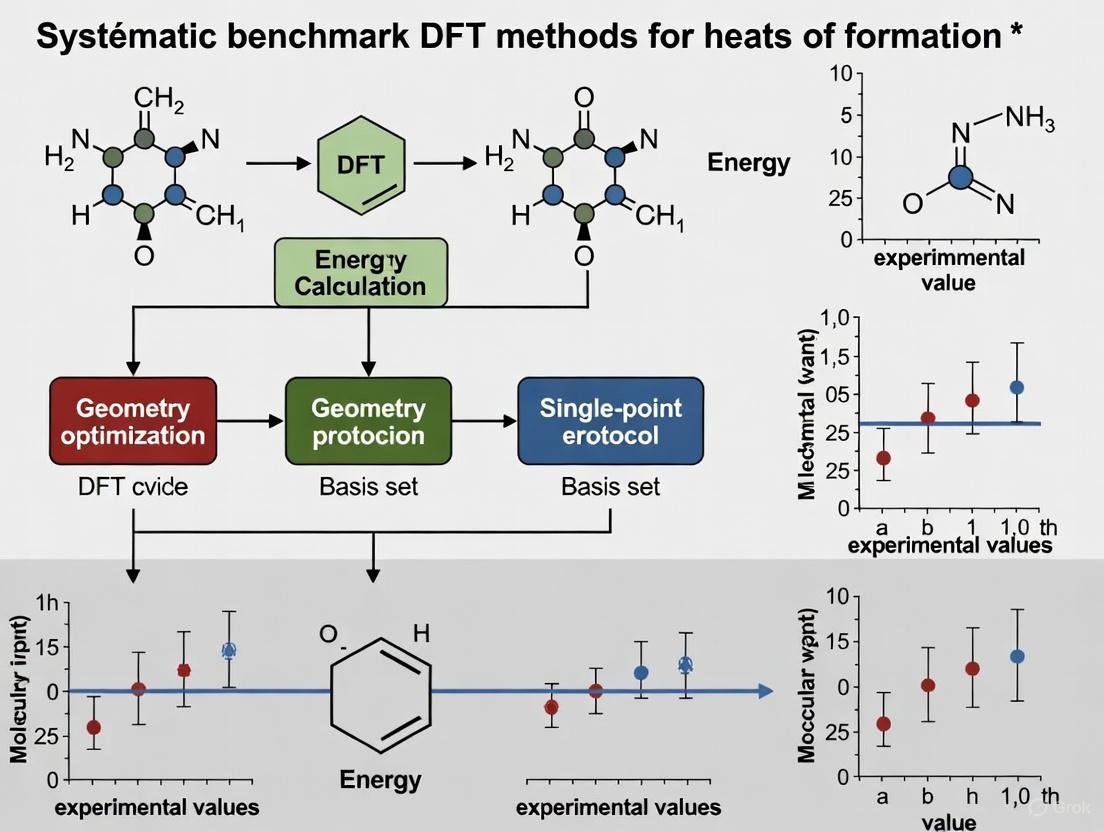
Accurately predicting heats of formation is critical for computational chemistry, materials science, and drug development, yet selecting the right Density Functional Theory (DFT) method remains a challenge.
Systematic Benchmarking of DFT Methods for Heats of Formation: A Guide for Computational Chemists and Drug Developers
Abstract
Accurately predicting heats of formation is critical for computational chemistry, materials science, and drug development, yet selecting the right Density Functional Theory (DFT) method remains a challenge. This article provides a systematic benchmark and practical guide, exploring the foundational principles of DFT benchmarking, methodological approaches for different chemical systems, strategies for troubleshooting and uncertainty quantification, and a comparative validation of popular functionals using the latest gold-standard data. It equips researchers with the knowledge to optimize their computational workflows for reliable thermochemical predictions in biomedical and energy research.
The Critical Challenge: Why Benchmarking DFT for Heats of Formation is Non-Trivial
The Fundamental Importance of Accurate ΔfH° in Drug Design and Materials Science
The standard enthalpy of formation (ΔfH°) is a fundamental thermodynamic property that quantifies the heat released or absorbed when a substance is formed from its constituent elements in their standard states. In both drug design and materials science, accurate prediction of ΔfH° provides crucial insights into compound stability, synthetic feasibility, and performance characteristics. For pharmaceuticals, formation enthalpies help predict binding affinities and metabolic stability, while in materials science, they inform the synthesis pathways and thermodynamic stability of new compounds. The development of computational methods to predict this property with high accuracy has therefore become an essential pursuit, enabling researchers to screen candidate molecules efficiently before undertaking costly synthetic efforts.
Computational Methodologies for Predicting ΔfH°
Density Functional Theory (DFT) Approaches
Density Functional Theory has become a cornerstone for calculating formation enthalpies due to its favorable balance between computational cost and accuracy. Different functionals and approaches have been developed, each with distinct strengths and limitations for specific chemical systems.
Table 1: Performance of Selected DFT Functionals for ΔfH° Prediction
| Functional | Method Class | Reported Accuracy (RMS) | Optimal Use Cases | Key Limitations |
|---|---|---|---|---|
| PBE0 | Hybrid GGA | 1.1 kcal/mol (activation energies) [1] | Main-group thermochemistry, transition metal catalysis | Systematic underestimation for some systems [2] |
| B3LYP | Hybrid GGA | 1.9 kcal/mol (activation energies) [1] | Organic molecules, energetic materials [3] | Underestimates excitation energies [2] |
| M06-2X | Hybrid meta-GGA | 0.26-0.30 eV (excitation energies) [2] | Excited states, charge transfer systems | Overestimates VEEs; less accurate for barriers (6.3 kcal/mol) [1] |
| CAM-B3LYP | Range-separated | 0.32 eV (excitation energies) [2] | Charge-transfer excitations, biochromophores | Systematic overestimation of VEEs (0.25-0.31 eV) [2] |
| ωB97X-D | Range-separated + dispersion | 0.30 eV (excitation energies) [2] | Systems requiring dispersion correction | Performance varies with system type |
The performance of these functionals varies significantly across different chemical systems. For instance, the PBE0 functional with D3 dispersion correction has demonstrated exceptional performance for activation energies of covalent main-group single bonds with an MAD of 1.1 kcal/mol relative to CCSD(T)/CBS reference data [1]. In contrast, range-separated functionals like CAM-B3LYP tend to systematically overestimate vertical excitation energies by 0.2-0.3 eV for biochromophores, prompting the development of empirically adjusted versions like CAMh-B3LYP to reduce this error [2].
Beyond DFT: Emerging Machine Learning Approaches
Recent advances in machine learning have introduced powerful alternatives to traditional quantum mechanical methods for property prediction:
- Neural Network Potentials (NNPs): Models like EMFF-2025 achieve DFT-level accuracy for predicting structures, mechanical properties, and decomposition characteristics of high-energy materials while being significantly more computationally efficient [4].
- Graph Neural Networks (GNNs): These approaches incorporate elemental features and physical symmetries to improve generalization capabilities, even for compounds containing elements not present in the training data [5].
- Transfer Learning: Strategies that leverage pre-trained models like DP-CHNO-2024 enable accurate predictions with minimal new training data, dramatically reducing computational costs for new systems [4].
Experimental Protocols for Validation
Calorimetric Measurement Techniques
Experimental validation of computed ΔfH° values relies primarily on calorimetric methods, which measure heat changes during chemical reactions:
Experimental Workflow for Calorimetric ΔfH° Determination
Bomb Calorimetry involves combusting a sample in a sealed, oxygen-filled vessel surrounded by a known volume of water, allowing complete combustion and accurate measurement of heat release [6]. The calibration factor (CF) is determined using a substance with known enthalpy change: [ CF = \frac{E}{\Delta T} ] where E is the energy released and ΔT is the temperature change. For electrical calibration: [ E = VIt ] where V is voltage, I is current, and t is time [6].
Solution Calorimetry measures enthalpy changes of reactions in solution using insulated vessels to minimize heat loss. This method is particularly valuable for pharmaceutical compounds where solution-phase properties are relevant to biological activity [7] [6].
Experimental determinations face several challenges that must be addressed for accurate results:
- Heat Loss Compensation: Extrapolating cooling curves back to the time of mixing provides better estimates of maximum temperature in the absence of heat loss [7].
- System Calibration: Using the same amount of water during both calibration and measurement minimizes errors [6].
- Accounting for All Components: The heat capacity of all system components (not just the solvent) must be considered for accurate measurements [7].
Specialized Applications Across Disciplines
Energetic Materials Design
In the development of high-energy materials (HEMs), accurate ΔfH° predictions are crucial for determining performance characteristics and stability. Quantum mechanical calculations using atom-equivalent methods can predict gas-phase heats of formation with root mean square deviations of approximately 3.1 kcal/mol from experimental values [3]. The atom-equivalent approach represents the heat of formation as: [ \Delta Hi = Ei - \sum nj \epsilonj ] where (Ei) is the energy of molecule i, (nj) is the number of j atoms in the molecule, and (\epsilon_j) is the atom equivalent correction determined through least-squares fitting to experimental data [3]. For condensed-phase HEMs, neural network potentials like EMFF-2025 now enable large-scale molecular dynamics simulations with DFT-level accuracy, predicting both mechanical properties and thermal decomposition behaviors [4].
Hydrogen Storage Materials
For hydrogen storage applications, DFT calculations help screen potential materials by predicting formation energies and hydrogen storage capacities. Recent studies on Fe-based perovskite hydrides (XFeH₃, where X = Y, Zr) reveal negative formation energies confirming thermodynamic stability, with hydrogen storage capacities of 2.05 wt% and 2.02 wt%, respectively [8]. Such predictions guide experimental efforts toward the most promising candidates.
Pharmaceutical and Biological Systems
In drug design, ΔfH° values inform compound stability and reactivity. Time-dependent DFT (TDDFT) calculations help elucidate light-capturing mechanisms in photobiological systems, though careful functional selection is crucial. For biochromophores, range-separated functionals with adjusted HF exchange (e.g., CAMh-B3LYP, ωhPBE0) significantly reduce systematic errors in excitation energy predictions compared to CC2 reference data [2].
Table 2: Key Computational and Experimental Resources for ΔfH° Research
| Resource Category | Specific Tools | Primary Function | Application Context |
|---|---|---|---|
| Computational Software | Wien2k, TURBOMOLE, ORCA | DFT calculation implementation | Materials screening, reaction modeling |
| Force Fields | EMFF-2025, DP-CHNO-2024 | Neural network potentials | Large-scale MD simulations of HEMs |
| Machine Learning Frameworks | SchNet, MACE | Graph neural network training | Formation energy prediction with elemental features |
| Experimental Instruments | Bomb calorimeter, Solution calorimeter | Direct ΔH measurement | Experimental validation of predictions |
| Benchmark Databases | NIST Chemistry WebBook, Matbench | Reference data sources | Method validation and calibration |
Performance Benchmarking Across Methods
Accuracy Comparison
Table 3: Comprehensive Accuracy Assessment of ΔfH° Prediction Methods
| Methodology | Representative Examples | Reported Accuracy | Computational Cost | System Limitations |
|---|---|---|---|---|
| Semiempirical | NDDO methods | Lower accuracy vs. DFT [9] | Low | Limited transferability |
| Standard DFT | B3LYP, PBE0 | 1.1-1.9 kcal/mol (thermochemistry) [1] | Medium | Charge transfer states, multireference systems |
| Range-Separated DFT | CAM-B3LYP, ωB97X-D | 0.16-0.31 eV (excitation) [2] | Medium-High | Systematic over/under-estimation trends |
| Double-Hybrid DFT | PWPB95-D3, B2PLYP | ~1.9 kcal/mol (barriers) [1] | High | Multireference character challenges |
| Neural Network Potentials | EMFF-2025 | DFT-level accuracy [4] | Low (after training) | Training data requirements |
| Graph Neural Networks | SchNet, MACE | Improved OoD generalization [5] | Variable | Representation space coverage critical |
Guidelines for Method Selection
Choosing the appropriate computational method depends on the specific research requirements:
- For high-throughput screening of organic molecules, B3LYP or PBE0 provide reasonable accuracy with manageable computational cost [1] [3].
- For systems with charge-transfer character or excited states, range-separated functionals like CAM-B3LYP or ωB97X-D are preferable despite systematic errors [2].
- When studying reaction dynamics or large systems, neural network potentials like EMFF-2025 offer near-DFT accuracy with significantly lower computational expense [4].
- For elements outside training distributions, GNNs with elemental features provide the best generalization capabilities [5].
Accurate prediction of ΔfH° remains essential for advances in both drug design and materials science. While DFT methods continue to evolve with improved functionals and corrections, machine learning approaches present a promising path forward, particularly through their ability to capture complex relationships while dramatically reducing computational costs. The integration of physical knowledge into machine learning architectures, as demonstrated by element-aware GNNs and physically-informed NNPs, will likely drive further improvements in predictive accuracy and transferability across the chemical space. As these computational tools become more sophisticated and accessible, they will increasingly enable researchers to navigate complex molecular landscapes with greater confidence, accelerating the discovery and development of novel pharmaceuticals and advanced materials.
Density Functional Theory (DFT) has become an indispensable computational tool across chemistry and materials science, yet its systematic errors present particular challenges when moving beyond simple organic molecules to complex systems such as boron hydrides and inorganic clusters. While DFT provides reasonable accuracy for many organic systems, its performance becomes more variable and method-dependent when confronting the electron-deficient bonding environments in boranes, the strong correlation effects in transition metal complexes, and the delocalized electronic structures in nanomaterials. Understanding these limitations is crucial for researchers relying on computational predictions for drug development, materials design, and catalytic processes.
The inherent approximations in exchange-correlation functionals manifest differently across chemical space, with boron-containing compounds presenting unique challenges due to their propensity for multicenter bonding and electron delocalization. As research expands into increasingly complex systems, a thorough understanding of these systematic errors becomes essential for accurate prediction of molecular properties, reaction energies, and spectroscopic characteristics. This review systematically benchmarks DFT performance across diverse chemical systems, providing researchers with practical guidance for functional selection and error anticipation in computational investigations.
Benchmarking DFT Performance: Quantitative Error Analysis
Comprehensive benchmarking studies reveal substantial variations in DFT performance across different chemical systems. A large-scale assessment of 2648 gas-phase reactions demonstrated that modern functionals can correctly predict temperature-independent equilibrium compositions in over 90% of cases when using appropriate basis sets [10]. However, the errors are not uniformly distributed across chemical space, with particular challenges emerging for specific element combinations and bonding environments.
Table 1: DFT Performance Across Chemical Systems and Properties
| System Category | Representative Error Range | Best-Performing Functionals | Key Challenges |
|---|---|---|---|
| Small Organic Molecules | 2-10 kcal/mol for reaction enthalpies [10] | PBE0, B3-LYP, ωB97X [10] [11] | van der Waals interactions, dispersion forces |
| Inorganic Compounds | Up to 40 kcal/mol for reaction energies [10] | PBE0, TPSS [10] | Strong correlation, metal-ligand bonding |
| Boron Clusters | Significant delocalization errors [12] | PBE0, ωB97X [13] | Electron-deficient bonding, multicenter interactions |
| Transition Metal Complexes | Variable bond dissociation energies [14] | PBE0, B3-LYP [14] | d-electron correlation, spin states |
| Charge-Transfer Systems | Incorrect excitation energies [11] | Range-separated hybrids [11] | Long-range exchange, excited states |
The performance of DFT depends significantly on both the functional choice and basis set quality. For general applications, triple-zeta basis sets (TZVP) typically provide the optimal balance between accuracy and computational cost, with minimal improvement when moving to quadruple-zeta basis sets (QZVPP) [10]. Hybrid functionals like PBE0 and B3-LYP consistently outperform their pure GGA counterparts, though the margin of improvement varies across chemical systems.
Table 2: Functional Performance in Reaction Energy Prediction (Percentage Correct) [10]
| Functional | SVP Basis Set | TZVP Basis Set | QZVPP Basis Set |
|---|---|---|---|
| PWLDA | 88.7% | 90.5% | 90.7% |
| PBE | 92.1% | 94.2% | 94.6% |
| B3-LYP | 92.7% | 94.7% | 94.8% |
| PBE0 | 92.8% | 94.8% | 95.2% |
| M06 | 92.6% | 94.4% | 94.5% |
| TPSS | 91.5% | 95.1% | 94.9% |
Systematic errors in DFT originate from both the electronic ground state energy and the treatment of nuclear motions. The harmonic approximation for vibrational modes introduces temperature-dependent errors that range from -45.53 to 60.53 kJ/mol at 400 K, expanding to -312.72 to 297.78 kJ/mol at 1500 K [10]. These errors become particularly significant when calculating temperature-dependent equilibrium compositions and thermodynamic properties.
Special Challenges in Boron Chemistry and Complex Systems
Electron-Deficient Bonding in Boron Hydrides
Boron-containing compounds present exceptional challenges for DFT due to their electron-deficient nature and propensity for unconventional bonding patterns. The intrinsic electron deficiency in elemental boron networks initially posed significant obstacles to computational characterization [15]. Boron atoms possess only three valence electrons but four valence orbitals, creating unique bonding scenarios that defy traditional two-center, two-electron bond descriptions [15].
The structural diversity of borophene polymorphs exemplifies these challenges, with different lattice configurations and defect patterns dramatically influencing stability [15]. DFT computations have revealed that introducing atomic vacancies plays an essential role in stabilizing borophene structures [15]. For borane clusters like B₅H₁₁, the delocalized nature of electrons in the boron cage limits the efficiency of local correlation methods, requiring careful treatment of electron correlation [12]. These systems often feature three-center, two-electron bonds that test the limits of standard density functionals.
Metal-Doped Boron Clusters
The incorporation of transition metals into boron clusters creates additional complexity, as demonstrated in studies of B₈Cu₃⁻ clusters [13]. DFT investigations reveal that the lowest-energy structure features a vertical Cu₃ triangle supported on a B₈ wheel geometry, with the horizontal Cu₃ configuration lying 3.0 kcal/mol higher in energy at the PBE0 level [13]. Electron localization function (ELF) and Mulliken population analyses indicate strong Cu-B interactions and significant electron delocalization in the most stable isomer [13].
These metal-doped systems exhibit complex bonding patterns with multicenter interactions that challenge standard computational approaches. The accurate description of these clusters requires careful attention to functional selection, with double-hybrid and range-separated functionals often providing improved performance for these electronically complex systems.
Methodological Approaches for Error Mitigation
Advanced Electron Correlation Methods
For systems where standard DFT approaches prove inadequate, advanced electron correlation methods offer improved accuracy at increased computational cost. The incremental scheme provides a systematic approach to calculating correlation energies for large systems by expanding the correlation energy as a sum over contributions from individual domains and their interactions [12].
This method groups localized Hartree-Fock orbitals into domains and calculates correlation energy through a series of calculations on single domains, pairs, triples, etc., until correction terms fall below a specified threshold [12]. Error analysis demonstrates that the propagation of errors in this incremental expansion can be controlled systematically, with total correlation energy errors kept below 1 kcal/mol with respect to canonical coupled cluster singles and doubles (CCSD) calculations [12].
Incremental Scheme Workflow for Correlation Energy Calculation [12]
Charge-Transfer Descriptors and Excited States
The accurate description of charge-transfer excitations presents particular challenges for DFT-based methods. Benchmarking studies have identified several reliable approaches for characterizing these states, with density-based descriptors providing crucial insights into charge-transfer character [11].
The DCT descriptor, based on the variation of electron density upon excitation, has emerged as a particularly valuable tool for identifying charge-transfer states [11]. This approach calculates the distance between centers of charge accumulation and depletion upon excitation, providing a quantitative measure of charge-transfer extent [11]. For supramolecular systems and molecular dimers, orbital-optimized DFT methods (OO-DFT) and time-dependent DFT (TD-DFT) with range-separated hybrid functionals have demonstrated improved performance for charge-transfer excitations [11].
Research Reagent Solutions: Computational Tools for DFT Benchmarking
Table 3: Essential Computational Tools for DFT Benchmarking Studies
| Tool Category | Specific Examples | Primary Function | Application Context |
|---|---|---|---|
| Quantum Chemistry Packages | ORCA [13], Jaguar [14], TURBOMOLE [12] | DFT calculations, geometry optimization, property prediction | General computational chemistry |
| Post-Processing Analysis | Multiwfn [13], TheoDORE [11] | Electron localization analysis, charge-transfer descriptors | Bonding analysis, excited state characterization |
| Wavefunction Analysis | QTAIM, NBO, ELF [16] [13] | Bonding analysis, electron distribution | Understanding bonding patterns in complex systems |
| Reference Databases | CCCBDB [10], NIST Chemistry WebBook [10] | Experimental reference data for benchmarking | Method validation and error assessment |
| Local Correlation Methods | LMP2, LCCSD, LCCSD(T) [12] | Accurate correlation energies for large systems | Systems where conventional coupled cluster is prohibitive |
These computational tools enable researchers to implement the methodologies discussed throughout this review, from initial structure optimization to sophisticated bonding analysis. The combination of robust quantum chemistry packages with specialized analysis tools provides a comprehensive toolkit for assessing and mitigating systematic errors in DFT calculations.
The systematic errors in DFT calculations present significant but manageable challenges when moving from organic molecules to boron hydrides and complex systems. Through careful functional selection, method benchmarking, and the application of specialized approaches for specific chemical challenges, researchers can navigate these limitations while maintaining predictive accuracy.
Future developments in functional design, particularly in range-separated hybrids and double-hybrid functionals, show promise for addressing current limitations in charge-transfer and strongly correlated systems. Similarly, the integration of machine learning approaches with traditional quantum chemistry methods may provide pathways to improved accuracy without prohibitive computational cost. As these methods continue to evolve, systematic benchmarking across diverse chemical spaces will remain essential for guiding method selection and application in both academic and industrial research contexts.
Computational chemistry provides an indispensable toolkit for modern scientific discovery, from designing new drugs to developing high-energy materials. However, the reliability of these computational predictions hinges entirely on the accuracy of the methods employed. A rigorous, multi-layered benchmarking hierarchy has thus emerged, stretching from the theoretical "gold standards" of quantum chemistry to the ultimate arbiter of experimental data. This hierarchy balances a critical trade-off: achieving high chemical accuracy often requires immense computational resources, creating a persistent tension between feasibility and precision. This guide systematically compares the performance of prevalent computational methods—from Coupled Cluster theory to various Density Functional Theory (DFT) functionals and modern machine-learning potentials—using heats of formation and related properties as key metrics. The analysis is framed within a broader thesis on systematic benchmark DFT methods, providing researchers and drug development professionals with a clear, data-driven framework for selecting the appropriate tool for their specific challenge.
The Benchmarking Hierarchy Explained
The benchmarking of computational chemistry methods is not a linear path but a structured ecosystem where high-level theories validate more approximate methods, which in turn are judged against physical reality. The following diagram illustrates the logical relationships and validation pathways within this hierarchy.
This hierarchy functions as follows: Coupled Cluster (CCSD(T)) and Quantum Monte Carlo (QMC) are considered theoretical "gold standards" for solving the Schrödinger equation [17] [18]. Their results are used to validate and calibrate the more approximate Density Functional Theory (DFT) methods. In a modern paradigm, both CCSD(T) and DFT data are also used to train Machine Learning Potentials, such as Neural Network Potentials (NNPs), which aim to achieve near-quantum accuracy at a fraction of the computational cost [4] [17]. Ultimately, the predictions of all these methods—from high-level quantum chemistry to force fields—are benchmarked against real Experimental Data, such as experimentally measured heats of formation, binding energies, or crystal structures [19] [20]. This creates a robust framework for establishing the accuracy and limitations of each computational approach.
Quantitative Performance Comparison of Computational Methods
The true test of any computational method lies in its quantitative performance against reliable benchmarks. The following tables summarize the accuracy of various methods for predicting heats of formation and interaction energies, key properties in material and drug design.
Table 1: Performance of Methods on Heats of Formation (ΔfH°) for Boron Hydrides [19]
| Method | Mean Absolute Error (MAE) for Boron Hydrides (kcal mol⁻¹) | Key Limitation / Note |
|---|---|---|
| G4 | 3.6 | High computational cost |
| CCSD(T) | 6.6 | Requires specialized basis set for core-valence correlation |
| ωB97X-D3 | ~10.0 (est.) | Poor performance vs. hydrocarbons (MAE: 3.2 kcal mol⁻¹) |
| B3LYP-D3 | ~13.0 (est.) | Poor performance vs. hydrocarbons (MAE: 6.0 kcal mol⁻¹) |
| B3LYP-D2 | 13.3 | Empirical dispersion can overcorrect |
Table 2: Performance on Organic/Biological Molecule Benchmarks
| Method / Benchmark | Mean Absolute Error (MAE) / Performance | Application Context |
|---|---|---|
| ANI-1ccx (NNP) | ~1.6 kcal mol⁻¹ (GDB-10to13 relative energies) [17] | General-purpose for organic molecules |
| DLPNO-CCSD(T) | 1.6 kcal mol⁻¹ (ΔfH° for organic molecules) [19] | Approximate CCSD(T) for larger systems |
| DFT (PBE0+MBD) | Accurate structural prediction for ligand-pocket motifs [18] | Non-covalent interactions in drug discovery |
| Hartree-Fock | Outperformed DFT in crystal structure refinement of amino acids [20] | Hirshfeld Atom Refinement (HAR) |
The data reveals critical trends. For heats of formation, high-level methods like G4 and CCSD(T) offer the best accuracy but are computationally demanding [19]. Standard DFT functionals like B3LYP and ωB97X, while excellent for many properties, show significant errors for systems with complex bonding, such as the multicenter bonds in boron hydrides, though they perform much better for typical organic molecules [19]. This highlights the importance of context in benchmarking; a method's performance is system-dependent. Furthermore, modern Neural Network Potentials (NNPs) like ANI-1ccx can approach coupled-cluster accuracy at speeds billions of times faster, bridging the gap between cost and accuracy for specific chemical spaces [17].
Detailed Experimental Protocols
To ensure the reproducibility of benchmark studies, it is essential to outline standard protocols for data generation and validation.
Protocol 1: Coupled Cluster Data Generation for Machine Learning Potentials
This protocol was used to create the data for training the ANI-1ccx potential [17].
- Step 1: Generate Conformational Ensemble. A vast set of diverse molecular conformations (e.g., 5 million from the ANI-1x dataset) is generated, often through active learning or molecular dynamics.
- Step 2: Preliminary DFT Calculation. Single-point energy and force calculations are performed on these conformations using a robust DFT functional (e.g., ωB97X) with a moderate basis set (e.g., 6-31G*).
- Step 3: Intelligent Data Selection. A smaller subset (e.g., ~500,000 conformations) is intelligently selected from the larger DFT set to optimally span the chemical space of interest.
- Step 4: High-Level CC Calculation. Single-point energy calculations are performed on the selected subset at the CCSD(T)*/CBS level, a highly accurate extrapolation to the complete basis set limit.
- Step 5: Transfer Learning. A neural network potential is first pre-trained on the large DFT dataset and then refined (transfer learning) on the high-quality CCSD(T) dataset to create the final potential (e.g., ANI-1ccx).
Protocol 2: Atomization Energy Approach for Heats of Formation
This protocol is a standard method for computationally determining gas-phase enthalpies of formation (ΔfH°), as applied in the study of boron hydrides [19].
- Step 1: Geometry Optimization. The molecule of interest is optimized at a reliable level of theory (e.g., B3LYP/DZVP-DFT or MP2/cc-pVDZ) using strict convergence criteria for energy and gradient.
- Step 2: Frequency Calculation. A harmonic vibrational frequency calculation is performed at the same level of theory as the optimization. This provides the Zero-Point Vibrational Energy (ZPVE) and other thermodynamic corrections (enthalpy, entropy) needed to convert electronic energies into thermodynamic properties at a specific temperature.
- Step 3: High-Level Single-Point Energy Calculation. The total electronic energy of the optimized molecule is computed at a higher level of theory (e.g., CCSD(T) or DFT with a large basis set like def2-QZVP).
- Step 4: Atom Energy Calculation. The energies of the constituent atoms in their standard states (e.g., C(g), H(g), etc.) are calculated at the same high level of theory as in Step 3.
- Step 5: Compute Atomization Energy and ΔfH°. The atomization energy is calculated as the difference between the sum of the atomic energies and the molecular energy. The heat of formation is then derived using this atomization energy and the known experimental heats of formation of the atoms.
Protocol 3: Validating Ligand-Pocket Interactions (QUID Framework)
The QUID framework provides a robust protocol for benchmarking methods on systems relevant to drug discovery [18].
- Step 1: Dimer Selection. Select large, flexible, drug-like molecules (host) and small, representative ligands (e.g., benzene, imidazole).
- Step 2: Equilibrium Dimer Generation. Manually position the ligand near a binding site on the host molecule (e.g., an aromatic ring at ~3.55 Å) and perform a geometry optimization (e.g., at PBE0+MBD level) to generate an equilibrium dimer structure.
- Step 3: Non-Equilibrium Conformation Sampling. For a subset of equilibrium dimers, generate non-equilibrium conformations by displacing the ligand along the dissociation coordinate (e.g., using a scaling factor q from 0.90 to 2.00 of the equilibrium distance), with heavy atoms frozen.
- Step 4: "Platinum Standard" Energy Calculation. Calculate the interaction energy (E_int) for all dimers using two fundamentally different high-level methods, specifically Localized Natural Orbital Coupled Cluster (LNO-CCSD(T)) and Fixed-Node Diffusion Monte Carlo (FN-DMC). The benchmark "platinum standard" value is established where these two methods converge (e.g., within 0.5 kcal/mol).
- Step 5: Benchmark Approximate Methods. Compute E_int for all dimers using various DFT functionals, semi-empirical methods, and force fields. Their performance is assessed by comparing their predictions against the established "platinum standard" energies.
The Scientist's Toolkit: Essential Research Reagents
This section details key computational "reagents" and resources essential for conducting rigorous benchmark studies in computational chemistry.
Table 3: Key Research Reagents and Computational Resources
| Item Name | Function / Application | Example Use Case |
|---|---|---|
| Coupled Cluster Theory | Provides theoretical gold-standard energies for small systems; used to train/validate faster methods. | Generating benchmark data for reaction energies and non-covalent interactions [17] [18]. |
| Density Functional Theory (DFT) | Balanced speed/accuracy method for geometry optimization and property prediction of medium-sized systems. | Optimizing molecular structures and predicting spectroscopic parameters [21] [19]. |
| Neural Network Potentials (NNPs) | Surrogate models trained on QM data to achieve near-QM accuracy at million-fold speed increases. | Large-scale molecular dynamics simulations of energetic materials [4] [17]. |
| def2 Basis Set Series | Standardized, size-consistent Gaussian basis sets for accurate QM calculations across the periodic table. | Standard choice for molecular DFT calculations and Hirshfeld Atom Refinement (HAR) [19] [20]. |
| PubChemQCR Dataset | Large-scale dataset of DFT relaxation trajectories for small organic molecules; used for training MLIPs. | Benchmarking the generalizability of machine learning interatomic potentials [22]. |
| Hirshfeld Atom Refinement (HAR) | QM-based method for refining crystal structures against XRD data, providing highly accurate H-atom positions. | Determining precise molecular geometries in the solid state for use as experimental benchmarks [20]. |
The benchmarking hierarchy from Coupled Cluster to experimental data provides an essential, systematic framework for validating computational methods. The quantitative comparisons presented in this guide clearly demonstrate that there is no single "best" method for all scenarios. While CCSD(T) remains the gold standard for accuracy, its cost is prohibitive for most practical applications. DFT offers a versatile balance but requires careful functional selection, particularly for challenging systems like boron hydrides or non-covalent interactions in drug discovery.
The most promising future direction lies in the integration of machine learning with traditional quantum chemistry. Transfer learning, where models pre-trained on massive DFT datasets are fine-tuned on high-quality CC data, has proven capable of producing potentials like ANI-1ccx and EMFF-2025 that approach quantum-mechanical benchmark accuracy at a fraction of the cost [4] [17]. As these methods mature and are validated against robust experimental and theoretical benchmarks, they are poised to redefine the boundaries of what is computationally feasible, ultimately accelerating discovery across chemistry, materials science, and drug development.
Calculating accurate thermochemical properties, such as enthalpies of formation, is a fundamental test for electronic structure methods. Density Functional Theory (DFT) is widely used due to its favorable balance of cost and accuracy. However, its performance is not universal; certain chemical systems expose significant limitations of approximate exchange-correlation functionals. This guide objectively compares the performance of various computational methods when applied to two particularly challenging classes of systems: molecules with multicenter bonding and transition metal complexes.
Benchmark studies reveal that these systems are challenging because their electronic structure requires a delicate treatment of electron correlation effects that are often poorly described by standard DFT functionals. For researchers in drug development and materials science, where such motifs are common, selecting an inappropriate computational method can lead to large errors in predicted energies, stability, and reactivity.
Multicenter Bonding: The Case of Boron Hydrides
The Computational Challenge
Boron hydrides feature three-center two-electron (3c-2e) bonds and three-dimensional aromaticity, leading to structures that differ dramatically from traditional hydrocarbons with their two-center two-electron bonds [19]. This unique bonding presents a severe test for computational methods. The difficulty arises from the complex electron correlation effects inherent in multicenter bonding, which are not captured accurately by many standard functionals [19].
Table 1: Performance of Computational Methods for Boron Hydride Heats of Formation (kcal/mol)
| Method | Mean Absolute Error (MAE) | Key Finding |
|---|---|---|
| G4 | 3.6 | Best performer for boron hydrides [19] |
| CCSD(T) | 6.6 | Requires specialized basis sets for accuracy [19] |
| ωB97X-D3 | >3.2 | Much larger errors vs. organic molecules (MAE 3.2 for organics) [19] |
| B3LYP-D3 | >6.0 | Much larger errors vs. organic molecules (MAE 6.0 for organics) [19] |
Performance Data and Analysis
The data shows a significant accuracy gap between the best methods and commonly used DFT functionals. The G4 composite method achieves a high level of accuracy (MAE 3.6 kcal/mol), while even high-level methods like CCSD(T) show compromised accuracy (MAE 6.6 kcal/mol) unless combined with a basis set optimized for core-valence correlation effects [19]. The empirical dispersion correction D3, when combined with the BJ damping function, was found to provide excessively large intramolecular dispersion energies for boron hydrides, thereby compromising the accuracy of DFT-D3 methods [19].
Recommended Experimental Protocols
For reliable results on boron clusters, the following protocol is recommended based on benchmark studies [19]:
- Geometry Optimization: Use B3LYP/DZVP-DFT or MP2/cc-pVDZ levels with strict convergence criteria.
- Single-Point Energy Calculation: Employ high-level methods like CCSD(T) with basis sets specifically designed for accurate description of core-valence correlation. The atomization energy approach is used to compute ΔfH°.
- Bonding Analysis: Apply the intrinsic bond orbital (IBO) method to identify complex bonding, such as the five-center two-electron (5c-2e) bond in B5H9.
Diagram 1: Computational workflow for boron hydrides.
Transition Metal Complexes: Spin States and Binding Energies
The Computational Challenge
Transition metal (TM) complexes, such as metalloporphyrins found in hemoglobin and cytochrome P450 enzymes, are ubiquitous in biology and catalysis. A primary challenge is accurately calculating spin-state energetics—the energy differences between low-spin (LS) and high-spin (HS) states. This is critical for characterizing spin-crossover materials and modeling open-shell reaction mechanisms [23]. The accuracy of DFT for these systems is heavily influenced by the admixture of exact exchange (EE); higher EE typically stabilizes the HS state [23].
Performance Data and Analysis
Benchmarking against the Por21 database reveals that most functionals fail to achieve "chemical accuracy" (1.0 kcal/mol) for spin-state energetics and binding energies in metalloporphyrins [24].
Table 2: Performance of Select DFT Functionals for Transition Metal Porphyrins (Por21 Database)
| Functional | Type | Mean Unsigned Error (MUE, kcal/mol) | Remarks |
|---|---|---|---|
| GAM | GGA | <15.0 | Best overall performer [24] |
| r2SCANh | Hybrid Meta-GGA | 10.8 | Top performer among commonly suggested functionals [24] |
| HCTH | GGA | ~15.0 | Class A performer [24] |
| revM06-L | Meta-GGA | ~15.0 | Class A performer [24] |
| B3LYP | Hybrid GGA | >23.0 | Failing grade; representative of many popular hybrids [24] |
The errors for most functionals are at least twice the best-case MUE, with many suffering from catastrophic failures [24]. Range-separated and double-hybrid functionals with high percentages of exact exchange are often particularly problematic. Furthermore, many functionals incorrectly predict the ground state of iron(III) and cobalt(II) porphyrins, casting doubt on computed reaction mechanisms [24].
Recommended Experimental Protocols
For reliable computation of TM complex properties [24] [23]:
- Functional Selection: Use local functionals (GGAs or meta-GGAs) or global hybrids with a low percentage of exact exchange (e.g., r2SCANh, revM06-L).
- Geometry Optimization: Perform with a selected functional, noting that dispersion corrections have minimal effect on spin-state energy differences.
- Reference Data: When possible, benchmark against experiment-derived spin-state gaps, which may require correcting for vibrational and environmental (solvent, crystal) effects [23].
- Wavefunction Methods: For highest accuracy, use correlated wavefunction methods like DLPNO-CCSD(T) or CASPT2 on top of DFT-optimized geometries, though their computational cost is high [23].
Diagram 2: Computational workflow for transition metal complexes.
The Scientist's Toolkit: Key Research Reagents and Methods
This table details essential computational "reagents" and their functions for tackling these challenging systems.
Table 3: Essential Computational Tools for Challenging Chemical Systems
| Tool / Method | Function | Application Notes |
|---|---|---|
| CCSD(T) | High-level wavefunction method for accurate energies | Requires specialized basis for boron; high cost for TMs [19] |
| G4 | High-accuracy composite method | Best for boron hydride ΔfH° [19] |
| r2SCANh / revM06-L | Density Functional Approximations | Recommended for TM spin-state and binding energies [24] |
| DLPNO-CCSD(T) | Approximate coupled cluster method | Balances accuracy and cost for larger TM complexes [23] |
| CASPT2 | Multireference perturbation theory | For systems with strong static correlation [24] |
| Intrinsic Bond Orbital (IBO) | Bonding analysis | Visualizes complex bonding (e.g., 5c-2e bonds) [19] |
| Atomization Energy Approach | Calculates gas-phase enthalpy of formation | Used for boron hydride benchmarks [19] |
Systematic benchmarking reveals a clear hierarchy of method performance for challenging chemical systems. For multicenter-bonded boron hydrides, high-level composite methods (G4) or specially-tailored CCSD(T) calculations are necessary for accurate thermochemistry. For transition metal complexes, the choice of DFT functional is critical; local functionals and those with low exact exchange (like r2SCANh and revM06-L) generally provide the most balanced description of spin-state energetics, while popular hybrids like B3LYP often fail.
The pursuit of universal, chemically accurate functionals continues. Until then, researchers and drug development professionals must rely on method-specific benchmarks and the protocols outlined here to ensure computational predictions are both reliable and meaningful.
Computational Approaches: From Atomization Energy to Advanced Error-Correction Schemes
The accurate prediction of thermochemical properties, such as enthalpy of formation (ΔHf), is a cornerstone of computational chemistry with critical applications in the development of energetic materials, pharmaceuticals, and novel chemical processes [25]. The performance of quantum chemical methods in calculating these properties varies significantly based on the chosen computational protocol. This guide provides an objective comparison of three core calculation strategies—the atomization energy method, the isodesmic reaction approach, and the novel isocoordinated reaction method—within the context of systematically benchmarking Density Functional Theory (DFT) for heats of formation research. We summarize quantitative performance data, detail experimental protocols, and provide essential resources to guide researchers in selecting the appropriate method for their specific needs.
The three methods differ fundamentally in their computational design, balancing the trade-off between theoretical rigor and practical error cancellation. The following diagram illustrates the core workflow and logical relationship between these approaches.
Performance Benchmarking and Quantitative Comparison
The choice of method profoundly impacts the accuracy and computational cost of the resulting thermochemical predictions. The following tables summarize key performance metrics across the different approaches, providing a quantitative basis for comparison.
Table 1: Comparative Accuracy of Calculation Methods
| Calculation Method | Mean Absolute Error (MAE) | Key Advantages | Key Limitations |
|---|---|---|---|
| Atomization Energy [26] | Varies by DFT functional:• Best (M06-2X): 1.8 kcal mol⁻¹• Worst (B97-D): 10.0 kcal mol⁻¹ | • Theoretically direct• No need for reference reactions | • No error cancellation• Extremely sensitive to method quality |
| Isodesmic Reaction [27] | Can be < 1.0 kcal mol⁻¹ with low-level theory (e.g., HF/STO-3G) | • Excellent error cancellation• Accurate with inexpensive methods | • Requires known ΔHf of references• Limited to gas phase |
| Isocoordinated Reaction [25] | 9.3 kcal mol⁻¹ (39 kJ mol⁻¹) for over 150 solid energetic materials | • Direct solid-phase ΔHf calculation• No experimental input or fitting | • Higher MAE than best isodesmic cases• Newer, less validated method |
Table 2: DFT Functional Performance for Challenging Thermochemistry (TAE Benchmark) [26]
| Functional Type | Example Functional | Mean Absolute Deviation (MAD) for TAEs (kcal mol⁻¹) |
|---|---|---|
| Pure-GGA | B97-D | 10.0 |
| Meta-GGA | B97M-V | 2.9 |
| Hybrid-GGA | CAM-B3LYP-D4 | 4.0 |
| Hybrid-Meta-GGA | M06-2X | 1.8 |
Detailed Experimental Protocols
Atomization Energy Method
The Total Atomization Energy (TAE) approach is considered the most demanding test for electronic structure methods because it involves breaking all bonds in a molecule without any error cancellation [26].
- Geometry Optimization: Fully optimize the molecular structure of the target compound using a chosen DFT functional and basis set [26].
- Frequency Calculation: Perform a frequency calculation at the same level of theory to confirm a true minimum (no imaginary frequencies) and to obtain the zero-point vibrational energy (ZPVE) [26].
- Single Point Energy Calculation: Calculate the electronic energy of the optimized target molecule.
- Atomic Energy Calculations: Calculate the electronic energies of the individual constituent atoms (e.g., C, H, O, N) in their ground states, using the same method and basis set.
- TAE Calculation: The TAE is computed as the difference between the sum of the energies of the isolated atoms and the energy of the molecule: TAE = ΣE(atoms) - E(molecule).
- Enthalpy of Formation: The gas-phase enthalpy of formation is derived from the TAE using known enthalpies of formation of the atoms [26].
Isodesmic Reaction Method
This method uses a balanced hypothetical reaction where the number and formal types of bonds remain constant, leading to significant error cancellation [28] [27].
- Reaction Design: Construct a balanced chemical reaction for the target molecule where the types and number of chemical bonds are conserved on both sides [27]. For example, to find the ΔHf of ethanol, one might use: CH₃CH₂OH + CH₄ → CH₃CH₃ + CH₃OH [27].
- Reference Selection: Select reference molecules (e.g., CH₄, CH₃CH₃, CH₃OH) for which highly accurate experimental or theoretical enthalpies of formation are known [27].
- Geometry Optimization & Energy Calculation: Optimize the geometries and calculate electronic energies for all species in the reaction (target and references) at a consistent level of theory.
- Reaction Energy Calculation: Compute the energy of the isodesmic reaction (ΔE_rxn) from the electronic energies.
- Target ΔHf Calculation: Use Hess's Law to calculate the unknown enthalpy of formation of the target molecule. The formula is: ΔH_f(target) = Σ ΔH_f(products) - Σ ΔH_f(reactants) + ΔE_rxn, where the sums are over the stoichiometrically weighted known ΔHf values [27].
Isocoordinated Reaction Method
This recently developed method extends the error-cancellation principle to the direct calculation of solid-phase enthalpies of formation by conserving the coordination environment of each atom [25].
- Crystal Structure Preparation: Obtain the experimental crystal structure of the solid energetic material from a database like the Cambridge Structural Database (CSD) [25].
- DFT Structural Relaxation: Perform DFT structural relaxation of the crystal, including dispersion corrections (e.g., DFT-D3), to optimize lattice parameters [25].
- Reference State Assignment: For each atom in the material, identify its coordination number. The constituent elements are then represented by small reference molecules where the central atom has the same coordination number [25]:
- H (Coordination Number = 1): H₂
- O (CN=1): O₂
- O (CN=2): H₂O
- N (CN=1): N₂
- N (CN=2): N₂H₂
- N (CN=3): NH₃
- Energy Calculation: Compute the enthalpy difference between the solid-phase energetic material and a "reaction" with its constituent elements in these reference states [25].
- ΔHf, solid Calculation: The standard solid-phase enthalpy of formation is obtained directly from this first-principles calculation, without using experimental gas-phase ΔHf or sublimation enthalpy data [25].
The Scientist's Toolkit: Essential Research Reagents & Databases
Table 3: Key Computational Resources for Thermochemical Benchmarking
| Resource Name | Type | Primary Function | Relevance |
|---|---|---|---|
| GDB9-W1-F12 Database [26] | Thermochemical Database | Provides 3,366 highly accurate CCSD(T)/CBS Total Atomization Energies for organic molecules up to 8 non-H atoms. | Benchmarking DFT functional performance. |
| MSR-ACC/TAE25 Dataset [29] [30] | Thermochemical Database | A massive dataset of 76,879 TAEs at the CCSD(T)/CBS level, broadly covering chemical space for elements up to argon. | Training and validating data-driven models. |
| Cambridge Structural Database (CSD) [25] | Structural Database | A repository of experimentally determined crystal structures. | Source of initial geometries for solid-state calculations. |
| CCCBDB (NIST) [10] | Thermochemical Database | A collection of experimental thermochemical data for molecules. | Source of reference ΔHf values and Gibbs free energies for method validation. |
| DFT-D3 [25] | Computational Method | An empirical dispersion correction for DFT. | Critical for accurately modeling intermolecular interactions in solids and molecular crystals. |
Leveraging Massive Datasets (OMol25) for Training and Validation
The emergence of massive, curated datasets represents a paradigm shift in computational chemistry, enabling the development and validation of more accurate and transferable models for predicting critical molecular properties. In the specific context of benchmarking Density Functional Theory (DFT) methods for heats of formation research, these large-scale datasets provide the essential foundation for systematic comparison and methodological improvement. The OMol25 dataset, alongside other contemporary data resources, allows researchers to move beyond isolated validation on small, homogeneous molecular sets to robust evaluation across diverse chemical spaces. This comprehensive approach is crucial for identifying methodological strengths and weaknesses, ultimately guiding the selection and development of computational strategies with proven predictive power for thermochemical properties. The integration of machine learning with traditional quantum chemical approaches further leverages these datasets, creating powerful hybrid frameworks that achieve chemical accuracy while managing computational expense [4] [31].
Comparative Performance of Quantum Chemistry Methods
Benchmarking Density Functionals for Enthalpy of Formation
Table 1: Performance of Select Minnesota Functionals for ΔHf° Prediction (Hydrocarbons)
| Density Functional | Mean Absolute Error (MAE) (kcal/mol) | Key Characteristics | Sensitivity to ZPE Corrections |
|---|---|---|---|
| MN15 | 1.70 (with ZPE) | Highest accuracy for diverse hydrocarbons; recommended for general use | Moderate |
| M06-2X | Available in source | Good overall performance | Moderate |
| MN12-SX | Available in source | Competitive for some applications | High (limiting factor for reliability) |
Note: Benchmarks performed with Gaussian 16, cc-pVTZ basis set, using the atom equivalent method. ZPE = Zero-Point Energy [31].
The accurate prediction of standard enthalpy of formation (ΔHf°) is a critical test for quantum chemical methods. Recent benchmarking of three Minnesota density functionals (M06-2X, MN12-SX, and MN15) on a diverse set of hydrocarbons identified MN15 as the most accurate functional when zero-point energy corrections are included, achieving a mean absolute error of 1.70 kcal/mol [31]. This level of accuracy approaches chemical accuracy (1 kcal/mol), making it suitable for predictive studies where experimental data is unavailable. In contrast, the MN12-SX functional exhibited significant sensitivity to ZPE corrections, limiting its reliability for thermochemical predictions. These findings highlight the importance of systematic benchmarking on large, diverse datasets like OMol25 to identify functionals with consistent performance across different molecular classes.
Cross-Functional Transferability Challenges in Foundation Models
Table 2: Comparison of DFT Methodologies for Foundation Potentials
| Methodological Approach | Typical Formation Energy MAE | Strengths | Limitations |
|---|---|---|---|
| GGA/GGA+U (PBE) | ~194 meV/atom (compounds) | Computationally efficient; extensive datasets available | Large errors in oxides and strongly bound systems |
| Meta-GGA (SCAN) | ~84 meV/atom (compounds) | Improved accuracy for formation energies, volumes, band gaps | Higher computational cost; smaller datasets |
| r2SCAN | Similar to SCAN | Balanced accuracy and numerical stability | Limited large-scale datasets; transfer learning required |
Note: Data compiled from large-scale tests on formation energies of solid-state compounds [32].
The development of foundation machine learning interatomic potentials (MLIPs) faces significant challenges regarding cross-functional transferability. Current foundation potentials predominantly trained on Generalized Gradient Approximation (GGA) and GGA+U calculations inherit the limitations of these functionals, including mean absolute errors of approximately 194 meV/atom for formation energy prediction across diverse compounds [32]. The transition to higher-fidelity functionals like the meta-GGA r2SCAN, which demonstrates improved accuracy with MAEs of approximately 84 meV/atom, is complicated by significant energy scale shifts and poor correlation between different functional levels. This creates fundamental challenges for transfer learning approaches, where models pre-trained on lower-fidelity data struggle to adapt to higher-fidelity datasets, often requiring specialized techniques like elemental energy referencing to achieve satisfactory performance [32].
Machine Learning Potentials: A New Frontier
Performance of Emerging Neural Network Potentials
Table 3: Machine Learning Potentials for Molecular Property Prediction
| Model/Approach | Key Features | Demonstrated Applications | Reported Performance |
|---|---|---|---|
| EMFF-2025 | General NNP for C,H,N,O systems; Transfer learning | Structure, mechanical properties, decomposition of 20 HEMs | MAE: ~0.1 eV/atom (energy), ~2 eV/Å (force) |
| MACE-OFF | Short-range transferable FF; 10 organic elements | Molecular crystals, liquids, proteins, torsion scans | Accurate lattice parameters, energies, dynamics |
| ANI-2x | Classical ML force field; Broad organic coverage | Molecular simulations; Hybrid ML/MM | Widely adopted benchmark |
| CHGNet | Foundation potential with charge information | Crystal properties, dynamics | Challenges in cross-functional transfer |
HEMs = High-Energy Materials [4] [32] [33].
Machine learning potentials have emerged as powerful surrogates for direct quantum mechanical calculations, achieving near-DFT accuracy with significantly reduced computational cost. The EMFF-2025 model, a general neural network potential for C, H, N, O-based systems, demonstrates the effectiveness of transfer learning approaches, achieving mean absolute errors within ±0.1 eV/atom for energies and ±2 eV/Å for forces across 20 high-energy materials [4]. Similarly, the MACE-OFF framework showcases remarkable capabilities for organic molecules, producing accurate dihedral torsion scans for unseen molecules, reliable descriptions of molecular crystals and liquids, and even enabling nanosecond-scale simulations of fully solvated proteins [33]. These advances highlight how massive datasets enable the development of ML potentials with exceptional transferability across chemical space.
The Out-of-Distribution Generalization Challenge
Despite these advances, systematic benchmarking through initiatives like BOOM (Benchmarking Out-Of-distribution Molecular property predictions) reveals fundamental limitations in current ML models. Across 10 diverse molecular property tasks and 12 ML models, no existing approach achieved strong out-of-distribution generalization across all tasks, with the top-performing model exhibiting an average OOD error approximately 3 times larger than in-distribution error [34]. This performance gap presents a critical challenge for molecular discovery campaigns, which inherently require extrapolation beyond known chemical space. The findings underscore the need for more sophisticated architectures, training strategies, and benchmarking practices that specifically address OOD generalization rather than merely optimizing in-distribution performance [34].
Experimental Protocols and Methodologies
Quantum Chemical Benchmarking Workflow
The reliable benchmarking of computational methods requires standardized, rigorous protocols. For enthalpy of formation predictions, the atom equivalent method provides a robust approach, where carbon and hydrogen energy equivalents are obtained via least-squares fitting to experimental data [31]. Calculations typically employ high-level theory such as the MN15 functional with the correlation-consistent polarized valence triple-zeta (cc-pVTZ) basis set, incorporating vibrational frequency calculations for zero-point energy corrections. Single-point electronic energies should be computed with tight convergence criteria and ultrafine integration grids to minimize numerical errors, with the Gaussian 16 software package commonly employed for such studies [31] [35].
Machine Learning Potential Development Pipeline
The development of generalizable neural network potentials like EMFF-2025 follows a sophisticated pipeline beginning with the creation of diverse training datasets from first-principles calculations. The Deep Potential Generator (DP-GEN) framework provides an active learning approach for efficiently sampling the configuration space, while transfer learning strategies leverage pre-trained models on larger, lower-fidelity datasets to accelerate learning on smaller, higher-fidelity datasets [4]. Training typically employs deep neural networks with physical constraints such as translational, rotational, and periodic invariance, with models validated against both quantum mechanical references and experimental data for properties including crystal parameters, mechanical properties, and thermal decomposition behavior [4] [32].
Diagram 1: Workflow for computational method benchmarking using massive datasets, showing the iterative cycle of quantum chemical calculation, machine learning, and multi-level validation.
Research Reagent Solutions: Essential Computational Tools
Table 4: Essential Software and Computational Tools for Molecular Property Prediction
| Tool Name | Category | Primary Function | Application in Heats of Formation Research |
|---|---|---|---|
| Gaussian 16 | Quantum Chemistry | Electronic structure calculations | Reference DFT calculations with various functionals |
| ADF | Quantum Chemistry | DFT with relativistic methods | Heavy element systems; QM/MM approaches |
| DP-GEN | Machine Learning | Active learning for ML potentials | Automated configuration space sampling |
| CHGNet | Foundation Potential | Pre-trained MLIP | Transfer learning starting point |
| MACE-OFF | Machine Learning | Organic molecule force field | Biomolecular system simulations |
| BerkeleyGW | Many-Body Perturbation | Excited state calculations | Beyond-DFT accuracy benchmarks |
| ASE | Atomistic Simulation | Workflow automation | High-throughput calculation management |
Note: MLIP = Machine Learning Interatomic Potential [36] [32] [37].
The computational chemist's toolkit for leveraging massive datasets encompasses both traditional quantum chemistry packages and emerging machine learning frameworks. Established quantum chemistry software like Gaussian 16 and ADF provide the reference calculations essential for training and validation, offering a range of density functionals, basis sets, and solvation models [36] [31] [35]. Specialized tools like the Atomic Simulation Environment (ASE) enable workflow automation and high-throughput computation management, while machine learning frameworks such as DP-GEN facilitate the active learning cycles necessary for developing robust neural network potentials [4] [36]. The emerging category of foundation potentials, including CHGNet and MACE-OFF, offers pre-trained models that can be fine-tuned for specific applications, significantly reducing the computational cost of property prediction [32] [33].
The systematic benchmarking of computational methods using massive datasets like OMol25 represents a critical advancement in the pursuit of predictive thermochemical calculations. The comprehensive evaluation of density functionals reveals significant performance differences, with meta-GGA functionals like MN15 and r2SCAN generally outperforming GGA approaches for formation enthalpy prediction, though with higher computational cost. Machine learning potentials demonstrate remarkable potential as accurate, efficient surrogates for quantum mechanical calculations, though challenges remain in out-of-distribution generalization and cross-functional transferability. The integration of these approaches—leveraging massive datasets for both traditional quantum chemical benchmarking and machine learning model development—provides a powerful pathway toward more accurate, efficient, and reliable prediction of molecular properties essential for materials design and drug development. Future progress will depend on continued expansion of high-fidelity datasets, development of more sophisticated transfer learning approaches, and systematic attention to out-of-distribution generalization in model evaluation.
Density Functional Theory (DFT) is a cornerstone of computational chemistry and materials science, enabling the prediction of molecular and solid-state properties by solving the Kohn-Sham equations to reconstruct electron density distributions [38]. The accuracy of these predictions, however, critically depends on the approximations made for the exchange-correlation energy (E_xc), a term that encompasses all quantum mechanical effects not covered by the simple non-interacting kinetic and electrostatic energy treatments [39] [40]. With hundreds of available functionals, selecting the appropriate one for a specific system or property remains a significant challenge for researchers [40].
This guide provides a systematic framework for functional and basis set selection, particularly within the context of benchmarking DFT methods for calculating properties like heats of formation. We present an objective comparison of functional performance across different chemical systems, supported by experimental and high-level theoretical data, to equip researchers with practical decision-making tools for their computational investigations.
Theoretical Foundation of DFT and the Exchange-Correlation Problem
In the Kohn-Sham formulation of DFT, the total electronic energy is expressed as a sum of several components: the non-interacting kinetic energy of a fictitious reference system, the electrostatic interactions (electron-nuclei attraction and classical electron-electron repulsion), and the exchange-correlation energy [40]. The precise mathematical formulation is:
$$E\textrm{electronic} = T\textrm{non-int.} + E\textrm{estat} + E\textrm{xc}$$ [39]
The exchange-correlation energy (Exc) and its associated potential (vxc = δExc/δρ) are the only terms that lack an exact, universally applicable form [39] [40]. The development of increasingly sophisticated approximations for Exc gives rise to the various families of functionals, each with distinct computational costs, strengths, and limitations [38].
Table 1: Hierarchy of Common Exchange-Correlation Functional Types
| Functional Type | Dependence | Key Features | Computational Cost | Example Functionals |
|---|---|---|---|---|
| LDA (Local Density Approximation) | Local electron density (n) [40] | Nearly exact for homogeneous electron gas; inaccurate for most real systems [40] [38] | Lowest | SPW92, SVWN5 [41] |
| GGA (Generalized Gradient Approximation) | Electron density and its gradient (n, ∇n) [40] | Improved over LDA for molecular properties and hydrogen bonding [38] | Low | PBE, BLYP, revPBE [41] |
| meta-GGA | Electron density, its gradient, and kinetic energy density (n, ∇n, τ) [40] | Can detect bonding character; better for reaction energies and lattice properties [39] | Moderate | SCAN, M06-L, TPSS [41] |
| Hybrid | Mix of Hartree-Fock (HF) and semilocal exchange [40] | Often more accurate for reaction mechanisms and molecular spectroscopy [38] | High | B3LYP, PBE0, HSE06 [42] [40] |
| Hybrid + vdW | Includes non-local correlation for dispersion [39] | Crucial for systems dominated by weak interactions (e.g., physisorption) [39] | High | B97M-V, B97-D, VV10 [41] |
A Systematic Guide to Functional Selection
Choosing the right functional requires balancing computational cost, system characteristics, and the target properties. The following workflow and detailed breakdown provide a structured approach to this selection process.
Diagram 1: A practical workflow for selecting a density functional.
Selection by System Composition and Properties
Solids, Surfaces, and Bulk Materials
For periodic systems like solids and surfaces, GGAs like PBE are widely used and perform well for structural properties and initial geometry optimizations [40]. The PBE functional offers a good balance of reliability and computational efficiency for cohesive and elastic properties [39]. For more accurate energetics, including surface chemistry and bulk properties simultaneously, modern meta-GGAs like SCAN are recommended, as they provide a better description of different bonding types [39] [40]. When dispersion forces are critical, as in physisorption or layered materials, functionals with non-local van der Waals corrections, such as rVV10 or BEEF-vdW, are essential [39] [41]. For accurate electronic band structures, especially band gaps, hybrid functionals like HSE06 are superior to semi-local functionals, though at a significantly higher computational cost [39] [40].
Molecular Systems and Reaction Mechanisms
For gas-phase molecular calculations, including reaction energies and barrier heights, hybrid functionals often show superior performance. B3LYP and PBE0 are well-established for studying reaction mechanisms and molecular spectroscopy [38]. The M06 suite of functionals is also a popular choice for main-group thermochemistry and kinetics [42]. Double-hybrid functionals, which incorporate a second-order perturbation theory correction, can provide even higher accuracy for excited-state energies and reaction barriers but are computationally very intensive [38].
Transition Metal Complexes and Strongly Correlated Systems
Systems containing transition metals pose a significant challenge for standard DFT due to localized d- or f-electrons, which can lead to self-interaction errors [39]. For such systems, a GGA+U or meta-GGA+U approach, which adds an on-site Coulomb repulsion term (Hubbard U), can often be as reliable as the much more costly hybrid functionals [39] [40]. Studies on complexes containing first-row transition metals have shown that PBE0 and M06 perform similarly to B3LYP, but their accuracy can be substantially improved with localized orbital correction approaches like DBLOC [42]. For strongly correlated materials like certain transition metal oxides, a beyond-DFT treatment is often necessary [39].
Pharmaceutical and Biomolecular Applications
In drug formulation design, where understanding API-excipient interactions is key, functionals that accurately describe weak interactions are vital. GGA functionals are a preferred choice for biomolecular systems and hydrogen bonding [38]. For quantifying van der Waals interactions and π-π stacking, which are critical in nanodelivery systems and drug-target binding, long-range corrected (LC-)DFT or empirically-corrected functionals like B97-D are highly effective [38] [41].
Performance Benchmarking and Experimental Data
The true test of a functional's utility lies in its performance against reliable experimental or high-level theoretical benchmark data. The following table and case studies illustrate this comparative performance.
Table 2: Quantitative Performance Comparison of Select Functionals Across Systems
| Functional (Type) | Transition Metal Redox Potentials (MUE) | Surface Chemisorption Energy (MAE) | Band Gap of Silicon (eV) | D2 Sticking on Cu(111) |
|---|---|---|---|---|
| PBE (GGA) | ~0.3 V [42] | Moderate [39] | ~0.6 (Underestimated) [39] | Poor agreement with experiment [39] |
| PBE0 (Hybrid) | ~0.3 V (Improved with DBLOC) [42] | - | - | - |
| M06 (meta-GGA) | ~0.3 V (Improved with DBLOC) [42] | - | - | - |
| MCML (meta-GGA) | - | Low (~0.1 eV) [39] | - | - |
| MS-B86bl (meta-GGA) | - | - | - | Excellent agreement [39] |
| HSE06 (Hybrid) | - | - | >1.0 (Improved) [39] | - |
| Experiment / Benchmark | Reference Data [42] | Benchmark Experiments [39] | 1.1 eV [39] | Experimental Curve [39] |
Case Study: Surface Chemistry and Adsorption
The performance of a functional can be system-dependent even within the same domain. For predicting binding energies on transition metal surfaces, the machine-learned MCML meta-GGA functional demonstrates a lower mean absolute error for both chemisorption and physisorption energies compared to other GGAs and meta-GGAs [39]. In dynamics studies, such as the sticking probability of D₂ on Cu(111), the MS-B86bl meta-GGA functional shows particularly good agreement with experiment, whereas other functionals like PBE and RPBE deviate significantly [39].
Case Study: Band Gaps and Electronic Structure
Semi-local functionals like PBE are known to underestimate band gaps, as seen in the case of silicon where PBE predicts a gap of about 0.6 eV, much lower than the experimental 1.1 eV [39]. Machine-learning functionals like DM21, trained on molecular quantum chemistry data, can perform even worse and produce spurious band structure oscillations if not properly constrained. However, a modified version, DM21mu, which incorporates the homogeneous electron gas as a physical constraint, predicts a more reasonable band gap of about 1.0 eV for silicon and reduces the overall bandwidth, demonstrating the importance of physical constraints in functional design [39].
Case Study: Transition Metal-Containing Systems
A benchmark study evaluating B3LYP, PBE0, and M06 for calculating redox potentials and spin splittings in octahedral transition metal complexes found that all three functionals had similar mean unsigned errors (MUEs) [42]. The study further showed that applying a localized orbital correction (DBLOC) substantially improved the results, with PBE0-DBLOC and B3LYP-DBLOC showing remarkably similar and high accuracy. This indicates that the deviations between hybrid DFT and experiment for transition metal systems exhibit regularities that can be systematically corrected [42].
Essential Research Reagents: Computational Tools
The following table details key "research reagent" solutions and materials essential for conducting benchmark DFT studies.
Table 3: Essential Computational Tools for Benchmark DFT Studies
| Tool / Reagent | Function / Purpose | Example Use-Case |
|---|---|---|
| DFT Software (VASP, Gaussian, Q-Chem) | Platform for performing self-consistent DFT calculations using various functionals and basis sets. | Geometry optimization of a drug molecule; calculating the band structure of a semiconductor [40] [43]. |
| Pseudopotentials / Basis Sets | Represent the core electrons and define the spatial functions for valence electrons, balancing cost and accuracy. | Using a plane-wave basis with PAW pseudopotentials in VASP for solids; using the 6-31G* basis set in Gaussian for molecules [38]. |
| Solvation Models (e.g., COSMO) | Simulate the effects of a solvent environment (polarity) on molecular structure and reactivity. | Calculating the solvation free energy (ΔG) of a drug molecule to predict its release kinetics [38]. |
| DFT+U / DBLOC Corrections | Apply corrective terms for systems with strongly correlated electrons (localized d/f orbitals). | Improving the description of electronic properties in a transition metal oxide like Fe₂O₃ [42] [44]. |
| van der Waals Corrections (DFT-D, VV10) | Account for weak, non-covalent dispersion interactions not captured by standard semi-local functionals. | Modeling the physisorption of graphene on a Ni(111) surface or π-π stacking in a molecular crystal [39] [41]. |
| High-Performance Computing (HPC) & GPUs | Provide the necessary computational power for expensive calculations (hybrid functionals, large systems). | Running a frequency calculation for a 50-atom system using DFT with a hybrid functional in Gaussian [45] [43]. |
Practical Protocols for Functional Benchmarking
To ensure reliable and reproducible results, a structured benchmarking protocol is essential. The following workflow outlines key steps from system preparation to result validation.
Diagram 2: A proposed workflow for systematic benchmarking of DFT methods.
Protocol for Benchmarking Heats of Formation
System Preparation and Geometry Optimization:
- Begin with well-defined initial molecular or crystal structures from databases or experimental crystallography data.
- Perform an initial geometry optimization using a computationally efficient GGA like PBE to relax the structure to its nearest local minimum [40]. This serves as a common starting point for higher-level methods.
Single-Point Energy Refinement:
- Using the PBE-optimized geometry, perform a series of single-point energy calculations with a panel of more advanced functionals. This panel should include:
- A meta-GGA (e.g., SCAN)
- A global hybrid (e.g., PBE0 or B3LYP for molecules)
- A range-separated hybrid (e.g., HSE06 for solids)
- A dispersion-corrected functional (e.g., B97M-V) [41]
- This approach isolates the effect of the functional on the electronic energy without the confounding variable of slight geometric differences.
- Using the PBE-optimized geometry, perform a series of single-point energy calculations with a panel of more advanced functionals. This panel should include:
Frequency Analysis and Thermodynamic Correction:
- For molecular systems, perform a frequency calculation on the optimized structure to confirm it is a true minimum (no imaginary frequencies) and to obtain the vibrational contributions to the internal energy and enthalpy.
- Apply the appropriate thermal corrections to the electronic energy to compute the standard enthalpy (heat) of formation at the desired temperature (typically 298 K).
Validation and Error Analysis:
- Compare the computed heats of formation against a reliable experimental benchmark dataset.
- Calculate statistical error metrics such as Mean Unsigned Error (MUE) and Mean Signed Error (MSE) for each functional to quantitatively assess its accuracy and systematic bias (over- or under-binding) [39] [42].
Technical Considerations for Accurate Calculations
- Basis Set Selection: The choice of basis set is critical. For molecules, polarized triple-zeta basis sets (e.g., cc-pVTZ) are often a good starting point for property prediction. For periodic systems, a high plane-wave energy cutoff must be selected to ensure convergence [38].
- Numerical Convergence: Tight convergence criteria for the self-consistent field (SCF) cycle and geometry optimization are necessary to obtain precise energies, with SCF convergence precision up to 10⁻⁶ a.u. or tighter being common [38].
- Integration Grids: Use finer integration grids (e.g., "UltraFine" in Gaussian) for final energy calculations, especially when using meta-GGAs or for systems with transition metals, to avoid numerical noise.
- Exploiting Hardware: For large systems, using GPUs can significantly speed up DFT calculations, particularly for energies, gradients, and frequencies with hybrid functionals. Note that each GPU requires a dedicated CPU core for control, and sufficient memory must be allocated for both [43].
Density Functional Theory (DFT) is a cornerstone of computational chemistry, but standard functionals often fail to accurately describe two critical areas: non-covalent interactions and solid-state enthalpies of formation. London dispersion forces, a type of weak, attractive non-covalent interaction, are notoriously poorly described by conventional DFT [46] [47]. Similarly, predicting the solid-phase enthalpy of formation (∆Hf, solid) is challenging due to the difficulty of accurately computing the energy difference between a crystalline solid and its constituent elements in their reference states [25] [48]. These limitations are particularly consequential in fields like drug development and materials science, where reliable predictions of binding affinity and thermodynamic stability are essential.
This guide objectively compares two advanced schemes designed to overcome these limitations: DFT-D dispersion corrections and coordination-based methods for solid-phase enthalpies. We will compare their performance against other approaches, providing structured experimental data and protocols to inform researchers' methodological choices.
DFT-D3 Dispersion Corrections: Tackling Non-Covalent Interactions
Dispersion corrections are atom-pairwise additions to the standard DFT energy, designed to capture the long-range electron correlation effects that semilocal functionals miss. The most common schemes, such as Grimme's D3 and D3 with Becke-Johnson damping (D3BJ), add a semi-empirical energy term of the form -C6/R^6 (and higher-order terms like -C8/R^8 in D3BJ) to the DFT total energy [49] [47]. These corrections are "added on" to existing functionals, making them a versatile and computationally inexpensive improvement. The C6 coefficients are not constants but depend on the chemical environment and coordination of each atom, making the correction more physically realistic [49] [50].
Performance Comparison and Benchmarking Data
The inclusion of dispersion corrections consistently and significantly improves the accuracy of DFT for non-covalent interactions, as evidenced by benchmark studies against high-level ab initio methods like coupled-cluster theory.
Table 1: Performance of Dispersion-Corrected DFT for Non-Covalent Interactions
| DFT Method | System / Test Set | Key Performance Metric | Result with Dispersion | Result without Dispersion |
|---|---|---|---|---|
| Double-Hybrids (e.g., PWPB95-D4, revDSD-PBEP86-D4) | IONPI19 (Ion-π interactions) [50] | Mean Accuracy vs. Coupled Cluster | Most reliable; errors minimized | Significant underestimation |
| Various (meta-)GGAs & Hybrids | IONPI19 (Ion-π interactions) [50] | Description of Interaction Energy | Consistent improvement with D4 | Significant underestimation |
| B3LYP-D3/D3BJ | Noble-gas hydride complexes [49] | Intermolecular Bond Distances & Vibrational Frequencies | Improved agreement with reference | Less accurate |
| State-of-the-Art Dispersion-Inclusive DFT | Small van der Waals dimers (~20 atoms) [47] | Mean Absolute Error (MAE) in Interaction Energy | ~0.5 kcal/mol | Unbound or highly inaccurate |
| State-of-the-Art Dispersion-Inclusive DFT | Large systems (≳100 atoms) [47] | MAE in Total Interaction Energy | 3–5 kcal/mol (varies widely) | Not Applicable |
The data shows that no single functional is universally best, but double-hybrid functionals with the modern D4 correction generally top performance charts [50]. While accuracy for small dimers is excellent, it diminishes for larger systems like those relevant to biomolecular modeling, representing the current frontier for development [47]. Furthermore, dispersion corrections are not only crucial for energy calculations but also profoundly impact geometry optimizations, leading to more compact and accurate molecular structures [51].
Experimental Protocol for Benchmarking Dispersion Corrections
A typical protocol for assessing the performance of a dispersion-corrected DFT method is as follows [50] [47]:
- Test Set Selection: Compile a balanced set of molecular complexes (e.g., IONPI19 for ion-π interactions) with known, reliable benchmark interaction energies, typically from high-level ab initio calculations like CCSD(T) at the complete basis set (CBS) limit.
- Geometry Optimization: Optimize the geometry of each monomer and complex using a high-level method (e.g., a double-hybrid functional with a large basis set) or use pre-existing benchmark geometries.
- Single-Point Energy Calculations: Calculate the single-point interaction energy for each complex using the target DFT method, both with and without the dispersion correction. The interaction energy is computed as the difference between the complex's energy and the sum of the isolated monomers' energies:
ΔE_int = E_complex - (E_monomer_A + E_monomer_B). - Error Analysis: Compare the calculated interaction energies to the benchmark values. Standard metrics include Mean Absolute Error (MAE), Root Mean Square Error (RMSE), and linear correlation coefficients (R²).
Figure 1: Workflow for benchmarking dispersion-corrected DFT methods.
Coordination-Based Methods for Solid-Phase Enthalpies of Formation
Predicting the solid-phase enthalpy of formation (∆Hf, solid) directly from first principles is challenging for DFT. Traditional methods compute it indirectly from the gas-phase enthalpy of formation (∆Hf, gas) and the sublimation enthalpy (∆Hsub), both of which are difficult to obtain accurately for energetic materials and pharmaceuticals [25].
A recent advancement is the First-principles Coordination (FPC) method, which directly computes ∆Hf, solid by using an "isocoordinated reaction" [25]. This approach cleverly selects reference molecules for the constituent elements (e.g., H₂, O₂, H₂O, N₂, N₂H₂, NH₃) based on the coordination number of each atom in the target solid. This ensures that the number and type of chemical bonds are similar on both sides of the hypothetical formation reaction, leading to significant error cancellation and higher accuracy without needing experimental data for fitting [25].
Another powerful approach is Reaction Network (RN) theory, which leverages a network of known experimental data and calculated energies. For a target compound with unknown ∆Hf, solid, the method finds a balanced chemical reaction linking it to other compounds with known experimental ∆Hf, solid. The calculated reaction energy (∆rxnHcalc) from DFT is then used to solve for the unknown value, again relying on error cancellation within a chemically similar reaction [48].
Performance Comparison and Benchmarking Data
Both coordination-based and reaction network methods show marked improvements over standard DFT and even some machine learning approaches for predicting solid-phase enthalpies.
Table 2: Performance of Different Methods for Predicting Solid-Phase Enthalpy of Formation (∆Hf, solid)
| Method | Test Set | Key Performance Metric | Reported Result |
|---|---|---|---|
| First-principles Coordination (FPC) [25] | >150 Energetic Materials | Mean Absolute Error (MAE) vs. Literature | 39 kJ mol⁻¹ (9.3 kcal mol⁻¹) |
| Reaction Network (RN) Theory [48] | 1550 Crystalline Solids | Mean Absolute Error (MAE) vs. Experimental Data | 29.6 meV atom⁻¹ (close to exp. uncertainty) |
| Machine Learning (Multifidelity RF) [48] | 1550 Crystalline Solids | Mean Absolute Error (MAE) vs. Experimental Data | Higher error than RN approach |
| Standard DFT (e.g., PBE) [48] | General Solids | Systematic Error vs. Experiment | Large, difficult to replicate experimental values |
The FPC method provides a direct first-principles prediction without experimental input, while the RN method leverages existing experimental data to achieve remarkable accuracy, outperforming ML models on large and diverse datasets [25] [48].
Experimental Protocol for the First-Principles Coordination (FPC) Method
The protocol for directly computing ∆Hf, solid using the FPC method is as follows [25]:
- Crystal Structure Optimization: Obtain the experimental crystal structure (e.g., from the Cambridge Structural Database, CSD) and perform DFT structural relaxation using a functional with dispersion corrections (e.g., DFT-D3 with BJ damping) to account for van der Waals forces, which are critical for molecular crystals.
- Reference State Selection: For each atom in the compound, select its reference molecule based on its coordination number in the crystal structure. For example, a nitrogen atom with coordination number 3 would be referenced to NH₃, while an oxygen with coordination number 2 would be referenced to H₂O.
- Energy Calculations: Perform a single-point energy calculation on the optimized crystal structure. Perform similar calculations on the isolated reference molecules in their standard states.
- Enthalpy of Formation Calculation: Calculate the solid-phase enthalpy of formation using the following conceptual reaction, where
Eis the element andRef(E, CN)is its reference molecule:Solid → Σ E (in their reference states)ΔHf, solid ≈ E_DFT(solid) - Σ E_DFT(Ref(E, CN)) + [H(solid) - U_el(solid)] - Σ [H(Ref(E, CN)) - U_el(Ref(E, CN))]The last terms, converting electronic energy (U_el) to enthalpy (H), are small and often partially cancel out.
Figure 2: Workflow for calculating solid-phase enthalpy of formation using the FPC method.
The Scientist's Toolkit: Essential Research Reagents and Materials
Table 3: Key Computational Tools and Resources for Benchmark DFT Studies
| Tool / Resource | Function / Description | Relevance to Research |
|---|---|---|
| Grimme's D3 & D4 Corrections [49] [50] | Semi-empirical dispersion corrections added to DFT energy and gradients. | Essential for accurate modeling of non-covalent interactions in drug-target binding and molecular crystals. |
| Becke-Johnson Damping (D3BJ) [49] [25] | A specific damping function for D3 that improves short-range behavior and often accuracy. | A common and recommended choice for geometry optimizations and solid-state calculations. |
| Cambridge Structural Database (CSD) [25] | A repository of experimentally determined organic and metal-organic crystal structures. | Source of initial structures for solid-phase property prediction and method validation. |
| Materials Project Database [48] | A database of computed properties for a vast range of inorganic materials, including DFT energies. | Source of calculated energies for constructing reaction networks and benchmarking new methods. |
| Benchmark Sets (e.g., IONPI19) [50] | Curated sets of molecules with high-level reference data for specific interaction types. | Crucial for the objective performance evaluation and validation of new DFT methods and corrections. |
| Symmetry-Adapted Perturbation Theory (SAPT) [49] | An ab initio method that decomplicates interaction energy into physical components (electrostatics, exchange, induction, dispersion). | Used as a benchmark to understand the nature of interactions and validate the dispersion component from DFT. |
Navigating Pitfalls: Uncertainty Quantification and Optimization Strategies
Density Functional Theory (DFT) serves as a cornerstone for calculating thermochemical properties in computational chemistry and materials science, yet its predictions are inherently influenced by approximations in the exchange-correlation functional and computational parameters. The accuracy of DFT-calculated enthalpies of formation, Gibbs free energies, and reaction equilibria is paramount for reliable predictions in catalyst design, drug development, and materials discovery. This guide systematically compares error sources and performance of common DFT approaches, providing a framework for identifying and mitigating uncertainties in thermochemical calculations. By synthesizing recent benchmarking studies, we objectiveively compare methodological alternatives and provide standardized protocols for enhancing computational reliability, contributing to broader efforts in systematic DFT benchmarking.
Comparative Performance of DFT Methodologies
Exchange-Correlation Functional Selection
The choice of exchange-correlation functional fundamentally influences DFT accuracy through its treatment of electron exchange and correlation energies. Different functional classes exhibit systematic errors in thermochemical predictions, with performance varying significantly across chemical systems.
Table 1: Performance of Exchange-Correlation Functionals for Thermochemical Properties
| Functional | Class | Mean Absolute Error (Enthalpy) | Optimal Application Domain | Key Limitations |
|---|---|---|---|---|
| PBE | GGA | 1.61-2.21% (lattice) [52] | Oxide materials, solid-state systems [52] | Overestimates lattice constants [52] |
| PBE0 | Hybrid GGA | 4.8-5.2% correct equilibria [10] | General organic reactions [10] | Increased computational cost |
| B3LYP | Hybrid GGA | 4.7-4.8% correct equilibria [10] | Main-group organic chemistry [53] | Poor for dispersion [54] |
| B3LYP-D3 | Hybrid GGA + Dispersion | 6.0 kcal/mol (ΔfH°) [19] | Systems with weak interactions | Empirical parameters required |
| M06-2X | Hybrid meta-GGA | 4.4-4.5% correct equilibria [10] | Organocatalysis [54] | Grid-sensitive [55] |
| ωB97X-D | Range-separated hybrid | 3.2 kcal/mol (ΔfH°) [19] | Systems requiring dispersion | High computational cost |
| SCAN | Meta-GGA | High grid sensitivity [55] | Solid-state materials | Requires dense integration grids [55] |
| PBEsol | GGA | 0.79% (lattice) [52] | Solid-state materials [52] | Less accurate for molecular systems |
| vdW-DF-C09 | vdW-DF | 0.97% (lattice) [52] | Sparse and dense packed structures [52] | Specialized application |
Functional performance shows significant material dependence. For oxide materials, vdW-DF-C09 and PBEsol demonstrate superior performance with mean absolute relative errors below 1% for lattice parameters, outperforming PBE (1.61%) and LDA (2.21%) [52]. For organic reaction equilibria, hybrid functionals including PBE0, B3LYP, and M06-2X correctly predict temperature-independent equilibrium compositions in 92.7-95.2% of cases with triple-zeta basis sets [10]. However, functional performance varies dramatically for specific elements, with larger errors observed for magnetic transition metals (Cr, Fe, Ni, Mo) [52].
Basis Set Selection
Basis set completeness directly impacts thermochemical accuracy, with larger basis sets generally reducing errors but increasing computational cost.
Table 2: Basis Set Convergence for Reaction Equilibrium Predictions
| Basis Set | Quality | Typical % Correct Equilibria | Computational Cost | Recommended Use |
|---|---|---|---|---|
| SVP | Double-zeta | 88.7-92.8% [10] | Low | Initial screening |
| TZVP | Triple-zeta | 90.5-95.1% [10] | Medium | Standard thermochemistry |
| QZVPP | Quadruple-zeta | 90.7-95.2% [10] | High | Benchmark calculations |
| def2-QZVP | Quadruple-zeta | NA (DFT benchmarking) [19] | High | Reference computations |
| cc-pVDZ | Double-zeta | Variable accuracy [54] | Low | Preliminary optimization |
| cc-pVTZ | Triple-zeta | Good cost-accuracy balance [54] | Medium | Transition states |
Basis set enhancement from SVP to TZVP improves correct equilibrium predictions by 1.8-4.1%, while further augmentation to QZVPP provides diminishing returns (0.2-0.4% improvement) [10]. This suggests TZVP-level basis sets offer favorable accuracy-cost tradeoffs for routine thermochemical predictions.
Technical Implementation Errors
Numerical Integration Grids
DFT calculations evaluate functionals over spatial grids, where insufficient grid density introduces significant numerical errors, especially for modern functionals.
Table 3: Integration Grid Recommendations for DFT Thermochemistry
| Grid Level | Grid Points (Radial, Angular) | Total Points/Atom | Recommended Functionals | Performance Notes |
|---|---|---|---|---|
| Coarse | (50,194) - SG-1 | ~9,700 | B3LYP, PBE (caution) [55] | Rotational variance >5 kcal/mol [55] |
| Fine | (75,302) | 22,650 | B3LYP, PBE (adequate) [55] | Moderate rotational variance |
| Ultrafine | (99,590) | ~58,410 | All functionals, especially mGGAs [55] | <0.5 kcal/mol rotational variance |
| dftgrid 3 | Comparable to (99,590) | ~58,410 | All functionals (TeraChem) [55] | Production calculations |
Modern meta-GGA functionals (M06, M06-2X, SCAN) and double-hybrid functionals exhibit high grid sensitivity, performing poorly on sparse grids [55]. Even "grid-insensitive" functionals like B3LYP demonstrate orientation-dependent free energy variations exceeding 5 kcal/mol with coarse grids, dramatically impacting selectivity predictions [55]. A pruned (99,590) grid is recommended for all production thermochemical calculations.
Low-Frequency Vibrational Modes
Low-frequency vibrations disproportionately impact entropy calculations through the inverse relationship between vibrational frequency and entropy contribution. Quasi-rotational and quasi-translational modes below 100 cm⁻¹ can artificially inflate entropy estimates, leading to errors in Gibbs free energy [55]. The recommended correction raises all non-transition-state modes below 100 cm⁻¹ to 100 cm⁻¹ for entropy calculations, preventing spurious overestimation of entropic effects [55].
Symmetry Corrections
Molecular symmetry directly impacts rotational entropy through symmetry numbers, yet this effect is frequently overlooked in computational thermochemistry. High-symmetry molecules possess fewer accessible microstates, reducing rotational entropy. For example, the deprotonation of water (symmetry number σ=2) to hydroxide (σ=1) requires a free energy correction of RTln(2) ≈ 0.41 kcal/mol at 298 K [55]. Automated point group detection and symmetry number application are essential for accurate thermochemical predictions.
Advanced Error Mitigation Methodologies
Error-Cancelling Balanced Reactions (EBRs)
EBRs exploit structural similarity between reactants and products to systematically cancel systematic errors in computational thermochemistry.
The EBR methodology identifies reactions preserving structural and electronic environments between reactants and products, minimizing net error in computed reaction energies [56]. Isodesmic, hypohomodesmotic, and homodesmotic reactions constitute common EBR classes with increasing preservation of chemical environments. Automated frameworks recursively identify multiple EBRs for target species, generating ΔfH° estimate distributions that improve accuracy through statistical analysis [56]. This approach enables affordable DFT calculations to achieve accuracy comparable to high-level quantum methods when applied systematically.
DFT Error Decomposition Framework
Recent advancements enable decomposition of total DFT error into functional-driven and density-driven components:
ΔE = EDFT[ρDFT] - E[ρexact] = ΔEfunctional + ΔE_density
Where ΔEfunctional = EDFT[ρexact] - E[ρexact] and ΔEdensity = EDFT[ρDFT] - EDFT[ρ_exact] [53].
This decomposition identifies error origins, guiding functional selection. For example, density-driven errors dominate in systems with significant self-interaction error (e.g., charge-transfer complexes), suggesting Hartree-Fock density (HF-DFT) approaches as mitigation [53]. Functional-driven errors prevail in systems with accurate densities but imperfect functional approximation.
Empirical Energy Corrections
Fitted elemental reference energy (FERE) approaches apply element-specific corrections to mitigate systematic DFT errors, particularly for gaseous species and transition metal compounds [57]. Oxidation-state-dependent corrections further refine accuracy for anions and transition metal cations. Uncertainty quantification incorporates experimental uncertainty and fitting sensitivity, enabling error propagation to phase stability predictions [57]. These corrections reduce formation enthalpy errors to ~50 meV/atom or less when properly parameterized [57].
Experimental Protocols for DFT Benchmarking
Thermochemical Accuracy Assessment Protocol
Reference Data Curation: Compile experimental formation enthalpies from standard databases (NIST, ATcT), prioritizing critically evaluated measurements with uncertainty estimates [56] [10].
Computational Model Selection: Employ hybrid functionals (B3LYP, PBE0, ωB97X-D) with triple-zeta basis sets (TZVP, cc-pVTZ) and ultrafine integration grids (99,590) [55] [10].
Geometry Optimization: Optimize all structures with tight convergence criteria (energy change <0.0006 kcal/mol, gradient <0.12 kcal/mol/Å) [19].
Frequency Calculations: Compute harmonic vibrational frequencies at same theory level, confirming no imaginary frequencies for minima and one imaginary frequency for transition states [54].
Thermochemical Analysis: Calculate enthalpies and Gibbs free energies incorporating zero-point energy, thermal corrections, and entropy contributions with low-frequency corrections (<100 cm⁻¹ raised to 100 cm⁻¹) [55].
Symmetry Correction: Automatically determine molecular symmetry numbers and apply appropriate entropy corrections [55].
Statistical Validation: Compare computed and experimental values using mean absolute error, mean signed error, and standard deviation metrics.
Research Reagent Solutions
Table 4: Essential Computational Tools for DFT Thermochemistry
| Tool Category | Specific Implementation | Primary Function | Application Notes |
|---|---|---|---|
| Quantum Chemistry Packages | Gaussian, Q-Chem, ORCA, NWChem | Electronic structure calculations | Varying grid defaults require verification [55] |
| Local Correlation Methods | LNO-CCSD(T), DLPNO-CCSD(T) | Gold-standard reference energies | Chemical accuracy (~1 kcal/mol) [53] |
| Automated Symmetry Analysis | pymsym library | Point group detection | Critical for entropy corrections [55] |
| Error Decomposition | HF-DFT implementation | Density-driven error quantification | Identifies self-interaction error [53] |
| Reference Databases | CCCBDB, NIST WebBook, Materials Project | Experimental benchmark data | Essential for validation [10] [57] |
| Neural Network Potentials | EMFF-2025, DP-CHNO-2024 | Accelerated molecular dynamics | DFT accuracy with reduced cost [4] |
Reliable DFT thermochemistry requires integrated attention to functional selection, technical parameters, and systematic error mitigation. Hybrid functionals with triple-zeta basis sets and dense integration grids provide a robust foundation, while specialized approaches including error-cancelling reactions and energy corrections address specific error sources. As benchmark studies reveal, even advanced functionals exhibit material-dependent errors, necessitating validation against experimental data or high-level reference calculations. The methodologies and protocols presented herein provide researchers with standardized approaches for enhancing computational reliability across diverse chemical domains, from main-group organic chemistry to transition metal complexes and solid-state materials. Continued development of uncertainty quantification and error decomposition techniques will further strengthen the predictive power of computational thermochemistry in the coming years.
A Framework for Quantifying Uncertainty in DFT Energy Corrections
Accurate first-principles calculations of phase equilibria are essential for rapid screening of new materials in technological domains such as energy storage, structural alloys, semiconductors, and catalysts [57]. Density Functional Theory (DFT) serves as the most widely used computational method for calculating solid-state phase stability. However, approximate DFT functionals result in systematic errors, particularly for diatomic gases and transition metal compounds with localized electronic states, leading to formation enthalpy errors of several hundred meV/atom [57].
Empirical DFT correction schemes improve accuracy by fitting energy corrections to experimental data, but these introduce uncertainty from both the underlying experimental data and sensitivity to fitting parameters [57]. This article provides a comprehensive comparison of the uncertainty quantification framework against alternative approaches, examining their methodologies, performance, and applicability for computational thermochemistry in materials research and drug development.
Experimental Protocols and Methodologies
Uncertainty Quantification Framework Protocol
The framework employs a systematic approach to quantify uncertainty in DFT energy corrections through simultaneous fitting of all corrections using a system of linear equations [57]. The methodology proceeds through these specific steps:
- Compound Selection: Curate 222 binary and ternary compounds from Materials Project database with both DFT and experimental enthalpies of formation [57]
- DFT Calculations: Employ mixture of GGA and GGA+U calculations with U values fitted according to Jain et al. methodology, applying U only to transition metal compounds containing oxygen or fluorine [57]
- Correction Categories: Apply corrections to three specific compound categories: (1) oxygen species in specific bonding environments (oxide, superoxide, peroxide) determined from nearest-neighbor bond lengths, (2) element-specific corrections for anions, and (3) transition metal corrections for oxide and fluoride compounds calculated in GGA+U [57]
- Uncertainty Calculation: Compute uncertainties as standard deviations from fitting procedure using weighted least squares, with weights based on experimental uncertainties [57]
- Stability Analysis: Use uncertainty-quantified corrections to estimate probability that compounds are stable on compositional phase diagrams [57]
Alternative Methodologies for Comparison
Bond Additivity Correction (BAC) Methods
Recent comprehensive benchmarks of 284 model chemistries employ Petersson- and Melius-type bond-additivity corrections derived using curated databases of 421 reference species [58]. These methods significantly improve accuracy, especially for neutral singlet species, with composite schemes combining moderate-level DFT geometries with local coupled-cluster single-point energies approaching chemical accuracy (≤1 kcal/mol) [58].
Linear Formation Energy Correction
This approach addresses flaws in common correction methods by modeling proportional error rather than only additive errors [59]. The "110% PBE correction" method applies a simpler linear formation energy correction to address problems of unphysical results and false positives in material discovery [59].
Equilibrium Composition Benchmarking
This methodology benchmarks DFT predictions of temperature-dependent equilibrium compositions by comparing against experimental data for 2648 reactions constructed from 117 molecules [10]. The approach assesses how errors in DFT thermodynamics affect equilibrium composition predictions across different temperature ranges [10].
Performance Comparison and Experimental Data
Accuracy of Formation Enthalpy Predictions
Table 1: Comparison of Formation Enthalpy Prediction Accuracy Across Methods
| Method | MAE (meV/atom) | Applicable Systems | Uncertainty Quantification |
|---|---|---|---|
| Uncertainty Quantification Framework [57] | ~50 | Transition metal oxides/fluorides, compounds with systematic errors | Explicit quantification via standard deviations (2-25 meV/atom) |
| GGA/GGA+U Mixing Scheme [57] | ~50 | Transition metal compounds | Not systematically quantified |
| FERE Method [57] | ~50 | Broad chemical classes | Limited uncertainty treatment |
| Coordination-Corrected Enthalpy (CCE) [57] | ~50 | Compounds with local environment effects | Not systematically quantified |
| DLPNO-CCSD(T)-F12d/cc-pVTZ-F12 with BAC [58] | ~24 (0.57 kcal/mol) | Small organic molecules | Not explicitly quantified |
| B97-3c for Reduction Potential [60] | 260-414 mV | Main-group and organometallic species | Statistical error metrics |
Performance on Charge-Related Properties
Table 2: Accuracy on Reduction Potential and Electron Affinity Predictions
| Method | Main-Group MAE (V) | Organometallic MAE (V) | Electron Affinity Accuracy |
|---|---|---|---|
| B97-3c [60] | 0.260 | 0.414 | Not reported |
| GFN2-xTB [60] | 0.303 | 0.733 | Moderate |
| UMA-S NNP [60] | 0.261 | 0.262 | Comparable to DFT |
| eSEN-S NNP [60] | 0.505 | 0.312 | Variable |
| ωB97X-3c [60] | Not reported | Not reported | High with proper convergence |
Temperature-Dependent Predictions
For temperature-dependent equilibrium compositions, DFT with various functionals correctly predicts over 90% of reactions with constant equilibrium compositions below 1000K [10]. The errors originate equally from vibrational spectrum inaccuracies and DFT electronic ground state energy errors [10]. The harmonic approximation for vibrational modes introduces significant errors at higher temperatures (range of -312.72 to 297.78 kJ/mol at 1500K) though energy differences between products and reactions remain more reliable [10].
Workflow and Logical Relationships
The Scientist's Toolkit
Table 3: Essential Research Reagents and Computational Tools
| Tool/Resource | Function | Application Context |
|---|---|---|
| Materials Project Database [57] | Provides reference DFT and experimental formation enthalpies | Data curation for fitting corrections |
| GGA/GGA+U Calculations [57] | Computes base electronic structure energies with systematic error correction | Transition metal oxide/fluoride systems |
| Linear Fitting Algorithm [57] | Simultaneously fits all energy corrections | Uncertainty propagation analysis |
| Bond-Additivity Corrections [58] | Improves accuracy via bond parameterization | Small organic molecule thermochemistry |
| Neural Network Potentials (OMol25) [60] | Predicts energies without explicit charge physics | Charge-related property prediction |
| CPCM-X Solvation Model [60] | Accounts for solvent effects in reduction potentials | Electrochemical property calculation |
Discussion
The uncertainty quantification framework demonstrates that traditional accuracy metrics like Mean Absolute Error (MAE) provide incomplete assessment of DFT correction schemes [57]. By explicitly quantifying uncertainties (typically 2-25 meV/atom), this approach enables probabilistic assessments of phase stability crucial for materials discovery [57]. The method reveals that many chemical systems contain unstable polymorphs that may appear stable without proper uncertainty consideration [57].
Alternative approaches offer complementary strengths. Bond-additivity corrections achieve remarkable accuracy for organic molecules [58], while neural network potentials show promising results for charge-related properties of organometallic species despite not explicitly modeling Coulombic interactions [60]. The 110% PBE correction addresses proportional errors ignored by most schemes [59].
For computational drug development, these methods provide crucial thermochemical accuracy with proper uncertainty bounds, enabling more reliable prediction of molecular stability, reactivity, and binding affinities. The choice between methods depends on specific application requirements: the uncertainty framework for transition metal systems with stability concerns, BAC methods for organic molecule thermochemistry, and NNPs for high-throughput screening of charge-related properties.
This comparison demonstrates that the "Framework for Quantifying Uncertainty in DFT Energy Corrections" provides critical advancements for reliable phase stability prediction through explicit uncertainty quantification. While alternative methods excel in specific domains—BAC for molecular thermochemistry, NNPs for charge properties, and linear corrections for proportional error—the integrated approach of simultaneously fitting corrections with uncertainty propagation offers unique advantages for materials discovery. Implementation of this framework enables researchers to make better-informed assessments of compound stability, particularly for transition metal systems where small energy differences determine functional properties. Future methodologies should incorporate similar rigorous uncertainty quantification to enhance predictive reliability across computational materials science and drug development.
{# The Role of Empirical Dispersion and Damping Functions on Accuracy .docx}
The Role of Empirical Dispersion and Damping Functions on Accuracy
Accurate prediction of molecular and solid-state properties using Density Functional Theory (DFT) remains a significant challenge in computational chemistry and materials science, particularly for systematic benchmark studies on fundamental thermodynamic properties such as heats of formation. A critical shortcoming of traditional semi-local density functionals is their inability to properly capture dispersion (van der Waals) interactions, which are essential for describing molecular crystals, biomolecular systems, and non-covalent interactions in general. This limitation has driven the development of empirical dispersion corrections, commonly known as the DFT-D family of methods, which incorporate pairwise additive potentials based on the London formula to account for these missing interactions [61].
The behavior of these empirical dispersion corrections is critically controlled by their damping functions, which modulate the correction potential at short to medium interatomic distances. These functions serve two primary purposes: they prevent the divergence of the attractive dispersion potential at short range, and they avoid double-counting of electron correlation effects already described by the underlying exchange-correlation functional [62]. The choice of damping function significantly impacts the accuracy and transferability of DFT calculations, particularly for complex systems where a delicate balance exists between different types of interactions, such as in liquid water, molecular crystals, and biological systems.
Within the context of benchmarking DFT methods for heats of formation research, the selection of appropriate dispersion corrections and damping functions becomes paramount. This guide provides a comprehensive comparison of the performance characteristics of different empirical dispersion and damping approaches, supported by experimental data and detailed methodologies, to assist researchers in selecting optimal computational protocols for their specific applications.
Theoretical Framework of Dispersion Corrections
Fundamental Concepts
In the Kohn-Sham formulation of DFT, the total energy includes an exchange-correlation functional that replaces the exact exchange and correlation terms from Hartree-Fock theory [63]. Traditional generalized gradient approximation (GGA) functionals lack an adequate description of non-local correlation effects, leading to inaccurate treatment of dispersion interactions. Empirical dispersion corrections address this by adding a post-SCF energy term of the form:
[ E{\text{disp}} = -s6 \sum{A}^{\text{atoms}} \sum{B
where (s6) is a functional-dependent scaling parameter, (C{6,AB}) is the dispersion coefficient for atom pair A-B, (R{AB}) is their interatomic distance, and (f{\text{damp}}) is the damping function [61].
Evolution of Dispersion Correction Methods
The development of empirical dispersion corrections has progressed through several generations. The earliest approach, DFT-D2, utilizes a simple pairwise potential with atomic (C6) coefficients and a damping function that depends on the sum of van der Waals radii [61]. The more sophisticated DFT-D3 method incorporates both (C6) and (C_8) terms, along with an optional three-body dispersion term (the Axilrod-Teller-Muto triple-dipole term), significantly improving accuracy and transferability [61]. Recent variants have introduced modified parameters and damping functions to address specific limitations and improve performance for diverse systems.
Comparative Analysis of Damping Functions
Types of Damping Functions
The damping function is the crucial component that determines how the dispersion correction behaves across different interatomic distances. Two primary approaches have emerged as the most widely used in computational chemistry software packages.
Table 1: Key Characteristics of Major Damping Functions
| Damping Type | Mathematical Form | Short-Range Behavior | Key Parameters | Repulsive Gradient |
|---|---|---|---|---|
| Zero-Damping | ( f{\text{damp}}(R{AB}) = \left[1 + e^{-d(R{AB}/R{0,AB}-1)}\right]^{-1} ) [61] | Approaches zero | (s6), (s8), (sr,6), (sr,8) | Yes |
| Becke-Johnson (BJ) Damping | ( f{\text{damp}}(R{AB}) = \frac{R{AB}^n}{R{AB}^n + (a1 R{0,AB} + a_2)^n} ) [61] | Approaches finite value | (s6), (s8), (a1), (a2) | No |
| Linear Soft Damping (lsd) | Softer damping to minimize overfitting [64] | Intermediate | Optimized to reduce overcorrection | Minimal |
Zero-damping functions are designed to minimize double-counting of short-range interactions by damping the correction to zero at small interatomic distances. This approach, used in the original DFT-D3 and Tkatchenko-Scheffler models, creates a negative gradient (repulsive forces) at small to medium distances, which is physically inconsistent with the purely attractive nature of dispersion interactions but can compensate for other deficiencies in the functional [62].
In contrast, Becke-Johnson damping approaches a constant finite value at small interatomic distances, maintaining an attractive gradient throughout and avoiding the unphysical repulsive forces. This behavior is generally considered more theoretically sound, but may not compensate for functional deficiencies as effectively in certain systems [62].
The recently proposed linear soft damping (lsd) function aims to address the overfitting problem observed in some current damping functions. This approach damps the asymptotic curve more softly than existing functions, minimizing overcorrection and demonstrating improved performance for thermochemical properties including atomization energies [64].
Performance Comparison for Different Properties
The choice between damping functions significantly impacts the accuracy of calculated properties, with performance varying across different system types and target properties.
Table 2: Performance Comparison of Damping Functions for Different Applications
| Application Domain | Zero-Damping Performance | BJ-Damping Performance | Recommended Usage |
|---|---|---|---|
| Non-covalent Interactions | Comparable (within ~1 kcal/mol) [64] | Comparable (within ~1 kcal/mol) [64] | Either suitable |
| Atomization Energies | Better performance (up to 2-6 kcal/mol improvement) [64] | Shows overfitting symptoms [64] | Zero-damping preferred |
| Liquid Water Properties | Improved structure, self-diffusion, and density [62] | Artificially destabilizes H-bond network [62] | Zero-damping superior |
| Energetic Materials Density | N/A | MAE 0.026 g cm⁻³ for DFT-D3(BJ) [25] | BJ-damping suitable |
| Solid-Phase Enthalpy of Formation | N/A | MAE 39 kJ mol⁻¹ (9.3 kcal mol⁻¹) for DFT-D3(BJ) [25] | BJ-damping applicable |
For noncovalent interactions, zero-damping, BJ-damping, and the newer linear soft damping perform comparably, with mean absolute errors typically within 1 kcal/mol of each other [64]. However, for atomization energies, zero-damping clearly outperforms BJ-damping by up to 2-6 kcal/mol due to reduced overfitting [64].
In simulations of liquid water, a critically important system in chemistry and biology, the choice of damping function has particularly pronounced effects. Zero-damping provides improved structural description, self-diffusion, and density of liquid water compared to BJ-damping. The repulsive gradient in zero-damping at small distances can artificially destabilize water's tetrahedral hydrogen-bonding network, which paradoxically helps compensate for the over-structuring typically observed with GGA functionals [62]. This compensation is not possible with the strictly attractive BJ-damping potential.
For solid-state properties such as those of energetic materials, BJ-damping has demonstrated respectable accuracy in predicting densities (mean absolute error 0.026 g cm⁻³) and solid-phase enthalpies of formation (mean absolute error 39 kJ mol⁻¹ or 9.3 kcal mol⁻¹) [25].
Figure 1: Decision pathway for selecting appropriate damping functions based on system type and target properties.
Benchmarking Methodologies for Heats of Formation
Experimental Protocols for Solid-Phase Enthalpy Calculations
Accurate calculation of solid-phase enthalpies of formation requires carefully designed methodologies to minimize errors. A recently proposed approach for energetic materials introduces the concept of an "isocoordinated reaction," where reference states are selected based on the coordination numbers of all atoms in the material [25].
The methodology proceeds as follows:
- Crystal Structure Optimization: Retrieve experimental crystal structures from databases (e.g., Cambridge Structural Database) and perform DFT structural relaxation with dispersion corrections (DFT-D3 with BJ-damping recommended) [25].
- Reference State Selection: For each element, select reference molecules based on coordination environment:
- Hydrogen: H₂ molecule (coordination number 1)
- Oxygen: O₂ (coordination number 1) or H₂O (coordination number 2)
- Nitrogen: N₂ (coordination number 1), N₂H₂ (coordination number 2), or NH₃ (coordination number 3) [25]
- Energy Calculation: Compute DFT energies and enthalpy corrections for both the solid-phase material and reference molecules.
- ∆Hf, solid Calculation: Calculate the solid-phase enthalpy of formation from the energy difference between the compound and its constituent elements in their reference states, applying the isocoordinated principle to minimize errors.
This approach effectively reduces errors in DFT calculation of energy differences between chemically dissimilar systems by maintaining similar coordination environments, similar to the error cancellation achieved in isodesmic reactions but applicable to solid systems [25].
Alkane Combustion Thermodynamics Benchmarking
Benchmark studies of alkane combustion reactions provide valuable insights into the performance of different DFT methods for calculating thermodynamic properties. One comprehensive study evaluated six functionals (LSDA, PBEPBE, TPSSh, B3LYP, B2PLYP, and B2PLYPD3) with two basis sets (6-31G(d) and cc-pVDZ) for predicting reaction enthalpies, Gibbs free energy changes, and entropies for alkanes with 1-10 carbon atoms [65].
The protocol involves:
- Geometry Optimization: Full optimization of all reactant and product structures using each DFT method.
- Frequency Calculations: Computation of vibrational frequencies to confirm stationary points and obtain thermal corrections to enthalpies and free energies.
- Energy Evaluation: Single-point energy calculations at optimized geometries.
- Thermodynamic Analysis: Calculation of reaction thermodynamics using statistical mechanical relations.
- Error Assessment: Comparison with experimental data to determine systematic errors and optimal methods.
Results indicate that LSDA and dispersion-corrected methods (e.g., B2PLYPD3) demonstrate closer agreement with experimental values when used with correlation-consistent basis sets, while higher-rung functionals like PBE and TPSS exhibit significant errors with split-valence basis sets, particularly for larger chain lengths [65].
Research Reagent Solutions: Computational Tools
Table 3: Essential Computational Tools for Dispersion-Corrected DFT Calculations
| Tool Category | Specific Examples | Function/Role | Implementation Notes |
|---|---|---|---|
| DFT Software Packages | Gaussian, Q-Chem | Provide implementation of various DFT functionals and dispersion corrections | Gaussian 16 defaults to UltraFine grid for DFT [63]; Q-Chem offers multiple D3 variants [61] |
| Dispersion Correction Methods | DFT-D3(0), DFT-D3(BJ), D3M, DFT-D2 | Add empirical dispersion corrections to account for van der Waals interactions | DFT-D2 is considered outdated [66]; DFT-D3(BJ) recommended for most functionals [66] |
| Specialized Functionals | B3LYP, PBE, M06-2X, wB97XD | Exchange-correlation functionals with different dispersion handling | M06-2X should only use zero-damping [66]; wB97XD includes empirical dispersion [63] |
| Benchmark Databases | S66, GMTKN55, X40 | Provide reference data for method validation and parameterization | Essential for developing and testing new damping functions |
| Analysis Utilities | Multiwfn, NCIPLOT | Analyze non-covalent interactions and visualize results | Helpful for understanding dispersion effects in specific systems |
The accuracy of Density Functional Theory calculations for predicting thermochemical properties, particularly heats of formation, is profoundly influenced by the inclusion of empirical dispersion corrections and the specific choice of damping function. Our comparative analysis reveals that:
The selection between zero-damping and Becke-Johnson damping should be guided by the specific system and properties of interest, with zero-damping generally superior for liquid water and atomization energies, while BJ-damping performs well for molecular crystals and energetic materials.
The recently proposed linear soft damping function shows promise in reducing overfitting problems observed in current damping functions, particularly for thermochemical properties.
For solid-phase enthalpy of formation calculations, the isocoordinated reaction approach combined with dispersion-corrected DFT provides a robust methodology with errors around 39 kJ mol⁻¹ for energetic materials.
Benchmark studies on alkane combustion thermodynamics highlight the importance of combined functional and basis set selection, with dispersion-corrected double-hybrid functionals generally providing superior accuracy.
These findings emphasize that continued development and careful selection of dispersion corrections and damping functions remain essential for advancing the accuracy of DFT methods in computational thermochemistry and materials science.
High-throughput computational screening has become an indispensable tool for accelerating the discovery of new molecules and materials, from pharmaceuticals to energy storage technologies. At the heart of these efforts lies a fundamental challenge: balancing the competing demands of computational cost and predictive accuracy. Density Functional Theory (DFT) has long served as the workhorse for such screenings due to its favorable efficiency-accuracy balance, but it faces well-documented limitations in describing challenging electronic structures, such as strongly correlated systems and non-covalent interactions [67].
This comparison guide objectively examines the current landscape of computational methods, from traditional DFT to emerging machine-learning approaches, focusing on their performance in predicting critical properties like formation energies—a key metric in materials stability and reactivity assessment. By synthesizing recent benchmarking studies and large-scale dataset initiatives, we provide researchers with a structured framework for selecting appropriate computational strategies that align with their specific accuracy requirements and resource constraints.
Methodologies Compared: From Electronic Structure to Machine Learning
Density Functional Theory Variants
DFT methods represent a hierarchy of approximations for treating electron exchange and correlation. Generalized Gradient Approximation (GGA) functionals like PBE offer good computational efficiency but can struggle with accuracy for certain properties, while hybrid functionals such as HSE06 incorporate exact Hartree-Fock exchange to improve accuracy at greater computational cost [68]. Double-hybrid functionals combine DFT with second-order perturbation theory, offering superior accuracy for thermochemical predictions but with significantly increased computational demands [67].
Wavefunction-Based Methods
For systems where DFT struggles, wavefunction-based methods provide more reliable alternatives. The multireference correlated wavefunction theory is particularly valuable for systems with strong electronic correlations, but remains computationally challenging for high-throughput applications [69]. Recent work has shown how wavefunction and electron density-based methods can be efficiently combined in computational protocols that yield accurate potential energy profiles with significant reduction in computational cost compared to fully ab initio characterizations [70].
Semi-Empirical and Machine Learning Approaches
Semi-empirical methods like the GFN (Geometry, Frequency, Non-covalent interactions) family offer substantial speed advantages, with GFN-FF providing an optimal balance between accuracy and speed for large systems [71]. Machine learning interatomic potentials (MLIPs) trained on DFT data can provide predictions of comparable accuracy approximately 10,000 times faster, unlocking the ability to simulate large atomic systems that have traditionally been out of reach [72].
Quantitative Performance Comparison
Table 1: Comparative Performance of Computational Methods for Formation Energy Prediction
| Method | Computational Cost | Accuracy (MAE) | System Size Limit | Key Applications |
|---|---|---|---|---|
| GGA-DFT (PBE) | Low | ~39 kJ/mol for ΔHf,solid [73] | Hundreds of atoms | Initial screening, large systems |
| Hybrid DFT (HSE06) | Medium-High | Improved band gaps (MAE: 0.62 eV) [68] | Tens of atoms | Oxides, band structure |
| Double-Hybrid DFT | High | High for thermochemistry [67] | Small molecules | Benchmark calculations |
| GFN Methods | Very Low | Good for geometries [71] | Thousands of atoms | Pre-screening, geometry optimization |
| MLIPs (OMol25-trained) | Very Low (after training) | Near-DFT accuracy [72] [74] | Thousands of atoms | High-throughput screening |
| Multireference WFT | Very High | High for correlated systems [69] | Small molecules | Challenging electronic structures |
Table 2: Performance Across Material Classes and Properties
| Method | Energetic Materials ΔHf | Band Gaps | Transition Metal Complexes | Non-covalent Interactions |
|---|---|---|---|---|
| GGA-DFT | Moderate accuracy [73] | Poor underestimation [68] | Variable quality | Requires dispersion corrections |
| Hybrid DFT | Improved accuracy | Good accuracy (MAE: 0.62 eV) [68] | Good performance | Good with proper functional |
| GFN Methods | Not recommended | Limited accuracy | Good for geometries [71] | Good with parameterization |
| MLIPs | High (if trained) | High (if trained) | High (if trained) [74] | High (if trained) |
Experimental Protocols and Workflows
First-Principles Coordination Method for Solid-Phase Enthalpies
A recently developed protocol for direct calculation of solid-phase enthalpy of formation (ΔHf,solid) of energetic materials introduces a concept of isocoordinated reaction to reduce errors in DFT calculations [73]. In this approach, reference states are selected based on the coordination numbers of all atoms in the material, maintaining consistent coordination environments between reactants and products without requiring experimental input or machine learning training.
Key workflow steps:
- Retrieve and optimize crystal structures using DFT-D3 for van der Waals corrections
- Determine coordination numbers of each atom by counting neighboring atoms within cutoff bond lengths
- Select appropriate reference molecules for each element based on coordination environment:
- H (coordination number 1): H₂
- O (coordination number 1 or 2): O₂ or H₂O
- N (coordination number 1, 2, 3): N₂, N₂H₂, or NH₃
- C (coordination number 2, 3, 4): C₂H₂, C₂H₃, or CH₄
- Calculate ΔHf,solid from enthalpy difference between solid-phase material and constituent reference molecules
This method achieved a mean absolute error of 39 kJ mol⁻¹ for over 150 energetic materials, demonstrating comparable accuracy to previous methods while avoiding their reliance on data fitting or experimental inputs [73].
Hybrid DFT Database Construction
A comprehensive workflow for building materials databases with hybrid functional DFT calculations addresses the accuracy limitations of GGA functionals [68]:
Computational workflow:
- Structure selection from ICSD with filtering of duplicate entries
- Geometry optimization with PBEsol functional for accurate lattice constants
- Single-point HSE06 energy evaluations and electronic structure calculations using all-electron FHI-aims code
- Property computation including band structures, density of states, and Hirshfeld charges
- Thermodynamic stability assessment through convex hull phase diagram construction
This protocol has been applied to 7,024 inorganic materials, focusing on oxides relevant to catalysis and energy applications, with rigorous validation showing significant improvements in band gap accuracy over GGA methods (MAE improvement from 1.35 eV to 0.62 eV) [68].
Machine Learning Potential Training Pipeline
The creation of the Open Molecules 2025 (OMol25) dataset establishes a robust protocol for developing accurate MLIPs [72] [74]:
Dataset construction:
- Calculations performed at ωB97M-V/def2-TZVPD level of theory with large integration grids
- Diverse molecular sets covering biomolecules, electrolytes, and metal complexes
- Existing community datasets recalculated at consistent theory level
- 100+ million molecular snapshots with 6 billion CPU-hour investment
Model training:
- Two-phase training scheme for conservative-force neural network potentials
- Direct-force prediction pre-training followed by conservative-force fine-tuning
- Mixture of Linear Experts architecture for multi-dataset training
- Evaluation on comprehensive benchmark sets including Wiggle150 and GMTKN55
Diagram 1: Multi-level screening workflow balancing cost and accuracy.
Table 3: Key Computational Tools and Resources
| Tool/Resource | Type | Primary Function | Access |
|---|---|---|---|
| OMol25 Dataset [72] [74] | Dataset | 100M+ DFT calculations for MLIP training | Open access |
| Universal Model for Atoms (UMA) [74] [75] | ML Model | Pre-trained neural network potential | Open access |
| FHI-aims [68] | Software | All-electron DFT with hybrid functionals | Open source |
| GFN-xTB [71] | Software | Semi-empirical geometry optimization | Open source |
| Isocoordinated Reaction Method [73] | Protocol | Solid-phase ΔHf,solid calculation | Method description |
| Hybrid Functional Materials DB [68] | Database | 7,024 materials with HSE06 calculations | Open access |
The evolving landscape of computational screening methods offers researchers an expanding toolkit for balancing cost and accuracy. Traditional DFT methods continue to play a crucial role, particularly with ongoing developments in hybrid functionals and specialized protocols like the isocoordinated reaction approach for formation energies. However, the emergence of large-scale datasets like OMol25 and sophisticated machine-learning potentials represents a paradigm shift, enabling high-throughput screening with near-DFT accuracy at dramatically reduced computational cost.
As these technologies mature, we anticipate increased specialization of methods, with GFN and ML approaches handling initial screening stages and more accurate wavefunction methods reserved for final validation of particularly challenging cases. The integration of machine learning directly into electronic structure methods promises further advances, potentially overcoming current limitations in DFT's treatment of strongly correlated systems and opening new frontiers in predictive computational materials design.
Benchmarking in Action: A Comparative Analysis of DFT Methods on Gold-Standard Data
Systematic benchmarking is fundamental to the advancement and application of Density Functional Theory (DFT) in computational chemistry. The accuracy of the hundreds of available density functionals must be rigorously assessed against reliable reference data to guide their selection for specific chemical problems, particularly in critical areas like predicting heats of formation for drug development and materials science. The recent introduction of the Gold-Standard Chemical Database 138 (GSCDB138) provides a comprehensive, rigorously curated platform for such evaluations. This database significantly expands upon and updates previous benchmarks, incorporating 138 data sets encompassing 8,383 individual data points that cover main-group and transition-metal reaction energies, barrier heights, non-covalent interactions, and crucially, molecular properties like dipole moments and vibrational frequencies [76] [77]. This review objectively compares the Mean Absolute Errors (MAEs) of 29 popular density-functional approximations assessed against GSCDB138, providing researchers with a current, data-driven guide for functional selection within the context of systematic DFT benchmarking.
GSCDB138: A New Benchmark for Modern DFT
Database Composition and Curation
GSCDB138 represents a substantial evolution from its predecessors, GMTKN55 and MGCDB84. Its development involved a meticulous curation process to establish a new standard of accuracy for functional assessment and development [76].
- Enhanced Diversity and Quality: The database incorporates an extensive range of energy differences, including new categories such as electric-field response energies and vibrational frequencies [76] [78]. Legacy data from older databases have been updated to today's best reference values, and redundant, spin-contaminated, or low-quality data points have been systematically removed [76].
- Expanded Chemical Space: A key improvement is the extensive inclusion of transition-metal data, drawn from realistic organometallic reactions and well-defined model complexes [76]. This addresses a significant gap in many previous benchmarks and provides a more challenging test for functional performance across the periodic table.
- Property-Focused Benchmarks: Beyond traditional ground-state energetics, GSCDB138 introduces data sets for density-dependent properties like dipole moments and polarizabilities, offering a more holistic assessment of functional accuracy [76].
Experimental and Computational Protocols
The reference values in GSCDB138 are derived from high-accuracy computational methods, establishing a "gold-standard" for comparison.
- Reference Method: Coupled Cluster (CC) theory, specifically CCSD(T)—coupled cluster with single and double excitations and a perturbative treatment of triple excitations—serves as the primary source of benchmark-level accuracy for molecular energy differences [76] [79] [80].
- Basis Set Treatment: To approach the complete basis set (CBS) limit, energies are extrapolated using large basis sets or F12-type methods [76]. This minimizes errors associated with the finite size of the atomic orbital basis set.
- Specialized Treatments: For certain systems, additional corrections are applied, including core-valence (CV) correlation effects and scalar relativistic corrections, to ensure the highest possible accuracy of the reference values [79].
The protocol for benchmarking functionals involves computing the same set of energy differences and molecular properties defined in GSCDB138 and then comparing the results to these reference values, with the Mean Absolute Error (MAE) serving as a key metric of performance.
Performance Analysis of Density Functionals
The evaluation of 29 popular density functionals on GSCDB138 reveals a general adherence to the expected Jacob's Ladder hierarchy, where more complex functionals typically offer greater accuracy. However, the data also uncover notable exceptions and provide a clear ranking within each functional class.
Table 1: Overall Performance of Leading Density Functionals on GSCDB138
| Functional | Type | Mean Absolute Error (MAE) | Key Strengths |
|---|---|---|---|
| Double Hybrids | Double Hybrid | ~25% lower vs. best hybrids | Highest overall accuracy for energetics [76] |
| ωB97M-V | Hybrid meta-GGA | Lowest MAE in class | Most balanced hybrid meta-GGA [76] |
| B97M-V | meta-GGA | Low MAE | Leads the meta-GGA class [76] |
| ωB97X-V | Hybrid GGA | Lowest MAE in class | Most balanced hybrid GGA [76] |
| revPBE-D4 | GGA | Low MAE | Leads the GGA class [76] |
| r2SCAN-D4 | meta-GGA | N/A | Rivals hybrids for vibrational frequencies [76] |
Detailed Functional Performance by Category
The Leading Functionals
- ωB97M-V and ωB97X-V: These functionals are identified as the most balanced within their respective classes (hybrid meta-GGA and hybrid GGA) for overall performance across the diverse chemistry in GSCDB138 [76]. Their range-separated design and inclusion of non-local correlation (VV10) contribute to their robust and transferable accuracy.
- Double Hybrid Functionals: This class demonstrates superior accuracy, lowering mean errors by approximately 25% compared to the best hybrid functionals [76]. However, this improved performance demands careful treatment of computational parameters such as frozen-core approximations and basis sets, and requires vigilance against multi-reference character in the systems studied.
Notable Exceptions and Specialists
The benchmarking also revealed that functional performance is not uniform across all property types.
- r2SCAN-D4: The meta-GGA functional r2SCAN-D4 was found to rival the accuracy of more expensive hybrid functionals specifically for calculating vibrational frequencies [76].
- Electric-Field Properties: Errors in calculating energies under an external electric field (OEEF set in GSCDB138) correlate poorly with errors in ground-state energetics [76]. This indicates that a functional's performance for standard energy differences is not a reliable predictor of its accuracy for property-related calculations, underscoring the value of the new property-focused sets in GSCDB138.
Table 2: Functional Performance on Specific Chemical Systems from Complementary Studies
| Functional | System / Property | Performance | Citation |
|---|---|---|---|
| M06-2X | Si–O–C–H Enthalpy of Formation | Lowest MAE | [79] |
| SCAN | Si–O–C–H Vibrational Frequencies | Lowest MAE | [79] |
| B2GP-PLYP | Si–O–C–H Reaction Energies | Smallest Errors | [79] |
| PW6B95 | Si–O–C–H Various Properties | Most Consistent | [79] |
| ωB97X-D | X-PAH Bond Dissociation Energies | Best Performance | [80] |
Table 3: Key Reagents and Computational Tools for DFT Validation
| Item | Function / Description | Role in Benchmarking |
|---|---|---|
| GSCDB138 Database | A curated set of 8,383 reference data points [76] | Primary benchmark for validating functional accuracy across diverse chemistry. |
| Coupled Cluster (CCSD(T)) | High-level wavefunction theory method [76] [79] | Provides "gold-standard" reference energies for the database. |
| Dunning's cc-pVXZ Basis Sets | Correlation-consistent basis sets (e.g., X=T,Q,5) [79] | Used for extrapolating energies to the complete basis set (CBS) limit. |
| Core-Valence Basis Sets (cc-pwCVXZ) | Specialized basis sets for core-electron correlation [79] | Essential for accurate thermochemistry involving heavy elements. |
| D3/D4 Dispersion Corrections | Empirical corrections for weak interactions [76] | Added to many functionals to improve accuracy for non-covalent interactions. |
Workflow for Systematic DFT Benchmarking
The following diagram illustrates the logical workflow for conducting a systematic assessment of density functionals using a gold-standard database like GSCDB138, from initial setup to final analysis and functional selection.
The rigorous benchmarking of 29 density functionals against the GSCDB138 database provides critical, data-driven insights for the computational chemistry community. The results confirm that while the Jacob's Ladder hierarchy generally holds, with double hybrids offering the highest accuracy, there are significant exceptions. Specialized functionals can excel in specific areas, such as r2SCAN-D4 for vibrational frequencies, and performance on property-based benchmarks like electric-field responses does not directly correlate with ground-state energetic accuracy.
For researchers engaged in systematic benchmark DFT methods for heats of formation and other properties, this review underscores that ωB97M-V (hybrid meta-GGA) and ωB97X-V (hybrid GGA) currently represent the most balanced choices for general-purpose use across the diverse chemical space covered by GSCDB138. When the highest accuracy is required and computational resources allow, double hybrids are recommended, though they require careful application. The GSCDB138 database itself establishes a new, more reliable standard for the validation and development of next-generation density functionals, ensuring continued progress in the predictive power of computational chemistry.
Density functional theory (DFT) stands as the most widely used electronic structure method in computational chemistry and materials science due to its favorable balance between computational cost and accuracy [81]. The theoretical framework of DFT operates on the fundamental principle that the ground-state energy of a many-electron system can be determined through its electron density, dramatically simplifying the computational challenge compared to wavefunction-based methods [81]. However, the practical application of DFT requires approximations for the exchange-correlation functional, which accounts for quantum mechanical effects not captured in the basic formulation. These approximations have been systematically organized through a classification scheme known as Jacob's Ladder, which arranges functionals in a hierarchy of increasing complexity and accuracy, with each "rung" incorporating more physical ingredients [82].
This guide provides an objective comparison of density functional approximations across the key rungs of Jacob's Ladder, with particular emphasis on their performance for predicting formation enthalpies—a critical property in materials science and drug development. By synthesizing data from comprehensive benchmark studies and emerging methodologies, we aim to equip researchers with practical insights for selecting appropriate functionals for thermochemical predictions, understanding their limitations, and recognizing promising developments in machine-learning-enhanced approaches.
Jacob's Ladder: A Systematic Hierarchy of Density Functionals
The Jacob's Ladder classification system, proposed by John Perdew, organizes density functionals into five distinct rungs based on the physical ingredients they incorporate [82]. Each successive rung adds complexity with the goal of improving accuracy for molecular properties.
Table: The five rungs of Jacob's Ladder with their key characteristics and physical ingredients [82].
| Rung | Functional Type | Key Physical Ingredients | Computational Cost | Typical Applications |
|---|---|---|---|---|
| 1 | Local Spin-Density Approximation (LSDA) | Electron density (ρ) | Low | Uniform electron gas, solid-state physics |
| 2 | Generalized Gradient Approximation (GGA) | ρ, density gradient (∇ρ) | Low-medium | General chemistry, molecular structures |
| 3 | Meta-GGA | ρ, ∇ρ, kinetic energy density (τ) | Medium | Thermochemistry, kinetics |
| 4 | Hybrid | ρ, ∇ρ, τ, exact exchange | Medium-high | Accurate thermochemistry, reaction barriers |
| 5 | Double-Hybrid | ρ, ∇ρ, τ, exact exchange, virtual orbitals | High | Benchmark-quality results, non-covalent interactions |
As one ascends Jacob's Ladder, functionals incorporate more sophisticated physical ingredients and exact exchange mixing, generally leading to improved accuracy for molecular properties including thermochemistry, kinetics, and noncovalent interactions [83] [82]. However, this improved accuracy comes at the expense of increased computational cost, creating practical trade-offs for researchers.
Benchmark Performance Across Functional Classes
Comprehensive Assessment of Traditional Functionals
A thorough benchmark study evaluating 47 density functionals across the GMTKN30 database for general main group thermochemistry, kinetics, and noncovalent interactions provides critical insights into the performance hierarchy of different functional classes [83].
Table: Performance summary of recommended density functionals across Jacob's Ladder rungs for general main group thermochemistry, kinetics, and noncovalent interactions [83].
| Functional Rung | Recommended Functional | Key Strengths | Performance Notes |
|---|---|---|---|
| GGA | B97-D3, revPBE-D3 | General applicability, robust with dispersion corrections | Good baseline accuracy for cost-effective calculations |
| Meta-GGA | τ-HCTH-D3 | Improved thermochemistry | No clear improvement over simpler GGAs in general |
| Hybrid | PW6B95-D3 | Most robust hybrid | Superior to widely used B3LYP; sensitive to dispersion corrections |
| Range-Separated Hybrid | ωB97X-D | Promising for specific applications | Long-range correction does not generally outperform standard hybrids |
| Double-Hybrid | DSD-BLYP-D3, PWPB95-D3 | Most accurate and robust overall | Outperform spin-scaled MP2 variants; recommended for high accuracy |
The benchmark reveals several critical insights. First, the widely used B3LYP functional performs worse than the average of all tested hybrids and shows significant sensitivity to dispersion corrections, leading to recommendations against its usage as a standard method without closer inspection of results [83]. Second, meta-GGAs generally provide no clear improvement compared to numerically simpler GGAs, with the τ-HCTH-D3 functional identified as the best in this class [83]. Third, double-hybrid functionals demonstrate superior accuracy across multiple chemical properties, with DSD-BLYP-D3 and PWPB95-D3 emerging as the most accurate and robust functionals in the entire study [83].
Specialized Assessment for Enthalpy of Formation Predictions
For the specific prediction of standard enthalpy of formation (ΔHf°)—a crucial property in materials science and drug development—recent research has benchmarked Minnesota functionals with intriguing results [31].
Table: Performance of Minnesota functionals for enthalpy of formation prediction of hydrocarbons [31].
| Functional | Mean Absolute Error (kcal/mol) | ZPE Sensitivity | Recommended Usage |
|---|---|---|---|
| MN15 | 1.70 (with ZPE) | Low | General-purpose for ΔHf° prediction |
| M06-2X | Moderate | Moderate | Balanced performance |
| MN12-SX | Higher | Significant | Limited due to sensitivity issues |
The MN15 functional demonstrates particular promise for enthalpy of formation predictions, achieving chemical accuracy (mean absolute error of 1.70 kcal/mol) when zero-point energy (ZPE) corrections are included [31]. This performance highlights the importance of selecting functionals parameterized specifically for thermochemical properties when predicting formation enthalpies.
Emerging Paradigms: Machine Learning Enhancement of DFT
Addressing DFT's Intrinsic Accuracy Limitations
Despite the systematic improvement offered by higher rungs on Jacob's Ladder, DFT calculations still face fundamental accuracy limitations for certain properties, particularly formation enthalpies and phase stability predictions [84]. The predictive accuracy of DFT for alloy formation enthalpies, for instance, is often limited by intrinsic energy resolution errors, especially in ternary phase stability calculations [84].
Machine learning approaches have emerged as powerful tools to correct these systematic errors. By training neural network models to predict the discrepancy between DFT-calculated and experimentally measured enthalpies, researchers have demonstrated significant improvements in predictive accuracy [84]. These models utilize structured feature sets comprising elemental concentrations, atomic numbers, and interaction terms to capture key chemical and structural effects that traditional functionals may miss [84].
Enhancing Generalization with Elemental Features
Incorporating elemental features beyond simple atomic numbers represents a particularly promising approach for improving out-of-distribution generalization in ML-corrected DFT predictions [5]. By including properties such as atomic radius, electronegativity, ionization energy, and valence electron counts, ML models can better capture periodic trends and chemical relationships [5].
This approach has shown remarkable effectiveness, with models maintaining predictive performance even when applied to compounds containing elements not present in the training data [5]. Such generalization capability is crucial for the discovery of novel materials and compounds in pharmaceutical development, where researchers frequently explore chemical spaces beyond existing experimental datasets.
Hybrid Approaches: Combining Quantum Chemistry and Machine Learning
The integration of machine learning with traditional quantum chemical methods continues to evolve. For noncovalent interactions—critical in drug binding and materials design—double-hybrid DFT methods have been shown to produce accuracy comparable to state-of-the-art neural-network-based approaches like spin-network scaled MP2 (SNS-MP2) [85]. This demonstrates that traditional physically-motivated functionals can remain competitive with pure machine-learning approaches, especially when enhanced with efficient computational implementations such as dual-basis and resolution-of-the-identity approximations [85].
Research Reagent Solutions: Computational Tools for Functional Assessment
Table: Essential computational tools and approaches for density functional assessment and application.
| Tool Category | Specific Examples | Function/Purpose |
|---|---|---|
| Quantum Chemistry Software | Q-Chem [82], GAMESS [85], Gaussian 16 [31] | Platforms for implementing various density functionals and computational methods |
| Benchmark Databases | GMTKN30 [83], Matbench [5] | Curated datasets for validating functional performance across diverse chemical systems |
| Machine Learning Libraries | scikit-learn [31], XenonPy [5] | Tools for implementing error correction models and elemental feature analysis |
| Dispersion Corrections | DFT-D3 [83] [85], VV10 [82] | Empirical corrections for improving noncovalent interaction energies |
| Elemental Descriptors | Atomic radii, electronegativity, ionization energy, valence electron counts [5] | Physical-chemical features for enhancing ML model generalization |
The systematic benchmarking of density functionals across Jacob's Ladder reveals a clear accuracy hierarchy, with double-hybrid functionals such as DSD-BLYP-D3 and PWPB95-D3 currently providing the highest accuracy for general main-group thermochemistry, kinetics, and noncovalent interactions [83]. For specific applications like formation enthalpy prediction, the MN15 functional has demonstrated particular promise [31]. However, the optimal functional choice remains application-dependent, with computational cost and specific chemical properties of interest influencing the selection.
The emerging paradigm of machine-learning-enhanced DFT offers promising pathways to overcome the intrinsic accuracy limitations of traditional functionals, particularly for formation enthalpy predictions and phase stability calculations [84] [5]. By combining the physical foundations of DFT with data-driven error correction, these hybrid approaches potentially offer the best of both worlds: the transferability and interpretability of physics-based models with the accuracy of empirically-corrected methods.
For researchers in pharmaceutical development and materials science, these advances translate to increasingly reliable predictive capabilities for molecular stability, reaction energetics, and materials properties—accelerating the discovery and development of novel compounds and functional materials. As both traditional density functional development and machine-learning approaches continue to evolve, the systematic assessment framework provided by Jacob's Ladder will remain essential for navigating the complex landscape of computational tools.
The accuracy of Density Functional Theory (DFT) and other quantum chemical methods is fundamentally tested when applied to boron-containing compounds, which exhibit diverse and complex bonding patterns not found in traditional organic molecules. This case study provides a systematic benchmark of computational methods for predicting the gas-phase enthalpy of formation (ΔfH°) of boron hydrides and contrasts their performance with calculations on more conventional electron-precise boron compounds. Boron hydrides are characterized by multicenter bonding (e.g., 3c-2e bonds), leading to 3D aromaticity, whereas electron-precise boron compounds feature classical two-center, two-electron bonds [19]. Accurately modeling boron hydrides remains a significant challenge for computational chemistry, with even high-level methods showing greater discrepancies than for hydrocarbons [19]. This performance gap creates obstacles for applications ranging from materials science to drug development, where boron-containing compounds are increasingly important [19] [86].
Methodological Framework
Computational Benchmarking Strategy
The benchmarking methodology centers on evaluating how effectively different computational methods reproduce experimental enthalpies of formation using the atomization energy approach [19].
- Target Molecules: The benchmark set includes eight boron hydrides (e.g., B₂H₆, B₄H₁₀, B₅H₉, B₅H₁₁, B₆H₁₀, B₆H₁₂, B₁₀H₁₄, B₁₀H₁₆) and eight electron-precise boron compounds (e.g., B₂Cl₄, B₂F₄, B₃N₃H₆, BCl₃, BF₃) [19].
- Reference Data: Experimental ΔfH° values were compiled from standard sources including JANAF tables and other thermochemical studies [19].
- Geometry Optimization: Initial molecular structures were optimized using B3LYP/DZVP-DFT and MP2/cc-pVDZ levels with strict convergence criteria via the Cuby4 framework, which interfaces with Turbomole 7.3 and ORCA 5.0.3 [19].
- Energy Calculations: Single-point energy calculations were performed on optimized structures using coupled cluster theory (CCSD(T)) and various DFT functionals (BLYP, B3LYP, ωB97X) with the def2-QZVP basis set [19].
- Dispersion Corrections: The impact of empirical dispersion (D3) with different damping functions (Becke-Johnson and zero-damping) was systematically evaluated [19].
- Thermochemical Corrections: Harmonic vibrational frequency calculations provided zero-point vibrational energies (ZPVE) and thermal corrections to enthalpies at the same level as geometry optimizations [19].
Experimental Data Integration
The experimental enthalpies of formation used for benchmarking were carefully curated from literature sources, with averages calculated where multiple values existed (Table 1) [19]. For example, the ΔfH° for B₂H₆ was averaged from four independent measurements (7.9 ± 1.7 kcal mol⁻¹), while B₅H₉ used an average of three values (16.0 ± 1.3 kcal mol⁻¹) [19]. This rigorous approach to reference data selection ensures a reliable benchmark for assessing computational method performance.
Workflow Visualization
The computational benchmarking process follows a systematic workflow encompassing molecular preparation, quantum chemical calculations, and data analysis stages.
Diagram 1: Computational workflow for benchmarking DFT methods on boron compounds, showing the sequential process from molecular structure preparation to final performance evaluation.
Performance Comparison Across Computational Methods
Accuracy Metrics for Boron Hydrides vs. Electron-Precise Compounds
The performance of various computational methods was quantified by their mean absolute errors (MAEs) in reproducing experimental ΔfH° values, revealing significant differences between boron hydrides and electron-precise compounds.
Table 1: Performance Comparison of Computational Methods for ΔfH° Prediction
| Computational Method | MAE for Boron Hydrides (kcal mol⁻¹) | MAE for Electron-Precise Compounds (kcal mol⁻¹) | Key Characteristics |
|---|---|---|---|
| CCSD(T)/CBS | ~2.5 | Not reported | Requires core-valence correlation optimized basis sets [19] |
| G4 | 3.6 [19] | Not reported | High-level composite method |
| B3LYP-D3(0) | 5.6 | Not reported | Includes dispersion with zero-damping [19] |
| ωB97X-D3(BJ) | 13.5 | Not reported | Includes dispersion with BJ-damping [19] |
| B3LYP-D2 | 13.3 [19] | Not reported | Earlier dispersion correction |
| B3LYP | 18.6 | Not reported | No dispersion correction [19] |
| BLYP-D3(BJ) | 22.3 | Not reported | GGA functional with dispersion [19] |
Detailed Performance Analysis
The benchmarking data reveals several crucial patterns in method performance:
CCSD(T) Excellence: The coupled-cluster method CCSD(T) achieved the highest accuracy for boron hydrides but only when combined with basis sets optimized for core-valence correlation effects [19]. This highlights the importance of proper basis set selection for high-accuracy thermochemical predictions.
Dispression Correction Effects: The empirical dispersion correction D3 with Becke-Johnson damping significantly overestimated intramolecular dispersion energies in boron hydrides, compromising accuracy [19]. The zero-damping function performed substantially better for these systems.
Hydride vs. Electron-Precise Discrepancy: All methods showed markedly better performance for electron-precise compounds compared to boron hydrides, underscoring the unique challenge posed by multicenter bonding [19].
Functional Dependence: Range-separated hybrid functionals like ωB97X generally outperformed standard GGA functionals like BLYP, though both showed significant errors without proper dispersion treatment [19].
Table 2: Representative Experimental ΔfH° Values for Benchmarking (kcal mol⁻¹)
| Boron Hydrides | ΔfH° | Electron-Precise Compounds | ΔfH° |
|---|---|---|---|
| B₂H₆ | 7.9 ± 1.7 [19] | B₂Cl₄ | -116.9 [19] |
| B₄H₁₀ | 13.8 [19] | B₂F₄ | -342.2 [19] |
| B₅H₉ | 16.0 ± 1.3 [19] | B₃N₃H₆ | -123.0 ± 1.6 [19] |
| B₅H₁₁ | 22.2 [19] | BCl₃ | -96.9 ± 0.9 [19] |
| B₆H₁₀ | 19.6 [19] | BF₃ | -270.7 ± 1.3 [19] |
| B₁₀H₁₄ | 5.6 ± 3.9 [19] | HO-BO | -134.0 [19] |
| B₁₀H₁₆ | 34.8 [19] | BO₃H₃ | -237.2 [19] |
Bonding Analysis and Thermochemical Implications
Multicenter Bonding in Boron Hydrides
The intrinsic bond orbital (IBO) method applied to the series of boron hydrides revealed distinctive bonding patterns that explain the computational challenges:
- Five-Center Bonds: B₅H₉ was found to contain a five-center two-electron (5c-2e) bond, demonstrating the complex delocalized bonding in these systems [19].
- Three-Center Bonding: The prevalence of three-center two-electron (3c-2e) bonds represents the fundamental difference from hydrocarbon systems, leading to the characteristic 3D aromaticity in boron hydrides [19].
- Stability Relationship: The number of multicenter bonds present in the molecules directly correlated with their stability as indicated by the heats of formation [19].
Electronic Structure Differences
The bonding in boron hydrides differs dramatically from aliphatic hydrocarbons, which only exhibit two-center two-electron (2c-2e) bonds, and from aromatic hydrocarbons, which feature π electron clouds forming the basis of 2D aromaticity [19]. This fundamental difference in bonding character explains why methods parameterized for organic molecules often perform poorly for boron hydrides.
Research Reagent Solutions
Successful computational thermochemistry of boron compounds requires specific computational protocols and resources.
Table 3: Essential Computational Resources for Boron Thermochemistry
| Resource | Type | Application in Boron Compound Studies |
|---|---|---|
| Cuby4 Framework [19] | Software | Integration framework for quantum chemical calculations |
| Turbomole 7.3 [19] | Software | High-performance DFT and wavefunction theory calculations |
| ORCA 5.0.3 [19] | Software | DFT and wavefunction theory with focus on molecular spectroscopy |
| def2-QZVP Basis Set [19] | Basis Set | High-accuracy energy calculations for boron compounds |
| cc-pVDZ Basis Set [19] | Basis Set | Geometry optimization and frequency calculations |
| DZVP-DFT Basis Set [19] | Basis Set | DFT-specific basis set for geometry optimization |
| DFT-D3 Corrections [19] | Method | Empirical dispersion corrections for noncovalent interactions |
This systematic benchmark reveals critical insights for computational studies of boron compounds:
- Method Selection: For high-accuracy thermochemical predictions on boron hydrides, CCSD(T) with core-valence optimized basis sets remains the gold standard, despite its computational cost [19].
- DFT Practicality: For larger systems where CCSD(T) is prohibitive, B3LYP-D3(0) (with zero-damping) provides the best compromise between accuracy and computational efficiency [19].
- Dispression Caution: Standard DFT-D3(BJ) methods significantly overestimate dispersion energies in boron hydrides and should be used with caution or avoided for these systems [19].
- Bonding Considerations: The presence of multicenter bonding directly impacts computational method performance and should inform method selection for boron-containing systems [19].
These findings provide crucial guidance for researchers across chemistry and drug development who work with boron-containing compounds, highlighting the importance of method validation for this challenging class of molecules. The performance gap between boron hydrides and electron-precise compounds underscores the need for continued method development specifically targeting multicentered bonding environments.
For decades, Density Functional Theory (DFT) has served as the cornerstone of computational materials research, enabling scientists to predict electronic structures, material properties, and reaction energetics from first principles. However, the computational cost of solving the central Kohn-Sham equations remains a fundamental constraint, limiting practical applications to systems of modest size and timescales. The emergence of neural network potentials (NNPs) represents a paradigm shift in computational materials science, offering a machine-learning-based approach that aims to achieve DFT-level accuracy with orders of magnitude speedup. This comparison guide objectively evaluates the performance of NNPs against traditional DFT across multiple metrics, with particular attention to their application in predicting formation enthalpies—a key property in materials stability assessment and discovery.
Fundamental Methodology Comparison
Traditional DFT Workflow
Traditional DFT operates by solving the Kohn-Sham equations, which map the complex many-electron problem to an effective one-electron system. The methodology involves computing the electronic charge density through self-consistent field (SCF) iterations, where the Kohn-Sham Hamiltonian is repeatedly updated until convergence. The total energy is expressed as a functional of the electronic charge density, with the accuracy fundamentally limited by the approximation used for the exchange-correlation functional. Common approximations include the Generalized Gradient Approximation (GGA), meta-GGAs, and hybrid functionals, each with known trade-offs between computational cost and accuracy [87] [88]. For example, GGAs like PBE often provide reasonable structural properties but systematically underestimate band gaps, while hybrid functionals like HSE06 improve electronic property predictions at significantly higher computational cost [89].
Neural Network Potential Framework
NNPs employ a fundamentally different approach, learning the mapping from atomic configuration to potential energy surface and other properties from DFT-generated training data. Instead of explicitly solving the Kohn-Sham equations, NNPs utilize atomic environment descriptors (such as Atom-Centered Symmetry Functions or Atomic Environment Vectors) that encode the chemical and structural neighborhood of each atom in a rotation-, translation-, and permutation-invariant manner [90]. Deep neural networks then establish a nonlinear relationship between these descriptors and target properties. A particularly powerful strategy emulates the core concept of DFT by first predicting the electronic charge density and then deriving other properties from it, maintaining a physically motivated workflow while bypassing expensive SCF cycles [87].
Figure 1: Comparative workflows of traditional DFT and neural network potential approaches for calculating material properties from atomic structure.
Performance Benchmarking: Quantitative Comparisons
Accuracy Metrics for Formation Enthalpies and Electronic Properties
The predictive accuracy for formation enthalpies (ΔfH) serves as a critical benchmark for thermodynamic stability predictions. Recent research has demonstrated that reaction network (RN) theory approaches, which leverage error cancellation through balanced chemical reactions, can achieve mean absolute errors (MAE) of 29.6 meV/atom for experimental formation enthalpies of 1550 compounds—surpassing existing ML-based predictive methods and approaching experimental uncertainty [48]. In contrast, standard DFT approximations with GGA functionals typically exhibit significantly larger errors when compared directly to experimental formation enthalpies.
Table 1: Accuracy Comparison for Different Computational Methods
| Method | System Type | Target Property | Accuracy Metric | Reference Method |
|---|---|---|---|---|
| ML-DFT Framework [87] | Organic molecules, polymers | Total Energy | Chemical Accuracy | DFT |
| ANI-1 [90] | Organic molecules (H, C, N, O) | Total Energy | Chemically Accurate | DFT (CCSD(T)) |
| Reaction Network Approach [48] | Crystalline solids | Formation Enthalpy | MAE: 29.6 meV/atom | Experimental data |
| OMol25 NNPs [60] | Organometallic species | Reduction Potential | MAE: 0.262 V | Experimental data |
| B97-3c DFT [60] | Main-group species | Reduction Potential | MAE: 0.260 V | Experimental data |
| EMFF-2025 NNP [4] | Energetic materials | Energy/Forces | MAE Energy: <0.1 eV/atom | DFT |
For electronic properties such as band gaps, traditional DFT with standard functionals like PBE systematically underestimates values, while hybrid functionals (HSE06) and many-body perturbation theory (GW) significantly improve accuracy at substantially higher computational cost. For instance, in MoS₂ studies, PBE calculations underestimate band gaps while HSE06 functionals provide greatly improved alignment with experimental values [89]. NNPs can indirectly predict electronic properties by learning from reference DFT data generated with higher-level functionals, effectively transferring the accuracy of the reference method at a fraction of the computational cost.
Computational Efficiency and Scaling
The most dramatic advantage of NNPs over traditional DFT lies in computational efficiency. While the computational cost of DFT typically scales cubically with system size (O(N³)), NNPs achieve linear scaling (O(N)) with a small prefactor, enabling speedups of several orders of magnitude [87]. This fundamental difference in scaling behavior makes NNPs particularly advantageous for molecular dynamics simulations of large systems and long timescales that would be prohibitively expensive with conventional DFT.
Table 2: Computational Efficiency Comparison
| Characteristic | Traditional DFT | Neural Network Potentials |
|---|---|---|
| System Size Scaling | Cubic (O(N³)) | Linear (O(N)) with small prefactor [87] |
| Typical Speedup | 1x (Reference) | Orders of magnitude (100-100,000x) [90] |
| System Size Limits | ~100-1,000 atoms | ~10,000-1,000,000 atoms [87] |
| MD Time Scales | Picoseconds | Nanoseconds to microseconds [4] |
| Basis Set | Plane waves, Gaussians | Atomic environment vectors [90] |
| SCF iterations | Required (10-100) | Not required |
Transferability and Domain of Applicability
Traditional DFT, as a first-principles method, is in principle universally applicable across the periodic table, though practical accuracy varies with the chosen functional. NNPs, in contrast, exhibit exceptional accuracy within their training domain but face transferability challenges outside this domain. For example, the ANI-1 potential provides chemically accurate predictions for organic molecules containing H, C, N, and O atoms, successfully generalizing to molecules larger than those in the training set [90]. Similarly, the EMFF-2025 NNP demonstrates remarkable transferability across 20 different high-energy materials with C, H, N, and O elements after being trained on a limited subset [4].
However, NNPs trained on specific chemical spaces may perform poorly on systems with fundamentally different bonding environments or elemental compositions not represented in the training data. Advanced transfer learning techniques, where pre-trained models are fine-tuned with small amounts of additional data, are increasingly addressing this limitation and expanding the applicability of NNPs to broader chemical spaces [4].
Experimental Protocols and Validation Frameworks
Benchmarking Formation Enthalpy Predictions
Accurate assessment of formation enthalpy prediction capabilities requires carefully designed validation protocols. The reaction network approach provides a robust framework for benchmarking, leveraging error cancellation through balanced chemical reactions. The fundamental assumption is that reaction enthalpies computed from reference experimental data and from calculated electronic energies should be equivalent: ΔrxnHref = ΔrxnHcalc [48]. This protocol enables systematic evaluation of both DFT and NNP predictions against experimental data.
For NNPs specifically, validation should include: (1) training on diverse configurational snapshots from DFT-based molecular dynamics runs; (2) employing a 90:10 train-test split with further 80:20 splitting of the training set for validation; and (3) testing on larger molecular systems than those included in training to assess transferability [87] [90]. Performance metrics should include mean absolute error (MAE), root mean square error (RMSE), and correlation coefficients (R²) relative to both DFT reference calculations and experimental data where available.
Electronic Structure Validation
For electronic properties such as density of states, band gaps, and reaction potentials, validation protocols must assess capability to reproduce not only energies but also electronic distributions. The ML-DFT framework [87] employs a two-step learning procedure where electronic charge density is predicted first using Gaussian-type orbital descriptors, followed by prediction of other properties using both atomic structure and charge density as inputs. This approach consistently outperforms direct property prediction, demonstrating the importance of incorporating physical principles into the machine learning architecture.
Validation of electronic properties should include comparison with higher-level theoretical methods (e.g., hybrid DFT, GW) and experimental measurements where available. For example, NNPs can be benchmarked against experimental reduction potentials and electron affinities, with recent studies showing that OMol25-trained NNPs can match or exceed the accuracy of low-cost DFT functionals for organometallic species despite not explicitly considering charge-based physics [60].
Research Reagent Solutions: Computational Tools for Materials Modeling
Table 3: Essential Computational Tools for DFT and NNP Research
| Tool Name | Type | Primary Function | Application Context |
|---|---|---|---|
| VASP [87] | DFT Code | Electronic structure calculations | Generating reference data for NNP training |
| Quantum ESPRESSO [89] | DFT Code | Plane-wave pseudopotential DFT | Solid-state systems, band structure calculations |
| ANI [90] | NNP Platform | Neural network potential | Organic molecule energetics |
| Deep Potential [4] | NNP Framework | Neural network interatomic potential | Large-scale molecular dynamics |
| CHGNet [48] | Graph Neural Network | Crystal Hamiltonian prediction | Formation energy of solids |
| NeuroChem [90] | NNP Software | Training and deployment of ANI potentials | High-throughput molecular screening |
| DP-GEN [4] | Sampling Algorithm | Deep Potential generator | Active learning for NNP training |
Neural network potentials have emerged as powerful alternatives to traditional DFT, offering comparable accuracy with orders of magnitude speedup for systems within their training domain. While traditional DFT remains the more universally applicable method, particularly for exploratory research in new chemical spaces, NNPs provide unprecedented capabilities for large-scale and long-timescale simulations of complex materials. The optimal approach for formation enthalpy predictions and related materials property screening increasingly involves hybrid strategies that leverage the strengths of both methodologies.
Future developments will likely focus on improving NNP transferability through advanced architectures and training protocols, better integration of physical constraints into machine learning models, and the creation of more comprehensive training datasets spanning broader chemical spaces. As these methodologies continue to mature, neural network potentials are poised to become indispensable tools in the computational materials scientist's toolkit, working in synergy with traditional DFT to accelerate materials discovery and design.
Conclusion
Systematic benchmarking is not a luxury but a necessity for reliable heats of formation predictions in computational research. This analysis synthesizes that while no single DFT functional is universally perfect, modern meta-GGAs and hybrids like B97M-V and ωB97X-V offer a balanced performance. The emergence of massive, high-quality datasets and machine-learned potentials presents a paradigm shift, offering DFT-level accuracy at a fraction of the cost. For biomedical research, these advances promise more accurate in silico screening of drug-like molecules and materials for drug delivery, ultimately accelerating the path from computation to clinical application. Future directions will focus on integrating robust uncertainty quantification into standard workflows and developing next-generation functionals trained on expansive, curated benchmark data.
References
- 1. Benchmark Study of the Performance of Density Functional ... [https://pmc.ncbi.nlm.nih.gov/articles/PMC3703816/]
- 2. Benchmarking the performance of time-dependent density ... [https://pmc.ncbi.nlm.nih.gov/articles/PMC7391796/]
- 3. Predicting heats of formation of energetic materials using ... [https://www.sciencedirect.com/science/article/abs/pii/S0010218099000085]
- 4. EMFF-2025: a general neural network potential for ... [https://www.nature.com/articles/s41524-025-01809-w]
- 5. how elemental features enhance ML-based formation energy ... [https://pubs.rsc.org/en/content/articlehtml/2025/dd/d5dd00182j]
- 6. Using calorimeters for accurate heat measurement [https://www.monash.edu/student-academic-success/chemistry/quantifying-changes-in-chemical-reactions/using-calorimeters-for-accurate-heat-measurement]
- 7. measuring enthalpy changes practically [https://www.chemguide.uk/14to16/calculations/thermopractical.html]
- 8. DFT study to explore the physical properties of Fe-based ... [https://www.sciencedirect.com/science/article/abs/pii/S0360319925030551]
- 9. Comparison of the accuracy of semiempirical and some DFT ... [https://pubmed.ncbi.nlm.nih.gov/14655037/]
- 10. Benchmarking First-Principles Reaction Equilibrium ... [https://pmc.ncbi.nlm.nih.gov/articles/PMC10179931/]
- 11. Benchmarking DFT-based excited-state methods for ... [https://pubs.rsc.org/en/content/articlehtml/2024/cp/d4cp01866d]
- 12. Error analysis of incremental electron correlation ... [https://www.sciencedirect.com/science/article/abs/pii/S0301010407003011]
- 13. Structural and Bonding Insights into B8Cu⁻₃ Clusters [https://arxiv.org/html/2505.14839v1]
- 14. A density functional theory benchmark of the formation ... [https://www.sciencedirect.com/science/article/abs/pii/S016612800400661X]
- 15. Borophene: Challenges in stability and pathways to synthesis [https://www.sciencedirect.com/science/article/abs/pii/S0927796X24001438]
- 16. Fifth Element: The Current State of Boron Chemistry [https://www.mdpi.com/2304-6740/12/1/10]
- 17. Approaching coupled cluster accuracy with a general-purpose neural network potential through transfer learning | Nature Communications [https://www.nature.com/articles/s41467-019-10827-4]
- 18. Extending quantum-mechanical benchmark accuracy to ... [https://www.nature.com/articles/s41467-025-63587-9]
- 19. Heats of formation on the way from B 2 H 6 to B 20 H 16 [https://pubs.rsc.org/en/content/articlehtml/2025/dt/d4dt02589j]
- 20. Benchmarking crystal structure refinement: A systematic ... [https://pmc.ncbi.nlm.nih.gov/articles/PMC12422757/]
- 21. Systematic assessment of DFT methods for geometry ... [https://pubs.rsc.org/en/content/articlelanding/2021/cp/d1cp01851e]
- 22. A Benchmark for Quantum Chemistry Relaxations via ... [https://arxiv.org/abs/2506.23008]
- 23. Benchmarks for transition metal spin-state energetics [https://pubs.rsc.org/en/content/articlehtml/2023/cp/d3cp03537a]
- 24. Comparison of the Performance of Density Functional ... [https://www.mdpi.com/1420-3049/28/8/3487]
- 25. First-principles calculations of solid-phase enthalpy of ... [https://pmc.ncbi.nlm.nih.gov/articles/PMC12065916/]
- 26. A highly diverse and accurate database of 3366 total ... [https://www.sciencedirect.com/science/article/abs/pii/S0009261425001708]
- 27. Isodesmic Reactions [https://zipse.cup.uni-muenchen.de/teaching/computational-chemistry-2/topics/isodesmic-reactions/]
- 28. Isodesmic reaction [https://en.wikipedia.org/wiki/Isodesmic_reaction]
- 29. Accurate Chemistry Collection: Coupled cluster ... [https://www.microsoft.com/en-us/research/publication/accurate-chemistry-collection-coupled-cluster-atomization-energies-for-broad-chemical-space/]
- 30. Coupled cluster atomization energies for broad chemical ... [https://arxiv.org/abs/2506.14492]
- 31. Combining data-driven and quantum chemical approaches ... [https://link.springer.com/article/10.1007/s00894-025-06583-6]
- 32. Cross-functional transferability in foundation machine ... [https://www.nature.com/articles/s41524-025-01796-y]
- 33. MACE-OFF: Short Range Transferable Machine Learning ... [https://arxiv.org/html/2312.15211v5]
- 34. BOOM: Benchmarking Out-Of-distribution Molecular ... [https://arxiv.org/html/2505.01912v1]
- 35. Trying to Match QCHEM Settings to Gaussian16 Settings [https://talk.q-chem.com/t/trying-to-match-qchem-settings-to-gaussian16-settings/548]
- 36. Software in MGCF - University of California, Berkeley [https://mgcf.cchem.berkeley.edu/mgcf/software.html]
- 37. Let's benchmark quantum chemistry packages! [https://github.com/r2compchem/benchmark-qm]
- 38. Application of Density Functional Theory to Molecular ... [https://pmc.ncbi.nlm.nih.gov/articles/PMC11989887/]
- 39. - Exchange | Johannes Voss correlation Functionals [https://stanford.edu/~vossj/project/xc-functionals/]
- 40. Category:Exchange-correlation functionals [https://vasp.at/wiki/Category:Exchange-correlation_functionals]
- 41. 5.3.5 Exchange-Correlation Functionals [https://manual.q-chem.com/6.2/sect_DFTexchangecorrelation.html]
- 42. Evaluation of the Performance of the B3LYP, PBE0, ... [https://pubmed.ncbi.nlm.nih.gov/26808695/]
- 43. Using GPUs [https://gaussian.com/gpu/]
- 44. A density study of the influence of... functional theory [https://pubmed.ncbi.nlm.nih.gov/28379839/]
- 45. CCCBDB cost of calculations [https://cccbdb.nist.gov/costirikurax.asp]
- 46. Applications of density functional theory in COVID-19 drug ... [https://pmc.ncbi.nlm.nih.gov/articles/PMC8695517/]
- 47. Density functional theory for van der Waals complexes [https://www.sciencedirect.com/science/article/abs/pii/S157414002400001X]
- 48. Accurate formation enthalpies of solids using reaction ... [https://www.nature.com/articles/s41524-024-01404-5]
- 49. The influence of the dispersion corrections on ... [https://www.sciencedirect.com/science/article/abs/pii/S0009261417310576]
- 50. Benchmarking London dispersion corrected density ... [https://pubs.rsc.org/en/content/articlelanding/2021/cp/d1cp01333e]
- 51. Are dispersion correction methods for DFT (such as D3) ... [https://mattermodeling.stackexchange.com/questions/4946/are-dispersion-correction-methods-for-dft-such-as-d3-useful-for-geometry-optim]
- 52. Putting error bars on density functional theory [https://www.nature.com/articles/s41598-024-69194-w]
- 53. Understanding DFT Uncertainties for More Reliable Reactivity ... [https://pmc.ncbi.nlm.nih.gov/articles/PMC12529897/]
- 54. Accurate Reaction Enthalpies and Sources of Error in DFT ... [https://pmc.ncbi.nlm.nih.gov/articles/PMC2748113/]
- 55. Common Errors in Density-Functional Theory - Rowan Scientific [https://rowansci.com/blog/dft-errors]
- 56. A systematic method to estimate and validate enthalpies of ... [https://www.sciencedirect.com/science/article/abs/pii/S0010218017303103]
- 57. A framework for quantifying uncertainty in DFT energy ... [https://www.nature.com/articles/s41598-021-94550-5]
- 58. Toward Accurate Quantum Mechanical Thermochemistry ... [https://chemrxiv.org/engage/chemrxiv/article-details/67f06adffa469535b9cc7307]
- 59. A Simple Linear Relation Solves Unphysical DFT Energy ... [http://www.tri.global/research/simple-linear-relation-solves-unphysical-dft-energy-corrections-preprint]
- 60. Benchmarking OMol25-Trained Models on Experimental ... [https://rowansci.com/publications/omol25-redox]
- 61. 5.7.2 Empirical Dispersion Corrections: DFT-D [https://manual.q-chem.com/5.2/Ch5.S7.SS2.html]
- 62. Impact of the damping function in dispersion-corrected ... [https://arxiv.org/html/2506.20371v1]
- 63. Density Functional (DFT) Methods [https://gaussian.com/dft/]
- 64. A Soft Damping Function for Dispersion Corrections With ... [https://pubmed.ncbi.nlm.nih.gov/27825242/]
- 65. Benchmarking of Density Functional Theories for ... [https://chemrxiv.org/engage/chemrxiv/article-details/6797b6766dde43c908998d0f]
- 66. Dispersion correcting factor in DFT functionals [http://sobereva.com/wfnbbs/viewtopic.php?id=937]
- 67. Advanced Topics in Density Functional Theory [https://www.numberanalytics.com/blog/advanced-density-functional-theory]
- 68. Materials Database from All-electron Hybrid Functional ... [https://www.nature.com/articles/s41597-025-05867-z]
- 69. Data-Driven Approaches Can Overcome the Cost - Accuracy Trade-Off... [https://pubmed.ncbi.nlm.nih.gov/32536161/]
- 70. Is DFT enough? Towards accurate - high ... throughput computational [https://pubs.rsc.org/en/content/articlelanding/2025/me/d4me00183d]
- 71. Comparative analysis of GFN methods in geometry optimization of... [https://arxiv.org/html/2505.09606v1]
- 72. A Record-Breaking Dataset to Train AI Models has Launched [https://buildings.lbl.gov/news/computational-chemistry-unlocked-record-breaking-dataset-train-ai-models-has-launched]
- 73. First-principles calculations of solid-phase enthalpy ... [https://www.nature.com/articles/s42004-025-01544-9]
- 74. Exploring Meta's Open Molecules 2025 (OMol25) & Universal ... [https://www.rowansci.com/blog/exploring-open-molecules-2025]
- 75. Sharing new breakthroughs and artifacts supporting ... [https://ai.meta.com/blog/meta-fair-science-new-open-source-releases/]
- 76. Gold-Standard Chemical Database 138 (GSCDB138) [https://arxiv.org/html/2508.13468v1]
- 77. Gold-Standard Chemical Database 138 (GSCDB138): A ... [https://papers.cool/arxiv/2508.13468]
- 78. Benchmarking and Development of Modern Density ... [https://escholarship.org/uc/item/89z7s4mt]
- 79. Evaluation of Density Functionals for Si–O–C–H Molecule ... [https://pmc.ncbi.nlm.nih.gov/articles/PMC12598855/]
- 80. Benchmark calculations for bond dissociation energies and ... [https://pmc.ncbi.nlm.nih.gov/articles/PMC9040899/]
- 81. Can machines learn density functionals? Past, present ... [https://arxiv.org/html/2503.01709v1]
- 82. 5.3 Overview of Available Functionals [https://manual.q-chem.com/5.3/sect_XCfuncs.html]
- 83. A thorough benchmark of density functional methods for ... [https://pubs.rsc.org/en/content/articlelanding/2011/cp/c0cp02984j]
- 84. Machine learning for improved density functional theory ... [https://www.nature.com/articles/s41598-025-02088-7]
- 85. Benchmark comparison of dual-basis double-hybrid ... [https://www.sciencedirect.com/science/article/abs/pii/S0022285220301740]
- 86. sciencedirect.com/topics/chemistry/ boron - hydride [https://www.sciencedirect.com/topics/chemistry/boron-hydride]
- 87. A deep learning framework to emulate density functional ... [https://www.nature.com/articles/s41524-023-01115-3]
- 88. Machine learning for accuracy in density functional ... [https://arxiv.org/html/2311.00196v2]
- 89. Accurate benchmark DFT simulations and assessment of ... [https://www.sciencedirect.com/science/article/abs/pii/S0301010424000582]
- 90. ANI-1: an extensible neural network potential with DFT ... [https://pmc.ncbi.nlm.nih.gov/articles/PMC5414547/]