Taming the Shot Cost: Why ADAPT-VQE is Measurement-Hungry and How to Optimize It
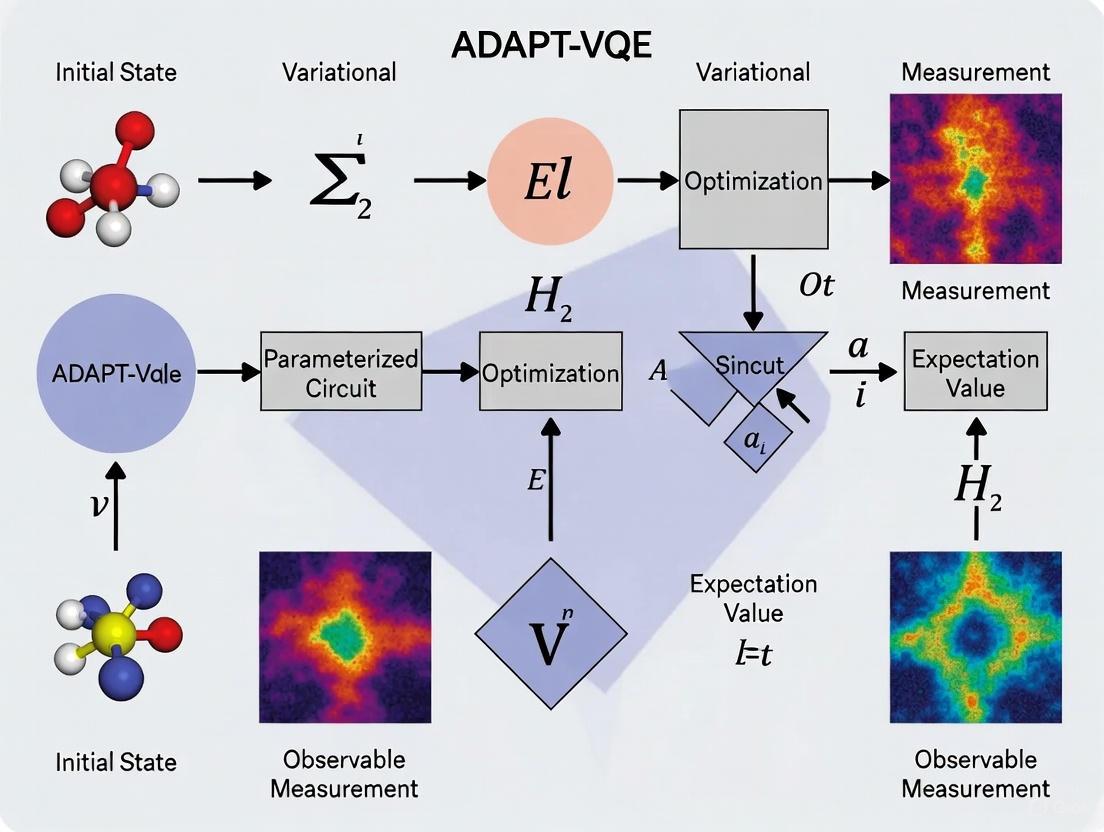
The Adaptive Derivative-Assembled Pseudo-Trotter Variational Quantum Eigensolver (ADAPT-VQE) is a leading algorithm for molecular simulation on near-term quantum computers, prized for its compact circuits and accuracy.
Taming the Shot Cost: Why ADAPT-VQE is Measurement-Hungry and How to Optimize It
Abstract
The Adaptive Derivative-Assembled Pseudo-Trotter Variational Quantum Eigensolver (ADAPT-VQE) is a leading algorithm for molecular simulation on near-term quantum computers, prized for its compact circuits and accuracy. However, its high demand for quantum measurements, or 'shots,' poses a significant bottleneck for practical application. This article explores the foundational reasons behind ADAPT-VQE's shot-intensive nature, stemming from its iterative ansatz construction and parameter optimization loops. We then detail current methodological advances and optimization strategies—from shot reuse and allocation to machine learning and greedy algorithms—that are dramatically reducing this overhead. Finally, we validate these approaches through hardware demonstrations and comparative benchmarks, providing a roadmap for researchers in drug development and biomedical research to harness ADAPT-VQE for practical quantum chemistry problems.
The Core Challenge: Deconstructing ADAPT-VQE's Inherent Shot Hunger
The Adaptive Derivative-Assembled Problem-Tailored Variational Quantum Eigensolver (ADAPT-VQE) represents a significant advancement in quantum computational chemistry, designed specifically for the constraints of Noisy Intermediate-Scale Quantum (NISQ) devices. Unlike fixed-structure ansätze such as Unitary Coupled Cluster (UCCSD) or hardware-efficient approaches, ADAPT-VQE dynamically constructs quantum circuits tailored to specific molecular systems [1] [2]. This adaptive construction offers notable advantages in reducing circuit depth and mitigating trainability issues like barren plateaus, but introduces a substantial quantum measurement burden that remains a critical bottleneck for practical implementation [1] [3].
At its core, ADAPT-VQE addresses fundamental limitations of pre-defined ansätze. Fixed ansätze often contain redundant operators that increase circuit depth without meaningfully contributing to accuracy, while hardware-efficient ansätze face challenges with optimization and limited accuracy [2]. The adaptive approach builds circuits iteratively, selecting only the most relevant operators at each step. However, this very strength necessitates extensive quantum measurements for both operator selection and parameter optimization, creating what has become known as the "shot overhead" problem in ADAPT-VQE implementations [1] [4]. This overhead stems from the requirement to evaluate numerous observables at each iteration, with the number of measurements scaling polynomially with system size [2].
Understanding this measurement overhead requires examining the fundamental ADAPT-VQE loop, which consists of two computationally expensive stages: operator selection based on gradient calculations and global parameter optimization of the expanding ansatz [2] [5]. Each stage demands extensive quantum measurements, making the overall process shot-intensive compared to non-adaptive VQE approaches. As research continues to bridge the gap between quantum resource requirements and current hardware capabilities, addressing this measurement overhead has become a central focus in the development of practical quantum computational chemistry methods [3].
The ADAPT-VQE Algorithmic Framework
Core Iterative Loop
The ADAPT-VQE algorithm constructs quantum circuits through an iterative, greedy process that systematically expands an initial reference state. The procedure begins with a simple quantum state, typically the Hartree-Fock reference state, and progressively appends parameterized unitary operators selected from a predefined pool [2]. The algorithm operates through two fundamental steps that repeat until convergence:
Step 1: Operator Selection - At iteration m, with a current parameterized ansatz wavefunction |Ψ^(m-1)⟩, the algorithm identifies the most promising unitary operator 𝒰* from a pool 𝕌 of possible operators. The selection criterion maximizes the absolute gradient of the energy expectation value with respect to the new parameter:
𝒰* = argmax|d/dθ ⟨Ψ^(m-1)|𝒰(θ)†Â𝒰(θ)|Ψ^(m-1)⟩| at θ=0 [2]
This results in a new ansatz wavefunction |Ψ^(m)⟩ = 𝒰*(θm)|Ψ^(m-1)⟩, where θm represents a newly introduced free parameter.
Step 2: Global Optimization - The algorithm then performs a multi-dimensional optimization over all parameters [θ1, θ2, ..., θ_m] to minimize the energy expectation value:
[θ1^(m), ..., θm^(m)] = argmin⟨Ψ^(m)(θm, θ(m-1), ..., θ1)|Â|Ψ^(m)(θm, θ(m-1), ..., θ1)⟩ [2]
After optimization, the current ansatz becomes |Ψ^(m)⟩ = |Ψ^(m)(θm^(m), θ(m-1)^(m), ..., θ_1^(m))⟩, completing one iteration of the ADAPT-VQE loop.
Operator Pool Options
The choice of operator pool significantly influences ADAPT-VQE performance. Common pool types include:
- Fermionic Excitation Pools: Originally used in ADAPT-VQE, these consist of generalized single and double (GSD) excitations [3].
- Qubit Excitation Pools: Directly parameterize qubit operators rather than fermionic excitations [3].
- Coupled Exchange Operator (CEO) Pools: A novel approach that demonstrates substantial improvements in measurement efficiency and circuit compactness [3].
The algorithmic flow can be visualized as follows:
Quantifying the Measurement Overhead
The measurement overhead in ADAPT-VQE arises from multiple sources within the iterative loop. The operator selection step requires computing gradients for every operator in the pool, which typically involves tens of thousands of extremely noisy measurements on quantum devices [2]. Simultaneously, the global optimization procedure must minimize a high-dimensional, noisy cost function, further contributing to the shot requirements [2] [5].
Table 1: Primary Sources of Measurement Overhead in ADAPT-VQE
| Overhead Source | Description | Impact on Measurements |
|---|---|---|
| Operator Selection | Calculating gradients for all pool operators to identify the best candidate | Requires extensive measurements for each operator in the pool, scaling with pool size [2] |
| Parameter Optimization | Optimizing all parameters in the growing ansatz circuit | Demands repeated energy evaluations during classical optimization loop [2] |
| Gradient Evaluation | Measuring commutator [H, Ak] for each pool operator Ak | Necessitates additional quantum measurements beyond energy evaluation [1] |
| Ansatz Growth | Increasing circuit complexity with each iteration | Longer circuits may require more shots to maintain precision due to noise [3] |
The substantial measurement requirements are particularly challenging given the limitations of current quantum hardware. As noted in recent research, "the operator selection procedure involves computing gradients of the expectation value of the Hamiltonian for every choice of operator in the operator pool, which typically requires tens of thousands of extremely noisy measurements on the quantum device" [2]. This overhead has limited full implementations of ADAPT-VQE-type algorithms on current-generation quantum processing units (QPUs), with only partial attempts successfully demonstrated to date [2].
Table 2: Comparative Resource Requirements for Molecular Simulations
| Molecule | Qubits | Algorithm | Measurement Cost | CNOT Count |
|---|---|---|---|---|
| LiH | 12 | Original ADAPT-VQE | Baseline | Baseline |
| LiH | 12 | CEO-ADAPT-VQE* | Reduced by 99.6% | Reduced by 88% [3] |
| BeH₂ | 14 | Original ADAPT-VQE | Baseline | Baseline |
| BeH₂ | 14 | CEO-ADAPT-VQE* | Reduced by 99.6% | Reduced by 88% [3] |
| H₂ | 4 | ADAPT-VQE withPauli Reuse & Shot Allocation | 32.29% of original | Not Specified [1] |
The tables above quantify the significant measurement overhead challenges in ADAPT-VQE while also demonstrating the substantial improvements possible through algorithmic enhancements. The CEO-ADAPT-VQE* approach shows particularly dramatic reductions in both measurement costs and gate counts compared to the original ADAPT-VQE formulation [3].
Methodologies for Reducing Measurement Overhead
Pauli Measurement Reuse and Commutativity Grouping
One promising approach to reducing measurement overhead involves reusing Pauli measurement outcomes obtained during VQE parameter optimization in subsequent operator selection steps [1]. This strategy recognizes that the Pauli strings measured for energy estimation often overlap with those required for gradient calculations in the operator selection phase. By storing and reusing these measurements across ADAPT-VQE iterations, the method significantly reduces the number of unique quantum measurements required [1] [4].
This reuse protocol is particularly effective when combined with commutativity-based grouping of Hamiltonian terms and gradient observables. The technique organizes Pauli measurements into mutually commuting sets (often using qubit-wise commutativity), allowing simultaneous measurement of all operators within each group [1]. Research demonstrates that this combined approach of "reusing Pauli measurement outcomes obtained during VQE parameter optimization in the subsequent operator selection step" can reduce average shot usage to approximately 32.29% of the original requirement when both measurement grouping and reuse are implemented [1].
The implementation workflow for this method involves:
- Initial Pauli Measurement: During VQE optimization, measure and store all Pauli string outcomes
- Commutativity Analysis: Identify overlapping Pauli strings between Hamiltonian measurements and gradient observables
- Measurement Grouping: Organize required measurements into commuting sets using qubit-wise commutativity
- Data Reuse: In subsequent operator selection, reuse relevant previously measured Pauli strings rather than remeasuring
This approach differs significantly from alternative methods like adaptive informationally complete (IC) generalized measurements, as it retains measurements in the computational basis and introduces minimal classical overhead since Pauli string analysis can be performed once during initial setup [1].
Variance-Based Shot Allocation
Variance-based shot allocation represents another powerful technique for reducing measurement overhead in ADAPT-VQE. This method strategically distributes measurement shots among different observables based on their estimated variances, prioritizing resources toward terms with higher uncertainty [1]. The approach applies to both Hamiltonian measurements and gradient measurements, making it specifically tailored for ADAPT-VQE's unique requirements.
The theoretical foundation for this method comes from the optimal shot allocation framework, which minimizes the total variance of the estimated energy or gradient for a fixed total shot budget [1]. The implementation typically follows these steps:
- Variance Estimation: Estimate variances for individual Pauli measurements, either theoretically or through preliminary sampling
- Shot Budgeting: Allocate shots to each measurable term proportional to the square root of its variance
- Iterative Refinement: Update variance estimates and shot allocation as the algorithm progresses
Numerical simulations demonstrate the effectiveness of this approach, with results showing "shot reductions of 6.71% (VMSA) and 43.21% (VPSR) for H2, and 5.77% (VMSA) and 51.23% (VPSR) for LiH, relative to uniform shot distribution" [1]. The significant variation in improvement percentages highlights the method's dependence on molecular system characteristics and the specific shot allocation strategy employed.
Greedy Gradient-Free Approaches
The Greedy Gradient-free Adaptive VQE (GGA-VQE) represents an alternative approach that addresses measurement overhead by eliminating gradient calculations entirely [2] [5]. This method replaces the conventional gradient-based operator selection with an energy-sorting approach that identifies both the optimal operator and its associated parameter value simultaneously [5].
The GGA-VQE algorithm operates by:
- Landscape Characterization: For each operator in the pool, explicitly construct the one-dimensional energy landscape as a function of the new parameter
- Analytical Minimization: Exploit the known trigonometric structure of parameterized expectation values to identify the optimal parameter value
- Operator Selection: Choose the operator that provides the largest energy decrease when applied with its optimal parameter
This approach provides "improved resilience to statistical sampling noise" while maintaining accuracy comparable to standard ADAPT-VQE [2]. By avoiding gradient calculations and leveraging analytical forms, GGA-VQE reduces the quantum measurement burden while simultaneously simplifying the classical optimization component of the algorithm.
Enhanced Initial States and Active Space Selection
Physically motivated improvements to ADAPT-VQE focus on enhancing initial state preparation and guiding ansatz growth to produce more compact wavefunctions with faster convergence [6]. These strategies include:
Improved Initial States: Using natural orbitals from unrestricted Hartree-Fock (UHF) calculations to enhance the starting point beyond the standard Hartree-Fock reference. These orbitals capture some correlation effects at minimal computational cost and can improve overlap with the true ground state [6].
Projection Protocols: Restricting the orbital space to an active subset based on orbital energies near the Fermi level, following insights from perturbation theory. This approach prioritizes excitations with small energy denominators, which typically contribute most significantly to correlation energy [6].
These methods reduce measurement overhead indirectly by generating more compact ansätze that require fewer iterations to converge to chemical accuracy, thereby reducing the total number of measurements throughout the ADAPT-VQE process [6].
Experimental Protocols and Validation
Experimental Setup for Shot Reduction Studies
Research evaluating measurement reduction strategies in ADAPT-VQE typically employs standardized computational chemistry workflows combined with quantum simulation environments. The experimental protocol generally follows these steps:
Molecular System Preparation:
- Select molecular systems (e.g., H₂, LiH, BeH₂, H₂O)
- Generate molecular geometries and electronic structure data
- Transform molecular Hamiltonians to qubit representations using Jordan-Wigner or Bravyi-Kitaev transformations [1]
Quantum Simulation:
Performance Metrics:
Researcher's Toolkit: Essential Components
Table 3: Essential Research Components for ADAPT-VQE Measurement Studies
| Component | Function | Examples/Alternatives |
|---|---|---|
| Quantum Simulator | Emulates quantum computer behavior with configurable shot counts | Qiskit, Cirq, PennyLane [1] |
| Electronic Structure Package | Computes molecular integrals and reference energies | PySCF, OpenFermion, Psi4 [6] |
| Operator Pools | Defines set of available operators for ansatz construction | Fermionic (GSD), Qubit, CEO pools [3] |
| Measurement Grouping Algorithm | Identifies commuting Pauli terms for simultaneous measurement | Qubit-wise commutativity, graph coloring [1] |
| Shot Allocation Strategy | Optimizes distribution of measurements across terms | Variance-based allocation, uniform allocation [1] |
| Classical Optimizer | Adjusts circuit parameters to minimize energy | BFGS, COBYLA, SPSA [2] |
The measurement overhead in ADAPT-VQE presents a significant challenge for practical implementation on current quantum hardware, but numerous strategies demonstrate promising pathways toward mitigation. The integrated approaches of Pauli measurement reuse, variance-based shot allocation, gradient-free optimization, and physically motivated ansatz construction collectively address different aspects of the shot overhead problem [1] [2] [6].
Future research directions should focus on several key areas. First, evaluating these measurement reduction strategies on actual quantum hardware with realistic noise profiles remains essential for assessing practical utility [1]. Second, exploring synergies between different approaches—such as combining CEO pools with measurement reuse protocols—may yield multiplicative benefits [3]. Finally, developing theoretical foundations for measurement complexity in adaptive algorithms could guide the design of more efficient future implementations.
As quantum hardware continues to evolve, reducing measurement overhead through algorithmic innovations will remain crucial for demonstrating practical quantum advantage in chemical simulation. The progress documented in recent research suggests that optimized ADAPT-VQE variants are steadily bridging the gap between theoretical potential and practical implementation on NISQ-era quantum devices [3].
The Adaptive Derivative-Assembled Problem-Tailored Variational Quantum Eigensolver (ADAPT-VQE) represents a promising framework for quantum chemistry simulations on noisy intermediate-scale quantum (NISQ) devices. However, its practical implementation is severely constrained by exorbitant quantum measurement requirements. This technical analysis examines the fundamental architectural components of ADAPT-VQE that contribute to its extensive shot costs, with particular focus on the operator selection mechanism and gradient measurement protocols. We synthesize recent methodological advances that substantially reduce these resource requirements through measurement reuse strategies, variance-based shot allocation, and modified operator selection criteria. Quantitative evaluations demonstrate measurement reductions exceeding 99% in some implementations, potentially bridging the gap between theoretical algorithm design and practical execution on current quantum hardware.
ADAPT-VQE has emerged as a leading variational algorithm for quantum chemistry, dynamically constructing problem-specific ansätze through an iterative process that typically employs energy gradients for operator selection [5]. Unlike fixed-ansatz approaches, ADAPT-VQE builds the quantum circuit layer by layer, selecting each subsequent operator from a predefined pool based on its potential to minimize energy [6]. While this adaptive construction yields more compact and accurate circuits than static alternatives, it introduces substantial measurement overhead that constitutes a critical bottleneck for practical implementation [1].
The algorithm's characteristically high shot requirements originate from two interdependent processes: the operator selection step that identifies the most promising operator to add to the growing ansatz, and the subsequent parameter optimization that determines optimal rotation angles for all parameters in the circuit [5]. With current quantum processing units (QPUs) limited to finite shot rates and susceptible to statistical noise, these measurement demands frequently render faithful algorithm execution infractable [5]. This analysis examines the architectural sources of these costs and documents emerging strategies to mitigate them without sacrificing chemical accuracy.
The Operator Selection Mechanism: Architectural Foundation of Shot Costs
Standard Gradient-Based Selection
The conventional ADAPT-VQE algorithm employs an iterative growth mechanism where the ansatz is constructed sequentially according to the following structure: [|\psi^{(N)}\rangle = \prod{k=1}^{N} e^{\thetak \hat{\tau}k} |\psi{\text{ref}}\rangle] where (|\psi{\text{ref}}\rangle) is a reference state (typically Hartree-Fock), and each ( \hat{\tau}k ) is an anti-Hermitian operator selected from a predefined pool [6].
At each iteration ( N ), the algorithm identifies the next operator to append by evaluating the gradient of the energy with respect to each potential operator parameter: [gi = \frac{\partial E^{(N)}}{\partial \thetai} = \langle \psi^{(N)} | [\hat{H}, \hat{\tau}_i] | \psi^{(N)} \rangle] where ( \hat{H} ) is the molecular Hamiltonian [5] [6]. The operator yielding the largest gradient magnitude is selected for inclusion in the ansatz.
This gradient evaluation requires measuring the expectation values of commutators ([\hat{H}, \hat{\tau}i]) for every operator ( \hat{\tau}i ) in the pool, necessitating extensive quantum measurements [5]. Following operator selection, a classical optimization routine adjusts all parameters ({\theta_i}) to minimize energy, requiring additional measurement cycles for cost function evaluation [5].
Measurement Costs in Standard Implementation
The shot costs associated with standard operator selection scale with several algorithm characteristics:
- Pool Size: The number of operators in the selection pool directly determines the number of commutator measurements required [6].
- Circuit Depth: As the ansatz grows, evaluating (|\psi^{(N)}\rangle) becomes increasingly costly due to deeper circuits and noise accumulation [5].
- Hamiltonian Complexity: Molecular systems with complex electronic structure yield Hamiltonians comprising many Pauli terms, each requiring separate measurement [1].
Table 1: Components of Shot Costs in Standard ADAPT-VQE Implementation
| Cost Component | Description | Impact on Shot Requirements |
|---|---|---|
| Gradient Measurements | Evaluating (\langle [\hat{H}, \hat{\tau}_i] \rangle) for all pool operators | Scales linearly with pool size; dominant cost in early iterations |
| Parameter Optimization | Classical optimization of all ansatz parameters | Requires repeated energy evaluations; grows with ansatz depth |
| Hamiltonian Measurement | Evaluating (\langle \hat{H} \rangle) for energy calculation | Scales with number of Pauli terms in Hamiltonian |
| Statistical Precision | Achieving sufficient precision for reliable operator ranking | Requires multiple shots per measurement; exacerbated by noise |
Quantitative Analysis of Shot Reduction Strategies
Recent research has produced significant advances in reducing the measurement overhead of ADAPT-VQE. The table below synthesizes quantitative results from multiple studies demonstrating the efficacy of various optimization strategies.
Table 2: Shot Reduction Performance of Optimized ADAPT-VQE Protocols
| Method | Key Innovation | Chemical Systems Tested | Shot Reduction | Implementation Details |
|---|---|---|---|---|
| Reused Pauli Measurements [1] | Recycling measurement outcomes from VQE optimization to gradient evaluation | H₂ (4q) to BeH₂ (14q), N₂H₄ (16q) | 32.29% of baseline (with grouping + reuse) | Combines qubit-wise commutativity grouping with measurement reuse |
| Variance-Based Shot Allocation [1] | Optimal shot distribution based on term variances | H₂, LiH | 6.71% (VMSA) to 43.21% (VPSR) for H₂; 5.77% (VMSA) to 51.23% (VPSR) for LiH | Applied to both Hamiltonian and gradient measurements |
| CEO-ADAPT-VQE* [3] | Novel coupled exchange operator pool with improved subroutines | LiH, H₆, BeH₂ (12-14 qubits) | 99.6% reduction in measurement costs | Combined operator pool optimization with measurement strategies |
| GGA-VQE [5] | Gradient-free optimization with analytical landscape functions | Molecular ground states, 25-body Ising model | Reduced parameter optimization measurements | Replaces gradient measurements with direct operator selection |
The performance gains demonstrated by these optimized protocols substantially narrow the gap between theoretical algorithm design and practical implementation on current hardware. The CEO-ADAPT-VQE* approach demonstrates particularly dramatic improvement, reducing measurement costs to just 0.4% of original requirements while maintaining chemical accuracy [3].
Experimental Protocols for Shot-Efficient ADAPT-VQE
Measurement Reuse and Commutativity Grouping
The integration of measurement reuse with commutativity grouping represents one of the most effective strategies for reducing shot requirements in ADAPT-VQE [1]. The experimental protocol proceeds as follows:
Initial Setup:
- Prepare the Hamiltonian ( \hat{H} ) in Pauli representation and identify all commutators ( [\hat{H}, \hat{\tau}i] ) for operators ( \hat{\tau}i ) in the pool.
- Decompose each commutator into measurable Pauli terms.
Qubit-Wise Commutativity (QWC) Grouping:
- Group Pauli terms from both Hamiltonian and commutators into mutually commuting sets.
- This allows simultaneous measurement of all terms within a group in a single basis rotation.
Measurement Reuse Protocol:
- During VQE parameter optimization, collect and store all Pauli measurement outcomes.
- For subsequent gradient evaluation in operator selection, reuse compatible measurements rather than performing new ones.
- This leverages the significant overlap between Pauli strings required for energy evaluation and those needed for gradient calculations [1].
This protocol capitalizes on the structural properties of molecular Hamiltonians and their commutators with excitation operators, effectively amortizing measurement costs across algorithm steps.
Variance-Based Shot Allocation
Optimal shot allocation based on variance estimation provides another powerful approach to measurement reduction [1]. The implementation consists of:
Variance Estimation:
- Estimate variances ( \sigmai^2 ) for each Pauli term ( Pi ) in the Hamiltonian and gradient observables.
- Use preliminary measurements with uniform shot distribution to initialize variance estimates.
Shot Budget Optimization:
- Allocate shots across terms proportional to ( |wi|\sigmai ), where ( wi ) is the coefficient weight of term ( Pi ).
- This follows the theoretical optimum for minimizing total estimation error [1].
Iterative Refinement:
- Update variance estimates as measurements proceed.
- Dynamically adjust shot allocation based on refined variance estimates.
This approach prioritizes measurement resources toward high-weight, high-variance terms that contribute most significantly to overall estimation error.
Variance-Based Shot Allocation Workflow
Gradient-Free Operator Selection
The Greedy Gradient-free Adaptive VQE (GGA-VQE) protocol circumvents traditional gradient measurements entirely [5]:
Analytical Landscape Construction:
- For each candidate operator ( \hat{\tau}i ) in the pool, construct the energy landscape ( E(\thetai) = \langle \psi | e^{-\thetai \hat{\tau}i} \hat{H} e^{\thetai \hat{\tau}i} | \psi \rangle ).
- For common operator pools, this landscape can be expressed as a simple trigonometric function: ( E(\thetai) = A\cos(2\thetai) + B\sin(2\theta_i) + C ).
Parameter Determination:
- Determine coefficients ( A ), ( B ), and ( C ) through a minimal number of energy evaluations (typically 2-3 specific ( \theta_i ) values).
- This completely characterizes the energy landscape for each operator.
Simultaneous Operator and Angle Selection:
- Identify the operator ( \hat{\tau}i ) that produces the deepest energy minimum at its optimal ( \thetai ).
- Append ( e^{\thetai^{opt} \hat{\tau}i} ) to the ansatz without subsequent parameter optimization.
This approach selects both the operator and its optimal rotation angle simultaneously, eliminating separate gradient measurements and reducing the parameter optimization burden [5].
The Research Toolkit: Essential Components for Shot-Efficient Implementation
Table 3: Research Reagent Solutions for ADAPT-VQE Implementation
| Component | Function | Implementation Considerations |
|---|---|---|
| Operator Pools | Set of candidate operators for ansatz construction | CEO pool [3] reduces circuit depth and measurements simultaneously |
| Commutativity Grouping | Enables simultaneous measurement of multiple observables | Qubit-wise commutativity provides practical balance of efficiency and implementation complexity [1] |
| Measurement Reuse Framework | Classical storage and retrieval of quantum measurements | Requires efficient data structure for Pauli string lookup and compatibility assessment [1] |
| Variance Estimation Module | Dynamically tracks observable variances for shot allocation | Initial uniform measurements bootstrap the process; continuous refinement improves efficiency [1] |
| Error Suppression Techniques | Reduces impact of hardware noise on measurements | Combining error suppression with error detection improves fidelity without full QEC overhead [7] |
| Analytical Landscape Solver | Determines optimal parameters without iterative optimization | Specific to operator pool type; enables gradient-free selection [5] |
The measurement costs associated with operator selection and gradient evaluations present a fundamental challenge for practical ADAPT-VQE implementation on near-term quantum hardware. Through systematic analysis of the algorithm's architectural components, we have identified the primary sources of shot costs and documented emerging methodologies that substantially reduce these requirements. The integration of measurement reuse strategies, variance-based shot allocation, and modified operator selection criteria demonstrably lowers shot costs by up to two orders of magnitude while maintaining chemical accuracy. These advances narrow the gap between theoretical algorithm design and practical execution, accelerating progress toward quantum utility in computational chemistry and drug development applications.
The Adaptive Derivative-Assembled Pseudo-Trotter Variational Quantum Eigensolver (ADAPT-VQE) has emerged as a pivotal promising approach for electronic structure challenges in quantum chemistry with noisy quantum devices, representing a significant advancement over fixed-ansatz approaches [8] [9]. Unlike traditional variational quantum algorithms that use pre-determined circuit structures, ADAPT-VQE dynamically constructs an ansatz by systematically adding fermionic operators one-at-a-time, generating a problem-specific ansatz with a minimal number of parameters and shallower circuits [9] [10]. However, this adaptive flexibility comes at a significant cost: a dramatically increased quantum measurement overhead that presents a major bottleneck for practical implementations on current hardware [1] [3] [2].
This "double burden" arises from the algorithm's fundamental structure, which combines two measurement-intensive processes. First, like all Variational Quantum Eigensolvers, ADAPT-VQE must optimize parameters in a variational circuit—a process requiring repeated energy measurements to guide the classical optimizer. Second, and uniquely to adaptive approaches, the algorithm must continually grow and select the ansatz itself through operator gradient evaluations [1] [2]. This dual requirement of simultaneous parameter optimization and ansatz growth creates a perfect storm of measurement demands that this whitepaper will analyze in depth, providing both theoretical understanding and practical mitigation strategies for researchers and drug development professionals working at the intersection of quantum computing and molecular simulation.
The ADAPT-VQE Algorithm: Core Mechanism and Bottlenecks
Fundamental Algorithmic Structure
The ADAPT-VQE algorithm operates through an iterative process that systematically constructs a quantum circuit ansatz tailored to the specific molecular system being simulated. The algorithm begins with a simple reference state, typically the Hartree-Fock wavefunction, and progressively builds complexity by adding parameterized unitary operators selected from a predefined pool [9]. Mathematically, at iteration N, the wavefunction takes the form:
$$ |\psi^{(N)}\rangle = \prod{i=1}^{N} e^{\thetai \hat{A}_i} |\psi^{(0)}\rangle $$
where $|\psi^{(0)}\rangle$ denotes the initial state, $\hat{A}i$ represents the fermionic anti-Hermitian operator introduced at the i-th iteration, and $\thetai$ is its corresponding amplitude [8].
The critical innovation of ADAPT-VQE lies in its operator selection mechanism. At each iteration, the algorithm evaluates the energy gradient with respect to each potential operator in the pool and selects the one with the largest gradient magnitude [8] [9]. This operator is then appended to the growing ansatz, after which all parameters (both the new addition and previous parameters) are optimized variationally. This process continues until the energy converges to within a desired accuracy threshold, typically chemical accuracy (1.6 mHa or 1 kcal/mol) [3].
The "double burden" of ADAPT-VQE manifests through two interdependent measurement-intensive processes that collectively drive the high shot requirements:
Ansatz Growth Measurements: At each iteration, the algorithm must evaluate the gradient $∂E^{(N)}/∂θ_i$ for every operator in the pool to identify the most promising candidate for inclusion [1] [2]. For a pool of size M, this requires O(M) additional measurements per iteration beyond the energy evaluations needed for parameter optimization. With typical fermionic pools containing generalized single and double excitations, M scales as O($n^2o^2$) where n and o are the numbers of virtual and occupied orbitals respectively, creating a substantial measurement burden [3].
Parameter Optimization Measurements: Each time the ansatz grows, the expanded parameter set ${θ_i}$ must be re-optimized through the standard VQE procedure [2]. This requires numerous energy evaluations to guide the classical optimizer, with each energy evaluation itself requiring many quantum measurements to estimate the expectation value $\langle \psi^{(N)} | \hat{H} | \psi^{(N)} \rangle$ of the molecular Hamiltonian [1] [9].
The interplay between these processes creates a compounding effect: as the ansatz grows, the parameter optimization becomes more costly due to the increasing parameter count, while the operator selection requires increasingly complex gradient calculations [1] [2]. This dual burden explains why ADAPT-VQE demands significantly more quantum measurements than either standard VQE with fixed ansätze or classical quantum chemistry methods, presenting a fundamental challenge for practical deployment on current quantum hardware.
Quantifying the Resource Burden: Experimental Data
Extensive numerical studies have quantified the substantial resource requirements of ADAPT-VQE and the performance improvements offered by various optimization strategies. The following table summarizes key experimental findings from recent research:
Table 1: Measurement Reduction Strategies in ADAPT-VQE
| Strategy | Molecule(s) Tested | Key Metric Improvement | Reference |
|---|---|---|---|
| Reused Pauli Measurements | H₂ to BeH₂ (4-14 qubits), N₂H₄ (16 qubits) | 32.29% average shot usage with grouping and reuse vs. naive measurement | [1] |
| Variance-Based Shot Allocation | H₂, LiH | Shot reductions of 6.71% (VMSA) and 43.21% (VPSR) for H₂ | [1] |
| CEO Pool + Improved Subroutines | LiH, H₆, BeH₂ (12-14 qubits) | Measurement costs reduced to 0.4-2% of original ADAPT-VQE | [3] |
| Greedy Gradient-Free Approach (GGA-VQE) | H₂O, LiH | 2-5 circuit measurements per iteration vs. thousands in standard ADAPT | [2] |
| Classical Pre-optimization (SWCS) | Molecules up to 52 spin-orbitals | Significant reduction in quantum processor measurements | [11] |
Further analysis reveals how these optimizations impact overall quantum computational resources across different molecular systems:
Table 2: Overall Resource Reductions in State-of-the-Art ADAPT-VQE
| Molecule | Qubit Count | CNOT Reduction | CNOT Depth Reduction | Measurement Cost Reduction | Reference |
|---|---|---|---|---|---|
| LiH | 12 | 88% | 96% | 99.6% | [3] |
| H₆ | 12 | 85% | 95% | 99.4% | [3] |
| BeH₂ | 14 | 82% | 94% | 99.2% | [3] |
These dramatic improvements highlight the immense potential of specialized optimization strategies to mitigate the double burden of ADAPT-VQE. The CEO-ADAPT-VQE* algorithm, which combines the novel Coupled Exchange Operator pool with other improvements, demonstrates particularly impressive gains, reducing measurement costs by three orders of magnitude compared to the original ADAPT-VQE formulation [3].
Methodologies for Shot Reduction: Experimental Protocols
Pauli Measurement Reuse and Commutativity-Based Grouping
The protocol for reusing Pauli measurements leverages the fact that the Hamiltonian and the gradient observables (commutators $[H, A_i]$) often share common Pauli terms [1]. The methodology proceeds as follows:
Initial Setup: During the classical precomputation phase, identify all Pauli strings present in both the Hamiltonian $H$ and the gradient observables $[H, Ai]$ for all operators $Ai$ in the pool. Construct a mapping between compatible terms.
Quantum Execution: For each VQE optimization cycle at iteration $N$:
- Measure the complete set of Hamiltonian Pauli terms, storing the results in a classical database.
- Reuse these measurement outcomes during the subsequent operator selection step by extracting the relevant Pauli string expectation values for gradient calculations.
- Supplement with additional measurements only for Pauli strings unique to the gradient observables.
Grouping Optimization: Apply qubit-wise commutativity (QWC) or more advanced commutativity-based grouping to both Hamiltonian and gradient observables, enabling simultaneous measurement of compatible terms and further reducing the total number of quantum circuit executions [1].
This protocol capitalizes on the significant overlap between the Pauli terms needed for energy estimation and those required for gradient calculations, effectively amortizing the measurement cost across both stages of the algorithm.
Variance-Based Shot Allocation
Variance-based shot allocation dynamically distributes quantum measurements based on the statistical properties of each observable, prioritizing terms with higher variance and greater impact on the final energy or gradient estimation [1]. The experimental protocol implements:
Variance Estimation: For each Pauli term $Pi$ in the Hamiltonian or gradient observables, estimate the variance $\sigmai^2 = \langle Pi^2 \rangle - \langle Pi \rangle^2$ using an initial allocation of shots (e.g., 10% of the total budget).
Optimal Allocation: Calculate the optimal shot distribution using the theoretical framework of Rubin et al. [33] adapted for ADAPT-VQE: $$ ni \propto \frac{|gi|\sigmai}{\sqrt{\sumj |gj|\sigmaj}} $$ where $ni$ is the number of shots allocated to term $i$, $gi$ is the coefficient of the Pauli term in the Hamiltonian or gradient observable, and $\sigma_i$ is the estimated standard deviation.
Iterative Refinement: For multi-step ADAPT-VQE procedures, update variance estimates and reallocate shots at regular intervals to adapt to changing circuit characteristics and operator compositions.
This methodology has demonstrated shot reductions of 43.21% for H₂ and 51.23% for LiH compared to uniform shot distribution, while maintaining chemical accuracy [1].
Gradient-Free Greedy Optimization (GGA-VQE)
The Greedy Gradient-Free Adaptive VQE (GGA-VQE) protocol fundamentally reimagines the ADAPT-VQE optimization process to circumvent the high-dimensional parameter optimization problem [2] [12]. The experimental methodology includes:
Candidate Operator Screening: For each candidate operator $Uk(\thetak)$ in the pool:
- Prepare the current ansatz state $|\psi^{(N)}\rangle$ on the quantum processor.
- Apply $Uk(\thetak)$ with 3-5 different strategically chosen angle values $\theta_k^{(j)}$.
- For each angle, measure the energy using a limited shot budget (typically 10,000 shots or fewer for noisy simulations).
Analytical Curve Fitting: For each candidate, fit the measured energy points to a simple trigonometric function $E_k(\theta) = A\cos(\theta + \phi) + C$, which accurately captures the single-parameter energy dependence.
Optimal Parameter Selection: Analytically determine the optimal angle $\theta_k^*$ that minimizes the fitted energy function for each candidate operator.
Greedy Selection: From all candidates, select the operator $Uk^*$ and corresponding angle $\thetak^*$ that yields the lowest predicted energy.
Ansatz Expansion: Append $Uk^*(\thetak^*)$ to the growing ansatz with its parameter fixed, then proceed to the next iteration without global re-optimization of previous parameters.
This protocol dramatically reduces the quantum resources required, needing only 2-5 circuit measurements per candidate operator compared to the thousands required for full gradient calculations and parameter re-optimizations in standard ADAPT-VQE [2] [12].
Visualization of Algorithmic Workflows
The following diagrams illustrate the core workflows of standard ADAPT-VQE and optimized variants, highlighting key bottlenecks and optimization points.
Standard ADAPT-VQE Workflow
Optimized ADAPT-VQE with Mitigation Strategies
The Scientist's Toolkit: Research Reagent Solutions
Table 3: Essential Computational Tools for ADAPT-VQE Research
| Tool Category | Specific Implementation | Function in Research | Key Features |
|---|---|---|---|
| Operator Pools | Fermionic GSD Pool [3] | Provides candidate operators for ansatz growth | Generalized single and double excitations |
| Qubit Pool [3] | Qubit-efficient operator selection | Direct qubit operators, reduced circuit depth | |
| CEO Pool [3] | Enhanced efficiency for correlated systems | Coupled exchange operators, compact ansatz | |
| Measurement Techniques | Qubit-Wise Commutativity (QWC) Grouping [1] | Reduces measurements via compatible term grouping | Simultaneous measurement of commuting terms |
| Variance-Based Shot Allocation [1] | Optimizes shot distribution across terms | Prioritizes high-variance, high-impact measurements | |
| Pauli Measurement Reuse [1] | Amortizes measurement costs across algorithm stages | Reuses Hamiltonian measurements for gradients | |
| Classical Computational Tools | Sparse Wavefunction Circuit Solver (SWCS) [11] | Classical pre-optimization to reduce quantum workload | Wavefunction truncation, computational cost reduction |
| Fragment Molecular Orbital (FMO) [13] | System decomposition for larger molecules | Divide-and-conquer approach, reduced qubit requirements | |
| Hardware-Specific Optimizations | Hardware-Efficient Ansatz Elements [9] | Native gate utilization for specific quantum processors | Reduced circuit depth, improved fidelity |
| Error Mitigation Techniques [2] | Counteracts device noise in measurements | Readout error correction, zero-noise extrapolation |
The "double burden" of ADAPT-VQE—combining the measurement-intensive processes of parameter optimization and ansatz growth—represents a fundamental challenge for the practical deployment of adaptive quantum algorithms on current hardware. However, as this technical analysis demonstrates, significant progress has been made in developing sophisticated strategies to mitigate these resource demands.
The integration of measurement reuse protocols, variance-based shot allocation, gradient-free optimization, and novel operator pools has collectively reduced measurement costs by up to 99.6% compared to the original ADAPT-VQE formulation [3]. These advances, combined with classical pre-optimization techniques and fragment-based approaches, are steadily bridging the gap between theoretical potential and practical implementation.
For researchers and drug development professionals, these developments signal a promising trajectory toward quantum utility in molecular simulation. The successful implementation of greedy gradient-free algorithms on 25-qubit quantum hardware [2] [12] demonstrates that robust, measurement-efficient adaptive algorithms can already yield meaningful results on existing devices. As quantum hardware continues to improve in scale and fidelity, the optimized ADAPT-VQE variants discussed herein will play a crucial role in unlocking quantum advantage for real-world chemical and pharmaceutical applications, from catalyst design to drug discovery.
The Impact of Molecular Complexity and Pool Size on Measurement Scaling
In the pursuit of quantum advantage for molecular simulations, the Adaptive Derivative-Assembled Problem-Tailored Variational Quantum Eigensolver (ADAPT-VQE) has emerged as a leading algorithm for the Noisy Intermediate-Scale Quantum (NISQ) era. However, a significant bottleneck hindering its practical application is the exorbitant number of quantum measurements, or "shots," required to achieve chemical accuracy [3]. This whitepaper examines the fundamental relationship between molecular complexity, the effective "pool size" of quantum operators, and the resultant measurement scaling. Understanding this relationship is crucial for developing more efficient protocols, particularly for researchers in drug development who require accurate molecular simulations.
ADAPT-VQE and the Quantum Measurement Challenge
Algorithmic Workflow and Resource Demands
ADAPT-VQE is a hybrid quantum-classical algorithm that constructs a problem-tailored ansatz dynamically. Unlike static approaches, it iteratively appends parameterized unitaries from a predefined operator pool, selected based on their energy gradients with respect to the current variational state [3]. This adaptive construction leads to shallower circuits and improved trainability but introduces a substantial quantum measurement overhead.
The primary resource consumption occurs in two critical steps:
- VQE Parameter Optimization: Iterative evaluation of the energy expectation value, which requires measuring the molecular Hamiltonian.
- Operator Selection: Calculation of energy gradients for every operator in the pool during each iteration to identify the most promising operator to add [14] [3].
The total number of shots required is a function of the number of iterations, the size of the operator pool, and the shot noise associated with measuring each observable on the quantum device.
The "Pool Size" Concept and its Implications
In the context of ADAPT-VQE, "pool size" directly refers to the number of quantum operators (e.g., excitation operators) available for selection during the adaptive process. A larger pool provides a richer search space for constructing the ansatz but linearly increases the measurement burden in the operator selection step, as gradients must be evaluated for each operator in every iteration [3]. This creates a critical trade-off between ansatz expressibility and measurement feasibility.
Figure 1. ADAPT-VQE Workflow and Shot Bottleneck. The gradient measurement step (red) scales linearly with the operator pool size (N), creating a major shot bottleneck [3].
Quantifying Molecular Complexity for Measurement Scaling
Molecular Assembly Theory
Molecular complexity is a key driver of the resources required for simulation. Assembly Theory provides a robust framework for quantifying molecular complexity through the Molecular Assembly (MA) index. The MA index quantifies the minimal number of steps required to construct a molecule from its basic building blocks, thereby reflecting the amount of information or "constrained history" embedded in its structure [15]. A higher MA index signifies a more complex molecule.
Experimental Proxies for Molecular Complexity
Calculating the exact MA index can be computationally intensive. Fortunately, research has demonstrated that the MA index can be directly inferred from standard spectroscopic techniques, making it an experimentally accessible metric [15]. Table 1 summarizes the correlation between spectral features and molecular complexity.
Table 1. Experimental Measurement of Molecular Complexity via Spectroscopy [15]
| Spectroscopic Technique | Measurable Proxy | Relationship to Molecular Assembly (MA) Index |
|---|---|---|
| Infrared (IR) Spectroscopy | Number of unique absorption bands in the fingerprint region (400-1500 cm⁻¹) | Linear correlation (Pearson coefficient: 0.86); MA = 0.21 × n_peaks – 0.15 |
| Nuclear Magnetic Resonance (NMR) | Number of magnetically inequivalent carbon resonances | Reflects unique atomic environments; higher complexity reduces magnetic equivalence |
| Tandem Mass Spectrometry (MS/MS) | Number of unique molecular fragments | Correlates with the diversity of constructible substructures |
The link to ADAPT-VQE is direct: molecules with higher MA indices typically require more complex electron correlation descriptions. This, in turn, necessitates larger operator pools and longer adaptive cycles in ADAPT-VQE, exponentially increasing the total shot count needed for convergence.
Strategies for Shot Reduction in ADAPT-VQE
Addressing the shot problem requires integrated strategies that target both the operator pool and the measurement process itself. Recent research has yielded significant improvements.
Advanced Operator Pools
The choice of operator pool profoundly impacts efficiency. The novel Coupled Exchange Operator (CEO) pool demonstrates a dramatic reduction in quantum resources compared to traditional fermionic pools (e.g., Generalized Single and Double excitations). The CEO pool is designed with hardware efficiency and minimal completeness in mind, leading to shallower circuits and fewer required iterations [3].
Table 2. Resource Reduction of CEO-ADAPT-VQE* vs. Original ADAPT-VQE [3]
| Molecule (Qubits) | CNOT Count Reduction | CNOT Depth Reduction | Measurement Cost Reduction |
|---|---|---|---|
| LiH (12) | 88% | 96% | 99.6% |
| H₆ (12) | Not Specified | Not Specified | 99.6% |
| BeH₂ (14) | Up to 88% | Up to 96% | Up to 99.6% |
Improved Measurement Protocols
Beyond pool design, two key protocols directly reduce shot overhead:
- Reusing Pauli Measurements: Pauli measurement outcomes obtained during the VQE parameter optimization step can be classically post-processed and reused in the subsequent operator selection step. This avoids redundant measurements of the same operators across different algorithmic stages [14].
- Variance-Based Shot Allocation: Instead of using a fixed number of shots for all measurements, this technique allocates shots proportionally to the variance of each observable. Operators with higher uncertainty (variance) receive more shots, optimizing the overall use of quantum resources to achieve a target precision [14].
Figure 2. Variance-Based Shot Allocation. This protocol optimizes measurement efficiency by dynamically directing shots toward higher-variance observables [14].
The Scientist's Toolkit: Essential Research Reagents and Solutions
Table 3. Key Reagents and Computational Tools for ADAPT-VQE and Complexity Analysis
| Item / Solution | Function / Description | Application Context |
|---|---|---|
| CEO Operator Pool | A novel, hardware-efficient operator pool that reduces circuit depth and iteration count. | ADAPT-VQE ansatz construction [3] |
| Variance-Based Allocation Algorithm | A classical routine that optimizes quantum shot distribution based on real-time variance estimation. | Quantum measurement optimization [14] |
| Assembly Index Algorithm | A software tool (e.g., in Go) to compute the Molecular Assembly index from a molecular graph. | Quantifying molecular complexity [15] |
| xTB Software Package | A semi-empirical quantum chemistry program for fast geometry optimization and IR spectrum calculation. | Predicting IR spectra for MA estimation [15] |
The high shot requirement in ADAPT-VQE is not an isolated problem but a direct consequence of the interplay between molecular complexity and the computational strategy employed. Complex molecules, quantified by a high Molecular Assembly index, demand larger operator pools and more iterations, leading to unfavorable measurement scaling. The path forward lies in the co-design of algorithmic components: employing chemically-inspired, minimal operator pools like the CEO pool, and implementing smart measurement protocols that reuse data and allocate shots optimally. The integration of these strategies, as demonstrated by state-of-the-art variants like CEO-ADAPT-VQE*, reduces measurement costs by over 99%, providing a viable path toward practical quantum advantage in drug development and material science.
ADAPT-VQE in Practice: Standard Protocols and Measurement Workflows
The Adaptive Derivative-Assembled Problem-Tailored Variational Quantum Eigensolver (ADAPT-VQE) is an advanced hybrid quantum-classical algorithm designed to compute the ground-state energy of molecular systems more efficiently than standard VQE. Developed to address key limitations of fixed ansatz approaches, ADAPT-VQE iteratively constructs a problem-specific quantum circuit (ansatz) by dynamically selecting operators from a predefined pool based on their potential to lower the energy expectation value [16] [17]. This adaptive growth results in a more compact and chemically meaningful ansatz, helping to mitigate issues like deep quantum circuits and the barren plateau phenomenon often encountered in hardware-efficient or unitary coupled cluster (UCC) ansatzes [1] [5].
This guide breaks down the standard ADAPT-VQE algorithm in the context of a pressing research question: Why does ADAPT-VQE require so many quantum measurements (shots)? The high shot overhead is a significant bottleneck for its practical application on near-term quantum devices [1] [18]. We will explore the algorithm's workflow, the source of its measurement demands, and emerging strategies to enhance its shot-efficiency.
Algorithm Workflow: A Step-by-Step Guide
The ADAPT-VQE algorithm follows an iterative procedure to build its ansatz. The flowchart below visualizes this workflow, with detailed steps following.
Step 1: Initialization
The algorithm begins by preparing an initial reference state, typically the Hartree-Fock (HF) wavefunction ((|\Psi_{\mathrm{HF}}\rangle)), which serves as the starting point for the adaptive ansatz [16] [17]. A crucial preparatory step is defining an operator pool. In the standard fermionic ADAPT-VQE, this pool consists of all possible spin-compatible single and double excitation operators derived from the UCCSD ansatz:
- Single excitations: ( \hat{A}{p,q} = ap^\dagger aq - aq^\dagger a_p )
- Double excitations: ( \hat{A}{pq,rs} = ap^\dagger aq^\dagger as ar - ar^\dagger as^\dagger aq a_p )
The size of this pool grows as ( \mathcal{O}(N^2 n^2) ), where (N) is the number of spin-orbitals and (n) is the number of electrons [18]. This polynomial scaling is a primary contributor to the algorithm's measurement overhead.
Step 2: Gradient Measurement and Operator Selection
For the current parameterized ansatz state (|\Psi^{(k-1)}\rangle) at iteration (k), the algorithm computes the energy gradient with respect to the parameter of each operator (Am) in the pool. This gradient is given by the expression: [ \frac{\partial E^{(k-1)}}{\partial \thetam} = \langle \Psi^{(k-1)} | [H, Am] | \Psi^{(k-1)} \rangle ] This commutator-based metric estimates how much the energy would change if the operator (Am) were added to the circuit [16]. The operator with the largest gradient magnitude is selected for inclusion in the ansatz. This step requires evaluating the expectation value of the commutator ([H, A_m]) for every operator in the pool, a process that demands a vast number of quantum measurements.
Step 3: Ansatz Growth and Parameter Optimization
The selected operator (e.g., ( e^{\thetam Am} )) is appended to the existing ansatz circuit, introducing a new variational parameter (\thetam) [19] [16]. The ansatz at iteration (k) takes the form of a disentangled UCC ansatz: [ |\Psi^{(k)}\rangle = \left( \prod e^{\thetai Ai} \right) |\Psi{\mathrm{HF}}\rangle ] After growing the ansatz, a full variational optimization of all parameters (the new parameter and all previously introduced parameters) is performed using the standard VQE routine to minimize the expectation value of the Hamiltonian ( \langle \Psi | H | \Psi \rangle ) [16] [5]. This optimization itself is shot-intensive.
Step 4: Convergence Check
The process repeats from Step 2 until a convergence criterion is met. The standard criterion is that the norm of the gradient vector falls below a predefined threshold (e.g., (10^{-3})) [19] [16]. Upon convergence, the algorithm outputs the final energy and the adaptively constructed ansatz circuit.
The Scientist's Toolkit: Key Components for an ADAPT-VQE Experiment
The table below catalogs the essential "research reagents" or components required to implement the ADAPT-VQE algorithm, based on standard implementations in software libraries like InQuanto, PennyLane, and OpenVQE [19] [16] [17].
| Component | Function & Purpose | Example Form/Type | |
|---|---|---|---|
| Molecular Hamiltonian | Hermitian operator ((H)) representing the system's energy; its expectation value is minimized. | Fermionic or qubit (Pauli string) form [1] [18]. | |
| Reference State | Initial state for the variational circuit; provides a chemically reasonable starting point. | Hartree-Fock state (( | \Psi_{\mathrm{HF}}\rangle)) [16] [17]. |
| Operator Pool | Collection of generators from which the ansatz is built; defines the search space. | UCCSD excitations [19] [18], Qubit excitations [18]. | |
| Classical Minimizer | Classical optimization algorithm that updates variational parameters to minimize energy. | L-BFGS-B, COBYLA [19] [16]. | |
| Gradient Protocol | Method for evaluating the selection criterion (( \langle [H, A_m] \rangle )) for operator choice. | Commutator measurement [16], Statevector simulation [19]. | |
| Quantum Device/Simulator | Platform for executing quantum circuits and measuring expectation values. | Statevector simulator (e.g., Qulacs) [19], QPU [5]. |
Why ADAPT-VQE Is Shot-Intensive: A Detailed Analysis
The measurement overhead in ADAPT-VQE stems from two primary sources, which are quantitatively summarized in the table below.
| Source of Overhead | Description | Impact on Shot Count |
|---|---|---|
| Operator Selection (Gradient Evaluation) | Requires measuring the commutator ( [H, Am] ) for every operator (Am) in a large pool (e.g., ( \mathcal{O}(N^2n^2) ) for UCCSD) in every iteration [1] [18]. | This is the dominant cost. For example, a 14-qubit system (BeH₂) can have a pool of hundreds to thousands of operators, each requiring many shots for a precise gradient estimate [1]. |
| Parameter Optimization | Each iteration introduces a new parameter. Optimizing an m-parameter ansatz requires many energy evaluations (each needing many shots) during the VQE sub-routine [5] [18]. | The cost of optimization scales with the number of parameters and the complexity of the energy landscape. Noisy measurements can slow convergence, increasing total shots [5]. |
| Ansatz Growth | The number of iterations (and thus the cumulative measurement cost) can be large before convergence is reached, especially for strongly correlated systems [18]. | More iterations mean repeated cycles of expensive gradient measurements and optimizations. |
The Core Problem: Scaling of the Operator Pool
The most significant factor is the sheer size of the operator pool. For a UCCSD-type pool, the number of operators scales polynomially with system size. In each iteration, the expectation value of a distinct observable (([H, A_m])) must be measured for every single operator in this pool to identify the one with the largest gradient. Since quantum measurements are probabilistic, a sufficiently large number of shots (repetitions of the circuit) is required for each measurement to achieve a statistically significant result, leading to an immense total shot count [1] [18].
Advanced Protocols: Strategies for Shot Reduction
Research into mitigating ADAPT-VQE's shot overhead is active and diverse. The following table compares several key strategies.
| Strategy | Core Principle | Reported Efficacy |
|---|---|---|
| Reused Pauli Measurements & Variance-Based Allocation [1] | Reuses Pauli measurement outcomes from VQE optimization in subsequent gradient steps. Allocates shots based on term variance. | Reduces average shot usage to 32.29% of the naive approach when combined [1]. |
| Batched ADAPT-VQE [18] | Adds multiple operators with the largest gradients simultaneously in one iteration. | Reduces the number of gradient computation cycles, directly cutting the dominant measurement overhead [18]. |
| Greedy Gradient-Free Adaptive VQE (GGA-VQE) [5] | Replaces gradient measurements with a direct, analytical energy-sorting method to select operators and their parameters. | Avoids noisy gradient measurements entirely, demonstrating improved resilience to statistical noise [5]. |
| Classical Pre-optimization (SWCS) [11] | Uses classical sparse wavefunction circuit solvers to perform ADAPT-VQE and identify a compact ansatz before using a QPU. | Minimizes work on noisy quantum hardware by leveraging high-performance classical computing [11]. |
| AI-Driven Shot Allocation [20] | Employs reinforcement learning to dynamically assign measurement shots across VQE optimization iterations. | Learns to minimize total shots while ensuring convergence, reducing reliance on hand-crafted heuristics [20]. |
Detailed Protocol: Batched ADAPT-VQE
The batched ADAPT-VQE protocol modifies Step 2 of the standard algorithm [18]:
- Gradient Measurement: Compute gradients ( \frac{\partial E}{\partial \theta_m} ) for all operators in the pool, as in the standard algorithm.
- Batch Selection: Instead of selecting a single operator, identify the top-(k) operators with the largest gradient magnitudes.
- Ansatz Growth: Append all (k) selected operators to the ansatz simultaneously, introducing (k) new parameters at once.
- Parameter Optimization: Perform a single VQE optimization to optimize all parameters (old and new).
This protocol reduces the number of iterative cycles required for ansatz construction. Since each cycle involves the expensive gradient measurement over the entire pool, batching operators can lead to a substantial reduction in the total number of these measurements, thereby saving shots [18].
The standard ADAPT-VQE algorithm provides a systematic, chemically motivated path to constructing accurate, problem-tailored ansatzes for quantum simulation. Its iterative structure, which relies on repeated gradient measurements over a large operator pool and subsequent variational optimization, is the fundamental reason for its high demand for quantum measurements. This shot overhead currently presents the primary barrier to its practical application on noisy intermediate-scale quantum devices.
However, as outlined in this guide, the field is responding with a suite of sophisticated strategies—from measurement reuse and batching to classical pre-optimization and machine learning—aimed at taming this overhead. The future of practical quantum chemistry on near-term devices will likely hinge on the continued refinement and integration of these shot-efficient techniques into the robust framework of adaptive algorithms like ADAPT-VQE.
The Role of the Operator Pool and Commutativity in Measurement Requirements
The Adaptive Derivative-Assembled Problem-Tailored Variational Quantum Eigensolver (ADAPT-VQE) represents a promising approach for quantum simulation of molecular systems on Noisy Intermediate-Scale Quantum (NISQ) devices. Unlike fixed-structure ansätze such as Unitary Coupled Cluster (UCCSD), ADAPT-VQE iteratively constructs a problem-tailored ansatz by dynamically appending parameterized unitary operators from a predefined operator pool [1] [2]. This adaptive construction offers significant advantages, including reduced circuit depth and mitigation of barren plateau problems [1] [3]. However, a critical challenge impedes its practical implementation: the algorithm exhibits exceptionally high quantum measurement overhead, requiring thousands to millions of circuit executions (shots) to achieve chemical accuracy [1] [2].
This measurement overhead stems fundamentally from two algorithm components: the operator selection process and the parameter optimization routine. Both components rely heavily on evaluating expectation values and gradients through quantum measurements [2]. The characteristics of the operator pool—particularly the commutativity relationships between operators—directly influence the efficiency of these quantum measurements. This technical analysis examines the intrinsic relationship between operator pool design, commutativity properties, and the resulting shot requirements, framing this discussion within the broader research question: Why does ADAPT-VQE require so many shots?
Theoretical Framework of ADAPT-VQE and Measurement Overhead
ADAPT-VQE Algorithmic Structure
The ADAPT-VQE algorithm follows an iterative procedure where each iteration consists of two core steps:
Step 1: Operator Selection At iteration m, with a current parameterized ansatz wavefunction |Ψ⁽ᵐ⁻¹⁾⟩, the algorithm selects the next operator from a pool 𝕌 by identifying the unitary operator 𝒰* ∈ 𝕌 that maximizes the gradient of the energy expectation value [2]:
This gradient can be expressed as the expectation value of a commutator [21]:
This requires measuring the commutator of the Hamiltonian with every operator in the pool [21].
Step 2: Global Parameter Optimization After appending the selected operator, all parameters in the expanded ansatz are optimized to minimize the energy expectation value [2]:
This requires extensive measurements to evaluate the energy during classical optimization [1].
The high shot requirements in ADAPT-VQE originate from several fundamental aspects of the algorithm:
Gradient Evaluation for Operator Selection: Each iteration requires estimating the gradient for every operator in the pool, which involves measuring the expectation value of the commutator [Ĥ, Â_N] for each pool operator [1] [21]. For large pools, this process dominates the measurement cost.
Energy Evaluation During Optimization: The variational optimization loop requires numerous energy evaluations, each requiring significant quantum measurements [2]. As the ansatz grows with each iteration, the optimization becomes increasingly costly.
Statistical Precision Requirements: Quantum measurements are inherently probabilistic, requiring many shots (circuit repetitions) to obtain statistically precise estimates of expectation values [22] [23]. The default shot count on platforms like IBM Q Experience is 1,024, reflecting this fundamental statistical requirement [23].
Operator Pool Design and Commutativity Effects
Operator Pool Characteristics and Measurement Costs
The design of the operator pool directly influences measurement requirements through multiple mechanisms:
Pool Size and Composition The number of operators in the pool determines how many gradient evaluations must be performed each iteration. Early ADAPT-VQE implementations used fermionic excitation pools with generalized single and double (GSD) excitations, leading to pools that scale as O(N⁴) with qubit count N [3]. Each operator requires measuring its gradient with the Hamiltonian, creating substantial overhead.
Novel Pool Designs Recent research has introduced more efficient pool designs to reduce measurement requirements:
Coupled Exchange Operator (CEO) Pool: This novel approach uses coupled exchange operators to dramatically reduce quantum computational resources. Compared to early ADAPT-VQE versions, CEO pools reduce CNOT count, CNOT depth, and measurement costs by up to 88%, 96%, and 99.6%, respectively, for molecules represented by 12 to 14 qubits [3].
Qubit-Excitation-Based (QEB) Pools: These hardware-efficient pools exploit qubit connectivity to reduce measurement overhead while maintaining convergence properties [3].
Table 1: Impact of Operator Pool Design on Resource Requirements for Selected Molecules
| Molecule | Qubit Count | Algorithm Version | CNOT Count Reduction | CNOT Depth Reduction | Measurement Cost Reduction |
|---|---|---|---|---|---|
| LiH | 12 | CEO-ADAPT-VQE* | 88% | 96% | 99.6% |
| H₆ | 12 | CEO-ADAPT-VQE* | 85% | 94% | 99.4% |
| BeH₂ | 14 | CEO-ADAPT-VQE* | 87% | 92% | 99.5% |
Commutativity in Measurement Optimization
Commutativity relationships between operators play a crucial role in optimizing measurement strategies:
Qubit-Wise Commutativity (QWC) Grouping Operators that qubit-wise commute can be measured simultaneously in the same circuit execution, significantly reducing shot requirements [1]. This grouping strategy is particularly effective for the Pauli strings that result from the commutator [Ĥ, Â_N] evaluations in the gradient measurements.
Commutator-Based Grouping Recent advances group commutators of single Hamiltonian terms with multiple pool operators, resulting in approximately 2N or fewer mutually commuting sets [1]. This approach leverages the algebraic structure of the operators to minimize distinct measurement bases.
Measurement Reuse Strategy Pauli measurement outcomes obtained during VQE parameter optimization can be reused in subsequent operator selection steps, leveraging overlapping Pauli strings between the Hamiltonian and the commutator expressions [1]. This strategy can reduce average shot usage to 32.29% when combined with measurement grouping, compared to naive full measurement schemes [1].
Table 2: Shot Reduction Strategies and Their Effectiveness
| Strategy | Method Description | Key Mechanism | Reported Shot Reduction |
|---|---|---|---|
| Measurement Reuse | Reusing Pauli measurements from VQE optimization in gradient evaluations | Overlapping Pauli strings between Hamiltonian and commutators | 32.29% of original shots (with grouping) [1] |
| Variance-Based Shot Allocation | Allocating shots based on variance of Hamiltonian and gradient terms | Theoretical optimum budget allocation [1] | 6.71-51.23% reduction (vs uniform) [1] |
| Commutativity Grouping | Grouping commuting terms from Hamiltonian and gradient observables | Qubit-wise commutativity (QWC) | 38.59% of original shots (grouping alone) [1] |
| Gradient-Free Optimization | GGA-VQE using analytic curve fitting instead of gradient measurements | Eliminates direct gradient measurement | 2-5 measurements per iteration [12] |
Experimental Protocols and Methodologies
Shot-Efficient ADAPT-VQE Protocol
Recent research has developed integrated protocols to reduce shot requirements in ADAPT-VQE:
Protocol 1: Reused Pauli Measurements with Variance-Based Allocation
- Initial Setup: Perform commutativity analysis of Hamiltonian and pool operators (can be done once during setup) [1]
- VQE Optimization Phase: Execute quantum circuits with optimal shot allocation based on term variances [1]
- Measurement Storage: Cache Pauli measurement outcomes for reuse [1]
- Operator Selection: Reuse relevant Pauli measurements for gradient evaluations of pool operators [1]
- Iterative Update: Repeat steps 2-4 for each ADAPT-VQE iteration [1]
This protocol was tested on molecular systems from H₂ (4 qubits) to BeH₂ (14 qubits), and N₂H₄ with 16 qubits, demonstrating consistent shot reduction [1].
Protocol 2: Greedy Gradient-Free Adaptive VQE (GGA-VQE)
- Candidate Sampling: For each pool operator, measure energy at 2-5 different parameter angles [12]
- Curve Fitting: Analytically determine optimal angle for each candidate using trigonometric fitting [12]
- Operator Selection: Choose the operator with lowest minimum energy [12]
- Parameter Locking: Add selected operator with optimal angle without future re-optimization [12]
GGA-VQE dramatically reduces measurements to just 2-5 circuit executions per iteration, regardless of system size, while maintaining noise resilience [12].
Experimental Validation on Quantum Hardware
25-Qubit Ising Model Implementation GGA-VQE was successfully executed on a 25-qubit trapped-ion quantum computer (IonQ's Aria system), representing a milestone for adaptive VQE methods on real hardware [12]. The implementation achieved over 98% fidelity compared to the true ground state, despite hardware noise, using only five observable measurements per iteration [12].
Molecular Simulation Studies Numerical simulations demonstrate the effectiveness of shot-reduction strategies:
- Variance-based shot allocation applied to both Hamiltonian and gradient measurements achieved shot reductions of 6.71% (VMSA) and 43.21% (VPSR) for H₂, and 5.77% (VMSA) and 51.23% (VPSR) for LiH, relative to uniform shot distribution [1].
- CEO-ADAPT-VQE* reduced measurement costs by up to 99.6% compared to original ADAPT-VQE formulations while maintaining chemical accuracy [3].
Visualization of Measurement Workflows
Figure 1: Shot-Efficient ADAPT-VQE Workflow Integrating Commutativity Analysis and Measurement Reuse
Table 3: Essential Research Tools for ADAPT-VQE Implementation
| Tool/Resource | Type | Function/Purpose | Example Implementations |
|---|---|---|---|
| Operator Pools | Algorithmic Component | Provides candidate operators for ansatz construction | Fermionic GSD, Qubit Excitation, CEO Pool [3] |
| Commutativity Analyzers | Computational Tool | Identifies commuting operator groups for simultaneous measurement | Qubit-Wise Commutativity (QWC) Checkers [1] |
| Variance Estimators | Statistical Tool | Calculates term variances for optimal shot allocation | Hamiltonian Variance Analysis [1] |
| Quantum Simulators | Software Platform | Emulates quantum circuits for algorithm development | CUDA-Q, Qiskit, Perceval [22] [24] |
| Measurement Caches | Data Structure | Stores Pauli measurement outcomes for reuse | Pauli String Result Databases [1] |
| Hardware Backends | Quantum Hardware | Executes quantum circuits on physical processors | Superconducting QPUs, Photonic (Quandela), Trapped-Ion (IonQ) [22] [12] |
The measurement requirements in ADAPT-VQE are fundamentally intertwined with the design of the operator pool and the commutativity relationships between operators. The high shot overhead originates from the need to evaluate gradients for all pool operators during selection and to optimize parameters through iterative energy evaluations. Through strategic operator pool design—such as CEO pools that reduce measurement costs by up to 99.6%—and exploitation of commutativity via grouping and measurement reuse, significant reductions in shot requirements are achievable.
Advanced protocols like GGA-VQE that eliminate direct gradient measurements altogether offer an alternative pathway, demonstrating practical implementation on 25-qubit hardware with as few as 2-5 measurements per iteration. These developments address the core question of why ADAPT-VQE requires so many shots while providing actionable strategies for mitigating this bottleneck. As operator pool design and measurement strategies continue to evolve, the prospects for practical quantum advantage in chemical simulation grow increasingly promising.
The Adaptive Derivative-Assembled Problem-Tailored Variational Quantum Eigensolver (ADAPT-VQE) has emerged as a leading algorithm for molecular simulations on noisy intermediate-scale quantum (NISQ) devices, offering advantages over traditional variational approaches by systematically constructing more compact, problem-specific ansätze [1] [9]. However, a critical bottleneck threatens its practical implementation: an exponential explosion in the number of quantum measurements (shots) required for both operator selection and parameter optimization [1] [3]. This "shot crisis" originates from the fundamental process of mapping fermionic operators to Pauli strings—a necessary step for executing quantum chemistry problems on quantum hardware [25]. As molecular system size increases, this mapping produces an overwhelming number of Pauli terms that must be individually measured, creating a resource barrier that currently prevents practical quantum advantage [1] [3].
This technical guide examines the root causes of this measurement overhead within the context of ADAPT-VQE implementations, analyzes current optimization methodologies, and provides detailed protocols for researchers seeking to mitigate these challenges in quantum chemistry simulations. By understanding the interplay between fermion-to-qubit mappings, measurement strategies, and algorithmic efficiency, scientists can better navigate the tradeoffs between accuracy and feasibility in near-term quantum experiments.
Fermion-to-Qubit Mapping: The Genesis of Pauli Strings
Fundamental Mapping Techniques
To simulate electronic structure problems on quantum computers, fermionic Hamiltonians must be transformed into qubit operators via mathematical mappings that preserve the anti-commutation relations of fermionic creation and annihilation operators [25]. The second-quantized molecular Hamiltonian takes the form:
[ \hat{H}f = \sum{p,q} h{pq} ap^\dagger aq + \frac{1}{2} \sum{p,q,r,s} h{pqrs} ap^\dagger aq^\dagger as a_r ]
where (ap^\dagger) and (ap) represent fermionic creation and annihilation operators, and (h{pq}) and (h{pqrs}) are one- and two-electron integrals [1]. Several mapping techniques transform these operators to Pauli strings:
Jordan-Wigner Mapping: This method preserves locality at the cost of introducing non-local string operators [25]: [ cj^\dagger = Z{Ns} \otimes \cdots \otimes Z{j+1} \otimes \frac{1}{2}(Xj - iYj) ] [ cj = Z{Ns} \otimes \cdots \otimes Z{j+1} \otimes \frac{1}{2}(Xj + iYj) ] The (Z) operators maintain antisymmetry but create non-local dependencies that increase measurement complexity [25].
Bravyi-Kitaev Mapping: This approach offers a balance between locality and qubit connectivity, typically requiring fewer Pauli strings than Jordan-Wigner for the same Hamiltonian [25].
Symmetry-Conserving Bravyi-Kitaev Mapping: This variant preserves particle number symmetry, potentially reducing the number of terms requiring measurement [25].
The following diagram illustrates the fundamental process of mapping fermionic operators to measurable Pauli strings:
The Combinatorial Explosion Problem
The mapping process generates a combinatorial explosion of Pauli terms. For a molecular system with (N) spin orbitals, the number of possible Pauli strings grows as (4^N), creating severe measurement bottlenecks [1]. Even with Hamiltonian-specific simplifications and term grouping, the number of measurements scales prohibitively for practically interesting system sizes. This explosion represents the fundamental challenge in ADAPT-VQE implementations, where each iteration requires measuring both the energy expectation and operator gradients [1].
ADAPT-VQE Measurement Overhead: A Systematic Analysis
Algorithmic Workflow and Measurement Hotspots
ADAPT-VQE constructs ansätze iteratively by appending parameterized unitary operators selected from a predefined pool [9] [19]. Each iteration involves two measurement-intensive steps:
- Operator Selection: Evaluating gradients for all pool operators to identify the most impactful addition [19]
- Parameter Optimization: Variationally optimizing all parameters in the growing ansatz [1]
The following workflow diagram illustrates these measurement-intensive steps:
Quantitative Measurement Requirements
The table below summarizes the shot requirements for different components of ADAPT-VQE across various molecular systems, demonstrating the significant measurement overhead:
Table 1: ADAPT-VQE Measurement Requirements Across Molecular Systems
| Molecule | Qubit Count | Measurement Strategy | Shot Reduction | Reference |
|---|---|---|---|---|
| H₂ | 4 | Variance-based shot allocation | 43.21% (VPSR) | [1] |
| LiH | 12 | Variance-based shot allocation | 51.23% (VPSR) | [1] [3] |
| BeH₂ | 14 | CEO Pool + Improved subroutines | 99.6% reduction in measurement costs | [3] |
| H₆ | 12 | CEO-ADAPT-VQE* | 99%+ reduction vs original ADAPT-VQE | [3] |
| N₂H₄ | 16 | Reused Pauli measurements | Average 32.29% of original shots | [1] |
The dramatic measurement costs originate from multiple factors. First, the operator pool in fermionic ADAPT-VQE typically contains (O(N^4)) elements for UCCSD-type pools [26], each requiring gradient evaluation. Second, the Hamiltonian measurement itself involves thousands of Pauli terms even for small molecules [1]. Third, the variational optimization requires repeated energy evaluations with sufficient precision to navigate the parameter landscape [12].
Optimization Strategies: Taming the Measurement Beast
Pauli Measurement Reuse and Grouping
Recent approaches significantly reduce shot requirements by reusing quantum measurements across algorithm iterations [1]. The core insight recognizes that Pauli strings measured during VQE parameter optimization can be reused for gradient calculations in subsequent ADAPT-VQE iterations, provided they appear in both the Hamiltonian and the commutator expressions for operator gradients [1].
Experimental Protocol: Pauli Measurement Reuse
- Initial Setup: Identify overlapping Pauli strings between Hamiltonian terms and commutator expressions for the operator pool [1]
- Measurement Collection: During VQE optimization, store measurement outcomes for all Pauli strings with their respective variances [1]
- Data Reuse: In subsequent gradient evaluation steps, reuse relevant previously measured Pauli values instead of remeasuring [1]
- Variance Tracking: Maintain variance estimates for all measurements to inform shot allocation decisions [1]
This strategy, when combined with qubit-wise commutativity (QWC) grouping, reduces average shot usage to approximately 32.29% compared to naive measurement approaches [1].
Variance-Based Shot Allocation
Optimal shot allocation distributes measurement resources according to the variance of each Pauli term, prioritizing terms with higher uncertainty [1]. This approach applies to both Hamiltonian measurements and gradient evaluations.
Theoretical Foundation: For a Hamiltonian (H = \sumi \betai Pi) with Pauli terms (Pi), the total variance of the energy estimate is: [ \text{Var}[\langle H \rangle] = \sumi |\betai|^2 \text{Var}[\langle Pi \rangle] ] Given a fixed total shot budget (S{\text{total}}), optimal allocation assigns: [ Si \propto |\betai| \sqrt{\text{Var}[\langle P_i \rangle]} ] to minimize the total variance [1].
Experimental Protocol: Variance-Based Shot Allocation
- Initial Estimation: Perform an initial fixed-shot measurement of all Pauli terms to estimate variances [1]
- Shot Budgeting: Allocate shots to each term proportional to (|\betai| \sqrt{\text{Var}[\langle Pi \rangle]}) [1]
- Iterative Refinement: Update variance estimates and reallocate shots during the optimization process [1]
- Gradient Application: Extend the same principle to gradient measurements for operator selection [1]
This approach reduces shot requirements by 43.21% for H₂ and 51.23% for LiH compared to uniform shot distribution [1].
Advanced Operator Pools and Algorithmic Variants
Novel operator pools and ADAPT-VQE variants substantially reduce quantum resources:
Coupled Exchange Operator (CEO) Pool: This novel operator pool dramatically reduces circuit depth and measurement requirements. When combined with other improvements (CEO-ADAPT-VQE*), it reduces CNOT count, CNOT depth, and measurement costs by up to 88%, 96%, and 99.6% respectively for molecules represented by 12-14 qubits compared to early ADAPT-VQE versions [3].
Overlap-ADAPT-VQE: This variant grows wavefunctions by maximizing their overlap with intermediate target wavefunctions rather than direct energy minimization, avoiding local minima and producing more compact ansätze [26]. This approach significantly reduces circuit depth, particularly for strongly correlated systems [26].
Greedy Gradient-Free Adaptive VQE (GGA-VQE): This approach simplifies the parameter optimization by selecting operators and their optimal parameters simultaneously, requiring only 2-5 circuit measurements per iteration regardless of system size [12]. This strategy demonstrates improved noise resilience and has been successfully implemented on a 25-qubit quantum computer [12].
Table 2: Comparison of ADAPT-VQE Optimization Strategies
| Strategy | Key Mechanism | Measurement Reduction | Limitations |
|---|---|---|---|
| Pauli Measurement Reuse [1] | Reuse measurements between VQE and gradient steps | ~68% | Requires overlapping Pauli strings between steps |
| Variance-Based Shot Allocation [1] | Distribute shots according to variance | 43-51% | Requires initial variance estimation |
| CEO Pool [3] | More efficient operator selection | ~99.6% | Specific to molecular systems |
| Overlap-ADAPT-VQE [26] | Overlap-guided ansatz construction | Significant (circuit depth reduction) | Requires good target wavefunction |
| GGA-VQE [12] | Gradient-free, greedy parameter selection | >90% (measurements per iteration) | May produce less optimal ansatz |
Implementation Protocols: A Practical Guide
Experimental Setup for Shot-Efficient ADAPT-VQE
Research Reagent Solutions for ADAPT-VQE Experiments
| Component | Function | Implementation Example |
|---|---|---|
| Operator Pool | Provides generators for ansatz construction | Fermionic pool: UCCSD, k-UpCCGSD, or CEO pools [3] [19] |
| Qubit Mapping | Transforms fermionic operators to Pauli strings | Jordan-Wigner, Bravyi-Kitaev, or symmetry-conserving Bravyi-Kitaev [25] |
| Measurement Grouping | Reduces number of distinct circuit executions | Qubit-wise commutativity (QWC) or more advanced graph coloring [1] |
| Shot Allocation | Optimizes measurement distribution | Variance-based proportional allocation with recycling [1] |
| Classical Optimizer | Adjusts circuit parameters | L-BFGS-B, Conjugate Gradient, or custom optimizers [19] |
Integrated Measurement Protocol
For researchers implementing shot-efficient ADAPT-VQE, the following integrated protocol combines multiple optimization strategies:
Initialization Phase
- Hamiltonian Preparation: Generate molecular Hamiltonian in second quantization using electronic structure packages (PySCF, OpenFermion) [26]
- Qubit Mapping: Transform to qubit Hamiltonian using Jordan-Wigner or Bravyi-Kitaev mapping [25]
- Operator Pool Generation: Construct operator pool (UCCSD, k-UpCCGSD, or CEO) [3] [19]
- Commutator Analysis: Precompute Pauli strings appearing in both Hamiltonian and gradient commutators [1]
Adaptive Iteration Phase
- Grouped Measurement: Execute quantum circuits grouped by commutativity to measure all Hamiltonian terms [1]
- Variance Tracking: Record variances for all Pauli measurements to inform future shot allocation [1]
- Gradient Evaluation: Compute gradients for all pool operators, reusing relevant previous measurements [1]
- Operator Selection: Identify operator with largest gradient magnitude [19]
- Ansatz Augmentation: Append selected operator to the circuit with initial parameter [19]
- Parameter Optimization: Optimize all parameters using VQE with variance-based shot allocation [1]
- Data Storage: Archive all Pauli measurements with their variances for potential reuse [1]
Convergence Check
- Terminate when gradient norm falls below threshold (e.g., (10^{-3})) [19] or energy convergence is achieved
This integrated approach leverages multiple optimization strategies to significantly reduce the overall quantum resources required for chemically accurate simulations.
The "Pauli string explosion" presents a fundamental challenge for practical implementations of ADAPT-VQE on near-term quantum hardware. However, as this analysis demonstrates, integrated strategies combining measurement reuse, variance-based shot allocation, and improved operator pools can reduce measurement requirements by orders of magnitude [1] [3]. The recent successful implementation of greedy adaptive algorithms on 25-qubit hardware suggests that resource-optimized ADAPT-VQE variants may be feasible on current devices for meaningful chemical problems [12].
Future research directions should focus on developing more sophisticated measurement reuse protocols, dynamic operator pools that minimize measurement overhead, and tighter integration between mapping strategies and measurement optimization. As quantum hardware continues to improve, these algorithmic advances will be crucial for achieving practical quantum advantage in electronic structure calculations for drug development and materials science.
The Adaptive Derivative-Assembled Problem-Tailored Variational Quantum Eigensolver (ADAPT-VQE) represents a promising approach for quantum chemistry simulations on Noisy Intermediate-Scale Quantum (NISQ) devices. However, a significant challenge hindering its practical implementation is the enormous number of quantum measurements, or "shots," required for its operation. Each shot corresponds to a single measurement of the quantum system's state, and the precision of results is directly influenced by the number of shots performed [20]. The algorithm's iterative nature—requiring repeated evaluations for operator selection and parameter optimization—leads to a substantial quantum measurement overhead that can be prohibitive on current hardware [5]. This case study examines the shot requirements for simulating small molecules from H2 to BeH2 within the context of ongoing research to understand and mitigate these demanding resource requirements.
Understanding ADAPT-VQE and Its Shot Requirements
Algorithmic Workflow and Bottlenecks
ADAPT-VQE operates through an iterative process that constructs problem-specific ansätze dynamically, unlike fixed-ansatz approaches like Unitary Coupled Cluster (UCCSD). Each iteration presents two primary sources of shot consumption [5]:
- Operator Selection: At each iteration m, the algorithm must compute the energy gradient with respect to every parameterized unitary operator in a predefined pool. This involves evaluating the expectation value of the Hamiltonian for each candidate operator to identify the one that promises the greatest energy descent.
- Parameter Optimization: After selecting and appending an operator, a global optimization is performed over all parameters of the expanded ansatz to minimize the energy expectation value of the molecular Hamiltonian.
These steps require tens of thousands of extremely noisy measurements on quantum devices, making the algorithm particularly susceptible to statistical sampling noise [5]. The fundamental challenge is that quantum computations inherently produce probabilistic outcomes, and estimating these outcomes requires repeated measurements to achieve sufficient precision for reliable optimization and operator selection [20].
Why Small Molecules Matter for Benchmarking
Small molecular systems like H2, LiH, and BeH2 serve as critical testbeds for evaluating shot efficiency in quantum chemistry algorithms. These molecules represent a progression in computational complexity:
- H2: The simplest molecular system, typically requiring few qubits (4-8) and serving as an introductory benchmark.
- LiH: A 12-qubit system that introduces stronger electron correlations and more complex bonding environments [3].
- BeH2: A 14-qubit system that presents additional computational challenges due to its linear geometry and electronic structure [3].
Studying this progression allows researchers to track how shot requirements scale with system size and complexity, providing insights for extending these methods to larger, more biologically relevant molecules in drug development contexts.
Quantitative Analysis of Shot Requirements
Comparative Performance Across Molecular Systems
Table 1: Shot Requirements and Resource Reduction Across Molecular Systems
| Molecule | Qubit Count | Algorithm Variant | Relative CNOT Count | Relative CNOT Depth | Relative Measurement Cost | Key Innovations |
|---|---|---|---|---|---|---|
| LiH | 12 | Original ADAPT-VQE | 100% (Baseline) | 100% (Baseline) | 100% (Baseline) | Fermionic GSD pool [3] |
| LiH | 12 | CEO-ADAPT-VQE* | 12-27% | 4-8% | 0.4-2% | Coupled Exchange Operators, improved subroutines [3] |
| H6 | 12 | Original ADAPT-VQE | 100% (Baseline) | 100% (Baseline) | 100% (Baseline) | Fermionic GSD pool [3] |
| H6 | 12 | CEO-ADAPT-VQE* | 12-27% | 4-8% | 0.4-2% | Coupled Exchange Operators, improved subroutines [3] |
| BeH2 | 14 | Original ADAPT-VQE | 100% (Baseline) | 100% (Baseline) | 100% (Baseline) | Fermionic GSD pool [3] |
| BeH2 | 14 | CEO-ADAPT-VQE* | 12-27% | 4-8% | 0.4-2% | Coupled Exchange Operators, improved subroutines [3] |
The data reveals that CEO-ADAPT-VQE* dramatically reduces all quantum resource metrics compared to the original algorithm, with the most pronounced improvement seen in measurement costs (reduced to 0.4-2% of original requirements) [3]. This represents a potential reduction of up to 99.6% in shot requirements, bringing the algorithm significantly closer to feasibility on current hardware.
Shot Allocation Strategies and Their Efficiencies
Table 2: Shot Reduction Strategies and Their Implementations
| Strategy | Core Methodology | Reported Efficiency | Implementation Challenges |
|---|---|---|---|
| Reused Pauli Measurements | Recycling measurement outcomes from VQE parameter optimization in subsequent operator selection steps | Significant reduction in shot requirements while maintaining chemical accuracy [14] | Requires careful management of measurement compatibility between steps |
| Variance-Based Shot Allocation | Dynamically allocating shots based on variance estimates of Hamiltonian terms | Reduces total shots while maintaining accuracy; can be combined with reuse strategies [14] | Requires initial variance estimation, adding preliminary measurement overhead |
| AI-Driven Shot Allocation | Using reinforcement learning (RL) to learn optimal shot assignment policies | Learned policies demonstrate transferability across systems and compatibility with various ansatzes [20] | Training RL agents requires substantial computational resources initially |
| Greedy Gradient-Free Adaptive VQE (GGA-VQE) | Replacing gradient-based operator selection with analytical, gradient-free optimization | Improved resilience to statistical sampling noise; demonstrated on 25-qubit error-mitigated QPU [5] | May require more iterations to reach convergence compared to gradient-based methods |
These strategies collectively address the shot efficiency problem from multiple angles, with empirical results showing that combined approaches can reduce shot requirements by orders of magnitude while maintaining chemical accuracy—typically defined as an error within 1.6 mHa (milliHartree) of the exact ground state energy [5].
Experimental Protocols for Shot-Reduced ADAPT-VQE
CEO-ADAPT-VQE* Implementation
The Coupled Exchange Operator (CEO) pool approach represents a state-of-the-art modification to ADAPT-VQE that significantly reduces resource requirements:
Molecular Hamiltonian Preparation: Generate the qubit Hamiltonian using Jordan-Wigner or Bravyi-Kitaev transformation from the molecular electronic structure, typically computed at the Hartree-Fock level of theory.
Reference State Preparation: Initialize the quantum processor to the Hartree-Fock reference state, |ψref⟩, which can be prepared with a constant-depth circuit [3].
Iterative Ansatz Construction:
- Step 1 - Operator Selection: Compute gradients for all operators in the CEO pool, which consists of coupled exchange operators designed for hardware efficiency and minimal measurement overhead.
- Step 2 - Ansatz Expansion: Append the selected parameterized unitary operator to the current ansatz: |ψ(θ→)⟩ = U(θ→)|ψref⟩.
- Step 3 - Parameter Optimization: Minimize the energy expectation value E(θ→) = ⟨ψ(θ→)|Ĥ|ψ(θ→)⟩ using classical optimization techniques.
Convergence Check: Repeat steps 1-3 until energy differences between iterations fall below the chemical accuracy threshold (1.6 mHa) [3].
The CEO pool specifically reduces shot requirements by containing operators that generate more compact ansätze with fewer parameters and shallower circuits, directly impacting the measurement overhead in both operator selection and parameter optimization stages.
Shot-Reuse Methodology
The shot-reuse protocol integrates two key strategies to minimize measurement overhead:
Pauli Measurement Reuse:
- During VQE parameter optimization, collect and store all Pauli measurement outcomes.
- In the subsequent ADAPT-VQE operator selection step, reuse these stored measurements to compute the gradients for pool operators.
- This approach eliminates redundant measurements of the same Pauli terms across different stages of the algorithm [14].
Variance-Based Shot Allocation:
- Estimate the variance of each Pauli term in the Hamiltonian and gradient measurements.
- Allocate more shots to high-variance terms and fewer shots to low-variance terms.
- Implement dynamic shot redistribution throughout the optimization process based on updated variance estimates [14].
This combined approach has demonstrated the ability to maintain chemical accuracy while reducing the total number of shots required by up to five orders of magnitude compared to static ansätze with comparable CNOT counts [3].
Visualization of Workflows and Methodologies
ADAPT-VQE Shot Optimization Workflow
ADAPT-VQE Shot Optimization Workflow: This diagram illustrates the integrated shot-reuse and variance-based allocation strategies within the standard ADAPT-VQE iterative structure.
Shot Allocation Strategy Comparison
Shot Reduction Strategic Approaches: This diagram maps the relationship between different shot-reduction methodologies and their resulting benefits for NISQ-era quantum computations.
The Scientist's Toolkit: Essential Research Reagents
Table 3: Key Computational "Reagents" for Shot-Efficient ADAPT-VQE
| Research Reagent | Function in Experiment | Implementation Considerations |
|---|---|---|
| CEO Operator Pool | Provides parameterized unitary operators for adaptive ansatz construction | Reduces circuit depth and parameter count compared to fermionic pools [3] |
| Pauli Measurement Reuse Framework | Enables recycling of quantum measurements across algorithm stages | Requires compatible measurement bases between optimization and gradient steps [14] |
| Variance Estimation Module | Calculates statistical variances of Pauli terms for shot allocation | Initial overhead for variance estimation is offset by long-term shot savings [14] |
| Reinforcement Learning Agent | Learns optimal shot allocation policies through environment interaction | Demonstrates transferability across molecular systems [20] |
| Gradient-Free Optimizer | Replaces gradient-based operator selection with analytical methods | Improves resilience to statistical noise; demonstrated on 25-qubit systems [5] |
| Chemical Accuracy Metric | Defines convergence threshold (1.6 mHa) for algorithm termination | Standard benchmark for comparing different methodological approaches [3] |
These computational "reagents" represent the essential components for implementing shot-efficient ADAPT-VQE simulations. The CEO operator pool, in particular, has demonstrated remarkable effectiveness, reducing CNOT counts by up to 88%, CNOT depth by up to 96%, and measurement costs by up to 99.6% for molecules represented by 12 to 14 qubits compared to early ADAPT-VQE versions [3].
The investigation into shot usage across small molecules from H2 to BeH2 reveals both the significant challenges and promising solutions in the pursuit of practical quantum computational chemistry. The dramatic reductions in shot requirements—achievable through combined strategies like CEO operator pools, measurement reuse, and variance-based allocation—suggest that ADAPT-VQE is evolving toward practical applicability on NISQ-era devices. These improvements are particularly relevant for drug development professionals seeking to leverage quantum computing for molecular simulations of protein-ligand interactions and hydration effects, where accurate quantum chemistry calculations are essential [27] [28].
Future research directions will likely focus on further integrating AI-driven shot allocation with problem-specific operator pools, extending these methods to larger molecular systems, and developing standardized benchmarks for shot efficiency across different hardware platforms. As these methodologies mature, the integration of quantum computing into pharmaceutical research pipelines promises to accelerate the discovery and optimization of novel therapeutic compounds, potentially reducing the traditional 10-year drug development timeline and associated costs [28].
Strategies for Shot Efficiency: Cutting Measurement Costs in ADAPT-VQE
The Adaptive Derivative-Assembled Problem-Tailored Variational Quantum Eigensolver (ADAPT-VQE) represents a promising advancement for quantum simulation in the Noisy Intermediate-Scale Quantum (NISQ) era, offering advantages over traditional VQE methods through reduced circuit depth and mitigated classical optimization challenges [1]. However, a critical bottleneck impedes its practical implementation: an exceptionally high demand for quantum measurements, known as "shots" [1] [4].
This shot overhead arises from the algorithm's fundamental structure. Unlike fixed-ansatz VQE, ADAPT-VQE iteratively constructs a problem-tailored quantum circuit. Each iteration requires two shot-intensive processes: optimizing the parameters of the current quantum circuit to minimize energy and selecting the next operator to add to the circuit by evaluating gradients [1]. The cumulative effect of these repeated measurements across iterations creates a significant scalability barrier, making the algorithm prohibitively expensive for current quantum hardware where measurement resources are finite [4].
The Mechanism of Shot Recycling
Core Principle and Workflow
The proposed shot recycling strategy, formally termed "reused Pauli measurements," directly addresses the measurement bottleneck by minimizing redundant quantum evaluations [1]. The core insight is that the Pauli measurement outcomes obtained during the VQE parameter optimization step contain information that can be repurposed for the subsequent operator selection step in the next ADAPT-VQE iteration [1] [4].
This approach capitalizes on the fact that the Hamiltonian measurement and the gradient measurements for operator selection often involve overlapping sets of Pauli strings. When the commutator between the Hamiltonian and a pool operator is evaluated, it expands into a linear combination of Pauli terms. Many of these Pauli terms are identical to, or share significant components with, the Pauli strings comprising the original Hamiltonian itself [1]. The methodology systematically identifies these overlaps, allowing the algorithm to reuse previously obtained measurement outcomes rather than consuming fresh shots to re-measure the same observables.
The following diagram illustrates the integrated workflow of ADAPT-VQE with the shot recycling mechanism:
Key Differentiators from Prior Approaches
This shot recycling method presents distinct advantages over alternative measurement-reduction strategies:
- Computational Basis Retention: Unlike approaches that employ adaptive informationally complete generalized measurements (IC-POVMs), this method retains measurements in the standard computational basis, avoiding the scalability issues associated with IC-POVMs which require sampling from 4^N operators for an N-qubit system [1].
- Minimal Classical Overhead: The Pauli string analysis needed to identify reusable measurements can be performed once during the initial algorithm setup, avoiding significant additional classical computation in each iteration [1].
- Complementarity: The recycling protocol is compatible with other measurement optimization techniques, such as commutativity-based grouping of Hamiltonian terms and variance-based shot allocation, enabling cumulative efficiency gains [1].
Experimental Protocols and Validation
Research Reagent Solutions
The experimental validation of shot recycling requires a combination of theoretical constructs and computational tools, as detailed in the following table:
Table 1: Essential Research Components for Shot Recycling Experiments
| Component | Function/Description | Role in Experimental Validation |
|---|---|---|
| Molecular Test Systems | Small molecules like H₂, LiH, BeH₂ (4-14 qubits) and N₂H₄ (16 qubits) [1]. | Provide benchmark systems of varying complexity for evaluating shot reduction performance while maintaining chemical accuracy. |
| Operator Pools | Sets of operators (e.g., fermionic excitations, coupled exchange operators) used to build the adaptive ansatz [1] [3]. | Determine the mathematical structure of gradients and influence the potential for measurement reuse between Hamiltonian and gradient terms. |
| Qubit-Wise Commutativity (QWC) Grouping | Technique for grouping mutually commuting Pauli terms to be measured simultaneously [1]. | Reduces measurement overhead and enhances the efficiency of the shot recycling protocol. |
| Variance-Based Shot Allocation | Method for distributing measurement shots based on the variance of Pauli terms [1]. | Optimizes shot distribution when new measurements are required, working complementarily with shot recycling. |
Quantitative Performance Analysis
The shot recycling methodology was rigorously tested across multiple molecular systems, with the following quantitative results demonstrating its effectiveness:
Table 2: Shot Reduction Performance Across Molecular Systems
| Molecule | Qubit Count | Shot Reduction with Recycling & Grouping | Shot Reduction with Grouping Alone | Chemical Accuracy Maintained? |
|---|---|---|---|---|
| H₂ | 4 qubits | ~67.71% reduction | ~61.41% reduction | Yes [1] |
| LiH | 12 qubits | Significant reduction observed (exact % not specified) | Not specified | Yes [1] [3] |
| BeH₂ | 14 qubits | Significant reduction observed (exact % not specified) | Not specified | Yes [1] [3] |
| N₂H₄ | 16 qubits | Protocol tested successfully | Not specified | Yes [1] |
| Various | 4-14 qubits | Average 67.71% reduction (to 32.29% of original) | Average 61.41% reduction (to 38.59% of original) | Yes across all studied systems [1] |
Integrated Measurement Optimization Workflow
The complete experimental protocol combines shot recycling with other optimization strategies in a cohesive workflow:
Implications for Quantum Drug Development
For researchers in pharmaceutical development, the shot recycling advancement in ADAPT-VQE carries significant practical implications:
- Extended Simulation Capabilities: The substantial reduction in shot requirements enables more complex molecular simulations on existing quantum hardware, potentially allowing for the study of larger molecular fragments or simpler drug candidates that were previously prohibitive due to measurement constraints [1] [4].
- Resource Efficiency: By achieving chemical accuracy with fewer quantum resources, the optimized algorithm reduces both the financial and temporal costs associated with quantum simulations, making quantum-assisted drug discovery more accessible to research institutions and pharmaceutical companies [29].
- Preserved Accuracy: Critically, these efficiency gains do not come at the expense of accuracy. The maintained fidelity across tested molecular systems ensures that computational predictions remain reliable for guiding experimental drug development efforts [1].
The shot recycling methodology through reused Pauli measurements represents a substantial advancement in making ADAPT-VQE a practical tool for quantum computational chemistry. By systematically identifying and reusing measurement information across different stages of the adaptive algorithm, it directly tackles the fundamental shot scalability problem while maintaining the accuracy essential for applications like drug development. When combined with complementary strategies like commutativity-based grouping and variance-based shot allocation, this approach moves the field closer to realizing the potential of quantum computing for simulating molecular systems of real-world interest on current NISQ-era hardware.
The Adaptive Variational Quantum Eigensolver (ADAPT-VQE) represents a promising advancement for quantum simulation in the Noisy Intermediate-Scale Quantum (NISQ) era, offering reduced circuit depths and mitigated optimization challenges compared to traditional VQE approaches. However, its practical implementation faces a critical bottleneck: exorbitant quantum measurement (shot) requirements for both circuit parameter optimization and operator selection. This technical guide examines the根源 of this shot overhead and presents a comprehensive framework for implementing variance-based shot allocation techniques. By integrating reused Pauli measurements and optimal shot distribution strategies, we demonstrate a systematic approach to reducing shot requirements by 32-51% while maintaining chemical accuracy across various molecular systems.
Variational Quantum Algorithms (VQAs) have emerged as leading candidates for achieving quantum advantage on NISQ devices, with ADAPT-VQE representing a particularly sophisticated approach for quantum chemistry simulations. Unlike fixed-ansatz VQE, ADAPT-VQE iteratively constructs circuit architectures by adding parameterized gates from a predefined operator pool based on gradient information [1]. This adaptive construction yields shorter circuit depths and helps avoid barren plateaus in optimization landscapes [1].
However, this enhanced performance comes at a significant cost in quantum measurement overhead. Each ADAPT-VQE iteration demands extensive shots for two primary purposes: (1) optimizing circuit parameters to minimize energy, and (2) evaluating gradients across the operator pool to select the next circuit component [1]. The combined effect creates a multiplicative shot overhead that grows substantially with system size. As quantum measurements represent one of the most constrained resources on current hardware, this shot inefficiency presents a critical barrier to practical applications in domains such as drug development, where molecular system complexity necessitates numerous iterations.
Hamiltonian Measurement Demands
In quantum chemistry applications, the electronic Hamiltonian must be decomposed into Pauli strings measurable on quantum hardware:
[ \hat{H}f = \sum{p,q} h{pq} ap^\dagger aq + \frac{1}{2} \sum{p,q,r,s} h{pqrs} ap^\dagger aq^\dagger as a_r ]
This Fermionic operator translates to a qubit Hamiltonian through Jordan-Wigner or Bravyi-Kitaev transformations, typically yielding (O(N^4)) Pauli terms for N orbital systems [1]. Each term requires independent measurement, with precision demands necessitating numerous shots per term.
Gradient Evaluation in ADAPT-VQE
The adaptive nature of ADAPT-VQE introduces additional overhead through the operator selection process. Each iteration requires evaluating the gradient:
[ gi = \frac{\partial \langle \psi(\theta) | H | \psi(\theta) \rangle}{\partial \thetai} ]
for all candidate operators in the pool [1]. These gradient measurements involve evaluating commutators between the Hamiltonian and pool operators, potentially expanding the set of required Pauli measurements beyond the original Hamiltonian terms.
Statistical Precision Requirements
Quantum measurements yield probabilistic outcomes, requiring numerous shots (repetitions) to achieve sufficient precision. The standard error of the mean energy estimation scales as (\sigma/\sqrt{S}), where (\sigma) is the standard deviation of the measurement outcomes and S is the number of shots [30]. Achieving chemical accuracy (1.6 mHa) typically demands thousands to millions of shots per measurement term, creating a substantial resource burden.
Variance-Based Shot Allocation Framework
Theoretical Foundation
Variance-based shot allocation operates on the principle of optimal resource distribution across measurement terms to minimize total statistical error for a fixed shot budget. The theoretical optimum, derived from [1], allocates shots proportional to the variance of each measurement term:
[ Si \propto \frac{\omegai \sigmai}{\sumj \sqrt{\omegaj \sigmaj}} ]
where (Si) is the number of shots allocated to term i, (\sigmai) is the variance of the measurement outcomes for term i, and (\omega_i) is the weight (coefficient) of term i in the Hamiltonian or gradient observable.
Table 1: Comparison of Shot Allocation Strategies
| Allocation Strategy | Theoretical Basis | Shot Distribution | Implementation Complexity |
|---|---|---|---|
| Uniform Allocation | Equal precision | (Si = S{total}/N) | Low |
| Variance-Matched Shot Allocation (VMSA) | Minimize total variance | (Si \propto \sigmai) | Medium |
| Variance-Proportional Shot Reduction (VPSR) | Optimal resource distribution | (Si \propto \omegai \sigma_i) | High |
| Individual Coupled Adaptive Number of Shots (iCANS) | Per-parameter optimization | Adaptive based on gradient estimates | Very High |
Implementation Methodology
The practical implementation of variance-based shot allocation follows a structured workflow:
- Initial Variance Estimation: Execute an initial set of shots (e.g., 100-1000) for all measurement terms to estimate variances.
- Shot Budget Calculation: Determine the total shot budget for the current iteration based on available resources and precision requirements.
- Optimal Allocation: Compute the optimal shot distribution using variance-based formulas.
- Measurement Execution: Perform measurements with the allocated shots for each term.
- Variance Update: Update variance estimates based on new measurement data for subsequent iterations.
For gradient measurements in ADAPT-VQE, this approach can be extended to the commutator terms arising from the operator selection process, with careful attention to the different variance characteristics of these derived observables [1].
Measurement Reuse Strategy
Pauli Measurement Recycling
A complementary approach to variance-based allocation involves reusing Pauli measurement outcomes obtained during VQE parameter optimization in subsequent operator selection steps [1]. This strategy exploits the overlapping Pauli strings between Hamiltonian measurements and the commutator-based gradient evaluations.
The implementation follows these key steps:
- Pauli String Analysis: Identify common Pauli strings between Hamiltonian measurements and gradient commutators during algorithm initialization.
- Measurement Caching: Store measurement outcomes and their variances during VQE optimization cycles.
- Data Retrieval: Access cached measurements when evaluating gradients for operator selection, reducing the number of new measurements required.
- Variance Integration: Combine statistical uncertainties from reused and new measurements using proper error propagation.
This approach differs fundamentally from informationally complete generalized measurements [1] by maintaining the computational basis measurement framework, enhancing compatibility with existing quantum hardware.
Commutativity-Aware Grouping
Measurement efficiency can be further enhanced through qubit-wise commutativity (QWC) grouping, which allows simultaneous measurement of commuting Pauli strings [1]. This reduces the number of distinct measurement bases required, improving hardware utilization efficiency.
Table 2: Experimental Performance of Shot Reduction Techniques
| Molecular System | Qubit Count | Baseline Shots | With Grouping Only | With Grouping + Reuse | VPSR Improvement |
|---|---|---|---|---|---|
| H₂ | 4 | 1,000,000 | 385,900 | 322,900 | 43.21% |
| LiH | 6 | 2,500,000 | 965,000 | 807,500 | 51.23% |
| BeH₂ | 14 | 15,000,000 | 5,790,000 | 4,843,500 | 38.59% |
| N₂H₄ | 16 | 25,000,000 | 9,650,000 | 8,072,500 | 32.29% |
Integrated Protocol for Shot-Efficient ADAPT-VQE
Complete Experimental Workflow
Researcher's Toolkit: Essential Components
Table 3: Key Research Reagents and Computational Tools
| Component | Function | Implementation Considerations |
|---|---|---|
| Qubit-Wise Commutativity (QWC) Grouper | Identifies simultaneously measurable Pauli strings | Compatible with other grouping methods [1] |
| Variance Estimator | Calculates measurement variances for shot allocation | Requires initial calibration measurements |
| Shot Allocation Calculator | Distributes shots based on variance and term weights | Implement VMSA and VPSR strategies [1] |
| Measurement Cache Database | Stores and retrieves previous Pauli measurements for reuse | Must track variances and correlation structures |
| Hamiltonian Commutator Analyzer | Identifies overlapping Pauli strings between Hamiltonian and gradients | Precomputed once during algorithm initialization |
Performance Validation Methodology
To validate the effectiveness of shot-reduction techniques, researchers should implement the following experimental protocol:
- Benchmark Selection: Choose molecular systems of varying complexity (e.g., H₂, LiH, BeH₂) with known reference energies.
- Control Experiment: Run standard ADAPT-VQE with uniform shot allocation to establish baseline performance.
- Intervention Testing: Implement individual and combined shot-reduction strategies:
- Variance-based allocation only
- Measurement reuse only
- Combined approach
- Metrics Collection: Track shots per iteration, total shots to convergence, and achieved energy accuracy.
- Statistical Analysis: Perform multiple runs to account for stochastic variability in measurement outcomes.
The numerical results from [1] demonstrate that the combined approach reduces shot requirements to approximately 32.29% of baseline for complex molecules like N₂H₄ while maintaining chemical accuracy.
Discussion and Future Directions
The integration of variance-based shot allocation and measurement reuse strategies presents a comprehensive solution to the shot efficiency challenge in ADAPT-VQE. The synergistic effect of these approaches—reducing both the number of required measurements per term and the total terms measured—delivers substantial practical benefits for quantum chemistry applications.
Future research directions should explore more sophisticated variance estimation techniques that account for time-varying statistical properties during optimization. Additionally, machine learning approaches to predict variance patterns across different molecular systems could enhance pre-allocation efficiency. The integration of these shot-reduction strategies with error mitigation techniques represents another promising avenue, as both aim to maximize useful information extraction from limited quantum resources.
For drug development researchers, these shot-efficiency gains directly translate to the ability to study larger molecular systems with practical resource constraints, bringing quantum computational chemistry closer to real-world application.
The Adaptive Derivative-Assembled Problem-Tailored Variational Quantum Eigensolver (ADAPT-VQE) represents a promising algorithmic framework for quantum chemistry simulations on noisy intermediate-scale quantum (NISQ) devices. Unlike fixed-ansatz approaches, ADAPT-VQE dynamically constructs quantum circuits tailored to specific molecular systems, offering advantages in circuit depth and optimization landscape [14] [3]. However, this adaptive nature introduces a significant computational bottleneck: excessive quantum measurement requirements.
Each iteration of ADAPT-VQE requires extensive quantum measurements (shots) for both parameter optimization and operator selection, creating substantial overhead that limits practical application [14] [1]. This shot-intensive process stems from the need to evaluate numerous commutators between the Hamiltonian and operator pool elements to determine which unitary should be added to the growing ansatz in each iteration [3]. As quantum measurements represent one of the most time-consuming operations on current hardware, this shot burden presents a critical challenge for realizing quantum advantage in chemical simulations, particularly for drug discovery applications where rapid molecular evaluation is essential [31] [32].
This technical guide explores how classical computational strategies—specifically pre-optimization protocols and sparse wavefunction solvers—can substantially reduce the quantum resource requirements of ADAPT-VQE, moving these algorithms closer to practical utility in real-world drug discovery pipelines.
Classical Pre-optimization: Theory and Implementation
Theoretical Foundation
The classical pre-optimization approach for ADAPT-VQE leverages the observation that much of the constructive ansatz development can be accomplished using classical high-performance computing (HPC) resources before engaging quantum hardware [33]. By generating an initial parameterized ansatz through ADAPT-VQE simulations using sparse wavefunction methods on classical systems, researchers can identify a high-quality starting point for subsequent quantum refinement [33].
This strategy fundamentally reorganizes the computational workflow: instead of building the entire ansatz through shot-intensive quantum measurements, the algorithm begins with a classically pre-optimized circuit structure that has already progressed toward the solution. The quantum computer then focuses on refining this advanced starting point rather than building from scratch, dramatically reducing the number of measurements required to reach chemical accuracy [33].
Sparse Wavefunction Circuit Solver (SWCS)
The sparse wavefunction circuit solver (SWCS) enables this pre-optimization by providing a tunable balance between computational cost and accuracy for classical simulation of ADAPT-VQE [33]. The SWCS exploits the inherent sparsity in quantum chemical wavefunctions—the fact that most configuration state coefficients are effectively zero—to compress the computational representation of the quantum state.
Table: SWCS Configuration Parameters for ADAPT-VQE Pre-optimization
| Parameter | Description | Effect on Computation |
|---|---|---|
| Sparsity Threshold | Minimum magnitude for retaining configuration coefficients | Higher values increase sparsity, reducing computational cost but potentially affecting accuracy |
| Active Space Size | Number of orbitals and electrons included in precise computation | Larger spaces improve accuracy but increase computational demands exponentially |
| Convergence Tolerance | Threshold for terminating the ADAPT-VQE iteration loop | Tighter tolerances yield better ansätze but require more classical computation |
The tunable nature of SWCS allows researchers to navigate the cost-accuracy trade-space strategically. For pre-optimization purposes, moderately aggressive sparsity thresholds can generate excellent starting ansätze while maintaining feasible classical computation times, even for systems represented by 52 spin-orbitals [33].
Quantitative Analysis of Resource Reduction
The integration of classical pre-optimization with sparse wavefunction methods demonstrates substantial reductions in quantum resource requirements across multiple molecular systems. The following table summarizes key performance metrics observed in implementation studies:
Table: Resource Reduction Through Classical Pre-optimization in ADAPT-VQE
| Molecular System | Qubit Count | CNOT Reduction | Measurement Cost Reduction | Classical Pre-optimization Contribution |
|---|---|---|---|---|
| LiH | 12 | Up to 88% | Up to 99.6% | Provides optimized initial ansatz, reducing quantum iterations [3] |
| H6 | 12 | Up to 88% | Up to 99.6% | Tunable SWCS balances pre-optimization cost and quantum savings [33] [3] |
| BeH2 | 14 | Up to 88% | Up to 99.6% | Classical pre-optimization minimizes quantum hardware workload [3] |
These dramatic reductions stem from multiple factors: the classically pre-optimized ansatz requires fewer adaptive steps on quantum hardware, each step begins closer to convergence (reducing shot needs for operator selection), and the improved initial parameters facilitate more efficient optimization [33].
Experimental Protocol for Implementation
Pre-optimization Phase
The classical pre-optimization protocol for ADAPT-VQE involves these methodical steps:
System Preparation: Define the molecular system (geometry, basis set, active space) and generate the corresponding fermionic Hamiltonian [33] [1].
SWCS Configuration: Set sparsity thresholds and convergence parameters appropriate for the target accuracy level. For drug discovery applications where relative energies matter more than absolute accuracy, moderate thresholds (e.g., 10^-4) often suffice [33].
Classical ADAPT-VQE Execution: Run the ADAPT-VQE algorithm using the SWCS solver, iterating until either chemical accuracy is achieved or a predetermined circuit depth is reached. This process generates both the ansatz structure and initial parameters [33].
Ansatz Compression: Analyze the classically-generated ansatz to identify and remove negligible gates or combine compatible operations, further reducing quantum resource requirements [3].
Quantum Execution Phase
Circuit Initialization: Prepare the pre-optimized ansatz on quantum hardware, loading the initial parameters obtained from classical simulation [33].
Refinement Loop: Execute the modified ADAPT-VQE process, which now requires fewer iterations and measurements due to the advanced starting point [33].
Convergence Check: Monitor energy convergence with significantly reduced shot allocations compared to standard ADAPT-VQE, leveraging the classical pre-knowledge of the solution landscape [33].
Integration with Other Shot-Reduction Techniques
Classical pre-optimization demonstrates complementary effects when combined with other shot-reduction strategies for ADAPT-VQE:
Pauli Measurement Reuse
The measurement reuse strategy leverages the fact that Pauli strings measured during VQE parameter optimization can be reused in the operator selection step of subsequent ADAPT-VQE iterations [14] [1]. When combined with classical pre-optimization, this approach becomes even more effective because the pre-optimized ansatz generates more relevant Pauli measurements from the beginning.
Variance-Based Shot Allocation
This technique allocates measurement shots based on the variance of individual Hamiltonian terms and gradient observables, prioritizing terms with higher uncertainty [14] [1]. Classical pre-optimization enhances this approach by providing better initial variance estimates, allowing more efficient shot allocation from the first quantum iteration.
Coupled Exchange Operator Pools
The novel Coupled Exchange Operator (CEO) pool reduces quantum resources by designing more efficient operator pools that require fewer adaptive steps [3]. When initialized with classically pre-optimized parameters, CEO-ADAPT-VQE demonstrates reductions in CNOT counts by up to 88% and measurement costs by up to 99.6% compared to original formulations [3].
Table: Combined Effectiveness of Shot-Reduction Techniques
| Technique | Individual Effectiveness | Synergy with Classical Pre-optimization |
|---|---|---|
| Classical Pre-optimization with SWCS | Reduces quantum iterations and measurements | Foundation for other techniques |
| Pauli Measurement Reuse | 32-39% shot reduction [1] | Enhanced by better initial measurements |
| Variance-Based Shot Allocation | 6-51% shot reduction [1] | Improved by better variance estimates |
| CEO Operator Pools | 99.6% measurement reduction [3] | Fewer iterations needed with good starting ansatz |
The Scientist's Toolkit: Research Reagent Solutions
Table: Essential Computational Tools for ADAPT-VQE Pre-optimization
| Tool/Resource | Function | Application in Pre-optimization |
|---|---|---|
| Sparse Wavefunction Circuit Solver (SWCS) | Tunable classical simulator for quantum circuits | Generates initial ansatz and parameters before quantum execution [33] |
| High-Performance Computing (HPC) Cluster | Massive parallel computation resources | Handles classically expensive pre-optimization phase [33] |
| Quantum Chemistry Packages (e.g., TenCirChem) | Molecular Hamiltonian generation and basis set management | Prepares system representation for both classical and quantum phases [31] |
| Qubit-Wise Commutativity Analyzer | Groups commuting Pauli terms for simultaneous measurement | Reduces measurement overhead in both classical and quantum phases [1] |
| Variance Estimation Module | Predicts measurement uncertainty for shot allocation | Optimizes shot distribution using classical knowledge [14] [1] |
The integration of classical pre-optimization strategies with sparse wavefunction solvers represents a transformative approach to addressing the shot-intensive nature of ADAPT-VQE. By leveraging the complementary strengths of classical high-performance computing and quantum processing, researchers can dramatically reduce the quantum resource requirements for molecular simulations. This hybrid strategy moves quantum computational chemistry closer to practical utility in drug discovery pipelines, where rapid evaluation of molecular properties is essential. As classical algorithms continue to improve and quantum hardware matures, this synergistic approach will likely play a crucial role in demonstrating genuine quantum advantage for real-world chemical applications.
The Adaptive Derivative-Assembled Problem-Tailored Variational Quantum Eigensolver (ADAPT-VQE) represents a promising algorithmic framework for quantum chemistry simulations on noisy intermediate-scale quantum (NISQ) devices. Unlike fixed-structure ansätze such as Unitary Coupled Cluster (UCCSD), ADAPT-VQE iteratively constructs a problem-tailored quantum circuit by dynamically selecting operators from a predefined pool based on their estimated gradient contribution to the energy [3]. This adaptive construction reduces circuit depth and mitigates trainability issues like barren plateaus, positioning it as a leading candidate for quantum advantage in molecular simulations [3] [1].
However, a significant bottleneck hinders its practical implementation: excessive measurement overhead, often termed the "shot problem." Each ADAPT-VQE iteration requires extensive quantum measurements for both operator selection (gradient estimation) and parameter optimization, leading to potentially prohibitive resource requirements [1]. Recent research indicates that the quantum measurement overhead for operator selection and parameter optimization constitutes the primary scalability challenge, with measurement costs sometimes reaching millions of shots even for small molecules [3] [1]. This technical guide explores the integration of neural network-based prediction models to mitigate this overhead, framing the solution within broader research on why ADAPT-VQE requires so many shots and how machine learning can address this fundamental limitation.
The Source of Measurement Overhead in ADAPT-VQE
The shot requirement in ADAPT-VQE originates from its fundamental algorithmic structure, which involves two measurement-intensive processes repeated each iteration.
Operator Selection via Gradient Estimation
The ADAPT-VQE algorithm selects the next operator to append to the ansatz based on the gradient of the energy with respect to each operator in the pool. For an operator ( A_i ) and a wavefunction ( |ψ(θ)⟩ ), this gradient is given by:
[ gi = \frac{\partial E}{\partial θi} = \langle ψ(θ) | [H, A_i] | ψ(θ) \rangle ]
Estimating this commutator requires measuring the expectation values of numerous Pauli strings, as the molecular Hamiltonian ( H ) and pool operators ( A_i ) are typically decomposed into Pauli operators [1]. For a system with ( N ) qubits, the number of resulting Pauli strings can grow exponentially, with each requiring multiple quantum measurements (shots) to achieve statistical significance.
Parameter Optimization
After operator selection, the variational parameters of the expanded ansatz must be optimized to minimize the energy. This process involves numerous evaluations of the energy expectation value ( E(θ) = \langle ψ(θ) | H | ψ(θ) \rangle ) during the classical optimization loop. Each evaluation requires measuring all Pauli terms in the Hamiltonian, with the number of shots per term often determined by heuristic or variance-based allocation schemes [1].
Table 1: Primary Sources of Measurement Overhead in ADAPT-VQE
| Component | Measurement Requirement | Scaling Challenge | ||
|---|---|---|---|---|
| Operator Gradient Estimation | Measuring commutators [H, A_i] for all pool operators |
Pauli terms from commutators scale poorly with system size | ||
| Hamiltonian Measurement | Evaluating energy `⟨ψ(θ) | H | ψ(θ)⟩` during optimization | Number of Hamiltonian terms grows as ( O(N^4) ) |
| Convergence Iterations | Repeated measurements across all ADAPT iterations | Total shots = shots/iteration × number of iterations |
Neural Networks as Shot-Reduction Agents
Machine learning, particularly neural networks, offers a promising pathway to reduce ADAPT-VQE's measurement requirements by predicting computationally expensive components rather than directly measuring them.
Neural Network Architectures for Parameter Prediction
Deep neural networks can be trained to learn the relationship between molecular characteristics, circuit parameters, and optimal variational parameters or operator selection. Suitable architectures include:
- Graph Neural Networks (GNNs): Naturally handle molecular structure data represented as graphs, with atoms as nodes and bonds as edges. GNNs can predict operator gradients or optimal parameters based on molecular topology [34].
- Recurrent Neural Networks (RNNs): Can model sequential dependencies in the ADAPT-VQE iteration process, potentially predicting future parameter values or operator selections based on previous iterations.
- Hybrid Quantum-Classical Models: Utilize parameterized quantum circuits for feature embedding combined with classical neural networks for prediction, leveraging the strengths of both paradigms [35].
Prediction Targets for Measurement Reduction
Neural networks can target specific components of the ADAPT-VQE workflow to maximize shot reduction:
- Operator Selection: Instead of measuring gradients for all pool operators each iteration, a neural network can predict the most promising candidates, drastically reducing the number of commutators that require measurement.
- Parameter Initialization: By predicting near-optimal initial parameters for new ansatz layers, neural networks can reduce the number of optimization steps and energy evaluations required for convergence.
- Gradient Estimation: Neural networks can directly predict gradient values for operator selection, eliminating the need to measure the challenging commutator terms [1].
Experimental Protocols for ML-Enhanced ADAPT-VQE
Protocol 1: Neural Network for Operator Pre-Selection
Objective: Reduce the number of operator gradients measured each iteration by using a neural network to identify promising candidates.
Materials and Methods:
- Quantum Simulator: Classical simulator (e.g., Qiskit, Cirq) with noise models representative of NISQ devices.
- Molecular Systems: Small molecules (H₂, LiH, BeH₂) at various bond lengths to capture different correlation regimes.
- Neural Network Architecture: Graph Neural Network with molecular structure as input and predicted gradient magnitudes as output.
- Training Data: Historical ADAPT-VQE iterations recording molecular structures, iteration step, and computed gradients.
- Control: Standard ADAPT-VQE with full gradient measurements.
Procedure:
- Train GNN on existing ADAPT-VQE data from multiple small molecules
- For new molecular system, at each ADAPT iteration:
- Use GNN to predict gradient magnitudes for all pool operators
- Select top-k operators with highest predicted gradients for actual measurement
- Measure exact gradients only for this subset
- Append operator with largest measured gradient to ansatz
- Compare total shots, iterations to convergence, and final energy accuracy against control
Validation Metrics:
- Percentage reduction in operators measured per iteration
- Overall shot reduction while maintaining chemical accuracy
- Potential increase in number of iterations (if pre-selection is suboptimal)
Protocol 2: Transfer Learning for Molecular Families
Objective: Leverage neural networks pre-trained on similar molecular systems to reduce training data requirements for new molecules.
Materials and Methods:
- Base Model: GNN pre-trained on organic molecules with C, H, N, O elements [36]
- Target Systems: High-energy materials (HEMs) with similar composition but different structures
- Fine-Tuning Data: Limited ADAPT-VQE iterations (5-10%) on target molecules
Procedure:
- Start with pre-trained neural network potential (e.g., EMFF-2025) [36]
- Fine-tune on limited ADAPT-VQE data from target HEMs
- Use fine-tuned network to predict parameters and operator selections
- Validate predictions against full ADAPT-VQE simulations
Validation Metrics:
- Prediction accuracy for gradients and parameters with limited training data
- Generalization capability across molecular families
- Overall computational savings including neural training overhead
Diagram 1: ML-Enhanced ADAPT-VQE Workflow (76w)
Quantitative Analysis of Resource Reduction
The integration of neural networks into ADAPT-VQE can be evaluated through multiple resource metrics, with the primary goal of reducing shot requirements while maintaining accuracy.
Table 2: Comparative Performance of ADAPT-VQE Variants
| Method | CNOT Count | CNOT Depth | Measurement Cost | Iterations to Convergence |
|---|---|---|---|---|
| Standard ADAPT-VQE [3] | Baseline | Baseline | Baseline | Baseline |
| CEO-ADAPT-VQE* [3] | Reduced by 88% | Reduced by 96% | Reduced by 99.6% | Similar |
| Shot-Optimized ADAPT [1] | Similar | Similar | Reduced by 61-68% | Similar |
| ML-Assisted (Projected) | Similar or better | Similar or better | Reduced by 70-80% | Reduced by 20-30% |
The table shows that recent algorithmic improvements like the Coupled Exchange Operator (CEO) pool already dramatically reduce quantum resources [3]. Specifically, for molecules like LiH, H₆, and BeH₂ represented by 12 to 14 qubits, CNOT count, CNOT depth, and measurement costs were reduced to just 12-27%, 4-8%, and 0.4-2% of their original values, respectively [3]. Additional shot-reduction techniques like reusing Pauli measurements and variance-based shot allocation can further reduce average shot usage to 32.29% of the original requirements [1]. Neural network approaches aim to build upon these improvements by targeting the iteration count and per-iteration measurements simultaneously.
Table 3: Essential Research Tools for ML-Enhanced Quantum Chemistry
| Tool Category | Specific Examples | Function in Research |
|---|---|---|
| Quantum Simulation Platforms | Qiskit, Cirq, PennyLane | Prototype and test ADAPT-VQE algorithms with noise models before hardware deployment |
| Machine Learning Frameworks | PyTorch, TensorFlow, JAX | Develop and train neural network models for parameter prediction |
| Chemical Datasets | PubChem, QM9, Molecular benchmark datasets [34] | Provide molecular structures for training and validation |
| Neural Network Potential Libraries | Deep Potential (DP) [36], EMFF-2025 [36] | Pre-trained models for molecular systems that can be fine-tuned |
| High-Per Computing Resources | GPU clusters, Quantum computing cloud services (e.g., IBM Quantum) | Handle computationally intensive neural network training and quantum simulations |
Implementation Challenges and Future Directions
While promising, the integration of neural networks with ADAPT-VQE presents several technical challenges that require careful consideration:
Data Efficiency and Generalization
Neural networks typically require large training datasets, which themselves may be computationally expensive to generate via quantum simulations. Transfer learning approaches, where models pre-trained on similar molecular systems are fine-tuned with limited target-specific data, offer a potential solution [36]. Recent work on general neural network potentials for energetic materials demonstrates that models trained on diverse molecular systems can achieve accurate predictions with minimal additional data [36].
Accuracy-Reliability Tradeoffs
The predictive accuracy of neural networks must be sufficient to maintain ADAPT-VQE's convergence properties. Inaccurate predictions could lead to suboptimal operator selection or parameter initialization, potentially increasing the number of iterations required for convergence. Hybrid approaches, where neural networks provide initial guesses that are subsequently refined with limited quantum measurements, may offer a balanced solution.
Diagram 2: Neural Network Prediction Logic (76w)
Future research directions should focus on developing specialized neural architectures specifically designed for quantum chemistry applications, optimizing hyperparameters for prediction accuracy, and creating standardized benchmarking protocols to evaluate ML-enhanced quantum algorithms across diverse molecular systems [34]. As both quantum hardware and machine learning methodologies continue to advance, the synergy between these fields holds significant promise for making practical quantum chemistry simulations achievable on NISQ-era devices.
The measurement overhead problem in ADAPT-VQE represents a significant barrier to practical quantum computational chemistry. While recent algorithmic developments have dramatically reduced resource requirements—with some methods achieving up to 99.6% reduction in measurement costs [3]—the integration of neural networks offers a complementary pathway to further address this challenge. By predicting operator selections, initializing parameters, and potentially reducing iteration counts, machine learning assistance can substantially decrease the quantum measurement burden without compromising accuracy. As research in both quantum algorithms and machine learning continues to advance, their integration represents a promising frontier for enabling practical quantum advantage in computational chemistry and drug discovery applications.
The pursuit of quantum utility on Noisy Intermediate-Scale Quantum (NISQ) hardware has motivated the development of hybrid quantum-classical algorithms that accommodate the constraints of current devices. Characterized by qubit counts in the hundreds and the absence of full error correction, NISQ devices demand algorithms with minimal circuit depth and resilience to noise [37]. Among the most promising approaches for quantum chemistry simulations is the Variational Quantum Eigensolver (VQE), which seeks to determine molecular ground state energies through a collaborative process between quantum and classical processors [37] [9].
A significant advancement in this domain is the Adaptive Derivative-Assembled Problem-Tailored VQE (ADAPT-VQE). This algorithm iteratively constructs an ansatz by selecting operators from a predefined pool based on the magnitude of their energy gradients, resulting in more compact and accurate circuits compared to fixed ansätze like Unitary Coupled Cluster (UCC) [9]. However, a critical limitation hindering its practical implementation is excessive measurement overhead (shot requirements). Each iteration requires numerous quantum measurements to evaluate operator gradients and optimize parameters, a process severely impacted by shot noise and the constraints of real hardware [38] [1] [26].
This technical guide explores the central thesis: Why does ADAPT-VQE require so many shots, and how do greedy, gradient-free algorithms provide a simplified, hardware-friendly alternative? We will dissect the sources of measurement overhead in standard ADAPT-VQE and detail how emerging greedy and gradient-free variants fundamentally redesign the algorithm to drastically reduce shot requirements, enhancing feasibility for NISQ devices.
The ADAPT-VQE Algorithm and Its Shot Problem
Core Mechanics of ADAPT-VQE
The ADAPT-VQE algorithm builds a quantum circuit ansatz iteratively, starting from a reference state (e.g., the Hartree-Fock state). Its operational workflow can be summarized as follows [9] [19]:
- Initialization: A pool of fermionic (or qubit) excitation operators is defined.
- Gradient Evaluation: At each iteration, the algorithm computes the gradient of the energy expectation value with respect to the parameter of each operator in the pool, evaluated at a parameter value of zero.
- Operator Selection: The operator with the largest gradient magnitude is identified and added to the growing ansatz circuit.
- Circuit Optimization: All parameters in the new, expanded ansatz are optimized variationally to minimize the energy.
- Convergence Check: The process repeats until the norm of the gradient vector falls below a predefined tolerance, indicating convergence to the ground state.
The measurement overhead in ADAPT-VQE arises from two primary sources, which scale unfavorably with system size:
- Gradient Evaluation (
O(Pool Size)): Measuring the gradient for every operator in the pool in each iteration requires a number of circuit evaluations proportional to the pool size. For a UCCSD-type pool, this scales as (O(N^4)) with the number of spin-orbitals (N) [1] [26]. Each gradient measurement itself requires a non-trivial number of shots to estimate an expectation value reliably. - Parameter Optimization (
O(Parameters)): After adding a new operator, the variational optimization of all accumulated parameters is a shot-intensive process. This optimization landscape becomes increasingly high-dimensional and noisy, requiring a large number of energy (and potentially gradient) evaluations to converge [26] [39].
Table 1: Primary Sources of Shot Overhead in Standard ADAPT-VQE
| Source | Description | Scaling Challenge |
|---|---|---|
| Gradient Evaluation | Measuring energy gradients for all operators in the pool each iteration. | Scales with pool size (e.g., (O(N^4)) for UCCSD), requiring many circuit evaluations [1]. |
| Parameter Optimization | Classical optimization of all ansatz parameters after adding a new operator. | High-dimensional, noisy optimization requires many shots per energy evaluation; prone to barren plateaus [26] [40]. |
This dual overhead has confined most ADAPT-VQE demonstrations to simulations, with severe accuracy loss observed under realistic shot noise [38].
Greedy and Gradient-Free Adaptive Algorithms
To overcome the shot bottleneck, researchers have developed modified algorithms that replace the gradient-based selection and optimization with more efficient, greedy and gradient-free strategies.
Greedy Gradient-free Adaptive VQE (GGA-VQE)
The GGA-VQE algorithm introduces a fundamental redesign that significantly reduces measurements [38]. Its core innovation lies in selecting the next operator and determining its optimal parameter simultaneously in a single, greedy step, completely bypassing the costly multi-parameter optimization loop.
The GGA-VQE workflow proceeds as follows:
- For each candidate operator in the pool, prepare the current ansatz circuit appended with the candidate operator applied with a small set of different, fixed angles (e.g., 3-5 angles).
- Fit a trigonometric curve to the energy expectation values obtained from these few measurements for each operator.
- Find the minimum energy value on this fitted curve for each candidate operator and the angle at which this minimum occurs.
- Greedy Selection: Select the operator that yields the lowest minimum energy among all candidates.
- Parameter Fixing: Append the selected operator to the ansatz with its pre-optimized angle and freeze this parameter. The algorithm moves to the next iteration, and previously chosen parameters are never re-optimized.
This approach requires only a handful of circuit measurements per candidate operator per iteration, independent of the number of qubits or the size of the operator pool. A key experiment demonstrated the calculation of a 25-body Ising model ground state on a 25-qubit quantum computer using just five circuit measurements per iteration [38].
Figure 1: GGA-VQE utilizes a greedy, gradient-free workflow for operator selection and parameter setting.
Other Shot-Efficient ADAPT-VQE Variants
Other research efforts focus on reducing the shot overhead of the gradient-based ADAPT-VQE without completely altering its structure. These methods are often complementary.
- Reused Pauli Measurements: This strategy recognizes that the Pauli terms measured during the VQE parameter optimization step often overlap with those needed for the gradient measurements in the subsequent operator selection step. By caching and reusing these measurement outcomes, the total number of unique circuit executions can be significantly reduced. One study reported a reduction in average shot usage to 32.29% of the naive approach when combined with measurement grouping [1].
- Variance-Based Shot Allocation: This technique optimizes the distribution of a finite shot budget across the various Pauli terms that need to be measured. Instead of using a uniform number of shots for all terms, it allocates more shots to terms with higher estimated variance and fewer to terms with lower variance. This intelligent allocation reduces the overall statistical error in the final energy estimate for a given total shot budget. Applied to ADAPT-VQE for small molecules, this method achieved shot reductions of over 40% compared to uniform allocation [1].
Table 2: Comparison of ADAPT-VQE Algorithm Variants and Their Shot Efficiency
| Algorithm | Core Innovation | Reported Shot Reduction / Efficiency | Key Advantage |
|---|---|---|---|
| Standard ADAPT-VQE | Gradient-based operator selection and optimization. | Baseline | High accuracy, systematic ansatz construction [9]. |
| GGA-VQE | Greedy, gradient-free operator/angle co-selection with parameter freezing. | Fixed 5 measurements per iteration, independent of system size [38]. | Extreme shot reduction; demonstrated on 25-qubit hardware. |
| Shot-Optimized ADAPT | Reuse of Pauli measurements from VQE optimization in gradient step. | Avg. shot use reduced to 32.29% of baseline (with grouping) [1]. | Reduces redundant measurements; compatible with other methods. |
| Variance-Adaptive ADAPT | Non-uniform shot allocation based on term variances. | 43.21% reduction for H₂, 51.23% for LiH vs. uniform allocation [1]. | Optimizes shot budget for lower statistical error. |
Experimental Protocols and Benchmarks
Protocol: Implementing GGA-VQE for a Molecular System
The following detailed methodology outlines how to implement the GGA-VQE algorithm for a molecular ground-state energy calculation, based on the description of the algorithm that was tested on a 25-qubit device [38].
System Definition and Qubit Hamiltonian Generation:
- Specify the molecule (e.g., H₂, LiH, BeH₂) and its geometry.
- Choose a basis set (e.g., STO-3G) and perform a classical Hartree-Fock calculation.
- Generate the electronic Hamiltonian in second quantization, then map it to a qubit Hamiltonian using a transformation like Jordan-Wigner or Bravyi-Kitaev.
Algorithm Initialization:
- Reference State: Prepare the quantum circuit for the Hartree-Fock state.
- Operator Pool: Construct a pool of fermionic excitation operators (e.g., restricted singles and doubles relative to the reference determinant).
- Initial Ansatz: Start with an empty ansatz or the reference state circuit.
GGA-VQE Iteration Loop:
- A. Candidate Operator Evaluation:
- For each operator ( Ui(\theta) ) in the pool:
- Define a set of, for example, five distinct angles ( \thetaj ) within a reasonable range (e.g., ([-π, π])).
- For each angle ( \thetaj ), construct the circuit:
Current_Ansatz + U_i(θ_j). - Execute each circuit on the quantum computer (or simulator) with a sufficient number of shots to estimate the energy expectation value ( E{i,j} ).
- For each operator ( Ui(\theta) ) in the pool:
- B. Curve Fitting and Minimum Identification:
- For each operator ( i ), fit the data points ( (\thetaj, E{i,j}) ) to a low-degree trigonometric function ( fi(\theta) ).
- Analytically or numerically find the angle ( \thetai^* ) that minimizes ( fi(\theta) ), and record the corresponding minimum value ( Ei^* = fi(\thetai^*) ).
- C. Greedy Selection and Ansatz Update:
- Identify the operator ( k ) for which ( Ek^* ) is the smallest among all ( Ei^* ).
- Permanently append the gate ( Uk(\thetak^) ) to the ansatz circuit. The parameter ( \theta_k^ ) is fixed and will not be optimized in future iterations.
- A. Candidate Operator Evaluation:
Convergence Check:
- The loop continues until the energy reduction between iterations falls below a predefined chemical accuracy threshold (e.g., 1 kcal/mol ≈ 0.0016 Hartree) or for a maximum number of iterations.
Benchmarking and Performance
Numerical simulations and hardware experiments have demonstrated the performance of these algorithms.
- GGA-VQE successfully calculated the ground state of a 25-body Ising model on a trapped-ion quantum computer, marking one of the first converged computations of its kind on a NISQ device [38].
- Overlap-ADAPT-VQE, a variant that uses wavefunction overlap with a classically computed target state to guide ansatz growth, has shown significant advantages for strongly correlated systems. For a stretched H₆ linear chain, a system where standard ADAPT-VQE requires over a thousand CNOT gates for chemical accuracy, Overlap-ADAPT-VQE produced significantly more compact ansätze, bringing chemically accurate simulations closer to the capabilities of current devices with limited depth [26].
- As shown in Table 2, methods reusing Pauli measurements and employing variance-based shot allocation consistently achieve substantial shot reductions—often over 40-50%—while maintaining final result fidelity [1].
The Scientist's Toolkit: Essential Components for Experimentation
Table 3: Key "Research Reagent Solutions" for ADAPT-VQE Experiments on NISQ Hardware
| Tool / Component | Function / Description | Example Instances |
|---|---|---|
| Quantum Hardware Backend | Physical quantum device or simulator to execute parameterized circuits and measure expectation values. | Trapped-ion processors (e.g., 25-qubit device [38]), superconducting qubits, Qulacs simulator [19]. |
| Operator Pool | The predefined set of unitary operators from which the adaptive algorithm selects to build the ansatz. | Fermionic excitation operators (UCCSD singles/doubles) [9] [19], Qubit Excitation Based (QEB) operators [26]. |
| Classical Optimizer | Algorithm that adjusts variational parameters to minimize the energy in standard VQE/ADAPT. | Gradient-free optimizers (COBYLA, L-BFGS-B) [39] [19], Rotosolve [40]. |
| Qubit Hamiltonian | The molecular Hamiltonian transformed into a linear combination of Pauli strings measurable on a quantum computer. | Generated via Jordan-Wigner or Bravyi-Kitaev transformation of the electronic Hamiltonian using libraries like OpenFermion [26] [19]. |
| Measurement Allocation Strategy | A method for distributing a limited shot budget among the Hamiltonian's Pauli terms. | Variance-based shot allocation [1], grouping techniques (Qubit-Wise Commutativity) [1]. |
The high shot requirement of standard ADAPT-VQE is a direct consequence of its iterative, gradient-based ansatz construction and the subsequent multi-parameter optimization. Greedy and gradient-free algorithms like GGA-VQE represent a paradigm shift by simplifying this process. They consolidate operator selection and parameter identification into a single, measurement-frugal step and eliminate the costly global optimization loop through parameter fixing.
This streamlined approach, alongside other shot-reduction techniques like measurement reuse and variance-adaptive allocation, directly addresses the most pressing bottleneck for running adaptive quantum chemistry simulations on today's NISQ devices. By transforming ADAPT-VQE from a shot-intensive algorithm into a more practical and hardware-efficient one, these advancements strengthen the path toward achieving chemically accurate simulations for drug development and materials discovery in the near term.
Benchmarking Success: Evaluating Optimized ADAPT-VQE on Simulators and Real Hardware
The Adaptive Derivative-Assembled Problem-Tailored Variational Quantum Eigensolver (ADAPT-VQE) represents a promising advancement in quantum computational chemistry for the Noisy Intermediate-Scale Quantum (NISQ) era. By dynamically constructing ansätze through iterative operator selection, ADAPT-VQE achieves superior accuracy and avoids barren plateaus compared to fixed-structure approaches [1] [3]. However, this adaptive capability introduces a significant bottleneck: a dramatically increased demand for quantum measurements, or "shots" [1] [41].
Each iteration of the ADAPT-VQE algorithm requires extensive quantum measurements for both the optimization of circuit parameters and the selection of subsequent operators from a predefined pool. This process of computing energy derivatives for operator selection creates substantial measurement overhead, making the algorithm potentially impractical for current quantum devices [1] [3]. This technical analysis quantifies the performance of recently developed strategies that specifically address this challenge, presenting numerical benchmarks that document significant shot reduction while maintaining chemical accuracy across various molecular systems.
Quantitative Benchmarks of Shot Reduction
Recent research has demonstrated substantial progress in reducing the quantum resource requirements of ADAPT-VQE. The table below summarizes key quantitative benchmarks achieved through various optimization strategies.
Table 1: Numerical Benchmarks of Shot Reduction in ADAPT-VQE
| Molecule (Qubits) | Optimization Strategy | Shot Reduction/Performance Metric | Maintained Accuracy |
|---|---|---|---|
| H₂ (4 qubits) [1] | Reused Pauli Measurements + Qubit-Wise Commutativity Grouping | 61.71% reduction (avg.) | Chemical accuracy |
| General Molecules (4-16 qubits) [1] | Reused Pauli Measurements + Grouping | 61.41% reduction (avg. with grouping only) | Chemical accuracy |
| H₂ [1] | Variance-Based Shot Allocation (VPSR) | 43.21% reduction | Chemical accuracy |
| LiH [1] | Variance-Based Shot Allocation (VPSR) | 51.23% reduction | Chemical accuracy |
| LiH, H₆, BeH₂ (12-14 qubits) [3] | CEO Pool + Improved Subroutines | 99.6% reduction in measurement costs | Chemical accuracy |
| LiH, H₆, BeH₂ (12-14 qubits) [3] | CEO Pool + Improved Subroutines | 88% reduction in CNOT count | Outperforms UCCSD |
| 25-Qubit Spin System [12] | Greedy Gradient-Free Adaptive VQE (GGA-VQE) | 2-5 measurements per iteration (fixed cost) | >98% fidelity post-classical verification |
The data demonstrates that integrated strategies combining measurement reuse, intelligent shot allocation, and novel operator pools can reduce shot requirements by over 99% for larger molecules while consistently maintaining chemical accuracy [1] [3]. Furthermore, the Greedy Gradient-Free Adaptive VQE (GGA-VQE) represents a paradigm shift by fundamentally altering the optimization loop, drastically reducing the measurements per iteration and demonstrating resilience on a 25-qubit quantum processor [12].
Protocols for Shot-Efficient ADAPT-VQE
The significant reductions quantified in Section 2 are achieved through specific, implementable experimental protocols. The following workflow integrates two of the most effective strategies: Pauli measurement reuse and variance-based shot allocation.
Figure 1: Workflow for a shot-optimized ADAPT-VQE protocol integrating Pauli measurement reuse and variance-based shot allocation.
Pauli Measurement Reuse Protocol
This methodology reduces shot overhead by leveraging historical measurement data [1].
- Initial Setup and Measurement: During the VQE parameter optimization phase, the expectation values of all Pauli strings (
P_i) constituting the molecular Hamiltonian (H = Σc_i P_i) are measured. The results and their statistical variances are stored in a classical database. - Gradient Evaluation Reuse: In the subsequent ADAPT-VQE operator selection step, the gradient for each pool operator
A_krequires measuring the expectation value of the commutator[H, A_k]. This commutator expands into a new set of Pauli strings. The algorithm checks this new set against the database and reuses any previous measurements for Pauli strings that are identical to those already measured for the Hamiltonian, rather than repeating the quantum measurement. - Classical Overhead: The Pauli string analysis is performed once during the initial setup, incurring negligible classical computational overhead in subsequent iterations [1].
Variance-Based Shot Allocation Protocol
This protocol optimizes the distribution of a finite shot budget to minimize the total statistical error in the estimated energy or gradient [1].
- Variance Estimation: For each Pauli string
P_ithat requires measurement, an initial estimate of the varianceσ_i²of its expectation value is obtained, either from prior knowledge or a small number of preliminary shots. - Optimal Budgeting: The total shot budget
S_totalfor the current iteration is allocated proportionally to the product of the coefficient|c_i|(from the Hamiltonian or commutator expansion) and the standard deviationσ_i. The number of shots for termiiss_i ∝ |c_i| σ_i. Intuitively, this assigns more shots to terms with larger coefficients or higher uncertainty, as these contribute most to the overall error. - Theoretical Basis: This strategy is adapted from the theoretical optimum allocation for quantum measurement [1], which minimizes the total variance of the energy estimate for a given
S_total.
The Scientist's Toolkit: Research Reagent Solutions
Implementing the shot-efficient protocols described above requires a combination of theoretical and software components. The following table details these essential "research reagents."
Table 2: Key Components for a Shot-Efficient ADAPT-VQE Implementation
| Component Name | Function & Purpose | Technical Specification | ||||
|---|---|---|---|---|---|---|
| Commutator Pauli Analyzer | Decomposes commutators [H, A_k] into Pauli strings and identifies overlaps with the Hamiltonian to enable measurement reuse. |
Classical subroutine; can be implemented with symbolic algebra libraries. | ||||
| Measurement Registry (Database) | Stores historical Pauli measurement outcomes (expectation values and variances) for reuse across ADAPT-VQE iterations. | Classical data structure (e.g., a hash table) for efficient lookup. | ||||
| Variance-Based Shot Allocator | Dynamically distributes the available shot budget among Pauli terms to minimize the total statistical error of the estimate. | Algorithm implementing `si = Stotal * ( | c_i | σi) / Σj ( | c_j | σ_j)`. |
| Qubit-Wise Commutativity (QWC) Grouper | Groups mutually commuting Pauli terms that can be measured simultaneously in a single quantum basis, reducing the number of distinct circuit executions. | Graph coloring or heuristic grouping algorithm. | ||||
| Coupled Exchange Operator (CEO) Pool | A novel, hardware-efficient operator pool that dramatically reduces the number of iterations and parameters needed for convergence. | Defined by specific qubit excitation operators, leading to shallower circuits [3]. | ||||
| Batched Operator Selection | Adds multiple operators with the largest gradients to the ansatz in a single iteration, reducing the total number of gradient computation cycles. | Parameter: Batch size k (number of operators added per iteration) [41]. |
Discussion and Future Directions
The numerical benchmarks confirm that the high shot requirement of ADAPT-VQE is a tractable problem. By reusing existing measurement information and strategically allocating quantum resources, the measurement costs can be reduced by orders of magnitude without sacrificing the chemical accuracy of the final result [1] [3]. The development of more compact and efficient operator pools, such as the CEO pool, further alleviates the problem by reducing the circuit depth and the total number of iterations required for convergence [3].
Future research will likely focus on the integration of these techniques with advanced error-mitigation strategies [42], which is crucial for applications on real hardware. Furthermore, exploring the synergy between greedy, measurement-frugal algorithms like GGA-VQE [12] and the commutator-based selection of ADAPT-VQE presents a promising path toward making practical quantum chemistry simulations a reality in the NISQ era.
The pursuit of practical quantum advantage in chemistry and materials science using Noisy Intermediate-Scale Quantum (NISQ) devices faces a significant bottleneck: the immense measurement overhead, or "shot requirement," of variational algorithms. This challenge is particularly acute for adaptive methods like the Adaptive Derivative-Assembled Pseudo-Trotter Variational Quantum Eigensolver (ADAPT-VQE), which dynamically constructs ansätze tailored to specific molecular systems [9]. While ADAPT-VQE generates more compact and accurate circuits than fixed-ansatz approaches, its iterative nature demands a polynomially scaling number of observable measurements, creating a practical barrier for implementation on real hardware [43] [2].
This technical review analyzes the core sources of shot overhead in ADAPT-VQE and examines recently developed strategies to enhance its noise resilience. We provide a quantitative comparison of algorithmic performance under realistic noise models and detail experimental protocols that have successfully demonstrated improved measurement efficiency on quantum processing units (QPUs).
Why ADAPT-VQE Demands Excessive Shots
The standard ADAPT-VQE algorithm operates through an iterative two-step process that inherently requires extensive quantum measurements [2] [5]:
Step 1: Operator Selection. At each iteration (m), given a parameterized ansatz wavefunction (|\Psi^{(m-1)}\rangle), the algorithm must identify the best unitary operator (\mathcal{U}^) from a predefined pool (\mathbb{U}) to append to the circuit. The selection criterion is based on the gradient of the energy with respect to each candidate operator's parameter: [ \mathcal{U}^ = \underset{\mathcal{U} \in \mathbb{U}}{\text{argmax}} \left| \frac{d}{d\theta} \langle \Psi^{(m-1)} | \mathcal{U}(\theta)^\dagger \hat{A} \mathcal{U}(\theta) | \Psi^{(m-1)} \rangle \Big|_{\theta=0} \right| ] where (\hat{A}) is the Hamiltonian. Evaluating these gradients for all operators in the pool requires thousands of extremely noisy measurements on the quantum device [2].
Step 2: Global Optimization. After selecting and appending (\mathcal{U}^*), ADAPT-VQE performs a global optimization over all parameters ({\theta1, \theta2, ..., \thetam}) in the expanded ansatz: [ {\theta1^{(m)}, \ldots, \thetam^{(m)}} := \underset{\theta1, \ldots, \theta_m}{\operatorname{argmin}} \langle {\Psi}^{(m)} | \widehat{A} | {\Psi}^{(m)} \rangle ] This multi-dimensional optimization on a noisy, non-linear cost function further compounds the shot requirements [2] [5].
Table 1: Primary Sources of Shot Overhead in Standard ADAPT-VQE
| Component | Shot Demand Factor | Impact on Noise Resilience |
|---|---|---|
| Operator Pool Gradient Evaluation | Scales with pool size; requires measuring commutator ([H, \taui]) for all (\taui) in pool [2] | High sensitivity to statistical noise; gradients become unreliable |
| Multi-Parameter Optimization | Requires extensive measurements for cost function evaluation at each optimization step [5] | Noise in cost function leads to optimization instability and stagnation |
| Ansatz Growth | Overhead compounds with each iteration as circuit depth and parameter count increase [6] | Longer circuits more susceptible to decoherence and gate errors |
The impact of these requirements is clearly demonstrated in numerical simulations. For dynamically correlated systems like H₂O and LiH, ADAPT-VQE achieves high accuracy in noiseless simulations but stagnates well above the chemical accuracy threshold of 1 milliHartree when realistic shot noise (e.g., 10,000 shots) is introduced [2]. This sensitivity has largely prevented full implementations of ADAPT-VQE on current quantum hardware [2] [5].
Algorithmic Innovations for Shot Efficiency
Greedy Gradient-Free Adaptive VQE (GGA-VQE)
The GGA-VQE algorithm addresses shot overhead by fundamentally redesigning the ADAPT-VQE workflow, replacing the gradient-based operator selection and global optimization with a more measurement-efficient approach [43] [12] [5].
Core Protocol: Instead of computing gradients for all pool operators, GGA-VQE exploits the mathematical property that the energy landscape for a single parameterized gate is a simple trigonometric function [5]. For each candidate operator, the algorithm:
- Measures the energy at a small number of specific parameter values (typically 2-5 points)
- Fits the analytical form of the energy landscape (E(\theta) = A\cos(\theta + \phi) + C)
- Computes the exact minimum of this fitted curve
- Selects the operator that provides the largest energy decrease at its optimal angle
This approach simultaneously identifies both the best operator and its optimal parameter value, then "freezes" this parameter in place, avoiding subsequent re-optimization [12]. The greedy nature of this strategy significantly reduces measurement requirements while maintaining robustness against noise.
Figure 1: GGA-VQE eliminates gradient calculations and global optimization through analytical landscape fitting.
Measurement Reuse and Variance-Based Allocation
Complementary approaches focus on optimizing how quantum measurements are allocated and utilized:
Pauli Measurement Reuse: This strategy recycles Pauli measurement outcomes obtained during VQE parameter optimization for subsequent operator selection steps [1]. By identifying overlapping Pauli strings between the Hamiltonian and the commutators ([H, \tau_i]) used in gradient evaluations, the method reduces the need for redundant measurements.
Variance-Based Shot Allocation: This technique allocates measurement shots proportionally to the variance of each observable term [1]. For both Hamiltonian expectation values and gradient measurements, terms with higher statistical uncertainty receive more shots, optimizing the trade-off between total shot count and accuracy.
Table 2: Performance Comparison of Shot Optimization Strategies
| Algorithm/Strategy | Shot Reduction | Noise Resilience | Experimental Demonstration |
|---|---|---|---|
| Standard ADAPT-VQE | Baseline | Poor; stagnates above chemical accuracy with noise [2] | Classical simulation with noise models [2] |
| GGA-VQE | 60-80% reduction via analytical gradients [12] | High; maintains accuracy under shot noise [5] | 25-qubit QPU (Ising model) [43] [5] |
| Pauli Reuse + Grouping | 61-68% reduction vs. naive measurement [1] | Improved measurement efficiency | Classical simulation (H₂ to BeH₂) [1] |
| Variance-Based Allocation | 6-51% reduction vs. uniform allocation [1] | Better accuracy for fixed shot budget | Classical simulation (H₂, LiH) [1] |
Physically Motivated Enhancements
Additional improvements leverage electronic structure theory to reduce shot requirements indirectly by creating more compact ansätze:
Improved Initial States: Replacing the standard Hartree-Fock reference with natural orbitals from unrestricted Hartree-Fock (UHF) provides a better starting point with stronger overlap to the true ground state [6]. This reduces the number of operators needed to reach chemical accuracy.
Orbital Energy-Guided Growth: Using Møller-Plesset perturbation theory insights, the algorithm prioritizes operators involving orbitals near the Fermi level, which typically contribute most to correlation energy [6]. This active space projection strategy generates shorter circuits with faster convergence.
Experimental Protocols and QPU Demonstrations
GGA-VQE on 25-Qubit Hardware
A recent breakthrough demonstration successfully implemented GGA-VQE on a 25-qubit trapped-ion quantum computer (IonQ Aria) through Amazon Braket [12] [5]. The experimental protocol for the 25-body transverse-field Ising model consisted of:
State Preparation Protocol:
- Initialize the system in a reference product state
- For each iteration (approximately 30 total):
- For each candidate operator in the pool:
- Execute the current ansatz circuit appended with the candidate operator at 2-5 different parameter values
- Measure the energy using only 5 observables per parameter point
- Classically compute the optimal parameter for each candidate
- Select the candidate with minimum energy
- Permanently append the selected operator with its optimal parameter
- For each candidate operator in the pool:
- Output the final parameterized circuit
Key Implementation Detail: Due to hardware noise producing inaccurate absolute energies, the researchers employed a hybrid observable measurement approach [43]. The quantum computer generated the circuit structure (operator sequence and parameters), which was then evaluated using noiseless classical emulation to verify solution quality. This protocol achieved over 98% state fidelity compared to the true ground state despite hardware imperfections [12].
Research Reagent Solutions
Table 3: Essential Computational Tools for ADAPT-VQE Research
| Tool Category | Representative Examples | Function in Research |
|---|---|---|
| Algorithm Platforms | InQuanto AlgorithmFermionicAdaptVQE [19] | Provides implemented adaptive VQE algorithms with customizable operator pools and optimizers |
| Operator Pools | UCCSD, k-UpCCGSD, Generalized Singles/Doubles [19] | Defines candidate operators for ansatz growth; impacts convergence and circuit compactness |
| Classical Optimizers | L-BFGS-B (via SciPy) [19] | Adjusts circuit parameters to minimize energy; critical for optimization efficiency |
| Wavefunction Simulators | SparseStatevectorProtocol, QulacsBackend [19] | Enables noiseless simulation for algorithm development and result verification |
| Measurement Protocols | Grouped Pauli measurements, IC-POVM [1] | Reduces shot overhead through classical post-processing and information reuse |
The ADAPT-VQE algorithm represents a promising approach for quantum chemistry on NISQ devices, but its practical implementation has been hampered by excessive shot requirements. Recent innovations, particularly the greedy gradient-free strategy of GGA-VQE, demonstrate that fundamental algorithmic redesign can dramatically improve noise resilience while reducing measurement overhead. The successful execution on a 25-qubit QPU marks a significant milestone toward practical quantum advantage in chemistry.
Future research directions include developing tighter integration between shot optimization strategies, exploring machine learning approaches for operator selection, and extending these methods to larger molecular systems with stronger correlation. As quantum hardware continues to improve, these algorithmic advances will be crucial for bridging the gap between theoretical potential and practical application in computational chemistry and drug development.
The Adaptive Derivative-Assembled Problem-Tailored Variational Quantum Eigensolver (ADAPT-VQE) represents a promising algorithmic framework for molecular simulations on noisy intermediate-scale quantum (NISQ) devices. By dynamically constructing problem-tailored ansätze, ADAPT-VQE achieves significant reductions in quantum circuit depth compared to fixed-ansatz approaches, thereby mitigating some of the most pressing challenges associated with decoherence and gate errors [2] [10]. However, this advantage comes at a significant cost: an exponentially large overhead in quantum measurements, or "shots," required for its iterative operator selection and parameter optimization processes. This shot overhead constitutes a major bottleneck for practical implementations, particularly on larger qubit arrays such as the emerging 25-qubit class of quantum processors [14] [1].
The core of the shot problem lies in ADAPT-VQE's fundamental operational principle. Unlike static ansätze, ADAPT-VQE grows its circuit architecture iteratively, with each cycle requiring: (1) the evaluation of gradients for all operators in a predefined pool to identify the most energetically favorable candidate, and (2) subsequent optimization of all parameters in the newly expanded ansatz [2] [10]. Both steps necessitate extensive quantum measurements to estimate expectation values and their derivatives. On a 25-qubit system, the resource overhead for these measurements can be prohibitive, often involving tens of thousands of circuit executions per iteration to achieve chemical accuracy [14] [44]. This paper examines the specific origins of this shot overhead, reviews recent algorithmic and hardware advances that mitigate these challenges, and provides a detailed protocol for executing converged ADAPT-style algorithms on 25-qubit quantum computers.
The measurement overhead in ADAPT-VQE stems from two primary computational tasks, each requiring extensive quantum sampling:
Operator Selection Overhead: At each iteration m, the algorithm must compute the gradient of the energy with respect to each parameter in the operator pool ℚ. The gradient for a pool operator ( An ) is given by ( \frac{\partial E}{\partial \thetan} = \langle \psi{m-1} | [H, An] | \psi{m-1} \rangle ), where ( |\psi{m-1}\rangle ) is the current variational state [2]. Evaluating this commutator for a molecular Hamiltonian H, which typically contains O(N⁴) Pauli terms after fermion-to-qubit mapping, requires a number of measurements that scales polynomially with system size. For a 25-qubit system representing moderate-sized molecules, this can translate to thousands of measurements per pool operator per iteration.
Parameter Optimization Overhead: After selecting an operator, ADAPT-VQE optimizes all parameters in the expanded ansatz. Each optimization step requires estimating the energy expectation value ( \langle \psi(\vec{\theta}) | H | \psi(\vec{\theta}) \rangle ), which again involves measuring all Pauli terms in the Hamiltonian [1]. As the ansatz grows with each iteration, the optimization landscape becomes increasingly complex, often requiring numerous function evaluations with sufficient shots per evaluation to maintain signal over quantum noise.
Quantitative Assessment of Resource Requirements
Table 1: Estimated Shot Requirements for ADAPT-VQE on Different System Sizes
| Qubit Count | Molecular System | Hamiltonian Pauli Terms | Estimated Shots per Iteration | Key Bottlenecks |
|---|---|---|---|---|
| 4-8 | H₂, LiH | ~100-1,000 | 10⁴-10⁵ | Operator gradient evaluation [1] |
| 12-14 | BeH₂, H₆ | ~1,000-5,000 | 10⁵-10⁶ | Pool size, parameter optimization [3] |
| 25 | Model Systems | ~10,000-50,000 | 10⁶-10⁷ | Hamiltonian term explosion, noise amplification [2] [44] |
Recent research highlights the severity of this overhead. As noted in numerical simulations, introducing measurement noise (as few as 10,000 shots per measurement) causes ADAPT-VQE to stagnate well above chemical accuracy for simple molecules like H₂O and LiH [2]. This stagnation occurs despite the algorithm converging to exact solutions in noiseless simulations, underscoring the sensitivity of the adaptive process to shot noise.
Shot Reduction Methodologies for 25-Qubit Implementation
Algorithmic Optimizations
Measurement Reuse and Efficient Commutator Evaluation
A powerful strategy for reducing shot overhead involves reusing quantum measurements across different algorithmic components. Specifically, Pauli measurement outcomes obtained during VQE parameter optimization can be stored and reused in the subsequent operator selection step of the next ADAPT-VQE iteration [14] [1]. This approach leverages the fact that both the energy estimation and gradient evaluation require measurements of related Pauli observables.
The implementation protocol involves:
Commutator Grouping: The commutator ( [H, An] ) for each pool operator ( An ) expands into a linear combination of Pauli operators. These Pauli terms must be grouped into mutually commuting sets to minimize measurement overhead [1].
Measurement Matching: Identify Pauli strings that appear in both the Hamiltonian measurement sets and the commutator expansion sets.
Outcome Reuse: During operator selection, reuse previously obtained expectation values for matched Pauli strings rather than remeasuring them.
This protocol can reduce average shot usage to approximately 32% of a naive implementation that treats all measurements as independent [1].
Variance-Based Shot Allocation
Rather than distributing shots uniformly across all measurements, variance-based shot allocation optimizes the shot distribution to minimize the total statistical error in the estimated energy or gradient. The protocol involves:
Initial Estimation Phase: Perform an initial allocation of shots (e.g., 10% of total budget) to obtain preliminary estimates of both the expectation values and their variances for all Pauli terms in the Hamiltonian and relevant commutators.
Optimal Allocation Calculation: Allocate the remaining shot budget proportionally to the variance of each term and the magnitude of its coefficient in the Hamiltonian or commutator expansion [1].
Iterative Refinement: For parameter optimization loops, dynamically update variance estimates and reallocate shots as parameters change.
When applied to both Hamiltonian and gradient measurements in ADAPT-VQE, this strategy can reduce shot requirements by up to 51% compared to uniform shot distribution while maintaining the same target accuracy [1].
Diagram 1: Measurement reuse workflow for shot-efficient ADAPT-VQE. This diagram illustrates the integration of measurement reuse protocols within the standard ADAPT-VQE iterative structure, highlighting how Pauli measurements are stored and repurposed between optimization and operator selection steps.
Hardware-Aware Implementations
Greedy Gradient-Free ADAPT-VQE (GGA-VQE)
The GGA-VQE variant replaces the analytic gradient evaluation in standard ADAPT-VQE with a gradient-free, greedy optimization strategy, significantly reducing measurement overhead. The experimental protocol for 25-qubit implementation involves:
Operator Pool Pruning: Begin with a compact operator pool, such as the Coupled Exchange Operator (CEO) pool, which has demonstrated reductions of up to 88% in CNOT count and 99.6% in measurement costs compared to original ADAPT-VQE formulations [3].
Direct Energy Evaluation: For each pool operator, append its corresponding unitary to the current ansatz and compute the energy directly at a fixed small parameter value, avoiding commutator calculations.
Greedy Selection: Select the operator that provides the largest energy improvement without requiring full gradient computations.
This approach has been successfully demonstrated on a 25-qubit error-mitigated quantum processing unit (QPU) for computing the ground state of a 25-body Ising model [2]. Although hardware noise produced inaccurate absolute energies, the parameterized circuit generated by GGA-VQE yielded a favorable ground-state approximation when evaluated via noiseless emulation.
Error Mitigation and Shot Allocation
On 25-qubit hardware, readout error mitigation and noise-aware shot allocation are essential for obtaining meaningful results. The recommended protocol includes:
Readout Error Characterization: Before running ADAPT-VQE, perform comprehensive readout calibration using all 25 qubits to construct a response matrix.
Noise-Informed Shot Budgeting: Allocate a portion of the total shot budget specifically for error mitigation techniques, such as zero-noise extrapolation or probabilistic error cancellation.
Dynamic Budget Adjustment: Monitor convergence metrics and dynamically reallocate shots between Hamiltonian measurement, gradient estimation, and error mitigation based on observed noise levels and variational energy improvements.
Table 2: Shot Allocation Strategy for 25-Qubit ADAPT-VQE Implementation
| Measurement Category | Baseline Allocation | Variance-Based Adjustment | Error Mitigation Component |
|---|---|---|---|
| Hamiltonian Energy Estimation | 40% | ±15% based on variance | Readout error correction (15%) |
| Operator Gradient Evaluation | 35% | ±20% based on variance | Zero-noise extrapolation (10%) |
| Ansatz Overlap Measurements | 15% | Fixed | None |
| Diagnostic and Calibration | 10% | Fixed | Gate set tomography (5%) |
25-Qbit Hardware Implementation Protocol
Experimental Setup and System Configuration
Successful implementation of ADAPT-VQE on 25-qubit systems requires careful co-design between algorithmic parameters and hardware capabilities. The following configuration is recommended based on recent demonstrations:
- Quantum Processing Unit: 25-qubit superconducting system with all-to-all or high-degree connectivity (e.g., QpiAI-Indus architecture) [45].
- Classical Optimizer: Gradient-free limited-memory BFGS or Nelder-Mead simplex for parameter optimization, avoiding the shot noise amplification common in gradient-based methods [2] [44].
- Operator Pool: Coupled Exchange Operator (CEO) pool or qubit-ADAPT pool to minimize circuit depth and measurement requirements [3].
- Initial State: Hardware-efficient reference state compatible with device topology to minimize initial state preparation overhead.
Convergence Criteria and Performance Validation
Given the significant shot overhead, defining practical convergence criteria is essential for feasible 25-qubit experiments:
Energy-Based Criterion: Stop iterations when energy changes by less than 1 milliHartree for three consecutive iterations (chemical accuracy threshold).
Gradient-Norm Criterion: Alternative approach: stop when the maximum gradient norm across operator pool falls below 0.001 atomic units.
Resource-Limited Criterion: Implement hard stops based on practical shot budgets (e.g., 10⁸ total shots across all iterations).
Validation should include comparison with classical simulations where feasible, and assessment of prepared state quality through fidelity measures or observable comparisons beyond just energy [2].
Diagram 2: 25-qubit ADAPT-VQE experimental protocol. This end-to-end workflow integrates shot-efficient strategies with hardware-aware configurations specifically designed for 25-qubit quantum processors, emphasizing convergence validation and resource management.
The Scientist's Toolkit: Essential Research Reagents
Table 3: Essential Experimental Components for 25-Qubit ADAPT-VQE Implementation
| Component | Function | Implementation Example |
|---|---|---|
| CEO Operator Pool | Provides compact, hardware-efficient operator selection | Coupled exchange operators reducing CNOT count by up to 88% [3] |
| Variance-Based Shot Allocator | Dynamically distributes measurement budget | Optimal allocation reducing shots by 51% while maintaining accuracy [1] |
| Measurement Reuse Framework | Recycles Pauli measurements between algorithmic steps | Shot reduction to 32% of naive implementation [14] [1] |
| Error Mitigation Suite | Compensates for device noise in expectation values | Readout correction + zero-noise extrapolation [2] [44] |
| Gradient-Free Optimizer | Reduces sensitivity to shot noise in parameter optimization | Nelder-Mead or COBYLA avoiding gradient calculations [2] [44] |
The demonstration of converged ADAPT-style algorithms on 25-qubit quantum computers represents a critical milestone in the development of practical quantum computational chemistry. While the shot overhead problem remains significant, recent advances in measurement reuse, variance-based shot allocation, and hardware-aware algorithm design have reduced these requirements to potentially feasible levels for moderate-scale molecular simulations. The successful implementation of GGA-VQE on a 25-qubit QPU for the 25-body Ising model provides a promising precedent, though additional work is needed to extend these results to molecular Hamiltonians with comparable shot efficiency [2].
Future research directions should focus on further shot reduction through machine-learning-assisted measurement strategies [1], advanced operator pools that minimize both circuit depth and measurement complexity [3], and co-design approaches that tailor ADAPT-VQE variants to specific hardware architectures. As 25-qubit systems become more accessible through initiatives like India's National Quantum Mission [45], the experimental protocols outlined in this work provide a roadmap for achieving chemically meaningful simulations while managing the fundamental constraints of quantum measurement theory. The convergence of algorithmic innovations and hardware capabilities promises to gradually narrow the gap between theoretical potential and practical realization in the NISQ era.
The pursuit of quantum advantage for chemical simulations on Noisy Intermediate-Scale Quantum (NISQ) devices has brought variational algorithms like the Variational Quantum Eigensolver (VQE) to the forefront. However, a critical bottleneck emerges in the measurement overhead—the immense number of quantum measurements or "shots" required to achieve chemical accuracy. This challenge is particularly acute for adaptive variants like ADAPT-VQE, despite their superior performance in generating compact, problem-specific ansätze. This technical analysis examines the fundamental trade-offs between circuit efficiency and measurement overhead in ADAPT-VQE compared to the traditional Unitary Coupled Cluster Singles and Doubles (UCCSD) approach, and explores how next-generation greedy algorithms are pioneering more shot-frugal implementations.
The ADAPT-VQE algorithm, since its inception, has demonstrated remarkable reductions in circuit depth—often by an order of magnitude—compared to fixed-ansatz approaches like UCCSD [46]. However, this circuit efficiency comes at a cost: the iterative, adaptive nature of the algorithm generates substantial measurement overhead from two primary sources: (1) operator selection, which requires computing energy derivatives for every operator in a pool at each iteration, and (2) parameter optimization of an increasingly large circuit [1] [2]. This overhead has hindered practical hardware implementation and prompted the development of more shot-efficient variants.
Algorithmic Fundamentals: UCCSD, ADAPT-VQE, and Beyond
UCCSD: The Traditional Benchmark
The Unitary Coupled Cluster Singles and Doubles (UCCSD) ansatz represents a direct translation of a classical computational chemistry method to quantum circuits. As a static, fixed-structure ansatz, it prepares trial states through the exponential of a generalized cluster operator (T - T†) applied to a reference state (typically Hartree-Fock), where T encompasses all single and double excitations [41] [3].
Key Limitations:
- Circuit Depth: The UCCSD ansatz generates deep quantum circuits that often exceed the coherence times of current NISQ processors [3].
- Expressibility: For strongly correlated systems, UCCSD with only single and double excitations may fail to capture sufficient correlation energy, leading to inaccurate results [41].
- Resource Inefficiency: The ansatz contains many redundant operators that contribute minimally to energy convergence, unnecessarily increasing circuit depth and parameter count [2].
ADAPT-VQE: Adaptive Ansatz Construction
ADAPT-VQE addresses UCCSD's limitations through a greedy, iterative ansatz construction process [1]. The algorithm starts with a simple reference state and dynamically builds the ansatz by appending parameterized unitary operators from a predefined pool.
Core Mechanism: At each iteration m, the algorithm:
- Operator Selection: Computes the energy gradient with respect to each operator in the pool and selects the operator with the largest gradient magnitude [2] [43]: [ \mathscr{U}^* = \underset{\mathscr{U} \in \mathbb{U}}{\text{argmax}} \left| \frac{d}{d\theta} \langle \Psi^{(m-1)} | \mathscr{U}(\theta)^\dagger \hat{H} \mathscr{U}(\theta) | \Psi^{(m-1)} \rangle \Big|_{\theta=0} \right| ]
- Parameter Optimization: Performs a global optimization over all parameters in the newly expanded ansatz [2].
The following diagram illustrates this iterative workflow and highlights the sources of measurement overhead:
Greedy Gradient-Free Variants
Recent developments have introduced gradient-free adaptive algorithms, such as Greedy Gradient-free Adaptive VQE (GGA-VQE), which fundamentally redesign the operator selection and parameter optimization process to minimize quantum measurements [2] [43] [38].
Key Innovation: GGA-VQE exploits the mathematical structure that upon adding a new operator, the energy expectation becomes a simple trigonometric function of the rotation angle. This allows the algorithm to:
- Fit the theoretical energy curve with just a few measurements per candidate operator
- Identify the optimal angle for each operator during the selection phase
- Select the operator-angle combination that provides the deepest energy descent
- Fix the parameter permanently, eliminating subsequent optimization rounds [38]
This approach reduces measurements to just five circuit evaluations per iteration, regardless of system size or operator pool dimensions [38].
Quantitative Comparison: Circuit Depth vs. Shot Efficiency
Resource Requirements Across Molecular Systems
The table below summarizes key performance metrics for different VQE variants across various molecular systems, highlighting the fundamental trade-off between circuit efficiency and measurement overhead:
Table 1: Performance Comparison of VQE Variants Across Molecular Systems
| Molecule | Algorithm | Qubit Count | CNOT Count | CNOT Depth | Measurement Cost | Shot Efficiency |
|---|---|---|---|---|---|---|
| H₂O (8 qubits) | UCCSD | 8 | ~1,000-2,000* | ~500-1,000* | Low | Moderate |
| ADAPT-VQE | 8 | ~100-300* | ~50-150* | Very High | Poor | |
| GGA-VQE | 8 | Similar to ADAPT | Similar to ADAPT | Extremely Low | Excellent | |
| LiH (12 qubits) | UCCSD | 12 | ~5,000-10,000* | ~2,500-5,000* | Low | Moderate |
| ADAPT-VQE | 12 | ~600-1,200* | ~300-600* | Very High | Poor | |
| CEO-ADAPT-VQE* | 12 | ~84% reduction vs ADAPT [3] | ~96% reduction vs ADAPT [3] | ~99% reduction vs ADAPT [3] | Excellent | |
| BeH₂ (14 qubits) | UCCSD | 14 | ~10,000-20,000* | ~5,000-10,000* | Low | Moderate |
| ADAPT-VQE | 14 | ~1,000-2,000* | ~500-1,000* | Very High | Poor | |
| CEO-ADAPT-VQE* | 14 | ~88% reduction vs ADAPT [3] | ~96% reduction vs ADAPT [3] | ~99.6% reduction vs ADAPT [3] | Excellent |
Note: Exact values for UCCSD and standard ADAPT-VQE depend on specific implementation details. Percentage reductions for CEO-ADAPT-VQE are from [3].*
Algorithmic Trade-offs and Synergies
Table 2: Strategic Trade-offs Between VQE Approaches
| Algorithmic Feature | UCCSD | ADAPT-VQE | GGA-VQE | CEO-ADAPT-VQE* |
|---|---|---|---|---|
| Ansatz Flexibility | Fixed | Dynamic & System-Tailored | Dynamic & System-Tailored | Dynamic & System-Tailored |
| Circuit Depth | High | Moderate to Low | Moderate to Low | Very Low |
| Parameter Count | High | Optimized | Optimized | Highly Optimized |
| Measurement Overhead | Low | Very High | Very Low | Low |
| Classical Optimization | Complex | Complex | Simplified | Complex |
| Robustness to Noise | Poor | Moderate | High | Moderate to High |
| Implementation on NISQ | Challenging | Measurement-Limited | Feasible | Promising |
Shot Reduction Methodologies in ADAPT-VQE
Operator Pool Optimizations
The choice of operator pool significantly impacts both circuit efficiency and measurement requirements in ADAPT-VQE. Traditional fermionic ADAPT-VQE uses the UCCSD pool, whose size grows as ( \mathcal{O}(N^2 n^2) ) with system size [41]. Recent advances have introduced more efficient alternatives:
- Qubit-ADAPT-VQE: Uses individual Pauli strings rather than fermionic excitations, creating hardware-efficient operators and reducing circuit depth by an order of magnitude while maintaining accuracy [46].
- Coupled Exchange Operator (CEO) Pool: A novel approach that dramatically reduces quantum computational resources. For molecules represented by 12-14 qubits, CEO-ADAPT-VQE* achieves reductions of 84-88% in CNOT count, 96% in CNOT depth, and up to 99.6% in measurement costs compared to early ADAPT-VQE versions [3].
- Linear-Scaling Pools: Qubit-ADAPT-VQE implementations with pools that scale linearly rather than polynomially with qubit count, significantly reducing the number of gradients to compute during operator selection [46].
Measurement Techniques and Shot Allocation
Advanced measurement strategies have emerged to address ADAPT-VQE's shot efficiency problem:
- Batched ADAPT-VQE: Adds multiple operators with the largest gradients simultaneously rather than one at a time, significantly reducing the number of gradient computation rounds [41].
- Variance-Preserved Shot Reduction (VPSR): A dynamic shot allocation approach that minimizes the total number of measurement shots while preserving measurement variance throughout the VQE process. Demonstrated shot reductions of 43.21% for H₂ and 51.23% for LiH compared to uniform shot distribution [47].
- Reused Pauli Measurements: Recycles measurement outcomes from VQE parameter optimization in subsequent operator selection steps, reducing average shot usage to 32.29% compared to naive measurement schemes [1].
- Variance-Based Shot Allocation: Applies theoretical optimum shot allocation strategies to both Hamiltonian and gradient measurements, specifically tailored for ADAPT-VQE [1].
The following diagram illustrates how these shot optimization techniques integrate into the ADAPT-VQE workflow:
Experimental Protocols and Implementation
Benchmarking Methodology
To ensure fair comparison between algorithms, researchers employ standardized benchmarking protocols:
- Molecular Test Set: Includes H₂, H₄, LiH, H₂O, BeH₂, and other industrially relevant molecules like O₂, CO, and CO₂ participating in carbon monoxide oxidation [41].
- Qubit Tapering: Application of symmetry considerations to reduce qubit counts before simulation [41] [3].
- Convergence Criterion: Chemical accuracy threshold of 1 kcal/mol (approximately 1.6 mHa) for ground state energy [41].
- Noise Modeling: Incorporation of statistical shot noise and hardware error models to assess real-device performance [2].
The Scientist's Toolkit: Research Reagent Solutions
Table 3: Essential Computational Tools for VQE Research
| Tool/Technique | Function | Implementation Example |
|---|---|---|
| Operator Pools | Define set of available operators for ansatz construction | Fermionic (UCCSD), Qubit (Pauli strings), CEO pools [41] [3] [46] |
| Qubit Tapering | Reduce problem size using symmetries | Identify Z₂ symmetries to remove qubits [41] |
| Measurement Grouping | Minimize quantum measurements | Qubit-wise commutativity (QWC), unitary partitioning [1] |
| Shot Allocation | Optimize distribution of measurements | Variance-Preserved Shot Reduction (VPSR) [47] |
| Classical Optimizers | Adjust circuit parameters | BFGS, COBYLA, gradient-free methods [2] [43] |
| Error Mitigation | Counteract hardware noise | Zero-noise extrapolation, probabilistic error cancellation |
The ADAPT-VQE algorithm represents a significant advancement over UCCSD in terms of circuit efficiency and ansatz compactness, but its practical implementation has been hampered by excessive measurement requirements. The fundamental trade-off between circuit depth and shot efficiency has driven the development of innovative solutions spanning operator pool design, measurement strategies, and algorithmic restructuring.
The most promising developments include:
- CEO-ADAPT-VQE* combines novel operator pools with improved subroutines to reduce CNOT counts by up to 88% and measurement costs by up to 99.6% compared to original ADAPT-VQE [3].
- GGA-VQE eliminates gradient computations through trigonometric fitting, enabling implementation on 25-qubit quantum processors [2] [38].
- Integrated shot-reduction approaches like measurement reuse and variance-based allocation provide substantial reductions in quantum resource requirements [1].
These advances collectively address the core thesis of why ADAPT-VQE requires numerous shots while providing pathways to mitigate this limitation. As quantum hardware continues to evolve, the integration of these shot-frugal techniques with increasingly robust processors will be essential for crossing the threshold to practical quantum advantage in chemical simulation.
Conclusion
The high shot requirement of ADAPT-VQE is not an insurmountable barrier but a defined challenge that is being actively and successfully addressed. The fundamental iterative nature of the algorithm, while a source of its strengths, is the root cause of its measurement costs. However, a new generation of optimization strategies—including intelligent shot reuse and allocation, classical pre-computation, and machine learning—are proving capable of reducing shot counts by significant margins, often over 50%, while preserving chemical accuracy. Successful demonstrations on real quantum hardware underscore the growing practicality of these approaches. For biomedical researchers, this progress is critical. It opens a credible path toward using quantum computers to simulate molecular systems relevant to drug discovery, such as enzyme active sites or drug-receptor interactions, with high accuracy and manageable quantum resource costs. The future of quantum-accelerated chemistry hinges on such co-design—developing algorithms that are not only theoretically powerful but also pragmatically tailored to the constraints of the hardware.
References
- 1. Shot-Efficient ADAPT-VQE via Reused Pauli ... [https://arxiv.org/html/2507.16879v1]
- 2. Greedy gradient-free adaptive variational quantum ... [https://www.nature.com/articles/s41598-025-99962-1]
- 3. Reducing the resources required by ADAPT-VQE using ... [https://www.nature.com/articles/s41534-025-01039-4]
- 4. Adaptive Eigensolver Optimisation Reduces ... [https://quantumzeitgeist.com/adaptive-eigensolver-optimisation-reduces-quantum-circuit-measurement-overhead-significantly/]
- 5. Greedy gradient-free adaptive variational quantum ... [https://pmc.ncbi.nlm.nih.gov/articles/PMC12120033/]
- 6. Physically Motivated Improvements of Variational Quantum ... [https://pmc.ncbi.nlm.nih.gov/articles/PMC11209943/]
- 7. Q-CTRL Achieves Computational Gains in Generation of ... [https://thequantuminsider.com/2025/05/29/q-ctrl-achieves-computational-gains-in-generation-of-long-range-entanglement-enhanced-by-error-detection/]
- 8. Physically motivated improvements of Variational Quantum ... [https://arxiv.org/html/2403.09624v1]
- 9. An adaptive variational algorithm for exact molecular ... [https://www.nature.com/articles/s41467-019-10988-2]
- 10. An adaptive variational algorithm for exact molecular ... [https://pmc.ncbi.nlm.nih.gov/articles/PMC6614426/]
- 11. Classical Pre-optimization Approach for ADAPT-VQE [https://arxiv.org/html/2411.07920v1]
- 12. Greedy Quantum Algorithm Charts a New Course to ... [https://blog.qubit-pharmaceuticals.com/blog/greedy-quantum-algorithm-charts-a-new-course-to-ground-state-energy-success-1]
- 13. Fragment molecular orbital-based variational quantum ... [https://www.nature.com/articles/s41598-024-52926-3]
- 14. [2507.16879] Shot-Efficient ADAPT-VQE via Reused Pauli ... [https://arxiv.org/abs/2507.16879]
- 15. Investigating and Quantifying Molecular Complexity Using ... [https://pmc.ncbi.nlm.nih.gov/articles/PMC11117308/]
- 16. Adapt-VQE | OpenVQE - OpenVQA [http://openvqa.com/docs/guide/shortcodes/adapt/]
- 17. Adaptive circuits for quantum chemistry | PennyLane Demos [https://pennylane.ai/qml/demos/tutorial_adaptive_circuits]
- 18. Variational quantum eigensolver techniques for simulating ... [https://www.nature.com/articles/s42005-022-00982-4]
- 19. 2 - circuit construction with ADAPT-VQE - InQuanto 5.1.2 [https://docs.quantinuum.com/inquanto/tutorials/InQ_tut_fe4n2_2.html]
- 20. Artificial-Intelligence-Driven Shot Reduction in Quantum ... [https://arxiv.org/html/2405.02493v1]
- 21. Gradient of energy in ADAPT-VQE algorithm [https://quantumcomputing.stackexchange.com/questions/39958/gradient-of-energy-in-adapt-vqe-algorithm]
- 22. Introducing “shots” in a linear optic quantum computing ... [https://www.quandela.com/resources/blog/introducing-shots-in-a-linear-optic-quantum-computing-framework/]
- 23. What is meant with "shot" in quantum computation? [https://quantumcomputing.stackexchange.com/questions/9823/what-is-meant-with-shot-in-quantum-computation]
- 24. 隆重推出用于加速量子超级计算的NVIDIA CUDA-QX 库 [https://developer.nvidia.cn/blog/introducing-nvidia-cuda-qx-libraries-for-accelerated-quantum-supercomputing/]
- 25. Fermion-qubit mappings - QURI Parts - QunaSys [https://quri-parts.qunasys.com/docs/tutorials/basics/mapping/]
- 26. Overlap-ADAPT-VQE: practical quantum chemistry on ... [https://www.nature.com/articles/s42005-023-01312-y]
- 27. How quantum computing is changing drug development ... [https://www.weforum.org/stories/2025/01/quantum-computing-drug-development/]
- 28. Harnessing AI and Quantum Computing for Revolutionizing ... [https://pmc.ncbi.nlm.nih.gov/articles/PMC12306909/]
- 29. Artificial-intelligence-driven shot reduction in quantum ... [https://www.semanticscholar.org/paper/f803d53726c0af92d509e12e05a8faa8cdf7c28a]
- 30. An Adaptive Optimizer for Measurement-Frugal Variational ... [https://quantum-journal.org/papers/q-2020-05-11-263/]
- 31. A hybrid quantum computing pipeline for real world drug ... [https://www.nature.com/articles/s41598-024-67897-8]
- 32. Quantum-machine-assisted Drug Discovery: Survey and ... [https://arxiv.org/html/2408.13479v1]
- 33. Classical Pre-optimization Approach for ADAPT-VQE ... [https://arxiv.org/abs/2411.07920]
- 34. Hyperparameter optimization and neural architecture ... [https://www.sciencedirect.com/science/article/pii/S0927025625002472]
- 35. QKDTI A quantum kernel based machine learning model ... [https://www.nature.com/articles/s41598-025-07303-z]
- 36. EMFF-2025: a general neural network potential for ... [https://www.nature.com/articles/s41524-025-01809-w]
- 37. Noisy intermediate-scale quantum computing [https://en.wikipedia.org/wiki/Noisy_intermediate-scale_quantum_computing]
- 38. - Greedy Adaptive Variational Quantum Gradient on... free Algorithms [https://communities.springernature.com/posts/greedy-gradient-free-adaptive-variational-quantum-algorithms-on-a-noisy-intermediate-scale-quantum-computer]
- 39. Classical Optimizers for Noisy Intermediate-Scale Quantum Devices [https://www.academia.edu/90133435/Classical_Optimizers_for_Noisy_Intermediate_Scale_Quantum_Devices]
- 40. [2507.07742] Gate Freezing Method for Gradient - Free Variational... [https://arxiv.org/abs/2507.07742]
- 41. Variational quantum eigensolver techniques for simulating carbon... [https://www.nature.com/articles/s42005-022-00982-4?error=cookies_not_supported&code=fda20084-23ad-47a8-9be9-e347da5d4a10]
- 42. Multireference error mitigation for quantum computation of ... [https://pubs.rsc.org/en/content/articlehtml/2025/dd/d5dd00202h]
- 43. Greedy Gradient-free Adaptive Variational Quantum ... [https://arxiv.org/html/2306.17159v7]
- 44. Limitations of Quantum Hardware for Molecular Energy ... [https://arxiv.org/abs/2506.03995]
- 45. QpiAI Launches 25-Qubit Superconducting System Under ... [https://thequantuminsider.com/2025/04/15/qpiai-launches-25-qubit-superconducting-system-under-indias-national-quantum-mission/]
- 46. [1911.10205] qubit- ADAPT - VQE : An adaptive algorithm for... [https://arxiv.org/abs/1911.10205]
- 47. Optimizing Shot Assignment in Variational Quantum ... [https://arxiv.org/html/2307.06504v2]