The Born-Oppenheimer Approximation: From 1927 Quantum Breakthrough to Modern Biomedical Applications
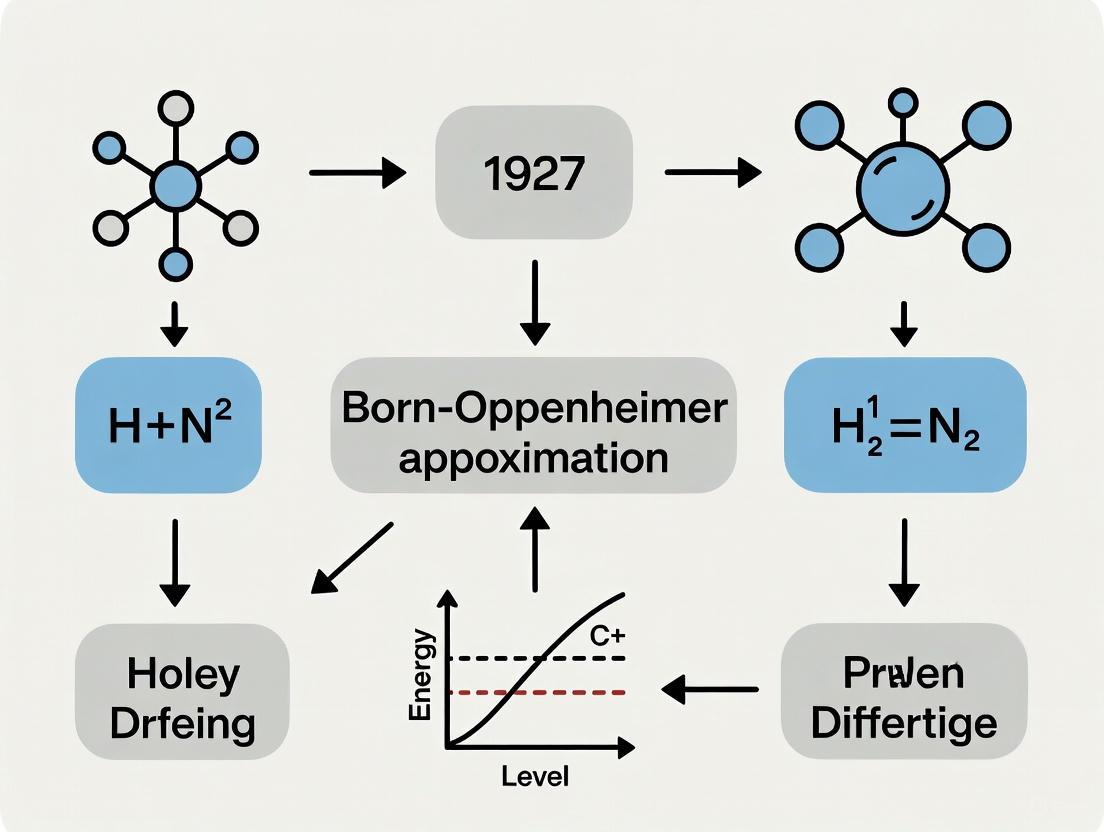
This article explores the historical development and enduring impact of the Born-Oppenheimer (BO) approximation, a cornerstone of quantum chemistry proposed in 1927.
The Born-Oppenheimer Approximation: From 1927 Quantum Breakthrough to Modern Biomedical Applications
Abstract
This article explores the historical development and enduring impact of the Born-Oppenheimer (BO) approximation, a cornerstone of quantum chemistry proposed in 1927. We detail its foundational principles, which separate electronic and nuclear motion to make molecular quantum mechanics tractable. The discussion extends to its critical methodological applications in computational chemistry and drug design, examines its limitations and modern solutions where the approximation breaks down, and validates its utility through comparisons with more complex, non-adiabatic frameworks. Aimed at researchers and drug development professionals, this review synthesizes how this seminal theory continues to shape molecular modeling and the future of biomedical research.
The 1927 Breakthrough: Origins and Foundational Principles of the BO Approximation
The Pre-1927 Quantum Mechanics Landscape and the Molecular Problem
The year 1927 represents a watershed moment in theoretical physics, marking the culmination of the quantum theory's development and the famous Solvay Conference debates between Einstein and Bohr [1] [2]. Within this transformative period, a critical challenge emerged: applying the new quantum mechanics to molecular systems containing both fast-moving electrons and slow-moving nuclei. The fundamental incompatibility between classical physics and microscopic phenomena became increasingly apparent through several key anomalies during the early 20th century. Table 1 summarizes the critical experimental findings that classical mechanics failed to explain, creating the necessity for a new theoretical framework.
Table 1: Experimental Anomalies Unexplainable by Classical Physics (1900-1913)
| Phenomenon | Experimental Findings | Classical Prediction vs. Reality | Key Researchers |
|---|---|---|---|
| Blackbody Radiation | Spectral distribution depends on temperature | Rayleigh-Jeans law: UV catastrophe; Planck's quanta: correct distribution | Planck [3] |
| Photoelectric Effect | Electron ejection depends on light frequency | Wave theory: dependent on intensity; Einstein: quantized light particles | Hertz, Einstein [4] |
| Atomic Spectra | Discrete line spectra for elements | Continuous spectra expected; Bohr: quantized electron orbits | Balmer, Rydberg, Bohr [4] |
| Atomic Stability | Stable atoms with electrons orbiting nuclei | Electrons should spiral into nucleus radiating energy; Bohr: stationary states | Rutherford, Bohr [3] |
The molecular problem presented particular difficulties because molecules introduced the complexity of multiple interacting nuclei and electrons—a multi-body problem that proved intractable for exact solution even within the new quantum framework. This paper explores the conceptual landscape of pre-1927 quantum mechanics as it grappled with molecular systems, setting the stage for the development of the Born-Oppenheimer approximation as a critical enabling methodology for quantum chemistry.
The Evolving Conceptual Framework (1900-1925)
Foundational Quantum Concepts
The quantum revolution began with Max Planck's 1900 solution to the blackbody radiation problem, introducing the radical concept of energy quanta [3]. His work demonstrated that electromagnetic energy could only be emitted or absorbed in discrete packets proportional to frequency (E = hν), directly contradicting the classical continuum viewpoint. This quantization hypothesis resolved the ultraviolet catastrophe by effectively acting as a high-frequency cutoff [3].
Albert Einstein extended this quantum hypothesis in 1905 to explain the photoelectric effect, proposing that light itself consists of particle-like quanta (photons) whose energy correlates with frequency [4]. This wave-particle duality challenged fundamental classical conceptions about the nature of light and matter. Niels Bohr's 1913 atomic model further advanced quantum theory by postulating discrete electron orbits with quantized angular momentum, successfully explaining the hydrogen spectrum but lacking a firm theoretical foundation [4].
The Molecular Challenge in Early Quantum Theory
Prior to 1927, theoretical understanding of molecules evolved significantly through both chemical and physical investigations. The development of molecular orbital theory began with early insights into bonding mechanisms, including:
- G.N. Lewis's cubical atom theory (1902) proposing electron pairs as bonding agents [4]
- Irving Langmuir's work on electron arrangements in atoms and molecules [2]
- Friedrich Kekulé and Archibald Couper's structural theories showing carbon tetravalence and molecular connectivity [5]
- Early molecular modeling by August Wilhelm von Hofmann using stick-and-ball representations [5]
The fundamental challenge in applying quantum mechanics to molecules lay in the coupled nature of electronic and nuclear motions. A molecule with N nuclei and n electrons presents a 3(N+n)-dimensional Schrödinger equation that proved computationally intractable even for the simplest molecular systems [6]. This complexity demanded innovative approximation methods that would eventually lead to the Born-Oppenheimer approximation.
Theoretical Foundations for Molecular Quantum Mechanics
The Mathematical Formulation of the Molecular Problem
The complete molecular Hamiltonian encompasses both electronic and nuclear degrees of freedom:
[ \hat{H}{\text{total}} = -\sum{i}\frac{\hbar^2}{2me}\nablai^2 - \sum{A}\frac{\hbar^2}{2MA}\nablaA^2 - \sum{i,A}\frac{ZAe^2}{r{iA}} + \sum{i>j}\frac{e^2}{r{ij}} + \sum{B>A}\frac{ZAZBe^2}{R{AB}} ]
where indices i,j denote electrons and A,B denote nuclei, with me and MA representing electron and nuclear masses respectively [6] [7]. The terms represent, in order: electronic kinetic energy, nuclear kinetic energy, electron-nucleus attraction, electron-electron repulsion, and nucleus-nucleus repulsion.
The immense computational challenge is illustrated by the benzene molecule (C₆H₆), comprising 12 nuclei and 42 electrons, resulting in a wavefunction depending on 162 coordinates (3×12 + 3×42) [6]. Solving the corresponding Schrödinger equation directly was computationally prohibitive with available methods, necessitating a physically motivated approximation.
The Mass Disparity Insight
The conceptual breakthrough emerged from recognizing the significant mass disparity between electrons and nuclei. Even the lightest nucleus (hydrogen) possesses approximately 1836 times the mass of an electron [7]. This mass difference translates to dramatically different timescales of motion—electronic motion occurs on femtosecond timescales (10⁻¹⁵ s), while nuclear vibrations and rotations occur on picosecond timescales (10⁻¹² s) or longer [7]. This temporal separation suggested that electrons could instantaneously adjust to nuclear positions, treating nuclei as effectively fixed when solving for electronic wavefunctions.
Table 2: Mass and Timescale Comparison for Molecular Constituents
| Component | Mass (kg) | Characteristic Timescale | Energy Range | Primary Motion Types |
|---|---|---|---|---|
| Electrons | 9.1×10⁻³¹ | ~10⁻¹⁷ - 10⁻¹⁵ s | 1-10 eV | Orbital transitions |
| Nuclei | 1.67×10⁻²⁷ - 4×10⁻²⁵ | ~10⁻¹⁴ - 10⁻¹² s | 0.01-0.5 eV | Vibration, rotation |
The Born-Oppenheimer Approximation: Conceptual Antecedents
Physical Insight and Mathematical Formulation
Although the formal Born-Oppenheimer approximation was published in 1927, its physical basis emerged from earlier recognition of the adiabatic principle in quantum systems. The central insight was that the wavefunction for a molecular system could be separated into electronic and nuclear components:
[ \Psi{\text{total}}(\mathbf{r}, \mathbf{R}) = \psi{\text{electronic}}(\mathbf{r}; \mathbf{R}) \cdot \psi_{\text{nuclear}}(\mathbf{R}) ]
where r represents electronic coordinates and R represents nuclear coordinates [6] [8]. The parametric dependence of the electronic wavefunction on nuclear positions (indicated by the semicolon notation) reflects the adiabatic adjustment of electrons to nuclear configuration.
The approximation proceeds in two essential steps:
- Electronic Equation: For fixed nuclear positions R, solve the electronic Schrödinger equation:
[ \hat{H}{\text{electronic}} \psik(\mathbf{r}; \mathbf{R}) = Ek(\mathbf{R}) \psik(\mathbf{r}; \mathbf{R}) ]
where ( \hat{H}{\text{electronic}} ) includes electron kinetic energy and all potential energy terms [6] [7]. This yields potential energy surfaces ( Ek(\mathbf{R}) ) for each electronic state k.
- Nuclear Equation: Using the potential energy surfaces from the electronic solution, solve the nuclear Schrödinger equation:
[ \left[\hat{T}{\text{nuclear}} + Ek(\mathbf{R})\right] \chi{k,\kappa}(\mathbf{R}) = E{k,\kappa} \chi_{k,\kappa}(\mathbf{R}) ]
where ( \hat{T}_{\text{nuclear}} ) is the nuclear kinetic energy operator, and κ denotes nuclear quantum states [6].
Diagram 1: Born-Oppenheimer Approximation Workflow (13 characters)
Limitations and Boundary Conditions
The Born-Oppenheimer approximation validity depends on the separation of electronic energy surfaces [6] [8]. The approximation is most reliable when:
[ E0(\mathbf{R}) \ll E1(\mathbf{R}) \ll E_2(\mathbf{R}) \ll \cdots \quad \text{for all } \mathbf{R} ]
However, the approximation breaks down at:
- Conical intersections where potential energy surfaces cross or approach closely
- Avoided crossings in diatomic molecules
- Regions of high nuclear kinetic energy where non-adiabatic coupling becomes significant
- Systems with near-degenerate electronic states [8]
The non-adiabatic coupling terms that are neglected in the BO approximation have the form:
[ \textbf{A}{ij} = \langle \psii | \nablaR | \psij \rangle \cdot \nabla_R ]
which act as non-abelian gauge potentials coupling different electronic states [8].
Experimental Foundations and Research Tools
Key Experimental Methodologies
The development of quantum mechanics was driven by sophisticated experimental investigations that revealed the inadequacy of classical explanations. Several critical experiments provided essential data for theoretical development:
Franck-Hertz Experiment (1914): Demonstrated discrete energy levels in atoms through electron collision studies with mercury vapor, showing energy transfer only at specific voltages and providing direct evidence for Bohr's quantized orbits [4].
Stern-Gerlach Experiment (1922): Revealed spatial quantization of angular momentum by passing silver atoms through an inhomogeneous magnetic field and observing discrete deflection patterns [4].
X-ray Crystallography: Enabled determination of molecular structures through Bragg's law, with William Lawrence Bragg and William Henry Bragg receiving the Nobel Prize for their work on crystal structure analysis [2].
Spectroscopic Techniques: Advanced precision measurements of atomic and molecular spectra, including Stark effect (1913) and Zeeman effect (1896) studies, which revealed the response of quantum systems to external fields [4].
Table 3: Essential Research Tools for Quantum Molecular Investigations (Pre-1927)
| Tool/Technique | Function | Key Researchers |
|---|---|---|
| Wilson Cloud Chamber | Track ionizing particles | C.T.R. Wilson [2] |
| X-ray Diffraction | Determine crystal structures | W.H. & W.L. Bragg [2] |
| Spectroscopy Apparatus | Measure emission/absorption spectra | Bohr, Kramers [4] |
| High-Vacuum Systems | Isolate molecular systems | Knudsen [2] |
| Electrometers | Measure radioactive emissions | Curie [4] |
Computational and Theoretical Tools
Theoretical research preceding 1927 relied on both analytical and early numerical approaches:
- Perturbation theory for approximating solutions to near-solvable systems
- Variational methods for estimating ground state energies
- Group theory for understanding symmetry implications
- Semiclassical quantization rules for atomic systems
- Hamiltonian mechanics adapted to quantum systems
Diagram 2: Theoretical Development Toward BO Approximation (13 characters)
The Road to 1927: Unresolved Molecular Problems
Specific Molecular Challenges
As quantum theory developed through the early 1920s, several molecular problems remained particularly recalcitrant:
- Chemical Bonding Nature: No satisfactory quantum explanation existed for the covalent bond, particularly the mechanism of electron pairing
- Molecular Spectroscopy: Complex band spectra of molecules defied complete interpretation without proper treatment of vibrational-rotational coupling
- Reaction Kinetics: Understanding chemical reaction rates required potential energy surface concepts not yet formalized
- Molecular Structure Prediction: Determining equilibrium geometries of polyatomic molecules remained largely empirical
The work of Robert Oppenheimer, then a 23-year-old graduate student working with Max Born, addressed precisely these challenges by providing a mathematically rigorous foundation for separating electronic and nuclear motion [6]. This approximation enabled the conceptual framework for potential energy surfaces that would become fundamental to molecular spectroscopy and chemical reactivity theory.
The Intellectual Context of 1927
The famous 1927 Solvay Conference brought together 29 leading physicists, including 17 past or future Nobel laureates, to confront the foundational questions of quantum theory [1] [2]. The conference featured intense debates between Einstein and Bohr regarding the interpretation of quantum mechanics, particularly the uncertainty principle and indeterminism. Within this environment of profound theoretical reassessment, the Born-Oppenheimer approximation represented a pragmatic approach to rendering complex molecular problems tractable within the new quantum framework.
The approximation emerged as the culmination of decades of development in both quantum theory and molecular physics, providing the essential conceptual tool that would enable the development of quantum chemistry as a distinct discipline and ultimately support applications across chemistry, materials science, and molecular biology.
Historical and Personal Context of the Collaboration
The collaboration between Max Born and J. Robert Oppenheimer was a classic protégé-mentor relationship, forged at a pivotal time in the development of quantum mechanics. In 1926, Oppenheimer, a brilliant but troubled American graduate student, moved from Cambridge University to the University of Göttingen to finish his graduate studies under Born [9] [10]. At the time, Göttingen was one of the world's foremost centers for theoretical physics, and Born, already a distinguished physicist, had assembled a remarkable group of students and assistants [11] [12].
Their personalities were strikingly different. Born was a settled, established professor, while Oppenheimer was a young, intense, and sometimes overbearing student. Accounts from the time note that Oppenheimer was so enthusiastic in discussions that he would sometimes dominate them, to the point where Born was presented with a petition signed by other students, including Maria Goeppert, threatening a boycott of the class unless he made Oppenheimer quiet down [13]. Despite these challenges, Born recognized Oppenheimer's exceptional intellect. He later included Oppenheimer in his circle of brilliant young physicists, a group that also included figures such as Wolfgang Pauli, Werner Heisenberg, and Enrico Fermi [11] [12]. Oppenheimer received his doctorate in 1927 at the age of 23 under Born's supervision [13]. It was during this fertile period in Göttingen that their most famous joint work, the Born-Oppenheimer approximation, was conceived and published in 1927 [13].
The Born-Oppenheimer Approximation: A Technical Exposition
The Born-Oppenheimer (BO) approximation is a fundamental concept in quantum chemistry and molecular physics that allows for the separation of nuclear and electronic motion within a molecule [6] [14]. It forms the bedrock upon which most modern computational chemistry is built.
Physical and Mathematical Rationale
The core physical insight of the approximation is the significant disparity in mass between atomic nuclei and electrons. Because nuclei are thousands of times heavier than electrons (e.g., a proton's mass is roughly 2000 times greater than an electron's [14]), their motions occur on a much slower timescale [6]. Consequently, from the perspective of the electrons, the nuclei appear almost stationary. This allows for the treatment of the nuclei as fixed, clamped points in space when solving for the electronic wavefunction and energy [6] [14].
The molecular Hamiltonian, H_total, for a system with M nuclei and N electrons is given in atomic units by [6] [14]:
Where:
T_n= Kinetic energy operator of the nucleiT_e= Kinetic energy operator of the electronsV_ne= Coulomb attraction between electrons and nucleiV_ee= Coulomb repulsion between electronsV_nn= Coulomb repulsion between nuclei
The BO approximation recognizes that the total wavefunction for the molecule, Ψ_total(r, R), which depends on both electronic (r) and nuclear (R) coordinates, can be approximated as a product [6]:
Ψ_total(r, R) ≈ ψ_electronic(r; R) ψ_nuclear(R)
Here, ψ_electronic(r; R) is the electronic wavefunction solved for with the nuclear coordinates R treated as fixed parameters. This leads to a two-step solution process:
The Electronic Schrödinger Equation: For a fixed nuclear configuration
R, one solves the electronic eigenvalue problem:[T_e + V_ne + V_ee + V_nn] ψ_electronic(r; R) = E_e(R) ψ_electronic(r; R)The solution yields the electronic wavefunctionψ_electronicand the electronic energyE_e(R), which includes the nuclear repulsion termV_nnand depends parametrically onR[6] [14].The Nuclear Schrödinger Equation: The electronic energy
E_e(R)subsequently acts as the effective potential energy surface on which the nuclei move. The nuclear wavefunctionψ_nuclear(R)is then found by solving:[T_n + E_e(R)] ψ_nuclear(R) = E_total ψ_nuclear(R)The eigenvalueE_totalfrom this equation is the total energy of the molecule [6].
Table 1: Components of the Molecular Hamiltonian within the BO Approximation.
| Component | Mathematical Operator | Role in the BO Approximation | ||
|---|---|---|---|---|
| Nuclear Kinetic Energy | T_n = -∑_A (1/(2M_A)) ∇_A² |
Neglected in the first (electronic) step; reintroduced as the kinetic energy operator for nuclear motion in the second step [6]. | ||
| Electronic Kinetic Energy | T_e = -∑_i (1/2) ∇_i² |
Retained in the electronic Schrödinger equation [6] [14]. | ||
| Electron-Nuclear Potential | `Vne = -∑A,i Z_A / | ri - RA | ` | Treated as an external potential for electrons with fixed nuclei [6] [14]. |
| Electron-Electron Potential | `Vee = ∑{i>j} 1 / | ri - rj | ` | Retained in the electronic Schrödinger equation [6] [14]. |
| Nuclear-Nuclear Potential | `Vnn = ∑{A>B} ZA ZB / | RA - RB | ` | Treated as a constant (Enuc) for a fixed nuclear configuration and added to the electronic energy [14]. |
Computational Impact and an Illustrative Example
The BO approximation dramatically reduces the computational complexity of solving the molecular Schrödinger equation. Instead of solving a single intractable problem involving all particles simultaneously, one solves a series of smaller, decoupled problems [6].
Consider the benzene molecule (C_6H_6), which contains 12 nuclei and 42 electrons [6]. The total number of spatial coordinates for the combined system is 162 (3 x 12 = 36 nuclear + 3 x 42 = 126 electronic). The computational complexity for solving an eigenvalue problem typically increases faster than the square of the number of coordinates (n²) [6].
Table 2: Computational Complexity Reduction for the Benzene Molecule using the BO Approximation.
| Solution Method | Number of Variables | Relative Computational Complexity (∝ n²) |
|---|---|---|
| Full Molecular Schrödinger Equation | 162 coordinates | 162² = 26,244 |
| BO - Electronic Step | 126 electronic coordinates (repeated for N nuclear grids) | 126² * N = 15,876 * N |
| BO - Nuclear Step | 36 nuclear coordinates | 36² = 1,296 |
As the table demonstrates, the BO approximation breaks a single large problem (complexity ~26,244) into a smaller nuclear problem (complexity ~1,296) and a series of electronic problems. This makes quantum mechanical calculations for large molecules feasible [6].
The Scientist's Toolkit: Essential Concepts and "Reagents"
To work effectively with the Born-Oppenheimer approximation, researchers utilize a set of conceptual and computational "research reagents." The following table details key items and their functions.
Table 3: Key "Research Reagents" for the Born-Oppenheimer Approximation.
| Conceptual "Reagent" | Function and Role |
|---|---|
| Potential Energy Surface (PES) | A hypersurface representing the electronic energy E_e(R) as a function of all nuclear coordinates R. It is the central result of the electronic structure calculation and dictates the molecule's geometry, vibrational frequencies, and reactivity [6]. |
Wavefunction (ψ) |
A mathematical function containing all information about a quantum system. The BO approximation allows for the factorization of the total wavefunction into manageable electronic and nuclear components [6]. |
Hamiltonian Operator (H) |
The quantum mechanical operator corresponding to the total energy of the system. The BO approximation simplifies the full molecular Hamiltonian by decoupling its terms [6] [14]. |
Nuclear Kinetic Energy Operator (T_n) |
The operator representing the kinetic energy of the nuclei. It is the key term neglected in the first step of the BO approximation due to the large nuclear mass [6]. |
Limitations and Modern Extensions
Despite its profound utility, the BO approximation has well-defined limits of validity. It breaks down when the fundamental assumption of separable nuclear and electronic motion fails. This occurs when two or more electronic states are very close in energy, leading to significant nonadiabatic couplings (NACs) [14].
The breakdown can be understood by considering the full Hamiltonian acting on the product wavefunction. A more complete treatment reveals off-diagonal coupling terms, represented by matrix elements like ⟨ψ_1 | ∇_R | ψ_2⟩ ⋅ ∇_R, which couple different electronic states (ψ_1 and ψ_2) through the nuclear momentum operator [6] [14]. These terms are negligible when electronic states are well-separated, but become critical near points of degeneracy, such as conical intersections [14].
When the BO approximation breaks down, more sophisticated methodologies are required:
- Nonadiabatic Dynamics: Simulations that explicitly account for the coupling between electronic states, allowing for transitions between potential energy surfaces [14].
- Diabatic Representations: Using a basis set in which the nuclear momentum coupling is minimized, often providing a more intuitive picture of nonadiabatic processes [14].
- Multicomponent Quantum Chemistry: Methods that attempt to solve the full Schrödinger equation for electrons and specific quantum nuclei (e.g., protons) without invoking the BOA, treating them on an equal footing [14].
The collaboration between the established mentor Max Born and his brilliant protégé J. Robert Oppenheimer yielded one of the most enduring approximations in theoretical chemistry and physics. The Born-Oppenheimer approximation provided a practical and computationally feasible path forward for applying quantum mechanics to molecules, directly enabling the entire field of quantum chemistry. While modern research continues to develop methods for situations where the approximation fails, the BO framework remains the essential starting point for nearly all quantum mechanical studies of molecular structure and dynamics, a testament to the power of the insight Born and Oppenheimer had in 1927.
The year 1927 marked a pivotal moment in the history of quantum mechanics, when Max Born and his 23-year-old graduate student J. Robert Oppenheimer published their seminal paper "Zur Quantentheorie der Molekeln" in Annalen der Physik [15]. This work emerged during a period of intense foment in quantum theory, just one year after Erwin Schrödinger published his wave equation. Born and Oppenheimer addressed what was then a formidable challenge: solving the quantum mechanical equations for molecules, which required dealing with the coupled motions of all electrons and nuclei simultaneously [6] [15]. Their ingenious solution leveraged a fundamental physical insight—the significant mass disparity between electrons and atomic nuclei—to enable what would become the cornerstone of molecular quantum mechanics [6] [16].
The Born-Oppenheimer (BO) approximation introduced a revolutionary approach by recognizing that the vast difference in mass (with the electron to proton mass ratio being approximately 1:1836) translates to a corresponding separation of motional time scales [17] [7]. This insight allowed them to propose a separation of the molecular wavefunction into electronic and nuclear components, effectively decoupling the rapid motion of electrons from the comparatively sluggish nuclear movements [18]. Though mathematical techniques for handling such singular perturbation theories were poorly developed at the time, their physical intuition created a framework that remains indispensable nearly a century later [15] [19].
The Fundamental Physical Principle: Mass Ratio and Timescale Separation
The Core Mass Disparity Argument
The foundational insight of the Born-Oppenheimer approximation rests on a straightforward physical fact: atomic nuclei are significantly heavier than electrons, with mass ratios ranging from approximately 1,836:1 for a proton versus an electron to much higher ratios for heavier nuclei [6] [16]. This mass difference creates a natural separation of motional time scales within molecules. Electrons, being lighter, move and adjust to changing nuclear configurations almost instantaneously, while the heavier nuclei move much more sluggishly in comparison [16] [7].
In technical terms, Born and Oppenheimer introduced a small parameter κ = (m/M)^1/4, where m is the electron mass and M is a typical nuclear mass, which serves as an expansion parameter in their perturbation theory [17]. This parameter (approximately 0.15 for hydrogen nuclei) quantifies the separation of scales and provides a mathematical basis for the approximation. The physical picture that emerges is that from the perspective of the rapidly moving electrons, the nuclei appear nearly stationary, while the nuclei experience the electrons as a continuous charge distribution that provides a potential field for their motion [6].
Comparative Motional Timescales in Molecular Systems
Table: Characteristic Timescales of Molecular Motions
| Motion Type | Typical Timescale (seconds) | Governing Mass Factor | Primary Role |
|---|---|---|---|
| Electronic Motion | 10^-17 to 10^-16 | Electron mass (m_e) | Chemical bonding, electronic excitations |
| Molecular Vibrations | 10^-14 to 10^-13 | Reduced nuclear mass (μ) | Bond stretching, angle bending |
| Molecular Rotations | 10^-12 to 10^-10 | Moment of inertia (I) | Overall molecular tumbling |
| Nuclear Relocation | 10^-3 and longer | Full molecular mass | Diffusion, chemical reactions |
The temporal separation between electronic and nuclear motions is dramatic, with electrons undergoing periodic motions within their orbitals on the 10^-17 second timescale, while typical bond vibrations occur on 10^-14 second scales, and molecular rotations require even longer periods [7]. This separation justifies the BO approximation for most ground-state molecular systems, as electrons can promptly "adjust" their distribution to the much slower nuclear motions [7].
Mathematical Formulation: From Physical Insight to Working Equations
The Molecular Hamiltonian and Its Separation
The full molecular Hamiltonian contains terms for the kinetic energy of all electrons and nuclei, as well as all Coulomb interaction potentials between these particles [6]:
[ H = \sumi \left[- \frac{\hbar^2}{2me} \frac{\partial^2}{\partial qi^2} \right] + \frac{1}{2} \sum{j\ne i} \frac{e^2}{r{i,j}} - \sum{a,i} \frac{Zae^2}{r{i,a}} + \suma \left[- \frac{\hbar^2}{2ma} \frac{\partial^2}{\partial qa^2}\right] + \frac{1}{2} \sum{b\ne a} \frac{ZaZb e^2}{r_{a,b}} ]
Within the BO approximation, this complex many-body problem is separated into two more manageable parts [6] [16]. First, the nuclear kinetic energy terms are neglected (the clamped-nuclei approximation), leaving the electronic Hamiltonian:
[ H{\text{e}} = -\sumi \frac{1}{2}\nablai^2 - \sum{i,A} \frac{ZA}{r{iA}} + \sum{i>j} \frac{1}{r{ij}} + \sum{B>A} \frac{ZA ZB}{R{AB}} ]
This electronic Hamiltonian is solved for fixed nuclear positions R, yielding electronic wavefunctions χₖ(r;R) and energy eigenvalues Eₖ(R) that parametrically depend on nuclear coordinates [6]:
[ H{\text{e}}(r,R)\chik(r;R) = Ek(R)\chik(r;R) ]
The electronic energy Eₖ(R) then serves as the potential energy function for nuclear motion in the second step [6]:
[ [T{\text{n}} + E{\text{e}}(R)]\phi(R) = E\phi(R) ]
where Tₙ represents the nuclear kinetic energy operator that was initially neglected [6].
The Born-Oppenheimer Wavefunction Factorization
The BO approximation expresses the total molecular wavefunction as a simple product of nuclear and electronic wavefunctions [18]:
[ \Psi{\text{total}} = \psi{\text{electronic}} \psi_{\text{nuclear}} ]
More precisely, the wavefunction is written as:
[ \Psi(r,R) = \psie(r; R) \psiN(R) ]
where ψₑ(r;R) is the electronic wavefunction that depends parametrically on the nuclear coordinates R, and ψ_N(R) is the nuclear wavefunction [18]. This factorization is the mathematical embodiment of the physical insight regarding mass disparity and represents what is more precisely termed the adiabatic approximation [18].
Computational Methodology: Implementing the Approximation
The Two-Step Computational Protocol
The Born-Oppenheimer approximation transforms an intractable many-body quantum problem into a computationally feasible protocol through a sequential two-step approach:
Step 1: Electronic Structure Calculation → For a fixed nuclear configuration R, solve the electronic Schrödinger equation to obtain the electronic wavefunction ψₑ(r;R) and energy Eₑ(R) [6] [16]. This step is repeated for multiple nuclear configurations to map out the potential energy surface (PES).
Step 2: Nuclear Dynamics → Using the PES from Step 1 as the effective potential, solve the nuclear Schrödinger equation for vibrational, rotational, and translational motions [6]. The nuclear kinetic energy operator, initially neglected, is reintroduced at this stage [17].
Computational Complexity Reduction
The computational advantage offered by the BO approximation is substantial, particularly for larger molecules. Consider the example of the benzene molecule (C₆H₆) [6]:
Table: Computational Complexity Reduction for Benzene (C₆H₆)
| Calculation Type | Number of Variables | Computational Complexity (∝ n²) | Practical Implementation |
|---|---|---|---|
| Full Molecular Schrödinger Equation | 162 variables (36 nuclear + 126 electronic) | 162² = 26,244 | Computationally intractable |
| BO Electronic Calculation | 126 electronic variables | 126²·N = 15,876·N grid points | Feasible with modern computing |
| BO Nuclear Calculation | 36 nuclear variables | 36² = 1,296 | Highly tractable |
This separation reduces a computationally intractable problem to a series of manageable calculations [6]. The electronic structure component, while still challenging, becomes feasible through various approximation methods (Hartree-Fock, Density Functional Theory, etc.), while the nuclear motion can be treated through quantum or classical dynamics on the resulting potential energy surface [16].
Research Applications and Methodologies
The Scientist's Toolkit: Essential Computational Methods
Table: Key Methodologies Enabled by the Born-Oppenheimer Approximation
| Method Category | Specific Techniques | Primary Application Domain | BO Approximation Role |
|---|---|---|---|
| Electronic Structure Methods | Hartree-Fock (HF), Density Functional Theory (DFT), Coupled Cluster (CC) | Molecular geometry, bonding analysis, electronic properties | Provides foundation by enabling electronic calculation at fixed nuclear positions |
| Vibrational Analysis | Normal mode analysis, Fourier-transform infrared (FTIR) spectroscopy prediction | Molecular identification, thermodynamic properties | Enables harmonic approximation of PES around minima |
| Reaction Pathway Studies | Transition state theory, Intrinsic Reaction Coordinate (IRC) | Reaction mechanism elucidation, catalyst design | Allows mapping of reaction coordinates on single PES |
| Molecular Dynamics | Ab initio molecular dynamics (AIMD), Path-integral molecular dynamics | Protein folding, materials properties, solution chemistry | Provides PES for classical nuclear motion |
| Spectroscopic Prediction | Rotational-vibrational spectroscopy, Electronic spectroscopy | Analytical chemistry, astrophysical molecule identification | Enables energy decomposition: Etotal = Eelec + Evib + Erot |
Experimental Protocols: Validating the Approximation
While the BO approximation is primarily a theoretical tool, its predictions are routinely validated against experimental measurements:
Photoelectron Spectroscopy Protocol: Measures electronic energy levels predicted by the BO approximation through ionization energies. The fixed-nuclei electronic energy differences are compared with measured ionization potentials [16].
Vibrational-Rotational Spectroscopy: High-resolution infrared spectroscopy validates the predicted vibrational frequencies and rotational constants that derive from the nuclear motion on BO potential energy surfaces [15] [7].
Time-Resolved Laser Spectroscopy: Ultrafast laser techniques can directly probe the timescales of electronic versus nuclear motion, providing experimental verification of the temporal separation assumed in the approximation [17].
Limitations and Modern Extensions
When the Approximation Breaks Down
Despite its widespread success, the BO approximation has well-established limitations arising from its fundamental assumptions:
Conical Intersections: These are points in nuclear configuration space where two electronic potential energy surfaces become degenerate or nearly degenerate [17]. In these regions, the non-adiabatic coupling terms (neglected in the BO approximation) become large, and the assumption of separable electronic and nuclear motion fails completely [16] [17].
Non-Adiabatic Processes: Photoinduced processes, electron transfer reactions, and situations involving strongly coupled electronic states violate the BO assumption that electrons remain in a single electronic eigenstate [16] [17]. In such cases, transitions between electronic states driven by nuclear motion become important.
Light-Element Systems: For molecules containing hydrogen or other light atoms, the mass ratio is less extreme, and nuclear quantum effects (such as tunneling) become more significant, reducing the accuracy of the standard BO approach [7].
Rydberg States: In highly excited electronic states where electrons occupy large orbitals, their motion slows considerably, reducing the timescale separation between electronic and nuclear motions [7].
Beyond Born-Oppenheimer: Modern Computational Approaches
Contemporary research has developed sophisticated methods to address the limitations of the basic BO approximation:
Non-Adiabatic Molecular Dynamics: Techniques such as surface hopping and multiple spawning explicitly account for transitions between electronic states, enabling the simulation of photochemical processes and electronic energy transfer [17].
Conical Intersection Optimization: Specialized computational algorithms now exist to locate and characterize conical intersections, which serve as efficient funnels for radiationless transitions in photochemistry [17].
Exact Factorization Methods: This novel approach maintains a product form for the wavefunction (similar to BO) but with a time-dependent electronic component, providing a formally exact representation that can describe non-adiabatic processes [17].
Vibronic Coupling Models: These approaches systematically include the off-diagonal coupling terms between electronic states that are neglected in the standard BO approximation, particularly important for Jahn-Teller systems and other symmetry-breaking phenomena [6] [18].
Impact on Chemistry and Drug Development
Enabling Computational Chemistry in Pharmaceutical Research
The Born-Oppenheimer approximation provides the fundamental theoretical framework that enables most modern computational chemistry applications in drug development:
Molecular Docking and Virtual Screening: By enabling rapid calculation of molecular geometries and interaction energies, the BO approximation allows researchers to screen thousands of potential drug candidates in silico before laboratory synthesis [16].
Protein-Ligand Binding Affinity Prediction: Drug-receptor interactions are modeled using potential energy surfaces calculated under the BO approximation, providing estimates of binding constants and guiding lead optimization [16].
Reaction Mechanism Elucidation: The BO framework allows computational chemists to map reaction pathways for drug metabolism, identifying potential toxic intermediates and guiding molecular design to avoid problematic metabolic pathways [16].
Spectroscopic Characterization of Drug Compounds: Computational prediction of infrared, Raman, and NMR spectra—all reliant on the BO separation—helps in the characterization of drug polymorphs and formulation optimization [16].
Emerging Applications in Sustainable Chemistry and Materials Design
The conceptual framework established by Born and Oppenheimer continues to enable advances in sustainable chemistry and materials science:
Photocatalyst Design: Understanding limitations of the BO approximation is crucial for designing molecular catalysts for solar energy conversion, where excited states and non-adiabatic transitions play central roles [16] [17].
Organic Photovoltaics: The development of efficient organic solar cells requires modeling charge separation processes that involve transitions between electronic states—phenomena that explicitly violate the standard BO approximation [16].
Quantum Materials: Materials with strong electron-phonon coupling, such as high-temperature superconductors, require methods beyond standard BO to properly describe their behavior [16].
Nearly a century after its introduction, the core physical insight of the Born-Oppenheimer approximation—leveraging the mass disparity between electrons and nuclei to separate their motions—continues to underpin computational approaches across chemistry, materials science, and drug development. While modern research has revealed its limitations and developed sophisticated methods to move beyond it, the BO approximation remains the essential starting point for most quantum mechanical treatments of molecular systems.
The elegant separation of scales proposed by Born and Oppenheimer in 1927 has proven remarkably resilient, providing both a practical computational framework and a conceptual foundation for understanding molecular structure and dynamics. As computational power continues to grow and experimental techniques probe ever-faster processes, the basic physical insight of separated time scales continues to guide new developments in non-adiabatic dynamics and time-dependent computational methods, ensuring that this historic approximation remains relevant for the quantum chemical challenges of the 21st century.
The 1927 paper by Max Born and J. Robert Oppenheimer introduced a conceptual and computational framework that would become one of the most enduring approximations in quantum chemistry and molecular physics [6] [15]. Born and Oppenheimer's key insight was to exploit the significant mass disparity between electrons and nuclei to separate the complex molecular Schrödinger equation into more manageable parts [20]. This approach recognized that due to their much larger mass, atomic nuclei move considerably more slowly than electrons; from the perspective of the swift electrons, the nuclei appear almost stationary [6] [21]. This physical observation forms the foundation of the two-step formulation now known as the Born-Oppenheimer (BO) approximation, a method that fundamentally shapes how scientists visualize molecules and chemical reactions, from simple ball-and-stick models to the computation of potential energy surfaces that guide nuclear motion [20]. The approximation's robustness is particularly remarkable given that its original derivation was restricted to molecules where the potential energy surface was essentially quadratic, yet it provides accurate results even in situations where these conditions are not met [21].
This technical guide examines the core two-step formulation of the Born-Oppenheimer approximation, detailing the clamped-nuclei electronic structure problem and the subsequent nuclear Schrödinger equation. We will explore the mathematical foundation, computational methodologies, and practical protocols for its application, while also addressing its limitations and the conditions under which the approximation may break down.
Theoretical Foundation: The Mathematical Formulation
The Born-Oppenheimer approximation begins with the exact non-relativistic, time-independent molecular Hamiltonian, which describes a system of interacting electrons and nuclei [6] [22]. In atomic units, this Hamiltonian is expressed as:
[ H = He + Tn ]
where ( Tn ) represents the nuclear kinetic energy operator, and ( He ) is the electronic Hamiltonian that includes the electronic kinetic energy (( Te )), electron-electron Coulomb interaction (( V{ee} )), electron-nucleus interaction (( V{en} )), and nucleus-nucleus Coulomb interaction (( V{nn} )) [6] [22] [21]. The explicit forms of these operators are:
[ Tn = -\sum{A} \frac{1}{2MA} \nablaA^2, \quad He = -\sum{i} \frac{1}{2} \nablai^2 - \sum{i,A} \frac{ZA}{r{iA}} + \sum{i>j} \frac{1}{r{ij}} + \sum{B>A} \frac{ZA ZB}{R{AB}} ]
Here, ( MA ) and ( ZA ) are the mass and atomic number of nucleus A, respectively, while ( r{iA} ), ( r{ij} ), and ( R{AB} ) represent electron-nucleus, electron-electron, and nucleus-nucleus distances [6]. The small dimensionless parameter ( \mu = me/M ), representing the electron-to-nuclear mass ratio (upper bounded by approximately ( 5.4 \times 10^{-4} )), naturally appears and serves as the foundation for the perturbative approach [22].
Table 1: Components of the Molecular Hamiltonian in the Born-Oppenheimer Framework
| Component | Mathematical Expression | Physical Significance |
|---|---|---|
| Nuclear Kinetic Energy | ( Tn = -\sum{A} \frac{1}{2MA} \nablaA^2 ) | Energy arising from motion of nuclei |
| Electronic Kinetic Energy | ( Te = -\sum{i} \frac{1}{2} \nabla_i^2 ) | Energy arising from motion of electrons |
| Electron-Nucleus Interaction | ( V{en} = -\sum{i,A} \frac{ZA}{r{iA}} ) | Attractive Coulomb potential |
| Electron-Electron Interaction | ( V{ee} = \sum{i>j} \frac{1}{r_{ij}} ) | Repulsive Coulomb potential |
| Nucleus-Nucleus Interaction | ( V{nn} = \sum{B>A} \frac{ZA ZB}{R_{AB}} ) | Repulsive Coulomb potential |
The Two-Step Formulation: A Detailed Examination
Step One: The Clamped-Nuclei Electronic Problem
In the first step of the BO approximation, the nuclear kinetic energy ( T_n ) is neglected, and the nuclear coordinates ( \mathbf{R} ) are treated as fixed parameters rather than dynamic variables [6] [23]. This is known as the clamped-nuclei approximation. The resulting electronic Schrödinger equation is solved for a specific nuclear configuration:
[ He(\mathbf{r}; \mathbf{R}) \chik(\mathbf{r}; \mathbf{R}) = E{e,k}(\mathbf{R}) \chik(\mathbf{r}; \mathbf{R}) ]
Here, ( \chi_k(\mathbf{r}; \mathbf{R}) ) represents the electronic wavefunction for the k-th electronic state, which depends explicitly on the electronic coordinates ( \mathbf{r} ) and parametrically on the nuclear coordinates ( \mathbf{R} ) [6]. The parametric dependence means that the electronic wavefunction and energy form a family of solutions parameterized by the nuclear geometry [8].
This computational process is repeated for many different nuclear configurations to map out the potential energy surface (PES) ( E_{e,k}(\mathbf{R}) ) for each electronic state k [23]. This PES serves as the effective potential energy governing the nuclear motion in the second step of the approximation. The accuracy of this surface is entirely determined by the method chosen to solve the electronic Schrödinger equation [21].
Step Two: The Nuclear Schrödinger Equation
In the second step, the nuclear kinetic energy operator ( Tn ) is reintroduced, and the electronic energy ( E{e,k}(\mathbf{R}) ) from the first step becomes the potential energy function for nuclear motion [6] [8]. For a given electronic state k, the nuclear Schrödinger equation is written as:
[ [Tn + E{e,k}(\mathbf{R})] \phi{k,\kappa}(\mathbf{R}) = E{k,\kappa} \phi_{k,\kappa}(\mathbf{R}) ]
Here, ( \phi{k,\kappa}(\mathbf{R}) ) is the nuclear wavefunction, and ( \kappa ) encompasses the quantum numbers for vibrational, rotational, and translational states [6] [8]. The total energy of the molecule is ( E{k,\kappa} ), and the total wavefunction in the BO approximation is expressed as a product:
[ \Psi{k,\kappa}(\mathbf{r}, \mathbf{R}) = \chik(\mathbf{r}; \mathbf{R}) \phi_{k,\kappa}(\mathbf{R}) ]
This product form illustrates the separation of electronic and nuclear motions, though it's important to note that the electronic wavefunction still depends parametrically on the nuclear coordinates [8]. The nuclear motion described by this equation includes translations and rotations of the entire molecule, plus internal vibrations, resulting in 3N-6 vibrational degrees of freedom for non-linear molecules (3N-5 for linear molecules) where N is the number of nuclei [8].
Table 2: Computational Complexity Reduction via the Born-Oppenheimer Approximation
| System | Total Variables | BO Step 1 (Electronic) | BO Step 2 (Nuclear) | Complexity Reduction |
|---|---|---|---|---|
| Benzene (C₆H₆) | 162 (126 electronic + 36 nuclear) | 126 variables solved for multiple fixed nuclear configurations | 36 variables solved using PES from Step 1 | Single 16,384-dimension problem reduced to multiple 15,876-dimension problems plus one 1,296-dimension problem [6] |
| General Molecule | 3Nₙ + 3Nₑ | 3Nₑ variables | 3Nₙ variables | Separation reduces computational scaling from O((3Nₙ+3Nₑ)²) to O((3Nₑ)²) + O((3Nₙ)²) [6] |
Computational Protocols and Methodologies
Electronic Structure Methods for the Clamped-Nuclei Problem
The solution of the clamped-nuclei electronic Schrödinger equation presents a significant computational challenge that has been addressed through various methodological approaches of differing accuracy and computational cost [21].
Hartree-Fock (HF) Self-Consistent Field Methods: This approach represents the first practical implementation for solving the many-electron problem [21]. The HF method approximates the electron-electron interaction through an effective potential and uses a properly antisymmetrized product wavefunction (Slater determinant) to satisfy the Pauli exclusion principle [21]. While it provides a sound theoretical foundation, its accuracy is limited by the neglect of electron correlation, leading to the development of post-HF methods like Møller-Plesset perturbation theory and configuration interaction to incorporate these effects [21].
Density Functional Theory (DFT): DFT offers a more mathematically elegant approach by using the electron density rather than a many-body wavefunction as the fundamental variable [21]. Based on the Hohenberg-Kohn theorems, which establish that the ground-state electron density uniquely determines the external potential and all molecular properties, DFT replaces the interacting many-body system with an auxiliary system of non-interacting electrons moving in an effective local potential [21]. This potential includes exchange and correlation effects, though their exact form must be approximated (e.g., LDA, GGA, hybrid functionals) [21].
High-Accuracy Methods and Empirical Approaches: For maximum accuracy, explicit many-body methods like quantum Monte Carlo, configuration interaction, and coupled-cluster methods can be employed, though their computational cost typically limits application to small molecules [21]. For larger systems or high-throughput studies, semi-empirical quantum chemistry methods (e.g., CNDO, MNDO, PM3) and tight-binding approaches offer practical alternatives by replacing expensive integrals with parametrizable expressions calibrated against experimental data or higher-level calculations [21].
Solving the Nuclear Equation
Once the potential energy surface is obtained, the nuclear Schrödinger equation can be addressed. For small molecules or specific modes, a fully quantum mechanical treatment of nuclear motion is possible, typically by expanding the nuclear wavefunction in a basis set and diagonalizing the Hamiltonian [8]. However, for larger systems with many nuclear degrees of freedom, a fully quantum treatment becomes computationally prohibitive [21].
In such cases, two principal approximations are employed. The first approximates the potential energy surface as an essentially quadratic function near minima, allowing the atomic motion to be separated into uncoupled harmonic oscillations (normal modes) [21]. The second, more broadly applied approach treats the nuclei as classical particles following Newtonian dynamics on the potential energy surface obtained from the electronic structure calculation [21]. This classical approximation is well-suited for situations where temperatures are sufficiently high that quantization effects may be neglected [21].
Limitations and Breakdown of the Approximation
The Born-Oppenheimer approximation provides an excellent description when electronic potential energy surfaces are well-separated, but it fails in several important scenarios where nonadiabatic effects become significant [23] [8].
Conical Intersections and Surface Crossings: In polyatomic molecules, potential energy surfaces of electronic states with the same symmetry can intersect, forming what are known as conical intersections [8]. These intersections create a funnel where the BO approximation breaks down completely, as the nuclear derivative coupling terms become singular [23]. Even in the simpler case of diatomic molecules, where the non-crossing rule generally prevents exact intersections, avoided crossings between potential curves of the same symmetry present regions where the approximation becomes poor [8].
Nonadiabatic Coupling Terms: The breakdown of the BO approximation is formally expressed through nonadiabatic coupling terms that appear when the full nuclear kinetic energy operator acts on the complete wavefunction [8]. These terms include:
- Scalar Couplings: ( B{ij}(\mathbf{R}) = \langle \psii | Tn | \psij \rangle )
- Derivative Couplings: ( \mathbf{A}{ij} \cdot \hat{\mathbf{p}} = \sum{\alpha} -\frac{\hbar^2}{2m\alpha} \langle \psii | \nabla{R\alpha} | \psij \rangle \cdot \nabla{R_\alpha} )
The derivative couplings act as nonabelian gauge potentials coupling different electronic states [8]. When these terms become significant, the simple product form of the wavefunction must be replaced by a sum over electronic states:
[ \Psi(\mathbf{r}, \mathbf{R}) = \sumj \psij(\mathbf{r}; \mathbf{R}) \chi_j(\mathbf{R}) ]
This leads to a set of coupled nuclear Schrödinger equations that must be solved simultaneously [23]. To facilitate the solution of these coupled equations, a diabatic transformation is often employed, which minimizes (but generally cannot completely eliminate) the off-diagonal nuclear kinetic energy terms at the expense of introducing off-diagonal potential couplings [23].
The Scientist's Toolkit: Essential Research Reagents
Table 3: Computational Tools for Born-Oppenheimer Implementation
| Tool/Reagent | Function/Role | Application Context |
|---|---|---|
| Electronic Structure Codes (Gaussian, PySCF, Q-Chem, VASP) | Solve clamped-nuclei electronic Schrödinger equation | Compute potential energy surfaces, molecular properties, electronic energies |
| Basis Sets (Gaussian-type orbitals, plane waves, numerical atomic orbitals) | Represent electronic wavefunctions or densities | Flexibility in representation balances accuracy and computational cost |
| Exchange-Correlation Functionals (LDA, GGA, hybrid, meta-GGA) | Approximate electron correlation effects in DFT | Critical for accurate energetics in density functional theory |
| Molecular Dynamics Engines (LAMMPS, AMBER, GROMACS) | Propagate nuclear motion classically on BO surface | Simulate thermodynamic properties, reaction dynamics, and structural evolution |
| Vibrational Analysis Tools | Solve nuclear Schrödinger equation for harmonic approximation | Predict vibrational spectra, zero-point energies, and thermal corrections |
The two-step formulation of the Born-Oppenheimer approximation, with its separation into clamped-nuclei electronic structure and nuclear Schrödinger equations, remains a cornerstone of computational chemistry and molecular physics nearly a century after its introduction. By leveraging the natural small parameter of the electron-to-nuclear mass ratio, this approach enables the practical computation of molecular wavefunctions, energies, and properties for systems ranging from small diatomics to complex biomolecules and materials. While the approximation breaks down in specific scenarios involving conical intersections or avoided crossings, leading to the development of more sophisticated nonadiabatic treatments, the BO framework continues to provide the foundational language for describing molecular structure and dynamics. Its enduring legacy is a testament to the profound physical insight of its originators, who recognized that the separation of timescales between electronic and nuclear motion could unlock the quantum mechanical description of matter at the molecular level.
Early Reception and Immediate Impact on Quantum Theory
The Born-Oppenheimer approximation, introduced in 1927 by Max Born and his 23-year-old graduate student J. Robert Oppenheimer, represents a cornerstone of molecular quantum mechanics [6] [20]. This work emerged during a period of intense foment in quantum theory, just one year after Erwin Schrödinger published his wave equation and as the modern framework of quantum mechanics was being assembled [15] [24]. The approximation provided the first rigorous theoretical justification for treating nuclear and electronic motions separately in molecules, fundamentally reshaping how scientists conceptualize and calculate molecular structure and behavior [20]. This article examines the early reception and immediate impact of this seminal contribution within the developing landscape of quantum theory.
Historical and Theoretical Context
The State of Quantum Mechanics in 1927
The year 1927 fell within a transformative period for quantum physics. Werner Heisenberg had recently developed matrix mechanics (1925), and Erwin Schrödinger had published his wave mechanics (1926) [24]. The physical interpretation of the quantum formalism remained hotly contested—Heisenberg found Schrödinger's wave interpretation "disgusting," while Schrödinger equally disliked the matrix approach [24]. Max Born had just introduced his probabilistic interpretation of the wave function in 1926 [24]. Within this tumultuous environment, the Born-Oppenheimer paper addressed a fundamental practical problem: how to apply the new quantum mechanics to molecular systems containing multiple interacting nuclei and electrons [6] [20].
The Conceptual Foundation
The Born-Oppenheimer approximation recognized the significant mass difference between electrons and atomic nuclei [6]. A single proton weighs approximately 2,000 times more than an electron, meaning nuclei move much more slowly than electrons [20]. Oppenheimer's key insight was that this mass disparity allowed scientists to treat nuclei as nearly stationary while solving the Schrödinger equation for electrons [20]. This separation of motions dramatically simplified the computational complexity of molecular quantum mechanics [6].
Table: Mass and Velocity Scales in Molecular Systems
| Component | Relative Mass | Typical Velocity Scale | Theoretical Treatment |
|---|---|---|---|
| Electrons | 1 | Fast | Quantum wavefunctions |
| Protons | ~1836 | Slow | Nearly stationary |
| Nuclei (heavy atoms) | >10,000 | Very slow | Classical point charges |
Technical Framework and Methodological Approach
Mathematical Formulation
The Born-Oppenheimer approximation begins with the complete molecular Hamiltonian:
[ H = H{\text{e}} + T{\text{n}} ]
where ( H{\text{e}} ) represents the electronic Hamiltonian and ( T{\text{n}} ) the nuclear kinetic energy operator [6]. The approximation involves two consecutive steps:
Clamped-nuclei approximation: The nuclear kinetic energy is neglected, and nuclear positions are treated as fixed parameters in the electronic Schrödinger equation: [ H{\text{e}}(\mathbf{r}, \mathbf{R}) \chi(\mathbf{r}, \mathbf{R}) = E{\text{e}} \chi(\mathbf{r}, \mathbf{R}) ] where ( \chi(\mathbf{r}, \mathbf{R}) ) represents the electronic wavefunction dependent on electron coordinates ( \mathbf{r} ) and parametrically on nuclear coordinates ( \mathbf{R} ) [6].
Nuclear motion: The electronic energy ( E{\text{e}}(\mathbf{R}) ) becomes a potential energy surface for nuclear motion, described by: [ [T{\text{n}} + E_{\text{e}}(\mathbf{R})] \phi(\mathbf{R}) = E \phi(\mathbf{R}) ] where ( \phi(\mathbf{R}) ) represents the nuclear wavefunction [6].
Computational Simplification
The approximation achieved dramatic computational savings, as illustrated by the benzene example (12 nuclei, 42 electrons) [6]. Instead of solving a single eigenvalue problem in 162 coordinates (3×(12+42)), one solves multiple electronic problems in 126 electronic coordinates for different nuclear configurations, followed by a nuclear problem in 36 coordinates [6].
Figure 1: Workflow of the Born-Oppenheimer approximation, showing the separation of electronic and nuclear motions.
Immediate Impact on Quantum Chemistry
Conceptual Framework for Molecular Science
The Born-Oppenheimer approximation provided the theoretical foundation for how chemists conceptualize molecules [20]. It justified the familiar "ball-and-stick" model of molecular structure, where nuclei are represented as fixed points in space with electrons moving between them [20]. This framework became fundamental to understanding chemical bonding and molecular structure.
The approximation also shaped how scientists conceptualize chemical reactions [20]. It established that electron behavior drives chemical reactions, with nuclei moving on potential energy surfaces determined by electronic interactions [20]. This perspective placed electron behavior at the heart of chemistry as a scientific discipline [20].
Methodological Advancements
The approximation enabled practical computations that were previously intractable [6]. By separating the problem into manageable components, it opened the door to quantitative quantum chemistry [20]. Although the approximation was proposed in 1927, its full potential emerged with the development of computational resources, eventually enabling applications from pharmaceutical discovery to materials design [20].
Table: Impact on Computational Complexity for Selected Molecules
| Molecule | Particles | Full Problem Dimensions | BO-Separated Dimensions | Complexity Reduction |
|---|---|---|---|---|
| H₂⁺ | 3 (2p, 1e) | 9 | 3 (e) + 6 (n) | ~50% |
| Benzene (C₆H₆) | 54 (42e, 12n) | 162 | 126 (e) + 36 (n) | ~75% |
| Typical protein | ~10,000 atoms | ~30,000 | ~90% electronic | >90% |
Research Applications and Protocols
Computational Implementation Protocol
The standard implementation of the Born-Oppenheimer approximation in quantum chemistry calculations follows this methodology:
Geometry Input: Define initial nuclear coordinates {R₁, R₂, ..., Rₙ} for the molecular system
Electronic Structure Calculation:
- Fix nuclear positions at specific configuration R
- Solve electronic Schrödinger equation: ( H{\text{e}}(r;R)\chi(r;R) = E{\text{e}}(R)\chi(r;R) )
- Compute electronic energy ( E_{\text{e}}(R) ) and wavefunction ( \chi(r;R) )
Potential Energy Surface Mapping:
- Repeat electronic calculation for different nuclear configurations
- Construct multidimensional PES: ( E_{\text{e}}(R) )
Nuclear Dynamics:
- Use ( E_{\text{e}}(R) ) as potential in nuclear Schrödinger equation
- Solve for vibrational, rotational, and translational states
Essential Research Tools
Table: Key Theoretical Components in Born-Oppenheimer Calculations
| Component | Function | Mathematical Representation |
|---|---|---|
| Electronic Hamiltonian | Describes electron kinetics and potentials | ( He = -\sumi \frac{1}{2}\nablai^2 - \sum{i,A}\frac{ZA}{r{iA}} + \sum{i>j}\frac{1}{r{ij}} + \sum{B>A}\frac{ZA ZB}{R{AB}} ) |
| Nuclear Kinetic Energy | Accounts for nuclear motion | ( Tn = -\sumA \frac{1}{2MA}\nablaA^2 ) |
| Adiabatic Wavefunction | Approximates total molecular wavefunction | ( \Psi{\text{total}} = \psi{\text{electronic}}\psi_{\text{nuclear}} ) |
| Potential Energy Surface | Determines nuclear dynamics | ( E_e(R) ) from electronic solution |
Limitations and Boundary Conditions
The Born-Oppenheimer approximation remains valid only when potential energy surfaces are well separated [6]:
[ E0(R) \ll E1(R) \ll E_2(R) \ll \cdots \quad \text{for all} \quad R ]
When energy surfaces approach or cross, the approximation breaks down, requiring more sophisticated treatments that include non-adiabatic effects [6]. Such breakdowns occur in various photochemical processes, including light-driven reactions fundamental to vision in animals [20].
The Born-Oppenheimer approximation, developed during the formative years of quantum mechanics, provided an essential bridge between quantum theory and practical molecular computation [6] [20]. Its immediate impact laid the groundwork for quantum chemistry as a discipline, enabling the conceptual framework and computational methodologies that would develop over the following century [20]. While modern quantum chemistry has developed more refined methods, the Born-Oppenheimer approximation remains the foundational starting point for most molecular calculations and continues to shape how scientists conceptualize molecular structure and dynamics [6] [20].
Methodology and Modern Applications in Chemistry and Biomolecular Research
The year 1927 marked a cornerstone in the field of quantum mechanics with the publication of the seminal paper by Max Born and his 23-year-old graduate student J. Robert Oppenheimer [6]. Their work, emerging during a period of intense development in quantum theory, addressed one of the most fundamental challenges in molecular physics: how to describe the complex quantum behavior of molecules consisting of multiple interacting nuclei and electrons. The approximation that bears their names introduced a powerful simplification that would become the foundational framework for nearly all subsequent developments in quantum chemistry and molecular spectroscopy [17].
The Born-Oppenheimer (BO) approximation recognizes the significant mass disparity between electrons and atomic nuclei, leveraging this physical insight to separate their motions [6]. This separation enables chemists to decompose the total molecular energy into distinct electronic, vibrational, and rotational contributions, creating a theoretical structure that resonates deeply with chemists' intuitive understanding of molecular structure and reactivity [17] [25]. As Born and Oppenheimer themselves articulated in their original work, the eigenvalues of the electronic Hamiltonian play "the role of a potential for the nuclear motion" [17], establishing the conceptual basis for potential energy surfaces that underpin modern computational chemistry.
Despite its central importance, the BO approximation is often misunderstood. Common misconceptions include the notions that it requires nuclei to be frozen in fixed positions or that it treats nuclei classically, both of which are incorrect interpretations [25]. A proper understanding requires recognizing that the approximation separates—but does not eliminate—nuclear motion, maintaining the quantum nature of nuclei while exploiting the different timescales of electronic and nuclear dynamics.
This technical guide examines the theoretical foundation, practical implementation, and modern extensions of the BO approximation, with particular emphasis on its crucial role in enabling the decomposition of molecular energy into electronic, vibrational, and rotational components. We frame this discussion within the historical context of Born and Oppenheimer's 1927 research while connecting these foundational concepts to contemporary applications in chemical research and drug development.
Theoretical Foundation of the Born-Oppenheimer Approximation
The Molecular Hamiltonian and Wavefunction
In quantum mechanics, the state of a molecule is described by a molecular wavefunction—a complex, multidimensional quantity that depends on the coordinates of all electrons and nuclei [25]. This wavefunction encodes all information about the molecular system, with mathematical operators extracting specific observable properties. The system's behavior is governed by the molecular Hamiltonian, which contains all contributions to the total energy: the kinetic energy of all nuclei, the kinetic energy of all electrons, and all electrostatic interactions between these particles [25].
The molecular Schrödinger equation connects the wavefunction and Hamiltonian, but solving this equation exactly for any but the simplest molecules is mathematically intractable due to the coupled nature of all degrees of freedom [25]. A benzene molecule (C₆H₆), for instance, presents a daunting challenge with 12 nuclei and 42 electrons, resulting in a Schrödinger equation with 162 combined variables in the wavefunction [6]. The computational complexity of solving such eigenvalue equations increases faster than the square of the number of coordinates, making direct solutions impractical for most chemically interesting systems [6].
The Born-Oppenheimer Separation
The BO approximation addresses this complexity by exploiting the significant mass difference between electrons and nuclei. Because nuclei are thousands of times more massive than electrons, they move on considerably slower timescales [6]. From the perspective of the rapidly moving electrons, the nuclei appear nearly stationary, while the light electrons adjust almost instantaneously to nuclear motion [17].
This physical insight enables a separation of the total molecular wavefunction into electronic and nuclear components:
[ \Psi{\text{total}} = \psi{\text{electronic}} \psi_{\text{nuclear}} ]
In this product form, the electronic wavefunction depends on both electron coordinates and—parametrically—on nuclear coordinates, while the nuclear wavefunction depends only on nuclear coordinates [6] [8]. The parametric dependence means that for each fixed nuclear configuration, one can solve for the electronic wavefunction and energy as if the nuclei were stationary [25].
The following diagram illustrates the conceptual separation and the key steps in applying the Born-Oppenheimer approximation:
The approximation proceeds in two consecutive steps. First, for fixed nuclear positions, one solves the electronic Schrödinger equation, obtaining electronic wavefunctions and energies that parametrically depend on R [6]. Second, these electronic energies serve as potential energy surfaces for nuclear motion, wherein the nuclear Schrödinger equation is solved [6]. The total molecular energy then includes contributions from both the electronic and nuclear components.
Mathematical Derivation
The full molecular Hamiltonian can be written as:
[ H = H{\text{e}} + T{\text{n}} ]
where
[ H{\text{e}} = -\sum{i}{{\frac{1}{2}\nabla{i}^{2}}} - \sum{i,A}{\frac{Z{A}}{r{iA}}} + \sum{i>j}{\frac{1}{r{ij}}} + \sum{B>A}{\frac{Z{A}Z{B}}{R{AB}}} ]
represents the electronic Hamiltonian, and
[ T{\text{n}} = -\sum{A}{{\frac{1}{2M{A}}\nabla{A}^{2}}} ]
is the nuclear kinetic energy operator [6]. In atomic units, the coordinates r and R represent electronic and nuclear positions, respectively, with distances (r{iA}) between electron (i) and nucleus (A), (r{ij}) between electrons, and (R_{AB}) between nuclei.
In the first step of the BO approximation, the nuclear kinetic energy is neglected (the clamped-nuclei approximation), and the electronic Schrödinger equation is solved:
[ H{\text{e}}(\mathbf{r}, \mathbf{R})\chi(\mathbf{r}, \mathbf{R}) = E{\text{e}}\chi(\mathbf{r}, \mathbf{R}) ]
This yields electronic wavefunctions (\chi(\mathbf{r}, \mathbf{R})) and eigenvalues (E_e(\mathbf{R})) that depend parametrically on nuclear positions [6].
In the second step, the nuclear kinetic energy is reintroduced, leading to the nuclear Schrödinger equation:
[ [T{\text{n}} + E{\text{e}}(\mathbf{R})]\phi(\mathbf{R}) = E\phi(\mathbf{R}) ]
where (E_e(\mathbf{R})) serves as the potential energy function for nuclear motion [6]. The eigenvalue (E) represents the total molecular energy, incorporating electronic, vibrational, rotational, and translational contributions.
The validity of the BO approximation requires well-separated potential energy surfaces satisfying:
[ E0(\mathbf{R}) \ll E1(\mathbf{R}) \ll E_2(\mathbf{R}) \ll \cdots \text{ for all } \mathbf{R} ]
When electronic states become degenerate or nearly degenerate, the approximation breaks down, necessitating more sophisticated treatments that include non-adiabatic couplings [6] [17].
Energy Component Decomposition
Hierarchical Energy Contributions
Within the Born-Oppenheimer framework, the total energy of a molecule can be systematically decomposed into distinct contributions according to:
[ E{\text{total}} = E{\text{electronic}} + E{\text{vibrational}} + E{\text{rotational}} + E{\text{translational}} + E{\text{nuclear spin}} ]
This decomposition reflects the hierarchy of energy scales in molecular systems, with electronic transitions typically occurring at the highest energies, followed by vibrational and rotational transitions [6]. The energy scales differ by approximately an order of magnitude between each contribution, enabling their experimental discrimination through various spectroscopic techniques.
Table: Characteristic Energy Scales and Spectroscopic Regions for Molecular Transitions
| Energy Component | Typical Energy Range | Spectroscopic Region | Primary Experimental Techniques |
|---|---|---|---|
| Electronic | 1-10 eV (≈8,000-80,000 cm⁻¹) | Visible to Ultraviolet | UV-Vis Spectroscopy, Photoelectron Spectroscopy |
| Vibrational | 0.05-0.5 eV (≈400-4,000 cm⁻¹) | Infrared | Infrared Spectroscopy, Raman Spectroscopy |
| Rotational | 0.001-0.05 eV (≈1-400 cm⁻¹) | Microwave to Far-IR | Microwave Spectroscopy, Far-IR Spectroscopy |
The separation between these energy contributions is not absolute, and real molecular spectra typically exhibit vibronic (vibrational-electronic) and rovibrational (rotational-vibrational) transitions, where changes in electronic state are accompanied by vibrational and rotational transitions [26]. For a diatomic molecule, the total energy can be expressed as:
[ \tilde{E}{\text{total}} = \tilde{\nu}{\text{el}} + G(v) + F(J) ]
where (\tilde{\nu}_{\text{el}}) represents the electronic energy, (G(v)) the vibrational energy with quantum number (v), and (F(J)) the rotational energy with quantum number (J) [26]. Expanding this expression using an anharmonic oscillator and nonrigid rotor model gives:
[ \tilde{E}{\text{total}} = \underbrace{\tilde{\nu}{\text{el}}}{\text{electronic}} + \underbrace{\tilde{\nu}e \left (v + \frac{1}{2} \right) - \tilde{\chi}e \tilde{\nu}e \left (v + \frac{1}{2} \right)^2}{\text{vibrational}} + \underbrace{\tilde{B} J(J + 1) - \tilde{D} J^2(J + 1)^2}{\text{rotational}} ]
where the vibrational constant ((\tilde{\nu}e)) and anharmonic constant ((\tilde{\chi}e)) depend on the electronic state [26].
Electronic Energy
The electronic energy ((E_{\text{electronic}})) represents the solution to the electronic Schrödinger equation with fixed nuclear positions [27]. This energy serves as the foundation for all thermochemical calculations but presents a static picture that omits nuclear motion and temperature effects [27]. Computationally, this is the energy obtained from single-point calculations or geometry optimizations.
The electronic energy includes several components: the kinetic energy of electrons, electron-nucleus attraction, electron-electron repulsion, and nucleus-nucleus repulsion [8]. The latter term remains constant for fixed nuclear configurations and can be treated as a parameter in the electronic Hamiltonian [8].
Electronic transitions typically fall in the visible to ultraviolet spectral range, with energies between 1-10 eV (approximately 8,000-80,000 cm⁻¹) [26]. These transitions are often portrayed as electronic potential energy curves with vibrational levels superimposed, where each vibrational level has an associated set of rotational levels [26].
Vibrational Energy
Vibrational energy arises from the quantum mechanical nature of nuclei "vibrating" in potential wells created by the electronic energy landscape [27]. Even at absolute zero temperature, molecules possess vibrational energy due to the wavelike nature of matter—this is the zero-point energy (ZPE) [27]. Stronger vibrational frequencies (narrower potential wells) correspond to higher zero-point energies.
The energy of an isolated molecule at absolute zero is given by:
[ E0 = E{\text{e}} + \text{ZPE} ]
where (E_{\text{e}}) is the electronic energy and ZPE is the zero-point energy [27]. Calculating the zero-point energy requires a frequency analysis following the electronic structure calculation.
Vibrational transitions typically occur in the infrared region, with energies between 0.05-0.5 eV (approximately 400-4,000 cm⁻¹) [27]. The vibrational spectrum provides crucial information about molecular structure, bonding, and functional groups.
Rotational Energy
Rotational energy results from the overall rotation of the molecule. While typically smaller than electronic and vibrational contributions, rotational energy provides essential information about molecular geometry, bond lengths, and symmetry [26].
Rotational transitions occur in the microwave to far-infrared region, with energies between 0.001-0.05 eV (approximately 1-400 cm⁻¹) [26]. The spacing between rotational levels depends on the molecular moment of inertia, with lighter molecules and smaller bond lengths resulting in wider rotational spacing.
In molecular spectroscopy, rotational transitions often accompany vibrational transitions, giving rise to rovibrational spectra characterized by distinct branches (P, Q, and R branches) that provide detailed structural information.
Thermochemical Energy Corrections
In computational chemistry, molecular energies are decomposed into several thermochemical components that build upon the electronic energy [27]. The following diagram illustrates the hierarchical relationship between these energy components in thermochemical calculations:
Table: Thermochemical Energy Components in Computational Chemistry
| Energy Component | Mathematical Expression | Physical Significance | Calculation Requirements |
|---|---|---|---|
| Electronic Energy (Eₑ) | Solution to electronic Schrödinger equation | Energy of electrons with fixed nuclei | Single-point calculation or optimization |
| Zero-Point Energy (ZPE) | ( \frac{1}{2} \sum h\nu_i ) | Vibrational energy at 0 K due to quantum uncertainty | Frequency calculation |
| Internal Energy (U) | ( E_{\text{e}} + ZPE + TE ) | Total energy of isolated molecule at temperature T | Frequency calculation with thermal correction |
| Enthalpy (H) | ( U + pV ) | Includes work term for constant-pressure processes | Add pV term to internal energy (≈RT for ideal gases) |
| Gibbs Free Energy (G) | ( H - TS ) | Accounts for entropic effects at constant T and P | Include entropy contribution |
The thermal energy correction incorporates finite-temperature effects, accounting for the Boltzmann distribution of translational, rotational, and vibrational modes at a given temperature (typically 298.15 K) [27]. The enthalpy correction adds the (pV) work term, while the Gibbs free energy further incorporates entropic effects, making it particularly relevant for experimental chemists working at constant pressure [27].
Experimental Methodologies and Protocols
Spectroscopic Techniques for Energy Level Determination
Experimental determination of molecular energy levels relies heavily on spectroscopic techniques that probe transitions between different quantum states. The NIST WebBook on Vibrational and Electronic Energy Levels of Polyatomic Molecules provides a critical compilation of experimental data for neutral and ionic transient molecules, encompassing species with lifetimes too short for conventional sampling techniques [28].
Table: Experimental Methodologies for Probing Molecular Energy Components
| Technique Category | Specific Methods | Energy Components Probed | Key Applications |
|---|---|---|---|
| Ground-State Vibrational Spectroscopy | Fourier Transform IR, Laser Absorption, Matrix Isolation IR | Vibrational fundamentals, Zero-point energy | Molecular identification, Structure determination |
| Electronic Spectroscopy | UV-Vis Absorption/Emission, Flash Photolysis, Laser-Induced Fluorescence | Electronic transitions, Vibronic structure | Electronic structure, Excited-state dynamics |
| Advanced Techniques | Photoelectron Spectroscopy, Rydberg Transition Analysis, Molecular Beam Spectroscopy | Combined electronic-vibrational, Ion energetics | Reactive intermediates, Transition states |
Gas-phase measurements offer the highest precision but present challenges for transient species due to their high reactivity [28]. Fourier transform infrared spectroscopy coupled with sophisticated digital data handling has enabled gas-phase survey spectra for numerous transient molecules [28].
Matrix isolation techniques trap molecules in dilute solid solution with rare gas or small molecule matrices, providing sharp infrared absorptions with half band widths of 0.1-1 cm⁻¹ [28]. Neon matrices typically produce the smallest matrix shifts, followed by argon matrices, with shifts generally smaller than 2% for covalently bonded molecules [28].
Computational Protocols for Energy Decomposition
Computational determination of molecular energy components follows well-established protocols building upon the BO approximation:
1. Geometry Optimization Protocol
- Select appropriate electronic structure method (DFT, HF, MP2, CCSD(T), etc.)
- Choose basis set suitable for system and property of interest
- Optimize molecular geometry to locate stationary points on potential energy surface
- Verify nature of stationary point (minimum vs. transition state) via frequency calculation
2. Frequency Calculation Protocol
- Compute second derivatives (Hessian matrix) at optimized geometry
- Convert to mass-weighted Cartesian coordinates
- Project out translational and rotational motions using Eckart-Sayvetz conditions
- Diagonalize resulting Hessian to obtain vibrational modes and frequencies
- Apply thermochemical corrections to obtain ZPE, thermal energy, entropy, etc.
3. Advanced Treatments
- For weak modes: Apply Cramer-Truhlar correction by raising frequencies below 100 cm⁻¹ to 100 cm⁻¹ for entropy calculations [27]
- For anharmonic systems: Use vibrational perturbation theory or path integral methods
- For open-shell systems: Employ appropriate spin-unrestricted methods
The following diagram illustrates the computational workflow for determining decomposed molecular energy components:
The Scientist's Toolkit: Essential Research Reagents and Computational Methods
Table: Essential Computational Tools for Molecular Energy Decomposition
| Tool Category | Specific Methods/Software | Primary Function | Key Applications |
|---|---|---|---|
| Electronic Structure Methods | Density Functional Theory (DFT), Hartree-Fock (HF), Coupled Cluster (CC) | Solve electronic Schrödinger equation | Potential energy surfaces, Electronic properties |
| Basis Sets | Pople-style (6-31G*), Dunning (cc-pVDZ), Atomic Natural Orbitals | Represent molecular orbitals | Balance between accuracy and computational cost |
| Frequency Analysis | Harmonic approximation, Anharmonic corrections | Compute vibrational frequencies | Zero-point energy, Thermal corrections, IR spectra |
| Thermochemistry | Statistical mechanics, Rigid rotor-harmonic oscillator | Convert electronic energy to thermodynamic properties | Reaction energies, Equilibrium constants |
| Spectroscopic Prediction | Anharmonic frequency calculations, Intensity simulations | Predict experimental spectra | Molecular identification, Band assignment |
Beyond the Born-Oppenheimer Approximation
Limitations and Breakdowns
Despite its remarkable success and widespread adoption, the BO approximation has well-defined limitations. The approximation begins to fail when electronic potential energy surfaces approach degeneracy or when the assumption of separable electronic and nuclear motion becomes invalid [17]. Key limitations include:
Conical Intersections: In polyatomic molecules, potential energy surfaces of the same symmetry can intersect, forming conical intersections that act as efficient funnels for non-radiative transitions between electronic states [17]. These degeneracies violate the condition of well-separated potential energy surfaces required for the BO approximation.
Non-Adiabatic Processes: Light-induced processes in photochemistry and photophysics often involve coupled electronic-nuclear dynamics beyond the BO framework [17]. Ultrafast processes such as internal conversion, intersystem crossing, and electron transfer involve transitions between electronic states that cannot be described within a single potential energy surface.
Proton-Coupled Electron Transfer: Processes involving concerted proton and electron transfer present challenges for the BO approximation, as they require a correlated description of electron and proton motion [17].
Vibronic Couplings: Certain molecular properties, such as electronic current density and vibrational circular dichroism, are incorrectly predicted within the BO approximation because they depend on couplings between electronic states [17]. The electronic current density, for instance, is always zero within the BO approximation, conflicting with experimental observations [17].
Modern Approaches and Extensions
Contemporary research has developed sophisticated methods to address the limitations of the BO approximation:
Non-Born-Oppenheimer Calculations: An entire subdiscipline of quantum chemistry involves non-BO calculations that treat electrons and nuclei on more equal footing [29]. These approaches can successfully calculate chemical and biochemical properties of molecules without relying on the BO separation [29]. For example, Monte Carlo approaches have recovered the structure of the D₃⁺ molecule in a completely ab initio manner without applying the BO approximation [29].
The Exact Factorization: This approach represents the molecular wavefunction as a single product of nuclear and electronic components, similar in form to the BO approximation, but with a time-dependent electronic wavefunction that makes the representation formally exact [17]. The exact factorization provides a rigorous framework for describing excited-state processes while maintaining a product form for the wavefunction.
Born-Huang Expansion: This extension represents the total wavefunction as a sum of products of electronic and nuclear wavefunctions:
[ \Psi(\mathbf{R}, \mathbf{r}) = \sum{k=1}^{K} \chik(\mathbf{r}; \mathbf{R}) \phi_k(\mathbf{R}) ]
This expansion includes coupling terms between electronic states through the nuclear kinetic energy operator, enabling the description of non-adiabatic processes [6].
Nuclear Derivative Couplings: Beyond the BO approximation, the nuclear kinetic energy operator couples different electronic states through terms:
[ \sum{\alpha} -\frac{\hbar^2}{2m{\alpha}} \langle \psii | \nabla{R{\alpha}} | \psij \rangle \cdot \nabla{R{\alpha}} \chi_j(\mathbf{R}) ]
These couplings act as nonabelian gauge terms, analogous to vector potentials in magnetic field problems, and become significant near avoided crossings and conical intersections [8].
The Born-Oppenheimer approximation, introduced in 1927, remains one of the most profound and impactful contributions to theoretical chemistry. By leveraging the mass disparity between electrons and nuclei, it provides a conceptually elegant framework for decomposing molecular energy into electronic, vibrational, and rotational components. This decomposition not only facilitates computational treatments of molecular systems but also aligns perfectly with chemists' intuitive understanding of molecular structure and reactivity.
While the BO approximation has limitations—particularly in describing non-adiabatic processes, conical intersections, and certain spectroscopic properties—it continues to serve as the essential starting point for most quantum chemical investigations. Modern extensions, including the Born-Huang expansion, exact factorization approaches, and non-BO methods, have expanded the reach of quantum chemistry to domains where the original approximation breaks down, while still building upon the conceptual foundation laid by Born and Oppenheimer.
The enduring legacy of the 1927 paper lies in its successful establishment of a hierarchy in electron-nuclear interactions, enabling the powerful concept of potential energy surfaces that underpin our contemporary understanding of chemical reactivity and dynamics. As computational methods continue to advance and experimental techniques probe ever more complex molecular phenomena, the fundamental insights provided by the Born-Oppenheimer approximation ensure its continued relevance in chemical research for the foreseeable future.
The Concept of Potential Energy Surfaces (PESs)
The Potential Energy Surface is a fundamental concept in theoretical chemistry that describes the energy of a system of atoms as a function of their geometric positions [30] [31]. This conceptual framework provides the foundation for understanding molecular structure, stability, and chemical reactivity, offering a mathematical landscape that guides the behavior of atoms during chemical processes. The PES is intrinsically linked to the Born-Oppenheimer approximation, established in 1927, which enables the practical computation of molecular properties by separating nuclear and electronic motions [6] [20]. This approximation forms the cornerstone of modern computational chemistry, making the calculation of molecular wavefunctions and properties feasible for all but the simplest molecular systems.
The historical context of the PES concept traces back to early quantum mechanics, with the French physicist René Marcelin first suggesting the idea in 1913 [30]. However, it was the pioneering work of Born and Oppenheimer that provided the quantum mechanical justification for treating nuclear motion as occurring on a surface defined by electronic energies. Their 1927 paper demonstrated that due to the significant mass difference between electrons and nuclei, the motions could be separated, allowing electrons to adjust quasi-instantaneously to nuclear positions [6] [17]. This theoretical breakthrough created the conceptual framework that continues to underpin most contemporary approaches to computational chemistry and molecular simulation.
Mathematical Foundation and the Born-Oppenheimer Approximation
Theoretical Framework
The Born-Oppenheimer approximation rests on the significant mass disparity between atomic nuclei and electrons, with protons being nearly 2,000 times heavier than electrons [20]. This mass difference translates to vastly different timescales of motion: electrons move much faster than nuclei, allowing the approximation that nuclei appear essentially stationary from the electronic perspective [6] [20]. This separation of timescales makes the concept of molecular shape meaningful and enables the definition of a potential energy surface.
Mathematically, the total molecular Hamiltonian is separated into electronic and nuclear components:
[ H = He + Tn ]
where ( He ) represents the electronic Hamiltonian and ( Tn ) the nuclear kinetic energy operator [6]. In the Born-Oppenheimer approximation, the nuclear kinetic energy is initially neglected (the clamped-nuclei approximation), allowing the solution of the electronic Schrödinger equation for fixed nuclear positions:
[ He \chik(\mathbf{r}; \mathbf{R}) = Ek(\mathbf{R}) \chik(\mathbf{r}; \mathbf{R}) ]
where ( \chik ) represents the electronic wavefunction and ( Ek(\mathbf{R}) ) the electronic energy for nuclear configuration ( \mathbf{R} ) [6]. The resulting electronic energies ( E_k(\mathbf{R}) ) serve as potential energy functions for subsequent nuclear motion, creating the potential energy surface [17].
Dimensionality of Potential Energy Surfaces
The complete description of a molecular system requires specification of all nuclear coordinates. For a system comprising N atoms, the potential energy surface exists in a space of 3N-6 dimensions (3N-5 for linear molecules), after removing translational and rotational degrees of freedom [31] [32]. This high-dimensional hypersurface cannot be visualized directly, so chemists typically examine two-dimensional slices or one-dimensional projections along specific reaction coordinates.
Table: Dimensionality of Potential Energy Surfaces for Molecular Systems
| System Type | Number of Atoms | PES Dimensionality | Visualization Approach |
|---|---|---|---|
| Diatomic molecule | 2 | 1 (Potential Energy Curve) | 2D plot: Energy vs. bond length |
| Triatomic nonlinear molecule (e.g., H₂O) | 3 | 3 | 2D slices with one parameter fixed |
| Benzene molecule | 12 | 30 | Selected reaction coordinates |
| Protein system | Thousands | Thousands | Collective variables or principal components |
Key Features of Potential Energy Surfaces
Stationary Points and Their Significance
Potential energy surfaces contain critical features called stationary points, where the gradient (first derivative) of the energy with respect to all nuclear coordinates is zero [30] [33] [32]. These points have profound physical significance in determining molecular structure and reactivity.
Minima represent stable molecular configurations corresponding to reactants, products, or reaction intermediates [33]. At these points, the energy increases in all directions, and the curvature (second derivative) is positive in all dimensions. Global minima represent the most stable molecular configuration, while local minima correspond to metastable states.
Saddle points are particularly important stationary points that represent transition states between minima [30] [32]. A first-order saddle point is a maximum along the reaction coordinate (the lowest energy path connecting two minima) but a minimum in all other perpendicular directions [33] [32]. The energy at the saddle point determines the activation barrier for a chemical reaction.
Table: Characterization of Stationary Points on Potential Energy Surfaces
| Stationary Point | Mathematical Definition | Physical Significance | Curvature Properties |
|---|---|---|---|
| Local Minimum | ∇E = 0 | Stable molecular structure (reactants, products, intermediates) | All eigenvalues of Hessian matrix are positive |
| Global Minimum | ∇E = 0 | Most stable configuration of the system | All eigenvalues positive, lowest energy value |
| First-order Saddle Point | ∇E = 0 | Transition state (highest point on reaction path) | One negative eigenvalue, others positive |
| Higher-order Saddle Point | ∇E = 0 | Connects multiple reaction pathways | Multiple negative eigenvalues |
Reaction Coordinates and Pathways
The reaction coordinate represents the progress of a chemical reaction, often corresponding to specific bond formations or cleavages [33]. On a multi-dimensional PES, the reaction pathway is the minimum energy path (MEP) connecting reactants to products through the transition state [34]. This pathway represents the most probable route for a chemical reaction under given conditions.
The energy difference between the reactants and the transition state defines the activation energy ((E_a)), which determines the reaction rate according to the Arrhenius equation:
[ k = A \exp(-E_a/RT) ]
where (k) is the rate constant, (A) is the pre-exponential factor, (R) is the gas constant, and (T) is temperature [33]. The overall energy change between reactants and products determines the thermodynamic favorability of the reaction.
Computational Methodologies
Electronic Structure Methods
Calculating points on a potential energy surface requires solving the electronic Schrödinger equation for fixed nuclear configurations. The computational complexity increases rapidly with system size, scaling at least as the square of the number of coordinates [6]. For complex systems, direct computation of the entire PES is infeasible, necessitating strategic approaches:
Analytical potentials can be derived for very simple systems, such as the London-Eyring-Polanyi-Sato potential for the H + H₂ reaction [30]. These provide exact mathematical expressions for the PES but are limited to small, well-characterized systems.
Interpolation methods such as Shepard interpolation are used for more complex systems where only a reduced set of points on the PES can be directly computed [30]. These methods provide a computationally efficient approach to approximating the full surface from limited data.
Modern machine learning approaches have emerged as powerful tools for constructing accurate PESs with excellent computational efficiency [34]. Kernel methods and neural networks can learn complex relationships between molecular geometries and energies, enabling rapid evaluation of energies and forces for molecular dynamics simulations.
Exploring the Potential Energy Surface
Locating and characterizing stationary points on the PES is essential for understanding chemical reactivity. Several computational algorithms have been developed for this purpose:
Geometry optimization techniques locate minima on the PES using gradient-based methods such as steepest descent, conjugate gradient, or quasi-Newton approaches [32]. These methods iteratively adjust nuclear coordinates until the energy gradient approaches zero.
Transition state optimization requires specialized algorithms that converge to saddle points rather than minima. Common approaches include the growing string method, nudged elastic band, and eigenvector-following methods [30] [32]. These methods typically require accurate calculation of the energy Hessian (second derivatives).
Molecular dynamics simulations explore the PES by numerically integrating Newton's equations of motion, allowing the system to evolve over time according to the forces derived from the PES gradient [6]. This approach provides information about dynamic processes and finite-temperature behavior.
Table: Computational Methods for PES Exploration
| Method Type | Key Algorithms | Applications | Limitations |
|---|---|---|---|
| Geometry Optimization | Steepest Descent, Conjugate Gradient, Quasi-Newton Methods | Locating stable molecular conformations | May converge to local rather than global minima |
| Transition State Location | Growing String Method, Nudged Elastic Band, Eigenvector Following | Finding reaction pathways and activation barriers | Requires good initial guess, computationally intensive |
| Molecular Dynamics | Velocity Verlet, Leapfrog Integrators | Simulating time-dependent behavior and finite-temperature effects | Limited by time step and simulation duration |
| Global Optimization | Simulated Annealing, Genetic Algorithms | Locating global minimum on complex PES | Computationally expensive, no guarantee of success |
Applications in Chemical Research
Chemical Reaction Analysis
Potential energy surfaces provide the theoretical framework for understanding chemical reactivity and designing new synthetic pathways. By examining stationary points and reaction pathways on the PES, chemists can:
- Predict reaction rates through transition state theory [30] [32]
- Understand regioselectivity and stereoselectivity in complex reactions [34]
- Design catalysts that lower activation barriers for desired transformations [30] [33]
- Identify competing reaction pathways and potential byproducts
For example, in the reaction H + H₂ → H₂ + H, the PES can be represented in two dimensions, showing the minimum energy path from reactants to products through a well-defined transition state [30]. This simple system provides fundamental insights into bond formation and cleavage processes.
Biochemical and Pharmaceutical Applications
In biochemistry, potential energy surfaces explain enzyme-catalyzed reactions and protein folding [30] [35]. The folding funnel hypothesis describes how proteins navigate complex energy landscapes to find their native conformations [30]. Understanding these landscapes provides insights into misfolding diseases and facilitates rational drug design.
In pharmaceutical development, PES analysis helps predict drug-receptor interactions, metabolic pathways, and bioavailability. Computational screening of candidate compounds relies heavily on efficient exploration of molecular energy landscapes to identify structures with desired properties and activities.
Materials Science and Catalysis
Potential energy surfaces guide the design of novel materials and catalysts by revealing the relationship between atomic structure and properties [30] [34]. In catalysis, energy landscapes help identify and avoid low-energy or high-energy intermediates that could halt reactions or demand excessive energy [30]. This understanding enables the rational design of catalysts with improved activity and selectivity.
In materials science, PES analysis explains phase transitions, defect formation, and mechanical properties. For example, the PES for glass-forming systems contains numerous local minima corresponding to metastable low-temperature states [30].
Advanced Concepts and Current Research
Conical Intersections and Non-Adiabatic Processes
While the Born-Oppenheimer approximation provides a robust foundation for most chemical applications, it breaks down in certain important scenarios [17]. Conical intersections occur when two potential energy surfaces become degenerate, creating a funnel that enables efficient transitions between electronic states [17]. These features are crucial in photochemistry and vision processes, where non-radiative relaxation occurs through non-adiabatic transitions.
The study of processes beyond the Born-Oppenheimer approximation represents an active research frontier, particularly for light-induced processes in photochemistry and photophysics [17]. Methods for non-adiabatic dynamics must account for couplings between electronic states and the quantum nature of nuclear motion in these regions.
Machine Learning Potential Energy Surfaces
Recent advances in machine learning have revolutionized the construction of accurate potential energy surfaces [34]. Kernel methods and neural networks can learn complex relationships between molecular structures and energies from quantum chemical reference data, producing potentials that combine high accuracy with computational efficiency. These approaches enable high-dimensional PES construction for systems intractable with traditional methods.
Machine-learned potentials have been successfully applied to molecular dynamics simulations, vibrational spectroscopy, and reaction pathway analysis [34]. As these methods mature, they promise to expand the scope and accuracy of computational chemistry across diverse chemical domains.
Research Reagent Solutions
Table: Essential Computational Tools for PES Exploration
| Tool Category | Specific Methods/Software | Primary Function | Application Context |
|---|---|---|---|
| Electronic Structure Methods | Density Functional Theory (DFT), Coupled Cluster (CC), MP2 | Calculate accurate energies and forces for nuclear configurations | High-accuracy single-point energy calculations |
| Geometry Optimization | Gaussian, ORCA, Q-Chem, PySCF | Locate minima and transition states on PES | Determining molecular structure and reaction pathways |
| Molecular Dynamics | AMBER, CHARMM, GROMACS, LAMMPS | Simulate time evolution of molecular systems | Studying finite-temperature behavior and kinetics |
| Machine Learning Potentials | ANI, SchNet, PhysNet, Kernel Methods | Construct efficient PES approximations from reference data | Large-scale molecular dynamics and high-throughput screening |
| Visualization & Analysis | VMD, PyMOL, Jmol, Matplotlib | Represent PES features and molecular structures | Interpreting computational results and identifying patterns |
The concept of potential energy surfaces, enabled by the Born-Oppenheimer approximation, represents one of the most powerful frameworks in theoretical chemistry. From its historical development in 1927 to contemporary applications in drug discovery and materials science, the PES provides the fundamental link between quantum mechanics and chemical behavior. While the Born-Oppenheimer approximation has limitations, particularly in photochemical processes and systems with significant non-adiabatic effects, it continues to form the basis for most computational approaches to molecular structure and reactivity.
Current research directions, including machine-learned potential energy surfaces and advanced methods for non-adiabatic dynamics, promise to extend the applicability of PES-based approaches to increasingly complex systems and phenomena. As computational power grows and theoretical methods advance, the potential energy surface will remain central to our understanding and prediction of chemical processes across disciplines from fundamental physical chemistry to applied pharmaceutical research.
The many-body Schrödinger equation serves as the fundamental framework for describing electron behavior in molecular systems based on quantum mechanics, forming the cornerstone of modern electronic structure theory [36]. However, its exact solution remains intractable in most practical cases due to exponential complexity growth with each additional interacting particle [36]. This computational barrier manifests starkly in molecular systems: for benzene (C₆H₆) with 12 nuclei and 42 electrons, the Schrödinger equation becomes a partial differential eigenvalue equation in 162 coordinates (3 spatial coordinates for each particle) [6]. The computational complexity increases faster than the square of the number of coordinates, creating an exponential scaling problem that quickly surpasses the capabilities of even planet-sized supercomputers for systems approaching 100 quantum particles [37].
The necessity to overcome this fundamental limitation drove the development of approximation strategies that now form the foundation of computational quantum chemistry [36]. Among these, the Born-Oppenheimer approximation, proposed in 1927 by J. Robert Oppenheimer and his graduate mentor Max Born, represents perhaps the most impactful conceptual and computational breakthrough for molecular quantum mechanics [6] [15]. By exploiting the significant mass disparity between electrons and nuclei, this approximation enables the separate treatment of electronic and nuclear motion, dramatically reducing computational complexity while maintaining physical relevance [6] [17]. This review examines the computational necessity driving these approximations, the mathematical foundation of the Born-Oppenheimer approach, and contemporary strategies extending beyond its limitations.
The Exponential Wall: Mathematical and Physical Foundations of the Quantum Many-Body Problem
The Scaling Problem
In quantum mechanics, the state space required to represent a system must encompass all possible superpositions of particles. While classical N-body problems require O(2ⁿ) variables, quantum systems demand O(2²ⁿ) variables to reasonably approximate any possible state [38]. This double exponential growth means that directly representing a quantum system requires O(2ⁿ) bits versus only O(n) bits for analogous classical systems [38]. For context, today's most powerful supercomputers can accurately solve Schrödinger's equation for systems with a maximum of approximately 50 particles [37].
Table: Computational Complexity Comparison
| System Type | Representation Complexity | 50-Particle Requirement |
|---|---|---|
| Classical N-body | O(2ⁿ) | ~10¹⁵ variables |
| Quantum N-body | O(2²ⁿ) | ~10³⁰⁰ variables |
The Born-Oppenheimer Breakthrough: Historical Context and Physical Insight
In their seminal 1927 paper, Born and Oppenheimer addressed this complexity through what would become known as the Born-Oppenheimer approximation [15]. Their key physical insight recognized that atomic nuclei are significantly heavier than electrons (with a single proton weighing nearly 2,000 times more than an electron), resulting in vastly different timescales for their motion [20]. This mass disparity, with the electron-nuclear mass ratio (m/M) serving as a natural small parameter (κ = (m/M)¹⁴), enables the separation of nuclear and electronic coordinates [17].
The approximation assumes that nuclear and electronic wavefunctions can be treated separately, allowing scientists to consider nuclei as nearly stationary while solving the Schrödinger equation for electrons [6] [20]. Mathematically, this separation decomposes the total molecular wavefunction (Ψtotal) into a product of electronic (ψelectronic) and nuclear (ψ_nuclear) components:
Ψtotal = ψelectronic · ψ_nuclear [6]
This approach transforms the computational problem into more manageable parts: for a given nuclear configuration, scientists solve the electronic Schrödinger equation while treating nuclear coordinates as fixed parameters, then repeat this calculation across different nuclear configurations to construct a potential energy surface governing nuclear motion [6].
Born-Oppenheimer Approximation Workflow
Computational Methodology: Approximation Strategies and Implementation
The Born-Oppenheimer Approximation in Practice
The Born-Oppenheimer approximation enables practical computation through a two-step process:
First Step - Electronic Structure Calculation: The nuclear kinetic energy is neglected (clamped-nuclei approximation), and the electronic Hamiltonian is solved with nuclear positions as fixed parameters [6]. The electronic Schrödinger equation:
He(r,R)χ(r,R) = Eeχ(r,R)
where χ(r,R) represents the electronic wavefunction depending on electron coordinates (r) parametrically on nuclear coordinates (R), and E_e represents the electronic energy [6].
Second Step - Nuclear Motion: The nuclear kinetic energy (T_n) is reintroduced, and the Schrödinger equation for nuclear motion:
[Tn + Ee(R)]ϕ(R) = Eϕ(R)
is solved, where E_e(R) serves as the potential energy surface for nuclear motion [6].
The computational advantage is substantial: for the benzene example with 162 total coordinates, instead of solving one large equation requiring at least 162² = 26,244 operations, the Born-Oppenheimer approach solves a smaller electronic equation (126 coordinates) multiple times (N) for different nuclear configurations (126²N = 15,876N operations), followed by a nuclear equation (36² = 1,296 operations) [6].
Table: Born-Oppenheimer Computational Advantage for Benzene
| Calculation Method | Problem Dimensions | Computational Complexity |
|---|---|---|
| Full Quantum Treatment | 162 coordinates | 162² = 26,244 operations |
| Born-Oppenheimer Approach | 126 electronic + 36 nuclear | 15,876N + 1,296 operations |
| Computational Savings | ~40% reduction per cycle | Exponential scaling reduction |
Breakdown Limitations and Modern Extensions
The Born-Oppenheimer approximation loses validity when electronic states become degenerate or nearly degenerate, with notable breakdowns at conical intersections where potential energy surfaces touch [17]. These intersections are crucial in photochemistry, acting as "funnels" that enable efficient transitions between electronic states after photoexcitation [17]. Additional limitations appear in processes involving proton-coupled electron transfer and when calculating properties like electronic current density, which remains identically zero within the standard Born-Oppenheimer framework [17].
Modern approaches address these limitations through:
- Non-adiabatic dynamics: Considering multiple, coupled electronic states and their interactions [17]
- Exact factorization: Maintaining a product form of the wavefunction but with a time-dependent electronic component that remains formally exact [17]
- Quantum nuclear effects: Incorporating nuclear quantum phenomena like tunneling and zero-point energy [17]
Contemporary Computational Approaches
Advanced Wavefunction Methods
Beyond the Born-Oppenheimer foundation, sophisticated computational methods have been developed to approximate the many-body Schrödinger equation:
- Post-Hartree-Fock methods: Configuration interaction, perturbation theory, and coupled-cluster techniques systematically improve upon the mean-field approximation [36]
- Density Functional Theory (DFT): Uses electron density rather than wavefunctions as the fundamental variable, greatly improving computational efficiency for many systems [36] [38]
- Semi-empirical models: Incorporate experimental data to parameterize simplified quantum models [36]
Machine Learning and Neural Network Quantum States
Recent advances employ machine learning to address quantum many-body problems:
- Neural Network Quantum States (NNQS): Parameterize quantum wavefunctions with neural networks and optimize parameters stochastically using variational Monte Carlo algorithms [37] [39]
- Transformer Architectures: Frameworks like QiankunNet combine Transformer architectures with efficient autoregressive sampling to solve many-electron Schrödinger equations, achieving 99.9% of full configuration interaction accuracy for systems up to 30 spin orbitals [39]
- Neural Differential Equations: Solve Hamiltonian learning problems by inferring quantum dynamics from many-body state trajectories [40]
Table: Computational Methods for Quantum Many-Body Problems
| Method | Key Approach | Computational Scaling | Key Applications |
|---|---|---|---|
| Hartree-Fock | Mean-field approximation | N⁴ | Initial wavefunction guess |
| Coupled Cluster | Exponential ansatz | N⁶-N⁷ | Accurate molecular energies |
| Density Functional Theory | Electron density functional | N³ | Large systems, materials |
| Neural Network Quantum States | Neural wavefunction ansatz | Polynomial | Strongly correlated systems |
| Quantum Monte Carlo | Stochastic sampling | N³-N⁴ | High accuracy benchmarks |
Research Reagent Solutions: Computational Tools for Quantum Chemistry
Table: Essential Computational Tools for Quantum Chemistry Research
| Research Tool | Function/Purpose | Key Applications |
|---|---|---|
| Electronic Structure Codes | Solve electronic Schrödinger equation | Molecular property prediction |
| Basis Sets | Mathematical functions for electron orbital representation | Wavefunction expansion |
| Pseudopotentials | Replace core electrons with effective potentials | Heavy element treatment |
| Molecular Dynamics Packages | Simulate nuclear motion on potential surfaces | Reaction pathway analysis |
| Neural Quantum State Frameworks | Parameterize wavefunctions with neural networks | Strongly correlated systems |
The Born-Oppenheimer approximation established a foundational paradigm that has enabled nearly a century of progress in computational quantum chemistry. By providing a physically justified approach to separate electronic and nuclear degrees of freedom, it tamed the exponentially complex many-body Schrödinger equation to computationally manageable proportions. While modern quantum chemistry recognizes its limitations—particularly in photochemical processes, conical intersections, and systems requiring explicit treatment of nuclear quantum effects—the approximation remains the conceptual starting point for most computational approaches.
Emerging methods incorporating machine learning, neural network quantum states, and quantum computing promise to extend computational capabilities beyond current limitations. As these technologies mature, they will enable accurate quantum chemical calculations for increasingly complex molecular systems, potentially overcoming the exponential scaling that has historically constrained quantum simulations. The Born-Oppenheimer approximation will continue serving as both historical cornerstone and conceptual framework for this ongoing development, demonstrating how physical insight can overcome seemingly intractable computational barriers.
The year 1927 marked a pivotal moment in the history of quantum chemistry with the publication of the seminal work by Max Born and his 23-year-old graduate student J. Robert Oppenheimer [6] [15]. Their paper, emerging during a period of intense development in quantum mechanics, introduced an approximation that would become the fundamental basis for representing molecules and their properties [17]. The Born-Oppenheimer (BO) approximation addressed a critical challenge: the overwhelming mathematical complexity of solving the molecular Schrödinger equation for systems containing multiple nuclei and electrons.
Prior to their work, the coupled motion of all particles in a molecule presented an intractable problem for quantum mechanical treatment beyond the simplest systems. Born and Oppenheimer's insight was to recognize and exploit the significant mass disparity between electrons and nuclei, which leads to their motion occurring on vastly different time scales [6] [41]. This physical insight allowed them to propose a separation of the wavefunctions, treating nuclear and electronic motions independently [42]. Their perturbation theory approach, with κ = (m/M)¹/⁴ as a small parameter (where m and M are the electron and nuclear masses, respectively), established that coupling effects between electronic and nuclear motions appear only beyond the fourth order in this expansion [17].
This theoretical breakthrough created the conceptual framework of electronic potential energy surfaces, where eigenvalues of the electronic Hamiltonian function as potentials governing nuclear motion [17]. This decomposition resonates deeply with chemical intuition, underpinning our concepts of molecular structure, chemical bonds, and reaction coordinates [17]. Nearly a century after its formulation, the BO approximation remains the indispensable foundation for most computational chemistry methods, including ab initio quantum chemistry and density functional theory (DFT), enabling the calculation of molecular structures, energies, and properties across virtually all chemical domains [41] [17].
Mathematical Foundation: The Born-Oppenheimer Formalism
The Molecular Hamiltonian
The complete non-relativistic molecular Hamiltonian for a system with multiple nuclei and electrons can be expressed in atomic units as [6] [43]:
[ \hat{H}{\text{total}} = \hat{T}n + \hat{H}_e ]
where the nuclear kinetic energy operator is:
[ \hat{T}n = -\sum{A}\frac{1}{2MA}\nablaA^2 ]
and the electronic Hamiltonian is:
[ \hat{H}e = -\sum{i}\frac{1}{2}\nablai^2 - \sum{i,A}\frac{ZA}{r{iA}} + \sum{i>j}\frac{1}{r{ij}} + \sum{B>A}\frac{ZAZB}{R{AB}} ]
In these equations, r and R represent the collective coordinates of all electrons and nuclei respectively, MA denotes the mass of nucleus A, ZA is the atomic number of nucleus A, riA represents the distance between electron i and nucleus A, rij is the distance between electrons i and j, and RAB is the distance between nuclei A and B [6] [43].
Table 1: Components of the Molecular Hamiltonian
| Term | Mathematical Expression | Physical Significance |
|---|---|---|
| Electron Kinetic Energy | (-\sum{i}\frac{1}{2}\nablai^2) | Kinetic energy of all electrons |
| Nuclear Kinetic Energy | (-\sum{A}\frac{1}{2MA}\nabla_A^2) | Kinetic energy of all nuclei |
| Electron-Nucleus Attraction | (-\sum{i,A}\frac{ZA}{r_{iA}}) | Coulomb attraction between electrons and nuclei |
| Electron-Electron Repulsion | (\sum{i>j}\frac{1}{r{ij}}) | Coulomb repulsion between electrons |
| Nuclear-Nuclear Repulsion | (\sum{B>A}\frac{ZAZB}{R{AB}}) | Coulomb repulsion between nuclei |
The Approximation Scheme
The BO approximation consists of two consecutive steps that transform this coupled problem into a tractable one. First, the nuclear kinetic energy is neglected in the initial step (the clamped-nuclei approximation), recognizing that nuclei move much more slowly than electrons due to their larger mass [6] [41]. For a given fixed nuclear configuration R, one solves the electronic Schrödinger equation:
[ \hat{H}e(\mathbf{r}; \mathbf{R})\chik(\mathbf{r}; \mathbf{R}) = E{e,k}(\mathbf{R})\chik(\mathbf{r}; \mathbf{R}) ]
where χk(r; R) are the electronic wavefunctions and Ee,k(R) are the electronic energy eigenvalues for the k-th electronic state, both parameterized by the nuclear coordinates R [6].
In the second step, the electronic energy Ee(R) becomes an effective potential for nuclear motion, leading to the nuclear Schrödinger equation:
[ [\hat{T}n + E{e,k}(\mathbf{R})]\phik(\mathbf{R}) = E\phik(\mathbf{R}) ]
where ϕk(R) is the nuclear wavefunction and E is the total molecular energy [6]. The total wavefunction is approximated as a product:
[ \Psi{\text{total}}(\mathbf{r}, \mathbf{R}) \approx \chik(\mathbf{r}; \mathbf{R})\phi_k(\mathbf{R}) ]
This separation is justified because the same momentum corresponds to much slower nuclear motion than electronic motion due to the mass difference—electrons can be thought of as instantaneously adjusting to nuclear positions [43] [41].
Computational Implementation: From Theory to Practice
Workflow for Quantum Chemical Calculations
The BO approximation enables practical computational chemistry by reducing the multidimensional coupled problem to a series of more manageable steps. The standard implementation involves:
Selection of Nuclear Coordinates: Choose an initial nuclear configuration R for the molecular system [6].
Electronic Structure Calculation: At fixed R, solve the electronic Schrödinger equation using appropriate quantum chemical methods (Hartree-Fock, post-Hartree-Fock, or DFT) to obtain the electronic energy Ee(R) and wavefunction [6].
Potential Energy Surface Mapping: Repeat the electronic structure calculation for multiple nuclear configurations to construct the potential energy surface Ee(R) [6].
Nuclear Dynamics: Use the PES to study nuclear motion, including vibrational frequencies, rotational states, and reaction dynamics [6] [41].
Table 2: Computational Advantages of the BO Approximation for Benzene (C₆H₆)
| Computational Aspect | Full Quantum Treatment | With BO Approximation | Reduction Factor |
|---|---|---|---|
| Total Variables | 162 (126 electronic + 36 nuclear) | Treated separately | N/A |
| Electronic Equation Size | 162² = 26,244 elements | 126² = 15,876 elements | 1.65x smaller |
| Nuclear Equation Size | Included in full problem | 36² = 1,296 elements | 20.25x smaller |
| Typical Implementation | Single immense calculation | Multiple smaller calculations | Computationally feasible |
The Scientist's Toolkit: Essential Computational Components
Table 3: Key Components for Born-Oppenheimer-Based Calculations
| Component | Function | Implementation Examples |
|---|---|---|
| Basis Sets | Mathematical functions to represent electronic orbitals | Slater-type orbitals, Gaussian-type orbitals, plane waves [44] |
| Electronic Structure Methods | Algorithms to solve electronic Schrödinger equation | Hartree-Fock, MP2, Coupled Cluster, Density Functional Theory [44] [45] |
| Potential Energy Surface Scanners | Methods to explore nuclear configurations | Geometry optimization, transition state search, nudged elastic band [44] |
| Relativistic Extensions | Treatments for heavy elements | ZORA (Zero Order Regular Approximation) [44] |
| Solvation Models | Incorporation of environmental effects | COSMO (Conductor-like Screening Model), SM12 (Solvation Model 12) [44] |
| Non-Adiabatic Dynamics Methods | For BO breakdown situations | Surface hopping, exact factorization, multiple spawning [17] |
When the Approximation Fails: Breakdown and Limitations
Despite its widespread success, the BO approximation has a finite domain of validity. Breakdown occurs when the central assumption of separable electronic and nuclear motion fails, typically in situations involving [6] [17] [42]:
Conical Intersections: Points where potential energy surfaces become degenerate, creating efficient pathways for non-radiative transitions between electronic states [17] [42].
Photochemical Processes: Light-induced transitions and ultrafast dynamics where electrons and nuclei evolve on comparable timescales [17].
Non-Adiabatic Transitions: Processes involving coupled motion between electronic states, such as electron transfer reactions and curve crossings [42].
Vibronic Coupling: Strong interactions where nuclear motion significantly affects electronic states, particularly in Jahn-Teller systems [17].
The breakdown is particularly important in processes involving electronically excited species, such as the collisional de-excitation of electronically excited hydroxide (OH) radicals by H₂, where non-adiabatic dynamics controlled by stereodynamics and conical intersections play a crucial role [42].
Contemporary Perspectives and Future Directions
Recent advances have expanded the scope of quantum chemistry beyond the traditional BO framework, addressing its limitations while building upon its foundation:
Beyond Born-Oppenheimer Methodologies
Exact Factorization: An alternative representation of the molecular wavefunction that maintains the product form of the BO approximation but with a time-dependent electronic wavefunction, making it formally exact and capable of describing excited-state processes [17].
Non-Adiabatic Molecular Dynamics: Methods that explicitly account for couplings between multiple electronic states, essential for modeling photochemical reactions and conical intersection dynamics [17] [42].
Nuclear Quantum Effects: Treatments that incorporate quantum mechanical behavior of nuclei, such as tunneling and zero-point energy, which are crucial for accurate description of proton transfer and low-temperature processes [17].
Pre-Born-Oppenheimer Methods: Approaches that treat electrons and nuclei on equal footing without resorting to the BO approximation, enabling high-accuracy predictions of molecular energies [17].
Emerging Applications and Research Frontiers
Current research focuses on systems and phenomena where going beyond the BO approximation is essential [17]:
Light-Induced Processes: Photochemistry and photophysics where light-matter interactions induce ultrafast, out-of-equilibrium dynamics coupling electronic and nuclear motion.
Proton-Coupled Electron Transfer: Processes fundamental to biological energy conversion and catalytic mechanisms, requiring treatment of electron-proton vibronic states.
Chirality-Induced Spin Selectivity: Recently discovered effects where electron transmission through chiral molecules depends on spin orientation, involving complex electron-nuclear coupling [45].
Quantum Sensing and Control: Manipulation of molecular systems for quantum information applications, requiring precise understanding of coupled electron-nuclear dynamics.
The continued development of theoretical frameworks and computational methods that either refine or move beyond the BO approximation ensures that quantum chemistry will maintain its central role in addressing emerging challenges across chemical, materials, and biological sciences.
Nearly a century after its introduction in the seminal 1927 paper, the Born-Oppenheimer approximation remains the indispensable cornerstone of quantum chemistry. Its profound insight—separating electronic and nuclear motion based on mass disparity—created the conceptual and computational framework that enables modern quantum chemical calculations. While its limitations are now well-recognized, particularly in photochemistry and excited state dynamics, the BO approximation established the fundamental paradigm of potential energy surfaces that continues to shape our understanding of molecular structure and reactivity. As computational methods evolve to address domains where the approximation breaks down, the BO foundation persists as the starting point for increasingly sophisticated treatments of molecular quantum mechanics, maintaining its vital role in the computational toolkit of chemists across research and industrial applications.
The year 1927 marked a pivotal moment in quantum mechanics with the publication of Max Born and J. Robert Oppenheimer's seminal work, which established what would become the cornerstone of molecular quantum mechanics: the Born-Oppenheimer (BO) approximation [6] [15]. This approximation exploits the significant mass disparity between electrons and atomic nuclei, allowing for the separation of their wavefunctions and enabling the foundational concept of potential energy surfaces (PES) upon which nuclei move [6] [17]. This theoretical framework is not merely a historical artifact; it is the essential foundation upon which modern computational drug discovery is built.
The BO approximation provides the rigorous quantum mechanical justification for representing molecules as structures of nuclei held in specific configurations by electrons distributed in molecular orbitals. This picture resonates with numerous tools used by chemists in their everyday life, from drawing Lewis structures to describing chemical bonds and reaction coordinates [17]. In contemporary drug development, this translates to sophisticated computational methods that predict how potential drug molecules (ligands) interact with their biological targets (proteins). Molecular dynamics (MD) simulations, a powerful tool for studying structural flexibility and molecular interactions in biomedical research, fundamentally rely on the BO approximation by calculating forces on nuclei based on electronic potentials derived under this assumption [46] [47].
Theoretical Foundation: The Born-Oppenheimer Approximation
Core Physical Principle
The Born-Oppenheimer approximation rests on a straightforward physical observation: atomic nuclei are significantly heavier than electrons (by factors of thousands), and therefore move much more slowly [6]. This mass disparity allows for the treatment of electronic and nuclear motions as separable. The total molecular wavefunction can be approximated as a product of electronic and nuclear wavefunctions:
Ψtotal ≈ ψelectronic · ψnuclear [6]
This separation leads to two consecutive, simpler problems instead of one intractably complex one:
- The Electronic Schrödinger Equation: For a fixed configuration of nuclei, the electronic wavefunction
χ(r;R)and energyEₑ(R)are solved. The electronic energy, which depends parametrically on the nuclear positionsR, becomes the potential energy for nuclear motion [6]. - The Nuclear Schrödinger Equation: The nuclei then move on the Potential Energy Surface (PES) generated by the electrons [6].
Implications for Molecular Representation
This derivation leads to the decomposition of total molecular energy into recognizable components:
Etotal = Eelectronic + Evibrational + Erotational [6]
This energy decomposition forms the bedrock for interpreting molecular spectra and understanding molecular stability [6] [17]. The BO approximation introduces a specific perspective on molecular motion, suggesting that electronic dynamics occur on a much faster time scale than nuclear dynamics [17]. In drug discovery, this justifies the use of classical-nuclei approximation in MD simulations, where nuclei are propagated according to classical equations of motion on a quantum-mechanically derived PES, though quantum nuclear effects can be crucial for processes like tunneling [17].
Table 1: Key Consequences of the Born-Oppenheimer Approximation
| Concept | Mathematical Representation | Significance in Drug Development |
|---|---|---|
| Potential Energy Surface (PES) | Eₑ(R) |
Provides the energy landscape for protein folding, ligand binding, and conformational changes. |
| Separated Motions | Ψtotal ≈ ψelectronic · ψnuclear |
Enables efficient computational methods like MD by separating electronic and nuclear degrees of freedom. |
| Energy Decomposition | E_total = E_elec + E_vib + E_rot |
Allows for interpretation of vibrational spectra and analysis of binding energies. |
Computational Methodologies and Experimental Protocols
Molecular Dynamics Simulation Protocols
MD simulations numerically solve Newton's equations of motion for all atoms in a system, with forces derived from the PES, a direct conceptual descendant of the BO surface [46]. A typical MD workflow for studying protein-ligand interactions involves several standardized steps.
System Setup and Minimization
The process begins with system preparation, where the three-dimensional structures of the protein and ligand are placed in a simulation box filled with explicit water molecules and ions to neutralize the system's charge and mimic physiological conditions [48]. The GROMOS 54a7 force field is a typical choice for generating topology and initial coordinate files [48]. The initial structure then undergoes energy minimization using algorithms like steepest descent to remove any steric clashes and relieve residual strain, resulting in a stable starting configuration for dynamics [48].
Equilibration and Production
The minimized system undergoes a two-step equilibration process. First, NVT equilibration is performed, where the Number of particles, Volume, and Temperature are kept constant for 100-500 picoseconds to stabilize the system at the target temperature (e.g., 300 K) [48]. This is followed by NPT equilibration, which maintains constant Number of particles, Pressure, and Temperature for another 100-500 picoseconds to achieve the correct solvent density (e.g., at 1 bar) [48]. Finally, the equilibrated system is used for a production MD run, which can span from tens of nanoseconds to microseconds, generating a trajectory that records the positions and velocities of all atoms over time for subsequent analysis [48].
Molecular Docking and Free Energy Calculations
Molecular docking predicts the preferred orientation of a small molecule (ligand) when bound to a protein target, essentially performing a computational "match" to solve a 3D molecular puzzle [49]. Docking relies on scoring functions that estimate the binding affinity, often based on the thermodynamic principles derived from the BO framework.
The fundamental physical basis for these interactions involves several non-covalent forces that are quantum mechanical in origin but can be treated classically in docking algorithms [49]:
- Hydrogen bonds: Polar electrostatic interactions (D—H···A) with a strength of ~5 kcal/mol.
- Van der Waals interactions: Nonspecific forces from transient dipoles, with a strength of ~1 kcal/mol.
- Ionic interactions: Electrostatic attraction between oppositely charged pairs.
- Hydrophobic interactions: Entropy-driven aggregation of nonpolar molecules.
The overall binding process is governed by the Gibbs free energy equation:
ΔG_bind = ΔH - TΔS [49]
This highlights how binding is a balance between achieving stable bonding states (enthalpy, ΔH) and the system's tendency toward randomness (entropy, ΔS) [49]. Docking applications in drug discovery include virtual screening of large compound libraries and lead optimization to improve binding affinity and specificity [49].
Table 2: Key Quantitative Properties from MD Simulations for Solubility and Binding Analysis
| Property | Symbol/Unit | Physical Significance | Role in Drug Development |
|---|---|---|---|
| Root Mean Square Deviation | RMSD (Å) | Measures structural stability of protein/ligand. | Assesss target stability and ligand binding pose stability. |
| Solvent Accessible Surface Area | SASA (Ų) | Quantifies surface area accessible to solvent. | Correlates with solvation energy and solubility; monitors binding interfaces. |
| Coulombic Interaction Energy | Coulombic_t (kJ/mol) | Electrostatic interaction energy. | Evaluates polar contributions to ligand binding and solvation. |
| Lennard-Jones Energy | LJ (kJ/mol) | Van der Waals interaction energy. | Evaluates non-polar, dispersive contributions to binding. |
| Estimated Solvation Free Energy | DGSolv (kJ/mol) | Free energy change of solvation. | Key predictor of solubility and passive membrane permeability. |
| Octanol-Water Partition Coefficient | LogP | Measure of lipophilicity. | Well-established descriptor for solubility and permeability. |
Applications in Drug Discovery and Development
Target Identification and Binding Pose Prediction
MD simulations provide insights into protein flexibility and conformational changes that are inaccessible through static experimental structures [46] [47]. This is crucial for identifying allosteric binding sites and understanding the full range of a target's druggable conformations. In binding pose prediction, MD refines the initial poses generated by docking through explicit solvation and accounting for full protein flexibility, leading to more accurate predictions of ligand binding modes [47] [50]. The physical understanding of these interactions stems directly from the molecular recognition models—lock-and-key, induced-fit, and conformational selection—that are grounded in the BO-based representation of PESs [49].
Lead Optimization and Solubility Prediction
MD simulations facilitate lead optimization by providing atomic-level details of protein-ligand interactions, helping medicinal chemists rationally modify molecular structures to improve potency, selectivity, and other drug-like properties [47]. Furthermore, MD-derived properties have been successfully used with machine learning to predict critical physicochemical properties like aqueous solubility [48]. Studies have shown that properties such as SASA, Coulombic and Lennard-Jones interaction energies with water, and solvation free energy are highly effective predictors of solubility, enabling early-stage prioritization of compounds with favorable solubility profiles [48].
Modeling Complex Diseases
Computational methods have made significant impacts in understanding and treating complex diseases. For example, in Alzheimer's disease research, MD simulations have been instrumental in elucidating the molecular mechanisms behind amyloid-beta aggregation and tau protein hyperphosphorylation, and in screening potential inhibitors against these targets [51]. Integration of artificial intelligence with these physics-based methods is revolutionizing traditional drug development pipelines, from target identification to precision medicine [50] [51].
The Scientist's Toolkit: Essential Research Reagents and Software
Table 3: Key Research Reagent Solutions for MD and Docking Studies
| Tool/Reagent | Category | Primary Function | Example Applications |
|---|---|---|---|
| GROMACS | MD Software | High-performance MD package for simulating Newtonian dynamics. | Simulating protein-ligand complexes in explicit solvent [48]. |
| AMBER | MD Software | Suite of biomolecular simulation programs with specialized force fields. | Detailed analysis of conformational dynamics and binding free energies [46]. |
| DESMOND | MD Software | MD code designed for biological systems with advanced algorithms. | Long-timescale simulations of membrane proteins and large complexes [46]. |
| GROMOS Force Field | Force Field | Set of parameters for calculating potential energy (PES). | Modeling drug-like molecules in solution for solubility studies [48]. |
| Protein Data Bank | Database | Repository of experimentally determined 3D structures of proteins/nucleic acids. | Source of initial protein structures for docking and MD simulations [49]. |
| Machine Learning Algorithms | Analysis Tool | Identify complex patterns in high-dimensional MD data. | Predicting solubility from MD trajectories; scoring protein-ligand interactions [50] [48]. |
Advanced Concepts: Beyond the Born-Oppenheimer Approximation
While the BO approximation is remarkably successful, its domain of validity is finite, and there are important scenarios where it "breaks down" [6] [17]. These are particularly relevant in photochemistry and photophysics, where light-induced processes involve multiple electronic states.
Conical intersections are regions where two potential energy surfaces become degenerate, acting as efficient funnels for non-radiative transitions between electronic states [17]. Understanding these regions is crucial for modeling photostability and photoreactivity in potential photosensitizing drugs [17]. Non-adiabatic processes, such as proton-coupled electron transfer, require a beyond-BO treatment because the electronic state can change during nuclear motion, violating the fundamental BO assumption [17]. New theoretical frameworks, including the exact factorization approach, offer formally exact representations of the molecular wavefunction that can describe these excited-state processes without relying on the BO approximation [17].
The 1927 Born-Oppenheimer approximation has evolved from a foundational concept in quantum mechanics to an indispensable enabler of modern computational drug discovery. By providing the theoretical justification for potential energy surfaces and the separation of electronic and nuclear motions, it forms the bedrock upon which molecular dynamics simulations, molecular docking, and free energy calculations are built. These methods now play pivotal roles in target identification, binding pose prediction, lead optimization, and the prediction of key drug properties like solubility.
While the approximation has limitations, particularly in modeling photochemical processes and certain quantum nuclear effects, it remains the essential starting point for most computational approaches in drug development. The ongoing integration of these physics-based methods with artificial intelligence and machine learning promises to further accelerate progress in this evolving field, bridging the gap between computational models and actual cellular conditions to deliver more effective therapeutics.
Limitations, Breakdowns, and Advanced Non-Adiabatic Frameworks
The 1927 paper by Max Born and J. Robert Oppenheimer, "Zur Quantentheorie der Molekeln," established a cornerstone of molecular quantum mechanics by proposing a powerful approximation that separates nuclear and electronic motion [52] [15]. This approach leverages the significant mass disparity between electrons and nuclei, where the lighter electrons respond almost instantaneously to slow nuclear motion [6] [20]. The Born-Oppenheimer (BO) approximation simplifies the molecular Schrödinger equation by first solving for electronic wavefunctions with nuclei clamped at fixed positions, creating potential energy surfaces upon which nuclei then move [6] [17].
This formalism has become the fundamental framework for most modern computational chemistry, enabling the calculation of molecular structures, reaction pathways, and spectroscopic properties [17] [20]. However, its domain of validity is finite, and its breakdown, while once considered esoteric, is now recognized in a wide array of chemically and physically important scenarios [53] [17]. This guide examines the key failure scenarios of the BO approximation, detailing their physical origins, experimental signatures, and the methodological advances required to address them.
Fundamental Mechanisms of BO Approximation Failure
The BO approximation rests on the assumption that electrons perfectly adiabatically follow nuclear motion. Its failure is fundamentally tied to the non-adiabatic coupling terms that are neglected in the standard approximation.
Mathematical Origin of Breakdown
The total molecular wavefunction in the BO approximation is a simple product: Ψ_total = ψ_electronic * ψ_nuclear. A more general, coupled solution is expressed as a sum over electronic states: Ψ(r, R) = Σ ψ_j(r; R) χ_j(R) [53] [8]. Substituting this into the full Schrödinger equation reveals coupling terms mediated by the nuclear kinetic energy operator, T_N [8]. The critical terms are:
- Derivative Couplings (Non-Adiabatic Coupling):
⟨ψ_i| ∇_Rα |ψ_j⟩ ⋅ ∇_Rα- These terms act like a vector potential, coupling electronic statesiandjthrough the gradient of the nuclear wavefunction [8]. - Momentum Couplings:
⟨ψ_i| T_N |ψ_j⟩- These directly couple electronic states via the nuclear kinetic energy [53].
These couplings become large when electronic wavefunctions change rapidly with nuclear coordinates, R [53]. The approximation is generally valid when potential energy surfaces are well separated: E_0(R) ≪ E_1(R) ≪ E_2(R) ... [6]. Breakdown occurs when this separation condition is violated.
Conceptual Diagram of BO Breakdown
The following diagram illustrates the fundamental difference between the BO approximation's view of molecular dynamics and the physical reality of non-adiabatic transitions.
Key Failure Scenarios and Quantitative Data
The BO approximation fails in several well-characterized scenarios, each with distinct physical mechanisms and observable consequences. The following table summarizes the primary failure modes, their underlying causes, and key experimental or computational signatures.
Table 1: Key Failure Scenarios of the Born-Oppenheimer Approximation
| Failure Scenario | Physical Mechanism | Characteristic Systems | Key Signatures |
|---|---|---|---|
| Conical Intersections [53] [17] | Degeneracy between two or more potential energy surfaces. Electronic wavefunction becomes discontinuous [53]. | Photochemical reactions (e.g., vision, photosynthesis) [54] [17]. | Ultrafast non-radiative relaxation (< 100 fs), population transfer between states, geometric phase effects [17]. |
| Avoided Crossings [53] | Near-degeneracy of electronic states with non-zero coupling. A "pseudocrossing" where surfaces repel [53]. | Diatomic molecule spectra, charge transfer reactions. | Inability to assign molecular state to a single electronic configuration, resonant energy transfer [53]. |
| Light-Induced Non-Adiabaticity [17] | Ultrafast, out-of-equilibrium nuclear dynamics induced by light-matter interaction [17]. | Photovoltaic materials, photochemical synthesis. | Breakdown of single-surface molecular dynamics, failure to predict reaction products [17]. |
| Scattering at Semiconductor Surfaces [55] | Atoms impinging on a surface transfer energy directly to electrons, exciting them across the band gap [55]. | H atoms on Ge(111), Ge(100), Si surfaces [55]. | Large, discrete energy loss of scattered atoms (~0.5-1 eV), corresponding to surface bandgap [55]. |
| Kohn Anomalies [54] | Short vibrational period and long electron relaxation time cause significant electron-phonon coupling. | Carbon nanotubes, graphene [54]. | Anomalous phonon dispersion, renormalization of vibrational spectra [54]. |
| Proton-Coupled Electron Transfer [17] | The transferring proton is light enough that its quantum motion couples strongly to electron transfer. | Enzyme catalysis, energy conversion processes [17]. | Kinetic isotope effects that deviate from BO predictions, anomalous reaction rates [17]. |
In-Depth Case Study: Hydrogen Scattering from Germanium
A dramatic failure of the BO approximation was recently demonstrated in scattering experiments of hydrogen atoms from germanium surfaces [55]. The following diagram outlines the experimental workflow and key finding of this study.
Experimental Protocol and Methodology
- Atom Generation: Hydrogen atoms are generated via photodissociation or thermal dissociation of H₂ molecules [55].
- Beam Preparation: A supersonic beam of H atoms is prepared with a well-defined initial kinetic energy (e.g., ~1 eV) [55].
- Surface Preparation: A single-crystal germanium surface (e.g., Ge(111)) is cleaned and characterized to ensure a well-ordered, reconstructed surface structure [55].
- Scattering Experiment: The H-atom beam is directed onto the Ge surface at a specific angle. Scattered atoms are detected using a time-of-flight mass spectrometer to measure their final velocity and energy distribution [55].
- Data Analysis: The energy loss spectrum of the scattered atoms is analyzed. Under the BO approximation, a single inelastic peak is expected. The observation of a second, high-energy-loss peak indicates a failure of the approximation [55].
The Scientist's Toolkit: Research Reagents and Materials
Table 2: Essential Materials and Computational Methods for Non-Adiabatic Research
| Item | Function in Research | Example Application |
|---|---|---|
| Ultra-High Vacuum (UHV) System | Provides a contamination-free environment for surface scattering experiments [55]. | Studying H/Ge scattering dynamics [55]. |
| Supersonic Atomic Beam Source | Produces a collimated, kinetically controlled beam of atoms with defined energy [55]. | Preparing reactant H atoms with specific collision energy [55]. |
| Time-of-Flight (ToF) Mass Spectrometer | Measures the velocity and energy distribution of scattered or desorbed particles [55]. | Detecting energy loss of H atoms scattering from a surface [55]. |
| Multi-Reference Electronic Structure Methods (MRCI, CASSCF) | Computationally models systems with strong electron correlation and near-degeneracies where single-reference methods fail [53]. | Accurately mapping conical intersections and avoided crossings [53]. |
| Non-Adiabatic Dynamics Algorithms (e.g., Surface Hopping) | Simulates the coupled motion of electrons and nuclei beyond the BO approximation [17]. | Modeling photochemical pathways in vision or photosynthesis [54] [17]. |
| Quantum Dynamics Packages | Solves the nuclear Schrödinger equation fully quantum mechanically, including non-adiabatic coupling terms [17]. | Benchmarking approximate methods and studying tunneling in proton transfer [17]. |
Advanced Concepts and Current Research Frontiers
Conical Intersections and the Geometric Phase
Conical intersections are now recognized as a ubiquitous feature in the photochemistry of polyatomic molecules [17]. They act as efficient funnels facilitating ultrafast non-radiative relaxation between electronic states. A key consequence is the "geometric phase" or "Berry's phase," where the electronic wavefunction acquires a measurable phase factor when the nuclei are transported around a conical intersection [17]. This effect must be included in quantum dynamics simulations to obtain accurate results, even when dynamics are confined to a single adiabatic surface [17].
The Exact Factorization Approach
A significant modern development is the "exact factorization" or "pre-Born-Oppenheimer" framework [17]. This approach represents the total molecular wavefunction as a single product, Ψ(r, R, t) = χ(R, t) ϕ(r, t; R), but crucially, the electronic factor ϕ is time-dependent. This formalism is formally exact and provides a rigorous framework for developing new methods to simulate electron-nuclear dynamics beyond the BO approximation, offering insights into the time-dependent potential energy surfaces that drive coupled dynamics [17].
The 1927 Born-Oppenheimer approximation remains one of the most successful and impactful concepts in chemical physics, forming the bedrock of our qualitative and quantitative understanding of molecular structure and dynamics [17] [20]. However, as detailed in this guide, its failure is not a mere theoretical curiosity but a prevalent phenomenon with critical implications across chemistry, physics, and materials science. From the ultrafast processes of vision and photocatalysis to the quantum dynamics at material interfaces, identifying and correctly modeling these failure scenarios is essential for a complete understanding of molecular behavior. The continued development of experimental and theoretical tools to probe and simulate non-adiabatic effects ensures that this area will remain a vibrant and essential frontier of scientific research, nearly a century after Oppenheimer's seminal contribution.
The No-Crossing Rule for Diatomics vs. Conical Intersections in Polyatomics
This technical guide examines a fundamental dichotomy in molecular quantum mechanics: the strict prohibition of potential energy surface crossings for diatomic molecules versus the prevalence and functional importance of conical intersections in polyatomic systems. Framed within the historical context of the 1927 Born-Oppenheimer approximation, we explore how the additional vibrational degrees of freedom in polyatomic molecules create topological conditions that enable true degeneracies at conical intersections, facilitating ultrafast non-radiative transitions that underlie critical photochemical processes. This analysis provides researchers with both theoretical foundations and practical methodologies for investigating non-adiabatic phenomena in molecular systems.
Historical Context: The Born-Oppenheimer Approximation
The 1927 publication by Born and Oppenheimer established what would become the cornerstone of molecular quantum mechanics for the following century [17]. Their work introduced a systematic strategy for decomposing molecular energy into distinct electronic, vibrational, and rotational contributions, creating the conceptual framework for modern spectroscopy and chemical reactivity analysis [15].
The Born-Oppenheimer approximation leverages the significant mass disparity between electrons and nuclei (mass ratio ~10⁻³) to separate their motions [6]. This approach yields two critical outcomes:
- The eigenvalues of the electronic Hamiltonian function as potential energy surfaces for nuclear motion
- The coupling effects between electronic states appear only beyond the fourth order in κ (where κ = (m/M)¹⁄⁴ represents the electron-nuclear mass ratio) [17]
This approximation forces electrons to remain in a specific electronic eigenstate as nuclear configurations change, effectively "gluing" nuclei together via a single electronic configuration. This picture underpins fundamental chemical concepts including Lewis structures, chemical bonding representations, and reaction coordinate analyses [17].
The Non-Crossing Rule for Diatomic Molecules
Theoretical Foundation
The non-crossing rule, quantitatively formulated by von Neumann and Wigner in 1929 based on earlier work by Hund, states that potential energy curves corresponding to electronic states of the same symmetry cannot cross [56]. This prohibition arises from mathematical constraints in the Hamiltonian solutions for systems with limited degrees of freedom.
For a two-state system with Hamiltonian H = [[E₁, W], [W, E₂]], the eigenvalues are given by:
E± = (E₁ + E₂)/2 ± √(((E₁ - E₂)/2)² + |W|²) [57]
When E₁ = E₂, the energy splitting equals 2|W|, preventing degeneracy unless the off-diagonal coupling element W vanishes exactly [57]. In diatomic molecules, with only one nuclear coordinate (internuclear separation), the conditions for degeneracy cannot be satisfied simultaneously, making exact crossings mathematically prohibited for states of identical symmetry [56].
Avoided Crossings and Quantum Resonance
When two potential energy curves approach each other, their interaction results in avoided crossings (also termed "anticrossings") where the eigenvalues repel each other [57]. This phenomenon embodies the principle of quantum resonance, where the new eigenstates become superpositions of the original states:
|ψ₊⟩ = (1/√2)(eⁱᵠ|ψ₁⟩ + |ψ₂⟩) |ψ₋⟩ = (1/√2)(-eⁱᵠ|ψ₁⟩ + |ψ₂⟩) [57]
This superposition always produces a stabilized lower energy state (E₋), increasing molecular stability—a fundamental mechanism underlying chemical bond resonance [57].
Table 1: Characteristics of Avoided Crossings in Diatomic Molecules
| Aspect | Description | Mathematical Expression | ||||
|---|---|---|---|---|---|---|
| Eigenvalue Repulsion | Energy levels repel rather than cross | E± = (E₁ + E₂)/2 ± √(((E₁ - E₂)/2)² + | W | ²) | ||
| Minimum Energy Separation | Smallest gap between surfaces | 2 | W | (occurs when E₁ = E₂) | ||
| Wavefunction Mixing | Original states mix to form new eigenstates | Superposition of | ψ₁⟩ and | ψ₂⟩ | ||
| Stabilization Effect | Lower energy state becomes more stable | E₋ < E (where E = ⟨ψ₁ | H | ψ₁⟩ = ⟨ψ₂ | H | ψ₂⟩) |
Conical Intersections in Polyatomic Molecules
The Polyatomic Exception
Polyatomic molecules violate the strict non-crossing rule due to their additional vibrational degrees of freedom. As expressed in the von Neumann-Wigner theorem, achieving electronic degeneracy requires satisfying multiple independent conditions simultaneously [56]. For an n-atom nonlinear molecule:
- A conical intersection forms a hypersurface of dimension 3n-8 [58]
- Two independent parameters are required to define the branching space that lifts degeneracy
This dimensional argument explains why diatomic molecules (with only one nuclear coordinate) cannot support true conical intersections, while triatomic and larger molecules can [56].
Geometric Phase and Topological Properties
Conical intersections exhibit unique topological properties, most notably the geometric phase effect (or Berry phase). When the molecular wavefunction is transported around a conical intersection along a closed loop, it acquires a phase factor of π, changing sign in the process [58]. This phase-change rule provides both a diagnostic test for conical intersections and a design principle for locating them.
The Longuet-Higgins loop construction demonstrates that a conical intersection must exist within any region where the total electronic wavefunction changes sign during a complete nuclear coordinate cycle [58]. This principle enables prediction of possible conical intersections using chemical intuition and ground-state properties alone.
Table 2: Dimensionality of Conical Intersections in Molecular Systems
| Molecular Type | Total Degrees of Freedom | Conical Intersection Dimension | Branching Space Dimension |
|---|---|---|---|
| Diatomic | 1 (internuclear distance) | Not possible | Not applicable |
| Triatomic (nonlinear) | 3N - 6 = 3 | 3N - 8 = 1 | 2 |
| Tetratomic (nonlinear) | 3N - 6 = 6 | 3N - 8 = 4 | 2 |
| n-atomic (nonlinear) | 3N - 6 | 3N - 8 | 2 |
Comparative Analysis: Fundamental Differences
The distinction between avoided crossings in diatomics and conical intersections in polyatomics represents more than merely a mathematical technicality—it creates fundamentally different photophysical and photochemical behavior.
Breakdown of the Born-Oppenheimer Approximation
The Born-Oppenheimer approximation fails dramatically at conical intersections, where non-adiabatic coupling terms between electronic states diverge [59] [17]. This breakdown enables ultrafast (sub-picosecond) transitions between electronic states that would be improbable in diatomic systems with similar energy gaps.
In photochemical processes, conical intersections serve as efficient funnels facilitating rapid conversion of electronic energy to vibrational energy, often leading to ground-state products [58]. This mechanistic pathway explains phenomena including:
- Ultrafast excited-state decay (sub-picosecond timescales)
- Lack of fluorescence from certain excited states
- Rapid product formation following photoexcitation
Light-Induced Conical Intersections
Recent research has revealed that external electromagnetic fields can induce conical intersections even in diatomic molecules, which normally cannot support them [59]. For a diatomic molecule dressed by a laser field, a light-induced conical intersection (LICI) appears when:
E₁(R₀) = E₂(R₀) - ℏω_L
where E₁ and E₂ are ground and excited state potential energy curves, R₀ is the internuclear distance, and ω_L is the laser frequency [59].
These LICIs create strong couplings between different vibrational and rotational states, significantly altering molecular alignment and dynamics compared to rigid-rotor approximations [59].
Experimental and Computational Methodologies
Detection and Characterization
Experimental identification of conical intersections relies on indirect evidence due to their transient nature and femtosecond timescales:
- Time-resolved spectroscopy tracks ultrafast decay processes
- Alignment measurements detect anomalous rotational-vibrational coupling
- High-harmonic generation spectroscopy probes electronic-nuclear correlations
Computational approaches have become indispensable for characterizing conical intersections:
- Ab initio multiple spawning (AIMS) models non-adiabatic dynamics
- Wavepacket propagation on coupled potential energy surfaces
- Gradient difference and derivative coupling vectors locate degeneracies
The Scientist's Toolkit: Research Reagent Solutions
Table 3: Essential Computational and Experimental Methods for Studying Non-Adiabatic Phenomena
| Method/Tool | Category | Primary Function | Key Applications |
|---|---|---|---|
| Floquet Theory | Computational | Treats period-driven quantum systems | Analysis of light-induced conical intersections [59] |
| Non-Adiabatic Molecular Dynamics | Computational | Models transitions between electronic states | Photochemical reaction simulations [17] |
| Time-Resolved Femtosecond Spectroscopy | Experimental | Probes ultrafast molecular dynamics | Direct observation of conical intersection passage [58] |
| Quantum Chemistry Software | Computational | Calculates potential energy surfaces | Mapping conical intersection seams [58] |
| Phase-Sensitive Detection | Analytical | Identifies geometric phase effects | Verification of conical intersection topology [58] |
Implications for Photochemistry and Molecular Design
The functional significance of conical intersections extends across multiple domains of molecular science:
Photochemical Reaction Mechanisms
Conical intersections enable bifurcated reaction pathways leading to multiple products from a single excited-state precursor. The phase-change rule dictates that reactions proceeding through conical intersections necessarily produce at least two distinct products [58]. This mechanistic understanding explains complex product distributions in organic photochemistry and provides design principles for controlling photochemical outcomes.
Biological and Pharmaceutical Applications
The role of conical intersections in molecular photostability has profound implications for biological systems and pharmaceutical development:
- DNA nucleobases utilize conical intersections for ultrafast radiationless decay, providing photoprotection against UV damage
- Photosynthetic complexes may exploit conical intersections for energy dissipation and regulation
- Photopharmacological agents can be designed with targeted non-adiabatic decay pathways
The progression from the strict non-crossing rule in diatomic molecules to the prevalence of conical intersections in polyatomic systems represents a paradigm shift in our understanding of molecular quantum mechanics. This evolution, rooted in the 1927 Born-Oppenheimer approximation but extending far beyond its original scope, has revealed rich topological structures in molecular potential energy landscapes that fundamentally control photochemical behavior.
For researchers in chemical physics and drug development, recognizing these distinctions provides critical insights for interpreting spectroscopic data, predicting photochemical reactivity, and designing molecular systems with tailored photophysical properties. The emerging ability to create light-induced conical intersections further expands opportunities for controlling molecular dynamics with external fields, opening new frontiers in quantum control and photochemical synthesis.
As computational methodologies continue advancing, integrating these non-adiabatic concepts into molecular design workflows will become increasingly essential for developing next-generation phototherapeutic agents, organic optoelectronic materials, and artificial photosynthetic systems.
The 1927 formulation of the Born–Oppenheimer (BO) approximation by Max Born and his 23-year-old doctoral student, J. Robert Oppenheimer, established a foundational paradigm for quantum molecular physics [6] [13]. Its core insight is the separability of electronic and nuclear motion, justified by the significant mass disparity between electrons and nuclei, which makes nuclei move thousands of times more slowly [6] [42]. This leads to the assumption that the total molecular wavefunction can be expressed as a simple product: Ψ_total = ψ_electronic * ψ_nuclear [6]. Consequently, the molecular Hamiltonian is separated, allowing one to first solve for the electronic wavefunctions and energies with the nuclei held fixed, generating a Potential Energy Surface (PES). The nuclear motion is then solved on this pre-computed PES [6] [14].
However, this elegant separation is not universally valid. The approximation fails, or "breaks down", in regions of configuration space where electronic states become close in energy, such as at avoided crossings or conical intersections [6] [42] [60]. The primary cause of this breakdown is the nuclear kinetic energy terms that were neglected in the initial electronic Hamiltonian [6]. These terms, when considered, couple different electronic states. The coupling vector, known as the vibronic coupling (or nonadiabatic coupling), is defined as the matrix element of the nuclear momentum operator acting on the electronic wavefunctions [6] [60]:
f_{k'k} ≡ ⟨χ_k'| ∇_R χ_k⟩
Here, χ_k and χ_k' are electronic wavefunctions for states k and k', and ∇_R is the gradient with respect to nuclear coordinates R [60]. This coupling is the central subject of this guide, as it governs a vast array of photochemical and dynamical processes in molecular systems.
Table 1: Key Definitions in Nonadiabatic Dynamics
| Term | Mathematical Symbol/Expression | Physical Significance | |
|---|---|---|---|
| Born-Oppenheimer Approximation | Ψ_total ≈ ψ_electronic * ψ_nuclear |
Decouples electronic and nuclear motion; foundational for quantum chemistry [6]. | |
| Vibronic Coupling | `f{k'k} = ⟨χk' | ∇R χk⟩` | Couples electronic states via nuclear motion; responsible for BO breakdown [60]. |
| Conical Intersection (CI) | Point where E_k(R) = E_k'(R) |
A degeneracy where vibronic coupling is singular, enabling ultrafast radiationless transitions [42] [60]. | |
| Potential Energy Surface (PES) | E_e(R) |
Energy of electrons for fixed nuclear geometry R; surface for nuclear motion within BO approximation [6]. |
Mathematical Foundation of Vibronic Coupling
Derivation from the Molecular Hamiltonian
The full non-relativistic molecular Hamiltonian is given by:
H = H_e + T_n
where H_e is the electronic Hamiltonian (including electron kinetic energy and all Coulomb interactions) and T_n is the nuclear kinetic energy operator, T_n = -∑_A (1/(2M_A)) ∇_A^2 [6].
Within the BO approximation, the total wavefunction is approximated as a single product, Ψ(R,r) = χ_k(r; R) φ(R), leading to a decoupled set of equations. To move beyond this approximation, a more general ansatz is used, expressing the total wavefunction as a superposition of adiabatic electronic states:
Ψ(R, r) = ∑_k=1^K χ_k(r; R) φ_k(R)
Substituting this expansion into the full Schrödinger equation, H Ψ = E Ψ, and projecting onto a specific electronic state ⟨χ_k'| reveals the coupled equations for the nuclear wavefunctions φ_k(R) [6].
The critical off-diagonal terms that couple different states k' and k involve matrix elements of the form:
⟨χ_k' | T_n | χ_k φ_k ⟩
This operation yields two key coupling terms. The first-order, nonadiabatic coupling is proportional to ⟨χ_k' | ∇_R χ_k⟩ ⋅ ∇_R, a vector quantity often denoted as the first-order derivative coupling or vibronic coupling, f_{k'k} [6] [60]. The second-order term involves ⟨χ_k' | ∇_R^2 χ_k⟩. The first-order term is typically the dominant one and has a profound physical interpretation: it represents how the electronic wavefunction χ_k changes with respect to a small displacement of the nuclei.
The Physical Role of Nuclear Kinetic Energy
The nuclear kinetic energy operator T_n is the generator of these coupling terms. Its action disrupts the simple product form of the BO wavefunction. In regions where electronic states are well-separated in energy (E_k(R) ≪ E_k'(R)), the coupling is small. However, when two or more electronic states become nearly degenerate, the energy denominator in the perturbation theory expression becomes very small, and the coupling terms become large, rendering the BO approximation invalid [6]. At a conical intersection, where the energy gap is exactly zero, the magnitude of the derivative coupling f_{k'k} approaches infinity [60]. This divergence signifies a complete failure of the adiabatic picture and necessitates a treatment where the nuclei are no longer confined to a single PES.
Computational Methodologies and Protocols
The accurate evaluation of vibronic couplings is computationally demanding but essential for simulating nonadiabatic processes.
Numerical Gradient Methods
This approach directly implements the finite-difference approximation to the defining equation of the vibronic coupling. The coupling vector component along the l-th nuclear coordinate can be calculated as follows.
Table 2: Numerical Evaluation of Vibronic Coupling
| Method | Formula | Accuracy | Computational Cost | ||
|---|---|---|---|---|---|
| Forward Difference | `(f{k'k})l ≈ (1/d) [ γ^{k'k}(R | R+de_l) - γ^{k'k}(R | R) ]` | First-order | N+1 single-point calculations (N = number of nuclear degrees of freedom) [60]. |
| Central Difference | `(f{k'k})l ≈ (1/(2d)) [ γ^{k'k}(R | R+de_l) - γ^{k'k}(R | R-de_l) ]` | Second-order | 2N single-point calculations, but higher accuracy [60]. |
In these formulas, γ^{k'k}(R_1|R_2) = ⟨χ_k'(r; R_1) | χ_k(r; R_2)⟩ is the wavefunction overlap at two different nuclear geometries, e_l is a unit vector along the l-th coordinate, and d is a small displacement [60]. A significant drawback is that the wavefunctions must be computed in a consistent, approximately diabatic basis to avoid spurious results from the geometry-dependent phase of the wavefunctions.
Analytic Gradient Methods
Analytic methods compute the derivative coupling directly at a reference geometry without the need for finite displacements. These methods are based on the Hellmann-Feynman theorem and the Lagrangian formalism, leading to expressions that are both highly accurate and computationally efficient. For two electronic eigenstates, the coupling can be related to the electronic Hamiltonian's derivative [60]:
(f_{k'k})_l = ⟨χ_k' | ∂H_e / ∂R_l | χ_k⟩ / (E_k - E_k')
This formula provides a clear physical picture: the coupling is driven by the derivative of the electronic Hamiltonian with respect to nuclear displacement, moderated by the energy gap between the states. Modern implementations, particularly for multi-reference wavefunctions like SA-MCSCF and MRCI, use sophisticated analytic gradient techniques that are roughly as expensive as a single energy gradient calculation, representing a massive speedup over numerical methods [60].
TDDFT-Based Methods
For large molecules, where high-level multi-reference methods are prohibitively expensive, Time-Dependent Density Functional Theory (TDDFT) offers a more feasible path. The central formula, derived by Chernyak and Mukamel, allows the calculation of the coupling from the reduced transition density matrix [60]:
(f_{k'k})_l = (1/(E_k - E_k')) * ∑_{pq} ⟨ψ_p | (∂V_ne / ∂e_l) | ψ_q⟩ * (γ^{k'k})_{pq}
where V_ne is the nuclear-electron potential operator. While this formula is exact in the complete basis set limit, it converges slowly with standard atomic orbital basis sets. More advanced implementations include corrections for the Pulay force, making them more accurate and widely used. The cost is comparable to a ground-state or TDDFT energy gradient calculation, making them applicable to sizable systems [60].
The Scientist's Toolkit: Essential Research Reagents and Computational Solutions
Table 3: Key Computational Tools for Vibronic Coupling Studies
| Research Reagent / Software | Type | Primary Function in Vibronic Coupling |
|---|---|---|
| Multi-Reference Methods (MCSCF, MRCI) | Wavefunction Theory | Provides a qualitatively correct description of near-degenerate electronic states, essential for accurate coupling near CIs [60]. |
| Time-Dependent DFT (TDDFT) | Quantum Chemical Method | Enables approximate calculation of vibronic couplings for larger molecules via transition density matrices [60]. |
| Quantum Dynamics Packages | Software Suite | Performs nuclear wavepacket propagation on coupled PESs to simulate ultrafast nonadiabatic processes (e.g., surface hopping) [60]. |
| Diabatic State Construction | Conceptual/Computational Model | Creates a basis where derivative couplings are minimized, transforming the coupling into potential-like terms, simplifying dynamics [61]. |
| Potential Energy Surface (PES) Mapping | Computational Protocol | Locates and characterizes Conical Intersections (CIs) and avoided crossings, which are hotspots for vibronic coupling [42]. |
Case Study: Nonadiabatic Quenching of OH(A²Σ⁺)
A compelling example of the critical importance of vibronic coupling is the full-dimensional quantum dynamics study of the non-adiabatic quenching of electronically excited hydroxide radicals, OH(A²Σ⁺), by H₂ molecules [42]. This reaction is pivotal in combustion and atmospheric chemistry. The process is facilitated by two conical intersections between three BO electronic states, making the dynamics inherently nonadiabatic [42].
State-of-the-art quantum calculations revealed that the dynamics are controlled by stereodynamics—the relative orientation of the OH and H₂ reactants. The research successfully reproduced experimental product state distributions and, crucially, uncovered a major inelastic channel that had been neglected in a prior analysis. This theoretical insight resolved a long-standing experiment-theory discrepancy concerning the branching ratio, demonstrating a case where "theory trumps experiment" by providing a microscopic interpretation that forced a re-evaluation of the experimental data [42]. This case underscores that quantitative understanding of such processes is impossible without properly accounting for vibronic couplings.
The 1927 Born-Oppenheimer approximation provided an indispensable foundation for molecular quantum mechanics. However, the nuclear kinetic energy terms, which are neglected in its simplest form, re-emerge as the physical origin of vibronic coupling. This coupling is not a minor correction but a fundamental driver of dynamics in electronically excited molecules, leading to radiationless decay through conical intersections. Modern computational chemistry has developed rigorous, albeit complex, methods to evaluate these couplings, moving beyond the BO approximation to achieve a more complete understanding of molecular behavior. As demonstrated in systems like the quenching of OH(A²Σ⁺), mastering these concepts and tools is essential for accurately modeling and predicting chemical reactivity, from the combustion chamber to the biochemical cell.
The 1927 paper by Max Born and J. Robert Oppenheimer introduced an approximation that would become the cornerstone of quantum chemistry for nearly a century [15] [17]. By exploiting the significant mass difference between electrons and nuclei, they proposed a separation of the molecular wavefunction, allowing electrons to be considered for fixed nuclear configurations [6] [20]. This approach effectively decomposes the total molecular energy into distinct electronic, vibrational, and rotational contributions, making computational quantum chemistry feasible [6] [17]. The Born-Oppenheimer (BO) approximation provides the theoretical justification for representing molecules with fixed nuclei connected by chemical bonds, forming the basis of our chemical intuition and traditional computational approaches [17] [25].
Despite its profound success, the domain of validity of the BO approximation remains finite [17]. It begins to fail when electronic potential energy surfaces come close together or intersect, situations commonly encountered in photochemical processes and light-induced reactions [8] [17]. At these degeneracies, the nuclear kinetic energy terms neglected in the simple BO treatment become significant, coupling the electronic states and enabling non-radiative transitions between them [8]. Such breakdowns have motivated the development of more sophisticated theoretical frameworks that can accurately describe molecular behavior in these challenging regimes, including the diabatic transformation and the exact factorization approach [17].
The Born-Oppenheimer Approximation: Historical and Mathematical Foundation
Original Formulation and Theoretical Basis
The Born-Oppenheimer approximation emerged from the rapid development of quantum mechanics in the 1920s, just one year after Schrödinger published his seminal equation [15]. While the theory bears both names, most historians recognize that the majority of the work was carried out by the 23-year-old Oppenheimer, then a graduate student working with Born [6] [20]. Their fundamental insight was recognizing that the large mass ratio between nuclei and electrons (with a proton nearly 2000 times heavier than an electron) creates a natural separation of time scales [6] [20]. Nuclei move considerably slower than electrons, allowing scientists to treat them as nearly stationary while solving the Schrödinger equation for electrons [20].
The mathematical derivation begins with the full molecular Hamiltonian:
[ \hat{H} = \hat{T}n + \hat{T}e + \hat{V}{ee} + \hat{V}{en} + \hat{V}_{nn} ]
where (\hat{T}n) and (\hat{T}e) represent the nuclear and electronic kinetic energy operators, and the (\hat{V}) terms denote the various Coulomb interactions between electrons and nuclei [6] [8]. The BO approximation involves expressing the total wavefunction as a product of nuclear and electronic components:
[ \Psi{\text{total}}(\mathbf{r}, \mathbf{R}) = \psi{\text{electronic}}(\mathbf{r}; \mathbf{R}) \phi_{\text{nuclear}}(\mathbf{R}) ]
where the electronic wavefunction depends parametrically on the nuclear coordinates (\mathbf{R}) [6] [8]. This separation leads to two coupled equations: an electronic Schrödinger equation with nuclei fixed at specific positions, and a nuclear equation where the electronic energy serves as a potential energy surface [6].
Computational Advantages and Limitations
Table: Computational Complexity Reduction via Born-Oppenheimer Approximation
| System | Total Variables | BO Electronic Step | BO Nuclear Step | Complexity Reduction |
|---|---|---|---|---|
| Benzene (C₆H₆) | 162 coordinates (36 nuclear + 126 electronic) | 126 electronic coordinates | 36 nuclear coordinates | ~162² = 26,244 vs. ~15,876N + 1,296 (where N is grid points) [6] |
| Water (H₂O) | 39 dimensions (3 nuclei + 10 electrons) | 30 electronic dimensions | 9 nuclear dimensions | Significant dimensional reduction [62] |
The BO approximation dramatically reduces computational complexity. For the benzene molecule (12 nuclei, 42 electrons), the full Schrödinger equation involves 162 coordinates, while the BO approach separates this into electronic computations for fixed nuclei (126 coordinates) followed by nuclear motion on the resulting potential energy surface (36 coordinates) [6]. This makes calculations feasible for large molecules and forms the foundation for most modern quantum chemistry methods [6] [63].
However, the approximation fails when electronic states become degenerate or nearly degenerate, such as at conical intersections where potential energy surfaces cross [8] [17]. In these regions, the nuclear derivative couplings—terms neglected in the simple BO treatment—become large, coupling the electronic states and enabling non-adiabatic transitions [8]. This breakdown is particularly relevant in photochemistry, charge transfer reactions, and processes involving light atoms [17].
The Diabatic Transformation: Managing Electronic Couplings
Theoretical Framework
The diabatic transformation addresses BO breakdown by constructing a representation where the nuclear kinetic energy coupling is minimized between electronic states [8]. In the standard adiabatic representation obtained from the BO approximation, electronic states are coupled through nuclear derivative terms:
[ \text{Coupling} = \sum\alpha \frac{- \hbar^2}{2M\alpha} \langle \psii | \nabla{R\alpha} | \psij \rangle \cdot \nabla{R\alpha} ]
where (M\alpha) are nuclear masses, and (\psii), (\psi_j) are electronic wavefunctions [8]. These couplings become singular at conical intersections, making dynamical simulations problematic.
The diabatic transformation seeks a unitary transformation U(R) that minimizes these derivative couplings, producing electronic states that vary more smoothly with nuclear coordinates. The transformation satisfies:
[ \psi^{\text{dia}} = \mathbf{U}(\mathbf{R}) \psi^{\text{adi}} ]
where (\psi^{\text{dia}}) represents the diabatic states and (\psi^{\text{adi}}) the adiabatic states [8]. In this representation, the potential energy matrix rather than the kinetic energy operator contains the dominant coupling between states, which is often more manageable for quantum dynamics simulations.
Methodologies and Implementation Protocols
Several computational strategies have been developed for constructing diabatic representations:
Property-Based Methods: Diabatic states are defined by maximizing the expectation values of specific molecular properties (e.g., dipole moments) or ensuring smooth evolution of these properties with geometry changes [8]. This approach connects to chemically intuitive concepts like charge-localized states.
Coupled Electronic States: The electronic Hamiltonian is represented in a basis of configuration state functions (CSFs) or molecular orbitals that vary slowly with nuclear coordinates. The transformation matrix is obtained by minimizing the residual derivative coupling:
[ \int || \langle \psi^{\text{dia}}i | \nablaR | \psi^{\text{dia}}_j \rangle ||^2 dR ]
- Regularization Techniques: For systems with unavoidable singularities, regularization methods add penalty functions that control the magnitude of derivative couplings while maintaining physical relevance.
Table: Comparison of Adiabatic and Diabatic Representations
| Feature | Adiabatic (BO) Representation | Diabatic Representation |
|---|---|---|
| Basis States | Eigenstates of electronic Hamiltonian | User-defined, chemically motivated states |
| Coupling | Through nuclear derivative operators | Through potential energy off-diagonal elements |
| Behavior at Crossings | Singular couplings, numerical challenges | Smooth potentials, manageable couplings |
| Computational Cost | Lower for single surfaces, expensive for dynamics near degeneracies | Higher initial setup, more efficient for non-adiabatic dynamics |
| Chemical Interpretation | Energy eigenstates (delocalized) | Often charge/state localized configurations |
Diagram: The Diabatic Transformation Pathway. This workflow illustrates how the diabatic transformation addresses Born-Oppenheimer breakdown by converting between representations.
Exact Factorization: A Fundamentally Different Approach
Theoretical Foundation
The exact factorization (EF) approach represents a fundamentally different perspective on the electron-nuclear separation. Unlike the BO approximation, which is inherently approximate, the EF provides an exact representation of the full molecular wavefunction [17]. In this framework, the wavefunction is expressed as a single product:
[ \Psi(\mathbf{r}, \mathbf{R}, t) = \chi(\mathbf{R}, t) \phi(\mathbf{r}, t; \mathbf{R}) ]
where (\chi(\mathbf{R}, t)) is the nuclear wavefunction and (\phi(\mathbf{r}, t; \mathbf{R})) is an electronic wavefunction that depends parametrically on (\mathbf{R}) and explicitly on time [17] [20]. The key distinction from the BO approximation is this explicit time dependence of the electronic component, which allows the EF to capture non-adiabatic effects exactly.
The EF leads to two coupled equations: one for the nuclear wavefunction evolving under a time-dependent potential that includes the exact time-dependent vector and scalar potentials, and one for the electronic wavefunction that resembles the time-dependent electronic Schrödinger equation but includes additional terms that ensure conservation of the total energy and momentum [20]. The exact time-dependent potential energy surface (TDPES) in the nuclear equation incorporates all electron-nuclear coupling, providing a rigorous foundation for mixed quantum-classical methods.
Key Methodological Advances
Implementation of the exact factorization requires specialized computational techniques:
- Coupled Evolution Equations: The nuclear and electronic components are propagated simultaneously according to:
[ i\hbar \frac{\partial \chi}{\partial t} = \left[ \sum\alpha \frac{(-i\hbar \nabla\alpha - \mathbf{A}\alpha(\mathbf{R},t))^2}{2M\alpha} + \epsilon(\mathbf{R},t) \right] \chi ]
[ i\hbar \frac{\partial \phi}{\partial t} = \left[ \hat{H}e + \hat{U}{en}[\phi,\chi] \right] \phi ]
where (\mathbf{A}\alpha(\mathbf{R},t)) and (\epsilon(\mathbf{R},t)) are the time-dependent vector and scalar potentials, and (\hat{U}{en}) contains the electron-nuclear coupling operator [20].
Mixed Quantum-Classical Approximations: For practical applications to larger systems, the exact equations are often approximated by treating nuclei classically while maintaining the quantum nature of electrons. This leads to trajectory-based methods where classical nuclei evolve on the exact TDPES while simultaneously influencing the electronic evolution.
Gauge Freedom Exploitation: The EF possesses a gauge-like freedom in the phase separation between nuclear and electronic components. Computational efficiency can be enhanced by selecting optimal gauges that minimize the time dependence of the electronic states or simplify the equations of motion.
Diagram: Exact Factorization Framework. This diagram shows how the exact factorization decomposes the molecular wavefunction into exactly coupled nuclear and electronic components.
Research Reagents and Computational Tools
Table: Essential Computational Tools for Beyond-Born-Oppenheimer Research
| Tool Category | Specific Examples | Function and Application |
|---|---|---|
| Electronic Structure Methods | Complete Active Space SCF (CASSCF), Time-Dependent DFT, Multireference CI | Provide accurate electronic wavefunctions and potential energy surfaces for excited states and degeneracy regions [8] |
| Quantum Dynamics Packages | MCTDH, Newton-X, SHARC, PIMD-SH | Perform non-adiabatic molecular dynamics simulations using various algorithms (surface hopping, MCTDH) [17] |
| Non-Adiabatic Coupling Calculators | Nonadiabatic coupling vectors, derivative coupling evaluators | Compute critical coupling terms between electronic states that drive transitions [8] |
| Diabatization Tools | Boys localization, block-diagonalization, propagation schemes | Construct diabatic representations from standard electronic structure outputs [8] |
| Exact Factorization Implementations | TDDFT-EF, EF-MQC, quantum-trajectory methods | Implement the exact factorization framework for small to medium systems [20] |
| Conical Intersection Locators | Gradient difference vectors, derivative coupling maximization | Identify and characterize conical intersections and avoided crossings [8] [17] |
Comparative Analysis and Applications
Methodological Comparison
Table: Comprehensive Comparison of Molecular Quantum Dynamics Methods
| Feature | Born-Oppenheimer | Diabatic Representation | Exact Factorization |
|---|---|---|---|
| Theoretical Status | Approximate | Approximate transformation | Exact representation |
| Computational Scaling | Favorable for single surfaces | Moderate for construction, efficient for dynamics | Challenging, system-dependent |
| Treatment of Couplings | Neglected or perturbative | Potential energy couplings | Exact time-dependent potentials |
| Applicable Systems | Ground states, weakly coupled systems | Systems with avoided crossings, conical intersections | All systems, particularly strong coupling regimes |
| Implementation Maturity | Highly mature, widely available | Established for small/medium systems | Emerging, active development |
| Key Limitations | Fails at degeneracies | Diabatization not always possible | Computational complexity for large systems |
| Chemical Applications | Structure optimization, harmonic frequencies, single-surface dynamics | Photochemistry, charge transfer, non-adiabatic processes | Benchmarking, fundamental studies, complex non-adiabatic phenomena |
Applications in Pharmaceutical and Materials Research
The advanced methods discussed have significant implications for drug development and materials design:
Photodynamic Therapy and Photosensitizers: Understanding intersystem crossing and non-radiative transitions in organic photosensitizers requires accurate treatment of spin-orbit coupling and conical intersections between singlet and triplet states—situations where the BO approximation fails [17]. Diabatic methods provide more efficient frameworks for simulating these processes.
Organic Photovoltaics and Charge Transfer: The design of efficient organic photovoltaic materials involves optimizing charge separation and minimizing recombination. Non-adiabatic transitions at donor-acceptor interfaces critically influence device performance and can be systematically studied using exact factorization and diabatic representations [17].
Vision and Light Sensing: The initial step in vision involves photoisomerization of retinal in rhodopsin, a process proceeding through conical intersections on femtosecond timescales [20]. Beyond-BO methods have been essential for understanding the high quantum efficiency of this process.
Proton-Coupled Electron Transfer: Many enzymatic reactions and catalytic processes involve concerted proton and electron transfer, where the BO approximation breaks down due to the light mass of the proton and strong coupling between electronic and nuclear degrees of freedom [17]. Exact factorization provides a rigorous framework for these reactions.
The development of methods beyond the Born-Oppenheimer approximation represents an ongoing evolution in quantum chemistry, driven by both theoretical considerations and practical applications in photochemistry and molecular dynamics. The diabatic transformation and exact factorization approach offer complementary strategies for addressing the limitations of the traditional BO framework: the former by constructing representations that minimize troublesome couplings, the latter by providing an exact reformulation of the molecular quantum problem.
As computational power increases and algorithmic sophistication improves, these methods are transitioning from theoretical curiosities to practical tools for predicting molecular behavior in complex environments. The integration of machine learning techniques with non-adiabatic dynamics, the development of efficient diabatization protocols for large systems, and the extension of exact factorization to broader chemical applications represent active frontiers in theoretical chemistry [17]. These advances promise to expand our computational capabilities to photochemical processes, charge and energy transfer, and reactions involving light atoms—precisely the domains where the traditional Born-Oppenheimer picture shows its limitations.
Nearly a century after Oppenheimer's seminal contribution, the field continues to build upon his foundational work, developing increasingly sophisticated methods to capture the rich complexity of molecular quantum mechanics.
The Born-Oppenheimer approximation (BOA), introduced in 1927 by Max Born and J. Robert Oppenheimer, represents one of the most foundational concepts in quantum chemistry and molecular physics [6]. This approximation strategically separates the motion of electrons from that of atomic nuclei, leveraging the significant mass disparity between these particles. For decades, the time-independent BOA has provided the theoretical underpinning for our understanding of molecular structure, chemical bonding, and potential energy surfaces. However, many fundamental processes in physics, chemistry, and materials science involve the coupled dynamics of electrons and nuclei, representing a challenging quantum many-body problem that requires methods balancing computational efficiency with accuracy [64]. The time-dependent Born-Oppenheimer approximation has emerged as a critical framework for investigating molecular dynamics, particularly for processes involving nonadiabatic transitions where the separation of electronic and nuclear motion breaks down.
Recent research has focused on developing quantitatively accurate, iterable approximations of molecular evolution to arbitrary order, deriving effective equations for reduced nuclear dynamics that contain no electron variables yet remain equivalent to the original Schrödinger equation [65] [66]. These advances are particularly relevant for understanding ultrafast photochemical processes, electron-phonon energy transfer in materials, and laser-induced phase transitions—all phenomena where the traditional BOA proves insufficient. This technical guide examines recent quantitative advances in time-dependent BO methodology, focusing on mathematical formulations, computational implementations, and applications to molecular systems.
Theoretical Foundations: From Time-Independent to Time-Dependent Formulations
The Original Born-Oppenheimer Approximation
The original BO approximation recognizes the large difference between electron mass and the masses of atomic nuclei, and correspondingly the time scales of their motion. Given the same amount of momentum, nuclei move much more slowly than electrons. Mathematically, the BO approximation consists of expressing the total wavefunction (Ψtotal) as a product of an electronic wavefunction (ψelectronic) and a nuclear wavefunction (ψnuclear): Ψtotal = ψelectronicψnuclear [6].
In its standard implementation, the BO approximation involves two key steps:
Clamped-nuclei electronic equation: The nuclear kinetic energy is neglected in the first step, with the remaining electronic Hamiltonian He depending parametrically on nuclear positions: He(r,R)χ(r,R) = Ee(R)χ(r,R) where χ(r,R) represents the electronic wavefunction and Ee(R) is the electronic energy as a function of nuclear coordinates [6].
Nuclear motion equation: The nuclear kinetic energy is reintroduced in the second step, with the electronic energy Ee(R) serving as a potential energy surface: [Tn + Ee(R)]ϕ(R) = Eϕ(R) where Tn represents the nuclear kinetic energy operator [6].
This approach remains highly successful for treating adiabatic chemical processes but fails dramatically in situations involving conical intersections, strong nonadiabatic couplings, or when electronic excitation timescales overlap with nuclear motion.
The Need for a Time-Dependent Formulation
The time-dependent molecular Schrödinger equation describes how a molecular wavefunction evolves, predicting how the state of a molecule changes over time [25]. For systems involving nonadiabatic processes—such as photochemical reactions, charge transfer, and dynamics at conical intersections—a time-dependent framework becomes essential. The limitations of the conventional BO approximation are particularly evident in molecules with continuous electronic spectra (as in metals) or when dealing with processes like electron-phonon energy transfer, chiral phonons, excitons, polarons, and laser-induced structural phase transitions in solids [64].
The mathematical complexity of solving the complete molecular Schrödinger equation directly is prohibitive. For example, a benzene molecule (consisting of 12 nuclei and 42 electrons) requires solving an equation in 162 coordinates (3 × 12 = 36 nuclear plus 3 × 42 = 126 electronic) [6]. The time-dependent BO approximation addresses this complexity through a more sophisticated treatment of the coupled electron-nuclear dynamics.
Recent Mathematical Frameworks and Quantification of Errors
Systematic Derivation of Higher-Order Corrections
Recent mathematical work has established rigorous foundations for the time-dependent BO approximation. Gherghe, Moyano, and Sigal (2025) have developed an iterable approximation scheme that allows molecular evolution to be approximated to arbitrary order [65] [66]. This approach provides quantitative estimates of the coefficients in the effective nuclear dynamics equations, leading to tractable approximations that go beyond the original BO approximation.
A significant insight from this research is the derivation of an effective equation for reduced dynamics involving only nuclear coordinates that remains equivalent to the original Schrödinger equation. This represents a crucial advance because it maintains mathematical rigor while dramatically reducing computational complexity. The framework enables systematic improvement of approximation accuracy through controlled expansion parameters related to the electron-nuclear mass ratio.
Exponentially Small Error Estimates
Hagedorn and Joye (2001) demonstrated the construction of an exponentially accurate time-dependent BO approximation for molecular quantum mechanics, specifically studying systems where electron masses are proportional to ε⁻⁴ [66]. Their work established that under appropriate conditions, the error of the approximation decreases exponentially rather than polynomially with the expansion parameter.
These mathematical advances provide much-needed rigor to the application of time-dependent BO methods, offering quantitative error bounds that were previously unavailable. For practitioners, this means greater confidence in simulations of nonadiabatic processes and clearer understanding of the regimes where the approximation remains valid.
Table 1: Key Mathematical Advances in Time-Dependent BO Approximation
| Advance | Key Contribution | Error Characteristics | Primary References |
|---|---|---|---|
| Iterable Approximation Scheme | Allows arbitrary-order approximations of molecular evolution | Systematic error reduction with expansion order | Gherghe et al. (2025) [65] |
| Exponentially Accurate Approximation | Construction with exponentially small error estimates | Exponential error decrease with mass ratio parameter | Hagedorn & Joye (2001) [66] |
| Space-adiabatic Perturbation Theory | Systematic scheme for higher-order corrections | Quantifiable error bounds for specific systems | Panati et al. (2007) [67] |
Beyond Born-Oppenheimer: The Exact Factorization Approach
Theoretical Framework
A significant advancement beyond conventional time-dependent BO methods is the exact factorization approach [64]. In this framework, the exact total wave function Ψ(r,R,t) is factorized into a marginal nuclear wave function χ(R,t) and a conditional electronic wave function Φ_R(r,t):
Ψ(r,R,t) = χ(R,t)Φ_R(r,t)
This exact transformation leads to a set of coupled equations:
Conditional electronic equation: i∂tΦR(r,t) = [Hel(R,r,t) - ε(R,t)]ΦR(r,t)
Nuclear equation: i∂tχ(R,t) = [∑a(1/(2Ma))(-i∇Ra + Aa(R,t))² + V_ext^n(R,t) + ε(R,t)]χ(R,t)
The nuclear equation takes the form of a Schrödinger equation with time-dependent scalar and vector potentials (ε, A_a) that are unique up to a gauge choice [64]. This differs fundamentally from the Born-Huang formalism, where nuclear wave amplitudes evolve on multiple static BO potential energy surfaces with population exchange mediated by nonadiabatic couplings.
Time-Dependent Density Functional Theory Extension
Recent work has extended the exact factorization approach through time-dependent density functional theory (TDDFT). Li et al. (2025) have formulated a TDDFT for coupled electron-nuclear dynamics that goes beyond the BO approximation [64]. They demonstrated that the time-dependent marginal nuclear probability density |χ(R,t)|², the conditional electronic density nR(r,t), and the current density JR(r,t) are sufficient to uniquely determine the full time-evolving electron-nuclear wave function, and thus the dynamics of all observables.
This approach employs a time-dependent Kohn-Sham scheme which reproduces the exact conditional electronic density and current density and the exact N-body nuclear density. The remaining challenge lies in developing accurate functional approximations for the Kohn-Sham exchange-correlation scalar and vector potentials. Using a model driven proton transfer system, the researchers numerically demonstrated that the adiabatic extension of a beyond-BO ground state functional captures dominant nonadiabatic effects in the regime of slow driving [64].
Diagram 1: Exact Factorization Framework for Beyond-BO TDDFT
Computational Methodologies and Model Systems
Proton-Coupled Electron Transfer: A Model System
Recent advances in time-dependent BO approximation have been validated using carefully chosen model systems. A particularly illustrative example is the one-dimensional proton-coupled electron transfer model involving a hydrogen atom transfer between donor (D) and acceptor (A) centers [25]:
D-H + A⁺ → [D⁺ + H⁺ + e⁻ + A⁺] → D⁺ + H-A
This model system, while conceptually simple, captures the essential physics of coupled electron-proton dynamics and has been successfully used to mimic charge transfer in biological and chemical processes [25]. The system possesses only a single degree of freedom for both the electron and the proton, with both particles constrained to move along a one-dimensional coordinate connecting donor to acceptor sites.
The molecular wavefunction for this system exists in two dimensions (electronic position and proton position), while the Hamiltonian includes kinetic energy terms for both electron and proton, their electrostatic interaction, and interactions with the fixed donor and acceptor charges. This simplification enables detailed numerical studies of nonadiabatic effects while remaining computationally tractable for exact and approximate treatments.
Numerical Implementation and Validation
The implementation of beyond-BO time-dependent density functional theory involves several computational components:
- Marginal nuclear probability density calculation: Solving the nuclear Schrödinger equation with time-dependent potentials
- Conditional electronic density determination: Computing electronic structure at each nuclear configuration
- Current density evaluation: Tracking electron flow during nuclear motion
- Kohn-Sham potential optimization: Determining exchange-correlation functionals for coupled dynamics
In the proton transfer model system, researchers have demonstrated that the adiabatic extension of beyond-BO ground state functionals can capture dominant nonadiabatic effects under slow driving conditions [64]. This represents a promising compromise between computational efficiency and physical accuracy, potentially extending the reach of TDDFT to larger systems where full quantum treatment remains prohibitive.
Table 2: Computational Methods in Beyond-BO TDDFT
| Methodological Component | Computational Approach | Key Challenges |
|---|---|---|
| Nuclear Wavefunction Propagation | Time-dependent Schrödinger equation with vector potentials | Gauge dependence and numerical stability |
| Conditional Electronic Structure | Electronic Kohn-Sham equations with nuclear coupling | Memory effects and non-adiabatic energy functionals |
| Electron-Nuclear Correlation | Adiabatic extension of ground-state functionals | Capturing dynamical correlation effects |
| Current Density Functional Theory | Vector potential coupling in Kohn-Sham equations | Developing accurate orbital functionals |
The Scientist's Toolkit: Research Reagent Solutions
Implementing time-dependent BO approximation methods requires both theoretical tools and computational resources. Below are essential "research reagents" for advancing work in this field:
Table 3: Essential Research Reagents for Time-Dependent BO Studies
| Research Reagent | Function/Application | Implementation Examples |
|---|---|---|
| Exact Factorization Codes | Numerical solution of coupled electron-nuclear equations | Model proton transfer systems [64] [25] |
| Beyond-BO TDDFT Platforms | Time-dependent density functional theory for coupled dynamics | Electron-nuclear Kohn-Sham schemes [64] |
| Nonadiabatic Coupling Calculators | Quantification of BO approximation breakdown | Conical intersection localization algorithms |
| Molecular Quantum Dynamics Suites | Full numerical solution of molecular Schrödinger equation | Wavefunction propagation on grid representations |
| Adiabatic-to-Diabatic Transformers | Representation changes for improved convergence | Diabatic electronic wavepacket construction [68] |
Applications and Future Directions
Current Applications
Time-dependent BO approximation methods are finding application across diverse domains of molecular physics and chemistry:
- Photochemical dynamics: Simulating molecular behavior under laser excitation, particularly through conical intersections where nonadiabatic effects dominate
- Charge transfer processes: Modeling electron and proton transfer in biological systems and materials
- Materials properties: Predicting behavior of metals, semiconductors, and nanostructures where electron-phonon coupling is significant
- Ultrafast spectroscopy interpretation: Providing theoretical framework for interpreting time-resolved experimental data
The exact factorization approach has proven particularly valuable in situations where the Born-Huang expansion becomes impractical due to continuous electronic spectra, as occurs in metals or materials with electrons excited to conduction bands [64].
Emerging Research Frontiers
Future developments in time-dependent BO approximations will likely focus on:
- Improved exchange-correlation functionals: Developing more accurate functional approximations for the Kohn-Sham scalar and vector potentials in beyond-BO TDDFT
- Nonadiabatic dynamics in complex systems: Extending methodologies to larger molecular assemblies and biological systems
- Machine learning approaches: Leveraging neural networks and other ML tools to develop accurate potential energy surfaces and nonadiabatic couplings
- Multiscale modeling: Bridging quantum dynamical methods with classical molecular dynamics for extended systems
- Experimental validation: Designing precise measurements to test predictions of beyond-BO theories
Diagram 2: Evolution and Future Directions of BO Approximation
The time-dependent Born-Oppenheimer approximation has evolved significantly from its original 1927 formulation, developing into a sophisticated framework for treating coupled electron-nuclear dynamics. Recent quantitative advances—particularly the exact factorization approach and its combination with time-dependent density functional theory—provide powerful tools for investigating nonadiabatic processes that were previously intractable. The development of iterable approximation schemes with quantitative error bounds represents a particular advance in mathematical rigor.
As methodological developments continue and computational resources expand, time-dependent BO approximations promise to deepen our understanding of molecular dynamics across virtually all domains of chemistry, physics, and materials science. The ongoing refinement of these methods ensures their continuing relevance for interpreting experimental results and predicting molecular behavior in complex environments.
Validation, Comparative Analysis, and Benchmarking Accuracy
BO Approximation vs. Clamped Nuclei and Classical-Nuclei Approximations
The Born-Oppenheimer (BO) approximation, introduced by Max Born and J. Robert Oppenheimer in 1927, represents a cornerstone of quantum chemistry and molecular physics [6] [20]. This approximation emerged during a period of intense development in quantum mechanics, providing the first robust framework for applying quantum theory to molecules beyond the simplest hydrogen atom. Oppenheimer, then a 23-year-old graduate student, is widely recognized as having performed the majority of the work leading to this fundamental insight [20]. The approximation addresses what was then, and remains today, the central challenge of molecular quantum mechanics: the coupled motion of electrons and atomic nuclei within a molecule.
The BO approximation achieves this by exploiting the significant mass disparity between electrons and nuclei. Given that atomic nuclei are thousands of times heavier than electrons, their motions occur on vastly different time scales [6] [41]. Oppenheimer realized that electrons respond almost instantaneously to nuclear displacements, allowing one to conceptually separate their motions. This insight fundamentally shaped how scientists visualize molecules, leading directly to the familiar "ball-and-stick" models where nuclei are connected by bonds formed from shared electrons [20]. Over the past century, this approximation has become the foundational principle enabling virtually all computational quantum chemistry, from drug discovery to materials design [69] [70] [20]. However, this very ubiquity has led to widespread conceptual confusion, particularly regarding its relationship to the more drastic "clamped nuclei" and "classical nuclei" approximations, which this guide aims to clarify.
Theoretical Foundations: A Multi-Layered Approximation
The Full Molecular Hamiltonian
The complete, non-relativistic molecular Hamiltonian for a system with multiple electrons and nuclei is given by [6]:
$$ \hat{H}{\text{total}} = -\sum{i}\frac{1}{2}\nabla{i}^{2} \quad - \quad \sum{A}\frac{1}{2M{A}}\nabla{A}^{2} \quad - \quad \sum{i,A}\frac{Z{A}}{r{iA}} \quad + \quad \sum{i>j}\frac{1}{r{ij}} \quad + \quad \sum{B>A}\frac{Z{A}Z{B}}{R_{AB}} $$
Where:
- Term 1: Electronic kinetic energy
- Term 2: Nuclear kinetic energy
- Term 3: Electron-nucleus attraction
- Term 4: Electron-electron repulsion
- Term 5: Nucleus-nucleus repulsion
Solving the corresponding Schrödinger equation with this Hamiltonian is prohibitively difficult for all but the smallest molecular systems due to the coupled motion of all particles [6] [70]. The benzene molecule (C₆H₆), for instance, presents a 162-coordinate problem (36 nuclear + 126 electronic), whose computational complexity scales faster than the square of the number of coordinates [6].
The Genuine Born-Oppenheimer Approximation
The BO approximation addresses this complexity by proposing a product ansatz for the total molecular wavefunction [6]:
$$ \Psi{\text{total}}(\mathbf{r}, \mathbf{R}) \approx \psi{\text{electronic}}(\mathbf{r}; \mathbf{R}) \times \phi_{\text{nuclear}}(\mathbf{R}) $$
Here, $\mathbf{r}$ and $\mathbf{R}$ collectively denote the electronic and nuclear coordinates, respectively. The approximation involves two key steps [6]:
Electronic Equation: For fixed nuclear positions $\mathbf{R}$, solve the electronic Schrödinger equation: $$ \hat{H}{\text{e}}(\mathbf{r}; \mathbf{R}) \chik(\mathbf{r}; \mathbf{R}) = Ek(\mathbf{R}) \chik(\mathbf{r}; \mathbf{R}) $$ The electronic Hamiltonian $\hat{H}{\text{e}}$ includes the electronic kinetic energy and all potential energy terms (electron-electron, electron-nuclear, and nuclear-nuclear). This yields potential energy surfaces $Ek(\mathbf{R})$ for each electronic state $k$, which depend parametrically on $\mathbf{R}$.
Nuclear Equation: Use the electronic energy $Ek(\mathbf{R})$ as a potential for the nuclear Schrödinger equation: $$ \left[-\sum{A}\frac{1}{2M{A}}\nabla{A}^{2} \quad + \quad Ek(\mathbf{R})\right] \phi(\mathbf{R}) = E{\text{total}} \phi(\mathbf{R}) $$ This equation describes nuclear motion (vibrations, rotations) on the potential energy surface created by the electrons.
The physical basis for this separation is the mass disparity: nuclei move so slowly compared to electrons that the electrons can instantaneously adjust to any nuclear displacement [41] [25]. It is crucial to understand that the genuine BO approximation retains the quantum nature of nuclear motion; the nuclei are not frozen, nor are they treated classically [25].
Clarifying the Distinctions: A Critical Comparison
Despite its foundational role, the BO approximation is often conflated with more severe approximations. The following table delineates the key conceptual and mathematical differences.
Table 1: Comparison of Molecular Quantum Mechanics Approximations
| Approximation | Mathematical Treatment | Physical Interpretation | Domain of Validity | Limitations |
|---|---|---|---|---|
| Full Molecular Hamiltonian | $\hat{H} = \hat{T}e + \hat{T}N + \hat{V}{ee} + \hat{V}{eN} + \hat{V}_{NN}$ [6] | Fully coupled quantum particles; no separation | The exact description | Computationally intractable for most molecules |
| Genuine Born-Oppenheimer (BO) | $\Psi{\text{total}} \approx \psie(\mathbf{r}; \mathbf{R}) \phiN(\mathbf{R})$ Nuclear KE: $\hat{T}N$ retained [6] [25] | Electrons adapt instantaneously to slow nuclear motion; nuclei treated as quantum waves on a potential surface | Most ground-state chemical processes; systems with well-separated electronic surfaces [6] | Fails when electronic states are close in energy (conical intersections, Jahn-Teller systems) [6] [25] |
| Clamped Nuclei Approximation | $\hat{H}{\text{e}} = \hat{T}e + \hat{V}{ee} + \hat{V}{eN} + \hat{V}{NN}$ Nuclear KE: $\hat{T}N = 0$ [6] | Nuclei are frozen at a single, specific geometry $\mathbf{R}_0$; a single snapshot of the PES | First step in the BO procedure; calculating molecular properties at a fixed geometry | Does not describe nuclear motion (vibrations, rotations, reactions) |
| Classical Nuclei Approximation | Newton's laws: $MA \ddot{\mathbf{R}}A = -\nablaA Ek(\mathbf{R})$ Nuclear KE: Classical [25] | Nuclei are classical point particles moving on the potential surface $E_k(\mathbf{R})$; no quantum effects | Molecular dynamics (MD) simulations; high-temperature/classical regimes | Neglects quantum nuclear effects (tunneling, zero-point energy, quantization) |
The Clamped Nuclei Approximation: A Subset of the BO Framework
The clamped nuclei approximation is often incorrectly used synonymously with the full BO approximation. In reality, it represents only the first step in the BO procedure [6]. It involves neglecting the nuclear kinetic energy operator entirely ($\hat{T}N = 0$) and solving the electronic Schrödinger equation for electrons in the field of *static* nuclei clamped at a specific geometry $\mathbf{R}0$ [6]. This provides the electronic energy and wavefunction for that single geometry, but contains no information about nuclear dynamics. The genuine BO approximation uses the clamped-nuclei solution at many different geometries to construct a potential energy surface $E_k(\mathbf{R})$, upon which the nuclei then move quantum-mechanically.
The Classical Nuclei Approximation: A Step Beyond BO
A common misconception is that the BO approximation treats nuclei classically. This is false [25]. The BO approximation explicitly includes the quantum mechanical nuclear kinetic energy operator in the second step of its procedure. The "classical nuclei" approximation is a further, more severe simplification often employed in molecular dynamics (MD) simulations. In this approach, the nuclei are treated as classical particles that obey Newton's laws of motion on the BO potential energy surface [70] [25]. This approximation is valid when quantum nuclear effects like tunneling or zero-point energy are negligible, but it is a distinct and additional approximation made after the BO separation.
Computational Methodologies and Protocols
Standard Workflow for Quantum Chemical Calculations
The theoretical distinctions translate into specific computational protocols. The standard workflow for calculating molecular structure and properties relies on a hierarchy of these approximations.
Diagram 1: Computational workflow hierarchy showing the relationship between the different approximations. The clamped nuclei step is contained within the full BO procedure.
Modern computational chemistry employs a suite of software and methods built upon the BO framework. The table below details key methodological "reagents" and their functions.
Table 2: Essential Computational Tools and Methods in Quantum Chemistry
| Tool / Method | Category | Primary Function | Theoretical Basis | Typical System Size |
|---|---|---|---|---|
| Gaussian [69] [71] | Software Package | Solves electronic structure for molecular systems | Born-Oppenheimer + Clamped Nuclei (HF, DFT, MP2) | ~100-500 atoms [69] |
| Density Functional Theory (DFT) [69] [70] | Electronic Structure Method | Models electronic ground state via electron density | Hohenberg-Kohn theorems + Kohn-Sham equations (within BO) | ~500 atoms [69] |
| Hartree-Fock (HF) [69] [70] | Electronic Structure Method | Provides baseline electronic structure via a mean-field Slater determinant | Self-Consistent Field (SCF) theory (within BO) | ~100 atoms [69] |
| QM/MM [69] [71] | Hybrid Method | Combines QM accuracy for active site with MM efficiency for environment | BO for QM region; Classical force fields for MM region | ~10,000 atoms (QM: 50-100) [69] |
| Fragment Molecular Orbital (FMO) [69] | Fragmentation Method | Enables QM calculation on large systems by dividing into fragments | BO approximation applied to individual fragments | Thousands of atoms [69] |
Advanced Protocol: Quantum Mechanics/Molecular Mechanics (QM/MM)
For drug discovery applications involving enzymes or protein-ligand complexes, the QM/MM method is a critical advanced protocol. It leverages the BO approximation for the chemically active region while treating the vast biological environment with computationally cheaper molecular mechanics.
Diagram 2: QM/MM methodology workflow. The QM region is treated with quantum mechanics (relying on the BO approximation), while the MM region is handled classically.
Detailed QM/MM Methodology:
- System Setup: Prepare the initial structure of the full system (e.g., a protein-ligand complex). Add hydrogen atoms, assign protonation states, and embed the system in a water solvent box [69].
- Partitioning: Define the QM region, typically comprising the ligand and key catalytic amino acid residues. The remainder is the MM region. A common example is modeling the binding of HIV protease inhibitors like Darunavir, where the inhibitor and catalytic aspartates are treated quantum mechanically [71].
- QM Calculation: For the fixed nuclear coordinates of the QM region (clamped nuclei step), solve the electronic Schrödinger equation using a method like DFT to obtain the energy and forces. This step explicitly includes the electron density of the QM region [69] [71].
- MM Calculation: Calculate the energy and forces of the MM region using a classical force field (e.g., AMBER, CHARMM), which uses point charges and empirical potentials for bonds, angles, and dihedrals [69] [70].
- QM/MM Coupling: Combine the energies and forces from both regions. This involves handling the boundary between QM and MM atoms and accounting for the electrostatic interaction of the MM point charges with the QM electron density [71].
- Property Calculation: The combined QM/MM potential is used to perform geometry optimization, molecular dynamics, or transition state search, yielding properties like binding free energies or reaction barriers that would be inaccessible with pure MM methods [69] [71].
Applications and Breakdowns in Drug Discovery
Successful Applications Guided by the BO Framework
The BO approximation underpins most modern, physics-based drug design efforts. Key applications include:
- Structure-Based Drug Design (SBDD): DFT calculations on ligand-receptor complexes provide precise binding energies and reveal key interaction motifs (e.g., hydrogen bonding, π-stacking) that classical force fields may misrepresent [69] [71].
- Reaction Mechanism Modeling: Modeling enzyme catalysis, such as the proton transfer in soybean lipoxygenase, requires QM/MM to elucidate the reaction pathway and transition state structure for inhibitor design [71].
- Spectroscopic Property Prediction: Predicting NMR chemical shifts or IR frequencies for structure elucidation relies on calculating electronic properties at the BO-DFT level [69].
- Fragment-Based Drug Design (FBDD): QM calculations evaluate the intrinsic binding energy and electrostatic properties of small molecular fragments before optimization [69].
When the Approximation Breaks Down: Signaling the Need for Beyond-BO Methods
Despite its broad success, the BO approximation is not universal. Its breakdown signals the presence of strong electron-nuclear coupling, requiring more sophisticated treatments.
Table 3: Scenarios of BO Approximation Breakdown and Consequences
| Scenario | Physical Cause | Experimental Signature | Required Beyond-BO Method |
|---|---|---|---|
| Conical Intersections [25] | Two electronic states become degenerate at a specific nuclear geometry. | Ultrafast (femtosecond) non-radiative relaxation in photochemistry. | Multi-reference electronic structure (CASSCF) + nuclear wavepacket dynamics. |
| Electron Transfer [71] | Coupling between electronic state and specific nuclear vibrations (vibronic coupling). | Abnormal kinetic isotope effects (KIE) or optical absorption band shapes. | Marcus Theory or non-adiabatic dynamics (e.g., surface hopping). |
| Proton/Atom Tunneling [71] | Quantum nuclear wavefunction penetrates a classical energy barrier. | KIE much larger than classical prediction (e.g., ~80 in lipoxygenase vs. ~7 classically) [71]. | Path integral MD or instanton theory. |
| Jahn-Teller Effects | Electronic degeneracy in symmetric complexes broken by nuclear distortion. | Symmetry-breaking geometric distortions and specific spectroscopic splits. | Multi-reference methods (CASPT2) that include coupling to symmetric vibrations. |
Diagram 3: Diagnostic workflow for identifying the cause of BO breakdown and selecting an appropriate advanced method.
The distinctions between the full Born-Oppenheimer approximation, the clamped nuclei approximation, and the classical nuclei approximation are foundational to the rigorous application of quantum mechanics in chemistry and drug discovery. The genuine BO approximation is a subtle and powerful concept that separates electronic and nuclear motion while retaining the quantum mechanical nature of both. The clamped nuclei approximation is merely its first computational step, and the classical nuclei approximation is a separate, additional simplification.
Understanding this hierarchy is not merely academic pedantry; it is essential for correctly interpreting computational results, selecting appropriate methodologies for a given problem, and pushing the boundaries of quantum chemistry into new frontiers. As drug discovery increasingly targets complex biological processes involving charge transfer, photochemistry, and quantum tunneling—precisely where the BO approximation shows its limitations—a precise understanding of its scope ensures that researchers can both leverage its power and recognize when to move beyond it. Oppenheimer's 1927 insight thus continues to provide the conceptual framework upon which modern molecular science is built.
The Born-Oppenheimer (BO) approximation, proposed in 1927 by Max Born and J. Robert Oppenheimer, represents one of the most foundational concepts in molecular quantum mechanics [15] [6] [42]. This approach exploits the significant mass difference between atomic nuclei and electrons, allowing for the separation of their wave functions and thereby simplifying the molecular Schrödinger equation from a computationally intractable problem to one that can be solved with practical computational resources [6]. In essence, the BO approximation assumes that due to their much larger mass, nuclei move considerably slower than electrons. This permits scientists to compute electronic wavefunctions and energies for fixed nuclear positions, generating potential energy surfaces (PESs) upon which nuclear motion occurs [6]. For nearly a century, this approximation has formed the cornerstone of quantum chemistry, enabling the interpretation of molecular spectra and the prediction of chemical properties [15] [6].
The historical development of the BO approximation is deeply intertwined with efforts to interpret and predict spectroscopic data. Initially conceived shortly after the formulation of the Schrödinger equation, the approximation provided the necessary theoretical framework for understanding molecular structure and spectroscopy [15]. As computational power has advanced, so too has the ability to test the limits of the BO approximation and develop methods to account for its breakdown in certain chemical regimes. The enduring legacy of the 1927 work is evident in modern computational chemistry, where the BO approximation remains the starting point for most quantum chemical calculations, though contemporary methods increasingly incorporate non-adiabatic effects where necessary [72] [42]. This article examines how modern computational methodologies benchmark their accuracy against experimental spectroscopic data, highlighting both the remarkable success of the BO framework and the important corrections required beyond it.
Modern Computational Methodologies for Electronic Structure
The pursuit of spectroscopic accuracy has driven the development of increasingly sophisticated computational methods. These methodologies can be broadly categorized into several classes, each with distinct approaches to solving the electronic Schrödinger equation.
Wavefunction-Based Methods
Wavefunction-based methods attempt to directly solve the electronic Schrödinger equation. Explicitly correlated exponential basis sets have demonstrated exceptional accuracy for molecular systems like H₂, achieving relative accuracies of 10⁻¹⁰ (0.00002 cm⁻¹) or better for excited Σ⁺ states [73]. This represents an improvement of at least six orders of magnitude over previous best results and provides invaluable benchmark data for testing more approximate methods. The variational calculations employ efficiently evaluated molecular integrals with explicitly correlated exponential basis functions using arbitrary precision arithmetic, enabling unprecedented accuracy across all internuclear distances [73].
The Coupled Cluster method, particularly CCSD(T) often called the "gold standard" of quantum chemistry, provides nearly exact results for many molecular systems but scales as 𝒪(N⁷) computational complexity, where N represents the number of one-electron basis functions [74]. This severe scaling limits its application to small molecules or requires significant computational resources. For instance, generating 10⁵ data points for molecules with up to 32 atoms using CCSD(T) can cost millions of dollars in computational resources [74].
Density Functional Theory and Its Limitations
Density Functional Theory (DFT) offers a more computationally efficient alternative to wavefunction-based methods and has become widely adopted for medium to large systems. Modern DFT functionals like ωB97M-V/def2-TZVPD have enabled the creation of massive datasets such as Meta FAIR's Open Molecules 2025 (OMol25), comprising more than 100 million calculations [74]. However, DFT suffers from both systematic and unsystematic errors that vary across chemical space. It struggles with long-range charge transfer, delicate non-covalent interactions, open-shell and multi-reference transition-metal complexes, spin-splitting energetics, and strongly correlated bonding [74]. Models trained exclusively on DFT data inevitably inherit these biases, limiting their predictive reliability for certain chemical applications.
Emerging Approaches: Neural Network Wavefunctions
Recent advances introduce Large Wavefunction Models (LWMs) – foundation neural-network wavefunctions optimized by Variational Monte Carlo (VMC) that directly approximate the many-electron wavefunction [74]. Unlike DFT and post-Hartree-Fock methods, these models minimize the variational energy, yielding upper bounds that approach the exact Born-Oppenheimer solution as the ansatz becomes more expressive. LWMs capture both static and dynamic correlation without hand-crafted functionals and are increasingly transferable across multiple molecules, pointing toward pretrained "foundation" wavefunctions that can be rapidly fine-tuned for new systems [74]. The integration of novel sampling schemes like Replica Exchange with Langevin Adaptive eXploration (RELAX) has demonstrated 15-50x cost reductions compared to traditional approaches while maintaining parity in energy accuracy [74].
Table 1: Comparison of Computational Methodologies for Molecular Energy Calculations
| Method | Computational Scaling | Key Strengths | Key Limitations | Typical Applications |
|---|---|---|---|---|
| Explicitly Correlated Exponential Basis | High | Ultra-high accuracy (10⁻¹⁰ relative), systematic improvability | Limited to small molecules, computationally intensive | Benchmark calculations, spectroscopic standards [73] |
| Coupled Cluster (CCSD(T)) | 𝒪(N⁷) | "Gold standard" accuracy, well-defined hierarchy | Prohibitively expensive for large systems | Small molecule thermochemistry, reference data [74] |
| Density Functional Theory | 𝒪(N³)-𝒪(N⁴) | Favourable scaling, good cost/accuracy tradeoff | Functional-dependent errors, struggles with correlated systems | Large systems, high-throughput screening [74] |
| Large Wavefunction Models | Varies with architecture | Direct wavefunction approximation, handles strong correlation | Training complexity, computational cost for training | Transferable wavefunctions, drug discovery applications [74] |
Benchmarking Against Experimental Spectroscopic Data
The true test of any computational methodology lies in its ability to reproduce and predict experimental spectroscopic data. High-accuracy calculations now routinely achieve spectroscopic accuracy, enabling direct comparison with experimental measurements.
Accuracy Benchmarks for Diatomic Molecules
For the hydrogen molecule, highly accurate BO potentials for excited nΣ⁺ states have been computed for all combinations of singlet/triplet and gerade/ungerade symmetries up to n=7 [73]. These calculations achieve remarkable relative accuracy of 10⁻¹⁰ (0.00002 cm⁻¹) or better across all internuclear distances—surpassing the best previously available results by at least six orders of magnitude [73]. Such precision enables rigorous benchmarking against experimental transitions between rovibrational levels of the ground state for hydrogen molecule isotopologues, where both experimental and theoretical approaches now reach accuracies of 10⁻⁴ cm⁻¹ [73].
The importance of these accurate potentials extends beyond fundamental interest. States such as EF 2¹Σg⁺, GK 3¹Σg⁺, B¹ ¹Σu⁺, and B'² ¹Σu⁺ comprise intermediate states in multiphoton processes crucial for investigating doubly excited states, which are recognized as resonant states involved in preionization and predissociation dynamics [73]. Furthermore, BO potentials provide essential input for Multichannel Quantum Defect theory analyses of Rydberg states, where accuracy better than 0.001 cm⁻¹ is required [73].
Vibronic Coupling in X-ray Absorption Spectroscopy
X-ray Absorption Spectroscopy (XAS) presents particular challenges for the BO approximation due to dense manifolds of electronic states and strong vibronic coupling effects. The pre-edge structure of X-ray spectra involves transitions from core orbitals of specific elements on each atomic center, resulting in numerous closely spaced electronic states that inevitably experience strong vibronic mixing [75].
Advanced approaches like the QD-DFT/MRCI(2) method enable the direct computation of quasi-diabatic core-excited electronic states, including vibronic coupling between them [75]. This method constructs diabatic potentials and couplings directly using a perturbative approximation to block-diagonalization diabatization via an effective Hamiltonian formalism [75]. Applications to unsaturated hydrocarbons (ethylene, allene, and butadiene) demonstrate that simulations incorporating vibronic coupling yield excellent agreement with recently measured X-ray absorption spectra, whereas simulations based solely on vertical excitation energies and oscillator strengths generally fail to predict experimental peak positions, particularly for transition energies above the band origin [75].
Table 2: Benchmark Accuracy for Spectroscopic Properties Across Methodologies
| System | Methodology | Property | Accuracy Achieved | Key Factors for Accuracy |
|---|---|---|---|---|
| H₂ excited Σ⁺ states | Explicitly correlated exponential basis | BO potentials | 10⁻¹⁰ relative (0.00002 cm⁻¹) [73] | Explicit electron correlation, arbitrary precision arithmetic |
| C K-edge XAS of unsaturated hydrocarbons | QD-DFT/MRCI(2) with vibronic coupling | X-ray absorption spectra | Excellent agreement with experiment [75] | Diabatic state construction, inclusion of vibronic coupling, anharmonic potentials |
| LiH molecule | Non-BO Monte Carlo approach | Dipole moment | Exact value recovery [72] | Full quantum treatment without BO approximation |
| OH(A²Σ⁺) + H₂ quenching | Full-dimensional quantum dynamics | Branching ratios, state distributions | Resolution of experiment-theory discrepancy [42] | Treatment of conical intersections, non-adiabatic couplings |
Case Studies: Successes and Limitations of the BO Approximation
Non-Adiabatic Dynamics in Molecular Collisions
The breakdown of the BO approximation is particularly evident in processes involving electronically excited species and molecular collisions. Research on the non-adiabatic quenching of electronically excited hydroxide radicals (OH(A²Σ⁺)) by hydrogen molecules reveals the limitations of the BO framework [42]. This reaction, important in combustion and atmospheric chemistry, is facilitated by two conical intersections between three BO electronic states, making quantum dynamics calculations exceptionally demanding.
Full-dimensional quantum dynamics models of this system uncovered stereodynamic control of the non-adiabatic dynamics and revealed a major (in)elastic channel neglected in previous experimental analyses [42]. This case exemplifies situations where "theory trumps experiment," as the computational results identified flaws in the experimental interpretation, leading to resolution of a long-standing experiment-theory discrepancy concerning the reactive/non-reactive branching ratio [42]. Such studies demonstrate that theory has reached a point where it can provide microscopic insights into complex nonadiabatic reactions beyond what can be easily extracted from experiment alone.
Recovering Molecular Structure Beyond BO
A persistent critique of the BO approximation suggests that molecular structure cannot be fundamentally derived from quantum mechanics but must be imposed through the "clamping" of nuclei [72]. However, recent advances challenge this perspective. A group in Norway has successfully recovered the structure of the D₃⁺ molecule in a completely ab initio manner without applying the BO approximation, using a Monte Carlo approach [72]. Additionally, recent calculations have obtained the exact value of the dipole moment for the LiH molecule without relying on the BO framework [72].
These developments indicate that the alleged failure of reductionism—often used to argue for concepts like emergence and downward causation in chemistry—may be premature. While the BO approximation remains indispensable for practical computations, these demonstrations prove that molecular structure can indeed be recovered from the full quantum mechanical description without artificial clamping of nuclei [72].
Modern computational spectroscopy relies on a sophisticated toolkit of computational methods and resources. Below are key "research reagent solutions" essential for achieving spectroscopic accuracy in quantum chemical calculations.
Table 3: Essential Computational Tools for High-Accuracy Spectroscopy
| Tool/Resource | Category | Primary Function | Key Applications |
|---|---|---|---|
| Explicitly Correlated Basis Sets | Basis Functions | Accelerate convergence to complete basis set limit | Ultra-high accuracy BO potentials, benchmark calculations [73] |
| Variational Monte Carlo (VMC) | Sampling Method | Optimize neural network wavefunctions through stochastic sampling | Ground and excited state energies of complex molecules [74] |
| RELAX Sampling | Enhanced Sampling Algorithm | Reduce autocorrelation times in VMC calculations | Large Wavefunction Models, efficient data generation [74] |
| QD-DFT/MRCI(2) | Electronic Structure Method | Direct computation of quasi-diabatic electronic states | Vibronic coupling problems, X-ray absorption spectroscopy [75] |
| ML-MCTDH | Quantum Dynamics Method | Solve high-dimensional quantum dynamics problems | Non-adiabatic dynamics, vibronic spectra [75] |
| Explicitly Correlated Gaussians (ECG) | Basis Functions | Describe electronic correlation efficiently | Non-BO calculations, small molecule spectra [73] |
Workflow and Signaling Pathways
The process of benchmarking computational methods against spectroscopic data follows a systematic workflow that integrates theoretical development, computational implementation, and experimental validation. The diagram below illustrates this integrated approach.
Diagram 1: Computational Spectroscopy Workflow. This diagram illustrates the iterative process of developing, benchmarking, and refining computational methods against experimental spectroscopic data.
The relationship between different computational methodologies and their respective domains of applicability can be visualized as a hierarchy of accuracy versus system size, demonstrating the fundamental tradeoffs in computational spectroscopy.
Diagram 2: Computational Methods Hierarchy. This diagram illustrates the relationship between different computational methodologies based on their target system size and achievable accuracy, highlighting the fundamental tradeoffs in computational spectroscopy.
The benchmarking of computational methods against experimental spectroscopic data reveals a complex landscape where the Born-Oppenheimer approximation remains fundamentally important but increasingly supplemented by corrections for its limitations. Modern computational chemistry has achieved remarkable accuracy, with the best methods now achieving sub-wavenumber accuracy for small molecules and providing reliable predictions for increasingly complex systems.
The emergence of Large Wavefunction Models and advanced quantum dynamics methods points toward a future where computational spectroscopy will provide even more reliable predictions across broader ranges of chemical space. These advances are particularly relevant for drug discovery and materials science, where reliable prediction of spectroscopic properties can guide experimental efforts and reduce costly trial-and-error approaches.
As methods continue to evolve, the integration of machine learning approaches with rigorous quantum mechanical principles promises to further expand the boundaries of what is computationally feasible while maintaining the accuracy required for meaningful comparison with experimental spectroscopy. The century-long legacy of the Born-Oppenheimer approximation continues to shape this field, providing both a foundation for computational spectroscopy and a benchmark against which new beyond-BO methods must be measured.
The Born-Oppenheimer approximation, formulated by J. Robert Oppenheimer and his adviser Max Born in 1927, represents a cornerstone of quantum molecular physics that continues to underpin modern computational chemistry, including the modeling of light-induced processes [76] [6]. This approximation successfully separates the quantum mechanical motion of electrons from the motion of atomic nuclei, a feat achieved by leveraging the significant mass disparity between these particles; even the lightest nucleus (a proton) is approximately 1800 times more massive than an electron [6] [77]. The core physical insight is that atomic nuclei move much more slowly than electrons, allowing scientists to treat nuclear positions as fixed parameters when solving for the electronic wavefunction and energy at a given molecular geometry [76] [78]. This approach transforms the intractable coupled problem of nuclei and electrons into a separable framework, enabling the calculation of molecular properties that would otherwise be computationally prohibitive.
The mathematical formulation begins with the total molecular Hamiltonian. The Born-Oppenheimer approximation allows for a wavefunction solution of the form ( \Psi{\text{total}} = \psi{\text{electronic}} \psi{\text{nuclear}} ), leading to a separation of the corresponding energies: ( E{\text{total}} = E{\text{electronic}} + E{\text{vibrational}} + E{\text{rotational}} ) [6] [14]. In the first step, known as the clamped-nuclei approximation, the nuclear kinetic energy is neglected, and the electronic Schrödinger equation is solved for fixed nuclear positions, yielding an electronic energy ( E{e}(R) ) that depends parametrically on the nuclear coordinates ( R ) [6] [77]. This electronic energy, combined with the constant nuclear repulsion term, forms the Potential Energy Surface [77]. In the second step, this PES serves as the effective potential in the Schrödinger equation for nuclear motion, determining vibrational, rotational, and translational states [6] [78].
Table 1: Key Steps in the Born-Oppenheimer Approximation
| Step | Description | Key Equation/Output |
|---|---|---|
| 1. Electronic Calculation | Solve electronic structure with nuclei fixed at position ( R ). | ( H{\text{e}} \chi{k}(\mathbf{r}; \mathbf{R}) = E{k}(\mathbf{R}) \chi{k}(\mathbf{r}; \mathbf{R}) ) yields electronic energy ( E_{k}(R) ) [6]. |
| 2. Nuclear Calculation | Use ( E_{k}(R) ) as potential for nuclear motion. | ( [T{\text{n}} + E{k}(\mathbf{R})] \phi(\mathbf{R}) = E \phi(\mathbf{R}) ) yields molecular energies & wavefunctions [6]. |
For decades, this paradigm has provided the conceptual foundation for visualizing molecules as having well-defined shapes and geometries, corresponding to the minima on the PES [76] [79]. It is the bedrock of computational quantum chemistry, enabling the in-silico prediction of molecular structure, reactivity, and spectra [76]. The approximation is robust whenever electronic potential energy surfaces are well-separated. However, its limitations become critically important in photochemistry, where the absorption of light can promote molecules to excited states where these surfaces approach each other or even intersect [78] [14]. At these points, the coupling between electronic and nuclear motion—neglected in the standard BO approximation—cannot be ignored, necessitating more advanced theoretical treatments to accurately model photochemical events [80].
Beyond Born-Oppenheimer: Theoretical Framework for Photochemistry
The standard Born-Oppenheimer framework breaks down in specific, crucial scenarios common in photochemistry, primarily when potential energy surfaces come into close proximity. These breakdowns are not mere theoretical curiosities; they are often the very points at which interesting photochemistry occurs, such as bond breaking, isomerization, or electron transfer.
Conical Intersections and Nonadiabatic Couplings
In polyatomic molecules, potential energy surfaces of the same symmetry can intersect, forming conical intersections [78]. These are no longer simple avoided crossings as often seen in diatomic molecules but are true intersections that act as funnels, facilitating rapid radiationless transitions between electronic states [78]. The potential energy near a conical intersection for two coordinates ( R1 ) and ( R2 ) can be described as: [ V{\pm}(R1, R2) = V0 + c1 R1 + c2 R2 \pm \sqrt{d1 R1^2 + d2 R2^2 + d3 R1 R2} ] This form creates a double-cone structure, where the two surfaces are degenerate at the point ( (R1, R_2) = (0, 0) ) [78]. When a molecule reaches this region on an excited-state potential energy surface, it can efficiently transition to the lower state without emitting a photon.
The failure of the BO approximation at such points is formally captured by the nonadiabatic coupling terms that appear when the full Hamiltonian acts on the product wavefunction. These terms, which are neglected in the BO approximation, involve matrix elements of the nuclear momentum operator of the form: [ \langle \psii | \nabla{R\alpha} | \psij \rangle \cdot \nabla{R\alpha} ] and [ \langle \psii | Tn | \psij \rangle ] where ( \psii ) and ( \psij ) are different electronic wavefunctions [6] [77] [14]. These couplings act as a source of interaction between the adiabatic states, causing transitions that drive non-Born-Oppenheimer processes [14]. Their magnitude becomes significant when the energy gap ( Ei(R) - E_j(R) ) is small, precisely as happens at conical intersections and avoided crossings.
Figure 1: Role of Conical Intersections in Photochemistry. Conical intersections serve as funnels enabling efficient transition from excited to ground state, often leading to photoproducts distinct from thermal pathways.
Surface-Hopping and Direct Dynamics
To simulate the behavior of molecules when the BO approximation fails, chemists employ nonadiabatic dynamics methods [80] [14]. A widely used approach is surface hopping, most commonly implemented via the fewest-switches surface hopping algorithm developed by Tully. In this method, the nuclear dynamics are propagated classically on a single potential energy surface, but with a probability of "hopping" to another surface based on the quantum mechanical evolution of the electronic degrees of freedom. This method captures the quantum mechanical nature of electronic transitions while leveraging the computational efficiency of classical molecular dynamics.
The development of multicomponent quantum chemistry methods represents a more radical departure from the BO framework. These methods attempt to solve the full time-independent Schrödinger equation for electrons and specified key nuclei (e.g., protons) without invoking the BOA, thereby treating them on a more equal footing [14]. While computationally demanding, this approach can directly capture nuclear quantum effects such as tunneling, which can be significant in hydrogen transfer reactions.
Table 2: Computational Methods for Non-Born-Oppenheimer Dynamics
| Method | Description | Applicability |
|---|---|---|
| Surface Hopping | Classical nuclei "hop" between PESs based on quantum electronic coefficients [80]. | Modeling photochemical reaction dynamics in large molecular systems. |
| Multiconfigurational Time-Dependent Hartree (MCTDH) | Quantum dynamics for both electrons and nuclei on a pre-computed PES [14]. | Accurate quantum nuclear effects in small to medium molecules. |
| Multicomponent Quantum Chemistry | Solves Schrödinger equation for electrons and specific nuclei without BOA [14]. | Systems with strong nuclear quantum effects (e.g., H-tunneling). |
Computational Protocols for Validating Photochemical Pathways
Validating proposed mechanisms for light-induced reactions requires a multi-faceted computational strategy that bridges multiple time and length scales. The following protocols outline key methodologies for modeling and validating photochemical processes from initial excitation to final product formation.
Protocol 1: Mapping Potential Energy Surfaces and Critical Points
Objective: To characterize the ground and excited electronic states involved in a photochemical reaction and locate the critical points (minima, transition states, and conical intersections) that govern the reaction pathway.
- Electronic Structure Method Selection: Choose an appropriate quantum chemical method. For excited states, Multiconfigurational Methods like Complete Active Space Self-Consistent Field (CASSCF) are often required for a qualitatively correct description of bond breaking and conical intersections [80]. Time-Dependent Density Functional Theory (TD-DFT) can be used for initial excitation energies but may fail for certain excited-state chemistries [80].
- Geometry Optimizations:
- Optimize the geometry of the reactant on the ground-state PES.
- Optimize the Franck-Condon geometry (typically the ground-state minimum) on the excited-state PES.
- Locate and optimize Minimum Energy Conical Intersections using specific algorithms (e.g., gradient projection methods) designed for this purpose [80].
- Optimize the geometries of excited-state and ground-state photoproduct minima.
- Energy and Property Calculations: Perform single-point energy calculations on optimized structures using higher-level theories (e.g., CASPT2, NEVPT2, or XMCQDPT2) to correct dynamic correlation errors and obtain accurate energetics [80]. Calculate relevant properties such as dipole moments and spin densities to characterize electronic states.
- Intrinsic Reaction Coordinate (IRC) Calculations: Follow the steepest descent path from transition states (or MECIs) downward to confirm which reactant and product minima they connect.
Protocol 2: Nonadiabatic Dynamics Simulations
Objective: To simulate the real-time evolution of a molecule after photoexcitation, including the quantum mechanical transitions between electronic states.
- Initial Conditions Sampling: Generate an ensemble of initial nuclear coordinates and momenta, typically by running ground-state molecular dynamics at the target temperature (e.g., 300 K) and sampling snapshots from the trajectory.
- Excited-State Propagation: For each initial geometry, compute the initial electronic excitation. Propagate the coupled electron-nuclear system using a surface-hopping methodology [80].
- Trajectory Analysis: Run hundreds of independent trajectories to obtain statistically meaningful results. Monitor key observables over time:
- Electronic state populations.
- Evolution of key internal coordinates (e.g., bond lengths, dihedral angles).
- The time and location of hops between electronic states.
- Product Branching Ratios: Classify the final outcome of each trajectory (e.g., regenerated reactant, specific photoproduct) to calculate product branching ratios, which can be directly compared to experimental quantum yield measurements.
Figure 2: Workflow for Nonadiabatic Dynamics Simulations. This protocol models the real-time, atomistic evolution of a photochemical reaction.
Protocol 3: QM/MM for Photoreceptors in Protein Environments
Objective: To model photochemical processes in complex biological environments, such as the chromophore of a photoreceptor protein, where the surrounding protein matrix can critically tune the photophysics and photochemistry [80].
- System Preparation: Obtain the atomic coordinates of the protein from a crystal structure or a previously equilibrated structure. Define the QM Region (the chromophore and key nearby residues involved in the chemistry) and the MM Region (the rest of the protein and solvent) [80].
- Equilibration: Run classical molecular dynamics of the entire QM/MM system to equilibrate the protein structure and solvent around the chromophore.
- QM/MM Calculations: Perform QM/MM geometry optimizations, transition state searches, and energy calculations for the ground and excited states. The QM region is treated with a quantum chemical method, while the MM region provides an electrostatic and van der Waals background.
- QM/MM Nonadiabatic Dynamics: Run nonadiabatic surface hopping trajectories within the QM/MM framework, where the forces on the QM atoms are computed using the QM/MM Hamiltonian, and the MM atoms are propagated classically [80].
Table 3: Key Research Reagent Solutions for Computational Photochemistry
| Reagent / Resource | Function in Validation |
|---|---|
| Multiconfigurational Quantum Methods (CASSCF, CASPT2) | Provide a qualitatively correct description of bond breaking, diradicals, and conical intersections [80]. |
| Nonadiabatic Dynamics Codes | Software to perform surface-hopping simulations and analyze trajectories [80]. |
| QM/MM Software | Enable photochemical modeling in complex biological environments like protein pockets [80]. |
| Enhanced Sampling Techniques | Used with MD to simulate the slow protein conformational changes following the initial photochemical step [80]. |
Applications in Drug Development and Protein Functionalization
The theoretical and computational framework for modeling photochemical processes has found powerful applications in the life sciences, particularly in the development of new strategies for drug discovery and protein functionalization.
Photoaffinity Labeling (PAL)
Photoaffinity Labeling is a historical yet continually evolving technique that directly leverages the principles of photochemistry to study drug-target interactions [81]. The process begins with synthesizing a biologically active ligand (e.g., a drug candidate) that is conjugated to a photoactivatable group, such as an aryl azide, diazirine, or benzophenone. This modified ligand is allowed to bind to its target protein non-covalently. Subsequent irradiation with light, typically in the UVA range (~315–400 nm), activates the photoreagent, generating highly reactive intermediates like carbenes, nitrenes, or diradicals within the binding pocket [81]. These species can form covalent bonds with proximal amino acid residues on a timescale of picoseconds to microseconds, effectively "tagging" the binding site. The covalent adduct can then be identified through analytical techniques like mass spectrometry, providing crucial information on the drug's binding site and selectivity, which is invaluable for validating target engagement and guiding lead optimization in drug discovery [81].
Light-Induced Protein Functionalization
Beyond probing interactions, photochemistry enables the site-specific functionalization of proteins, a key technology for creating bioconjugates like antibody-drug conjugates (ADCs) and labeled proteins for imaging [81]. Photochemical methods offer distinct advantages, including:
- Spatio-temporal Control: Reactions are initiated only by light, allowing for precise control over the timing and location of conjugation.
- Mild Conditions: Reactions often proceed under ambient conditions in aqueous buffers, helping to preserve the biological activity of sensitive proteins like monoclonal antibodies [81].
- Novel Bond Formation: Photoreactions can create diverse covalent linkages (e.g., C-C, C-N, C-O bonds), offering potential to fine-tune the stability and pharmacokinetic profile of the resulting bioconjugate [81].
The mechanistic pathways for this functionalization often involve Surface-Photoinduced Electron Transfer, where absorption of light by a metal substrate or a photosensitizer generates "hot" carriers that can be injected into unoccupied states of an organic adsorbate, generating an anionic state that triggers a chemical transformation [82]. Direct intramolecular excitation of the photoreagent is another common mechanism.
Rational Design of Photopharmaceuticals
Computational modeling is instrumental in the emerging field of photopharmacology, which aims to design drugs whose activity can be switched on or off with light. The workflow involves:
- Using the protocols in Section 3 to model the photoisomerization or photo-dissociation pathway of a molecular photoswitch (e.g., azobenzenes, diarylethenes).
- Predicting how the resulting change in molecular shape affects its binding affinity for a biological target.
- Rationally designing molecules with improved photophysical properties (e.g., longer-lived states, red-shifted absorption) and biological activity.
The journey from Oppenheimer's seminal 1927 approximation to the contemporary modeling of light-induced chemistry illustrates the dynamic evolution of theoretical chemistry. The Born-Oppenheimer approximation provided the essential foundation, making quantum mechanical treatments of molecules tractable and establishing the core concepts of potential energy surfaces and molecular structure. Its limitations, particularly at conical intersections and regions of strong nonadiabatic coupling, ironically paved the way for a deeper understanding of photochemical reactivity. Today, advanced theoretical frameworks that go beyond Born-Oppenheimer, including nonadiabatic dynamics and QM/MM simulations, provide powerful tools for dissecting and validating photochemical mechanisms with atomistic resolution. These computational protocols are no longer confined to theoretical studies; they are now integral to practical applications in drug development, from mapping the binding sites of lead compounds via photoaffinity labeling to the rational design of next-generation bioconjugates and photopharmaceuticals. As computational power continues to grow and methods are further refined, the synergy between theory and experiment will undoubtedly continue to illuminate the intricate dance of electrons and nuclei initiated by light.
The Born–Oppenheimer (BO) approximation, formulated in 1927 by Max Born and J. Robert Oppenheimer, represents a cornerstone of molecular quantum mechanics [6] [15]. This approximation enables the practical separation of electronic and nuclear motion within the molecular Schrödinger equation, a feat that remains fundamental to computational chemistry and molecular physics. The conceptual foundation rests upon the significant mass disparity between electrons and nuclei, which dictates their respective timescales of motion [83] [8].
This technical guide assesses the adiabatic parameter that emerges from this mass ratio, detailing its quantitative justification, the resulting mathematical formalism, and the specific conditions under which the approximation holds or fails. The analysis is framed within the historical context of the original 1927 publication, which laid the groundwork for our modern understanding of molecular structure and chemical reactivity [15] [20].
Historical Context: The 1927 Born–Oppenheimer Paper
The year 1927 was a period of intense development in quantum mechanics, merely one year after Erwin Schrödinger introduced his wave equation [15]. In this fertile environment, the 23-year-old J. Robert Oppenheimer, then a graduate student working with Max Born, proposed the seminal approximation that would bear both their names [6] [20].
The original work recognized that the problem of solving for molecular wavefunctions represented a singular perturbation problem in mathematical physics, nearly intractable with the tools of the time due to the small mass ratio between the electronic and nuclear components of molecular systems [15]. Historians generally acknowledge that while the theory carries both names, the majority of the foundational work was conducted by Oppenheimer himself [20]. Their approximation provided the first rigorous justification for treating molecular energy as a sum of independent contributions:
[ E{\text{total}} = E{\text{electronic}} + E{\text{vibrational}} + E{\text{rotational}} ]
This separation became the basis for the phenomenological interpretation of molecular spectra and continues to underpin modern quantum chemical calculations [6] [15].
Mathematical Foundation of the Approximation
The Molecular Hamiltonian
The exact non-relativistic molecular Hamiltonian for a system with multiple electrons and nuclei is given in atomic units by:
[ \linop{H} = -\sum\limits{\alpha=1}^{\nu} \frac{1}{2 M{\alpha}} \nabla{\alpha}^2 - \sum\limits{i=1}^{n} \frac{1}{2} \nabla{i}^2 - \sum\limits{\alpha=1}^{\nu} \sum\limits{i=1}^{n} \frac{Z{\alpha}}{r{\alpha i}} + \sum\limits{\alpha=1}^{\nu} \sum\limits{\beta > \alpha} \frac{Z{\alpha} Z{\beta}}{r{\alpha \beta}} + \sum\limits{i=1}^{n} \sum\limits{j > i}^{n} \frac{1}{r_{ij}} ]
where (M{\alpha}) is the mass of nucleus (\alpha) (in atomic units), (Z{\alpha}) is its atomic number, (r{\alpha i}) denotes electron-nucleus distance, (r{\alpha \beta}) internuclear distances, and (r_{ij}) interelectronic distances [83]. The complexity of solving the associated Schrödinger equation scales dramatically with system size; for example, the benzene molecule (12 nuclei, 42 electrons) requires solving a partial differential eigenvalue equation in 162 variables (36 nuclear + 126 electronic) without approximation [6].
The Adiabatic Parameter and Separation of Motions
The BO approximation introduces a separation parameter based on the mass ratio. Considering that the average kinetic energy of electrons and nuclei follows the equipartition theorem:
[ \frac{M{\alpha} v{\alpha}^2}{2} \sim \frac{me ve^2}{2} ]
the ratio of their velocities becomes:
[ \frac{ve}{vn} \sim \sqrt{\frac{M{\alpha}}{me}} ]
For the lightest nucleus (a proton), this ratio is approximately (\sqrt{1836} \approx 43), indicating electrons move considerably faster than nuclei [83]. This velocity difference justifies treating nuclear coordinates as fixed parameters when solving for electronic motion—the essence of the clamped-nuclei approximation [6].
The formal adiabatic parameter is defined as (\kappa = (m_e/M)^{1/4}), where (M) is a characteristic nuclear mass [8]. This small parameter ((\kappa \approx 0.15) for hydrogen) allows for a perturbative treatment of the molecular Hamiltonian.
The Born–Oppenheimer Approximation Procedure
The approximation procedure involves two consecutive steps:
Electronic Schrödinger Equation: For fixed nuclear positions (\mathbf{R}), solve: [ He \chik(\mathbf{r}; \mathbf{R}) = Ek(\mathbf{R}) \chik(\mathbf{r}; \mathbf{R}) ] where (He = Te + V{en} + V{ee} + V{nn}) is the electronic Hamiltonian [83]. The electronic energy (Ek(\mathbf{R})) depends parametrically on (\mathbf{R}), forming a potential energy surface (PES) for nuclear motion.
Nuclear Schrödinger Equation: Using the PES from step one, solve: [ [Tn + Ek(\mathbf{R})] \phi(\mathbf{R}) = E \phi(\mathbf{R}) ] where (T_n) is the nuclear kinetic energy operator [6] [83].
Table 1: Mass and Velocity Ratios for Selected Nuclei
| Nucleus | Mass (amu) | Mass Ratio (M/mₑ) | Velocity Ratio (vₑ/vₙ) |
|---|---|---|---|
| Proton | 1.0078 | 1836 | 43 |
| Deuterium | 2.014 | 3670 | 61 |
| Carbon-12 | 12.000 | 21890 | 148 |
| Oxygen-16 | 15.995 | 29180 | 171 |
Breakdown Conditions and Non-Adiabatic Coupling
When the Approximation Fails
The BO approximation breaks down when the separation of electronic and nuclear motion becomes invalid. This occurs when:
Potential Energy Surfaces Approach or Cross: For diatomic molecules, the no-crossing rule dictates that potential curves of the same symmetry cannot cross, leading to avoided crossings [8]. In polyatomic molecules, potential energy surfaces of the same symmetry can intersect, forming conical intersections where the BO approximation fails completely [8].
Light Nuclei Systems: Systems containing hydrogen or helium exhibit more significant nuclear motion, enhancing non-adiabatic effects [83].
High-Energy Regions: Near dissociation limits or in highly excited states where multiple electronic states become degenerate or nearly degenerate [6].
Non-Adiabatic Coupling Terms
The exact molecular wavefunction after separating electronic and nuclear motions includes coupling terms:
[ \Psi(\mathbf{R}, \mathbf{r}) = \sum{k=1}^K \chik(\mathbf{r}; \mathbf{R}) \phi_k(\mathbf{R}) ]
Substituting this into the full Schrödinger equation reveals non-adiabatic coupling elements:
[ \Lambda{ji} = \sum{\alpha=1}^{\nu} \frac{1}{2 M{\alpha}} \left[ 2 \langle \chij | \nabla{\alpha} | \chii \rangle \nabla{\alpha} + \langle \chij | \nabla{\alpha}^2 | \chii \rangle \right] ]
These operators (\Lambda_{ji}) couple different electronic states (i) and (j) [83]. The BO approximation neglects all these coupling terms, while the more general adiabatic approximation neglects only the off-diagonal elements ((i \neq j)) [83].
Diagram 1: Logical flow of the Born–Oppenheimer approximation
Quantitative Analysis of the Mass Ratio Parameter
Computational Complexity Reduction
The BO approximation dramatically reduces computational complexity. For the benzene example (162 total coordinates):
- Without BO: Solve one equation in (162^2 = 26,244) variables
- With BO: Solve electronic equation (126 variables) multiple times for different nuclear configurations, then nuclear equation (36 variables) [6]
The computational complexity increases faster than the square of the number of coordinates, making this reduction essential for practical computation [6].
Table 2: Computational Advantage for Molecular Systems
| Molecule | Total Variables | BO Electronic Variables | BO Nuclear Variables | Complexity Reduction Factor |
|---|---|---|---|---|
| H₂⁺ | 9 | 6 | 3 | ~5x |
| H₂O | 39 | 30 | 9 | ~17x |
| C₆H₆ (Benzene) | 162 | 126 | 36 | ~20x |
Experimental Verification Methodologies
Spectroscopic Validation
Molecular spectroscopy provides direct experimental verification of the BO approximation through:
- Vibrational-Rotational Spectroscopy: Comparing observed energy level spacings with BO predictions
- Electronic Spectroscopy: Measuring transition energies between different electronic states
- Photoelectron Spectroscopy: Probing electronic energy levels while monitoring nuclear motion effects
Deviations from BO predictions indicate breakdown regions and the importance of non-adiabatic effects.
Computational Protocols
Electronic Structure Calculations Protocol:
- Select nuclear configuration (\mathbf{R})
- Solve electronic Schrödinger equation at fixed (\mathbf{R})
- Record electronic energy (Ek(\mathbf{R})) and wavefunction (\chik(\mathbf{r};\mathbf{R}))
- Repeat for grid of (\mathbf{R}) values to map potential energy surface
- Solve nuclear motion on resulting PES
- Compare with full quantum dynamics including non-adiabatic couplings
Diagram 2: Computational workflow for BO-based calculations
The Scientist's Toolkit: Research Reagent Solutions
Table 3: Essential Computational Tools for BO Approximation Research
| Tool Category | Specific Examples | Function in BO Research |
|---|---|---|
| Electronic Structure Methods | Hartree-Fock, DFT, CCSD(T) | Solve electronic Schrödinger equation for fixed nuclear configurations |
| Potential Energy Surface Scanners | Gaussian, GAMESS, Q-Chem | Map complete PES by calculating Eₖ(R) across nuclear configuration space |
| Nuclear Dynamics Solvers | MCTDH, Newton-X | Simulate nuclear motion on single or multiple coupled PESs |
| Non-Adiabatic Coupling Calculators | SHARC, JADE | Compute Λⱼᵢ terms for accurate treatment beyond BO approximation |
| Spectroscopic Property Predictors | VIBRAT, ROTATE | Calculate observable spectra for comparison with experiment |
Applications and Contemporary Relevance
The BO approximation continues to be indispensable across numerous scientific domains:
Drug Discovery and Pharmaceutical Development
In rational drug design, the BO approximation enables:
- Molecular Docking Simulations: Predicting drug-receptor binding affinities
- Protein-Ligand Interaction Modeling: Understanding interaction mechanisms at atomic level
- Reaction Pathway Analysis: Mapping enzymatic reaction mechanisms
Materials Science and Nanotechnology
Applications include:
- Catalyst Design: Modeling surface reactions and catalytic cycles
- Photovoltaic Material Development: Optimizing light absorption and charge transfer
- Battery Technology: Understanding ion migration and intercalation processes
Chemical Reaction Dynamics
The approximation provides the foundation for:
- Transition State Theory: Calculating reaction rates
- Reaction Path Following: Tracing minimum energy pathways
- Photochemical Process Modeling: Understanding light-induced molecular transformations
The Born–Oppenheimer approximation, rooted in the fundamental electron-nuclear mass ratio, remains a cornerstone of modern molecular science. The adiabatic parameter (\kappa = (m_e/M)^{1/4}), first leveraged in the 1927 paper by Born and Oppenheimer, continues to enable practical computation of molecular structure and dynamics across chemistry, materials science, and drug discovery.
While the approximation breaks down in specific scenarios involving surface crossings, light nuclei, or high-energy processes, its utility for the vast majority of chemical systems ensures its continued relevance. Ongoing developments in computational quantum chemistry, including the emergence of quantum computing, will build upon this foundational approximation while developing increasingly sophisticated methods to treat its limitations, particularly in biologically relevant photochemical processes and materials with strong non-adiabatic effects.
Introduced by Max Born and J. Robert Oppenheimer in 1927, the Born-Oppenheimer (BO) approximation represents one of the most foundational tenets of quantum chemistry and molecular physics [62]. This approximation emerged from the need to tackle the excruciatingly difficult mathematical complexity of the molecular Schrödinger equation, which describes the behavior of all particles within a molecule [25]. For even a simple molecule like water (H₂O), the full quantum description involves 10 electrons and 3 nuclei—resulting in a wavefunction existing in 39 dimensions, making exact solutions practically impossible for anything beyond the simplest systems [62]. The BO approximation provided an elegant solution by capitalizing on the significant mass disparity between electrons and nuclei, thereby enabling the separation of nuclear and electronic motions [84]. This separation introduced a crucial hierarchy in electron-nuclear interactions, allowing chemists to visualize molecules as nuclei connected by electrons—a picture that has become central to chemical intuition [25]. Despite its age, the BO approximation remains the cornerstone of most modern computational chemistry methods, though its limitations in predicting certain observables have become increasingly apparent and important to characterize.
Table: Historical Context and Fundamental Basis of the Born-Oppenheimer Approximation
| Aspect | Description | Significance |
|---|---|---|
| Origin | Born & Oppenheimer, 1927 | Provided first practical approach to molecular quantum mechanics |
| Core Principle | Separation of electronic and nuclear motion | Enables hierarchical treatment of molecular quantum mechanics |
| Physical Basis | Mass ratio (me/MN \rightarrow 0) (1:1836 for proton) | Electrons respond instantaneously to nuclear motion |
| Mathematical Representation | (\Psi{\text{total}}(\mathbf{r}, \mathbf{R}) = \psi{\text{electronic}}(\mathbf{r}, \mathbf{R})\chi_{\text{nuclear}}(\mathbf{R})) | Factorizes molecular wavefunction |
Mathematical Foundation and Methodology
Formal Theoretical Framework
The BO approximation begins with the complete molecular Hamiltonian, which encompasses the kinetic energies of all electrons and nuclei, as well as all potential energy contributions from their mutual electrostatic interactions [25]. The approximation is derived by recognizing that electrons are substantially lighter than nuclei—with a mass ratio of approximately 1:1836 for protons, and even smaller for heavier nuclei [84]. This mass discrepancy translates to vastly different timescales of motion: electrons move much faster than nuclei, effectively allowing the electronic wavefunction to adjust instantaneously to nuclear positions [8].
The mathematical implementation involves first solving the electronic Schrödinger equation for fixed nuclear positions (\mathbf{R}_0):
[ (\hat{T}e + \hat{V}{ee} + \hat{V}{NN} + \hat{V}{eN})\Phik(\mathbf{r};\mathbf{R}0) = E{el,k}\Phik(\mathbf{r};\mathbf{R}_0) ]
where (\hat{T}e) represents electronic kinetic energy, and the (\hat{V}) terms denote electron-electron, nucleus-nucleus, and electron-nucleus potential interactions, respectively [53]. The resulting electronic energy (E{el,k}) then serves as the potential energy surface for nuclear motion, leading to the nuclear Schrödinger equation:
[ [\hat{T}{N} + E{el,k}]\chi(R) = E\chi(R) ]
where (\hat{T}{N}) is the nuclear kinetic energy operator [53]. The critical mathematical simplification arises from neglecting the action of the nuclear kinetic energy operator on the electronic wavefunction, specifically disregarding terms involving (\nablaR \Phi_k(\mathbf{r};\mathbf{R})) [53]. This approximation is justified because nuclear momenta are small compared to electronic momenta, and the electronic wavefunction varies slowly with nuclear coordinates under most conditions.
Diagram: Born-Oppenheimer Approximation Workflow. The schematic illustrates the sequential procedure of the BO approximation, beginning with fixed nuclear positions and culminating in the prediction of molecular observables.
Key Experimental and Computational Protocols
The practical implementation of BO approximation-based methodologies follows several well-established protocols across computational chemistry and materials science:
Electronic Structure Calculation Protocol: For a given molecular configuration, the electronic Schrödinger equation is solved numerically using methods such as Hartree-Fock, Density Functional Theory (DFT), or more advanced quantum chemistry approaches [85]. This involves: (1) Selecting an appropriate basis set for expanding electronic orbitals; (2) Implementing self-consistent field procedures to account for electron-electron interactions; (3) Calculating the electronic energy (E_{el,k}) across a grid of nuclear coordinates to map the potential energy surface [85].
Nuclear Dynamics Protocol: Once potential energy surfaces are established, nuclear motion is simulated using: (1) Quantum nuclear dynamics for light atoms or high-precision spectroscopy, solving the nuclear Schrödinger equation numerically; (2) Classical molecular dynamics for heavier systems, where nuclei evolve according to Newton's laws on the BO potential energy surface; (3) Path-integral methods for incorporating nuclear quantum effects when necessary [53].
Non-Adiabatic Dynamics Protocol: In regions where BO approximation fails, specialized methods are employed: (1) Surface hopping algorithms that allow transitions between electronic states; (2) Exact quantum dynamics on coupled potential energy surfaces for small systems; (3) Multi-configurational approaches that explicitly treat coupling between electronic states [53].
Successes in Predicting Molecular Observables
The BO approximation has demonstrated remarkable success in predicting diverse molecular observables across chemistry and materials science, forming the foundation for most modern computational approaches in these fields.
Molecular Structure and Energetics
The BO approximation enables highly accurate predictions of molecular equilibrium geometries, binding energies, and reaction barriers. For the (H2^+) molecular ion, BO-based calculations reproduce the ground state energy with approximately 1% error compared to experimental values [84]. This accuracy improves substantially for heavier nuclei; for the (C2) molecule, where nuclei are twelve times heavier than protons, the error reduces to at least 1/12th of that for (H_2^+) [84]. These successes stem from the approximation's ability to generate reliable potential energy surfaces that dictate molecular structure.
Spectroscopic Observables
Within its domain of validity, the BO approximation successfully predicts various spectroscopic observables, particularly when combined with perturbative treatments of non-adiabatic effects. The approximation forms the basis for calculating vibrational frequencies, rotational constants, and phonon spectra in materials [53]. For systems where non-adiabatic couplings are weak, BO-based calculations of infrared and Raman spectra show excellent agreement with experimental measurements.
Large-Scale Materials Properties
Recent advances have combined the BO approximation with machine learning approaches to predict electronic structures at unprecedented scales. As demonstrated in the Materials Learning Algorithms (MALA) framework, BO-informed neural networks can predict the electronic structure of systems containing over 100,000 atoms with up to three orders of magnitude speedup compared to conventional DFT calculations [85]. For a system of 131,072 Beryllium atoms at room temperature, this approach accurately captured stacking fault energies and electronic density changes while requiring just 48 minutes on 150 standard CPUs—a calculation entirely infeasible with conventional DFT due to its (N^3) scaling [85].
Table: Performance of BO Approximation in Predicting Key Observables
| Observable Category | Example Systems | Typical Accuracy | Conditions for Success |
|---|---|---|---|
| Molecular Geometries | (H2^+), (C2), small organic molecules | 1-3% error in bond lengths | Isolated electronic states, heavy nuclei |
| Reaction Energetics | Reaction barriers, binding energies | 1-5 kcal/mol error | Single dominant electronic configuration |
| Vibrational Spectra | IR frequencies, phonon dispersion | 1-5% error in frequencies | Harmonic regions of potential surfaces |
| Electronic Properties | Band gaps, charge densities | Varies with functional quality | Minimal non-adiabatic coupling |
Inherent Limitations and Breakdown Scenarios
Despite its widespread success, the BO approximation exhibits fundamental limitations in specific physical regimes, leading to inaccurate predictions of certain observables and necessitating more sophisticated treatments.
Conical Intersections and Non-Adiabatic Processes
In polyatomic molecules, potential energy surfaces of electronic states with the same symmetry can intersect, forming conical intersections where the BO approximation catastrophically fails [8]. At these points, the electronic wavefunction changes discontinuously with nuclear coordinates, rendering the approximation of separable nuclear and electronic motion invalid [53]. Such intersections are ubiquitous in photochemistry, where they facilitate rapid transitions between electronic states—processes fundamental to vision, photosynthesis, and photostability of molecules [53]. The breakdown occurs because the nuclear derivative coupling terms (\langle \psii | \nablaR | \psi_j \rangle), neglected in the BO approximation, become singular at conical intersections [8].
Charge and Proton Transfer Processes
The BO approximation shows limitations in certain charge and proton transfer reactions, particularly those involving quantum particles like protons in condensed phases [86]. While an exactly solvable model of proton transfer between donor and acceptor centers revealed that deviations from BO approximation are negligible for symmetric systems at realistic parameters, significant non-Condon effects emerge in non-symmetric systems [86]. These limitations become pronounced when the transferable particle is quantum-mechanically delocalized and strongly coupled to its environment.
Light Element Systems and High-Precision Spectroscopy
For systems containing light elements (especially hydrogen) and in high-precision spectroscopic applications, the BO approximation proves insufficient due to non-negligible nuclear quantum effects [53]. The diagonal Born-Oppenheimer correction (DBOC) and other beyond-BO treatments become necessary to achieve spectroscopic accuracy [53]. These limitations manifest in observables such as isotope effects, zero-point energies, and fine-structure in rotational-vibrational spectra.
Diagram: Born-Oppenheimer Approximation Limitations. The chart categorizes key failure scenarios of the BO approximation and their implications for predicting molecular observables.
Table: Breakdown Scenarios and Their Impact on Observables
| Breakdown Scenario | Affected Observables | Physical Origin | Remedial Approaches |
|---|---|---|---|
| Conical Intersections | Photoabsorption spectra, reaction quantum yields | Singular derivative couplings | Multi-reference methods, surface hopping |
| Charge Transfer | Electron transfer rates, kinetic isotope effects | Non-Condon effects, quantum delocalization | Beyond-BO wavefunction methods |
| Light Elements | Zero-point energies, vibrational spectra | Significant nuclear quantum effects | Path-integral methods, DBOC |
| Polaronic Systems | Charge mobility, optical properties | Strong electron-phonon coupling | Explicit non-adiabatic treatments |
Advanced Research Reagents and Computational Tools
The investigation of BO approximation's performance relies on sophisticated computational methodologies and theoretical frameworks that constitute the essential "research reagents" in this field.
Table: Essential Computational Tools for Investigating BO Approximation
| Tool Category | Specific Methods | Function in BO Research |
|---|---|---|
| Electronic Structure Theory | Density Functional Theory (DFT), Hartree-Fock, Coupled Cluster | Generate BO potential energy surfaces |
| Beyond-BO Dynamics | Surface Hopping, Multiple Spawning, Density Matrix Propagation | Simulate non-adiabatic processes where BO fails |
| Vibrational Structure Methods | Vibrational SCF, Vibrational Configuration Interaction | Incorporate nuclear quantum effects on BO surfaces |
| Machine Learning Approaches | Neural Network Potentials, MALA Framework | Extend BO-based calculations to large systems |
| Wavefunction Analysis | Electron Localization Function, Natural Bond Orbitals | Probe quality of BO wavefunction approximation |
The Born-Oppenheimer approximation, since its introduction in 1927, has provided an indispensable framework for predicting molecular observables across virtually all domains of chemistry and molecular physics. Its success stems from the physical intuition of separating fast electronic motion from slow nuclear dynamics, mathematically implemented through neglect of specific coupling terms in the molecular Hamiltonian. This approach has enabled accurate predictions of molecular structures, reaction energetics, spectroscopic parameters, and materials properties across countless systems.
Nevertheless, the approximation exhibits fundamental limitations in specific regimes—most notably at conical intersections, in charge transfer processes, for systems containing light elements, and in polaronic materials—where non-adiabatic couplings become significant. In these scenarios, the approximation fails to capture essential physics, leading to inaccurate predictions of key observables such as photoinduced reaction rates, charge transfer probabilities, and fine spectroscopic details.
Future research directions will likely focus on developing increasingly sophisticated beyond-BO methodologies that maintain computational tractability while capturing essential non-adiabatic effects. The integration of machine learning approaches with traditional quantum chemistry methods presents a particularly promising path forward, potentially enabling accurate treatment of non-adiabaticity in complex systems. As theoretical frameworks advance and computational power grows, the scientific community moves toward a more comprehensive understanding of molecular quantum mechanics that transcends the limitations of this historically crucial approximation while preserving its remarkable successes where applicable.
Conclusion
The Born-Oppenheimer approximation, conceived in 1927, remains a foundational pillar of molecular quantum mechanics. Its profound utility in simplifying complex molecular calculations has made it indispensable for computational chemistry and drug discovery. However, its limitations in describing phenomena like photochemical reactions and conical intersections have driven the development of sophisticated non-adiabatic methods. The future of the BO approximation lies not in its replacement, but in its role as a robust starting point for more refined theories. For biomedical research, ongoing advancements in simulating dynamics beyond the BO approximation promise a deeper understanding of light-activated drugs, proton-coupled electron transfer in enzymes, and other quantum effects in biological systems, ultimately enabling more precise and rational drug design.
References
- 1. Solvay Conference [https://en.wikipedia.org/wiki/Solvay_Conference]
- 2. Probably the Most Intelligent Picture Ever Taken, 1927 [https://rarehistoricalphotos.com/solvay-conference-probably-intelligent-picture-ever-taken-1927/]
- 3. The Birth of Quantum Mechanics: A Historical Study ... [https://arxiv.org/html/2503.13630v3]
- 4. Timeline of quantum mechanics [https://en.wikipedia.org/wiki/Timeline_of_quantum_mechanics]
- 5. History of molecular theory [https://en.wikipedia.org/wiki/History_of_molecular_theory]
- 6. Born–Oppenheimer approximation [https://en.wikipedia.org/wiki/Born%E2%80%93Oppenheimer_approximation]
- 7. 1.3: The Born-Oppenheimer Approximation [https://chem.libretexts.org/Bookshelves/Physical_and_Theoretical_Chemistry_Textbook_Maps/Advanced_Theoretical_Chemistry_(Simons)/01%3A_The_Basics_of_Quantum_Mechanics/1.03%3A_The_Born-Oppenheimer_Approximation]
- 8. Oppenheimer Approximation - an overview [https://www.sciencedirect.com/topics/mathematics/oppenheimer-approximation]
- 9. J. Robert Oppenheimer - Atomic Heritage Foundation [https://ahf.nuclearmuseum.org/ahf/profile/j-robert-oppenheimer/]
- 10. The Life of J. Robert Oppenheimer: Life Before ... [https://www.nps.gov/articles/000/the-life-of-j-robert-oppenheimer-life-before-the-manhattan-project.htm]
- 11. Max Born [https://en.wikipedia.org/wiki/Max_Born]
- 12. Max Born | Nobel Prize Winner, Quantum Mechanics Pioneer [https://www.britannica.com/biography/Max-Born]
- 13. J. Robert Oppenheimer [https://en.wikipedia.org/wiki/J._Robert_Oppenheimer]
- 14. Born-Oppenheimer Approximation - an overview [https://www.sciencedirect.com/topics/chemistry/born-oppenheimer-approximation]
- 15. The Born-Oppenheimer Approximation [https://link.springer.com/chapter/10.1007/978-3-7091-7673-3_7]
- 16. Born-Oppenheimer Approximation → Term [https://climate.sustainability-directory.com/term/born-oppenheimer-approximation/]
- 17. Chemistry without the Born–Oppenheimer approximation - PMC [https://pmc.ncbi.nlm.nih.gov/articles/PMC8958276/]
- 18. Born–Oppenheimer approximation (BT07008) [https://goldbook.iupac.org/terms/view/BT07008]
- 19. The Born-Oppenheimer Approximation [https://link.springer.com/chapter/10.1007/978-1-4613-3350-0_5]
- 20. J. Robert Oppenheimer's Legacy in Quantum Mechanics [https://zuberlawler.com/j-robert-oppenheimers-legacy-in-quantum-mechanics/]
- 21. 2 Theory of States and Reactions [https://www.iue.tuwien.ac.at/phd/schanovsky/thesisch2.html]
- 22. Non-adiabatic perturbation theory of the exact factorisation [https://arxiv.org/html/2511.02004v1]
- 23. Diabatic transformation - Knowino [https://www.theochem.ru.nl/~pwormer/Knowino/knowino.org/wiki/Diabatic_transformation.html]
- 24. The Tumultuous Birth of Quantum Mechanics - Physics (APS) [https://physics.aps.org/articles/v18/24]
- 25. A pictorial (and hopefully pedagogical) discussion on the ... [https://link.springer.com/article/10.1007/s10698-025-09559-9]
- 26. 13.6: Electronic Spectra Contain Electronic, Vibrational ... [https://chem.libretexts.org/Bookshelves/Physical_and_Theoretical_Chemistry_Textbook_Maps/Physical_Chemistry_(LibreTexts)/13%3A_Molecular_Spectroscopy/13.06%3A_Electronic_Spectra_Contain_Electronic_Vibrational_and_Rotational_Information]
- 27. Frequencies and Thermochemistry | Rowan Documentation [https://docs.rowansci.com/science/quantum-chemistry/frequencies-and-thermochemistry]
- 28. Vibrational and Electronic Energy Levels - the NIST WebBook [https://webbook.nist.gov/chemistry/polyatom/]
- 29. Revised version of The Born-Oppenheimer Approximations ... [https://philsci-archive.pitt.edu/24990/]
- 30. Potential energy surface [https://en.wikipedia.org/wiki/Potential_energy_surface]
- 31. 2.6: Potential Energy Surfaces [https://chem.libretexts.org/Courses/University_of_California_Davis/Chem_107B%3A_Physical_Chemistry_for_Life_Scientists/Chapters/2%3A_Chemical_Kinetics/2.06%3A_Potential_Energy_Surfaces]
- 32. Introduction To Computational Chemistry Calculations: PES ... [https://aritraroy.live/tutorial/blogs/2020/introduction-to-pes-and-saddle-point/]
- 33. Potential energy surfaces | Physical Chemistry I Class Notes [https://fiveable.me/physical-chemistry-i/unit-14/potential-energy-surfaces/study-guide/4WOK72alZZjIGmic]
- 34. Potential Energy Surface - an overview [https://www.sciencedirect.com/topics/chemistry/potential-energy-surface]
- 35. Revision Notes - Potential Energy Diagrams [https://www.sparkl.me/learn/collegeboard-ap/chemistry/potential-energy-diagrams/revision-notes/941]
- 36. Approximation Strategies to the Many-Body Schrödinger ... [https://chemrxiv.org/engage/chemrxiv/article-details/6920a703ef936fb4a2e8d563]
- 37. Quantum many-body physics: Taming complexity [https://www.phys.ethz.ch/research/highlights/research-highlights/2017/04/taming-complexity.html]
- 38. What are the primary obstacles to solve the many-body ... [https://physics.stackexchange.com/questions/252/what-are-the-primary-obstacles-to-solve-the-many-body-problem-in-quantum-mechani]
- 39. Solving the many-electron Schrödinger equation with a ... [https://pmc.ncbi.nlm.nih.gov/articles/PMC12479837/]
- 40. Solving The Quantum Many-Body Hamiltonian Learning ... [https://arxiv.org/html/2408.08639v1]
- 41. 9.1: The Born-Oppenheimer Approximation Simplifies ... [https://chem.libretexts.org/Bookshelves/Physical_and_Theoretical_Chemistry_Textbook_Maps/Physical_Chemistry_(LibreTexts)/09%3A_Chemical_Bonding_in_Diatomic_Molecules/9.01%3A_The_Born-Oppenheimer_Approximation_Simplifies_the_Schrodinger_Equation_for_Molecules]
- 42. UNM scientists address flawed Born–Oppenheimer ... [http://news.unm.edu/news/unm-scientists-address-flawed-bornoppenheimer-approximation-in-molecular-collisions]
- 43. 10.1: The Born-Oppenheimer Approximation [https://chem.libretexts.org/Bookshelves/Physical_and_Theoretical_Chemistry_Textbook_Maps/Book%3A_Quantum_States_of_Atoms_and_Molecules_(Zielinksi_et_al)/10%3A_Theories_of_Electronic_Molecular_Structure/10.01%3A_The_Born-Oppenheimer_Approximation]
- 44. Required Citations — ADF 2025.1 documentation - SCM [https://www.scm.com/doc/ADF/Required_citations.html]
- 45. Ab initio parametrization of a generalized Hubbard model ... [https://www.nature.com/articles/s43246-025-00821-3]
- 46. Molecular dynamics simulations of proteins: an in-depth ... [https://pubmed.ncbi.nlm.nih.gov/41003729/]
- 47. Molecular dynamics-driven drug discovery [https://pubs.rsc.org/en/content/articlelanding/2025/cp/d5cp00380f]
- 48. Machine learning analysis of molecular dynamics ... [https://www.nature.com/articles/s41598-025-11392-1]
- 49. Docking strategies for predicting protein-ligand interactions ... [https://pmc.ncbi.nlm.nih.gov/articles/PMC11583305/]
- 50. Modeling protein–ligand interactions for drug discovery in ... [https://pubs.rsc.org/en/Content/ArticleLanding/2025/CS/D5CS00415B]
- 51. Application of computational methods in the drug discovery ... [https://www.sciencedirect.com/science/article/pii/S2211383525005179]
- 52. Born, M., & Oppenheimer, R. (1927). Zur Quantentheorie ... [https://www.scirp.org/reference/referencespapers?referenceid=1363458]
- 53. What are the situations/problems where Born ... [https://mattermodeling.stackexchange.com/questions/174/what-are-the-situations-problems-where-born-oppenheimer-approximation-is-invalid]
- 54. When Born-Oppenheimer Fails - Elliptigon [https://elliptigon.com/when-born-oppenheimer-fails/]
- 55. A solid-state failure of the Born–Oppenheimer approximation [https://physicstoday.aip.org/news/a-solid-state-failure-of-the-born-oppenheimer-approximation]
- 56. The Non-Crossing Rule - Potential Energy Surfaces [https://www.chm.bris.ac.uk/~paulmay/webprojects2002/grantold/non-crossing.html]
- 57. Avoided crossing [https://en.wikipedia.org/wiki/Avoided_crossing]
- 58. Photochemistry by conical intersections: a practical guide ... [https://www.sciencedirect.com/science/article/abs/pii/S1010603001004518]
- 59. The effect of light-induced conical intersections on ... [https://www.sciencedirect.com/science/article/abs/pii/S0301010411002771]
- 60. Vibronic coupling [https://en.wikipedia.org/wiki/Vibronic_coupling]
- 61. Vibronic coupling – Knowledge and References [https://taylorandfrancis.com/knowledge/Engineering_and_technology/Mechanical_engineering/Vibronic_coupling/]
- 62. The Born–Oppenheimer Approximation - by Dr. Manhattan [https://substack.com/home/post/p-160323151?utm_campaign=post&utm_medium=web]
- 63. Born Oppenheimer Approximation | PDF [https://www.scribd.com/presentation/699192394/Born-Oppenheimer-Approximation]
- 64. Beyond Born-Oppenheimer Time-Dependent Density ... [https://arxiv.org/html/2511.09899v1]
- 65. On the time-dependent Born-Oppenheimer Approximation [https://ui.adsabs.harvard.edu/abs/arXiv:2505.18701]
- 66. On the time-dependent Born-Oppenheimer Approximation [https://www.semanticscholar.org/paper/On-the-time-dependent-Born-Oppenheimer-Gherghe-Moyano/d7c545a90bb0823beae2ee63db48226736788cf2]
- 67. The time-dependent Born-Oppenheimer approximation [https://www.numdam.org/item/M2AN_2007__41_2_297_0/]
- 68. Born–Oppenheimer approximation and beyond for time ... [https://www.scilit.com/publications/aefff07c35962392b32a4f30bdc4e36a]
- 69. Quantum Mechanics in Drug Discovery - PubMed Central - NIH [https://pmc.ncbi.nlm.nih.gov/articles/PMC12249871/]
- 70. Quantum Chemistry in Drug Discovery - Rowan Scientific [https://rowansci.com/publications/quantum-chemistry-in-drug-discovery]
- 71. The Quantum Paradox in Pharmaceutical Science [https://www.mdpi.com/1422-0067/26/10/4658]
- 72. Revised version of The Born-Oppenheimer Approximations ... [https://philsci-archive.pitt.edu/24990]
- 73. Accurate Born-Oppenheimer potentials for excited Σ+ ... [https://www.sciencedirect.com/science/article/abs/pii/S0065327621000149]
- 74. Benchmarking simulacra AI's Quantum Accurate Synthetic ... [https://arxiv.org/html/2511.07433v1]
- 75. The simulation of X-ray absorption spectra including ... [https://pubs.rsc.org/en/content/articlehtml/2025/cp/d5cp02832a]
- 76. Before he developed the atomic bomb, J. Robert... [https://theconversation.com/before-he-developed-the-atomic-bomb-j-robert-oppenheimers-early-work-revolutionized-the-field-of-quantum-chemistry-and-his-theory-is-still-used-today-210428]
- 77. - Born - Knowino Oppenheimer approximation [https://www.theochem.ru.nl/~pwormer/Knowino/knowino.org/wiki/Born-Oppenheimer_approximation.html]
- 78. Oppenheimer - an overview | ScienceDirect Topics [https://www.sciencedirect.com/topics/mathematics/oppenheimer]
- 79. – Born .pdf Oppenheimer Approximation [https://www.slideshare.net/slideshow/bornoppenheimer-approximationpdf/255596708]
- 80. Deciphering Photoreceptors Through Atomistic Modeling ... [https://www.sciencedirect.com/science/article/pii/S0022283623004692]
- 81. Light-induced chemistry for protein functionalisation [https://pubs.rsc.org/en/content/articlehtml/2025/cc/d4cc06529h]
- 82. Light‐Induced On‐Surface Reactions - PubMed Central [https://pmc.ncbi.nlm.nih.gov/articles/PMC12605785/]
- 83. Born–Oppenheimer adiabaticity [https://chemistry.stackexchange.com/questions/31358/born-oppenheimer-adiabaticity]
- 84. The Born-Oppenheimer Approximation and its role in ... [https://link.springer.com/article/10.1007/s10698-025-09543-3]
- 85. Predicting electronic structures at any length scale with ... [https://www.nature.com/articles/s41524-023-01070-z]
- 86. Does really Born–Oppenheimer approximation break down ... [https://www.sciencedirect.com/science/article/abs/pii/S0301010405006300]