Research Articles
Harnessing Symmetry Protection to Overcome Quantum Noise in Computational Chemistry for Drug Discovery
This article explores the critical role of symmetry-protected subspaces in mitigating the effects of quantum noise for practical quantum computational chemistry.
Intrinsic Fault Tolerance in Quantum Chemistry Algorithms: A New Pathway for Accelerated Drug Discovery
This article explores the emerging paradigm of intrinsic fault tolerance within quantum chemistry algorithms, a transformative approach poised to overcome the persistent challenge of noise in quantum computations.
Environmental Decoherence in Molecular Ground State Calculations: Challenges and Mitigation Strategies for Computational Chemistry
This article examines the critical impact of environmental decoherence on the accuracy and reliability of molecular ground state calculations, a fundamental challenge in computational chemistry and drug discovery.
Mathematical Frameworks for Quantum Noise Analysis in Chemistry Circuits: From Theory to Drug Discovery Applications
This article provides a comprehensive analysis of advanced mathematical frameworks designed to characterize, mitigate, and optimize against noise in quantum chemistry circuits.
Navigating Quantum Resource Tradeoffs for Noise-Resilient Chemical Simulations in Drug Discovery
This article explores the critical tradeoffs between computational resources, accuracy, and noise resilience in quantum simulations for chemical systems.
Beyond the Noise: The Fundamental Limits of Quantum Error Correction in Computational Chemistry
This article explores the critical challenges and current frontiers of quantum error correction (QEC) as they apply to computational chemistry and drug discovery.

Barren Plateaus in VQE: Impact, Solutions, and Implications for Quantum Drug Discovery
The Barren Plateau (BP) phenomenon, where gradients vanish exponentially with system size, presents a fundamental challenge to scaling the Variational Quantum Eigensolver (VQE) for practical applications like drug development.
Navigating the Noise: Understanding Thresholds for Quantum Advantage in Chemical Computation
This article explores the critical challenge of quantum noise in achieving computational advantage for chemical and pharmaceutical applications.
Noise-Resilient Quantum Algorithms: Principles, Applications, and Breakthroughs for Biomedical Research
This article provides a comprehensive exploration of noise-resilient quantum algorithms, a critical frontier in quantum computing that addresses the pervasive challenge of decoherence and gate imperfections.
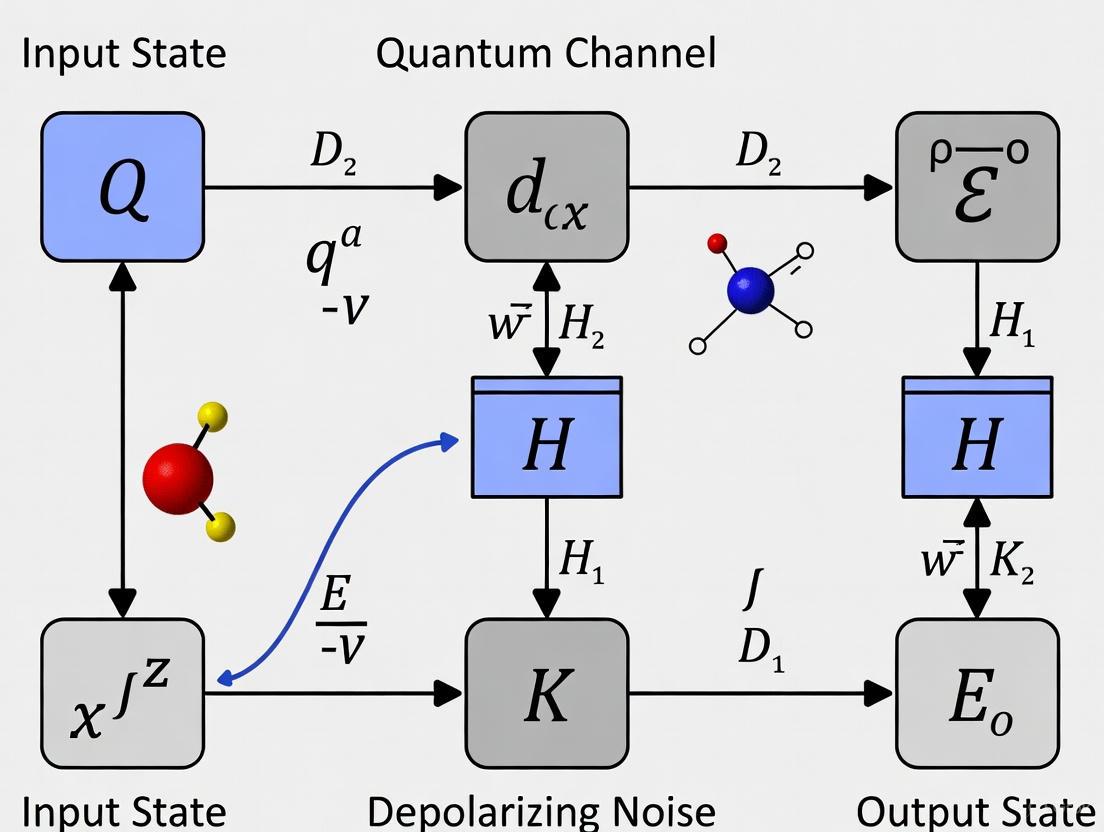
Modeling Quantum Noise for Accurate Chemistry Simulations: A Guide to Depolarizing and Amplitude Damping Channels in Drug Discovery
This article provides a comprehensive guide for researchers and drug development professionals on the critical role of quantum noise models, specifically depolarizing and amplitude damping channels, in computational chemistry simulations...